



Abstract
Many professionals want to both achieve professional success and contribute to society. Yet, in some professional contexts, these aims are in tension because serving elite clients is considered the pinnacle of professional success, but professionals themselves may view serving this clientele as antithetical to making a societal contribution. Drawing on interviews with 84 architects and designers who self-identify as people seeking to contribute to society—that is, who hold a prosocial identity—we develop theory about how professionals navigate tensions between their prosocial and professional identities and with what consequences for their work with clients. We identified four strategies that professionals used to ease these tensions, all of which gave the prosocially oriented professionals a sense of identity integration. However, these strategies differently shaped professionals’ approach to power relations with the client, depending on the client’s status and the types of knowledge and skills each professional viewed as central to their work. Professionals with marginalized social identities, such as women and ethnic/racial minorities, were more likely than others to embrace working with low-status clients and to use broader definitions of the knowledge and skills required for their work. Our findings contribute to scholarship on professional identity construction and prosocial work.
Keywords
Many people seek to positively contribute to society through their professional work, a desire that is rising with the salience of urgent social issues like inequality and climate change (Margolis and Walsh, 2003; Briscoe and Gupta, 2016; Battilana et al., 2022; Heucher et al., 2024). One channel through which professionals aspiring to contribute to society may do so is their work with clients. Yet, these professionals can experience conflict when the types of clients they view as enabling societal impact differ from the types of clients that enable professional success. Imagine a management consultant who feels that working with wealthy corporate clients enables her to achieve professional recognition but leaves her doubting her impact on society. Or consider an architect who works with a mission-driven community client that can afford only a simple drawing, which the architect feels enables him to contribute to society but leaves him aspiring to do more complex, cutting-edge design. Such tensions can spark a deep identity conflict between individuals’ sense of themselves as people who contribute to society, a form of prosocial identity (Grant, 2007; Grant et al., 2009; Grant and Berg, 2012), and their professional identity, the “constellation of attributes, beliefs, values, motives, and experiences in terms of which people define themselves in a professional role” (Ibarra 1999: 764–765; see also Pratt, Rockmann, and Kaufmann, 2006).
Prior research suggests that clients are important relational partners in the construction of both professional (Lepisto, Crosina, and Pratt, 2015; Cardador and Pratt, 2018) and prosocial (Grant, 2007) identities. Recent research on professional identity construction shows that clients can affirm or threaten professional identity (DiBenigno, 2022). At the same time, research on prosocial behavior at work shows the importance of experiencing impact on and contact with intended beneficiaries, such as clients, customers, or patients, for one’s prosocial motivation and identity (Grant, 2007, 2008, 2012). Each of these bodies of research points to the importance of clients but treats prosocial and professional identities as though they operate in isolation from each other. A multiple identities perspective problematizes this view: people experience their identities jointly, and identities may conflict (Ramarajan and Reid, 2013; Ramarajan, 2014; Caza, Moss, and Vough, 2018). Therefore, clients may simultaneously be counterparts for the construction of professional and prosocial identity, and the types of clients that affirm one may not affirm the other.
Drawing on this multiple identities perspective, we investigate how professionals negotiate prosocial–professional identity tensions in relation to clients. How professionals reconcile their prosocial and professional identities matters because identity work has consequences for how people engage in behaviors in their work roles (Ashforth, Harrison, and Corley, 2008), such as how they approach and interact with others, including clients (Caza, Vough, and Puranik, 2018; Ramarajan and Reid, 2020; DiBenigno, 2022). Thus, we ask, how do professionals aspiring to contribute to society navigate potential conflicts between their prosocial and professional identities, and how do their identity strategies, in turn, shape how they relate to clients?
We investigated these questions through a qualitative, inductive study of 84 architects who expressed a desire to contribute to society through their professional work. 1 We found that the professionals in our study viewed building their professional identity as dependent on creating cutting-edge designs that showcased their aesthetic and technical excellence, which meant working for high-status, wealthy clients who could pay for such work (such as corporate and upper-class clients). By contrast, they viewed working with low-status clients (such as clients from low-income communities and socially disadvantaged backgrounds) as a threat to professional identity because these clients could not afford such high-quality design. At the same time, however, working with high-status clients sparked an internal conflict for many of the professionals we studied, as doing so was inconsistent with how they wanted to contribute to society and therefore threatened their prosocial identity. We found that professionals used four prosocial–professional identity integration strategies to resolve this conflict, which we label defending, affirming, expanding, and reforming professional identity. These strategies consisted of different approaches to the types of clients that professionals worked with (high- versus low-status) and the types of knowledge and skills professionals used with those clients (design expertise versus other types of knowledge and skills). All four strategies enabled professionals to integrate their prosocial and professional identities. In addition, the strategies differently shaped how professionals related to their clients, specifically by shaping professionals’ approach to mutual or hierarchical power relations with clients.
We build on our findings to develop a conceptual model of how professionals navigate prosocial–professional identity conflicts in relation to their clients. Our model theorizes how client status and the knowledge and skills used in professional work are central foci of prosocial–professional identity integration strategies. We also theorize how these strategies shape power dynamics in professional–client relationships. Our model contributes to research on professional identity by bringing a multiple identities perspective (Ramarajan and Reid, 2013; Dumas and Sanchez-Burks, 2015) to scholarship on the centrality of clients in professional identity construction (Vough et al., 2013; DiBenigno, 2022). We show that clients reflect and express not only one’s professional identity but also one’s personal prosocial identity. We also reveal that client status and the knowledge and skills that professionals use matter for identity integration. Last, we show how these strategies shape whether professionals maintain, enhance, or diminish their own power in relation to their clients.
Prosocial–Professional Identity Conflict in Relation to Clients
The literatures on professional identity and prosocial identity independently highlight the importance of clients. We discuss each, then draw on a multiple identities lens to integrate the two, and explore the potential for tension between prosocial and professional identity. In exploring this tension, we discuss relevant scholarship on client status, which emerged from our data as a key source of this identity tension.
Constructing Professional Identity: The Role of Clients and Professional Work
Professional identity is the set of meanings that people attach to themselves in their professional roles (Ibarra, 1999; Pratt, Rockmann, and Kaufmann, 2006). Individuals construct professional identity through identity work (Snow and Anderson, 1987), a process through which they “build, revise, maintain, repair, and otherwise craft their identities” (Lepisto, Crosina, and Pratt, 2015: 12). People conduct this identity work in relation to the profession’s expectations, norms, and values about what it means to be a “good” professional (Pratt, Rockmann, and Kaufmann, 2006; Cech, 2015; Reid, 2015), as well as in relation to important others (Cooley, 1902; Gecas, 1982), such as role models (Ibarra, 1999), managers (Pratt, Rockmann, and Kaufmann, 2006; Reid, 2015), and spouses (Petriglieri and Obodaru, 2019). Research highlights that clients and customers are important relational counterparts for professional identity construction (Vough et al., 2013; Lepisto, Crosina, and Pratt, 2015; Cardador and Pratt, 2018). For instance, DiBenigno (2022) showed how client interactions can affirm or threaten nurses’ ability to craft a professional identity consistent with the nurses’ idealized view of themselves as maternal caregivers of sick and helpless patients. Thus, clients play a key role in shaping professionals’ understandings of themselves.
Professionals also “derive their identities directly from the professional work they do” (Kellogg, 2014: 915; see also Pratt, Rockmann, and Kaufmann, 2006). Central to professional work is expertise, the body of abstract, specialized, technical knowledge and skills that professionals gain through formal training and use to diagnose and treat problems in the course of their work (Abbott, 1988; Sandefur, 2015). In addition to formal expertise, other types of knowledge and skills are central to the performance of one’s professional role or the accomplishment of desired work outcomes. These types include contextual knowledge and skills (Barley, 1996); knowledge of how to navigate relationships and procedures (Sandefur, 2015), of clients’ daily routines and challenges (Huising, 2015), and of the communities in which one works (Oelberger, 2018: 983); emotion and intuition (Craciun, 2018); and the ability to handle non-professional issues, i.e., those typically outside one’s specialized expertise, such as teachers’ ability to handle students’ complaints and lawyers’ ability to handle clients’ emotions (Liu, 2020). 2 From a professional identity perspective, the entire range of knowledge and skills that professionals use to do their professional work can serve as a foundation for constructing identity.
Indeed, recent research shows that in some contexts, professionals strongly identify with various types of knowledge and skills associated with their professional roles, and they experience challenges to the content of and control over this knowledge as a threat to their professional identity (Lifshitz-Assaf, 2018; Kang and Kim, 2021). Research further shows that as their work changes, professionals can adapt their self-definitions to incorporate mastery over different kinds of knowledge and skills needed to do their work. For instance, as technology disrupted the value of the specialized skills librarians traditionally used in their roles, they adapted their professional identity from “masters of search” to “connectors of people and information” (Nelson and Irwin, 2014: 903). Building on this research, we explore how professionals can construct different sets of knowledge and skills as central to their professional work and, therefore, to their professional identity.
Constructing Prosocial Identity: The Role of Clients and of Self- and Other-Interested Motives
A separate stream of research on prosociality at work suggests that many people want to have a positive impact on others, i.e., that they have prosocial motivation (Grant and Berg, 2012; Bolino and Grant, 2016). Prosocial identity, “the dimension of the self-concept focused on helping and benefitting others” (Grant et al., 2009: 321), is rooted in this motivation and guides prosocial behavior (Callero, 1985; Penner et al., 2005). Prosocial behavior at work encompasses a wide range of behaviors intended to help others, including helping one’s colleagues (Grant, Dutton, and Rosso, 2008), volunteering and pro bono work (Rhode, 2005; Rodell et al., 2016; Gatignon, 2022), paid work in service occupations or nonprofits (Grant, 2008; Jiang, 2021; Fang and Tilcsik, 2022), and activism around social issues (Meyerson and Scully, 1995; Howard-Grenville, 2007; Briscoe and Gupta, 2016) (for a review see Penner et al., 2005).
Research suggests that the intended beneficiaries of prosocial work are important relational counterparts in the construction of prosocial identity. Grant (2007) theorized that impact on and contact with the beneficiaries of one’s work shape the development of prosocial identity and behavior. Field experiments show that giving fundraisers and lifeguards more exposure to the impact of their work on others increases helping behavior (Grant, 2008). Other research shows that contact with intended beneficiaries and the perception of prosocial impact increase motivation (Grant et al., 2007), job satisfaction (Grant and Campbell, 2007; Steijn and van der Voet, 2019), and meaningfulness (Rosso, Dekas, and Wrzesniewski, 2010: 110).
Interrogating professionals’ desire to benefit their clients, however, reveals a tension that can complicate the expression and construction of prosocial identity: prosocial behavior can arise from both other-focused and self-interested motives, and these motives can be independent of each other (Grant and Berg, 2012). Prosocial behavior can entail emotional, relational, and material costs to oneself, incurred in the name of helping others (England, Budig, and Folbre, 2002; Schabram and Maitlis, 2017; Fang and Tilcsik, 2022; Wilmers and Zhang, 2022). For instance, Oelberger (2019) showed that international aid workers’ devotion to their work can generate conflict in their close personal relationships, and Bunderson and Thompson (2009) described how zookeepers’ calling to protect wildlife leads them to accept low pay, long hours, and difficult working conditions. At the same time, prosocial behavior can entail self-benefits, such as relational and status gains (for a review, see Simpson and Willer, 2015). For instance, helping others can enhance one’s reputation as helpful, moral, or good (Grant and Mayer, 2009; Flynn and Yu, 2021), and it can yield career benefits, such as the opportunity for less experienced workers to learn skills (Burbano, Mamer, and Snyder, 2018).
The potential for self-interest complicates the expression of prosocial identity through client work, raising the question of who benefits (cui bono?) from prosocial behavior (Blau and Scott, 1962; Marquis, Toffel, and Zhou, 2016; Oelberger, 2018; Giridharadas, 2019; Kutlaca and Radke, 2023). While people often view costs or sacrifices as evidence of prosociality (Bunderson and Thompson, 2009; Fang and Tilcsik, 2022), self-benefits that accrue from prosocial behavior, whether intentionally or unintentionally, can raise doubts about one’s own or others’ prosociality (Simpson and Willer, 2015). Thus, clients’ potential to help or harm one’s pay, reputation, and career trajectory suggests that they may both threaten and support prosocial identity.
Tensions Between Professional and Prosocial Identity: A Multiple Identities Perspective and the Role of Client Status
Despite the central role of clients in the literatures on professional identity and prosocial identity, these conversations have largely evolved separately. Yet, scholars have long acknowledged that people have multiple identities (Burke and Stets, 2009; see Ramarajan, 2014 for a review) and that when the different roles and institutions to which they belong have diverging expectations, they often experience conflict between their personal and professional identities (Ramarajan and Reid, 2013; Dumas and Sanchez-Burks, 2015). For example, many studies explore the tension individuals experience when identities based on personal life and family roles conflict with professional identity demands, such as being fully committed to work or embodying a particular professional ideal (Meyerson and Scully, 1995; Kreiner, Hollensbe, and Sheep, 2009; Creed, DeJordy, and Lok, 2010; Reid, 2015; Cha and Roberts, 2019; Chreim et al., 2020).
Building on this work, we bring a multiple identities perspective to examine the joint construction of prosocial and professional identity in relation to one’s clients. Professionals may view clients as an expression and reflection (Cooley, 1902; Mead, 1934) of both their personal prosocial identity and their professional identity because clients are the intended beneficiaries of their work and the key recipients of their professional services, respectively. A multiple identities perspective suggests that if the clients that affirm prosocial identity differ from those that affirm professional identity, individuals may experience identity conflict. We therefore set out to investigate how professionals who aspire to contribute to society navigate potential prosocial–professional identity tensions related to their clients.
One important source of tension that emerged from our data was client status, i.e., clients’ prestige and social worth based on their wealth and social class standing (Berger, Cohen, and Zelditch, 1972). We found that the prosocial–professional identity tension that professionals experienced in architecture was driven by professional norms that valued working with high-status clients and devalued working with low-status clients; working with high-status clients best supported professionals’ design expertise and thereby affirmed their professional identity, while working with low-status clients who could not afford high-end designs threatened this expertise and identity. 3 To make sense of this finding, we turned to scholarship on client status in professional work.
Scholars suggest that professions face different social, commercial, bureaucratic, and technological pressures, which shape variation in norms and experiences within and between professions (Leicht and Fennell, 2001; Gorman and Vallas, 2020). In some commercialized contexts, professionals may view working with high-status clients as more valued and rewarded than working with low-status clients because such clients can help one garner professional success (Leicht and Fennell, 2001: 93–94). 4 In elite, commercialized professional contexts such as corporate law, accounting, and management consulting, clients with financial resources are likely to be valued because they are thought to provide complex, challenging work that requires technical expertise, earns high fees, and can burnish professionals’ own reputations (Anderson-Gough, Grey, and Robson, 2000; Liu, 2020). Architecture, the focus of our study, is another such context in which elite clients may be highly valued partly because they can pay for complex, cutting-edge designs and can bring attention and visibility to one’s design expertise (Blau, 1984; Cuff, 1991). Conversely, low-status clients and those without financial resources may be devalued and avoided in some professional contexts. For instance, in corporate law some professionals avoid low-status clients because they may threaten the interests of high-status clients (Phillips, Turco, and Zuckerman, 2013). Some professionals may also devalue low-status clients because they are associated with tasks that do not draw on professional expertise or because they present more challenges to expertise than high-status clients do (Becker, 1952; Roth, 1972; Heimer and Staffen, 1995; Liu, 2020). In sum, one perspective on this work is that it provides examples of contexts in which professionals may view high-status clients as valuable, partly because they may enable professional expertise. As such, in some contexts, high-status clients may affirm and low-status clients may threaten professional identity.
Building on these streams of work, we explore the role that clients in general and client status in particular may play in professionals’ prosocial–professional identity conflict and the strategies professionals use to resolve it. Further, professional identity construction has important consequences for how people engage with and relate to others (Petriglieri and Obodaru, 2019; Ramarajan and Reid, 2020; DiBenigno, 2022). We therefore also explore the consequences of professionals’ identity work for how they relate to their clients.
Method
We draw on interviews with 84 architects and designers. Our approach is inductive, as recommended for theory building (Edmondson and McManus, 2007; Charmaz, 2014). We began with a broad research question, seeking to understand how professionals pursued behavior they viewed as contributing to society in their work. Iterating among data collection, analysis, and theorizing, we refined our research question to focus on how professionals navigate prosocial–professional identity conflicts in relation to clients.
Research Setting
The architecture profession is characterized by a collective professional identity rooted in design expertise, which is developed and valorized via intense socialization and training practices (Blau, 1984; Cuff, 1991; Deamer, 2015). An influential ethnography of architectural work explains, “Architects are trained to assume responsibility for design; their professional identity depends on it,” and “The architect’s primary expertise” is “design-as-art” (Cuff, 1991: 21, 31). Recent ethnographies also describe how the “ideal” architect, emphasized in training and through professional competitions and awards, is a creative genius for whom design is central to their identity (Ahuja, Nikolova, and Clegg, 2017). Becoming a licensed architect in the United States involves graduate training at a professional school, work requirements, and a rigorous exam (NCARB, 2019). The onerous nature of this certification process prompts many people in the profession to work as unlicensed designers. 5 Architects and designers work in an array of contexts, including large corporate firms and small, medium-sized, and solo practices (Miller, 2019). Like many professions, architecture remains predominantly White and male (NCARB, 2019). In 2014, licensed and associate members of the American Institute of Architects (AIA) were 21.7 percent women and 1.89 percent African American (AIA, 2015).
Working with high-status clients is often viewed as desirable in architecture; wealthy clients who seek distinction offer opportunities to build a professional reputation as a successful designer (Cuff, 1991; Brown, et al., 2010; Rahman and Barley, 2017). By contrast, working with low-status clients is not well institutionalized, though public interest and social impact work exist and garner some attention (Feldman et al., 2011). To further explore the relationship between design and client status, we conducted an exploratory analysis of articles in Architectural Record, a premier industry publication focused on design. This analysis indicates that articles containing words associated with high-status client work (e.g., luxury, corporate) are far more prevalent than those associated with low-status client work (e.g., affordable housing); see Figure 1 and Online Appendix A for details. Thus, architecture is a suitable context for our study; in a client-facing profession that values working with elites, conflict over who benefits from their work is likely salient for individuals who want to make a societal contribution.
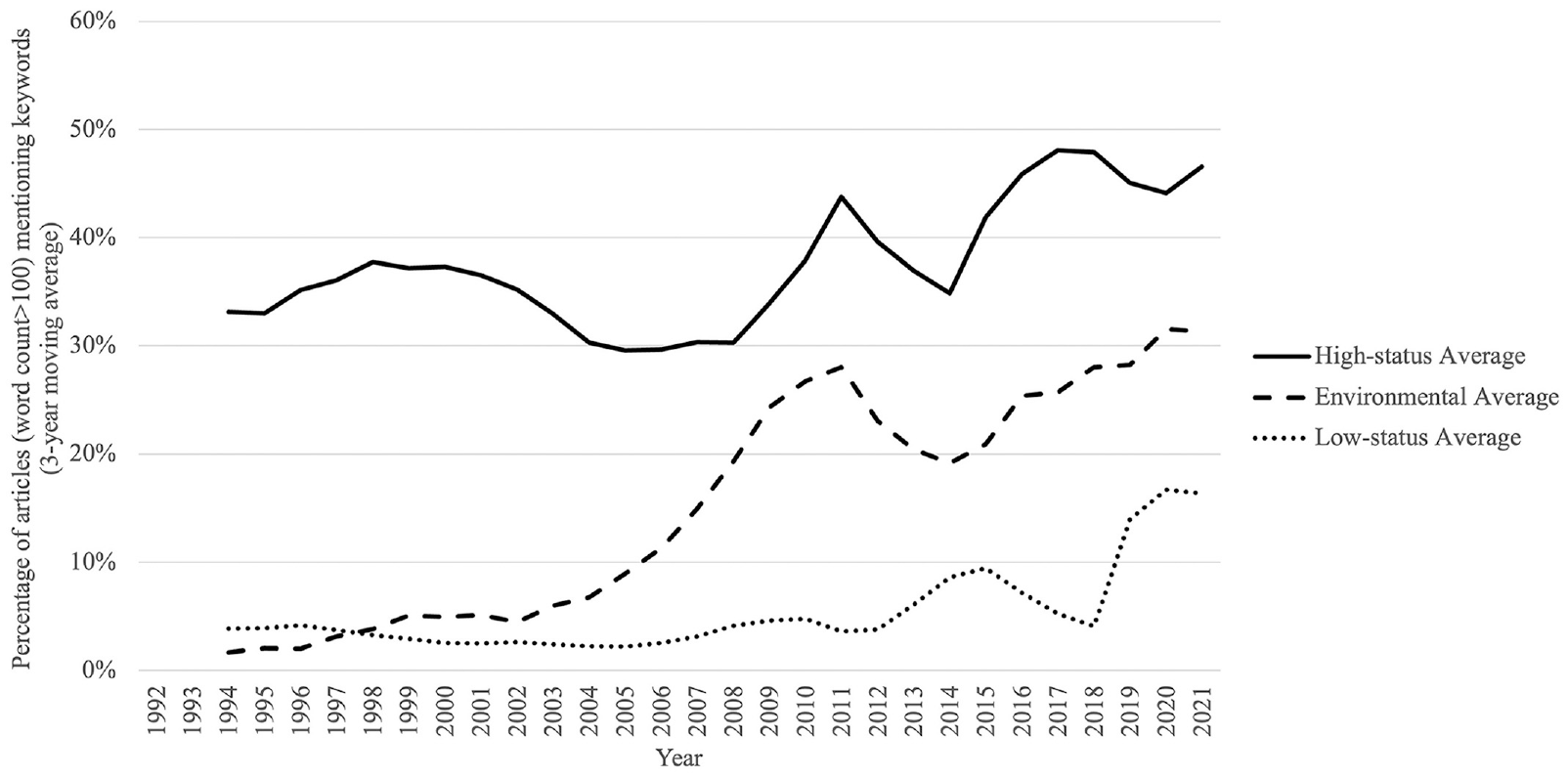
Percentages of Articles in Architectural Record with Keywords Associated with Low- vs. High-Status Clients Over Time, 1992–2021*
Data Collection
Sample design
Our data consist primarily of semi-structured interviews with 84 architects and designers. Three participants were key informants who provided orientation to the profession and facilitated access to practitioners. Sampling evolved over three rounds of data collection. Our initial research question led us to purposefully sample professionals who expressed interest in doing work they viewed as contributing to society, which we referred to in recruitment materials and initial conversations broadly as pro bono, public interest, public service, social responsibility, or social impact work. Considering the literature, we conceptualized these activities as a type of prosocial behavior that could be influenced by prosocial identity (Penner et al., 2005; Grant, 2007; Grant and Berg, 2012).
During the first round (2012), we interviewed 22 employees at two large, prominent, national firms. These firms primarily work with paying clients, which include businesses, residences, hospitals, universities, and schools. They also have formal programs to work with pro bono clients. 6 At both firms, pro bono work was explicitly distinguished from conventional work for paying clients and was performed under the auspices of “social responsibility” or “social impact” initiatives. Recruiting participants broadly interested in contributing to society yielded individuals who did and did not participate in the formal pro bono programs; we interviewed them all, as we initially wanted to understand the full range and context of prosocial work in traditional firms. Through our analysis, this initial sampling choice enabled us to understand that while all our participants viewed themselves as people aiming to contribute to society through their work, the types of clients they associated with this self-view varied. For instance, some participants associated their contribution to society with working with low-status, pro bono clients, but others associated this contribution with working with high-status, paying clients.
We conducted a second round of 36 interviews (2015–2019) after learning from our key informants about professionals who did public interest or social impact work outside of traditional firms. Through conferences, lists of public interest designers, and snowball sampling, we purposefully sampled professionals working in small, socially focused design firms, nonprofit and community-based organizations, and local governments. We used similar language, describing our interest in talking to professionals who were engaged in public interest, social impact, or public service work.
Iterating between analysis and theorizing yielded the insight that participants associated their prosocial identities with their clients, especially low-status clients, prompting us to embark on a third round of data collection (2021). We again sampled architects who expressed interest in contributing to society, this time intentionally focusing on those working with low-status clients from both traditional firms and non-traditional contexts. We added 23 participants. In this round, we revised our questions to focus on client status and power in client relationships. We also re-interviewed four participants from the prior rounds to learn about their experiences over time. Thus, our strategy enabled us to maintain a consistent approach to recruiting professionals who viewed themselves as contributing to society and, as our research questions and findings evolved, enabled us to analyze variation in our sample in the professionals’ work contexts and in the types of clients with whom they worked.
Supplementary activities familiarized us with the field. We visited two large firms and a leading architecture-oriented nonprofit multiple times, which provided context for participants’ accounts of prevailing professional expectations (e.g., intense focus on design). We attended 15 days of workshops and conferences on socially oriented design, where we observed and conversed informally with practitioners and clients. We also read books, articles, and reports and gathered publicly available data on firms and practitioners in the field, which we used to create a narrative timeline of key events in the field. These activities provided a broad overview of the field-level discourse and work-related activities through which professionals aimed to contribute to society.
Interview-based approach and procedures
Interviews are commonly used to conduct identity research in organizational behavior (e.g., Ibarra, 1999; Petriglieri, Ashford, and Wrzesniewski, 2019) because they are particularly well suited to understanding how people make sense of themselves in their social contexts. Interview data were required for accessing the internal meaning-making and self-concepts pertinent to our research question (Lamont and Swidler, 2014); these data gave us access to participants’ “interior experiences,” how they interpreted their perceptions, and “the meanings to them of their relationships . . . their work, and their selves” (Weiss, 1994: 1). We followed recommended practices for interview methods. For example, we familiarized ourselves with the field to enhance our ability to build trust and elicit disclosure (Charmaz, 2014); we conducted interviews as conversations, tailoring our questioning to better understand the meaning of each person’s experience (Weiss, 1994; Lamont and Swidler, 2014); and we probed for specific, concrete examples and stories to move beyond generalized accounts and explore nuances in meaning (Elsbach and Bechky, 2018; Small and Calarco, 2022). These practices help researchers manage challenges that can arise with interview data, such as self-justification, social desirability bias, and recall errors (Charmaz, 2014).
Interviews followed a semi-structured protocol, beginning with a description of the participant’s current role and career history. Our questions addressed projects and practices across various work contexts and types of clients, as well as goals, motives, and challenges associated with pursuing prosocial work. The protocol, which evolved over the course of the study (Charmaz, 2014), served as a consistent guide (see Online Appendix B for the final protocol). In the first round of data collection, we conducted interviews onsite at the offices responsible for firms’ pro bono programs, located in two large U.S. cities. For the second and third rounds, we interviewed geographically dispersed professionals by telephone or video. Interviews lasted 30 to 100 minutes, averaging about an hour. All interviews except one were recorded and transcribed; one participant declined our request to record.
Participants’ characteristics and work contexts
All participants had at least one formal degree in architecture or design at the bachelor’s level or higher. Participants worked in a range of organizational contexts, including traditional architecture firms, i.e., large, commercially focused practices (n=37); socially oriented design organizations, such as smaller firms serving under-resourced clients or organizations that linked design professionals with nonprofit clients (n=33); and community-oriented organizations, such as a housing advocacy organization (n=14). Roles and tasks varied with contexts, but in all cases, professionals viewed themselves as architects or designers. 7 At traditional firms, participants held conventional titles, such as project architect, design associate, and principal. In the other contexts, their titles ranged from traditional (e.g., design associate) to unconventional for architects (e.g., community development director). In all three contexts, participants performed both high- and low-complexity work for low-status clients, ranging from large affordable housing complexes to temporary installations in public spaces. Table 1 reports counts of participants’ demographics, work experience, and work contexts.
Counts of Participant Demographics*
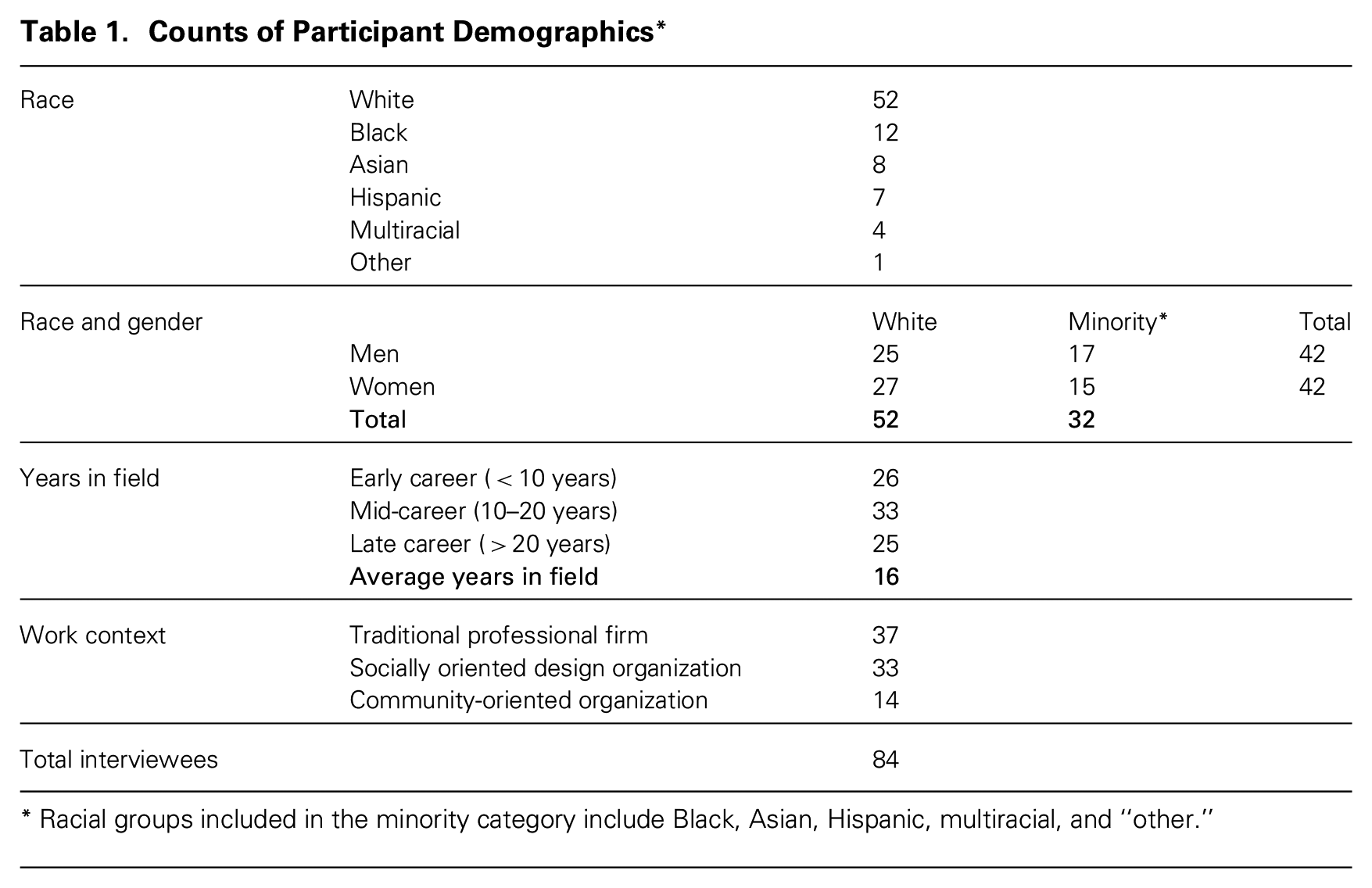
Racial groups included in the minority category include Black, Asian, Hispanic, multiracial, and “other.”
Data Analysis
Recent scholarship has advocated making the inductive process more transparent by sharing the decision points, “aha” moments, and analytical moves unique to each study (Grodal, Anteby, and Holm, 2020; Pratt, Sonenshein, and Feldman, 2022). Accordingly, we describe key turning points in our process. Initial analysis occurred during our first round of data collection. We engaged in open coding, allowing themes to emerge inductively (Charmaz, 2014). Our key insight during this analysis was that participants struggled with pro bono work because they perceived it to conflict with professional norms of design excellence. Curiosity about whether this conflict extended to non-traditional contexts prompted our second round of data collection, after which our second stage of analysis focused on similarities and differences between participants in traditional firms and those in other settings. Participants in both contexts spoke of “struggle” and “unease” with professional norms that emphasized “theory and form.” However, we were struck by a key difference: participants at traditional firms tended to talk about contributing “buildings” and “design skills,” while those in non-traditional contexts invoked “working beyond buildings” and “interdisciplinary skills.” Consulting the literature led us to associate this pattern with participants’ understanding of the types of knowledge and skills they viewed as central to their prosocial work.
Our third round of analysis was sparked by feedback that helped us conceptualize the status of the client as critical to participants’ struggles. We observed that professionals who viewed working with elite clients as contradicting their desires to contribute to society struggled when they encountered professional norms associating design expertise with work for elite, high-status clients. We also saw that many participants aimed to work with low-status clients because they were more easily associated with prosociality, but this created tensions regarding their professional identity. This insight generated further data collection and re-analysis to focus more on status and power. We coded for all mentions of power, class, elites, and status to analyze how professionals viewed high- versus low-status clients, looking for heterogeneity across participants employed in traditional and non-traditional contexts. We found that this variability existed at the individual—rather than context—level, which led us to shift the focus of our theorizing from contexts to approaches. We recoded all data at the individual level and asked, what type of client is this professional working with, and how do they view the client’s status? Recoding our data revealed that participants related the status of clients to their own prosocial identities (e.g., viewing working for any client as prosocial versus wanting to serve “needy” people), as well as further variation in how participants talked about the types of knowledge and skills that were relevant. We then assessed how participants combined these two elements. This assessment enabled us to identify four approaches based on the type of clients (high-status versus low-status) the participant worked with and the types of knowledge and skills (design expertise versus other types) the participant viewed as relevant. We call these four approaches prosocial–professional identity integration strategies because each constitutes a distinct way of enacting a prosocial identity and reconciling it with one’s professional identity.
In our fourth stage of analysis, we focused on understanding the relational consequences of these identity work strategies. We looked for differences both within and between individuals in their approaches to working with high- versus low-status clients. We noticed that a subset of participants working with low-status clients often spoke about “collaboration” and “sharing power” with clients. This finding led us to focus on participants’ approaches to power with their clients. We coded for approach to power each time participants described working with high- and low-status clients and found that these descriptions signaled (1) mutuality; (2) a hierarchy in which the professional was superior to the client; or (3) a hierarchy in which the professional was subordinate to the client. Further analysis revealed that embracing design expertise as central to professional identity elevated architects’ sense of their own power with clients; with high-status clients this resulted in mutuality, and with low-status clients this resulted in professionals’ superiority over clients. At this stage, iterating between our findings and the literature on the self-benefits of prosocial behavior helped us to ask, who benefits from these strategies? (cui bono) (Blau and Scott, 1962). We came to interpret our findings as showing that strategies were differentially advantageous to professionals, specifically by maintaining, enhancing, or diminishing their power in relation to clients.
Last, we analyzed the data for factors that influenced which strategy a professional adopted. Following recommended practices (Vough et al., 2013; Cardador and Pratt, 2018), we analyzed for narrative causality (Polkinghorne, 1988), examining how participants narrated processes and moves. Analyzing participants’ accounts of how they made choices about which clients to serve helped us to see how themes that had emerged in earlier analyses—such as “shared experiences” with low-status clients and “pushback from clients”—shaped the strategies they used. These findings led us to incorporate into our theory professionals’ own demographic identities and client invalidation as key factors shaping their use of identity integration strategies.
Findings
We propose a conceptual model describing professionals’ strategies for integrating prosocial and professional identities and how these strategies shape professionals’ approach to power in relation to clients. First, we describe the professional norms our participants encountered and the conflict they experienced between prosocial and professional identity, which stemmed from their clients’ status. Second, we report the four prosocial–professional identity integration strategies through which professionals managed these conflicts. Third, we show that these strategies shaped professionals’ approach to power in relation to clients. Last, we describe two relational factors that shape professionals’ use of strategies and movement between them.
Conflicts Between Prosocial and Professional Identity
We found that both design and contributing to society were central to architects’ identities. The architects in our sample described their profession as valuing high-status clients because they enabled design expertise. They further discussed how this professional norm threatened their personal prosocial aspirations, sparking prosocial–professional identity conflict.
Centrality of prosocial and professional identity
Making a positive contribution to society was a central part of self-definition for the professionals in our study. Participants often rooted their intention to benefit others in how they were raised and expressed a desire to integrate prosociality into their professional work. One participant described a “feeling of wanting to be of service to others,” saying, “I credit my parents for that, how I grew up.” She stated that “figuring out how to integrate that into my professional and personal [lives]” was important to her (P81). Another architect similarly emphasized having long known “that ultimately whatever I did would have a larger social impact,” saying, “I was raised in community. My grandmother was a civil rights activist. . . . All I understood was, how do you take care of others? What profession do you take on that therefore allows you to impact the masses?” (P19).
Similarly, participants described design as central to their identity. One architect described design as more than a job, saying, “for me, design is 24/7 . . . everything I see or do, whether it’s like a spoon or a building or an outdoor space I’m walking through . . . I just pick up on cues and color, texture, all those things. So, it’s kind of always all-encompassing” (P58). Another described design “as an innate interest,” saying, “from very early on . . . my interest was always on the creative side, designing how things go together” (P15). Thus, for the architects in our study, both prosociality and design were central and enduring facets of who they were.
Working with high-status clients supports professional identity
Participants’ accounts indicated that aesthetic and technical design excellence was the core professional ideal that architects were expected to prioritize. Architects characterized the valorization of design as “design for design’s sake” (P68) and described a culture of elevating design: “the ethos [was] strong, design was important,” and “architectural culture” required being “really passionate about design” (P72). Design was central to achieving the pinnacle of professional success: becoming a “signature architect,” “black-cape architect,” or “starchitect,” famous for design. As one participant asserted, “To this day, our profession is largely defined by success equals being the starchitect . . . your name is associated with a building” (P9).
Architects further described how the pursuit of design excellence was linked to working with clients who had sufficient capital to pay for expensive design services, i.e., high-status clients. As one architect described, high-status clients’ association with design excellence made them the most desirable clients and those traditionally served by the profession: Our profession values beauty, aesthetics, the economics of buildings. Obviously, the more you can spend, the more you can do, and the more beautiful they are. We really have marketed ourselves as purveyors of something hard to attain. To do that, we have to elevate the profession into . . . not even 1 percent, it’s like the 0.01 percent that can really afford the services of architects at the level that a lot of architects want to work. (P16)
Another participant asserted that the highest-quality design tends to be done for wealthy corporate clients: “I think the zoomiest projects for us, the ones that get the most design recognition, they would probably be in our corporate commercial sector” (P77). Still another described how high-status clients enable the professional’s self-interest as a designer, saying “some of it’s ego-driven. . . . We’re always aspiring to that top, top, top client so . . . that we can fulfill our own vision” (P16). These accounts express a common belief that architects can best enact their design expertise and the ideal of the architect as “visionary” when working for clients with substantial financial resources.
Working with high-status clients conflicts with prosocial identity
We found that the link between elite clients and design expertise put architects’ professional identities in conflict with their prosocial identities. For many architects, serving an elite few who could pay for visionary design did not align with their desire to help society at large. One architect described struggling with the profession’s focus on design expertise and high-status clients in light of her own political goals: When I went into grad school, then I was faced with the pedagogy of form and ornamentation. It was very aesthetic-driven, which I think was very alarming for me. I’m . . . drawn to those aspects, but I had this more ideal notion of an architect—building cities with people, and the social implications of that . . . I felt like the overarching pedagogy was in conflict with some of my own political goals that I wanted to achieve. . . . The last thing I wanted to do was build homes and museums for wealthy people. (P54)
Another participant described being troubled by how “star architect[s]” made “transformative buildings” and “glamorous institutions” but did not better the lives of less privileged groups, saying, “The reach that those specific institutions have, it’s not necessarily the audience that I am personally most interested in serving . . . I do feel that we are dealing with an economic gap in the population” (P88). Thus, exclusively benefiting a wealthy few aligned with the ideal of the star architect but conflicted with participants’ prosocial identity.
Working with low-status clients supports prosocial identity and conflicts with professional identity
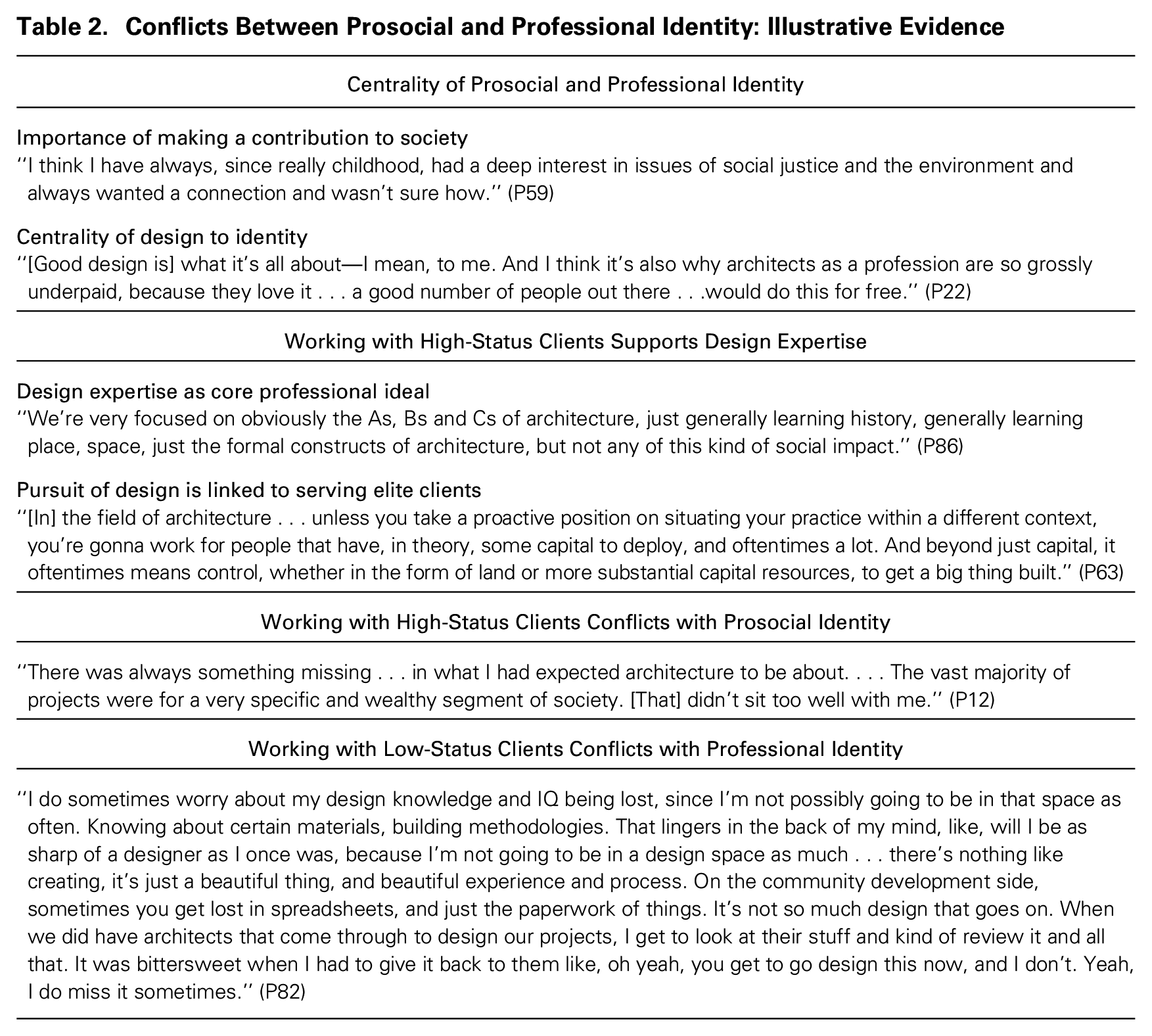
Just as working with elite clients sparked an identity conflict for professionals, so did working with low-status clients. While participants viewed high-status clients as enabling design expertise but conflicting with prosocial identity, they viewed low-status clients as enabling prosocial identity but conflicting with design expertise. This conflict was driven by the perception that work for low-status clients was unlikely to provide opportunities for high-level design. One participant noted that projects for low-status clients would never be featured in design magazines, which was a mark of professional achievement as a designer: “Most of our [pro bono] projects [for clients with few resources] are very feasible and have great community impact but have very little high design . . . they aren’t projects that will go into Architectural Record or up on [the website] ArchDaily” (P92). Another architect contrasted the low design quality of a reduced-fee project with its prosocial nature: “The design was not an award-winning design. It was really about a minimalist amount of money. . . . But . . . this warmed your heart in a big way” (P29). Some architects expressed a sense of loss after stepping away from high-status clients (including ones that could be seen to have a public benefit) and the high-quality design they enabled: “there certainly is a difference in doing a project for a nonprofit agency doing your housing development . . . versus designing a new museum of natural history for a client that has huge financial backing . . . I certainly miss getting to do a higher design project. . . . It’s that inner struggle for sure” (P11). Table 2 presents additional data illustrating these identity conflicts, and Online Appendix C includes a more detailed version of the table.
Conflicts Between Prosocial and Professional Identity: Illustrative Evidence
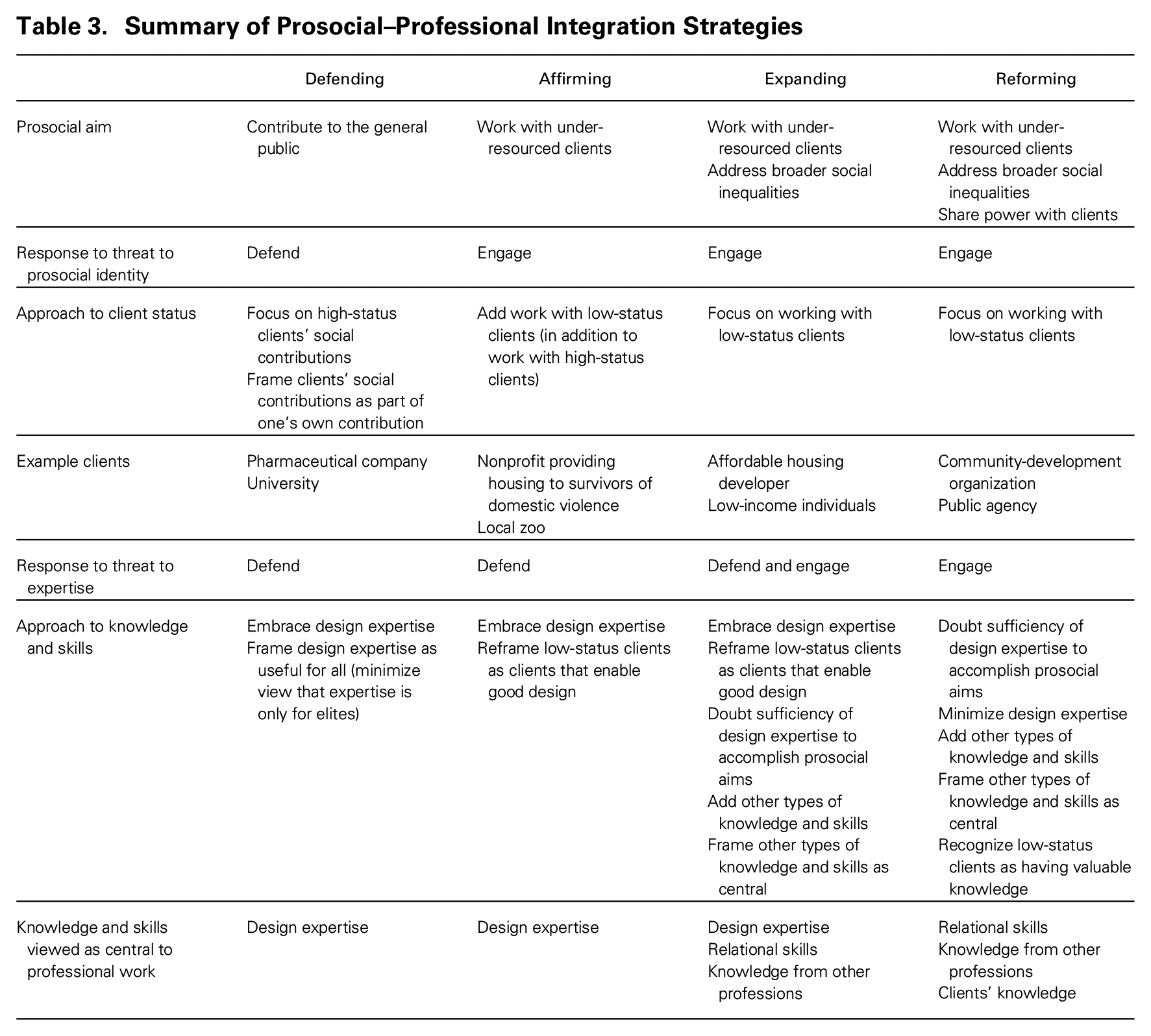
Prosocial–Professional Identity Integration Strategies
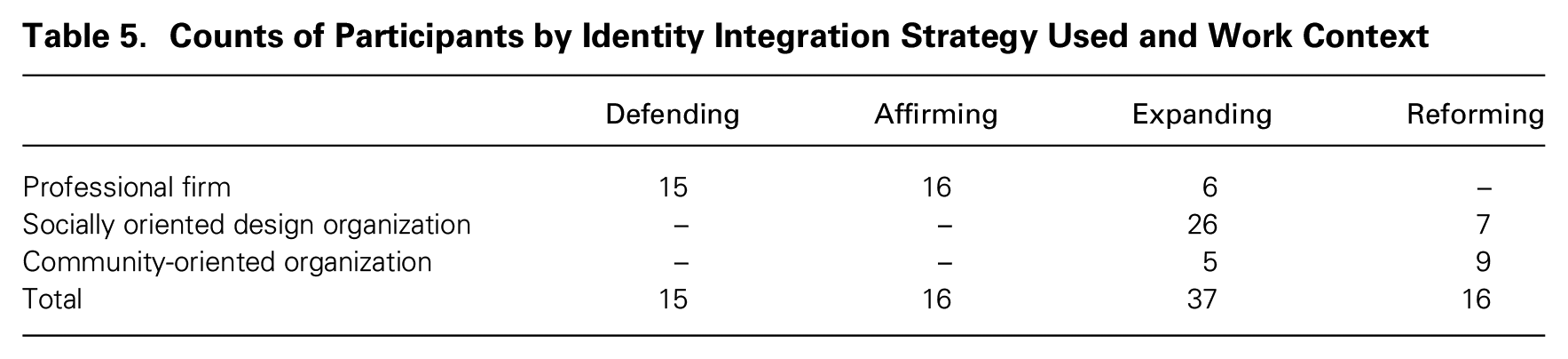
Professionals used four strategies to manage prosocial–professional identity conflict: defending, affirming, expanding, and reforming professional identity. Each strategy responded to threats to prosocial identity and to design expertise, and each consisted of a prosocial aim linked to approaches to different types of clients and different types of knowledge and skills. Table 3 summarizes the strategies, Table 4 provides additional illustrative quotes (see Online Appendix C for a more detailed version), and Table 5 provides counts of participants by strategy and work context.
Summary of Prosocial–Professional Integration Strategies
Prosocial–Professional Identity Integration Strategies: Illustrative Evidence*
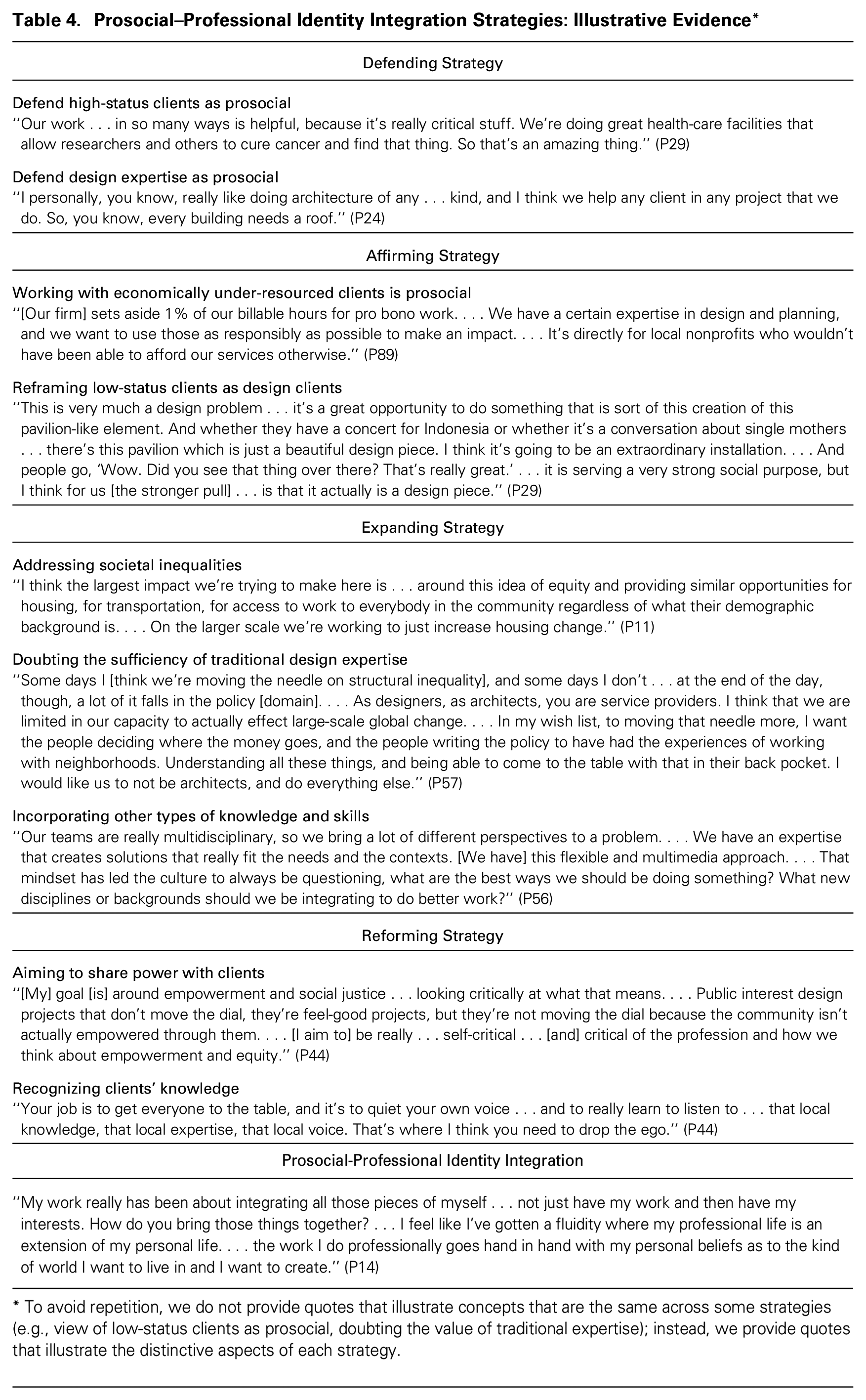
To avoid repetition, we do not provide quotes that illustrate concepts that are the same across some strategies (e.g., view of low-status clients as prosocial, doubting the value of traditional expertise); instead, we provide quotes that illustrate the distinctive aspects of each strategy.
Counts of Participants by Identity Integration Strategy Used and Work Context
Defending professional identity
Professionals using the defending strategy framed high-status clients and design expertise as prosocial. They defined their prosocial aims as helping the public through design. We label this strategy “defending” because it maintained architecture as it was typically practiced: working for high-status clients and using design expertise, which supported the traditional professional identity.
Professionals using this strategy responded in two ways to the threat that working with high-status clients posed to prosocial identity. First, they redefined the high-status clients they worked with as prosocial, invoking the mission and social contributions of clients like hospitals, schools, and research laboratories as evidence of the prosocial value of their design work. One architect attributed social benefit to designing for scientists as follows: “I think that we all get up in the morning, especially in the science-and-tech practice, and we go to work because we’re trying to use our design talent and our abilities to help science progress, by giving it really good places to be. . . . I see that as a calling of sorts, and a contribution that we make to science” (P17). Another described working with a public-school client as “noble” work benefitting others: “At a certain level, you’re still doing God’s work, right? We’re trying to keep the schools from falling apart . . . so there is a nobility to it” (P22). Participants also described clients, and by extension themselves, as prosocial by contrasting industries in which they worked, such as education and health care, with those they did not serve, such as high-end residential or retail (P30, P17), and with clients they considered morally questionable, such as totalitarian governments, prisons, and tobacco companies (P72, P85, P86).
Second, these professionals framed aesthetic and design expertise as itself prosocial, making the case for their own prosociality regardless of clients’ status. One professional said, “I don’t think anyone does socially irresponsible work. Architecture is fundamentally a social art. And that’s what we try to do, is promote environments for people to have positive experiences” (P18). Another defended traditional design expertise as prosocial while also highlighting the prosocial mission of his high-status clients, saying, “architecture is a social art in profession, doing museums and places of worship and schools and residences . . . the very nature of what we do already has a social impact” (P83). In this view, beauty, aesthetics, and thoughtfully designed buildings were the core contributions of designers, and they were inherently helpful to a generic public, no matter who the client was.
Affirming professional identity
In the affirming strategy, professionals framed work with low-status clients as fulfilling prosocial aims while maintaining design expertise as central to professional identity. We label this strategy “affirming” because it entailed affirming a professional identity rooted in design expertise even as it involved remapping that expertise onto working with a different set of clients, i.e., low-status clients.
Professionals using this strategy viewed working with under-resourced clients who could not afford the market rate for design services as prosocial. One professional described this work as her unique contribution to society: “With this skill set, I’m making a difference to someone’s life in my way. Like, I’m not a doctor, and I cannot treat someone, but I’m an architect and I can improve someone’s way of living, and I can improve someone’s way of working. . . . That’s my contribution to that person who is needy” (P21). Another asserted that all architects should donate their design services, saying, “It is our duty to give back to other organizations that are unable to . . . pay” (P35). These professionals thus upheld their prosocial identities by casting their clients as “needy” and themselves as benefactors.
While working with low-status clients alleviated the threat to prosocial identity, it evoked a threat to professional identity because low-status clients were not associated with high-quality design. In response, professionals using the affirming strategy reframed low-status clients as “design” clients, enabling them to reaffirm a professional identity rooted in design expertise. They often explicitly pushed back on the idea that working with low-status clients was only about feeling good or helping others, asserting that it was about design. One said, “I think it’s got to be more than the satisfaction of helping somebody. I think it denigrates the craft of what we do if all you’re doing is offering help and not actually . . . using it as part of your own development as an architect or as a designer” (P30). Another architect underscored this emphasis on design: “A lot of times [a pro bono project] is a feel-good thing and I want it to be about design excellence. . . . If someone wants to volunteer in a soup kitchen, that’s not a design challenge. . . . There’s plenty of people that could use our help, but they want design expertise. That’s what we bring” (P18). The affirming strategy turned the potential threat of working with low-status clients into an opportunity to exhibit one’s design excellence.
Expanding professional identity
The expanding strategy focused on low-status clients and retained the focus on design expertise while also incorporating other types of knowledge and skills as a core part of professional work. This strategy expands what is considered core to professional identity to include design expertise alongside a broader set of knowledge and skills, including relational skills and knowledge from other professions.
This strategy framed working with low-status clients as a way to help those who lacked resources, but unlike the affirming strategy it also aimed to address broader societal inequalities. An architect working in neighborhood redevelopment included pursuing “equity” and addressing “structural inequality” in describing her work: We really represent the grassroots, the regular Joe who is interested in improving his front stoop or his street, his neighborhood . . . [serving] community-based organizations that typically wouldn’t have design funding available to them, [and] we contribute to strengthening the fabric of neighborhoods . . . it’s not just about affordable housing or just about neighborhood change . . . it’s about working within all the systems to make people’s lives better. . . . That structural inequality, to me, is important. (P45)
Another architect contrasted the “more glamorous” side of architecture with a desire to work on social issues for low-status clients; he had an “interest and focus” on “communities and societies around the world . . . facing extreme challenges that come of very basic human needs” (P88).
Professionals using the expanding strategy drew on design expertise in their work with low-status clients, yet they doubted the sufficiency of this expertise for addressing social problems. One architect working in low-income areas voiced dissatisfaction with architects’ typical lack of involvement in questions that were important for clients—discussions “that the traditional architectural practice doesn’t enable you to participate in”: When an architect gets a project, 90 percent of it is done. The land is secure. There’s a real-estate developer and a client or a city . . . and you’re just implementing what they want. That was always [much] less satisfying to me than the other 90 percent of the work, of “Well, what is the project? Who is benefiting from that? Who is not going to benefit from that? Why is it happening this way and not that way?” (P7)
Architects responded to this doubt by expanding their understanding of which knowledge and skills were necessary for working with low-status clients. One described “expanding the definition of practice” beyond “traditional” architecture to include community members’ participation in the design process, saying, “traditional practice [in] architecture is considered to be the design of buildings . . . I’m increasingly a proponent of expanding the definition of practice there” (P9). Another architect characterized the traditional role of the architect as only about design expertise: “If you go into most meetings with the American Institute of Architects, there is the set idea that the place of the architect is this world of design and construction. . . . That’s probably how 95 percent of architects practice.” Then he described his own approach to “mission-driven work” as encompassing both design expertise and a set of relational skills: As an architect, I think of design as problem solving. . . . It requires an understanding of architecture in the traditional sense, but then also architecture as deep project management and architecture as deep relationship management—and just this idea of herding cats, and using the greater world of building and the built environment to solve problems, rather than trying to think of a building as a stand-alone thing. . . . My number-one goal is just to hear people’s stories. And I feel like that’s what I do at my job: I just listen to people’s stories. And I say, “Okay, I’ll build a building. Why not?” (P80)
The expanding strategy could also involve incorporating the expertise of other professions, such as public health, urban planning, or environmental engineering. One participant described an interdisciplinary approach centered on design: Definitely the center circle would be the design industry. From there on, it would be then the social sector; then, if you zoom out of that, it would then be the world—but I think the center of it is always design, because it’s very design-led. The work that we do, I think it would be maybe some kind of lovely crisscross . . . the boundaries between design and the social sector, it’s a nice weave, that kind of weaving the fabric of impact. (P33)
Similarly, the architect quoted above who wanted to work on the “90 percent” of a project typically outside of the architect’s scope explained that he double-majored in college because he felt that additional training in other fields was necessary to his work with low-status clients: It really started pushing more than just architecture bricks and mortar kind of questions. . . . I also was left a little unsatisfied with what just the standard school of architecture curriculum was offering around that, and I added a public policy major to my work. . . . It was taking grant writing classes and environmental policy class or interning with housing organizations . . . in one of the poorest neighborhoods in the country. Kind of being able to dance between those two fields and areas of work was really fundamental for me to move into what I call community design. (P7)
Professionals using this strategy believed that expanding the types of knowledge and skills they associated with their professional identity beyond design expertise enabled them to more effectively work with low-status clients and to address social inequalities.
Reforming professional identity
The fourth strategy also focused on working with low-status clients but went further than the expanding strategy. Professionals using this strategy included “empowering clients” as part of their prosocial aim. In addition, they considered low-status clients’ lived experiences and knowledge of their local contexts to be relevant to their professional work. We label this strategy “reforming” because it represents a greater divergence from a professional identity rooted solely in design expertise.
Architects using this strategy expressed the idea that sharing power with low-status clients was part of their prosocial aim. One architect described this aim by asking who played the “hero” role in a project, asking rhetorically how architects could “build stages” to support and showcase low-status clients: It’s a little bit of taking away from the hero architect. I would prefer hero resident. . . . It’s really different from the typical. Most design workshops, you’ll have the architect being like, “This is my vision. This is what I’ve done.” That’s not a comfortable place for me. That’s not the place that I’m striving for. How do we build stages instead of stand on them? (P54)
Others described their work as “community-driven,” suggesting a desire for the client, not the architect, to have control over the direction of the work (P34). Thus, professionals using the reforming strategy desired to express their prosocial identity by sharing power with low-status clients.
Like those using the expanding strategy, these architects doubted the sufficiency of design expertise for addressing their prosocial aims. In response to this doubt, these architects minimized their use of design expertise and framed low-status clients as having knowledge that was essential to their work as professionals, knowledge that architects lacked. One described working on a school in a low-income community and “feeling like architecture might not always be the answer”: It became clear . . . that they needed as much help with the curriculum design and a lot of other stuff that wasn’t directly related to the building. I started to feel like I didn't really have any skillsets outside of architecture. . . . I start[ed] having feelings like, I don’t know if I really wanted to do architecture, and I don’t know if I always feel like architecture is the best way to tackle a lot of these issues. (P28)
Another described the importance of “citizen expertise,” viewing his own role as a designer as receiving and interpreting others’ knowledge: The citizen-expert aspect of it is that . . . people know themselves, people know their own neighborhoods, they know their own homes, they know their own streets. I can’t pretend that I know those things, and I can’t pretend like I can tell you what that is. So, my job here is to listen, to understand, to interpret. (P75)
Another architect explained that in order to share power with clients, it was important to respect their knowledge: “You have to genuinely believe that the people you’re working with know as much as you do, have as much to contribute as you do” (P34). Thus, the reforming strategy entailed minimizing design expertise, viewing other types of knowledge and skills as central to one’s own professional work, and recognizing clients’ knowledge as critical to this work.
Identity integration
All four identity strategies offered professionals a positive and integrated sense of their prosocial and professional identities (Dutton, Roberts, and Bednar, 2010). One architect who used the defending strategy described feeling “enchantment with being able to practice with a larger body of people who had similar values” (P17). Another, who adopted the affirming strategy, recalled her joy at learning that her firm was inaugurating a social impact initiative that would involve working with low-status clients: “[The firm announced] this call to action . . . and that really made me happy. It made my heart sing. . . . It was a validation [that] this is the right thing to do . . . that really made me even more elevated” (P35). Describing a deep synergy between her prosocial and professional identities, an architect who used the expanding strategy remarked, “I don’t even think of it as work or career goals. I just kind of see it all as one—like I’m doing what I find meaningful, and that I love, and makes me happy” (P57). An architect who used the reforming strategy commented that “this work . . . feels really spiritually aligned, personally aligned, with my own vision” (P62). Thus, all strategies enabled prosocial–professional identity integration; however, they had different implications for the power dynamics in professional–client relationships.
How Identity Integration Strategies Shape Approach to Power with Clients
We found that identity integration strategies shaped how professionals approached their power in relation to their clients. We conceptualized approach to power as professionals’ view of their relationship with clients based on their own and clients’ control over access to valued resources (Emerson, 1962; Magee and Galinsky, 2008), which in this context meant knowledge, skills, and financial resources. We observed that design expertise elevated professionals’ power relative to that of clients. However, viewing a broader set of knowledge and skills as central to one’s professional identity shifted the power dynamic. Below we describe how these dynamics played out differently with high- and low-status clients.
Defending: Embracing design expertise enables mutuality with high-status clients
Professionals using the defending strategy typically perceived mutual power in their client relationships. Architects described a collaborative dynamic in which they interpreted clients’ desires while also encouraging clients toward what they viewed as good design: Over the years I think we have been pretty good as far as pushing our clients to not necessarily think in the same way they’ve always been thinking, and to be able to understand education [the client’s industry] a little bit. . . . Sometimes if you just sit down and start drawing and . . . show the client the variations without any predetermined [notion of] what it should be, they can then say, “Oh, you know, this is how I teach or this is how I would like to teach.” And all of a sudden, now you use the design process to feed back down into, “Okay. What should I build?” (P24)
Architects also described how they defended their expert contributions against high-status clients’ financial power. One said, “You are hired for an expertise, and the expertise is to fulfill on this definition of design. . . . You’ve got to like the space that I design for you, but let me be the professional that listens to you, understands you, and translates” (P76). Professionals using the defending strategy thus largely viewed themselves to be in mutual, symmetrical relationships with high-status clients in which clients’ financial resources enabled good design, and architects used their design expertise to create the best possible building for the client. 8
Affirming: Embracing design expertise enables hierarchy over low-status clients
Architects using the affirming strategy typically perceived a sense of superiority and power over their clients. They saw low-status clients as clients they could help but whom they de-prioritized in terms of time and level of service because these clients lacked the resources to make the same demands that high-status clients did on architects’ time and attention. One architect noted that pro bono work must not jeopardize relationships with high-status clients: “When push comes to shove, and you have a deadline for a paying client,” she explained, the paying client took precedence (P89). Another reported that when work for low-status clients consumed more time than expected, “there can be discord around it in conversations on the business side of things.” In these cases, the architect said, the solution was to scale back the work: “I’ll just call the [pro bono] client and I’ll say, ‘Well, we’re kind of getting a little further into this than we had bargained for. . . . We said we’d do three community meetings; we’re at six. . . . Now that you want us to do the seventh, it’s getting painful’” (P83).
These architects’ sense of having power over low-status clients was driven by architects’ perception that such clients lacked knowledge and therefore depended on architects’ expertise. One professional, describing his pro bono clients’ knowledge as deficient, said, They initially were looking for permit-level drawings. But in reality, they had no capital, so . . . there’s a lot of client education that goes into doing projects like this, because they aren’t your typical architectural-project client. They don’t know what an architect can do. They also don’t really know what they need, necessarily. (P50)
Expressing a view held by several participants, the architect who described scaling back work for low-status clients asserted that these clients “need someone to protect them from themselves,” adding, “they need to be educated in the design and building professions” (P83). Architects who used the affirming strategy perceived low-status clients as dependent recipients of their largesse, lacking resources and knowledge, while casting themselves as possessors and givers of expertise.
At the same time, however, architects using the affirming strategy benefited from low-status clients’ dependence on them, whether intentionally or unintentionally. Some architects reported seeking opportunities to exercise their design excellence in work with low-status clients that they could not get with high-status clients, whom they sometimes perceived as dictating the possibilities and constraints for design. One architect contrasted the creative freedom he experienced working with corporate versus pro bono clients as follows: “There’s this mentality with [corporate] clients: when they are paying [for] something, they usually want you to do it a certain way . . . but with [pro bono clients] it’s just open for interpretation. You come in and you can be a lot more creative” (P39). Another architect recalled that his pro bono client, a nonprofit providing services to victims of domestic violence, “gave us some more design freedom than [usual]” (P52). Thus, some architects turned to low-status clients to bolster both their prosocial and professional identities, and as a result, they gained power to exercise their design expertise.
Expanding: Maintaining design expertise enables hierarchy, and adding other knowledge and skills enables mutuality with low-status clients
Professionals using the expanding strategy exhibited the most heterogeneity in how they approached clients. Our analysis revealed that this heterogeneity was driven by variation in attachment to design expertise. Those rooted more strongly in design expertise tended to approach low-status clients more hierarchically, whereas those who viewed their knowledge and skills more broadly approached clients more mutually.
Professionals who strongly embraced design expertise and only weakly embraced other types of knowledge and skills had an approach similar to those using the affirming strategy. For example, one architect who used the expanding strategy owned a socially oriented design firm focused on working with low-status clients and addressing social inequalities. He described himself as “the Bernie Sanders of architecture,” with the prosocial aim of helping “the folks at the bottom and the folks that have been left out,” as well as “not-for-profits who are mission driven” (P13). He maintained a strong grounding in design expertise with minimal expansion to other types of knowledge and skills. He described his role as “designer-in-chief” and talked about how he had won design awards and was reviewed in prominent outlets such as Architectural Record and The New York Times Magazine. He spoke about the technical and design elements of his work, describing his “very, very good instincts when it comes to trying to provide the highest-quality architecture.” Like those using the affirming strategy, he perceived that working with low-status clients enabled autonomy to exercise design expertise freely, saying, “the lack of budget liberates me in a fantastic way. It almost gives me more freedom, because as long as I keep that budget in mind, I can pretty much do whatever I want” (P13). This example further illustrates how strong reliance on design expertise as one’s social contribution could reinforce architects’ perceptions of power over low-status clients.
Others using the expanding strategy had a weaker attachment to design expertise and greater reliance on other types of knowledge and skills. These professionals perceived more mutual relationships with low-status clients. One architect described how he embraced his relational skills to create more mutuality with clients, saying, What we’re really trying to do now is the human-centered process overall, which is not just about design, which is about building a cultural understanding between groups, the sense of respect, and using that to create very open and honest and candid feedback and discussion and debate. (P12)
Another architect who worked at a neighborhood redevelopment organization described her approach to community engagement as “all about collaboration” and “starting a conversation” and contrasted it with a more heroic and paternalistic approach of “dive-bombing into neighborhoods” that she called “Mighty Mouse architecture.” She said, You’re not there to save the day. You’re there to work with communities. They have the ideas. Your job is to help them put ’em on paper—not to tell them what’s right and what’s wrong. . . . I feel like [my organization] is in a position to train the next generation of architects to be a bit more humble, and work with community, and receive information, and to make a better product. . . . If you can’t collaborate, you shouldn’t be working in neighborhood redevelopment. (P45)
Thus, the use of a broader set of knowledge and skills, especially relational skills, led to a less hierarchical approach to relationships with low-status clients.
Reforming: Recognizing clients’ knowledge enables mutuality with low-status clients
Architects using the reforming strategy were the most mutual in their approach to low-status clients. They described an explicit intention to alter the power balance by recognizing clients’ lived experience and knowledge as relevant to their work and saw client knowledge as a basis for sharing power more equally with clients. One architect described how, since she viewed community members as the best-informed project participants, she pursued a “resident-driven” design process: If we want to know about an issue, we should ask them to join the meetings. . . . I feel [an] inherent commitment to the resident to make sure that what they’re saying gets elevated and amplified . . . always taking a step back and letting residents talk about what they need to talk about. . . . Residents are hired from the community to be engagement coordinators. . . . Power is this two-way street, and it’s not always top-down. (P81)
This architect included community members because she “want[ed] to know about an issue” and linked this inclusiveness to her understanding that “power is this two-way street.” This link illustrates how architects using the reforming strategy perceived clients’ knowledge as a resource that they depended on, which enabled more mutual relationships. Another architect said, “I . . . create a process . . . that really puts decision-making power and respect and mutual appreciation into the hands of the people that we work with.” She expressed trying to make it “clear that there is gonna be a reciprocal relationship, and that governed everything from how a site is built to how we debate ideas to who gets to ultimately decide what happens.” Describing the mutuality of her client relationships, she said, “There are lots of disagreements. There’s yelling and demands. Things that very much signal a 50/50 relationship or an even playing field” (P34). These examples illustrate how professionals using the reforming strategy articulated their intention to share power with their low-status clients and believed they were putting this intention into practice.
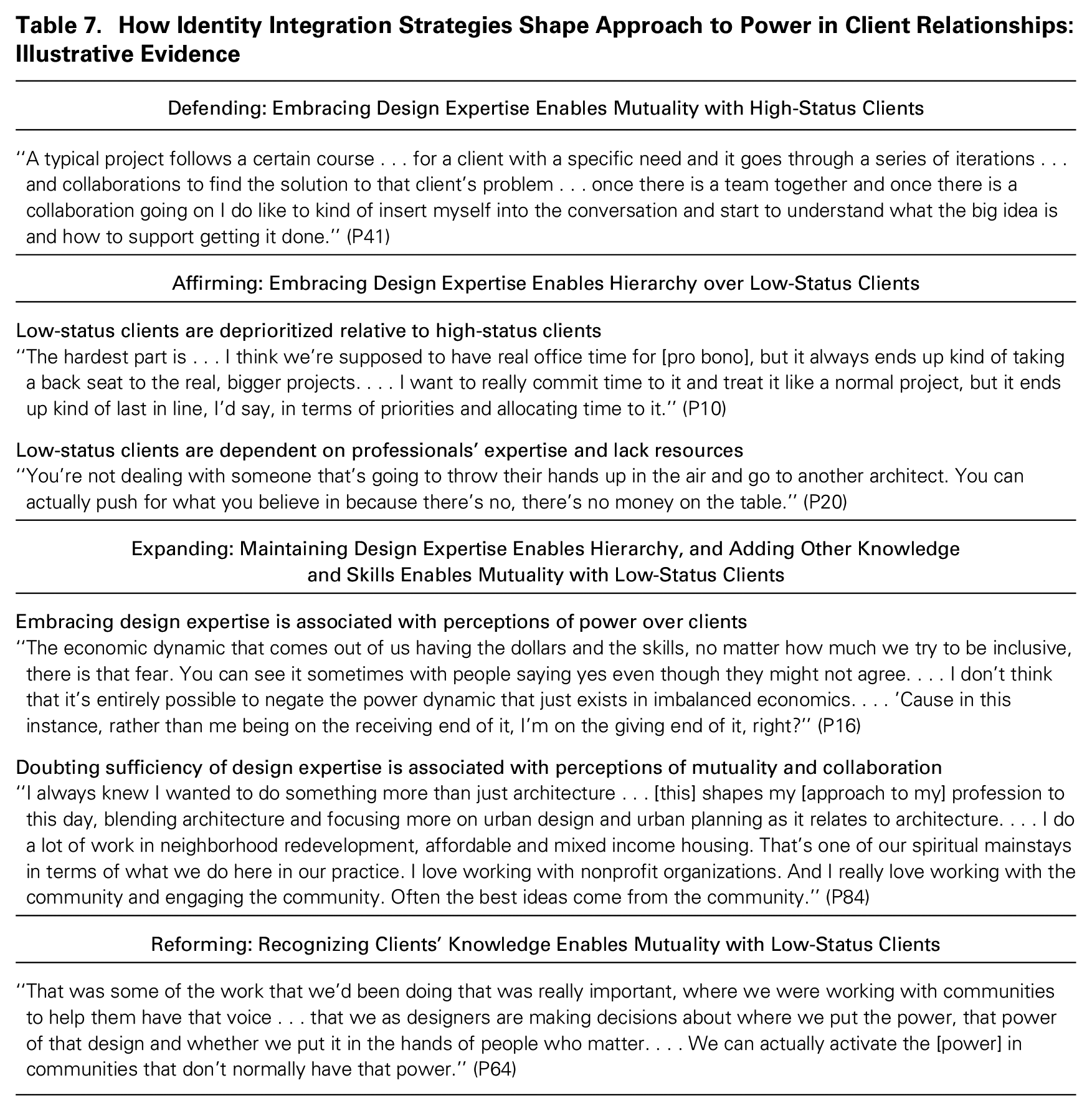
Our analysis demonstrates that professionals’ perceptions of power dynamics were shaped by the combination of their client’s status and their view of the knowledge and skills that were relevant to their professional work with those clients. Table 6 presents a summary of power and status dynamics, and Table 7 provides further illustrative data (see Online Appendix C for a more detailed version of this table).
Summary of Power Dynamics by Identity Integration Strategy
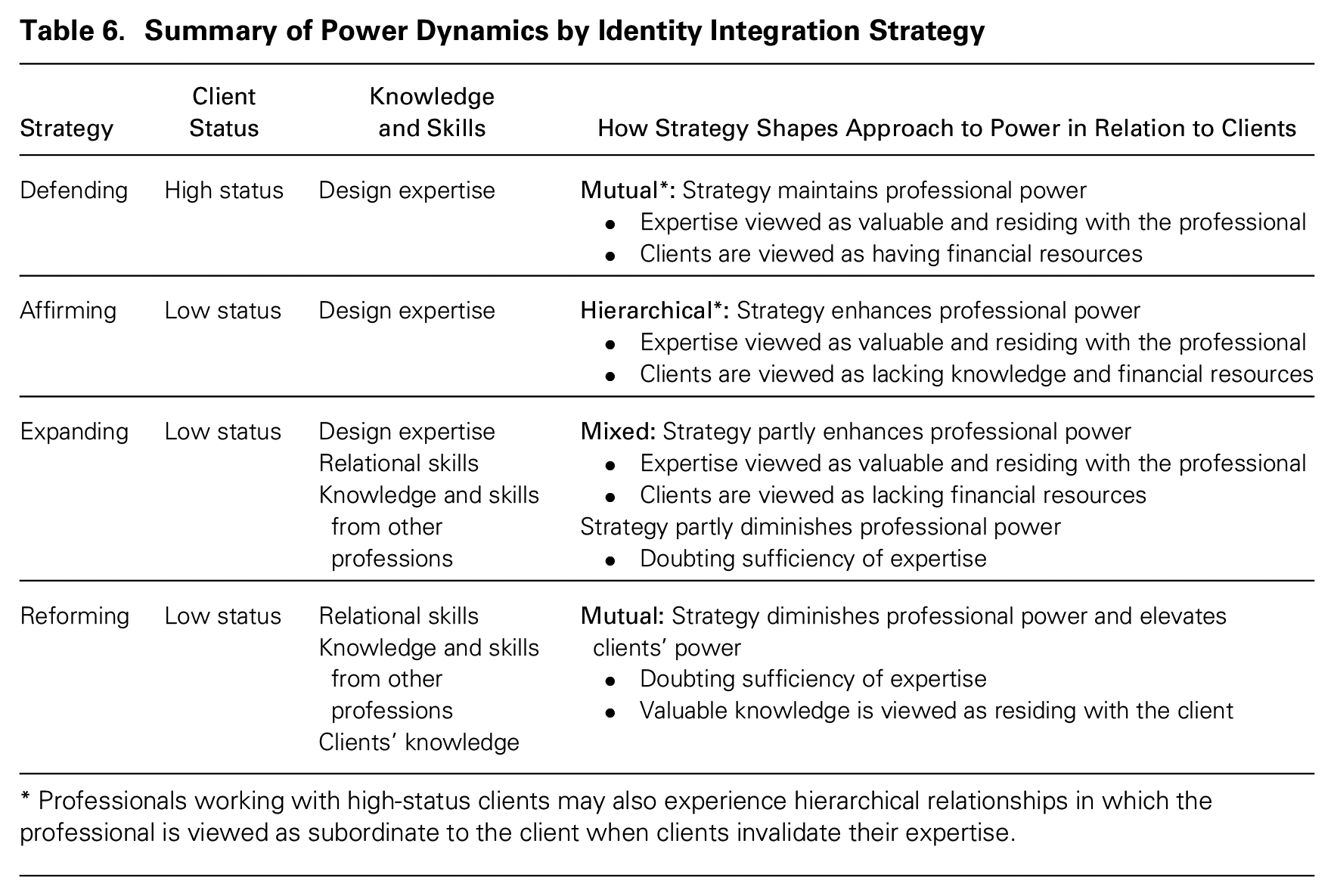
Professionals working with high-status clients may also experience hierarchical relationships in which the professional is viewed as subordinate to the client when clients invalidate their expertise.
How Identity Integration Strategies Shape Approach to Power in Client Relationships: Illustrative Evidence
Factors Shaping the Use of Identity Integration Strategies
Though all professionals in our sample were able to achieve prosocial–professional identity integration, this integration was not necessarily stable; further experiences of identity conflict sometimes led them to alter their use of identity integration strategies in search of greater identity fulfillment. Such shifts occurred when clients invalidated a professional’s prosocial or professional identity and when professionals found it difficult to identify with the archetypal architect (high-status, White, male) or the archetypal client (high-status, wealthy) because of their own demographic identities, which we conceptualized as demographic misfit.
Invalidation by high-status clients
Professionals sometimes perceived themselves as being excessively dependent on and subordinate to high-status clients in ways that compromised their prosocial and professional identities. One architect perceived a high-status client to have violated his prosociality when the client took extreme action against a local community affected by the project without involving him. This experience “was a turning point” that prompted him to work with low-status clients: I was project lead, in a role to make decisions. . . . [The land for the project] was taken over by informal settlers. . . . One day we get back to site . . . and we find that all those people . . . have been bused out overnight. . . . The developer had worked with [the] local municipality, got the Army involved, bused everybody out. . . . To think that I had a role in leading the design, but here I [had] no involvement whatsoever in the fate of those people. . . . So that really was a turning point for me in terms of, how can we as designers and architects, not just work for the people who are paying for us, but consider other people who are stakeholders in what we do? (P73)
At other times, high-status clients invalidated architects’ professional identities. This invalidation occurred when architects felt pressured to compromise design quality to accommodate clients’ preferences and felt that clients did not respect their expertise. One architect described feeling devalued in such relationships: “I feel like I’m no different than the potato chip supplier. . . . You’re just in the commodity business. . . . They don’t care about design.” These clients inhibited designers from expressing their professional identities, as they were not able to pursue “really interesting design with [their] expertise” (P29). Some architects who experienced identity invalidation by (and subordination to) high-status clients turned to the affirming strategy; they compensated for these experiences by turning to low-status clients to express their prosocial identity and by seeking opportunities to exercise design excellence in work with such clients to express their professional identity, thereby inverting the power dynamic.
Invalidation by low-status clients
Professionals also described how interactions with low-status clients could invalidate their prosocial identity. In these cases, low-status clients challenged professionals’ prosocial intent, which could trigger a shift to using broader skills and knowledge. For example, one architect who had founded a socially focused design firm described how she altered her prosocial aim and expanded her sense of her knowledge and skills in response to clients challenging her to include them in the decision-making process: The young people we were working with . . . felt that we didn’t hear them. . . . That was a really startling moment for me. . . . It flipped me in a way, and it really made me really hear people differently. It changed my way of being. . . . How do I . . . change the way in which you’re feeling empowered? A lot of it came down to changing process. Now it’s the young-adult advisory council that makes all the decisions. . . . I realized [the clients] want to speak more. You want to run these things more. You want to be in a position of decision-making, right? Okay. Then I can make that happen. (P14)
This example illustrates how professionals, when they encountered resistance from low-status clients, experienced a threat to their prosocial identity, which prompted them to alter their identity integration strategy to one that aimed to share power with clients.
Experiences of misfit/fit: Low-status demographic identities
Participants reported that both design expertise and high-status clients were typically associated with the archetype of the high-status, White, male architect. We found that how architects viewed their demographic identities in relation to this archetype shaped the identity integration strategies they used.
Female and racial minority architects described a lack of demographic fit with the archetype of the White, male architect as design expert. One woman said, “I switched a lot of firms at the beginning because I love to do design, and I’d get really frustrated that as a female I wasn’t being given those opportunities, and automatically it was like, ‘Oh, you’re an interior designer.’ I’m like, ‘No, I’m an architect’” (P6). Another related how challenging it was to be one of few Black professionals in architecture: I’m a Black woman. . . . At the time that I was hired there was one other Black [architect, a] male. . . . I [am] . . . constantly having to remind myself that I belong here, that I’m capable here, that I am impactful here, that there is opportunity for me to grow here. . . . Resisting tokenism has been one of the hugest battles of my entire career as an architect. (P19)
Many other architects from lower-status demographic backgrounds described similar experiences of marginalization in the profession. This demographic misfit made it more challenging and less compelling to embrace design expertise as one’s sole professional contribution.
Individuals with low-status demographic identities also experienced misfit with the elite clients that architects traditionally served. For example, one Black architect described feeling alienated from elite clients: “Why are these my clients? . . . Why do I have to serve this rich client who doesn’t really care about the community, and the project’s impact, or me?” He elaborated on the dissonance he felt using his design skills to build apartments he could not afford to live in for a highly profit-oriented client: These people aren’t for me. They were developing . . . these really expensive apartments. . . . How crazy is that? I’m the designer, and I won’t be able to experience living here. I can’t even afford this. Those moments we were thinking about access, or lack of access, and equality. You’re just like, this isn’t it, this isn’t worth it, to serve these groups of individuals with my time and my skill set, and to produce something I won’t ever have full access to. That makes no sense to me. (P82)
This example illustrates how professionals with low-status identities perceived high-status clients as lacking concern for communities with whom they shared experiences of marginalization. This perception led them to feel that working with high-status clients and design expertise did not fulfill their prosocial identity, pushing them to question their approach.
Conversely, professionals with low-status identities reported a sense of fit with low-status clients, which made it easier and more attractive to work with them. The architect who described alienation from high-status clients above described how his prosocial and marginalized demographic identities propelled him to work with low-status clients: “I want to choose my clients; I want people who more or less look like me, have the same issues that I have, and I want work that I do to be able to benefit them. I don’t want it to just be an elitist thing” (P82). He recounted an internal thought process that captured the process of expanding from design expertise to include other types of knowledge and skills, “evolving” and “building” from “design-specific skills” to “policy”: It evolves . . . like, “Man, there’s so many hurdles to prevent us from building affordable housing or building community-based projects. . . . What do I need to do to not allow those hurdles to block us from doing this work?” . . . Policy is really the first step in design. These laws and these codes really dictate what we can do and how we can do it. (P82)
A White architect similarly reported that experiencing economic marginalization led him to identify with low-income clients: “My family was very low-income growing up. . . . This kind of identity of growing up without much, but trying to be self-reliant and resilient, certainly helped me resonate with the people that we serve every day.” This identification enabled him to view his clients as “not just recipients [but] also givers” and to aim for a more egalitarian relationship: It’s not just a top-down approach. It’s also an opportunity to be served by them. We have a client that we’ve helped a few times, an older individual who is an artist. . . . In a way for him to show his gratitude to us he recently gave us several beautiful paintings that he’d done, that we put in our office. Even though we’re helping people that are often economically struggling, they still have value and the ability to also serve us and serve others in their neighborhood and community. . . . That kind of portion of my identity is very much shaped by my upbringing and being on the other side at some point. (P11)
Experiences of fit/misfit: High-status demographic identities
Professionals with high-status identities—i.e., White and male participants—typically reported maintaining a strong grounding in design expertise and less expansion to a broader set of knowledge and skills, suggesting demographic fit with the professional archetype and elite clients (i.e., being White, male, and/or upper-class). While most of these participants did not discuss their high-status demographic identities explicitly, there were a few exceptions. One, who described himself as “architecture focused,” noted how as “a White male, I am kind of part of . . . the old guard [of the profession]” (P11). Another White, male professional described a sense of distance from some issues facing low-status clients because they were not part of his own “narrative.” He noted that “gender and racial issues . . . are just not really my thing,” explaining, “I mean, I realize there’s tremendous imbalance, but it’s not—I don’t really spend much time on it. . . . And, yeah, look, I support all of it. It’s just not part of my narrative” (P13). In this sense, high-status professionals’ experience of fit with the professional archetype and with high-status clients may have enabled strategies that helped maintain their own status.
However, a few high-status professionals were aware of their misfit with low-status clients, which prompted them to move toward expanding and reforming strategies. Several White professionals described how clients who were members of ethnic/racial minority communities challenged their presence due to their race. As one architect explained, I’m the White guy in the room. . . . It’s about knowing that when you work with a community that has been . . . made to distrust you because of the body you’re in, then you have to be aware of that and you have to be okay with being dragged through the mud as part of the initiation process of building trust.
This architect discussed how awareness of his higher-status characteristics fueled greater use of relational practices. He described “an eight-month process of working with community members and partnering them with designers to do small-scale place-making projects. . . . Small stuff, but really impactful for the people who get leadership opportunities and a voice and someone to listen to them.” He also said that in response to being one of the few White people at a community meeting, “I was staying in the back of the room . . . kind of just figuring how to show up in the space in a loving and compassionate way.” This professional saw navigating his own high-status demographic identity in relation to low-status clients as a necessary part of his work, explaining, “We have to dive so deep into the generational impacts of marginalization. . . . Unless you go that deep . . . it’s not going to be systems changing. In order to change something so deeply entrenched, you have to be so deeply aware of yourself” (P38). This view of one’s own high-status demographic identities prompted some architects to adopt the reforming strategy, approaching low-status clients with the intention of sharing power.
Table 8 provides further data illustrating factors shaping the use of identity integration strategies (see Online Appendix C for a more detailed version of the table). Figure 2 presents participant counts by race and gender, categorized by the strategy used. Most of the participants using the defending and affirming strategies were White, while racial minority participants tended to use the expanding and reforming strategies. We also found that the few participants using the expanding strategy in traditional firms identified with marginalized groups. These data provide further support for the idea that lack of fit with demographic archetypes related to professional identity and high-status clients can influence professionals from low-status groups to use the expanding and reforming strategies, while fit with design expertise and elite clients influences those from high-status groups to use the defending and affirming strategies.
Factors Shaping the Use of Identity Integration Strategies: Illustrative Evidence
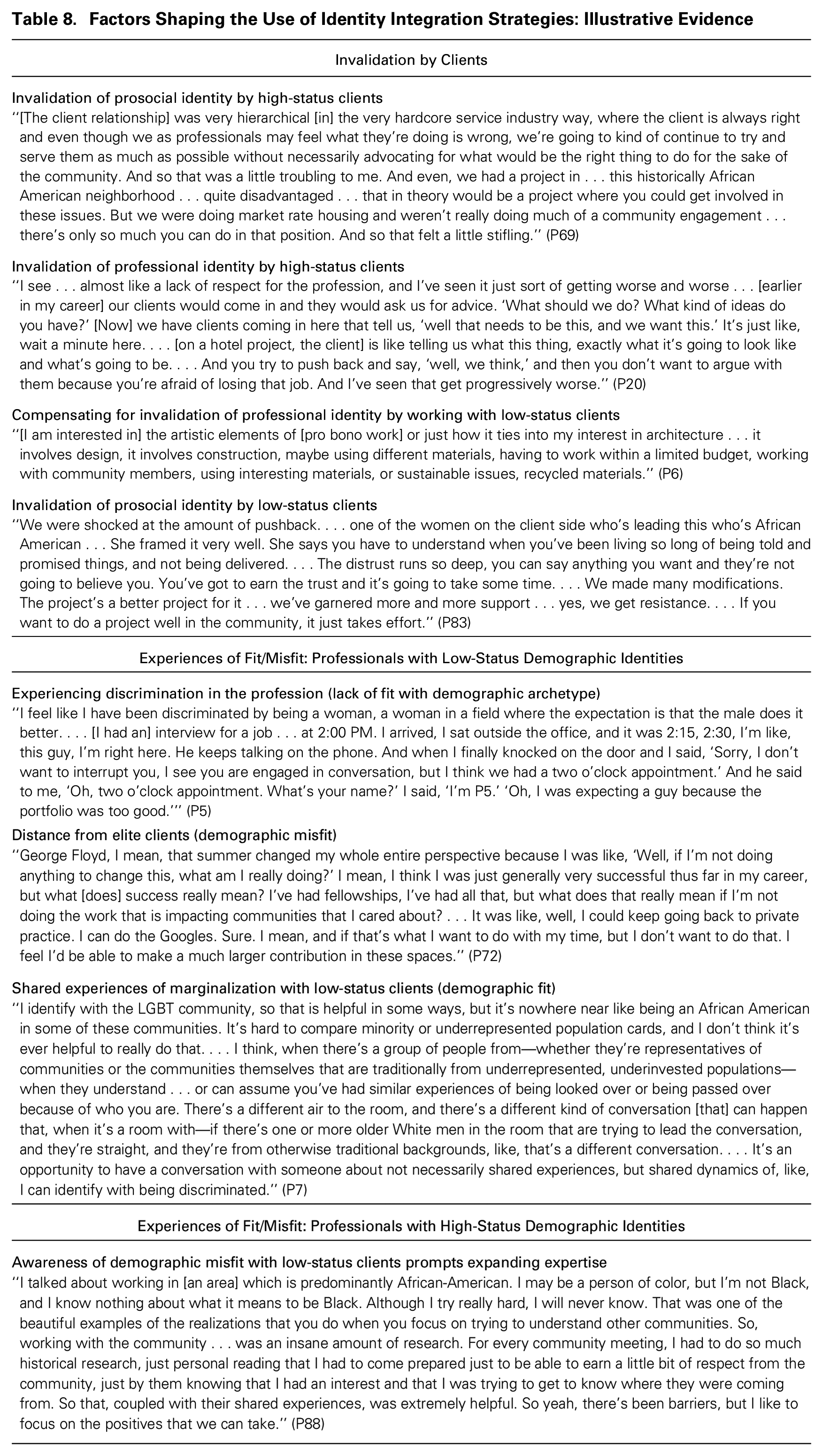
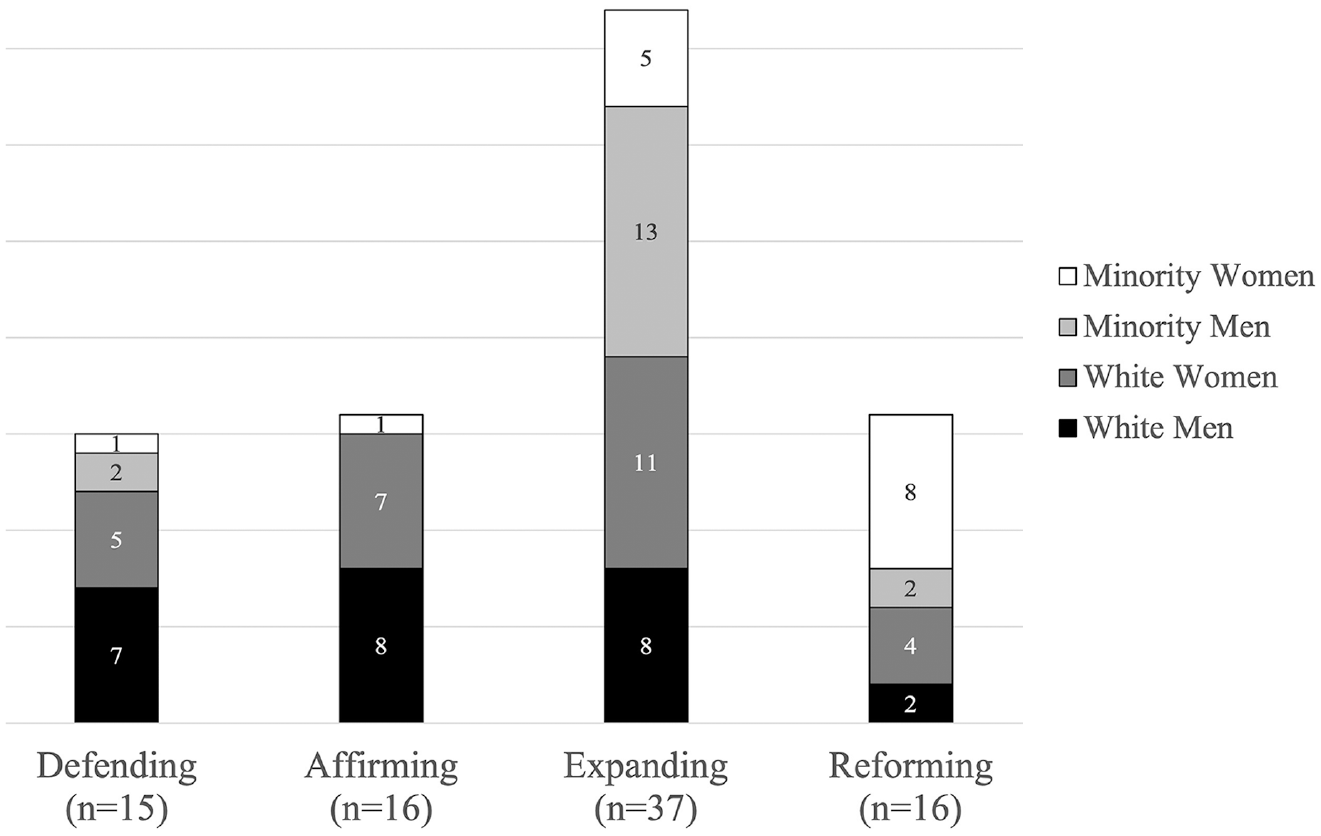
Prosocial–Professional Identity Integration Strategies by Participants’ Race and Gender*
Discussion
Toward a Theoretical Model of Prosocial–Professional Identity Integration
Professionals look to clients to answer fundamental identity questions: “do the clients I work with define who I am as a person who aspires to benefit others and as a professional?” Our model, depicted in Figure 3, presents pathways through which people can fulfill their desire to integrate prosocial and professional aspects of the self. Professionals’ identity integration strategies consist of linking their clients and the knowledge and skills they use with prosocial and professional meanings. These strategies, in turn, shape how professionals relate to their clients. Specifically, we uncover how strategies shape professionals’ symmetrical or asymmetrical approach to power in relation to their clients.
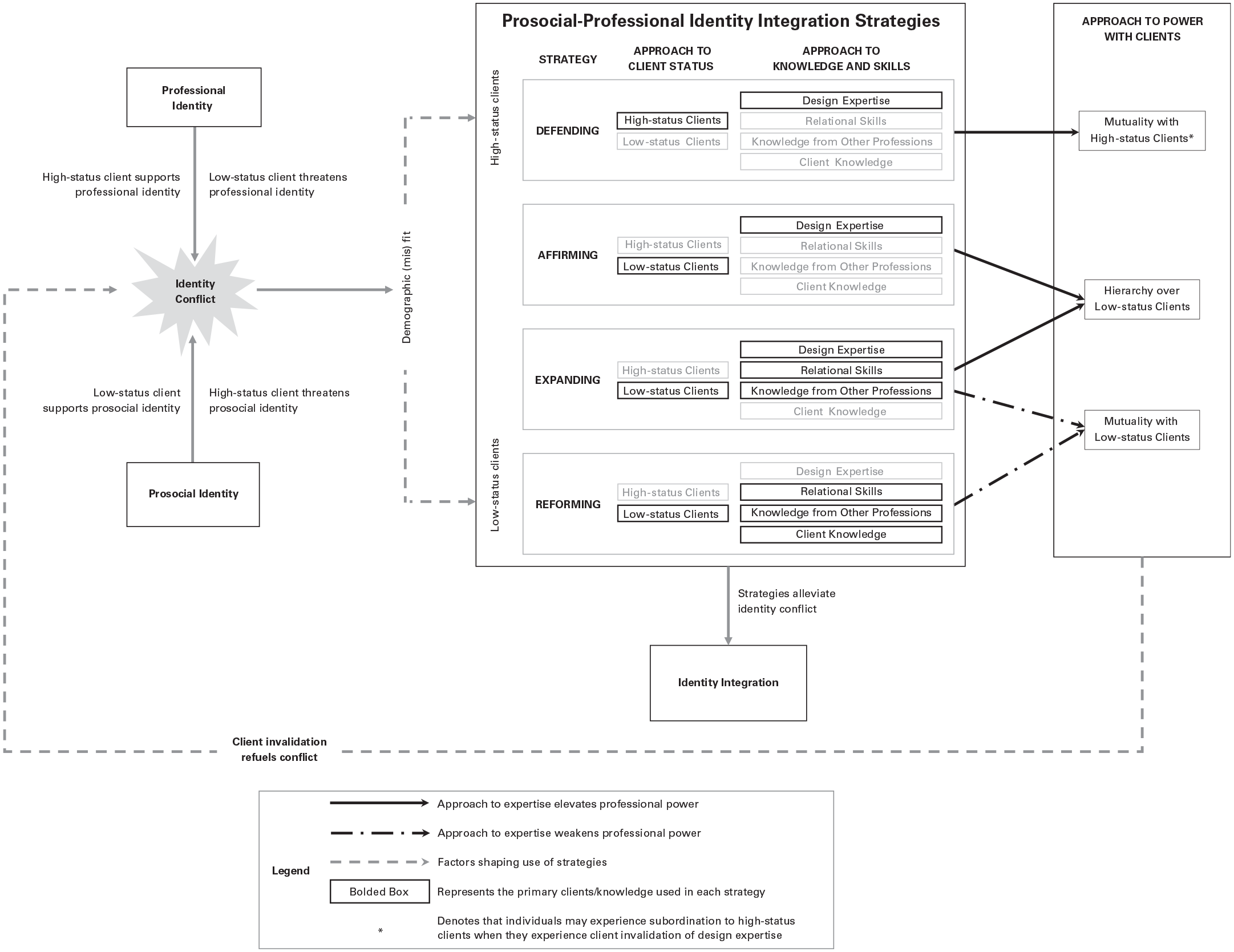
A Model of Prosocial–Professional Identity Integration
Our model centers on the role of the client in identity construction. People have multiple identities, and clients may therefore activate not only people’s professional identities but also other facets of who they are, requiring professionals to negotiate their multiple identities in relation to clients. We theorize that for professionals for whom prosocial identity is important, clients are an expression and reflection not just of their professional identity as an expert but also of their personal prosocial identity as a person who benefits others.
We situate this conflict within the context of professional norms about the types of clients that are valuable to work with and may thus best support professional identity. Professional norms regarding clients vary across and within professions, such that the types of clients that validate and threaten different identities are likely context specific. We suggest that in elite professional contexts that value well-resourced clients (such as architecture), the status of one’s clients can be a source of prosocial–professional identity conflict. As depicted on the left side of Figure 3, working with high-status clients can validate one’s professional identity by enabling the development of the specialized expertise that traditionally undergirds it. Yet, working with high-status clients can threaten prosocial identity because doing so may be associated with benefiting only a narrow group of elites and with benefiting oneself through prestige and pay rather than benefiting others. Conversely, working with low-status clients can threaten professional identity because they are not associated with enabling expertise, though they can validate prosocial identity.
Our model next depicts how professionals respond to this conflict by using an array of prosocial–professional identity integration strategies. We identify four such strategies, which we conceptualize as defending, affirming, expanding, and reforming professional identity through the integration of prosocial identity. As depicted in the middle box of Figure 3, each strategy we identified consists of approaches to the type of client with whom the professional works and to the types of knowledge and skills they view as central to their work with those clients. When the client is high-status, the threat to prosocial identity is salient, so professionals’ identity work revolves primarily around ascribing prosocial meaning to the client. When the client is low-status, the threat to professional identity is salient, so identity work revolves primarily around crafting understanding of the knowledge and skills that support both prosocial and professional identity. Specifically, professionals using the defending strategy respond to identity conflict by framing the high-status clients they work with, who already support professional identity, as prosocial. Those using the affirming, expanding, and reforming strategies respond to identity conflict by working with at least some low-status clients, and they respond in different ways to the threat that working with low-status clients may sully their professional identity claims to specialized expertise. Some protect their professional identity by reasserting their specialized expertise as the sole or primary source of knowledge and skills central to their professional work, while others expand their professional identity to encompass a broader range of knowledge and skills. As depicted in the box below the strategies, each strategy represents a different path to the same outcome: experiencing the integration of one’s prosocial and professional identities.
We depict the relational consequences of prosocial–professional identity integration strategies in the right-hand box of Figure 3. Although all strategies help professionals achieve integration, they have different implications for professionals’ approach to power with their clients. We theorize that the set of knowledge and skills professionals view as central to their work shapes how they perceive power dynamics with their clients. When using strategies relying on expertise (defending, affirming, and expanding), professionals approached their clients as though they possessed a resource on which clients depended. However, using strategies (expanding and reforming) that additionally relied on other types of knowledge and skills, including relational skills and knowledge from other professions, shifted the power dynamic such that professionals approached clients in more mutual ways. Moreover, we theorize that when professionals recognize low-status clients as having knowledge necessary to professionals’ work (reforming), power may be distributed beyond the professional, further enabling a mutual approach.
Last, we theorize two relational factors that shape which strategies professionals use (depicted with gray dotted lines in Figure 3). First, client invalidation—which occurs when professionals perceive that clients do not support either their prosocial or professional identities—may refuel conflict and prompt professionals to shift strategies. Second, experiences of demographic misfit or fit with professional archetypes and clients influence professionals’ propensity to work with high- or low-status clients and the types of knowledge and skills they view as central to their work. Overall, our model shows how prosocially oriented professionals’ search for identity integration is intertwined with status and power dynamics.
Contributions to Scholarship on Professional Identity
Our study makes several contributions to the rich body of research on professional identity. First, we show that clients shape the joint construction of both professional and personal identity. Prior research shows that clients and customers are key relational partners in professional identity construction (Vough et al., 2013; Cardador and Pratt, 2018; DiBenigno, 2022). We advance this emerging stream of work by showing that clients shape not only professional but also personal identities, and by integrating this stream with research on the challenge of negotiating multiple valued identities (Meyerson and Scully, 1995; Creed, DeJordy, and Lok, 2010; Ramarajan and Reid, 2013; Caza, Moss, and Vough, 2018; Chreim et al., 2020). Prior research also shows that relational counterparts in the personal domain (such as spouses) shape professional identity (Reid, 2018; Petriglieri and Obodaru, 2019). Conversely, we show how counterparts in the professional domain (such as clients) can shape personal identity.
Second, we highlight an underexplored dimension of personal identity in this literature—prosocial identity (Grant, 2007; Grant and Berg, 2012)—and demonstrate that professionals’ clients express and reflect (Cooley, 1902; Mead, 1934) not only their identities as professionals but also their identities as good people who benefit others. Our central contribution here is to identify prosocial identity as an understudied factor in professional identity construction, suggesting a novel and important source of the variation we see in how professionals live out their work and relate to their clients. By focusing on prosocial identity, we also respond to professional identity scholars’ calls for research on how conceptions of the public good, morality, virtue, and “the importance of seeing value in one’s work beyond its implications for self-interest” can spark professional identity work (Lepisto, Crosina, and Pratt, 2015: 27). Abstracting from our focus on prosocial identity as a key personal identity, we show how clients may be a critical source of identity conflicts at work when they validate some important identities but not others. Our findings show that the identity work people engage in to resolve such conflicts can involve reframing or changing the types of clients they work with to support their multiple identities.
Third, we highlight the key role of client status in professional identity construction. Prior research has shown that clients can affirm or threaten professional identity (DiBenigno, 2022) but has not explored whether and how such threats depend on clients’ status. Our focus on status arose from our data. We integrate this finding with insights from prior scholarship suggesting that in some contexts, working with high-status, well-resourced clients may be considered valuable because it supports professional status and reputation (e.g., Leicht and Fennell, 2001: 93–94), to argue that in some elite, commercialized contexts, high-status clients may more easily enable and low-status clients more easily threaten one’s professional identity. A perspective that considered only people’s desires to affirm their professional identity might suggest that they would simply align with professional norms, embracing high-status clients and avoiding lower-status ones. Our multiple identities perspective complicates this picture. We show how people may diverge from professional norms and alter the types of clients they work with and the meanings they associate with those clients because high-status clients who affirm professional identity can threaten prosocial identity, and low-status clients who threaten professional identity can affirm prosocial identity.
We further show how professionals respond to each of these identity threats by defending themselves from or engaging with them (Petriglieri, 2011). For example, we see how some professionals, to defend against the threat that high-status clients pose to their prosocial identity, focus on clients’ missions, while others engage with this threat by expanding the set of clients they work with. We see how professionals defend against the threat to their expertise by affirming its value for low-status clients and/or engage with this threat by expanding their approach to professional knowledge and skills. Thus, we document how clients can spark an ongoing tug-of-war in professionals’ search for identity integration.
Fourth, our work deepens our understanding of how professionals’ expertise in their domain—as well as a broader set of knowledge and skills they view as central to their work—can be a focus of professional identity construction. Recent research at the collective level suggests that though it is difficult for professionals to let go of defining themselves based on valued knowledge and skills, they can adapt their identities such that new types of knowledge and skills become a basis for professional identity (Nelson and Irwin, 2014; Lifshitz-Assaf, 2018). Our findings show how clients can trigger these adaptations at the individual level: seeing oneself as a prosocial professional may require modifying one’s understanding of one’s own professional knowledge and skills in order to effectively work with different types of clients and achieve prosocial aims. Moreover, our findings show how professionals’ identity work enables them to adapt the same types of knowledge and skills to different types of clients (e.g., design expertise for both high- and low-status clients) and to adapt different types of knowledge and skills to clients of similar status. We further show that this identity work sometimes involves changing whose knowledge and skills (their own and/or their clients’) professionals consider necessary for their work. Thus, we demonstrate the challenge of constructing professional identity when one’s expertise is threatened (Kang and Kim, 2021), but we also showcase professionals’ flexibility in doing so. Crucially, we show that professionals’ prosocial aims and identities, as well as their demographic identities, shape this flexibility.
Last, part of our research question asked in broad terms how prosocial–professional identity strategies might shape professionals’ relations with clients. Emergent research on relational approaches to and outcomes of professional identity construction shows that these strategies shape how educators approach socializing students (Ramarajan and Reid, 2020), how nurses interact with clients (DiBenigno, 2022), and how domestic partners shape each other’s professional identities (Petriglieri and Obodaru, 2019). We advance this stream of work by uncovering how professionals’ identity integration can shape their approach to power in relation to their clients. Building on a common definition of power as control over access to valued resources (Emerson, 1962; Magee and Galinsky, 2008), we conceptualize our findings as revealing professionals’ approaches to and perceptions of their own and their clients’ control over valued resources in the professional–client relationship. Our data suggest that professionals’ knowledge and skills, on the one hand, and clients’ financial resources and knowledge, on the other, are key resources that can shape power relations and that identity work can shape the configuration of these resources.
Because professional identity research has not focused on power in relation to clients, we draw on insights from research on power dynamics in professional–client relationships to ground our findings. One key insight centers on the power dynamic when professionals are subordinate or, at most, mutual to the client. This work highlights that professionals’ control over their expertise and their dependence on clients’ resources can contribute to power asymmetries and that elite clients can typically exert more power over professionals than low-status clients can (Freidson, 1986: 173–174, 218; Gunz and Gunz, 2008). But defending expertise is only one strategy for maintaining power in relation to clients; in some cases, professionals may also engage in non-expert tasks, which may be viewed as “scut work,” to gain authority (Huising, 2015: 263).
We build on these insights to elucidate how and why professionals’ identity work related to their expertise and to client status is critical to shaping their approach to power. As we might expect from an identity perspective, many professionals responded to the threat to expertise by defending (Petriglieri, 2011), thereby embracing expertise as the foundation for professional identity. Thus, our study illuminates how defending against identity threat can be at the root of maintaining power with elite clients and of enhancing power over low-status clients. However, from an identity perspective, we also observed professionals engaging (Petriglieri, 2011) with the threat to expertise: some professionals doubted the value of their expertise and shifted their approach, viewing their expertise as one resource among a larger set of knowledge and skills needed for their professional work. This shift altered their approach to power with low-status clients. The relational skills and recognition of clients’ knowledge that these professionals embraced are consistent with relational practices such as “fluid expertise,” or “the willingness to show and acknowledge interdependence or need for input” (Fletcher, 2004: 653). Thus, our study also shows how engaging with identity threat may be at the root of a more mutual “power-with” (Follett, 1973: 72) approach to low-status clients.
Contributions to Scholarship on Prosocial Identity
Our study advances research on prosocial identity by showing how such identity work is intertwined with client status and power. Prior research on prosocial work has shown how contact with clients enables people to feel that they are making a prosocial contribution by helping others whom they view as beneficiaries (Grant, 2007, 2008). Scholars have also noted that self- and other-oriented motivations for prosocial behavior can co-occur (Grant and Berg, 2012; Simpson and Willer, 2015). Similarly, research highlights that prosocial and meaningful work can entail costs and sacrifices (e.g., Bunderson and Thompson, 2009; Schabram and Maitlis, 2017; Oelberger, 2019) but can also yield self-benefits (Grant and Mayer, 2009; Burbano, Mamer, and Snyder, 2018; Flynn and Yu, 2021). Our study adds to this picture by showing that the status of one’s clients can call into question whom one is benefiting through one’s work (Blau and Scott, 1962; Oelberger, 2018), thereby threatening one’s prosocial identity.
We illuminate an important potential self-benefit arising from the pursuit of prosocial–professional integration: intentionally or unintentionally, some professionals may maintain or gain status and power through prosocial identity work. Those using the defending strategy minimize the role of client status and focus on prosocial mission, thereby gaining the benefits of working with elite clients and of claiming a prosocial identity while avoiding the potential professional costs of working with low-status clients (such as loss of challenging work, reputation, and fees). Those using the affirming and sometimes the expanding strategies, who work with low-status clients to enact their prosocial identity, can gain a sense of greater professional autonomy and power in client relationships. Even those using the reforming strategy, who, in search of their own identity fulfillment, state that they aim to approach low-status clients equitably and collaboratively, could be critiqued for encroaching into spaces in which they would not traditionally be considered experts. These findings are resonant with critiques of people and organizations, especially elites, who purport to change the world but whose ostensibly prosocial activities often maintain the status quo and their elite positions (Marquis, Toffel, and Zhou, 2016; Oelberger, 2018; Giridharadas, 2019; Kutlaca and Radke, 2023).
Our findings also contribute to research on the role of status and demographic identities in prosocial work. First, we show how demographic identities can complicate the integration of one’s prosocial and professional identities. Research on status in the professional identity literature has tended to focus on the identity work involved in managing the lower-status demographic identities of the professional (e.g., Creed, DeJordy, and Lok, 2010) or managing the lower status of the work itself (e.g., Ashforth and Kreiner, 1999). We bring in client status and show its connection to the status of professionals’ own demographic identities. Our findings show how professionals’ demographic fit with a professional archetype and with their clients can reinforce, on the one hand, associations between high-status demographic categories (e.g., male, White) and professional expertise and success and, on the other hand, associations between low-status demographic categories (e.g., female, lower-class) and prosocial work (Joshi, 2014; Cech, 2015; Dimitriadis et al., 2017; Bode, Rogan, and Singh, 2021; Fang and Tilcsik, 2022).
We further show how demographic considerations matter differently for professionals with low-status and high-status identities. For professionals with low-status identities, the experience of demographic similarity with low-status clients can shape prosocial identity work by making professionals more likely to work with low-status clients, adopt a broader understanding of professional knowledge and skills, and even aim to share power with clients. The role of demographic fit helps to explain our somewhat counterintuitive finding that some professionals proactively seek to reduce their own power relative to clients, building on research showing that a sense of solidarity with others can induce people, even when they occupy positions of structural power, to prioritize others’ interests (Tost and Johnson, 2019).
Our findings also show that professionals from high-status groups may struggle with identity conflict when they pursue prosocial identity, yet compared to low-status professionals, they may have more potential to manage the trade-offs of prosocial–professional integration in ways that may maintain social and professional hierarchies. Furthermore, unlike members of low-status groups, members of high-status groups rarely viewed their high-status identities as relevant to their work, even when they were working with low-status clients. While this is consistent with research on avoiding one’s high-status identities, for instance, in cross-class interactions (Gray and Kish-Gephardt, 2013), we also observed that some professionals were aware of the privilege associated with their identities. Future studies could focus on such within-group differences, as recent research suggests that identity work in relation to privilege plays a role in high-status group members’ aims to address inequalities (Scully et al., 2018). In sum, our work contributes to deeper understanding of the role of power in professional and prosocial identity construction, by showing how power dynamics in the broader social context—professionals’ and clients’ different levels of power and status based on their demographic characteristics—shape identity work and professionals’ interpersonal approaches to power in relation to their clients.
Last, our findings problematize the breadth and ambiguity of the concept of prosociality in prior research (Penner et al., 2005; Bolino and Grant, 2016). Our research underscores how the vagueness of what it means to contribute to society makes it possible to claim a very broad range of behaviors (e.g., serving high- and low-status clients) under a prosocial mantle, including behaviors that may primarily benefit oneself and/or reinforce existing power hierarchies. Our findings highlight the importance of analyzing how people deploy and defend claims to prosociality and the potential self-benefits they may accrue from doing so, indicating the need for scholars to consider the extent to which work and activities that maintain professionals’ own status and power should be considered prosocial and the potential value of narrower definitions of prosociality. Pressure to make a positive social contribution is rising for both individuals and corporations, and claiming prosociality can garner valuable benefits and rewards (Burbano, 2016; Nardi, 2022). In this context, it is increasingly important to attend to how people and organizations can rhetorically claim prosociality as a strategic resource that may be decoupled from accountability for specific social outcomes. Moreover, future research should focus on the social and professional contexts in which prosocial claims are made. In the architecture context, working with low-status clients affirmed prosocial identity, while working with high-status clients threatened it. Our findings open up new questions about whether and how high-status professionals may be using low-status clients to gain prosocial credibility and how broader social and professional contexts may reinforce beliefs about the types of clients seen as affirming prosociality.
Limitations and Future Work
Our study draws on professionals’ narratives about their identities from interview data, which have important limitations: they are retrospective, may reflect participants’ biases and impression management concerns, and may not accurately represent people’s motives and behavior (Charmaz, 2014; Lamont and Swidler, 2014). In our study, for example, participants who explained working with low-status clients as an agentic choice shaped by their prosocial motives may have been compensating for lack of demand for their work from high-status clients, or they may have downplayed self-benefiting motives such as gaining reputation and skills. However, our data were well suited to our research questions on identity. Interview data are unique in their ability to provide access to individuals’ internal meaning-making and how they negotiate internal conflicts (Weiss, 1994; Lamont and Swidler, 2014). Our theorizing is based on the patterned ways in which professionals make identity claims in relation to the clients they work with and the work they do. To mitigate some of the challenges of working with interview data, we gained familiarity with the context, built trust, and elicited concrete, vivid stories (Charmaz, 2014; Small and Calarco, 2022). Our interviews captured details that could be seen as negative or risky, such as poor evaluations from clients and managers and issues in participants’ personal lives, suggesting that we were able to build trust with our participants. Further, in our analysis, we did not take interviewees’ accounts at face value but, rather, systematically analyzed our data for contradictions and critical interpretations (Pugh, 2013). This approach enabled us to identify obscured and self-presentational tensions in professionals’ pursuit of prosociality, such as the potential for self-benefits (e.g., maintaining or gaining power).
Our data do not include clients’ perspectives or observational data on professional–client interactions. Accordingly, we can analyze people’s claims to being prosocial and to making a positive contribution to society, but we cannot assess the accuracy of professionals’ accounts of how they approached clients, nor can we assess the impact or effectiveness of their efforts to engage in work that contributes to society. We limit our analysis to professionals’ accounts of their identities and of their approach and intentions toward their clients when enacting those identities. Future research incorporating clients’ perspectives and observational data could help connect identity accounts to how professionals treat clients in practice and to how clients perceive these interactions. Interrogating the power dynamics of prosociality from clients’ perspectives, as well as investigating when and how professionals’ identity fulfillment leads to positive and negative consequences for clients, is a critical task for future research.
Future studies could also take a longitudinal approach. Our study is largely based on interviews at a single point in time. This approach enabled us to cover a wider array of experiences but not the real-time evolution of participants’ approaches. We analyzed the data for how people described moves and shifts over time (Polkinghorne, 1988), but longitudinal data could alter the sequence we theorize and could extend our approach by exploring how the pursuit of prosocial–professional identity integration could trigger career shifts over time.
Our study has important boundary conditions. First, we purposefully sampled professionally trained architects interested in contributing to society through their work. This approach enabled us to investigate our research question, which concerns individuals who have both a prosocial and professional identity. We do not assume, however, that all professionals have a prosocial identity; though research suggests that prosocial identity matters for many people (Grant, 2007; Grant, Dutton, and Rosso, 2008), it may well be unimportant or absent for many others.
Second, architecture is an elite professional context; the profession is known to associate high-end design with clients who have socioeconomic resources (Cuff, 1991; Ahuja, Nikolova, and Clegg, 2017). Studying prosociality in elite contexts is important (Khan, 2012) because professionals in these contexts face significant pressure to be more socially oriented and yet may be doing so in ways that reproduce status and power hierarchies. Future research should investigate the extent to which the prosocial–professional identity tensions we studied may be salient in other contexts. We suspect that our findings may be relevant to other contexts in which working with elite, commercial clients is seen as enabling professional accomplishment and expertise (e.g., corporate law, finance, consulting, media and advertising). Our findings may also be relevant in organizations facing increasing employee social activism (Briscoe and Gupta, 2016; Heucher et al., 2024). For instance, recent reports that some Google engineers expressed concern about working on cutting-edge AI projects for defense contractors suggest that there may be different bases for the types of clients that professionals see as supporting prosocial versus professional identity in different settings. Future research should interrogate this possibility as well as how pressures and prosocial–professional identity tensions may differ in other organizational and professional contexts. Whereas our research investigates a setting in which professionals’ clients are external to the organization, future research could also investigate settings in which professionals and clients work within the same organizations (e.g., Huising, 2015); for instance, internal company auditors who give professional advice to managers may experience different tensions and power dynamics than those revealed in this study. In addition, though we found that all the participants in our study were able to achieve a sense of identity integration (though integration was unstable and conflict could recur), identity conflict may remain unresolved in some contexts, e.g., if one cannot work with different types of clients due to monetary constraints or lack of opportunity. Future research should investigate conditions under which identity conflict may be unresolvable and how individuals respond to such situations.
Last, our findings are at the individual level but may have implications for collective-level change, suggesting directions for future research. As the rise of social issues heightens many people’s desires to bring their personal prosocial identity into the workplace and as many professions’ memberships become more diverse, future research should examine how individual-level prosocial–professional identity work may aggregate to shape change at the collective level. Identity work can enable individuals to fulfill their personal prosocial aims within their work contexts, but it may also shape employees’ individual and collective efforts to influence their workplaces to address important social issues (Meyerson and Scully, 1995; Briscoe and Gupta, 2016; Heucher et al., 2024), with potential implications for whether low-status clients have access to professional services. In addition, future research should probe how identity work that alters some professional members’ understanding of their knowledge and skills may also shape understandings of expertise and professional identity at the collective level (Nelson and Irwin, 2014). Individual identity work may fuel contestation within a profession over which knowledge and skills count as expertise, who can hold it, and who benefits from it: professionals themselves, specific types of clients, or the broader society. Future studies should investigate how these dialogues reshape a profession and its relationship to society.
Practical Implications
Many people, especially young professionals, are struggling with what it means to contribute to society through their work. At the same time, organizations and professions are being challenged to pursue social goals. Our study has implications for individuals, organizations, and professions grappling with these challenges.
Our findings show that many types of clients—ranging from elite, well-resourced corporations to low-status, under-resourced communities—can fulfill professionals’ prosocial and professional identities. For the individual, this flexibility is beneficial; being prosocial can mean different things to different people, and individuals may find various ways to fulfill their prosocial identities without feeling like they must trade off against important aspects of their professional identities. However, some professional and organizational contexts, especially elite, commercial ones, may heighten the trade-off between clients who validate one’s prosocial identity and those who validate one’s professional identity. In such contexts, professionals who wish to work with low-status clients must be prepared to diverge from the status quo. Furthermore, our study encourages professionals to consider the self-benefits that may arise, intentionally or unintentionally, from pursuing prosocial work and claiming a prosocial identity at work. Our findings suggest that mitigating the hierarchical power dynamics that may arise when working with low-status clients may require professionals to expand and reform how they view themselves as experts.
At the collective level, our findings have implications for how to expand a commercialized, elite profession’s clientele to include low-status clients. Organizations should take care that initiatives intended to fulfill employees’ prosocial identities through work with low-status clients substantively benefit those clients. Doing so may require a different understanding of which knowledge and skills are central to professional work, suggesting that professional organizations (e.g., schools, firms, and industry associations) may wish to consider altering how they set and reinforce professional norms and values. In the case of commercialized professions such as architecture, such a shift could involve preparing professionals to work with a more diverse clientele by altering socialization practices that privilege working with elite clients and by broadening the body of knowledge and skills required of new entrants.
Last, our findings have implications for how organizations attend to the demographic identities of both professionals and clients. Our findings are consistent with research showing that under certain conditions, women and racial/ethnic minority clients are better served by professionals who share their demographic characteristics (Fairlie, Hoffman, and Oreopoulos, 2014; Greenwood, Carnahan, and Huang, 2018; Greenwood et al., 2020). Yet, the risk of matching professionals and clients who share low-status identities is that in elite professions, professionals from low-status demographic groups may face disproportionate demands to work with low-status clients and may therefore still find themselves at the margins of the profession if such work is devalued relative to work with elite clients. Organizations should attend to the risk that these dynamics may impede efforts to pursue diversity and equity.
As societal issues become increasingly salient, heightening discourses of equality, access, and justice for all, our study shows that professionals can experience a deep struggle to do work with clients that validates both their prosocial and professional identities. This struggle is fraught with choices about status and power. While some find identity integration in ways that maintain or enhance their professional status and power, others find it through redefining whom they serve and how they serve them.
Supplemental Material
sj-pdf-1-asq-10.1177_00018392241238407 – Supplemental material for Defining Who You Are by Whom You Serve? Strategies for Prosocial–Professional Identity Integration with Clients
Supplemental material, sj-pdf-1-asq-10.1177_00018392241238407 for Defining Who You Are by Whom You Serve? Strategies for Prosocial–Professional Identity Integration with Clients by Lakshmi Ramarajan and Julie Yen in Administrative Science Quarterly
Footnotes
Acknowledgements
We are grateful to associate editor Forrest Briscoe and three anonymous reviewers for their constructive guidance and feedback. This paper benefitted from insights from May Al Dabbagh, Michel Anteby, Lotte Bailyn, Sigal Barsade, Julie Battilana, Ethan Bernstein, Vanessa Conzon, Julia DiBenigno, Robin Ely, Alexandra Feldberg, Summer Jackson, Joshua Margolis, Chris Marquis, Otilia Obodaru, Mike Pratt, Ryan Raffaelli, Erin Reid, James Riley, Nancy Rothbard, Bobbi Thomason, Emily Truelove, Steffanie Wilk, Lilly Yu, and Ting Zhang. We are also grateful for feedback from colleagues in the Junior Faculty Seminar, OB Lab, the Gender, Race and Organizations workshop, and the Work, Organizations and Markets workshop at Harvard Business School. We thank Sophie Haugen, Serenity Lee, Rachel Litt, Amanda Merryman, Michael Norris, Maia Scharphie, and Rachel Tropp for invaluable research assistance. The Division of Research and Faculty Development at Harvard Business School provided research support. We also thank the GC, our parents, Nick Levitt, Martin Gerwin, Judith Rutledge, Soundhari Balaguru, and Felix Wu for their insight and support. We are grateful to Liz Ogbu, John Peterson, and John Cary for introducing us to the field. Finally, thank you to the architects and designers who made this study possible. We learned so much from you and are grateful to you for sharing your experience and your time. We dedicate this paper to the memory of Sigal Barsade, whose research and mentorship continue to inspire us.

1
We purposefully sampled participants by approaching people in traditional firms with social responsibility or public interest programs and in social-sector design organizations, explaining our interest in talking to those interested in contributing to society through their work. We provide further details in our Method section.
2
Scholars vary in how they define expertise, whether they include these other types of knowledge and skills in professional expertise, and how they label the various types of knowledge and skills that professionals use. To avoid confusion, we use “expertise” to denote the specialized, abstract, formal knowledge of a profession. We do not use this term in reference to other types of knowledge and skills.
3
We use the terms “high-status” and “low-status” to denote the top and bottom of the client hierarchy. Though middle-status clients exist, we focus on the clear challenge to professional norms that value working with high-status clients represented by serving clients from low-status groups, particularly those from low-status class backgrounds and socioeconomically disadvantaged groups.
4
We acknowledge different perspectives in the literature about this relationship. There is also variation in contexts within and across professions. For example, in some social work contexts, working with low-status clients may be more valued than working with wealthy clients, because wealthy clients may be seen as less in need of social workers’ expertise. In other contexts, clients with complex cases or obedient clients may be more valued than wealthy ones. In still others, wealthy or elite clients may be seen as those who devalue professional expertise and subject professionals to their demands. Thus, we do not theorize that working with high-status clients will be seen as supporting expertise in general.
5
These non-licensed professionals, who often use the title “designer,” typically identify as architects but cannot legally call themselves registered architects or market their services as such. There were approximately 115,000 licensed architects in the United States in 2018 (NCARB, 2019); numerous non-licensed practitioners engage in similar work, including design, documentation, and construction management. Only registered architects are legally allowed to stamp drawings and to sign off on technical documentation.
6
Various institutional pressures and instrumental motivations prompt firms to pursue pro bono and corporate social responsibility work (e.g., recruitment, reputation, attracting clients). Accordingly, we do not assume that these programs existed for altruistic reasons or necessarily created social value. These firms were nonetheless appropriate settings for examining how professionals engaged with prosocial work in traditional firms. They were distinctive in the profession in that not all firms have pro bono programs. Individual prosocial behavior such as participating in pro bono work within firms can come with costs (e.g., loss of pay) as well as benefits (e.g., career and reputational benefits; see, e.g., Bode, Rogan, and Singh, 2021), so we do not assume that all participants in these programs are motivated only by the desire to contribute to society. However, the existence of these programs made it likely that professionals who self-identified as motivated to contribute to society would have opportunities to do so.
7
Our initial sample included an additional ten people; we did not include them in our final analysis because they were not formally trained as architects/designers. Accordingly, our sample includes 84 participants, but participant ID numbers range from P1 to P94.
8
Below, we discuss the potential for architects working with high-status clients to view themselves as subordinate to those clients; see the section “Invalidation by high-status clients.”
Authors’ Biographies
References
Supplementary Material
Please find the following supplemental material available below.
For Open Access articles published under a Creative Commons License, all supplemental material carries the same license as the article it is associated with.
For non-Open Access articles published, all supplemental material carries a non-exclusive license, and permission requests for re-use of supplemental material or any part of supplemental material shall be sent directly to the copyright owner as specified in the copyright notice associated with the article.
