



Abstract
Though recent waves of large-scale street protests have not directly targeted the business sector, they can still represent a major development in a company’s external environment. Building on the literature on community embeddedness, this study extends activism-as-information theory to understand how and when companies respond to street protests that take place in their communities. We argue that for business leaders, the scale of protests serves as an information update regarding the changing relevance of the protested social issue in a community. Using data from 2017 to 2020 on Women’s March protests in the United States, we show that the scale of street protests in local communities is associated with the likelihood of subsequent female director appointments for corporations headquartered in those communities: larger-scale protests are associated with a higher likelihood of such appointments. Further, we show that this response to proximal protests is heightened for protests that occur in local communities least aligned with the protest movement and for companies least internally aligned with the protest goals. Our theory and findings extend research on social movements in markets, showing how and why organizations respond to diffuse community protests, and they enrich corporate governance research on the roles of communities and stakeholders in shaping board composition.
Keywords
Organizational research on business responses to social activism has progressed from understanding how firms and their stakeholders respond when directly confronted by activists (Zald, Morrill, and Rao, 2005; King and Soule, 2007) to the question of how firms are influenced when they observe activism that does not target them but occurs in their environment (Hiatt, Sine, and Tolbert, 2009; Reid and Toffel, 2009; Soule, Swaminathan, and Tihanyi, 2014; Pacheco and Dean, 2015). Scholars have documented the effects of this indirect form of activism through studies of companies observing protests against their rivals. Yue, Rao, and Ingram (2013), for instance, documented that the leaders of the retail firm Target sometimes altered their plans for their own future store locations after observing community protests against new Walmart stores. This indirect effect of activism has been theorized to depend on the comparison process through which observing firms evaluate their practices and identities in relation to those of the targeted firms. In particular, if an observing firm sees itself as similar to a targeted firm in terms relevant to the activism, such as sharing the same organizational form, industry, or peer group (as in the case of Target and Walmart), managers in the observing firm should be inclined to find informational value in what they observe and thus adapt their behaviors and decisions accordingly (for a review, see Briscoe and Gupta, 2016).
In this article, we consider another category of social activism that could indirectly influence business: community street protests. Many street protests take place in communities where companies are headquartered, without objecting to any particular corporate behavior or even mentioning a given firm or the business sector at large. For example, recent street protests on issues such as climate change, gender equity, and racism have sought to draw local actors’ attention to the issue at hand, without implicating the business sector per se. In such cases, leaders of a geographically proximal firm are likely to learn about local protests as newsworthy events in their communities but might not consider them to have any direct implications for their business. In these situations, because no firm is directly targeted to activate business leaders’ comparison process and inform their responses, the logic in prior research explaining the effects of indirect activism may not hold. Therefore, instead of focusing on how protests trigger firms to respond based on pressure levied against their peers, we argue that the informational value of such diffuse street protests for business leaders should depend on what the protests reveal about the community itself.
When business leaders make this type of inference, a crucial formative factor should be the extent to which the activism appears to represent the views of the broader community. A street protest that appears to reflect only the narrow interests of a small fringe group is unlikely to provide information about the larger community, while a street protest of sufficient scale could suggest shifting preferences among mainstream community members that are of interest to observant business leaders. This leads us to theorize that business leaders will find informational value mostly in the reported scale of street protests in a community, beyond the mere occurrence of protests.
To theorize the information value of community protest scale for business leaders, we draw on insights from the literature on community embeddedness (Tilcsik and Marquis, 2013; Marquis and Tilcsik, 2016), which emphasizes the crucial influence of headquarter communities on corporate social practices. We argue that for organizational leaders, the scale of protests in a company’s headquarter community serves as a valuable information update regarding the changing relevance of the social issue being protested. When the local population size is taken into account, larger local protests should increase business leaders’ motivation to align their companies with the protest goals, both to reap anticipated instrumental benefits from demonstrating such alignment to local stakeholders and to maintain an identity aligned with this changing part of their environment.
Building on the notion that activism serves as an information update about the preferences and expectations of local communities, we further propose that business leaders will respond more strongly to larger protest scale when protests occur in a region that is historically thought to not prioritize the protested issue. We also propose that the signal conveyed by a larger-scale protest will present a greater opportunity for some organizations than others to respond. Here, unlike prior research suggesting that soft target organizations that already have structures and practices aligned with activists’ goals are most inclined to change their practices and policies to further align with the protest goals (McDonnell, King, and Soule, 2015; Gupta and Briscoe, 2020), our study argues that the signal brought by larger-scale protests is most valuable for organizations least aligned with the focal issue of those protests. Without obligating them to respond, protests provide these lagging organizations greater motivation to take action to better align themselves with the community on the protest issue.
Our central theoretical construct, protest scale, has not been featured prominently in previous theorizing about the effects of activism on businesses; instead, past research has tended to focus on the presence of protest (Ingram, Yue, and Rao, 2010; McDonnell and Werner, 2016), the number of protest events (Yue, Rao, and Ingram, 2013; Ferguson, Dudley, and Soule, 2018; Fremeth, Holburn, and Piazza, 2022), or the number of media stories about protests ( McDonnell and King, 2013; Marquis and Bird, 2018). This focus may be attributed to the fact that prior research has primarily studied activism that targets business. In that context, a minimal threshold of protest significance for business is already established, so the question for business leaders is usually whether their particular operation or reputation is implicated. For example, when activists protest a new Walmart store in a community, Target executives could easily infer that they, too, would be targeted for constructing a store in that region. But when protests do not target business—neither a specific company nor the sector at large—the inference patterns that business leaders follow should differ, starting with their assessments of how the protests reveal changing issue relevance in the community. Given this, the scale of street protest serves as a central concept allowing us to predict the business response to activism, somewhat akin to the logic for predicting policymakers’ responses to protests that take place in society (Etzioni, 1970; Wouters and Walgrave, 2017).
We tested these ideas by examining changes in corporate practices during the first four years of the Women’s March street protests. Based largely in the U.S., these protests advocated for gender equity but did not target business in general or any specific company. Rather, the multifaceted and mostly annual protests occurred to advance gender equity by raising the issue of women’s rights and by advocating legislation regarding human rights and other issues, including reproductive rights, racial equity, and voting rights. To understand possible organizational responses to these protests, we focused on the specific practice of whether Standard and Poor’s (S&P) 1500 constituents appointed new female directors to their governing boards following the protests. We focused on female director appointments because this highly visible practice could help organizations better align themselves with the broad protest goal of increasing gender equity in society, especially considering that only 18 percent (2,347 female directors to 10,864 male directors) of incumbent S&P 1500 directors were women when the Women’s March protests began in January 2017. Additionally, because our theory focuses on the distal effects of how corporate decision makers may access and interpret the information embedded in protests, it is ideal to test our theory in a context where the protest focus was not to directly alter business practices, such as the gender composition of boardrooms. The Women’s Marches occurred in towns and cities across the U.S., were of varying sizes, and continued through the end of our study period in 2020. We investigated variation in corporate responses by comparing firms headquartered in regions that were more versus less ideologically aligned with the protest goals and by comparing firms that appeared more versus less aligned with the protest goals.
Our study develops an information-based theory to explain how ordinary citizens can affect organizational priorities and outcomes at the most senior ranks of business—from asphalt streets to boardroom suites. We theorize and document how organizations respond to street protests that do not target business, by elaborating how business leaders incorporate the voices of communities and their stakeholders into organizational decision making. Furthermore, whereas prior studies have shown the acute responsiveness of soft target organizations (King, 2008b; Zhang and Luo, 2013), we show that street protests can indirectly drive the strongest responses from the hardest of targets: organizations that have historically been most misaligned with protestors’ goals. By focusing on board diversity, our study also enriches corporate governance research by theorizing about how community events influence board composition and outcomes.
The Information Value of Street Protests
Information Spillovers from Activism Against Companies
Researchers studying the effects of activism in markets have noted that information spillovers can be an important mechanism through which activism indirectly influences non-targeted firms. We refer to spillovers as the unintended consequences and subjects of activism (Yue, Rao, and Ingram, 2013; Fremeth, Holburn, and Piazza, 2022; Shi, Wajda, and Aguilera, 2022). In particular, activism against a focal company can inform the decision making of observing entities, including relevant stakeholders and peer organizations.
One stream of research shows how activism against a firm can inform the firm’s stakeholders, including shareholders, employees, and regulators. In a pioneering paper on this topic, King and Soule (2007) discovered that when calculating a firm’s value, shareholders may consider information generated by protests against the firm, as protests threaten revenue and communicate stakeholder dissatisfaction in ways that might harm intangible assets such as the firm’s reputation. Building on these ideas, Vasi and King (2012) illustrated how risk managers can use business-targeted environmental activism as information to assess a firm’s environmental risk. Similarly, Fremeth, Holburn, and Piazza (2022) theorized how industry regulators draw upon information provided by activists in order to inform their own scrutiny of firms’ noncompliant practices.
A second research stream discusses how activism against firms can also provide information to peer organizations that view themselves as closely related to targeted firms, often those in the same industry category or field. In this vein, Yue, Rao, and Ingram (2013) found that protests directed against a new Walmart location in a community can inform Target executives’ evaluations of the merits of opening an establishment in the same community. Likewise, Reid and Toffel (2009) argued that firms take note when their peers in the same industry are targeted by shareholder activists, which can lead observing firms to alter their organizational practices to align with the activists’ goals. In addition, Briscoe, Gupta, and Anner (2015) proposed that observing organizations draw inferences from the tactics that activists employ against peer organizations, leading observing organizations to further change their behavior.
Thus, the first stream of literature demonstrates that stakeholders draw information from activism against firms, and the second stream assumes that the information value for observing firms is mostly limited to those that closely resemble the activists’ targets. What remains unclear, then, is whether and how business leaders might draw information from community street protests that do not target any firm or even the business sector at large. In such cases, there is no specific target firm for peer comparisons, limiting the application of existing theory based on that process. For this reason, whether or how diffuse kinds of activism in the form of community street protests will impact organizational decision making goes beyond the scope of existing theory. Therefore, to build theory on this relationship, we turn to sociology and political science research on how street protests provide information to leaders in the public sector.
Street Protests as Information for Policymakers
Political sociologists theorize that street protests are reflections of society’s changing norms and expectations and can be readily observed by people interested in tracking and understanding those changes (Lipsky, 1968; Etzioni, 1970). Street protests are among the most widely visible activities of social movements (Fassiotto and Soule, 2017), and people who organize and participate in street protests aim to draw attention to a social issue (King, Bentele, and Soule, 2007; Walgrave and Vliegenthart, 2012). Accordingly, Wouters and Walgrave (2017) suggested that protests yield informational cues about (1) how many people and (2) which people care about an issue; (3) to what extent they care; and (4) their exact position on the issue.
These signals, in turn, can be interpreted by observing politicians and lawmakers as evidence of what the public wants, motivating them to respond. Accordingly, research on the political implications of protests suggests that street protests can signal information to policymakers about citizens’ views and preferences (McAdam and Su, 2002; Andrews, 2004; Amenta et al., 2010). Fassiotto and Soule (2017: 17) wrote, “activities of social movements provide information to policymakers, much like public opinion and the activities of political parties and lobbying groups.” Expanding the scope of influence, studies have also found that street protests can influence the broader public’s opinion regarding certain social issues or policies (Banaszak and Ondercin, 2016), particularly among individuals who are geographically close to the protests (Branton et al., 2015; Enos, Kaufman, and Sands, 2019; González and Larreboure, 2021), which further increases the information value of the protests.
Although prior research has shown how policymakers act on the information provided by street protests, these policymakers have a direct incentive to react to newly revealed citizen preferences, given their mandate to represent the public interest (Fording, 1997). In contrast, as long as their businesses are not directly implicated, private business leaders may have little incentive to do so. Against this backdrop, we consider why street protests may also provide actionable information for some companies that might appear to have little incentive to be moved, specifically those that are most proximate to protests. In doing so, we incorporate research on the embeddedness of businesses in local geographic communities, which has important implications for how business leaders may interpret street protests.
Community Street Protests as Information Spillover for Business Leaders
For business leaders, street protests in the communities where their firms are located could be of particular interest. While the geographic dispersion of operations might reduce large corporations’ motivation to pay attention to a single region, the literature on community embeddedness suggests that “even the most globally oriented organizations are rooted in the organizational field of some headquarters location” (Tilcsik and Marquis, 2013: 113). Therefore, a firm’s local community is often conceptualized (and operationalized) as the metropolitan area in which the firm is headquartered (Marquis, Glynn, and Davis, 2007). Organizational theorists have found that the local communities in which organizations are embedded inform and influence firms’ actions in important ways, especially corporate social actions (Husted, Jamali, and Saffar, 2016; Marquis and Tilcsik, 2016; Lewis and Carlos, 2022).
Local communities matter to organizational decision makers because they can provide the cognitive, normative, and regulative context in which organizations are expected to operate (Marquis, Glynn, and Davis, 2007). If organizations fail to satisfy the needs of local stakeholders in the same community, they can suffer backlash from these stakeholders, including reputational harm and loss of resources (Dorobantu and Odziemkowska, 2017). Separate from this instrumental logic, prior studies also suggest that business leaders try to pursue organizational fit with their local communities because of the common goals and sense of identity they share with them (Marquis, Lounsbury, and Greenwood, 2011). In this vein, Almandoz, Marquis, and Cheely (2017: 192) reasoned that local business leaders will “value the community for its own sake or for the positive impact it has on common values, and not only for its instrumental benefits.”
Following either instrumental or intrinsic motivations, organizational decision makers will strive to monitor the prevailing sentiments of the communities in which they are embedded and will modify organizational actions to ensure fit with those communities’ values. Yet, business leaders may not always find it easy to know a community’s stances on social issues. Community attitudes are multidimensional and immeasurable, and they shift over time (Lee and Lounsbury, 2015; Lee, Gupta, and Hambrick, 2022). Although some public information, such as the outcomes of local political elections, can serve as an observable proxy for shifting community sentiment, such information cannot fully reflect the community’s attitudes toward specific social–political issues that may be significant to local organizations.
Protest Scale Provides an Information Update on Community Issue Relevance
We propose that street protests can be informative to business leaders because these events convey information about the relevance of social issues to community members and local stakeholders. We refer to relevance as the degree to which the issue is consonant with community members’ evolving values, preferences, and expectations. For example, the onset of local protests from the Occupy Movement signaled that pay equality had become a relevant issue to local employees and other community stakeholders. Assessing the relevance of an issue is vital for business leaders since organizations have finite resources and a limited mandate to respond to the wide array of societal values that continually evolve.
Although the mere presence of a protest in a community might provide some information to business leaders, the total informational value should depend closely on protest scale, which we define as the total reported number of participants in community protests that occur during a given time period. Conceptually, this construct reflects both the number of participants in each event (Negro and Olzak, 2019) and the number of events that occur (Ferguson, Dudley, and Soule, 2018). News media and bystander accounts of the protest events report these protest attributes, which communicate the relevance of those issues to the community. As we elaborate below, we measure protest scale in relation to the size of a community’s local population.
For observers, protest scale in a community conveys key information about the extent of issue relevance for that community. If the number of protest participants is high, two natural inferences accompany that number: first, that a relatively large number of citizens in that community care enough about that social issue to have dedicated their time and energy to protest, and second, that there must be correspondingly more local citizens who generally agree with the protest goals for that social issue but who did not participate for one reason or another. Because participation in protests requires time, resources, and exposure to opposition, the number of protestors is a strong indicator of the degree of a “group’s unmet need and social power” (Etzioni, 1970: 25). As a movement garners substantial participation from local residents, it becomes evident to business leaders that the protested goal has transcended marginalization. The spirit of the movement is becoming more widely accepted within the community, even at some point appearing to acquire mainstream acceptance.
Businesses Are Motivated to Respond to Information about Community Issue Relevance
When business leaders update their assessment of an issue’s relevance to their community, they in turn can be motivated to act on that update through two related pathways. First, business leaders can be intrinsically motivated to ensure that their organizations reflect what is socially appropriate in their firms’ local communities (Marquis, 2003; Lee and Lounsbury, 2015) and follow the communities’ prevailing values and norms because of their sense of shared community identity. CEOs of large companies, for instance, may see themselves as part of the community in which their organization is headquartered and desire to fit in with the community and its values. Similarly, middle managers, who sometimes reside with families near their corporate headquarters and/or have connections to the local community, can channel local sentiments into corporate decision making. Showing that organizational members have this sense of community identity and that it can shape organizational actions, Tilcsik and Marquis (2013) found that local mega-events, such as the Olympics and Super Bowl, increased the salience of community identity for organizational members and therefore encouraged corporate philanthropic spending.
Hence, a perception of increased community issue relevance may motivate business leaders toward action out of a desire to maintain an identity in the community that is compatible (or at least not incompatible) with the community. Even if business leaders do not personally share the community’s prevailing sentiments, by following a logic of appropriateness (March and Olsen, 2005) they may seek to align their organizational practices with the collective preferences of the community and local organizational members. This means that organizational practices, structures, and leadership may need to change to align (or at least not misalign) with the values, preferences, and expectations of organizational members expressed through local protests.
The assessment of issue relevance from protest scale can also motivate business leaders to act for more-instrumental reasons. Protests often comprise primarily local residents, the same people who tend to purchase from, work for, or supply local organizations and their peers or are likely to do so in the future, reinforcing the connection between protest scale and issue relevance to a firm’s local stakeholders. For instance, in the Women’s Marches that started to spread across the U.S. in 2017, most protestors were members of the local community in which a focal protest took place (González and Larreboure, 2021). As business leaders perceive that more organizational stakeholders (including employees and other kinds of stakeholders) see an issue as relevant, they may conclude that they should make internal changes to maintain healthy relationships with those stakeholders. Research, often under the rubric of corporate social responsibility (CSR), has shown that garnering local stakeholders’ support is important for companies to maintain legitimacy and enhance competitiveness (Galaskiewicz, 1997; Marquis, Glynn, and Davis, 2007), which can also help buffer them from financial damages caused by social conflicts (Dorobantu, Henisz, and Nartey, 2017; Dorobantu and Odziemkowska, 2017) and other events (Godfrey, Merrill, and Hansen, 2009; Luo, Kaul, and Seo, 2018). Organizations can maintain stakeholder support by responding to issues deemed relevant by those stakeholders.
For these reasons, assessing that an issue has gained relevance among community members and other local stakeholders may set off a process of change that reflects the organizational enactment of a changing community identity and the maintenance of support from local stakeholders. To return to our prior example, companies that interpreted the scale of local Occupy Movement protests as evidence of an issue-relevance update may have then taken internal actions (e.g., pay reforms) to reflect both the enactment of a more egalitarian community identity and the desire to appease employees and other local stakeholders prioritizing the issue of pay inequality. Similarly, firms exposed to large-scale feminist equality protests throughout the late 2010s may have responded by creating new executive positions to improve gender equity (a new structure) or, as in this research, by increasing representation of women in leadership positions (new leaders). These observations lead to the following hypothesis:
Heterogeneity in the Information Value of Street Protest in a Community
If the scale of local protests provides a stronger information update on community issue relevance, then it follows that the information update may be even greater to the extent that the community in question was not necessarily expected to have produced such large protests. This suggests that the proximal street protest signal may also be more or less informative for companies based on their locale. In regions where the community’s preferences and expectations have not historically been in line with the goals of a focal protest, business leaders may perceive a greater information update from the mobilization of local protestors they observe in the streets, for two reasons.
First, given the higher costs of organizing mass protests in communities that appear misaligned with a protest issue, larger-scale protests will send stronger signals of changing issue relevance in those communities. In communities with prevailing beliefs that seem ideologically misaligned with a protest issue, protestors may anticipate that their behaviors and involvement will likely be viewed as socially undesirable, preventing community members from involving themselves by taking to the street. Previous research has shown that individuals are less likely to participate in a protest when they perceive that most community members disapprove of the protest’s goals (Mannarini et al., 2009). Therefore, in communities that appear ideologically misaligned with a protest issue, people will protest only if they have sufficient grievances about the issue such that they might accept social and reputational penalties. By comparison, in communities that appear ideologically aligned with a protest issue, people may attend protest events just because their involvement and support are socially advantageous. Because of the higher organizing barriers, observers perceiving similar levels of protest scale should infer greater issue relevance from protests in communities that seem historically misaligned with the protest issue.
Second, according to theories of sensemaking and cognition, information is more salient and impactful in updating decision makers’ mental maps and cognitive frameworks when it stands out from existing information in the environment (Kiesler and Sproull, 1982; Weick, 1995). Thus, in environments where the protest goals fit closely with the community’s historical values, preferences, and expectations, business leaders may do little to respond to the protest; here, those observing a protest are likely to already be well informed about the issue’s relevance to the organization’s members and stakeholders in the local community. Conversely, in environments where protest goals do not fit with the community’s historical values, preferences, and expectations, larger protests more strongly indicate potential change afoot and therefore should warrant further organizational consideration.
For many business leaders, prior values, preferences, and expectations of a community’s prevailing stance on a given social issue may be rooted in the community’s generalized sociopolitical values. Studies suggest that one highly visible representation of a community’s sociopolitical values, preferences, and expectations is its recent voting record (Pe’er and Gottschalg, 2011). In the U.S., state-level electoral results form the basis for frequent media references to “red states” and “blue states,” labels based on majority support in recent elections for Republicans and Democrats, respectively; these labels signify general conservative or liberal identities that map onto polarized attitudes toward a range of social issues, lifestyles, and consumer products (Layman, Carsey, and Horowitz, 2006; DellaPosta, Shi, and Macy, 2015). 1 For example, red states are typically associated with favorable sentiment toward immigration control and church-based traditions, while blue states are associated with favorable views toward environmental regulations and gender diversity.
These observations suggest that business leaders may find a street protest more surprising and meaningful if its increased issue relevance runs counter to the sociopolitical values, preferences, and expectations of the community in which the protest occurs. Large-scale local street protests concerning liberal issues will thus provide more-meaningful information updates for business leaders located in communities traditionally identified as conservative, compared with business leaders located in communities traditionally identified as liberal. The same is true for business leaders in liberal communities who observe large-scale street protests concerning conservative issues. In such contexts, business leaders may have previously assumed that liberal (conservative) issues hold little relevance to the community and thus the company’s business dealings, permitting them to overlook their organizations’ degree of progressiveness (conservatism) on these issues. Therefore, when larger protests take place in the local community to voice support on an issue that business leaders had historically thought was marginal at most within the community, those protests will do more to draw their attention to this shift in community issue relevance. In essence, the scale of protest serves as a bigger informational jolt because it violates business leaders’ priors, triggering a reassessment of their company’s position on an issue that appears notably more relevant than it did previously.
By comparison, in communities that have historically been more aligned with the focal issue of a protest (e.g., where either both the community and issue are liberal or both are conservative), local protest scale will provide less new information to business leaders and not seem nearly as jolting or jarring to their assumptions about an issue’s relevance. As business leaders in such contexts will likely have already been well aware of the community’s values, preferences, and expectations on the issue, their responsiveness to the protest and any business realignment will be limited.
Heterogeneity in the Opportunity and Value of Businesses Responding to Street Protests
Business leaders, based on the organizations they work for, will likely vary in the value they perceive in responding to information they glean from street protest scale, suggesting a second condition that will influence organizational responsiveness. When activists target businesses, leaders in companies that already share activists’ values and have made changes to align with the activists’ goals are often more likely than leaders in other companies to make further changes that align their organizations with new activism they encounter (King, 2008a; McDonnell and King, 2013; Zhang and Luo, 2013; McDonnell, King, and Soule, 2015). Under the parlance of corporate opportunity structures (King, 2008b; Briscoe, Chin, and Hambrick, 2014), these soft targets have already established stakeholders’ expectations that they be attentive to the issue at hand; thus, if they fail to respond when directly targeted, they may be more penalized by stakeholders and society than would lagging companies that have not set such expectations (Mohliver and Hawn, 2019). Additionally, well-aligned firms have already established organizational structures, leadership, and identities to align with the activists, which increase the firms’ receptivity.
Yet, these logics may not apply when companies are not directly targeted by activists and have no imminent threat. In the case of street protests, which target neither specific companies nor the business field in general, the scale of local protests poses little threat to companies that are already leading on the issue. By comparison, companies that stand to learn more about their misalignment with their local communities and stakeholders from a street protest may have the most opportunity to be responsive to protest scale.
We argue that business leaders at companies most poorly aligned with the relevant issue will be most responsive to an information update about their misalignment with the community on that issue. Leaders at those firms might otherwise overlook their misalignment, absent exposure to the protest’s information update. For example, after observing an intense local street protest in which thousands of community residents protested against economic inequality, such as the Occupy Movement in the U.S. or the Yellow Vests protests in France, companies that assumed that pay inequality had little relevance to their local communities (and therefore to them) may have been relatively more jolted.
First, for poorly aligned companies, street protest scale can serve as a cue that a firm’s current identity on a social issue is losing legitimacy in the local community. Research has shown that when organizations and individuals perceive their current social groups and belief systems to be losing favor in the broader context, they are motivated to change their current practices or switch their identity to align with an alternative group in which they can maintain a positive social identity given their practices (Rao, Davis, and Ward, 2000; Rao, Monin, and Durand, 2003). Similarly, firms positioned at the opposite end of the social issue spectrum from protestors may realize, through street protests, that their current stance is no longer tenable within the local community, prompting them to alter their current position and internal practices.
Second, poorly aligned companies have greater instrumental motivation to respond to the newly revealed gap between their current practice and local community issue relevance. After being jolted by newly revealed issue relevance in the local community, companies that did not prioritize that issue may perceive greater value or rewards from aligning their business with it. In terms of the previous example, by increasing executives’ understanding of evolving community expectations on distributive justice, an anti-economic inequality protest may make the leaders of poorly aligned companies think they need to make changes to avoid losing employees and customers who value egalitarianism more than the leaders previously assumed. Conversely, for companies already well aligned to the protest issue, a local protest raising the issue will be less motivating for business leaders; responding further to it by adjusting internal practices would provide only marginal rewards, thus restricting further realignment.
Third, compared to well-aligned firms, firms poorly aligned with a protest’s goals are more likely to have overlooked relevant information on the social issue and less likely to have made ongoing and incremental updates to reflect the community’s prioritization of that issue prior to protests erupting; thus, the protest will be more jarring and deserving of response. Well-aligned firms have taken actions that already demonstrate their responsiveness to a given social issue; therefore, the information conveyed from a street protest should be less motivating. For poorly aligned firms, the manifestation of a large-scale protest can be necessary to convince business leaders of a social issue’s relevance. Therefore, although one might argue that the existing structure, values, and behavioral focus in poorly aligned firms may reduce those firms’ awareness of newly revealed community sentiment from street protests (Stainback, Tomaskovic-Devey, and Skaggs, 2010), we expect this information filter to diminish as protests increase in scale. Local street protests on a larger scale can serve as a strong situation (Judge and Zapata, 2015), or a wake-up call, that triggers a deliberate reevaluation of current organizational practices and empowers internal constituencies to advocate changes. Considering these three factors together, we propose the following hypothesis:
Methods
Research Setting: Female Director Appointments After the Women’s Marches
To test our theory, we situated our analyses in the context of firms’ appointment of female directors after local Women’s March protests. When they occurred, the Women’s March protests were among the largest street protests in U.S. history (Chenoweth and Pressman, 2017), with 1.3 percent of the U.S. population having participated. This context allowed us to examine a large, visible, geographically dispersed protest movement that focused on a social issue of potential importance to all corporations (regardless of specific industry or region) but that did not directly target businesses. It also allowed us to examine organizational responses through an activity that all corporations engage in routinely, which could be implemented in a manner that either clearly aligned with the protest’s goals or did not.
The first protest occurred in January 2017 in response to the election of Donald Trump, who had become associated with misogyny during the presidential campaign. The protests spread and continued in cities around the country (see Figure 1), with the broad aim of advocating gender equity by raising the relevance of women’s rights for the general public and voicing opposition to the Trump administration. While the protests raised concerns about women’s rights, the Women’s Marches did not target business in general or any company specifically, and the protests did not focus on boardroom gender diversity. The Women’s March movement is renowned for its broad scope, raising the issues of not only gender diversity but also racial equity, voting rights, and opposition to Donald Trump. While the relative breadth of the message sent by the Women’s Marches might reduce their effectiveness (Fassiotto and Soule, 2017; Wang, Piazza, and Soule, 2018), this setting offers a conservative test for our theory of how firms react to non-business-specific street protests.
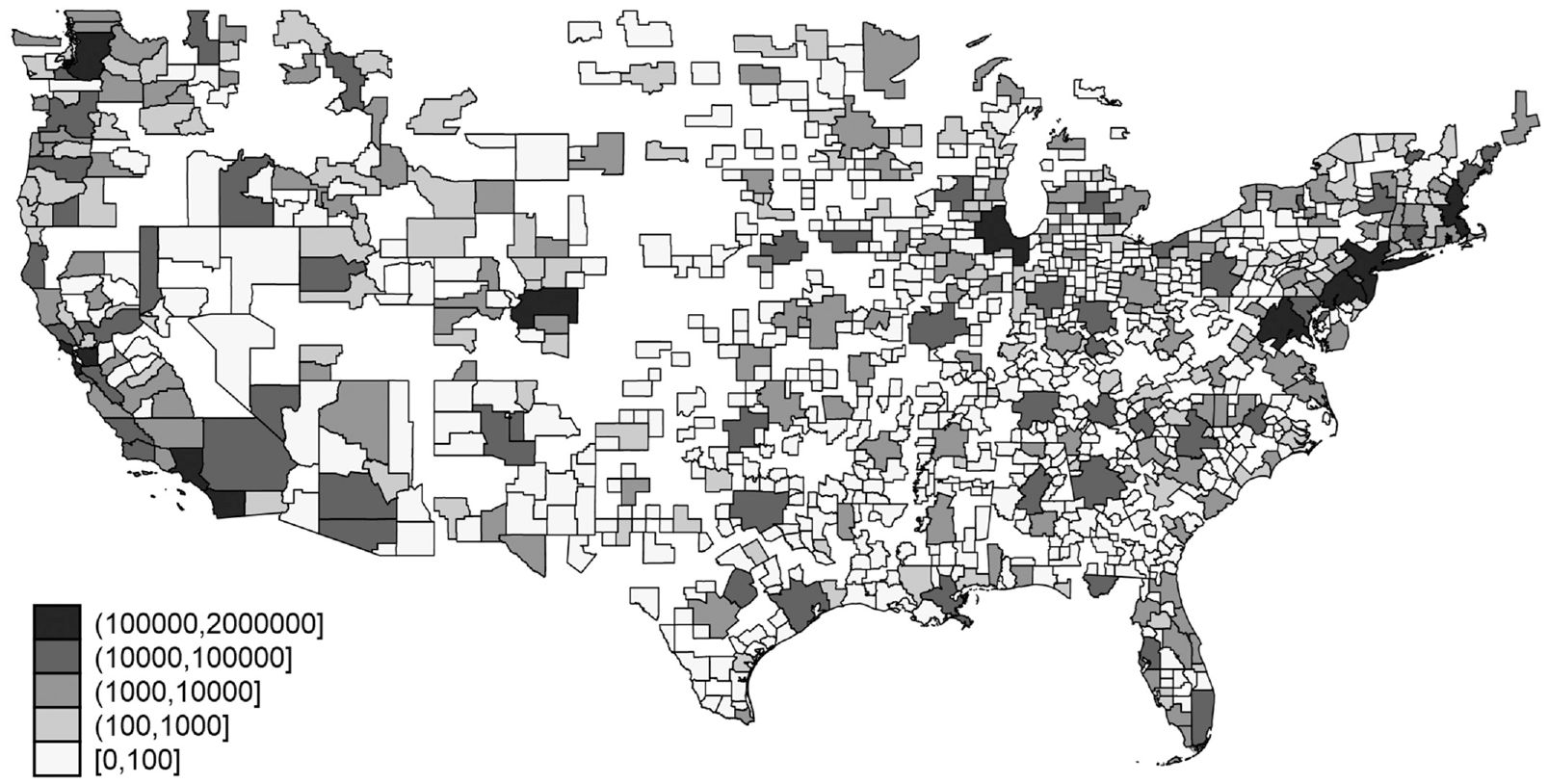
Total Size of Women’s March Protests by CBSA, 2017–2020
Given the broad nature of the Women’s Marches, our focal interest is whether these protests in communities across the U.S. resulted in local companies appointing more female directors to their boards. Board composition is a relevant outcome to examine since board appointments serve as an organizational practice that should evolve with updated information about the business environment. Here, the prominent corporate law firm Wachtell, Lipton, Rosen & Katz advised, “Board composition must be continually re-evaluated to ensure that the expertise and other qualities of the board as a whole are well-suited to the company’s ongoing challenges and strategy” (Katz and McIntosh, 2022: 2).
The traditional (uncontested) appointment of directors to U.S. boards typically follows a multistep process during which information from protests can be incorporated. First, the existing board decides to seek a new director. This decision may be prompted by the departure of an existing director, by a change in business needs (e.g., due to changing societal trends), or by recognition that the board could benefit from greater diversity of thought or representation. Once the decision to hire is made, incumbent directors outline the profile of the newly desired director, for which the requirements can include skills, experiences, and/or demographic attributes. Then, directors from the board’s nomination committee search for potential candidates (often with the help of an advisory firm) and select and meet with qualified candidates. Nomination committee members recommend a short list of candidates to the rest of the board’s directors, who meet and deliberate to finalize the candidate to nominate for shareholder election. Finally, the name of the board-recommended director candidate is submitted to shareholders for an approval vote (usually a rubber stamp vote) at the annual shareholders meeting. For example, in early April 2019, Facebook’s board nominated Peggy Alford, who was subsequently approved to join the board at the company’s annual shareholder meeting that May; similarly, in late February 2019, Boeing nominated Nikki Haley, who was approved in late April.
The Women’s March street protests could potentially influence director appointment at any step in this hiring process (Fernandez-Mateo and Fernandez, 2016). A board’s discussion of the protests could influence the company’s initial decision to hire (e.g., the board is motivated to hire for the explicit purpose of increasing board gender diversity), the selection of candidates (e.g., the board prioritizes female gender as one desirable candidate attribute), and the interview process (e.g., the board strengthens its messaging with candidates regarding the firm’s interest in diversity goals).
Directors would not need to live in the same community in which the protest and their company’s headquarters are located for the Women’s Marches to influence their recruitment decisions. Directors are likely to monitor news about events taking place in the company’s headquarters region, and since most protests in our sample happened in larger cities, major protest events would likely be covered by national and regional media. In addition, geographically distant directors may pick up information about protests from other directors during board meetings, such as from the company’s CEO, who typically resides in the local community and has substantial influence on the director selection process (Westphal and Zajac, 1995; Duchin and Sosyura, 2021), or from the 32 percent of U.S. outside directors who live within 60 miles of the company’s headquarters (Alam et al., 2014).
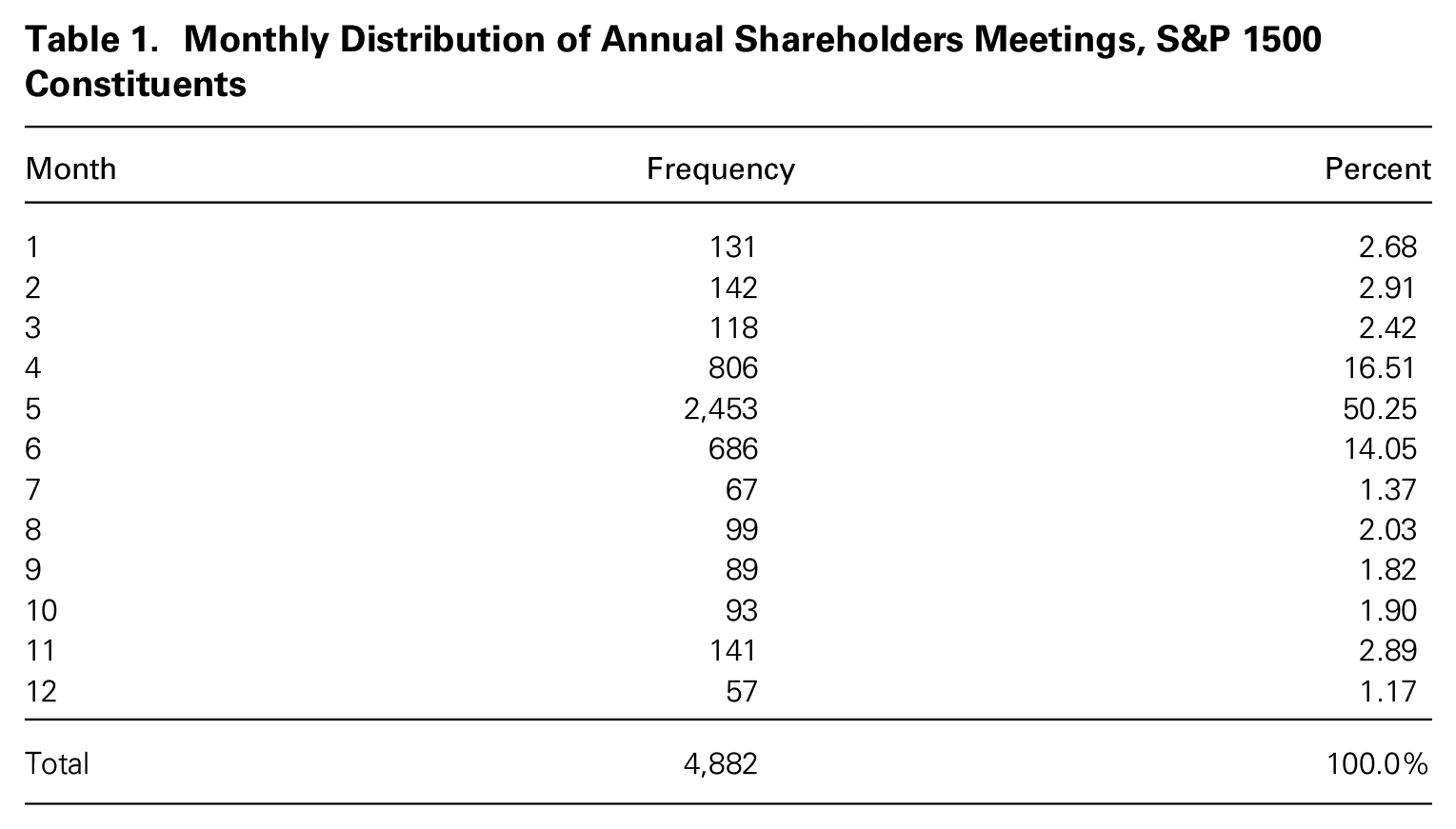
The timing of the Women’s March protests in relation to the annual director appointment process varied across community locales and companies. Though some protests occurred throughout the year, the largest and most significant Women’s Marches were typically held each January. As Table 1 shows, around 80 percent of firms in the S&P 1500 typically hold their annual shareholders meeting, when new directors are formally elected, in April (16.5 percent), May (50.3 percent), or June (14.1 percent). Hence, in most cases, a four-month gap exists between protests and new director elections. We interviewed director recruitment experts to better understand how protests could affect elections within this time frame. We were told that the recruitment timeline can vary widely: a challenging search, with stringent requirements that greatly narrow the field of candidates for a new directorship, could take up to nine months, but in most cases a recruitment firm typically can “get it done in 2–3 months.” Asked about this timeline, the recruitment experts we spoke to agreed that a Women’s March in January could influence various stages of the director hiring process preceding an annual shareholder meeting in May.
Monthly Distribution of Annual Shareholders Meetings, S&P 1500 Constituents
Data and Sample
To obtain data on street protests, we drew on a unique dataset collected by the Crowd Counting Consortium (CCC), which documents the size of activist crowds in the U.S. from marches, strikes, street protests, and other events. Updated every two weeks, the data come from multiple sources, including news outlets, search engines, organization websites, police reports, and social media sites (Fisher et al., 2019). Compared with a strict media-based approach to assessing protest size, using multiple data sources can reduce concerns about media selection biases and provide better coverage of small protest events (Earl et al., 2004). The CCC dataset provides the time, location, topics, and scale of street protests in the U.S. This dataset yields 61,214 total protest events in the U.S. from 2017 through 2020, which defines our sample window. We consolidated these protest data at the level of a community defined by core-based statistical areas (CBSAs) in order to investigate the influence of protest size on companies headquartered in those communities.
We collected information on corporate directors from the Institutional Shareholders Service (ISS) Director database, which provides demographic information about directors of firms in the S&P 1500 index. S&P 1500–listed firms provide a fitting sample for two reasons. First, covering approximately 90 percent of the U.S. equity market in terms of market value, and comprising both small and large capitalization companies across all major sectors, S&P 1500 constituents represent the broader population of major public corporations, aiding in the generalizability of our findings. Second, because of the S&P 1500 index’s prominence, financial and non-financial data for firms in the index are widely available, allowing us to construct a fairly balanced and complete sample over the period for which we have protest data.
Remaining data came from multiple sources, including firm financial data from Compustat; CSR data from MSCI KLD; state-level election results from Ballotpedia, an online political encyclopedia; organizational diversity climate data from Glassdoor, a website that collects reviews from employees anonymously; CEO characteristics from Execucomp; state salary history ban legislation from the University of California, Irvine School of Law; shareholder resolutions from Insightia; firm media coverage from RavenPack News Analytics (RPNA); and corporate sexual harassment events from Borelli-Kjaer, Moehl Schack, and Nielsson (2021). To combine data from different sources, we used crosswalks from the National Bureau of Economic Research (NBER) and the U.S. Department of Housing and Urban Development. These crosswalks allowed us to connect the locations of corporate headquarters (by zip code) to the locations of protests (in Federal Information Processing Standards codes) and aggregate the firm–protest dataset to the CBSA level.
Our sample collection started with 1,362 unique S&P 1500 firms that appear in both the ISS and Compustat databases. Building on prior research on community embeddedness (Marquis, Glynn, and Davis, 2007; Tilcsik and Marquis, 2013), we define a firm’s local community as the CBSA in which the firm’s headquarters are located. CBSAs represent geographic areas that link workplaces and residential neighborhoods through common commuting routes. Since CBSAs must have an urban center with more than 10,000 residents, some counties in the U.S. do not belong to any CBSA, and thus firms located in those counties are excluded from our sample. After removing these firms (18 in total) and those with missing data for other variables (5 in total), we were left with 1,339 firms. Thus, the final sample consists of 4,882 firm–year observations for 1,339 firms.
Dependent Variable
Following Knippen, Shen, and Zhu (2019), our dependent variable, Appointment of new female directors, is a dummy variable coded 1 if the firm appointed at least one female director in the focal year and 0 otherwise. We used a dummy variable rather than the count of new female directors because only 4.3 percent of observations in our sample included more than one new female director appointment in a given year and because we are interested in the firm’s likelihood of response rather than the level of response.
Independent Variables
Our focal independent variable is Feminist protest scale, which is a time-varying measure that captures the annual number of participants in the Women’s March protests in the CBSA where a firm is headquartered, as a function of the local population. We counted the total number of Women’s March protestors from month n–12 to month n–1, where n represents the month of the annual shareholders meeting of the focal firm. When there were multiple protest events in a CBSA, we calculated the total number of protestors in all events. Our assumption is that while most CBSAs experienced a certain level of mass mobilization, protests with more participants provide more information to firms. Because the incremental effect of increasing the size from 1,000 to 2,000 protestors is more important than increasing from 51,000 to 52,000, we took the natural log of the size of the protest. The protest size equals 0 if there is no protest event in the local community in the 12-month window.
To capture protest scale at the community level, we divided the natural logarithm of the number of participants in local Women’s March protests by the natural logarithm of population in the community. We used this measure rather than the number of protest participants divided by CBSA population because the latter is highly skewed. Additionally, as shown in Figure A1 in our Online Appendix, logged protest participants is highly correlated with logged population, indicating that our measure effectively accounts for the effect of population on the ease of organizing protests. As discussed below, we also used two alternative methods to capture protest scale. First, we used the natural logarithm of protest participant count without accounting for the size of the local population. Second, we regressed the raw population and year fixed effects on the log-transformed number of participants in local protests and used the residual as a measure of population-adjusted protest scale. In both cases, our results remained similar when using these alternative methods to capture protest scale.
Following past research on mass mobilization (Ferguson, Dudley, and Soule, 2018) and community embeddedness (Marquis and Tilcsik, 2016), we constructed protest scale at the CBSA level rather than the city level since CBSAs more accurately capture communities of business and people, or sub-populations linked through economic and social ties (Marquis, Glynn, and Davis, 2007). For instance, executives in St. Paul, Minnesota are likely to have observed a Women’s March in Minneapolis, a neighboring city, and to perceive it as a local event; however, as St. Paul and Minneapolis are different cities, a protest in Minneapolis would not be considered local if we constructed our dataset at the city level and not by CBSAs.
Because the CCC collects data on the number of protest participants from multiple sources, the dataset includes both low and high estimates of the size of each protest and an estimated mean size, which we used as our focal measure. The CCC dataset does not report detailed information about the size of protests for 30 percent of the Women’s March protests, due to information unavailability. Most (85 percent) of the protests that lack the protest size information are covered by a single information source and are typically not covered by any news media or police report. Because these protests are often very small (which we verified manually) and unlikely to be noticed by business leaders, we replaced these missing values with zeros. The findings are similar when we used the bottom 10 percent of the reported protest size (i.e., 12 protestors) to replace the missing values for these events.
Moderating Variables
Conservative state
To test Hypothesis 2, we collected state-level results of the 2016 U.S. presidential election. As noted, in the U.S. states are often referred to as “blue” or “red” as a shorthand to identify whether the state’s dominant political ideology is liberal, aligned with the Democratic (blue) party, or conservative, aligned with the Republican (red) party, respectively. Just as the general U.S. public uses the blue/red dichotomy to understand a community’s preferences, business leaders use this dichotomy based on state-level election results as an indicator of their local institutional environment (Pe’er and Gottschalg, 2011). Therefore, in line with our theory, we used the state election results to capture each community’s dominant political ideology as conservative or liberal, where Conservative state equals 1 if most voters in the state voted for the Republican presidential candidate, Donald Trump, in the 2016 presidential election and 0 otherwise.
Gender diversity climate
To test Hypothesis 3, we generated an index of each firm’s diversity climate, using textual data from reviews on Glassdoor, a career intelligence website that allows employees to rate and write comments on their current or former employers. Data from Glassdoor have been used by organizational scholars to evaluate organizational culture and measure other workplace variables (e.g., Bermiss and McDonald, 2018; Cavicchini, Ferraro, and Samila, 2021; Deeds Pamphile and Ruttan, 2022). Using five-point rating scales, employees can evaluate to what extent they are satisfied with a firm’s working conditions, including work/life balance, culture and values, and diversity and inclusion (D&I). Employees can also write textual reviews about the pros and cons of working at a firm.
Intuitively, the average D&I rating reported on Glassdoor would best capture each firm’s diversity climate; however, Glassdoor began collecting and reporting these data only in late 2020, which overlooks most of our sample. Therefore, using the D&I rating available at the time of our study (late 2020 to 2021), we used the wordscore method (see Laver, Benoit, and Garry, 2003 for more details) to generate diversity climate ratings from textual reviews covering our entire study time period. The wordscore method is a supervised machine learning model widely used in political science and other social science domains (Cao, Ash, and Chen, 2020; Monsen, 2022) to extract policy positions from textual data. In our setting, the wordscore method allows us to generate a model of how textual reviews predict D&I ratings and to apply the model to reviews preceding 2020. The wordscore method is a fully automated data generation technique. It allows us to derive firm diversity climate scores from the texts of 844,306 employee reviews, without requiring assumptions about which words are relevant.
To apply the wordscore method, we first isolated all D&I ratings and the associated textual reviews reported on Glassdoor in 2021 (263,564 reviews in total). We then removed all punctuation, numbers, stopwords (i.e., a set of commonly used words in a language, e.g., “you,” “yet,” “and,” “with”), and low-frequency words (i.e., those that occurred in fewer than ten reviews) from the reviews. Second, we generated a model of how the text in reviews predicts D&I ratings, using the review data from the first step as the training set in the supervised machine learning model. We trained the model separately for words in the Pros and Cons sections because the same word can have opposite meanings in these different sections.
We then put the employee-provided D&I ratings (i.e., reference score) and words in reviews written by the same employees (i.e., reference text) into the algorithm. Based on this information, the algorithm automatically calculated the word scores for all words mentioned by reviewers in the training set. The word score for a word reflects the extent to which that word more frequently occurs in text with a high reference score. For instance, if the word “divers*” is three times more frequent in one review (D&I rating = 5) than in another review (D&I rating = 1), the word score generated from those two reviews is (1/4) × 1 + (3/4) × 5 = 4. Next, the model applied the word scores to the new texts that were never rated (i.e., reviews that were written before late 2020). The model took the mean of the scores of words in the new texts, weighted by their frequency. Figure A2 in the Online Appendix presents the word scores for diversity-related words. As highlighted in red, diversity-related words are strong predictors of D&I ratings. For instance, the word “divers*” has an above-average word score in the Pros section and a below-average score in the Cons section, which means it decreases the predicted D&I rating when it appears in the Cons section and increases the rating when it appears in the Pros section.
Third, we validated the model using the 2021 reviews and ratings. We applied the models in the second step and generated predicted D&I ratings for all reviews. We averaged the predicted scores generated from the Pros and Cons sections to compute the final predicted ratings. Then, we calculated the firm–year level average D&I rating. For firms with more than ten reviews in 2021, the text-generated rating is highly correlated with the actual average rating (r = 0.75). These results suggest that the wordscore method has strong predictive power in our context. Based on these results, we applied the trained model to all reviews from 2017–2020 to backfill Diversity climate as the predicted D&I rating for each firm–year based on the firm’s textual reviews in that year. We replaced the measure with the mean value of the sample if the focal firm was not listed on Glassdoor or if the firm received less than three reviews per year (21 percent of the total observations). Our findings remained similar when we dropped those firms from the sample.
Control Variables
We included control variables at the firm, board, and CBSA levels. At the firm level, we controlled for Firm size, measured as the natural logarithm of total assets, and ROA (return on assets), measured as net income divided by total assets. We controlled for Past media attention to firm, measured by the log-transformed number of news articles about the firm in 2016. Next, we controlled for each firm’s CSR. Using data from KLD, we measured this variable by subtracting the number of concerns in the CSR subdomains from the number of strengths (Hubbard, Christensen, and Graffin, 2017). We omitted the diversity CSR subdomain because it captured leadership diversity, which is controlled for by our other variables. As KLD had not updated its CSR data past 2018, we treated this variable as time-invariant by averaging the CSR score during 2014–2018. We also included dummy controls for whether the firm had a Female CEO and whether it experienced any Sexual harassment accusations, using data from Borelli-Kjaer, Moehl Schack, and Nielsson (2021). Because firms may appoint female directors as a result of shareholder activism, we also controlled for Diversity shareholder resolutions, calculated as the number of shareholder resolutions in year t–1 with pro-diversity demands.
At the board level, we controlled for Board size, average Age of directors, and average Tenure of directors (because boards with older and longer-tenured directors are more likely to need new directors). We further controlled for the percentage of Racial minority directors and the percentage of Incumbent female directors on the board. As firms tend to appoint new female directors to replace departing directors, we included Male director turnover and Female director turnover to control for whether any incumbent directors departed the board in the focal year. We controlled for Board centrality, measured as the number of distinct firms in which a focal firm’s directors also hold board appointments (Mizruchi, 1996). Finally, to capture the general trend of appointing more female directors over time, Female director percentage (S&P1500) controlled for the average percentage of female directors in all firms in our sample. All firm- and board- level control variables, except CSR and Past media attention, were lagged by one year.
As our main variables are at the CBSA and state levels, we also included several controls on both levels that update on an annual basis. We used CBSA fixed effects to control for stable CBSA-level factors. We controlled for California Bill 826, a law passed in 2018 that mandates a quota for female directors. This variable equals 1 for firms headquartered in California after 2018 and 0 otherwise. Additionally, a dummy for State salary history ban controlled for being headquartered in a state that passed a law prohibiting employers from asking job applicants for their salary history. Considering the time it takes for firms to respond to newly passed laws, this variable is coded 1 if the law has been passed in a state for more than two months and 0 otherwise.
Given our theoretical focus on information about protest scale, we controlled for information from other sources that could raise business leaders’ awareness of protests, using Prominent media coverage of protests and Other media coverage of protests. Each variable captures the log-transformed number of articles covering feminist protests in the local community, from prominent or other media sources. Prominent media sources are media outlets recognized by more than 80 percent of Americans, according to a survey conducted by the Pew Research Center (Mitchell et al., 2014). 2 As protests with more-focused goals can be more impactful (Wang, Piazza, and Soule, 2018), we included Multiple protest issues to capture the percentage of Women’s March protests with more than one protest issue, weighted by protest size. Moreover, we controlled for the Size of distant feminist protests, which is the natural logarithm of the total number of Women’s March participants outside the focal community in the past 12 months. 3 Finally, we controlled for Non-feminist protest scale, defined as the protest scale for all street protests other than the Women’s March protests. As we did for our main predictor variable, we took the natural log of the size and aggregated the number of protestors over the 12 months preceding each firm’s annual shareholders meeting, divided by the logged local population.
Estimation Technique
We used linear probability models (LPM) with random effects to estimate a firm’s likelihood of appointing new female directors. Though we found similar results using non-linear models, such as logistic regressions, which we discuss below, we favored LPM because interactions in non-linear models are notoriously difficult to interpret (Hoetker, 2007; Breen, Karlson, and Holm, 2018). As noted, we included industry and CBSA fixed effects to control for time-invariant industry and community-specific heterogeneity. We also included year fixed effects separately for firms in conservative and liberal states because temporal trends may impact the relationships of interest, and these trends may differ among states by political climate. We did not include firm fixed effects because our independent variable, Feminist protest scale, is exogenous to the firm after accounting for community fixed effects and, hence, not influenced by firm-specific unobserved factors. We clustered standard errors at the CBSA level, as this represents the level of aggregation in which firms are nested and our independent variable is measured (Hansen, 2007; Abadie et al., 2023).
Results
Prior to discussing our regression analyses, we report descriptive statistics on female director appointments. In January 2017, when the Women’s March protests started, only 18 percent of the incumbent directors at S&P 1500 firms were women. However, the percentage of new female directors appointed increased over time and quickly accelerated from 2017. As shown in Figure 2, in 2017, 30.5 percent of new directors in the S&P 1500 were women, an increase from 25.2 and 24.4 percent in the years 2015 and 2016, respectively. By 2020, the percentage of new female directors had reached 44.1 percent. Table 2 provides descriptive statistics for the remaining variables. As demonstrated in the table, our independent variable, Feminist protest scale, exhibits a weak negative correlation with our dependent variable, Appointment of new female directors (corr = −0.001); however, this negative correlation can be attributed to two trends in the data: the tendency for protest scale to decrease over time and for the appointment of female directors to increase over time. Indeed, when we exclude the first year of the movement (2017) when protest crowds were largest and female directors fewest, the correlation turns positive (corr = 0.019). Similarly, including year fixed effects also reverses the negative relationship between the protest scale and female directors, turning it positive. While not the focus of our theorizing, this pattern is consistent with the initial wave of Women’s March protests spurring an enduring positive impact on the appointment of female directors at the national level over subsequent years.
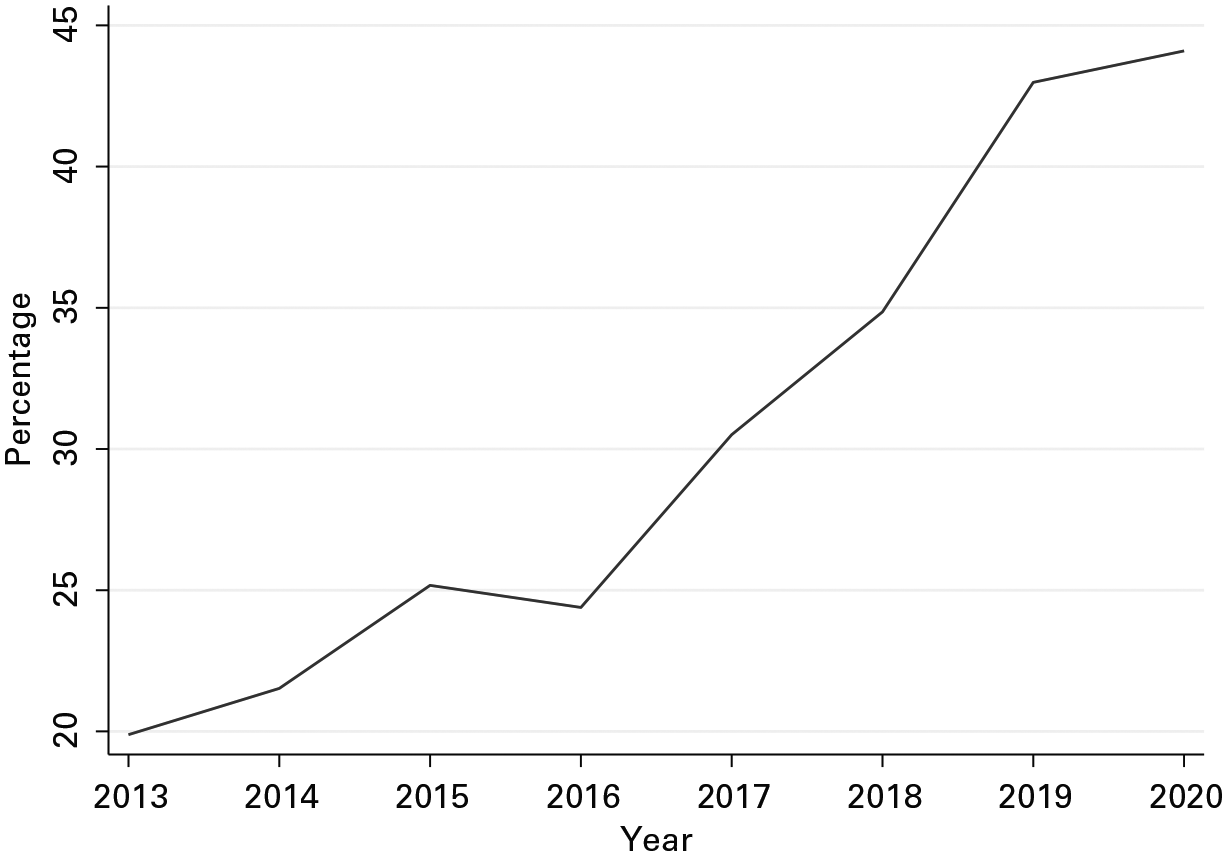
Percentage of New Directors That Are Women, S&P 1500 Constituents
Descriptive Statistics and Correlations*
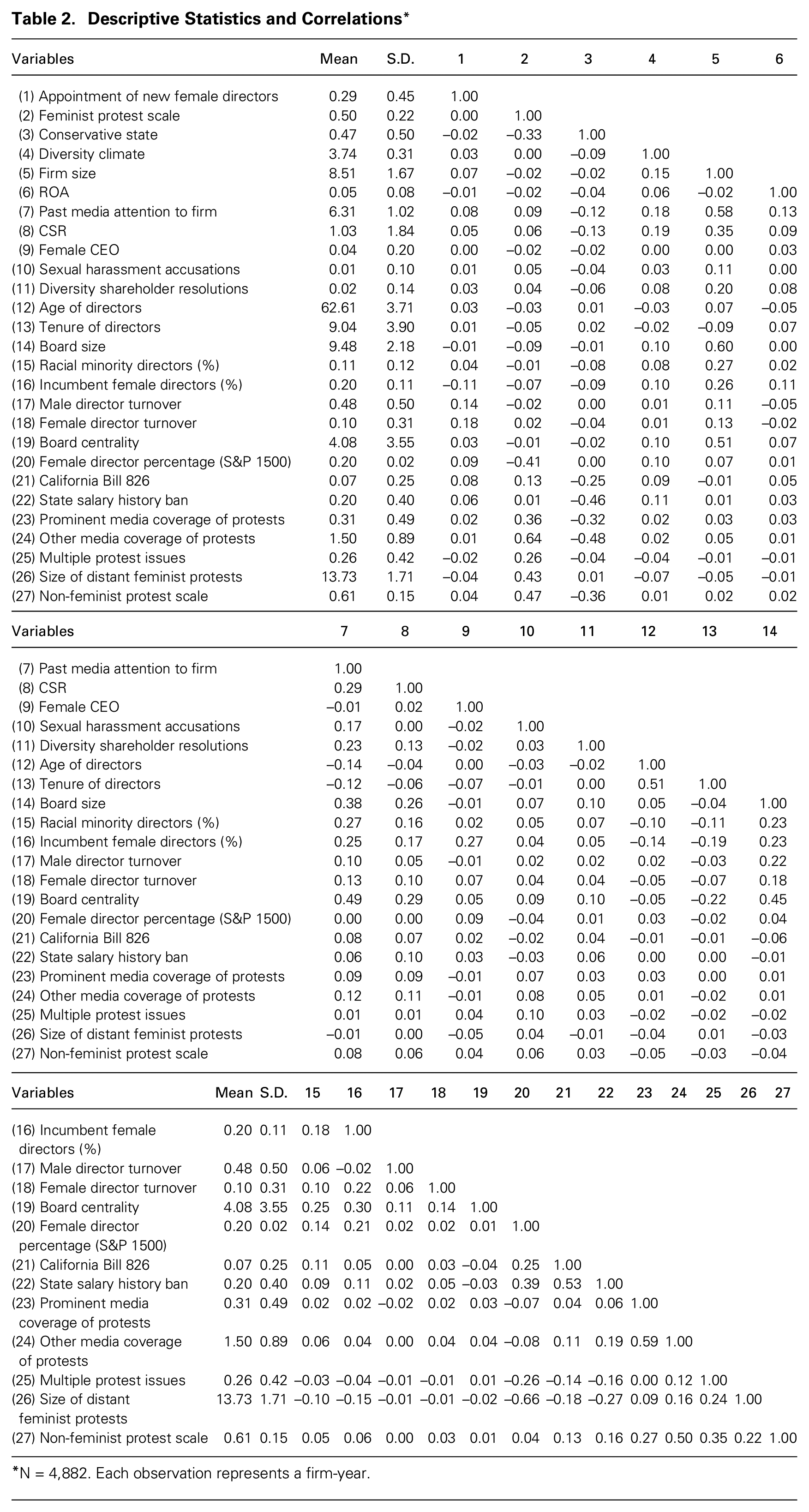
N = 4,882. Each observation represents a firm-year.
Table 3 presents the results of the LPM regression estimating the probability of new female director appointments based on the protest scale of Women’s Marches in local communities. Model 1 reports the baseline model with only the set of controls, which shows that Non-feminist protest scale is not significantly correlated with the likelihood of new female director appointments. Model 2 includes Feminist protest scale, our focal independent variable, without any controls. As hypothesized, the coefficient estimate is positive and highly significant (β = 0.174, p = 0.002). With the control variables added in Model 3, the coefficient for Feminist protest scale remains significant (β = 0.174, p = 0.007), indicating that local Women’s March protest scale is positively associated with the probability of firms in the community appointing new female directors, supporting Hypothesis 1. To gain more insight into this effect, we calculated the marginal effect based on the results from Model 3. When the relative number of Women’s March protestors in a community increases from its mean − 1 S.D. to the mean + 1 S.D. (from 0.277 to 0.714), the likelihood that locally headquartered firms add at least one new female director in a given year increases by 31 percent (from 24.8 to 32.5 percent). 4
Main Regressions Predicting New Female Director Appointments*
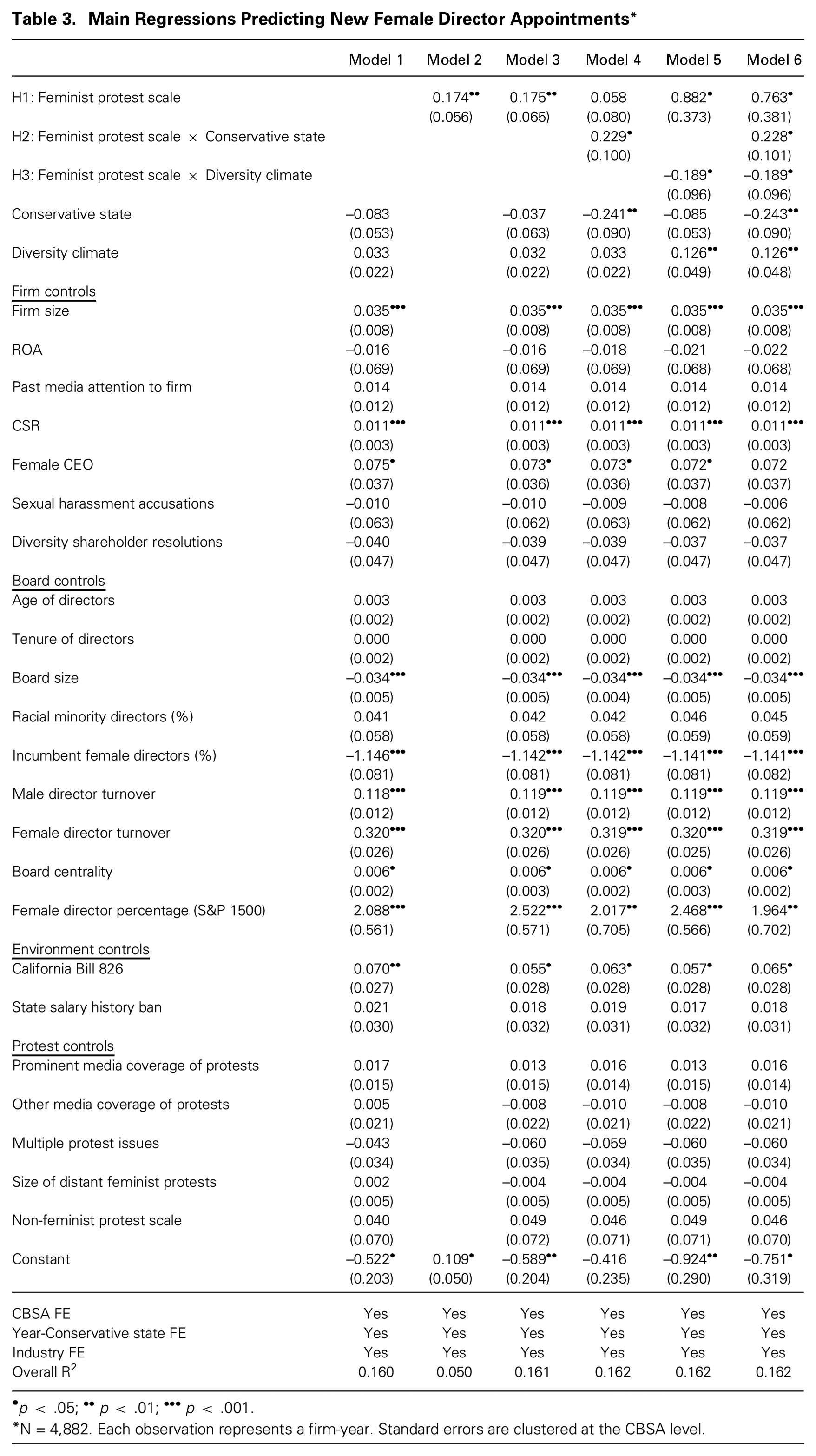
p < .05; •• p < .01; ••• p < .001.
N = 4,882. Each observation represents a firm-year. Standard errors are clustered at the CBSA level.
We tested Hypothesis 2 by interacting Conservative state with Feminist protest scale. As shown in Model 4, firms in conservative (red) states are more reactive to street protests compared to firms located in liberal (blue) states (β = 0.229, p = 0.023), supporting Hypothesis 2. As shown in Figure 3, in conservative states, indicated by the dotted line, when the scale of protest in local Women’s Marches increases from its mean − 1 S.D. to its mean + 1 S.D., the likelihood that locally headquartered firms appoint at least one new female director increases dramatically, by about 67 percent (from 18.9 to 31.5 percent). However, for the same change in protest scale, this effect is subdued in liberal states, as shown by the nearly flat solid line.
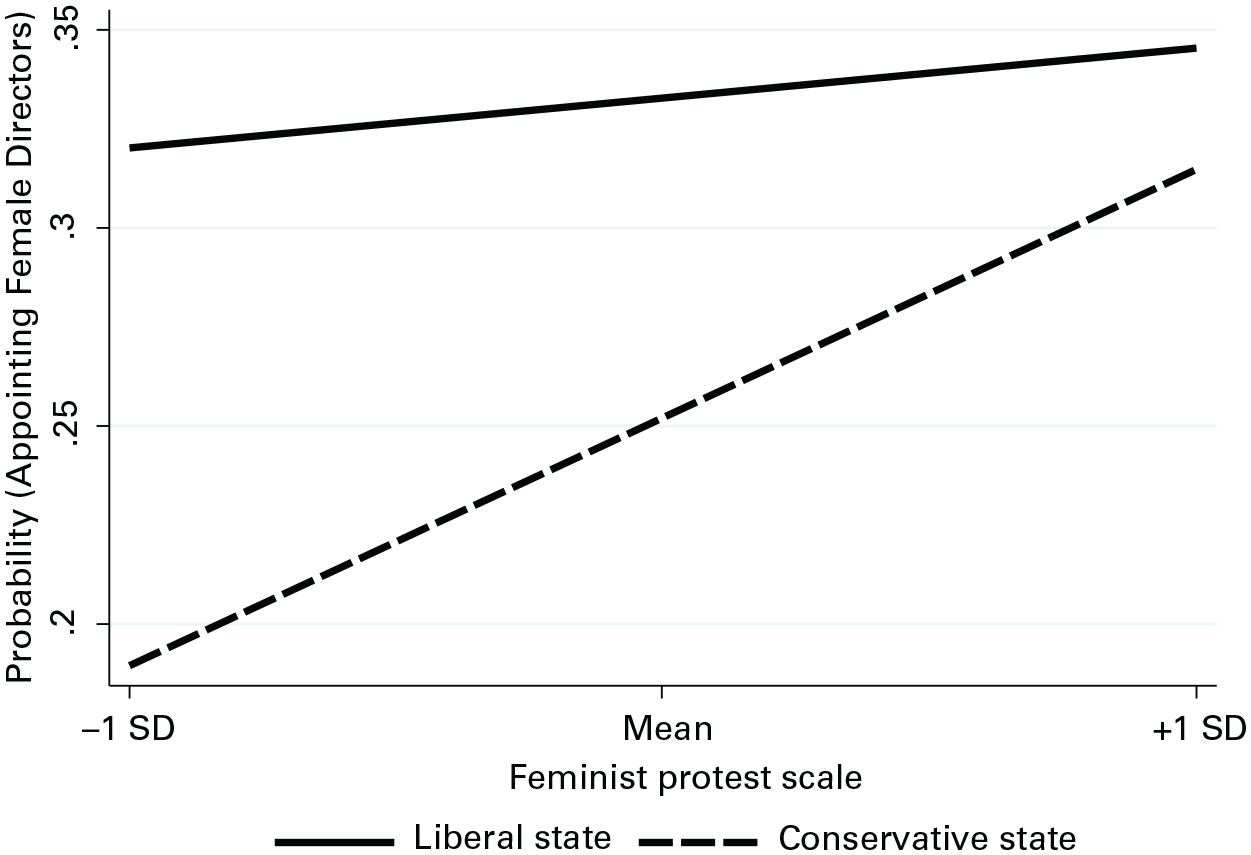
The Effect of Feminist Protest Scale on a Firm’s Likelihood of Appointing Female Directors in Conservative Versus Liberal U.S. States (for H2)
Hypothesis 3 suggests that having a strong internal organizational diversity climate will weaken the positive effect of the local Women’s Marches scale on the probability that firms in the community appoint new female directors. In support of this prediction, Model 5 shows that the interaction term Feminist protest scale × Diversity climate has a significant negative effect on the likelihood of adding new female directors (β = −0.189, p = 0.049). We plot these findings in Figure 4. As shown, the effect of the local protest scale is much stronger for companies with a weaker organizational diversity climate (mean − 1 S.D.), indicated by the upward steeply sloping solid black line, than for companies with a stronger organizational diversity climate (mean + 1 S.D.), indicated by the dashed black line. These results support Hypothesis 3: firms that are less internally aligned with the protest goals are more responsive to a local protest. Model 6 includes both interaction terms and further supports the prior results.
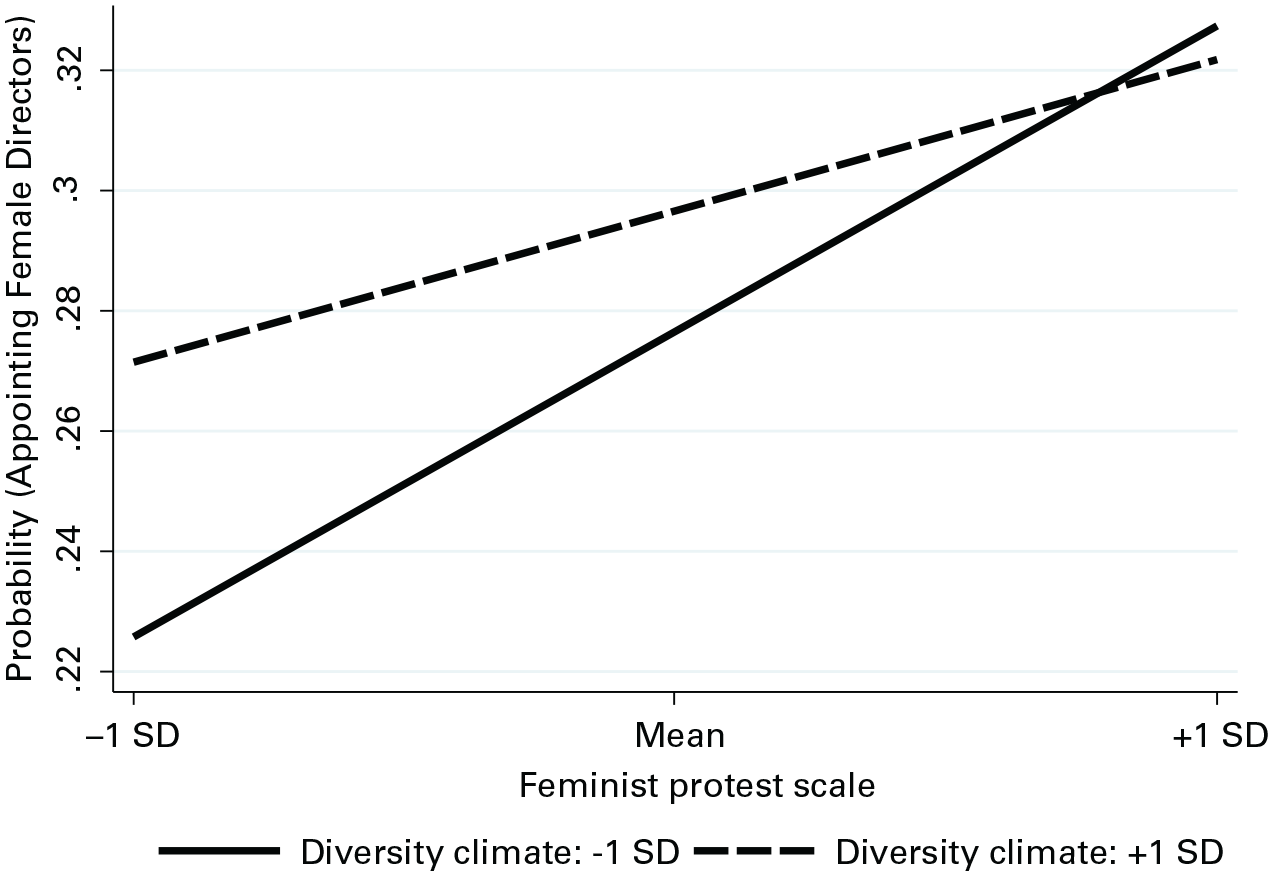
The Effect of Feminist Protest Scale on a Firm’s Likelihood of Appointing Female Directors at High Versus Low Levels of Organizational Diversity Climate (for H3)
Robustness Analyses
For our two moderating hypotheses, we used two additional measures that capture additional dimensionality of the focal constructs: internal organization-to-protest alignment and community-to-protest alignment. For our main test of Hypothesis 2, we measured community alignment by using a broad state-level blue/red dichotomy that we expect is salient to most U.S.-based business leaders but that likely overlooks nuanced differences in women’s rights between states that might inform these leaders’ priors; therefore, we also tested this hypothesis by using a granular measure specific to the topic of women’s rights. For Hypothesis 3, we measured organizational diversity climate as a reflection of each firm’s internal alignment with the Women’s March protest goals, but since business leaders may not be fully aware of employees’ perception of organizational climate, we also retested this hypothesis by using a more visible measure.
State gender parity score for Hypothesis 2
To provide a continuous measure of geographic alignment with the topic of women’s rights, we used a State gender parity score developed by the McKinsey Global Institute, based on publicly available data (Ellingrud et al., 2016). 5 This indicator was constructed using the average of ten sub-dimensions that capture state-level differences in men’s and women’s rights, including gender equality in work, essential services and enablers of economic opportunity, legal and political voice between men and women, and physical security. The score ranges from 0 to 1, where a score of 1 indicates complete parity between men’s and women’s rights in a state. As reported in Model 1 of Table A1, the coefficient of the interaction term Feminist protest scale × State gender parity score is negative and statistically significant (β = −2.386, p = 0.004). This result further supports our Hypothesis 2, which suggests that the positive effect of local Women’s Marches in a community on the likelihood that locally headquartered firms appoint female directors is stronger in regions where women are more disadvantaged compared to men.
Diversity sanctions for Hypothesis 3
Following prior research (Abebe, Jones, and Acharya, 2020; Heese, Pérez-Cavazos, and Peter, 2022), we used Violation Tracker, a database on corporate misconduct maintained by Good Jobs First, to collect data related to corporate diversity sanctions as a more visible measure of organizational misalignment. We sorted these data to identify all penalties under the category of “employment discrimination,” 94 percent of which are levied by the U.S. Equal Employment Opportunity Commission and Office of Federal Contract Compliance Programs; both organizations investigate complaints of job discrimination based on race, sex, religion, national origin, and disability. We computed Diversity sanction as the total amount (in dollars) of discrimination-related penalties received by the focal firm over the prior three years. 6 We took the natural log of this variable to reduce skewness. We also used the log-transformed number of penalties, and the results remained similar. The results are reported in Table A1. In Model 1, the coefficient for the interaction term Feminist protest scale × Diversity sanction is positive and statistically significant (β = 0.031, p = 0.004). The result further supports Hypothesis 3: firms are more likely to respond to large-scale local Women’s Marches by appointing new female directors when the firms have higher diversity sanctions or greater organizational misalignment with the protest goals.
Alternative models
We experimented with different models to see whether the results are sensitive to our use of linear probability models. As shown in Model 2 and Model 3 of Table A1, we found very similar results when using logistic regression.
Alternative measure of street protest scale
We also altered the construction of feminist protest scale to ensure that our measurement was not driving our results. First, we calculated the Size of feminist protests, which captured log-transformed protest size in the local community without considering the local population. As reported in Model 4 and Model 5 of Table A1, using this simplified measure, we obtained similar results to those in our main analyses. The only exception is H3, which is marginally supported (β = −0.011, p = 0.054). Second, we adopted a two-step approach to adjust protest size with local population. In the first step, we regressed local population and year fixed effects on the size of local feminist protests, using ordinary least squares regression, and calculated the residual as a population-adjusted protest size. In the second step, we used this population-adjusted protest size as our independent variable. As presented in Models 6 and 7, all of our hypotheses are supported at the 0.05 level, using this alternative measure.
Discussion
How do business leaders interpret and respond to local street protests that do not target the business sector? Answering this question is of utmost importance as protests continue to spread across communities in the U.S. and the globe. Building on the community embeddedness literature, our study offers a theory of cross-sector information spillover in which business leaders use information about the scale of street protests in their firms’ communities to gauge the changing relevance of a social issue for local community members. The information update that protests provide can motivate business leaders to make organizational changes consistent with the social issue being protested, in order to maintain their firm’s alignment with the community and to garner instrumental benefits from local stakeholders who likely approve of those changes.
We further developed our theoretical framework to account for two conditions that heighten business leaders’ likelihood of adapting their organizations following local street protests. First, we proposed that organizations located in regions historically thought to not prioritize an issue should be more responsive to protests on that issue. Protests in those less ideologically aligned locales should deliver more of an informational jolt by contradicting what business leaders previously assumed about the issue’s relevance to their community and by informing how organizational practices may need to be adjusted to maintain alignment with the community. Second, organizations least aligned with the social issue raised by a protest should also be more responsive because protests provide more of a wake-up call to these organizations’ leaders about their misalignment with the community and the need to do more on the relevant issue.
Our analysis of firms’ female director appointments after local Women’s March protests provides support for our theory: the larger the scale of local street protests in a community, the more likely corporations headquartered in that community were to subsequently add female directors. This was particularly true for firms located in regions with values less aligned with the protest goals and for firms less internally aligned with the protest goals.
Contributions to Research on Social Movements and Markets
This article contributes to the social movements literature in several ways. First, we contribute to the literature on the spillover effects of social movements. An emerging theme in this research is that activists may not only affect the practices and policies of organizations directly targeted by activists (Eesley and Lenox, 2006; Walker, Martin, and McCarthy, 2008; Soule, 2009; King and Pearce, 2010; Hiatt, Grandy, and Lee, 2015; McDonnell and Cobb, 2020) but also create unintended impacts on organizations not targeted (King and Soule, 2007; Vasi and King, 2012; Yue, Rao, and Ingram, 2013; Georgallis and Lee, 2020; Fremeth, Holburn, and Piazza, 2022). For the most part, these spillover effects of activism have been assumed to depend on how observers think of themselves in relation to targeted firms, either as stakeholders or peer firms. Yet, when no firm is targeted and issues are instead raised by protestors in the street, such a comparison process is unlikely to arise, limiting the potential applicability of existing theory. Accordingly, we developed a theory focused on information that protests can convey to business observers about an issue’s relevance to the community at large, which can shape those business leaders’ future decisions.
Our theory development also elucidates business leaders’ motivation to respond to protest-based information regarding changes in social issue relevance to their communities. Drawing on the community embeddedness literature, we show why business leaders have both instrumental and intrinsic motivations to react to newly revealed social issue relevance. By explaining the content of information conveyed by community street protests and why business leaders are motivated to react to it, we believe our study provides an important starting point for a new line of research on how local street protests that do not target businesses can influence corporate decision making, taking sentiment expressed on the street into the boardroom.
Our findings also highlight the importance of local community orientations for understanding the effects of protests on business. While previous studies (Yue, Rao, and Ingram, 2013) found that bystander organizations evaluated protests against their peers based on characteristics of the focal organizers, the content of protests, and the target organizations’ responses, less is known about how the community or region itself matters. Our article documents that street protests are more informative to organizations when the issue raised contrasts with the region’s historical stance on that issue. Scholars can further explore this line of theorizing, on how executives filter their interpretations of protests via community attributes, for both diffuse street protests and business-targeted activism.
We also contribute to research on corporate receptivity to activism. Business-targeted activism and diffuse street protests provide different types of information and exert different forms of pressure on organizations: while business-targeted activism tends to signal the preferences and goals of specific social movement organizations, mobilization in the street can reflect broader but more subtly evolving local community undercurrents that organizations may otherwise overlook absent a protest. Moreover, whereas business-targeted activism coerces a firm to respond, street protests provide more of a voluntary opportunity to respond and get on top of a social issue. As a result of their differences, these two forms of activism should motivate responses from different types of firms. For business-targeted activism, firms are more likely to reconcile with activist goals if they are aligned with the goal in the first place, as indicated by shared ideology (Briscoe, Chin, and Hambrick, 2014) or the organizations’ prior prosocial claims (McDonnell and King, 2013). However, the logic is different for street protests that do not directly target business. Although misaligned firms may be less likely to value activists’ goals, they have stronger motivation to react to protests because the information the protestors reveal attunes those organizations and their leaders to the issue’s significance.
Contributions to Research on Corporate Governance and Local Community
Our study contributes to research on corporate governance. Although many governance researchers have studied the antecedents of demographic diversity in the boardroom, including organizational predictors (Hillman, Shropshire, and Cannella, 2007) and industry peer pressure (Knippen, Shen, and Zhu, 2019), we know little about whether local events at the community level can impact boardroom diversity and corporate governance. Of particular relevance, a recent study by Bednar, Westphal, and McDonald (2022) found that media coverage of the #MeToo social movement can influence how incumbent directors evaluate prospective director candidates. In addition, McDonnell and Cobb (2020) found that social activism directly targeting firms can prompt the departure of directors who hold similar values as those of the activists. However, the effect of diffuse street protests on corporate governance remains unclear. Our study suggests that local community protest events, specifically the scale of those events, can serve as important information sources that business leaders use to inform board-related decisions. A director recruitment expert at Korn Ferry described such protests as a “wake-up call . . . a powerful reminder that society is not ok with the status quo.”
Our study also sheds light on the pathways through which community events shape the behavior of corporations. As Tilcsik and Marquis (2013: 135) argued, “communities shape organizations not simply because of their enduring features but also because punctuating events are geographically distributed.” Our research shows how street protest, as a rising phenomenon, is a critical type of local event that can reveal the shifting relevance of social issues to communities and, under certain circumstances, can influence corporate decision making.
Directions for Future Research
Although the U.S. Women’s Marches provide a fitting context to test our theory, they represent only one social movement and national context. Future research could investigate business responses to other diffuse street protests, including the 2023 French pension reform strikes, 2020 Black Lives Matter protests, and Indian farmers’ protests. Future research should also investigate how countermovements, which were rare for the Women’s Marches, influence firms’ responsiveness to street protests.
The mechanism underlying our theory suggests boundary conditions for its operation. For example, firms might not respond to the information spillover from street protests if they heavily rely on a single supplier or buyer, which limits instrumental benefits from aligning to more-generalized community issue relevance. Similarly, we might also expect a muted response for firms whose core business and/or stakeholders are closely linked to a particular position on the protested social issue, as was the case anecdotally for health care companies observing local antimasking protests during the COVID-19 pandemic.
The mechanism in our theory also assumes that firms are socially embedded in the geographic location of their headquarters. While previous theory and research on community embeddedness (Marquis, Glynn, and Davis, 2007) support this assumption, business leaders may also take into account the locations of their other operations. For example, firms that have substantial operations in the community where they are also headquartered might be even more responsive to local street protests. While we did not find evidence of this when using http://Glassdoor.com data to capture the geographic locations of a firm’s employees, future research can explore how factors shaping a firm’s community embeddedness affect its protest response.
The protest effect we found on board directorates also raises interesting questions about the downstream consequences of such responsiveness to activism and the potential imprinting of the social issue on firms. Do female directors appointed under the apparent influence of Women’s March protests perceive a different mandate for their role as business leaders, compared with other directors? Do these appointments lead to further changes in the structures, policies, and practices of the corporation itself? This is particularly interesting to consider since our theory and findings indicate that the least-aligned firms are most influenced by this activism-as-information effect. From the perspective of a wider field- or sector-level reform process, this finding suggests that street protests could play a special role in spurring change among the most inert and intransigent corners of the organizational landscape.
Supplemental Material
sj-pdf-1-asq-10.1177_00018392231199717 – Supplemental material for Corporate Boards with Street Smarts? How Diffuse Street Protests Indirectly Shape Corporate Governance
Supplemental material, sj-pdf-1-asq-10.1177_00018392231199717 for Corporate Boards with Street Smarts? How Diffuse Street Protests Indirectly Shape Corporate Governance by Muhan Zhang, Forrest Briscoe and Mark R. DesJardine in Administrative Science Quarterly
Footnotes
Acknowledgements
We thank associate editor András Tilcsik and three anonymous reviewers for helping us improve this paper in crucial ways. We furthermore thank Donald Hambrick, Jue Wang, John McCarthy, and Kate Odziemkowska for helpful feedback and discussions. Earlier versions of this paper were presented at Pennsylvania State University, MIT Institute for Work and Employment, Madrid Work and Organizations Workshop, the Alliance for Research on Corporate Sustainability Annual Conference in Washington DC, and the Academy of Management annual meeting in Seattle. We acknowledge research funding through a Smeal Sustainability Research Grant and Smeal Small Research Grant.

1
Though our empirical setting is situated in the U.S., which leads us to theorize about red states and blue states, our theory may potentially generalize to any jurisdictions in which competing sociopolitical values exist.
2
These media outlets are CNN, ABC, NBC, CBS, Fox News, USA Today, MSNBC, PBS, The New York Times, The Wall Street Journal, and The Washington Post.
3
In additional analyses to further confirm that our findings are not driven by country-wide protest intensity, we interacted this control variable with our two moderators. Our hypothesized H2 and H3 effects retained their significance in the presence of these interactions. We also constructed an alternative distant-protest measure by averaging the same variable used for our independent variable across all localities outside the focal CBSA. This alternative method of variable construction did not alter our findings, either.
4
For example, in a community with 500,000 residents, the number of protestors would increase from 37 to 11,723.
5
These state-level state parity scores and sub-indicators can be found on page 19 of the referenced report.
6
For firms that never appear in Violation Tracker (36.7 percent of our sample observations), we assumed they never received any discrimination-related penalties because fines of substantial size are likely to be detected by Violation Tracker and because we found from additional analysis that the firms missing from Violation Tracker had much higher CSR scores than did firms with violations in Violation Tracker, suggesting the missing firms are more responsible and likely to have fewer (or no) violations. For these firms, we assigned a value of 0 for discrimination sanctions, though our results remain when we excluded these firms from the sample.
Authors’ Biographies
References
Supplementary Material
Please find the following supplemental material available below.
For Open Access articles published under a Creative Commons License, all supplemental material carries the same license as the article it is associated with.
For non-Open Access articles published, all supplemental material carries a non-exclusive license, and permission requests for re-use of supplemental material or any part of supplemental material shall be sent directly to the copyright owner as specified in the copyright notice associated with the article.
