



Abstract
While a positive view of calling has been ubiquitous since its introduction into the literature over two decades ago, research remains unsettled about the extent to which it contributes to various aspects of the good life: an optimal way of living well via worthwhile endeavors. Further, scholars have identified two conceptual types of calling, marked by internal versus external foci; yet their differential impact on outcomes indicative of the good life, such as eudaimonic and hedonic well-being (characterized by the experience of purpose and meaning versus pleasure and happiness, respectively), is unknown. Through a meta-analysis of 201 studies, we provide the first systematic review focused on these two fundamental theoretical issues in the calling literature: how strongly related callings are to outcomes in the domains of work and life and which type of calling (internally or externally focused) more strongly predicts these outcomes, if either. We find that callings more strongly relate to outcomes indicative of the good life than recently argued. We further find that callings are more strongly linked to work than to life outcomes and to eudaimonic than to hedonic outcomes. The two types of calling converge in being associated with many similar outcomes, but they show some divergence: internally focused callings are more positively related to hedonic outcomes and less positively related to eudaimonic outcomes, relative to externally focused callings. This finding supports a view of callings as hierarchically structured, with a higher-order calling factor composed of two correlated yet distinct lower-order calling types. Integrating our meta-analytic findings with relevant literatures, we propose a theoretical model that addresses psychological and social need fulfillment through which different types of callings contribute to the good life.
People are driven to find meaning in their lives, with the search for meaning being a key part of the human experience (Frankl, 1959; Baumeister, 1991). Some people find meaning in life through engaging in personally and/or socially significant work (Pratt and Ashforth, 2003; Rosso, Dekas, and Wrzesniewski, 2010; Michaelson et al., 2014). Work can provide different types of meanings, such as by offering opportunities to earn money or achieve organizational or occupational advancement, or as a fulfilling end in itself (Bellah et al., 1985; Wrzesniewski et al., 1997). Scholars and practitioners alike have been captivated by the search for a “central perspective” for understanding deeply meaningful work (Lepisto and Pratt, 2017: 101)—that is, when people experience their work as a calling (e.g., Wrzesniewski et al., 1997; Hall and Chandler, 2005; Duffy and Sedlacek, 2007; Bunderson and Thompson, 2009; Dobrow and Tosti-Kharas, 2011). Part of calling’s appeal comes from its potential to give life positive meaning, a hallmark outcome of the good life (e.g., Park and Peterson, 2009; Michaelson, 2021). While the literature on the good life varies considerably, resisting precise definitions, the term generally refers to an optimal way of living well via worthwhile endeavors (e.g., Ciulla, 2000; Aristotle, 2002; Richardson Lear, 2004; Park and Peterson, 2009). We thus propose that callings are an important pathway to achieving the good life.
Calling was initially defined in the organizational psychology literature as an experience of work that is “inseparable” from life, provides “fulfillment” through engagement, and represents “an end in itself—involving activities that may, but need not be, pleasurable” (Wrzesniewski et al., 1997: 22). Over the past 20-plus years, the fascination with calling has grown to the point that its benefits are widely touted in academic research (Wrzesniewski, 2012; Thompson and Bunderson, 2019; Schabram, Nielsen, and Thompson, 2022). Furthermore, callings are often taken for granted as being extremely positive for wide-ranging outcomes in oft-heard career advice, such as, if you love what you do, you’ll never work a day in your life, while finding one’s calling is often held up as an ultimate life achievement (Finney and Dasch, 1998; Berkelaar and Buzzanell, 2015). Nevertheless, scholars have also viewed callings as a double-edged sword, whereby the same qualities that make callings so positive may also be accompanied by negative consequences for people’s financial, psychological, or physical well-being (Bunderson and Thompson, 2009; Cardador and Caza, 2012; Schabram and Maitlis, 2017; Lysova et al., 2018). These intriguing yet potentially inconsistent perspectives highlight a key tension that can be resolved by empirical integration and enhanced theorizing about the extent to which callings actually contribute to the good life.
Further, as the literature on calling has expanded, scholars have grappled with defining and conceptualizing calling (e.g., Duffy and Dik, 2013; Wang and Dai, 2017; Dik and Shimizu, 2019), resulting in a “stalemate” between two “different camps” (Thompson and Bunderson, 2019: 429). Some scholars have viewed calling as having an internal focus, that is, focusing on people’s ability to attain self-realization and fulfillment via their work without necessarily benefiting society or originating from a sense of duty (e.g., Rosso, Dekas, and Wrzesniewski, 2010; Dobrow and Tosti-Kharas, 2011). Other scholars have viewed calling as having an external focus, that is, focusing on people’s sense of doing work that contributes to society and fulfills a sense of duty and destiny, without necessarily involving self-fulfillment (Rosso, Dekas, and Wrzesniewski, 2010; Lepisto and Pratt, 2017; Thompson and Bunderson, 2019; Beer, Micheli, and Besharov, 2022). This conceptual distinction points to a second key tension that lies at the heart of calling theory and research: is calling’s focus ultimately internal or external? And to what extent do the two types of calling converge and/or diverge in their relation to the good life? Are they both equally predictive of eudaimonic and hedonic well-being indicators of the good life, or is one more strongly predictive than the other, and why? The answers to these unresolved questions are critical for understanding calling’s impact on the good life as well as the nature of calling.
In this study, we provide the first meta-analysis of these two fundamental theoretical tensions in the literature by integrating and synthesizing findings on calling’s outcomes across 201 studies in the calling literature. Our first research question focuses on the tensions concerning the potential double-edged impact of calling (Lysova et al., 2018; Thompson and Bunderson, 2019) on the good life—the extent to which callings contribute to and/or detract from outcomes such as meaningfulness, an indicator of eudaimonic well-being, and to subjective, or hedonic, well-being (Ryan, Huta, and Deci, 2008; Park and Peterson, 2009). We then examine which of the two types of calling is more strongly related to these outcomes by testing whether the strength of the associations depends on the calling being more internally or externally focused, and for which of the indicators of the good life, both at work and in life.
Our large-scale meta-analysis is uniquely suited to offer insight into these fundamental theoretical tensions, as it enables us to take stock of the extant findings in the calling literature, thereby extending calling theory by resolving tensions and integrating knowledge across independent primary studies. We combine our meta-analytic findings that callings—of both types—contribute to the good life with extant theory to propose a causal model that links each type of calling to different well-being outcomes via distinct underlying mechanisms. This model advances understanding of the extent to which and how callings lead to existentially significant outcomes—as well as of the very nature of calling—and, so, enhances calling theory and shapes the trajectory of future calling scholarship.
Theoretical Foundations of Calling
Scholars have long sought to address profound societal-level questions about the significance and purpose of the work people do in their daily lives. Dating back several centuries, religious thinking has addressed this topic by asserting that a calling, which comes from God, is “that place in the world of productive work that one was created, designed, or destined to fill by virtue of God-given gifts and talents and the opportunities presented by one’s station in life” (for a history of the “classical” origins of the construct, see Bunderson and Thompson, 2009: 33; Wrzesniewski, 2012). More recently, sociologists examined similar questions through a secular lens, again offering calling as a key notion for understanding the role of work in society (Bellah et al., 1985).
Building on this work, pioneering research by Wrzesniewski and colleagues (1997) shifted these questions to understand how callings operate at the individual, psychological level. In an empirical study of employees from diverse occupations, they assessed calling as one of three orientations people have toward their work (Wrzesniewski et al., 1997). These orientations, first introduced in sociological work by Bellah and colleagues (1985), describe how people relate to their work in terms of the type of meaning they derive from the domain of work and how that domain fits into their lives as a whole. Those with calling orientations view work as an enjoyable, fulfilling, and potentially socially useful end unto itself, while those with job and career orientations view work as a way to earn money or other rewards or advance within an organizational or occupational hierarchy, respectively. Notably, Wrzesniewski and colleagues (1997) found people with each orientation across occupations, hierarchical positions, and roles. This research showed the importance of work orientations by highlighting different attitudes and behaviors associated with each, broadly establishing that compared to job and career orientations, the calling orientation was associated with the most positive outcomes, such as lower absenteeism from work and higher life satisfaction. This research further revealed that important outcomes both in people’s work and lives may depend just as much—or more—on their orientation toward work than on the objective characteristics of work, such as job title, income, or occupational prestige, that scholars had previously identified (Wrzesniewski et al., 1997).
In the two decades since this seminal work, research on calling burgeoned—and it has grown exponentially in recent years, as shown in Figure 1 (see also Schabram, Nielsen, and Thompson, 2022). Scholars across academic disciplines ranging from psychology to management, education, and medicine have fleshed out what it means to experience a calling, both conceptually (e.g., as a lens through which to understand deeply meaningful work; Lepisto and Pratt, 2017) and methodologically (e.g., introducing scales to test its effects on outcomes). In light of the proliferation and diversity of calling research, scholars have begun to synthesize this literature. To date, these reviews have been conceptual in nature, primarily focusing on defining calling and examining its outcomes (Duffy and Dik, 2013; Wang and Dai, 2017; Thompson and Bunderson, 2019). 1
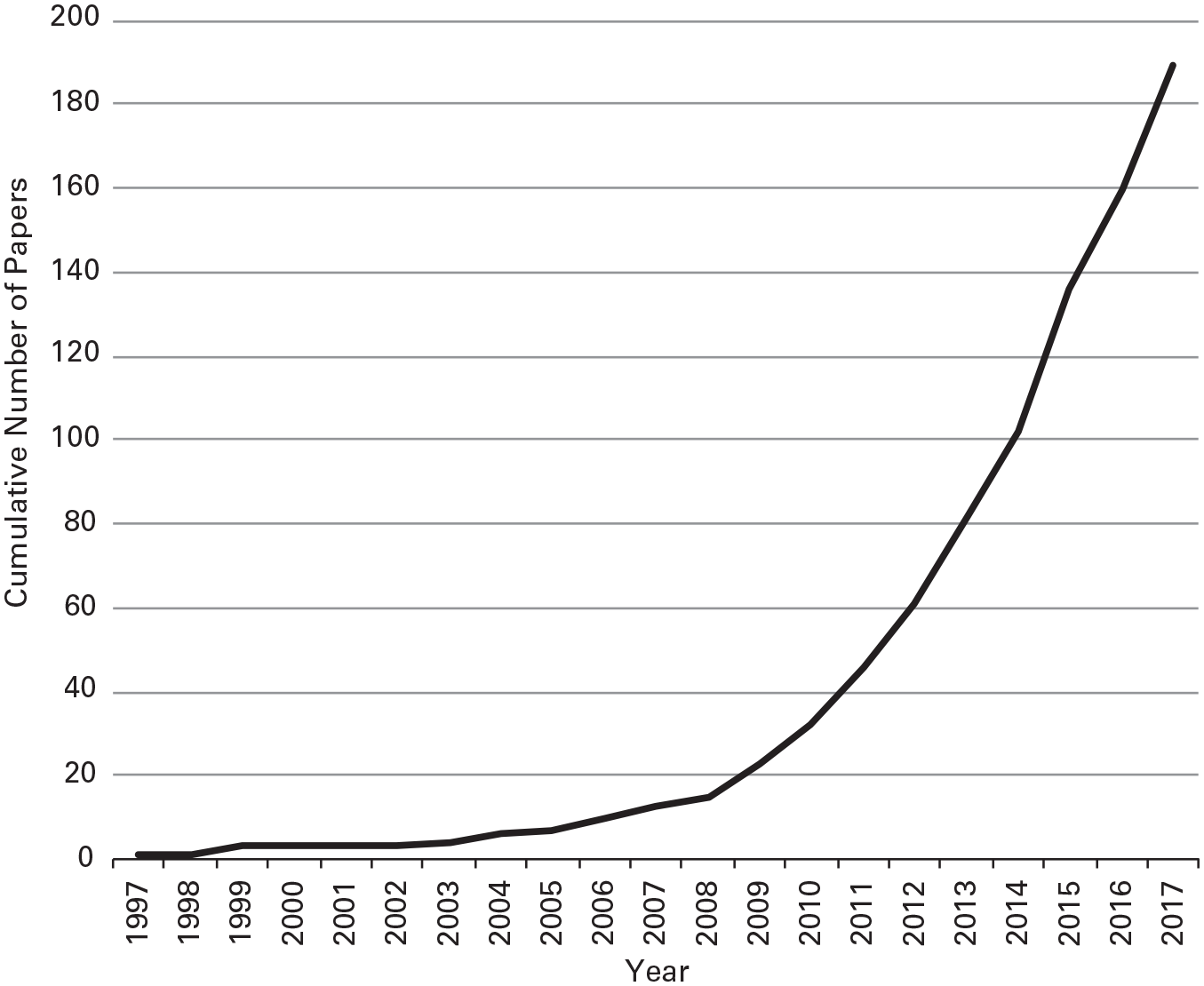
Cumulative Number of Published Quantitative Calling Papers, 1997–2017
Calling and the Good Life
Starting with Wrzesniewski and colleagues’ (1997) study, scholars have examined the effects of calling on two significant categories of outcomes: people’s work experiences (e.g., job satisfaction, job performance, work engagement, organizational commitment), including in their broader careers (e.g., career self-efficacy and decision making, career development), and, to a lesser extent, their lives in general, which may include their work (e.g., life satisfaction, psychological well-being, subjective well-being; Dik and Duffy, 2009; Dobrow and Tosti-Kharas, 2011; Kim et al., 2018). 2 The arguments for why a calling toward work would impact life as a whole tend to invoke the disproportionate amount of time people spend at work when they are employed full time, typically amounting to more than one-third of waking life, and these arguments claim that for those with strong callings, work may be seen as even more inseparable from, and therefore integrated into, life (Wrzesniewski et al., 1997). There is thus the potential for experiences at work, whether positive or negative, to spill over into life (e.g., Eby et al., 2005; Heller and Watson, 2005), especially for those with strong callings.
Within the categories of work and life, studies have predominantly examined psychological outcomes (e.g., job and career satisfaction, work engagement, turnover intentions) and, to a lesser extent, behavioral outcomes (e.g., tenure in one’s job or organization, absenteeism, job performance). This initial stream of research has posited and revealed strong positive associations between callings and indicators of the good life (e.g., Park and Peterson, 2009; Michaelson, 2021). For example, calling has been found to be positively related to psychological and subjective well-being, work meaningfulness, and life meaning (e.g., Wrzesniewski et al., 1997; Duffy et al., 2013; Conway et al., 2015; Praskova, Creed, and Hood, 2015a, 2015b, 2015c). Yet, other evidence has demonstrated the ways in which calling can also hinder the attainment of the good life, for example via overwork, stress, and poor physical and psychological health outcomes (e.g., Bunderson and Thompson, 2009; Clinton, Conway, and Sturges, 2017; Schabram and Maitlis, 2017), thus presenting calling as a “painfully double-edged sword” (Bunderson and Thompson, 2009: 39).
In our review of the literature on why calling might both contribute to and hinder the attainment of the good life, we were able to distill three potential interrelated yet distinct explanations. First, callings enhance intrinsic (versus extrinsic) motivation, whereby work is not a means to an end but instead is a meaningful end in itself, and doing the work is marked by satisfaction and enjoyment (e.g., Wrzesniewski, 2003; Dobrow and Tosti-Kharas, 2011; Conway et al., 2015). In this perspective, people may lose themselves in moments of flow (Csikszentmihalyi, 1990) because they are so engaged in performing the work, which has been described as “consuming” for those with strong callings (Dobrow and Tosti-Kharas, 2011: 1003). Supporting this association, a daily diary study of Church of England clergy found that calling enactment related significantly to affective well-being (a form of hedonic well-being)—a positive relationship explained by intrinsic motivation (Conway et al., 2015). Yet, we note a potential pattern in which the amount of work enjoyment associated with moderate levels of calling is conducive to the good life, but at extreme levels calling could have a detrimental effect. For example, for people with very strong callings, work may extend beyond being enjoyable to the point that they experience it as addictive, or they become workaholics (e.g., Duffy et al., 2016; Keller et al., 2016). In this case, very strong callings result in detrimental outcomes like reduced sleep quality and energy in the morning after trouble detaching from work the previous night (Clinton, Conway, and Sturges, 2017).
Second, for people with callings, their work may be central to their identity (Hall and Chandler, 2005; Dobrow, 2006; Dobrow and Tosti-Kharas, 2011), helping them answer the question “Who am I?” (Pratt and Ashforth, 2003: 312). The path to feeling that work is meaningful, a key indicator of the good life, has been theorized to occur through two levels of identity: personal identity, aspects of the self that are distinct from all other people, and social identity, aspects of the self that are based in group membership (e.g., Brewer and Gardner, 1996; Tajfel and Turner, 2004). These two levels of identity creation help people answer the questions “What am I doing?” (personal) and “Where do I belong?” (social) (Pratt and Ashforth, 2003: 312). Feeling that their personal and social identities are so inextricably linked to their work helps those with strong callings answer these questions and therefore feel that their work is meaningful. For example, zookeepers with strong callings identified more with their occupational communities, which, in turn, mediated the relationship between calling and the perceived meaningfulness and social importance of their work (Bunderson and Thompson, 2009). Yet, we note that calling may also detract from the good life, such as when people experience a strong calling that they are not able to enact fully, as with unanswered occupational callings (Berg, Grant, and Johnson, 2010). In this case, a calling that is central to a person’s identity is not fulfilled in a formal work role, creating dissonance. When people are unable to reduce this dissonance through aligning their work with their identity, they likely experience detrimental outcomes such as higher stress, greater regret, and frustration.
Third, for people with callings, the belief that one’s work is a moral duty can guide them to focus their energy and attention on work that draws on their unique talents and is their destiny, thereby enhancing work meaningfulness (e.g., Bunderson and Thompson, 2009; Dik and Duffy, 2009). However, for people with very strong callings, such as zookeepers, this belief can also represent a moral ideal that may be so high as to be unattainable, which can lead to outcomes detrimental to the good life (Bunderson and Thompson, 2009). Failing to attain this moral ideal is profoundly painful; to avoid that pain, people may do whatever is needed to accomplish their work, including making personal sacrifices like working more hours for less pay, or they may instead become hypercritical of the organization (Bunderson and Thompson, 2009; Schabram and Maitlis, 2017; Tosti-Kharas, Dobrow, and Kappes, 2020; Cinque, Nyberg, and Starkey, 2021).
Overall, whereas research has predominantly viewed calling as promoting the good life, scholars have begun considering its potential inhibiting effects as well as the possible mechanisms explaining these relationships. However, no consensus has emerged in the literature about the extent to which calling actually contributes to the good life. Moreover, the three explanations we identified have garnered little scholarly attention and, in the limited available research, have typically been studied in isolation (e.g., Bunderson and Thompson, 2009; Conway et al., 2015), which indicates the need for more theoretical elaboration and integration. In particular, it is unclear whether and how these three explanations are related. For example, as we argue below, the intrinsic motivation and personal identity mechanisms are likely related and interdependent. Specifically, a calling focused on the pursuit of internally generated preferences and passions is likely to invoke one’s sense of self-determination and to activate and affirm one’s valued personal identities, both of which enhance intrinsic motivation (Shamir, 1991; Deci and Ryan, 2000). Similarly, we suspect that the socially and culturally based mechanisms of moral duty and identity, specifically social identification, are likely interdependent and interrelated; indeed, moral duty and occupational identification are positively and significantly correlated (Bunderson and Thompson, 2009). This is because social identification with an occupation or an organization implies both “oneness” with that community (e.g., Ashforth and Mael, 1989: 21) and an adherence to that community’s ideological beliefs (e.g., Van Maanen and Barley, 1984), which may include a sense of moral duty to perform the work, as with zookeepers (Bunderson and Thompson, 2009).
Because a fundamental theoretical and empirical puzzle in the calling literature relates to its association with the good life, our first research question focuses on the strength of the associations between callings and important outcomes indicative of the good life.
Types of Calling
Conceptual reviews of calling have aimed to make sense of varied perspectives and definitions of the calling phenomenon, yielding the identification of two broad types in the literature (Dik and Shimizu, 2019; Thompson and Bunderson, 2019). We term the first type a primarily internally (or self-) focused calling, which is characterized by passion, enjoyment, and personal meaning. When viewed in this way, a calling is considered by some scholars as the highest level of subjective career success and can be defined primarily in terms of factors inside oneself, such as the work one views as one’s purpose in life (Hall and Chandler, 2005) or as an individual-level psychological experience defined as a “consuming, meaningful passion people experience toward a domain” (Dobrow and Tosti-Kharas, 2011: 1003). We term the second type a primarily externally (or other-) focused calling, which is characterized by duty or obligation to do work that addresses an important need in society or as something one is destined to do. When viewed in this way, a calling can be defined primarily in terms of factors outside the self; for example, the neoclassical view considers a calling the occupational place in society’s division of labor that people feel destined to fill in light of their unique gifts, talents, and/or life opportunities (Bunderson and Thompson, 2009), and another view is that a calling is a “transcendent summons” to pursue a particular line of work (Duffy and Sedlacek, 2007; Dik and Duffy, 2009: 427).3,4 Notably, these diverse definitions have yielded a similarly diverse array of scales to measure people’s callings; see Table 1.
Calling Scale Characteristics
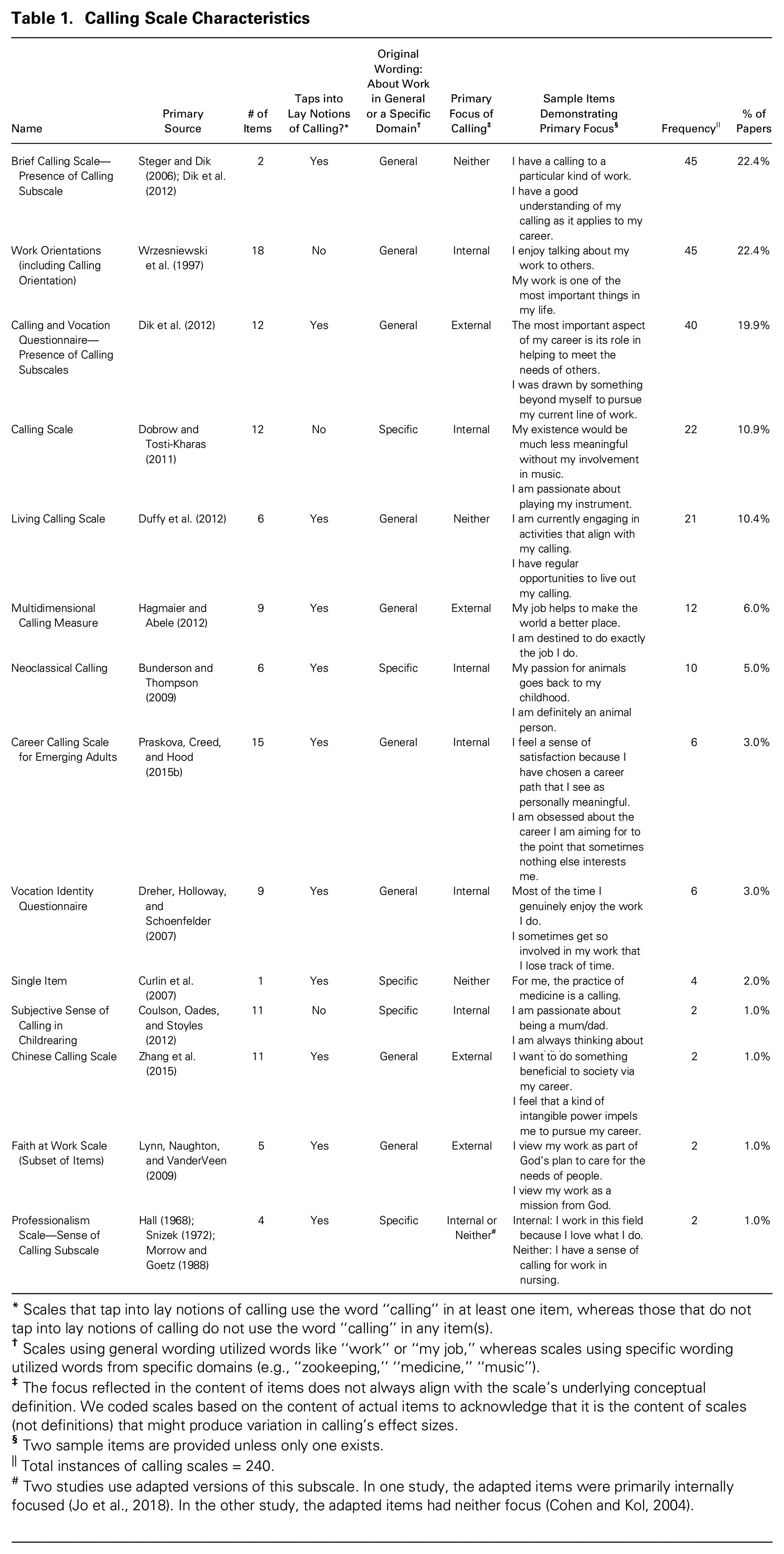
Scales that tap into lay notions of calling use the word “calling” in at least one item, whereas those that do not tap into lay notions of calling do not use the word “calling” in any item(s).
Scales using general wording utilized words like “work” or “my job,” whereas scales using specific wording utilized words from specific domains (e.g., “zookeeping,”“medicine,”“music”).
The focus reflected in the content of items does not always align with the scale’s underlying conceptual definition. We coded scales based on the content of actual items to acknowledge that it is the content of scales (not definitions) that might produce variation in calling’s effect sizes.
Two sample items are provided unless only one exists.
Total instances of calling scales = 240.
Two studies use adapted versions of this subscale. In one study, the adapted items were primarily internally focused (Jo et al., 2018). In the other study, the adapted items had neither focus (Cohen and Kol, 2004).
Although scholars have highlighted the differences between the two types of calling in terms of their internal versus external foci (sometimes referred to as the source of the calling; see Duffy and Dik, 2013), they have nonetheless argued that the two types are related. Specifically, the two types might fall along a continuum, with internally focused callings anchoring one end and externally focused callings anchoring the other (e.g., Dik and Shimizu, 2019; Thompson and Bunderson, 2019). Past reviews have primarily focused on the important task of categorizing calling into the two types, generally with the goal of making sense of the large body of research on calling and thus providing definitional clarity to benefit future research. Accordingly, they have focused less on theorizing how or why the two types might differentially relate to outcomes. One notable exception that began this theorizing is Thompson and Bunderson’s (2019) literature review, which suggested that externally focused callings are likely more important for work meaningfulness—i.e., the perception of work as important and significant (Jiang, 2021)—due to their relative focus on social obligations, moral duty, and destiny. This review also argued that internally focused callings are more important for sustaining and maintaining one’s deep connection to work, whether or not that work is felt to be significant (Thompson and Bunderson, 2019). The authors did not speculate about why an externally focused calling would be more related to work meaningfulness while an internally focused calling would be more related to sustaining one’s connection to work; however, we believe and will argue that this is likely due to the latter type of calling’s focus on self-actualization and thus its more-hedonic outcomes.
In their review, Thompson and Bunderson (2019: 432) further proposed that, rather than being viewed as falling along a continuum, the two types should instead be viewed as orthogonal dimensions in which the “most powerful” version of calling occurs when people experience strong internally and externally focused callings. Taken together, recent reviews of the calling literature have clearly identified the two conceptual types, but the literature has not yet explored whether the two types yield similar or different outcomes.
This aim is important because there is reason to believe that one type of calling might relate more strongly to some outcomes indicative of the good life and the other might relate more to other such outcomes (Dik and Shimizu, 2019). Specifically, internally focused callings, characterized in part by passion and enjoyment, may invoke aspects of hedonic well-being (Ryan and Deci, 2001; Heller, Watson, and Ilies, 2004). Thus, internally focused callings may more strongly predict outcomes reflecting hedonic aspects of work and life, such as job satisfaction and subjective well-being. In contrast, the core of externally focused callings need not be accompanied by passion and enjoyment, such as self-transcendence and a sense of deep meaningfulness. Externally focused callings may even entail self-sacrifice (Bunderson and Thompson, 2009), which is decidedly unhedonic. Externally focused callings may thus be more strongly related to outcomes capturing the more purely eudaimonic aspects of work and life, such as perceived meaningfulness and psychological well-being.
We also expect that the two types of calling could relate similarly to outcomes. At their core, both types are about people experiencing work as deeply meaningful (Rosso, Dekas, and Wrzesniewski, 2010; Beer, Micheli, and Besharov, 2022)—regardless of the focus of the calling. And both types of calling may reflect the process of eudaimonic living, characterized by excellence and virtue (Ryan, Huta, and Deci, 2008: 147). Accordingly, we infer that both types may represent intrinsic goals (those valued for their own sake; Kasser and Ryan, 1996) that people have internalized and incorporated as their own and thus pursue autonomously and volitionally (Ryan and Deci, 2000). Further, the attainment of these goals has been found to be strongly linked to the satisfaction of basic psychological needs and, as a result, to various indicators of well-being (for a review, see Ryan, Huta, and Deci, 2008).
Because limited and mixed theoretical and empirical knowledge exists about whether internally and/or externally focused callings are associated with various outcomes, particularly regarding which type might be more conducive overall to indicators of the good life, our second research question builds on the recent categorization of calling into two types, to examine their divergence and/or convergence in impacting the good life:
Method
Literature Search
Exploratory search
First, we conducted an exploratory scan of the calling literature to determine if enough quantitative calling studies existed to warrant a systematic review. We looked for all papers that cited key calling scales (see Table 1), and made a call for unpublished papers on electronic mailing lists of the Academy of Management, including those of the Careers, Human Resources, Organizational Behavior, and Management, Spirituality and Religion Divisions, as well as the Emotions Network. We also established a website with our call for papers and contacted frequent contributors in the calling and meaning of work literatures to request unpublished papers.
This exploratory search ultimately surfaced 123 papers in which calling was measured. These papers used various calling measures and came from an array of disciplines, including management, psychology, and careers, as well as religious studies, education, and medicine. Given this substantial and diverse body of quantitative calling research, we determined that performing a meta-analysis was justified. Before proceeding to do so, our coauthor team developed a basic coding scheme for the papers found during the exploratory search, which the second author then implemented to collect information such as the calling measures used, the variables measured, the samples studied, and the journals in which they appeared. Our coauthor team used this information to develop a protocol for the subsequent meta-analysis, which included research questions, a literature search strategy, inclusion criteria, and a coding scheme (see details below).
Systematic search
Considering the results of the exploratory search, we conducted a systematic literature search to locate all relevant studies, published and unpublished, across two decades of calling research (March 1997–January 2018; see Figure 2). The start date coincides with the publication of Wrzesniewski and colleagues’ (1997) research on work orientations, which marks when the notion of calling entered the psychology literature.
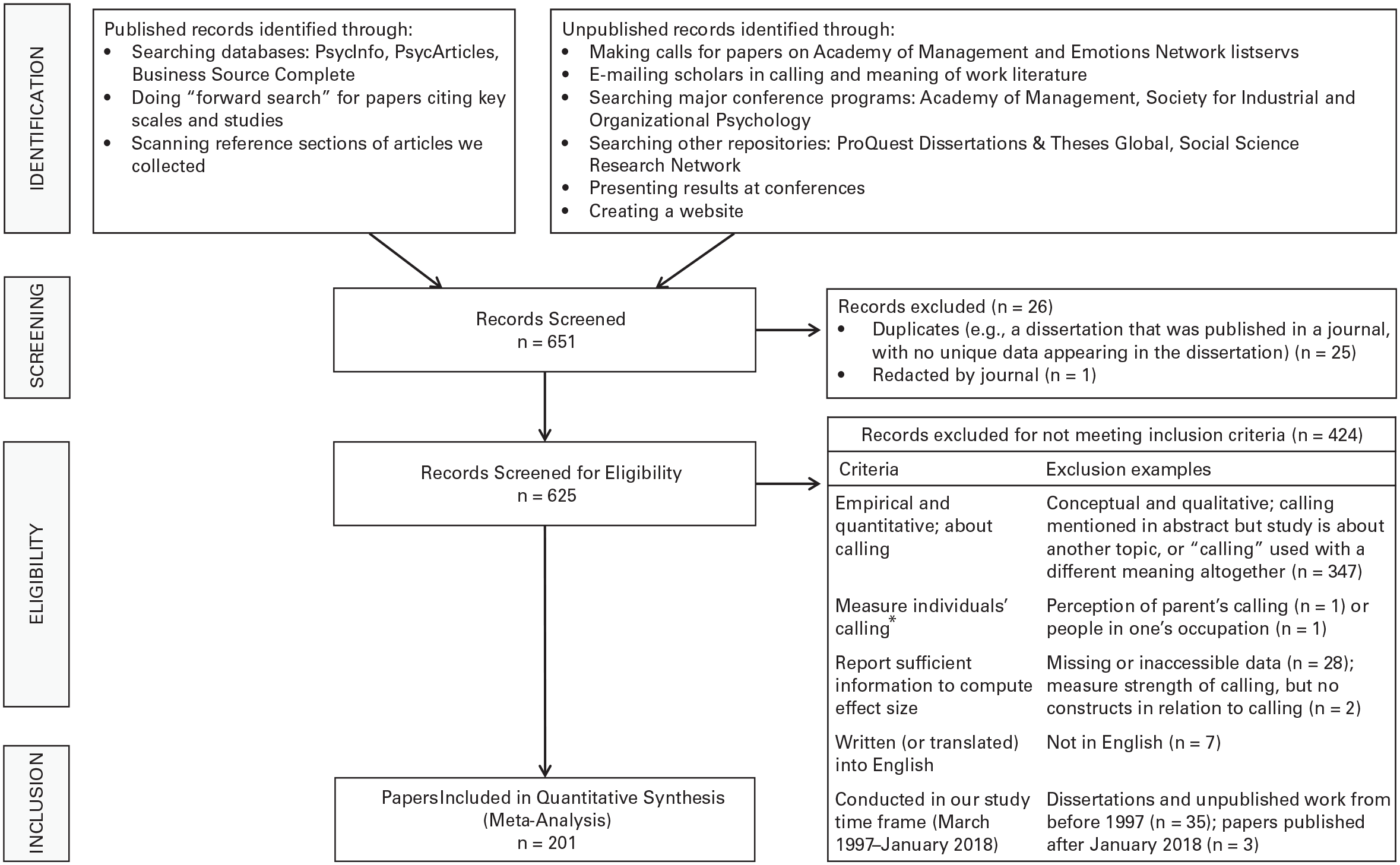
Systematic Literature Search
We began our search by using research databases to identify articles featuring phrases and keywords such as “sense of calling,”“work as a calling,”“occupational calling,” and “calling orientation”; see Table 2 for all search terms and sources. Next, we searched ProQuest Dissertations & Theses Global, the Social Science Research Network, the Academy of Management Proceedings, and the Society for Industrial and Organizational Psychology Conference Programs for unpublished papers that contained the word “calling” in their title. We also conducted a forward search for articles that cited early key calling scales and/or studies. Further, we regularly scanned the articles we reviewed to find citations of additional articles.
Summary of Search Terms and Sources for the Literature Search
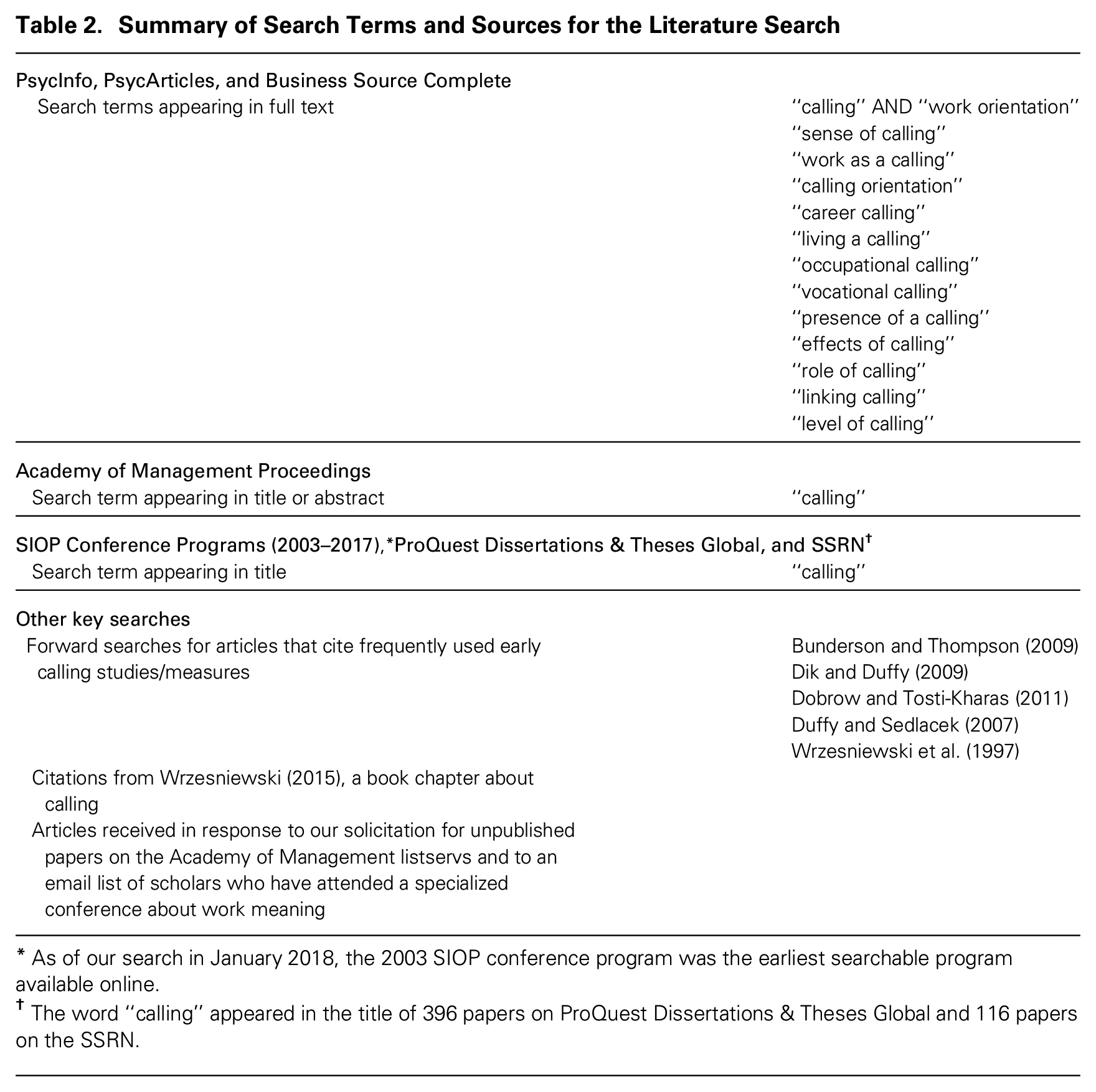
As of our search in January 2018, the 2003 SIOP conference program was the earliest searchable program available online.
The word “calling” appeared in the title of 396 papers on ProQuest Dissertations & Theses Global and 116 papers on the SSRN.
To mitigate the impact of publication bias on our meta-analysis, we supplemented our search for published articles with efforts to gather unpublished papers and raw data. We welcomed unpublished work that scholars sent us either in response to our call for papers or through their informal social networks. We also presented early-stage results of our research at academic conferences, each time taking the opportunity to solicit unpublished work from audience members. Our systematic search, encompassing published and unpublished work identified via multiple sources, surfaced a total of 651 papers, presentations, theses, book chapters, and books to consider for potential inclusion in the meta-analysis. 5
Inclusion Criteria
We included studies in the meta-analysis if they passed five predetermined screening criteria; see Figure 2. Studies needed to (1) be empirical and quantitative in nature, as well as be about calling (broadly defined); (2) measure individuals’ self-perceived calling using any measure or scale; (3) report sufficient information to allow effect size computation; (4) be written in or translated into English; and (5) be conducted in our study time frame of March 1997–January 2018. 6 When we came across studies that passed our screening criteria but omitted the full information necessary to compute an effect size, we attempted to obtain the relevant data by contacting the study authors. In some cases, authors gave us additional information, such as extra results from their dataset not reported in their published work or often-nonsignificant correlations mentioned in their study’s text but not reported in the tables. Accessing these types of unpublished results helped to further mitigate concerns over publication bias in the meta-analysis (see our Results section and Online Appendix A).
Reflecting these criteria, our overall sample consisted of 201 papers and 240 independent samples (total sample size of individuals across studies = 185,857; see Online Appendix B for a list of included studies). We used this overall sample to generate descriptive characteristics of the quantitative calling literature. Of note, this literature has grown exponentially since Wrzesniewski and colleagues’ initial study (1997), with over 80 percent of published quantitative calling papers having appeared since 2011 (see Figure 1).
Coding Procedure
We developed a procedure for coding the collected data through a two-stage process. First, as described above, we used our exploratory search results to develop a preliminary coding scheme of various relevant features of the studies. Our coauthor team discussed, refined, and elaborated this coding scheme before beginning the comprehensive search. This process ensured that we had a shared understanding of the coding scheme to be used for our formal coding process.
In the second stage of the process, the second author coded all studies. The first author reviewed approximately two-thirds of the coded data, including all unclear data or coding questions noted by the second author, which yielded a very high overall level of agreement. In the few instances of disagreement, these two authors discussed the coding and reached a decision, occasionally with additional input from the third and fourth authors. The second author then reviewed the dataset’s remaining coded data (approximately one-third) to ensure that decisions about the first two-thirds of the dataset were applied consistently throughout. Through this iterative process, we reached consensus decisions about final codes and produced our final dataset, as follows.
We first recorded statistics, including sample size, correlations, means, standard deviations, and t-tests and/or F-tests, depending on what each study reported. We converted all effect size data (e.g., means and standard deviations) into a common form (i.e., correlations) for the purposes of conducting the meta-analyses (Lipsey and Wilson, 2001). We next coded several features of the studies related to our focal constructs—calling scale, outcomes of calling, and moderators of calling—as well as characteristics of the studies and samples; see descriptive characteristics in Table 3. Each independent sample (or study) is our unit of analysis unless otherwise noted, as some papers included more than one sample or study.
Descriptive Characteristics of Papers, Studies and Samples, and Constructs Measured in Relation to Calling
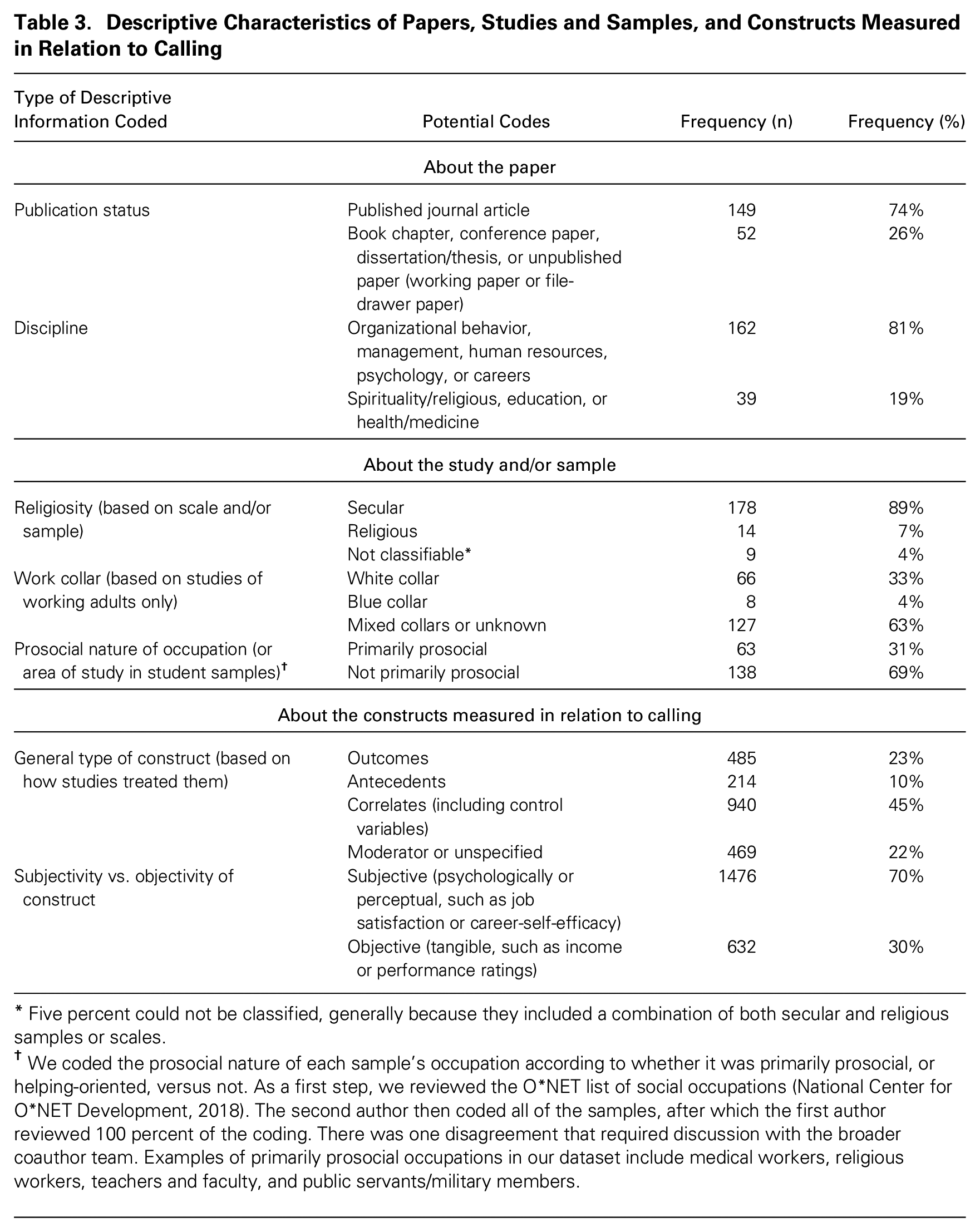
Five percent could not be classified, generally because they included a combination of both secular and religious samples or scales.
We coded the prosocial nature of each sample’s occupation according to whether it was primarily prosocial, or helping-oriented, versus not. As a first step, we reviewed the O*NET list of social occupations (National Center for O*NET Development, 2018). The second author then coded all of the samples, after which the first author reviewed 100 percent of the coding. There was one disagreement that required discussion with the broader coauthor team. Examples of primarily prosocial occupations in our dataset include medical workers, religious workers, teachers and faculty, and public servants/military members.
Calling measures
Scholars have used various approaches to measure calling. Wrzesniewski and colleagues (1997) introduced the first calling scale measure, which aimed to identify whether people primarily experienced their work as a job, career, or calling. A decade later, additional scale measures began to enter the literature, including the Brief Calling Scale (Steger and Dik, 2006; Dik et al., 2012), subsequently developed into the longer Calling and Vocation Questionnaire (Dik et al., 2012); Bunderson and Thompson’s (2009) Neoclassical Calling Scale; Dobrow and Tosti-Kharas’s (2011) 12-item Calling Scale to assess the strength of calling toward any domain; and several other scales.
These scales differ in several ways, including whether they assess callings toward the broad domain of work in general (e.g., Wrzesniewski et al., 1997) or specifically focus on people’s current job or on a particular domain, such as an occupation, industry, or field (e.g., music, business, working with animals; Bunderson and Thompson, 2009; Dobrow and Tosti-Kharas, 2011), and whether they are primarily internally or externally focused (see Table 1 for each measure’s details). Even with diverse conceptualizations of calling underlying their associated measures, extant calling scales demonstrate considerable convergent validity, with rs between different calling measures typically ranging from .50 to .80 (as reported in Dobrow and Tosti-Kharas, 2011; Dik et al., 2012; Hagmaier and Abele, 2012; Praskova, Creed, and Hood, 2015b). These correlations support the viability of viewing calling as a coherent construct across studies for meta-analytic purposes, while also suggesting that a meta-analysis might generate useful insight into the differential effects of distinct calling types.
To facilitate such exploration, we coded information about the calling measures used across studies. We found 14 calling measures that were used in more than one study, along with 20 scales and single-item measures that were used only once. Studies frequently used adapted versions of scales, such as subscales of full-length scales, selected items from full-length scales, adaptations of the wording to fit a different context, or translations of scales. Thirteen percent of studies used more than one measure of calling. 7 No single calling scale dominated the literature; in fact, even the most frequent scales were each used in only about 20 percent of studies. Nevertheless, 86 percent of studies included at least one of the five most frequent calling scales.
Outcomes of calling
Following previous meta-analyses (e.g., Eby et al., 2013) and to enable adequate sample sizes for rigorous and meaningful analyses, we assigned each unique effect size in our dataset (n = 2,118) into a variable category, based on the variable whose relationship with calling was measured. A variable category is a grouping of similar individual variables. To avoid the jingle-jangle fallacy (Block, 1995), we checked the underlying definitions and items of the various measures used in the original studies rather than relying on variable names to do these assignments. We grouped together only sufficiently similar variables to create categories whose conceptual meaning would be coherent (e.g., the variables Job satisfaction, Overall job satisfaction, Satisfaction with domain, Pleasure at work, and Work enjoyment were assigned to the category “job and domain satisfaction”). This process resulted in the creation of 42 distinct variable categories.
We next classified each variable category as representing either an antecedent, correlate, or outcome in the nomological network of calling. To make our classifications, we relied on the traditional way the literature has treated each variable category (cf. Thompson and Bunderson, 2019). We mention this because most quantitative calling research has relied on cross-sectional methodologies (Wrzesniewski, 2012), which cannot temporally separate calling from its outcomes. For example, if a given study sought to examine whether stronger callings were linked to higher job satisfaction, we followed suit in classifying job satisfaction as an outcome for meta-analytic purposes.
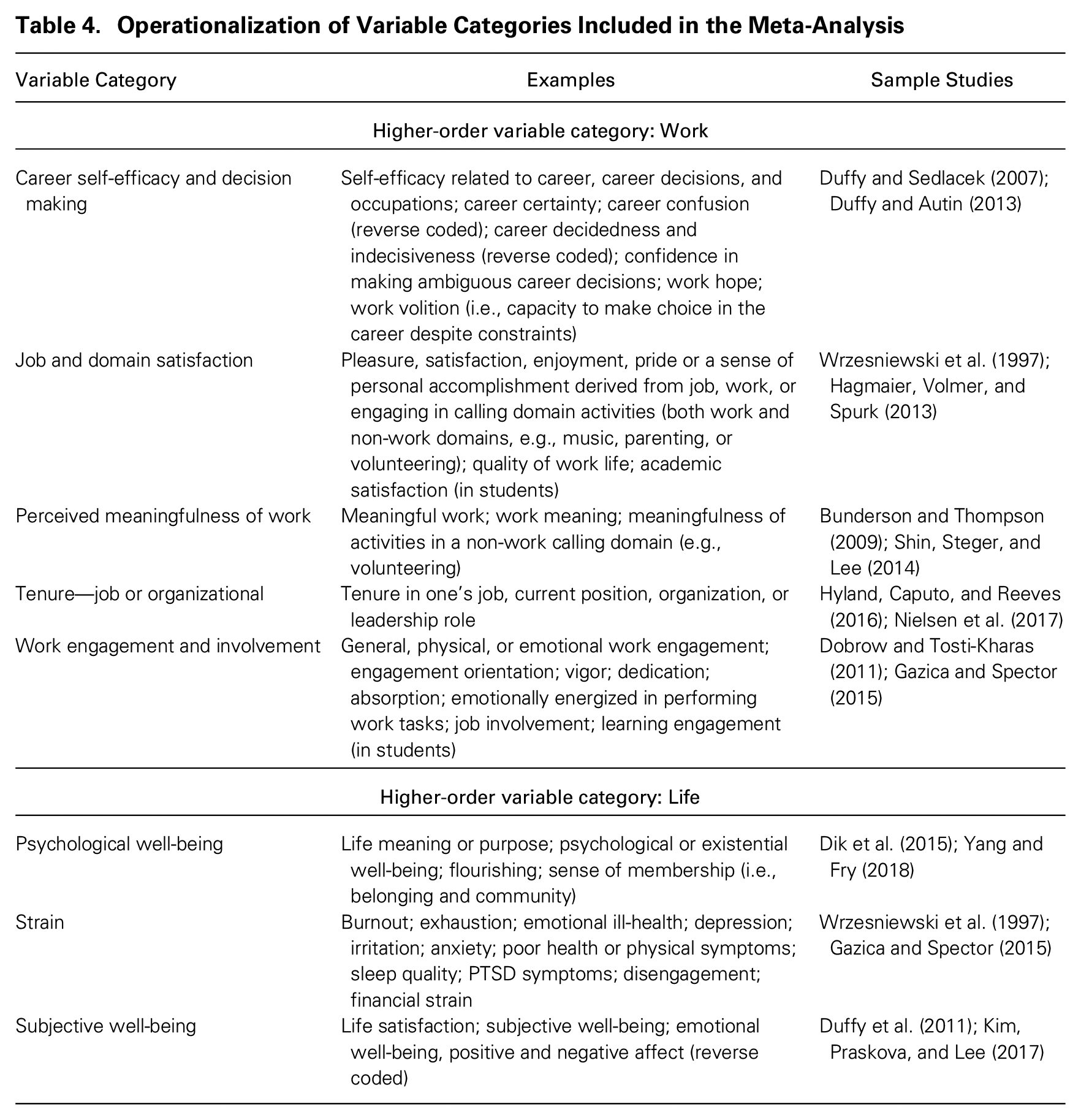
We focus on eight theoretically significant outcome variable categories in our meta-analysis, selected because of their capacity to address our research questions. That is, they may capture outcomes related to both hedonic and eudaimonic indicators of the good life (Ryan, Huta, and Deci, 2008; Park and Peterson, 2009), and they have also been studied with both internally and externally focused measures of calling; see Table 4 for details. 8 Importantly, these outcomes are also the most frequently studied in the calling literature, capturing varied yet central aspects of work and life. We present results for the remaining 34 variable categories in Online Appendix C. 9
Operationalization of Variable Categories Included in the Meta-Analysis
Types of calling
We coded whether each measure of calling was predominantly internally or externally focused, or neither. To do so, we coded each individual item in each measure as being internally focused, externally focused, or neither based on how these types have been described and differentiated in previous studies (see Table 1; Dik and Shimizu, 2019; Thompson and Bunderson, 2019). We coded items as being internally focused if they contained words or phrases capturing the experience of a calling as any of the following: passionate, consuming, or obsessive; personally meaningful and important; gratifying and satisfying; intrinsically enjoyable and joyful; or fascinating. Samples items included, “My work is one of the most important things in my life” (Wrzesniewski et al., 1997: 25), “Playing music gives me immense personal satisfaction” (Dobrow and Tosti-Kharas, 2011: 1048), and “I sometimes get so involved in my work that I lose track of time” (Dreher, Holloway, and Schoenfelder, 2007: 105).
We coded items as being externally focused if they contained words and phrases characterizing calling as a duty or obligation that addresses an important need in society, or as something that one is destined to do and that makes a difference in the world. Sample items included, “My work makes the world a better place” (Wrzesniewski et al., 1997: 25), “The most important aspect of my career is its role in helping to meet the needs of others” (Dik et al., 2012: 260), and “It sometimes feels like I was destined to work with animals” (Bunderson and Thompson, 2009: 56).
We coded items as “neither” when they fit neither the internally nor externally focused categories, usually because of their reliance on the word “calling” itself. Some of these items aimed to ascertain the extent to which people’s current work domain is their calling (e.g., “For me, the practice of medicine is a calling” in Curlin et al., 2007: 354). Others asked general questions about people’s callings but without any internally or externally focused content (e.g., “I have a good understanding of my calling as it applies to my career” in Duffy and Sedlacek, 2009: 594).
We classified each scale based on the majority focus of its items: a scale was internally focused if at least 50 percent of the scale items were coded as internally focused and less than 50 percent of the scale items were coded as externally focused or neither. We followed the same pattern for coding scales as externally focused and neither. All scales could be classified into one of these three categories. 10
Meta-Analytic Procedures
We conducted our meta-analyses using the Comprehensive Meta-Analysis (CMA) Version 3 software’s random-effects model (Borenstein et al., 2013). Our procedures followed the Hedges and Olkins (1985) approach to meta-analysis, such that we conducted our analyses using correlation coefficients, our chosen summary effect measure, 11 and we computed the mean correlation between calling and each variable category by using inverse variance weights. Some meta-analytic approaches attempt to estimate effects in a perfect world, so they assume that measures of the focal variable (e.g., calling) and outcomes (e.g., job satisfaction) have perfect reliability and validity (see Hunter and Schmidt, 1990, 2004). By contrast, we preferred an approach that estimates effects as they would be observed in the real world, where some types of error are always present (e.g., focusing on finding the relationship between two observable measures or scales, such as calling scales and job satisfaction scales; Borenstein et al., 2009), and that we believe represents the realities inherent in behavioral research in general and calling research in particular.
Overall, our analyses included one meta-analysis apiece for the effects of calling on each of our eight variable categories. We thus ran separate meta-analyses for each variable category of interest, using a subset of the overall sample containing data from studies that measured that specific variable category. Some studies reported multiple correlations between calling and a variable category within the same sample (e.g., calling and a variable at Time 1 and between calling and the same variable at Time 2). In these instances, we computed a single composite effect size for each sample (Lipsey and Wilson, 2001). This ensured that only one effect size represented each sample in any given meta-analysis and that none of our meta-analyses incorporated inflated sample sizes (Borenstein et al., 2009). 12
We investigated whether calling’s relationship to outcomes depends on type of calling (i.e., internally or externally focused), through subgroup analyses in which we treated type as a categorical moderator. These analyses statistically compared meta-analytic results for studies using internally focused scales versus those using externally focused scales via the mixed-effects model in CMA, thereby testing whether the effects of calling on the outcomes differed according to calling type.
Results
Research Question 1: How Strongly Related Are Callings to Outcomes Indicative of the Good Life?
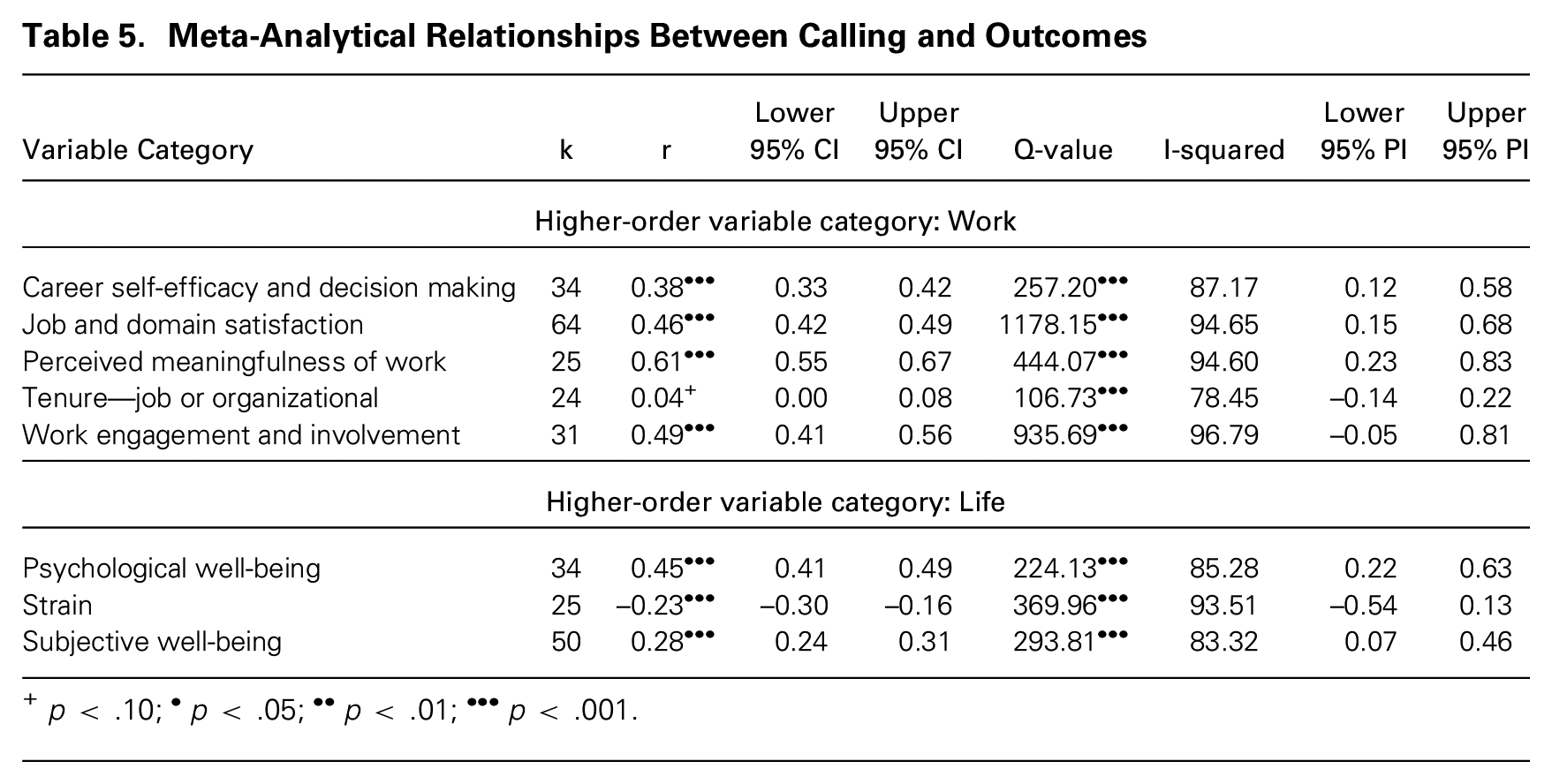
Calling had strong, significant, and positive relationships with several work variable categories; see Table 5. Calling’s strongest relationship was with the perceived meaningfulness of work (r = .61, p < .001), while it was also positively related to work engagement and involvement (r = .49, p < .001), job and domain satisfaction (r = .46, p < .001), and career self-efficacy and decision making (r = .38, p < .001). Lastly, calling was positively but not significantly associated with longer tenure in one’s job or organization (r = .04, p = .07).
Meta-Analytical Relationships Between Calling and Outcomes
p < .10; •p < .05; ••p < .01; •••p < .001.
Among the life-domain variable categories, calling was again associated with several indicators of the good life. We found a strong and positive association between calling and psychological well-being (r = .45, p < .001) and a smaller but still positive association with subjective well-being (r = .28, p < .001). Calling had a significant and negative relationship with strain (r = –.23, p < .001), revealing that calling was associated with experiencing fewer of the negative physiological, psychological, and behavioral outcomes that comprise strain.
Our results indicate that calling had an extensive positive impact, even beyond our theorizing, on outcomes in both work and life. Calling was more strongly and positively related to work outcomes relative to life outcomes on average (significant correlations ranged from .38–.61 and .28–.45, respectively). Comparing analogous work and life outcomes sheds greater light on these findings. The hedonic work variable category, job and domain satisfaction, was more strongly correlated with calling (r = .46) than was the hedonic life variable category, subjective well-being (r = .28). Similarly, the eudaimonic work variable category, perceived meaningfulness of work, was more strongly correlated with calling (r = .61) than was the eudaimonic life variable category, psychological well-being (r = .45). Thus, the findings, in aggregate, also indicate that callings were more strongly related to eudaimonic than to hedonic outcomes.
Research Question 2: Which Type of Calling Is More Strongly Related to Outcomes Indicative of the Good Life?
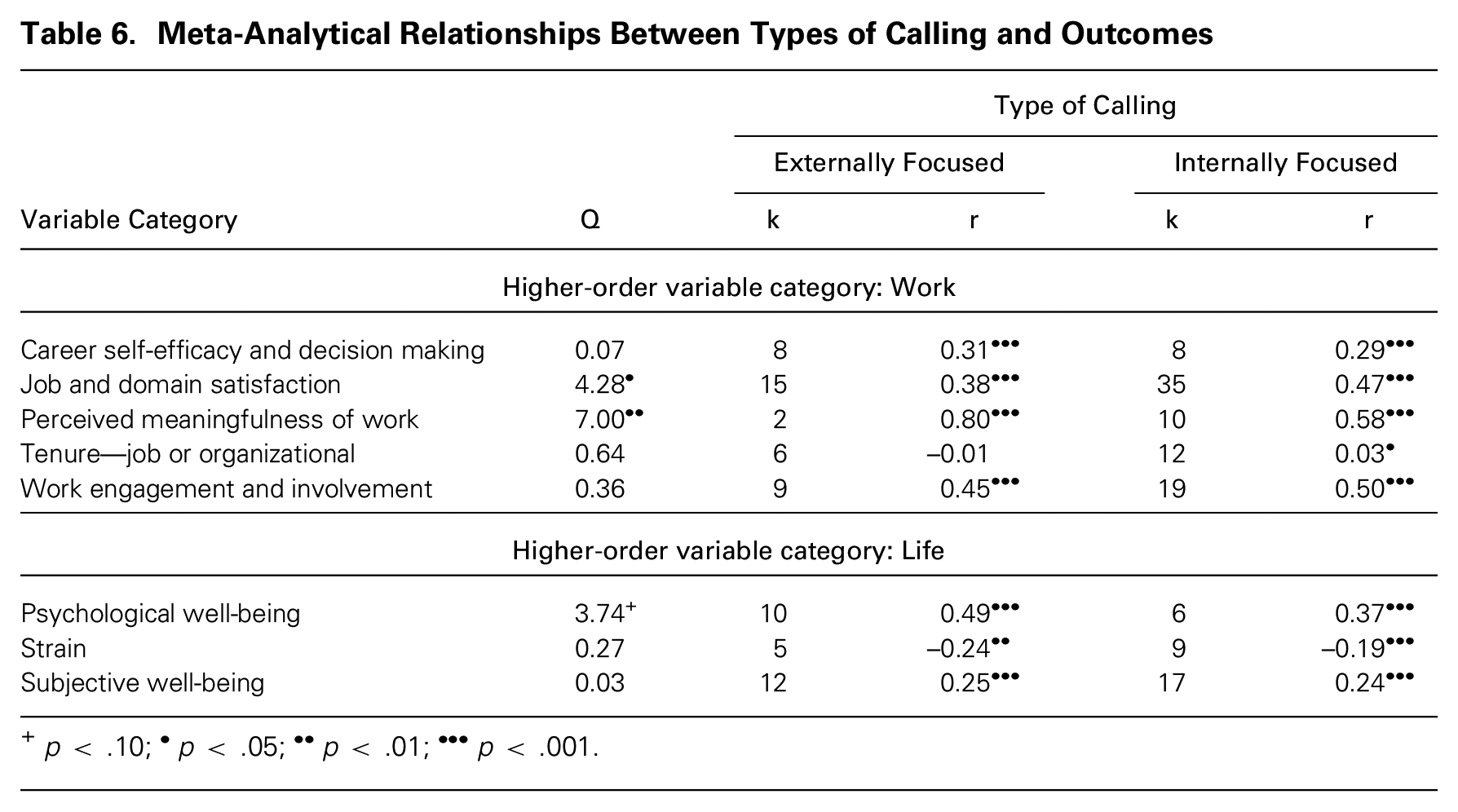
We conducted subgroup analyses to address the question of which callings, internally versus externally focused, were more strongly related to work and life outcomes, using each variable category with sufficient data (i.e., at least four total primary studies, with at least two studies in each subgroup); see Table 6.
Meta-Analytical Relationships Between Types of Calling and Outcomes
p < .10; •p < .05; ••p < .01; •••p < .001.
Among the work-domain variable category outcomes, we found that perceived meaningfulness of work was more strongly associated with externally than internally focused callings (rs = .80 vs. .58; Qbetw = 7.00, p = .01) and that job and domain satisfaction was more strongly associated with internally than externally focused callings (rs = .47 vs. .38; Qbetw = 4.28, p = .04). We note that these findings were consistent with our theorizing about the more eudaimonic nature of externally focused callings and more hedonic nature of internally focused callings.
Among the life-domain variable category outcomes, however, the same pattern did not hold. We found marginally significant support that psychological well-being is more strongly associated with externally than internally focused callings (rs = .49 vs. .37; Qbetw = 3.74, p = .053), which is in the direction of our theorizing. But we did not find that subjective well-being was more strongly associated with internally versus externally focused callings (rs = .24 vs. .25; Qbetw = .03, p = .86). Further, we did not find that the relationships between calling and our other variable categories (career self-efficacy and decision making, work engagement and involvement, strain, and tenure—job or organizational) depended on whether those callings were internally versus externally focused. 13
These results indicate considerable convergence in the work and life outcomes predicted by the two types of calling. The divergence that did occur followed a notable pattern, primarily regarding well-being outcomes: internally focused callings were associated with hedonic outcomes at work (job and domain satisfaction) but not more broadly in life (subjective well-being), while externally focused callings were more strongly related to eudaimonic outcomes in both work (perceived meaningfulness of work) and life (psychological well-being).
Supplemental Analysis
In light of the considerable convergence and more-limited divergence between the impact of internally and externally focused callings on work and life outcomes in our meta-analyses, we conducted a supplemental analysis to quantify the relationship between the two types of calling. To do so, we identified all papers in our dataset that included at least one internally and one externally focused calling scale (n = 5) and recorded the correlation between the two types of calling from these studies (n = 14; range of correlations present per paper = 1 to 5). We first computed a composite correlation representing the average correlation between internally and externally focused scales within each study. To generate the overall effect size for this relationship, we then computed a weighted average correlation across studies (r = .59), thereby accounting for sample size (Ellis, 2020). The large magnitude of this relationship is consistent with our meta-analytic findings of much convergence and some divergence between the effects of the two types of calling.
Publication Bias
We sought to reduce the impact of publication bias on our meta-analysis by conducting an extensive search for unpublished studies, but it is likely we did not find every unpublished calling study. Thus, to test the robustness of our findings, we examined the degree to which bias might have impacted our results, particularly whether this bias was substantial enough to change the interpretation of our findings. We used the trim-and-fill method (Duval and Tweedie, 2000; Duval, 2005) to test for publication bias (see Online Appendix A). Overall, these analyses highlight that our results are relatively robust to missing studies, such that they are unlikely to have systematically biased our results in any discernible pattern.
Discussion
Our meta-analysis examined how strongly related callings are to outcomes indicative of the good life and which type of calling, internally or externally focused (if either), is more predictive of these outcomes. Rather than reinforcing the purported double-edged effect of calling, our findings show that callings were strongly predictive of the good life, as indicated by outcomes in both the work and life domains. Callings were more strongly related to outcomes in the proximal domain of work than in the more distal domain of life. Further, when viewing our outcomes through the lens of the type of well-being they capture, we found (somewhat counterintuitively) that callings were associated with positive hedonic outcomes, though calling’s relationships to positive eudaimonic outcomes were stronger. Second, we found that the two types of calling demonstrated considerable convergence in their association with various outcomes indicative of the good life. The limited divergence we discovered indicates that, largely in accordance with our theorizing, internally focused callings were more strongly associated with hedonic outcomes at work but not in life, while externally focused callings were more strongly associated with eudaimonic outcomes in both work and life.
Calling and the Good Life
The first major contribution of our study is that we integrate a large and somewhat inconsistent set of findings in the calling literature, addressing a fundamental theoretical puzzle about the extent to which callings contribute to and/or detract from the good life. Existing theory would lead us to believe that callings are a double-edged sword (e.g., Bunderson and Thompson, 2009; Berkelaar and Buzzanell, 2015; Lysova et al., 2018). Our findings that callings are overwhelmingly positively related to outcomes indicative of the good life challenge this notion, revealing the important role of calling in the good life.
Our findings also address the divergent views and findings in the literature about calling’s impact on life in general (Wrzesniewski et al., 1997; Rosso, Dekas, and Wrzesniewski, 2010; Duffy and Dik, 2013). On the one hand, strong callings could be viewed as enhancing one’s life. Consistent with this notion, some calling scholars have shown that people with stronger callings may have more-positive experiences at work (Hirschi, 2012) and enjoy greater positive affect in general (Steger et al., 2010). These positive experiences and affect at work can, in turn, spill over into life (Heller, Watson, and Ilies, 2006; Choi et al., 2018). On the other hand, other recent research has theorized and shown that people with strong callings are more likely to be consumed by work, even to the point of becoming workaholics (e.g., Duffy et al., 2016; Keller et al., 2016). For these people, the potential thus exists of negative spillover into, and hurting their lives outside of, work.
In making sense of these seemingly contradictory views and findings, we note that these effects may be understood in terms of calling’s impact on resources (Clinton, Conway, and Sturges, 2017; Hirschi, Keller, and Spurk, 2019). Research using a sample of older workers demonstrated that calling enhanced positive affect at work, which in turn led to work–nonwork enrichment, representing a replenishment-of-resources pathway (Hirschi, Keller, and Spurk, 2019). But this study also showed that callings increased workaholism and work-related vigor and in turn increased work–nonwork conflict, representing a depletion-of-resources pathway available for life outside of work (Hirschi, Keller, and Spurk, 2019). This depletion effect was similar to that found in a sample of church ministers; those with strong callings reported working longer hours, which led to reduced sleep quality and morning vigor (Clinton, Conway, and Sturges, 2017).
Addressing this puzzle, our results provide evidence that callings are substantially positively related to outcomes in the domains of both work and life, but more so to work than to life outcomes; see Figure 3. These findings thus imply that calling has a positive spillover effect from work to life, just as the related concept of meaning in work spills over to meaning in life (Allan et al., 2019). Additional evidence that calling was related to lower work–life conflict (see Online Appendix C, Table C2) provides further support for this argument. Thus, our results strongly indicate that the effects of callings can be characterized as replenishing and enriching (Rothbard, 2001; Greenhaus and Powell, 2006), in that calling’s overall positive impact at work spills over to provide positive impact in life outside of work. The advantage of a meta-analytic approach is that it takes into account results from a large set of (aggregated) primary studies and thus can reveal results, such as this one, that may contradict what has been found in individual studies, which by nature are based on smaller sample sizes and/or more unusual study populations than are meta-analyses (e.g., Clinton, Conway, and Sturges, 2017; Hirschi, Keller, and Spurk, 2019). We call for additional research and theorizing that further elaborates calling’s replenishing or depleting impact on life as a whole and the potential boundary conditions of these relationships.
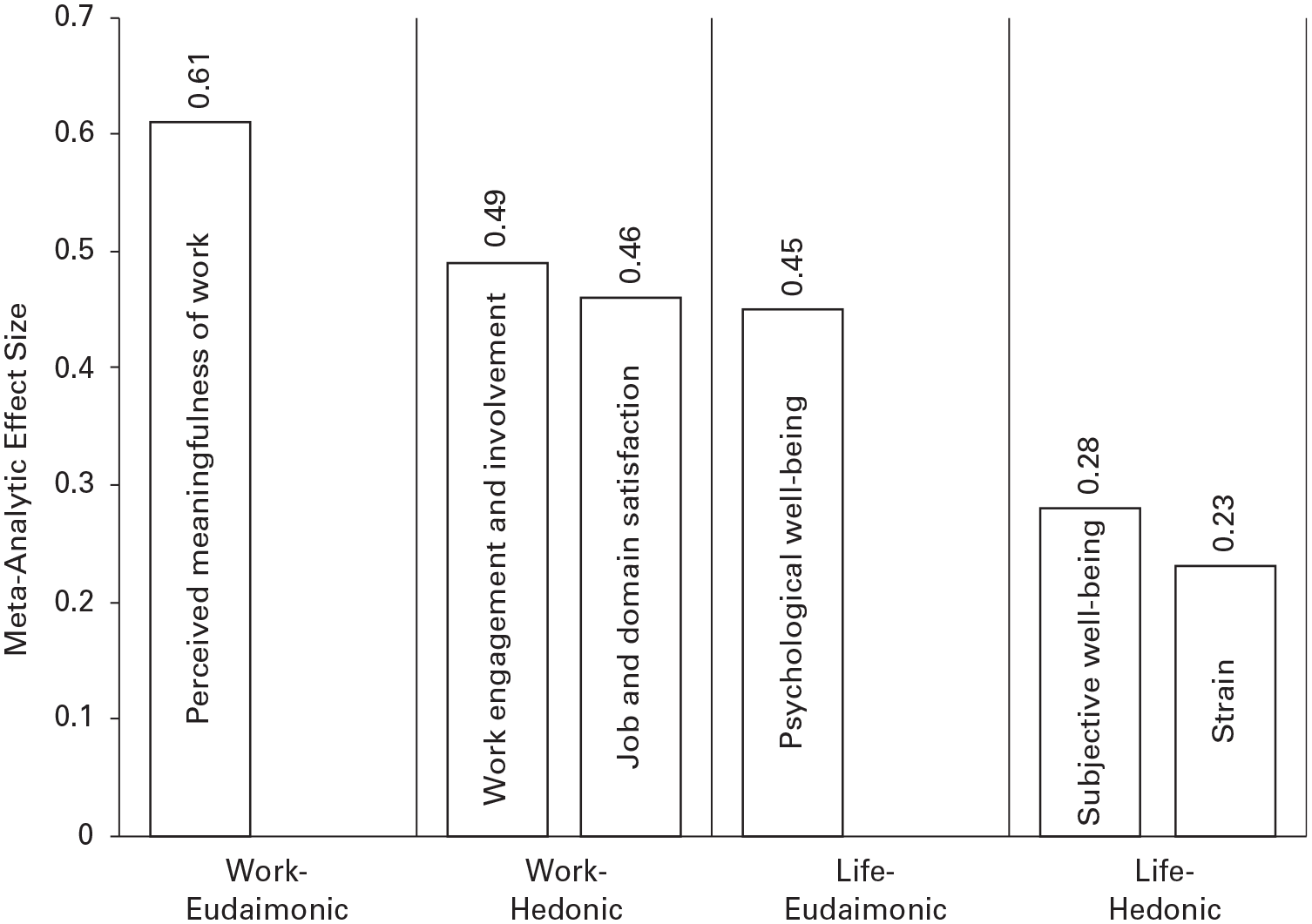
Relationships of Calling to Key Outcomes by Domain and Well-Being Type
Our findings highlight that while, as expected, calling had a strong and positive relationship with eudaimonic outcomes in both work and life, calling also had only slightly less-strong and -positive relationships with hedonic outcomes. Calling had the strongest relationships with eudaimonic outcomes at work and, of note, the second strongest relationships with hedonic outcomes, also at work. These findings advance our knowledge of calling’s link to well-being by challenging conventional wisdom and theory that callings are linked solely to eudaimonic, and not hedonic, outcomes. Below we return to this point and theorize about its underlying reasons. We depict an integration of these results in Figure 3, which helps us better understand the effects of calling in relation to different types of outcomes in its nomological network, and facilitates interpretation of the meaning of our results and subsequent theorizing.
Types of Calling and the Good Life
Another major contribution of our study is its direct examination of a fundamental issue in the calling literature about which type of calling, if either, is more predictive of significant work and life outcomes. Our findings speak to the very nature of calling, challenging the emerging consensus in the literature that the more self-oriented internally focused callings are highly distinct from the more other-oriented externally focused callings (e.g., Dik and Shimizu, 2019). Our meta-analysis documents that both types of calling are substantially linked to extensive positive outcomes—in many cases to a similar degree. Adding nuance to the findings reported above that callings relate to both eudaimonic and hedonic outcomes, not solely to eudaimonic outcomes as the literature has theorized (e.g., Dik and Duffy, 2015), our findings show that while both types had highly beneficial impact on eudaimonic outcomes in work and life, both were unexpectedly also positively related to hedonic outcomes. We find a strong association between the two types (r = .59), which attests even more directly to their convergence.
In line with the general consensus in the extant calling literature (e.g., Dik and Shimizu, 2019; Thompson and Bunderson, 2019), however, we also found some limited evidence for divergence in how the two types of calling lead to outcomes. Internally focused callings were more strongly associated with hedonic outcomes at work, compared to externally focused callings. By contrast, externally focused callings were more strongly related to eudaimonic outcomes in both work and life, compared to internally focused callings.
This nuanced pattern of convergence and divergence enhances our understanding of the unified yet faceted nature of callings. It suggests that callings are hierarchically structured such that they could be viewed and examined at different levels, similar to several other important individual differences, such as affect (Watson, 2000), intelligence (Brody, 1992), and personality (Costa and McCrae, 1992). We argue for a general higher-order calling factor that is composed of two correlated yet distinct lower-order calling types. In this structure, the higher level reflects the convergence between the calling types. We argue that this represents the core of calling—work that is experienced as worthwhile, that involves internalized goals, that is pursued passionately and autonomously, and that leads to the fulfillment of needs. In contrast, the lower level reflects the distinctive aspects of the types of callings—whether their focus is internal or external (e.g., Thompson and Bunderson, 2019). Our meta-analytic findings of convergence and divergence in the effects of the two types of calling reveal that while at times callings may be best viewed at the higher-order level, in other instances it may be more theoretically useful to conceptualize callings at the lower-order level, such as to observe differential effects and pathways. However, we also note that it is clearly necessary to examine both levels of the hierarchy in any complete investigation of the effects of calling.
A New Theoretical Model for Understanding Calling and the Good Life
Our findings provide the basis for a new perspective on calling’s role in leading to the good life (Aristotle, 2002; Ryan, Huta, and Deci, 2008; Park and Peterson, 2009), including the strength and positivity of this connection and differential effects as a function of calling type, from which we can theorize about the mechanisms underlying these relationships. We build on our empirical findings and develop a theoretical model depicting two different paths, one for each of the two types of calling, toward outcomes reflecting well-being in work and life. Specifically, we integrate our results with theories of psychological needs (e.g., Deci and Ryan, 1985) and well-being (Heller, Watson, and Ilies, 2004; Ryan, Huta, and Deci, 2008) to advance our knowledge of the mechanisms through which the types of calling contribute to the good life. In doing so, we build on, develop, and synthesize the aforementioned initial explanations offered in the calling literature to provide nuanced understanding of what drives the effects of the two types. Our model, depicted in Figure 4, thus accounts for both the convergent and divergent roles of the two types of calling in addressing one of the most fundamental and profound questions we can ask: what contributes to the good life?
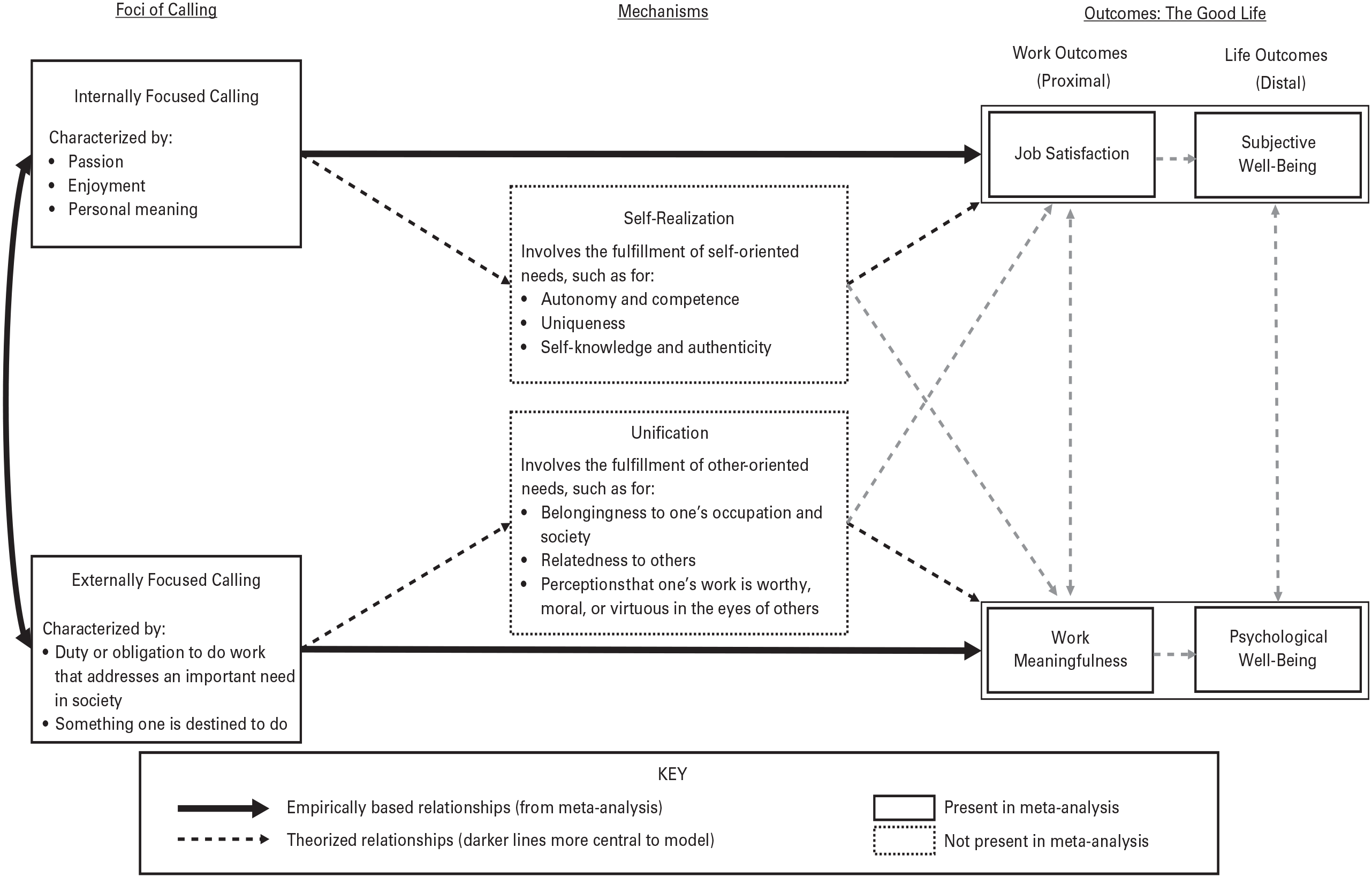
Theoretical Model of Calling’s Relationship to the Good Life
Primary paths
In the model, each of the two types of calling leads to a different primary path through a mechanism, theorized from the existing literature, and then to subsequent outcomes reflecting the good life. We ground the model’s main effect relationships in our meta-analytic results. For the first primary path, internally focused callings displayed a strong relationship with the more proximal (to calling) work outcome, job satisfaction, and also a positive but slightly less strong relationship with the more distal (to calling) life outcome, subjective well-being. Building on and integrating previous explanations in the calling literature related to intrinsic motivation and personal identity (e.g., Wrzesniewski, 2003; Rosso, Dekas, and Wrzesniewski, 2010; Dobrow and Tosti-Kharas, 2011; Conway et al., 2015), our theorizing suggests that internally focused callings positively influence these outcomes via satisfying a set of psychological needs associated with realizing one’s full potential. This mechanism, self-realization, involves the fulfillment of self-oriented needs—those that originate within and are aligned with the self, such as autonomy and competence (Deci and Ryan, 2000), uniqueness (Kreiner, Hollensbe, and Sheep, 2006; Brewer, 2011), and self-knowledge and authenticity (Ashforth and Schinoff, 2016).
For the second primary path, we found that externally focused callings displayed a very strong relationship with the more proximal (to calling) work outcome, work meaningfulness, and also a positive but slightly less strong relationship with the more distal (to calling) life outcome, psychological well-being. Building on the aforementioned social identity and moral duty explanations in the calling literature (Bunderson and Thompson, 2009), we theorize that externally focused callings, which inherently involve seeing one’s work as being connected to others and to society in general, can fulfill a specific set of fundamental needs that in turn influence outcomes. This mechanism, which has been referred to as unification, involves the fulfillment of other-oriented needs—needs that originate outside the self and involve behavior aimed at aligning oneself with significant others or with the value systems or principles of society writ large (Rosso, Dekas, and Wrzesniewski, 2010). These needs include having a sense of belongingness in one’s occupation and society (Baumeister and Leary, 1995; Tyler and Blader, 2003; Bunderson and Thompson, 2009), relatedness to others (Deci and Ryan, 2000), and perceptions that one’s work is worthy, moral, or virtuous in the eyes of others (Lepisto, Crosina, and Pratt, 2015; Lepisto and Pratt, 2017; Beer, Micheli, and Besharov, 2022). In sum, people’s externally focused callings, marked by moral obligation, duty, and a sense of destiny, fulfill these social needs, which in turn enhance work meaningfulness and psychological well-being.
This model provides a guide for theorizing about why the two types of calling relate to a holistic set of outcomes indicating the good life. While the primary mechanism for internally focused callings, self-realization, has received considerable scholarly attention (e.g., Maslow, 1943; Deci and Ryan, 1985; Lepisto and Pratt, 2017), we encourage future research to examine how people can satisfy various self-oriented needs simultaneously. It is possible that the simultaneous satisfaction of these needs influences well-being in unique ways (e.g., additive, compensatory, or reinforcing effects). Moreover, the mechanism for externally focused callings, unification, is particularly poised for future investigation into the satisfaction of other-oriented needs, including those rooted in culture and society. We also acknowledge that the primary paths discussed above are not the only paths to achieve the good life, as secondary, interrelated paths also exist.
Interrelated paths
Challenging current thinking in the calling literature about the distinctiveness of the two types of calling, our evidence highlights how strongly the two types relate to each other. Internally and externally focused callings not only lead to quite convergent outcomes but are also substantially correlated (weighted average r = .59). Although we did not test this, we believe the two calling foci likely influence one another; for example, sensing that work contributes to the greater good can make the work more enjoyable.
Further accounting for the convergence between the two types, our model includes a number of links (depicted as dashed gray arrows in Figure 4) whose existence we theorize but that we posit are less strong than the primary paths. For instance, we reason that each type of calling can operate via a secondary mechanism. Internally focused callings could lead to the good life via the proposed secondary mechanism of achieving unification, as this type of calling could also fulfill other-related needs. For example, musicians who experience their work as a consuming, meaningful passion may also—as a result of positive feedback from audiences—come to perceive that their performances are valued in society (Dobrow and Heller, 2015). Similarly, externally focused callings could lead to outcomes indicative of the good life via the proposed secondary mechanism of self-realization, as this type of calling could also fulfill self-oriented needs. For example, zookeepers who feel a moral duty to protect animals may also experience substantial autonomy and competence in caring for them (Bunderson and Thompson, 2009). This line of theorizing is consistent with the notion that work meaningfulness is achieved through asking both “Who am I [as a unique person]?” as in the self-realization path and “Where do I belong?” as in the unification path (Pratt and Ashforth, 2003: 312). We also highlight the interconnection among the outcomes in our model, which reflects that they are all indicators of the good life (Ryan, Huta, and Deci, 2008). Previous research has demonstrated connections between the proximal and distal outcomes on the upper and lower paths (e.g., work meaningfulness can lead to psychological well-being, in Ward and King, 2017) via spillover from the work to life domains (e.g., Eby et al., 2005; Heller and Watson, 2005), as well as between outcomes on the upper and lower paths (e.g., work meaningfulness can lead to job satisfaction in Hackman and Oldham, 1975). We encourage future research that empirically tests this full model.
Limitations of Meta-Analysis and Future Directions
This research has several limitations to consider when interpreting the results and conclusions. First, the nature of a meta-analysis means that data, and so variables, can be included only to the extent that they were measured in past studies. Broadly, this means that our emergent theory necessarily builds on what has already been examined in prior work, and we acknowledge that our review’s cutoff date means that we have not included empirical results that have emerged since that year (i.e., 2018–present). In addition, while we would have liked to test our theorized mechanisms directly, we were unable to do so given the insufficient number of primary studies that examined calling’s effects on our proposed mediators specifically or tested for mediation in general (cf. Bunderson and Thompson, 2009; Duffy, Allan, and Bott, 2012; Praskova, Hood, and Creed, 2014; Clinton, Conway, and Sturges, 2017). Thus, although our findings provided the basis for theorizing about a set of important outcomes indicative of the good life, we strongly encourage future research to investigate a broader range of well-being outcomes as well as additional types of outcomes (e.g., organizational commitment, prosocial behavior, physical well-being) that may relate to the two types of calling via self-realization and/or unification.
We note that our largely positive results could be perceived as being due to the fact that most empirical calling studies have focused on positive rather than negative outcomes (i.e., those indicative of positive aspects of well-being in work and life), as reflected in seven of our eight variable categories. That said, we note that our negative variable category, strain, was composed of more than 10 pervasive and important negative variables, including burnout, exhaustion, depression, irritation, and poor health or physical symptoms. Further, we note that all the associations within this variable category were either negative or nonsignificant, again indicative of calling’s contribution to the good life. Nevertheless, we call for future research to examine additional potential negative outcomes of calling, especially as they may relate to people’s (in)ability to sustain a calling over time (e.g., Schabram and Maitlis, 2017; Cinque, Nyberg, and Starkey, 2021; Sturges and Bailey, 2022).
Moreover, we acknowledge that people can experience work as meaningful without also experiencing it as a calling per se (e.g., Bunderson and Thompson, 2009; Tosti-Kharas and Michaelson, 2021). 14 Better distilling calling’s effect from that of experiencing work as meaningful but not as a calling will help advance theory in both calling and meaningful work research. We therefore encourage future research that explores the extent to which calling contributes to the good life above and beyond other relevant inputs (e.g., perceived social impact in Grant, 2008; cultural accounts at work in Boova, Pratt, and Lepisto, 2019).
We also note that our meta-analysis, by definition, was based on the synthesis of quantitative evidence and so cannot include evidence from qualitative studies. This may partially explain our lack of findings that support the double-edged-sword nature of calling, as key studies on this topic have used qualitative methodologies. It is possible that these qualitative studies have examined more-extreme samples and contexts than the quantitative ones (e.g., zookeepers in Bunderson and Thompson, 2009; animal shelter workers in Schabram and Maitlis, 2017), thereby yielding more negative outcomes—while also highlighting the importance of conducting research in such contexts (Eisenhardt, 1989; Bamberger and Pratt, 2010).
Despite the limitations of a meta-analytic approach, we nonetheless believe a strength of our study lies in our approach to theory development, namely, theorizing through integrating our robust meta-analytic findings with relevant literatures. We believe that building theory in this way has the potential to “improv[e] the process of theory development in management and organizational studies” (Thatcher and Fisher, 2022: 2). For instance, the connections between the two types of calling and outcomes in the model are largely based on main effect results from our meta-analysis, whereas we drew other elements of the model, such as the two mechanisms, from other literatures and then adapted and applied them to the current context. We hope that this mix—the theoretical integration of meta-analytic results with insights from relevant literatures—will inspire other scholars to do the same to further develop management theory.
Next, we encourage a broader investigation of the macro-level factors that may affect callings’ relationships to outcomes. To date, most calling research has involved samples drawn from Western, educated, industrialized, rich, and democratic societies (abbreviated as WEIRD in Henrich, Heine, and Norenzayan, 2010). In these societies, there are strong cultural norms around calling’s positivity and aspirational qualities such that people from these cultures or social classes may be particularly likely to hold the belief that work should be a calling (e.g., Newport, 2012; Berkelaar and Buzzanell, 2015; Tokumitsu, 2015). 15 We strongly encourage future research employing greater diversity to examine socioeconomic status and/or cultural context as moderators of calling’s relationships with outcomes (cf. Li et al., 2021). For instance, increased focus on the working class and how its members understand and experience callings would benefit the calling literature. We might see fewer or weaker positive relationships between calling and outcomes as people from more varied backgrounds, including those in “unconventional” settings (Bamberger and Pratt, 2010: 665), may espouse different work-related values and beliefs. Callings and their relationships to outcomes reflecting the good life may also be affected by additional macro conditions, including economic instability or scarcity, such as during the Covid-19 pandemic (e.g., Zhu et al., 2021), as well as by other characteristics of occupational labor markets (e.g., winner-take-all markets in Frank and Cook, 1995), which we suggest future research should examine. As critiques have recently emerged about the merits of pursuing callings in light of the potential for employee exploitation and societal inequality, we also encourage studies to explore the populations, occupations, and organizational contexts in which such mistreatment is likely to occur (e.g., low SES populations; Kim et al., 2020; Cech, 2021; Jaffe, 2021).
Another limitation is that the studies providing data for our meta-analysis predominantly used cross-sectional and single-source, usually self-report, methodologies (see Online Appendix D for meta-analytic results for study design as a moderator). Thus, we note potential concerns about common-method bias in reported results (Podsakoff et al., 2003) and our limited ability to draw causal inferences about calling’s effects. To address these concerns, we suggest that future research use more-rigorous and more-diverse research methodologies (see Wrzesniewski, 2012), including those that can unpack causality (e.g., experiments) to empirically distinguish calling from outcomes, explore long-term relationships of calling (e.g., longitudinal studies), draw on multi-source data, and use designs that can allow the possibility of reciprocal or recursive relationships.
Further, our treatment of the two types of calling was informed by how prior research has conceptualized and measured them. Scholars tend to conceptualize, and thus measure, calling as being one type or the other, but not both. We believe the reality is likely much more complicated. For instance, one plausible methodological factor contributing to the convergence we found between internally and externally focused callings is that the scales used were not explicitly designed to measure these types and so did not distinguish the two to the maximum extent. The two types may exist on a continuum (Thompson and Bunderson, 2019), with extant scales not falling at the extreme endpoints of this continuum. As a result, most scales of one type include at least a little bit of the other type, rather than being completely pure scales that would be ideal for studying the two types. We encourage scholars to use construct-valid measures of the two types, as well as both types together, to further test the pattern of results we found for the two types of calling.
The possibility exists that people can shift from experiencing one type of calling to another type—or to experiencing both types at once, which some scholars have argued would be best (the “transcendent” type of calling in Thompson and Bunderson, 2019: 432; Zhang et al., 2022). The ultimate question of the good life implications for people experiencing one type versus both types of calling simultaneously is an avenue we strongly encourage in future research. Our meta-analysis and theorizing suggest that due to the similarity between the two paths, as well as the several inter-relationships among aspects of the paths, both types can contribute to the good life. Moreover, people can change paths and experience elements of either/both paths along the way to experiencing the good life in both the work and general life domains.
Lastly, we encourage future research to further refine the many different scales currently used in the literature to measure calling. We were able to conduct analyses based on the type of calling, as measured by various scales, and thus speak to which type better predicts different outcomes. However, we also noticed that the content of items did not always match a scale’s underlying conceptual definition. For instance, a study using an externally focused definition of calling might then use a calling measure composed mostly of internally focused items. To mitigate this issue, we adopted an empirically driven approach to classifying scales based on the wording of their actual items, regardless of whether the conceptual definition matched. We believe that given the quantitative nature of our review, this approach was justified, compared to a traditional literature review that might categorize scales based solely on their stated definitions. Further large-scale psychometric work including revised calling scales that ensure a conceptual–empirical match and multiple calling scales in the same study is needed to provide additional guidance about which calling scales are recommended and for which purposes.
Conclusion
A key assumption underlying contemporary career advice is that people should find a calling and do what they love. Research on calling has grown in lockstep with its growing importance in public discourse. Through a systematic meta-analysis of calling research, we examined whether callings unequivocally contribute to the good life, arguably an overarching goal of human existence, and whether all callings are created equal. We found that callings at work strongly contribute to the good life. Although our findings paint a rosy picture of the work and lives of those with strong callings, we acknowledge that these people may not represent the majority of workers. Particularly given recent global trends in employee experiences, such as overwork, exhaustion, and burnout, as well as the so-called “Great Resignation,” during which both job vacancies and voluntary turnover were at all-time high levels (Cook, 2021; Malesic, 2022), we believe the time is right to examine in diverse contexts how callings contribute to—or detract from—overall well-being. It is possible that even in extreme contexts, callings buffer people from the increased hardship of their work (Nielsen et al., 2020; Zhu et al., 2021). We hope that our rich meta-analytic findings, alongside the novel theorizing, model, and research agenda we have introduced, provide the basis for a new generation of scholarship on the nature and outcomes of calling. We also hope that this study may help people answer for themselves the important questions of whether, which, and how callings contribute to their own good lives.
Supplemental Material
sj-pdf-1-asq-10.1177_00018392231159641 – Supplemental material for Calling and the Good Life: A Meta-Analysis and Theoretical Extension
Supplemental material, sj-pdf-1-asq-10.1177_00018392231159641 for Calling and the Good Life: A Meta-Analysis and Theoretical Extension by Shoshana R. Dobrow, Hannah Weisman, Daniel Heller and Jennifer Tosti-Kharas in Administrative Science Quarterly
Footnotes
Acknowledgements
We are grateful to Mike Pratt and three anonymous reviewers for their commitment to and insights into advancing this paper. We also thank those who saw this work presented in the LSE Behavioral Science Paper Club and at the Academy of Management Annual Meeting for their helpful feedback. Hannah Rothstein, Michael Borenstein, and Krista Hill-Cummings provided invaluable statistical advice. Finally, we would like to recognize the very active community of calling scholars who generously shared their work, in various stages, to be included in the meta-analysis.
1
The exceptions are Dalla Rosa, Galliani, and Vianello’s (2017) book chapter and Rowles, Cox, and Pool’s (2021) commentary article, which meta-analyzed a select group of studies (as opposed to those derived via systematic search) and/or a limited number of variables in relation to calling.
2
Although it would be conceptually cleaner to separate the work and non-work domains of life, because our meta-analysis employs data from existing primary studies, we are limited to the constructs examined in those studies. Our focal variables thus best reflect life as a whole, which may include work—for example, life satisfaction (e.g., Wrzesniewski et al., 1997)—rather than separating out non-work domains. Accordingly, in this article we refer to work and life as our focal domains, rather than to work and non-work.
3
Bunderson and Thompson (2009) use the term neoclassical to differentiate their “secular reimagining of the classical formulation” (Thompson and Bunderson, 2019: 429) of calling, a religious or divine view of calling as a reflection of one’s God-given gifts and talents.
4
In the literature, internally and externally focused callings have alternatively been termed modern versus neoclassical (Bunderson and Thompson, 2009; Dik and Shimizu, 2019); inner versus outer requiredness (Thompson and Bunderson, 2019); and secular versus neoclassical or modern versus religious (Wrzesniewski, 2012).
5
We did not conduct a targeted comprehensive search for purely qualitative or conceptual papers pertaining to calling, yet our search for quantitative studies surfaced over 100 such studies.
6
If authors sent us work dated after our time frame ended, we included the published study in the meta-analysis to the extent possible.
7
Across the 201 papers in our dataset, 174 papers used one scale, 20 papers used two scales, four papers used three scales, one paper used four scales, and two papers used five scales (total instances of calling being used = 240).
8
We required that each variable category include a minimum of five studies, the minimum number of studies necessary to generate precise prediction intervals. Thus, we excluded variables from the meta-analysis if they could not be grouped together with enough similar variables to produce a variable category (n = 864). Further, our variable categories excluded basic demographic variables (e.g., gender).
9
Beyond outcomes, the calling literature has also examined calling in relation to antecedents (i.e., constructs treated by studies as precursors of calling), correlates (i.e., constructs for which studies did not provide strong theoretical arguments for causal ordering, often control variables), and moderators of calling’s relationship with other constructs, namely characteristics of the studies (study design, sample composition, and type of national culture) that might affect the generalizability of these relationships. These 34 variable categories include outcomes as well as antecedents and correlates; see Online Appendix C (Table C1) for representative citations and meta-analytic results (Tables 2 and 3). We also provide moderator analyses for the relationships between calling and the eight core variable categories as well as with the 34 additional variable categories, using the aforementioned three study characteristics, in  .
.
10
We did not code any scales as both internally and externally focused, given that the scales were neither developed for this purpose nor were any evenly split in terms of items such that they can reasonably represent both perspectives equally.
11
For use in the analyses, we first transformed the original reported effect sizes, using a Fisher’s z transformation. We transformed the results back to correlation coefficients. We also corrected for sampling error variance—a major source of error in estimating population-level effects—but not for other statistical artifacts such as measurement error, artificial dichotomization of continuous variables, and range restriction or enhancement (Hedges and Olkin, 1985; Hedges and Vevea, 1996). In this sense, our procedure for making corrections (i.e., correcting only for sampling error) is similar to bare-bones meta-analyses in the tradition. A consequence of our chosen approach is that our calculated mean correlations may be conservative (i.e., slightly underestimate actual values).
12
For conceptual reasons, we would have liked to examine the differential effects of the various calling scales in the literature. For our main effect meta-analyses, the statistical requirement to not violate the sample independence assumption (Cooper, Hedges, and Valentine, 2009) meant we had to compute a single composite effect size for each sample, which precluded this possibility. However, we were able to use a different approach to examine whether the relationship between calling and outcomes depends on the type of calling (internally or externally focused). Here, when studies used two or more calling scales in the same sample, we randomly selected one calling scale to use in the analyses, rather than creating a composite. Further, for a robustness check, we also ran our main effect analyses using a randomly selected calling scale, rather than a composite, when more than one scale was used. This check yielded no substantive differences in the relationship between calling and any variable category (i.e., differences in the effect sizes of the composite and random versions ranged from –.06 to .01), with no change in the direction or significance of any relationship.
13
14
15
Our meta-analysis included range restriction for both national culture and socioeconomic status (SES), with individualist (vs. collectivist) and white collar/high SES (vs. blue collar/low SES) samples predominating, respectively; over 60 percent of the studies had U.S.-only samples. However, neither national culture nor sample composition moderated calling’s relationships with outcomes (), possibly due to lack of sufficient variance in these characteristics in the samples.
Authors’ Biographies
References
Supplementary Material
Please find the following supplemental material available below.
For Open Access articles published under a Creative Commons License, all supplemental material carries the same license as the article it is associated with.
For non-Open Access articles published, all supplemental material carries a non-exclusive license, and permission requests for re-use of supplemental material or any part of supplemental material shall be sent directly to the copyright owner as specified in the copyright notice associated with the article.
