



Abstract
We propose that individuals differ in their ability to generate creative ideas as a function of the values, beliefs, and norms of their social group’s culture they have adopted and routinely use. To generate creative ideas, an individual needs to think differently from their group to generate novel ideas that others cannot, while understanding what the group will view as appropriate and practical. We view culture as a network of cultural elements and decompose individuals’ cultural adoption into two conceptually and empirically distinct dimensions. Cultural breadth, which reflects whether individuals have adopted a broad range of values, beliefs, and norms that span the organization’s culture, contributes to the novelty required for creativity. Cultural embeddedness, which reflects whether individuals have adopted the core values, beliefs, and norms entrenched in the organization’s culture, helps an individual generate ideas that others will view as useful. We predict that individuals with both high cultural breadth and high cultural embeddedness, who we label integrated cultural brokers, will be most likely to generate creative ideas that are novel and useful. We test and find support for our theory in two contexts: an e-commerce firm in South Korea and MBA students at a U.S. university.
For an idea to be considered creative, it must meet at least two criteria: novelty and usefulness (Barron, 1955; Amabile, 1983, 1996). Novelty describes ideas that are unique and rare; usefulness describes ideas that are appropriate, feasible, and effective. As such, to generate creative ideas, an individual needs to think differently from others to make unique and unusual associations, while also understanding what others will view as appropriate and practical. In this article, we explore how individuals can strike this balance as a function of the values, beliefs, and norms—the cultural elements—of their social group’s culture that they have adopted.
Culture shapes how individuals interpret, understand, and respond to events and information: what they pay attention to, what they ignore, how they define problems, and how they ultimately respond to problems. Scholars have examined various aspects of culture, including cultural content (e.g., Li et al., 2013), cultural diversity (e.g., Corritore, Goldberg, and Srivastava, 2020), and cultural tightness (e.g., Chua, Roth, and Lemoine, 2015), to explain both why social groups with different cultures differ in their ability to generate creative ideas as a collective (e.g., Corritore, Goldberg, and Srivastava, 2020) and why different groups evaluate different ideas as creative (e.g., Chua, Roth, and Lemoine, 2015). However, prior research on culture and creativity has focused mainly on cross-cultural differences between groups and has not examined individual differences within a single social group—that is, how members of a social group differ in their level of creativity as a function of how they adopt and enact their group-specific culture. If culture shapes how group members interpret and respond to various issues and, consequently, their creativity at the collective level, they may differ in their creative ability according to the specific elements of their group’s culture that they have adopted. Two members with different perspectives may interpret their organization’s environment in different ways, pay attention to different cues, collect different types of information, and view different solutions as more appropriate (Kaplan, 2008). Yet prior research has not explored how the different ways that individuals have adopted their organizational culture can influence their ability to generate creative ideas.
This gap in the literature may exist partly because current approaches to the operationalization of cultural fit mask differences in individuals’ cultural adoption that are critical in shaping their creative abilities. Previous research on such adoption has focused on cultural agreement among organizational members and has operationalized cultural fit as the average similarity between one individual’s thoughts and behaviors and those of others in the organization (e.g., O’Reilly, Chatman, and Caldwell, 1991). We move away from this blanket approach and decompose fit into two components: one that allows individuals to consider a wider range of perspectives than others so that they can generate novel and unique ideas and one that enhances individuals’ understanding of what others will find useful rather than strange or inappropriate.
Specifically, we decompose individuals’ cultural adoption into two conceptually and empirically distinct dimensions: (1) cultural breadth, which focuses on whether individuals have adopted a broad range of cultural elements that span the organization’s culture, and (2) cultural embeddedness, which focuses on whether individuals have adopted the core cultural elements that are deeply embedded in the culture and reflect “who we are as a group.” Taking insights from cultural sociology research that conceptualizes culture as a toolkit of cognitive resources (Swidler, 1986), we argue that individuals with higher cultural breadth are more likely to consider diverse perspectives and, as a result, are more likely to generate novel ideas. But novelty without a good understanding of what others consider appropriate and useful will not be appreciated as creative. Therefore we argue that high cultural embeddedness and thus ability to understand what the group will appreciate as appropriate and useful can complement high cultural breadth, such that an individual can generate ideas that are novel and useful (i.e., creative). We test and find support for this hypothesis in two contexts: an e-commerce firm in South Korea and MBA students at a U.S. university.
Our study makes significant contributions to the literature on culture and creativity. By decomposing the notion of fit into cultural breadth and embeddedness, we can distinguish integrated cultural brokers, or those who have adopted core cultural elements (i.e., high cultural embeddedness) that span the organizational culture (i.e., high cultural breadth), from localized insiders, or those who have adopted core elements (i.e., high cultural embeddedness) concentrated in a limited range of the organization’s culture (i.e., low cultural breadth). Depending on the distribution of cultural elements within the organization, an integrated cultural broker and a localized insider might show a similar level of fit if fit is measured as the average similarity to others. Such a blanket approach, however, would mask key differences in these actors’ ability to use cultural resources for creativity. As creativity requires both novelty and usefulness, the concepts of cultural breadth and embeddedness are both necessary to fully understand an individual’s capacity to deploy cultural resources for creativity. Collapsing cultural breadth and embeddedness into a single dimension, as extant approaches to cultural fit have done, is akin to trying to identify a geographic location by using only longitude, not latitude.
Our decomposition of fit into breadth and embeddedness also aligns with scholars’ recent acknowledgment that cultural heterogeneity exists in varying forms in organizations and can affect organizational performance (Battilana and Dorado, 2010; Besharov and Smith, 2014; Chatman et al., 2014; Corritore, Goldberg, and Srivastava, 2020). Thus we build a bridge between micro and macro approaches to culture by exploring the implications of cultural heterogeneity for individuals within an organization. In other words, we bring the individual into the emerging literature on cultural heterogeneity.
We also contribute to methods for studying culture by introducing a novel approach for measuring culture and individuals’ engagement with it. First, we distill the organization’s culture from members’ short essays on who is valued in the organization and why. By asking organizational members to share which attributes and behaviors make people valued in the organization, we glean insight into what they perceive as the normative way of thinking and acting in the organization. By contrast, prior methods have typically measured culture by using content dimensions predetermined by researchers and have sometimes privileged top executives’ responses. Such top-down approaches may be insufficient to account for the cultural heterogeneity within organizations (Martin, 1992; Goldberg et al., 2016). By inviting all members of the organization to describe their culture, without imposing a predetermined structure on their articulations, we can capture subcultures that exist within the organization.
Second, we apply the concept of semantic networks to the texts we gather from organizational members, to map the structure of the culture (Mohr et al., 2020). This application can be particularly useful for future research given that scholars have begun using various types of text data—e.g., Glassdoor (Corritore, Goldberg, and Srivastava, 2020) and email content (Srivastava et al., 2018)—to rejuvenate the study and practice of organizational culture (Corritore, Goldberg, and Srivastava, 2020). The semantic-network approach that we introduce can be used with different types of text data to locate individuals in the topography of culture. This allows researchers to examine at scale the efforts of cultural brokers and cultural entrepreneurs and to characterize every group member’s ability to use culture.
Theory and Hypothesis
Different Types of Cultural Heterogeneity and Their Consequences at the Organizational and Individual Levels
Previous research on organizational culture has mostly emphasized how cultural agreement among organizational members can enhance task coordination, improve goal alignment, and consequently affect organizational performance positively (Kotter and Heskett, 1992; O’Reilly and Chatman, 1996; Weber and Camerer, 2003). Accordingly, research has treated heterogeneity in organizational culture as a sign of a weak culture or an imperfect state that will eventually lead to conflict (e.g., Weber and Camerer, 2003). Studies on individuals’ cultural adoption have also focused on cultural agreement among members and have operationalized cultural fit as the average similarity between an individual’s thoughts and behaviors and those of others in the organization (e.g., O’Reilly, Chatman, and Caldwell, 1991). Organizational members who are most similar to others in the organization are viewed as having achieved cultural fit.
More recently, scholars have begun to acknowledge that cultural heterogeneity is inevitable in organizations and that it influences organizational performance in various ways (e.g., Battilana and Dorado, 2010; Besharov and Smith, 2014). For example, Chatman et al. (2014) argued that each organization’s culture differs in three components: (1) the content of norms, (2) how widely members agree about norms, and (3) how intensely organizational members hold particular norms. They assessed the financial performance of high-tech firms and found that firms with high cultural consensus perform well if their norm content intensely emphasizes adaptability. Relatedly, Corritore, Goldberg, and Srivastava (2020) argued that organizations can differ in terms of intrapersonal cultural heterogeneity (i.e., cultural diversity that exists within an organizational member) and interpersonal cultural heterogeneity (i.e., cultural diversity that exists between organizational members) and that organizations with high intrapersonal cultural heterogeneity are more innovative because they are more likely to have members who can access broader cultural toolkits and, as such, are more creative.
Cultural heterogeneity in an organization is a function of individual differences in cultural adoption. Yet efforts to disentangle forms of cultural heterogeneity and their influences on performance have mostly been limited to organization-level studies. Most management studies still conceptualize an individual’s cultural fit as an average of the correspondence of cultural perception between the individual and others in the organization. This unidimensional conceptualization of cultural fit explains some important individual outcomes such as job satisfaction and tenure (e.g., Chatman, 1991; O’Reilly, Chatman, and Caldwell, 1991; Srivastava et al., 2018), but it masks some significant differences in individuals’ engagement with their organizational culture that could have profound implications for individual performance differences. For example, imagine an organization with multiple subcultures. One member may be culturally entrenched in one of the subcultures by having adopted its core values and beliefs, while another may have adopted some core values and beliefs of two or more subcultures. Depending on the distribution of the cultural elements that make up the subcultures, both members may have the same level of fit, measured as the average similarity to others in the organization, but they have adopted their organization’s culture in markedly different ways. The former might think similarly to others who share the subculture, while the latter will be fluent with a wider range of perspectives from multiple subcultures. The relevance of individual differences in cultural adoption for understanding individual performance is particularly salient for the outcome of creativity because generating creative ideas involves thinking differently from others and understanding how others think—two distinct abilities that stem from different types of cultural heterogeneity.
A creative idea has components of novelty and usefulness, and achieving both is not easy. A novel idea is by definition different from existing ideas, and therefore uncertainty exists about whether the idea is practical and reliably implementable (Amabile, 1996; Mueller, Melwani, and Goncalo, 2012). Novel ideas are also often constructed by combining content from multiple domains, and while the idea generator may be familiar with those multiple domains, the audience evaluating the idea may not (Berg, 2016). As such, novel ideas are often misunderstood and judged as weird (Uzzi et al., 2013). As Csikszentmihalyi (1999: 314) noted, “creativity is not the product of single individuals, but of social systems making judgments about individuals’ products.” Thus individuals who generate novel ideas may not be considered creative if they cannot convince others to fully appreciate their ideas.
To disentangle an individual’s ability to think differently than other group members from that person’s ability to understand what the group will appreciate as appropriate and practical, we conceptualize individuals’ adoption of their organizational culture in terms of breadth and embeddedness. Cultural breadth focuses on the diversity of the cultural elements one has adopted, where two cultural elements are considered to be similar when they are often adopted simultaneously by members of the organization. Thus individuals with high cultural breadth have adopted cultural elements from various subcultures within the organization. Two individuals may have adopted the same number of cultural elements and may still differ in their cultural breadth when one has adopted elements clustered within a limited range and the other has adopted elements spanning the organizational culture. Cultural embeddedness, by contrast, focuses on how deeply entrenched an individual is in the organization’s culture by having adopted core cultural elements that interrelate with many other cultural elements in the organization. Core cultural elements are nested within a cohesive cultural cluster and reflect the foundational notion of “who we are as a group.” Violation of these elements is considered inappropriate and is discouraged (O’Reilly, 1989). Peripheral cultural elements, in contrast, are loosely connected with other cultural elements in the organization, so violation of these elements will not result in serious punishment from the group (O’Reilly, 1989).
How Cultural Breadth and Embeddedness Affect Creativity
To our knowledge, our study is the first to explore the concepts of breadth and embeddedness simultaneously to examine individuals’ engagement with their organizational culture. In particular, cultural breadth is rarely explored in research on cultural adoption in the organizational context. This rarity reflects a major gap in the literature, given that various studies have shown benefits of having access to a broad range of cultural repertoires outside the context of organizational culture. Cultural sociology (e.g., Swidler, 1986) researchers have argued that individuals with broader cultural toolkits “may have greater horizons of possibility because they have a wider array of repertoires of action” (Small, Harding, and Lamont, 2010: 16). Drawing on this insight, we posit that individuals with high cultural breadth are more likely than individuals with low cultural breadth to consider a wider range of interpretations, even when given access to the same set of information.
Research on creativity has highlighted how individuals who consider a wider range of perspectives than others are more likely to generate creative ideas (Hargadon and Bechky, 2006; Perry-Smith, 2014; Perry-Smith and Mannucci, 2017). For example, Miron-Spektor, Gino, and Argote (2011) showed that individuals are more likely to generate creative solutions when they are primed with paradoxical frames (e.g., plan for everything, remain flexible), because paradoxical frames broaden individuals’ attention span and encourage them to consider a wider range of possibilities. Relatedly, multicultural individuals are creative because they can evaluate issues from diverse perspectives they have learned from their experiences in foreign cultures (Leung et al., 2008; Maddux, Adam, and Galinsky, 2010). Studies have also shown that individuals with greater knowledge breadth—that is, individuals with knowledge, know-how, and experiences from various domains (Amabile, 1983; Taylor and Greve, 2006)—are more likely to consider diverse perspectives and to generate creative ideas (Perry-Smith and Shalley, 2003; Taylor and Greve, 2006; Mannucci and Yong, 2018). Drawing on these literature streams, we argue that individuals who have adopted a wider range of the organization’s culture are more likely than those who have adopted a narrower range to consider a broader range of possibilities and, as a result, are more likely to generate novel ideas.
As mentioned, however, novelty without good understanding of what the audience will consider appropriate and useful will not be deemed as creative. Even if an idea has merit, organizational members may not appreciate it if it clashes with the organization’s culture (Hargadon and Sutton, 1997; Perry-Smith and Shalley, 2003; Cattani and Ferriani, 2008). Thus we argue that high cultural breadth will lead to creativity when complemented with high cultural embeddedness. Individuals with both high cultural breadth and embeddedness are those who have adopted core cultural elements that belong to different subcultures of the organization. As such, they are likely to consider a broader range of perspectives and to understand which types of novelty will be accepted in multiple subcultures across the organization as appropriate, useful, and implementable and which types will be rejected as weird, impractical, or not how things are done in that organization.
In addition, individuals with high cultural embeddedness can better frame their ideas in ways that are more palatable to the group. The ability to frame a thought and present it most persuasively to an audience is an important part of the ideation process (Perry-Smith and Mannucci, 2017; Falchetti, Cattani, and Ferriani, 2022). Individuals are also more susceptible to the ideas of others who share their own perspective (Kaplan, 2008) or their language style (Ireland and Pennebaker, 2010; Kovacs and Kleinbaum, 2020; Sytch and Kim, 2021). Those with high cultural embeddedness are more likely to share perspectives and language styles with many others in the organization and, therefore, to be able to frame their novel ideas most persuasively. Thus we argue that cultural embeddedness will complement cultural breadth, such that cultural breadth increases the likelihood that the ideas of those with high cultural embeddedness, but not of those with low cultural embeddedness, will be deemed creative.
Figure 1 depicts four types of cultural adoption with different levels of breadth and embeddedness. Individuals in Quadrant I, integrated cultural brokers, have adopted core cultural elements that span the organizational culture. We argue that these types of brokers will be the most creative. Their high cultural breadth will allow them to consider a diverse range of perspectives and generate novel ideas, while their high cultural embeddedness will allow them to channel their cognitive resources in ways that others in the organization will appreciate as appropriate and useful. Individuals in Quadrant II, localized insiders, have adopted core cultural elements concentrated within a limited range of the organization’s culture. For example, a localized insider can be culturally entrenched in one significant subculture within the organization. While localized insiders may understand what others will appreciate as appropriate and useful, they may have limited ability to generate novel ideas that diverge from others’ ways of thinking. Or what they understand as their organization’s culture may be true only for the subculture in which they are embedded and not for the rest of the organization. Depending on the distribution of cultural elements within the organization, an integrated cultural broker and a localized insider may have the same level of fit, measured as the average similarity to others in the organization. By moving away from average similarity and decomposing fit into breadth and embeddedness, we can disentangle their influences on the ability to generate creative ideas.
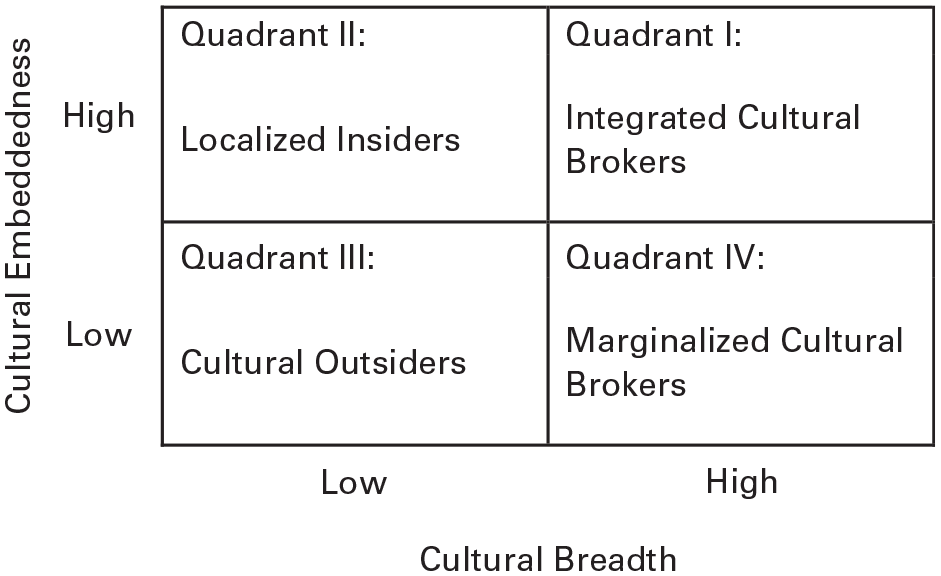
Four Types of Cultural Adoption
Individuals in Quadrant III are cultural outsiders who adhere to peripheral cultural elements concentrated within a limited range of the organization’s culture. These individuals may experience misalignment and find it difficult to be accepted as part of the organization. Last, individuals in Quadrant IV are marginalized cultural brokers who have adopted peripheral cultural elements that cover a comprehensive range of the organization’s culture. While their high cultural breadth may enable them to think differently from others and generate novel ideas, their novelty may often be poorly evaluated by others because these marginalized brokers do not understand what others will appreciate as useful or how to communicate their ideas so that others will fully appreciate the usefulness. With all four quadrants in mind, we hypothesize the following:
Measuring Cultural Breadth and Embeddedness in a Cultural Network
A common method for measuring individuals’ engagement with organizational culture is a survey focused on a set of cultural topics predefined by the researchers or a group of organizational elites, e.g., the Organizational Culture Profile (O’Reilly, Chatman, and Caldwell, 1991). Certain cultural topics, such as innovation and teamwork, are prevalent across various organizations, so we acknowledge that focusing on these cultural topics can be fruitful depending on the research question. Yet these predefined cultural topics may not reflect the topics that matter most to employees at a given organization (Goldberg et al., 2016). This is especially problematic for our research setting because we focus on the differences in cultural adoption among organizational members. For example, the difference between integrated cultural brokers (with high breadth and embeddedness) and localized insiders (with low breadth and high embeddedness) is less likely to be captured by coarse-grained survey items such as whether an individual believes that innovation is an important part of the culture.
Another method to evaluate individuals’ differences in cultural adoption is to examine their multiple memberships in different social groups, for example by using multicultural background as a proxy for cultural breadth (Jang, 2017). In organizations, however, no single proxy represents cultural breadth; various factors such as an individual’s background (Swidler, 2001), the division for which an individual works (Kaplan, 2008; Leonardi, 2011), when the individual joined the organization (Stinchcombe, 1965; Tilcsik, 2014), and with whom the individual most often interacts (Lu et al., 2018) can also affect which cultural elements the individual will adopt. Therefore an individual’s multiple memberships in a certain domain, such as being multicultural or having worked in more than one division, may not accurately capture the breadth of the organizational culture they have adopted.
Given this distinction, instead of relying on predefined survey items or a proxy, we directly measure individuals’ cultural breadth and embeddedness, using a two-mode network between individuals and the organizational cultural elements they have adopted (Mohr et al., 2020). To construct this cultural network, we use short essays that organizational members write on the attributes and behaviors valued in their organization. In an online survey, we first ask members to identify three colleagues who they believe are most valued by others in the organization and then ask them to write a short essay identifying the attributes and behaviors that make those members valued. Here, “valued” offers insight into what individuals perceive as the normative way of thinking and acting in the organization. For example, imagine an employee who talks about efficiency to make sense of why others value a certain colleague (e.g., “X is valued because he gets things done fast” or “Y is valued because she knows how to maximize output with limited resources”). Such a response reflects the notion that culture guides its members on how to think and act within the organization (O’Reilly, 1989; O’Reilly and Chatman, 1996). With this cultural network, we examine the breadth of cultural elements individuals have adopted and the degree to which these elements are embedded within the organization’s cultural network.
Integrated Cultural Brokers Versus Social Network Brokers
The benefits of being high in both cultural breadth and embeddedness on creativity stem from an individual’s capacity to process information; this is distinct from having access to information (Burt, 2004). Thus we posit that integrated cultural brokers will be more creative regardless of their social network and the access to information they gain from their network. We also argue that being in an integrated cultural network will not necessarily lead to being a broker in a social network, and vice versa. While we acknowledge the interdependence between social networks and cultural networks (Pachucki and Breiger, 2010; Vilhena et al., 2014), social network position does not completely determine which cultural elements an individual will adopt. Even when individuals are exposed to the same set of cultural elements, certain elements may resonate more with individuals with certain social identities, backgrounds, or experiences (Goffman, 1974; Lamont and Thévenot, 2000; Swidler, 2001). In addition, while newcomers need to adopt a certain level of organizational culture to be accepted by peers, how much more of the organizational culture they take on after being accepted varies (Srivastava et al., 2018). For example, two newcomers may both observe that some organizational members care a great deal about mentoring junior members. However, while one may quickly adopt this behavior as an organizational norm, the other may not, believing it is just an issue of personal preferences. Moreover, certain individuals may have a higher absorptive capacity to adopt various cultural elements. For example, experiences such as having lived in different countries might contribute to a person’s capacity to learn an organization’s culture, as might listening ability, belief in lay theories regarding people’s ability to learn culture (e.g., a growth mindset with respect to culture), and personality traits such as openness, tolerance for ambiguity, and need for cognition. Thus two individuals in a similar network position may be exposed to a similar set of cultural elements but differ in whether they adopt them as part of the organization’s culture.
In addition, individuals’ social network positions change more quickly than their cultural adaptation, which is stickier (Lizardo, 2006). For example, members of a newly created team may quickly form social ties with one another, but it may take longer for these team members to create group norms of how to work and to close gaps in the set of cultural elements they have adopted (De Vaan, Stark, and Vedres, 2015). Therefore a person who is both a network broker and an integrated cultural broker at time 1 may not be a network broker at time 2 but may continue to be an integrated cultural broker. Relatedly, Burt and Merluzzi (2016) found that individuals who oscillate between brokerage and closure positions in social networks have an advantage over those who constantly occupy brokerage positions, suggesting that an element of perspective transcends current social network position. Consequently, we predict that the advantages in creativity that integrated cultural brokers enjoy will persist when we control for their position in the social network within the organization.
Finally, organizational members may discover and adopt elements of organizational culture through means other than information gleaned through social networks. For example, individuals can learn about the organization’s culture via company-wide communications such as memos or announcements by the senior management to all staff. Individuals may also be exposed to conversations and jokes outside their social network in common areas such as cafeterias or breakout areas. Thus even an individual in a dense social network may still gain access to a wider range of cultural elements from various sources outside that social network, though whether this individual can adopt those elements as part of their cultural toolkit may depend on various factors already mentioned.
Study 1
We conducted Study 1 at a company in South Korea that provides an e-commerce marketplace where consumers can purchase local merchants’ goods and services. The company began as a startup in 2010 and experienced rapid revenue growth. At the time of the study, the company employed roughly 1,200 individuals, and its annual revenue was approximately $250 million. We tested our hypothesis with employees in the company’s IT department. At the time of the study, 268 people were employed in this department, which was the largest in the company. The IT department’s main responsibility was to provide a user-friendly online platform, which is a main source of the company’s competitive advantage. 1 We obtained basic information (e.g., age, gender, job rank, education background) on all IT employees from the company’s human resources (HR) department. We conducted an online survey in Korean to collect data on cultural elements that employees had adopted from the organization’s culture, employees’ ideas on improving the organization, and their social networks. The online survey was administered over five working days. Of the 268 employees, 217 (81 percent) completed the survey. Using the Kolmogorov–Smirnov test, we confirmed that nonrespondents were not significantly different from respondents in firm tenure, age, gender, job rank, and educational background. We then conducted an online idea tournament in which employees evaluated others’ submitted ideas and voted on them using two key creativity criteria: novelty and usefulness. This voting process took place over two weeks.
Identifying the Organization’s Cultural Network
We applied the concept of a semantic network to identify the structure of the organization’s culture and locate individuals’ positions in the cultural network in terms of breadth and embeddedness. In the online survey, we first asked employees to identify three colleagues who they believed were most valued by others in the organization. We then asked them to write a short essay on which attributes and behaviors made the three colleagues valued. From these responses, we extracted the organizational values, beliefs, and norms the respondents identified; for example, we extracted “efficiency” from the text response “X is valued because he gets things done fast.” This process involved two steps. First, we broke each response into separate statements, each containing one concept. For example, one response was “He is very passionate about work and is very hard working. He is always the last one to leave. He is also very good at his job.” We broke this response into four separate statements: He is (a) very passionate about work, (b) very hard working, (c) the last one to leave, and (d) very good at his job. One of the authors and one employee from the company’s HR department conducted this unitizing process, which resulted in 693 unique statements across all respondents.
Many of the 693 statements reflected similar concepts. For example, three statements—“is cooperative,”“is a team player,” and “always pitches in to help”—all emphasized the value of cooperation. Some statements shared a personal experience that demonstrated the character of the person the respondent described, such as how that person was a great teammate. Different statements describing the same concept needed to be grouped together. Ideally, the original respondents would have decided whether two statements reflected the same concept and could be merged under a single concept. However, asking 217 survey respondents to categorize 693 statements was not feasible. Thus one of the authors and three employees from the company’s HR department sorted statements into groupings that could be considered synonymous. Two statements were grouped only when three or all four raters deemed them as representing the same concept, that is, when the interrater agreement was 75 percent or above. 2 This process reduced 693 statements into 48 distinctive organizational cultural elements.
Next, we needed to identify patterns of association among these 48 cultural elements, to construct the network. We thus returned to the survey responses and examined how the respondents used these elements in their essays. Through this process, we created a rectangular two-mode (i×k) matrix between 217 individuals and the organizational cultural elements they enacted. We adopted this approach from the recent works of sociologists who studied patterns of relationships between individuals and the cultural elements they employ (Breiger, 1974; Vilhena et al., 2014; Mohr et al., 2020). Our method is also akin to Weber, Patel, and Heinze’s (2013) approach to mapping the culture of a field by using network analyses. We transformed the two-mode (i×k) individual-to-element matrix into a one-mode element-to-element (k × k) matrix and created the cultural network of this organization, which Figure 2 illustrates.
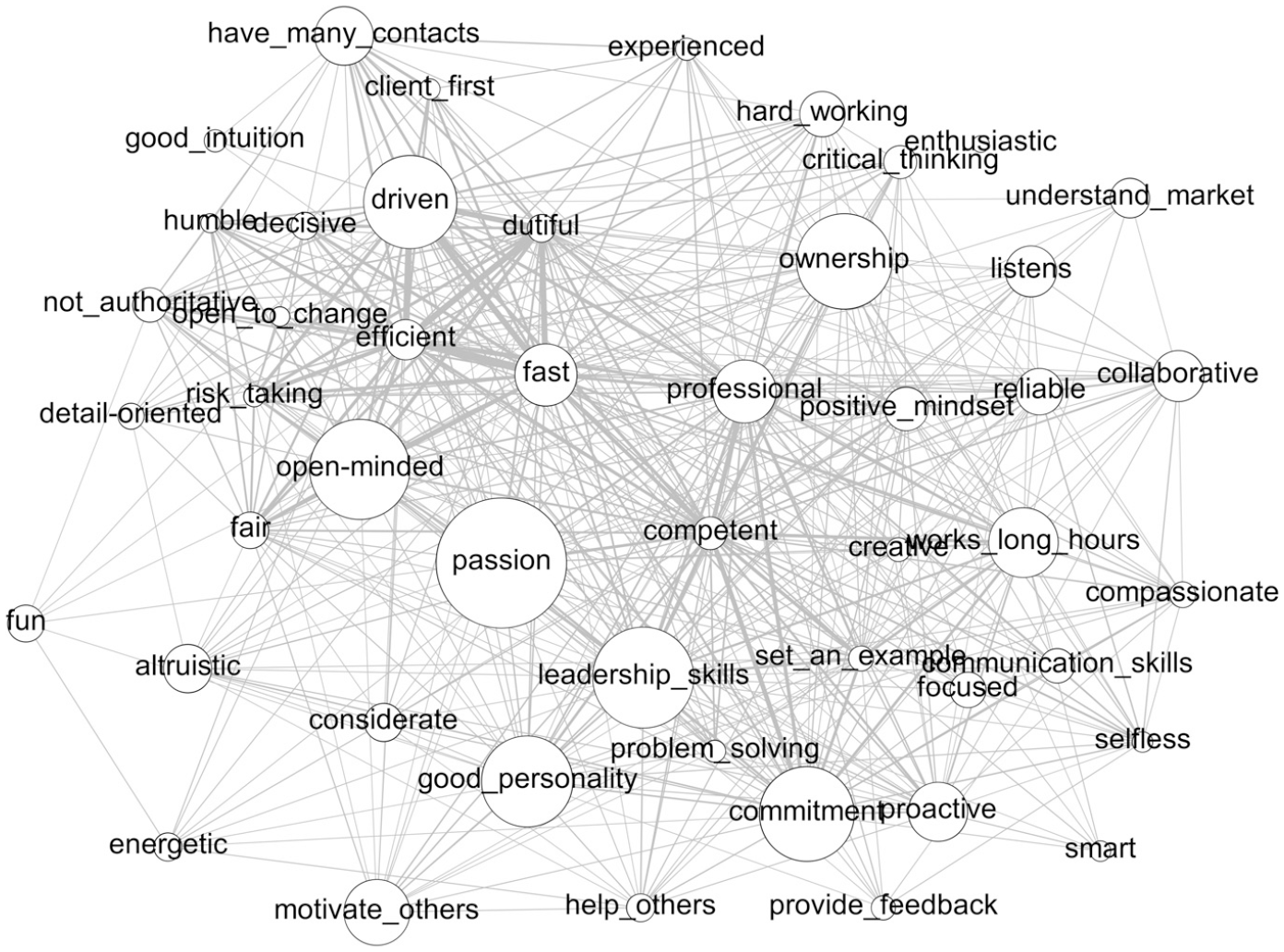
Cultural Network Depicting Organization’s Culture
The size of the node represents betweenness centrality (Freeman, 1978) within the network. Therefore, in conceptual terms, an integrated cultural broker who reflects both high cultural breadth and embeddedness has adopted cultural elements represented by the larger nodes spread out across the network.
Measuring Cultural Breadth and Cultural Embeddedness
Cultural breadth
To measure cultural breadth, we used Lizardo’s (2014) cultural network efficiency (CNE) measure. Lizardo (2014) developed CNE from Burt’s (1992) effective ego-network size metric. The CNE measure represents the extent to which an individual’s cultural choices bridge different cultural worlds that are weakly connected. According to Lizardo (2014), cultural omnivores consume not only many cultural genres but also genres that cut across types. For example, two people who consume four genres may differ in their level of cultural omnivorousness when one consumes four genres that belong in a certain type while the other consumes four genres with few overlapping audience members. Thus Lizardo (2014) argued that cultural omnivorousness cannot be identified only by the number of genres one consumes. Instead, he suggested an effective omnivorousness (EO) measure that accounts for the extent of audience overlap between genres chosen by each person. EO is calculated as
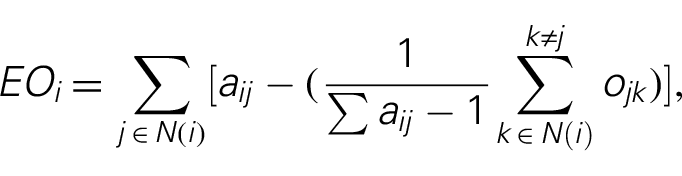
where
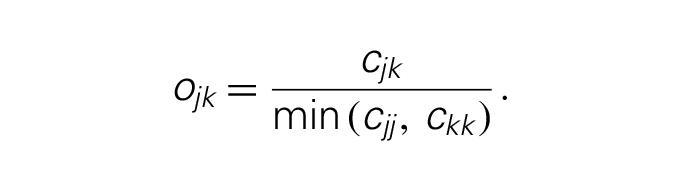
CNE is calculated by dividing the EO measure by degree centrality or the number of genres selected. In other words, CNE represents the extent to which a person bridges distant genres, when we control for the number of genres the person chooses. Individuals may have adopted the same number of cultural elements but differ in their cultural breadth. Figure 3 illustrates this using two individuals, drawn from our data, who both adopted eight cultural elements. As the figure shows, the person in the left panel has higher cultural breadth than the person in the right panel, because the former adopted a set of cultural elements that others in the organization are less likely to associate together. 3
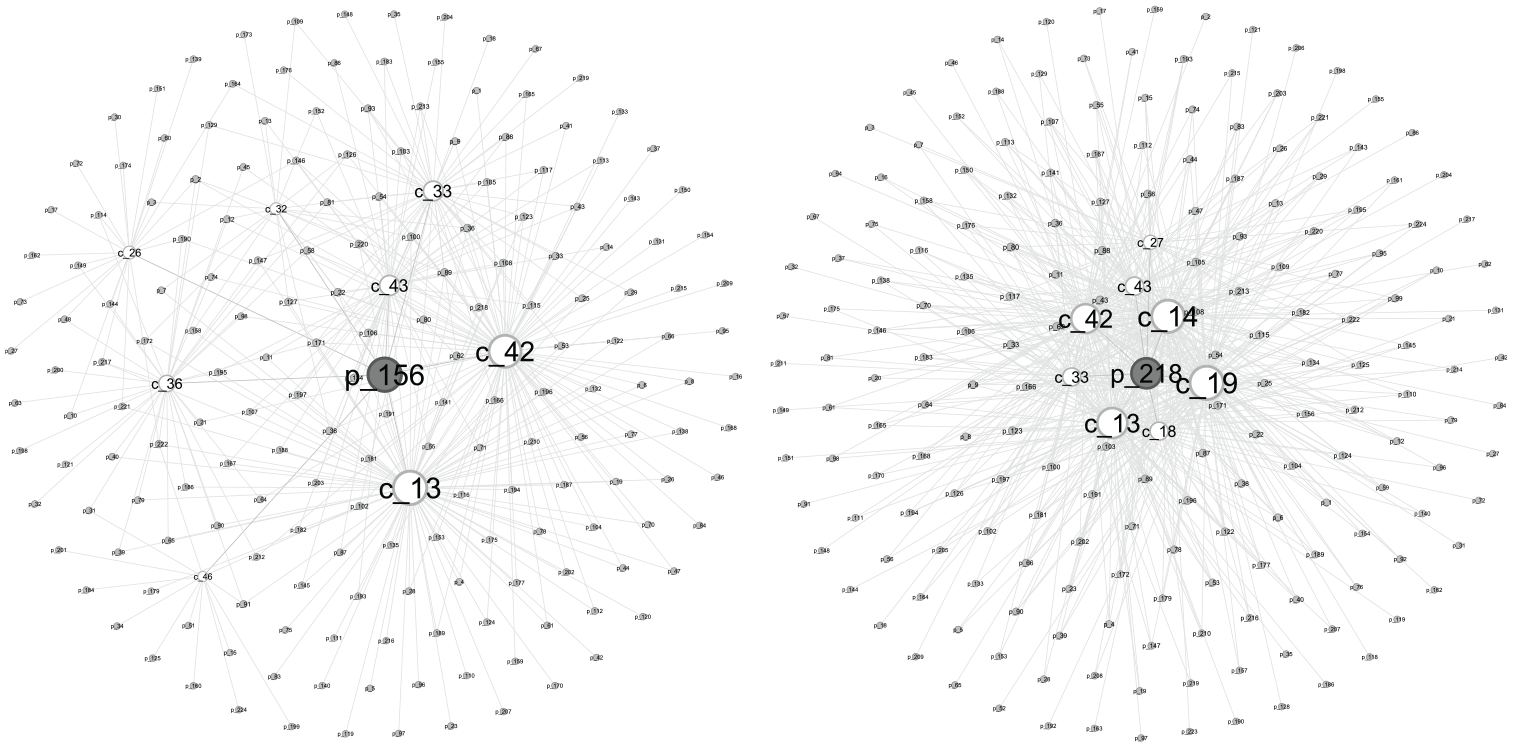
Individual-to-Cultural Element Bipartite Egocentric Networks of Two Individuals Who Have Adopted Eight Cultural Elements and Differ in Their Cultural Breadth*
Cultural embeddedness
We operationalize cultural embeddedness as the extent to which individuals are nested in a person-to-person cultural network in which they are connected by having adopted the same cultural element. Individuals are more deeply nested insofar as their connections with others in the group are robust to the removal of specific other individuals. Operationalized this way, individuals’ cultural embeddedness represents the robustness of their connection with others in the organization through shared cultural elements. This operationalization corresponds to the understanding of culture as an emergent property of a group that transcends individuals (Eliasoph and Lichterman, 2003). Granovetter (1992: 35) observed that the patterns of overall network cohesion associated with high individual levels of nestedness produce “normative, symbolic, and cultural structures” that affect behavior—in other words, a strong culture.
In terms of calculation, cultural embeddedness is a function of the extent to which individuals are nested in cohesive sections in the one-mode (i×i) individual-to-individual matrix that is projected from the two-mode (i×k) individual-to-element matrix. We use cohesive blocking, or k-components, to uncover nested subgroup structures (Moody and White, 2003; Mani and Moody, 2014; Benton, 2016). A subgroup of nodes is said to be k-connected if it would become disconnected with the removal of k nodes (Moody and White, 2003). In equivalent terms, a subgroup is said to be k-connected if there are at least k node-independent paths between all pairs of member nodes in the block. 4 Therefore highly cohesive subgroups are less vulnerable to being disconnected because of multiple independent paths linking pairs of nodes in the block, while weakly cohesive blocks can be broken apart when a few of the nodes are removed from the group. We measure cultural embeddedness as an individual’s maximum k-connectivity level, and this measure reflects how nested an individual is in subgroups in the cultural network. We provide more details on the cohesive blocking process in Online Appendix A.
Measuring Individual Creativity
To measure employees’ creativity, we held an online idea tournament. Following Burt (2004), we asked respondents, “From your perspective, what is the one thing that you would change to improve the company (e.g., ideas for a new service that we can launch, ideas on how to improve our current platform)?” On average, respondents wrote three or four sentences that in total included roughly 240 Korean characters. Employees were told that their submitted ideas would be anonymously entered into an online idea tournament and would compete with others’ ideas. Employees were not compensated for their participation in the idea tournament but were told that upper management would carefully examine the top five-ranked ideas for implementation and that the names of the employees generating the top-ranked ideas would be made public. Thus they had reputational incentives to perform well in the tournament.
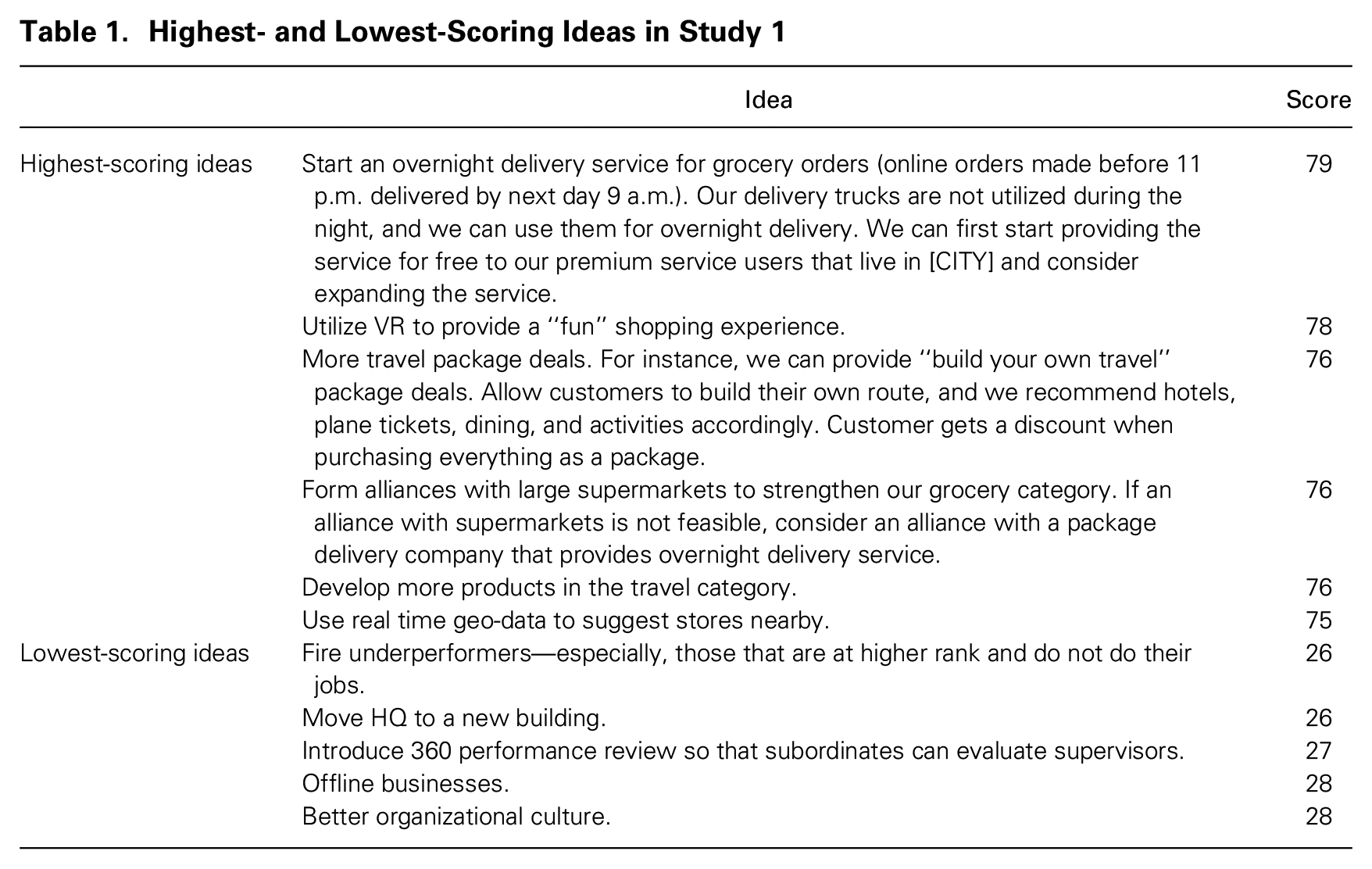
Submitted ideas were mostly about new projects the company could launch (e.g., “Launch in-house startups,”“Use real-time geo-data to suggest stores nearby”) or new markets it could enter (e.g., “Enter the T-commerce market”; “Provide service in Chinese, Japanese, and English”). Some ideas focused on inefficiencies or product improvements (e.g., “Eliminate inefficient team-level meetings where everyone is required to participate. Replace them with short and frequent chats between three to four core members of the project”; “Our products in the travel category lack variety. We need to attract more businesses in this category”). In Table 1, we list the highest- and lowest-scoring ideas. Ideas were submitted in Korean, and the ideas presented in Table 1 were translated into English by one of the authors.
Highest- and Lowest-Scoring Ideas in Study 1
We measured the creativity of the submitted ideas according to their performance in the idea tournament. Using an online voting tool at www.allourideas.org, a pairwise wiki survey developed by Salganik and Levy (2015), we built a website on which respondents could choose between a pair of ideas. All IT employees received a link to the idea tournament web page via email one week after the idea submission survey closed. When they entered the site, they were presented with a randomly selected pair of ideas and were asked which one they considered to be better. The website defined “better” as reflecting both novelty and usefulness, two key criteria for creativity (Amabile, 1996; Hargadon and Sutton, 1997; Perry-Smith and Shalley, 2003). The ideas were presented anonymously such that voting employees did not know who submitted them. The votes were also anonymous. After choosing which idea they believed was better, respondents were immediately presented with another randomly selected pair of ideas, and the voting continued for as long as the respondent wished. The voting website was open for two weeks and received 3,282 votes.
From the voting results, a score for each idea—the estimated chance that it would beat a randomly chosen idea—was generated from the website and updated dynamically in real time. For example, a score of 50 meant that an idea was equally likely to win or lose when compared with a randomly selected idea for a randomly selected user (for details on the scoring methods, see Salganik and Levy, 2015). We used the idea scores generated by the website to measure Idea creativity.
Control Variables
As noted, we theorize that the benefits of high cultural breadth and cultural embeddedness to creativity are independent of the advantages an individual may enjoy from being a network broker. Thus we needed to control for individuals’ social network position. In an online survey, we asked respondents three conventional ego-network questions (Burt, 1984). Respondents were first asked, “Please list the names of the company’s employees with whom you communicate most frequently regarding your tasks and the company.” Respondents could name up to eight contacts from anywhere in the company. Second, respondents were asked to describe their relationship with each, ranging from “very close” (38%) to “close” (43%) to “not so close” (18%) to “distant” (1%). Third, respondents were asked to answer the following question to describe the relationship between all pairs of their communication partners: “Think about the relationship between (column name) and (row name). Would you say that they are strangers who never communicate, acquaintances who sometimes communicate, or friends who communicate a lot?”
We used the ego-network data to calculate the variable Network constraint, a summary measure that captures the extent to which a focal actor bridges structural holes (Burt, 1992). Actor i’s network constraint (
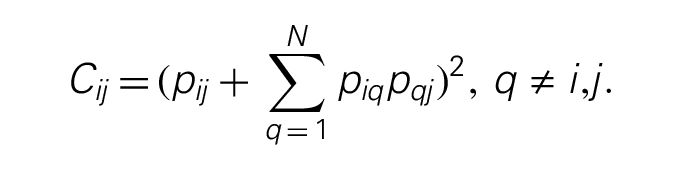
The first component is the proportion of ego’s total relational strength that ego allocates to an alter j, and the second component is the strength of the indirect connection between ego i and alter j through a mutual contact q in the network.
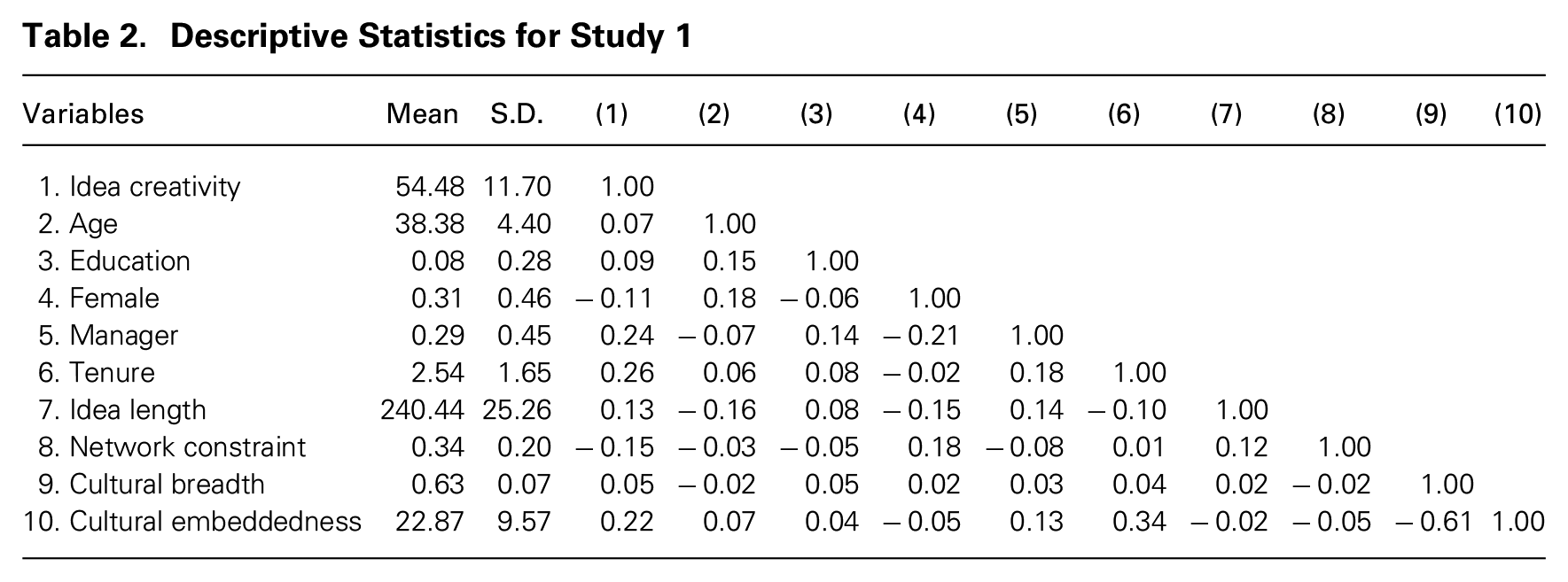
In addition, we controlled for the Age of employees because this variable indirectly captures their level of work experience. We included both the dummy variable Female, coded as 1, and the dummy variable Education, coded as 1 if the individual had a graduate degree (all respondents had at least a four-year bachelor’s degree). We also created three dummy variables to control for different teams within the IT division. There were four teams in total. Our sample included only employees from the IT division, and therefore the results were less likely to be driven by differences in their job functions and backgrounds (e.g., IT versus marketing department). However, systematic differences may still exist between teams, so we used team dummy variables to control for them. In addition, we coded the dummy variable Manager as 1 if the individual’s rank in the division was a manager or higher. We also included the employee’s Tenure with the company, measured in years, to control for knowledge or experience specific to the company. Finally, we controlled for Idea length, or the number of Korean characters used to describe the idea, to control for any effect caused by the sheer length of the idea. Table 2 presents the descriptive statistics and correlations among the variables included in our models.
Descriptive Statistics for Study 1
Results
In our data, we identified multiple outliers—bad leverage points and vertical outliers—that can distort the ordinary least squares (OLS) estimator and generate unreliable results. To reduce the effects of these outliers, we applied a robust regression method with the MM-estimator (Yohai, 1987). In Online Appendix B, we examine the outliers in our dataset in detail and explain our estimation strategy. Table 3 presents the results of a robust regression predicting idea creativity. We also ran coarsened exact matching and found similar results; see Online Appendix C. Model 1 includes all control variables, and in Model 2 we added cultural breadth and embeddedness. In Model 3, we tested our hypothesis by including the interaction term Cultural breadth×Cultural embeddedness. In Models 1–3, we find that network constraint has a negative and significant effect on idea creativity, replicating the findings of Burt (2004). We also find that being a manager has a positive and significant effect on idea creativity when both cultural breadth and embeddedness are taken into account (Models 2 and 3). Idea length is also positively associated with creativity in Models 2 and 3, suggesting that longer ideas are of better quality. Our main model of interest is Model 3, which includes the interaction term Cultural breadth×Cultural embeddedness. As expected, we find that this interaction is positive and significant in predicting idea creativity.
Robust Regression Model Predicting Idea Creativity in Study 1*
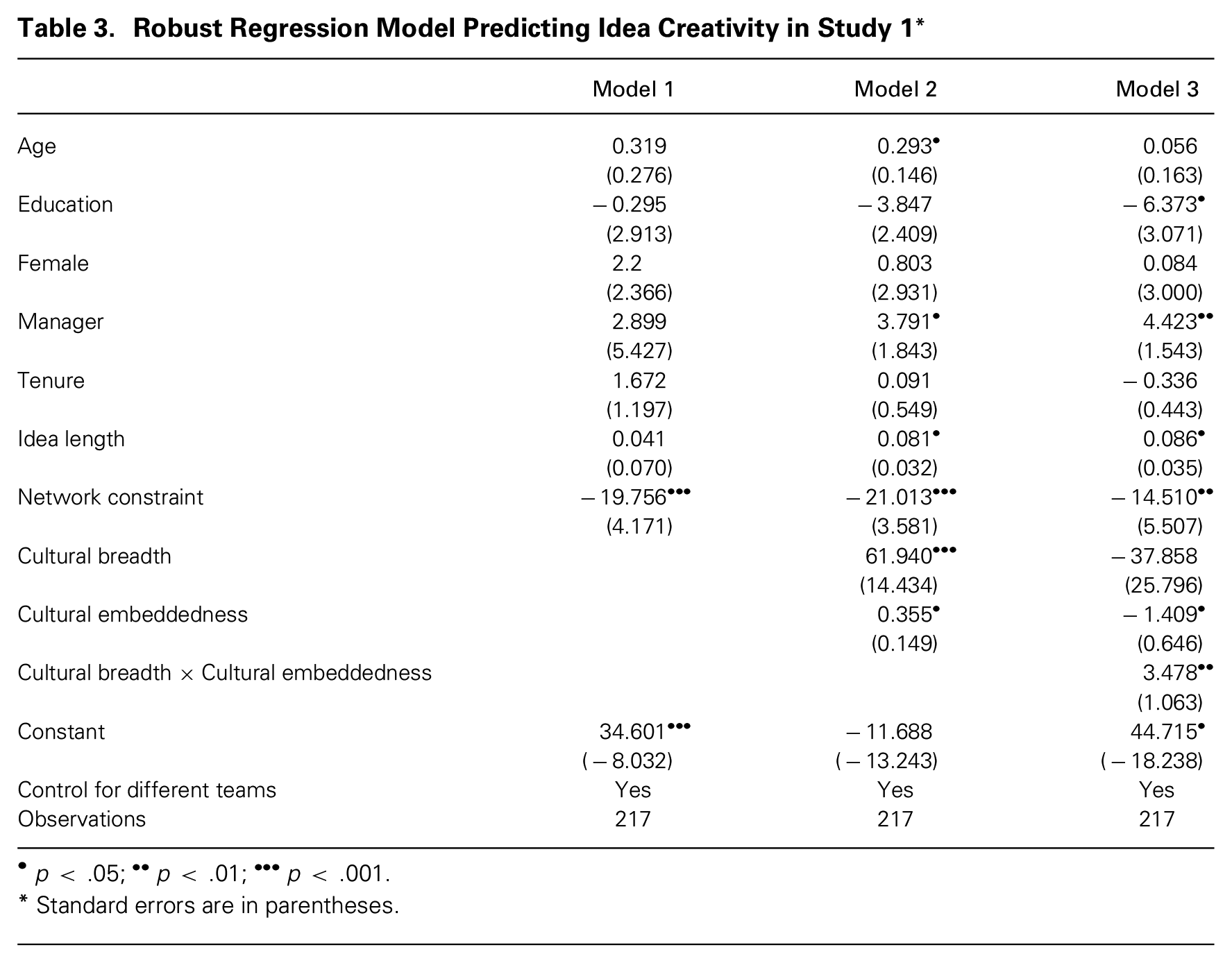
p < .05; ••p < .01; •••p < .001.
Standard errors are in parentheses.
Figure 4 illustrates this interaction effect. We find a positive association between cultural breadth and idea creativity for individuals who are at the median level of cultural embeddedness. This positive relationship becomes steeper for individuals with high cultural embeddedness (i.e., at the 90th percentile), consistent with our expectation that integrated cultural brokers’ ideas will be evaluated as more creative than will ideas of localized insiders. By contrast, for individuals with a low level of cultural embeddedness (i.e., at the 10th percentile), an increase in cultural breadth actually reduces their idea creativity—marginalized cultural brokers’ ideas were evaluated as less creative than were ideas of cultural outsiders. Thus we find evidence supporting our hypothesis that cultural embeddedness complements cultural breadth, such that for individuals with high cultural embeddedness, an increase in cultural breadth leads to increased ability to generate creative ideas.
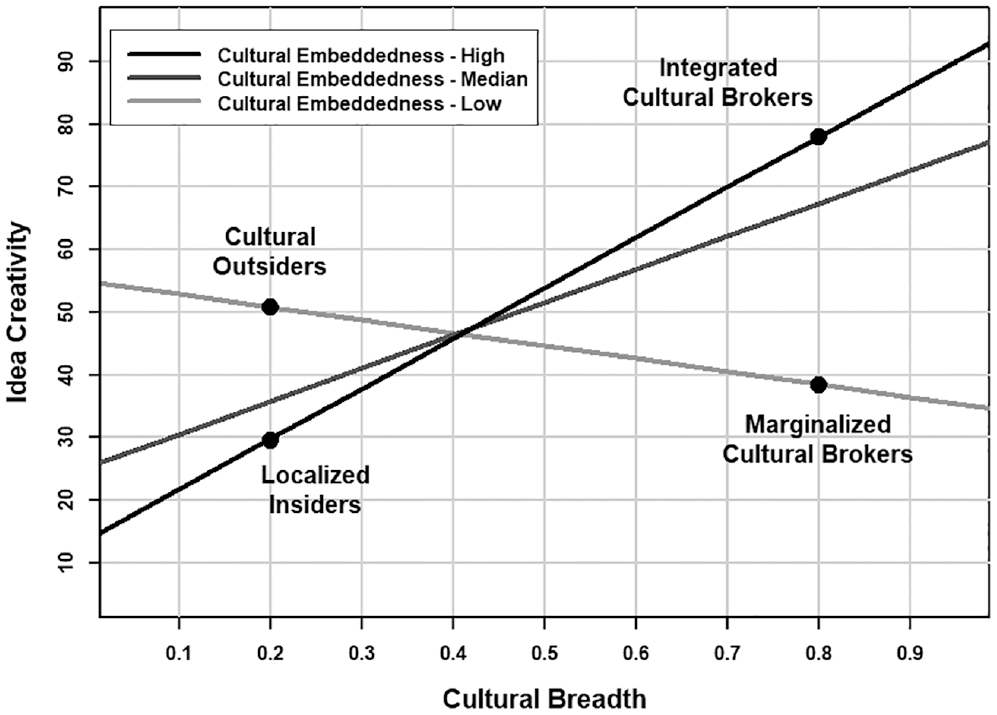
Interaction Between Cultural Breadth and Embeddedness on Idea Creativity in Study 1*
As a robustness test, Table 4 presents a replication of our analysis based on a subsample of employees in the top quartile in terms of the number of cultural elements they have adopted (N = 72). Our independent variables, cultural breadth and cultural embeddedness, are functions of an individual’s adoption of cultural elements, but they also depend on the distribution of those elements in the organization’s culture. With this robustness test, we aim to show that the distribution, not merely the number, of adopted cultural elements matters. Our hypothesized result holds in the subsample analysis presented in Table 4. In other words, among a subsample of those who adopted more cultural elements than others in the organization, integrated cultural brokers (who have both high cultural breadth and embeddedness) were most likely to generate creative ideas.
Robust Regression Model Predicting Idea Creativity in Study 1 with Subsample of Individuals with High Degree Centrality (N = 72)*
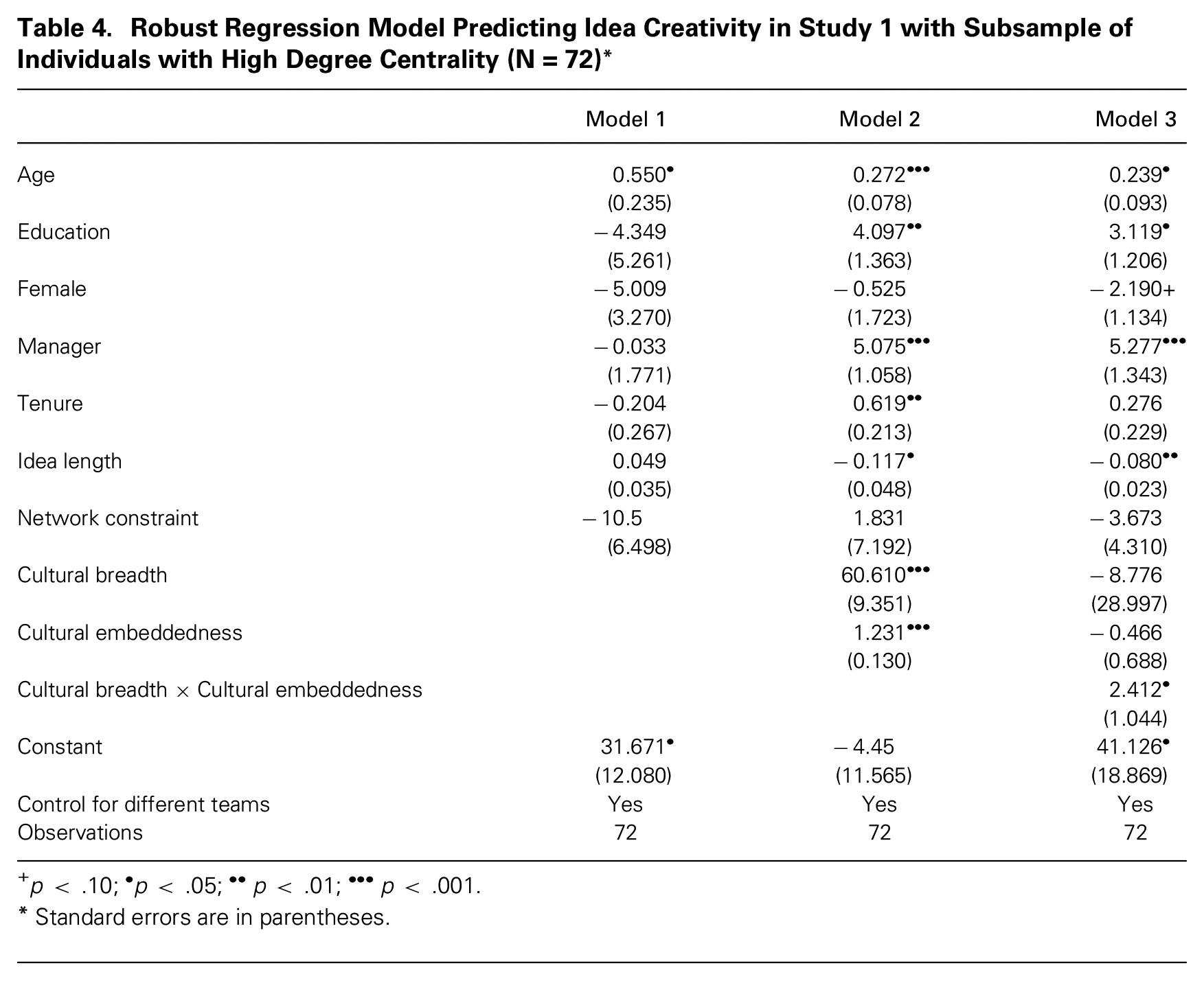
p < .10; •p < .05; ••p < .01; •••p < .001.
Standard errors are in parentheses.
Additional Analysis: Perceived Fit and Organizational Attachment
We also examined how cultural breadth and cultural embeddedness influence individuals’ perceived fit with and attachment to the organization. This analysis had two main objectives. The first was to further validate our constructs. In particular, while our way of measuring cultural embeddedness is new, previous research has indicated that individuals who have adopted the most deeply held organizational cultural elements (i.e., have high cultural embeddedness) are more likely to report higher perceived fit with and to show attachment to the organization (e.g., Edwards and Cable, 2009). Second, while cultural breadth leads individuals with high cultural embeddedness to have competitive advantages in generating creative ideas, it may also lead to lower levels of perceived fit and organizational commitment (Vedres and Stark, 2010). The different way of thinking among individuals with high cultural breadth may weaken their experience of perceived fit and make them more likely to consider leaving the organization. Thus to fully grasp the implications of cultural breadth and embeddedness requires understanding how these constructs relate to individuals’ perceived fit and organizational commitment.
To measure Perceived fit (M = 4.56, S.D. = 0.94), we used a survey item that asked employees how much they agreed with the following statement on a 5-point scale (1 = strongly disagree, 5 = strongly agree): “I believe that I fit well into the organization’s culture.” To measure Organizational attachment (M = 3.01, S.D. = 1.34), we used a survey item that asked employees, “For a 20% increase in pay, would you consider making a lateral move to another company in our industry?” Employees answered on a 5-point-scale (1 = definitely yes, 5 = definitely no). Many studies operationalize organizational attachment as job satisfaction, affective commitment, and intention to leave the organization (Venkataramani, Labianca, and Grosser, 2013). We tap into all three accounts of organizational attachment by asking respondents about their intention to leave the organization for a higher paying job at another company.
We used OLS regression models to test how cultural breadth and cultural embeddedness affect perceived fit and organizational attachment. 5 We find similar results when using ordered logistic regression models. Table 5 reports the results from the OLS regression models. In Models 2 and 3, we include cultural breadth and embeddedness, respectively, with the control variables and find that cultural breadth has a negative effect and cultural embeddedness has a positive effect on perceived fit. In Model 4, which includes both cultural breadth and embeddedness, we find that cultural breadth is no longer significant. In Model 5, we test the interaction effect of cultural breadth and embeddedness on perceived fit and find that the effect is not significant. Overall, cultural embeddedness has a significant and positive effect on perceived fit, consistent with previous literature (e.g., Edwards and Cable, 2009). Alleviating our concern, cultural breadth does not decrease perceived fit after we account for cultural embeddedness.
OLS Regression Model Predicting Perceived Fit and Organizational Commitment
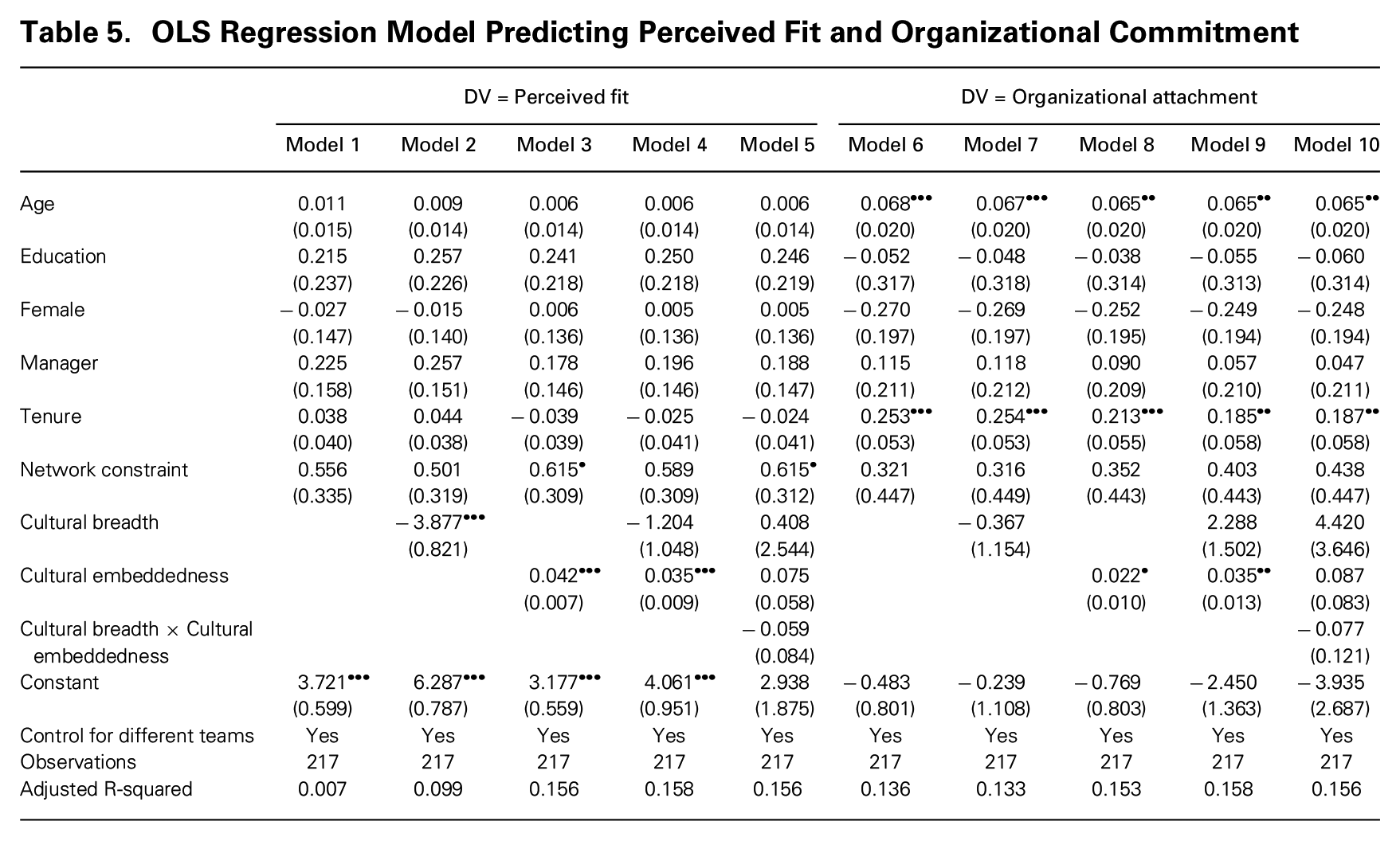
In Models 6–10, organizational attachment serves as a dependent variable. In the models, we find that age and tenure are positively associated with organizational attachment. As with perceived fit, we again find that cultural embeddedness has a positive and significant effect on organizational attachment, while cultural breadth does not. Thus while cultural breadth enables individuals to think differently from others, it does not seem to reduce their perceived fit with or attachment to the organization. Cultural embeddedness is positively associated with perceived fit and attachment.
Additional Analysis: Who Becomes an Integrated Cultural Broker?
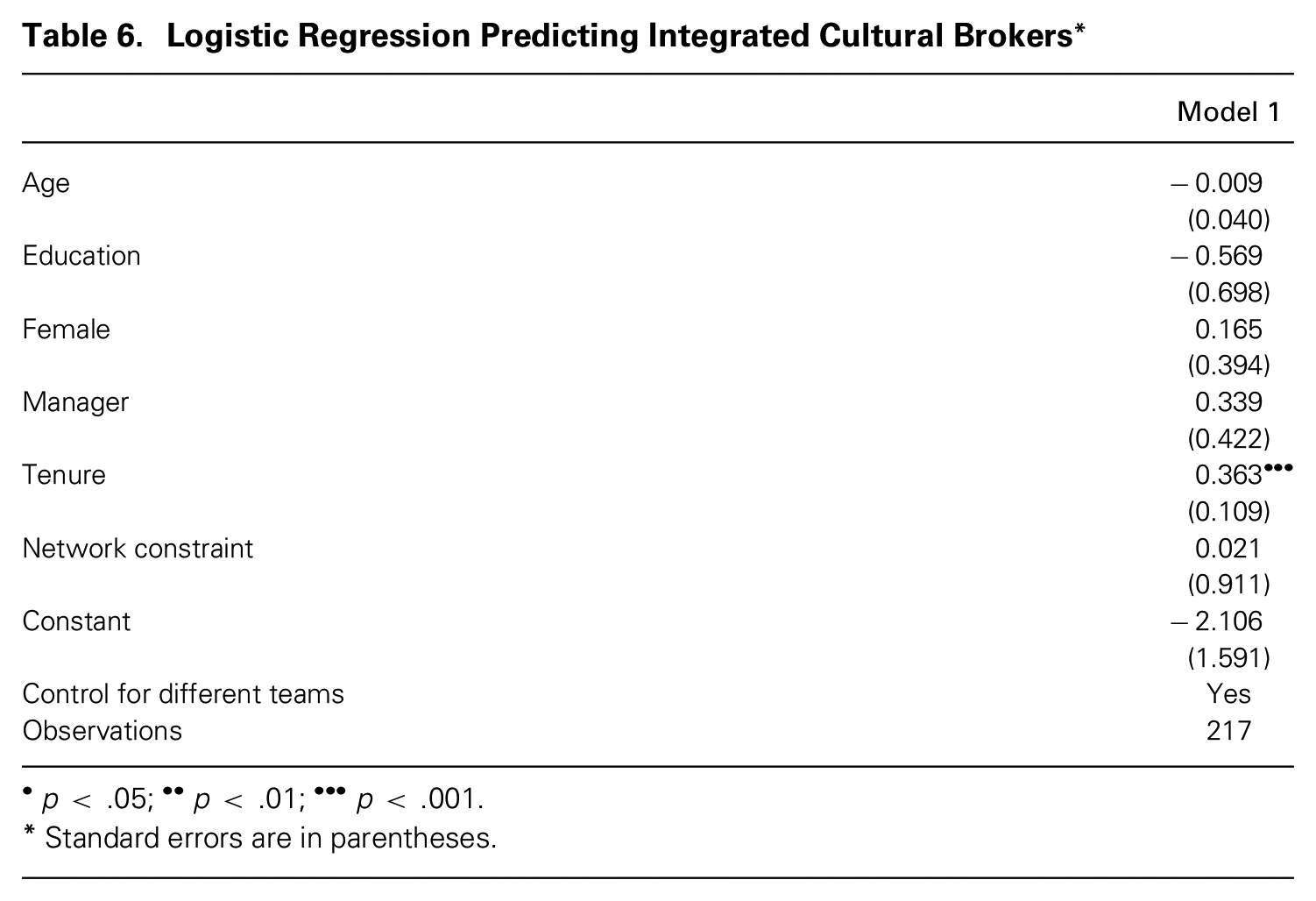
Given the benefits of being an integrated cultural broker, who becomes an integrated cultural broker is an important question for both theoretical and practical reasons. While a full answer to this question is beyond the scope of this article, we examined some of the characteristics of integrated cultural brokers by using a logistic regression analysis with Integrated cultural broker (= 1 when individuals’ cultural breadth and embeddedness are both above median) as the dependent variable. Table 6 presents the result of this analysis. We find that tenure has a significant and positive relationship with being an integrated cultural broker. This is consistent with previous research showing that individuals with longer tenure are more likely to have greater social knowledge, such as knowledge of the nature, history, and preferences of different departments in the organization (Obstfeld, 2005). Aside from tenure, we do not find any variable that significantly predicts being an integrated cultural broker, perhaps because, as noted, various factors such as individuals’ background, personality, and social identities outside the organization affect which cultural elements they adopt. We also find no association between being an integrated cultural broker and being a social network broker. We consider this finding further in the “Discussion” section.
Logistic Regression Predicting Integrated Cultural Brokers*
p < .05; ••p < .01; •••p < .001.
Standard errors are in parentheses.
Study 2
Study 2 allows us to replicate our results in a different context and to address two limitations of Study 1. The first limitation is the issue of endogeneity: creativity may be a function of individual attributes not accounted for in Study 1 that also promote cultural breadth and/or embeddedness, and therefore the relationships between these variables and creativity may be spurious. To address this issue, in Study 2 we controlled for individuals’ traits that are known to affect creativity. Specifically, we measured participants’ cognitive flexibility and promotion motivation. Cognitive flexibility is the ability to shift cognitive categories and has been recognized as a fundamental requisite for creativity (Mednick, 1962; Amabile, 1983). It is plausible that individuals with high cognitive flexibility adopt culture in such a way that they show high cultural breadth and embeddedness. Individuals with high promotion motivation are also more creative (Friedman and Förster, 2001) and more comfortable interacting with diverse others (Zou, Ingram, and Higgins, 2015), which may have shaped their levels of cultural breadth and/or embeddedness as well as their creativity score. The second limitation is the possibility that the national culture of the company we examined in Study 1 affected our results, as South Korea has a more collectivist culture than most Western countries. Thus we conducted Study 2 in the United States, which has an individualist culture.
Participants for Study 2 were working MBA students, taking classes on the weekends at a large university in a large city in the northeastern United States. The students were divided into two “clusters,” X and Y. A cluster is a group of 65 students who take required classes together, to which the school assigns admitted students by using constrained randomization to achieve demographic diversity in each cluster. At the time of our study, all our participants were taking classes only with students from their cluster. In addition to taking required classes together, the students took part in many cluster-focused events, such as cluster-members-only social events coordinated by their elected student officers and informal seminars in which they could exchange work experiences and expertise. Through repeated interactions over time among cluster members, each cluster went from being an anomic assembly of random students to having its own culture.
Methods
Before the first class in the first semester and before participants had met other students, we sent participants in both clusters an online survey to collect data on their personal attributes and to measure their cognitive flexibility. Two months into the semester, we conducted a second online survey, which included the same “who is valued and why?” essay question as in Study 1, to collect data on each cluster’s culture. As we did in Study 1, we broke down each response into unique statements that we then categorized into distinct cultural elements. We identified 39 elements in Cluster X and 50 in Cluster Y. We then built a two-mode network for each cluster, linking cluster members and the cultural elements they enacted.
The second survey also asked participants to generate an idea to improve the community within their cluster. Submitted ideas included various ways to network with one another (e.g., different ways of having mixers and small-group lunches/dinners), ways to build rapport as a team (e.g., team-building activities outside campus), and ways to share information (e.g., various mediums for idea/information sharing). Students were told that their peers would evaluate their ideas and that the best-rated ideas and the names of those who submitted them would be made public. As with Study 1, while there was no monetary reward for participation, we offered reputational incentives for strong performance. We also collected network data to control for individuals’ positions in the social network of the cluster: we presented participants with a list of students in their cluster and asked them to indicate those they considered their friends.
Dependent variables
Two weeks after the second survey, we conducted a third online survey to collect creativity evaluations of the submitted ideas. We asked all participants to evaluate three randomly selected ideas from their own cluster and three randomly selected ideas from the other cluster without being told that the ideas came from outside their cluster. Evaluations were made on a 6-point scale, and students were told that their evaluations should consider novelty and usefulness, the two main components of creativity. One hundred twenty-three students participated in all surveys and were included in the study (a 94.6 percent response rate). The dependent variable Idea score is an average of three scores received by students from the same cluster.
Independent and control variables
We measured individuals’ cultural breadth and cultural embeddedness in the same way as in Study 1. We measured Cognitive flexibility via the divergent thinking task administered with the first online survey. We asked participants to come up with as many different uses for a paper clip as they could in two minutes. Drawing on Guilford’s (1967) coding scheme, we measured participants’ cognitive flexibility as the number of distinct categories represented in their responses (e.g., “turn it into a ring” and “turn it into an earring” would lead to a score of 1 as both ideas are about making accessories with a paper clip; “turn it into a ring” and “use as a fishing hook” would lead to a score of 2). Two coders showed high interrater reliability (Cronbach’s α = 0.87), and we used the average of the two scores. We also measured participants’Promotion focus by using the regulatory focus questionnaire included in the first survey (Higgins et al., 2001).
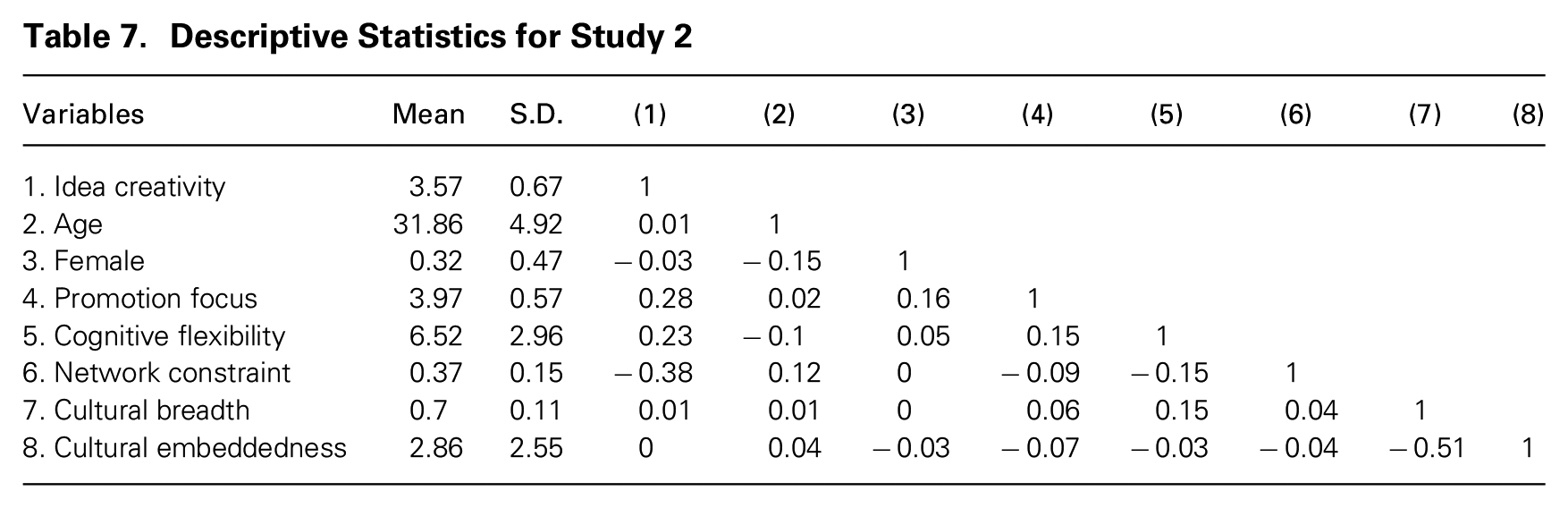
To control for participants’ age, gender, race, and occupation, we used information collected in the first survey. We also controlled for their network constraint based on the friendship network responses. Table 7 presents the mean, standard deviation, and correlations among the variables included in the analyses.
Descriptive Statistics for Study 2
Results
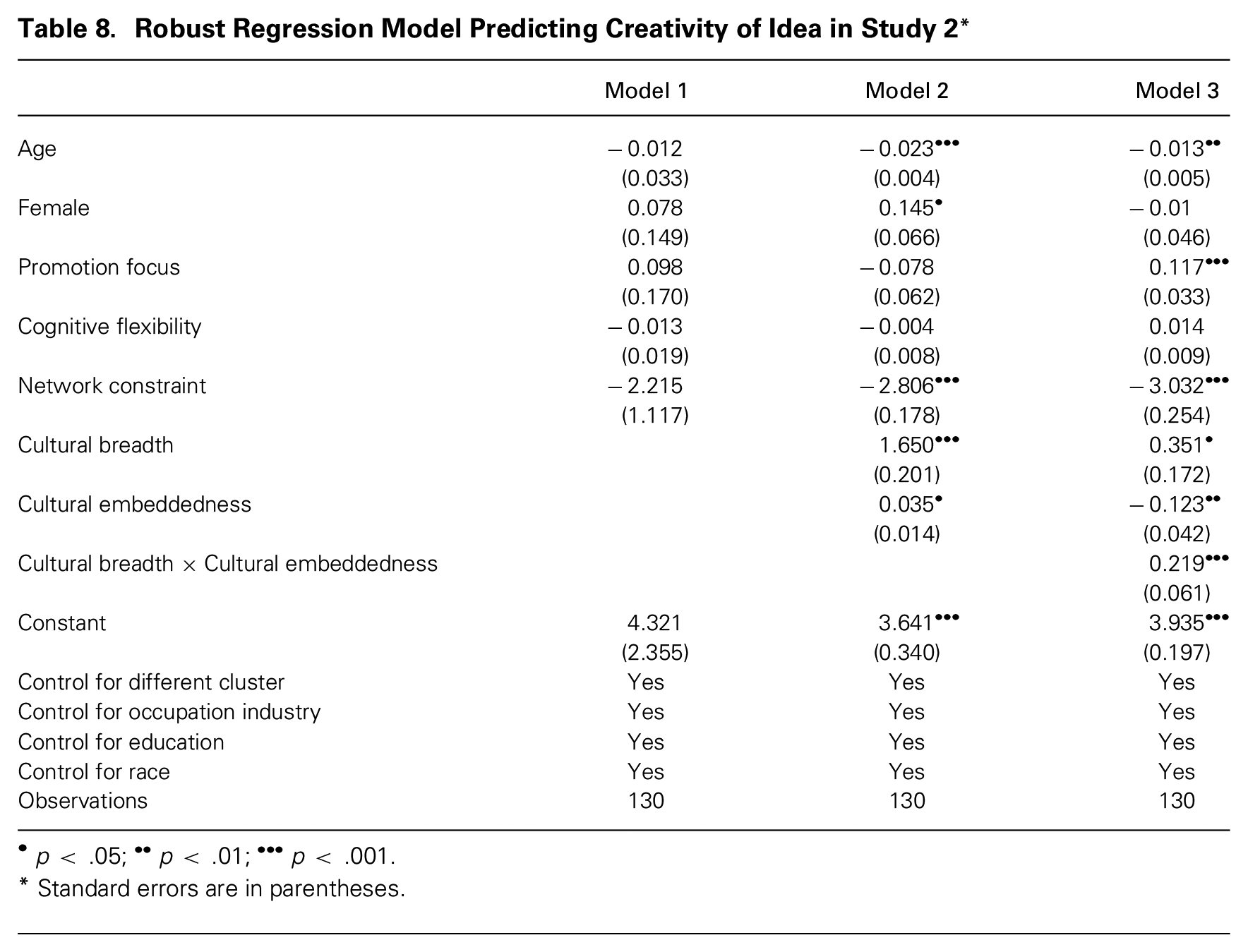
Table 8 presents the results of the robust regression analysis based on an MM-estimator predicting idea creativity. This is the same estimation model as in Study 1, and we explain the rationale for choosing this approach in Online Appendix B. We include a dummy variable to distinguish clusters. Model 1 is the baseline model with controls, and Model 2 includes the cultural breadth and embeddedness variables. In Model 3, we test our hypothesis with the interaction term between cultural breadth and embeddedness. In Models 2 and 3, we find that age has a negative and significant effect on idea creativity. We also find that network constraint has a negative and significant effect on idea creativity, consistent with Study 1 and previous literature (e.g., Burt, 2004). Promotion focus is significant and positively related to creativity only in Model 3. As hypothesized, in Model 3 we find that the interaction between cultural breadth and embeddedness is positive and significant in predicting idea creativity, and we illustrate this interaction effect in Figure 5.
Robust Regression Model Predicting Creativity of Idea in Study 2*
p < .05; ••p < .01; •••p < .001.
Standard errors are in parentheses.
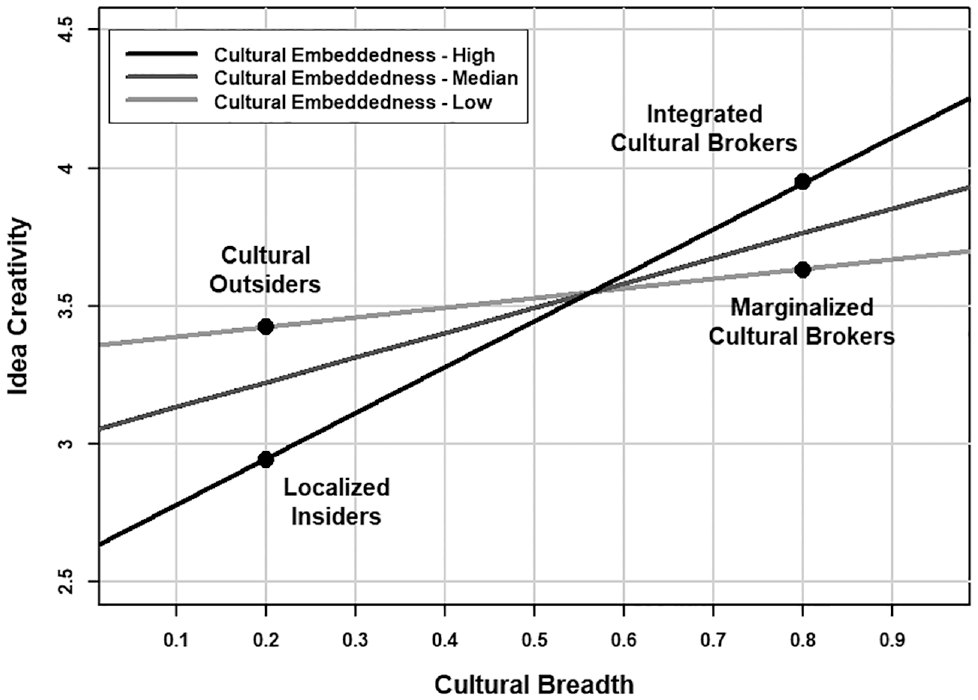
Interaction Between Cultural Breadth and Embeddedness on Idea Creativity in Study 2*
We find that for individuals with a median level of cultural embeddedness, an increase in cultural breadth leads to an increase in creativity. This positive effect between cultural breadth and creativity becomes stronger for individuals with high cultural embeddedness (i.e., at the 90th percentile), while the effect becomes weaker for individuals with low cultural embeddedness (i.e., at the 10th percentile). Therefore we find, consistent with Study 1, that cultural breadth engenders creativity for individuals with high cultural embeddedness. Thus we find evidence supporting our hypothesis even when we control for potential confounds of creativity and cultural adoption and when we analyze groups in an individualist national culture. Contrary to our finding from Study 1, cultural breadth is still positively associated with idea creativity for individuals with low cultural embeddedness, only to a lesser extent than for those with median or high cultural embeddedness. We consider this difference between Studies 1 and 2 further in the “Discussion” section.
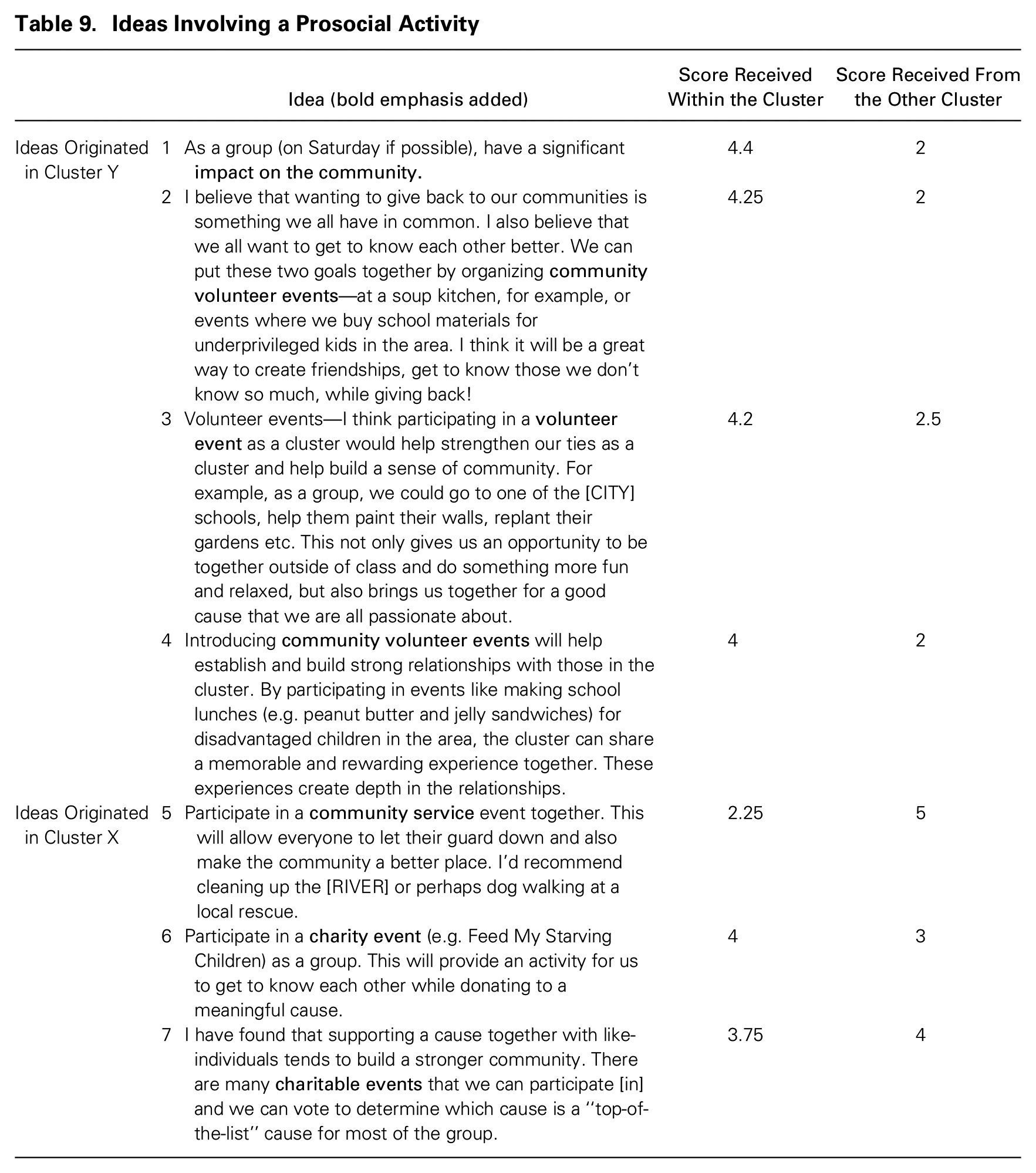
While we find that the interaction between cultural breadth and cultural embeddedness has a significant and positive effect on the idea creativity score provided by others within the same cluster, we do not find this effect on the idea creativity score provided by members of the other cluster. This finding is consistent with our theory that individuals’ adoption of a group’s culture influences their ability to generate ideas that will be viewed as creative within that group, by allowing them to understand what will be considered novel and useful. A closer look at the idea scores within and between clusters supports this interpretation. Table 9 lists ideas from Clusters X and Y that involved doing something prosocial as a group. In Cluster Y, all ideas for prosocial activities involved volunteering in the local community, and all such ideas were considered creative by members of Cluster Y but not by members of Cluster X. In Cluster X, one idea described volunteering in the local community; it was rated within that cluster as one of the least creative ideas, even as it was considered creative by members of Cluster Y. In other words, while members of Cluster Y evaluated all the ideas of volunteering as a group in the local community as creative (scoring 4 or above), members of Cluster X evaluated them all as uncreative (all scoring 2.5 or below). Yet Cluster X was not less prosocial than Cluster Y; rather, prosocial ideas scored as creative in Cluster X involved participating in “charity events” (ideas #6 and #7). The difference in evaluation of prosocial ideas across the clusters demonstrates that an idea viewed as creative in one group may not be deemed such in another group. Understanding the cultural context of evaluation in a group is therefore important for generating ideas viewed as creative within that group.
Ideas Involving a Prosocial Activity
Discussion
Organizational Culture and Creativity
Our findings make important contributions to the literature on organizational culture and creativity. Previous research has focused more on interorganizational differences and less on how individual differences in cultural adoption may lead to differences in creative abilities. In our study, we show that for individuals with high cultural embeddedness, cultural breadth enhances the ability to generate creative ideas. While our study focuses on the idea-generation stage, cultural breadth and embeddedness may also have positive effects on later stages of the idea journey (Perry-Smith and Mannucci, 2017). For example, these dimensions may also be helpful in the idea-championing stage, in which the idea originator advocates an idea, to gain approval and resources needed for implementation. During this stage, the idea originator must be able to influence and convince others in the organization (Perry-Smith and Mannucci, 2017). Integrated cultural brokers, who have high cultural breadth and embeddedness, would excel in this stage as they can appeal to diverse constituents across subcultures within the organization. This contrasts with how network brokerage can be beneficial in the idea-generation stage but undermine the coordination necessary to implement those ideas (Obstfeld, 2005; Fleming, Mingo, and Chen, 2007; Vedres and Stark, 2010).
Future research could explore how the effects of cultural breadth and cultural embeddedness on creativity vary in different organizations and contexts. We tested our hypothesis in very different contexts in Studies 1 and 2. One difference was that Study 1 was located in a country with a more collectivist culture, while Study 2 was located in a country with a more individualist culture. In both studies, we find a positive relationship between cultural breadth and creativity for individuals with median or higher cultural embeddedness. In Study 1, we find a negative relationship between cultural breadth and creativity for individuals with low cultural embeddedness—for these individuals, cultural breadth actually becomes a barrier to creativity. By contrast, in Study 2, we find that cultural breadth still has a positive relationship with creativity for individuals with low cultural embeddedness, though the effect is less positive for those with median or higher cultural embeddedness. While we cannot determine exactly why such differences occurred in the two studies, a plausible explanation is that cultural breadth without cultural embeddedness is punished in a more collectivist culture. We theorized that while having high cultural breadth allows individuals to consider diverse perspectives and therefore enhances their ability to generate novel ideas, ideas generated by those with high cultural breadth and low cultural embeddedness run the risk of being judged inappropriate or impractical. This rejection of novelties that lack good understanding of what the group considers appropriate and useful may be stronger in a collectivist than an individualist culture.
In our studies, we did not find any cultural gaps or cognitive clusters that were completely disconnected from the rest of the organization, perhaps because the groups we examined are somewhat homogeneous. In Study 1, we analyzed a department in an e-commerce company in Korea in which all members were college graduates and had the same ethnic background. Study 2 analyzed U.S. MBA students, and while they were more diverse in terms of ethnicity and nationalities, they were all students at the same school, which limits the sample’s diversity. The likelihood of finding cultural gaps and cliques increases as organizations grow larger and more diverse. In such cases, the competitive advantage enjoyed by integrated cultural brokers is likely to be greater. These individuals would play a key role in bridging cultural holes and fostering collaboration within such organizations (Giorgi, Bartunek, and King, 2017; Jang, 2017).
New Approach in Locating Individuals Within Cultures
In this article, we provide a novel and useful way to understand individuals’ adoption of culture. Previous measures of cultural fit, which emphasize an employee’s average similarity to others, do not consider the structure of the organization’s culture and, as a result, mask important differences in cultural adoption. Instead, we view culture as a network and examine individuals’ engagement with culture in terms of how diverse and nested their adopted cultural elements are within the cultural network. We thus bring the individual into the emerging literature on cultural heterogeneity.
Given the advantages of being an integrated cultural broker for creativity, future research should explore how individuals’ cultural breadth and embeddedness evolve over time and how and why certain individuals become integrated cultural brokers. Cultural adoption is a dynamic process (Srivastava et al., 2018), and we suspect that individuals’ cultural breadth and embeddedness will change over time. In particular, research could examine how changes in an individual’s position in a social network influence changes in that person’s cultural breadth and embeddedness. We found, as part of our additional analyses in Study 1, that being an integrated cultural broker has no significant relationship to the person’s position in the social network. However, examining changes in an individual’s social structure over time may reveal important dynamics between social network position and cultural network position. It is possible that during a period of deep engagement with the group (closure), individuals can enhance their cultural embeddedness, and during a period of connecting across groups (brokerage), they can enhance their cultural breadth (Burt and Merluzzi, 2016). In other words, while an individual’s position in a social network at one point does not predict whether they will be an integrated cultural broker with both high cultural breadth and embeddedness, shifts between closure and brokerage in a social network could help them become an integrated cultural broker.
We also encourage research on other determinants of who develops cultural breadth and cultural embeddedness. As we have noted, personality traits such as openness or need for cognition as well as experiences such as having lived in different countries might influence individuals’ capacity to learn an organization’s culture and their development of cultural breadth and embeddedness. In addition, some positions in the organizational structure may confer an advantage for learning culture, beyond the social network implications. For example, a top executive’s administrator serves as a clearinghouse for formal and informal information throughout the organization and may be exposed to more-honest perceptions, and less placation, than the top executive is (Ciampa, 2020).
By using open-ended questions and not relying on cultural categories predefined by researchers (Srivastava et al., 2018), we have also offered a new method to extract and examine the content and structure of an organization’s culture. From the survey responses, we built a person–cultural element network to map the content and structure of the organization’s culture (Mohr et al., 2020). This method could be implemented to examine various aspects of organizational culture and the different ways individuals engage with it. For example, the notion of cultural tightness could be operationalized as the density of the organization’s cultural network, or research could investigate the tightness around specific norms by zooming in on clusters within the cultural network, such as evaluating the tightness of the norm on efficiency by assessing the density of the network around efficiency. Tracking how an organization’s cultural network changes over time may also provide richer understanding of cultural change.
While we operationalize culture on the basis of respondents’ essays describing why certain members are valued in their organization, our definition of culture and the assumptions we make in the process are more aligned with the toolkit-based cultural model (e.g., Swidler, 1986) than with the value-based cultural model (e.g., Schein, 1985). Our emphasis on the distributional structure of culture is indeed based on the assumption that culture is fragmented, which contrasts with what the value-based cultural model assumes. What we capture from respondents’ essays on why someone is valued in their organization is not a system of values uniformly shared within the organization. Rather, we capture various cultural elements that people use to make sense of what is considered appropriate and ideal within their organization. Thus while we emphasize the cognitive conception of culture—i.e., that culture shapes individuals’ understanding of how things work—we also acknowledge that organizational values define what the organization desires and considers ideal and are thus an important part of organizational culture. In this sense, our work responds to scholars who have called for a synthesis of old value-based cultural models and new toolkit-based cultural models (Vaisey, 2009, 2010; Giorgi, Lockwood, and Glynn, 2015).
Conclusion
As the conception of organizational culture develops to recognize heterogeneity explicitly, it follows that some locations within a culture may present unique advantages or disadvantages for individuals. We demonstrate the potential of that idea for one important element of individual performance: creativity. In doing so, we create and detail a method to measure organizational cultures in the form of a two-mode network, in which organizational members are connected with cultural elements. This approach allows us to differentiate individuals’ embeddedness in core elements that make up their organization’s culture from the breadth with which they embrace the culture. We show that both concepts matter for creativity, and we see promise in using them to predict other individual outcomes, such as organizational commitment, influence, turnover, and the capacity to get things done. Likewise, just as the two-mode network of organizational culture allows us to differentiate individuals within cultures, it also allows us to differentiate the standing of cultural elements—that is, how certain values, beliefs, and norms are core/peripheral in the cultural network and how certain beliefs are more or less cognitively similar to others. Future research might therefore examine how organizational culture changes when a new CEO is appointed or when a prominent individual retires. Given emerging theory and methods, now is the time to bring the individual into analyses of organizational culture.
Supplemental Material
sj-pdf-1-asq-10.1177_00018392221146792 – Supplemental material for Cultural Breadth and Embeddedness: The Individual Adoption of Organizational Culture as a Determinant of Creativity
Supplemental material, sj-pdf-1-asq-10.1177_00018392221146792 for Cultural Breadth and Embeddedness: The Individual Adoption of Organizational Culture as a Determinant of Creativity by Yoonjin Choi, Paul Ingram and Sang Won Han in Administrative Science Quarterly
Footnotes
Acknowledgements
We thank three anonymous ASQ reviewers for their helpful comments and suggestions, and Associate Editor Maxim Sytch for his guidance throughout the review process. The article has benefited greatly from comments on earlier drafts by Eric Abrahamson, Dan Cable, Matthew Corritore, Sheena Iyengar, Pier Mannucci, Michael Parke, Damon Phillips, Eliot Sherman, and Sameer Srivastava. We also thank seminar participants at Columbia Business School, London Business School, and Stanford University; and participants at the Academy of Management Annual Meeting and the Berkeley Culture Conference.
Declaration of Conflicting Interests
The author(s) declared no potential conflicts of interest with respect to the research, authorship, and/or publication of this article.
Funding
The author(s) received no financial support for the research, authorship, and/or publication of this article.

1
The company participated in the study because its leaders wanted to better understand their employees and their organizational culture. At the end of the study, we provided the company with various analyses of its culture, communication networks, and employee satisfaction, without revealing individual employee data. The company’s leaders selected this department to be part of the study because they believed it was representative of the entire organization.
2
We performed a sensitivity analysis in which we grouped statements together only if all three of the company raters considered them representative of the same concept. This approach yielded results comparable to those reported subsequently.
3
In supplemental analyses, we estimated our models by using the Herfindahl–Hirschman index (HHI), a popular measure of concentration, as the cultural breadth measure. We found similar results.
4
Two paths from i to j are node-independent if they have only nodes i and j in common along the two paths (Moody and White, 2003). This means that if the subgroup has higher k node-independent paths, the members in this subgroup are more likely to be connected with each other by multiple pathways, thus implying high embeddedness.
5
For perceived fit and organizational attachment, we did not find outliers in our dataset as we did with idea creativity, and therefore we used an OLS estimator instead of a robust estimator.
Authors’ Biographies
References
Supplementary Material
Please find the following supplemental material available below.
For Open Access articles published under a Creative Commons License, all supplemental material carries the same license as the article it is associated with.
For non-Open Access articles published, all supplemental material carries a non-exclusive license, and permission requests for re-use of supplemental material or any part of supplemental material shall be sent directly to the copyright owner as specified in the copyright notice associated with the article.
