



Abstract
Movements seeking to infuse markets with moral values often end up utilizing the market mechanism and support from mainstream actors to scale up, even if it comes at the cost of diluting their founding ethos. But this process can be particularly challenging for movements that are explicitly opposed to using a market mechanism as a means of scaling up. Our analysis of yoga between 1975 and 2016 reveals how a countercultural movement fundamentally opposed to a capitalist market economy but seeking to grow can paradoxically become syncretic with or infiltrated by concepts and beliefs that are core to the market system but incompatible with the movement’s original ethos. We show how, before such a movement can be commodified, it must be de-essentialized, a process that requires stripping away key aspects of its history, context, and religious commitments and transforming collective goals into individual ones. This process involves not only external entrepreneurs looking to mine the movement but also movement leaders seeking wider enrollment of resource-rich actors to scale the movement up. We show how codes borrowed from parallel movements and templates borrowed from markets can be instrumental in driving such a movement’s transformation. Through this extreme case of the yoga movement, we advance understandings of how movements can become syncretic with values and practices they fundamentally oppose.
Studies at the intersection of social movements and markets (e.g., Carroll and Swaminathan, 2000; King and Pearce, 2010) have shown how the relationship between the two can be contentious and confrontational, as well as collaborative and complementary. Movements try to infuse markets with morals, often by supplying cultural codes that contain a “values” dimension of the morally desirable and undesirable (Weber, Heinze, and DeSoucey, 2008); however, markets also permeate movements and influence them in important ways (Soule and King, 2015). As movements attempt to scale up by expanding their boundaries and harnessing the power of markets, they risk diluting their core values and ethos (Hiatt, Sine, and Tolbert, 2009; Lee, Hiatt, and Lounsbury, 2017). Recent research has identified various strategies for avoiding this fate and achieving the twin goals of scaling up and preserving the movement’s authentic values (Hedberg and Lounsbury, 2020). However, as these movements seek change explicitly through the market and do not fundamentally oppose a market system or an exchange infrastructure, they can still accommodate the mainstream market for scaling up, even if they try to avert the blunting of their radical edges.
Movements that explicitly oppose the idea of creating profit-driven markets around what they consider to be civic, social, and community-based responsibilities (Radin, 1996) cannot readily embrace markets as a means to scale up, even though markets provide a potent means to increase impact. These movements include, among others, streams of the environmental movement (Frank, Hironaka, and Schofer, 2000), anti-capitalist movements (Reinecke and Ansari, 2020), and religious and spiritual movements (Rojas and King, 2018; Yue, Wang, and Yang, 2018) that oppose the commodifying nature of a market and seek a radical transformation of society. Countercultural movements (Roszak, 1995; Andretta, della Porta, and Saunders, 2019) oppose not just specific aspects of markets but the ideological underpinnings of market capitalism (Cini et al., 2017), which poses a more fundamental obstacle to accommodating the market mechanism as a means of scaling up. How is conflict with markets resolved in such movements?
Yoga is a particularly fertile empirical setting for investigating these dynamics. This ascetic, anti-market movement that started in India and arrived in earnest on American shores in 1893 came to be at the center of an $80 billion global market in 2016, one-fifth of which was in the United States. This is remarkable because, inspired by Hindu philosophy (De Michelis, 2004), the yoga movement’s central codes were meant to provide an antidote to the individualism and consumerism fostered by capitalism, aiming to free one from all worldly, material considerations (Vivekananda, 1947). Eventually, the movement was cleansed of its anti-materialist essence and “market-encumbering” religious constraints. A meditative and spiritual practice with the ultimate aims of self-diminution, ego transcendence, and union with the divine (Strauss, 2004) was transformed into a “certifiable,” priceable, and user-friendly product with different proprietary versions promising a positive body image, fitness, and stress relief that could be bought and sold in the market. Theoretically, this setting enables us to take a deeper look at how movements that oppose market capitalism itself can become implicated in it and paradoxically even become syncretic with a market ethos. We use the term “syncretic” to describe the infiltration of an ostensibly pure tradition by concepts, beliefs, and meanings seen as belonging to other incompatible and often conflicting traditions (Stewart and Shaw, 1994). Anti-market movements do not simply integrate or fuse with markets but transform to become syncretic with them.
Our study enables us to make three contributions. First, in contrast to movements seeking change through the market, we show how movements opposed to a market economy but seeking to scale up need to be “de-essentialized” before their core practices can be commodified. De-essentialization refers to the untethering of a movement from its meaning and historical context. We identify three components in the de-essentialization process: (a) selective desacralization, or selectively stripping a movement of its market-fettering “baggage”; (b) individualization, or converting its collectivist ethos into an individualist one; and (c) decontextualization, or obscuring its historical context to make it marketable.
Second, we show how such movements are not simply “coopted” (Lounsbury, Ventresca, and Hirsch, 2003), or appropriated by market actors, but syncretize with markets with the help of legitimizing support offered by movement leaders seeking wider enrollment and impact. Entrepreneurs and movement leaders become unlikely allies in this process. The latter provide discursive justification for entrepreneurs trying to forge new, easier-to-sell aspirations around the movement’s core practices and facilitate commensuration to enable expansion. Our analysis shows movements and markets do not necessarily present mutually exclusive and irreconcilable worlds comprising the sacred and the profane. Instead, the syncretization of conflicting moralities in “connected lives” (Zelizer, 2012; Hitlin and Vaisey, 2013) suggests an interpenetrative relationship between movement actors who need markets to grow and market actors who mine movements to create and expand markets.
Finally, we reveal how actors borrow and adapt codes from other intersecting and overlapping movements (Rao, Monin, and Durand, 2005) and fuse them with market templates to forge new markets and expand extant ones (Munir and Phillips, 2005). We shed light on how borrowing codes from overlapping versus non-overlapping movements might elicit different levels of resistance from within the movement. In doing this, we advance research on boundary spanning and spillovers (Meyer and Whittier, 1994; Wang, Piazza, and Soule, 2018) and offer a perspective that is neither movement-centric (Walder, 2009; Fligstein and McAdam, 2011; Crossley, 2015) nor isolated from the larger context.
Theoretical Motivations
An increasing number of studies at the intersection of social movements and markets (e.g., Davis et al., 2008; King and Pearce, 2010) have shown how movements can coerce corporations into acting more responsibly (e.g., Davis et al., 2008). By increasing pressure on these actors, social movements seek to infuse markets and market actors with moral values and/or to create and legitimize alternative markets (Bartley, 2007; Akemu, Whiteman, and Kennedy, 2016; Briscoe and Gupta, 2016). These alternative markets often develop around cultural codes supplied by movements, as seen in the cases of grass-fed beef (Weber, Heinze, and DeSoucey, 2008), soft drinks (Hiatt, Sine, and Tolbert, 2009), green products in banking (Almandoz, Lee, and Marquis, 2017), renewable energy (Sine, Haveman, and Tolbert, 2005; Vasi, 2011), and construction (York, Vedula, and Lenox, 2017). These codes are not accepted readily by markets, just as movements resist market actors’ attempts to coopt them. This conflict between the consumerist, growth-oriented, and profit-making ethos of markets and the moral values held by movement members becomes particularly palpable as movements engage with mainstream market actors in an attempt to grow and increase impact.
The Movement–Market Tension and Cooptation
The scaling up of moral movements can be a double-edged sword. On one hand, movements need to maintain the purity of their moral ideas and restrict the entry of non-adherents who diminish the salience of moral values (Lee, Hiatt, and Lounsbury, 2017). On the other hand, without courting mainstream participation for scaling and impact, they risk marginalization, irrelevance, and even dissipation. Thus, in many cases, tension arises between the twin goals of reaching the widest possible audience, for which markets provide a potent mechanism, and preserving movement authenticity. In other words, movements can easily find themselves in situations in which they can either remain confined to niche markets or dilute their core values by embracing mainstream markets.
Often described as movement cooptation (e.g., Lounsbury, Ventresca, and Hirsch, 2003), this dynamic has been observed in many studies. Lee, Hiatt, and Lounsbury (2017), for instance, showed how the scaling up of the organic food movement allowed the entry of more commercially minded members, and certification became product- instead of producer-based, resulting in a significant compromise of the original intent behind the movement. In a similar vein, Reinecke and Ansari (2015) showed how the Fair Trade movement seeking to reform unfair agricultural trading practices in the developing world had to adopt market mechanisms of standardization and certification as a necessary evil to satisfy buyers’ demand for credible guarantees of ethically sourced products. Similarly, McInerney’s (2014) study of “Circuit Riders”—a group of activists who mobilized IT professionals to work pro bono for nonprofits so that they could transcend the digital divide—showed how the movement was “captured” by entrepreneurs as it tried to scale up by expanding its boundaries. Finally, Michelon, Rodrigue, and Trevisan (2020) showed how the shareholder activism movement was marketized through the infusion of profit-oriented motivations that recast corporate social responsibility as risk management.
While this dynamic is seen across a broad range of contexts, movements are not necessarily coopted in their entirety. In fact, recent research has identified various strategies for movements to balance “ideological purity” and pragmatic “selling out” (Whittier, 2002: 298). For instance, Hedberg and Lounsbury (2020) pointed out how movements can initially decouple their core values and practices to attract mainstream participation and then recouple them after scaling up. But while all the aforementioned movements have elements that oppose aspects of particular markets and seek to infuse them with moral values that clash with commercialization imperatives, for the most part they accept the idea of a capitalist market economy. As such, they can still accommodate the market mechanism for scaling up, even if it potentially threatens their authenticity.
In movements that seek to reform society as a whole, however, the conflicting ethos of the movement and the commodifying aspects of markets present a stark contrast. That is, when movements embody codes that are a particularly “bad match” with contemporary markets (Fourcade, 2012: 1059), their values are fundamentally at odds with commodification that requires the production of at least four interrelated and cumulative qualities: objectification to disentwine products from the personhood of subjects; fungibility to make products exchangeable and interchangeable; commensurability to allow products to be scaled or ranked in comparison to others; and monetization to allow product evaluation in monetary terms (Radin, 1996).
These movements with anti-materialist philosophical trappings would seem incommensurable with a market ethos that enables categorization and smooth exchanges (Espeland and Stevens, 1998; Khaire and Wadhwani, 2010) and unamenable to commodification, or the creation of products with specific price tags (Montemaggi, 2013). This is because they often seek to challenge an individualized social order produced by markets, emphasizing instead the concepts of humanism, community, sharing, sacrifice, meditation, mysticism, or spirituality. Examples include anti-capitalist movements seeking a radical transformation of society (Cini et al., 2017), such as the decroissance (degrowth) movement to promote a post-growth society (Muraca, 2013) and the Occupy movement rallying around “Capitalism is Crisis” (Reinecke and Ansari, 2020), or countercultural movements such as the New Age movement (NAM) (Heelas, 1996) and American Buddhism (Rojas and King, 2018). These movements promote alternative ways of living with new forms of spiritual experience and detachment from materialism to liberate people from the stress, suffering, and angst caused by the frantic pace of Western society (Laraña, Johnston, and Gusfield, 1994). Given their opposition to the dominant mechanistic and materialist orientations of consumerist Western society, these movements cannot readily accommodate markets as a mechanism for scalability.
On their face, movements posing fundamental obstacles to market formation should make unappealing targets for entrepreneurs seeking to mine them for economic value. But even such movements are not immune to market influence in contemporary society (Carette and King, 2005). Consider the corporatization of the Buddhism-derived mindfulness movement (sometimes called McMindfulness) by Silicon Valley companies that have adopted mindfulness programs in their attempt to improve worker performance and create “corporate athletes” (Purser, 2019). In a study titled “Cutting the Buddha’s Body to Fit the Neoliberal Suit,”Cohen (2017) described how Buddhism had been increasingly secularized, psychologized, medicalized, and adapted to the Western individualistic ethos, wherein angst or stress is explained as an individual pathology of the mind to be “cured” through meditation, deflecting attention away from its cultural, institutional, and socio-economic sources. Similarly, Ellingson (2013: 70–71) described the transformation of American Protestantism in U.S. megachurches by organizers who have refashioned piety and “literally steered religious organizations to behaving like for-profit businesses as they build brand identities and services in pursuit of a market share.” These examples show that even countercultural movements fundamentally opposed to materialism can be “extracted” from their socio-historical contexts to walk hand in hand with markets.
Thus how the opposing ethos of movements and markets are reconciled needs more elaboration. Due to their opposition to the very institution of a market, countercultural movements seeking to liberate their members from the consumerist and materialist tendencies engendered by markets serve as ideal sites to study this phenomenon. How these movements become syncretic with markets is what we explore here.
Methods
Research Context
To answer our research question, we studied how the ascetic, spiritual, and anti-consumerist yoga movement transformed into an $80 billion global market. We chose this empirical context because it represents an extreme case (Eisenhardt, 1989) of a movement that was not confined to reforming a market but was opposed to the very institution of markets. As Pratt, Rockmann, and Kaufmann (2006) pointed out, issues of theoretical interest tend to be more visible in extreme cases.
Yoga is an ancient South Asian philosophy with the ultimate goal of Samadhi, a state of enlightenment achieved through the observance of strict moral and ethical standards and meditation practices (De Michelis, 2004). The eight limbs of yoga, according to the Yoga Sutras written by Patañjali (a revered name in yoga) in around 2 BCE, comprise yamas (abstinences), niyamas (observances), asana (yoga postures), pranayama (breath control), pratyahara (withdrawal of the senses), dharana (concentration), dhyana (meditation), and Samadhi (absorption). They require the yogi to live by moral codes that govern every aspect of life, such as truthfulness, nonviolence, repudiation of material desires, cleanliness, satisfaction with what one has, austerity, self-study, oneness with the object of meditation, and bliss. Notably, postural practice constitutes only one of the eight limbs; the aim is to strengthen the body sufficiently so that one may sit in meditation for long periods.
Given yoga’s long and rich history, a detailed account of how it developed would require much more space. In this paper, we begin our study period in 1975 for two reasons. First, an overwhelming majority of changes that led to a thriving yoga market occurred after the 1980s. Second, one of our key sources, Yoga Journal, is available only from 1975. In the widely cited Yoga in America Study (conducted by Yoga Journal and Yoga Alliance in 2016), 61 percent of respondents indicated that they obtained information about yoga from Yoga Journal, making it the primary source of information for yoga teachers and trainees. In 2016, Yoga Journal had close to two million readers and more than 14 million page views, making it the most influential and respected yoga magazine by far.
We found Yoga Journal to be an unparalleled catalogue of the debates and turning points that marked yoga’s gradual acceptance and entrenchment in the United States. Rather than simply mirroring trends in the field, it also provided intellectual leadership. Yoga’s leading influencers and personalities authored articles that directly tackled difficult questions, not only providing rich descriptions of how particular practices, movements, and interests seemed to be changing yoga, but also engaging in detailed debates on these changes, often in special issues.
At the same time, thanks to its consistent intellectual leadership, Yoga Journal was a key movement leader. It was formed, by its own account, to bring coherence and coordination to the gradually growing movement and to help it grow. In its very first issue, for instance, it declared that it aimed to mobilize the “yoga community” to bring yoga to the masses. Its role was particularly interesting because of the bold positions it consistently took on different questions, e.g., doing a special issue on women gurus at a time when they were almost invisible in the larger movement. Indeed, the most trenchant critics of the decontextualization of yoga, such as the Hindu American Foundation, blamed Yoga Journal above all for the mainstreaming of yoga. Whereas initially Yoga Journal resisted the marketization of yoga, later it became a cheerleader for yoga’s increasing commodification.
When Yoga Journal was launched in 1975, yoga was essentially a philosophy that prescribed a particular code of life aimed at ultimate liberation or enlightenment. Over the years, it became more physical, but as early issues of Yoga Journal illustrate, it was still very much about how life was to be lived. By 2005, however, it had been transformed beyond all recognition. Yoga’s strict moral and ethical codes, as well as its aspiration to attain enlightenment, had largely been discarded as the physical practice dominated. Yoga became a workout that promised to give practitioners a slender, toned body; sexual prowess; youthfulness; a calm mind; and relief from everyday stress. Gone were all the other cardinal principles on which yoga had been based and which promised to enable practitioners to attain self-realization.
It was fascinating to observe how Yoga Journal itself transformed. Initially, it served as the flagship journal of a movement, staking out new positions on issues ranging from women’s leadership roles to the compatibility of yogic philosophy and capitalism. Anti-capitalist and anti-consumerist articles written by highly qualified individuals ultimately were supplanted by articles championing the new version of yoga, along with many of its consumerist values and ambitions. The demographic shift in yoga practice was reflected in Yoga Journal’s readership, which was nearly 80 percent women in 2015. Its two million readers came from 36 million practitioners of yoga in the U.S. alone. The Yoga in America Study (Yoga Journal and Yoga Alliance, 2016) found another 44 million aspiring practitioners.
Yoga went from a movement underpinned by a religious and meditative philosophy that took years to learn to one that advocated weekend courses to become a yoga instructor. Yoga postures were copyrighted and franchised. The representation of yoga in popular discourse, and the values associated with it, also underwent transformation. Its image went from pictures of yoga gurus meditating in loin cloths to athletic women in acrobatic poses that represented a blend of ballet, gymnastics, and yoga. Many of these women emerged as the new gurus serving as role models for urban middle-class women the world over.
This rise reflected the increasing push that came from commercial actors now championing the practice of yoga. Retailers specializing in yoga wear (e.g., Lululemon, Sweaty Betty) burst onto the scene in the 2000s. Likewise, established brands like Nike and Adidas produced yoga lines. Nike even launched Kyoto, a yoga/dance shoe (Melillo, 2003), even though yoga is traditionally practiced barefoot.
Data Collection
Secondary data
To develop an understanding of the movement, we began by performing a survey of the academic literature on yoga. This involved reading 12 academic books on yoga and its history and 12 non-academic books by prominent yoga teachers and studios. We also read nine books on issues related to yoga (e.g., leisure, spirituality, fitness, etc.), as well as training manuals. In addition to reviewing survey research on changing attitudes toward spirituality, we scoured copies of leading yoga magazines (i.e., Yoga Journal, Yoga Today, Yoga and Health) published between 1975 and 2016. Among these, Yoga Journal served as the principal source, for reasons described above. Using the online database Factiva, we also searched all major U.S. papers from 1980 (when significant coverage began) to 2016 for major mentions of the term yoga, excluding articles with high similarity.
Primary data
Whereas much of our analysis was based on data gleaned from publications, we also collected primary data to understand firsthand how yoga was enacted, understood, and commercialized. This involved fieldwork in the form of participant observation and interviews with participants and instructors. One of the authors was a participant observer in 408 yoga classes, a 200-hour Yoga Alliance certified teacher-training program, and six field-configuring events.
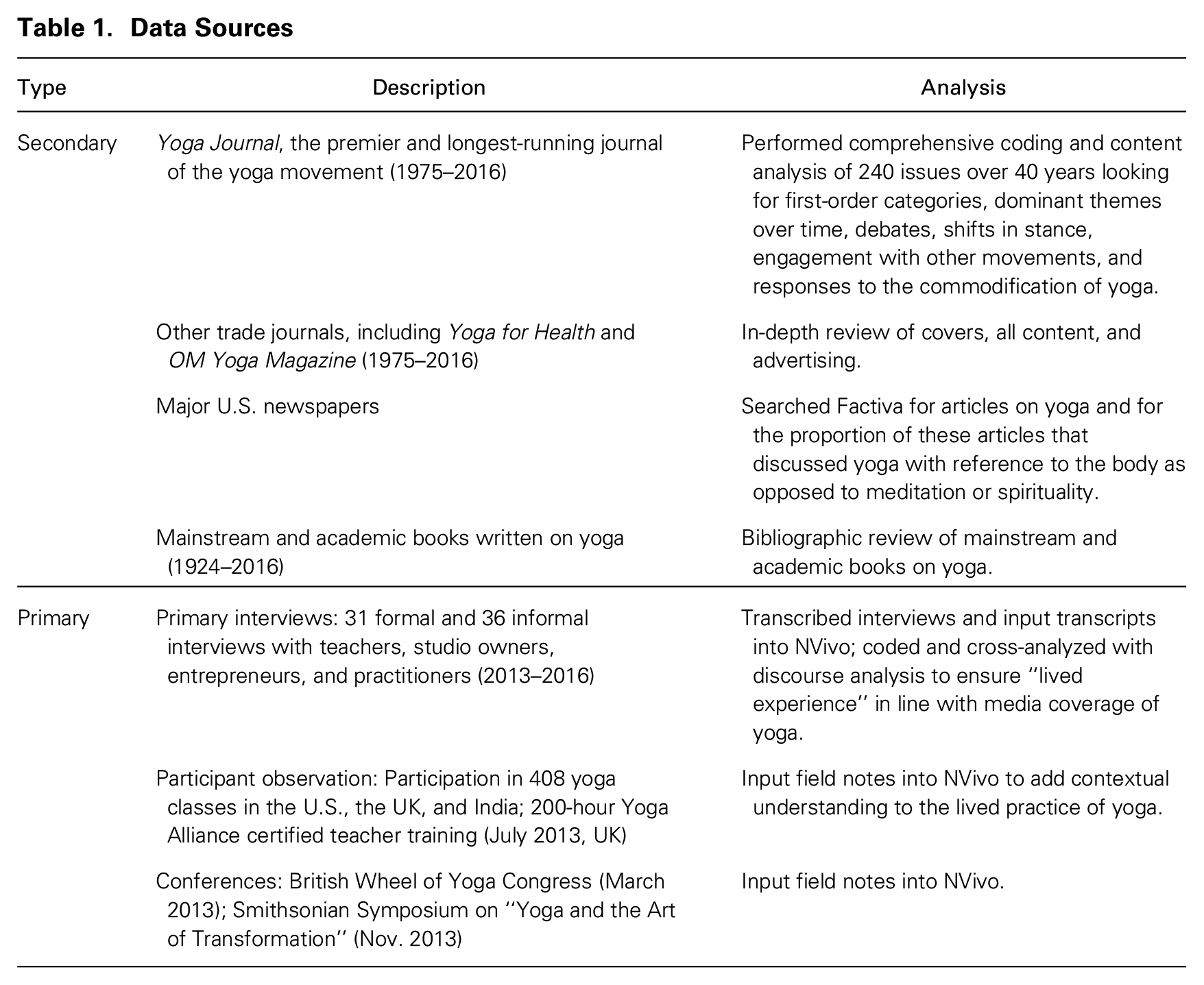
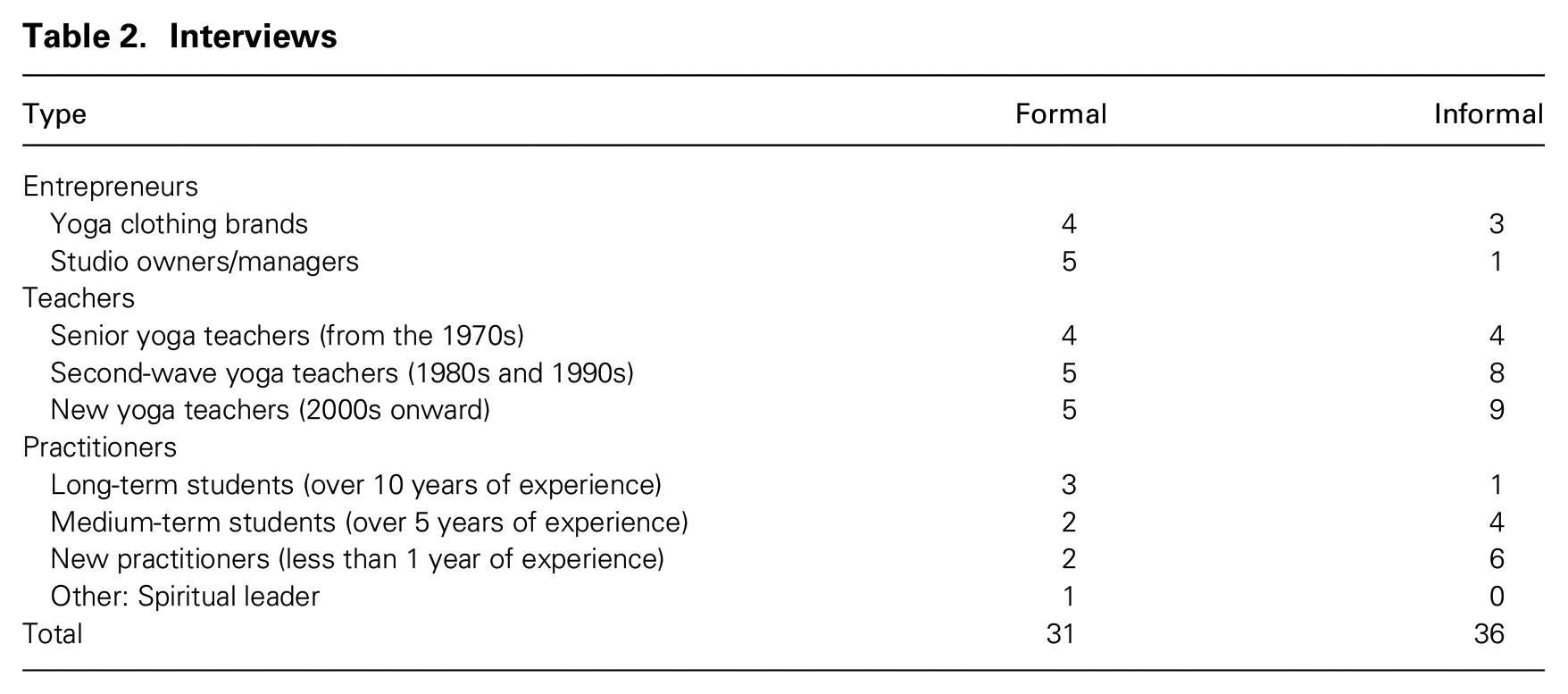
Finally, we interviewed 31 individuals involved in yoga practice as studio owners, teachers, practitioners, or entrepreneurs, including executives of yoga brands. The interviewees ranged in age from their early 20s to mid-60s and were predominantly white and middle class (largely representative of the yoga movement). All interviews, with one exception, were conducted face-to-face and ranged from 45 minutes to 2.5 hours. Audio recordings of the interviews were transcribed and then input into NVivo and coded. We also conducted an additional 36 informal interviews that we did not audio record but documented in field notes. See Table 1 for an overview of our data sources and Table 2 for detail about the interviews we conducted.
Data Sources
Interviews
Data Analysis
We analyzed the data in three stages. First, we coded 240 issues of Yoga Journal published between 1975 and 2016. We coded not only the covers for what they signaled (e.g., focus on body versus philosophy, sexuality, community versus individual) but also the content of articles and advertisements and the aspirations they reflected. Moreover, we tracked changes in editors along with editors’ own profiles, to the extent such information was available.
Our content analysis enabled us to track yoga’s changing representations from a movement based on a collectivist, religious, ascetic philosophy that shunned market relations to an individual enterprise focused on body image and stress relief. It also enabled us to track the sources of the different frames that were being utilized to describe yoga (e.g., various cultural codes borrowed from the New Age, health, and fitness movements). Finally, we focused on resistance to these changes—specifically, how the issues, loci, targets, and proponents of resistance changed over time.
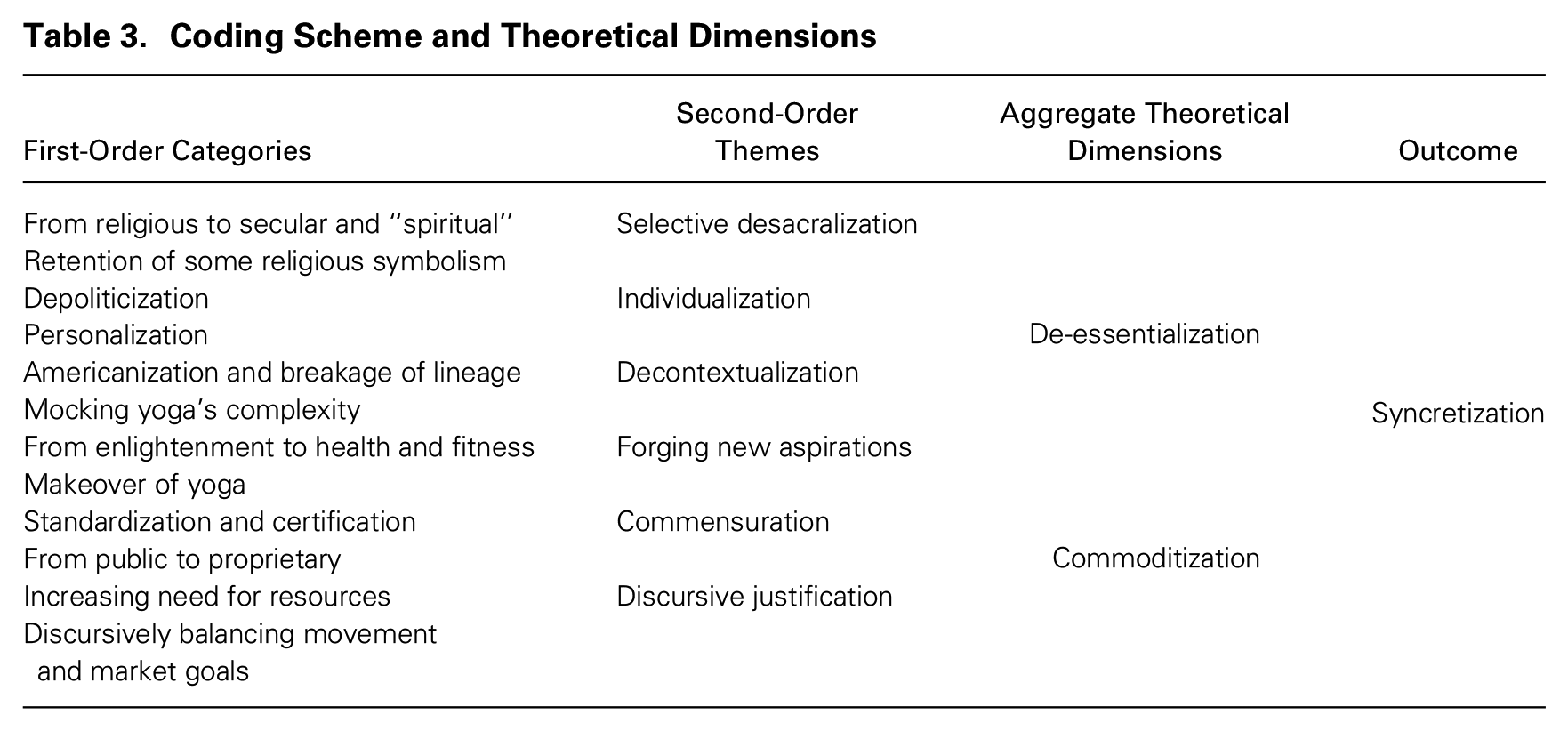
Coding in NVivo helped us track the changes in yoga over 40 years. Table 3 depicts our coding scheme and aggregate theoretical dimensions, while Figure 1 shows how various themes became prominent or faded with time. Similarly, Figure 2 illustrates how the covers of Yoga Journal evolved with time.
Coding Scheme and Theoretical Dimensions
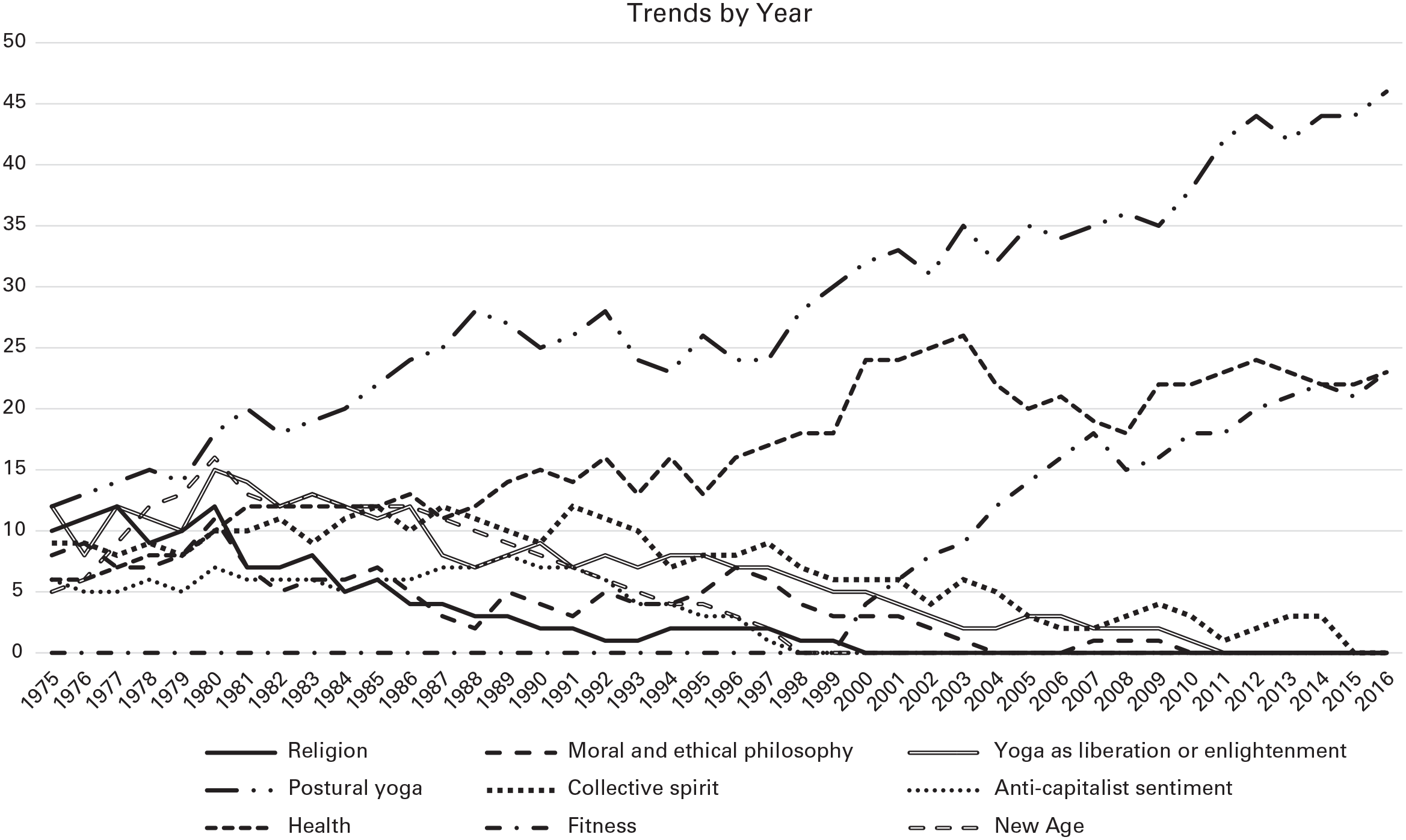
The Rise and Fall of Various Themes in Yoga Journal (1975–2016)
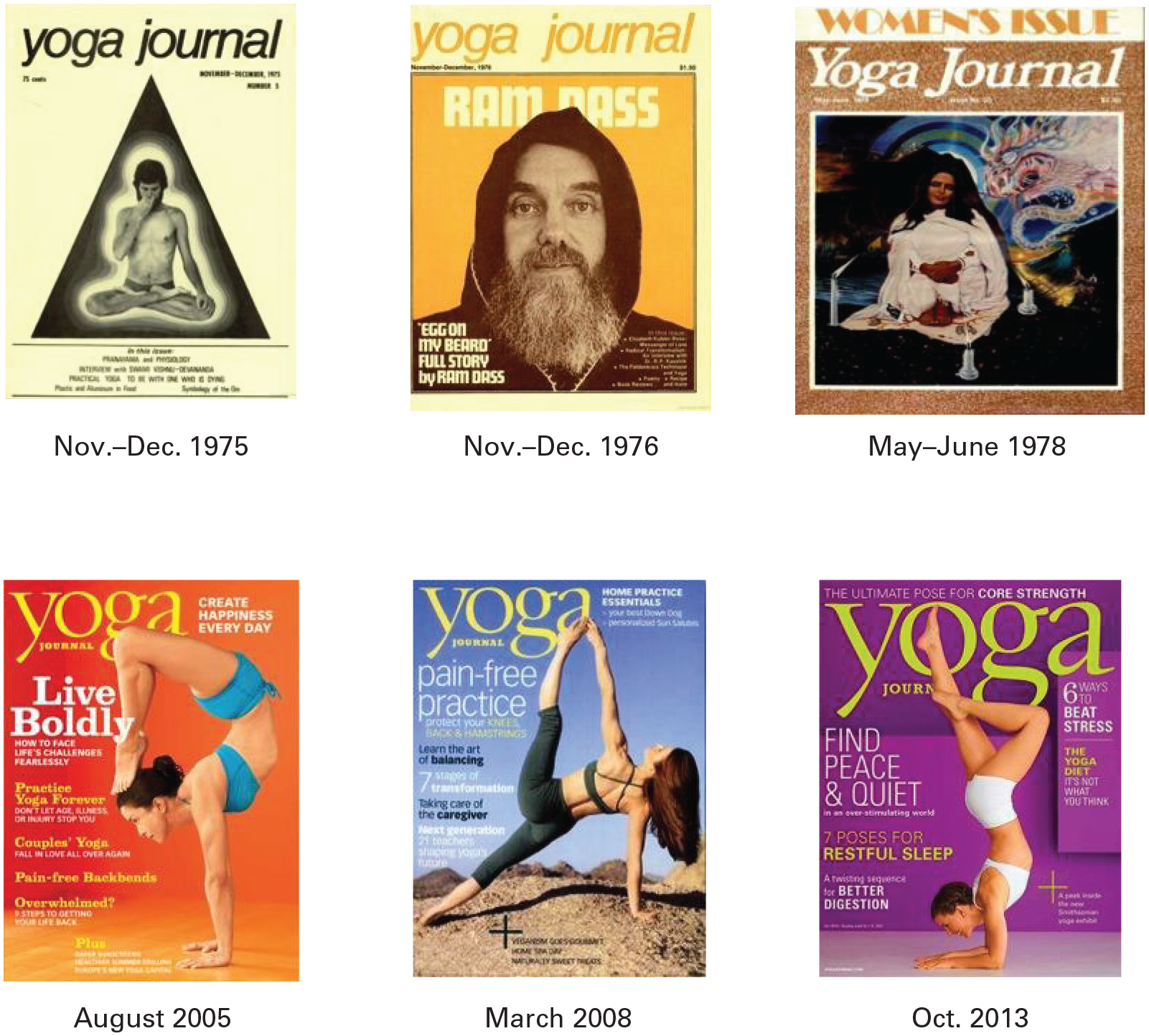
The Evolution of Yoga Journal Covers
Second, we performed a discourse analysis of data collected from major U.S. newspapers. Factiva yielded over 60,000 articles with mentions of yoga. We ran searches for major keywords associated with yoga, ranging from “spirituality” to “fitness” and “body.” The analysis helped us trace how certain associations strengthened while others weakened, and it revealed the key actors that mined these new associations. Relative to all articles about yoga, Figure 3 depicts the proportion of articles containing these keywords published in major U.S. newspapers between 1980 and 2016. In Figure 4, we show how yoga was represented as a way to develop better abs or a “yoga butt,” not only on the cover of Yoga Journal but in ads for clothing or yoga classes. This became important once the yoga market developed, as the discourse expanded beyond Yoga Journal into mainstream spaces.
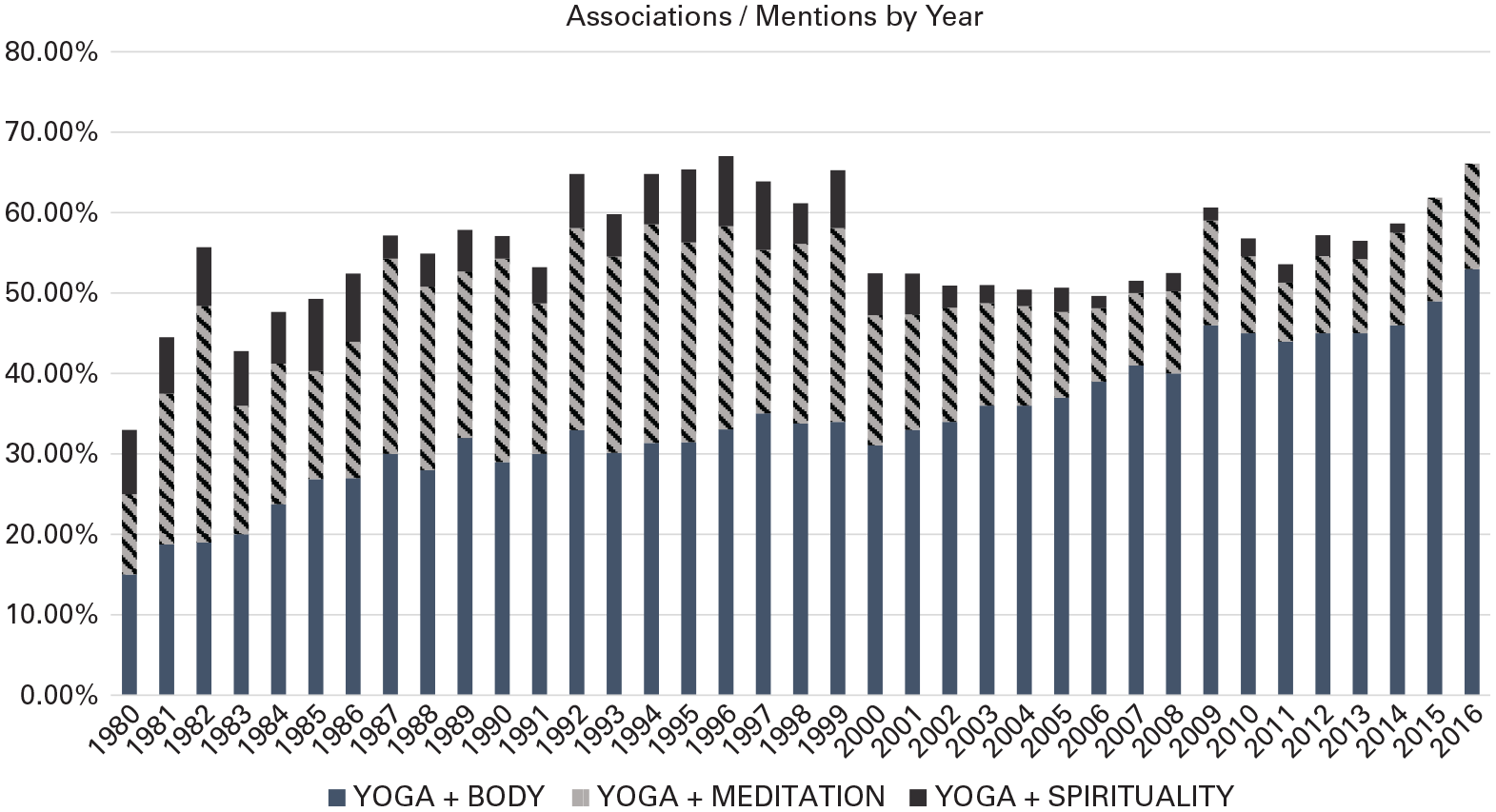
Terms Associated with Yoga in Major U.S. Newspapers as a Proportion of Total Articles Mentioning Yoga

Forging New Aspirations
Third, we reviewed our interview transcripts and field notes. Although our coding of magazines and newspapers enabled us to identify the various influences on and changes in yoga, these data enabled us to witness their enactment and identify the influence, for example, of celebrities, yoga entrepreneurs, and yoga brands in creating a market.
Yoga’s Transformation and the Creation of a New Market
Here, we describe how yoga, which started as an amorphous and fragmented countercultural movement, transformed into a thriving market. Before describing its transformation, we describe the state of yoga in 1975, the beginning of our data collection period.
Early Beginnings
We found that in 1975, yoga was a loosely organized movement without a central authority capable of speaking for the movement, clear hierarchies, or a narrowly defined membership. It was sustained by the arrival of yoga gurus from India who found rich, well-connected patrons in the United States. During nearly 80 years in the United States, the yoga movement had spread through a variety of means, including yoga instruction studios, residential centers, publications, lectures, and conferences. In 1975, a group of committed yoga teachers in California launched Yoga Journal with the explicit intention of coordinating and growing the yoga movement in America. The journal began by defining what the yoga movement was all about. Coding of journal issues published between 1975 and 1980 clearly revealed five defining traits. Table 4 depicts representative headlines from Yoga Journal and related quotes, while Figure 1 shows how the traits’ salience increased or decreased over time.
Issues of Importance to the Yoga Movement: Illustrative Feature Articles in Yoga Journal (1975–1980) and Related Quotes
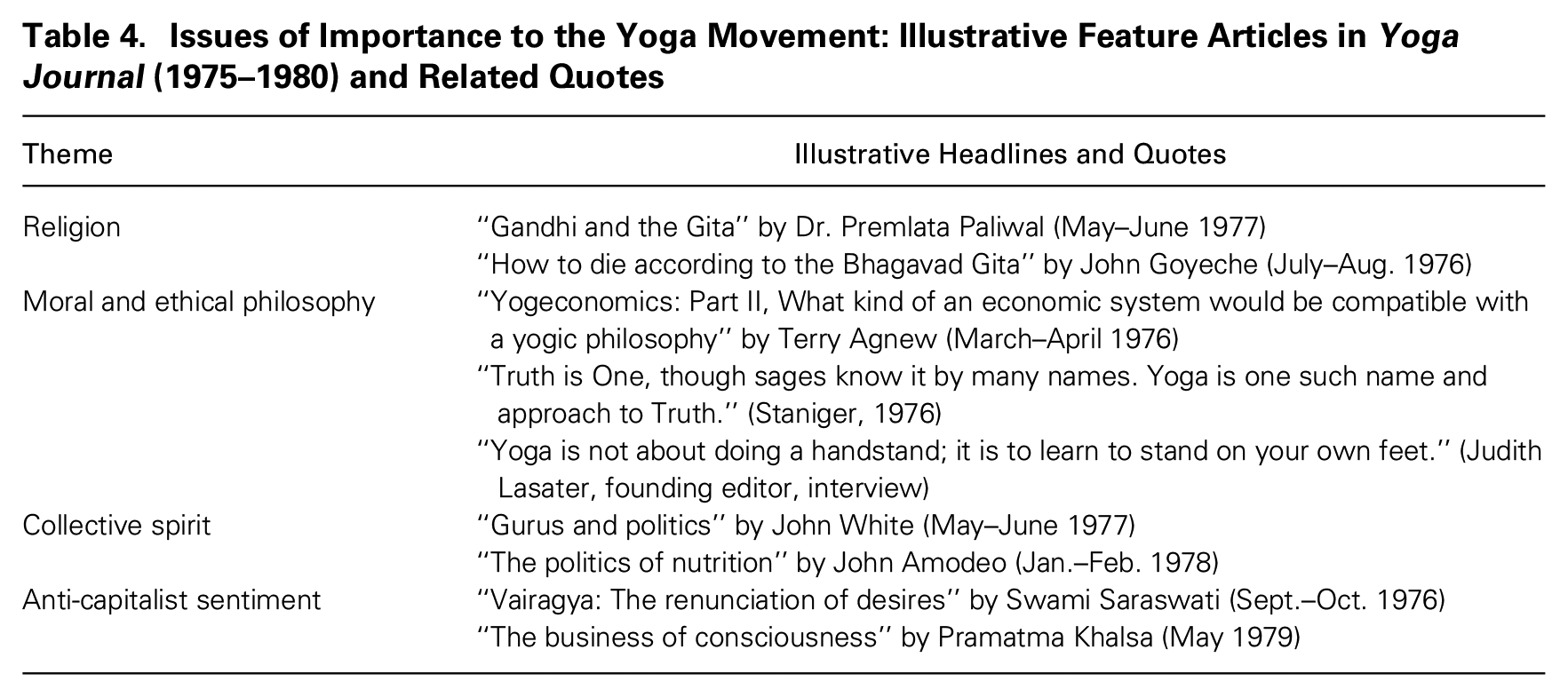
First, yoga was characterized by strong religious sensibilities. We found that between 1975 and 1980, on average, three articles in each issue invoked God and religion in connection with yoga. Although yoga’s connection with Hinduism was not based on a rigid set of orthodox beliefs, it was nonetheless so deeply established that many leading yoga personalities questioned humans’ ability to truly understand the world using only a secular lens. Second, the yoga movement centered on an ancient moral and ethical philosophy. The inaugural 1975 issue of Yoga Journal defined yoga as “one of the six classical schools of Indian philosophy.” Third, prior to the 1990s, the movement only partially emphasized postural yoga. The aim was enlightenment, and articles frequently proclaimed that practicing yoga postures without relating them to yoga’s deeper moral and ethical philosophy could increase tension. Fourth, the dominant discourse in the yoga movement tended to be collectivist, with an interest in larger social, political, and economic issues. Throughout the 1970s and 1980s, Yoga Journal frequently published articles on how a different social, political, and economic reality was possible, taking clear stances on a variety of these issues. Finally, the yoga movement clearly opposed capitalist relations of production and consumerism. A number of early articles emphasized that a market-based economy was inconsistent with yoga teachings of devotion and the renunciation of materialism. For example, in early articles about physical ailments, the focus was invariably on how the Western medical industry prioritized profits over patients and cure over prevention.
We now describe how these characteristics, as well as Yoga Journal’s position on them, changed over time. Although we present our analytical description in chronological order, yoga’s transformation was not linear, nor were all agents’ first transformation attempts successful. An important aspect was the borrowing of codes and templates from other movements and markets over the years. This process was driven primarily by intersections between the yoga movement and three other movements that also were markets.
Parallel Movements Influencing Yoga’s Transformation
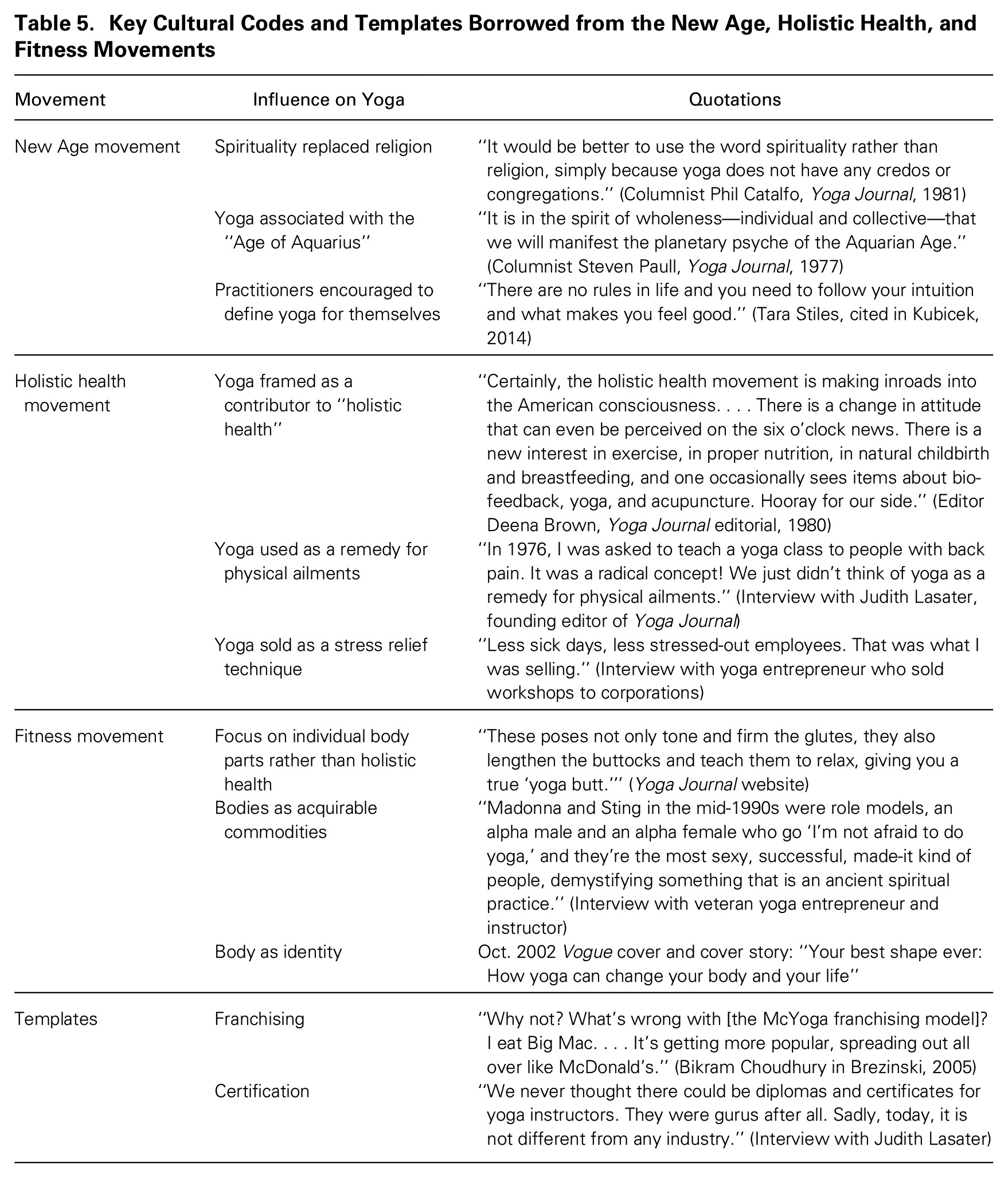
As we scoured the Yoga Journal archives, we found evidence of new cultural codes and market templates being adopted by members of the yoga movement and yoga entrepreneurs. See Table 5 for these borrowed codes and templates and how they became part of the yoga movement.
Key Cultural Codes and Templates Borrowed from the New Age, Holistic Health, and Fitness Movements
The New Age movement (1960s–1980s)
Yoga’s transformation was influenced significantly by its intersection with the New Age movement (NAM), which represented a departure from the political countercultural movements of the time. The NAM situated itself outside the confines of traditional religions, emphasizing spirituality as something “free, private, optional and according to one’s own needs and understanding” (Pickering, 1975: 6). 1 Over time, the NAM transformed perceptions of the world’s spiritual traditions, which became viewed as possible choices in a “religious consumer supermarket” (York, 2001: 361).
Because the NAM was essentially an educated, middle-class phenomenon (Heelas, 1996), considerable overlaps existed with the yoga movement, as evidenced by surveys (e.g., Morth, 1989) and interactions between adherents of the two movements in articles published in Yoga Journal. New Age Journal ads frequently appeared in Yoga Journal, and vice versa (see Online Appendix A), and many leading figures of the NAM were influential in yoga as well.
The contradiction between the NAM’s individualism and yoga’s collective sensibilities surfaced at times. Yoga leaders occasionally criticized the NAM yet avoided open confrontation. An editorial in the November 1991 issue, for instance, stated: “In recent years a certain idea has gained currency in New Age circles: ‘You create your own reality’. .. this notion seems to be a bastardization of Eastern teachings about karma and the nature of consciousness” (Bodian, 1991: 4). But thanks to considerable overlaps and the adoption of codes from the NAM (see Table 5), New Age ideas went on to profoundly influence the yoga movement.
The holistic health movement (1970s–1980s)
The 1970s also saw the rise of the holistic health movement (HHM), which drew on the increasing focus on individual health and fitness and advocated that a healthy life was one in harmony with nature. The movement criticized Western medicine for confining itself to curing diseases rather than preventing them and for ignoring holistic aspects of health and healing. The movement was a mixed bag of alternative medicine philosophies that included aspects of humanistic medicine, parapsychology, folk medicine, herbalism, nutritional therapies, homeopathy, meditation, and yoga (Salmon and Berliner, 1979, 1980; Goldner, 2001).
The movement had clear overlaps with both the NAM and the yoga movement. The NAM emphasized wellness, self-actualization, and tranquility (York, 2001) and included therapeutic techniques, such as reflexology or shiatsu, that were assimilated into the HHM (Danforth, 1989). Similarly, yoga was adopted for both its meditative and postural qualities. The yoga movement borrowed various codes from the HHM (see Table 5) as health continued to become an increasingly salient theme throughout the 1980s and 1990s (refer to Figure 1).
The fitness movement (1980s onward)
The fitness movement, which gathered strength in the 1980s and spawned a sizable market, focused on both physical health and bodily aesthetics (Green, 1986; Stern, 2008). Physical exercise was tethered to work through phrases such as “working out” and attached to institutionalized education via fitness classes (Brabazon, 2006). This focus on health improvement has a long history in American culture (Conrad, 1994). The “Muscular Christianity” movement promoted physical exercise as a way to develop a healthy, religious, and morally righteous lifestyle (Putney, 2001) through the YMCA and affiliated gymnasiums. Although the movement attracted many followers in the early twentieth century, especially among the middle classes, participation in fitness was not as widespread as it is today (Andreasson and Johansson, 2018). Prior to the 1970s, relatively few Americans exercised regularly; in 1960, only 24 percent of Americans claimed to do so. But by 1987, results of a Gallup poll showed that the proportion of regular exercisers had climbed to 69 percent (Gurin and Harris, 1987).
Far from being holistic, a major accomplishment of the fitness movement was to create an ideal type for each body part, with body builders working on different muscle groups using different equipment and techniques. Corporations were quick to notice the profit potential in this trend, and numerous new enterprises emerged, including fitness apparel companies (e.g., Nike, Adidas) and gym chains that marketed fitness as a form of identity that could be worn on the body.
The body quickly became an evaluative marker (Turner, 1991; Roy, 2008) used by individuals to judge themselves and others. Buoyed by the feminist movement, women joined the fitness movement in droves, comprising 60–65 percent of members (Stern, 2008). Until 2000, there was little direct overlap between the yoga and fitness movements. Later, entrepreneurs liberally borrowed codes from fitness to redefine yoga. Despite vocal resistance from core members (e.g., Yoga Journal readers), movement leaders actively borrowed codes from the fitness movement (see Table 5), which had rapidly turned into a sizeable market.
The Transformation of Yoga: De-essentialization and Commodification
Yoga’s transformation was essentially enabled by the movement’s desire to expand in America, the influence of other movements, entrepreneurs seeking to capitalize on the movement, a reluctant embrace of corporate sponsorships to meet resource needs, and wider socio-economic changes. Below, we describe the complex interplay of these factors. Our analysis led to the coding scheme in Table 3 that guides our account.
The transformation process involved two major components: a shift in yoga’s meaning (de-essentialization) and the development of a market around it (commodification). The de-essentialization of yoga involved selective desacralization, individualization, and decontextualization, whereas the commodification of yoga involved forging new aspirations, commensuration, and discursive justification. Collectively, they enabled the syncretization of yoga, or its integration with concepts and practices initially opposed by the movement.
De-essentialization
As Figure 1 depicts, mentions of Hinduism had completely disappeared from Yoga Journal by 2000. This selective desacralization process involved three distinct elements. First, during the 1980s, cultural codes borrowed from the NAM emphasizing a “whatever works” spirituality rather than a religious code were central to eliminating religion from the yoga discourse. As Table 5 shows, cultural codes such as spirituality, invocation of the Age of Aquarius, and individual choice became part of the yoga movement during the 1970s and 1980s. This process was enabled by the partial membership overlap between the two movements. Several leaders at the nexus of the two movements used the codes provided by the NAM to gradually replace the imprisoning and canonical religious with the ecumenical and more inclusive spiritual when it came to the dominant discourse surrounding yoga. Noted yoga columnist Phil Catalfo (1981: 31) wrote in Yoga Journal that “it would be better to use the word ‘spirituality’ rather than ‘religion’” to avoid “credos or congregations.” Similarly, influential author and yogi Alice Rankin (1980: 8), hailed as an “oracle of the New Age” by Yoga Journal, proclaimed: Yoga is not a religion. I believe everyone should be able to engage in whatever religious practices they like, without fear that yoga will threaten their beliefs in any way. . . . In the 1980s, I feel that yoga will come out from under this imprisoning cloud of religious affiliation.
The gradual omission of religious codes from Yoga Journal was lamented by many movement members, perhaps most visibly by the Hindu American Foundation (HAF). Over several decades, the HAF consistently petitioned the journal’s editors, who were perceived to be the most influential voices in the movement, not to separate yoga from its Hindu roots. The HAF claims their suspicions were confirmed when, upon calling Yoga Journal, they were told, “Yeah, they [the editors] probably avoid it [religious references]. Hinduism does, like, you know, have a lot of baggage.” 2
By the 2000s, Yoga Journal had considerably changed its position, acknowledging the need to “Americanize” yoga to expand the movement. As a result, any religious associations were cast aside (see Figure 1). Clearly, many core members were unhappy with how yoga was being recast. Many letters to the journal protested the decoupling of yoga from its Hindu roots, and the HAF was appalled at the lengths to which the journal was prepared to go to obscure those roots. In an open letter to Yoga Journal, HAF spokesperson Suhag Shukla wrote:
3
After reading this month’s articles, “Eat Like a Yogi,”“The Essence of Life” and “Everyday Ecstasy,” and admiring the prominently printed “Oms” throughout the magazine, I couldn’t help but wonder, “How many ways are there to avoid the word ‘Hindu’?”
Notably, not all religious symbols or practices were discarded by entrepreneurs who had been at the forefront of desacralizing yoga. Despite going against the wishes of many movement members by portraying yoga as a secular practice, yoga entrepreneurs, studio owners, and Yoga Journal retained a few of yoga’s original elements, including references to Hindu deities (Ganesh), rituals such as chanting of mantras (Om), and the use of Sanskrit to provide a sense of authenticity. The HAF noticed “the mantra of the month, the sacred Hindu symbol, Om, sprinkled throughout the magazine” without “any reference to Hinduism.” 4
Yoga Journal’s gradual shift was noticed by its founders, too. One of the founding editors, Judith Lasater (2010), wrote: I feel sad because it seems that Yoga Journal has become just another voice for the status quo and not for elevating us to the higher values of yoga: spiritual integration, compassion and selfless service. My request is that Yoga Journal doesn’t run ads with photos that exploit the sexuality of young women in order to sell products or more magazines.
Our observation of yoga practice revealed that classes often began with the Hindu greeting “Namaste,” even when the participants did not know what it meant. The symbol Om was used copiously in otherwise highly secular studios and splashed across yoga wear. A British yoga instructor we spoke to changed her name from Susan to Saraswati to appear more “authentic.” Many of our interviewees confessed that without some elements, symbols, and hallmarks of the original practice, it would be difficult to maintain the distinction between yoga and regular fitness classes. Sanskrit terms for the various postures served no other purpose than to symbolically connect yoga to its mystical tradition and retain a vague spirituality to differentiate it from other fitness classes. Religious symbols and artifacts were retained to enrich Western consumerism with Eastern spirituality and mysticism.
We also noticed the individualization of yoga over time. Throughout the 1970s and 1980s, most articles in Yoga Journal dealt with wider socio-economic, ethical, and ecological issues and were openly critical of consumerism, corporations, and markets. The March–April 1976 issue, for instance, included an article called “Yogeconomics: Part I & II” about the type of economic and taxation system that would be compatible with a yogic philosophy. Similarly, a feature article in the February 1978 issue talked about the food industry and how greed was playing havoc with the food chain. These themes were also reflected in various talks being given to members of the U.S. yoga movement.
As Figure 1 shows, the number of Yoga Journal articles taking an anti-capitalist stance fell dramatically in the 1990s, dwindling to zero in 1998. The yoga movement no longer remained wedded to political ideals. Although pressure from entrepreneurs looking to mine the movement was obviously a key factor, this shift was facilitated by the influence of the NAM and HHM (see Table 5). The idea that yoga practitioners should choose their own paths rather than conform to a collective code was borrowed from the NAM. Similarly, the HHM shifted responsibility for the realization of health from the collective to the individual level. Entrepreneurs built on these developments. Tara Stiles, a leading yoga entrepreneur and instructor based in New York, has made her career around the dictum “there are no rules in life” and one makes one’s own rules (Alvarez, 2011). She has prided herself on making yoga accessible and inventing her own user-friendly version of the practice. She explained, “People need yoga, not another religious leader. . . . I was never invited to the party anyway—so I started my own.” 5 This new sensibility was also reflected in an announcement by CorePower Yoga, a leading chain of yoga studios: “Our role is to guide students to make yoga practice their own and their intention personal—each student is encouraged to embark on their own spiritual journey.” 6
The individualization of yoga signaled a shift in the movement from collective to individual aspirations that was clearly visible on Yoga Journal covers. Through the early 1990s, covers depicted yoga gurus, communities, or abstract artwork with relevant social themes. By the mid-1990s, these images had given way to aspirational covers focused on attractive bodies. The aspiration was to work on the self to make it more desirable and stress-free rather than to become part of any larger movement. Figure 2 shows contrasting covers of Yoga Journal over time.
As shown in Figure 1, yoga also underwent a gradual decontextualization. From the 1970s through the 1990s, debate within the yoga movement raged on the extent to which the practice should remain aligned with its roots. Purists argued that yoga was a holistic philosophy and needed to remain whole to be effective. Dissecting yoga into pieces, adopting some aspects but rejecting others, was heavily criticized. For instance, the cover feature of the July 1977 issue of Yoga Journal stated, “Yoga is a holistic system and must be understood in its totality. The danger we are subject to falling into is picking up on two or three yogic concepts and isolating them from the totality of yoga” (Paull, 1977: 5).
Most yoga practitioners believed that this totality could come only from years of practice, absorbing not just the postural elements but everything else from the guru, who was not just a teacher but someone who dispelled darkness, having experienced inner awakening. Noted guru Sharath Jois explained that gurus are careful not to alter teachings: “The parampara (lineage) should go as it is—as it was—from your guru and his guru’s guru. It needs to be rooted in something real and not just fancies that are created in the moment.”
7
Yoga’s holistic philosophy and religious origins had always been intertwined. But this changed as the movement expanded. As Judith Lasater explained: Whereas earlier we had to borrow everything from India, and rely on their immense knowledge, by the 1990s the lineage was being broken. I realized this when I taught a workshop to Zen students. They would chant the names of their lineage all the way from Buddha every morning. That is the way to keep the practice close to its original philosophy. Now, many people doing yoga have absolutely no idea where this whole thing came from. Some even think it was invented in California in the 1980s.
Two factors were instrumental in the Americanization of yoga. First, well-known yogis admitted that given a different context, it was difficult to transmit the whole of yoga as it had evolved in India to Western practitioners. A 1990 issue of Yoga Journal clearly acknowledged that in order to spread yoga in America, it would have to be Americanized. Second, and relatedly, the U.S. yoga movement was influenced by its American context. Entrepreneurs justified their franchising and copyrighting of yoga through the trope of being American. In an interview on CBS News in 2010, Bikram Choudhury, the most high-profile yoga teacher in America during the 1990s and 2000s, summarized his approach: “I built an empire. Why not?. . . [It’s the] American way: make Bikram yoga, copyright, trademark, franchising, patent” (Brezinski, 2005).
Once begun, the Americanization of yoga (i.e., McYoga) was hard to stop. Judith Lasater explained, “In the 1970s, we had learned yoga from Hindus. We took it all on. Over time, yoga transformed; it adapted to American norms and culture. We adapted yoga. It is so American, doing things our own way.” She acknowledged, however, that very quickly things spun out of control, with yoga losing its essence. As she put it, “the genie was out of the bottle.”
Beyond the obscuring of yoga’s philosophical and Hindu roots, yoga was decontextualized through mockery of its rigid constraints. For example, the manifesto of a yoga studio, Fierce Grace, proclaimed “We won’t Om you” and assured people on its website that “this is not an Indian Secret Mystery Club.” Yoga clothing lines frequently referenced in the social media sphere used phrases such as “Namaste, bitches” and “Warning: Too much yoga can make you hot.” 8 In a yoga class that we attended, the instructor said, “Move it so you don’t end up with a belly like Buddha,” nodding toward a statue of Buddha in a corner of the studio.
Commodification
The commodification of yoga was facilitated by forging new aspirations for the yoga movement. In 1975, the essence of yoga was very much spiritual and philosophical, with the yoga movement fully conscious of the fact that the sole purpose of postural yoga (asana) was to strengthen the body for long periods of meditation. During the movement’s early stages, Pattabhi Jois, a world-renowned yoga guru, explained that “using it [yoga] for physical practice is no good, of no use—just a lot of sweating, pushing, and heavy breathing for nothing. The spiritual aspect, which is beyond the physical, is the purpose of yoga” (Medin, 2014: 8). Even when discussing postures, the aspiration was always spiritual, such as to awaken kundalini, or the primal energy stored at the base of the spine.
Our analysis of major newspapers and journals reveals the emergence of clear links between yoga and health, including mental health and physical therapy. This association with health had not originally been a core aspect of the yoga movement, as Judith Lasater explained to us: “In 1976, I was asked to teach a yoga class to people with back pain. It was a radical concept! We just didn’t think of yoga as a remedy for physical ailments.” Given the significant overlaps between the holistic health and yoga movements, however, postural yoga (asana) was increasingly understood in terms of its health benefits. Through the 1980s and 1990s, Yoga Journal published several special issues on health, which were initially focused on holistic health but gradually became more interventionist. For instance, the January–February 1990 issue discussed at length how some well-known yoga poses could improve your health. Likewise, contemporary yoga instructors confided in us that they had begun marketing yoga to corporations as a way to ensure a healthy, “stress-free” workforce. Other claims framed yoga as a way to decrease blood pressure, anxiety, and depression; improve self-efficacy; and combat post-traumatic stress disorder, drug addiction, and substance abuse (Khalsa et al., 2012).
By the turn of the century, Yoga Journal had undergone a significant shift. As depicted in Figure 1, the themes in a typical issue had changed dramatically. While early editors had been committed members of the yoga movement and adopted a purist approach to content, in 1998 a wealthy yoga practitioner bought the journal, and editors began to embrace broader content that reflected fitness-related aspirations. The fitness movement created an ideal type for each body part, and the holistic practice of yoga was distilled to techniques to get “super abs” or a “yoga body.”Yoga Journal played a key role in linking yoga with fitness, which had been entirely absent from the yoga movement in the 1970s and 1980s. In the May 2000 issue, the editor stated: Two worlds—the traditional yoga community and the fitness industry—have rarely mingled, until recently. Hoping to bridge the gap between the two communities and focus on their shared ideal of well-being, Yoga Journal is partnering with IDEA Health and Fitness to host Yoga Connection, a conference in Anaheim, CA. The conference is intended to provide fitness instructors with a firm grounding in yoga philosophy and techniques, and to introduce yoga teachers to the special needs of health clubs.
The slight reticence reflected in the quote above indicates that Yoga Journal was aware that readers might not support a whole-hearted embrace of the fitness culture. Indeed, many readers did voice stringent objections to what they perceived as a stark deviation from yoga’s principles. Nevertheless, the turn toward fitness continued, and in 2001, “strong abs” appeared on the cover of a Yoga Journal issue, marking a clear shift toward a new yoga aimed squarely at developing particular body parts. Yoga was now increasingly associated with a “better-looking butt.”
By the 2000s, Yoga Journal was using body image and celebrities to sell yoga, reflecting increased alignment between its editorial position and market actors. Celebrities in search of spiritual fulfillment widely promoted yoga (Jain, 2014), and yoga enthusiast and supermodel Christy Turlington became Yoga Journal’s editor-at-large. A yoga teacher with over 40 years of experience told us that newcomers began to seek out her class in search of Sting’s abs or Madonna’s biceps.
Because new practitioners were motivated by body image, it was no surprise to see yoga gurus undergoing makeovers, too. A prominent new guru was Tara Stiles, a former model and yoga instructor who developed a brand for fellow yoga instructors and attracted a following of over 140,000 people on Instagram. Her lithe and well-toned body was used to market the physical benefits of yoga, with no reference to the spiritual benefits. Figure 5 shows Stiles’s ad for W Hotels, a Vogue magazine cover, and a Lululemon ad for yoga wear, all of which are far cries from what yoga originally represented. 9 Corporate actors strengthened this trend significantly. In 2013, Lululemon, worth about $11 billion at the time, began hiring athletes to work in its stores rather than yoga practitioners; founder Chip Wilson explained that athletes better fit the brand’s profile to attract clientele. Lululemon even staged an event called “Gospel of Sweat”—a branded mass—at a church in New York as a means to leverage fitness-as-religion for its corporate branding. 10

The Media and Yoga
A commensuration process also contributed to the commodification of yoga. As yoga attracted more practitioners, it was clear that a few gurus would not be sufficient to meet demand. It became apparent that scaling up to include newcomers who were looking for yoga bodies would require a constant supply of certified instructors who visibly embodied the characteristics that practitioners desired (see Figure 5)—an idea that was considered blasphemous within the movement. Alice Rankin (1978: 45), an influential figure in the movement, wrote: “there have never been diplomas and certification of yoga gurus, nor in reality can there ever be.” Yoga, she wrote, was learned through a close relationship between disciple and guru, and instructors who had not been immersed in “this ancient philosophy” for years were doing a “disservice to their students” and the philosophy.
The contrast in how movement leaders looked at yoga instructors from the start to the end of our observation period is stark. In the 1980s, several sexual harassment scandals involving yoga gurus surfaced. An editorial in Yoga Journal reflects the ambivalence that some members of the movement felt about prosecuting these cases because of how gurus were viewed: What can it possibly mean for a student to sue her guru in a court of law. . . . It’s absurd—like bringing God to trial for making a mess of the universe! Who’s going to judge the case? Justice So-and-so from the Eighth District Court? What authority does he have? The legalistic and spiritual world views are totally incompatible! (Bodian, 1985: 4)
Over the course of the next decade or so, the idea that yoga instruction derived from deep immersion in the spiritual world had all but disappeared. As gyms began to offer yoga courses and demand for instructors increased, standardized teacher training became a major source of profit, and new training programs could be completed in mere days. In 2000, a Yoga Journal columnist narrated his experience in an instructor certification course: In just one weekend, I became a certified yoga teacher. . . . The formula was actually quite simple. We didn’t learn about the spiritual aspects of the practice at all. Nor did we study Sanskrit terms, yoga history, philosophy or ethics. Basically, the entire operation was a cliff-notes preparation designed to ready us for the health club members all across America who are clamouring for yoga. (Barrett, 2000: 83)
Concurrently, several entrepreneurs created new, proprietary categories of yoga. Foremost among them was Bikram Choudhury, who pioneered the use of intellectual property rights and franchising to develop a global business (Fish, 2014). The product was a patented sequence consisting of 26 postures taught during a 90-minute class at a temperature of 105°F (40°C). Bikram also developed a two-month teacher training program that certified 350 to 440 Bikram instructors at a time (Bikram Yoga, 2015).
These efforts comprised a two-pronged shift in the practice of yoga in the West, resulting in a flood of yoga-related patenting activity. First, by May 2016, there were 4,175 registered U.S. trademarks that included the word “yoga” (U.S. Patent Office, 2016). Second, yoga studios gradually adopted a corporate form dominated by chains such as Fierce Grace, Yoga Works, and CorePower Yoga. A chain’s representative noted that “the principle was to honor the tradition of yoga and create the sense that you were entering a sacred space. We wanted to dispel the illusion about who can practice yoga, because it is for everyone—hence, ‘everyone triyoga’” (Sattin and Woodhall, 2013). CorePower’s co-founder described the chain as the “Starbucks of Yoga”; with over 200 locations in 23 U.S. states and Washington, DC, the “fitness empire” churns out thousands of “certified” yoga instructors per year (Hines, 2019).
Resistance to this dramatic marketization of yoga came from the then-outnumbered core movement members, the HAF, and even the Indian government, which created a database of 1,300 yoga postures believed to be documented in ancient Indian texts (Sinha, 2011). The hope was that the database would function as a reference point for patent offices all over the world. In 2014, the Indian government even appointed a minister for yoga to promote what India framed as “their” system and reclaim yoga’s Hindu roots (Alexander, 2014).
The commodification of yoga could not be carried out solely by entrepreneurs or corporations; it required discursive justification from within the movement, provided primarily by Yoga Journal, which increasingly relied on corporate sponsorships. After two decades of gradual change, by the late 1990s, the journal was actively steering its readers toward embracing capitalist consumerism. In the May 2000 issue, for instance, it cited the views of prominent author Carol Connare (2000: 23), who opined: “maybe the pairing of yoga and marketing is an uneasy partnership, but it is probably unavoidable in America.” She quoted leading yoga figure Alan Finger as saying: As long as yoga images are used by the media tastefully and in the true spirit of the practice, I don’t see a conflict. Billboards all over NY show people meditating; it’s the age of spirituality. If not through a commercial context, how else do you reach the masses with this important message?
In 1998, after two decades of being led by individuals who were yogis first and editors later, and tired of perpetually struggling to raise funds, Yoga Journal hired an “entrepreneurial editor with a successful record of repositioning and relaunching magazines and building brand extensions.” 11 This marked a decisive shift in the journal’s editorial policy and in the types of subscribers it wanted to attract.
Soon thereafter, in early 2000, Yoga Journal bestowed “Karma Credits” on Banana Republic for launching a line of yoga apparel. This unleashed a torrent of adverse feedback from readers who accused the journal of selling out by endorsing exploitative Western apparel firms. In the May 2000 issue, a yoga teacher wrote to the editor, noting that because yoga taught that “we were all one,” she was “not separate from a 14-year-old girl in Saipan who sat on a sewing machine all day.” The editor’s response revealed Yoga Journal’s new conciliatory position: “Instead of condemning Banana Republic, isn’t embracing them the yogic thing to do? We can hold both the 14-year-old girl in Saipan and Banana Republic in our hearts and it does not need to be a contradiction.”
In many instances, Yoga Journal played a more passive role, allowing commercial enterprise to distort yoga’s history to create a new narrative that fit better with existing notions of beauty or fitness. In the November 1999 issue, the journal’s editor wrote: A couple of years ago, when I had just returned to Yoga Journal after six months of traveling to ashrams and holy sites in India, I got a call from a writer for Mirabella magazine who was researching a fashion spread on exercise wear. “I was wondering” she said, “what is the traditional outfit for doing yoga?” I thought of the naked yogis I had seen on the banks of the Ganges, their skin smeared with ashes from the cremation pyre to remind themselves of the body’s impermanence, their foreheads painted with the insignia of Shiva, the god of destruction. I couldn’t resist. “Well, traditionally, you would carry a trident and cover your body with the ashes of the dead,” I told her. There was a long pause, during which I could practically hear her thinking, “This will never fly with the Beauty Editor.” Finally, I took pity on her. “But alternatively,” I told her, “leotards and tights will work just fine.”
The journal took a similar position with regard to instructor certification. Although it initially questioned the appropriateness of outsiders regulating or standardizing yoga, its position became more conciliatory over time, with many leading yoga instructors themselves training new cohorts of instructors in programs of increasingly shorter duration.
If not for this crucial role played by Yoga Journal, the transformation might not have proceeded as it did. As it was, by 2010, yoga had become highly compatible, or syncretic, with the commercial world around it. It was being used to sell not only apparel and other yoga-related commodities but products as diverse as cars (Nissan), spirits (Absolut Vodka), and computers (Lenovo’s Yoga laptop). A new form of yogic investing was supposed to help clients “integrate yoga and money” (Pavia, 2013), and advertising agencies described yoga as “a reliable medium through which the advertiser can communicate with the Special K demographic” (Lane, 2003). A sizable market had emerged around a movement that began with no such aspirations and was diametrically opposed to the principles of a market society.
Yoga’s transformation cannot be understood apart from the social and economic currents of change in American society at the time, as depicted in Pew Research Center surveys. 12 To some degree, yoga entrepreneurs could capitalize on the rise of individualism and the increasing turn to the secular, as well as the ecumenical and nondenominational spiritual rather than the religious, as exemplified by the NAM’s attempts to appropriate spirituality (York, 2001). A gradual depoliticization unfolded at the national level after the 1960s, which picked up strength after the fall of the Berlin wall in 1989. Major countercultural movements had emerged in America in the 1960s and 1970s—youth and student movements, the sexual liberation movement, and the hippie movement, to mention a few—to break out of the constraints imposed by the capitalist rationalization and bureaucratization of society. Rearticulating yoga to underscore its utility as a panacea for physical and mental wellbeing expanded and proliferated its utility to consumers. In this sense, the yoga movement’s syncretization benefited from the rise of a market society (Fourcade and Healy, 2007) in which consumerist culture was not only accepted but valorized and even glamorized, a tendency that was always anathema to traditional yogis. Ritzer (2000) called this the McDonaldization of society, whereby efficiency and standardization shunted alternative movements and initiatives. While yoga entrepreneurs capitalized on these larger societal shifts, members of the yoga movement also fueled them by borrowing and blending codes from movements such as holistic health (Goldner, 2001) that had already become incorporated into markets through the assimilation of their alternative practices and ideologies.
Syncretization of Countercultural Movements and Markets
While at their core most movements hold notions of values such as fairness and justice that go beyond what is achievable through the market mechanism, countercultural movements reach further by opposing the very idea of markets and a materialist existence. The sweeping nature of their aspirations makes them a fertile setting to study how the conflict between the ethos of movements and the ethos of markets may be reconciled. Such reconciliation is not inevitable, and several factors influence the courses movements take. For instance, as the case of yoga shows, entrepreneurs looking to mine a movement for value will find it difficult to succeed all by themselves. Changing a core aspect of the movement and/or transforming a sacred practice into a commodity is likely to be met with resistance and lead to a crisis of legitimacy. Our findings inform a model that depicts how countercultural movements become syncretic with markets; see Figure 6. To guide readers through the figure, we have included markers (a, b, c, etc.).
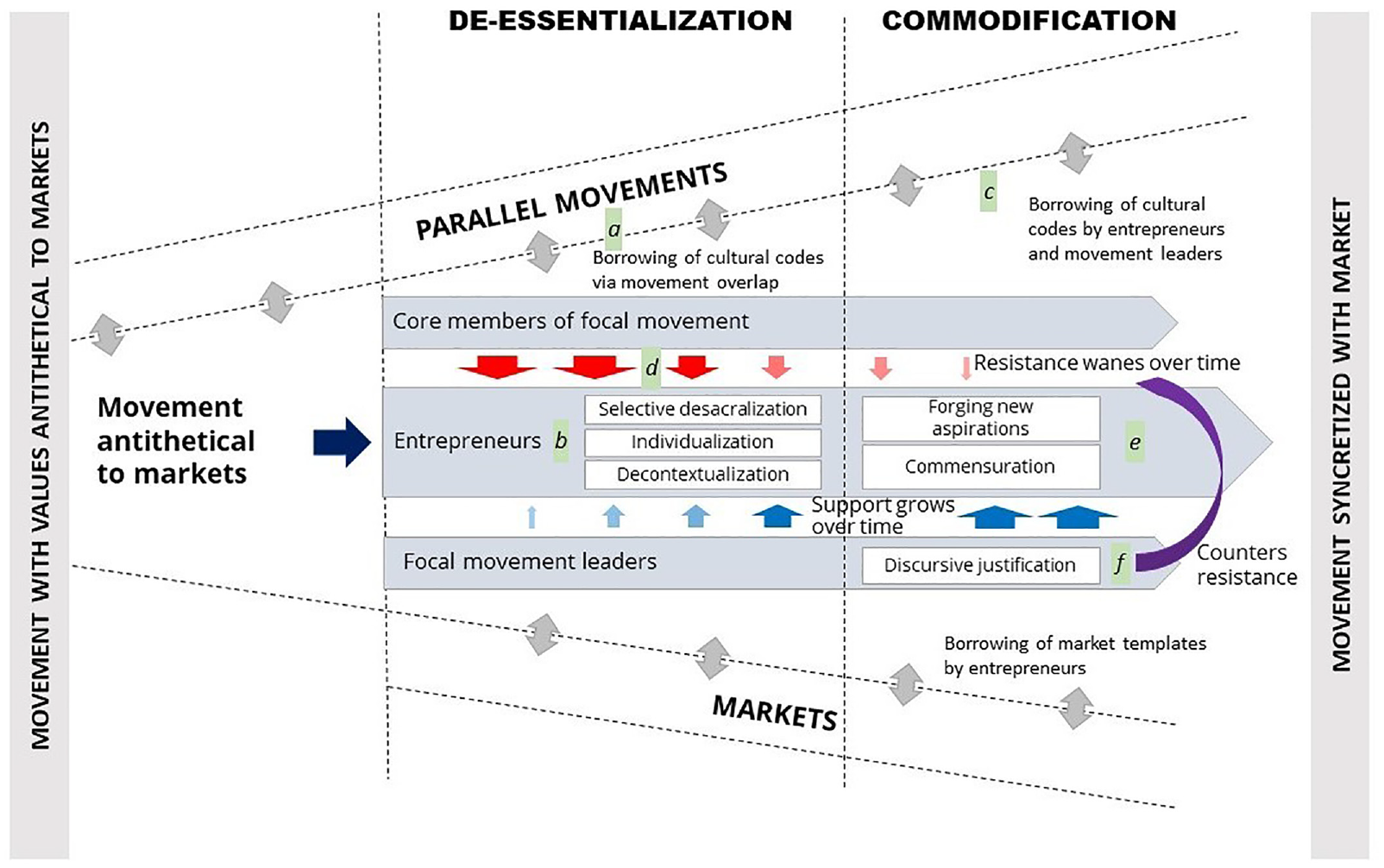
A Model for the Syncretization of Movements with Markets
De-essentializing a Movement
As Figure 6 shows, the process begins as a movement undergoes changes when new codes are borrowed from overlapping movements by members and leaders (a). These codes serve as valuable resources to de-essentialize the movement. Because these codes emanate from local movements, their borrowing inevitably means that the focal movement assumes a local color (e.g., the Americanization of yoga). At the same time, movement leaders’ evangelical desire to grow the movement requires accommodating members who are less committed to the movement’s original ideals (b). This puts pressure on leaders to distance the movement from sacred or non-negotiable codes, allow more individual choice (i.e., veer away from collective goals), and obscure the movement’s history.
De-essentialization involves de-emphasizing political, social, or religious aspects of a movement and opening central practices to new constructions and representations that broaden their appeal (Boucher, 2006; Bekerman, Zembylas, and McGlynn, 2009; Yi and Silver, 2015). In other words, de-essentialization deracinates key practices from the very movement that infuses them with an essence. In our case, de-essentialization inverted the meaning of yoga, stripping it of its core codes and eventually separating the practice from the movement. According to our model, de-essentialization proceeds in three interrelated ways: selective desacralization, individualization, and decontextualization.
Selective desacralization
Desacralization involves attempts by key movement leaders to strip any non-negotiable, sacred meaning from core practices. An idea, phenomenon, or space (e.g., human life or the Dome of the Rock in Jerusalem), practice (e.g., burying the dead), or object (e.g., a human organ) is sacred when it is revered, transcends everyday life, and evokes passions and strong feelings (Durkheim, 1915). Whereas yoga’s initial adopters in the West (i.e., the educated elite) recognized and embraced them, yoga’s sacred Hindu roots proved to be an obstacle to the movement’s growth. Desacralization is selective because some resemblance to the original entity must be retained (Eliade, 1959; Binkley and Littler, 2011). Selective desacralization thus allows a simultaneous nod toward the sacred while turning away from it, not seeking to validate or rigidly reinscribe the traditional but rather retaining some of its hallmarks and cultural cachet for trade. We argue that selective desacralization is at play when moral markets for life insurance and funeral services (Zelizer, 1979), human organs (Healy, 2004; Anteby, 2010), or human eggs and sperm (Almeling, 2007) are established.
Individualization
De-essentialization also involves individualization. To varying degrees, movements are premised on shared notions of a better collective future, with communitarian and collective purposes lying at their cores. Discourses shared by movement members often require them to abide by a certain code of conduct to attain their goals, which can impede the commodification of the movement’s central practices. Individualization involves attempts by movement leaders to shed any collectivist values that lie at the core of the movement. For example, vegetarianism began as a reformist reaction to industrialism’s encroachment into everyday life and to promote social causes such as temperance. Later, it became individualized as a lifestyle, as people adopt vegetarian diets to cure or assuage health problems and consume an increasing variety of animal-free natural foods (Maurer, 2002).
Decontextualization
Finally, de-essentialization requires decontextualization, which involves untethering a movement’s core practices from their moral or historical context, which may clash with a consumerist society. Decontextualization has occurred over time in several social movements, ranging from microfinance (Armendariz and Szafarz, 2011) to Circuit Riders (McInerney, 2014). In our case, the decontextualization of yoga has been so successful that it is common to come across practitioners who are largely unaware of its Hindu roots or underlying collectivist philosophy. Excluding a movement’s history from discourses and mocking the rigid constraints associated with the core philosophy are effective decontextualization techniques. For instance, capoeira, a form of Afro-Brazilian martial arts developed by slaves in colonial Brazil to prepare for uprisings against their masters, was decontextualized by removing troublesome racial references to Afro-Brazilian identity while retaining Brazilian music and subsequently promoting the practice as an effective fitness activity (Robitaille, 2014).
De-essentialization does not occur on its own but is facilitated by the borrowing of codes from outside the movement by entrepreneurs and movement leaders (Weber, Heinze, and DeSoucey, 2008) (c). The borrowing of codes is easier when overlaps exist across movements, e.g., between yoga and the NAM and HHM, or between the vegetarian movement and the animal rights and health movements (Maurer, 2002). When little overlap exists between movements, entrepreneurs and movement leaders must expend significant effort to bridge movements, as in the case of yoga and fitness.
In the latter case, as one would expect, there is bound to be resistance from within a movement to such shifts, just as there is to entrepreneurs seeking to monetize a movement under guises that are vastly different from the movement’s original ideals (d). In yoga’s case, the entry of businesses (e.g., Banana Republic) into the movement was not welcomed by members. Just as standards organizations seek to moderate the conflict between newcomers and core members, as in Lee, Hiatt, and Lounsbury’s (2017) study of organic food, movement leaders play a role in overcoming such resistance (arrow f). Yoga Journal, for instance, played a central role in defending and justifying businesses and their own persistent deviations from yoga’s core message. Gradually, new adherents were joining a movement that was no longer about seeking enlightenment but about building the perfect body and alleviating stress caused by hyper-productive lives. A core group of disillusioned members remained, but the overall movement was engulfed by a booming market.
Commodifying a Movement
De-essentialization paves the way for commodification (e), defined as transforming things, ideas, or people into commodities or objects of exchange (Radin, 1996; Appadurai, 2005). Commodification assigns economic value to something that is seemingly beyond valuation and ought not be treated as a tradable commodity (Marx, 1867; Zelizer, 2005). Commodification is largely engineered by entrepreneurs seeking to generate economic value from an expanding movement and facilitated by movement leaders seeking to propagate their message and extend a practice to a wider audience. This process comprises at least three components.
Forging new aspirations
First, for a movement incompatible with markets, cultural codes from outside the movement must be adopted to forge new aspirations. Movements are aimed at bringing about large-scale change in the social order, directly through social action or indirectly through shifts in individual behavior. In some cases, markets might be able to contribute to the accomplishment of such goals. In many others, however, including in the case of yoga, abstract goals such as enlightenment or emancipation may not lend themselves directly to the commodification of core practices. Yoga’s goals of achieving oneness, liberation, or ultimate enlightenment were not only abstract and demanding but also hard to observe or measure. Fitness, in contrast, was observable and in line with ideal body image types prevalent in the 1990s and 2000s.
Commensuration
Second, commodification requires commensuration: transforming different aspects of a movement’s core practice into a measurable, tangible, and seemingly achievable form and measuring them by applying a common standardized metric (Espeland and Stevens, 1998). Through commensuration, the practice is made proprietary and scalable, and it is divided into categories or types and certified. This process is essential for a competitive market to exist through the creation of categories, as seen in the construction of a marketable category and a coherent and comparable system of valuation for traditional Indian art (Khaire and Wadhwani, 2010). To accomplish this, templates are borrowed from parallel markets. In the case of yoga, Bikram Choudhury borrowed the McDonald’s franchising model and prepared thousands of certified instructors to teach in those franchises.
Discursive justification
Codes from other movements broaden a movement’s remit to attract new members, and market templates enable it to be scaled up. This is only possible with the help of discursive justification by movement leaders that creates a foothold for commodification (f). Commodification necessarily requires making important changes to how the practice is made accessible to potential practitioners. But entrepreneurs, who stand to gain the most from commodification, may not be accepted as legitimate actors, and their attempts to buy and sell a practice at the heart of an ascetic movement might be rebuffed by movement members. In such cases, entrepreneurs require the support of movement insiders to endorse these crucial shifts. In the case of yoga, corporate actors met with resistance initially, but it gradually faded as the movement’s intellectual leadership at Yoga Journal recognized that corporate advertisements were necessary to drive the movement’s expansion. This was akin to Chasin’s (2000) observation of the gay rights movement, as he noted how funding from several large firms fundamentally altered the movement’s trajectory.
The mechanisms described above enable a movement to become syncretic with ideas it previously opposed (Leopold, 2001). In our case, these mechanisms reconciled the underlying philosophies of yoga and markets to form what would have once seemed like an unlikely kinship. Syncretization is visible in a number of other settings, including the environmental movement, which has come to embrace the market it had previously vilified for degrading the environment through what has been described as eco-entrepreneurship (Mars and Lounsbury, 2009). Similarly, shareholder activists and advocates of socially responsible investing have spurred a new market that melds social and environmental concerns with financial profit (King and Gish, 2015). Our model shows the interactive and complex relationships through which both movement outsiders and insiders exercise agency to make syncretization possible.
Discussion
Movements that are opposed to markets—rather than those simply trying to extend or change markets—offer fertile ground for studying how certain movements can reconcile with opposing value systems. The yoga movement, with its subsequent implication in a thriving market, offers such an empirical site. Our analysis of this transformation allows us to make at least three contributions to existing research on the resolution of tension between the opposing ethos of countercultural movements and markets. First, we show how commodification is enabled by a process of de-essentialization. Second, we show how and where movement leaders exercise agency in commodifying the core practices of the movement. Finally, we demonstrate how the borrowing of codes and templates across parallel movements and markets is central to the twin processes of de-essentialization and commodification.
De-essentializing a Movement to Enable Syncretization
We argue that movements seeking the radical transformation of a market economy and capitalist structures (Cini et al., 2017) need to be de-essentialized before they can be commodified. De-essentialization comprises three components: selective desacralization, individualization, and decontextualization.
By appealing to different value systems and orders of worth, selective desacralization can increase market appeal by removing the market-encumbering aspects of a movement while retaining a few sacred symbols to maintain an aura of authenticity that facilitates differentiation and allows price premiums. In our case, the movement was not commodified in its original form; entrepreneurs did not attempt to sell Patañjali or ancient Hindu practices requiring decades of dedication and sacrifice. Nor did they completely strip yoga of religious symbolism. Rather, as is the case for Christmas celebrations in a Dubai luxury mall or a trendy Buddha bar franchise, yoga was only selectively desacralized, invoking a modicum of Eastern mysticism even in its Westernized incarnation. This is akin to how the spiritual aspects of mindfulness are selectively retained, omitted, or altered (Purser and Milillo, 2015) in corporate employee development programs. Mindfulness has become a “technology of the self” informed by biomedical models of stress and wellbeing to increase productivity.
Selective desacralization not only increases market appeal but also challenges the classical dichotomy between the sacred and the profane in the moral market narrative. It highlights how essentialist interpretations of sacred versus profane and authentic versus inauthentic can prevent us from understanding how these polarities are negotiated and reconciled (Anteby, 2010; Dioun, 2018). Weber (1930) explained how the Protestant work ethic could be compatible with capitalism, resulting in the concept of Protestant prosperity. Consider how biotechnology spans this dichotomy, where bio expresses sacred life, and technology suggests the commodified. While the commercialization of life in the form of gene therapy and DNA engineering is highly contested, biotechnology lies at the frontiers of medical research and practice (Schultz, 1997). Similarly, Peifer, Johnson, and Eckland (2020) showed how patents—once viewed as a manifestation of capitalism’s exploitative aspects that privatized a historically public good—came to be seen as “civilizing,” because they enhance economic growth and more quickly bring about cures to lifesaving diseases.
Selective desacralization highlights that what is held sacred can be both a form of baggage and a source of value creation. This especially holds true when attempts to blend religious movements with economic value are made. Some religious organizations (e.g., megachurches) seek wider appeal by making religion “entertaining” and building brand identities (Ellingson, 2013). Similarly, local governments in China have attempted to create economic value from sacred Buddhist temples by promoting them to tourists without the need to follow demanding Buddhist rituals (Yue, Wang, and Yang, 2018), and pilgrimages to Israel have been transformed into appealing tourist packages (Shoval, 2000). A religious event, Christmas, has become a global consumption festival even in non-Christian contexts (Hirschmann and LaBarbera, 1989) but with a symbolic nod to religious history. Religious movements initially opposed to a market ethos spawn new commercial offerings by stripping them of cumbersome regimens that may constrain wider adoption.
Movements opposed to markets may also become syncretic with them through individualization, which detaches a movement from its collectivist aspirations. The yoga philosophy to renounce material possessions and shun consumerism reflects collectivism, with an interest in wholesale changes in broader social, political, and economic issues. This philosophy is inconsistent with market principles, where freedom of choice is an enveloping framework of individual autonomy and self-expression (Giddens, 1991; Van Stekelenburg, Roggeband, and Klandermans, 2013). The reframing of angst, stress, and burnout as individual pathologies to be managed avoids a direct confrontation with their socio-economic causes, such as a high-pressure work culture and the underlying economic disparities and structural inequalities. Individualization freed yoga from the burden of such collectivist and communitarian ideals, and practitioners became motivated by personal rather than collective goals. A similar change was seen in the vegetarian movement, as many members are motivated by personal lifestyle goals rather than by the movement’s original political demands and aspirations for socio-economic change (Maurer, 2002).
Finally, decontextualization untethers a movement from its foundational underpinnings, thereby enabling it to expand to new contexts. Decoupling yoga from its religious foundations enabled it to expand to the fitness context. Likewise, the mindfulness movement had to be untethered from its original ethos to render it a corporate-friendly practice centered around health and performance perks. To become a profit center in the fashion industry, punk clothing had to be decoupled from the original ethos of the rebellious punk movement, whereby a subjugated lower class resisted the establishment through anti-conventional means of self-expression (Santos and Avery, 2016). Whereas punk’s founding members used handmade clothing to subvert commercial fashion, punk aesthetic today is bereft of its founding ethos, representing the very antithesis of the original philosophy.
Interestingly, a movement opposed to a market ethos, when syncretized, may paradoxically enable an even more diverse set of potential market domains to emerge, as it furnishes a wider repertoire of meanings (Pontikes, 2012). While new forms of value around yoga as sporty, sexy, and cosmopolitan are radically different from the original moral and religious intents of yoga, they have gained worth and widespread appeal in a changing context with shifting criteria for social and moral evaluation and have enabled a variety of markets to emerge and thrive. While something is lost in translation, something new may also be gained in the fusion between seemingly disparate counterculture and contemporary culture.
Where Does Agency Lie in Commodification?
Our analysis also provides insights into how commodification is made possible with the help of movement leaders. Commodification has been described as capitalism in “cell-form” (Marx, 1867). In this sense, it lies at the very heart of the tension we outlined between the ethos of a movement and the ethos of a market. However, delineating the tension between the two does not mean that we treat them as a binary in terms of values or that we view marketization as problematic in and of itself. Markets have been seen both as moral (Hirschman, 1982) and amoral (Walzer, 1983; Sandel, 2012). From a sociological perspective, different and often competing moralities exist that are historically and socially contingent and are negotiated and contested among diverse actors from different arenas (Hitlin and Vaisey, 2013; Balsiger and Schiller-Merkens, 2019). Some have argued that yoga has facilitated the “Easternization of America,” whereas others contend that markets have facilitated the “Westernization of yoga” (Brown and Leledaki, 2010). But as Reich (2014: 1584) noted, how this happens and to what extent does not “arise out of thin air.” Even the supposedly inexorable force of neoliberalism requires a helping hand. Agency exercised by movement leaders, members, and entrepreneurs is instrumental in this process.
We highlight three ways in which agency is exercised on both sides of the movement–market divide: forging new aspirations, commensuration, and discursive justification. In contrast to an indelible tendency of markets to colonize every social practice or exchange, a movement may forge new aspirations to expand to other contexts in order to attract new members, which may require embracing market principles. Similarly, entrepreneurs, with the help of movement leaders, can establish links with other movements to both create new markets and expand existing ones. Initially, yoga postures were meant to enhance the ability to meditate rather than develop a fit body. Once yoga was bridged with fitness, new possibilities emerged, with yoga eventually becoming associated with an attractive, lithe body and a clean, disciplined lifestyle followed by people who were “in control.” At this point, yoga could be used to sell anything from an electric car to a pair of jeans.
The forging of new aspirations can be observed across several movements. In the organic food movement, the California Certified Organic Farmers’ desire to “grow now and fix things later” (Lee, Hiatt, and Lounsbury, 2017: 456) enabled the entry of commercial producers seeking to weaken the definitions of organic to facilitate wider participation at the industrial level. In Fair Trade, the desire to expand the number of beneficiaries justified engagement with commercial farmers even if doing so went against the movement’s founding principle to work only with small-holder farmers (Reinecke and Ansari, 2015). In the microfinance movement, the Nobel Laureate founder of Grameen Bank, Muhammad Yunus (2011), who described new for-profit microlenders as loan sharks, found himself sowing the seeds for microfinance’s transformation by welcoming major corporate banks into the space. Microfinance’s original goal, poverty alleviation, was transformed into financial inclusion, allowing for-profit microlenders to sell financial products to the poor (Bateman, 2011). And the environmental movement lost part of its sacred “save the earth” ethos after insiders allowed the entry of entrepreneurs who harvested the movement for the creation of an ever-broadening range of innovative green products and services (e.g., York, Vedula, and Lenox, 2017). Movements may use commercialization as a “mobilizing technology” (Edwards and McCarthy, 2004) to resonate with a broader pool of supporters but may end up admitting members looking for commercial opportunities whose values are misaligned with the movement (Lee, Ramus, and Vaccaro, 2018). A desire to grow may thus “double back” to influence movements in unintended ways.
The second point we make concerns commensuration, which speeds up both the production and appropriation of cultural forms (Simmel, 1978; Khaire and Wadhwani, 2010). The resulting depersonalization is critical to the functioning of a rational, bureaucratic, capitalist system (Weber, 1930), but as Espeland and Stevens (1998: 315) pointed out, “commensuration warrants more sustained and systematic treatment.” Consider how the Open Access (OA) movement sought to create a “knowledge commons” (Suber, 2007; Thananusak and Ansari, 2019) and revolutionize scholarly communication by removing permission barriers (copyrights and licensing). Mainstream publishers accommodated this radical movement against proprietary models by modifying the OA model through an author-pay system and making it commensurate with their extant business models. Apart from the payment structure, “gold” OA journals now operate in a similar way to subscription-based journals. In our case, the transformation of yoga underlines a crucial aspect of commensuration: Where does the legitimacy to commensurate the previously incommensurable (e.g., Zelizer, 2005) come from?
This brings us to our final point that commodification requires discursive justification from movement insiders to be legitimate. The replacement of the guru–disciple relationship with a system of thousands of yoga instructors who were certified in mere weeks or even days with little if any grounding in the original ethos of yoga required legitimation from within the movement. Driven by the desire to grow, movement leaders found themselves discursively justifying entrepreneurial strategies to their members. Similarly, over time Islamic finance has come to include derivative products—but only once Islamic scholars in the vanguard of the movement discursively justified these products as being consistent with Islamic teachings (Gümüsay, Smets, and Morris, 2019).
Whereas others have highlighted how entrepreneurs try to legitimate their morally contentious work by downplaying commercial objectives (Quinn, 2008; Anteby, 2010; Yue, Wang, and Yang, 2018), we suggest that syncretization also involves depicting clashing moral values as seamlessly unified with commercial offerings. Such unification itself is a form of yoga, the Sanskrit word for yoke, meaning “union,”“binding,” or “joining together” to transcend Cartesian dualities (e.g., mind and body) and be at one with the universe (Herriott, Schmidt-Wilk, and Heaton, 2009). Ironically, yoga became “one” with neoliberal consumerism, which it was meant to subvert. Yoga Journal’s awarding of Karma Credits to Banana Republic and then defending it by suggesting that yoga teaches us to embrace both the little girl stitching clothes and the brand itself illustrates this point.
While commodification is often seen as a quintessential sell-out of movements by market actors, it is difficult to carry out without support from within the movement. Our three sub-mechanisms of commodification suggest an interactive and interpenetrative relationship between movements and markets whereby markets are leveraged for social transformation and movements are enrolled to create new markets.
Borrowing Codes from Parallel Movements and Markets
The famous French author Victor Hugo (1896) noted that “phenomena intersect; to see but one is to see nothing.” Our analysis shows that social movements must not be seen as standalone phenomena isolated from the reality and history of other movements and mobilizations (Fominaya and Cox, 2013). We suggest that constructing a market from a movement antithetical to market principles requires invoking cultural codes and templates that may not be available within the movement itself. These may need to be borrowed and blended from other intersecting movements, as well as from markets. In many social movement studies, broader “institutional and cultural factors tend to be treated as background conditions rather than as important explanatory factors” (de Bakker et al., 2013: 580). Their role in providing “a repertoire of capacities” (Swidler, 1986: 282) to actors for fashioning new patterns of activity and forging new linkages is thus underemphasized. Our analysis suggests the need to move beyond a movement-centric focus (Walder, 2009; Fligstein and McAdam, 2011) to consider how overlaps with different movements may be a critical determinant of a movement’s trajectory.
We therefore do not view social movements as self-contained (Meyer and Whittier, 1994) or isolated from the broader environments in which they are embedded (Calhoun, 2012; de Bakker et al., 2013). Instead, we offer a perspective that frames movements as overlapping and intersecting, with members as cross-pollinators of beliefs and practices, thereby expanding a movement’s reach. While boundary spanning among movements is recognized (Wang, Piazza, and Soule, 2018), we highlight that the degree of overlap between a focal movement and intersecting movements may shape the level of resistance from within the focal movement. We suggest the need to study contemporaneous and historical crossovers between social movements, such as the anti-globalization and Occupy movements, and to focus on movement ecologies rather than on social movements in isolation.
Given the above arguments, we suggest that the creation of thriving markets around countercultural movements cannot simply be defined as cooptation, whereby market actors extend their reach. Instead, this is a process replete with tensions and driven by agency from both movement insiders and entrepreneurs, as well as enabled by the context in which local movements, markets, and social currents shape the trajectory that the focal movement takes.
Limitations and Avenues for Future Research
Not every movement successfully becomes a market. As Weber, Heinze, and DeSoucey (2008) argued, whereas a market emerged around grass-fed beef, the comparable movement of biodynamic farming did not spur a market. Similarly, the ancient Chinese practice of Tai Chi rooted in Taoist philosophy has not become a market, despite widespread recognition. Also, unlike yoga, Muslim prayer has not been de-essentialized; it is not just a form of physical exercise but derives its meaning entirely from the foundational religious teachings of the Quran, and Muslims around the world continue to treat the postural aspect of the practice as sacred and intimately tied to the original teachings. It would be instructive to study other movements (e.g., Vipassana, mindfulness) that have followed a different route than yoga.
Also, although we studied desacralization, values and practices can equally become sacralized and de-commodified. Zelizer’s (1985) study of the “sacralization of child life”— a shift from children being economically “useful” (contributors to family income) toward being economically “useless” (even costly to parents) but emotionally priceless—falls into this category. Given the overlap between sacralization and selective desacralization, it is worth examining secular enchantment, or the sacralization of the mundane. The sacred is not limited to the religious or spiritual but also describes “something ‘set apart,’ regardless of whether it is distinct because it is exalted or because it is fouled” (Rossman, 2014: 44). For instance, the meditative cycling brand SoulCycle is selling not just an exercise class but a sacralized dream of purification, material improvement, and spiritual transcendence (Burton, 2020).
It would be equally useful to study instances of cultural reappropriation. For example, a resignified form of yoga is being re-exported to yoga’s birthplace, India (Antony, 2018), provoking resistance among Hindu nationalists but also entrepreneurship to capitalize on its economic potential, as illustrated by a yoga guru’s highly successful range of Patañjali consumer products in India. Although yoga was a movement rooted in Eastern philosophy and Hinduism, after its makeover in the West, the meaning of “authentic” is now up for grabs. Even people seeking authentic yoga in the East have reported visiting Westernized yoga centers offering instant gratification instead of original establishments offering traditional meditation, which attract a limited clientele in today’s time-starved world. Although yoga was imported from India, it became Americanized as a result of borrowing codes from local movements (i.e., the NAM). It would be interesting to examine yoga’s translation in other contexts, where local movements may cross-pollinate it in different ways.
In a world facing increasing pressures for marketization, it would be fruitful to further explore the movement–market nexus. Although much research has focused on how movements shape markets, more work needs to be done on how market imperatives put pressure on movements to change. Consider how the market for Black Lives Matter merchandise has increased exponentially since 2013; arguably, the discourse has been commodified through exploitation in pop culture, social media, and corporate advertising. Creating a brand out of a social problem and promoting pervasive commodification may arguably dilute the political and philosophical debates on the issue, as we have seen in other emancipatory movements such as the leftist Che Guevara movement. Yet, if commodification to varying degrees is unavoidable in modern society, can it serve to raise awareness and impact to help the cause it leverages?
The popularity of movements, even those that do not lend themselves well to markets, makes them an inviting target for corporate participation. It would be interesting to examine how counterculture went corporate in spiritual centers like the Esalen Institute in California—described as Hippie Inc., providing mysticism with a measurable return on investment (Segnit, 2019)—and how communal living ideas were translated into the idea of a platform for shared workspaces (i.e., WeWork). It would also be intriguing to study the sacralization and decommodification of markets, as well as cases of “failed marketization,” in which the nature of market relations cannot be reconciled with that of social relations (Turco, 2012; Vermeulen, Ansari and Lounsbury, 2016). Exploring the tensions between countercultural movements and contemporary markets and how they are reconciled continues to be a fruitful research endeavor.
Supplemental Material
sj-pdf-1-asq-10.1177_0001839221993475 – Supplemental material for From Patañjali to the “Gospel of Sweat”: Yoga’s Remarkable Transformation from a Sacred Movement into a Thriving Global Market
Supplemental material, sj-pdf-1-asq-10.1177_0001839221993475 for From Patañjali to the “Gospel of Sweat”: Yoga’s Remarkable Transformation from a Sacred Movement into a Thriving Global Market by Kamal Munir, Shahzad (Shaz) Ansari and Deborah Brown in Administrative Science Quarterly
Footnotes
Acknowledgements
We would like to offer our sincere thanks to our highly engaged and thoughtful editor, Forrest Briscoe, and three anonymous ASQ reviewers who offered us a wealth of insights to advance our thinking. We would also like to thank Diane-Laure Arjaliès, Stefan Arora-Jonsson, Grace Augustine, Santi Furnari, Royston Greenwood, Patricia Hein, Lamia Irfan, Tom Lawrence, Mike Lounsbury, Daniel Milner, Zehra Munir, Anand Narasimhan, Woody Powell, Chiqui Ramirez, Madeleine Rauch, Davide Ravasi, Juliane Reinecke, Florian Überbacher, Marc Ventresca, Samsurin Welch, Andrea Wessendorf, and participants at the ASA meeting 2015 in Chicago, AOM meeting 2018 in Chicago, OTREG meetings in Cambridge 2018–19, SCANCOR Stanford University Seminar 2020, Kings College London seminar 2018, Uppsala University seminar 2016, and Emlyon seminar 2018 who provided us with constructive insights and suggestions.

Supplemental Material
8
9
11
Editor’s Linkedin profile.
Authors’ Biographies
References
Supplementary Material
Please find the following supplemental material available below.
For Open Access articles published under a Creative Commons License, all supplemental material carries the same license as the article it is associated with.
For non-Open Access articles published, all supplemental material carries a non-exclusive license, and permission requests for re-use of supplemental material or any part of supplemental material shall be sent directly to the copyright owner as specified in the copyright notice associated with the article.
