



Abstract
Status–authority asymmetry in the workplace emerges when lower-status professionals are ascribed with the functional authority to oversee higher-status professionals and elicit compliance from them on specific processes or tasks. Eliciting such compliance is ridden with challenges. How and when can lower-status professionals with functional authority elicit compliance from higher-status professionals? To examine this question, I conducted a 24-month ethnography of 911 emergency coordination to understand how 911 dispatchers (lower-status professionals with functional authority) can elicit compliance from police officers (higher-status professionals). I identify a set of relational styles—entailing interactional practices and communication media—enacted by the dispatchers. My findings suggest that dispatchers whose relational styles involved customizing the workflow via private communications with police officers or privately escalating cases of officers’ noncompliance to supervisors did not elicit greater compliance. In contrast, dispatchers who did elicit compliance used a peer publicizing relational style: they shared news of the noncompliant behavior—generally in a bantering, humorous manner—with an officer’s immediate peers using a communication medium that all officers in the police unit could hear. Publicizing noncompliant behavior among the immediate peers triggered the officer to self-discipline, as that noncompliant officer’s trustworthiness was on the line in front of the peer group. More generally, through enrolling an alter’s peers in the compliance process, the lower-status professionals with functional authority could generate second-degree influence and elicit compliance from the higher-status professionals.
Organizations are increasingly inhabited by professionals, who make up the “largest and fastest growing proportion of the labor force in the United States” (Gorman and Sandefur, 2011; Kellogg, 2014: 913). Scholars of work and professions have examined how and under what conditions status differences between professions can promote noncompliant behavior and impede the achievement of organizational goals (Barley, 1986; Zetka, 2001; DiBenigno and Kellogg, 2014). Such studies have examined this issue in organizational contexts where professional status and formal authority are aligned (Barley, 1986; Vallas, 2001; DiBenigno and Kellogg, 2014; DiBenigno, 2018): higher-status professionals have higher formal authority over lower-status professionals. But in many other contexts, organizations ascribe more formal authority to lower-status professionals to oversee and direct a specific function (or set of functions) performed by higher-status professionals, with the overarching objective of eliciting their compliance with organizational policies, protocols, and standards (Etzioni, 1959; Daft, 2014). Organizational theorists refer to this subcategory of formal authority as functional authority, distinct from other subcategories of formal authority such as line and staff authority (Thompson, 1956; Galbraith, 1977; Daft, 2014).
In these organizational contexts, a misalignment or asymmetry between professional status and functional authority occurs, a phenomenon that I refer to as status–authority asymmetry. For example, lower-status safety auditors have functional authority over higher-status scientists with respect to lab safety practices (Huising, 2015), lower-status magazine fact checkers in news organizations have functional authority over higher-status journalists on the factual aspects of a feature article (Cohen and Staw, 1998), and lower-status DEI (diversity, equity, and inclusion) professionals have functional authority over higher-status recruiters with regard to diversity initiatives in hiring (e.g., criteria for demographic diversity in the application pool) (Portocarrero, 2021). Across these contexts, organizations give lower-status professionals the mandate to oversee, keep tabs on, and elicit compliance from higher-status professionals. But the asymmetry between status and authority poses critical challenges for the former to exercise their authority and elicit compliance from the latter (Silbey, Huising, and Coslovsky, 2009; Gray and Silbey, 2014; Huising, 2015; see also Valentine, 2018). A failure to elicit compliance from the higher-status professionals, in turn, could exacerbate conflicts and affect the attainment of organizational goals (Pondy, 1969; DiBenigno, 2020).
All of this begs the question of how and when lower-status professionals with functional authority could elicit compliance from higher-status professionals. I examine this question in the “strategic research site” (Merton, 1987) of 911 emergency coordination. In this setting, 911 dispatchers (lower-status professionals with higher functional authority) need to elicit compliance from police officers (higher-status professionals) in order to quickly and effectively dispatch 911 calls for service. Although police officers perform a range of functions that include patrolling, issuing citations, and making arrests, in functions that pertain to 911 emergency response, the 911 dispatchers have higher functional authority over the police officers. Not only are the dispatchers responsible for assigning 911 calls to the appropriate police officers, but also they are in charge of overseeing and directing police officers during such emergency response, including watching out for officer safety. Police officers are, by official protocol, expected to follow the directions given by 911 dispatchers when responding to a 911 emergency. They are also supposed to periodically update the dispatchers about their progress in responding to a 911 emergency. However, 911 dispatchers face difficulties in exercising their functional authority in practice and eliciting compliance from police officers. Indeed, police officers are often noncompliant with dispatchers’ requests.
Through a 24-month ethnography of 911 emergency coordination, I find that some 911 dispatchers are able to effectively elicit compliance from police officers, while others are not. This study suggests how and when certain relational styles enacted by some dispatchers—entailing a combination of interactional practices and the use of communication media—enabled them to elicit compliance from police officers. My findings also highlight the considerable emotional toll experienced by individual 911 dispatchers—including those who use the most effective relational style—in their attempts to elicit compliance from police officers, resulting in outcomes such as reduced morale, burnout, and absenteeism. I elaborate on the practices of eliciting compliance in the presence of status–authority asymmetry between professions, discussing what the underlying mechanisms are and with what organizational- and individual- level consequences.
Theoretical Background
Building on prior work, I distinguish between status, authority, and power as related but conceptually distinct bases of social hierarchy (Mechanic, 1962; Bunderson and Reagans, 2011; Fast, Halevy, and Galinsky, 2012; Anicich et al., 2016). Status is understood as “the position in a social hierarchy that results from accumulated acts of deference” (Ridgeway 1984; Sauder, Lynn, and Podolny, 2012: 268) or more simply as “the extent to which an individual or group is respected or admired by others” (Magee and Galinsky, 2008: 359). By extension, professional status is conceptualized as the position within a professional hierarchy that is derived from accumulated acts of deference and respect. Power is defined as the “asymmetric control over valued resources” in social relations (Emerson, 1962; Salancik and Pfeffer, 1977; Magee and Galinsky, 2008: 361).
Authority is a more complex and multi-faceted construct (Selznick, 1948; Crozier, 1964; Barley, 1986; Aghion and Tirole, 1997; Baker, Gibbons, and Murphy, 1999). Traditionally, authority is conceptualized as a form of power whose use is considered as legitimate by other actors (Weber, 1968; see also Merton, 1963). Sociologists and organizational scholars have subsequently examined how authority operates within organizations (Thompson, 1956; Stinchcombe, 1959; Presthus, 1960), focusing on how it is formalized as “command vested in an official position” by the bureaucracy (Parsons, 1965; Blau, 1968: 455). Often referred to as formal authority, it is considered to be distinct from other bases of authority such as tradition and charisma (Weber, 1952; see also Blau, 1955; Stinchcombe, 2001). Formal authority is vested in official positions and roles, as opposed to specific individuals or their characteristics, within an organization (Follett, 1940; Valentine and Bernstein, 2021).
Subcategories of Formal Authority: Line, Staff, and Function
Organizational scholars have further examined the distinct aspects of formal authority within organizations and theorized its three subcategories: line authority, staff authority, and functional authority (Simon, 1957; Etzioni, 1959; Peabody, 1962; Daft, 2014). Line authority is characterized by a direct chain of command or reporting structure and reflects the supervisor–subordinate relationship. Actors with line authority have the decision rights to hire/fire, sanction, supervise, and give orders to subordinates under their span of control. These actors are also responsible for evaluating subordinates’ performance. Line authority is typically hierarchical in nature, as reflected in the organizational chart, and extends down through different levels of an organization (Dalton, 1950; Koontz, 2010; Daft, 2014: 327).
Staff authority in an organization is narrower in scope and largely advisory in nature. Actors with staff authority have the “right to advise, recommend, and counsel” (Daft, 2014: 262) other professionals and managers/department heads in areas pertaining to their technical expertise but do not have the decision rights to command and/or enforce their recommendations. For example, a process analyst might counsel and give recommendations to a software engineer on software development processes, but the analyst does not have the decision rights to command, sanction, or evaluate the software engineer’s work performance (Dalton, 1950; Gouldner, 1954; Myers and Turnbull,1956; Daft, 2014: 328).
Functional authority occupies the middle ground between line and staff authority (Garner, 1990; Koontz, 2010; Daft, 2014). Actors ascribed with functional authority are responsible for monitoring, overseeing, and directing a specific function (or set of functions) performed by other actors in an organization. Such actors typically also have the requisite expertise pertaining to that function (Daft, 2014: 327). Unlike those with line authority, actors with functional authority have limited decision rights, i.e., they cannot hire/fire, sanction, or evaluate the work performance of those they oversee. Unlike those with staff authority, actors with functional authority take on a role that is more than advisory. They have the decision rights to oversee, direct, and even control “specified processes, practices, policies, or other matters relating to activities undertaken by persons in other departments” (Koontz, 2010: 182). For example, “a quality assurance representative directs a work center to do further repair on equipment that does not meet specifications. A safety representative closes down an unsafe operation” (Garner, 1990: 52–53).
Asymmetry between Professional Status and Functional Authority
With increased specialization and complexity of work, the presence of organizational actors with functional authority is becoming even more prevalent (Daft, 2014), as evidenced in the profusion of new professional roles in organizations such as sustainability professionals, safety auditors, DEI professionals, fact checkers, algorithmic auditors, financial fund auditors, and infection prevention/COVID-19 compliance officers (Cohen and Staw, 1998; Huising, 2015; Currie, Mantere, and Spencer, 2018; Augustine, 2021; Miller, 2021). These professionals typically do not have high status in the professional order, and ascribing functional authority to these lower-status professionals to direct parts of the work performed by higher-status professionals creates its own set of challenges. Lower-status professionals ascribed with functional authority often encounter acts of resistance and noncompliance from higher-status professionals (Heimer and Stevens, 1997; Kellogg, 2012; Gray and Silbey, 2014). For instance, Huising (2015) described the difficulties that lower-status lab safety auditors encountered in obtaining compliance from higher-status scientists, and DiBenigno (2018) examined the challenges that lower-status mental health professionals faced in obtaining compliance and cooperation from the higher-status commanders in the U.S. Army. More generally, this line of research suggests that higher-status professionals disregard, neglect, or disobey the directions given by lower-status professionals with functional authority as a way to reassert their dominant position in the professional hierarchy (Huising and Silbey, 2013). They may also fail to acknowledge the tasks assigned to them by lower-status professionals in anticipation that these professionals will follow up with them, creating interactional opportunities to trigger even more deference from the lower-status professionals (Ridgeway and Balkwell, 1997).
Thus lower-status professionals ascribed with functional authority over higher-status professionals do not have the requisite status—in terms of accumulated patterns of deference and respect—to enforce their authority in practice. Due to this asymmetry, these lower-status professionals are often implicitly viewed by the higher-status professionals as “punching above their weight” and “acting out of place” (Rudman, 1998; Magee and Galinsky, 2008; see also Bendersky and Hays, 2012). Consequently, during the moment-to-moment flow of work, there is a grinding reluctance among higher-status professionals to acknowledge lower-status professionals’ functional authority and comply with their directions (Huising, 2015). In short, lower-status professionals with functional authority need to navigate what I refer to as status–authority asymmetry in order to elicit compliance and cooperation from higher-status professionals.
Eliciting Compliance in the Presence of Status–Authority Asymmetry
Prior research has examined some general mechanisms for eliciting compliance in contexts involving status differences between professions (Kellogg, 2012; Huising, 2015). One stream of work has explored the relational aspects of eliciting compliance between professional groups with differential status (Huising and Silbey, 2011, 2013; Kellogg, 2012). For instance, Huising (2015) examined how lower-status professionals can perform a type of relational work—what she referred to as “scut work”—to elicit compliance from higher-status professionals. Scut work refers to work that is menial in nature and requires “additional interaction . . . in which the professional is observed doing work that is physically, socially, or morally difficult or dirty work” (Huising, 2015: 267; see also Hughes, 1958). She conducted a comparative ethnography of two types of lower-status professionals (biosafety officers and health physicists) who were assigned functional authority to monitor and oversee higher-status professionals (scientists in university labs). She found that one of the lower-status professional groups (biosafety officers) that tried to maintain professional purity was unable to elicit compliance, while the other lower-status group (health physicists) did not emphasize professional purity and instead performed scut work and was able to elicit compliance from the higher-status professionals. Scut work enabled the health physicists to interact more with the higher-status professionals, acquire more situated knowledge about them and their work, and expand the basis of their relationship. This, in turn, enabled the health physicists to elicit compliance from the scientists (cf. Ranganathan and Shivaram, 2021).
A second stream of work has examined the demographic aspects of different professionals within an organization in shaping compliance outcomes. Scholars have looked at how cross-cutting demographics between professional groups with differential status can help the lower-status professionals elicit compliance and cooperation from the higher-status professionals (DiBenigno and Kellogg, 2014; see also Blau and Schwartz, 1984). In contrast to consolidated demographics, the presence of cross-cutting demographics provides the lower-status professionals with relational toolkits to draw upon nonprofessional social identities, which they can use to build rapport with higher-status professionals and elicit compliance from them.
These streams of research help advance our understanding of eliciting compliance in contexts marked by status differences between professions. Nevertheless, if we consider Leifer’s (1988) classic work on status and role behavior, in the presence of status–authority asymmetry, the very act of a lower-status professional performing scut work could be viewed by the higher-status professionals as relational accommodations that they are fully entitled to and have little obligation to reciprocate. The higher-status professionals might even use such relational accommodations from lower-status professionals to “lock [them] into the giver’s role” (Leifer, 1988: 872) and to demand more favorable terms. These possibilities could undermine the functional authority of lower-status professionals and negatively impact compliance outcomes.
In addition, given the pervasive nature of occupational/professional segregation, most professional groups in the U.S. economy have consolidated as opposed to cross-cutting demographics (Weeden, 1998; Acker, 2006). As DiBenigno and Kellogg (2014) described in their study, only one of the units at their field site hospital had cross-cutting demographics between patient-care technicians and nurses. Most of the other units had consolidated demographics between the two professional groups. Even more importantly, these authors note that the benefits from cross-cutting demographics are possible when it is a feature of the “unit’s social structure . . . in which status [is] uncorrelated with demographic characteristics” at the unit level (DiBenigno and Kellogg, 2014: 399). In other words, demographic overlap needs to be a structural feature of the workgroup to reap some benefits.
To refine what we have learned from these research streams, I focus on how and when, in the presence of status–authority asymmetry in organizational contexts characterized by consolidated demographics, lower-status professionals with functional authority can elicit compliance from higher-status professionals.
Research Setting and Methods
This study is based on 24 months of ethnographic fieldwork in emergency management organizations (EMOs) conducted between May 2015 and May 2017. My primary fieldwork occurred at Delta City’s emergency management organization (DEMO) and the associated Delta City police department (DPD). 1 Specifically, I focused on emergency coordination between 911 dispatchers (lower-status professionals with higher functional authority) and police officers (higher-status professionals). This setting provided a “strategic research site” (Merton, 1987) to examine my research question for the following reasons. First, I was able to observe the phenomenon of interest at a higher frequency in this setting: since 911 dispatchers had to dispatch several 911 calls to police officers during each shift, I could observe and document issues around compliance. Second, this context also enabled me to conduct fine-grained observations of the practices enacted by lower-status professionals in their attempts to elicit compliance from the higher-status professionals.
Context and Research Site
Emergency management organizations (EMOs) served as the research context for this study (Manning 1988; Seim, 2017; Herring, 2019). The primary work of EMOs involves taking and dispatching 911 calls (Roberts et al., 2005). Call-takers answer incoming 911 calls from the public, gather required information about an incident from the caller, and evaluate whether the reported incident is a valid emergency or not and, if so, what type and category, while concurrently entering all these details into a computer-aided dispatch (CAD) system. Once the incoming call is categorized by the 911 call-taker as an emergency and all the relevant information is entered into CAD, the call is then referred to as a “job” and is automatically routed to an appropriate 911 dispatcher based on the location of the emergency incident. Information about the call (e.g., type and severity of the emergency) appears on the dispatcher’s jobs dashboard queue. This dispatcher then assigns the job to the available police officer who is nearest to the scene of the emergency within a pre-defined time period based on the type of emergency and performs important oversight functions, such as directing and keeping tabs on the officer, getting progress updates from the officer, and watching out for their safety until they have returned from the emergency location.
At DEMO, work is conducted across three shifts per day (referred to as “watches”), with each shift overseen by three to five supervisors who directly monitor the 911 call-takers and 911 dispatchers, as well as handle escalations, and one watch manager who is responsible for managing the operations floor and planning the schedule and staff rotation for the next day. The 911 dispatchers at DEMO are organized by 13 zones. 2 Some zones cater to two police districts, while others handle one “busy” police district. This arrangement ensures that the workload is distributed in a relatively equal manner across the dispatch zones. DEMO employs 190 dispatchers. Most of the 911 dispatchers are women (82% women; 18% men) from minority communities (66% Black, 16% Hispanic, 14% White, 2% Asian, 2% Other), and all dispatchers are civilians who work as full-time employees of DEMO (not the police department).
Data Collection
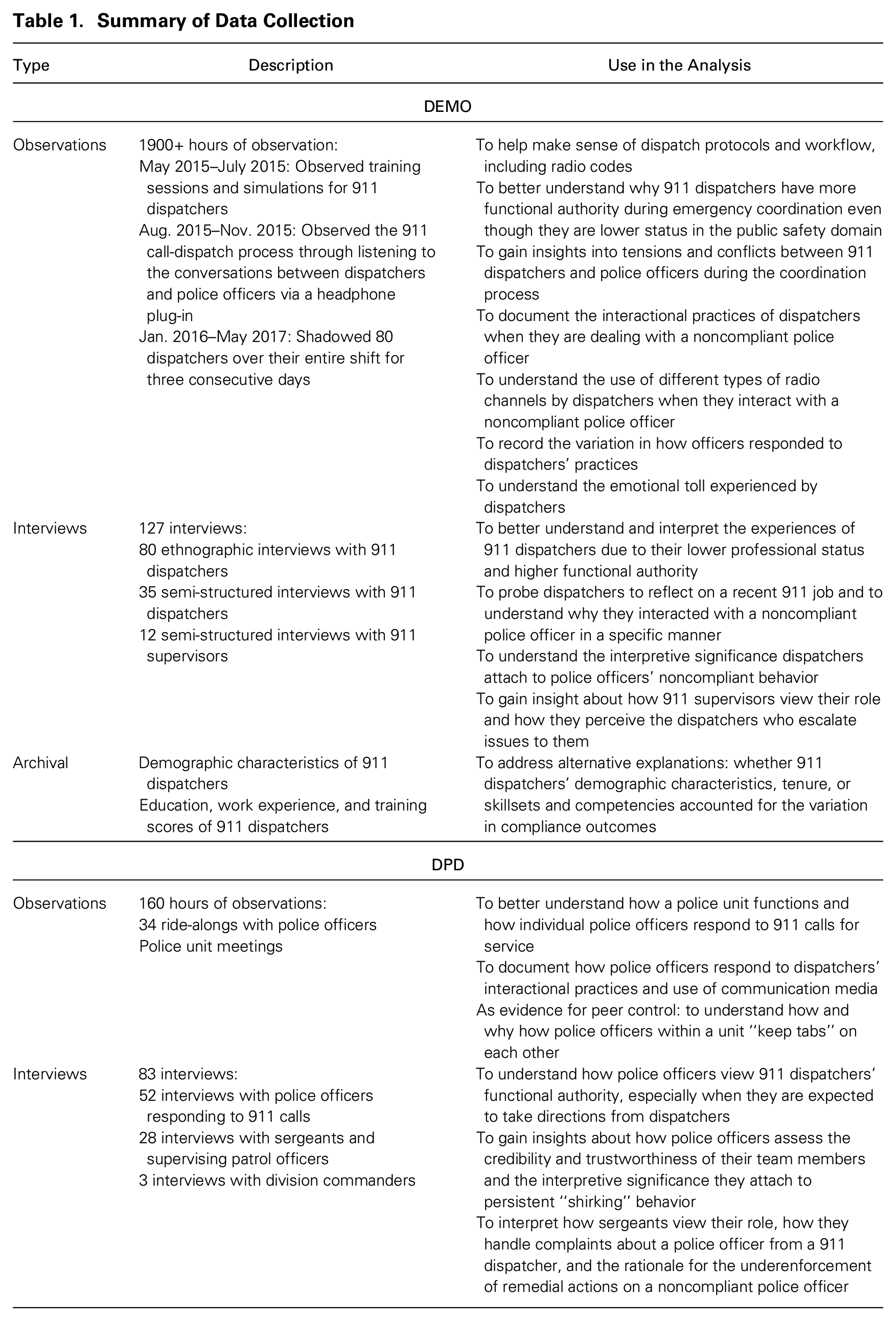
My primary sources of data include 24 months of longitudinal and embedded observations of the 911 dispatch process and interviews with 911 dispatchers at DEMO. To understand how responding to 911 calls for service feels from the “other side”—from the lived experiences of the police officers—I also did ride-alongs and conducted interviews with officers. As summarized in Table 1, I use three types of data: observational, interview, and archival.
Summary of Data Collection
Observations
When I began my research, I enrolled in an online training program on 911 emergency communication to learn about 911 dispatch protocols. I also participated in the internal training and dispatch simulation exercise that DEMO provides to its new 911 dispatchers. Part of the training was to become more familiar with police radio channels and radio codes. During observations, I kept a copy of the radio codes in front of me to make sure I could understand and follow the terms used by dispatchers. After the training period, I started my initial phase of observing the 911 dispatch process. At this stage, my research focus was on how professionals in fast-response organizations such as EMOs coordinate remotely under time constraints (Hinds and Bailey, 2003). I sat next to a 911 dispatcher and listened to the conversations and interactions between the dispatcher and police officers (via a headphone plug-in). As the observations progressed, I noticed the high frequency of noncompliance exhibited by police officers and what the individual 911 dispatcher did to address such noncompliance. From these observations, patterns of deference and status dynamics in this setting became evident: although the organization assigns these civilian dispatchers higher functional authority pertaining to 911 emergency coordination, they are lower status in the professional order than the sworn police officers. In addition to the professional status characteristics, nominal characteristics such as gender and race reinforced the dispatchers’ lower status.
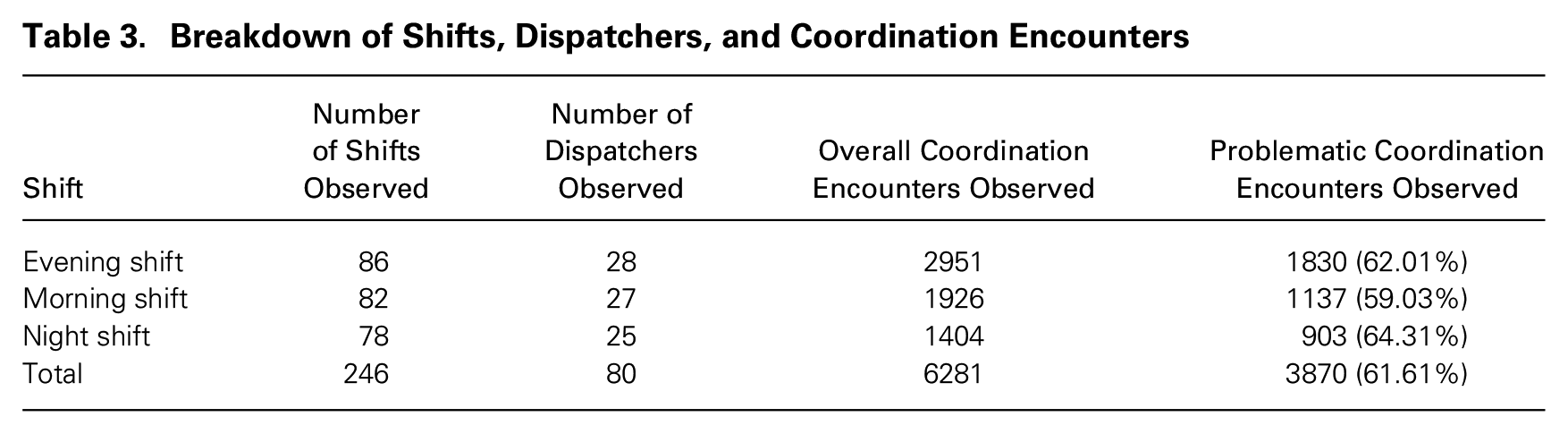
Therefore, I began the main phase of observations examining (a) the nature of the challenges that these 911 dispatchers with lower professional status but higher functional authority confronted during their everyday work and (b) the practices that dispatchers used to manage the challenges and elicit compliance from the higher-status police officers. I attended the shift roll call and shadowed a dispatcher for the entire duration of a shift. At this stage, it became clear that the non-overlapping nature of the shift schedule between DEMO and DPD created limited opportunities for long-term repeated interactions between a dispatcher–officer dyad. Both the shift timing (i.e., the structure of morning, evening, and night shift times) and the shift rotation policy (changes to what days of the week a dispatcher or an officer works) varied between DEMO and DPD. Consequently, the maximum number of times a specific dispatcher–police officer pair could engage in repeated interactions was for three shifts on three consecutive days, and the likelihood that the same pair would be interacting at this level occurred only after six weeks, thus generating “as if” random assignment of dispatchers and police officers into dyadic pairs. 3 To observe the interactions between a dispatcher–police officer dyad on the consecutive shifts they worked together (e.g., Shift A on Day 1, Shift A on Day 2, Shift A on Day 3), I focused my subsequent data collection efforts to observe a specific 911 dispatcher over the entire duration of a shift on three consecutive days. The primary data for this study come from this focused period of observation over 246 shifts, including 86 evening shifts (2 p.m.–10 p.m.), 82 morning shifts (6 a.m.–2 p.m.), and 78 night shifts (10 p.m.–6 a.m.). 4 During this period, I was able to shadow 80 dispatchers for the entire duration of their shift for three consecutive days at least once. This included 28 dispatchers from evening shift, 27 dispatchers from morning shift, and 25 dispatchers from night shift. Refer to Online Appendix A (http://journals.sagepub.com/doi/suppl/10.1177/00018392211059505) for background on the 80 dispatchers I shadowed, including information about their demographic characteristics, educational background, and tenure.
As and when the 911 emergency coordination was happening between the dispatcher and police officer, I used short-hand notations to record in a notebook the interactional practice and type of radio channel used by a dispatcher and the subsequent reactions from a noncompliant police officer (e.g., responsive, non-responsive, gave progress update, did not give progress update). Within a 24- to 48-hour period, I transcribed the handwritten field notes and assigned codes to the dispatchers’ practices and police officers’ responses. This enabled me to record and subsequently analyze the variation in how officers responded to the dispatchers’ practices. I also observed the emotional toll these practices had on dispatchers by noting their visible expressions of frustration and their use of swear words immediately following their interactions with the police officers.
To understand the perspectives and experiences from the “other side” of 911 emergency coordination, I observed how police officers responded to 911 dispatchers. Through ride-alongs with police officers and observations of police unit meetings, I examined how and why police officers responded to the dispatchers’ practices in a certain manner. I did 34 ride-alongs with officers from multiple police districts totaling over 160 hours of observations. During these ride-alongs, observations, and informal conversations, I noticed how police officers within a unit kept tabs on each other and how they gauged the trustworthiness of another officer within their unit.
Interviews
In addition to observations, I conducted 80 ethnographic interviews (Barley and Kunda, 2001) with the 911 dispatchers during my shadowing sessions or during their break times. These interviews helped me to ask clarification questions on a recent 911 job and to understand the interpretive significance that the dispatchers attached to their practices. I also conducted 35 semi-structured interviews in a conference room with the 911 dispatchers at DEMO, as well as 12 semi-structured interviews with the 911 supervisors. Finally, I conducted 52 ethnographic interviews with the police officers responding to 911 calls and 28 semi-structured interviews with the sergeants and supervising patrol officers. Refer to Online Appendix B for the interview protocol. Most interviews were taped and transcribed. For informal interviews, I took detailed notes during the interview, followed by my reflections and summaries.
These multiple sources of data enabled triangulation and generated an understanding of the phenomenon from different vantage points.
Data Analysis
Data collection and analysis unfolded in an iterative manner over three phases. In the first phase, I synthesized my daily fieldnotes into weekly descriptive memos. These memos described the work practices of 911 dispatchers, how they handled their workload, and the challenges they faced during their remote coordination with police officers. In the process of writing these memos, I was struck by how even in a time-sensitive, potentially life-or-death setting such as 911 emergency coordination, the social dynamics of status and authority impacted compliance outcomes, which in turn affected the overarching organizational goal of effective emergency response. In parallel, I started doing initial coding of my field notes and interview transcripts. Responses were coded based on the phrases and terms offered by the dispatchers (e.g., “radio discipline,”“reach out and be nice to the officers,”“play by the book,”“escalate to Sarge,”“put on girlfriend’s voice,”“use mommy’s voice”) and police officers (e.g., “Debbie Downer,”“shirker,”“will he watch my back?”“team player”). At this point, I was still collecting data and observed that some 911 dispatchers were able to elicit compliance from the police officers more effectively than others. I focused my subsequent data collection and analysis on examining what the 911 dispatchers did during the emergency coordination process (e.g., how deferential they were, their practices, use of language) and police officers’ responses.
In the second phase of data analysis, I did focused coding of the field notes and interview transcripts. I also wrote analytical memos detailing the interactional practices that a dispatcher used, especially following a noncompliant act from a police officer. This process also helped me move from my broad unit of observation (“coordination encounter”) to a more specific unit of analysis (“officer’s response to a dispatcher’s relational style”). By a “coordination encounter” between a dispatcher and police officer, I refer to an entire episode of back-and-forth interactions between this dyad for a particular 911 job (see Table 2 for examples). Across the three shifts in my main data collection period, I observed a total of 6,281 coordination encounters between dispatchers and police officers, around 62 percent of which (3,870) were problematic. I used the following criteria to define a problematic coordination encounter: (a) when an officer did not acknowledge after a dispatcher assigned the officer a new 911 call for service (i.e., job) and referred to the officer ID# twice; (b) when an officer failed to respond to a “progress update check” by a dispatcher for an existing/in-progress 911 job; (c) when an officer failed to give a “finish update” to the dispatcher after completing an existing 911 job; or (d) when an officer responded to the dispatcher in a rude and/or bullying manner. Table 2 illustrates the difference between an unproblematic and problematic coordination encounter.
Examples of Unproblematic and Problematic Coordination Encounters
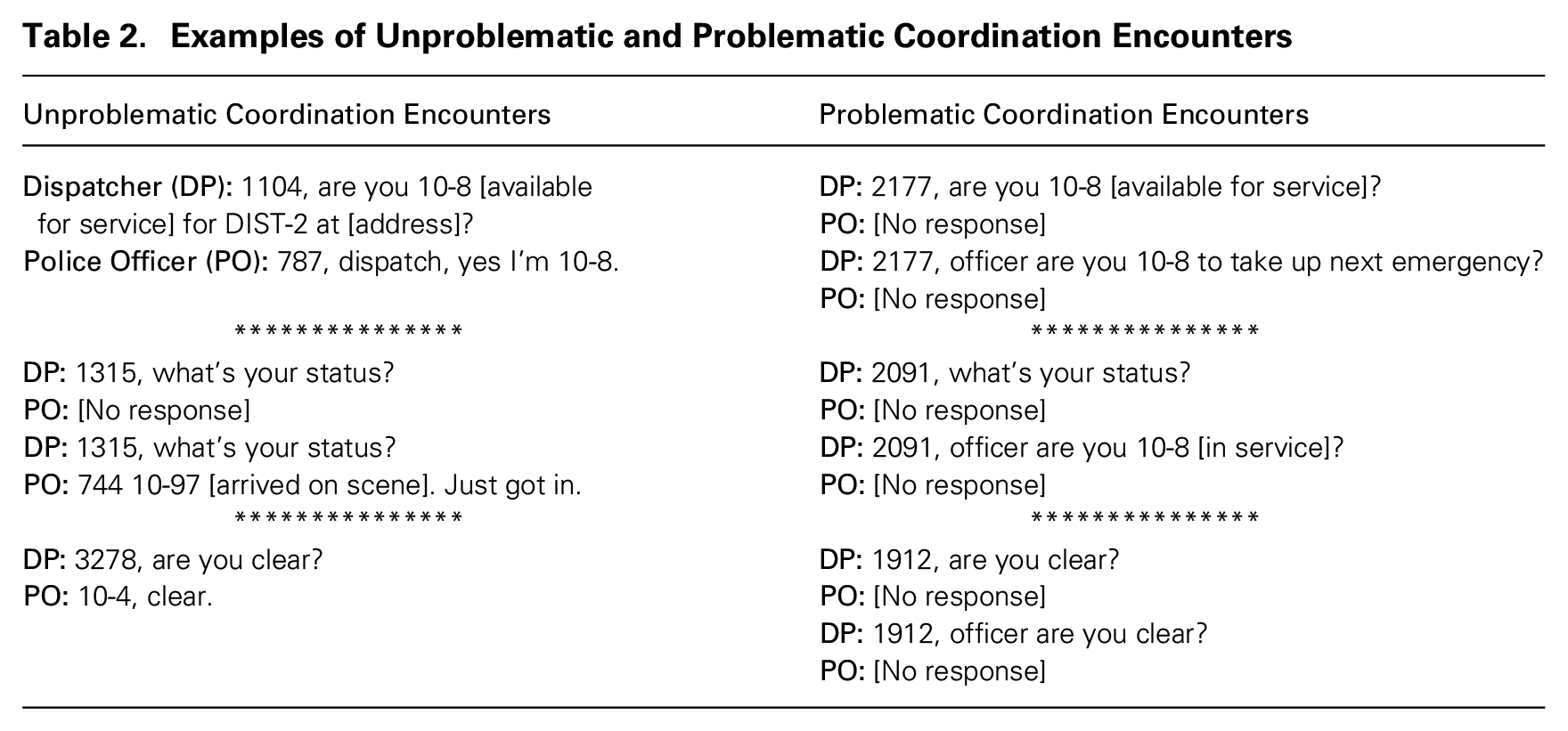
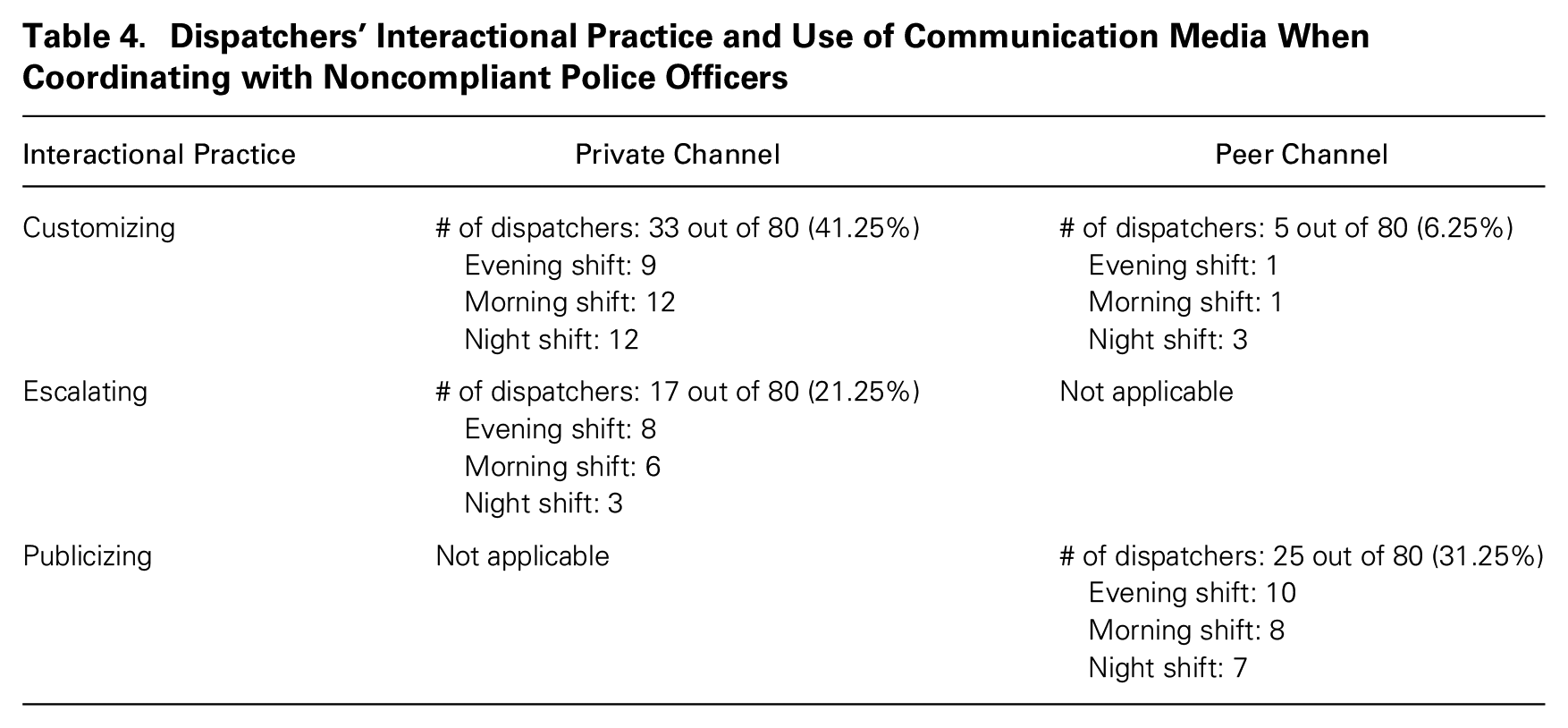
I analyzed coordination encounters that the 911 dispatchers used when dealing with noncompliant police officers and abstracted them into overarching interactional practices. For example, I abstracted codes such as “dispatcher was deferential” and “dispatcher modified her workflow” and conceptualized them analytically as the “customizing” practice. Iterative rounds of focused coding revealed that the interactional practices converged into three categories: customizing, escalating, and publicizing. Further coding and memo writing revealed the importance of not just the interactional practices that dispatchers enacted but also how and where these practices were enacted, i.e., the different types of communication channels that the dispatchers used during their remote coordination with police officers. I analyzed when and how individual dispatchers used the private radio channel versus the peer radio channel when interacting with a noncompliant police officer. On further analysis, I found that these two aspects of the dispatcher’s work—the interactional practices and the use of communication media—were entangled with each other to the extent that one would not be able to understand the interactional practice in isolation from the communication medium.
In the final stage, I engaged with relevant literature on the sociology of professions/occupations (Van Maanen and Barley, 1982; Abbott, 1988; Anteby, Chan, and DiBenigno, 2016), as well as the literature on eliciting compliance inside organizations (Kellogg, 2012; Gray and Silbey, 2014; Huising, 2015). I also read relevant literature, including on “cultural toolkits” (Swidler, 1986), to theorize my emergent findings. Since individual dispatchers typically did not mix-and-match their practices or draw from a portfolio of cultural toolkits or repertoires, I found those concepts less helpful in understanding my findings. Instead, I found the concept of relational style—”reoccurring patterns of interaction employed (by social actors) within and across exchange relationships” (Canales and Greenberg, 2016: 1202; see also Canales, 2014)—more helpful and in line with what I was observing at my field site. The 911 dispatchers tended to use a dominant relational style during interactions with police officers. My subsequent data analysis examined the relational style of the individual dispatcher, which took into account both the interactional practices and the communication channels a dispatcher used, as well as how noncompliant police officers responded to a dispatcher’s relational style. I wrote theoretical memos on how and when certain relational styles were more effective than others in eliciting compliance and what these findings meant theoretically. Online Appendix C provides additional evidence, in the form of interview quotes and exchanges from observations and ride-alongs, for these findings.
Findings
I first describe the difficulties that dispatchers encounter in exercising their functional authority and eliciting compliance from police officers during the process of 911 emergency coordination. I then elaborate on the relational styles, entailing interactional practices (customizing, escalating, publicizing) and the use of communication media (private or peer radio channel), that dispatchers use during their remote coordination with police officers and their respective compliance outcomes. Finally, I describe the emotional toll experienced by dispatchers enacting these relational styles, and with what consequences.
Difficulties in Exercising Functional Authority
While the everyday work of police officers involves several functions such as patrolling, issuing citations, making arrests, and paperwork, in functions that pertain to 911 emergency response, DEMO is the “command center,” and by extension, the 911 dispatchers are the “command.” Dispatchers are given the functional authority by the organization and the city bureaucracy to assign 911 calls to police officers and to oversee and direct police officers during 911 emergency response. Police officers are expected to follow dispatchers’ directions, respond to dispatchers when they call out an officer’s ID# over the police radio, and periodically update dispatchers about their progress. Following is part of the official protocol spelling this out: Dispatchers are provided with a means of determining which police units are available for assignment and authorized to assign police units. Dispatchers will monitor the status of [police] units on assignment. . . . A police officer who has received and understood a radio transmission from a dispatcher will acknowledge it immediately with his or her radio call identification number and appropriate [radio] code. Officers who receive their assignments by voice radio need to (1) maintain contact with the dispatcher; (2) report any changes in availability status to the dispatcher via voice radio only; changes in availability status are subject to the approval of the dispatcher and/or field supervisor; (3) clear the assignment via the voice radio.
A 911 supervisor described the rationale for dispatchers having functional authority over officers this way: We have more information about an [emergency] incident and have an overall picture of who is available and who is not. If an officer keeps questioning our decision or [does] not follow along, then we wouldn’t be able to dispatch any jobs. So the way we have designed the dispatch procedures . . . is to let the dispatcher make the decision and give out directions and the officer to just follow it. (Interview, 911 Shift Supervisor, #SS4)
One of the main responsibilities of a 911 dispatcher is to “clear the board”: to dispatch 911 jobs from their dashboard by assigning them to the appropriate police officer as soon as possible within a predefined time period based on the type and severity of the emergency. Thus eliciting compliance from police officers with regard to new 911 job assignments and progress updates is an important aspect of a dispatcher’s work. But police officers occupy a higher-status position within the public safety and law enforcement professions. Officers are “sworn” (and thus more prestigious), while 911 dispatchers have civilian status. I heard officers refer to 911 dispatchers as “desk jockeys,”“call center people,” and “just civilians in a fancy uniform.” In addition, in my context there were differences in nominal status characteristics such as gender between the police officers and dispatchers.
Although police officers are mandated to obey dispatchers’ functional authority and follow their directions during 911 emergency response, in practice, this does not often happen. For instance, when a dispatcher calls out an officer’s ID#, the officer is expected to acknowledge the dispatcher as soon as possible; if that does not happen and the same dispatcher calls out the officer’s ID# a second time, the officer must answer the dispatcher immediately. Officers are also expected to update the dispatcher on the progress of their current 911 job and to provide a “finish update” after completing a 911 job so that the dispatcher knows an officer is available for another assignment. In practice, dispatchers often call out an ID# more than twice, and officers still may not acknowledge or respond. Officers also frequently fail to give progress or finish updates to dispatchers. As this 911 dispatcher described: The most frustrating thing with this job is when they [officers] don’t answer [the radio]. It’s so frustrating, I can’t tell you how frustrating it is. I keep calling out their ID, but there is nothing on the other end. Not even a simple 99 or 10-4 [message received, understood]. I understand they may be busy or the signal is not clear, but can’t they just give me a 10-23 [stand-by] or even a 10-9 [repeat message]? I will be happy to do that, repeat the job to them. But they don’t do any of that. It’s like this: that I am not even acknowledged, not even recognized as a person. As if I don’t even exist anymore to them. . . . I am responsible for officer safety, so when I ask for an update, I am not trying to screw their happiness and kick them out of Dunkin Donuts [laughs]. I am just trying to do my job, make sure that they are okay and the jobs are dispatched on time. So next time [pointing at the headset and the monitor] when I call out, answer me. (Interview, 911 Dispatcher, #DP18)
Officers also interrupt and cut off dispatchers during the 911 job-assignment process, failing to follow “radio discipline.” Some police officers will interrupt a dispatcher with questions when that dispatcher is in the process of handling a 911 job with another officer. Officers expect their request to be prioritized and answered immediately by a dispatcher, even if it is not a high-priority incident. As a consequence, most dispatchers feel that police officers frequently behave like “assholes” and “dicks” who refuse to follow “any protocol or radio discipline.” Finally, officers often neglect to update dispatchers when they are taking a break, eating a meal, or returning to duty. This means dispatchers must keep checking with police officers about whether they are ready for the next job.
My interviews with police officers suggest that they are aware of the dispatch protocols and cognizant of dispatchers’ work, including the functional authority that dispatchers have during 911 emergency coordination. As a part of the police academy training, officers visit the DEMO operations floor for a day, observe the work of 911 dispatchers, and learn more about dispatch processes and protocols. Likewise, dispatchers are aware of, and have knowledge about, the work of police officers. As a part of their dispatch training, dispatchers do eight hours of ride-alongs with officers (see Online Appendix D for details). Even so, simmering tensions and manifest challenges emerge during the 911 emergency coordination process. My interviews with officers suggest that although they recognize the time-sensitive nature of dispatchers’ work, they also believe that such work is not in the “same league” as the work they do as law enforcers with the mandate to “perpetually engage in a struggle with those who would disobey, disrupt, do harm, agitate, or otherwise upset the just [social] order” (Van Maanen, 1978: 222). As this officer remarked: I get it, it is hard work and they need to do ten things at once and be focused. . . . I also get that dispatch is the “command” for 911 calls and there is a reason for that. But it is one thing to know that they are the command, but quite another to listen to dispatch every day, go where they ask us to go, give status update . . . “clear the job” update . . . this update that update. It gets to you, man. Sometimes it’s just annoying . . . what they do is not the same as what we do. No fucking way. Being out on the street, seeing an asshole trouble-maker eye to eye, that’s a whole different game, at a different level. (Interview, Police Officer, #PO22)
Thus my longitudinal observations, interviews, and ride-alongs revealed a clear pattern: officers often did not acknowledge or comply with directions given by 911 dispatchers. This hindered the dispatchers’ ability to exercise their functional authority in practice and elicit compliance from police officers in order to dispatch 911 emergency jobs in the thick of time.
I did, however, observe that some dispatchers managed these challenges and elicited compliance from police officers more effectively than others. The dispatchers’ tenure and experience at DEMO did not explain the difference in their effectiveness: some dispatchers with more than 12 years of experience faced difficulties in eliciting compliance from officers, while junior dispatchers with less than two years of experience and mid-career dispatchers with less than six years of experience elicited compliance. Likewise, an overlap in demographic characteristics, such as a female dispatcher interacting with a female police officer or a male dispatcher interacting with a male officer, did not explain the variation in outcomes.
I did find that gender made a qualitative difference in the tenor of interactions between dispatchers and police officers (DiBenigno and Kellogg, 2014; Doering and Thèbaud, 2017). Compared with male police officers, female police officers were less uncivil and rude to all dispatchers. In some instances, for example, female officers apologized to dispatchers for not acknowledging a new 911 job. But like male officers, female officers were often noncompliant with dispatchers’ requests, failed to respond to a new job assignment, failed to provide progress and finish updates, and expected deference from dispatchers. Such findings may reflect the relative status of the gendered professions as a whole instead of the gender of the individual professionals within them. The fact that the police officer profession is dominated by men while the dispatcher profession is dominated by women and considered to be a feminized profession (Acker, 2006; Ridgeway, 2009; Irvine and Vermilya, 2010; see also Johnson, 1993) may have played a salient role in shaping expectations of deference that the individual professionals have of each other, thereby impacting compliance outcomes. This might explain why female police officers, while less rude to dispatchers, nevertheless expected deference and were noncompliant with dispatchers’ requests. These findings are consistent with prior research, which suggests that overlap in demographic characteristics across a few dyadic pairs of higher- and lower-status professionals is not enough to elicit compliance; rather, demographic overlap needs to be a structural feature of the workgroup (DiBenigno and Kellogg, 2014). Refer to Online Appendix D for additional evidence on the role of demographic characteristics, such as an overlap in gender between the police officer and the dispatcher, in shaping compliance outcomes.
If dispatchers’ tenure or demographic characteristics did not explain differences in their ability to exercise their functional authority and elicit compliance from officers, what did? I found that their relational styles—constituted by interactional practices and use of communication channels— were key to compliance outcomes. Dispatchers enact various interactional practices when dealing with noncompliant officers, which I call customizing, escalating, and publicizing. Also, they interact with officers using different communication channels: either a private radio channel for transmitting a message to or interacting with a specific officer; a peer radio channel that all officers in a particular unit can listen to; or a department-wide radio channel that every officer, sergeant, and district commander can tune into. 5 I found that certain combinations of interactional practices and communication media used by the dispatchers helped explain the variance in compliance outcomes.
Below, I first describe the combinations that led to less effective compliance outcomes and then elaborate on a combination that led to more effective compliance outcomes. 6 Table 3 provides a breakdown of the number of shifts, dispatchers, coordination encounters, and problematic coordination encounters I observed. Table 4 provides an overview of how many dispatchers I observed using the various interactional practices and the private versus peer channels of communication. Online Appendix C provides additional evidence for each relational style.
Breakdown of Shifts, Dispatchers, and Coordination Encounters
Dispatchers’ Interactional Practice and Use of Communication Media When Coordinating with Noncompliant Police Officers
Customizing through the Private Communication Channel
When a police officer does not acknowledge and respond promptly to a new 911 job assignment or does not give progress or finish updates, a dispatcher who follows a customizing relational style tends to modify the dispatch workflow and reach out to that officer through the private radio channel. Once the officer responds, the dispatcher may also manually enter the updated information into the system, even though officers are supposed to enter it through their mobile data terminal (MDT). The exchange below illustrates this process: 7
5432, are you at 200 block of 19th Street? 8
[No response]
5432, I see that you’re at 200 block of 19th?
[No response]
5432, officer do ya copy that?
99 [affirmative].
Should I clear?
[No response]
[Switches to the private channel] 5432, officer do ya copy that? Are you at 200 block of 19th?
844, copy that. 9
[Waits for a response] 5432, what’s your status? Are you still 10-8 [in service]? Or should I clear?
Light my lamp [phrase for clearing an officer from a previous job so the officer can be assigned to the next job].
10-9 [repeat message]?
[No response]
5432, 10-9 [repeat message]. [Waits for a few more seconds] Can you repeat that?
844, sure go ahead.
[Pauses and lets out a sigh] 10-4, copy that. [Assigns a new job] 1263 North Main, block party and four people in fist fight.
[Interrupts] Check message [message sent through MDT to update a report from a previous job].
Checking.
844, 10-73 [how do you receive?], you got that?
[Stops dispatching the other job, reads the message from the job, and asks the secondary dispatcher for the RD number] 5432, updated it. RD is DPD102857344.
Standby. 10-22 [disregard last communication]. Check new message.
10-4 [message received, understood]. Thanks! Are you still 10-8 [in service]?
[No response]
This officer did not acknowledge or respond to the dispatcher’s initial requests, so the dispatcher modified the workflow and reached out through the private radio channel. When this officer interrupted the dispatch process with questions, this dispatcher accommodated the interruptions, responded to the officer, and then continued with the dispatch process instead of asking the officer to “clear the air” and “hold off” on questions. This officer also preferred to provide an update through the internal messenger on the MDT, even though the official protocol is to give all 911 job updates via radio channel. This dispatcher accommodated the officer’s noncompliant behavior; once the update was sent through the messenger, the dispatcher manually entered the information into the CAD so that the update was reflected in the system.
Some police officers also prefer to hive off menial work to dispatchers, such as filing a report after a database is accessed, although such reports are the officers’ responsibility. Dispatchers who follow a customizing relational style accept this work with the expectation that “the officers will not give me a hard time when I take care of such things. I do understand that officers are on the street all day, dealing with crazy people and all of that gets to them, so I feel those little gestures matter, and it is important to be flexible” (911 Dispatcher, #DP17). Finally, these dispatchers also customize their lingo when communicating with officers on the private radio channel. One dispatcher referred to these interactions as using a “girlfriend’s voice” in order to “be nice and sound nice.”
I found that the dispatchers who followed a customizing relational style experienced more difficulties in eliciting compliance from officers. My ride-alongs with police officers and informal interviews suggested that once a dispatcher adjusts the workflow and contacts an officer through the private channel, the officer expects that dispatcher to continue making such accommodations for the duration of the shift. For instance, these officers said that it was totally acceptable for them to update these dispatchers via an MDT message or to ask them to fill out a form or run a license plate on their behalf. Some officers even suggested that dispatchers are obliged to make such adjustments for them. As this officer described: They [dispatchers] are sitting out there in a nice air-conditioned room. I’m here, slogging my ass off moving from one job to another. So why not let them do such stuff [fill the report or run a license plate]? . . . Also, I cannot always respond right away because I may be talking to someone or checking off some things, or maybe I’m in a sketchy neighborhood. . . . So they can just hold off or check back with me later, in a few minutes, and I am not going anywhere. Is that so hard to do? (Interview, Police Officer, #PO15)
The following exchange illustrates officers’ expectations of customizing dispatchers:
5432, what’s your status?
[No response]
5432, officer are you 10-8 [in service]?
[No response]
[Switches to the private channel] Officer, are you in service at 1031 North Main?
[After some time] Can you repeat that? 10-9 [repeat].
What’s your status, officer?
Affirmative.
Affirmative what? You at 1031 North Main? Can you confirm location, officer?
No, I am 10-17 [request for gasoline] and then returning to station. Can you also put a lunch ticket in my slot for 14:30? And then a 10-19 [returning to station]?
So you clear at 1031 North Main? Can you confirm 10-20? [Waits a few seconds for response]
99 [affirmative].
And how long will you be at the station? Can you inform the Sarge?
Negative. You update it to 10-19. . . . Also, ask Sarge to approve my report in DIRA.
[Takes her foot away from the dispatch pedal so the officer cannot hear, and calls the officer a dick. Then presses the pedal]: 10-4.
Check message. I’m now 10-17. Signing off now. Don’t forget DIRA.
10-4.
[No response]
You’re welcome.
As this exchange shows, officers repeatedly did not comply with customizing dispatchers’ requests. Table 5 reveals that of the 1,160 times when dispatchers used the customizing relational style, 795 instances (68.53%) did not result in officers’ compliance, while only 365 instances (31.46%) did. The dispatchers who enacted the customizing relational style thus found it difficult to exercise their functional authority and elicit compliance from the police officers.
Lower-Status 911 Dispatchers with Functional Authority Eliciting Compliance from Higher-Status Police Officers
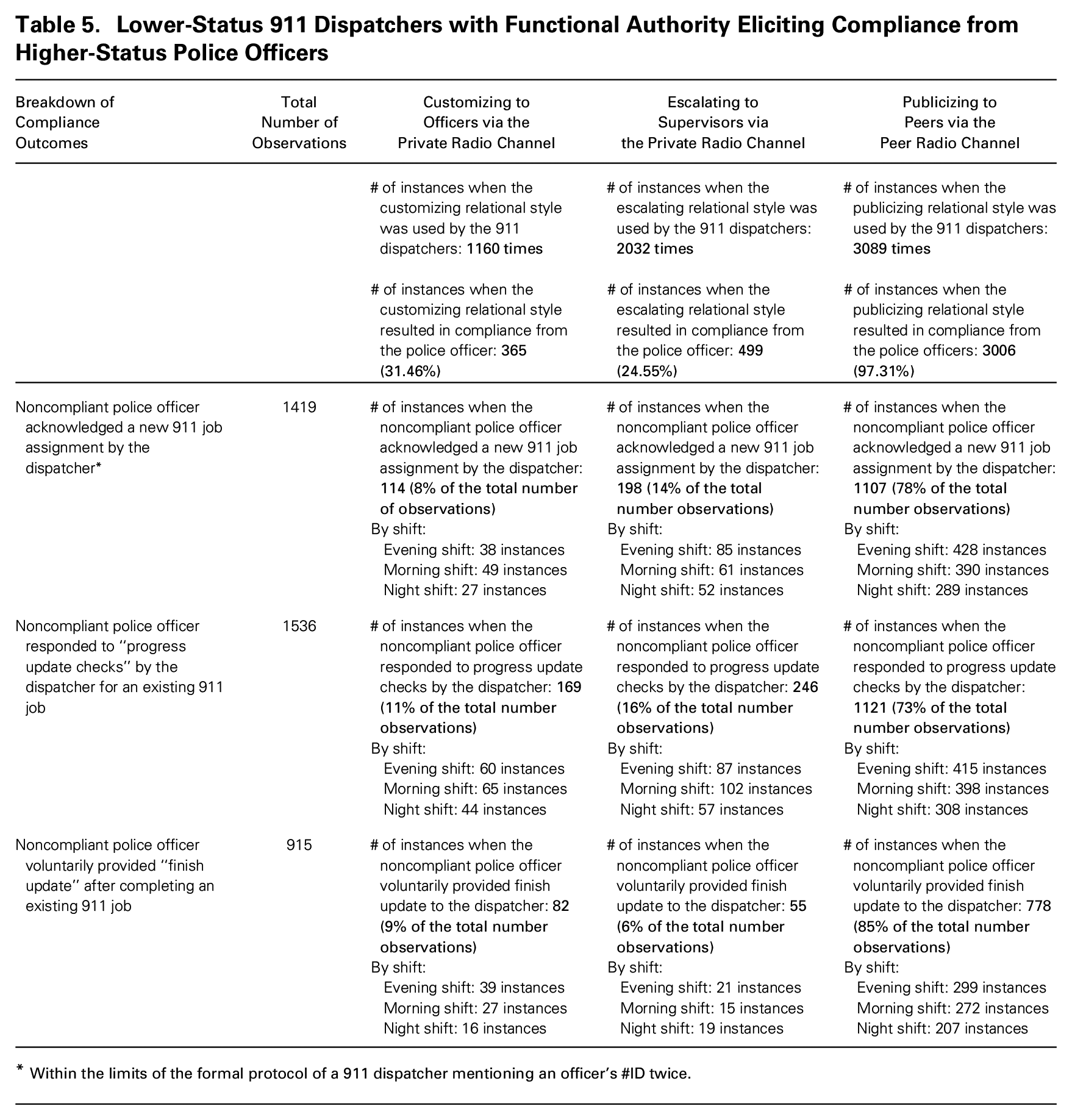
Within the limits of the formal protocol of a 911 dispatcher mentioning an officer’s #ID twice.
Escalating through the Private Communication Channel
Other dispatchers choose to play by the book and escalate officers’ noncompliant behavior to a supervising patrol officer or sergeant via the private radio channel. As this dispatcher described: I don’t have any other choice at that point than to inform the Sarge [sergeant] of that officer’s attitude. Because that is the protocol. I cannot shout at them [officers]. . . . So I tell the Sarge to take care of it. And even there, I don’t call out publicly but first ping the Sarge and then put in a word. I feel that is the right thing to do, and let him [sergeant] do what it takes to discipline the officer. (Interview, 911 Dispatcher, #DP4)
These dispatchers may escalate the incident in different ways. Some dispatchers privately reach out to the sergeant through the MDT to inquire about a police officer and then use that opportunity to raise the issue of noncompliance. Others contact the sergeant directly through the private radio channel to report on an officer’s noncompliance. This exchange illustrates these dynamics, as a dispatcher escalated the noncompliant behavior of officer #2090 to the sergeant:
2090, what’s your status?
[No response]
2090, are you clear now? 10-98?
[No response]
[After a few seconds] 2090, officer are you receiving?
[No response]
[Switches to the private channel] Sarge, this is dispatch 647.
647, go ahead.
Didn’t hear back from 2090, last known location at 200th of Lake and Ninth. Is he 10-7 [out of service]?
Stand by, lemme check.
Copy that.
[After a couple of minutes]: 647, are you receiving?
10-4 Sarge,
2090 is not 10-7. He is clear and available for service. Just spoke to him.
Copy that, thanks Sarge.
A sergeant responds to escalation by either informing the dispatcher that he will talk to the officer about the complaint or by calling out the officer’s ID and asking him to join their private radio channel. Once the noncompliant officer joins, the sergeant describes the nature of the escalation and asks the officer for an explanation. If satisfied with the explanation, the sergeant lets the matter drop, which is often the case. If he is not satisfied, the sergeant will issue an informal warning and ask the officer not to repeat such behavior. Only rarely, a sergeant writes up a police officer and issues an official warning that goes into the officer’s record. Sergeants are reluctant to issue such warnings and enforce remedial actions on noncompliant officers for a number of reasons, as this sergeant explained: [I do not want to evoke suspicion] that I am trying to play favorites . . . because I have a grudge against one of them. I mean, I don’t. But that’s how it would look, and like it or not, the word would spread and I want to avoid that. . . . And also this is more like “he said, she said” right? Each of them will have a story, and I’m not saying that one is right and the other is wrong. Or maybe, one of them is right, I don’t know. [pauses] So you just got to cool it off, deescalate it as much as possible, and then things will become alright over time. The more you engage, the more dirty it becomes. (Interview, Sergeant, #PS8)
Since sergeants depend on officers to do their bidding—to manage the workload of the district and handle contingencies—they prefer not to enforce remedial action based on escalations received from dispatchers. Even if remedial actions are proposed to an officer, they are typically underenforced. As another sergeant described: I am caught between them [officers and the dispatcher], and I got to handle it carefully. I can’t just shrug off the dispatcher. I need to listen to them, of course. But I cannot just suspend the officer for that. I might ask them something like “what’s up with the attitude?” or ask them to keep their temper under control. But anything beyond that, it will be difficult. . . . I need these guys [officers], if I piss them off then my job becomes all the more difficult. And I don’t want to end up in that situation. It is not good for the unit, not good for the department, and not good for dispatch either. (Interview, Sergeant, #PS6)
Officers who become aware of an escalation from a particular dispatcher often feel “betrayed” by that dispatcher, believing that the issues should have been “discussed and sorted out between us, like adults, [rather] than taking it up to the teacher. That’s what school kids do” (Interview, Police Officer, #PO11). Some officers interpret the escalation as a result of a dispatcher’s personal grudge toward them: “She got to remember that it’s just the heat of the moment and not personal. Nothing personal, I promise you. But the moment you take it personal, that’s a whole different ballgame. You are not acting like a professional anymore” (Interview, Police Officer, #PO9). This officer continued: You can tell from their voice that if someone is happy or not. . . . Most of them are professionals, I got to give it to them, they do their job well. But then there are a few who are always annoyed or have no energy to do this job at a level that is expected. So they constantly gripe and complain. They are the Debbie Downers. They just can’t be professional enough and discuss if something is wrong. Instead they want to create an issue out of everything. I get it, this is a tough job, but it is not personal. . . . You can’t keep holding a grudge. That’s not cool. . . . So when I interact with the Debbies, I just go matter-of-fact. Just boom boom boom. That’s it. Nothing more, nothing less. And if they screw up, of course I am going to call them out. It’s fair game. (Interview, Police Officer, #PO9)
Dispatchers who escalate issues to a sergeant may be labeled by officers as “incompetent,”“clueless,”“unprofessional,”“not a team player,” and at the extreme, “bitches.” Officers told me they could not trust dispatchers who had gone behind their backs to complain about them to the sergeants. Consequently, the relationship between the police officer and the dispatcher—as observed through their remote interactions during a shift—becomes more strained. Immediately after an escalation, the officer’s tone may be more rigid. While the officer ceremonially complies with the dispatcher’s messages for a short time, subsequently he fails to acknowledge new job assignments and directions given by the dispatcher throughout the rest of the shift. Officers also take much longer to respond to escalating dispatchers. The following exchange illustrates the dynamics after the dispatcher escalated officer #2090’s noncompliant behavior to the sergeant:
2090, are you receiving?
[No response]
[Sighs] 2090, are you receiving?
[In a stern voice] 10-4, receiving.
288 [lewd conduct] at District Park North, close to Main Street for 314 [possible nudity, lewd conduct]. White male, 30s, blue hoodie, grey pants . . .
647, which side of Main Street? Location info insufficient.
Stand by, checking.
10-4.
Northside corner. Closer to Main Street than Maple Street.
[No response]
Officer, do you receive?
10-4, but insufficient. Dispatch, get the right coordinates.
Calm down, I’m on it. Stand by.
2090 to dispatch, location incorrect, update to CAD.
In this case, the officer was looking for any mistakes that the dispatcher made, even slightly deviating from the dispatch protocol. In such instances, officers will point out deviations and respond rudely. Over the duration of a shift, officers will increase their noncompliance by repeatedly interrupting the dispatcher with clarification questions or by not updating the dispatcher. This vignette illustrates another officer’s response following an escalation by the dispatcher:
5460 officer, are you clear to take a 5-Zebra [code for a person with mental issues] at 1560 Eliot?
Negative.
Are you still 10-8 [in service]?
10-4 [message received, understood], with 5465. I sent an update 10 minutes ago, at 19:08.
Stand by. Any info on robbery at 454 Franklin?
5465 entered it. Check the updates.
Is there a weapon involved?
[In a mocking tone] They took a shot, we updated to 10-72 [gun involved], so yeah, weapon is involved I guess. Check CAD. Sarge, do you copy that?
Calm down . . . calm yourself down.
Party’s out in 5, and you have been advised. Update when you feel like, 10-7 [out of service]. Sarge, 5460, copy that? Dispatch will update and give it out whenever. . . .
Calm down.
Dispatch, you pull yourself together. Party’s out, and you have been advised.
Sure I would, 10-4.
Another option dispatchers have is to escalate an issue to their 911 shift supervisors and request that they handle it. This option is less frequently used, and even when it is, shift supervisors tend not to take any action as they are unwilling to become embroiled in a conflict with the police sergeants. As one shift supervisor described: I am supportive [of the dispatchers] most of the times. You have seen this, dispatching is a stressful job, and I always stand behind them when they are facing a situation. But once I have shown them the ropes, they are on their own. Remembering all the [radio] codes is important, but that is just a small part of the job. Working the radio and the human side of it is a lot more important. They need to learn how to handle the cops and keep clearing their board. That’s what they are paid for. Work the radio, work the cops. Work the radio, work the cops. . . . I know that the officers can be difficult at times, but they [dispatchers] need to learn how to deal with them. I cannot always jump in and get into an argument with the officer or the Sarge. It doesn’t look good. In fact, it might blow up the whole situation. (Interview, 911 Shift Supervisor, #SS1)
Shift supervisors also tend to believe that dispatchers are responsible for dealing with officers’ noncompliant behavior, as dispatchers’ ability to “work the radio” and handle noncompliance is a sign of job competence.
Dispatchers who followed the escalating relational style had difficulty eliciting compliance from officers for the rest of the shift. As shown in Table 5, of the 2,032 times when dispatchers used the escalating relational style, 1,533 instances (75.44%) did not result in compliance from the officer, while only 499 instances (24.55%) did.
Publicizing through the Peer Communication Channel
A dispatcher who enacts a publicizing relational style uses the peer radio channel—the radio channel that an officer’s immediate peer group (the unit) is tuned into—to reveal that officer’s noncompliant behavior to his peers. Such dispatchers typically do not customize the dispatch workflow to meet the needs of individual officers. For instance, when an officer fails to provide an update about a job or sends a late progress update via the MDT messenger asking the dispatcher to update the information in the system manually, the dispatcher using this relational style will often ignore such messages and not respond to the officer. When the officer repeats such behavior and is persistently noncompliant, the dispatcher publicizes the officer’s behavior to the police unit via the peer radio channel. This exchange illustrates this dynamic: 10
5525, what’s your status?
[No response]
5525, what’s your status? Back from code 7 [meal break]?
[No response]
[Checks the location of the police car of 5525] Barbeque any good at [restaurant name]? Heard their pulled pork is dope. And the potato chips . . .
[Laughter on the channel] You go, girl.
[Laughs] 832, dispatch. Back from 7, checked out at 15:35, now 10-8 [ in service] at 16:10.
[Laughs] Sure you did. Right at 15:35.
[More laughter] 15:30.
[More laughter] 15:00.
Alright, enough. 5525, y’all ready to talk to a downer [man or woman who is down]? A beer bottle Betty [phrase for a drunk woman by the sidewalk]?
10-4, sure I do. What’s the location?
124 South State? Might be a frequent flier too [phrase for a missing person]. Rack up the miles.
[Laughs] On my way.
By using the peer radio channel, the dissemination of information about the officer’s noncompliant behavior is bounded to the police unit—not shared with the full department. As evident in this exchange, dispatchers typically enact peer publicizing in a bantering tone rather than in an accusatory or angry tone. The dispatchers referred to this as using a “mommy’s voice.” Publicizing an officer’s noncompliant behavior in a bantering tone via the peer radio channel produced better compliance outcomes for a particular 911 job and, more importantly, shaped subsequent compliance outcomes with that officer for the rest of that dispatcher’s shift. Below is a subsequent exchange with the same police officer:
832 dispatch, clear from 124 South State and will take a quick 8 [restroom break] and then back.
10-4, anything on Betty?
832 dispatch, all clear. She was just passed out.
Got it.
832 dispatch, back now and 10-8, location at 300 block of Eliot and Main, at 16:50. What do you got for me?
5525, you’re invited to a party at 39 Eliot. Multiple complaints about loud noise. Will send backup right away, 5530 is 1500 away from 39 Eliot.
10-4 [message received, understood].
Go break it [the party]. And for y’all, there is pizza at the station, thanks to 5525. [After PO 5525 returns from that job]
832 dispatch, clear from 39 Eliot, now returning to station, 17:25. 10-7 [out of service].
10-4. Took the boom box [from 39 Eliot]?
[Laughs] I wish. Okay, signing out and will update Sarge with the DIRA report.
The officer complies with the direction the dispatcher issues, resists interrupting the dispatcher, and shapes his interaction so as to avoid further peer publicizing. In this way, the interaction order between the officer and dispatcher has been reshaped, enabling the dispatcher to subsequently elicit compliance from that police officer. Why does this practice work to secure officers’ compliance? My interviews with officers suggested they are aware of how to work around protocols to get some “cool-off” time. In other words, officers are aware that each one of them is trying to build some slack time into their work routines. But if any one of them slacks off too much and avoids responsibilities, the extra work will be distributed to the rest of the unit’s officers. As this officer explained: In this line of work, you got to build some time off or [else] you are burnt out before you know it. So we all do that. Take little breaks here and there. Once in a while, have a nice lunch and a good laugh. . . . But we don’t overdo that, we do it in moderation. And each one of us has our own way [to get around the dispatcher]. But the important thing here is when there is a need, we all step up our game and work hard and long hours. . . . We also know if someone is trying to take a break or is just not willing to take up any work. And when they [dispatchers] start outing an officer through the radio, we take a note of that, and that is a good thing, because we know that officer will start to behave. As a unit, that is good for us. (Interview, Police Officer, #PO5)
Further interviews with officers suggested that a dispatcher communicating this way through the peer radio channel gives other officers in the unit a way to police each other’s noncompliant behavior so that it does not become excessive. As an experienced police officer said, “Everybody is a slacker to some degree, whether they accept it or not. You need it. I would say it is even essential to survive in this intense, highly stressful job. But a slacker is different from a shirker. Slacker is okay, shirker is a problem, a disaster waiting to happen in your unit. You don’t want that” (Interview, Police Officer, #PO28). Officers view repeated noncompliance as a sign that someone is shirking responsibilities and unloading work on others and therefore is not a dependable, trustworthy partner in emergency situations. As this police officer noted: You don’t want shirkers in your unit. They will not hurt you today, but sometime in the future, they will. We don’t put on this blue uniform because we want to make money. We put on the uniform because it is a commitment. To the profession. To your district. To your unit. When I walk into a secluded neighborhood or knock on the door of a creepy guy’s [home], I want to be assured that there is someone else who got my back. A shirker, from my experience, I can tell you for sure, is not that person who will have your back. . . . If that officer keeps getting called out and doesn’t change, then you know that guy is a shirker, and I try to be careful with them. And I tell my folks to be careful. (Interview, Police Officer, #PO28)
Consequently, officers in a unit view dispatchers’ peer publicizing not as a personal grudge or score-keeping but rather as a form of playful ribbing or prodding that allows other officers to “keep a check on each other” to prevent a “slacker from becoming a shirker.” As this senior officer stated: Policing is teamwork. It’s not at all like what they show in Hollywood movies or even cop shows in television, which I love by the way. . . . It’s not about individual heroics although that does happen. It’s about the team. Your unit, if everyone is committed and do their part and there are no shirkers in your unit, you can manage anything, even during a busy evening with a big game going on. You can manage that. . . . So when someone gets outed by dispatch, we take note. And if that happens again, we try to elbow him and make fun. But not in a mean, nasty way. That will piss him off. We don’t want him to hang his head in shame or go silent rest of the shift. That beats the purpose. . . . We do this gently in a fun, enjoyable way to keep a check on each other, so that the officer does not overdo it and end up becoming a shirker, which is bad for all of us. (Interview, Police Officer, #PO19)
With peer publicizing, the noncompliant officer is aware that his trustworthiness is being implicitly assessed by other officers in the unit. That is, given the nature of the peer communication medium and the “common knowledge” (Chwe, 2001) it generates, members of the unit “know that others are watching [listening to] the same thing” (Adut, 2018: xi). More importantly, the noncompliant officer is also cognizant that other officers are aware that he is aware of his trustworthiness being assessed. In other words, publicizing through the peer radio channel engenders “third-order inference” (Correll et al., 2017) about noncompliance. As this police officer described: You want to be trusted by your unit, that’s most important. Especially if you are a new member, you want to win their trust. That you are a dependable guy who’ll watch your partner’s back and not some selfish jerk who’ll run away at the first sign of trouble. But once you got the trust, you got to keep it and not lose it just like that. That’s even more important and difficult. I joined this unit almost two years back, I got to bust my balls to be trusted. I think I earned that. . . . But the work gets to you . . . so I slacked off a bit here and there. And then dispatch noticed it and outed me, other officers [in the unit] also noticed it and had some fun with it. . . . It was all in good spirit, so I was not bummed or anything, but I realized I got to get my act together again so that I don’t end up losing it. . . . I do the same now when someone else gets outed. Yesterday [officer name], he got outed for “not clearing,” and we all had fun with it. (Interview, Police Officer, #PO15)
My observations during ride-alongs suggest that such peer publicizing incidents trigger peer control, as the officers in a unit try to monitor each other’s behavior. Consider the following exchange that I observed:
[Parking his car in the shade and humming a song. It’s been around 10 minutes since the officer completed his previous 911 job.]
6144, what’s your status?
[Reduces the volume]
6144, your status?
[Ignores the dispatcher]
[After a minute] 6144, officer are you clear?
[Does not answer the dispatcher]
[After another minute or so] There’s a casino nearby right by the corner of [location where he is parked]. Someone won three million dollars last week, [it was] all over the papers. [Unclear audio] Should give it a try officer, if you have some free time.
[Gives a puzzled reaction, sits up straight and attempts to answer the dispatcher]
[Laughter] 6144 is a blackjack pro, I heard.
[More laughter] Has a poker face too.
Wasn’t he a dealer too way back? [Unclear audio]
Now he is into busting dealers. [Laughter]
[Laughs] Okay then, thanks dispatch. I’m clear from [job #].
You’re welcome![More laughter on the channel]
What do you have for me?
Accident at [location details], two lightly injured and EMTs are at the scene. But one of the parties, white male grey Sedan, getting into an argument and situation might break into a fight, so requesting officer presence.
On it.
The bantering tone used by these dispatchers also highlights how these lower-status professionals are attempting to wrap their authority in humor instead of directly enforcing their authority by correcting officers or pointing out their mistakes. The tone helps minimize the stigma that is otherwise associated with exposure. What is implied through the bantering tone is not just the individual noncompliant act of that particular police officer but the common ploys that might be shared by the officers in the unit. As the officer noted above, the unit does not want a noncompliant individual to “hang his head in shame or go silent the rest of the shift. That beats the purpose.” These dispatchers’ actions do not result in public shaming: not only is the exposure limited to the immediate peer group, but also the bantering tone reduces the stigma when someone’s noncompliant behavior is exposed. As another police officer noted: Some days can be very tiring, so stuff like that [the dispatcher’s banter] keeps it alive. We just pull each other’s legs and laugh about it. Good fun in spotting the slacker in us. [laughs] I mean, we all do that at some point or another, so we are all slackers that way. But we pitch in when someone else is not feeling well or if there is a citywide event going on and you get a ton of calls, so on those days, we are hyperactive. On other off-days, it is okay to take it a little light. We all get it, but we pretend that we are trying to call each other’s bluff and not overdo it. (Interview, Police Officer, #PO3)
However, the bantering tone alone is not sufficient for the dispatcher to elicit compliance. When a dispatcher used the bantering tone through the private radio channel when interacting with a noncompliant officer, in most instances it did not result in compliance; instead, the officer continued not to acknowledge the dispatcher and not to comply with directions, as the exchange below, in which the dispatcher used a bantering tone via the private radio channel, illustrates:
2690, are you clear for a new job?
[No response]
2690, 10-73 [how do you receive]?
[No response]
[Switches to private channel] Officer, wanted to check if you are back from 10-17 [gasoline stop]?
[No response]
[Checks the GPS location of 2690, then continues to use the private channel] Officer, you at the [convenience store name] at the [gas station name] by 1030 North Brooke Street? [Pause]
[No response]
Are you getting the Red Bull Tangerine or the Red Bull Cranberry at [convenience store name]? Or Red Bull sugar-free?
[No response]
I’m sure it’s not sugar-free.
[Static from the radio, officer is preparing to speak]
Glazed donuts don’t go well with Red Bull sugar-free. . . .
Dispatch, just stop. 10-3 [stop transmitting].
2690, are you clear for a new job?
Check CAD.
2690, officer are you 10-8 and available for a new job?
[No response]
As this exchange illustrates, the communication medium matters. Here, the dispatcher cannot engage the same dynamics that exist on a peer channel. When a dispatcher combines a bantering tone with the use of a peer channel, an officer’s peers can jump in to make fun of the [noncompliant] officer and of each other. As we saw in the previous example (“barbeque any good”) where a dispatcher used the peer radio channel to publicize the noncompliant behavior of a police officer, other police officers build on each other’s jokes, and humor becomes a collective and emergent outcome that is structured by the peer communication medium. As compared to the above exchange between a dispatcher and a police officer via the private channel (“Red Bull”), the previous exchange illustrates the importance of the type of communication channel in enrolling peers and toward structuring the interaction order to elicit compliance.
The result is often that the dispatcher using the peer communication channel can elicit compliance. As shown in Table 5, of the 3,089 times when dispatchers used the publicizing relational style, 3,006 (97.31%) resulted in successful compliance outcomes. 11
Emotional Consequences for the Dispatchers
My findings also suggest that individual 911 dispatchers experience a substantial emotional toll from their attempts to elicit compliance from police officers, which results in individual-level consequences such as reduced morale, job burnout, and absenteeism. This toll exists regardless of the type of relational style used, though its severity varies depending on the relational style. I observed this variation in terms of the following indicators: (a) outward expressions of frustration in the form of “sighs,”“gasps,” and swear words uttered “backstage” (Goffman, 1956)—not expressed through the radio—right after a coordination encounter with a noncompliant police officer; and (b) the extent of absenteeism in terms of the number of sick leaves taken by dispatchers and the number of times they invoked the Family and Medical Leave Act (FMLA) for unplanned leave.
The dispatchers who enacted a customizing relational style suffered the most emotional toll, as even to get officers to do basic tasks (such as acknowledging a job or giving progress updates), they needed to “put on a mask” or “sweet talk” the officers. Because officers often take the “authority” of these dispatchers for granted and tend not to respond to them and/or follow their directions, these dispatchers experience greater emotional strain and burnout. Officers’ noncompliance makes it harder for these dispatchers to show sergeants and shift supervisors that they are competent and independent problem solvers, which negatively affects their morale. The outward expressions of frustration (sighs, gasps, and swear words) I heard were highest among these dispatchers. Moreover, on average they had the most absenteeism, using sick days and invoking the FMLA 31 percent more than dispatchers who enacted an escalating relational style and 14 percent more than those who used a publicizing relational style. As this dispatcher explained: When I was promoted to a dispatcher, a lot of my seniors warned me on how hard it is to work the radio and talk to the officers. I thought they were exaggerating, but I had no idea that it will be this bad. I go over-and-above my way to make sure the officers can focus and do their job. As I told you, I fill out the forms. Run the [license] plates. Check some addresses. I have even dialed the caller and asked them to be at their door for the officer. I do whatever it takes that will make their [officers’] job easier. But even then, they continue to be dicks to me. . . . They dump all their shit on me. Every day is a struggle, and I am not feeling motivated at all to get up from my bed and be back at my desk. (Interview, 911 Dispatcher, #DP2)
The dispatchers who enacted an escalating relational style experienced the least emotional toll. Escalating helped them avoid the dialogical drama of having to “reach out and please” the officer in order to get work done. As one dispatcher noted, such performances are “far more exhausting” than facing the negative consequences from the officer after an escalation incident. Escalation offered these dispatchers a break from the ongoing moment-to-moment performances that they felt were “fake” and beyond their professional mandate. Although these dispatchers also experienced morale and burnout issues, I observed fewer expressions of frustration from them than from other dispatchers. On average, they also took fewer sick days and FMLA leaves—about 24 percent fewer than the dispatchers who enacted a customizing relational style and about 13 percent fewer than those who enacted a publicizing relational style. As this dispatcher who enacted an escalating relational style described: Look, at one point I decided I am not going to take any of this . . . I will make their life difficult if y’all [they] try to make mine difficult. I tried to be nice to them, did the song and dance and made them do stuff that they are anyway supposed to do. Enough with that, because that didn’t get me anywhere, and I was so tired after my shift that I wanted to go home and crash. So one day, I decided to take them on and just inform the Sarge, and let them deal with it. It [the issue] doesn’t disappear, and they still act like assholes, but at least now I’m not tired and pissed off anymore. (Interview, 911 Dispatcher, #DP4)
The dispatchers who enacted a publicizing relational style experienced less emotional toll than the dispatchers who enacted a customizing relational style but more than those who enacted an escalating relational style. These dispatchers mentioned that the extent of “acting” they need to do while interacting with the officers in order to sound “funny” is the hardest part of their job. One dispatcher told me that “it need not be this tiring. It could be more straightforward. I tell them to give me an update, and they’ll give me an update. It should be that simple. Why do I need [to do] all this to get an officer to talk?” (Dispatcher, #DP11). Their expressions of frustration were lower than those from dispatchers who used a customizing relational style but higher than those from dispatchers enacting an escalating relational style. While one might argue that verbal expressions of emotion could be cathartic, these dispatchers nonetheless also exhibited absenteeism in the form of sick days and FMLA leaves—approximately 15 percent more than dispatchers who enacted an escalating relational style but 12 percent less than those using a customizing relational style. As a dispatcher who enacted the publicizing relational style remarked: Our supervisors think that we are used to this and that we are good at it [working the radio and handling the officers]. But what they are missing—or they just don’t want to know—is that it is painful to keep doing this. . . . Trying to be this funny “cool girl,” I mean come on. It is exhausting. If you all [officers] be an adult and just let me do my job—let me do my fucking job—it will be better for both of us. But I don’t have that [option] anymore, and I am just sad. And mad. (Interview, 911 Dispatcher, #DP7)
These findings suggest that while the publicizing relational style produced the most effective outcome for the organization in terms of compliance, it also produced significant individual-level consequences in terms of the emotional toll, burnout, and reduced morale experienced by dispatchers.
The relational styles enacted by dispatchers thus had varying effects on their individual well-being. Although the escalating relational style led to ineffective compliance outcomes, it generated less emotional toll; one dispatcher explained that “it felt good y’all, to tell the Sarge . . . just lash it out and move on, than holding it inside, hurtin’ and fumin’ for long, and be miserable” (Dispatcher, DP33). The publicizing relational style had better compliance outcomes but produced a more substantial emotional toll. The customizing relational style was the least effective in terms of compliance outcomes while also generating the most emotional toll and negative impact on dispatchers’ morale and well-being.
A Model of Eliciting Compliance in the Presence of Status–Authority Asymmetry between Professions
Figure 1 represents how I synthesized these findings to develop a model of eliciting compliance in the face of status–authority asymmetry between professions.
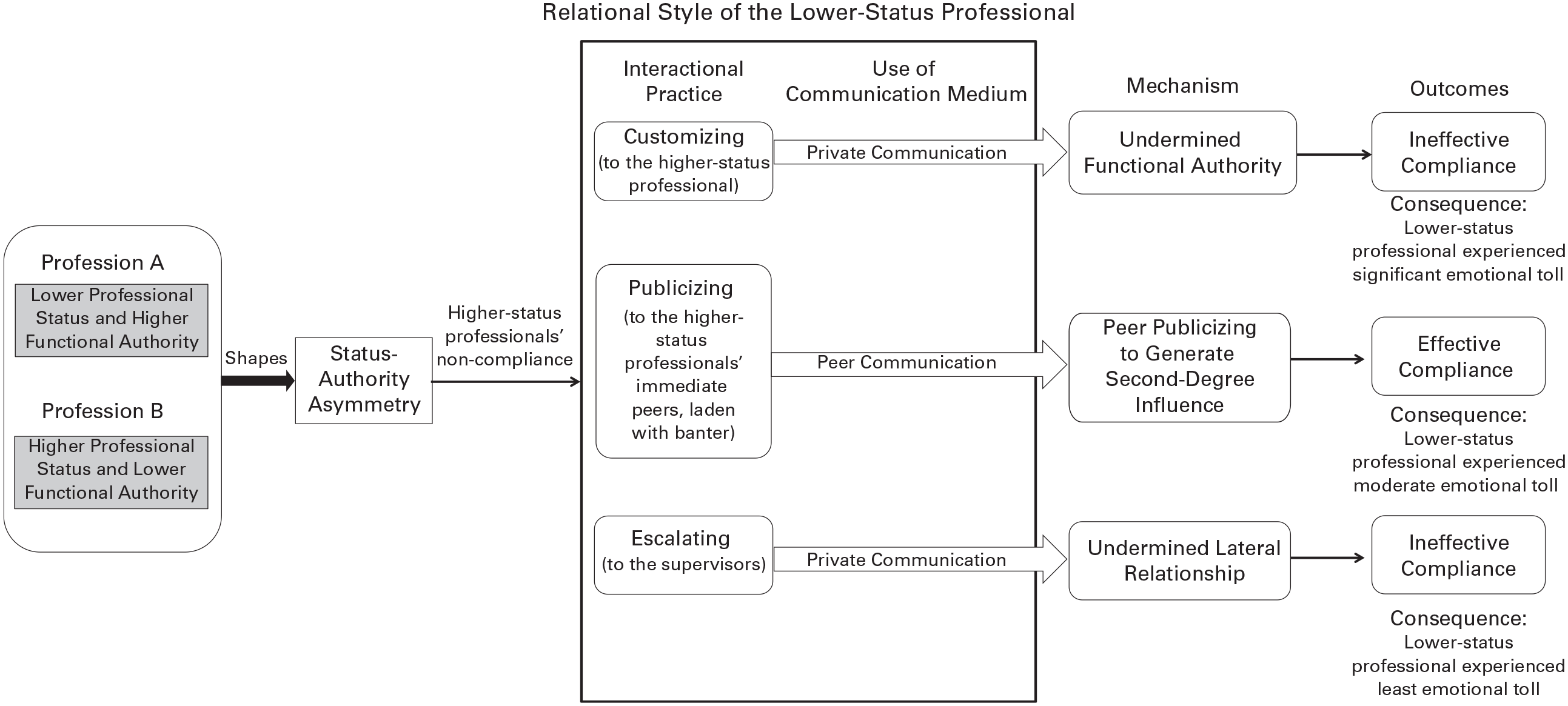
A Model of Eliciting Compliance in the Presence of Status–Authority Asymmetry between Professions
Peer Publicizing to Generate Second-Degree Influence
As illustrated in Figure 1, the publicizing relational style enacted by lower-status professionals via the peer communication channel resulted in more compliance from higher-status professionals. Through such peer publicizing, the lower-status professional disseminates the noncompliant behavior of a higher-status professional (i.e., alter) to that person’s immediate peers. This, in turn, creates “common knowledge” (Chwe, 2001) about noncompliance. Since higher-status professionals within a workgroup gauge each other’s behavior to appraise one’s dependability and trustworthiness (Pratt, Lepisto, and Dane, 2018), the common knowledge created via peer publicizing triggers peer control and self-disciplining of the noncompliant individual. At the same time, since such common knowledge is bounded to the immediate peer group—not disseminated to supervisors, the larger organization, or the general public (cf. Bernstein, 2012; Patil and Bernstein, 2021)—peer publicizing prevents a noncompliant act from “mutat[ing] into a spectacle” (Adut, 2018: 10) whereby the noncompliant higher-status professional could feel publicly shamed and exposed beyond the peer group boundary.
More generally, through peer publicizing, the lower-status professional generates what I refer to as second-degree influence. Instead of first-degree influence whereby the lower-status professional attempts to directly correct the behavior of a higher-status alter, through second-degree influence, the lower-status professional enrolls the alters’ peers in the compliance process and triggers them to enact influence. My findings suggest that such indirect and implicit influence generated via peer publicizing shapes not just the immediate compliance outcomes but also the subsequent interaction order between the lower-status and the higher-status professional. Moreover, the bantering tone enables the lower-status professionals to wrap their authority in humor, as opposed to making direct attempts at enforcing their authority by correcting the noncompliant behavior of higher-status professionals. Thus the lower-status professionals avoid evoking status threats.
In my research site, police officers within a unit interpret peer publicizing as a signal that an officer is “slacking off” too much and “becoming a shirker” who will end up offloading work to the rest of the unit and, more importantly, not be a dependable partner in situations when they might be teamed together. Due to the nature of the peer communication channel, the noncompliant officer is cognizant that his unit is aware of, and keeping tabs on, his behavior (Adut, 2018). This puts the officer’s trustworthiness on the line with the immediate peer group and prompts a reduction in subsequent noncompliance (see also Satterstrom, Kerrissey, and DiBenigno, 2021).
In addition, peer publicizing allows for a “culture of joviality” (O’Neill and Rothbard, 2017: 81) to flourish within the higher-status workgroup, enabling members to build on each other’s jokes about the “slacking ploys” used by the noncompliant individual and, in the process, elicit compliance. Humor becomes an emergent outcome of the interaction order structured by the peer communication medium. Such collective and emergent humor is used to produce peer control (cf. Barker, 1993). In sum, peer publicizing allows lower-status professionals to indirectly and implicitly exercise their functional authority through enrolling alters’ peers in the compliance process and thus elicit compliance from higher-status professionals.
Limits to Customizing
As illustrated in Figure 1, my findings suggest how the customizing relational style enacted via a private communication medium, unfolding at a dyadic level between the lower-status and higher-status professional, can undermine the functional authority of the former. The very act of customizing performed in the presence of status–authority asymmetry creates the preconditions for the higher-status professional to push the boundaries of the lower-status professional’s authority. The higher-status professional interprets customizations as a signal that the rules of the game undergirding functional authority are malleable and can be defied. Higher-status professionals use such relational accommodations from lower-status professionals to lock them into a “giver’s role” (Leifer, 1988: 872–873). The more lower-status professionals have “invested in establishing a giver role,” the more higher-status professionals “stand to gain from [lower-status professionals’] apparent commitment to the role . . . convincing a public and even A [lower-status professionals] that B [higher-status professionals] fully deserves favorable terms” (Leifer, 1988: 872). This imbalance in reciprocity further undermines the functional authority of the lower-status professional doing the customizing, reducing the lower-status professional’s ability to elicit compliance from the higher-status professional.
Pitfalls of Escalating
Findings from this study suggest that when a lower-status professional escalates the noncompliant behavior of a higher-status professional to that person’s supervisor, the higher-status alter views such escalation as a form of personal scorekeeping and beyond the professional realm (Brescoll, 2011; cf. Huising, 2014). Higher-status professionals view any disagreements or conflicts that arise during work as needing to be sorted out inter-professionally. As illustrated in Figure 1, escalation to a supervisor undermines the lateral relationship between the lower-status and higher-status professionals, which makes it even more difficult for the former to elicit compliance from the latter.
More importantly, the supervisors who receive complaints about a noncompliant individual under their watch need to act on those complaints and propose remedial action. But they are reluctant to do so because they do not want to be seen as “playing favorites” among their subordinates. In addition, supervisors depend on their subordinates to do their bidding and accomplish the work tasks. In my research site, sergeants and supervising patrol officers depend on police officers to manage the workload, handle contingencies, and keep the “order of the street” for their district (Van Maanen, 1982). Consequently, while sergeants and supervising patrol officers do sometimes warn noncompliant police officers, remedial actions are typically underenforced. Finally, when lower-status professionals escalate the noncompliant behavior of higher-status alters to their own supervisors (e.g., 911 shift supervisors), such an act is also often interpreted by supervisors as the former’s lack of job competence and/or independence. As a result, escalation to supervisors does not necessarily result in better compliance outcomes (cf. Ranganathan and Shivaram, 2021).
Discussion
This study advances our understanding of how and when lower-status professionals with functional authority could elicit compliance from higher-status professionals in the presence of status–authority asymmetry.
Contributions to Our Understanding of Professions and Compliance in Organizations
First, this research highlights the mechanism of peer publicizing—and more generally, the importance of the immediate peers of higher-status professionals—in eliciting compliance. My findings suggest that as compared with customizing or escalating behavior, higher-status professionals care more about behavior that affects how their immediate peers perceive them, especially incidents that could impact their reputation and trustworthiness. Consequently, involving higher-status professionals’ immediate peers in the compliance process could enable lower-status professionals to trigger peer control and elicit compliance from higher-status professionals. While prior research highlights the centrality of private relational work (e.g., customizing) enacted by lower-status professionals in order to elicit compliance from higher-status professionals (Gray and Silbey, 2014; Huising, 2015), this research suggests the limits of such private relational work in the presence of status–authority asymmetry (Bandelj, 2012). Private relational work might be effective when status and authority align, but performing such work when status–authority asymmetry exists may backfire, further undermining lower-status professionals’ authority and even resulting in less compliance from higher-status professionals. In contrast, through peer publicizing—a form of relational work that is enacted through a peer communication medium and therefore is not private or dyadic—the lower-status professional can enroll the higher-status professionals’ peers in the compliance process. Viewed together, this research (a) underscores the importance of immediate peers of the higher-status professional in the compliance process and (b) emphasizes not just the when and how of relational work enacted by lower-status professionals but also the where, i.e., the type and nature of the peer communication medium through which relational work is performed and how it shapes compliance outcomes.
Second, this study identifies the concept of second-degree influence and highlights its importance in enabling lower-status professionals to implicitly exercise their authority and elicit compliance from higher-status professionals. Existing research has focused on first-degree influence tactics, such as upward influence directed at senior managers and downward influence directed toward subordinates (Kipnis and Schmidt, 1988; Yukl and Falbe, 1990; Dutton and Ashford, 1993; Kellogg, 2019), as ways to elicit compliance. But this study suggests that in the presence of status–authority asymmetry, there are potential downsides to first-degree influence tactics. These include the risks of evoking status threat and of creating a perception among higher-status professionals that a lower-status professional is not acting in a professional manner by “going around” them and escalating directly to supervisors. Through peer publicizing, lower-status professionals avoid these pitfalls by enrolling higher-status professionals’ peers in the compliance process and generating second-degree influence, which pressures the noncompliant higher-status professional to (re)establish his trustworthiness to his immediate peers. In this process, lower-status professionals are able to elicit compliance from higher-status professionals.
Relatedly, this research highlights the role of banter and humor performed through a peer communication medium (as opposed to a private communication medium) in eliciting compliance. While prior research has examined the role of “putdown” humor (Terrion and Ashforth, 2002) in improving cohesion and reducing conflicts between professional groups, it has not examined the role of communication media through which such humor is enacted. This research shows that it is not just humor and banter alone but also the communication medium through which humor is performed that plays a critical role in eliciting compliance. When humor is performed through a private communication medium between two actors, one with higher status and another with lower status but more functional authority, it has the potential to be viewed by the higher-status professional as annoying. When performed through a peer communication channel, however, humor becomes cumulative as the higher-status alter’s peers build on each other’s jokes. The cumulative nature of humor reduces the personal sting that a higher-status professional will experience if he is publicly exposed or shamed beyond the workgroup boundary. These dynamics also avert the “incivility spiral” (Caza and Cortina, 2007) that can emerge when higher-status professionals view the practices of lower-status professionals as a form of personal scorekeeping. In that sense, peer publicizing, and the emergent and cumulative nature of humor that gets generated, occupies a middle ground between the Scylla of “escalations and public shaming” (and the incivility spiral this might engender) and the Charybdis of “customized relational accommodations” (which undermine authority).
Third, this research highlights the emotional toll experienced by lower-status professionals in their attempts to exercise their functional authority and elicit compliance from higher-status professionals. To accomplish even simple tasks using the authority that comes with their job description, these lower-status professionals need to perform additional work and exert considerable emotional labor (Hochschild, 1979), which diminishes their morale and impacts their well-being (Acker, 1990; Ashforth and Humphrey, 1993). In that regard, this study departs from prior research that attempts to identify relational work practices that produce a “win–win” positive effect for the individual professional and the organization (Huising, 2015). On the contrary, this study highlights that the relational styles and associated work practices that might lead to better outcomes for the organization (e.g., effective compliance) need not always translate to better individual-level outcomes for the professionals. In fact, they could negatively impact individual professionals’ morale and well-being. Therefore, this research suggests that lower-status professionals who are effective in eliciting compliance from higher-status professionals might also be at a greater risk of increased job burnout, reduced morale, and even turnover, in part because of the relational style that they need to employ. More generally, while prior research highlights the relational work that lower-status professionals use to build rapport and elicit compliance from higher-status professionals, it has not focused on the emotional toll on the lower-status professionals, which this research highlights.
Fourth, this study makes progress in answering how lower-status professionals can, in organizational contexts characterized by consolidated demographics, exercise their functional authority and elicit compliance from higher-status professionals. Prior research has examined how cross-cutting demographics between professional groups with differential status could enable members of the lower-status profession to draw upon shared “non-professional” social identities to increase trust, weaken the hold of group affiliation, and elicit compliance from the higher-status professionals (DiBenigno and Kellogg, 2014: 378). But given the pervasive nature of occupational/professional segregation in the U.S. economy, most professional groups inside organizations have consolidated as opposed to cross-cutting demographics (Weeden, 1998). Moreover, the cooperative benefits from cross-cutting demographics are salient only when they are a structural characteristic of the workgroup (Blau and Schwartz, 1984; DiBenigno and Kellogg, 2014). This research suggests that lower-status professionals can instead trigger peer control through enrolling the immediate peers of the higher-status professionals in the compliance process.
Finally, while prior research has examined how lower-status professionals without functional authority can use various tactics and practices to elicit compliance from higher-status professionals (e.g., Barley, 1986; DiBenigno, 2018), less research has gone into understanding how lower-status professionals with functional authority can elicit such compliance. Indeed, much prior research has focused on mechanisms to elicit compliance in contexts in which the professional status-order and the bureaucratic authority-order are aligned (Barley and Orr, 1997; Edmondson, Bohmer, and Pisano, 2001; Kellogg, 2012). This study suggests a mechanism for eliciting compliance when there is a misalignment or asymmetry between the two. While it might seem intuitive that having some functional authority is advantageous for lower-status professionals, as opposed to having none, this research portrays a more complex picture by describing the negative reactions from higher-status professionals to such functional authority ascribed to the lower-status professionals. Simmering tensions were on display during the moment-to-moment flow of work as higher-status professionals were expected to acknowledge lower-status professionals’ authority by listening to, responding to, and taking directions from them. My findings therefore suggest that it is perhaps not despite having functional authority but rather because of it that lower-status professionals encounter acts of noncompliance from higher-status professionals. The general awareness among higher-status professionals that certain lower-status professionals are ascribed with functional authority and deemed responsible for overseeing/directing a specific set of functions performed by them creates the structural preconditions for noncompliance, including their grinding reluctance in following the directions from the lower-status professionals.
Recent research and news media reports suggest that lower-status professionals who are ascribed with functional authority (e.g., sustainability professionals, diversity officers, safety auditors, COVID-19 compliance officers, patient safety advocates, algorithmic auditors, magazine fact checkers) face several challenges in exercising their authority in practice and eliciting compliance from higher-status professionals in their workplace (Currie, Mantere, and Spencer, 2018; Augustine, 2021; Miller, 2021). Given the importance of lower-status professionals in the implementation of organizational goals around a range of important issues (e.g., sustainability, diversity and inclusion, social distancing/infection prevention, patient care, algorithmic fairness, detecting fake news), it is crucial to not only document the challenges they face in the workplace but also understand the practices and mechanisms, such as peer publicizing, that might help them elicit compliance from higher-status professionals and implement organizational and social-purpose goals.
Broader Implications and Directions for Future Research
Future research could examine the extent to which the practices and mechanisms identified in this research could be analytically transferable to other contexts marked by status–authority asymmetry between professions. For example, lower-status product designers need to exercise their functional authority and elicit compliance from higher-status technologists during the early stages of product development (Kellogg, Orlikowski, and Yates, 2006; Bailey and Leonardi, 2015). Lower-status quality control officers need to elicit compliance from higher-status physicians during the integrated delivery of healthcare (Currie, Mantere, and Spencer, 2018). And lower-status safety auditors and sustainability officers need to exercise their functional authority and elicit compliance from higher-status scientists with respect to the raw materials used in scientific labs (Huising, 2015; Augustine, 2021). Across these contexts, exercising functional authority is far from straightforward due to the everyday acts of neglect and noncompliance exhibited by higher-status professionals (Huising and Silbey, 2013). Future research could further examine the scope conditions (e.g., task interdependence, long-term repeated interactions, the role of anonymity versus identity) that might enable lower-status professionals to use peer publicizing to elicit higher-status professionals’ compliance.
More broadly, if we conceptualize various forms of workplace harassment—from microaggressions and incivility to workplace bullying and sexual harassment—along a continuum, acts of noncompliance (e.g., neglect, non-response, not following directions) exhibited by higher-status professionals are high-frequency events, but they are also viewed by supervisors as minor issues or low-intensity conflicts. Consequently, noncompliance by higher-status professionals is often ignored or not taken seriously by supervisors. But precisely because these acts of noncompliance are high-frequency events that lower-status professionals experience daily, they produce a substantial emotional toll, affect these professionals’ ability to do their jobs, and perpetuate workplace inequality. As a study participant noted, everyday acts of noncompliance exhibited by the higher-status professionals invalidate the lower-status professionals’ identity to the extent that they are “not even acknowledged . . . not even recognized as a person. As if I don’t even exist anymore to them” (Interview, 911 Dispatcher, #DP18).
My findings suggest that even though managers and supervisors are responsible for resolving noncompliance issues, they often do not want to take follow-up action on an escalated complaint, as they want to avoid getting embroiled in a conflict (Berdahl, 2007). Instead, they prefer that lower-status professionals deal with such issues by themselves. Supervisors often advise lower-status professionals to “work it out” with noncompliant higher-status professionals. Supervisors view the social skills required to handle a higher-status professional in order to get things done smoothly without “creating a scene” or “drama” as important parts of the lower-status professionals’ job competence (cf. Fligstein, 2001).
Broader structural and organizational reforms are needed to create the conditions in which lower-status professionals can exercise their functional authority without fear of retaliation and/or the need for additional relational work. Yet such structural reforms typically take a long time to be implemented, and even if they are, the agendas of the regulatory professional groups involved can get redirected over time (e.g., Edelman, Uggen, and Erlanger, 1999; Dobbin and Kelley, 2007). An alternative is to institute turnaround times and service-level agreements that clearly specify the consequences for noncompliance and to communicate these ground rules across the organization. But prior research suggests that higher-status professionals find ways to work around or ceremonially comply with such processes and rules while not following them in practice (Huising and Silbey, 2013).
My research points to the practices and mechanisms that lower-status professionals can perform in the short term to implicitly exercise their functional authority by enrolling higher-status professionals’ peers in the compliance process. While the specific practices may vary from setting to setting, the broader mechanism of peer publicizing to generate second-degree influence might allow lower-status professionals to elicit compliance and navigate status–authority asymmetry. In the context of 911 EMOs, the publicizing happened through the peer radio channel. Future research could examine how in other contexts, such as product development, peer publicizing could happen (or not) through the use of communication tools such as e-mail and Slack. During initial stages of product development, a lower-status designer might peer publicize the noncompliant behavior of a software engineer to other engineers within the workgroup through the Slack channel or e-mail listserv for that workgroup. The lower-status designer could also publicize the engineer’s noncompliant behavior offline, such as during an in-person team meeting before the engineering manager and other non-engineering team members come to the conference room. Future research could also explore the role that professional/organizational norms and culture (e.g., a culture of silence and conflict avoidance) play in enabling (or not) lower-status professionals to exercise their functional authority in practice, elicit compliance from higher-status professionals, and help facilitate the effective accomplishment of organizational and social-purpose goals.
Supplemental Material
sj-pdf-1-asq-10.1177_00018392211059505 – Supplemental material for Status–Authority Asymmetry between Professions: The Case of 911 Dispatchers and Police Officers
Supplemental material, sj-pdf-1-asq-10.1177_00018392211059505 for Status–Authority Asymmetry between Professions: The Case of 911 Dispatchers and Police Officers by Arvind Karunakaran in Administrative Science Quarterly
Footnotes
Acknowledgements
This research benefitted from the generous feedback and guidance of Wanda Orlikowski, Kate Kellogg, John Van Maanen, and JoAnne Yates. I would also like to thank Matt Beane, Curtis Chan, Lisa Cohen, Matt Corritore, Diana Dakhlallah, Daphne Demetry, Julia DiBenigno, John-Paul Ferguson, Ruthanne Huising, Ece Kaynak, Erin Kelly, Audrey Mang, Ryann Manning, Hatim Rahman, Emily Truelove, Brad Turner, Victoria Zhang, and Ezra Zuckerman for their helpful comments on earlier drafts of this paper; participants at the ASA Annual Conference, AOM Annual Meeting, People and Organizations Conference, and LERA Annual Meeting; and workshop attendees at the Work, Technology, and Organizations Workshop at Emlyon, Montreal Organizations Writing Workshop, McGill University (Sociology), MIT Economic Sociology Working Group, and City University London. Finally, thanks to the associate editor, John Wagner, and three anonymous reviewers for their time and helpful feedback and to Joan Friedman for providing valuable copyediting expertise. A previous version of this paper was the recipient of the Louis Pondy Best Dissertation Paper Award from the AOM OMT Division.

Supplemental Material
1
Names of the city and the emergency management organization are pseudonyms for the purpose of protecting the confidentiality of the study participants.
2
In addition to the 13 zones, there are some dispatchers who handle city-wide services. I have excluded them from analysis as these dispatchers interact with a wide variety of city, state, and federal agencies, not just the police.
3
Such incongruence in (rotating) shift schedule between different professional groups is prevalent in other EMOs as well as in service sectors such as healthcare and aviation (Costa, 2003; Lambert, Haley-Lock, and Henly, 2012). However, the “as if” random assignment helps preclude selection issues around a particular relational style used by a 911 dispatcher to elicit compliance from specific police officers, as compared to other officers, who are persistently noncompliant.
4
I maintained an observation calendar that equally distributed the observation periods across the days of the week. Although the volume of calls handled by dispatchers varies from shift to shift, and there are fluctuations in the patterns of call inflows (e.g., on Friday and Saturday nights, dispatchers working the night shift handle an increased inflow of calls), the overarching dynamic of 911 call dispatch, interactions with the police officers, and status–authority asymmetry experienced by the dispatchers remained the same across shifts.
5
Unlike the private radio channel and the peer radio channel, the department-wide radio channel is not often used apart from broadcasting city-wide information.
6
Overall, I identified five combinations used by dispatchers: (a) customizing using the private radio channel; (b) customizing using the peer radio channel; (c) escalating using the private radio channel; (d) escalating using the department-wide radio channel; and (e) publicizing using the peer radio channel. Two of them (b and d) were rarely used. I thus focus on the three combinations that were used more often.
7
These exchanges illustrate the interactions that unfolded between the police officers and dispatchers. Radio codes and phrases that are specific to DEMO have been replaced with general codes.
8
The first part of the dispatcher’s message includes the ID# of the police officer.
9
The first part of the officer’s message includes the radio ID#.
10
It is important to note here that the publicizing dispatchers are not directly informing the sergeant or the supervising officer about a noncompliant officer or sending a broadcast message with the officer’s ID. While the sergeant may or may not be tuned into the radio frequency of the unit, the dispatcher’s message (about the noncompliant police officer) is not directed toward the sergeant.
11
Dispatchers used a bantering tone most of the time while enacting a publicizing relational style (97.57%, 3,014 out of 3,089). Of these instances, 98.44% (2,967 out of 3,014) led to compliance from the officers. When dispatchers did not use a bantering tone while enacting a publicizing relational style (e.g., when they used an admonishing or a neutral tone), the success rate was lower (39 out of 75 times, 52%). Of the 3,192 instances when a dispatcher used a private radio channel, a bantering tone was used only in 194 (6.08%). Of these, only 17 instances (8.76%) resulted in compliance.
Author’s Biography
References
Supplementary Material
Please find the following supplemental material available below.
For Open Access articles published under a Creative Commons License, all supplemental material carries the same license as the article it is associated with.
For non-Open Access articles published, all supplemental material carries a non-exclusive license, and permission requests for re-use of supplemental material or any part of supplemental material shall be sent directly to the copyright owner as specified in the copyright notice associated with the article.
