



Abstract
People in the early stages of their careers often face a trade-off between cultivating a closed network that helps them secure the resources they need to survive or developing an open network that can help them succeed. Actors who overcome this trade-off transition from a closed network to an open network; those who fail to do so can be caught in a survival trap that jeopardizes their chances of having a successful career. We identify the factors that enable and constrain network transitions and test our theory on a sample of Korean pop (K-pop) freelance songwriters before they have attained their first commercial hit. These songwriters initially rely on a closed network of collaborators and transition toward an open network by working with fellow songwriters who are not connected to those collaborators. This network transition occurs faster among songwriters who eventually attain their first hit than among those who remain unsuccessful. Songwriters are more likely to collaborate with new distant colleagues when they have a reference group of commercially successful peers and when they have created stylistically similar songs in the past that have failed to become hits. However, most of their new distant colleagues also lack a hit, revealing a status barrier that constrains the network transition of early-career songwriters.
Research on the effects of social networks on career outcomes suggests that the same network structure can play a substantially different role at different stages of a person’s career. For people who have advanced beyond the earlier stages of their careers, positive outcomes are consistently associated with having a large network with few connections between their contacts (Burt, 1992). These “brokers” benefit from the diversity of information and arbitrage opportunities resulting from being connected to people separated by “structural holes”—that is, people who are not connected directly in the social network. The association between sparse networks and success is particularly noticeable in creative fields. Scholars studying a variety of fields including philosophy (Collins, 1987, 1998), science (Uzzi et al., 2013), software (de Vaan, Stark, and Vedres, 2015), professional photography (Giuffre, 1999), performing arts (Uzzi and Spiro, 2005), and television shows (Clement, Shipilov, and Galunic, 2018; Soda, Mannucci, and Burt, 2021) have provided consistent evidence on the association between networks rich in structural holes and success. More generally, Burt (2004) reported that “good ideas” are more likely to come from managers occupying a brokerage position, meaning those with large and sparse networks.
A large and sparse network, however, can be detrimental for people in the earlier stages of their careers. Still lacking the legitimacy associated with reaching a noticeable career milestone, early-career actors often struggle to gain the trust and support they need to demonstrate their value. For most of them, the immediate challenge is not how to succeed but how to survive so they can maintain their chances to succeed (Menger, 1999; Aldrich, 2019). This has been documented among a wide variety of professionals, such as investment bankers (Gargiulo, Ertug, and Galunic, 2009), academics (Browning, Thompson, and Dawson, 2017), entrepreneurs (Portes and Sensenbrenner, 1993; Vissa, 2012), and freelance artists (Faulkner, 1983). The survival difficulties early-career actors encounter make them likely to benefit from the solidarity and mutual trust associated with a relatively small and cohesive network—that is, from a network without structural holes. Being embedded in such a network can help an early-career actor alleviate the uncertainty colleagues may feel regarding her abilities and trustworthiness, while also fostering their solidarity toward this actor (Granovetter, 1985; Coleman, 1988, 1990). Consistent with this perspective, Burt (1992) reported that entry-level employees in a large computer manufacturer benefited from smaller and relatively cohesive networks structured around a well-connected sponsor, and Gargiulo, Ertug, and Galunic (2009) showed that junior investment bankers with a cohesive network performed better than those with a network rich in structural holes (see also Ertug et al., 2018).
This research has important implications. Although actors may initially benefit from the solidarity and trust associated with a small and closed network during the early stages of their careers, eventually these actors must transition to a larger and sparser network to succeed. Actors who fail to transition can be caught in a survival trap: they may survive at the cost of jeopardizing their chances of having a successful career. Yet the literature remains silent about the factors that can drive and constrain this network transition. Because actors cannot unilaterally control the structure of their networks, transitioning from a small and closed network to a large and sparse one requires entering into new relationships with people who are not already connected to current contacts—that is, expanding one’s network with “distant” people who are more than two steps away from the focal actor.
But existing research suggests that entering new ties with distant parties is not straightforward. An array of evidence on the tendency toward triadic closure in social networks (Cartwright and Harary, 1956; Heider, 1958; Granovetter, 1973), encompassing large-scale longitudinal samples of interorganizational relationships (Gulati and Gargiulo, 1999; Sytch and Tatarynowicz, 2014b; Zhelyazkov, 2017) and field studies of managers (Gargiulo and Benassi, 2000; Jonczyk et al., 2016) and entrepreneurs (Vissa, 2012; Burt, Opper, and Holm, 2021), has suggested that actors favor local over distant contacts when they enter new relationships. Trusting friends or friends of friends is safe (Granovetter, 1985). Placing trust in a distant stranger is difficult and risky (Burt, 2005: 164) because the mutual contacts that can reassure someone about the capabilities and trustworthiness of the potential new partner are missing.
The difficulties of entering relationships with distant parties may be attenuated for—although not altogether absent from—careers that evolve within formal organizations. People working for such organizations may take advantage of opportunities opened by promotions and transfers to create ties with hitherto distant colleagues and build sparser networks (Kleinbaum, 2012; Jonczyk et al., 2016). These formal events can also loosen up existing ties and help actors overcome the psychological forces that favor proximate relationships, both by creating the functional need to interact with new colleagues and by providing a relatively safe institutional environment for the new relationship to emerge, even in the absence of reassuring common third parties. These opportunities and incentives are absent for people whose careers evolve outside formal organizations, as is the case with entrepreneurs, freelance artists, and other skilled professionals engaged in “boundaryless” careers (Arthur and Rousseau, 1996; Menger, 1999; Ashford, George, and Blatt, 2007; Cappelli and Keller, 2013). Building a new distant relationship is also riskier for these actors because they typically lack organizational reassurances about the competency and trustworthiness of the potential new associate.
What poses significant challenges for actors whose careers evolve outside formal organizations creates an excellent opportunity for scholars to study the factors that induce actors to embark on a network transition, as well as the difficulties they encounter when doing so. Identifying those factors and difficulties is the aim of this study. We propose and test a theory of what induces early-career actors to expand their networks by entering new distant relationships and transition from a closed network that allowed them to survive to an open network that can enable them to succeed. We test our theory on the professional collaboration networks of early-career freelance songwriters in the Korean pop (K-pop) music industry between 2003 and 2012. Our data follow the songwriters’ careers from the time they release their first song until the time they release a song that enters for the first time the top-100 chart that tracks popular demand for K-pop music in Korea, a milestone we use to indicate a songwriter’s first commercial success.
Our study shows that most of the early-career songwriters who obtained their first commercial success during our observation period initially relied on a closed network of collaborators but rapidly transitioned toward an open network richer in brokerage opportunities. They did this by starting to collaborate with fellow songwriters who were previously more than two steps away from them in the overall collaboration network—that is, with people who had not yet collaborated with the focal songwriter or with her direct collaborators. An early-career songwriter is more likely to expand her network by entering collaborations with new distant songwriters when she sees the success of peers in her reference group and when her unsuccessful songs are stylistically alike. These collaborations are more likely to occur with distant songwriters who are still unsuccessful, suggesting that status differences can limit the ways in which songwriters can transition from a closed to an open network to escape the survival trap.
A Theory of Network Transition
Advancing our understanding of how individuals transition from a small and cohesive network that helps them survive in the early stages of their careers to a large and sparse network that helps them succeed requires identifying the factors that induce them to engage in this transition, as well as the barriers they encounter when doing so. To do so, we assume that actors are motivated to succeed but have limited control over the structure of their networks. What they can control, at least in part, is the time and energy they invest in their existing relationships, as well as with whom they enter new relationships (Sewell, 1992). An actor who limits herself to collaborating with her current partners or with her partners’ partners may increase the size of her network but is not likely to alter substantially the structure of that network (see Uzzi, 1996, 1999, for similar examples in other contexts). To transition from a small and closed network to a larger and open one, the actor must expand her network by entering new relationships with “distant” people who are more than two steps away from her in the network. From a structural viewpoint, such a distant expansion is likely to create new structural holes in the actor’s network. From a substantive one, a distant expansion is more likely to put the actor in touch with information and ideas that differ significantly from those circulating in her local network (Reagans and McEvily, 2003), providing a broader view of the ongoing trends and opening new opportunities for professional advancement.
Entering a new relationship with people who are not directly connected to our local network is far from straightforward, however. Entering a new professional relationship entails trusting that the other party is competent and will behave professionally. In the absence of reassuring common third parties or visible reputational signals, actors are likely to find it difficult to ascertain the abilities and the trustworthiness of a prospective distant partner. The same difficulties affect the decision of the prospective distant partner.
And yet, evidence exists that people can overcome the barriers that deter the formation of distant relationships, even when these new relationships are not prompted or facilitated by a formal organizational structure. For example, fieldwork by Vissa (2012) showed that some entrepreneurs purposively eschew referrals and engage in “network broadening” behaviors to identify new partners beyond their local network neighborhood and advance their business. There is also evidence coming from interorganizational relationships. Baum and his collaborators (2005) showed that underperforming banks are more likely to create new underwriting syndicate ties with distant banks. Sytch, Tatarynowicz, and Gulati (2012) argued that incentives and the presence of other bridging ties encourage firms to form alliances with distant organizations. These examples suggest that social actors can overcome the inertial forces that favor relationships within their local networks and enter new ties that connect them with distant parties. This is probably one of the reasons real-world networks rarely resemble a structure characterized by the dense and disconnected clusters that would result if network formation were exclusively driven by triadic closure (cf. Watts, 1999).
Although the existing evidence suggests that actors can enter relationships with new distant parties, it also suggests that there is considerable heterogeneity in the extent to which they do. This heterogeneity may result in part from idiosyncratic characteristics that make individuals prefer a certain type of network over another (Sasovova et al., 2010; Burt, 2012), but it may also result from factors that can induce actors to explore relationships beyond the network that has helped them survive but does not seem to be helping them succeed. Such factors can make the actor realize that she is not making sufficient progress toward an important career milestone, rendering her more open to seek out new distant parties or to start collaborating with such parties if they seek her out. Actors who continue to rely on their local network despite their failure to attain the desired milestone may still survive but at the expense of jeopardizing their chances of success. The local network that helped them survive can then become a survival trap.
We identify two factors that can induce actors to escape the survival trap and expand their networks by entering ties with new distant parties: the success of relevant peers and the acknowledgment that what they have been doing so far to attain their goals has failed. The importance of relevant peers in defining aspirations is a common theme in psychology, sociology, organization theory, and—more recently—economics. The idea is central in Festinger’s (1954) social comparison theory, which argues that falling behind people in a relevant reference group regarding a particular issue or outcome can trigger corrective actions. Subsequent developments in psychology have emphasized the adaptive role of upward comparisons (see Buunk and Gibbons, 2007, for a comprehensive review). A similar idea is central to the performance feedback theory of organizational change (Cyert and March, 1963; Greve, 1998), which argues that an organization is more likely to take corrective actions when its performance falls behind its “social aspirations,” defined by the performance of organizations in its reference group. More recently, the idea that aspirations are shaped by the achievements of a reference group has taken hold in economics (Genicot and Ray, 2020). The success of people in one’s reference group also demonstrates that the goal is reachable, even if it has been elusive for the actor.
The second factor that can induce actors to enter relationships with new distant parties assumes that actors who fail to attain a goal are more likely to take corrective actions. Although failure can trigger feelings of helplessness that result in abandoning goals (Bandura, 1982), it can also be experienced as a motivation to explore alternative ways to attain that goal (Sitkin and Pablo, 1992; Amabile et al., 2005). The tendency to explore alternatives is typically stronger in environments in which failure is common and when success is important to maintain one’s identity, as is often the case with entrepreneurs and freelance artists (Brunstein and Gollwitzer, 1996; Lena and Lindemann, 2014). The idea that failure to attain a goal can induce exploration is also consistent with bounded rationality models of problemistic search. 1 When applied to our context of collaborative choices, the actor initially prefers to collaborate with people in her local network to attain her goal and observes the outcomes of her efforts. When her collaborations result in homogeneous outputs that consistently fail to achieve her goal, she is more likely to transform her initial preference for local collaborators and explore distant alternatives. The transformation of preferences (and the subsequent distant exploration) is less likely to occur when the collaborations result in failed but heterogeneous outputs because this makes it more difficult to identify the potential causes of the failure and take appropriate corrective action.
The success of relevant peers and the low variance of prior unsuccessful efforts to attain an important career milestone can induce an actor to explore relationships with distant parties, but the consummation of those relationships is only partially under the actor’s control. Although the formation of a new relationship typically goes through a series of interaction rituals that make it difficult to establish unambiguously who made the initial opening (Leifer, 1988; Collins, 2004), it ultimately requires the agreement of the two parties. In practical terms, this means that a proposal is eventually made by one of the parties and accepted by the other. If an early-career actor is open to exploring ties with distant parties, the formation of a relationship requires her to take the initiative and invite the distant party to collaborate or to accept the latter’s invitation if one is forthcoming.
Status homophily (Lazarsfeld and Merton, 1954; Podolny, 1994) suggests that not all distant parties would be equally likely to accept or to make a proposal to collaborate with an actor who cannot yet display a clear signal of her quality. This would be particularly the case if the actor is not referred by common contacts. Insofar as reaching an important career milestone can affect an actor’s status, failure to reach such a milestone can make it difficult for an actor to collaborate with distant parties who have already reached it. Thus, an actor who has not reached an important career milestone should be more likely to enter distant relationships with parties who also have not reached that milestone than with those who have. While both the focal actor and the distant party might prefer to collaborate with actors who have reached such a milestone, the limitations imposed by their status are likely to restrict their choices. In practical terms, this implies that an early-career actor who has yet to attain an important career milestone and is open to collaborating with new distant partners is more likely to do so with other actors who share her similar status than with higher-status parties. Although this may limit the resources the actor can access through those new relationships, it still serves to increase the diversity of ideas and opportunities available to the actor, which may increase her chances of attaining the elusive career milestone.
Collaboration Networks among K-Pop Songwriters
K-pop is a type of popular music created and produced in South Korea that is often characterized by its mix with dancing and a variety of audiovisual elements (Lie, 2014). Since the early 2000s, K-pop has been a dominant style in the East Asian music market and has become a major component of the highly successful cultural exports from South Korea, often referred to as the “Korean wave” or Hallyu. According to The Korea Times, in 2012, the final year of our observation period, exports from South Korea’s pop culture had reached $235 million (Park, 2013). Since then, its reach has continued to grow in Asia and elsewhere.
K-pop songs are typically performed by glamorous groups of same-sex young performers put together and tightly managed by production companies. Most of them are discovered at auditions or singing contests and trained by their production company for many years, during which they undergo a grueling selection process (Seabrook, 2012; Lie, 2014). The chosen few may enjoy long-term exclusive contracts with their production company, but they have little freedom in their artistic choices, including the songs they perform. Contrary to their proactive role in identifying, developing, and managing talented performers, production companies rarely get directly involved in songwriting. Rather, they select from songs submitted by freelance songwriters to the company’s artists and repertoire (A&R) department. Songwriters typically work in temporary teams composed of one or more melodists, lyricists, and arrangers who bring different skill sets or musical ideas, although one person may fulfill more than one of these roles.
The vast majority of K-pop songwriters are freelancers whose fate depends almost entirely on the commercial success of their songs. Because Korean law recognizes the songwriters’ copyright to be separate from the production and performing rights granted to the production companies, songwriters receive copyright fees from the reproduction, sales, or replay of their songs, irrespective of the medium. When the songs have little or no commercial success, those fees are meager or completely absent. This may force songwriters to rely on “day jobs” to get by (Menger, 1999). The precarious status of songwriters is compounded by the intense competition in popular culture markets, whose audiences are often characterized as having flickering tastes for “new” products (Peterson and Berger, 1975). The challenge for artists who want to survive and succeed in these markets is how to continuously create new products while trying to identify what the audiences might like at each particular time (Hirsch, 1972).
This challenge is particularly important for freelance artists who have not yet attained a single notable commercial success. In the absence of formal credentials such as a professional license or certificate, having created a product that became a “hit” is often the first clear signal of an artist’s commercial talent and an important milestone in her career (Bielby and Bielby, 1994). The lure of commercial success attracts a continuous flow of hopeful songwriters to K-pop, but few of them ever create a song that reaches the top-100 chart, a milestone that signals their talent for creating songs that the audience likes. Only 4.1 percent of the songs released during our observation period made it into the top-100 monthly charts, and only 14.5 percent of the early-career songwriters had at least one hit song during our study period. On average, those who attained their first hit reached this milestone after releasing 15.5 other songs that never made it onto the charts. This persistence attests to the fact that, for most songwriters, creating songs is not a hobby but a central part of their identity, even if they may need to do other things to make a living. Reflecting on the impact of her first hit, one songwriter told us that, before that hit, she “had to knock on doors, but now I need to block from my messenger people asking for my work!” 2 Her experience is backed up by the data. The odds of releasing a new song more than double once a songwriter gets a hit. In contrast, about 24 percent of songwriters who made a debut in our study period failed to release a new song within the following three years, and most of them never released another new song, effectively terminating their careers. Life as an early-career K-pop songwriter may not be brutish, but it is often nasty and short.
Although a few songwriters may be able to create the lyrics, melody, and arrangements for a new song by themselves, most collaborate with other songwriters to do so. An important byproduct of these collaborations is a network of songwriters that can support each other and provide referrals to find new collaborators, alleviating the challenge of surviving in the competitive market of popular music (see de Laat, 2015, for a similar example among popular music songwriters in North America). This pattern of collaboration would naturally evolve into a closely knit network of people who trust each other and develop norms of reciprocity that help them gain access to work opportunities and referrals. The expectation of reciprocity is apparent in this statement by a songwriter during one of our field interviews: “I was looking for a guy who could quickly write guitar arrangements for me. So, I invited him [the collaborator] into the project. . . . Of course, I expect him to invite me back when he needs me.”
A songwriter’s collaboration network is not only a means to secure work opportunities and trusted referrals to survive. It is also a means to keep abreast of the latest trends in the changing market of popular music and to learn how to bring new creative ideas into one’s work (Daskalaki, 2010). As an experienced songwriter told us, “you simply cannot master all the different sounds and styles. . . . Collaborating with different people makes it possible to learn about the different sounds that are becoming a new trend.” Those who fail to renew themselves “may still do okay, but they don’t top charts anymore.” A small and closely knit network can help a songwriter to secure the support of a trusted group of collaborators, but it may be of little use to keep track of the latest trends and to bring new ideas into one’s work. According to a successful songwriter, “the problem of many unsuccessful songwriters is that they just write their own thing, work with a few friends, but forget to reach out to potential collaborators that are not part of their social circle.”
The dual role of the collaboration network presents an important trade-off for songwriters who have yet to attain their first commercial hit. These songwriters still need a closed network of collaborators to secure the opportunities and referrals necessary to survive, but they also need to open up this network to learn about the new musical ideas that can help them succeed. Failure to do so may still allow the songwriter to keep creating songs with the vague hope that one might become a hit, but the safety of her local network may also become a survival trap. Escaping this survival trap requires starting to collaborate with songwriters who are not directly connected to her current network, but these collaborations can be difficult and risky. As one of our informants put it, “musical taste is subjective, so if someone removes or changes your part, this may raise tension, especially if you don’t have a trusting relationship.” Collaborators also share the proceeds that might result from the commercial success of the song, which recommends caution before entering a new relationship. And yet, some early-career songwriters do start collaborations with new distant parties and transition from a network that secures their survival to one that can help them succeed. In the next section, we hypothesize what induces them to do so.
The Drivers of Network Transition
Our theory of network transition helps us identify two factors that can induce an unsuccessful early-career songwriter to expand her network by starting collaborations with new distant parties: the success of her relevant peers and the stylistic invariance of her previous songs. For a songwriter who has not attained her first commercial hit, the success of her peers can demonstrate that success is still possible for someone like her (e.g., Festinger, 1954; Genicot and Ray, 2020), thus making additional efforts warranted (Aldrich, 2019). Not all peers would be equally important in defining a songwriter’s aspirations, however. We argue that an early-career songwriter would be influenced by the success of her peers to the extent that she is similar to those peers and that she can be aware of this similarity.
The similarity between songwriters can be ascertained in multiple ways. The extent to which they have collaborated with the same colleagues is particularly relevant in our context because it means they have been exposed to comparable musical ideas and trends, making the difference in commercial success more noticeable. The similarity in collaboration patterns should be apparent when those peers also collaborate with the focal songwriter because their relationship provides a reliable conduit of information on the collaborations of those peers that do not involve the focal songwriter. The success of a direct collaborator who tends to work with the same people as the focal songwriter also means that the collaborator’s hit song originated in a project in which she was not invited to participate. As one of our interviewees pointed out, the question “why wasn’t I involved in that hit?” naturally emerges and can be an additional incentive to search for new collaborators beyond the local network. Thus, the more a successful collaborator is relationally similar to the focal songwriter, the more salient she is in the songwriter’s reference group. 3 These considerations lead us to our first hypothesis:
The second factor inducing songwriters to expand their network by working with new distant collaborators highlights the effect of the failure to attain a goal on the exploration of alternatives (Simon, 1955; Cyert and March, 1963; Levinthal and March, 1981; Sitkin and Pablo, 1992; Amabile et al., 2005). We do not expect that all songs that fail to become hits would be equally important to induce songwriters to collaborate with new distant parties, however. Rather, we expect that a songwriter’s unsuccessful songs will be more likely to induce her to engage in such collaborations when they are stylistically similar. The stylistic invariance of her songs would be a clear signal that continuing to rely on the musical ideas that circulate within her local network is unlikely to result in a song with serious chances of becoming a hit. Starting to collaborate with colleagues who are not part of that local network becomes a natural next step for the songwriter to learn about new ideas and trends, despite the risks associated with those collaborations (see Skaggs, 2019, for a similar case for songwriters in Nashville).
Yet the effect of stylistic invariance on collaborations with new distant fellow songwriters is unlikely to be linear for two reasons. First, a songwriter whose songs display high levels of stylistic invariance may have developed an uncompromising (albeit hitherto not successful) musical style. Given the difficulties intrinsic to any artistic collaboration, a songwriter with a highly invariant musical style may find it challenging to join forces with distant songwriters whose styles are likely to be different from hers. Second, the potential collaborators may be wary of working with someone with a highly invariant style because stylistic invariance could indicate that the songwriter might be less open to experimenting with mixing different musical styles, which is a major attraction of working with a new distant colleague. Working to combine different musical styles is always challenging, but the difficulties would be compounded when the style of one of the parties is highly invariant across all her songs. Thus we expect that the positive relationship between stylistic invariance and distant network expansion will stabilize and eventually reverse at high levels of this stylistic invariance. This results in our second hypothesis:
Our hypotheses identify two factors that can induce an early-career songwriter to accept an invitation to collaborate from distant fellow songwriters or to seek out and engage such colleagues. Other things being equal, early-career songwriters are likely to prefer collaborating with distant colleagues who are already successful, given the learning potential and the opportunities these collaborators might bring (Liu, Mihm, and Sosa, 2018). Yet, because having commercial success is an important marker of status among K-pop songwriters, the status homophily principle (Lazarsfeld and Merton, 1954; Podolny, 1994) suggests that it might be more difficult for an early-career songwriter to collaborate with distant colleagues who have already reached this career milestone than to collaborate with someone who has not done so, because both would face similar status barriers when trying to expand their networks.
A direct consequence of status barriers is that, while status-heterophilous distant collaborations might be possible (Castellucci and Ertug, 2010; Zhelyazkov and Tatarynowicz, 2021), unsuccessful songwriters seeking to expand their networks with new distant collaborators are more likely to start collaborations with other unsuccessful colleagues than with successful ones. In empirical terms, this means that we expect that the effect of the factors that induce songwriters to enter distant collaborations will be more apparent for collaborations involving unsuccessful fellow songwriters than for those involving successful ones. Hence,
Data and Methods
We identified the population of K-pop songwriters using the Korean registry of copyright holders, which comprises every song ever recorded in the country. The registry is maintained by the Korea Music Copyright Association (KOMCA). Because KOMCA was the only organization that represented songwriters to collect their copyright fees during our study period, it provides the most comprehensive list of active songwriters in the K-pop industry. 4 Because this registry covers the entire history of the K-pop industry, it allowed us to identify and track down all songwriters without left censoring. We removed songs that were not commercially released, such as those aimed at the preservation of traditional Korean music. To this end, we used secondary lists made available by ManiaDB.com, which contains information about recording performers, producers, distributors, and genres for all recorded music albums ever released in the Korean music market. We also cross-validated the release of those songs using two other online music distributors: Melon.com and Bugs.co.kr. The result was a master database with 73,753 songs written by 10,792 unique songwriters and released between January 2000 and September 2012.
This database allowed us to identify all songwriters active during the observation period, as well as all instances of collaboration among these songwriters to create songs and the specific roles they played in those collaborations (i.e., melodist, lyricist, or arranger). Using these data, we reconstructed the monthly collaboration network among all songwriters who released songs during our observation period. For a given month t, cell zij in the matrix representing the network
Our study focuses on the careers of songwriters before they attain their first commercial success. To identify this milestone, we collected data on the commercial success of each song in the Korean popular music market using the monthly top-100 chart published by Melon.com, the dominant online music distributor in Korea. The Melon.com chart ranks songs primarily based on their sales, streaming, and downloads. It is the only music chart that regularly and consistently covered the commercial performance of songs during our study period. On average, about 2,050 new songs were released in any given month during the period of our study. Thus, being included in the monthly Melon.com top-100 chart is a reasonable indicator of the commercial success of a song, an assessment that is consistent with the views of industry informants in our field interviews. A songwriter exits the sample if any of her songs released in month t reached the Melon.com top-100 chart in the same month of the release or thereafter. Hence, our measure of first commercial success is forward-looking, tying a song’s future success to the month when the song was released. This is analogous to looking at the forward citations of a patent or an academic paper to assess its impact. Among the songs that entered the top-100 charts, 61 percent did so in the same month of their release, and 34 percent did so in the following month. This implies that practically all K-pop songs become hits either shortly after their release or never.
We also collected audio data on the songs to measure their stylistic features. Most Korean online music distributors, including Bugs.co.kr, share a free first-minute sample of each song. We used these samples to extract high-level music descriptors using Essentia, an open-source library of tools for audio and music analysis (Bogdanov et al., 2013). Each song is then represented by a vector of high-level descriptors across 12 different dimensions. These vectors (which are described in detail below) allowed us to measure the stylistic similarity between any two songs.
Dependent Variable
Distant network expansion is the dependent variable of our analysis. It is measured as the number of new collaborators who were more than two steps away from the focal songwriter in the network before the current release—that is, songwriters who were not collaborating with the focal songwriter or with one of her direct collaborators before the current release. This definition includes newcomers entering the field for the first time. To test H3a and H3b, we distinguished between distant network expansion with successful and unsuccessful new distant collaborators. Successful distant collaborators are those who had at least one song in the Melon-100 chart before the collaboration with the focal songwriter; unsuccessful ones do not meet this condition.
Independent Variables
Reference group success is the number of direct collaborators who had one or more songs in the top-100 chart, weighted by the similarity in collaboration profiles between the focal songwriter i and each of her collaborators j. Formally:

where
Stylistic invariance is the average similarity of the songs released by the songwriter before time t. Following Interiano et al. (2018) we used the set

We averaged the cosine similarity scores for all pairs of songs released by each early-career songwriter until time t to measure the stylistic invariance of the songwriter’s songs.
Control Variables
We controlled for several variables that could affect the tendency of early-career songwriters to collaborate with new distant parties. We used three variables to account for a songwriter’s experience. Number of songs in the release is the number of songs the focal songwriter had in the current release, defined as a collection of songs a songwriter put out in a given month. This variable controls for the fact that the number of songs in the release can increase the probability that the release contains new distant collaborators. Tenure is the number of months since the songwriter’s first release. Prior releases is the total number of releases by the focal songwriter before the current release. The last two variables can capture some time-variant unobserved heterogeneity in the songwriters’ learning, which may affect their disposition to collaborate with new distant parties or their attractiveness for those parties. Songwriters may also vary in their propensity to work with other songwriters (as opposed to working alone). Collaboration propensity is the proportion of a songwriter’s songs released in collaboration with other songwriters during the past 36 months.
Songs produced by majors is the number of the songwriter’s songs that were produced by one of the seven major producing companies in Korea (S.M. Entertainment, YG Entertainment, JYP Entertainment, DSPmedia, CJ E&M, CUBE Entertainment, and LOEN Entertainment) in the past 36 months. Although the songwriters in our sample are freelancers, they differ in the extent to which their songs were produced by these companies. This association can confer legitimacy to an early-career songwriter, affecting her chances of entering relationships with distant parties.
Genre specialization is a Herfindahl index measuring the concentration ratio of a songwriter’s songs in a genre within K-pop. This index captures the potential effect of having a consistent genre identity (Zuckerman et al., 2003) on entering collaborations with distant parties. We considered 11 basic genres (dance, pop, R&B, rock, hip-hop, jazz, trot, original soundtrack, religious, instrumental, and world music) plus a 12th miscellaneous category for songs that could not be included in any of those 11. Because genres are not yet well defined in K-pop, these basic genres are not mutually exclusive and can be combined to form a subgenre, such as dance/hip-hop. If a song was categorized in a detailed subgenre we assigned it to all the basic genres related to the subgenre. We also accounted for potential genre heterogeneity by including genre fixed effects in the models.
Performing experience is the number of songs in which the focal songwriter was listed as a performer in the last 36 months, irrespective of other roles she might have played in songwriting. Successful performing experience restricts the count to songs that reached the top-100 chart in the same period. Being a performer or a successful performer could increase a songwriter’s visibility and create more opportunities to collaborate with distant parties. Performers’ success measures the extent to which a songwriter’s songs have been recorded by successful performers, even though the songs themselves were not successful. We identified the performers (excluding the focal songwriter if she was part of the performing team) of each of the songwriter’s songs released up to time t, counted the number of hits each of these performers had in the past 36 months, and averaged these counts across all the performers of each song. We then averaged these scores across all songs that the focal songwriter had released in the past 36 months. Controlling for this variable allowed us to remove the effect successful performers might have on the attractiveness of the songwriter for potential collaborators.
Network closure measures the structure of the focal songwriter’s network. We used Burt’s (1992) constraint measure to capture network closure. Network constraint decreases with the number of collaborators in the songwriter’s network and increases with the relationships among those collaborators. Following common practice (e.g., Burt, 2005), we converted raw scores to a 100-point scale and used the natural log of network constraint in the models. The results remained unchanged when we used this variable without log transformation. Main component member is an indicator set to one when the songwriter is connected to the main component of the collaboration network. A significant number of K-pop songwriters are connected through a single large main component in this network; those who are not are scattered in one of the many disconnected smaller components. In October 2007 (the midpoint of our observation period), the main component comprised 3,011 songwriters, whereas the second-largest component had only 15. Songwriters with one or more commercial hits are significantly more likely to be part of the main component (χ2 = 428.53, p < .01). This suggests that unsuccessful songwriters who are connected to the main component might enjoy better access to collaboration opportunities than their less well-connected peers do. Local network opportunities counts the number of songwriters who are two steps away from a focal songwriter in the collaboration network. This variable controls for the availability of new potential local collaborators. The smaller this number, the fewer the opportunities for expanding the network locally and the more likely the songwriter has to resort to new distant collaborators if she wants to grow her network. Network age is the months passed since the first collaboration between the songwriter and each of her collaborators, averaged across all collaborators. A tie between the songwriter and a collaborator is considered dissolved after 36 months without a new collaboration between these two songwriters. The tie is reinstated if the two songwriters collaborate again in the future, and the tie duration is then the number of months since their very first collaboration.
We used two variables to control for the potential effects of the collaborators’ networks on a songwriter’s collaborations with new distant parties. Collaborators’ network closure is the closure of a collaborator’s network, averaged across all collaborators. We used the natural log of Burt’s (1992) constraint measure to capture the closure of a collaborator’s networks. Although prior research has not yielded consistent results (Burt, 2007; Galunic, Ertug, and Gargiulo, 2012), the network of a songwriter’s collaborators might affect her tendency to collaborate with new distant parties because collaborators with high-closure networks are less well connected in the larger collaboration network. Collaborators’ prior successes is the number of top-100 hits each of the songwriter’s collaborators had in the past 36 months, averaged across all collaborators. Because commercial success is an important status signal in our setting (Ertug et al., 2016), collaborating with successful songwriters can affect the status of the focal songwriter despite her lacking a commercially successful song, making her more attractive for distant parties. Finally, year and calendar month fixed effects account for possible seasonal effects on the tendency to expand a songwriter’s network.
Estimation Samples and Statistical Modeling
Because we were interested in songwriters’ early careers—before their first commercial success—we sampled songwriters who started their careers on or after January 2003 and tracked their monthly activity until the release containing their first commercially successful song or until the end of the observation period (September 2012), whichever was earlier. 7 We updated the independent and control variables every month to account for changes in these variables due to the activity of the songwriter and that of her collaborators. We considered the career of a songwriter to be right-censored if she did not release one or more songs after this period. The results of the analyses did not change if we kept songwriters in the sample after 36 months of inactivity.
A challenge to identifying unbiased network effects on outcomes is individual-level unobserved heterogeneity among songwriters. Songwriters may differ in terms of their innate creative talent or their psychological traits, which could make it more or less difficult for them to collaborate with distant fellow songwriters or manage their collaboration networks (Sasovova et al., 2010; Burt, 2012). Songwriters may also differ in terms of conditions such as their musical education or unobserved social networks at the time of their debut, which may affect their ability to enter collaborative relationships. Including songwriter fixed effects in the model helps alleviate these concerns. A fixed effect estimator would also identify within-songwriter network effects because it allows us to estimate effects that result from changes in the independent variables over a songwriter’s career rather than those resulting from differences between songwriters. Hence, the estimates from fixed effect models are adequate to test the effects resulting from the changes in our independent variables throughout a songwriter’s career.
The unit of our analysis is a release: a set of songs that are distributed in the market at the same period (in our case, in the same month). There are 15,161 releases by 4,387 songwriters who started their careers during our observation period. Because the prior network distance between a songwriter and her collaborators is undefined for the songwriter’s first release, we removed first releases from the estimation sample. In practical terms, this also removes songwriters who had only one release during the observation period, resulting in a sample of 10,477 releases by 2,588 songwriters. Given the count nature of our dependent variable, we used a conditional negative binomial model that incorporates songwriter fixed effects. This model drops songwriters who never entered a distant collaboration during our observation period, resulting in an estimation sample of 8,546 releases by 1,415 songwriters. We tested the robustness of the estimates using a standard fixed effects OLS model, which retains all 2,588 songwriters.
Network Transition among K-Pop Songwriters
Before presenting the results of the statistical analyses conducted to test our hypotheses, we assess the validity of several assumptions made to develop our theory. First, we assumed that early-career songwriters typically start with a small and closed collaboration network and then transition to a larger and open one by adding new collaborators who are more than two steps away from them in the network. This is indeed the case. Figure 1 plots the evolution of network closure over the first 30 releases for songwriters who did not attain their first commercial success during our observation period and for those who did (respectively labeled “unsuccessful” and “eventually successful”). Each point in the graph represents the average network closure for 10 or more songwriters in that release. Songwriters leave the sample once they have achieved their first commercial success. The line for eventually successful songwriters is truncated at the 16th release because there are fewer than 10 songwriters in our sample who attained their first commercial success after this release.
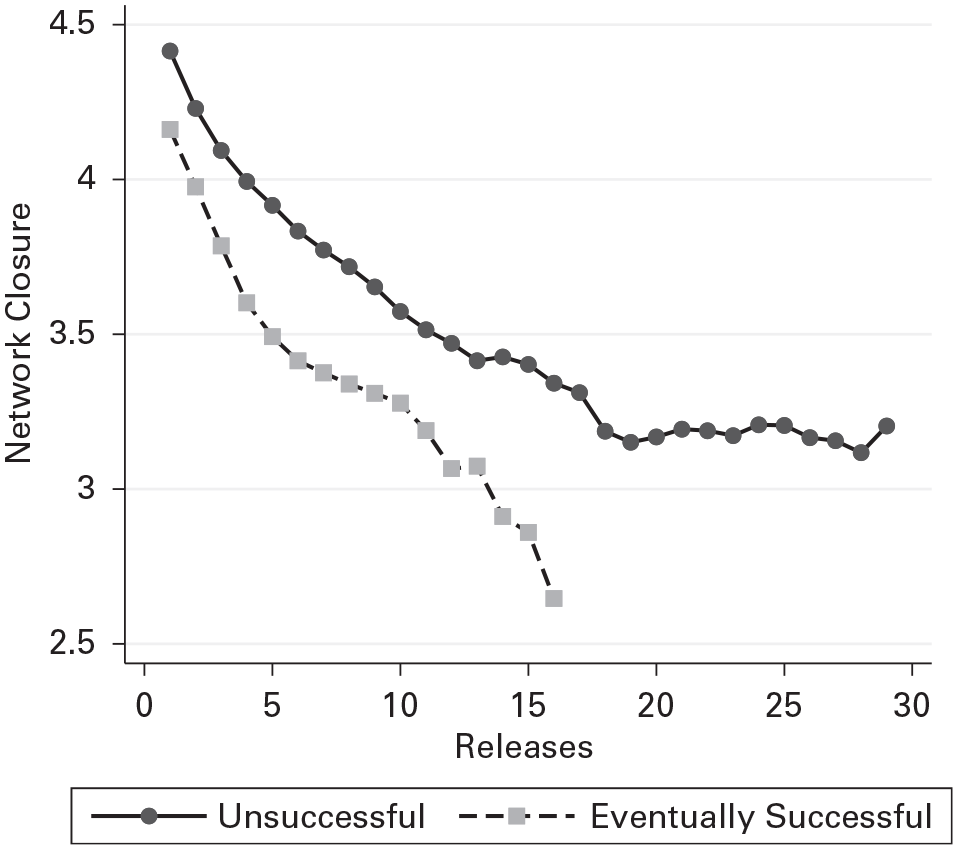
Evolution of Network Closure of Unsuccessful and Eventually Successful Songwriters over Releases
Consistent with our assumption, both unsuccessful and eventually successful songwriters increasingly opened up their networks with every new release, but those who eventually attained their first success did so more aggressively than those who did not. The difference between the two lines is statistically significant throughout all releases (p<.01). The steeper slope of the curve for eventually successful songwriters results from their tendency to create more new distant ties than those who remained unsuccessful. On average, songwriters who had their first hit during our observation period added 1.36 new distant collaborators in each new release, whereas those who did not have their first hit added only 1 (p<0.01). It is worth noting that each new distant collaborator decreases network closure by 0.88 percent, whereas adding a new local collaborator (someone who was already working with one of the songwriter’s existing collaborators) increases it by 1.59 percent.
Interestingly, network closure stabilizes after the 16th release for unsuccessful songwriters in Figure 1. Given the constant inflow of newcomers, this is unlikely to result from dwindling opportunities to collaborate with new distant songwriters. Rather, it is more likely that the stabilization results from a decision to consolidate the songwriter’s network. A comparison of the proportion of repeated collaborations for unsuccessful songwriters before and after the 16th release is consistent with this conjecture. On average, the proportion of new collaborations with prior collaborators is 0.41 before the 16th release and 0.69 afterward (p<.01). This pattern is consistent with the trade-off between survival and success-oriented networks proposed in our theory. A songwriter who has been adding structural holes to her network for 16 releases without being able to create her first commercial hit might have to focus on strengthening the bonds with her collaborators to secure working opportunities and mitigate the risk of ending her career, even if this reduces her chances of creating her first hit and increases the risk of falling into a survival trap.
Second, our theory assumes that new distant collaborators can put a songwriter in touch with musical ideas that are significantly different from the ones she can experience in her local network. Figure 2 plots the cosine similarity between a songwriter’s previous songs and those of her collaborators by the previous path distance dij between the songwriter and those collaborators. The path distance between the songwriters is undefined (dij = ∞) when the songwriter and her new collaborators were previously in different network components. The similarity between the two sets of songs decreases monotonically with the previous path distance between the collaborators, with all differences in the similarity between consecutive path distances being statistically significant based on Wald tests (p<.01). A sparser network also contains diverse musical styles. There is a significant positive correlation between a songwriter’s network closure and the stylistic similarity of her collaborators’ songs, measured as the average vector of high-level music descriptors for the songs created by each of those collaborators in the last 36 months (r = 0.45; p < .01).
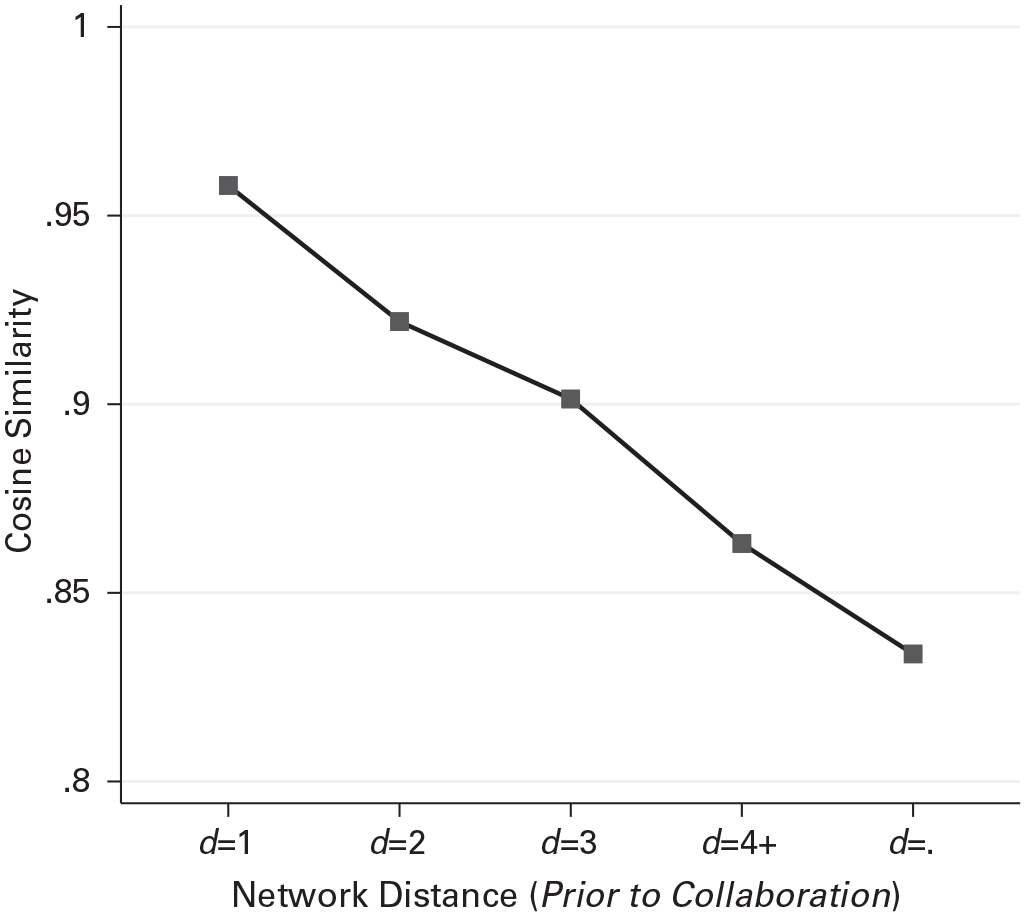
Similarity in Music Styles between a Songwriter and New Collaborators over Network Distance
Third, we also explored whether the collaboration network displayed a distinct community structure (Sytch, Tatarynowicz, and Gulati, 2012; Sytch and Tatarynowicz, 2014a). Prior research has shown that such communities are common in artistic fields (e.g., Uzzi and Spiro, 2005; Silver, Lee, and Childress, 2016; Clement, Shipilov, and Galunic, 2018). We applied a community-detection algorithm (Girvan and Newman, 2002) to the main component of the collaboration network to identify cohesive subgroups and examined the modularity associated with the optimal partition as well as the stylistic similarity of the songs that songwriters created within and between these partitions. A meaningful community structure should display strong modularity and significant differences in styles across communities (Clement, Shipilov, and Galunic, 2018: 265). Our data fulfill the first requirement but not the second. The average modularity across our study period is rather high (Q = 0.82), but the style of the songs by songwriters classified within one group is not substantially different from those written by songwriters in other groups. This suggests that these groups may not correspond to true communities with distinctive musical characteristics (Lena, 2012). The main correlate of stylistic difference between two K-pop songwriters is the path distance that separates them in the collaboration network and not their membership in structural subgroups (see Figure 2).
Finally, we argued that exposure to different musical styles is important not only to stimulate a songwriter’s creativity but also to learn about the ongoing trends in the musical market. This assumes that a K-pop song is more likely to become a hit if it is attuned to the ongoing musical trends. Our analysis confirmed that this is indeed the case. The probability of a new K-pop song becoming a hit has an inverted U-shaped relationship with the stylistic similarity between this song and all the K-pop songs released in the prior 36 months. 8 This pattern is similar to the one that Askin and Mauskapf (2017) reported in their study of U.S. popular music. If entering new distant collaborations can improve a songwriter’s awareness of ongoing musical trends, it can also increase her chances of creating a song with the “optimal distinctiveness” required to become a commercial success (see Zhao et al., 2017, for a review).
Results
Table 1 shows descriptive statistics and zero-order pairwise correlations for the sample. Models 1 through 4 in Table 2 present conditional negative binomial estimates of the factors that predict distant network expansion—that is, new collaborations with songwriters who were previously more than two steps away from the focal songwriter in the network. We test H1 and H2 with the full model (model 4). All the estimates for our key independent variables (and most of those for the controls) remain statistically significant when we estimate them using the fixed effects OLS estimator in model 5. This model also allows us to dispel concerns arising from the drop of observations in the conditional negative binomial—that is, songwriters who were observed only once, who never entered distant ties, or who always entered the same number of distant ties.
Descriptive Statistics and Pairwise Zero-Order Correlations*
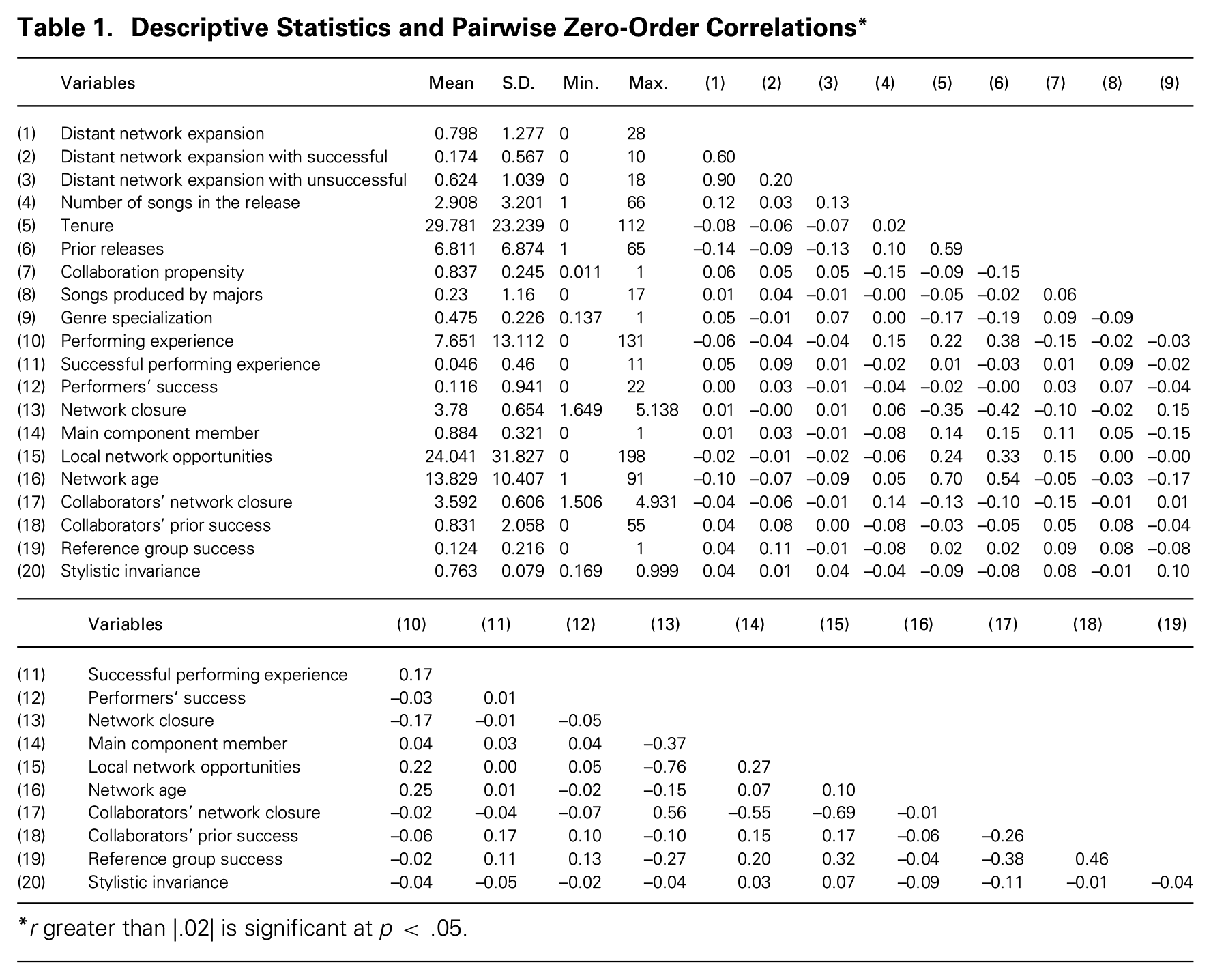
r greater than |.02| is significant at p < .05.
Determinants of Distant Network Expansion*
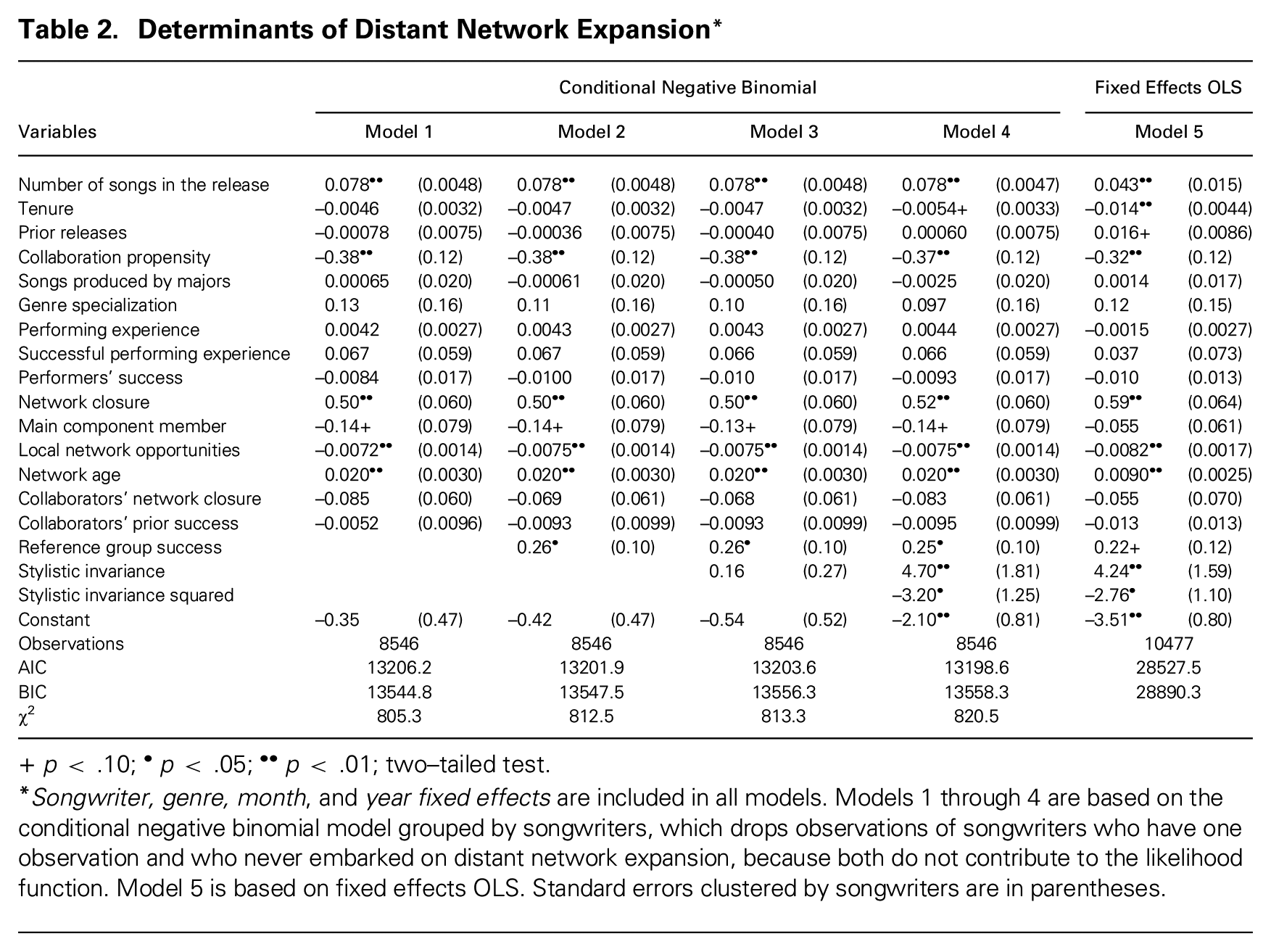
p < .10; •p < .05; ••p < .01; two–tailed test.
Songwriter, genre, month, and year fixed effects are included in all models. Models 1 through 4 are based on the conditional negative binomial model grouped by songwriters, which drops observations of songwriters who have one observation and who never embarked on distant network expansion, because both do not contribute to the likelihood function. Model 5 is based on fixed effects OLS. Standard errors clustered by songwriters are in parentheses.
Consistent with H1, reference group success has a positive effect on distant network expansion as shown in model 4 (β = 0.25, p<.05). An increase of one standard deviation in reference group success increases the incident rate ratio of distant network expansion by 6 percent. The more a songwriter witnesses the success of her relationally similar collaborators, the more she enters collaborations with new distant songwriters. Stylistic invariance displays the expected inverted U-shaped relationship with distant network expansion, providing support for H2. The effect is positive for lower levels of stylistic invariance, but it reverses when it reaches 0.74, which is close to the mean value in our sample (0.766). Additional analysis confirms that the 95% confidence interval of the inflection point (0.646−0.828) is within the observed range for this variable (that is, 0.170−1.000). Furthermore, the slope of the estimated curve is positive and statistically significant at the minimum value of the stylistic invariance (β = 3.51, p<.01) and negative and significant at its maximum (β = −1.62, p<.05). This confirms the presence of a true reversal in the relationship between stylistic invariance and distant network expansion (Haans, Pieters, and He, 2016). The relationship between these two variables is plotted in Figure 3. The figure shows the binned scatter plot of stylistic invariance and the level of distant network expansion after adjusting for the other variables in model 6. The graph clearly shows the inverted U-shaped relationship between distant network expansion and stylistic invariance.
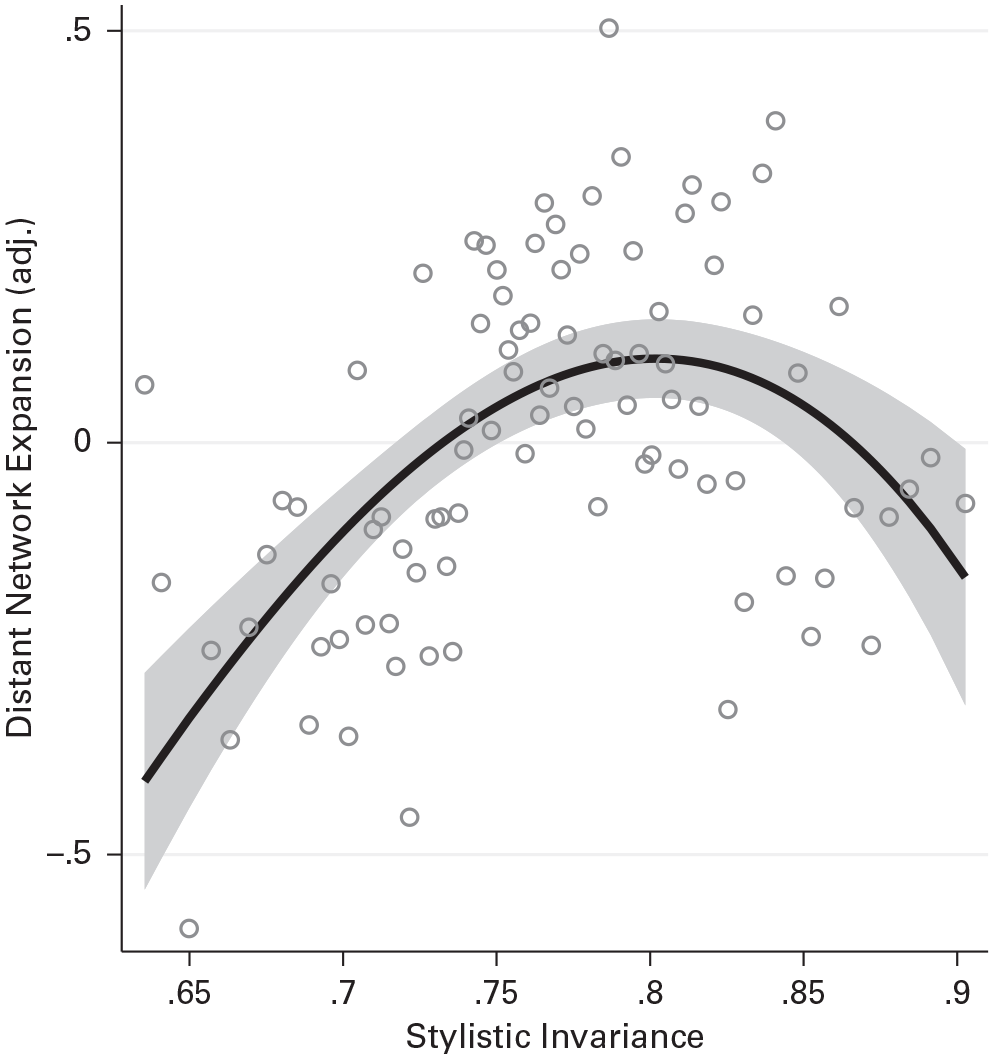
Inverted U-Shaped Effect of Stylistic Invariance*
In addition, it is worth noting that network closure has a consistently positive effect on distant network expansion. Because this effect is net of the availability of local colleagues (which is negatively correlated with network closure, r = −0.76), it cannot be interpreted as resulting from the lack of local opportunities to expand the songwriter’s network. Rather, it suggests that songwriters with a closed network seek to overcome the limitations of that network by collaborating with new distant colleagues.
Table 3 shows the results of distinguishing between collaborations with new unsuccessful and successful songwriters. Models 6 and 8 show results from conditional negative binomial models, whereas models 7 and 9 display estimates from fixed effects OLS models, which are consistent with the negative binomial estimates. The effects of the two independent variables are stronger for distant network expansion with unsuccessful songwriters. In fact, reference group success increases collaboration with new unsuccessful distant parties (β = 0.59, p<0.01 in model 6) but reduces collaborations with successful ones (β = –0.53, p<0.01 in model 8). One standard deviation in reference group success increases the incident rate ratio of new collaborations with unsuccessful distant songwriters by about 14 percent, whereas it decreases those with successful songwriters by about 11 percent. This result provides support for H3a, which predicts that the effect of reference group success on distant network expansion with unsuccessful songwriters will be stronger than the effect on distant network expansion with successful ones. Assuming that an unsuccessful early-career songwriter would prefer to collaborate with successful colleagues, these results show that an attribute that may be interpreted as a positive signal by same-status parties is interpreted oppositely by higher-status ones. An additional analysis in which we add an interaction between reference group success and tenure provides evidence supporting this interpretation. The negative effect of reference group success on distant expansion with successful songwriters is contingent on the tenure of the unsuccessful songwriter (β = –0.026, p<0.01; the results are available upon request). The longer songwriters remain unsuccessful despite collaborating with successful but otherwise similar peers, the more their collaborations with successful songwriters may become a signal of their lack of talent in the eyes of distant successful strangers. This interpretation is consistent with the significant negative effect of collaborators’ prior success on the number of new successful distant collaborators, which we used as a control variable (β = –0.063, p<.05 in model 8). This is not the case for unsuccessful strangers who share the same predicament, since the interaction between reference group success and tenure is not significant (β = 0.00093, p = n.s.).
Distant Network Expansion with Unsuccessful and Successful New Collaborators*
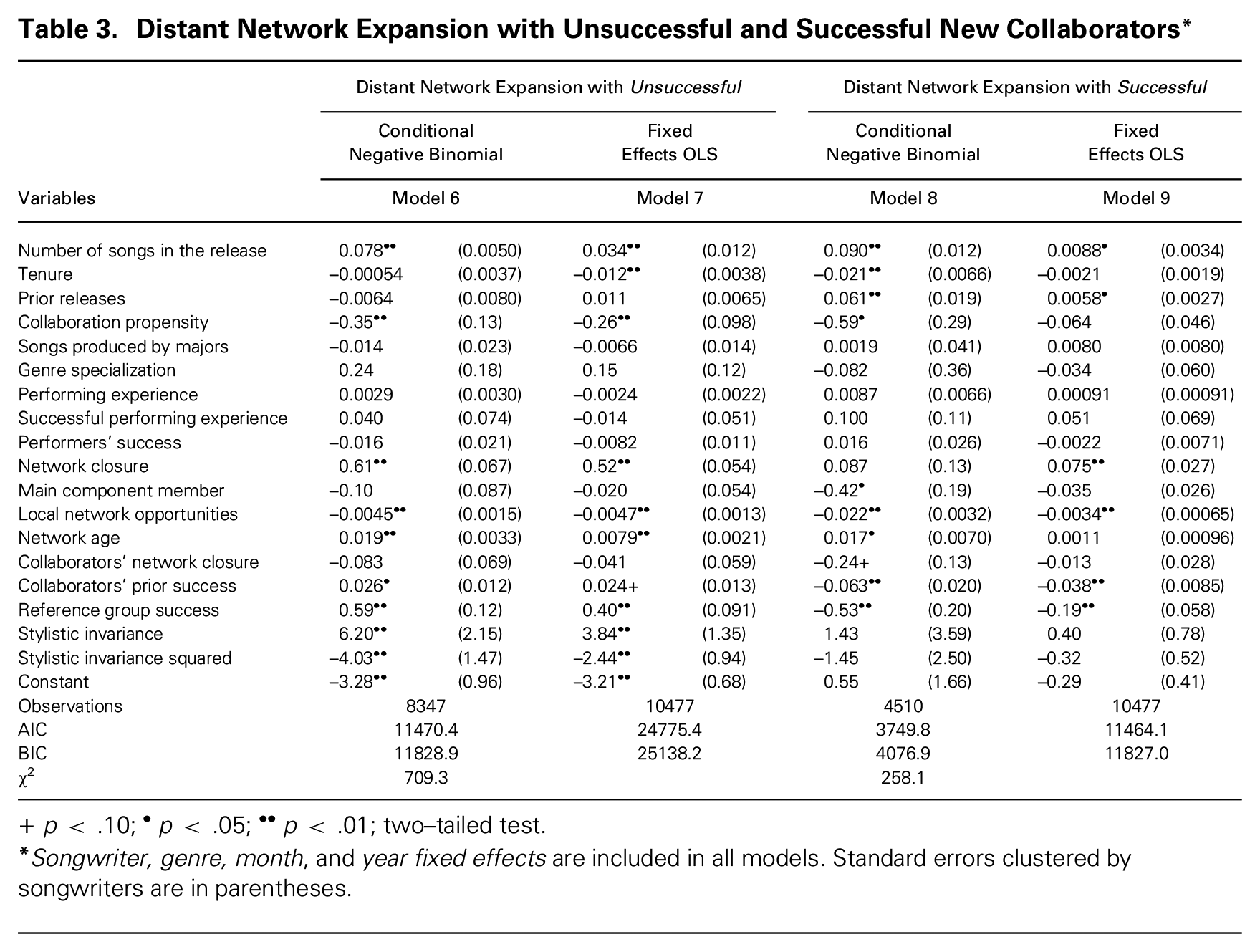
p < .10; •p < .05; ••p < .01; two–tailed test.
Songwriter, genre, month, and year fixed effects are included in all models. Standard errors clustered by songwriters are in parentheses.
The contrast between successful and unsuccessful new collaborators is less marked for stylistic invariance but still consistent with our hypothesis. This variable is a significant predictor of distant network expansion with new unsuccessful songwriters only. The size of its effect on distant network expansion with new successful distant parties is a fraction of that for unsuccessful ones and not statistically significant, supporting H3b.
Robustness Checks: Addressing Endogeneity Concerns
We performed several additional analyses to minimize concerns that our estimates could be biased or inconsistent due to endogeneity. Endogeneity could originate in time-invariant or time-variant unobserved heterogeneity among the songwriters. Our models address time-invariant heterogeneity using songwriter fixed effects. We also tried to account for potential sources of time-variant unobserved heterogeneity using several controls that capture a songwriter’s evolving experience and learning. Although we cannot completely rule out the possibility of an unobserved time-variant characteristic correlated with our dependent and independent variables, it is reasonable to assume that the combination of songwriter fixed effects and the various time-varying controls included in our model makes such a possibility less likely.
Even if our models reasonably account for omitted variables, it is still possible that prior distant network expansion could affect the current one, because this autoregressive problem is common in dynamic panels of network evolution. A simple way to address this concern would be to introduce the lagged dependent variable as a control. However, including the lagged dependent variable in a pooled fixed effects model introduces serial correlation with the error term, violating the strict exogeneity assumption and potentially yielding inconsistent estimators. To avoid this complication, we implemented the Arellano–Bond estimator, which relies on the generalized method of moments (GMM) to generate unbiased estimates (Arellano and Bond, 1991). The Arellano–Bond approach assumes that the first differences in the deeper lagged dependent variables (e.g., the dependent variable at t–2, t–3, etc.) are uncorrelated with the error terms because they would be correlated with the lagged dependent variable but exogenous to unobservable covariates at t, making them useful as instruments.
Table 4 presents the results of a dynamic panel model with songwriter’s fixed effects using the Arellano–Bond estimator. Satisfying the model assumptions, the Arellano–Bond test is significant for first-order autocorrelation in the first-differenced errors, AR(1), but not for the second-order, AR(2). Following Roodman’s (2009) suggestion for long panels like ours, we collapsed the matrix to reduce the number of instruments before computing the Hansen J statistics. The resulting J statistics are then within the recommended range (0.20<J<1.00), indicating that the models meet the model assumption. The estimates for our independent variables reported in Table 4 show that our results are robust to this alternative modeling choice.
GMM Estimation Results from Dynamic Panel Models*
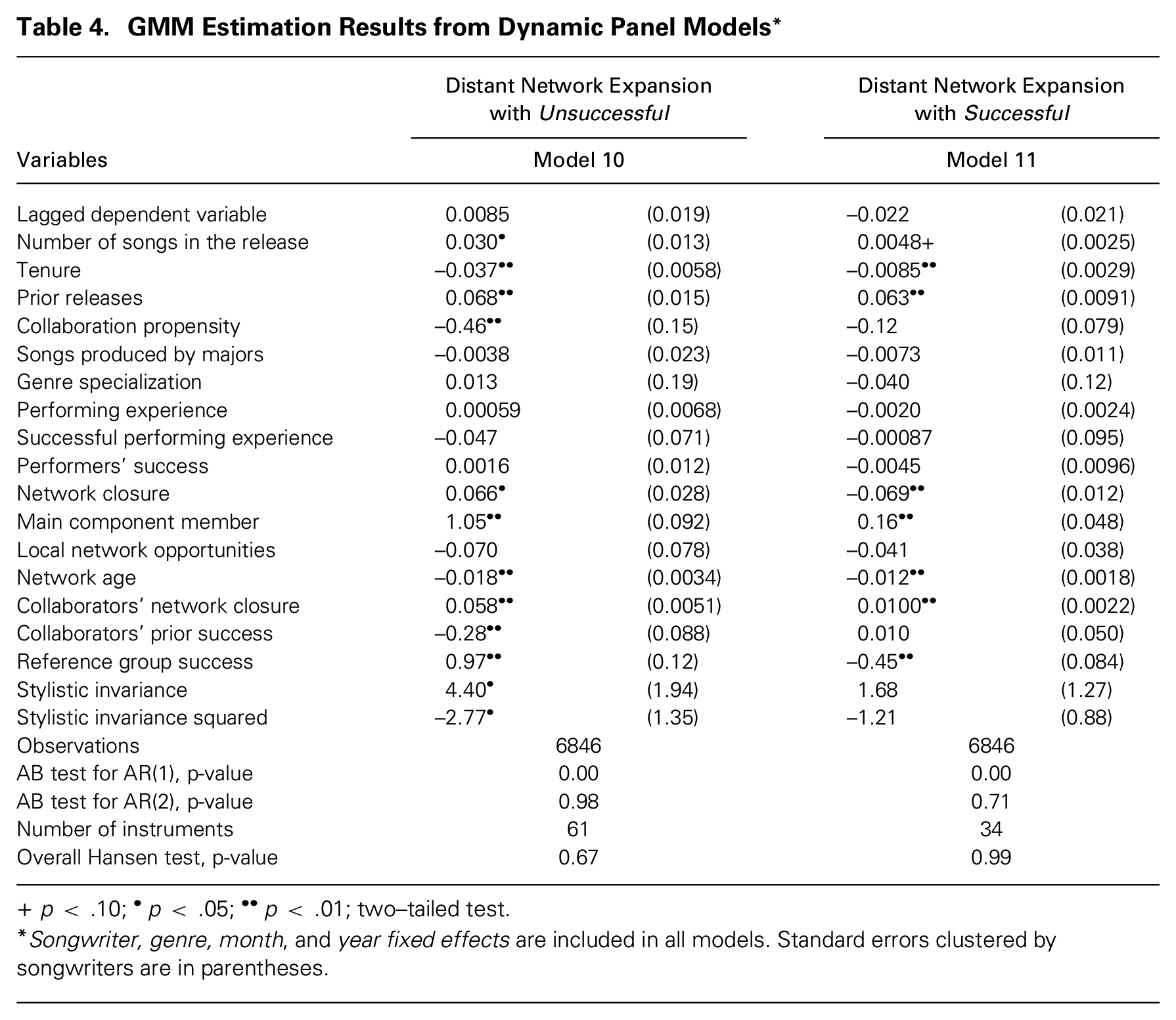
p < .10; •p < .05; ••p < .01; two–tailed test.
Songwriter, genre, month, and year fixed effects are included in all models. Standard errors clustered by songwriters are in parentheses.
We further checked the robustness of the estimates by assuming that our independent variables are also endogenous but that the first differences in the deeper lags of these variables are exogenous to the current error term. The results are presented in Table 5. The models satisfy the key assumptions in the dynamic panel modeling. The test for autoregression is significant for AR(1) but not for AR(2). The models also satisfy Hansen’s J test. Once again, the estimates are consistent with the ones presented in our main models, providing additional reassurance about the robustness of our findings.
GMM Estimation Results from Endogenous Independent Variables*
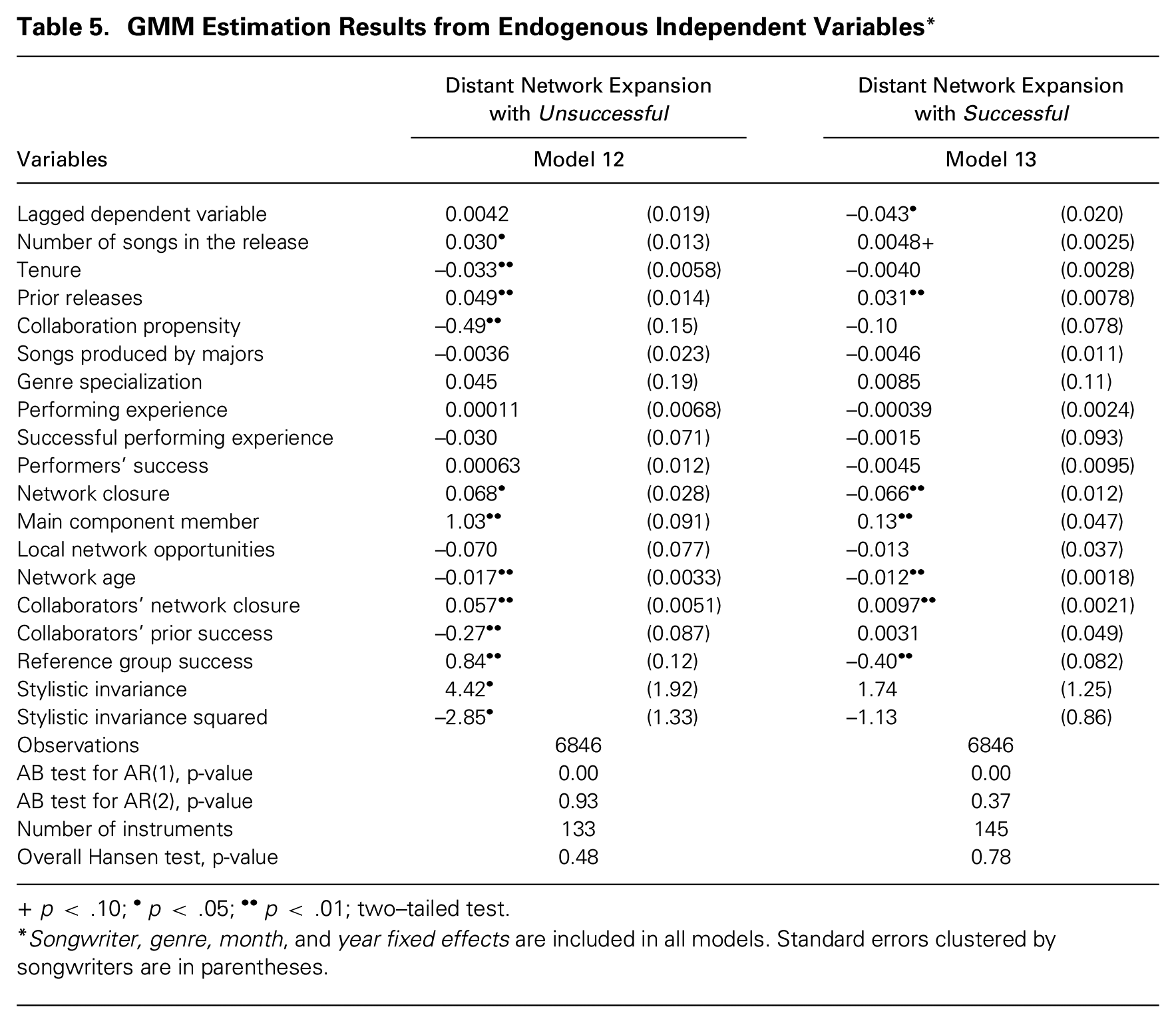
p < .10; •p < .05; ••p < .01; two–tailed test.
Songwriter, genre, month, and year fixed effects are included in all models. Standard errors clustered by songwriters are in parentheses.
Supplementary Analyses
Inducement versus halo effect
We conducted supplementary analyses to shed additional light on the interpretation of the results. The effect of having successful collaborators on distant network expansion can operate through two different mechanisms. The first mechanism highlights the role of relationally similar successful collaborators in defining the songwriter’s aspirations, inducing her to explore collaborations with distant parties when those aspirations are not met. The second mechanism stresses the “halo” created by having successful collaborators, which may simply make the songwriter more attractive to distant parties irrespective of their similarity with the focal songwriter. While the songwriter’s inability to match her successful reference group would still induce her to accept proposals from distant parties, the new collaborations would be predominantly (if not exclusively) driven by the initiative of those parties.
Several reasons make this last scenario unlikely, however. First, the effect of reference group success is net of the effect of collaborators’ prior successes, which counts the number of top-100 hits by those collaborators and is an indicator of the songwriter’s attractiveness. Second, the effect size of reference group success is larger than the effect of collaborators’ prior successes. Although the nature of the variables makes comparing standardized effect sizes difficult, a Wald test using a nonlinear combination indicates that the effect of a one-standard-deviation increase in these variables is substantially different (p = .053). Finally, because these two variables are naturally correlated (r = 0.47), we estimated model 6 after removing reference group success. This makes the effect of collaborators’ prior successes stronger (from β = 0.026, p<.05 to β = 0.035, p<.01), suggesting that this variable is picking up part of the variance associated with reference group success in model 6. Although the two mechanisms are not mutually exclusive, our results suggest that the halo effect of having successful collaborators may be smaller than the inducement created by witnessing the success of collaborators that defines the songwriter’s aspirations, making the scenario with a largely passive focal songwriter unlikely.
Distant versus local collaborations
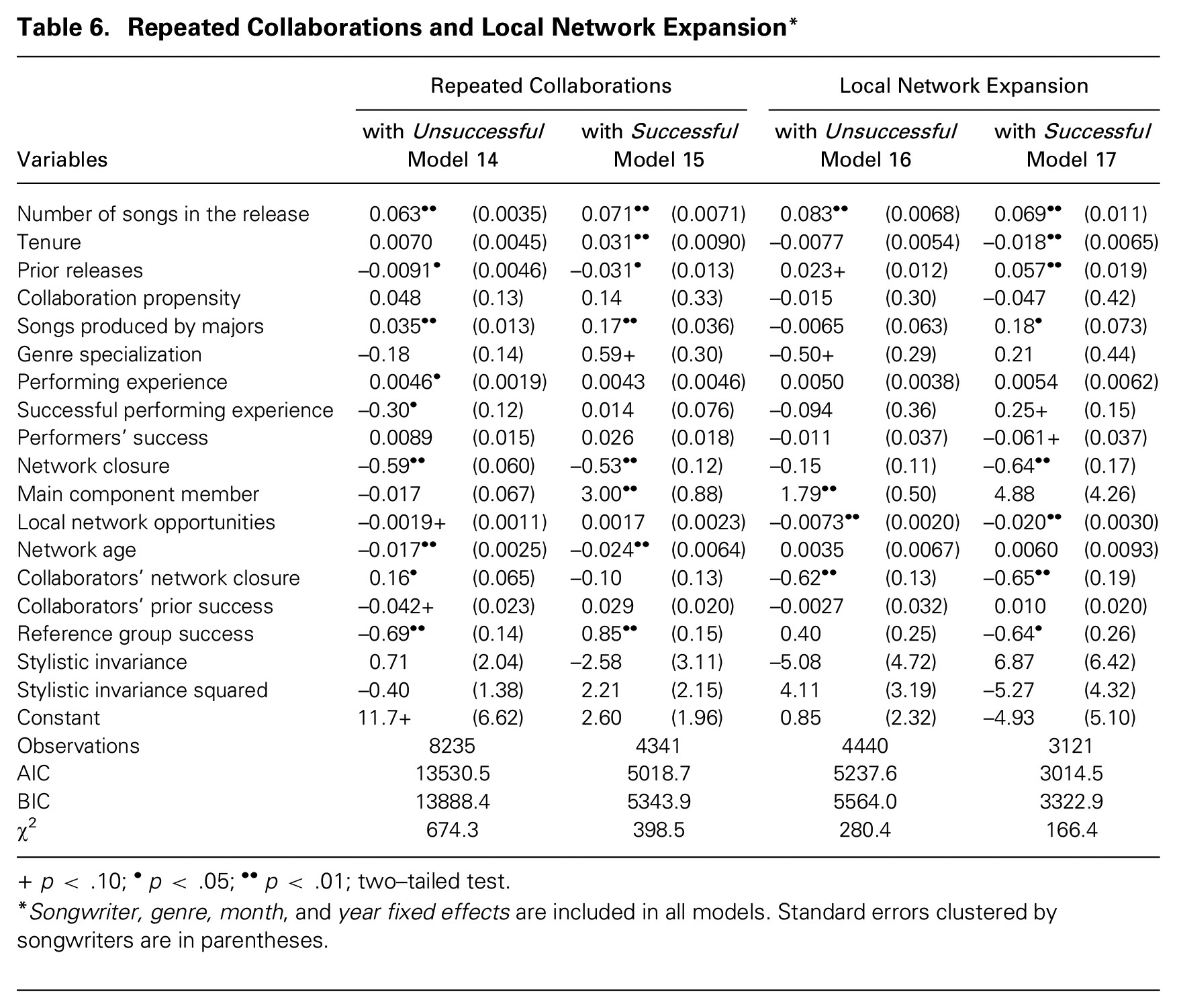
Our hypotheses focus on the effect that the success of people in a songwriter’s reference group and the stylistic invariance of her songs have on distant network expansion. Yet it is pertinent to ask whether these variables have a similar effect on new local collaborations. These collaborations consist of new projects with current collaborators (that is, repeated collaborations) or with the collaborators of these collaborators—that is, local network expansion with parties who were two steps away from the focal songwriter. To answer this question, we run the same conditional negative binomial models (model 4) used to predict distant network expansion on these two types of local collaborations. The results are shown in Table 6.
Repeated Collaborations and Local Network Expansion*
p < .10; •p < .05; ••p < .01; two–tailed test.
Songwriter, genre, month, and year fixed effects are included in all models. Standard errors clustered by songwriters are in parentheses.
Models 14 and 15 in Table 6 show that the effects of reference group success on repeated collaborations are the opposite of those for distant network expansion. Specifically, the effect is negative for new collaborations with unsuccessful prior collaborators (β = –0.69, p<.01 in model 14) and positive for those with successful ones (β = 0.85, p<.01 in model 15). Models 16 and 17 show that reference group success does not have a statistically significant effect on local network expansion (β = 0.40, p = .12 in model 16), which contrasts with the significant positive effect of this variable on distant network expansion (β = 0.59, p<.01 in model 6). Yet the success of a songwriter’s reference group still makes local expansion with successful new local songwriters unlikely (β = –0.64, p<.01 in model 17). Stylistic invariance, our other independent variable, is not a significant predictor of any form of local collaboration in any of the models, as none of the coefficients approaches statistical significance. Except for the difficulty to collaborate with new successful local parties, the local expansion of an unsuccessful songwriter’s network seems to be largely independent of the two factors that affect the distant expansion of that network.
The analysis of local collaboration helps us to refine the interpretation of our results and to clarify how early-career songwriters navigate the transition from a closed to an open network. An unsuccessful songwriter with a successful reference group continues to work with her successful collaborators but does not repeat collaborations with unsuccessful ones. Rather, she starts collaborating with unsuccessful distant parties while consolidating her relationships with her successful collaborators—presumably to secure a steady flow of opportunities while exploring riskier distant relationships. Those new distant collaborations are not simply triggered by the lack of collaboration opportunities in her local network. Rather, entering distant collaborations is a way to expand her exposure to musical trends and ideas, creating new brokerage opportunities in her networks.
Discussion
The idea that actors have some level of control over their social relationships and thus can affect the composition and the structure of their social networks has been often implicit in the research linking networks with career outcomes (Burt, 2010: 222–223; Tasselli and Kilduff, 2021). Network studies have often associated network closure with positive outcomes for actors who lack the formal authority, status, or reputation to be recognized as legitimate players by their colleagues or audiences. Network closure, however, is typically an obstacle to developing a successful career. Across a variety of fields, success is typically associated with the brokerage opportunities provided by open, low-closure networks. Yet the question of how and when actors transition from a high-closure network that helps people survive in the earlier stages of their career to a network that is rich in the brokerage opportunities associated with a successful career has been largely absent in studies linking networks to career outcomes. We sought to fill this gap by developing and testing a theory of the factors that induce early-career freelance songwriters to start collaborating with distant colleagues and transition from a closed to an open network of collaborators, as well as the barriers they encounter when they navigate through that transition.
Our theory of network transition brings together three theoretical streams: social comparison, behavioral change after failing to attain a goal, and status homophily. Our contribution is to bring them together to formulate a theory of how individuals transition from a closed network that helps them survive early-career challenges to an open network that provides the opportunities for brokerage associated with career success. Social comparison and past failure can drive behavioral change (i.e., distant network expansion), whereas status homophily poses limitations to that change. We argue that such transition is implicit in the literature linking network structures to career outcomes, but it has not been systematically theorized. Although rectifying this omission is important for our understanding of careers in general, it is especially important for careers that do not evolve within formal organizations because people in such careers cannot benefit from the networking opportunities opened by regular promotions and transfers that are common in those organizations (Kleinbaum, 2012). While people whose careers evolve in formal organizations still need to take advantage of those opportunities to renew and expand their professional networks, freelancers and entrepreneurs may also have to create such opportunities, adding difficulty to their tasks. As such, our research contributes to the increasingly important study of the evolution of “boundaryless careers” of skilled professionals (Arthur and Rousseau, 1996; Ashford, George, and Blatt, 2007; Tams and Arthur, 2010; Cappelli and Keller, 2013).
Our findings can contribute to several research streams in network and organization theory. First, our study extends prior research linking network change and performance feedback theory, showing that failure to meet aspirations can induce firms to partner with distant collaborators (Baum et al., 2005). Our findings confirm this tendency but add an important nuance by showing that, at least in some contexts, such distant collaborations are more likely to occur with actors who are facing a predicament similar to the one facing the focal actor—in our case, songwriters who are also striving to attain their first commercial hit.
Second, this study has implications for the literature on status signals (Podolny, 1993; see Podolny, 2005, for a comprehensive review). This literature assumes that connections to high-status actors can be a signal of the unobserved qualities of the lower-status party, which could increase her chances of building relationships with strangers. Yet our findings suggest that high-status affiliations can sometimes hinder subsequent ties between low-status actors and high-status distant parties. This opens the possibility that, at least in some contexts, the high-status connections of a low-status focal actor may be viewed as a negative signal by distant high-status parties when these affiliations did not help the focal actor to move ahead in her career. Our interpretation is consistent with the fact that the negative effect of high-status affiliations increases with the tenure of the unsuccessful songwriter. The longer her tenure, the more her affiliations with high-status colleagues become a negative signal for high-status strangers. High-status affiliations can be a signal of unobserved quality, but they can turn into the opposite if the actor cannot perform according to the inferred quality. Slavich and Castellucci (2016) made a similar point in their study of apprentice–master chef relationships in the restaurant industry.
Third, our results suggest a boundary condition to the idea that early-career actors may need to develop a clear, focused identity to attract the attention of potential associates (Zuckerman et al., 2003). To the extent that creating songs of a highly similar style can be considered a signal of having a focused identity as a songwriter, our findings suggest that such a strong identity can make it harder for an early-career actor to expand her network and escape a potential survival trap. A focused identity may help early-career actors survive in the precarious world of creative industries while they strive for their first noticeable success, but this survival strategy may come at the expense of jeopardizing their ability to do the things that can help them attain that success, like expanding their collaboration network. This finding adds an interesting nuance to the idea that actors need to leave behind a focused identity as they advance beyond the early stages of their careers (Zuckerman et al., 2003).
Fourth, our paper has implications for the inequality often observed in creative industries (Menger, 1999). Our findings suggest that unsuccessful early-career actors find it difficult to collaborate with successful distant partners, presumably because successful actors prefer to work with other successful colleagues. Over time, this pattern can produce significant inequality in the access to resources among actors and reinforces the divide between successful and unsuccessful actors. This inequality is apparent in the concentration of commercial success among K-pop songwriters: 85.5 percent of the songwriters who made their debut during our study period never had a hit song, and only 5 percent had more than one hit during our observation period. Among these, a tiny minority (0.6 percent) had 10 or more hit songs. Inequality is also apparent in the collaboration network. The networks of successful songwriters are larger (10.84 versus 3.36 collaborators, p<.01) and have more successful collaborators than do the networks of their unsuccessful colleagues (5.95 versus 1.00, p<.01). These inequalities may be strengthening over time. The Gini index for the distribution of network size increases from 0.613 in the first 36 months to 0.730 in the last 36 months of our observation period. The pattern is similar when we use Bonacich’s (1987) eigenvector centrality measure for the songwriters who are connected to the main component of the network, which weights an actor’s centrality by the centrality of the people in her network (e.g., Podolny, 1993).
The inequality in the distribution of resources and outcomes, as well as the status homophily among successful songwriters, can result in a typical core–periphery status hierarchy (Gould, 2002) in which high-status (i.e., successful) songwriters collaborate mostly among themselves and unsuccessful ones struggle to attract their attention (see Gulati and Gargiulo, 1999, for a similar pattern in strategic alliance networks). Successful songwriters may occasionally collaborate with distant unsuccessful colleagues. While rare, these status-heterophilous collaborations may suffice to allow for a permanent influx of new musical ideas into the core of the network (Cattani and Ferriani, 2008). While this helps the lucky few become connected to the core, it also contributes to the consolidation of the existing structural inequality. This process complements the idea proposed by Chu (2018), who used a numerical model to show how increasing competition can sustain durable dominance.
Although understanding the musical evolution of K-pop is beyond the scope of this study, our findings may allow us to speculate about the potential micro-foundations of this evolution. Unlike other popular music forms (Silver, Lee, and Childress, 2016), the evolution of K-pop during our observation period did not result in separated clusters of artists who consistently cultivated a distinctive style within an overarching common umbrella (Lena, 2012). A plausible explanation for this evolution may reside in the behavior of the songwriters documented here. Their eagerness to collaborate with distant fellow songwriters and the lack of geographical barriers might have led songwriters seeking their first success to contribute to the constant recombination of musical trends and ideas throughout the network, effectively preventing the consolidation of distinctive musical clusters within K-pop. Whether or not this characteristic would persist once K-pop becomes a more mature field is something that cannot be predicted from our results. Future research might advance in this direction by linking the patterns of collaboration between artists to the evolution of styles in popular music in general, as well as to the emergence of distinctive clusters within that music (see Phillips, 2011, for an example on the evolution of jazz).
Our research also highlights the role individual actors play in shaping the dynamics of social networks. The nature of our data prevents us from precisely allocating agency to the focal songwriter or the distant party in the consummation of the relationships that enable network transitions. Yet our findings are consistent with the idea that social actors can and do exert some level of control over their relationships (Sewell, 1992), irrespective of which party makes the initial move to secure the new collaboration. Several factors support this interpretation. First, entering distant collaborations requires that songwriters overcome the structural and psychological forces that favor local relationships, as documented in prior research (e.g., Gargiulo and Benassi, 2000). At its minimum, this manifests in accepting a risky invitation to collaborate from a stranger without having clear reassurances about that person’s abilities and trustworthiness. At its maximum, it requires actively seeking out and persuading that stranger. The first scenario satisfies the minimal requirement for agentic behavior, defined as “the capacity of actors to make practical and normative judgments among alternative possible trajectories of action, in response to the emerging demands, dilemmas, and ambiguities of presently evolving situations” (Emirbayer and Mische, 1998: 971).
Our data do not allow us to provide conclusive evidence of the more overtly agentic behavior depicted in the second scenario, but the results of the supplementary analyses reported above are more consistent with the image of an actor who seeks out opportunities to bring new distant parties into her network than with the one in which a passive individual simply benefits from the opportunities created by the actions of distant parties. Although both scenarios are possible, our results suggest that the transition from an individual network characterized by network closure to one that is rich in brokerage opportunities cannot be explained adequately without invoking some agency by the actor undergoing that transition. It is also worth mentioning that the very nature of the interaction rituals that precede the formation of a new personal or professional relationship often makes it almost impossible to univocally attribute agency to one of the parties (Collins, 2004). In most cases, the proposal that elicits a positive response is only the last link in a long chain of events in which both parties take actions that make this proposal increasingly likely to be made by one party and accepted by the other.
While our primary focus is on understanding how professionals avoid falling into a potential survival trap by transitioning from the closed network that helps them in the early stages of their career toward a more open network that helps them succeed, our theory does not preclude subsequent increases in network closure during the professional career. A songwriter who expanded her network to increase her exposure to different musical ideas and trends may at some point halt that expansion to focus on the consolidation of her new relationships, either because she achieved the coveted first hit and now focuses on exploiting the new ideas and relationships that helped her succeed to create new hit songs or because the failure to attain the first hit forces her to consolidate her local network to survive, even if this reduces her chances of attaining the first hit (see Mizruchi and Stearns, 2001, for a similar pattern among retail bankers facing uncertainty). When the creative potential of the new ideas dwindles, or once survival is sufficiently secured, the songwriter may go back into a new exploration period to advance her career and start a new episode of distant network expansion. This pattern would be consistent with the “oscillation” identified by Burt and Merluzzi (2016) in their analysis of network dynamics among investment bankers (see Reilly, 2017, for a similar pattern among stand-up comedians).
Despite the richness of the data, our study faces limitations that should be considered when assessing the boundary conditions for our results. Although we could track down collaboration networks from the start for everyone who started their career during our observation period, the formation of these networks could have been affected by unobserved relationships that preceded the artistic collaboration between songwriters. This may be particularly important during the early stages of their careers because the lack of a network of collaborators and of reputation makes it difficult for songwriters to establish collaborative relationships. Exogenous factors that make such relationships more or less likely could also introduce noise in our measure of songwriters’ networks. Yet, most K-pop songwriters are culturally homogenous and geographically proximate, which may make the effect of homophily and propinquity less likely to be consequential in our setting. Caution should be exercised when generalizing from the results obtained in a relatively unusual setting like the one analyzed here. We believe our findings are likely to apply to an array of careers in which collaboration to create outputs is the norm (Jones, 1996). While this type of career is becoming pervasive in the new economy (Spreitzer, Cameron, and Garrett, 2017), the relative absence of institutional forces shaping the careers of freelance songwriters makes our setting unusual even among artistic labor markets (cf. Lingo and O’Mahony, 2010). At the same time, our findings resonate with studies of networks’ role in entrepreneurial success in markedly different contexts (Portes and Sensenbrenner, 1993; Vissa, 2012), suggesting that the network transition process we documented among K-pop songwriters might be observable in a variety of seemingly unrelated settings.
The transition from closure to brokerage is an essential part of a successful career. Actors who fail to navigate this transition may survive but are less likely to succeed, as the network that helped them survive can become a survival trap. Ambitious actors need to exploit the opportunities offered by their position in the network while at the same time circumventing the constraints that network creates. Actors are prompted into action when they fall behind the aspirations defined by their reference group and by the realization that their efforts result in similar and equally unsuccessful outcomes. Yet some of the conditions that make actors more likely to explore ways to expand their networks beyond their local neighborhood also make them less attractive collaborators for successful distant peers, forcing them to rely on unsuccessful ones instead. Some actors overcome these limitations and create the conditions to succeed and advance their careers. They may be induced by factors that prompt them into action, but network transitions cannot happen without this action. As Burt (2012: 545) noted, “connections with certain people and not others can facilitate or inhibit action, but people are the source of action.”
Footnotes
Acknowledgements
We thank Ron Burt, Bill McEvily, Sameer Srivastava, Phanish Puranam, Henning Piezunka, Pavel Zhelyazkov, Yong H. Kim, and the participants of the Annual Academy of Management Meeting (2015), INSEAD Network Evolution Conference (2016), Wharton People and Organization Conference (2017), AMRC (2017), ION Conference at University of Kentucky (2018), as well as the seminar attendees at ESMT, Korea University, Seoul National University, CEIBS, University of Hong Kong, Hong Kong University of Science and Technology, and INSEAD for their comments and suggestions on earlier versions of the manuscript. We also thank Associate Editor Maxim Sytch and three anonymous reviewers for their helpful guidance and constructive feedback. We are grateful to Jungmin Lee and Ji Ho Park for their help in our data collection effort. We would like to acknowledge generous support from INSEAD (2520-9GARGIU) and HKUST (IGN15BM05). All remaining errors are ours.
