



Abstract
Firms increasingly offer employees the opportunity to participate in firm-sponsored social impact initiatives expected to benefit the firm and employees. We argue that participation in such initiatives hinders employees’ advancement in their firms by reducing others’ perceptions of their fit and commitment. Because social impact work is more congruent with female than male gender role stereotypes, promotion rates will be lower for participating men, and male evaluators will be less likely than female evaluators to recommend promotion for male participants. Using panel data on 1,379 employees of a consulting firm, we find significantly lower promotion rates for male participants relative to female participants, female non-participants, and male non-participants. A vignette experiment involving 893 managers shows that lower promotion rates are due to lower perceptions of fit, but not commitment, and greater bias against male participants by male evaluators. Taken together, the results of the two studies suggest that the negative effect of participation on promotion is conditional upon participant and evaluator gender, underscoring the role of gender in evaluation of social impact work. In settings in which decision makers are predominately male, gender beliefs may limit male employees’ latitude to contribute to the firm’s social impact agenda.
Is doing social good also good for one’s career? The role of business in society has been the subject of considerable research attention (Margolis and Walsh, 2003; Godfrey, 2005; Bies et al., 2007; Mahoney, McGahan, and Pitelis, 2009; Tilcsik and Marquis, 2013), and evidence has accumulated for both financial and reputational benefits of corporate social responsibility (Eccles, Ioannou, and Serafeim, 2014; Henisz, Dorobantu, and Nartey, 2014). As companies explore different means to engage with society, a new form of corporate social engagement has emerged: corporate social initiatives through which employees can engage in social impact work within their corporate roles via short-term projects (Marquis and Kanter, 2009; Grant, 2012; Aguinis and Glavas, 2013; Murray, 2016; Carnahan, Kryscynski, and Olson, 2017; Gatignon, 2019). Examples include disaster relief operations, consulting services offered to not-for-profit organizations, and community work. These initiatives have been associated with several organizational benefits including improved recruitment (Jones, Willness, and Madey, 2014; Hedblom, Hickman, and List, 2019), mitigation of adverse employee behavior (Flammer and Luo, 2017), and increased employee identification and retention (Glavas and Godwin, 2013; Bode, Singh, and Rogan, 2015). Accordingly, the idea that firms can do well by doing good has gained increasing acceptance among scholars and practitioners.
Although firms are presumed to do well when sponsoring social initiatives, it is less clear whether employees benefit professionally from participating in them. Scholars have identified mostly intangible benefits, such as increased personal fulfillment and meaning associated with the pro-social nature of the activity (Bartel, 2001; Bunderson and Thompson, 2009; Glavas and Kelley, 2014). Indeed, personal fulfillment is believed to underlie the association between participation in social impact work and improved employee retention (Bode, Singh, and Rogan, 2015). Scholars and practitioners have also argued that participating in social initiatives could benefit employees through enhanced skills development (Bartel, 2001; Peterson, 2003; Bhattacharya, Sen, and Korschun, 2008; Bode and Singh, 2018; Burbano, Mamer, and Snyder, 2018), which in turn should provide greater advancement possibilities in the firm. Participation provides employees with so-called stretch roles that grant them responsibilities not normally associated with their positions in the firm, as well as opportunities to interact with diverse and often senior stakeholders. Upon returning to their regular roles in the firm, employees might apply new skills and knowledge to the firm’s commercial work, aiding their performance. Thus prior research into employee-side factors, such as skills development, might lead one to expect a positive correlation between employee participation in corporate social initiatives and career advancement in the firm.
Yet career outcomes, such as promotions, depend not only on employee-side factors but also on evaluator-side factors. Attention to the latter is crucial because the same behavior can be interpreted differently depending on the characteristics of the actor and the evaluator. Evaluators are embedded in institutional environments that shape their beliefs about the types of behaviors that are appropriate or inappropriate and should be rewarded or punished (Zucker, 1977, 1983). An employee’s choice to participate in a social initiative sends a signal (Bills, 2003; Ferguson and Hasan, 2013) that may be interpreted differently by decision makers (i.e., evaluators) in the firm. 1 In contrast to the assumed career benefits from social impact work, there are at least two reasons why evaluations of participating employees could be negative. First, despite increased social engagement by firms, social impact work still diverges from preconceptions of what constitutes normal corporate work. Even when an initiative is approved and encouraged by the firm’s leadership, it may suffer from low cognitive legitimacy because it is relatively new (Dougherty and Heller, 1994; Suchman, 1995). Second, because participation involves investment in activities outside of the firm’s commercial business, evaluators may question participating employees’ involvement even when the initiative is firm-sponsored. It is well established in organization theory that even activities sponsored by a firm’s top management may be perceived negatively by decision makers when those activities are unrelated to current activities or are counter to other members’ self-interests (Cyert and March, 1963). Thus, differences in evaluators’ interpretations of employees’ participation in social initiatives—and not only employee-side factors—could affect career outcomes.
The evaluation of participation in corporate social impact initiatives may also depend in important ways on gender—both the employee’s and the evaluator’s. Prior research into social impact has largely focused on a key distinguishing feature of such work: it is social rather than commercial. But the communal, service-oriented behaviors associated with social impact work are closely related to the behaviors expected of women, as identified in research on gender role stereotypes (Wilson and Musick, 1997; Eagly and Karau, 2002; Heilman and Chen, 2005). Men are often penalized for succeeding in jobs with these characteristics (Rudman and Phelan, 2008; Heilman and Wallen, 2010; Bosak et al., 2018) because their success violates normative ideals of men’s roles in society (Ridgeway and Correll, 2004; Thébaud and Pedulla, 2016). Thus evaluators’ own gender beliefs are likely to affect their judgments of employees participating in social impact initiatives.
In addition, gender homophily between the evaluator and the employee may affect an evaluator’s judgment of an employee’s participation in a social initiative. Homophily is often associated with in-group favoritism, whereby women positively evaluate women and men positively evaluate men (Turner 1975; Tajfel, 1982). But when behavior violates the group’s norms, homophily can be associated with negative evaluations of in-group members because these violations threaten the group’s identity (Marques, Yzerbyt, and Leyens, 1988; Abrams and Hogg, 2010). Individuals may have even stronger negative reactions if they perceive the behaviors as threatening their group’s status. According to status characteristics theory, gender forms the basis of a status hierarchy in society in which men are usually held in higher esteem than women (Ridgeway, 2001, 2011). Therefore, a male evaluator could view other men’s participation in social initiatives not only as a violation of masculine gender norms but also as a threat to his own status and identity—and as a result be particularly harsh in evaluating them.
To investigate the question of how participating in corporate social initiatives affects evaluations of male and female employees, we analyze the effect of prior participation in a corporate social initiative on employees’ likelihood of promotion. We propose two evaluator-side mechanisms for the predicted negative effect of participation on promotion likelihood. First, the lower legitimacy of corporate social initiatives could lead evaluators to judge participation as a signal of an employee’s lack of fit with the firm. Second, the non-commercial nature of social impact work could lead evaluators to interpret participation as a signal of lower commitment to the firm. Furthermore, these mechanisms are likely to outweigh the potential positive effect of leadership skills that may be developed via participation in social impact projects. Empirical research has shown that, counterintuitively, leadership skills influence promotions much less than other factors, such as past behaviors and performance (Benson, Li, and Shue, 2019). With regard to gender beliefs, we propose that men who participate will be judged as having a lower fit and lower commitment than women who participate and will be less likely to be promoted. Finally, given the threats to identity and status that another man’s participation could pose to male evaluators, male evaluators should be less likely than their female counterparts to recommend promotions for participating men. Our central argument is that both participant gender and evaluator gender moderate the relationship between employee participation and subsequent promotion rates.
We test these predictions in two studies. First, using proprietary human resource data on 1,379 employees in a large multinational consulting firm, we observed employees’ project assignments, including their participation in social impact initiatives, and promotion to manager over a five-year period. We estimated the effect of participating in a corporate social initiative on the likelihood of promotion within the firm and how this effect varies for men and women. Second, we conducted a randomized vignette experiment involving 893 subjects with prior work experience in senior corporate roles. We varied employee gender and employee participation in social impact work across four fictitious employee profiles. Because this experimental study holds employee-side factors other than gender constant, it is not subject to biases from unobservable heterogeneity among employees. This study also effectively disentangles evaluator-side factors from employee-side factors, allowing for inferences concerning evaluator-side effects on the promotion of employees who have participated in social impact work.
Employee Participation in Corporate Social Initiatives and Promotions
There has been increasing recognition that corporate social engagement and firm performance can be positively linked (Margolis and Walsh, 2003; Eccles, Ioannou, and Serafeim, 2014), in particular through strategic human capital benefits. Social engagement can facilitate recruitment (Jones, Willness, and Madey, 2014; Hedblom, Hickman, and List, 2019), increase employees’ identification with the firm (Glavas and Godwin, 2013), and reduce the voluntary attrition of high-performing employees (Bode, Singh, and Rogan, 2015; Carnahan, Kryscynski, and Olson, 2017). Studies have also shown that firms strategically use social engagement as a lever to manage absenteeism and shirking (see, e.g., Flammer and Luo, 2017).
Participation in social initiatives could also be beneficial for the employee, especially when it provides opportunities for employees to take on more demanding roles with greater responsibilities earlier in their careers (Burbano, Mamer, and Snyder, 2018). Through these roles, employees gain new skills and knowledge, such as organizational leadership and stakeholder management. Those skills can then be applied to their commercial work, in particular as they move into managerial roles (Bartel, 2001; Grant and Berry, 2011; Bode and Singh, 2018). Accordingly, one might assume that participation in social impact work would have a positive effect on employee promotions. Although in principle the skills gained during participation should be positively linked to promotion outcomes, it is also important to consider how organizational members charged with making promotion decisions perceive an employee’s choice to participate in corporate social impact activities. Whether participation in corporate social initiatives actually improves promotion possibilities is likely to depend on how decision makers evaluate the signal that participation sends (Bills, 2003; Ferguson and Hasan, 2013).
Social Impact Initiatives and Promotions
Although one might expect the most able employees for the job to be promoted, in many firms promotion decisions are highly subjective (Hitt and Barr, 1989; Powell and Butterfield, 1994; Beckman and Phillips, 2005; Ng et al., 2005) and are not necessarily based on the employee’s ability to do the job to which they are being promoted (Peter and Hull, 1969). Among subjective criteria affecting promotions, two that have been the focus of prior research are perceptions of an employee’s fit with the firm, or person–organization fit (Pfeffer and Cohen, 1984; O’Reilly, Chatman, and Caldwell, 1991; Goldberg et al., 2016), and the level of perceived commitment of the employee (Hall, 1976; Shore, Barksdale, and Shore, 1995; Bielby and Bielby, 2002).
Person–organization fit refers to the congruence between the values and goals of a person and those of the organization for which they work (Chatman, 1991; O’Reilly, Chatman, and Caldwell, 1991). Values are fundamental elements of organizational culture, which plays a key role in determining how well an individual fits into an organization (Rousseau, 1990). Hence perceived fit is largely determined by how other members view an employee’s conformity to the cultural norms, values, and expectations set by members of the organization—in particular by the senior leaders who make hiring and promotion decisions (Turban and Dougherty, 1994; Podolny and Baron, 1997). Illustrating this point, in research on managers’ hiring decisions, Rivera (2012) presented evidence that fit—the extent to which candidates are culturally similar to others in the firm—often outweighs concerns about productivity because managers feel better able to assess the relative merit of such candidates. Perceived fit should also play a similar role in promotions, whereby managers would find it more difficult to evaluate an employee who diverges from the organization’s norms.
A second driver of promotion is the level of an employee’s perceived commitment (Bielby and Bielby, 2002); the “effort and dedication that a worker is perceived to put forth” significantly influence the evaluation of an employee (Pedulla, 2016: 266). As an example, Pedulla (2016) has argued and shown that engaging in part-time work can increase perceptions of lower commitment. Similarly, in a study of managers and subordinates in a large multinational firm, Shore and colleagues (1995) found a positive correlation between managerial perceptions of employee commitment and promotability. Certainly, lower actual commitment can reduce promotion likelihood if it affects an employee’s investment in human capital. In Becker’s (1985) allocation of energy model, engagement in activities unrelated to work, such as childcare, reduces employees’ likelihood of seeking challenging work and thus reduces their investment in human capital, leading to lower promotion rates. Yet perceived commitment affects promotion regardless of the employee’s actual commitment, especially when subjective criteria affect decisions.
In addition to these subjective criteria, an employee’s past performance and behaviors are also key determinants of promotion, even if these are not indicative of performance in the future role (e.g., Benson, Li, and Shue, 2019). Hence, skills that may be useful in the future role are often discounted in promotion decisions. Although employees may claim to have acquired valuable leadership skills, these can be difficult to observe, especially if the skills will not be applied until after the employee has been promoted. Furthermore, even if decision makers are aware of employees’ skill development, they may not necessarily use this information in making their promotion decisions, in particular because promotion is often used as an incentive for employees to perform well in their current roles (Baker, Jensen, and Murphy, 1988). Instead, decision makers often weigh past behavior and performance more heavily than employees’ potential in the new role (Peter and Hull, 1969). As illustrated in a large-scale empirical study by Benson, Li, and Shue (2019), promotions to manager in sales organizations were driven more by past performance than managerial ability, leading to poorer promotion decisions.
Given the nature of promotion decisions, how would participation in a corporate social initiative affect an employee’s likelihood of being promoted? As we have described, the answer depends in part on how participation affects decision makers’ judgments about the employee’s fit with the firm and the employee’s commitment to the firm and career. What distinguishes corporate social impact work from commercial work is the former’s focus on delivering social impact to a target beneficiary (e.g., a logistics company’s aid to a community affected by disaster, or a law firm’s pro bono services for people unable to pay for legal advice) rather than increasing the firm’s financial performance (Marquis, Glynn, and Davis, 2007). This emphasis of creation of social impact over achieving commercial goals often offers employees meaning that may not be provided by their daily jobs (Wilson, 2000; Rosso, Dekas, and Wrzesniewski, 2010; Glavas and Kelley, 2014).
But the alternative focus on social impact also underlies two characteristics of social impact work that could negatively affect the perceived fit and commitment of employees who participate. First, even when firms engage in social initiatives with the support of top management, other members of the firm may view corporate social impact initiatives as lacking legitimacy (Suchman, 1995; Tost, 2011; Bitektine and Haack, 2015). The novelty of corporate social initiatives means that they often have low cognitive legitimacy, i.e., “taken-for-granted-ness.” When it comes to promotions, supervisors may not know how to judge an employee’s participation in such an initiative. This argument does not imply that organizational members necessarily oppose their firm engaging in social impact work but rather that they struggle to understand how to evaluate employee participation—in particular, how it affects promotion eligibility in light of existing norms. In addition, although a firm’s managers may claim that they value social impact, their actions could conflict with their stated beliefs. In related research, investors’ actual investments indicate that they do not prioritize social impact to the same degree as commercial performance even when they state that they do (Hawn, Chatterji, and Mitchell, 2018).
Second, social impact work often requires participating employees to invest their time in activities that do not directly contribute to the firm’s financial performance. Evaluators may therefore question participating employees’ commitment to the firm’s commercial goals. When social impact activities involve peripheral corporate social responsibility (CSR) work—rather than embedded CSR, which is integrated with the firm’s business strategy and operations (Aguinis and Glavas, 2013)—commitment concerns may become particularly salient. 2 Perceptions of employees’ prioritization of other activities or goals above their main responsibilities can trigger perceptions of lower commitment, analogous to extant work showing that employees exercising the option for flexible work practice are often seen as lacking commitment (Leslie et al., 2012) or that individuals who take leaves of absence are less likely to be promoted (Judiesch and Lyness, 1999). If social impact work is viewed similarly, employees who participate may be seen as less committed to their careers with the firm. Together, the fit and commitment concerns associated with corporate social initiatives suggest that evaluators may perceive employees’ choice to participate negatively and thus may be less likely to promote those who do participate.
It is possible that employees develop commercially relevant skills through participation in corporate social impact work, as the extant literature has suggested, which in principle should boost chances of promotion. For example, compared with a typical commercial project, on a corporate social impact project a junior employee might have more interactions with a client’s senior leadership, providing leadership skills development. But such factors may not be key in promotion decisions. First, although an employee may claim to have gained valuable skills, these can be difficult to observe, especially if the skills would not be applied until after the employee has reached a managerial role. Second, past research shows that even if managers are aware of employees’ skill development, they often do not use this information when making their promotion decisions. As evidenced by Benson, Li, and Shue (2019), leadership skills indicative of an employee’s potential as a manager are often outweighed during promotion decisions by past performance and behaviors. Thus although skills gained through participation in social impact work suggest an employee would have higher potential in the long term, they may not affect the near-term promotion decision.
We therefore expect that, on average (i.e., holding an employee’s past performance constant), participation in a corporate social initiative negatively affects an employee’s promotion likelihood and hypothesize as follows:
Gender Roles, Social Impact Initiatives, and Promotions
The subjective nature of promotions suggests that not all employees might be penalized for participation in social initiatives and that there will be variance in promotion likelihood among those who participate. In other words, decision makers may judge participation differently depending on the participant’s characteristics. While there are several demographic and personality factors that can influence career advancement (Bertrand and Mullainathan, 2004; Fang et al., 2015), a large body of evidence shows that gender is a critical factor affecting decision makers’ judgments (Kanter, 1977; Baron, Davis-Blake, and Bielby, 1986; Bielby and Baron, 1986; Cohen, Broschak, and Haveman, 1998; Beckman and Phillips, 2005). The main emphasis of gender studies in the careers literature to date has been to explain the persistent pattern of lower career advancement for women (Burt, 1998; Hultin and Szulkin, 1999; Bertrand and Hallock, 2001; Gorman and Kmec, 2009; Castilla and Benard, 2010; Merluzzi and Dobrev, 2015) and the segregation of women and men into different occupations (Reskin and McBrier, 2000; Correll, 2001, 2004). Experimental studies have shown that, on average, men are more likely to be judged as fitting with the expectations of senior roles in a corporate context whereas women are viewed as less legitimate candidates—regardless of their behavior (Eagly and Karau, 2002). Moreover, gender bias is more likely to affect decisions when ambiguity is high, i.e., when there is a poor definition of evaluation criteria (Nieva and Gutek, 1980; Heilman, 2012).
Most of the extant research into corporate social engagement has focused on the societal dimension of the work as its distinguishing aspect vis-à-vis the firm’s other activities (e.g., Bode, Singh, and Rogan, 2015; Carnahan, Kryscynski, and Olson, 2017; Kaul and Luo, 2018). Yet fully assessing the effect of social impact work on promotion requires attention to gender roles. Prior research indicates that in general, women are stereotyped as less competitive, less motivated by financial compensation, more likely to act communally (Eagly, Wood, and Diekman, 2000), and more likely to value social impact than men (Gilligan, 1977; Kish-Gephart, Harrison, and Treviño, 2010; Barbulescu and Bidwell, 2013). The female role stereotype is one of nurturing and caring, which is more in line with social impact work than is the male role stereotype (Cejka and Eagly, 1999). Thus, to evaluators, women’s involvement in social impact work may be better aligned with their gender role stereotype.
Men’s participation in social impact work, in contrast, is less expected and more likely to violate their gender role stereotypes (Heilman and Wallen, 2010; Heilman, 2012). In social psychology research, men who behave in ways that violate masculine role stereotypes in general often experience backlash in the form of social and economic penalties (Phelan, Moss-Racusin, and Rudman, 2008; Moss-Racusin, Phelan, and Rudman, 2010). According to Rudman and Phelan (2008: 73), “backlash effects help to preserve gender stereotypes by keeping atypical men and women out of the spotlight.” In related research in the context of a consulting firm, Reid (2015a) found that men were socially permitted to take time off for events like exotic vacations, which symbolize commercial career success, but not for childcare or reasons related to work−life balance. Furthermore, men tend to avoid revealing that they engage in the latter kind of practices because engaging in them is seen as violating normative ideals regarding men’s role in society (Reid, 2015b; Thébaud and Pedulla, 2016). Experimental research has also found that men can be penalized for performing well in jobs that violate masculine gender norms (Heilman and Wallen, 2010). Thus, to the extent that participation in social impact work is considered women’s work, men’s participation in such work is likely to be viewed as violating norms.
Given the association of social impact work with the female gender role stereotype, the interpretation of participation in social impact initiatives is likely to be affected by the evaluators’ gender beliefs, especially when ambiguity is high (Heilman, 2012). In general, men are viewed as more “status worthy and competent, and more competent at the things that count” (Ridgeway and Correll, 2004: 513). Because social impact initiatives “don’t count” as much as commercial work in for-profit firms, social impact work may not be viewed as appropriate or legitimate work for men. Evaluators may therefore be more likely to judge men who participate as having a lower fit with the firm and, consequently, less likely to recommend their promotions. They may also perceive men who participate in social impact initiatives as less committed. Related experimental research on family leave found that, compared with women, men who ask for family leave suffer more negative reactions from evaluators (Wayne and Codeiro, 2003) and are rated lower on organizational commitment and viewed as less eligible for rewards (Allen and Russell, 1999). Similarly, in a study of hiring decisions, Pedulla (2016) found that men were penalized more heavily than women for part-time work practices because decision makers attributed men’s part-time work to lower commitment.
In contrast, for the female employee, participation in social impact work is less likely to be interpreted as signaling lower fit and commitment, because the choice to take part is more expected of women. Furthermore, since decision makers often already assume that women are less committed to their careers than are men (Marsden, Kalleberg, and Cook, 1993), they are less likely to change their beliefs about a woman’s commitment following her participation in social impact work. In other words, a woman’s participation offers less new information for the promotion decision—i.e., either it provides a weak signal, or the interpretation of the signal is consistent with prior beliefs—so participation by women is less likely to affect promotion. For men, the effect will be negative. These arguments lead to our third hypothesis:
Evaluator Gender and Judgments of Social Initiative Participation
The evaluator’s gender is also likely to matter in promotion decisions. Evaluators play important roles in the preservation of existing gender stereotypes by sanctioning atypical behavior. Under normal conditions, gender homophily between an evaluator and a subject might be associated with in-group favoritism and more favorable evaluations (Turner, 1975; Tajfel, 1982). Yet when behaviors are counter-normative, gender homophily can have the opposite effect. According to the “black sheep hypothesis,” a violation of gender role stereotypes by a member of the same gender may be perceived as a threat to the group’s identity, and norm violations will receive harsher responses from in-group members than from out-group members (Marques, Yzerbyt, and Leyens, 1988: 1).
Evaluators may also sanction behavior that violates gender roles in order to protect the gender hierarchy (Rudman et al., 2012). Scholars building on status characteristics theory maintain that men historically have been held in higher esteem than women and that gender forms the basis of a status hierarchy in society (Ridgeway, 2001; Ridgeway, 2011). Much research in this area has focused on backlash experienced by women who take on masculine roles that violate the existing hierarchy (Rudman and Glick, 1999; Heilman et al., 2004; Rudman et al., 2012). However, men are also likely to experience backlash if they adopt non-masculine behaviors (e.g., Heilman and Wallen, 2010). When a man who already has high status (as a function of his gender) violates gender norms, his actions may be perceived as threatening the status of his group. Hence men are more likely to react negatively to other men’s violations of gender norms to protect the status hierarchy. As Rudman and Phelan (2008: 72) noted, “Men may be less willing to refrain from backlash . . . if they view it as maintaining gender hegemony.” Consistent with this view, in an experimental study that looked at evaluations of requests for family leave—a behavior associated with the female gender stereotype—male evaluators viewed male family leave requesters more negatively than did female evaluators (Wayne and Codeiro, 2003).
Taken together, arguments regarding gender role stereotypes and status characteristics theory suggest that male evaluators are likely to view other men’s participation in social initiatives negatively. First, considering the black sheep hypothesis and gender role stereotypes, to the extent that male evaluators view men’s participation as a violation of masculine gender norms, it may pose a threat to their own identity. In contrast, female evaluators’ identities would not be threatened by male participation, given that they are not members of the same gender group, nor would they be threatened by female participation because it is not viewed as a violation of gender norms.
Second, regarding status characteristics theory, participation in social impact activities is a type of work more congruent with feminine gender norms and viewed as a lower status activity. Hence men’s participation in social impact work could be viewed as reducing men’s position in the status hierarchy. While female evaluators may see male participation in social impact as counter-normative, they would be less concerned about the effect of the behavior on the status hierarchy because male participation would not pose a status threat to members of their gender. We thus expect that male evaluators will react more negatively than female evaluators to men’s participation in social impact work and will be less likely to recommend promotion:
Study 1: Longitudinal Field Data from a Management Consulting Firm
We tested our hypotheses in two studies. Study 1 is an analysis of longitudinal field data from a management consulting firm. The purpose of this study was to investigate in a field setting whether employees choosing to participate in social impact work were less likely to be promoted (H1) and whether this effect differed for male and female employees (H3). Study 2 is a randomized vignette experiment. It enabled investigation into the evaluator-side effects on promotion decisions for employees who participated in social impact work (H4) and also allowed for testing the proposed mechanisms: fit and commitment (H2).
Setting
The Study 1 context was a management consulting firm that had recently started offering its services to non-profit organizations and development agencies through an initiative that, for confidentiality reasons, we shall refer to as “CSI” (Corporate Social Initiative). This initiative extended the firm’s consulting services to clients that had explicit social impact goals but could not afford the firm’s usual fees. Although CSI was motivated by a desire to address societal problems, the firm hoped this initiative would also yield talent management benefits, such as increased employee motivation, retention, and skills development. From the time of its launch, CSI was supported by the firm’s leadership, including the CEO. Externally, the firm was lauded by the press for the creation of CSI.
Employees could join a CSI project in lieu of working on a commercial project on a short-term basis—typically three to six months. Unlike traditional CSR initiatives, such as employees volunteering to build houses for charities or feed the poor in a soup kitchen, CSI drew on the skill sets also used in the firm’s commercial consulting projects. Clients were charged a reduced fee given their lower ability to pay, and employees accepted a reduced salary for the duration of the CSI project (mean duration of 108 days) to help the initiative be financially self-sustaining. CSI project teams were often smaller than regular project teams, and junior consultants assumed greater leadership roles on CSI projects. Following the same staffing and evaluation processes used for commercial projects, information on upcoming CSI projects, including the location, duration, and client details, was made available to employees on the company’s intranet.
An interested employee could apply for one or more of the available CSI projects, and the staffing manager proposed matches based on the employee’s skills and availability given their current project’s end date and the start date of the CSI project. The staffing manager used three main criteria when matching participants to CSI projects: (1) relevant experience, (2) availability at the start date of the project, and (3) at least average performance ratings. For example, if a CSI project involved logistics management for a non-profit organization’s disaster relief efforts, consultants who had experience in logistics management and who would end their currently assigned commercial project in time to start the CSI project would be selected. Employees were free to either accept or decline CSI offers. Finally, as shown in Online Appendix B (http://journals.sagepub.com/doi/suppl/10.1177/00018392211020660), a consultant’s previous performance rating was positively associated with their likelihood of CSI participation. Demand from employees usually exceeded the supply of CSI projects.
In terms of their career progression, employees typically entered the firm as analysts and could progress to different levels within the firm: consultant, manager, senior manager, and ultimately partner. We confirmed in interviews (described below) that an employee’s performance and chargeability ratings—the percentage of working hours billed to a paying client—were the most critical inputs to promotion decisions. Promotion decisions were approved at the city-office level, regardless of whether an employee had participated in CSI or (if applicable) where their CSI project took place.
Insights from Interviews
We conducted interviews with employees and managers to confirm key assumptions. Our first assumption was that participation in CSI was associated with skills development. Participants we interviewed reported developing skills via CSI participation. One participant explained: I came back a much more confident person in terms of my skills and my ability to deal with senior people. That helped me get on my next project in the commercial practice because in consulting, a huge part of [your success] is how you conduct yourself . . . how you manage people.
Another participant similarly recounted his much greater responsibility on the CSI project, where “everything has to be defined by you, the consultant, and your client team.”
The second assumption was that, because members of firms have divergent interests (Cyert and March, 1963), novel initiatives like CSI face different levels of acceptance within the firm, increasing ambiguity and introducing the potential for evaluator bias. Our interviews revealed varying levels of support for the initiative. At the senior level, senior managers and partners typically viewed CSI as an important activity for the firm. An interviewee explained, “I think almost all leaders support their people doing CSI. They understand why it’s good for people development. They get the business case.” Among the junior staff (consultants), the initiative was also generally viewed positively. A CSI participant described the “massive excitement” from his colleagues’ reactions after returning from a CSI project: “Everyone is saying ‘Amazing, how did you do it? What’s the process?’ They want to try to get on a project.” However, mid-level managers were not always supportive. As one employee explained, “I think the top guys get it quite quickly. They see the idea, like it, buy into it, and sign off on it. So, you get a tick in the box. The real problem is actually two or three levels down in the organization.”
The interviews also provided insights into how CSI participation might affect promotion. Although CSI was often viewed as leading to skill development, there was ambiguity about the value of CSI participation for an employee’s promotion due to the opportunity cost of not working on a more profitable commercial project during that time. A CSI participant observed: From a commercial perspective, it’s clearly an . . . opportunity cost [because] they can’t charge me out to a commercial client. But I’ve seen in the last two years that people have come through CSI and got promoted on the back of doing a good job in CSI, and also going back to commercial and being seen as a higher performer.
Another participant explained that, because CSI did not generate revenue, participation could jeopardize his promotion—especially when being compared with peers who continued working on commercial projects only: “[T]here will be people in my situation who [would have done] £1 million worth of work, [while] I would have been on a pro bono engagement, not making money but rather costing money.” Others saw participation as neutral: “There’s no difference in CSI versus the commercial environment . . . so I think it is a really strong operational model that drives people to dare to take up the challenge and supports [you] once you come back.”
The interviews validated our assumptions that consultants expected to develop skills via participation and that CSI nevertheless received varying levels of support from firm members. Perceptions regarding the effects of CSI participation on promotion were mixed. Interestingly, the interviews did not reveal direct mention of any gender bias with respect to CSI participation, perhaps because biases are often implicit (Greenwald and Banaji, 1995). We therefore turned to quantitative analysis of large-sample data to systematically investigate a potential correlation between CSI participation and promotion—and whether and how gender might moderate any such relationship.
Quantitative Data
The firm provided access to employees’ human resources data from the years 2007−2012 for 41 offices in four countries where the firm had substantial business: Canada, Ireland, United Kingdom, and the United States. The firm used fiscal years in its records, with September 1 denoting the first day of a fiscal year (e.g., September 1, 2007 is the start of fiscal year 2008). We follow the same convention here, so the year listed corresponds to the firm’s fiscal year. Promotion decisions were communicated once annually, on the last day of the fiscal year. Because of CSI staffing rules, analysts (entry-level employees) were rarely given the opportunity to participate in CSI projects, and the likelihood of participation decreased at the highest levels of the hierarchy. Participation in CSI was most common at the consultant level.
For comparability across employees in our sample, we restricted our sample to employees who were at the consultant level and therefore eligible for promotion to manager. Specifically, we followed the career progression of employees who started as consultants at any time during our observation window (i.e., after the start of fiscal year 2008, which was September 1, 2007) and determined if and when they were promoted to manager during our observation period (the last set of promotions we observed was at the end of fiscal year 2012). Because most promotions to manager occurred within three years after becoming a consultant, the observation window was sufficiently long to observe significant promotion activity. Our sample included 1,379 employees (692 men and 687 women), yielding an unbalanced panel of 2,868 employee-year observations for the years when the respective consultants were eligible for promotion to manager. 3
Measures
Dependent variable
Our dependent variable, promoted to manager, was an indicator set to 1 if the employee was promoted in the given year and set to 0 if they were not promoted. Once promoted, an employee was no longer in the risk set for promotion from consultant to manager, so all employee-years subsequent to such a promotion were dropped from the analysis.
Explanatory variables
Post-CSI was an indicator variable set to 1 in each year after an employee participated in a CSI project and set to 0 otherwise. For employees who never participated in CSI, post-CSI was set to 0 for all years. Female was an indicator for employee gender: set to 1 for female and 0 for male.
Control variables
Employee’s age (in years) was included as a control in case age could affect both promotion likelihood and the likelihood of CSI participation. Some studies have shown that younger individuals have a stronger interest in societal engagement (Montgomery and Ramus, 2011), particularly CSI-type work (Bode, Singh, and Rogan, 2015). In addition, at a given career level, older employees often receive higher performance ratings, which could affect promotions (Lawrence, 1988). We controlled for an employee’s performance rating in the prior year (previous performance rating) as measured on a scale ranging from 1 (lowest) to 5 (highest) and for the percentage of working hours employees billed to commercial and CSI clients (previous chargeability), calculated as hours worked divided by hours required per contract. 4 These control variables are critical because ability and productivity are key drivers of promotions (Ferris, Buckley, and Allen, 1992; Lyness and Heilman, 2006), and in our study setting, CSI projects were geared to above-average performers. Experienced hire was an indicator variable set to 1 for those who joined the firm with prior work experience and set to 0 otherwise. Experienced hires may have more skills and knowledge than do peers with the same tenure in the firm and may thus be more likely to be promoted (Bidwell and Mollick, 2015). However, because experienced hires have been with the firm for a shorter time compared with their peers at the same level in the firm, they may be less likely to know about CSI or less interested in participating. We included fixed effects (dummies) for year hired to control for potential cohort effects and fiscal year fixed effects to control for unobserved events related to a specific year that might affect promotion rates and CSI participation. We also included a set of city dummies for the 41 city-offices in our sample to control for unobserved office-specific factors that might affect CSI participation and promotion decisions. In robustness checks, we also employed an indicator left firm to capture whether an employee left the firm in a given year and used country dummies in place of city dummies.
To avoid including consultants who were not on the mainstream career track and were unlikely to be at risk of being promoted to manager, we omitted employees with age greater than 40 years at the end of our observation period, as well as those whose previous chargeability was less than 50 percent. Our results are robust to including these observations.
Analytical Approach
Our main analysis was a discrete-time hazard model estimating the likelihood of promotion to manager in each year, based on an unbalanced panel dataset of employee-year observations (cf. Allison, 1982; Singer and Willett, 1993, 2003). For event outcomes—such as promotion—that occur only once per subject and that not all subjects experience, estimations must account for the time to event (if it occurs) and for censoring of the data (Allison, 1982). Discrete-time hazard models estimate the conditional probability of an individual experiencing an event given that they have neither experienced the event already nor been censored. In the analysis, individuals enter the sample as soon as they reach the career level of consultant and thus become at risk of being promoted to manager (our dependent variable). Once promoted to manager, the individual is no longer considered at risk of promotion in subsequent time periods, and the corresponding employee-years for the individual are excluded from the analysis. The discrete-time hazard model also incorporates information on the censoring of observations that is due to employee departures, which can occur at any time during the observation period, and therefore avoids counting these observations as remaining at risk for promotion.
To control for differences in the baseline risk of promotion as a function of time, or for how long the employee has been at risk for promotion, the discrete-time hazard model includes a set of duration intercepts. This is a set of fixed-effects dummies for each of the years an employee is at risk of promotion to manager (i.e., for each year after becoming a consultant but before either promotion to manager or censoring) during the observation period. Each duration intercept captures the baseline risk of promotion to manager for employees at the corresponding point in the observation window.
It is important to note that in the discrete-time hazard model, observation years and calendar years (i.e., fiscal years in our setting) are not equivalent. Employees can enter the risk set at different moments in time, based on when they become consultants. The first observation year begins the first year they enter the risk set regardless of fiscal year. For example, an employee who became a consultant in 2010 would be at risk for promotion to manager beginning in 2011. If the employee was promoted to manager in 2013, we would have observed the employee for three years (from 2011 to 2013) at the time they were promoted to manager. The estimation would include three employee-year observations and three duration intercepts: one for each of these years. Given that this individual was first at risk for promotion during 2011, the duration intercept for the first year of observation time would be set to one in 2011, the intercept for the second year would be set to one in 2012, and the intercept for the third year would be set to one in 2013. By comparison, for an employee who entered the risk set in 2008 and was promoted to manager in 2012, we would have four observation years and four duration intercepts, one for each of the years observed. Employees who are observed but not promoted before the end of our observation period (in 2013) are considered censored. In these cases, a set of employee-years and duration intercepts would be included in the estimations for the years the employee was observed, but the outcome variable, promoted to manager, would be set to zero throughout.
All models in the main analysis also controlled nonparametrically for the employee’s year hired, the fiscal year, and city. To account for the nonindependence of observations across years for a given employee, all models used robust standard errors clustered at the employee level.
Results
Table 1 reports summary statistics for the key variables in our panel dataset. Recall that our unit of analysis is the employee-year. We first examined the relationship between CSI participation and promotions in the raw data. Figures 1a, 1b, and 1c illustrate the cumulative promotion rates of employees who take part in CSI compared with those who do not. 5 Time at level indicates how long the employee has been at risk for promotion. Not surprisingly, few promotions to manager occurred during the first year after promotion to consultant as the typical time between promotions is more than a year even for well-performing consultants. At five years after becoming a consultant, only a small number remained at risk of promotion to manager; most had already been promoted or censored. For any given value of time at level, the cumulative proportion of CSI participants promoted is lower than that of non-CSI participants (Figure 1a). Although the difference in proportions is not statistically significant in the raw data, it is more pronounced in the sample of men (Figure 1b) than of women (Figure 1c). However, the raw data do not account for performance or chargeability, two factors that could affect both CSI participation and promotion rates.
Definitions of Variables and Summary Statistics for Field Data*
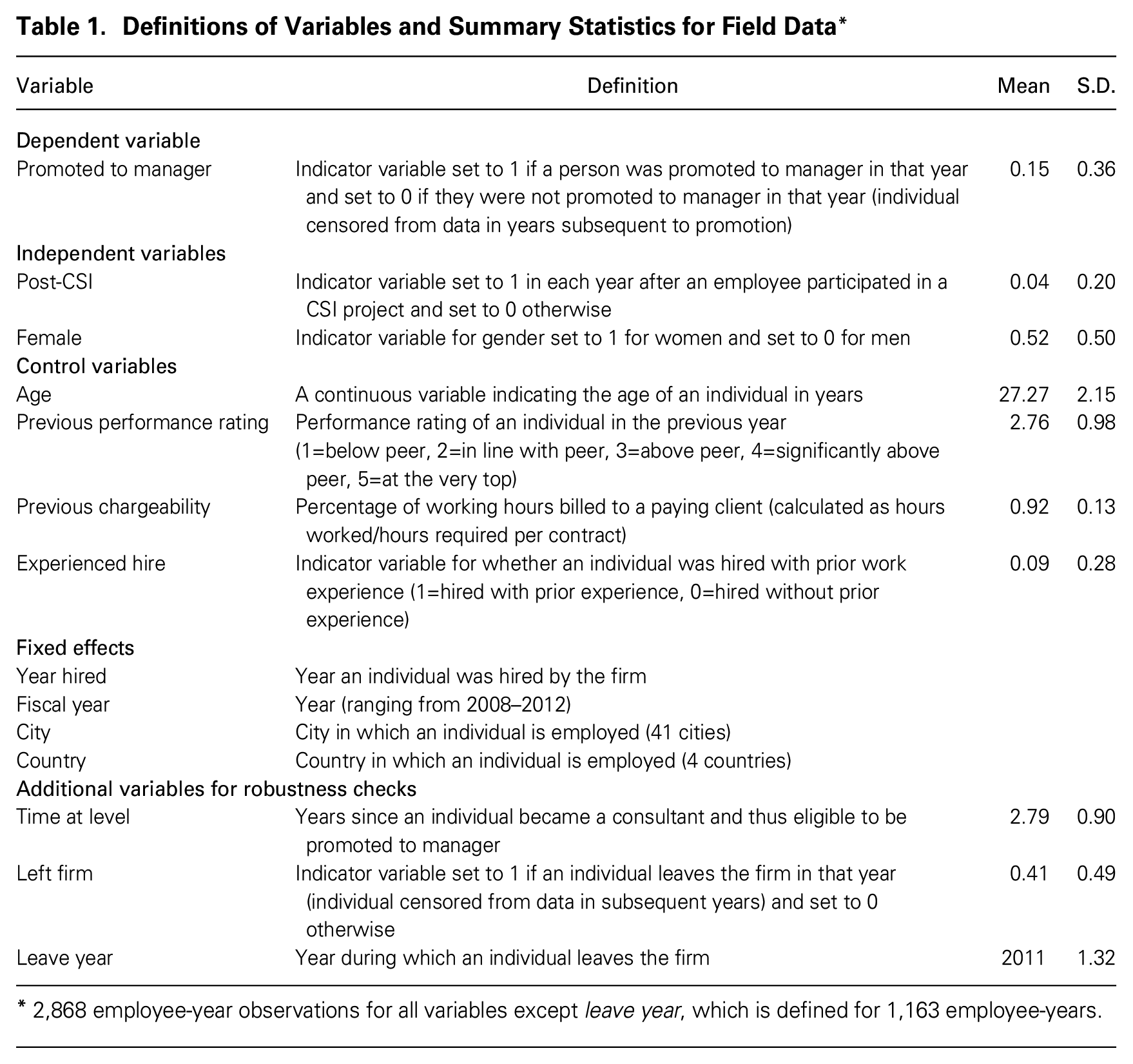
2,868 employee-year observations for all variables except leave year, which is defined for 1,163 employee-years.
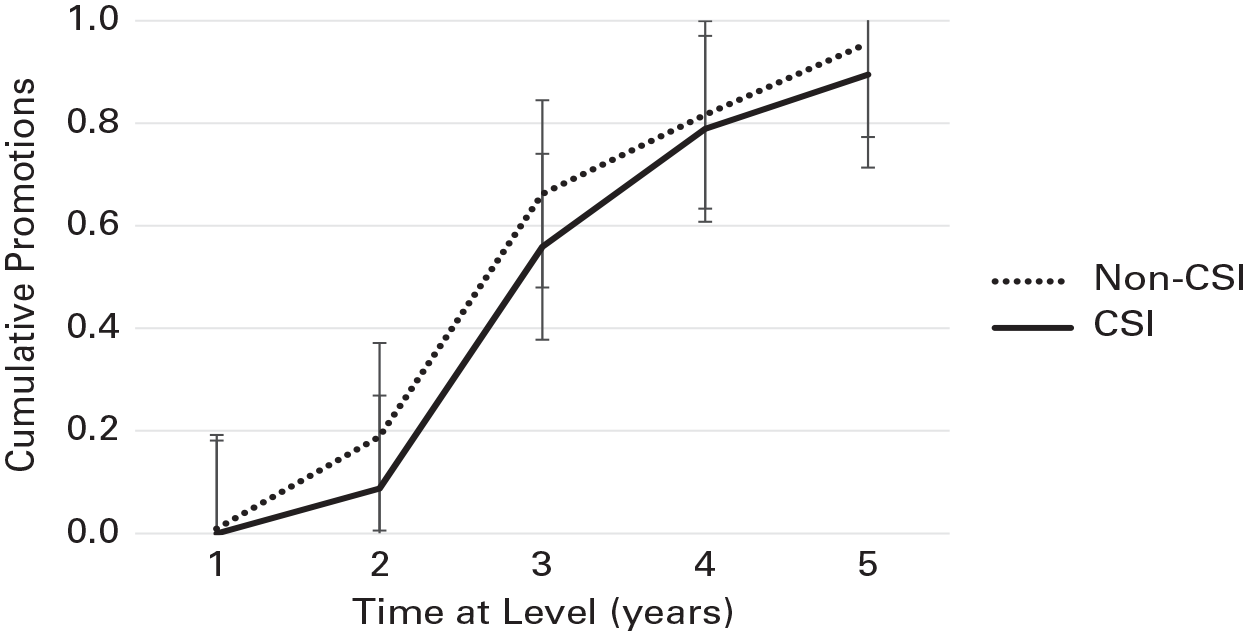
Cumulative Promotions—Full Sample
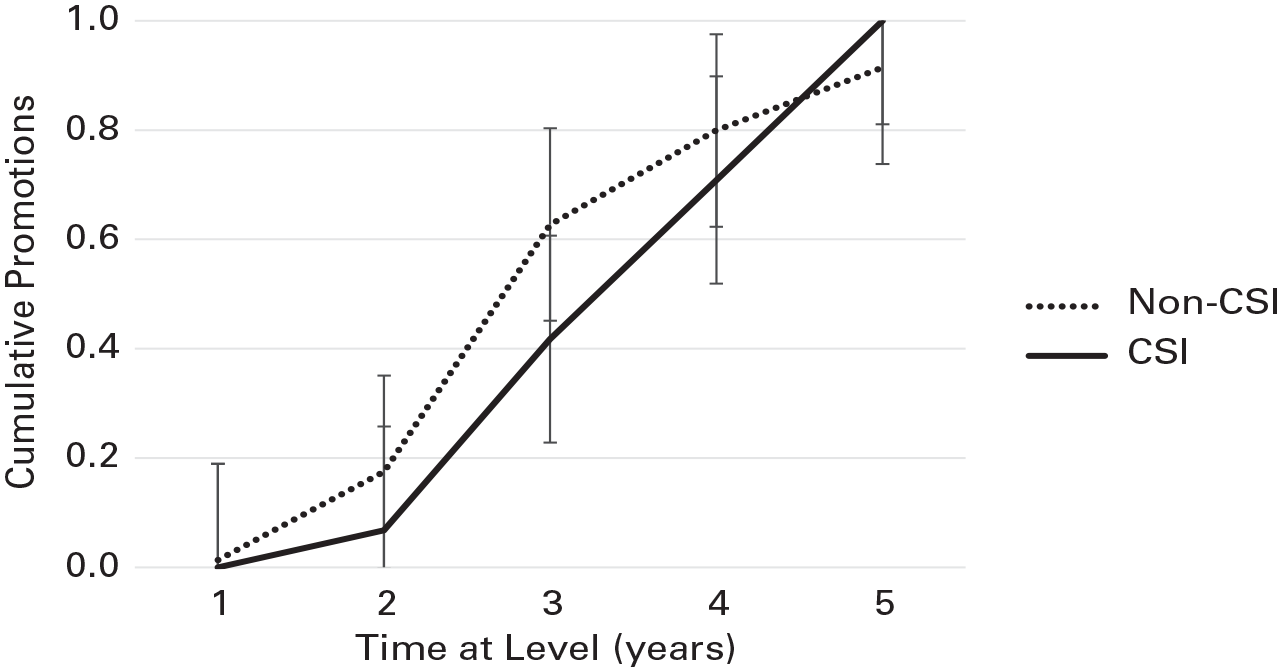
Cumulative Promotions—Male Subsample
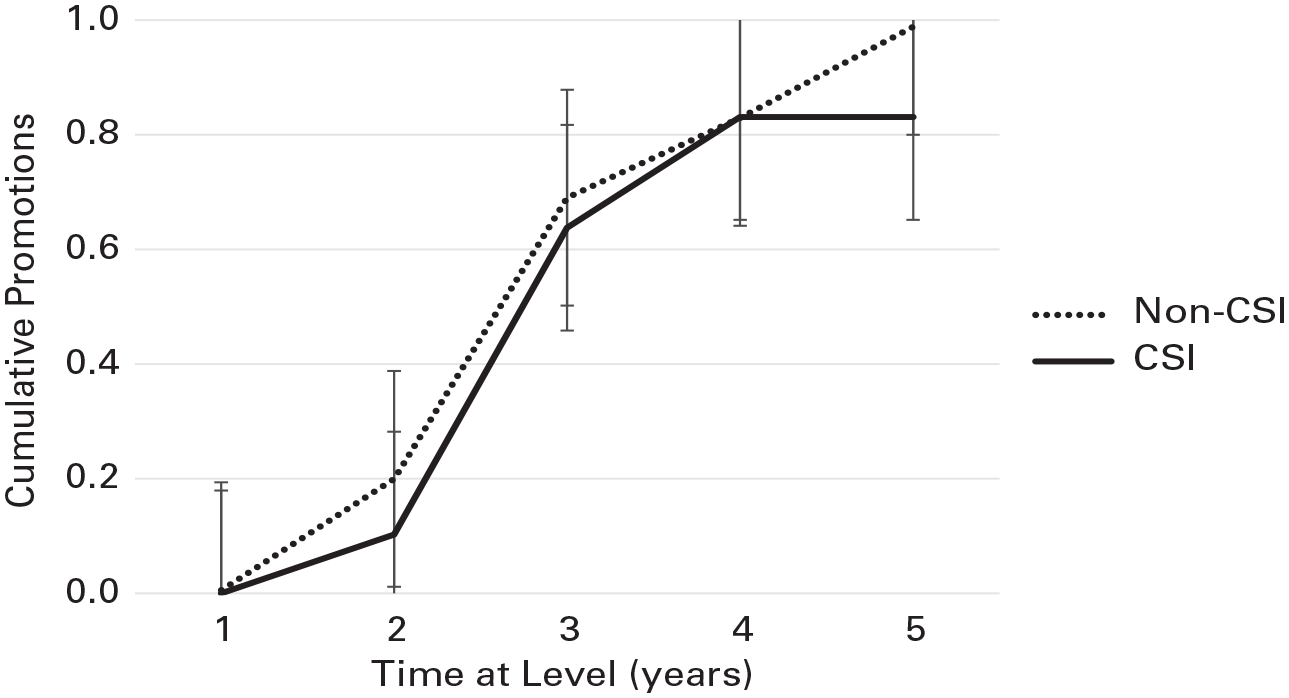
Cumulative Promotions—Female Subsample
Table 2 presents the results from the multivariate analyses, and Figure 2 plots the odds ratios and confidence intervals based on these models. In the figure, the farther the odds ratio is from one, the greater the effect size, and confidence intervals that do not include one are significant at 95 percent. Model 1 of Table 2 includes only the control variables. As one would expect, previous performance rating is positively and significantly associated with promoted to manager. None of the other control variables is statistically significant. H1 predicted a negative relationship between CSI participation and subsequent promotion likelihood. Model 2 of Table 2 shows that the post-CSI odds ratio is below one (odds ratio = 0.553, p = 0.034). Although this result suggests that H1 is supported, subsequent sensitivity analyses utilizing a matched sample reported below do not provide the same support.
Discrete-Time Hazard Model: Odds of Promotion to Manager*
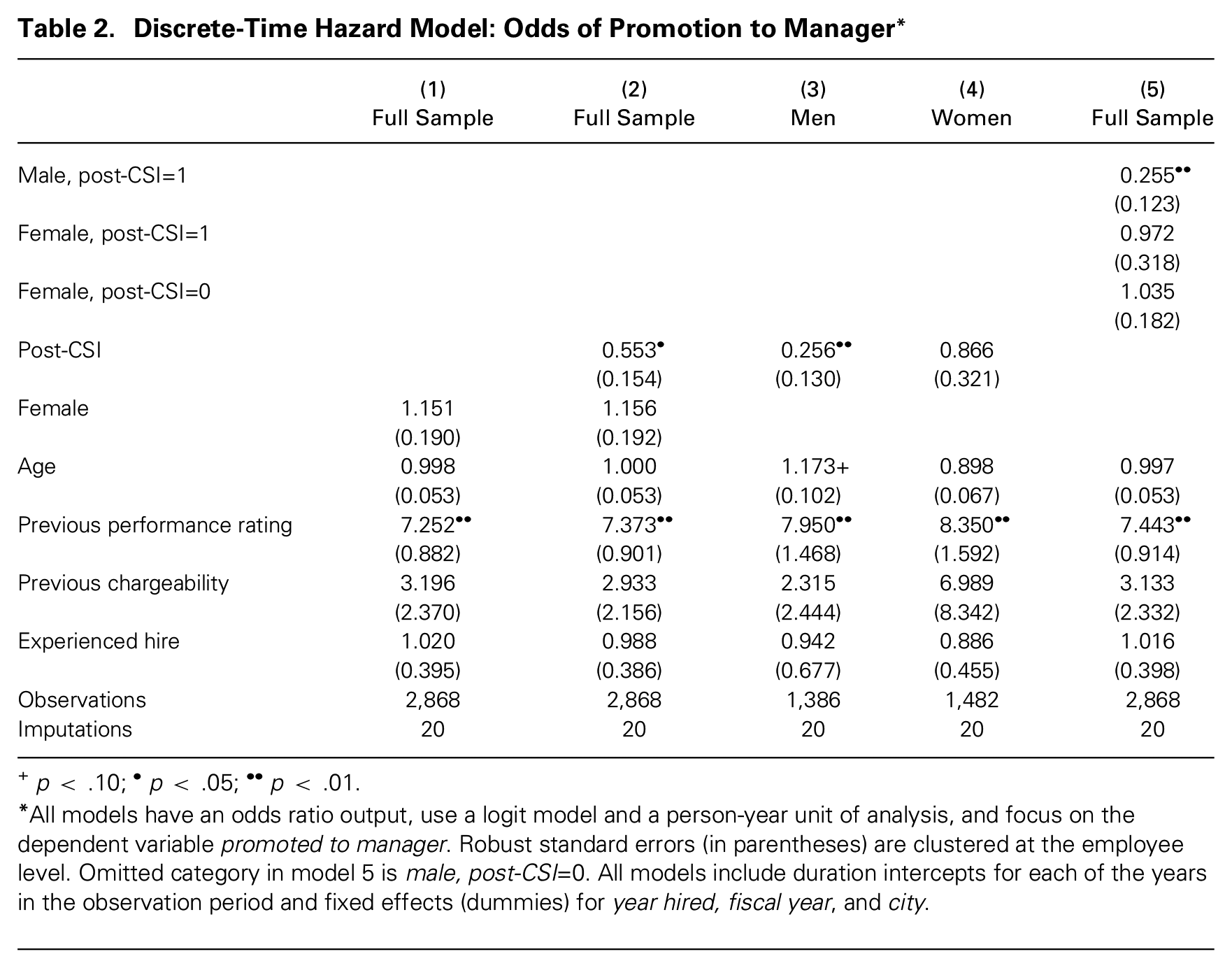
p < .10; •p < .05; ••p < .01.
All models have an odds ratio output, use a logit model and a person-year unit of analysis, and focus on the dependent variable promoted to manager. Robust standard errors (in parentheses) are clustered at the employee level. Omitted category in model 5 is male, post-CSI=0. All models include duration intercepts for each of the years in the observation period and fixed effects (dummies) for year hired, fiscal year, and city.
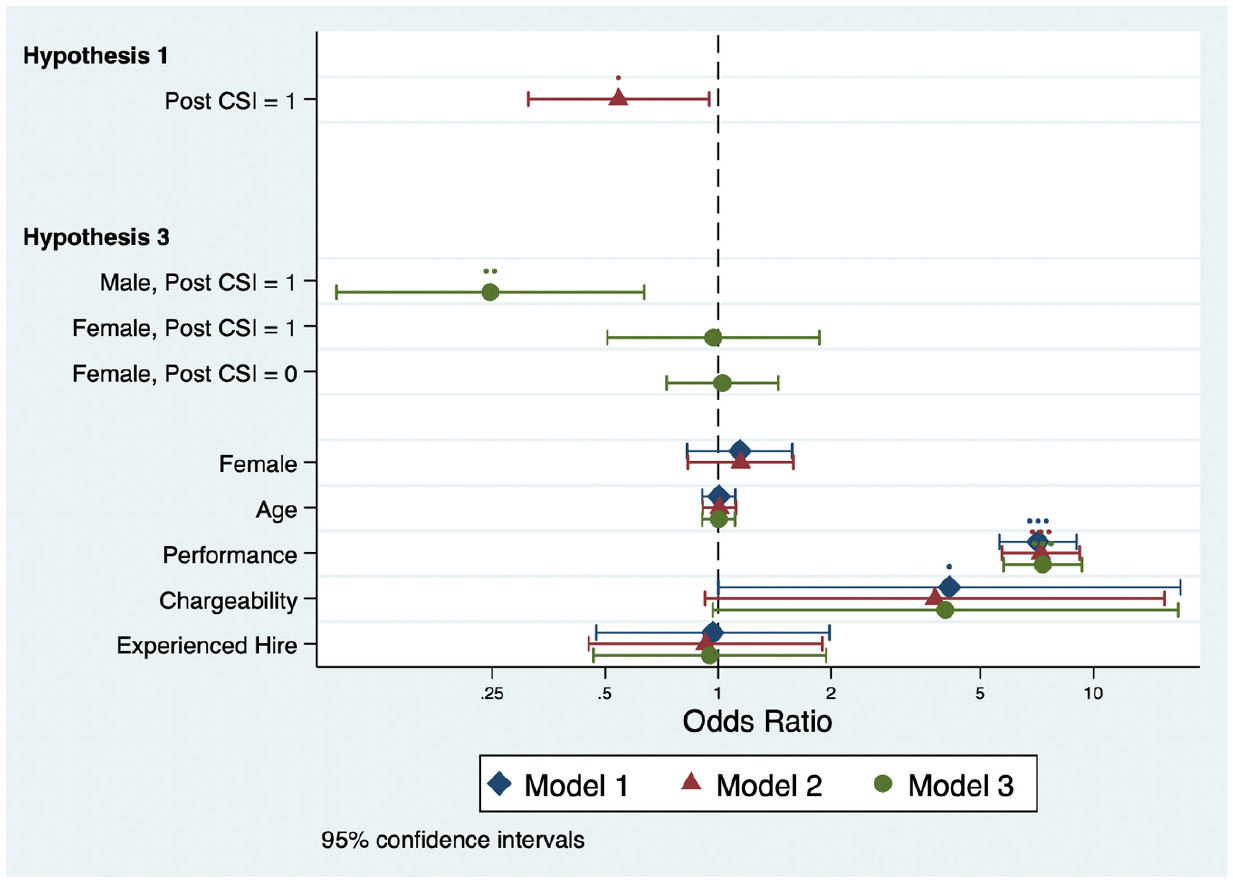
Discrete-Time Hazard Model: Odds Ratio Plot for Promotion to Manager*
H3, which predicted that male employees who participated would be less likely to be promoted than female employees, is supported: the split sample analyses in models 3 and 4 show that CSI participation is associated with a negative significant effect on promotion to manager for men (odds ratio = 0.256, p = 0.007) but not for women (odds ratio = 0.866, p = 0.699). 6 To compare promotion likelihoods across the four categories of employees—men who do not participate in CSI, women who do not participate in CSI, men who participate in CSI, and women who participate in CSI—we created a set of indicators for each of the categories and entered these into the regression (men who did not participate in CSI being the omitted category). As shown in model 5, the likelihood of promotion is significantly lower for men who participate in CSI (odds ratio = 0.255, p = 0.005) relative to men who do not (the omitted category). 7 In contrast, the effect for women who participate is statistically indistinguishable (odds ratio = 1.035, p = 0.844) relative to men who do not participate (the omitted category). Following Hoetker (2007), we also compared the odds ratios for promotion for men who participate in CSI and women who participate in CSI and found that they are significantly different from one another (χ2 = 6.00, p = 0.014).
The average marginal effects associated with CSI participation for men and women are shown graphically in Figure 3. The baseline probability of promotion for both men and women in the sample is 0.15. The discrete change associated with participating in CSI for women is −0.002 and is not statistically significant (p = 0.910). For men, it is −0.065 and significant (p = 0.001), corresponding to a 43-percent lower probability of promotion relative to men who do not participate in CSI. Although non-overlapping confidence intervals provide clear evidence of a significant difference, overlapping confidence intervals do not necessarily imply the lack of a significant difference, and they require further inspection (Schenker and Gentleman, 2001). Therefore, we computed the contrast between the marginal effects of CSI participation. As expected, the contrast in promotion likelihood between men and women is significant following participation in CSI (p = 0.01) but insignificant given no participation in CSI (p = 0.86). In summary, women participating in CSI experienced no difference in promotion relative to women who did not participate or to men who did not participate. Men who participated in CSI were significantly less likely to be promoted than men who did not, supporting H3.
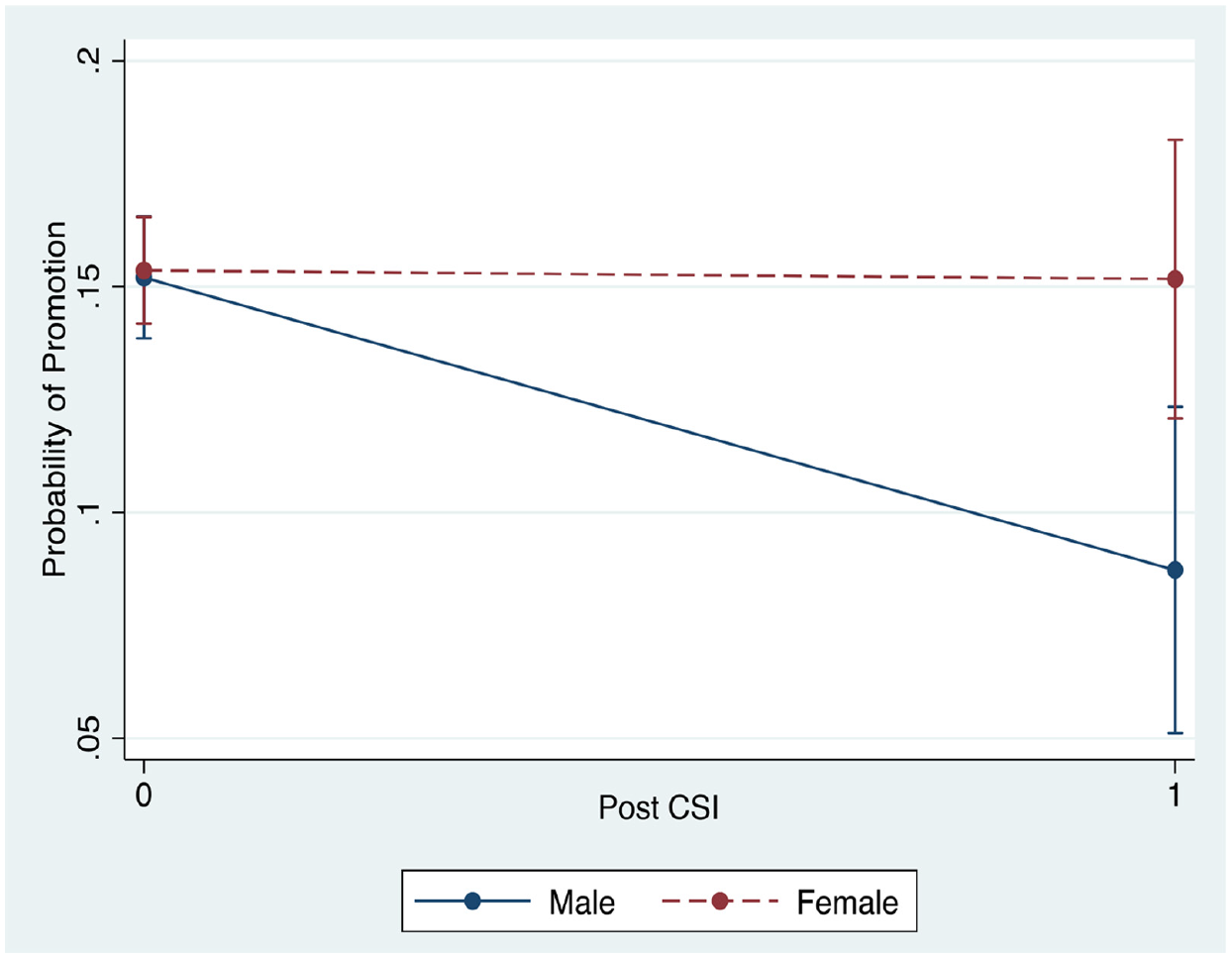
Effect of CSI Participation on the Promotion of Male vs. Female Consultants*
Alternative Explanations
Differences in attrition
If CSI participants leave the firm at a higher rate than non-participants, our findings could be biased because, by definition, a leaving employee is no longer at risk for promotion. We carried out two analyses to further examine this possibility. First, we excluded from our regression analysis all employee-years for any employee who left the firm at any point during our observation period. We obtained the same pattern of results as above (results available upon request). Second, we modeled promoted to manager and left firm as competing outcomes in a multinomial logistic regression with the base outcome taken as neither being promoted nor leaving the firm in the given year. 8 The multinomial logit regressions are reported in Table 3. Consistent with the main analyses, CSI participation is associated with a reduction in promotion likelihood (model 2), and we also observe that CSI participation is positively associated with retention. In other words, employees who participated in CSI are less likely than others to leave the firm, which indicates that the lower promotion likelihood following CSI participation is not driven by differences in retention rates between participants and non-participants. Model 3 shows that CSI participation is negatively associated with both promotion and the likelihood of leaving: for both outcomes, the relative risk ratio of post-CSI is below one and significant. In contrast, model 4 shows that CSI participation for women is negatively associated with the likelihood of leaving but does not have a significant association with promotion. Model 5 shows that both men and women who participated in CSI were less likely to leave the firm, but only men who participated had a significantly lower likelihood of promotion. Thus, accounting for retention does not change the finding that promotion rates are lower subsequent to CSI participation for men but not for women.
Discrete-Time Hazard Model: Relative Risk of Promotion to Manager or Leaving the Firm*
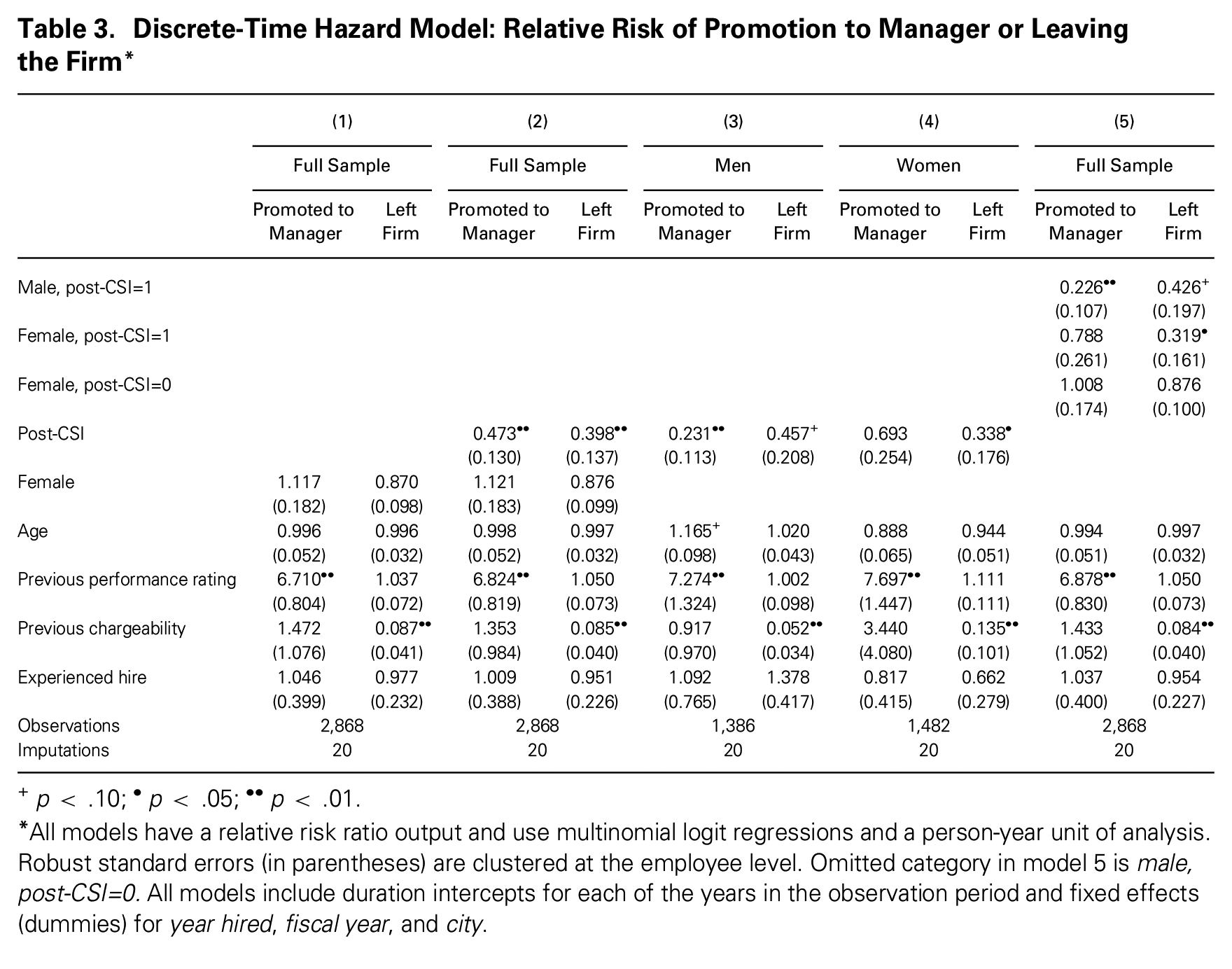
p < .10; •p < .05; ••p < .01.
All models have a relative risk ratio output and use multinomial logit regressions and a person-year unit of analysis. Robust standard errors (in parentheses) are clustered at the employee level. Omitted category in model 5 is male, post-CSI=0. All models include duration intercepts for each of the years in the observation period and fixed effects (dummies) for year hired, fiscal year, and city.
Differences in performance
An additional concern is that employees who participate in CSI may differ from those who do not in ways that also affect their promotion independently of CSI participation. To address this concern, we first examined what types of employees are most likely to participate in CSI. As shown in Online Appendix B, previous performance rating has a positive and significant effect on participation in CSI, and previous chargeability has a significant and negative effect. In our conversations with the firm’s managers and former CSI participants, we were told that the biggest challenge in staffing a CSI project was the difficulty aligning an employee’s availability with a given start date of a CSI project. We interpret these findings in light of this: employees with very high project loads (i.e., chargeability) have lower availability and therefore are less easily assigned to CSI projects. In addition, it was generally accepted among interviewees that a reasonable performance was a prerequisite for being selected for a CSI project. Although we controlled for previous performance rating and previous chargeability in the regressions, employing a matched sample of CSI participants and non-CSI participants would allow the estimation to be more robust to functional form assumptions (Dehejia and Wahba, 1999; Imbens, 2004). In addition, to the extent that unobserved factors are correlated with the observable characteristics on which the matching procedure is based (Altonji, Elder, and Taber, 2005), matching helps mitigate concerns that CSI participation is driven by unobservable factors, hence reducing concerns about endogeneity.
To construct the matched sample, each employee-year observation involving a CSI participant was matched to employee-year observations for non-participants on four characteristics: time at level, female, previous performance rating, and previous chargeability. 9 We relied on one-to-many matching (thus fully utilizing our available data) and used weights in the regressions to account for differences in the number of the cases and controls (Imbens, 2004; Iacus, King, and Porro, 2011, 2012). Online Appendix C shows the covariate balance for our matched sample for those variables utilized in our matching. The ratio of women in the matched sample (female) was perfectly balanced between CSI participants and controls. Similarly, previous performance rating and time at level were perfectly balanced. The matching also led to near-perfect matches on previous chargeability.
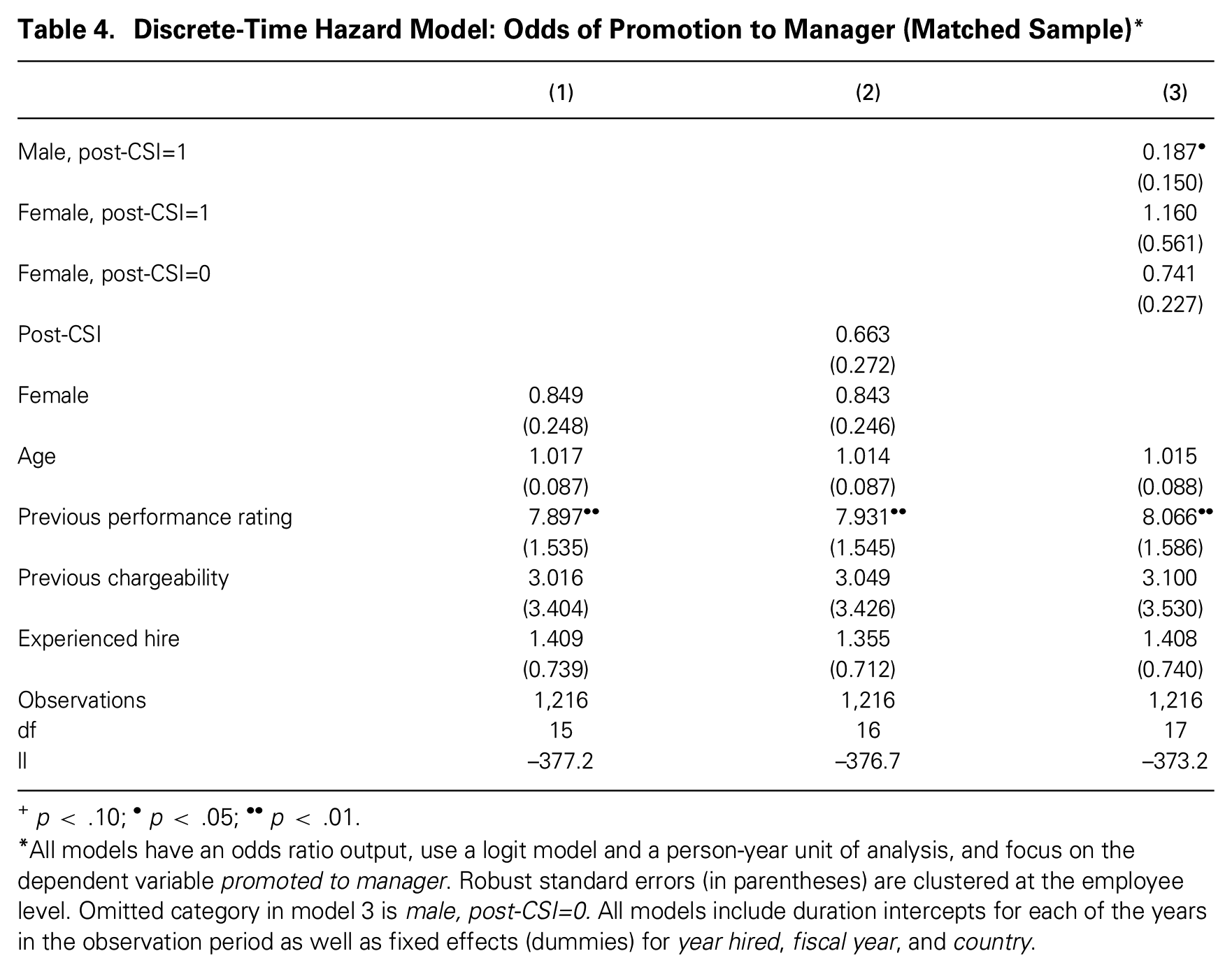
Table 4 reports our analysis using the matched sample, wherein we followed the same analytical approach as in the main analysis except for the slight difference that city dummies were replaced with country dummies due to reduced degrees of freedom in the smaller sample. 10 As shown in model 2 of Table 4, post-CSI is associated with a reduced likelihood of promotion, but this effect is not statistically significant (odds ratio = 0.663, p = 0.361). Thus, in the matched sample, we did not find support for H1. In model 3, the odds of promotion are significantly lower for men who participate in CSI relative to the omitted category, men who do not participate (odds ratio = 0.187, p = 0.037). In contrast, the odds for women who participate are not statistically different from the omitted category (odds ratio = 1.160, p = 0.759). The baseline probability of promotion for men in this sample is 0.19 and for women is 0.15. The discrete change associated with participating in CSI for women is 0.065 and statistically insignificant (p = 0.375) and for men is −0.146 and significant (p = 0.001). In conclusion, like our analysis based on the full sample, our matched sample analysis finds support for H3. 11
Discrete-Time Hazard Model: Odds of Promotion to Manager (Matched Sample)*
p < .10; •p < .05; ••p < .01.
All models have an odds ratio output, use a logit model and a person-year unit of analysis, and focus on the dependent variable promoted to manager. Robust standard errors (in parentheses) are clustered at the employee level. Omitted category in model 3 is male, post-CSI=0. All models include duration intercepts for each of the years in the observation period as well as fixed effects (dummies) for year hired, fiscal year, and country.
Discussion
Our field data in Study 1 provide evidence consistent with the argument that employee participation in social impact projects can impede their promotion prospects. Although we find mixed support for H1, there is strong support for H3. This suggests that participant gender is an important moderator of the effect of CSI participation on promotion. In fact, we find that the reduction in promotion likelihood following CSI participation applies only to male employees: women who took part in CSI did not experience a promotion penalty relative to female or male non-participants.
Although the bootstrap analysis indicates confidence in the estimates, one might be concerned that Study 1, being a single-firm study with a relatively small sample, is still subject to bias arising from low power (Ioannidis, Stanley, and Doucouliagos, 2017). Furthermore, because Study 1 relies on archival data, it cannot fully account for unobservable factors that could influence the relationship between CSI participation and promotions, nor can it confirm mechanisms or isolate evaluator-side factors affecting the promotion decision. Hence, in Study 2, we used an experimental design to attempt to address these limitations.
Study 2: Vignette Experiment
Study 2 was a randomized vignette experiment. Supplementing our field data with an experiment offers several advantages. First, an experiment provides more direct causal evidence than do observational data (Pager, 2007; Burbano, 2016). Second, through the experiment, we were able to test our proposed mechanisms—perceived lack of fit and commitment. Finally, a vignette experiment allowed us to isolate the effect of an evaluator’s bias from employee-side factors (e.g., changes in their skill level or motivation).
Subjects and Design
Given our interest in studying promotion decisions, a key requirement for subjects for our experiment was prior experience in making such decisions. We therefore employed a survey company to recruit 1,000 individuals with work experience, including promotion decision experience, in large firms (those with more than 250 employees) and in senior roles, rather than relying on generic participant pools such as university students or online panels like Amazon’s Mechanical Turk. The research site was GDPR compliant, and our study was approved by an institutional review board (IRB). 12
The experiment was fielded in April 2019. We implemented it as an English-language survey and limited the sample to individuals living in the United States or the United Kingdom to minimize cultural variance (cf. Hofstede, 2001). Due to the absence of prior research on the effect of corporate social impact participation on promotion, we relied on comparative sample sizes in experimental studies investigating gender effects and labor markets (though not on social impact work and gender) to estimate the required sample size (e.g., Rivera and Tilcsik, 2016; Brands and Fernandez-Mateo, 2017; Galperin et al., 2020). Post-estimation, we conducted analyses of achieved power, reported below, to assess whether the sample was sufficiently large to detect the hypothesized effects. After removing 107 individuals who failed either of the two attention checks (described below), the final sample included 893 subjects (445 women and 448 men). Collected demographic information included age, gender, and highest education level completed. Given the importance of the evaluator’s gender in our theory, we balanced the panel by subject gender. The average subject age was 44.79 years (standard deviation = 11.15), and the median education level was a bachelor’s degree. Seventy percent of subjects self-identified as White, 6 percent as Asian, 4 percent as Hispanic, 6 percent as African American or Black British, and 2 percent as Other; 12 percent declined to label their ethnicity. Thirty percent resided in the United Kingdom and 70 percent in the United States. 13
Our between-participant 2×2 experimental design consisted of manipulating corporate social impact (CSI) participation and gender of a hypothetical candidate being considered for promotion. Note that we retained the acronym “CSI” in Study 2, but it refers to an experimental condition rather than the specific initiative described in Study 1. We created four distinct vignettes of the candidate in a fictional accounting firm (details are given in Online Appendix D). Two practicing senior accountants reviewed our vignettes to ensure that they presented realistic information. Each vignette provided background information on the candidate, as well as the history of their last three projects and last three performance evaluations. The first two projects were purely commercial in nature and identical across all conditions. For the third project, the candidate either chose to participate in a social impact project or a commercial project, depending on the treatment group (as we shall describe). The rest of the vignette was identical, except for a randomization of gender by manipulating the candidate’s name and associated pronouns as explained below.
Procedure
Subjects first confirmed that they were over 18 years of age and were asked to indicate their experience with managerial activities, including making real-life promotion decisions. All subjects then received the same background information about the firm (see Online Appendix E) and were instructed to read it carefully before proceeding as they would not be able to return to that screen. Next, each participant was presented with a single randomly assigned vignette from the set of four vignettes, which varied by gender of the candidate and CSI participation.
Gender manipulation
For the gender manipulation, the male candidate was called “Matthew Thompson” and the female candidate was called “Amanda Thompson.” 14 We accordingly varied each vignette’s use of pronouns to match the candidate’s gender. Female candidate was coded as 1 for the condition in which the candidate was female and 0 for the condition in which the candidate was male.
CSI manipulation
The condition for corporate social impact (CSI) participation was indicated in the third client project in the vignette as follows: [Matthew/Amanda] had a choice of two projects. [He/She] had the option either to work for a pharmaceutical client’s India division as part of the firm’s main for-profit business or to work for a health services non-profit organization in India as part of the firm’s optional corporate social responsibility program. The health services project would not generate profit for the firm, but it would allow [Matthew/Amanda] to make a social impact. [He/she] chose to work for the [
The underlined text in brackets shows the two versions used for our manipulation. In the non-CSI condition, the candidate worked for a “pharmaceutical client” to increase the “client’s profitability”; in the CSI condition, the candidate worked for a “health services non-profit organization” to increase the “organization’s social impact.” The project work’s nature and location were the same across both conditions. We coded CSI candidate as 1 for candidates who participated in the non-profit organization’s project and as 0 for candidates who participated in the pharmaceutical client’s project.
Manipulation checks
The main threat to our manipulations was whether the subjects paid sufficient attention to the vignette information to perceive the candidate’s gender and participation in CSI. We used three means to ensure that our manipulations were effective. First, we conducted a separate test of the vignettes to verify that study subjects’ perceptions of the candidates’ gender and CSI participation corresponded to those in the manipulations; the advantage of conducting the check on a separate sample is that it avoids artificially increasing the salience of gender and social impact work in ways that would otherwise affect the subjects’ promotion recommendations (Hauser, Ellsworth, and Gonzalez, 2018). Twenty subjects were randomly assigned one of the four candidate profiles and asked to indicate whether the candidate was female or male and whether the candidate participated in a non-profit project. A Wilcoxon rank sum test shows that the CSI candidate manipulation was successful (z = −3.199; p < 0.001), as was the gender manipulation (female candidate) (z = −4.359; p < 0.000). Second, in the main experiment, we included two instructional manipulation checks to confirm that the subjects had read the vignettes and questions attentively (Oppenheimer, Meyvis, and Davidenko, 2009). 15 Third, we ensured that the vignette remained visible to subjects while they were asked for their ratings of the candidate’s fit and commitment and for their promotion recommendation.
Dependent variable
While keeping the vignette visible, we asked subjects to make a promotion recommendation. Subjects were asked, “Taking the perspective of a top manager in the firm, would you recommend that the employee be considered for promotion to manager?” We followed Castilla and Benard (2010), relying on a seven-point Likert scale for this measure, with seven indicating their highest recommendation.
Mediators
Based on recent work by Rivera and Tilcsik (2016), we utilized context-adjusted single items from their fit and commitment measures with seven-point Likert scales. 16 Subjects were asked to provide their evaluation of the candidate’s fit with the following item: “Do you agree that the employee is a good fit for the firm?” (with seven indicating the highest agreement). Subjects were asked to provide their evaluation of the candidate’s commitment using the following item: “If the firm asked the employee to work extra hours, how likely is it that the employee would meet that request?” (with seven indicating extremely likely).
Subjects then answered a set of questions about their demographic details, including nationality, marital status, and highest level of education completed, before completing the experiment.
Results
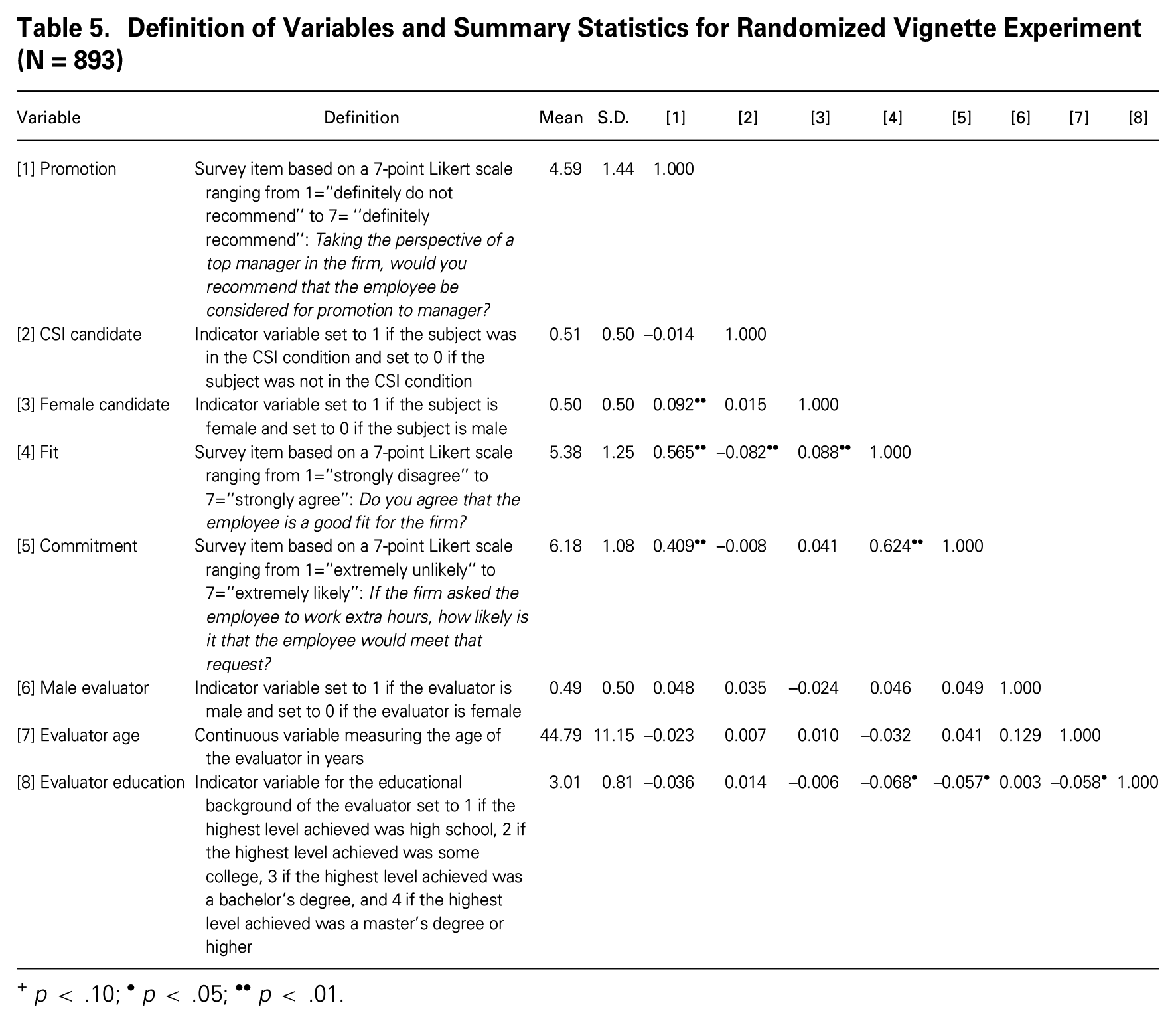
Summary statistics and correlations for the raw data are reported in Table 5. CSI candidate has only a weak (and statistically insignificant) negative correlation with promotion. Fit and commitment are positively correlated with promotion. Female candidate and promotion have a small positive correlation. Evaluator education has a small positive correlation with fit and commitment. Further t-tests confirm that evaluator education does not differ significantly across the four experimental conditions, indicating that our randomized assignment of subjects did work as intended. Below, we first discuss how the findings of Study 2 inform H1, H3, and H4, and then we turn to a discussion of the findings for H2.
Definition of Variables and Summary Statistics for Randomized Vignette Experiment (N = 893)
p < .10; •p < .05; ••p < .01.
Tests of Hypotheses 1, 3, and 4
Figure 4a shows the average promotion recommendations for CSI candidates compared with non-CSI candidates in the full sample by candidate gender. T-tests comparing promotion recommendations across the conditions do not provide evidence in support of H1 (CSI participation being negatively associated with likelihood of promotion) or H3 (the reduction in promotion likelihood following CSI participation being greater for male employees than for female employees). However, based on the t-tests, we do find strong support for H4, which predicted that male evaluators would be less likely than female evaluators to recommend promotions of male employees who have participated in corporate social initiatives. As shown in Figure 4b, compared with female evaluators, male evaluators gave significantly lower promotion recommendations to male CSI candidates. Neither male nor female evaluators’ promotion recommendations differed significantly for female CSI and female non-CSI candidates (for male evaluators: 4.85 vs. 4.99; p = 0.47; for female evaluators: 4.61 vs. 4.49; p = 0.54). 17
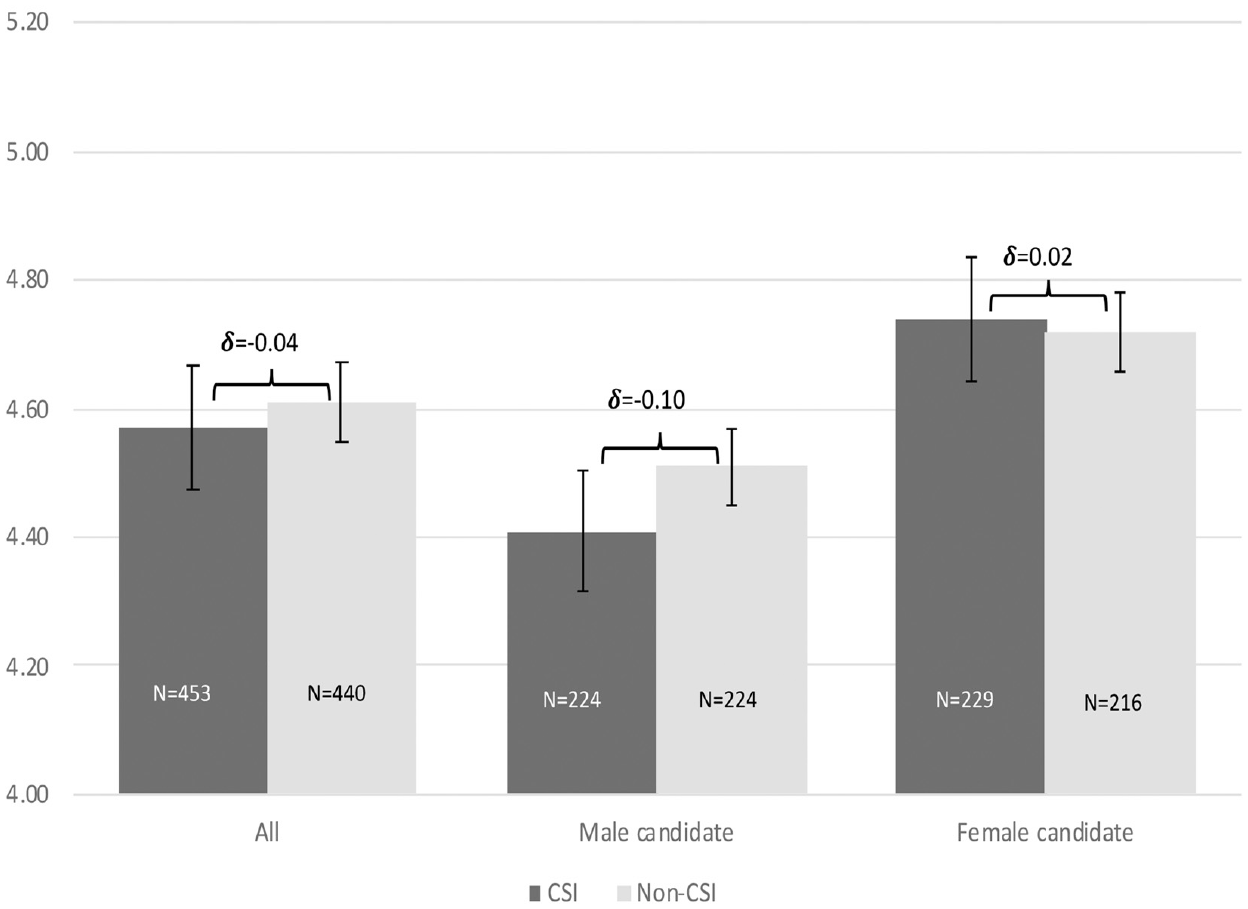
Average Promotion Recommendation for CSI Candidates vs. Non-candidates by Candidate Gender
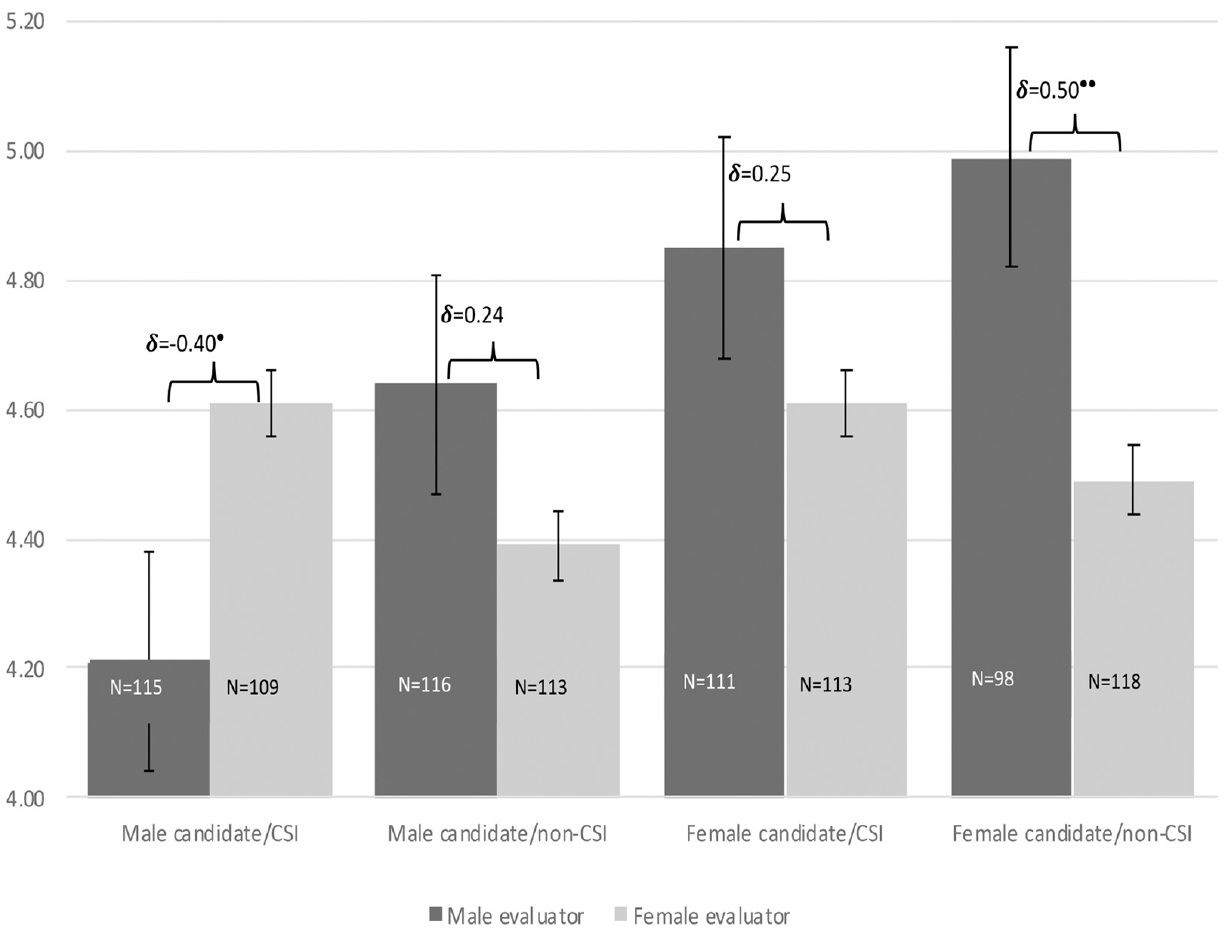
Average Promotion Recommendation from Male vs. Female Evaluators by Candidate CSI Participation and Candidate Gender
The results of the multivariate regression analyses in Table 6 show a similar pattern. The reported estimates are based on ordinary least squares (OLS) regressions, though the findings are robust to ordered logistic regression. As shown in models 1 and 2, the analyses do not provide support for H1 or H3. However, in model 3, the negative, significant estimate for the interaction term male evaluator×CSI candidate (β = −0.448, p = 0.020) indicates that male evaluators gave significantly lower promotion recommendations to CSI candidates than female evaluators did. In models 4 and 5, the interaction term remains negative and significant (β = −0.668, p = 0.015) in the subsample of male candidates but not in the subsample of female candidates (β = −0.262, p = 0.271). Thus H4 was supported. 18
OLS Estimates of Promotion Recommendations in Vignette Experiment*
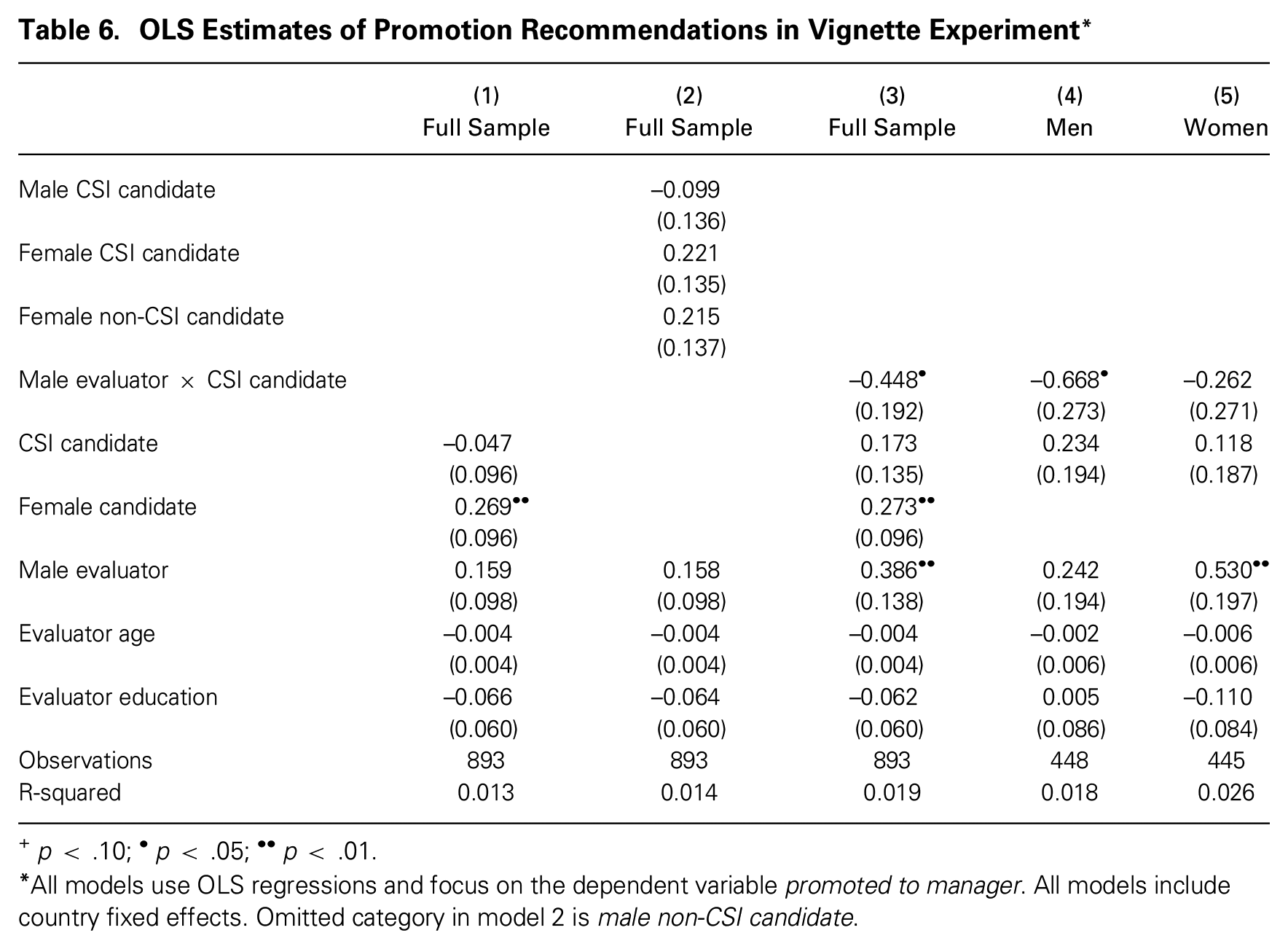
p < .10; •p < .05; ••p < .01.
All models use OLS regressions and focus on the dependent variable promoted to manager. All models include country fixed effects. Omitted category in model 2 is male non-CSI candidate.
Test of Hypothesis 2
H2 predicted that the negative effect of prior participation in a corporate social initiative on an employee’s likelihood of promotion would be mediated by (a) perceived fit and (b) perceived commitment. Following Hayes’ (2012) procedure we conducted a parallel mediation test to examine the conditional indirect effect of fit and commitment on the relationship between CSI candidate and promotion. Models were estimated using Hayes’ PROCESS macro in SPSS with bootstrap confidence intervals (5,000 replications). Results are shown in Table 7a. CSI candidate negatively affects perceived fit but not commitment. Fit and commitment both positively affect promotion. The direct effect of CSI candidate on promotion is not significant, but the indirect effect of CSI candidate on promotion through the two mediators is negative and significant. Further examination of the degree to which fit and commitment contribute to the indirect effect shows that only the indirect effect through fit is significant. The total effect of CSI candidate on promotion is not significant, consistent with the pattern of findings in Study 1. The same pattern of results is observed when considering fit and commitment separately rather than in a parallel analysis. In summary, we find evidence of indirect-only mediation via fit, providing support for H2a but not H2b. 19
Parallel Mediation Analysis (N = 893)*
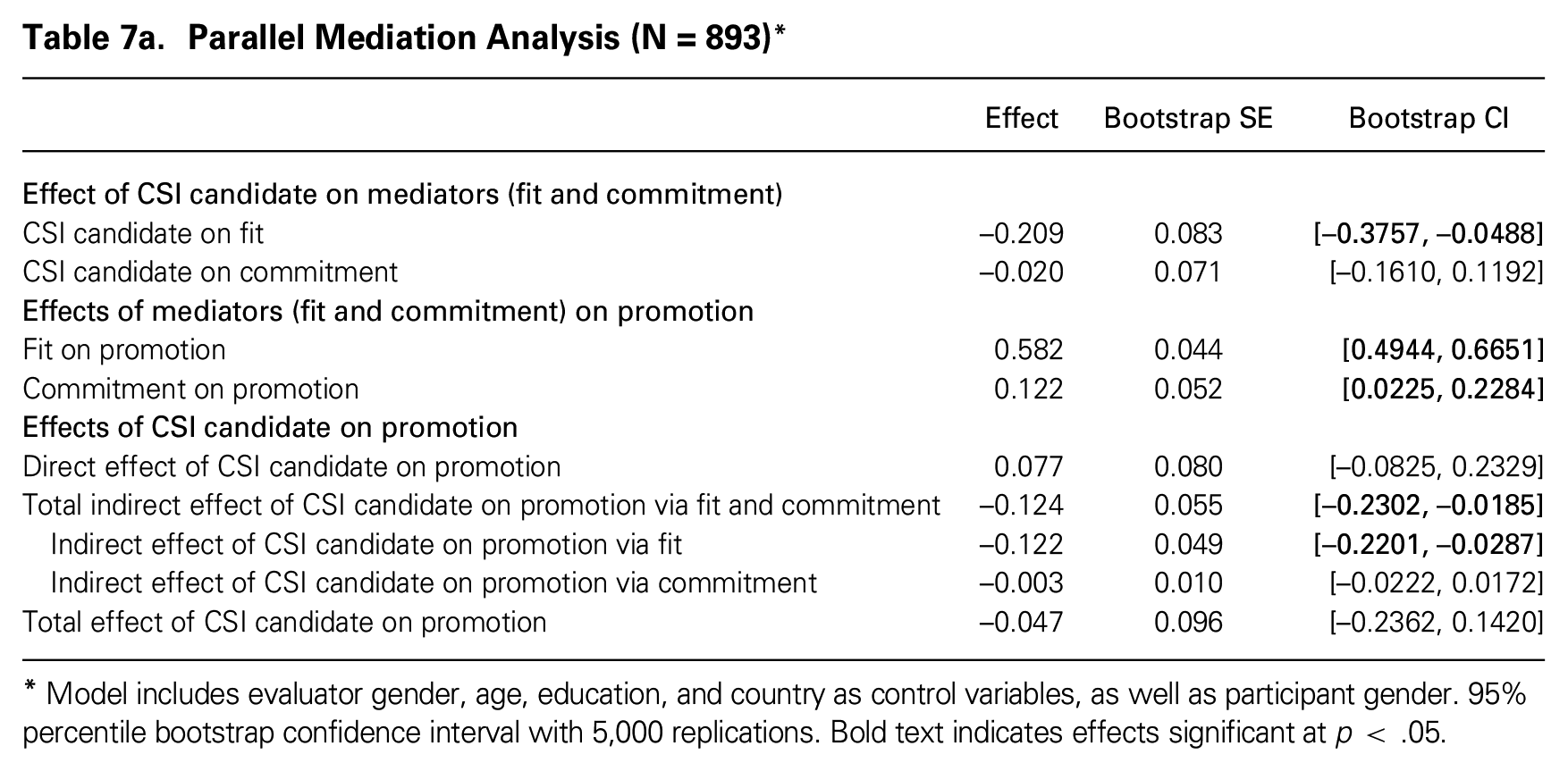
Model includes evaluator gender, age, education, and country as control variables, as well as participant gender. 95% percentile bootstrap confidence interval with 5,000 replications. Bold text indicates effects significant at p < .05.
Candidate gender differences in mediation
We also examined mediation effects on promotion for male and female CSI participants, corresponding to our arguments in H3 that female participation is less likely to be interpreted as signaling lower fit and commitment because the choice to take part in social impact work is more expected of women. We followed Hayes’ procedures for moderated mediation to test the conditional indirect effect of fit and commitment on the relationship between CSI candidate and promotion for male versus female candidates, examining both mediators, fit and commitment, in parallel (Preacher, Rucker, and Hayes, 2007; Hayes, 2012). Models were estimated using Hayes’ PROCESS macro in SPSS with bootstrap confidence intervals (5,000 replications). The results are shown in Table 7b. The interaction of CSI candidate×female candidate has a positive and significant effect on fit, while the effect of CSI candidate on fit remains negative and significant. The conditional effect analysis, which examines how the mediator (fit) varies as a function of the moderator (the gender of the candidate), shows that the effect of CSI candidate on fit is negative and significant only for male candidates and not for female candidates. The indirect effect of CSI candidate on promotion via fit is negative and significant also only for male candidates and not for female candidates. The index of moderated mediation is statistically significant, meaning that the conditional indirect effects for male and female candidates are significantly different from each other. Regarding commitment as a mediator, neither the interaction, CSI candidate×female candidate, nor CSI candidate has a significant effect on commitment. The conditional effect analysis does not provide evidence of a CSI candidate effect on commitment for male or female candidates. The indirect effect of CSI candidate on promotion via commitment is not significant for either male or female candidates, and the index of moderated mediation is also not significant. Hence the results of the moderated mediation analyses suggest that for men but not women, CSI participation is associated with a reduced perceived fit, which in turn is associated with a reduced likelihood of being promoted. There is no support for commitment as a mediator.
Parallel Moderated Mediation Analysis (N = 893)*
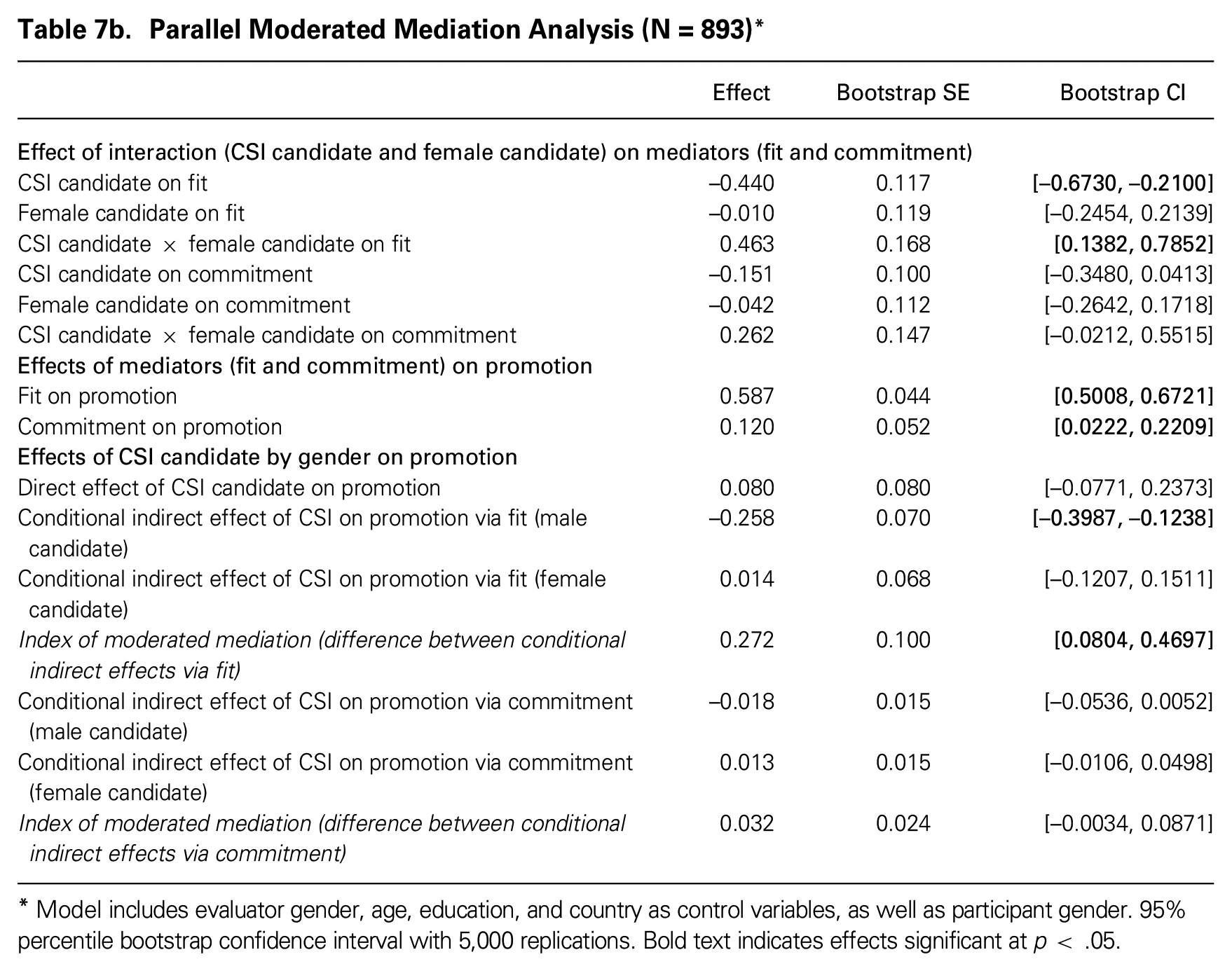
Model includes evaluator gender, age, education, and country as control variables, as well as participant gender. 95% percentile bootstrap confidence interval with 5,000 replications. Bold text indicates effects significant at p < .05.
Discussion
Study 2 provided a test of the mechanisms underlying the effect of CSI participation on promotion as predicted in H2 and a direct examination of effects related to the participant’s gender and the evaluator’s gender, per H4. We found evidence of a significant, negative indirect effect of CSI participation on promotion, mediated by the evaluator’s assessment of the candidate’s fit, supporting H2a. But H2b, proposing perceived commitment as a mediator, was not supported. One might be concerned that the lack of support could be because the measure of commitment, an employee’s willingness to work additional hours for the firm (Rivera and Tilcsik, 2016), was also measuring pro-social orientation. According to Brief and Motowidlo (1986: 715), commitment is similar to a form of prosocial behavior as it involves “actions which represent extra effort, diligence, perseverance, and conscientiousness in the performance of one’s job . . . performed for the benefit of the organization, often at some personal expense.” Yet, further examination of the data showed that in Study 2 the correlation between CSI candidate and commitment was negative and insignificant at −0.008. It is therefore unlikely that CSI candidates were seen as more prosocial than their peers.
Supporting H4, we found that the evaluator’s gender played an important role in the relationship between CSI participation and promotion: male evaluators were significantly less likely than female evaluators to recommend promotion for a male participant of the corporate social initiative. In fact, in analyses that do not account for the evaluator’s gender, we did not find significant support for a negative effect of participation on promotion as predicted in H1 or a greater reduction in promotion likelihood for male participants vs. female participants as predicted in H3. The lack of support for H3 in Study 2 highlights the importance of considering both participant gender and evaluator gender in promotion decisions. The results of Study 2, showing support for H4 predicting that the promotion penalty is strongest when the participating men are evaluated by other men, offer a potential explanation for the inconsistent findings for H3 between the two studies whereby H3 was supported in Study 1 but not in Study 2. The Study 1 finding that men who participated in CSI had significantly lower chances of promotions could have been driven by a higher proportion of male evaluators than female evaluators in the Study 1 firm. Although we did not have data on evaluators’ genders in Study 1, the majority of evaluators were likely male, given the gender distribution of senior managers who make promotion decisions in the firm.
It is also possible that in Study 2, the effect size of CSI on promotion was too small to detect given the sample size. The observed difference in means for CSI vs. non-CSI candidates was 0.04 and for CSI male candidates vs. non-CSI male candidates was 0.10 (Figure 4a), and achieved power for testing H1 and H3 in Study 2 was below the conventional threshold of 0.80 (Cohen, 1988). Given the small observed effect sizes, very large samples would have been necessary to detect a statistically significant main effect of participation on promotion (if it exists). Yet, as noted by Aguinis and colleagues (2005), even very small moderating effects may be consequential for outcomes in certain settings and would merit the use of larger samples to investigate these small effects, despite the significantly greater cost of doing so. This could be an area for future investigation. At the same time, in Study 2, the achieved power for the test of H4 was 0.90, indicating a high level of confidence in those results.
General Discussion and Conclusion
To better understand how employees’ participation in corporate social initiatives affects their promotions, we used a combination of field and experimental data to examine differences in promotion likelihood for male and female employees. We argued that participation in corporate social initiatives would be associated with lower perceived fit and commitment to the firm, which would reduce promotion chances for those who participate. Furthermore, to the extent social impact work is perceived as stereotypically female work, the promotion penalty should be greater for male than for female candidates. Finally, male evaluators may perceive male employees’ participation in social initiatives as a threat to the identity and status of their group, so male evaluators would be less likely to recommend promotion of male employees than female evaluators. Contrary to our arguments that the baseline effect of participation in social impact initiatives on promotion would be negative, the effect was even more gendered than anticipated. In our field data in Study 1, we found some evidence of a promotion penalty, but estimations using matched samples and further investigation of gender as a moderator of the CSI participation effect showed that the penalty existed only for male employees who participated in CSI.
An examination of the evaluator gender effect in Study 2, the vignette experiment, provided insight into the interplay of candidate gender and evaluator gender in the promotion decisions. The lowest promotion recommendation was given by male evaluators assessing male employees who participated in corporate social initiatives. In Study 2, we did not find evidence of a significant relationship between participation in the corporate social initiative and promotion in models that did not consider the moderating role of evaluator gender (no support for H1 or H3). One reason for the lack of support for H3 in Study 2, predicting lower promotion recommendations for men who participate in CSI in general, could be that the promotion penalty for men is driven entirely by male evaluators, in line with H4. Study 2 also provided insight into the mechanisms underlying the promotion effect. Evaluators’ perceptions of lower fit (but not lower commitment) of CSI participants with the firm was the mechanism underlying the promotion penalty. The field and experimental studies complement each other, providing external validity with field data and observation of the underlying mechanisms with the experimental data.
Our paper’s first contribution is to call attention to the gendered nature of corporate social impact work and the potential for negative career consequences for those who in engage in this type of work. Although recent work has focused on the strategic human capital outcomes associated with employee participation in corporate social initiatives, we know little about how participation affects employees’ careers. Even when an initiative is sponsored by the firm, ambiguity regarding evaluation of employee participation in the initiative provides opportunities for evaluators’ gender beliefs to affect judgments of those who participate (Petersen and Saporta, 2004). Using human resources data from a consulting firm, we found that participation in a corporate social initiative reduced male employees’ promotion likelihood. Our study extends prior research into how gender role stereotypes interact with characteristics of work to affect career advancement (Beckman and Phillips, 2005; Dencker, 2008; Barbulescu and Bidwell, 2013; Merluzzi and Dobrev, 2015; Kennedy, McDonnell, and Stephens, 2016).
The second contribution of this study is to provide arguments and evidence of evaluators’ gender bias in promotion decisions. Our examination of evaluators’ perceptions of employees’ fit and commitment as mechanisms underlying their promotion decisions parallels prior research on hiring decisions (Pedulla, 2016; Rivera and Tilcsik, 2016; Galperin et al., 2020) and brings attention to the importance of investigating the mechanisms underlying these decisions. Our experimental results show that evaluators’ gender plays an important role in their judgment of employees who participate in social impact work. While previous studies have found that men and women equally sanction behavior that violates gender norms (e.g., Rudman and Glick, 1999; Heilman et al., 2004; Rudman and Mescher, 2013; Rudman, Mescher, and Moss-Racusin, 2013), our study shows that male evaluators penalized men who participated in social impact work more than female evaluators did. This finding was consistent with our arguments that male CSI participation poses identity and status threats to male evaluators but not to female evaluators. In conditions in which men’s behaviors do not conform to stereotypes, male evaluators may be more likely to penalize their behaviors than female evaluators (Wayne and Cordeiro, 2003; Rudman and Phelan, 2008), in particular when the behavior creates identity and status threats, a point that merits investigation in future research.
Our study’s third contribution is to reveal a previously unidentified tension between business and society on the dimension of gender. A firm’s efforts to engage with society through employee initiatives may conflict with its members’ gender beliefs, consequently limiting male employees’ latitude to contribute to the firm’s social impact agenda. The gender bias we observed against men who participated in corporate social initiatives suggests that in many firms social impact work may be considered a primarily female agenda. Although the promotion penalty negatively affects male employees, it may signal the emergence of a new form of job segregation by gender that is also harmful to female employees. As business engages with society, if only female employees have the discretion to fill the roles required to do so, the social engagement of firms risks becoming only women’s work, reproducing patterns of job gender segregation. Because these socially oriented positions may be viewed as less valuable than commercially oriented ones, women may inadvertently assume roles that have poorer longer-term career prospects even though their near-term promotions are not affected (Ryan and Haslam, 2007; Barbulescu and Bidwell, 2013; Bergeron et al., 2013). This is particularly ironic given that a key aim of many firms’ CSR agendas is increased gender diversity (Mun and Jung, 2017; Solal and Snellman, 2019).
Our contributions have significant organizational and policy implications and highlight the need for firms to manage the potential unintended consequences of their strategic human capital practices. Firms are under increasing pressure to engage with society, and accordingly, many have added social impact activities to their regular practices. Yet managers’ biases can present challenges when implementing social impact activities. Men’s abilities to contribute toward their firms’ social impact agendas may be limited by the stereotyping of believed gender-appropriate behaviors. As explained by Ridgeway and Correll (2004: 523), “As gender beliefs write gender hierarchy into the interpersonal relations through which people create new social forms, the people in effect rewrite gender hierarchy into the new social practices that develop to define the new occupation or industry.” Within organizations, decision makers’ gender beliefs risk further feminizing social impact work, potentially constraining the long-term engagement of business with society. This has major implications both for firms and policymakers. Furthermore, to the degree that our observed pattern becomes known to employees, there is a risk that this might undermine the positive identification and retention benefits associated with participation in corporate social initiatives as highlighted by extant research. Indeed, it is possible that men who participate in corporate social initiatives experience not only poorer promotion outcomes but also less mobility across firms, as evidenced by the lower voluntary departures of employees who participated in CSI in Study 1. We interpret our findings not as suggesting that firms should halt their corporate social initiatives; instead, firms must carefully manage the gender-related beliefs and processes that could affect promotion decisions for participating employees.
Future Research
Our research suggests several directions for future research. First, although our experimental results in Study 2 indicate that the negative promotion effect we observed for male participants in social impact initiatives does generalize outside of the study setting used for Study 1, it is possible that the observed effects would not generalize across all firms or across time. For example, in our study, participants were required to accept a salary reduction in order to be staffed on a social impact project. This feature of the study may have influenced our findings. Differences across institutional contexts would certainly affect the evaluations of social impact work and gender role stereotypes associated with the work. For example, the legitimacy of corporate social initiatives is likely to be greater in settings in which corporate engagement with society is already common (Marquis, Glynn, and Davis, 2007), and the evaluations of employees who participate in such initiatives could be neutral or even positive. We examined our consulting firm data for this variance by investigating whether the promotion penalty varied as a function of the percentage of firms engaged in corporate giving in each metropolitan statistical area (MSA) corresponding to the firm’s city-offices; we used KLD data on corporate giving, averaged over 2008 to 2012 by MSA. We found that in MSAs with high corporate giving (above the median), one-third of men who participated in CSI were promoted. In MSAs with low corporate giving (below the median), none of the men who participated were promoted. For women who participated in CSI, the rates of promotion were similar for both low and high corporate giving MSAs: 40 percent and 38 percent, respectively. Thus male employees in institutional contexts in which CSR is legitimized may not experience a promotion penalty for participation in corporate social initiatives. Future research is needed to explore this effect further.
Second, our study focused on the consequences of social initiative participation for employees in a commercial organization in which social impact was an ancillary goal. In contexts in which social impact is a central goal, gender role expectations regarding social impact work may be helpful to women. For example, in a study of entrepreneurs’ pitches, Lee and Huang (2018) found that women were more positively evaluated when making pitches that involved a social impact mandate, despite the fact that, in general, women are significantly less likely to receive venture funding than men (Brooks et al., 2014). In the firm we studied, there were no significant differences in promotion rates for men and women who did not participate in the firm’s social initiative. But in firms in which women are generally promoted at lower rates than men, women’s participation in social initiatives could increase their promotion rates, especially when the firm has an explicit gender diversity mandate (Mun and Jung, 2017; Naumovska, Wernicke, and Zajac, 2020).
Third, future work might investigate whether our arguments and findings would generalize to initiatives that are not sponsored by the firm. Prior research by Rodell and Lynch (2016) suggested that non-firm-sponsored employee volunteering is both credited and stigmatized by others, but this work did not specifically examine promotion outcomes. One might expect that the assessment of fit would be even lower for participants in non-firm-sponsored initiatives and that the negative promotion effect would be even greater (assuming the volunteering was known to members of the firm). Furthermore, our findings are unlikely to generalize to contexts in which engaging in social impact denotes status, e.g., being a board member of a charity. In experimental research by Willer (2009), prosocial behaviors served as signals that a person was other-focused rather than self-focused, which led to status gains for the person within the group. In contrast, we found that social impact participation led to lower perceived fit with the firm, making status gains unlikely in our setting.
Fourth, in our study we were able to examine only relatively near-term promotion outcomes: those of consultants being promoted to the position of manager. It is possible that in the long term, employees who take part in social impact work could be more likely to be promoted to senior executive roles or to experience other career benefits. However, promotion delays early in one’s career can have lasting effects that slow the speed of subsequent promotions (Baker, Gibbs, and Holmstrom, 1994) and reduce future wage growth (Baker, Jensen, and Murphy, 1988), suggesting that the near-term outcomes we observed could have negative consequences over the long term. Given the novelty of our study and findings, future research is needed to identify the boundary conditions of the effect of social impact participation on promotion we observed.
Lastly, our experimental study controlled for employees’ self-selection into social impact work, and so we were able to draw conclusions about evaluator-side effects without concerns of unobserved heterogeneity among employees. Yet employee-side factors merit further research attention. In a recent field experiment, men were less likely to apply to work for socially responsible firms led by women compared with those led by men (Abraham and Burbano, 2021), suggesting that gender differences in self-selection are also an important factor to consider. Likewise, though our experimental study design controlled for self-selection into social initiatives, we were not able to observe whether participating in social initiatives generated employee-side treatment effects, i.e., increased motivation and engagement. Future research with random assignment to treatment is needed to fully address the question of how participation in corporate social initiatives affects employees.
Engaging employees in societal issues can be one way to counteract the trend toward a more transactional approach to employment by providing employees the opportunity to engage in meaningful work (Cappelli, 1999; Glavas and Godwin, 2013; Greguras et al., 2014), which can have positive strategic implications for employee recruitment and retention (Jones, Willness, and Madey, 2014; Bode, Singh, and Rogan, 2015; Carnahan, Kryscynski, and Olson, 2017). Yet, as we have argued and shown, gender beliefs about what constitutes legitimate work for male versus female employees could impede the implementation of corporate social initiatives, unless these gender beliefs are updated. For firms’ external stakeholder engagement to deliver benefits, a revision of internal stakeholders’ attitudes may be needed. This is a challenge not only for business but for all of society.
Supplemental Material
sj-pdf-1-asq-10.1177_00018392211020660 – Supplemental material for Up to No Good? Gender, Social Impact Work, and Employee Promotions
Supplemental material, sj-pdf-1-asq-10.1177_00018392211020660 for Up to No Good? Gender, Social Impact Work, and Employee Promotions by Christiane Bode, Michelle Rogan and Jasjit Singh in Administrative Science Quarterly
Footnotes
Acknowledgements
We would like to thank Associate Editor Christine Beckman and three anonymous reviewers for their careful guidance in developing this manuscript. We appreciate the generous feedback on previous versions of this paper from Arzi Adbi, Matthew Bidwell, Forrest Briscoe, Isabel Fernandez-Mateo, Roman Galperin, Winnie Jiang, Zoe Kinias, Matt Lee, Jennifer Merluzzi, Celia Moore, and Phanish Puranam; seminar audiences at Stanford, Duke, University of Washington Seattle, Bocconi University, University of Lugano, Tilburg University, London School of Economics, Imperial College, London Business School, George Washington University, and INSEAD Gender Research Lab; and participants at the Organizational Ecology Meeting, the Economic Sociology Conference, the Academy of Management, the Strategic Management Society Conference, and the Alliance for Research on Corporate Sustainability.

Supplemental Material
Notes
Authors’ Biographies
References
Supplementary Material
Please find the following supplemental material available below.
For Open Access articles published under a Creative Commons License, all supplemental material carries the same license as the article it is associated with.
For non-Open Access articles published, all supplemental material carries a non-exclusive license, and permission requests for re-use of supplemental material or any part of supplemental material shall be sent directly to the copyright owner as specified in the copyright notice associated with the article.
