




Abstract
The growing relevance of improvisation for successful organizing calls for a better understanding of how individuals develop improvisation skills. While research has investigated the role of training and simulations, little is known about how individuals develop improvisation skills when formal training is not an option and how individual-level factors shape development trajectories. We explore these issues in a longitudinal qualitative analysis of live action role-playing. Our findings reveal a three-stage process of improvisation development shaped by the presence of task and social structures, which act as both constraints and resources. Moreover, our findings illuminate how collaborative and competitive orientations shape whether improvisers perceive these structures as a resource that they need to nurture and renew (i.e., collaborative) or to seize and exploit (i.e., competitive). We also show that individual orientations are not always enduring but can change over time, engendering four types of improvisation development trajectories. Our work provides a longitudinal account of how individual orientations shape the process of improvisation development. In so doing, we also explain why individuals who are skilled improvisers do not necessarily improvise effectively as a collective, and we reconcile different conceptualizations of improvisation.
Improvisation has become a key capability for contemporary organizations. As change becomes more difficult to anticipate, employees need to go beyond just following procedures and executing strategic plans to quickly adapt to new circumstances. Successful organizing thus increasingly depends on employees’ ability to improvise (Miner, Bassoff, and Moorman, 2001; Patriotta and Gruber, 2015; Leberecht, 2016). Defined as the spontaneous process by which planning and execution happen at the same time (Crossan and Sorrenti, 1997; Moorman and Miner, 1998a; Crossan et al., 2005; Vera and Crossan, 2005), individual improvisation can make the difference between death and survival, both metaphorically (Brown and Eisenhardt, 1997) and literally (Weick, 1993, 1996; Bechky and Okhuysen, 2011).
Despite the growing relevance of improvisation for successful organizing, much of what we know on improvisation focuses on the contextual factors that allow individuals to improvise when the situation requires it (e.g., Vera and Crossan, 2005; Bechky and Okhuysen, 2011; Patriotta and Gruber, 2015). A central question remains: how do individuals develop improvisation skills (Barrett, 1998; Hatch, 1998)? While a few studies investigate how improvisation develops as an enduring skill in the context of training programs and simulation-based learning (Rudolph, 2003; Rudolph and Raemer, 2004; Vera and Crossan, 2005), these studies do not focus on how individual factors affect this process. But individuals who undergo similar training can exhibit very different degrees of improvisation skills (Weick, 1993), thus suggesting the presence of individual differences in improvisation development. Moreover, formal training is not always an option: employees often must “hit the floor running” and learn improvisation skills while working on their tasks (Weick, 1993; Bechky and Okhuysen, 2011). As this process is complex and difficult (Barrett, 1998; Fisher and Barrett, 2019), there is a need to better understand how individuals develop improvisation skills over time and how this process is influenced by individual factors.
To this end, we conduct a longitudinal qualitative analysis of individual improvisation development in a context characterized by improvisational efforts that are both transparently observable and sustained over time: live action role-playing (LARP). A LARP game is an immersive narrative game in which players assume the roles of fictional characters in a story enacted within a phenomenological frame (Orazi and Cruz, 2019). During LARP, players develop their improvisation skills “on the task” while embedded in an interactive, interdependent, dynamic context. LARP represents a metaphor for organizing (Hatch, 1998; Meyer, Frost, and Weick, 1998) that reveals in-depth insights into how improvisation development unfolds. Our findings reveal a three-stage process of individual improvisation development shaped by the presence of task and social structures, which act as both constraints and resources. Shining the spotlight on the individual, our findings illuminate how competitive and collaborative orientations change the way individuals perceive and use these structures and, consequently, the trajectory of improvisation development.
Individual Improvisation
Henry Mintzberg (1973; see also Mintzberg and Waters, 1985) introduced the notion of improvisation to management research to explain how some strategies adaptively emerge as a reaction to environmental shifts. Karl Weick (1993: 642) later formalized this notion: investigating the deaths of 13 firefighters in the infamous Mann Gulch fire disaster, he noted that the three survivors, in a “burst of improvisation,” were able to escape the fire as a result of their ability to think on their feet and act quickly. This landmark work inspired research on how improvisation aids in situations characterized by a lack of predictability due to frequent surprises and time pressure. A first research stream focuses on how improvisation helps organizations solve emergent, unexpected problems and has drawn insights from fast-response, high-reliability settings such as firefighting, SWAT teams, and emergency medical teams (e.g., Weick, 1993; Klein et al., 2006; Bechky and Okhuysen, 2011). A second research stream focuses on improvisation intended to generate creative and innovative outcomes, investigating artistic settings such as jazz and improvisational theater (e.g., Barrett, 1998; Crossan, 1998; Weick, 1998; Vera and Crossan, 2004). Scholars have also explored improvisation in more conventional contexts such as information systems development (Magni et al., 2009), new product development (Brown and Eisenhardt, 1997; Miner, Bassoff, and Moorman, 2001), R&D (Vera et al., 2016), law firms (Smets, Morris, and Greenwood, 2012), and news organizations (Patriotta and Gruber, 2015). Findings from these settings indicate that improvisations geared toward solving emergent problems and toward creating novel outcomes are not mutually exclusive; they coexist.
While scholars have proposed different definitions of improvisation, these definitions share a core element, which is the convergence of planning and execution (Crossan et al., 2005), such that “the more proximate the design and implementation of an activity in time, the more that activity is improvisational” (Moorman and Miner, 1998a: 698). Moreover, they all describe improvisation as a reactive, spontaneous action in response to unanticipated occurrences, in which individuals find a way to manage the unexpected problem (Weick, 1993; Moorman and Miner, 1998a, 1998b; Miner, Bassof, and Moorman, 2001) and/or create something novel in response to the unknown (Barrett, 1998; Zack, 2000; Kamoche and Cunha, 2001; Vera and Crossan, 2004, 2005). Drawing on these shared definitional elements, we developed a working definition of improvisation that we used as our compass as we navigated between theory and the field: improvisation is a spontaneous action in response to unanticipated occurrences that is characterized by the convergence of planning and execution.
The ability to improvise cannot be taken for granted. In the words of Joshua Funk, artistic director of Second City, the most prestigious improvisation theater and school: “It takes years of work before you can get good at improv” (Lehrer, 2012: 102). While previous research has acknowledged the difficulties and complexities associated with improvisation development (Weick, 1993; Barrett, 1998; Peplowski, 1998), we know little about how improvisation skills develop. Going from low to high skill in improvising means expanding the repertoire of skills at one’s disposal (Barrett, 1998; Vera and Crossan, 2005). These skills are usually acquired and come to life in a social setting. While other types of skill development may benefit from observation and interaction (e.g., Darr, Argote, and Epple, 1995; Gino et al., 2010), the interplay with others and the social environment more broadly are at the core of improvisation development (Barrett, 1998; Peplowski, 1998; Kamoche and Cunha, 2001). Thus, we need to know more about structures involved in improvisation and how individuals use them.
Improvisation and Minimal Structures
Research has emphasized the importance of minimal structures, or semi-structures, in fostering improvisation (Brown and Eisenhardt, 1997; Barrett, 1998; Kamoche and Cunha, 2001). Minimal structures provide the “frameworks for understanding” (Weick, Sutcliffe, and Obstfeld, 2005) necessary to afford improvisational action without imposing excessive constraints. While excessively articulated structures can inhibit the spontaneity and creativity at the heart of improvisation, their absence can lead to organizational chaos and inefficiency (Brown and Eisenhardt, 1997). Structures thus represent the boundaries within which improvisation takes place and the elements on which improvisation is built (Barrett, 1998; Kamoche and Cunha, 2001; Miner, Bassof, and Moorman, 2001; Vera and Crossan, 2005). Extant literature has highlighted the importance of task-related structures, such as role systems and routines (Kamoche and Cunha, 2001; Bechky and Okhuysen, 2011; Patriotta and Gruber, 2015), and of social structures, such as group composition and trust systems (Barrett, 1998; Vera and Crossan, 2004, 2005). Importantly, the relationship between structures and improvisation is not monodirectional: structures bound and affect improvisational action and its effectiveness (Brown and Eisenhardt, 1997; Kamoche and Cunha, 2001; Vera and Crossan, 2005), and new structures can emerge from improvisational efforts (e.g., Barrett, 1998; Miner, Bassof, and Moorman, 2001).
While scholars have thoroughly explored the importance of structures for the emergence of improvisational behavior, there is scant research that explores their role in shaping improvisation development. Notably, Vera and Crossan’s (2005: 209) study of improvisational theater shows that the presence of “ready-mades,” such as short motifs and clichés, allows individuals to develop “memory about scenes created in the past that actors can recombine in present improvisations.” This finding reveals an important gap in extant literature, as it demonstrates that individual factors, such as cognitive effort and memory, influence the use of structures: if a structure is not remembered, it is as if it does not exist. Most improvisation research has treated the relationships between individuals and structures as homogeneous, implying that everyone approaches structures in the same way (for an exception, see Banin et al., 2016). By contrast, management research suggests that individuals approach structures in different ways and that how they perceive and use them, rather than their mere availability, engenders entirely different behaviors (Baker and Nelson, 2005; Sonenshein, 2014). Structures are not objective elements equally acknowledged by all employees but are dependent on individuals’ perceptions (Ranson, Hinings, and Greenwood, 1980; Smircich and Stubbart, 1985; Weick, 1993). What constitutes a constraint for one employee can be a resource for another, and what is a common good for one might be a resource to be seized and exploited by another.
These perceptual differences are likely to be relevant for improvisation development: the way structures are perceived and used can affect the repertoire of skills and responses developed by employees (Barrett, 1998; Rudolph, 2003). As improvisation hinges on individuals’ ability to build “social and cognitive capacity” to access and use existing structures (Barrett, 1998; Kamoche and Cunha, 2001; Bechky and Okhuysen, 2011), understanding how individuals perceive and use structures is of capital importance to uncover how individual improvisation develops.
Improvisation and Individual Orientations
Most studies investigating the antecedents of improvisation have adopted the group as the level of analysis and assessed improvisation as a collective process (e.g., Vera and Crossan, 2005; Magni et al., 2009; Vera et al., 2016). A possible reason for the predominance of group-focused improvisation research is that individual improvisational efforts usually coalesce into a collective outcome. Jazz players improvise musical phrases that blend into a melody, and actors improvise lines and actions to form a theater show. In other words, the actions of one individual become a structural resource for another individual to build on, creating an iterative cycle in which individual improvisational efforts flow into a collective outcome and the collective outcome, in turn, shapes future individual efforts (Barrett, 1998; Zack, 2000; Vera and Crossan, 2004; Bechky and Okhuysen, 2011).
Beyond the group, some scholars have begun focusing on the individual, specifically on individual-level antecedents of improvisation. Vera et al. (2014), for example, found that an attitude toward spontaneity and not seeking out help facilitates individual propensity toward improvisational action. Banin et al. (2016) showed that perceived resource availability and pressing consumer demands increase the intensity of salespeople’s improvisational efforts. These studies have great merit in that they reveal how individual differences and perceptions can influence improvisational action. But they do not explain how individual differences influence the way improvisers approach available structures and, consequently, whether improvisation development trajectories differ depending on these approaches. This question is relevant because structures are neither inexhaustible nor stable, and their ongoing availability and accessibility depend on how different individuals perceive, use, and re-create them. Improvisation may thus develop differently depending on the improviser exploiting and bending structures versus nurturing and reinforcing them.
While the way individuals approach structures has not been explored in improvisation research, it has attracted ample attention in the field of negotiation. Specifically, scholars have shown that individuals approach the same resource with either a competitive or a collaborative orientation (e.g., De Dreu and Boles, 1998; Weingart et al., 2007). Improvisation research has typically implied that collaboration is inherent in improvisation efforts (e.g., Barrett, 1998; Peplowski, 1998), but this is not always the case. Many jazz ensembles consist of musicians who pursue a common goal, but in others some players want to stand out by displaying greater virtuosity. The same pattern occurs in team sports: competitive players advance faster in their improvisation development as they put their skills to the test by seizing on opportunities to shine rather than giving precedence to collaborative actions and interactions. Consistently, research has shown that effective collaboration requires time for collaborators to develop and successfully leverage connections for sensemaking (Vera et al., 2014). Focusing on collaboration could thus temporarily distract an individual from developing improvisation skills, potentially hindering his or her improvisation development.
Whether this picture may change when adopting a long-term perspective is not known. A competitive orientation might lead individuals to deplete and disrupt structures to sustain self-centered improvisational efforts and monopolize the spotlight. In the long run, this approach may progressively reduce their access to shared structures and impair the further development of their improvisation skills, as their improvisational efforts would likely not be accepted and integrated into the collective outcome. Adding to Miner, Bassoff, and Moorman’s (2001) point that unskilled improvisation may cause harm, we reason that improvisation, even when skilled, can exert a disruptive influence on structures and harm the collective outcome. As individuals’ cognitive orientation deeply affects the way structures are perceived, used, and enacted (Smircich and Stubbart, 1985), considering the interaction between orientation and structures is warranted to better understand how individuals develop the ability to improvise within a collective context.
Overall, our review of the literature evokes two key questions demanding further theory building: (1) How do individuals develop improvisation skills? (2) What roles do individual orientations and perceived structures play in shaping improvisation development trajectories?
Methods
The Context: Live Action Role-Playing (LARP)
Germane to our interest in building theory about process, we conducted an inductive longitudinal study, adopting a grounded theory approach (Strauss and Corbin, 1990; Edmondson and McManus, 2007). We used theoretical sampling to find a context in which the phenomenon of interest (i.e., improvisation) was intense and could be observed repeatedly and transparently (Pettigrew, 1990; Patton, 2002; Yin, 2009; Bamberger and Pratt, 2010). We discarded organizations as the field setting because, here, improvisation episodes tend to be sparse and not easily observable for long periods (Miner, Bassof, and Moorman, 2001; Fisher and Barrett, 2019). We thus followed an established research tradition and chose to focus on a nonorganizational setting—LARP games—to tap into “phenomena that are uniquely or most easily observed in non-business or non-managerial settings but nonetheless have critical implications for management theory” (Bamberger and Pratt, 2010: 668). 1
Our interest in LARP games as a potential context for studying improvisation initially emerged from the first and second authors’ experience with LARP (cumulatively, over 28 years). This extensive experience granted privileged access to the field and provided critical insights into the notion that improvisation is a core and transparently observable activity of LARP.
General features of LARP
LARP is a performative game “that take[s] place between imagination and embodied reality” (Seregina, 2014: 19). LARP participants play a specific character role (role-playing) while moving and acting (live action) as their character would in a verisimilar physical space appropriate to the setting (Tychsen et al., 2006). For example, a medieval LARP set in a real castle would have nobles dressed in fine robes and iron-clad mercenaries who hide in the dark corners of the main hall, plotting to gain power. In the words of one of our informants, LARP is “improvisational theater with a shared narrative framework.” The defining feature of LARP is that participants have the agency to negotiate and redefine the state of the fictional world through their actions and interactions (Montola, 2012; Orazi and Cruz, 2019). To this end, the game is facilitated by one or more storytellers (STs), who act both as “playwrights” and as supporting actors who provide some cues for the story to evolve. The role of STs is comparable to simulation managers (Christianson, 2019): they provide initial cues to start improvising, and then they remain in the background, supporting the emerging narrative and helping with rules if needed. As the game is played for the pleasure of interpreting a character (defined as “playing character,” or PC) and co-creating a story in a state of suspended reality (Seregina, 2014), there is no game winner. LARP games are typically organized on a voluntary basis by nonprofit organizations, are episodic (typically happening on a fortnightly or monthly basis), and can last for years.
LARP and improvisation
Improvisation represents LARP’s core activity, with improvisational actions being enacted through physical movement and speech. Players improvise both to impersonate their roles and to deal with the continuous and unpredictable changes and surprises generated by the STs’ and other players’ actions. The narrative is emergent, resulting from the interaction between narrative cues provided by the STs (e.g., “You are under attack from the French troops,” “The king of Italy will pay you a visit in two days”) and players’ actions rather than from a preset script. The narrative structure is flexible enough for players not just to react but to actively extend the narrative with their own narrative cues. When this happens, other players and STs need to react to these cues and embed them in the overall narrative. The following quote from one of our informants captures the resulting co-creation of the plot:
“We could create this plot, it sounds fun, let’s do it!” It is a subplot that we want to elaborate. It becomes a way to “play the storytellers,” giving storytellers new inputs, so that they can take the subplot and use it for the general plot, modifying it.
While players may conceive plans before they engage in the game, often these plans are disrupted by new storyline developments caused by other players’ actions. In this sense, LARP presents characteristics like those described for SWAT teams, film crews, newsrooms, and emergency medical teams: plans can be drafted but are almost always disrupted.
In LARP, improvisational activities are organized around “chronicles” (stories) that last over extended periods (e.g., weeks, usually months) similar to the unfolding narrative of a television series. “Chronicles” are formed by “live” and “downtime” events (we use these three emic terms throughout the article). “Live” refers to the main events in which all players gather and impersonate their dramatis personae for a period typically ranging from a few hours to a few days. During these events, improvisation starts the moment the ST calls “time in” and terminates only when the ST calls “time out.” “Downtime” refers to the time frame between two live events. Because live events are episodic and often separated by a few weeks, downtime allows players to remain connected and continue improvising face-to-face or online (e.g., Facebook groups, forums) to keep the momentum of the unfolding story. During downtime online chats, players know when improvisation starts from the use of distinctive symbols: multiple hyphens mean that a player starts impersonating his or her character, while square brackets indicate that someone is breaking character. We used these emic markers to identify when players improvise during observation.
Minimal task structures in LARP
Consistent with other settings explored in research (e.g., Brown and Eisenhardt, 1997; Kamoche and Cunha, 2001), minimal task structures are central in facilitating and regulating improvisational action in LARP. LARP is set in fictional worlds described in a guidebook that players receive before the first live event, which details (1) a narrative framework presenting the fictional world and (2) rules to regulate interactions between characters. Moreover, players need to create their own character profiles (Orazi and Cruz, 2019). We present examples for all these structures in the Online Appendix (http://journals.sagepub.com/doi/suppl/10.1177/0001839220975697).
The narrative framework provides information on the space and time in which the story unfolds, broad cues on why characters might find themselves in that specific space and time, and the description of an event that prompts them to meet and represents the starting point for improvisational activity. For example, a LARP set in 19th-century Italy that explores the struggle for power between different vampire clans could begin with the mysterious death of the prince.
Improvisational activity is further structured by rules defining what players can and cannot do. Rules include game mechanics that regulate the outcomes of characters’ actions. For example, rules typically prescribe that in fighting scenes the character with the highest strength score in their character sheet wins the physical confrontation. Another rule may consist of a codeword that, when used, forces a player to accept the demands of the codeword user. Rules also include codes of conduct that set standards for action. For example, a common code prescribes that the improvisational flow during live events cannot be interrupted with out-of-game conversations.
Finally, all players must create their own character profiles, including biography, appearance (i.e., costume and props), psychology, mannerisms, and personal goals. After setting their character profiles, players receive or agree on a “character sheet” detailing the skills and powers that characters have to influence the state of the fictional world (Montola, 2012). For example, the character sheet may attribute a physical strength value of 4 out of 5 or bestow the ability to disappear from sight. In summary, minimal task structures bound players’ actions within a shared narrative framework and rule system and provide both a loose plot and personal quests as cues to further develop the story, thus allowing improvisation to unfold uninterrupted.
Relevance of political LARP for organizing
While different LARP genres exist, the inherent features of political LARP made it a relevant metaphor for organizing and, as such, the focus of our investigation. The game that constitutes our field study, Vampire: The Requiem, has a hierarchical matrix structure that divides the characters into entities and layers, such that those at the top of the hierarchy (e.g., prince, sheriff) have more power than those lower down (e.g., court members). Moreover, as in many organizations, political LARP is characterized by divisional entities and individuals that compete for resources and power, with networks and coalitions that are critical to influencing outcomes. Core to the improvisational activity within LARP are players’ decisions on how to act in the face of unexpected strategic challenges, power struggles, resource negotiations, and political alliances. While the frequency of decision making may be more intense in LARP because the narrative evolves within a compact time frame, the nature of players’ decision making resembles the emergent problem solving that managers need to engage in when organizing. For example, and relevant to our focus on LARP players’ orientations, managers’ decision making can be driven by shared interests (e.g., increase market share) versus individual interests (e.g., advance one’s career to the detriment of others—Ross, 1973; Jensen and Meckling, 1976). This echoes the collaborative and competitive orientations we find among our LARP players.
Advantages of LARP over other improvisation-intensive contexts
The improvisation-intensive, nonorganizational settings explored in extant literature provide in-depth insights into one specific facet of improvisation, either emergent problem solving under pressure (e.g., SWAT teams, emergency medical teams, firefighters; Weick, 1993; Klein et al., 2006; Bechky and Okhuysen, 2011) or exploration and creativity (e.g., jazz orchestras, improvisational theater; Barrett, 1998; Crossan, 1998; Weick, 1998; Vera and Crossan, 2004). Individuals in LARP must engage in both types of improvisation. As part of the evolving narrative, players face continuous surprises and problems that require them to improvise to find solutions. At the same time, LARP displays the performative features of artistic improvisation-intensive contexts that invite players to engage in improvisational actions with the aim to co-develop an original, creative narrative. As employees usually need to enact both types of improvisation (Brown and Eisenhardt, 1997; Miner, Bassof, and Moorman, 2001; Patriotta and Gruber, 2015), LARP represents a rich and fertile setting to explore improvisation development and derive insights relevant for organizations.
In contrast with other artistic contexts, LARP does not happen in front of an audience but is performed for the sole pleasure of the players and STs. Therefore, LARP players typically do not use the exercises and techniques that help actors become better improvisers (Crossan, 1998; Hatch, 1998; Vera and Crossan, 2005). Failure and experimentation are part of the LARP experience and a way to become better at improvising. Unlike contexts in which decisions are a matter of life and death but akin to organizational simulations (Rudolph and Raemer 2004), in LARP stakes are relatively low: characters may die, but players can always continue to play with another character. LARP also differs from other improvisation-intensive contexts in terms of temporality: while simulations, jazz concerts, and rescue operations (to name a few) typically occur in a condensed timeframe, LARP chronicles unfold over many events spread out in time. Consequently, players develop their improvisational skills through intense, adrenaline-heavy moments but also while acting out the daily chores of their characters. In other words, players learn to improvise while they are organizing and performing.
Access and Data Collection
We gained access to the field using the first and second authors’ personal networks. We contacted different LARP communities in Europe and Australia to take part in this project. The choice of focusing on multiple groups is consistent with other inductive studies (e.g., Lingo and O’Mahony, 2010; Harrison and Rouse, 2014) and allowed us to rule out that our findings were due to idiosyncrasies of a specific group or culture. To ensure data comparability, we chose groups playing open-ended chronicles of Vampire: The Requiem. According to the game setting, each player is a member of a fictional vampire princedom in which interactions are regulated by status, duties, favors, and alliances. Three groups (pseudonyms: Renaissance, Babylon, and Shadows) agreed to participate in the study over a two-year period. This extended time frame allowed for longitudinal observation of improvisational behaviors and patterns. The first author collected data from Renaissance and Babylon and the second author from Renaissance and Shadows.
We used several data sources and modes of inquiry to ensure richness and depth of study (Strauss and Corbin, 1990; Denzin and Lincoln, 2005; Yin, 2009). Data collection included use of archival data, non-participatory and participatory observations of live events and downtimes, and in-depth interviews with group members. This diversity of data sources enabled triangulation of the findings. Table 1 provides a summary description of our data sources and labels for the informants (e.g., Ren-ST-1 is the ST of the group Renaissance).
Summary of Field Data Collection*
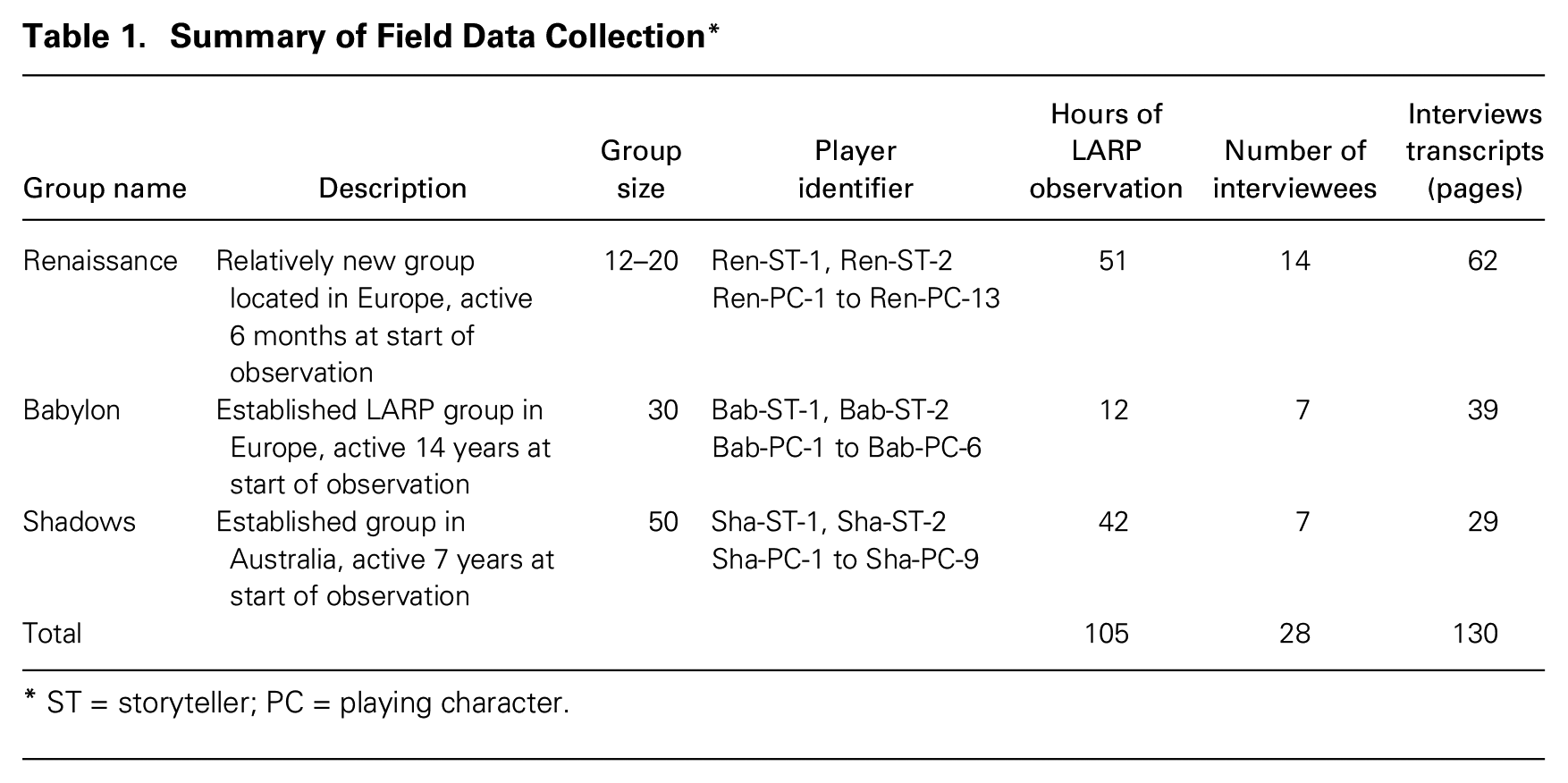
ST = storyteller; PC = playing character.
Pilot interviews and archival data collection
We first informally interviewed four experienced players and two STs. None were members of the three field study groups. The interviews were purposely broad in scope and touched on topics such as LARP experience, playing strategies, character interpretation, game structure, and role-playing in general. To further inform our analysis, we gathered archival materials, including newspaper interviews with prominent LARP players and STs and articles and documentaries on LARP. We did not subject pilot interviews and archival materials to formal analyses (see Pratt, Lepisto, and Dane, 2019).
Rough contours of themes
Our reading of the pilot interviews and archival data led to the emerging insight that perceived structures are a key element in improvisation development. Several interviewees underscored the importance of structural elements such as physical locations, rules, and social dynamics for improving improvisation and character interpretation. Additional interviews also uncovered the role of individual orientations in influencing how players develop improvisation skills. Both players and STs stressed how individuals differ in the way they approach the game and contextual structures, with some “playing to win” and others “playing to play.” Taken together, our pilot interviews and archival data analysis indicated that LARP communities aligned well with our theoretical sampling needs, providing a strong sense of “methodological fit” (Edmondson and McManus, 2007).
Observations and participatory observations
Given the spontaneity and the “in the moment” occurrence of improvisation (Crossan, 1998; Moorman and Miner, 1998a), we relied on observations as the primary data source. Observations helped us gain a deeper understanding of players’ behavior during live events and downtime, providing us with information that they were either not able to articulate or not willing to share. Typically, live events took place once a month, lasting for approximately three hours. We attended 90 percent of the live events occurring during our 24-month data collection period, and we continuously observed interactions during downtime, monitoring public forum discussions and Facebook interactions. Notes taken during the observations were further developed at the end of each live event. To strengthen the accuracy and trustworthiness (Lincoln and Guba, 1985) of our findings, parts of the events (approximately two hours) were filmed to facilitate subsequent analysis. In addition, the first and second authors participated in various live events of the three groups as nonplaying characters (NPCs). 2 This participation enabled us to gain an in-depth understanding of the different mechanisms involved. We reentered the field two years after the end of our first round of observations to refine our insights and gather additional data on the longitudinal effects of individual orientations. The total observation of live events amounted to 105 hours, 45 of which were participant observations.
Interviews
We conducted multiple semi-structured interviews with 28 players and STs: we interviewed 14 participants from Renaissance (12 players, two STs), seven from Babylon (five and two), and seven from Shadows (five and two). We set aside one-on-one time with the participants outside the live events to ask questions about their approach to LARP, how they interacted with others, the improvisational activities they engaged in, their perceptions of other players, and what elements were necessary for improvisation development. All informants were interviewed at least twice to capture variation over time. The questions we asked were similar across the two rounds, as we aimed to monitor the evolution of their beliefs and perceptions. The two rounds were conducted between four and six months apart, depending on the group. Interviews lasted between 20 and 60 minutes, were transcribed verbatim, and, when necessary, were translated into English. In total, transcriptions added up to 130 pages of single-spaced text. We also informally interviewed the players after the events to clarify interactions we had just observed. Finally, after our data collection ended, we interviewed players to get their perspective on other players’ approach to the game and its evolution over time. The full interview protocol is available in Online Appendix E.
Preliminary analyses
Throughout data collection, we met regularly to review field notes and discuss emerging patterns in the data, keeping note of our thoughts and insights. Given the first and second authors’ expertise in LARP, we were able to leverage some of the benefits of insider/outsider research in these conversations. The second author was closer to the setting and offered an expert view on the process from the players’ and STs’ perspectives, while the first author had particular insights into the players’ side. The third author, who was not familiar with LARP before the study, took up the role of critical observer who could question the taken-for-granted issues and pinpoint practices that seemed trivial for the initiated but were meaningful for theory development. These differences broadened the interpretative frame of our theorizing.
Analytical Process and Formal Analyses
We followed a four-stage process of coding the data to build theory (see Pratt, Rockmann, and Kaufmann, 2006; Pratt, Lepisto, and Dane, 2019). Figure 1 summarizes the emergent structure of our data (Corley and Gioia, 2004).
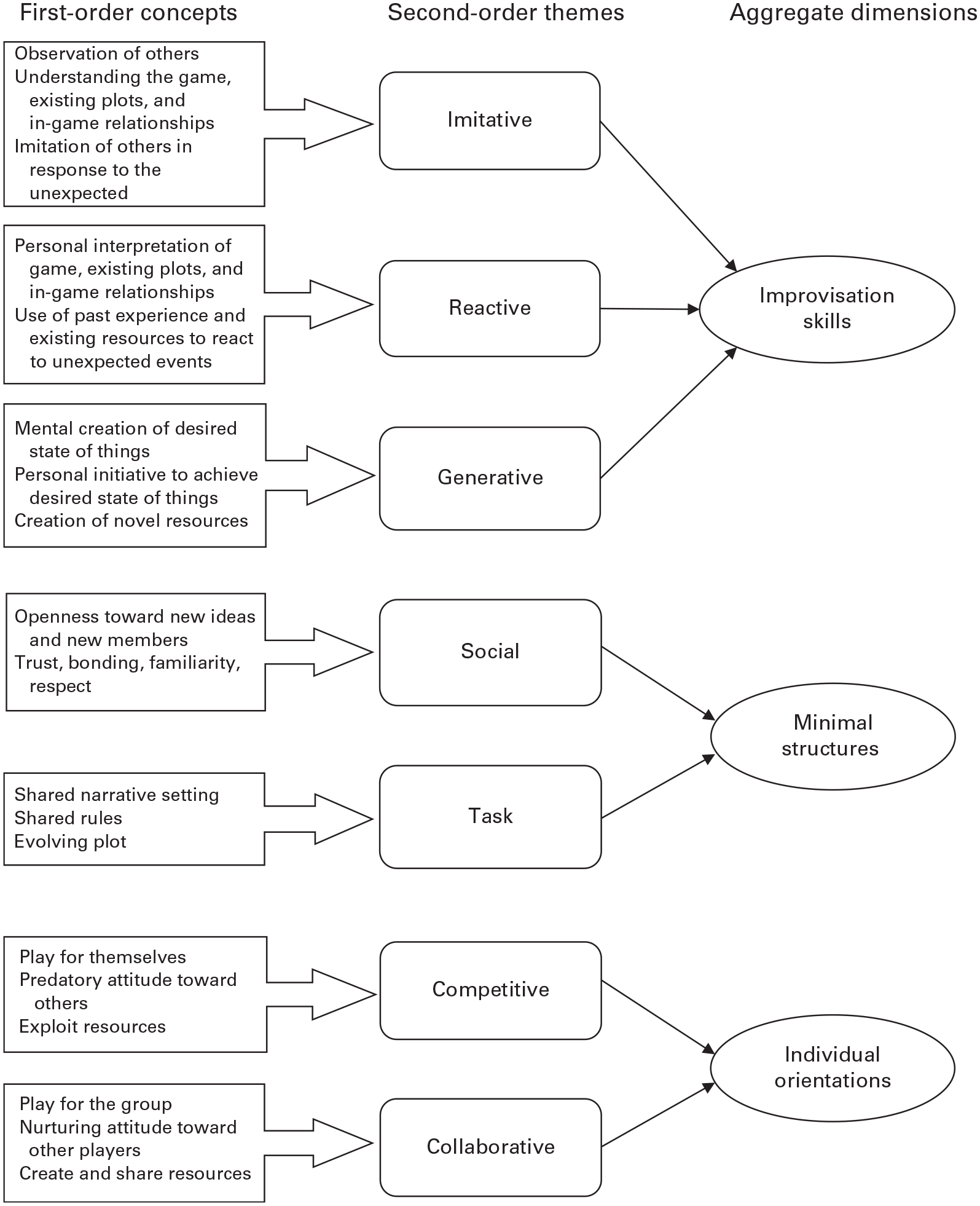
Data Structure
Stage 1: Developing first-order concepts
Adopting an iterative approach between data and theory (Strauss and Corbin, 1990; Locke, 2001), the first and second author independently searched for codes on how individuals develop the ability to improvise, comparing and discussing codes until reaching consensus. During this phase of open coding (Strauss and Corbin, 1990), we relied heavily on informants’ vocabulary and perspectives, using emic terms or verbatim statements to categorize dynamics seemingly related to improvisation. For example, we coded the statement “This character allowed me to observe a lot of other players and thus to learn a lot from them” as “observation of others.” Similarly, we coded the statement “These players play to win, to scavenge other characters and loot their objects or resources” as “predatory orientation toward other players.” We began with individual improvisation episodes. Our field notes from observations and videos allowed us to identify and distinguish subtle patterns of improvisational action. Interview data complemented our understanding of how and why a specific action was taken at a given point in time. After reaching saturation of first-order concepts (Glaser and Strauss, 1967; Corbin and Strauss, 2008), in which additional cycles of open coding revealed no new codes, we moved on to the next stage in the analysis.
Stage 2: Discovering second-order themes
We used axial coding to abstract from open-coded, first-order concepts to higher-level categories informed by both extant theory and emergent findings (Strauss and Corbin, 1990). All three authors began by comparing codes from improvisational actions characterized by different levels of sophistication, uses of structures, and playing approaches. This “compare-and-contrast” process allowed us to maximize “both the differences and the similarities of data that bear on the categories being studied” (Glaser and Strauss, 1967: 55). The third author, who has significant experience with axial coding, supervised this process and facilitated the abstraction from open, contextual meaning to higher-order themes. This process ultimately led to the emergence of second-order themes: imitative, reactive, and generative improvisation; social and task structures; and collaborative and competitive orientations.
Stage 3: Aggregating theoretical dimensions
In this stage, the iteration between data and theory became particularly intense. All three authors were involved in an intense dialectic that enabled us to better ground our constructs (Gioia, Corley, and Hamilton, 2013) and distinguish them from what extant literature already describes. We eventually settled on three aggregate dimensions: improvisation skills, minimal structures, and individual orientations.
Stage 4: Reconstructing individual trajectories
Finally, we went back to our data and developed detailed summaries of each individual’s improvisation development trajectory using our coding from stage 3 (for a similar approach, see Harvey and Kou, 2013). Our observations of live and downtime events and our field notes constituted the basis to identify and classify improvisation actions for each informant over time. We identified as “skill development” the first instance in which we observed a player using that type of skill (e.g., imitative improvisation) within our focal LARP groups. 3 We classified the subsequent and repeated use of a skill as “skill implementation/use.”
We used the interview data to triangulate our observations with players’ own perception of their development, as well as with the accounts of other players. As our framework acquired clarity, we understood that the development of improvisation skills follows an additive logic in which a previously acquired skill is not replaced but complemented with a new skill. We also observed that this development influenced and was influenced by structures.
We then engaged in trajectories mapping, adapting Christianson’s (2019) micro-ethnographic method to fit the longer timeframe of our research context. To do so, we searched for commonalities and differences between orientations in terms of (1) ease of transition from one developmental stage to the next and (2) interaction with minimal structures. First, we classified each participant as being either competitive or collaborative based on our final interviews, in which we asked informants to describe the playing style of every other member of their chronicle. We paid particular attention to how they qualified other players’ approach to structures and whether they observed changes in playing style over time. We triangulated the classifications with our field notes in which we described players’ actions during each event. For each player we gave an overall assessment for the orientation he or she displayed most in that event. As our analysis evolved, we realized that, while most of our participants (66 percent) maintained the same orientation throughout the observation period, others changed it. This change was not recursive but linear and stable over time. Once a player moved from collaborative to competitive, they would neither reverse to the previous orientation nor go back and forth between orientations. We thus tracked these changes and used the compare-and-contrast method to analyze the patterns of evolution in orientations. The result was the formalization of a theory of how individuals develop improvisation skills, with the aim to understand “how things evolve over time and why they evolve that way” (Langley, 1999: 692).
After reaching provisional conclusions about the data, we assessed the internal validity of our theoretical model by presenting our conclusions to players and STs from different groups for their review. We further validated our emergent theory through discussion with colleagues not involved in the study (Lincoln and Guba, 1985). These steps helped us ensure that our interpretations explain the studied phenomenon “authentically and plausibly, though not with absolute certainty of accuracy” (Reay, Golden-Biddle, and Germann, 2006: 983).
Findings
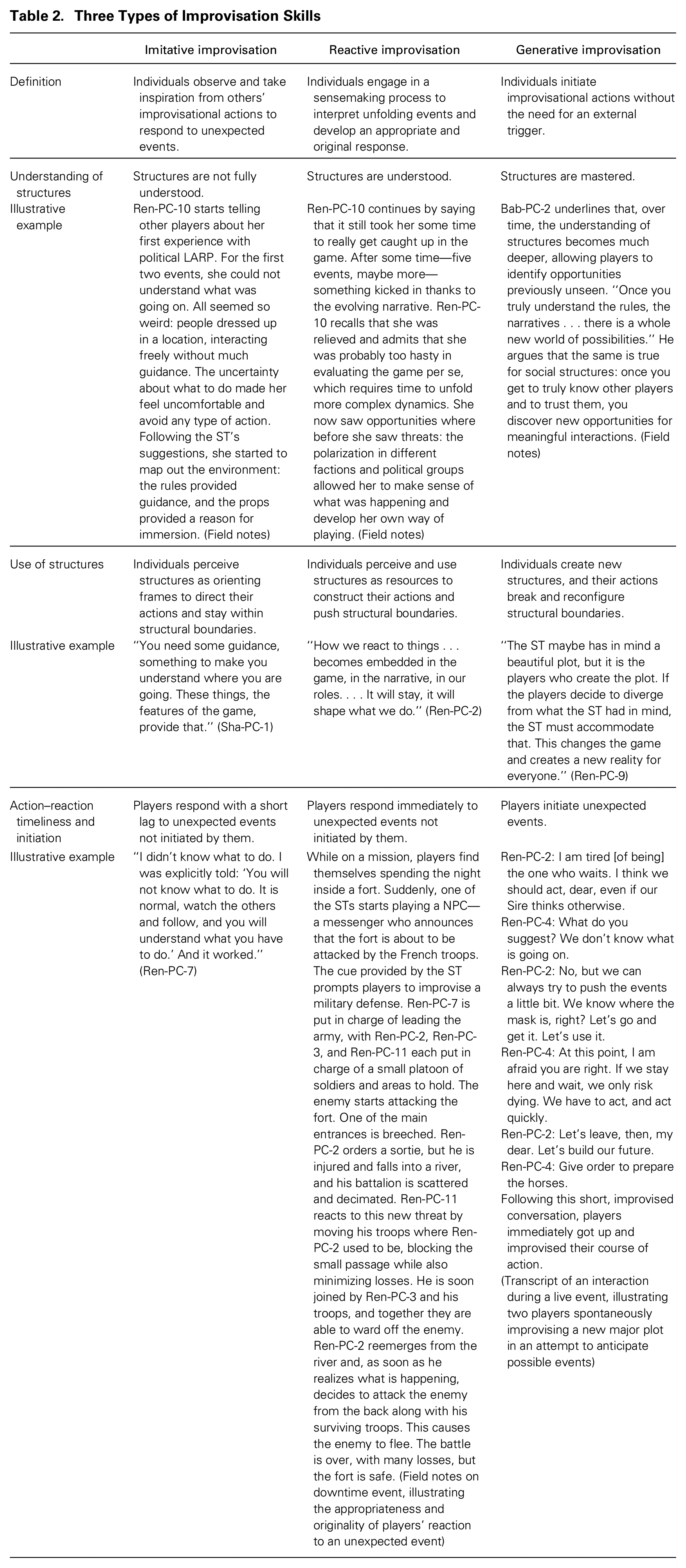
Our findings reveal that live action role-players develop three types of improvisation skills, following a sequential additive pattern. When faced with unexpected events, individuals at the beginning of their development trajectory improvise within structural boundaries that orient and direct their actions. We call this skill imitative improvisation, as players’ reactions mirror the actions of other players: their responses are not original, yet they are still improvisational (i.e., they are spontaneous rather than planned—cf. Crossan et al., 2005). Over time, players progress and develop the ability to construct their own original reactive responses to unexpected events, thereby actively using and often modifying available structures. We call this skill reactive improvisation, as players need a stimulus to trigger improvisation. Finally, some players no longer just improvise as a reaction to stimuli provided by STs and other players but develop the ability to initiate improvisation to probe into the future. We call this skill generative improvisation, as players’ actions often break and reconfigure existing structures, which become the starting point for further improvising. Table 2 provides an overview of the three types of improvisation skills.
Three Types of Improvisation Skills
The ability to effectively use reactive and generative improvisation is premised on mastering the preceding improvisation skill(s). Not everyone, however, follows the same improvisation development trajectory or ends up developing all three skills. We find that individuals perceive and use structures differently depending on their individual orientation (collaborative or competitive), which in turn shapes individual trajectories of improvisation development. Collaborative individuals take longer to move from imitative to reactive improvisation because they first invest time and effort in understanding and nurturing structures; upon developing reactive skills, however, they tend to be quicker and more likely to develop generative improvisation skills thanks to the support of previously nurtured structures. Conversely, competitive individuals move more easily from imitative improvisation to reactive improvisation as they immediately start exploiting readily available structures for their own good; however, they often have difficulty transitioning to generative improvisation due to the resistance of previously exploited structures. Importantly, we observe that individual orientations toward improvisation are not fixed but mutable, resulting in substantial differences in terms of how individuals develop improvisation skills over time. Figure 2 summarizes our findings.
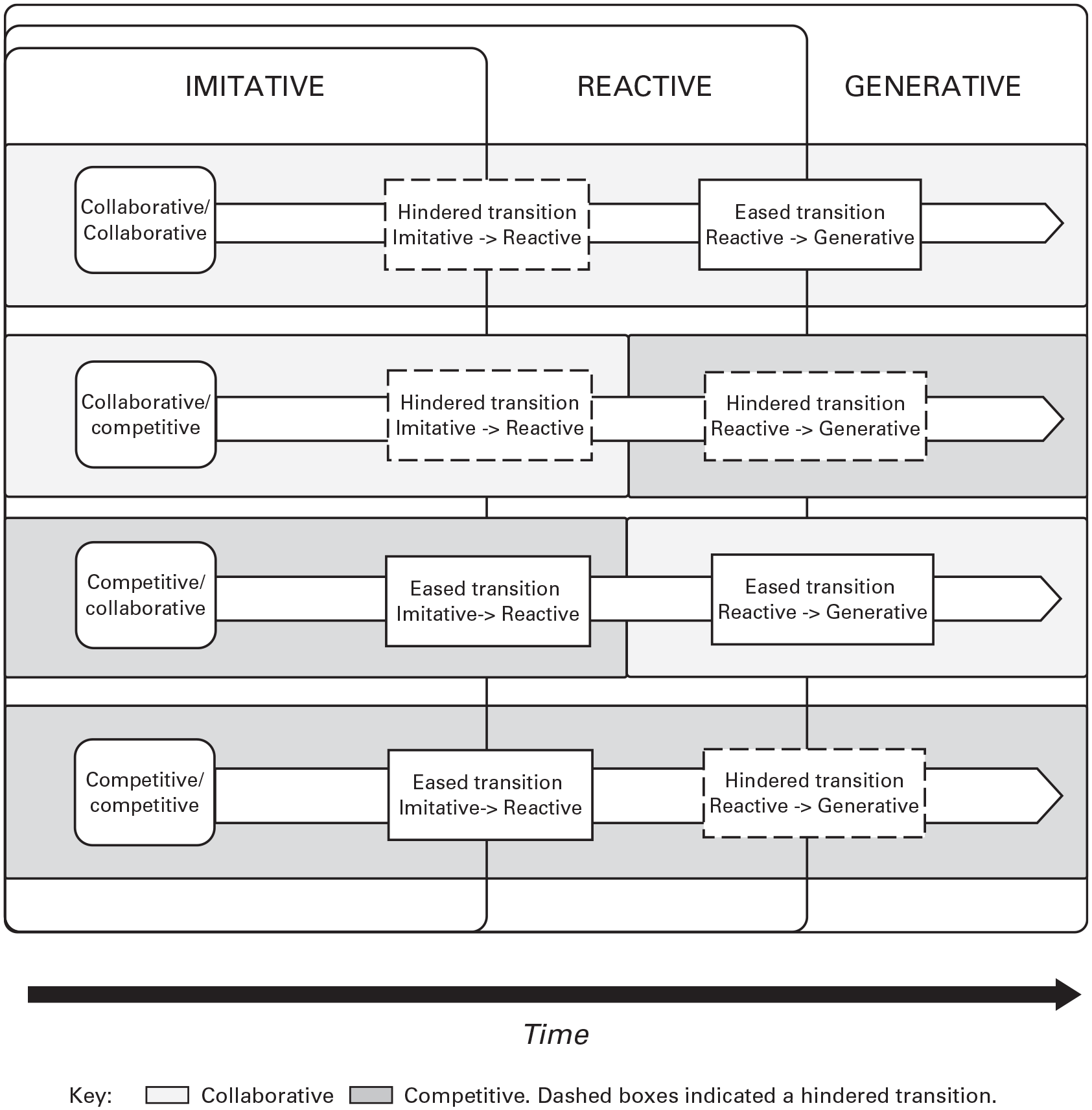
Impact of Individual Orientations on Improvisation Development
Individual Improvisation Development: Structures and Improvisation Types
Improvisation development is shaped by the evolving interactions between players’ actions and structures. In our field setting, task structures include the narrative framework, the rules, and the characters’ profiles. Investigating a context in which individual improvisation coalesces into a collective outcome led us to identify a second type of structures, which we call social structures. Specifically, the LARPs we observed were characterized by a trust network—the set of trust ties among players—and by a culture of inclusivity and experimentation (i.e., a set of values revolving around accepting others and being open to new ideas and inputs).
4
These structures help players to accept and build upon actions and reactions of other players. The following quote articulates how LARP players identify themselves as members of an open-minded, welcoming community and how this generates a positive game environment: I think that the feature that characterizes a role-playing group is great inclusivity. Differently from other social groups, role-playing groups are characterized by an open mind toward new ideas and people that they do not know, because the game, and it’s true both for tabletop games or LARPs, the game tends to be a social equalizer. . . . I think that inclusivity is one of the most interesting things emerging in a LARP group. In all my experiences, it has never happened that I felt marginalized or “less” than the others, even if I was the last guy joining. You are immediately integrated into the group because there is the shared idea that every new member can bring something new and positive to the group. (Ren-PC-2)
Both task and social structures are central to improvisational action as they constitute the boundaries within which improvisation takes place and the material upon which improvisation is built. As such, the perception and use of structures may enable or hinder the development of different improvisation skills, as we discuss next.
Types of improvisation skills
Table 2 provides illustrative examples for all three types of improvisation skills. In the initial stage of improvisation development, players’ sensemaking process is limited by their basic understanding of structures. As they do not fully grasp how to initiate improvisational action in response to unexpected events, they develop imitative improvisation skills by observing and taking inspiration from others’ improvisational actions. We observed many instances in which neophyte improvisers shadowed more experienced players and relied on their cues to decide what to do. Imitative improvisation happens within the boundaries set by existing structures. Task structures (narrative, character profiles, and rules) work as orienting cues that help players develop imitative improvisation skills, moving away from “improvisation paralysis” (Weick, 1993). The presence of social structures also facilitates imitative improvisation as they enable players at an early stage of improvisation development to feel “part of the group” and safe to imitate others rather than simply observe without acting (see Table 2). At this stage, the influence of structures on improvisational action is much stronger than the reverse.
Over time, players complement imitative improvisation with the more reactive improvisation skills that extant literature typically describes (Weick, 1993; Crossan, 1998; Patriotta and Gruber, 2015). Reactive improvisation focuses on “what is happening” and “how to react.” When improvising reactively, players engage in a sensemaking process to interpret unfolding events and develop an appropriate and original response. Unlike that of imitative improvisation, the development of reactive improvisation is premised on the ability to perceive and use structures as resources rather than just as orienting frames. Table 2 provides an illustration of this change in perception. Furthermore, reactive improvisation is characterized by greater agency in engaging with unexpected events. When improvisation is imitative, players tend to observe others to inform their actions. When improvisation is reactive, players can immediately respond to unexpected events without the need to model their reaction on that of others. Improvisers in the reactive stage “get it” so that their actions become more effective and valuable inputs for other players. The example provided in Table 2 illustrates that these players inform their improvisational reactions by leveraging their increased knowledge of rules and military tactics (i.e., task structures) and increased trust through familiarity with other players (i.e., social structures). It is important to note that their reactions are neither scripted nor automatic. All players act in the moment, with sensemaking and action converging into a coherent stream of unfolding events. Unlike imitative improvisation, reactive improvisation can have a substantial impact on structures. Reactive players push structural boundaries and, thanks to the social structures of trust and openness to experimentation, these changes become part of the shared pool of resources, thus enriching and influencing the LARP.
Some players further broaden their improvisation skillset by becoming the originators of unexpected events. Rather than waiting for STs and other players to provide cues for improvisation, they initiate improvisational actions without the need for an external trigger. These actions are geared toward probing into the future but are still characterized by the convergence of planning and execution: individuals conceive a course of action without the need for external stimuli and immediately act on it. This improvisation is generative in nature: the narrative is transformed through the injection of an entirely new course of action. The new structures created by players through generative improvisation become foundational to the shared resources accessible to all players. To enter this final stage of improvisation development, individuals must fully understand and master the structures of the context they operate in. Mastery of task and social structures enables players who develop generative improvisation skills to focus less on “what is happening” and direct their attention to “what could happen” and “how could I twist what happens.” At this stage, individuals feel an increasing desire to co-create rather than just modify the surrounding structures (see Table 2 for an illustrative example). We observed that social structures become increasingly relevant for individuals’ willingness and ability to “improvise into the unknown.” These structures favor experimentation and personal initiative, encouraging players to try out new things without the need for external triggers. The more players have nurtured these structures in the past, the more likely that their generative efforts will be perceived as constructive and weaved into the collective effort. Improvisation can be truly generative only if the new structures created by players are accepted and built upon by other players.
The additive nature of improvisation development
Individual improvisation skills develop sequentially and follow an additive logic, such that new levels of improvisation skills complement rather than substitute existing ones. For example, players continue to react to the cues provided by STs and other players (thus engaging in reactive improvisation) even when they have already developed generative improvisation. Upon achieving mastery of all three types of improvisation skills, individuals can choose which one to use depending on the situation. The following quote from Ren-PC-1 illustrates how players decide to adopt an imitative, reactive, or generative approach: What you do . . . depends on the situation, it depends on the kind of chronicle, it depends on how it is managed. . . . It depends on the character I am impersonating, how he is in that particular moment. Usually it is a mix of the two: it is very rare that you can always anticipate. Sometimes you have to react. In general, I would say that it depends both on the situation that the STs put in front of you and on the character that you are impersonating.
Individual Orientations and the Perception of Minimal Structures
While we observed a sequential additive pattern of improvisation development across informants, they did not follow identical trajectories in developing the three types of improvisation skills. Some developed reactive improvisation skills more easily but then seemed unable to develop generative improvisation; others needed more time to develop reactive improvisation skills but then developed generative improvisation skills almost seamlessly. Reflecting on and observing heterogeneity in the way individuals approach improvisation revealed two types of orientations toward the improvisational task: collaborative and competitive. These orientations have a distinctive influence on how individuals perceive, interpret, and use task and social structures. 5 Because these structures are critical for improvisation development, perceiving them differently due to orientation engendered variation in how individuals developed reactive and generative improvisation skills. In the following subsections, we first illustrate the effect of individual orientations on the perception of task and social structures (see Table 3 for a summary). Then we address how this differential perception shapes improvisation development trajectories.
Evolving Perception and Use of Structures Depending on Individual Orientations
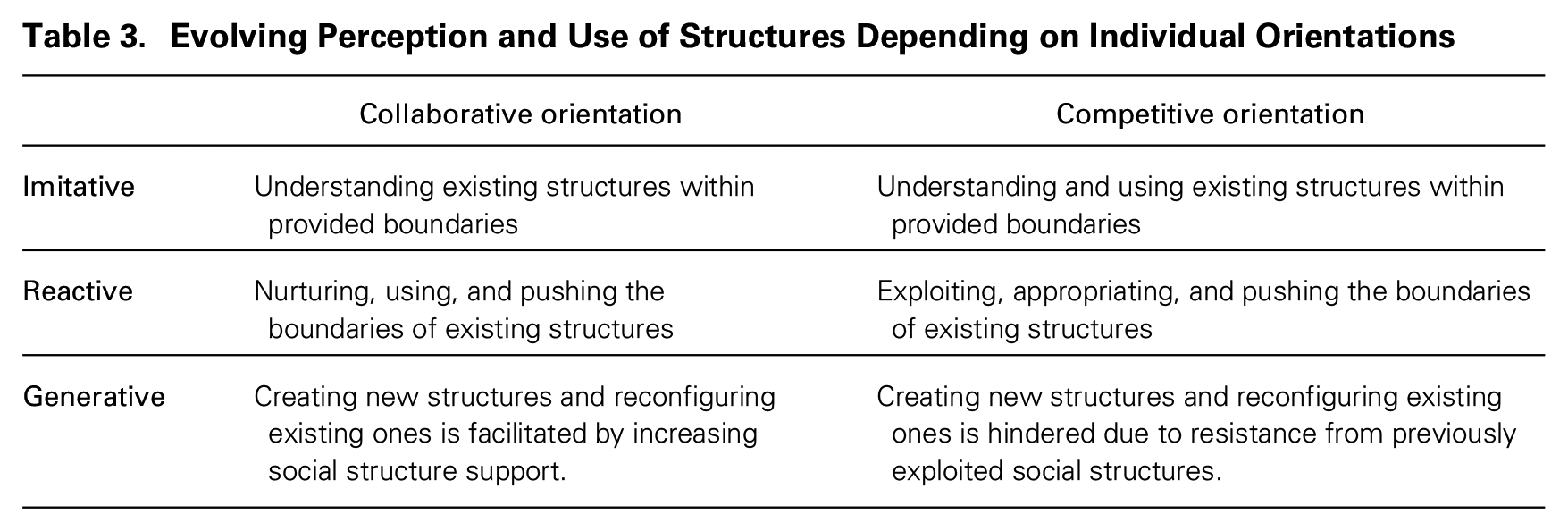
Collaborative orientation
Collaborative players approach improvisation with a focus on merging each individual improvisation effort into a collective outcome. Collaborative players tend to view task structures as background elements that support and enhance the collective experience rather than as something to exploit for personal advantage. Consequently, collaborative players put limited upfront effort into learning task structures such as rules and characters’ power dynamics. Instead, they learn them while playing and, as a result, usually need more time to master them. In the words of Ren-PC-4: I always paid minimal attention to [game] rules. They are important, of course, but being a person that doesn’t find it important if a certain ability has a value of 3 rather than a value of 4 . . . I understand if for certain players it is very important, that you can get advantages by knowing the rules, but to me it is less important than other elements. If you have fun, if the characters are interesting, the macro-plot is engaging, in the end you tend to avoid exploiting the gaps in the rules. . . . If you do it . . . well, you have to deal with it.
Not exploiting rules and other task structures is highly regarded among collaborative players. For example, it is considered honorable to create one’s character sheet by picking abilities that match the character’s background rather than those that would make them more powerful.
Collaborative players focus on understanding, nurturing, and expanding social structures. Learning how to interact meaningfully with others and offering improvisational cues compatible with their skill level are key development objectives for collaborative players. In addition, collaborative players place value in being members of an open-minded community in which diverse views and unplanned, out-of-the-box actions are accepted and encouraged. This orientation thus translates into a constant attempt to nurture and enrich social structures. A collaborative orientation is premised on being mindful of the effects of one’s actions on other players, while accepting and building on their input. By doing so, collaborative players contribute to the creation of a safe, trustful environment and an invigorating game experience.
This attitude is reflected by how other players describe collaborative-oriented players as “generous,” “good,” and “team players” but also as “playing for playing’s sake.” Since open-ended narratives present multiple occasions to behave opportunistically and deplete the pool of jointly created resources (e.g., narrative, subplots, rules), many players and STs emphasize the importance of collaborative players for improvisation’s viability: Bad players play to win, to kill others, to scavenge other characters. No, we want generous players. The more you show that you reward generous players, the more generous players you will have and the more this style will be widespread. You need to be rigid; you cannot allow to let go, because a player who cheats is ruining the game [for the] other ten players, is teaching others to cheat, to behave badly, and in the end you have a hovel of people who cannot behave. (Bab-ST-1)
Competitive orientation
Some players approach improvisation with a self-centered focus, aiming to have the best possible experience for themselves. Competitive players are very attentive to task structures and spend significant time and effort in mapping and mastering them. More broadly, they tend to perceive and use available structures as if they were theirs to consume, to the point of bending the rules and using newcomers as expendable resources. We observed many instances in which players with a competitive orientation exploited structures to their own advantage. Competitive players try and often manage to “shine the spotlight” on themselves to gain both in-game benefits and out-of-game recognition as capable improvisers.
Players exhibiting a competitive orientation are accepted and sometimes even admired by other players because of their mastery of game dynamics and rules. However, this acceptance is maintained only as long as competitive players do not deliberately break the rules or apply them pedantically, transforming a narrative performance into a game of numbers. When this happens, other players and STs will mount resistance to their actions. For example, some rules in Renaissance were changed after six months because one player found a loophole and exploited it for his own benefit. Other players had also been aware of the loophole but chose not to exploit it on grounds of fairness. The change in rules was motivated not by the presence of a flaw in the rule system but by one player’s deliberate choice to exploit this flaw for self-gain. The ambivalence toward competitive-oriented players is reflected in how other players describe them, calling them “results-oriented” and “potentially powerful” but also “smartasses” and “predators.” This is how Sha-PC-4 described a competitive player in his chronicle: He is most definitely a naughty boy. . . . I mean, he is a good player, acts well, dresses well, [is] soft-spoken, charming. . . . He is English, so playing an English knight works well for him, the accent and what not. So, when he approaches you, he makes an impact, you want to interact because he stands out. But if an advantage is to be gained, he will go for it. He will try to f* *k you if he can. Remember the tournament, the finals against Johnny? He would not give up even if Johnny had smashed him, and talk, and talk, even when he was down. . . . Johnny had to stake him to shut him up and not steal the scene.
The almost exclusive focus on task structures reduces competitive players’ perceptions of the presence of social structures, resulting in them not nurturing these structures. This neglect happens either because competitive players do not perceive these social structures or because they ascribe little value to them. For example, after one year playing in Babylon, Bab-PC-3 had developed the reputation of being a very competitive (though not predatory) player. When we asked him about the group he played in, he described it as “just a bunch of people who meet to play. We do not really interact much, we do not share much. And it is okay, I am here just to play.” Bab-PC-3 thus neither perceived social structures as a resource nor showed any particular interest in developing these structures. In contrast, most players in Babylon described the group as “like a family” and “always supportive.”
Individual Improvisation Trajectories: The Role of Evolving Orientations
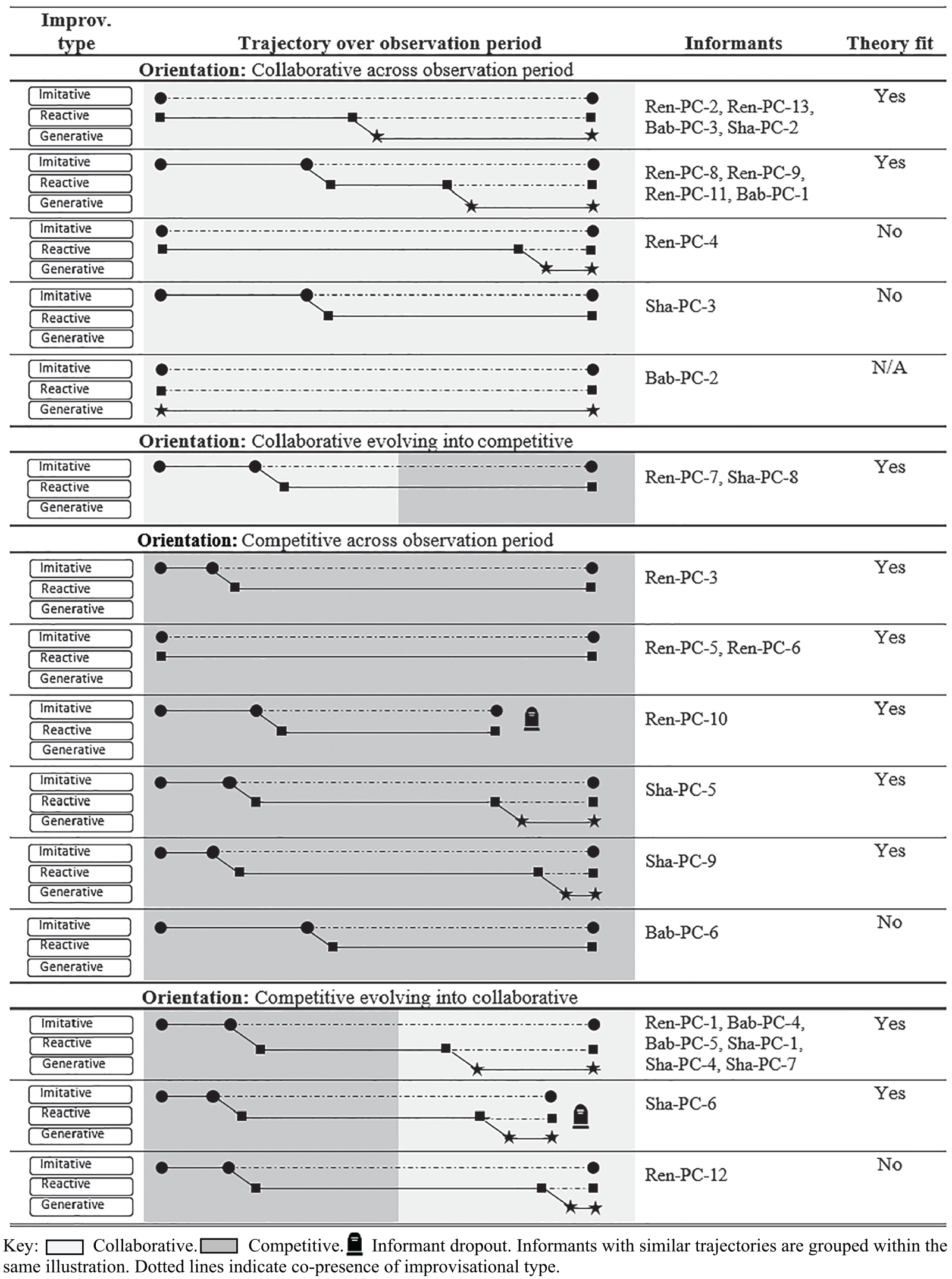
During our two-year observation period, many of our informants (66 percent) maintained either a collaborative or competitive orientation while developing their improvisation skills. But for about one-third, individual orientations were not enduring: after developing reactive improvisation skills, some collaborative players became competitive, while some competitive players turned collaborative. The evolving nature of orientations resulted in four different improvisation development trajectories. Figure 3 charts the trajectories of all informants, along with the orientations exhibited at the start of the observation period and halfway through it.
Improvisation Development Trajectories Based on Individual Orientations
Collaborative → collaborative
Players who maintain a collaborative orientation are characterized by their continued nurturing of social structures over time. Initially, these players observe how others approach improvisational action and extant structures. They are curious and eager to learn but do not want to interrupt the narrative flow, use shared structures inappropriately, or damage the collective experience. Given this initial caution, collaborative players tend to be in the midst of action less frequently than competitive ones.
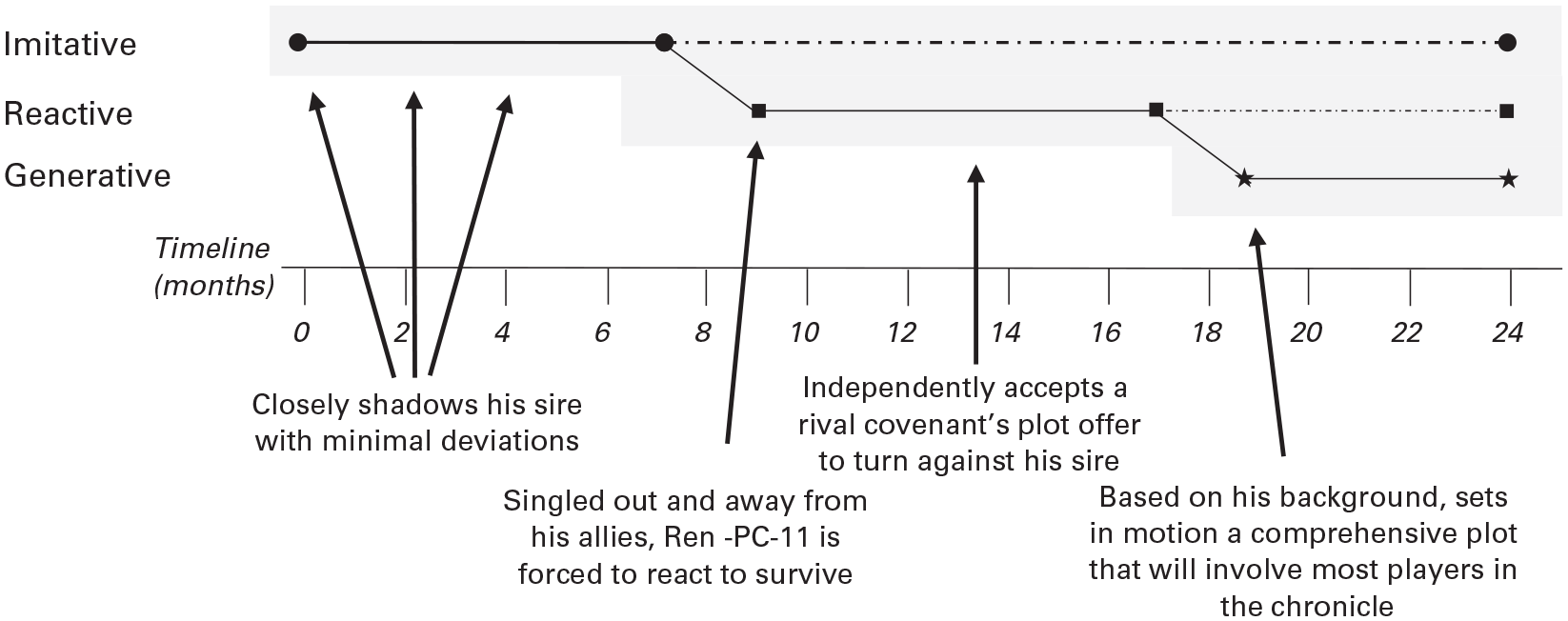
Reduced direct exposure to improvisational cues can slow the development of reactive improvisation skills. Collaborative players often do not attempt to transition to reactive improvisation until they have gained enough confidence that they can meaningfully contribute to the collective improvisational effort. Our summary of the first part of Ren-PC-11’s development trajectory offers a telling illustration: (Trajectory summary of Ren-PC-11—Part 1) When Ren-PC-11 joins the Renaissance chronicle, he is just one of Ren-PC-3’s minions. His costume and makeup are inspired by Ren-PC-3’s. During the first months, he replicates, with minimal variations, Ren-PC-3’s gestures and actions. On the orders of Ren-PC-3, he spends a lot of time observing other players, noting down their actions and behaviors, and reporting on them to Ren-PC-3. During off-game conversations, he says that he sees this as a way to learn as much as possible about the narrative setting and the plot. During the final event of the year, Ren-PC-3 is suddenly missing in action, and members of another covenant ask Ren-PC-11 to betray Ren-PC-3 and join them. Ren-PC-11 does not wait to consult with Ren-PC-3, nor does he seek to report this to him, but accepts the offer and becomes immediately involved in a plot to banish his former sire from the princedom. After the event, he comments that he now feels comfortable reacting on his own to external cues.
The prolonged time spent developing and nurturing social structures results in collaborative players earning trust from other players. Their “shadowing” behavior gives them more in-game connections than competitive players. These social structures are further fostered as they develop reactive improvisation skills, with other players willingly integrating their improvisational actions (Vera and Crossan, 2005) into the narrative, plot, and other structures. Over time, the combination of opportunities to improvise (because other players are receptive to their inputs) and perceived safety net (because of the trust among players) helps collaborative players experiment with existing structures and try out new things. All these factors ease the development of generative improvisation, both directly (by providing them with the needed resources and skills) and indirectly (by increasing the likelihood that their attempts are integrated into existing structures).
The second part of our trajectory summary for Ren-PC-11 illustrates these points, showing how this player continues to put the collective experience above his personal benefit while developing generative improvisation skills. His protracted collaborative orientation leads him to engage in improvisational actions geared toward creating a better improvisation experience or “a good scene” for everyone to build on, even if these actions may severely endanger his character: (Trajectory summary of Ren-PC-11—Part 2) Ren-PC-11’s second character was deeply entrenched in the social texture of the narrative, as much as he was entrenched in the social system outside the game. After only a couple of events, his character proactively acted to plot against his sire. He involved other players in the plot, and together they took many steps to bring it to fruition. Even if the plot was finally discovered and his character killed, it created a lot of new narrative lines involving almost all players. Consequently, Ren-PC-11’s actions gained him praise from the STs and other players.
Ren-PC-11’s actions may seem competitive: after all, he plots to overthrow his sire. Yet his actions are motivated by a collaborative spirit, as they create improvisational cues for everyone and allow for the progression of the narrative. Ren-PC-11 collaborates with his sire until the moment he believes there are no further opportunities to produce improvisational cues others can build upon. He switches factions, taking a huge personal risk that will eventually lead to his demise, all for the sole purpose of furthering the narrative. Figure 4 punctuates the key transitions of Ren-PC-11’s improvisation development journey.
Detailed Improvisation Development Trajectory for Ren-PC-11 (Collaborative → Collaborative)
Most informants appreciate “forever collaborative” players and are happy to play with them. They perceive them as “good citizens” and as role models for others to follow. In our interviews, the players at Renaissance all spoke with respect about Ren-PC-11. The following excerpts highlight how his collaborative orientation is appreciated by other players:
At the beginning he was just kind of “staying there” . . . but you could see that he was passionate about the game. Otherwise, you do not allow Ren-PC-3 to dress you up like a savage covered in blood. . . . I mean, I would not have done that if I were him, I’ll be honest. But then, hey, when he started to plot with Ren-PC-13 with his new character . . . he stirred the game. I mean, he was trying to kill me [laughs], but it was a great move, a risky one, but a great way to try to do something new, to improvise in a new direction. It was then that I decided I wanted to play with him more. He is a good player, a creative player. . . . His characters are often total nutjobs [laughs], but he plays for the sake of the game, and it is great.
Oh, Ren-PC-11! [laughs] Oh, my, my! Well, he is great. He just does not care, you know. About the technicalities, about survival. . . . And at the same time, he cares, he cares about the right things: the plot, other players, the collective narrative, improvisation. . . . He plays for the sake of playing, to interpret his character, to improvise. It is amazing to see how far he went, to be honest. He joined, what, one year ago? One and a half? Already? Wow . . . Anyway, he is relatively inexperienced, but still. . . . He made tremendous progress, he was kind of a background object—sorry, but it is true—and now he plays better than many of the more experienced players.
Collaborative → competitive
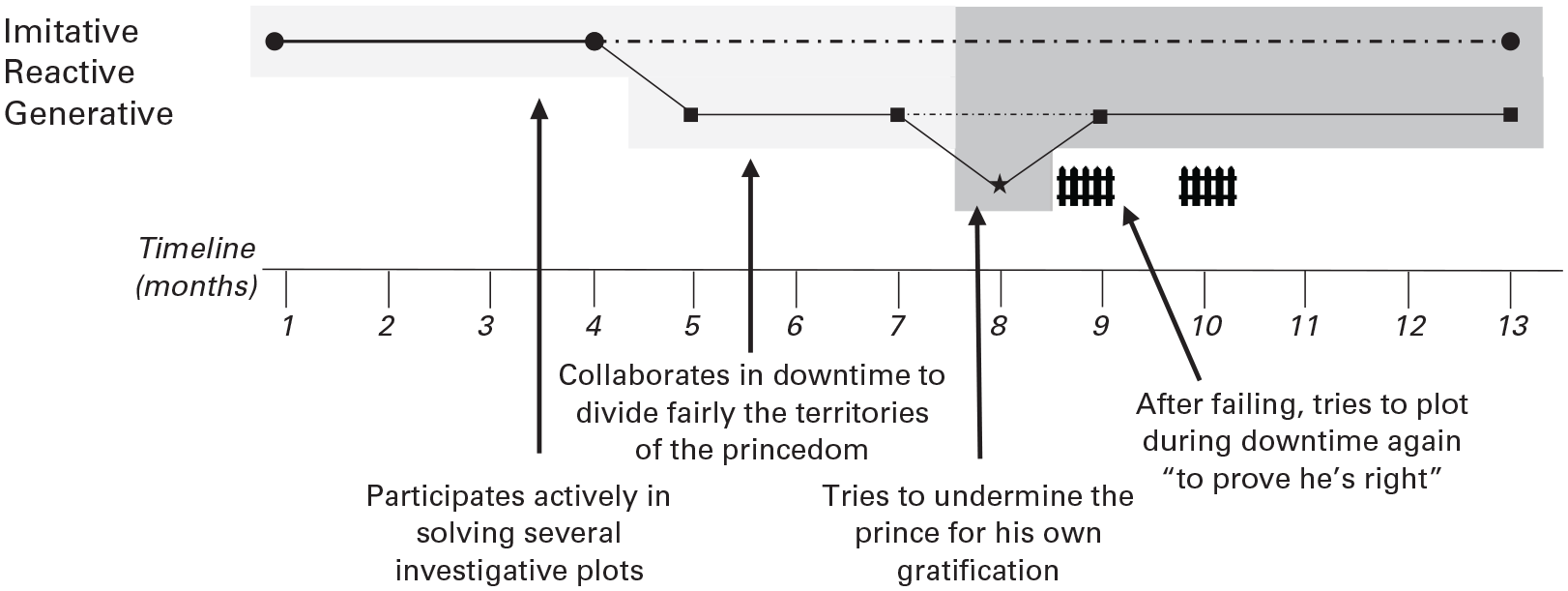
Players who begin the game with a collaborative orientation and then turn competitive move from being well-integrated in the game dynamics to falling from grace. This was by far the least common trajectory among our informants. In the initial stages of improvisation development, these players act in a way indistinguishable from what is already charted for the collaborative–collaborative trajectory: (Trajectory summary of Sha-PC-8—Part 1) Sha-PC-8 is a relatively experienced player who started the chronicle as a member of a medium-large faction. While his character is meant to be an ancient Ventrue, a lineage characterized by charisma and leadership, he has spent most of the first months in the rearguard, establishing collaborations with other factions without taking the lead. I [the participant researcher] knew he existed, but I did not even know his name after six months as I always saw him sneaking here and there, talking to people, forging bonds, being seemingly a good, generous player but lacking distinctiveness. I finally learned his name and interacted with him during a meeting to plot overthrowing the current prince. I noticed he started reacting independently to the cues others were offering, and I even thought he was a good player. In subsequent interactions, however, I noticed something changed in his approach, as if that ancient lineage his character was meant to embody suddenly awoke and engulfed him all at the same time.
After they have mastered reactive improvisation, players following this trajectory seem to undergo a transformation and begin to exploit the very structures that have helped them get there. This change occurs because of increased frustration with what they perceive to be insufficient attention from the collective toward their efforts. Hence, they turn “rogue,” deciding to exploit the same structures that allegedly do not recognize their contribution.
Collaborative–competitive players use what they have learned through observation not to help the collective improvisational effort but to pursue their own agenda, often exploiting task structures to build powerful characters and to exert dominance over social structures. They can become extremely confrontational and aggressive in their reactions to unexpected events, as the trajectory of Sha-PC-8 reveals: (Trajectory summary of Sha-PC-8—Part 2) The turning point for Sha-PC-8 happens after the old prince was overthrown. In the fight causing the prince’s downfall, I notice him staying behind and never engaging in the confrontation. Initially, I attribute this choice to his character not being a fighter, or a moment of confusion on how to act. Only later I understand it was a deliberate choice to conserve resources and strike in the eventuality the contender prince, Harry, would be weakened enough. When this does not happen (and up to this point this is still considered legit play in line with the character), Sha-PC-8 tries to plot during the downtime to gain consensus, aggressively presenting himself as a better claim to the throne due to his lineage and tenure, rather than being a mere soldier as Harry is. This move is perceived as very whimsical and out of character by many players, as it displays the willingness to ruin a plot that took months to improvise and was sustained by the conjoint efforts of about 20 players.
The collaborative–competitive trajectory displays not only a slower development of reactive improvisation but also a slowing down—and sometimes even a complete stop—of the development of generative improvisation. This slowing down seems to be due to “structural resistance,” in that other players actively thwart improvisational attempts of overly competitive players. Figure 5 illustrates the pivotal moments of this transition for Sha-PC-8.
Detailed Improvisation Development Trajectory for Sha-PC-8 (Collaborative → Competitive)
Owing to their initial collaborative orientation, these players experience privileged access to social structures. This legacy leads other players to try to “win them back to the light side,” to paraphrase Bab-ST-1, by involving them in different subplots in the game and during downtime. We observed these efforts fail, with much dismay and confusion for other players and STs alike, leading to negative reactions. We note that this was not the outraged reaction of players frustrated by a competitive player escalating his or her predatory orientation; it was the puzzled reaction of players who did not see it coming but had to react and erect boundaries to preserve the continuity of the shared improvisational effort.
At the beginning, he [Sha-PC-8] was not bad. He was collaborating with the Russians and the Giovanni [a faction in the game] to get rid of those supporting the sick prince, creating a lot of additional narratives. Then, during the attack to the prince’s bodyguard he stayed behind, and that irritated the Giovanni a lot. I mean your character is not a fighter, but do something, you have other skills. And then when he said he had a claim to the throne, I think the Russians just laughed at him, and I heard one of the Giovanni saying, “I would just kill him but it is not even worth it.” And then he kept just playing for himself and a few others, isolated from the broader princedom, just playing along as things happened.
I must admit I did not even notice him at the beginning, I guess he was doing the usual stuff, creating bonds, playing the game. Then suddenly he became the worst power player, seeking every crumble of action that the good players were leaving him. I know he started taking pride [in] his actions in private conversations with the STs and downtime, but when it comes to the live he keeps staying in the background as he used to do before. You see him plotting in a corner while he watches in frustration those that can create action without all this drama.
Competitive → competitive
Players who maintain a competitive orientation focus on learning and exploiting available structures and escalate this behavior over time. Competitive players develop reactive improvisation skills more easily than their collaborative counterparts because they fully exploit available structures to sustain their improvisational efforts. Their responses are effective in both addressing the challenge at hand and providing benefits for themselves. Our initial observation notes on Ren-PC-3 provide an illustration: (Trajectory summary of Ren-PC-3—Part 1). Ren-PC-3 is well versed in the dynamics of the game. At the same time, he is also pretty focused on winning: during the character creation session with the STs, he built up his character sheet very conscientiously, trying to maximize his character’s powers and the synergies between them. Combining knowledge about the game with a competitive mindset has enabled Ren-PC-3 to quickly stand out from the crowd: after only three events, he has displayed the ability to develop original responses to the events around him. For example, when a senior member of his covenant abruptly left the princedom, he quickly seized the opportunity and reached a leadership position within his covenant. . . . When three new players joined the LARP, Ren-PC-3 spotted the opportunity to expand his covenant and, consequently, his own influence and was extremely zealous in recruiting two of the three new players. He set up their relationship as one of ruler and minions, increasing his power and autonomy in the game. He even renamed the new players’ characters with different names and branded them with his hand.
While other players may initially perceive competitive players as inspirational because of their ability to leverage structures, prolonged competitiveness erodes social structures. In response, other players limit their interactions with competitive players to avoid being entangled in their improvisational cues, which are provided for self-serving purposes rather than for generating additional improvisational opportunities. These reduced interactions complicate or even block the development of generative improvisation. “Forever competitive” players witness a progressive structural resistance, with social structures gradually turning into barriers to improvisation development. The following quote from Sha-PC-6 illustrates the strong pushback and social exclusion that competitive players may experience: Sometimes you realize it’s not even worth doing this, when people with whom you play only care about how strong their character is and how much they can overwhelm other characters and impose their will . . . and this is a disease, the payback that some people want to have against life. It nauseates me; I don’t want to play with these people.
Facing social exclusion has direct consequences for the development of improvisation skills. Our observations of Ren-PC-3 reveal how this player falls victim to delusions of grandeur and willingly disrupts the game in all possible ways to secure personal benefit. The other players react by actively ostracizing him: (Trajectory summary of Ren-PC-3—Part 2) Many players lament that Ren-PC-3 preys upon newcomers who lack experience to understand the situation and who are eager to be included in the game’s dynamics. . . . Ren-PC-3’s predatory approach to the game is manifested in his overreliance on rules that favor him and his habit of bending, if not breaking, rules that disfavor him. He repeatedly complains about a downtime interaction in which he did not emerge victorious, although the ST in a separate conversation clarified the odds were against him. Eighteen months after our observation started, Ren-PC-3 interacts with a NPC played by guest player in a power struggle. The guest player confronts Ren-PC-3 in a narrative-rich, visually stimulating scene designed to conclude the chronicle. However, Ren-PC-3 perceives the scene as threatening to his character as it requires him to “play to lose” and stubbornly refuses to properly interact with the guest player: when attacked “in-game” by the far-more-powerful guest player, he declares he suffers no damage and cites a self-serving version of a game rule. This predatory and rule-bending attitude enrages the guest player so much that he loses his temper, slaps him in the face “out of game,” and exits the room. Albeit an extreme act, it shows how frustrated he became in a very short time about Ren-PC-3’s attitude. Later that night, Ren-PC-3 is the protagonist of another dubious event when, getting the sense that some other players have decided to eliminate his character, he conveniently “disappears” by hiding in the bathroom for half an hour, until the end of the event. . . . Other players condemn this action for many days after the event.
Figure 6 charts Ren-PC-3’s improvisation development journey.
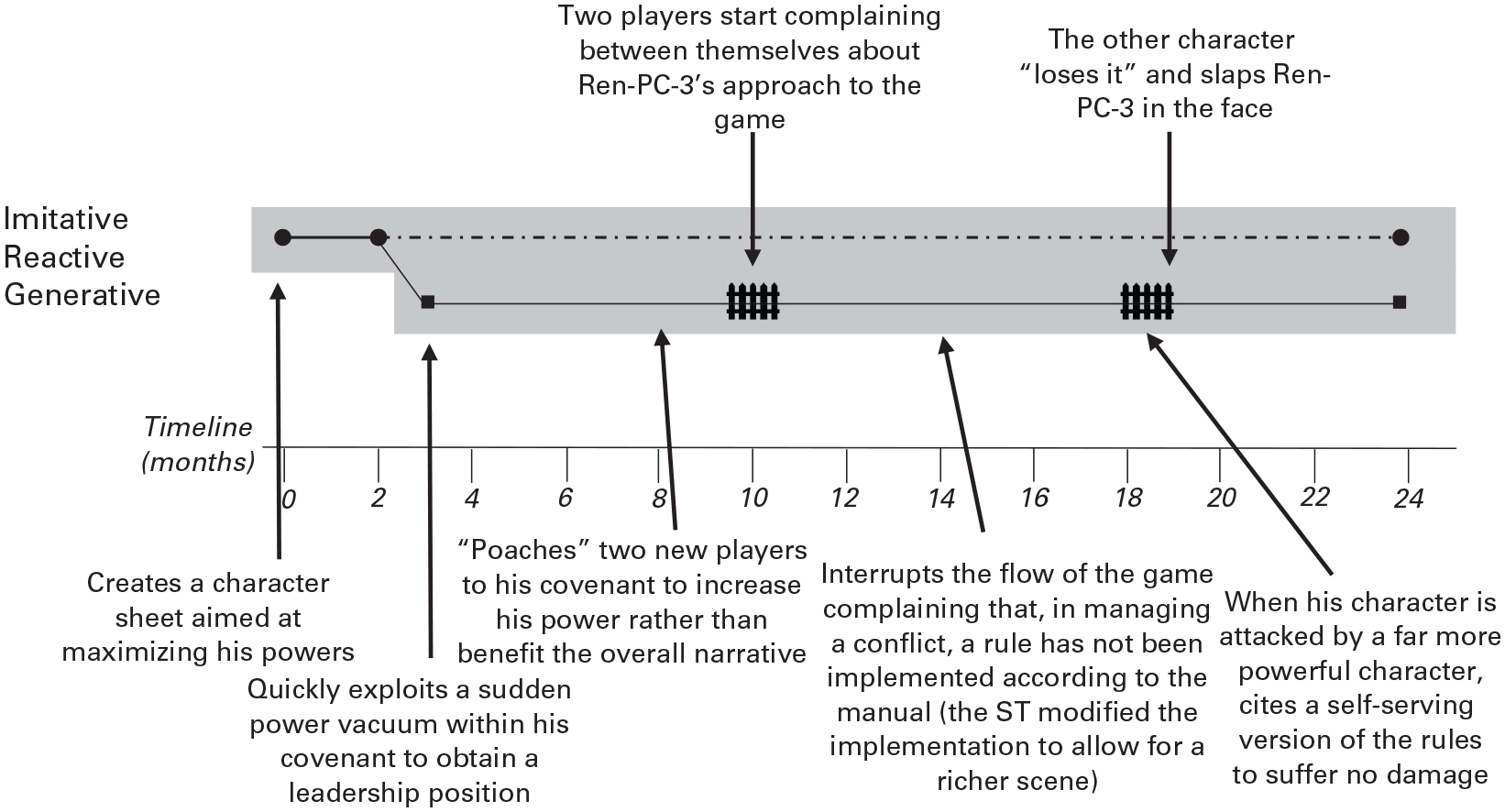
Detailed Improvisation Development Trajectory for Ren-PC-3 (Competitive → Competitive)
Consistent with our observations, other players at Renaissance spoke with contempt of Ren-PC-3 and despised his actions. They also noted that their opinion of him progressively worsened over time because of his escalation in competitive orientation:
He is the prototype of the power player. At the beginning, he was even useful because his actions created opportunities to advance the plot, he made props for new players he took under his wing. . . . But then he became simply annoying. I kind of pity players like him because they do not understand what this game . . . what improvising is about. They keep exploiting others and bending the rules, and they find themselves alone, crying in the dark, wondering what went wrong: well, you went wrong, Ren-PC-3. You. Went. Wrong.
Boy, the bathroom escape! Come on, this is one of the worst behaviors I have ever seen. My character was married to his just minutes before—thanks, STs, by the way—and he decided to totally avoid playing a major, very emotional scene just to keep his character alive. When I first met him, I was actually impressed by the quality of his costume and by his ability to quickly respond to what the storytellers were throwing at us. . . . But then I realized he is just playing to win and would go the extra mile to do so. He could be a good improviser, and maybe he was good at one point, but now he has been kind of left behind: it is hardly a surprise that no one is building on his ideas.
The enduringly competitive player is doomed to be a reactive improviser, as active resistance from other players bars access to structures that sustain the development of generative improvisation and results in rejection of improvisational actions he or she initiates.
Competitive → collaborative
Players who move from a competitive to a collaborative orientation initially behave in a similar way to the first leg of the competitive–competitive trajectory. They are quick in mapping and using existing structures, rapidly developing reactive improvisation skills.
(Trajectory summary of Bab-PC-5—Part 1) Bab-PC-5 started the game with a lot of experience in tabletop role-playing games. He is a very character-focused player, who sees his character as the center of what he does and why he plays the game. At the beginning, this focus translated into a perfect knowledge of the rules and a careful crafting of his character sheet—something he later argued to be a consequence of his “tabletop imprinting.” He was also playing characters very similar to himself to make them easier to interpret and was quick in accepting to interact with as many players as possible. Overall, this allowed him to get “up and running” very fast, abandoning imitative behaviors very early on.
What differentiates competitive–collaborative players from competitive–competitive ones is that the former realize, often through a trial-and-error process, that social structures are becoming resistant to their improvisational efforts. Hence, they progressively transition to a more collaborative approach, avoiding the escalation in competitiveness and allowing them to maintain and even increase the respect and admiration (i.e., competence-based trust) of other players. Players who transition to a more collaborative orientation increasingly perceive the importance of social structures and of nurturing them. At the same time, other players recognize and appreciate this change and thus become more acceptant of their generative “improvisational offers,” embedding them in the collective narrative. Competitive–collaborative players thus experience a facilitated development of generative improvisation skills. The second part of our notes on Bab-PC-5 illustrates this point: (Trajectory summary of Bab-PC-5—Part 2) After some time, Bab-PC-5’s continued focus on character creation and development gradually shifts to interpretation and acting, rather than rules and character sheet. He increasingly moves away from playing “self-inspired” characters to challenge himself, and to create something new to enrich the collective narrative as well as himself. During a conversation, he says that his new goal is “offering his character to others and enabling others to offer their characters to him.” The latest character he is playing, a Promethean, is supposed to be extremely physically powerful, but he decided to develop his background in such a way that the character is reluctant to use his powers, thus actively restraining them. His interpretation of this character is deeply admired by other players, who laud his focus on psychological features such as isolation, rejection, and the quest to find out his identity. He is increasingly sought out by other people to start microplots and missions, and he actively forges new connections. He makes a point of doing so especially with players he does not already know well outside the game. He has also become keener on helping less experienced players to develop their improvisation skills and to live the same experience he is having.
Overall, players who experience this change in orientation are the fastest to progress across the three stages of improvisation development, quickly developing both reactive and generative improvisation skills. Figure 7 details the transitional journey of Bab-PC-5 as an exemplar of competitive turned collaborative players.
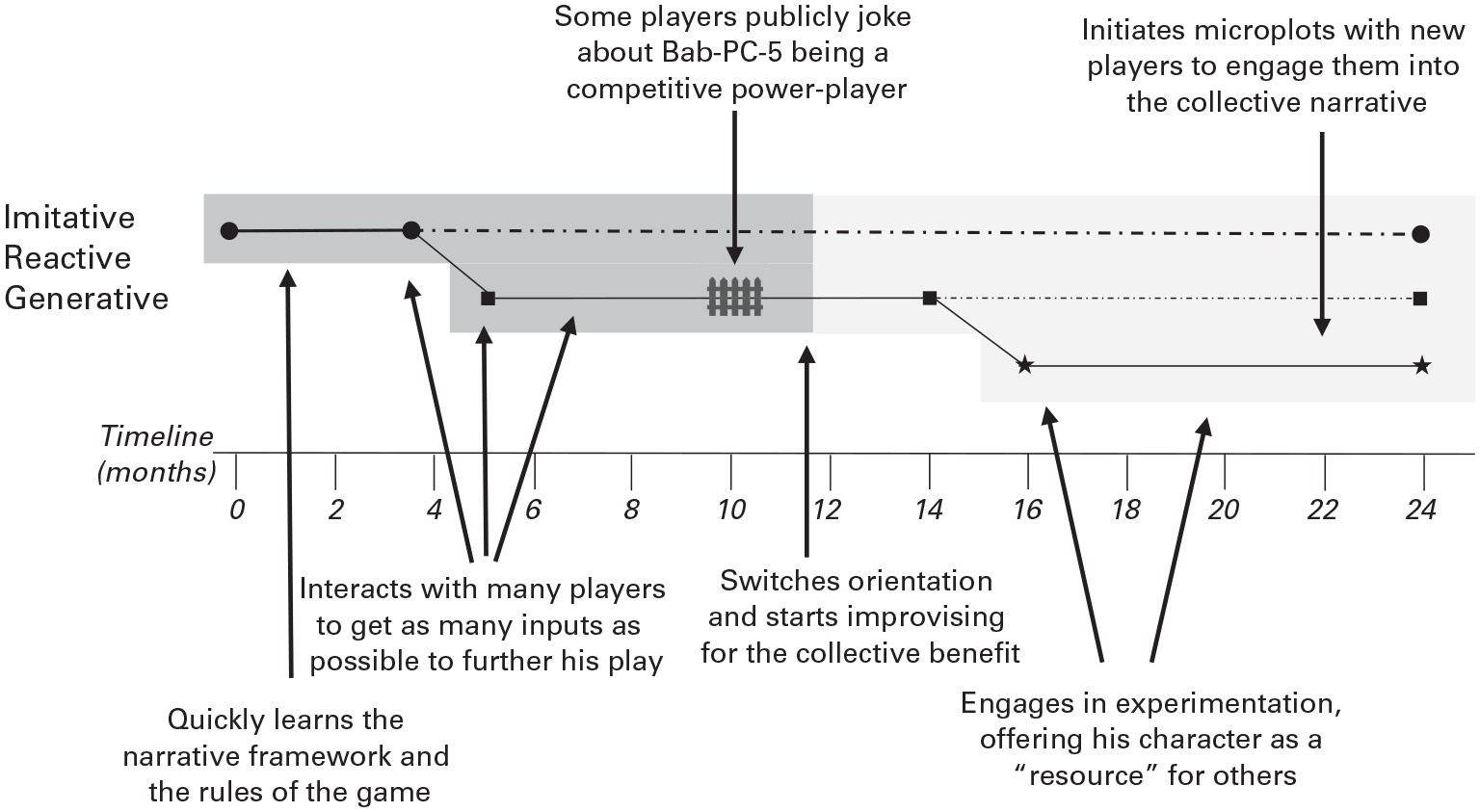
Detailed Improvisation Development Trajectory for Bab-PC-5 (Competitive → Collaborative)
Consistent with our observations, STs and players at Babylon spoke highly of Bab-PC-5, emphasizing his evolution from rules know-it-all to someone really committed to character interpretation and to nurturing structures:
At the beginning he was . . . well, one of those focused on rules. We have a lot of those. Some of them, however, grow and develop. Bab-PC-5 is a wonderful example of this: the more expert he became, the less he needed the rules. Interpretation and acting became the only thing that mattered for him, his defining features . . . and this even when he was interpreting very “physical” characters, where he could have . . . you know, just beaten up whoever disagreed with him. I would have never given a Promethean to anyone but him, and very few others. You need to have a type of . . . restraint to play that character, a strong sense of the collective game, of the collective, shared fun. . . . And he has that.
Well, you have seen him even tonight. Let’s talk about that scene . . . the one where he started crying. Here he is, with this extremely powerful character, that a lot of people would play as a dumb beast, or as an undefeatable warrior. . . . But not Bab-PC-5. He has to fight, a fight he is sure of winning, and he starts crying, because this is what his character would do. This is something that enriches everyone’s experience, it makes it deeper. . . . I mean, it was a moving, powerful moment. A lot of us had to build on that, on what happened. To be honest, I am proud of Bab-PC-5: he has always been a very good player, but six months ago he would not have played a scene like this. . . . It takes a lot of guts, but also a lot of sense of the moment.
Boundary Condition: The Role of Previous Experience
If improvisation development follows a sequential logic, a legitimate question is whether more experienced improvisers could transfer their skills to other contexts, effectively skipping one or more steps of the development trajectory. As we observed two of the chronicles (Renaissance and Shadows) from their starting date, and both included first-time, experienced, and very experienced LARP players, our data allowed us to explore whether prior LARP experience provides players with a head start in the development of improvisation skills.
6
We found that experienced players did not resort to imitative improvisation, yet they did not engage in generative improvisation for a while. Interviews with our informants revealed that this was primarily due to the low transferability of social structures. Groups have different social dynamics, which implies that players must invest effort to understand and nurture social structures. In the words of one of our informants: I need to feel comfortable with other people to give my best, to unleash improvisation. I need to understand the social dynamics. When I believe I have gauged the social layout of a chronicle, so to speak, then I feel like I can engage in more . . . proactive actions, going into the unknown. (Ren-PC-2)
To a lesser extent, the same is true for task structures: You need to know the boundaries, to learn them. When you move into a different chronicle, you need to identify the cardinal points before being able to improvise at your best. Once you know enough about the rules, the setting, then you can focus on yourself, try out stuff. (Ren-PC-1)
The low transferability of task and especially social structures sets experienced players back in terms of improvisation development when they move to a new chronicle. Even though experienced players in Renaissance and Shadows might have engaged in generative improvisation in previous chronicles, they started at the reactive improvisation level in the newly established chronicles that we observed from inception.
Because improvisation development is premised on the perception and use of structures, the role of previous experience for improvisation development in a new context depends on the transferability of structures. While task structures are likely to differ across groups, social structures tend to change even more significantly, to the point that someone who has developed generative improvisation skills in one social context may not immediately be able to improvise generatively when joining another, even if the setting is similar (e.g., jazz bands). This transfer of improvisation skills is likely to be even more complex across dissimilar settings: saving yourself from a fire is different than successfully storming an apartment with a SWAT team.
Discussion
While most improvisation research has focused on the antecedents of improvisation emergence (e.g., Weick, 1993; Crossan, 1998; Miner, Bassof, and Moorman, 2001; Vera and Crossan, 2005), little is known about how individuals develop improvisation skills. This limited understanding is partly due to the difficulties associated with transparent and prolonged observation of improvisation in organizational settings. Our inductive, longitudinal qualitative study of LARP improvisers aims to overcome these limitations and contribute to extant improvisation literature by building a theory of improvisation development in a social context.
We first pinpoint that improvisation is not merely a spontaneous reaction to unexpected events (Moorman and Miner, 1998b; Crossan et al., 2005) but can also be imitative and generative. The process of improvisation development follows an additive logic: individuals gradually add new improvisation skills to their toolkit and choose which one to use depending on the situation.
Crucially, our findings show that improvisation development depends on how individuals perceive and use task and social structures based on their individual orientations—that is, whether improvisers approach improvisation collaboratively or competitively. Orientations shape whether improvisers perceive structures as a resource that they need to nurture and renew (i.e., collaborative) or to seize and exploit (i.e., competitive). Collaborative-oriented improvisers are slower at developing reactive improvisation because of their structure-nurturing propensity, but they increasingly benefit from this structural support as it facilitates the development of generative improvisation skills. The opposite is true for competitive-oriented players: they easily develop reactive improvisation skills by using structures as expendable resources, but they are often hindered in the development of generative improvisation because other players bar their access to social structures. Notably, individual orientations are not always enduring but can change over time, engendering different development trajectories that reflect individuals’ approach to task and social structures.
Theoretical Contributions
Our work makes two contributions to the literature. First, we provide a longitudinal account of the process of improvisation development and how different individual orientations (competitive vs. collaborative) shape it. Highlighting these differences helps explain why we observe different developmental trajectories that lead some but not others to master more advanced skills. Moreover, it clarifies why individuals who are skilled improvisers do not necessarily improvise effectively as a collective. Second, we identify different types of improvisation skills that develop over time. By pinpointing these skills, we reconcile two parallel conceptualizations of improvisation: improvisation geared toward solving emergent problems and improvisation in the spirit of creativity and innovation. We detail these contributions below.
Improvisation development and the impact of individual orientations
Our first contribution lies in documenting how individuals develop improvisation skills in a social context based on individual orientations. Researchers have emphasized that improvisation is not a given but needs to be learned and developed (Barrett, 1998; Hatch, 1998). Formal training and simulation-based learning have been suggested as tools to achieve this (Rudolph, 2003; Rudolph and Raemer, 2004; Vera and Crossan, 2005). In most situations, however, individuals must learn to improvise “on the go,” without the time or the possibility to undergo formal training (Weick, 1993; Barrett, 1998; Bechky and Okhuysen, 2011). Our theory sheds light on how individual orientations and their variation over time influence the perception of the structural context in which improvisation takes place, resulting in four different trajectories of improvisation development. Individual orientations act as a boundary condition that facilitates, complicates, and sometimes even blocks the development of improvisation skills. In line with the idea that structures are perceived and subjective rather than real and objective (Ranson, Hinings, and Greenwood, 1980; Smircich and Stubbart, 1985; Weick, 1993), we show that different orientations lead improvisers to perceive structures differently. Subjectivity is central in understanding the role of structures in improvisation, shaping whether individuals will perceive them as boundaries to exploit or resources to nurture. A collaborative orientation, either sustained over time or emerging at later stages of the improvisation development journey, is necessary to recognize the centrality and significance of social structures, which are key to engaging in more original reactions and generative attempts to anticipate change. Benefited by a culture of openness toward new people and ideas and by a trust network, improvisers gain the necessary confidence to develop new improvisation skills, engaging in generative attempts to anticipate change. This finding aligns with what occurred in the Mann Gulch disaster in which three firefighters survived thanks to their attention to social structures: “Sallee and Rumsey stuck together. . . , which helped them keep their fear under control (Weick, 1993: 638), and Dodge “continued to see a group and to think about its well-being, which helped keep his own fear under control” (Weick, 1993: 638). While the centrality of subjective perceptions is not new to management research (e.g., Ranson, Hinings, and Greenwood, 1980; Smircich and Stubbart, 1985), it represents a significant shift for improvisation research, which tends to conceptualize structures as “objective,” static boundaries or resources that are equally available to everyone (e.g., Barrett, 1998; Kamoche and Cunha, 2001; Kamoche, Cunha, and Cunha, 2003; for an exception, see Weick, 1993).
In distinguishing between competitive and collaborative orientations, our findings offer a significant departure from current conceptualizations of improvisation that assume that individuals always approach improvisation collaboratively (e.g., Barrett, 1998; Peplowski, 1998). Instead, our findings show that individuals may approach improvisation competitively and that this approach can be personally advantageous in the short run. Competitive improvisers more easily master reactive improvisation by using and exploiting available structures to sustain their improvisational efforts. Furthermore, individuals who initially exhibit a competitive orientation are not only accepted but may even be considered inspirational by others because of their “virtuoso” reactive improvisation efforts. By contrast, a collaborative orientation seems to make individuals cautious about not disrupting the collective effort: they focus on mastering social structures, which detracts from their ability to quickly develop and engage in reactive improvisation. This latter finding is consistent with Vera et al.’s (2014) work on the effect of help-seeking behaviors on action propensity. Similar to help-seeking behaviors, a collaborative orientation premised on perceiving, gauging, and nurturing structures facilitates sensemaking and reduces the risk of negative consequences of one’s action, at the cost of increased effort and a delayed development of reactive improvisation.
Notably, orientations can change over time, resulting in distinct improvisation development trajectories. Competitive improvisers who, over time, shift to a collaborative orientation are substantially facilitated in the development of a broader improvisation skillset. Key to this shift is that they get attuned to social structures over the course of their improvisational journey. Players with a strong competitive orientation often do not perceive social signals and continue to treat structures as expendable resources, eventually encountering resistance to their actions and barriers to their improvisation development. This inability to advance has implications for the whole set of improvisation skills. A protracted refusal of their “improvisational offers” may result not only in the inability to develop generative improvisation but also, presumably, in the progressive decay of reactive improvisation skills. Just as not using a muscle leads to atrophy, not being able to practice improvisation skills leads to a decay in these skills and, ultimately, to disengagement from improvisation (Fisher and Barrett, 2019).
While our research focuses mainly on individual improvisation, we also contribute to the understanding of collective improvisation. Our findings suggest that individual orientations and their stability over time influence the likelihood that individual improvisational actions will integrate into a collective outcome. This insight sheds lights on the long-standing question of why good individual improvisers do not necessarily improvise well together (Barrett, 1998; Kamoche and Cunha, 2001; Vera and Crossan, 2005). We suggest that the answer lies in group members’ approach to structures and improvisation more broadly. When individuals build on and enrich available structures, their improvisational actions contribute value to the group effort. In contrast, competitive-oriented improvisers deplete structures, which impairs others’ ability to use them as improvisational cues and thus detracts from the collective outcome. We speculate that a sustained competitive orientation may even lead to the a priori refusal of competitive improvisers’ improvisational cues, even when these cues could benefit the collective. If a jazz player improvises a theme and no one follows, the resulting tune will be disjointed. If a firefighter improvises a path to access a room engulfed in fire expecting backup but no one follows, people might die. This finding extends Miner, Bassoff, and Moorman’s (2001) contention that unskilled improvisation can have nefarious effects on the outcome of the improvisational process. We suggest that even skilled improvisation, when underpinned by a competitive orientation, can have negative effects on the collective outcome.
Improvisation development and improvisation types
Our second contribution lies in identifying different types of improvisation skills and charting how they develop over time. Our findings reveal that reactive improvisation (the “classic,” most discussed type of improvisation) is just one in a set of improvisation skills that individuals can develop. Before developing the ability to improvise in reaction to unexpected events, individuals go through a socialization process—a period of observation and learning during which they have limited understanding of structures and how these can enable their improvisational actions. During socialization, they observe and take inspiration from others’ improvisational actions, developing imitative improvisation skills: they move within the boundaries set by existing structures and use them as a compass to navigate the unknown and avoid “improvisation paralysis” (Weick, 1993). We also find that, after developing reactive improvisation, individuals can further expand their improvisation skillset with the ability to improvise without the need for external triggers, becoming the originators of new events and structures (i.e., generative improvisation). While scholars have recognized the existence of different types of improvisation, extant typologies are based on variations of what we term imitative and reactive improvisation—i.e., improvisation as a relatively spontaneous and original response to unexpected events. For example, Moorman and Miner’s (1998a) and Weick’s (1998) distinction between incremental and radical improvisation refers to the magnitude of the response to an external trigger, qualifying them as less vs. more intense forms of reactive improvisation. Our findings detail differences in the trigger (or absence thereof) of improvisational efforts, showing that individuals can improvise even when a trigger is entirely absent.
In charting a typology of improvisation skills, we contribute to the conversation on the relationship between different improvisation types. Extant literature has treated improvisation types as alternative to each other, with individuals resorting to either one or the other depending on the situation (Crossan et al., 2005). We further this conversation in two ways. First, our emergent theory explains why some individuals improvise only if they need to (reactive improvisation) while others decide to engage in improvisation even in the absence of external triggers (generative improvisation) and, therefore, why some individuals thrive in unpredictable environments while others fail at coping with unexpected events (Brown and Eisenhardt, 1997). These differences in ability are likely dependent on the stage of development achieved by individuals—that is, what improvisation skills they have developed at that point in time—and thus not just on the situation as previously posited. Second, we show that improvisation types are interdependent skills connected through a developmental trajectory: the development of reactive and generative skills—and thus the ability to use them—is contingent on having mastered the previous one(s). Importantly, our findings reveal that improvisation development is not substitutive but additive, with individuals adding new improvisation skills to their toolkit and using the one that is more effective given the situation. For example, when cognitive resources are limited due to a high-stake, high-tension situation, imitative improvisation can be the most efficient option and make the difference between survival and death. In the Mann Gulch fire, firemen who could not come up with a solution on their own perhaps could have saved their lives by engaging in imitative improvisation, observing and taking inspiration from foreman Wagner Dodge, who “lived by lying down in the ashes of his escape fire” (Weick, 1993: 628). Other situations demand that individuals conceive and immediately act on an emergent strategy, probing into the future rather than just reacting to unanticipated events. For example, Zack (2000: 232) described instances in jazz in which “the musician looks ahead at what he or she will be playing so that the solo is not just a series of disconnected notes each decided only by the previous one, but rather a set of notes preconceived as a coherent whole.”
Reinterpreting evidence from extant research in light of our findings also allows us to reconcile two streams of improvisation literature that have traditionally progressed on parallel tracks: improvisation with the goal of solving emergent problems (e.g., SWAT teams, firefighters) and improvisation with the goal of creativity and innovation (e.g., jazz orchestras, improvisation theater). The LARP setting we investigated is a performative game (Seregina, 2014) in which individuals improvise both to solve problems and in the spirit of innovation and creativity. Our findings show that the two categories of improvisation are more similar than extant research suggests. Specifically, we observed that imitative, reactive, and generative improvisation skills are necessary for both problem solving and the generation of creative outcomes. Consistently, SWAT agents start by following more experienced team members, progress by effectively reacting to environmental threats, and, on reaching leadership positions, are capable of initiating improvisational action without external triggers. Similarly, musicians in jazz orchestras begin by following the lead of other band members, then construct their own reactions to the lead, and eventually develop the ability to take the lead and initiate novel musical phrasings that become a resource for others to build upon. Our findings offer an alternative to a goal-based categorization for improvisation based on the extent to which each improvisation skill is used. All improvisation skills are necessary for both problem solving and innovation, but some are used more for one goal than the other. While reactive improvisation is the most frequently observed skill across settings, it is particularly prevalent in problem-solving contexts. Conversely, improvisation in innovative and artistic contexts draws more equally on reactive and generative skills, even if extant research has acknowledged the latter less (Zack, 2000).
Transferability and Practical Implications
Transferability
Considering the transferability of findings is crucial for every inductive field study (Lincoln and Guba, 1985), particularly for those investigating nonconventional settings (Bamberger and Pratt, 2010). As discussed in the “Methods” section, political LARP represents a relevant metaphor for organizing that allows for the transparent and prolonged observation of a phenomenon that cannot be easily observed in a business context but has critical implications for management theory and practice (Bamberger and Pratt, 2010).
Our informants performed improvisation-intense activities centered on individual roles in high-autonomy settings characterized by minimal structures in which they were free to act in accordance with their individual orientations. With all the caution an inductive study requires, our findings can be transferred to organizational settings that offer employees autonomy and demand creative outputs in the face of continuous challenges and surprises. For example, our findings should be applicable to the management consulting and global advertising industries, in which employees answer complex client needs through brainstorming and prototyping novel ideas. We shared our findings with employees in both industries (for a similar approach, see Petriglieri, Ashford, and Wrzesniewski, 2019), who confirmed the importance of developing improvisation skills for their jobs and corroborated the existence of different individual orientations and their centrality in shaping this development. Furthermore, our findings may be of value to organizations that want to foster independence and improvisation. For example, Microsoft’s incubator The Garage allows employees to roam free and explore innovative projects (Subramanian, 2013), and Dell highlights the importance of managers being “ahead of the game” rather than just reacting to it (Narayandas and Rangan, 1996).
In addition, our findings on generative improvisation may be particularly relevant for professions in which uncertainty is high and proactive trial-and-error processes are frequently used, such as new product development, R&D, and customer service. Brown and Eisenhardt (1997: 16) described how employees working for a successful product development company constantly improvised “quick-and-dirty” experimental products to probe new markets, improvising innovation strategies based on managers’ vision; while they “did not extensively plan or invest in any version of the future, . . . they were not reactive either.” Other examples of unprompted, generative improvisation include 3M’s discovery of the Post-it Note (Peters and Waterman, 1982) and Zappos.com’s customer service, in which employees experiment and maneuver within and outside the available structures to create novel solutions to anticipate customer needs (Solomon, 2017). Following the same logic, we acknowledge that individuals embedded in organizations with different characteristics might follow different patterns of improvisation development. For example, our findings are less likely to apply to temporary teams, in which familiarity is low and the need to quickly achieve coordination is important (Bechky and Okhuysen, 2011). Temporary teams may require different structures and follow different development trajectories; emerging social structures may play a less prominent role than rules and protocols. Improvisation development within short periods thus represents an area for future inquiry.
Practical implications
Our findings have important implications for training programs aimed at fostering improvisation development, which differs from classic competency development models that describe activities such as learning to fly a plane, speak a language, or prepare an effective PowerPoint presentation. While some of these skills can benefit from learning by doing and vicarious learning (e.g., Darr, Argote, and Epple, 1995; Gino et al., 2010), their development is premised on a structured, individualized process (see Dreyfus and Dreyfus, 1980). By contrast, improvisation development is unstructured, uncertain, and social—rooted in interactions with others and with the social environment more broadly. Classic competency development models are thus unlikely to apply. Learning to improvise is more in line with models of learning by doing and vicarious learning that apply in collective creative contexts (e.g., Harrison and Rouse, 2014). These differences suggest that, when it comes to improvisation skills, what needs training is not just the ability to improvise but also the ability to collaborate and access social structures that enable and sustain improvisational efforts. Training for collaboration would be particularly relevant for developing generative improvisation skills.
Given the importance of social structures in creating the conditions that reduce uncertainty and allow generative improvisation to emerge, managers should create a psychologically safe environment (Edmondson, 1999) that is open to new ideas and new people, as well as create situations that foster and accelerate the development of trust networks among employees. Managers could embody experimentation by trying out new things and embracing failure when it happens. They could also set up meetings that are purposely designed to encourage employees to give each other candid feedback (to create competence-based trust) or recreational activities that stimulate interpersonal knowledge and positive interactions (to create affect-based trust).
Limitations and Future Research
One limitation of our work is that players’ experiences and norms were fairly homogeneous across the three fields we investigated. This homogeneity meant that, while there were significant differences in the tenure of the three groups (e.g., Babylon was established 14 years before our investigation while Renaissance had just been created), we could not observe meaningful differences across groups, such as in terms of how many newcomers each had. Moreover, the three fields were relatively small (20 to 30 players), and it is possible for individuals embedded in larger social contexts to display different orientations within and outside their group (e.g., being more collaborative within and competitive outside). That is, some employees may act collaboratively within their organizational division and become competitive when liaising with other organizational divisions, such as in discussions among marketing, R&D, and finance executives during an annual budget allocation meeting. Future research could help understand whether and how group and organization age and size influence the dynamics of individual improvisation development.
A potentially fruitful area for research is investigating the reasons that individuals change orientations. While our observations and interviews provided us some insights into why these changes occur, our qualitative methodology did not allow us to pin down what led to certain choices. For example, it could be that individuals moved from a collaborative to a competitive orientation because of the “bad influence” of other competitive players, as some of the STs suggested. Our observations suggest that individuals switched from a competitive to a collaborative orientation because of their increased attention to social structures, which could be due to dispositional traits such as their emotional intelligence. While our inductive methodology did not lend itself to the exploration of these processes and dispositions, future research could use experimental designs to examine why these changes occur.
Considering the differences between our setting and others in terms of improvisation development, as well as the differences with other forms of development, could also inform future research. LARP differs from other improvisation-intensive contexts (e.g., Vera and Crossan, 2005) in that it is characterized by the absence of formal training and instead is based on “training by doing.” It also differs from settings such as health care that include hands-on learning tools such as simulation-based education (Rudolph, 2003; Rudolph, Morrison, and Carroll, 2009; Cheng et al., 2016). In LARP, training and development are not separated from improvisational action but are an active part of it. LARP players do not have the chance to practice their improvisation skills before entering the game, nor do they have debriefings to help them make sense of what happened; they develop their skills as they go, and any false moves could result in their character being severely endangered or their strategy compromised. Future research could explore which type of training—formal, learning by doing, or a combination of the two—is more conducive to the development of improvisation skills.
We hope our work will stimulate a revived interest in improvisation as a key capability for contemporary employees coping with unpredictable environments and events. Future research that offers a more nuanced appreciation of improvisation’s nature and dynamics may prove essential as many organizations face the demand for planning and executing new ideas at ever-increasing speeds.
Supplemental Material
sj-pdf-1-asq-10.1177_0001839220975697 – Supplemental material for Developing Improvisation Skills: The Influence of Individual Orientations
Supplemental material, sj-pdf-1-asq-10.1177_0001839220975697 for Developing Improvisation Skills: The Influence of Individual Orientations by Pier Vittorio Mannucci, Davide C. Orazi and Kristine de Valck in Administrative Science Quarterly
Footnotes
Acknowledgements
The authors extend their gratitude to associate editor John Wagner and three anonymous reviewers for their invaluable feedback throughout the review process. We also thank Erica Coslor, Simone Ferriani, Davide Ravasi, Stoyan Sgourev, Kevyn Yong, and the participants of the 2016 Creativity Collaboratorium for their helpful comments and suggestions on previous drafts. The authors gratefully acknowledge the support of the HEC Foundation. Above all, we deeply thank the three LARP associations that made this study possible by giving us access to their chronicles. We wish to dedicate this paper to the memory of Giovanni M. Bosoni.

Supplemental Material
Notes
Authors’ Biographies
References
Supplementary Material
Please find the following supplemental material available below.
For Open Access articles published under a Creative Commons License, all supplemental material carries the same license as the article it is associated with.
For non-Open Access articles published, all supplemental material carries a non-exclusive license, and permission requests for re-use of supplemental material or any part of supplemental material shall be sent directly to the copyright owner as specified in the copyright notice associated with the article.
