



Abstract
Organizations typically employ a division of labor between specialist creator roles and generalist business roles in a bid to orchestrate innovation. We seek to determine the extent to which individuals dividing the work across roles can also benefit from dividing their network. We argue that collaborating individuals benefit from connecting to the same groups but different individuals within those groups—an approach we label dual networking—rather than from a pure divide-and-conquer approach. To test this argument, we study a dual career-ladder setting in a large multinational in which R&D managers and technologists partner up in their quest for innovation. We find that collaborators who engage in dual networking attain an innovation performance advantage over those who connect to distinct groups. This advantage stems from the opportunity to engage in the dual interpretation of input the partners receive, as well as from dual influencing that helps them to gain momentum for their proposed innovations, and it leads to more effective elaboration and championing of their ideas. In demonstrating these effects, we advance understanding of how collaborators organize their networking activities to best achieve innovative outcomes.
Keywords
“Innovation occurs when the what’s needed meets the what’s possible.” This is how an interviewee, a senior technologist in a technology-intensive multinational, summarized the quest for innovation. Innovations often arise from linking technological advancements to market needs (Burgelman, 1983; Van de Ven, Polley, and Garud, 1999; Dougherty et al., 2000), and creative ideas are typically considered innovations only after they are successfully commercialized or implemented (Porter, 1990; Amabile, 1996). In a bid to orchestrate the integration of technological and market knowledge into innovations (Lingo and O’Mahony, 2010), organizations often implement a division of labor between individuals occupying specialist creator and generalist business roles (Mintzberg, 1971; Mollick, 2012; Berg, 2016). Such a division of labor is not unique to corporate innovation. For instance, technology-based startups typically allocate chief executive officer (CEO) and chief technology officer (CTO) roles among founding members, requiring coordination and collaboration across these roles to develop and implement the organization’s technology and business strategy (Burton and Beckman, 2007; Jung, Vissa, and Pich, 2017). Likewise, creative industries such as the movie industry typically distinguish creative director roles and executive producer roles that work together to unite novelty and value creation in the generation of innovative offerings (Bechky, 2006; Clement, Shipilov, and Galunic, 2018). With respect to organizational innovation, large corporations commonly create dual career ladders in their R&D operations (Allen and Katz, 1992; Hoffmann et al., 2016). The pioneering work of Katz, Tushman, and Allen (1995) emphasized the interdependence between the roles of managers, tasked with recognizing and pursuing business opportunities, and technologists, tasked with identifying and pursuing novel technological opportunities (Gouldner, 1954; Parsons, 1956; Blau and Scott, 1962).
The division of labor—and the collaboration across roles it necessitates—is a key vehicle for the internal organization of innovation, designed to maximize individual contributions to organizational goals by exploiting individual advantages in skills and expertise (Lawrence and Lorsch, 1967; Strauss, 1985; Allen and Katz, 1992). Yet research has rarely dwelled on the question of whether and how employees who collaborate across roles divide their social ties within the organization to successfully carry out their work. This is surprising given the interdependence that the division of labor imposes on collaborators (Thompson, 1965). Not only do employees who divide work depend on one another’s human capital in terms of expertise and resources, but they may also rely on one another’s social capital in terms of their ability to mobilize networks (Battilana and Casciaro, 2013; Tortoriello, McEvily, and Krackhardt, 2015). Innovation will typically require collaborating individuals to reach out to their wider networks in the organization to get input on how their ideas may best benefit the organization and influence key stakeholders to build support behind them (Allen, 1977; Burt, 1982; Ibarra, 1993; Lechner and Floyd, 2012; Perry-Smith and Mannucci, 2017). Particularly in established organizations, successful innovation depends on the ability to relate ideas to existing organizational competences or strategies (Lingo and O’Mahony, 2010; Ter Wal, Criscuolo, and Salter, 2017) and to mobilize intra-organizational relationships to acquire the necessary resources for novel ideas to take root and gain legitimacy (Howell and Higgins, 1990; Ancona and Caldwell, 1992; Lingo and O’Mahony, 2010).
Therefore, this study seeks to advance social capital research by examining whether individuals dividing innovation work across roles benefit from also dividing their network. In answering that question, we adopt a role-set perspective (Merton, 1957) that characterizes individual networks in terms of their connectedness to distinct groups within the organization’s formal structure (McEvily, Soda, and Tortoriello, 2014). Each organizational group plays a set of unique roles as a source of input and influence in the innovation process and thus provides a distinct rationale for why one would want to connect to its members. In the context of corporate R&D, this study seeks to understand whether technologists and managers working together to achieve innovation benefit from divided networking—i.e., connecting to different role sets—or from dual networking—i.e., connecting to the same role sets but to different individuals.
Our core assertion is that there are two benefits of dual networking relative to divided networking. First, dual networking allows for dual interpretation of input that a manager and a technologist obtain from a given role set, which facilitates innovation by enabling the joint sensemaking process needed to merge their scientific and business expertise into novel ideas that fit the organization’s competences and strategies (Weick, 1995; Maitlis, 2005; Cronin and Weingart, 2007; Lingo and O’Mahony, 2010). Second, dual networking helps managers and technologists to innovate through dual influencing that enables them to gain momentum by winning over role sets through diffusing rich and varied arguments across their members (Howell and Higgins, 1990; Yukl and Falbe, 1990; Kanter, 2000). To help boost the credibility of our claims that dual interpretation and dual influencing underpin the advantages of dual networking, we offer two contingencies under which we expect the salience of these two mechanisms to vary. We expect the benefits of dual interpretation to be reduced for individuals with greater overlapping technical expertise with their partner and the benefits of dual influencing to be lessened for more prominent individuals.
To investigate these research questions, we conducted a multi-method study combining interviews, surveys, and archival data from Neptune—a large multinational firm that “partners up” its R&D managers and technologists in a quest to generate innovation. Given that the interdependence between collaborators is typically difficult to observe, we exploit manager–technologist partnerships as a unique feature of the dual career-ladder system in this organization that allows us to precisely observe patterns in the division of labor between managers and technologists. While managers and technologists cover distinct aspects of the innovation process, this partnership model formalizes the expectation that they will contribute to each other’s work on an ongoing basis and allows us to examine the dual networking hypothesis and mechanisms underpinning this effect.
Connecting Technology and Market Insights through Collaborative Innovation
The Division of Labor in Innovation
To orchestrate the match between technological and market insight, organizations commonly operate dual career-ladder structures that create a division of labor between managers and technologists and allow each party to focus on their respective areas of strength (Gouldner, 1954; Blau and Scott, 1962; Katz, Tushman, and Allen, 1995). Yet the need for coordination between their respective tasks implies managers and technologists need to work together in a horizontal collaborative relationship to achieve innovation (Thompson, 1965).
Much of the literature on innovation portrays the division of labor between managers and technologists as a sequential process, in which technologists play a creator role in the generation of ideas and managers enter during the evaluation stage for idea selection and implementation (Mollick, 2012; Berg, 2016). While we concur that technologists often play a dominant role in the early-stage generation of ideas and managers typically evaluate the merits of these ideas prior to the final stage of implementation, it is in the intermediate stages of idea elaboration and idea championing (Perry-Smith and Mannucci, 2017) that the boundaries between manager and technologist roles are more blurred and collaborative actions occur. In such collaborative innovation processes, both roles operate interdependently as equals to achieve the shared goal of innovation (Lawrence and Lorsch, 1967).
The value of collaborative innovation across roles is not restricted to organizations with dual career-ladder systems. Research has shown that coordination and collaboration among founding team members occupying different roles in entrepreneurial firms is a critical predictor of firm growth (Eisenhardt and Schoonhoven, 1990). Well-known examples include Steve Jobs as the visionary marketer and Steve Wozniak as the computer genius launching Apple. Along similar lines, the success of new offerings in creative industries depends on collaboration and coordination across roles (Clement, Shipilov, and Galunic, 2018). For example, Quentin Tarantino, the creative virtuoso behind many critically acclaimed movies, acknowledges the producer Sally Menke as the “quiet heroine” behind his signature style and success (Walters, 2010). Likewise, the architect Richard Rogers and the engineer Peter Rice worked intensively together on the “inside-out” structures of the Centre Pompidou and Lloyds Building to the extent that it would be difficult to tell who contributed what to their design successes (Brown, 2001). And in law firms, partners and counsel strongly depend on each other not only in their day-to-day operations but also in increasing organizational innovative capacity (Malhotra, Smets, and Morris, 2016). These examples illustrate that the success of the division of labor across roles is central to collaborative innovation success, yet they raise the question of how collaborating pairs successfully bring together their respective expertise and resources.
The Role of Networks in Collaborative Innovation
In the context of organizational innovation, we argue that managers and technologists depend on not only each other’s expertise but also each other’s networks in achieving innovation outcomes. In so doing, we follow a recent stream of research on second-order social capital that explores how social capital advantages may spill over to third parties (Leana and Van Buren, 1999; Brass, 2009; Galunic, Ertug, and Gargiulo, 2012; Clement, Shipilov, and Galunic, 2018). Although one’s own network resources are valuable throughout the innovation process (Perry-Smith and Mannucci, 2017), we maintain that the importance of second-order network resources is heightened in the intermediate stages of idea elaboration and idea championing during which the roles of managers and technologists are blurred.
First, during the idea elaboration stage, managers and technologists need to refine and improve the idea itself by integrating market and technological expertise (Lingo and O’Mahony, 2010). Representational gaps likely exist between managers’ and technologists’ understanding of a problem, including different views on underlying goals and assumptions (Cronin and Weingart, 2007). Technologists typically have deep expertise in their areas of technical specialty but often limited appreciation of market and business realities, whereas managers are often generalists with extensive understanding of the market and business context but limited depth of technical expertise (Cardador, 2017). To overcome representational gaps and to define and shape opportunities for innovation, managers and technologists engage in an iterative interpretation and sensemaking process of new technological possibilities and market opportunities (Burgelman, 1983; Drazin, Glynn, and Kazanjian, 1999; Dougherty et al., 2000; Postrel, 2002; Hargadon and Bechky, 2006). In this process managers and technologists typically move through multiple cycles of experimentation and discussion, iteratively adapting the narrative around the potential of their idea (Weick, 1995; Maitlis, 2005; Brown, Stacey, and Nandhakumar, 2008; Bartel and Garud, 2009) and aligning it to existing competences and strategies (Lingo and O’Mahony, 2010; Ter Wal, Criscuolo, and Salter, 2017). Thus the ability of managers and technologists to contribute to innovations in the organization critically depends on effective interpretation and integration of scientific and business insight (Lingo and O’Mahony, 2010). Supporting this point, one technologist we interviewed explained how managers and technologists, while engaging in a division of labor, jointly interpret innovation opportunities: We have clear differences in what we enjoy doing. For the structural, logistical, and managerial aspects of our work, [my manager partner] is taking the leadership, most of the times without me being involved. When it’s a matter of in-depth research, academic contacts, most of the time I’m leading without mentioning it [to my manager partner], right? Then there is this central pool, right, where the idea, the science, the [market] need, the business opportunity is coming together. [We will discuss] how are we going to generate that vision into a master plan and execute [it] later on. So, who is taking the lead at what times is a constant move.
Second, in the championing stage managers and technologists need to gain momentum for their ideas (Howell and Higgins, 1990; Perry-Smith and Mannucci, 2017). Since established organizations in particular tend to be conservative (Dougherty and Heller, 1994), novel ideas typically lack legitimacy and require vigorous championing to move forward (Howell and Higgins, 1990; Ancona and Caldwell, 1992). Gaining momentum is particularly critical in the resource-acquisition process—typically through stage-gate systems—whereby ideas compete for limited financial resources and decision makers’ attention (Kanter, 2000; Criscuolo et al., 2017). Hence the ability of managers and technologists to innovate depends on their ability to influence various stakeholder groups in the organization and build a structure of support around their ideas. As a manager just returning after successfully vying for her project in a stage-gate meeting suggested, it may pay to mobilize network connections to try to create buzz around ideas bound for evaluation: But the meeting happens outside the meeting. The decision happens somewhere else [than] where the decision is [formally] made. So how do you get that influence? . . . Those [stage-gate] decisions don’t get made the day you walk in there [the meeting]. . . . I would say it’s my experience it happens in some viral way in the organization. . . . Getting a bit of a groundswell on an idea is always good. . . . [It is] much more about getting those kinds of advocates, maybe that’s the right word, developing some advocacy from people in the organization to push an idea forward. Frankly, if you already have half the people in the room who know about your idea, then you’ve got an easier ride to get through it [i.e., the review meeting].
Thus during the elaboration and championing stages of the innovation journey managers and technologists draw upon their networks to interpret the merit and viability of their ideas and marshal influence to achieve buy-in and legitimacy.
We can distinguish various groups in the organization’s formal structure that serve as sources of information for interpretation and targets of influence. We draw on Merton’s (1957)“role-set” construct to define groups by hierarchy (junior versus senior) and career ladder (manager versus technologist) and to differentiate the respective roles of each group in interpretation and influence processes. The role-set concept captures the notion that each group incorporates a variety of roles that collectively characterize the tasks and responsibilities expected of its members. The concept clarifies the similarity within and dissimilarity across role sets in the types of input and influence role set members can provide. Each role set offers a distinct rationale as to why manager–technologist partners may benefit from connecting to its members, which means that members of the same role sets can often provide the same type of input or influence. Yet there will be variety in the exact content of that input or influence. One may consult a given role set to get advice on one market application versus another and obtain different opinions from different individuals because they focus on different criteria. Thus whether managers and technologists connect to different role sets or to different individuals in the same role set will determine the variety and overlap in resources accessed from their network and influence their capacity to collaboratively innovate.
The Advantages of Dual Networking
Inasmuch as managers and technologists who partner up in their pursuit of innovation divide work and responsibility, they may equally decide to take a divide-and-conquer approach to the associated networking activities by connecting to different role sets in the organization. We argue, however, that managers and technologists will benefit more from dual networking: connecting to different individuals in the same role sets. We define dual networking as the extent to which the networks of two individuals are equivalent in terms of the connectedness to role sets but non-overlapping with respect to connectedness to specific individuals. 1 Figure 1 graphically depicts the difference between dual and divided networking with the number of ties held constant. 2 We argue that managers and technologists who engage in dual networking with their partners will benefit in terms of their ability to contribute to innovative outcomes for the organization and will outperform those who engage in divided networking, due to superior interpretation of input in idea elaboration and superior influencing of stakeholders in idea championing.
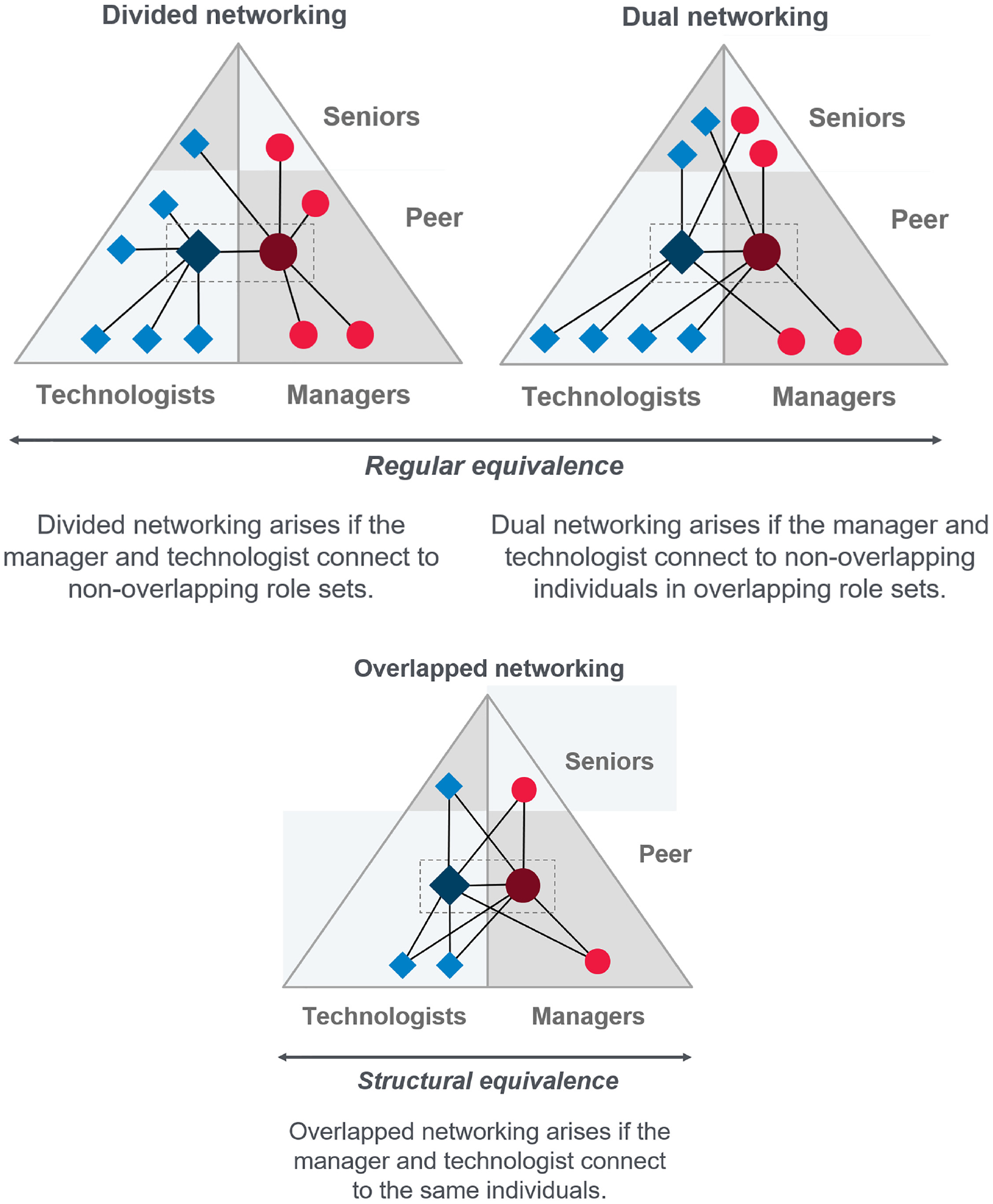
Stylized examples of divided and dual networking of the manager–technologist pair.*
First, obtaining inputs from the same role sets but different individuals allows manager–technologist pairs to benefit from dual interpretation, which facilitates the joint sensemaking required in the elaboration stage of innovation. Input from non-overlapping individuals from the same role sets should be advantageous in creating a basis for discussion, built on different perspectives, which allows individuals to approach a problem from different angles, contest prior assumptions, or incorporate new elements (Dougherty et al., 2000). Engaging with different individuals within the same role set exposes the partnership to an enriched range of views about the specific challenges associated with the use of technologies and the conditions of different markets. Much of this expertise is likely to be “sticky” to the context in which it was developed, requiring modification to be applied in another setting, even in the same organization (Von Hippel, 1994; Szulanski, 1996).
Dual networking allows both parties to independently interpret the diverse perspectives acquired from a given role set and exploit interpretive differences in the joint sensemaking of market opportunities and technological solutions (Latour and Woolgar, 1979; McFadyen and Cannella, 2004; Cronin and Weingart, 2007). Managers and technologists may have very different interpretive schema that would lead them to deduce different conclusions or implications from similar information (Simon and Feigenbaum, 1964; Brewer and Nakamura, 1984; Weick and Roberts, 1993). This helps ensure that partnered managers and technologists develop different views based on interactions with a given role set, which form crucial input for the joint sensemaking process and enable creativity through diversity of thought (Leonard-Barton, 1995; Maitlis, 2005; Kaplan, 2008). Given that each role set provides a different type of input, the greater the similarity in their connectedness to role sets, the better the manager and technologist can challenge each other in their interpretation of an idea’s merits. In contrast, divided networking creates a manager’s reliance on the technologist’s interpretation of input and vice versa. If one party lacks connections to a given role set and receives information from that role set only through the partner, that party obtains only interpreted, one-sided—often filtered or even biased—information that is more difficult to challenge or contest (Gavetti and Warglien, 2015).
Second, dual networking allows for dual influencing in the championing stage of innovation. Dual influencing consists of connecting to the same role sets but different individuals in a bid to win their buy-in. Having multiple non-overlapping influence channels to the different role sets helps disseminate a variety of arguments about an idea’s potential within those groups, making it more likely that momentum is generated. Momentum in organizations is more easily built through multiple channels (Howell and Higgins, 1990; Kanter, 2000; Battilana and Casciaro, 2013). In part, this may be simply a matter of repeated messages. “Buzz” may be more easily created around new ideas when multiple people independently get to hear about them (Yukl and Falbe, 1990; Centola and Macy, 2007). Due to the error-reducing properties of multi-channel information (Shannon and Weaver, 1948), dual messages from managers and technologists allow members of role sets on the receiving end to compare the manager’s version and the technologist’s version of the case for innovation and form a more complete picture of its potential.
In part, building momentum through dual influencing can also arise because, when seeking to gain influence, managers and technologists are likely to tell the same story differently due to differences in expertise or in opinion on what most effectively promotes traction with an idea. Although managers and technologists will try to build a shared narrative around the merits of an idea as part of their joint sensemaking (Brown, Stacey, and Nandhakumar, 2008), pairs who seek to influence different individuals belonging to the same role set can tailor and modify their innovation case to address their listeners’ varied interests and priorities (Battilana and Casciaro, 2013), thereby increasing the prospects of receiving support from different members of that role set. In contrast, managers and technologists who divide the influencing and reach out to different role sets miss the opportunity to take advantage of multi-channel influencing and face the challenge of winning over a role set with a single perspective and a potentially one-sided set of arguments. Such divide-and-conquer influencing attempts likely reduce the momentum that manager–technologist pairs can generate for their ideas inside the organization, compared with the momentum resulting from dual networking.
We thus expect managers and technologists engaging in dual networking to realize the benefits of dual interpretation and influencing, which will allow them to achieve higher innovation performance than those engaging in divided networking:
To corroborate our claims that dual interpretation and dual influencing drive the advantage of dual networking for individual innovation performance, our moderation hypotheses explore conditions under which the benefits of dual interpretation and dual influencing vary and hence the positive effect of dual networking is moderated. Specifically, a focal individual’s shared technical expertise with their partner will reduce the advantages of dual interpretation, while individual prominence will limit the value of dual influencing.
Partners’ Shared Technical Expertise
The extent to which a manager and technologist have shared technical expertise affects the ease of joint sensemaking and hence the relative benefit of dual interpretation for individual innovation performance. The greater the shared technical expertise between a focal individual and their partner, the easier it is for that individual to leverage common ground in interpretations of how market and technical knowledge relate (Cramton, 2001). The ability to contest or challenge insights from one’s partner depends on the extent to which that information relates to the focal individual’s prior expertise (Bruner, Goodnow, and Austin, 1956; Cohen and Levinthal, 1990). As a manager told us, “I think you have to have enough knowledge [as a manager] to be able to ask the right questions to your technologist partner. You need to invest in understanding enough of a technology so you can be supportive of your [technologist] partner.”
Prior information eases the independent interpretation of new, related information (Shannon and Weaver, 1948; Cohen and Levinthal, 1990; Ter Wal et al., 2016) and hence reduces the need for the focal individual to access inputs through dual networking. An individual who has greater shared technical expertise with their partner will find it easier to independently interpret and challenge the inputs that their partner brings to the conversation and need not rely as much on inputs from the same role sets that inform their partner. As a result, the benefit of dual networking for the manager and technologist is reduced if they have greater shared technical expertise. In contrast, if an individual manager or technologist has limited shared expertise with their partner, dual interpretation gains importance for effective joint sensemaking. In such situations, accessing information from the same role sets but from different individuals helps the focal individual to sound out and put in perspective any information the partner may have obtained from those role sets. We predict:
Individual Prominence
Whereas shared expertise may limit the benefits of dual interpretation, individual prominence may reduce the benefits of dual influencing. Individuals’ prominence in an organization can vary substantially depending on their track record and visibility in the organization (Cross and Cummings, 2004; Sauder, Lynn, and Podolny, 2012). In the context of this study, organizational prominence captures the status of managers and technologists in the eyes of their colleagues, as sources of advice or influence in the organization (Brass and Burkhardt, 1993; Ibarra and Andrews, 1993; Cattani et al., 2008). As one technologist explained, individuals can leverage their prominence to legitimize new directions that by their very nature will be received skeptically at first: Once you’ve done one or two things that turned out successful, so once you’ve actually really proven you can do that, it becomes quite easy to influence the organization actually. So it’s quite common then for you to have direct access to some of the most senior managers, and because they know that you’ve really brought about these changes, then they really want to know what you think. And so if you say, “Well, actually I really do think we should do this,” that’s usually enough actually.
The premise of dual influencing is that adding the voice of one’s partner complements the individual’s own political clout in attempts to legitimize new ideas. Yet the higher one’s own prominence, the less reliant one is on the dual influencing of one’s partner. Although the manager and technologist may rely on different arguments in trying to gain traction with specific role sets, members in those role sets are more likely to buy into those ideas if they are coming from a highly prominent source (Cattani et al., 2008), reducing the marginal value of the additional channel of influence through the partner. In contrast, multi-channel influencing with different arguments increases in importance for managers and technologists with lower prominence. Accordingly, we predict:
Context
The Manager–Technologist Partnership in R&D
The site of this study is Neptune, a pseudonym for a multinational corporation with large R&D operations across the globe. Core to its mission across its vast range of divisions is its desire for a competitive edge through a superior scientific and technological underpinning for its products. Neptune employs a dual career-ladder system, whereby individuals—typically after ten years of experience as technical R&D professionals—choose between a technical or managerial career path. Both typically accumulate relevant expertise over their careers, but given that managers move frequently between divisions, their technical expertise may not be as up-to-date and possibly not as relevant as technologists’.
We exploit Neptune’s R&D partnership model to investigate the impact of dual networking between technologists and managers on their innovation performance. To better understand the partnership model and the role of managers and technologists, in the first stage of the study we conducted 70 interviews: 40 with technologists and 30 with managers across various locations, divisions, and levels of seniority. The list of interviewees contained a selection of manager–technologist partners who had received accolades for exceptionally effective partnerships in recent years, as well as a random selection of other managers and technologists. The semi-structured interviews, which were conducted between 2011 and 2014 and lasted between 45 minutes and one hour, formed crucial input for the further design of the study. In addition, we performed some interviews with a pair of manager–technologist partners jointly, and we were able to observe one pair presenting their innovative idea to an external organization. Finally, we presented our findings to project sponsors at Neptune, including those individuals responsible for managing the dual career-ladder system. Their feedback on the findings helped to strengthen the study’s validity.
The rationale behind the partnership model is to help manage the interdependence that exists between managers and technologists and to facilitate the coming together of technology and market understanding in the pursuit of innovation. One of the key features of Neptune’s dual career-ladder system is that technologists have no administrative and managerial duties, so they can focus on developing new technologies and products. This means that technologists do not manage budgets or people, and they rely on managers to gain access to these resources. At the same time, managers depend on technologists as a constant source of new ideas and scientific legitimacy for novel technological solutions.
Typically, a shared line manager matches a manager and a technologist; the partners are not selected through the individual initiative of the manager or the technologist. Most often, for each technologist there is one or a limited number of potential manager partners—and vice versa—who operate in the same division, with the same job function, and at the same stage of the innovation process. As such, the organization does not assign partners based on past performance, career history, expertise, or prior networks. At the time of this study, Neptune’s human resources division did not have a list of the partnerships in the R&D organization, which indicates a lack of strategic organizational oversight for the issue of matching partners. The average duration of a partnership in the sample was around three years, although partners would typically have known each other for longer. Virtually all managers and technologists had long tenure in the organization, as promotion from within is the rule. Partnerships tend to change when the manager or technologist takes on a new role.
The partnership system emerged in Neptune following success stories of managers and technologists who had effectively worked together to generate breakthrough innovations. Senior management in Neptune felt that formalizing the relation in a partnership would help managers to better exploit novel technology in the development of business cases and help technologists to align their R&D efforts with market needs and strategic priorities. One technologist, who with her partner received a special accolade for effective partnership, explained: I think, actually, that’s the magic of the manager–technologist pair because it’s those ad-hoc informal conversations that spark the dynamics. If you have a bunch of technologists talking together you can get very technical, very deep very quickly. If you have a bunch of managers talking together, they don’t know what they’re talking about; they don’t know what’s possible from a technology point of view because that’s not their job. So, you get a manager and a technologist together and suddenly you spark about, “Okay, this is what the business needs.” You understand the business implications, the timing implications. You understand the technical risks and challenges, which is what the technologist is responsible for.
Partnerships typically involve partners of equal levels of seniority, although there are occasional partnerships across levels. Managers and technologists ought to act as each other’s sparring partners, enabling each other to conduct their respective tasks in such a way as to maximize the chances of developing a convincing business case in which technological and market opportunities come together. A manager explained the importance of partners challenging each other in the conceptualization and elaboration of new ideas: The value of the partnership has always been a healthy debate, a healthy tension . . . checks and balances on either side that enable us to say, you don’t know everything but the two of us will try our best to navigate through the streams because one plus one will be greater than two.
Managers depend on their technologist partners for advice on the science behind the projects they are managing, and often technologists are a source of scientific legitimacy for new directions. One manager explained why she values the opinions and input from her partner: [My technologist partner] is able to give me, I guess, at least two things. She is able to give me confidence that the program that we’re operating on has got the right degree of technical rigor. And the second one is, you know, the thing that the technologist does for me most is helping develop new ideas, new capability, that’s what the technologist gives me.
Conversely, technologists depend on their manager partners for guidance on how technology may relate to market opportunities and business strategy, as well as for access to financial resources, research equipment and materials, and personnel. Reflecting on the crucial role of freeing up resources for starting to explore new ideas, one technologist explained: But that’s where your manager partner can be absolutely critical in supporting you in that. If you’re a lone technologist shouting that you want to go off and, I don’t know, go to the equivalent of going to the moon, then the reality is, unless you’re lucky, it’s probably not going to go very far. I don’t have any direct people reporting to me. I don’t hold budget accountability.
Role Sets in the Dual Career-ladder Structure
Based on the interviews, we identified four role sets in the dual career-ladder system that play a key role as sources of input and targets of influence. Both managers and technologists referred to these groups repeatedly during the interviews, portraying them as distinct, community-like entities whose information and influence had strong bearing on their own innovative efforts. Managers and technologists can have connections to all role sets, including their own.
First, the role set of senior managers includes the highest grade of the managerial career ladder and the executive managers above them. Typically directors of product groups or R&D sites, they represent the decision-making authority in stage-gate processes and have control over resources. Given their track record in leading innovations to commercial success, they are an invaluable source of advice, particularly regarding road-to-market, market positioning, and synergies between units. One senior technologist explained, “We don’t have the full visibility of priorities across different platforms and [business units], so how I do this is to leverage the senior manager to help me.” Given their role as formal decision makers, senior managers are obvious influence targets. Responding to a question on how an idea becomes a formal project, a manager explained: You just need to talk and talk and talk, so it’s influencing. You need the advocacy, you need the pull. You need to work with the leaders. [Figuring out] what the R&D leader of your [product] category wants is the first task. What the president of your [division] wants is another task.
The second role set is senior technologists, which includes the two most senior grades on the technologist career ladder. They represent highly accomplished technical experts with a proven record of turning technological developments into profitable business lines. Their expert opinion is invaluable for positive reinforcement of new directions. One manager commented: You try to nurture [the breakthrough idea you are working on], but ideally you would want to try to get some visibility from senior technologists who would say if it was really a breakthrough and if it fits with one of the technology directions the company is looking into. So you could say if this is the sort of thing the corporation would support or not.
Sponsorship by senior technical experts in the organization will also help accelerate the influencing of relevant senior managers. Despite not having direct decision powers and budgets, senior technologists are opinion leaders with an influential voice in project decisions. One technologist explained: [A] lot of them [project sponsors] are technologists. I think they really get listened to. I mean even super-seniors like VPs in the company, they’ll listen to senior technologists because they are just a respected expert in that area of technology. . . . In my experience, maybe not everyone’s experience, is that if you can reach out to those people . . . and start to get that feedback, because quite often those are where you go “Oh, I hadn’t thought about that question they asked me,” that was the killer question because you know that’s the question your [senior manager decision maker] is going to ask you.
Peer managers and peer technologists form the third and fourth role sets respectively. Peer managers occupy the lower two grades on the managerial ladder. Their deep product-specific expertise on market preferences and their experience with building strong business cases for innovative ideas are valuable resources for their managerial peers and technologists alike. A senior technologist explained the role of peer managers this way: “I do believe they [managers] need to be an innovation guide. At the right level they either need to be helping to direct the strategy and what we [technologists] work on [or] they need to be helping with the execution.”
Peer technologists include the lowest of three grades on the technical ladder. Manager and technologist colleagues alike frequently ask for their feedback on the scientific and engineering aspects that underpin new technologies or product concepts. As a senior manager explained, peer technologists’ responsibilities extend beyond specific projects and include broader capability development in technology areas of strategic importance: Part of [the peer technologist] role is clearly working on the projects and delivering the technology leadership and direction on the project, but part of it is also having the connections as a true subject matter expert. I mean [peer technologists] should be investing in going to conferences or reaching out to the broader technical community. They are clearly a major contributor and technical leader in that project, but they also have this other broader role of building capability.
Although senior technologists and managers are generally seen as more directly influential, the enthusiasm of peer managers and technologists—or the lack thereof—is a valuable signal for decision makers to consider in their evaluation of an idea’s merits. One technologist, seeking to gauge the internal level of interest for a new technology, mentioned it would be critical to engage with peer managers: Now, the way I do it is when I have some big insights or wows or new tools that I am excited about, I go to people and tell them about it. As far as managers are concerned, you need people to say, “Hey, we really want the stuff you have been working on.” That’s the only way to get things done. I start to whisper like, “Hey, we have got this technology. I’m still working with the supplier to figure things out, but if it does this, would that be meaningful to you? Would that be of interest?”
Another technologist commented on the importance of engaging peer technologists: Being a technologist, I usually first work with other technologists to see if it makes sense to them, if it gets them excited. Internally, [I would talk to] the opinion leaders, so people who are senior technologists who are quite established within the company, but also younger colleagues who I feel have high potential and are good people. So if I have an idea, I’ll spin it to them, so they keep track with us.
Method
Data and Research Design
After the interview stage, we obtained quantitative data from a survey and from HR records for the second stage of the study. These data allowed us to estimate how the level of dual networking of a manager or technologist with their partner affects their individual innovation performance rating. In June 2015 we invited all 600 peer-level and senior technologists and 900 peer-level managers to participate in a survey that had been piloted with approximately 20 participants across various locations and divisions before launch. Senior managers—including the highest grade of the managerial career ladder and executives above that—were not included in this survey. 3 At Neptune’s request, the survey was administered anonymously to encourage responses. Given that some managers and technologists had more than one partner, we asked each respondent to complete the partnership section of the survey for up to two partners. Neptune holds no central records of partnerships, so sending coordinated invitations to partner pairs was not possible. Instead, given the anonymity of the survey, manager and technologist responses were linked after the survey was closed, by means of a double-blind algorithm that converted e-mail addresses of the respondent and the indicated partner into anonymized tokens.
The survey yielded a response rate of 43 percent among managers and 61 percent among technologists. We tested for non-response bias by examining whether respondents and non-respondents differed in their innovation rating, tenure, grade, business-unit affiliation, and location. No statistically significant differences were found along these dimensions, except that technologists with high performance were slightly overrepresented (discussed further below). As we could include an observation only if both the focal individual and their partner responded to the survey, the final sample consists of 187 technologists who reported on their manager partner and 213 managers who reported on their technologist partner. Most of the observations in the analyses (80 percent of technologists and 69 percent of managers) refer to reciprocated partnerships with people reporting on each other. The remainder are instances in which we have a complete response from a focal respondent’s partner (such that we can calculate dual networking), but that partner responded about a partnership with another individual. Some individuals occur twice in the dataset because they reported on two different partners or were mentioned as a partner by two individuals. 4 We acknowledge that the sample size is much reduced relative to the full set of respondents. To test whether the reduction of the sample may have introduced bias, we compared the final sample of technologists and managers to the complete response set. We found that technologists with high innovation performance are overrepresented in the sample, and thus we introduced population weights in regressions for both technologists and managers to account for this bias. There were no statistically significant differences at 5-percent confidence interval on the independent or moderator variables. After the questions about the partnership, respondents were asked to rate the overall effectiveness of the partnership on a scale from 1 to 5. We found no significant differences in effectiveness between individuals in our sample and other respondents.
Six months after the survey, we obtained individual innovation ratings from HR records for the full population of technologists and managers invited to participate in the survey. A key indicator of individual performance over the period that the survey covered, the rating was linked to the survey using the same algorithm with which we linked partner responses.
Network and Prominence Data
Ego-network data were obtained from a series of name generator and name interpreter questions on the survey. We used identical questions on the manager and the technologist surveys. First, four name-generator questions (see Online Appendix A), adapted from Burt (1992) and Podolny and Baron (1997), were used to solicit up to 11 names of individuals on whom respondents had relied in their work over the six months preceding the survey. Individuals were instructed to write the first name and first initial of the last name to maintain greater anonymity if desired and to reduce respondent burden. Second, a name-interpreter question solicited information about the role set (i.e., seniority and career ladder), business unit, and frequency of communication for each alter.
Based on this information, we linked all alter entries across the complete set of respondents to HR records of individuals in the population. Even though this exercise was complicated by allowing respondents to indicate the first names and initials, we unambiguously linked 94.6 percent of all entries to specific individuals. Most of the cases for which matching was impossible (2.9 percent of all alter entries) occurred due to the “John Smith problem” (i.e., multiple “John S’s” in the same division and same grade), and we identified two potential matches. In the remainder of cases (2.5 percent), no plausible match in the HR file could be identified. Using the algorithm described above, the e-mail addresses of all alters were recoded to anonymized tokens prior to linking the network data to the original dataset. This enabled us to disregard the relationship with the focal individual’s partner in the calculation of all network variables. 5
In addition to the name-generator questions, we included extra questions (see Online Appendix A) to learn who respondents considered to be relevant decision makers and opinion leaders in their work context. The listed individuals were matched to HR records using the process described above. Although we used information about decision makers and opinion leaders in our calculations of individual prominence, the listed individuals were not considered part of the focal individual’s network, as these questions were designed to elicit the names of people influential in the organization rather than in the individual’s network.
Dependent Variable: Innovation Performance
For both technologists and managers, the dependent variable in the study is the annual performance rating. Ratings are allocated with a forced distribution across three rating categories that we use as a categorical dependent variable in the analyses. Consistent with how the rating is used at Neptune, we interpret it as an assessment of innovation performance for three main reasons.
First, the assessment criteria used for both manager and technologist performance—made available to us by Neptune—focus on the individual contributions to innovations. Specifically, the criteria emphasize contributions to innovations that have led to revenue growth or cost reduction, or—for technologists and managers who work further upstream—key technology or market learnings that have the potential to generate such advantages. Performance evaluation criteria for technologists include demonstrated ability to influence the direction of technological development, contributions to broader technology and capability development in their business unit, and their track record of innovations with demonstrable market impact. Managers are primarily evaluated on their ability to deliver innovation programs—on time and within budget—that align with Neptune’s broader strategy, and to contribute to defining the strategic goals and direction of R&D and guiding capability development in their division. As these criteria demonstrate, the ability of managers and technologists to contribute to organizational innovation outcomes is paramount to their role.
Second, the rating is based on a multi-rater assessment procedure. Given the subjective nature of creativity and innovation assessments, multi-rater procedures tend to provide more reliable assessments (Amabile, 1982; Dahlander and Frederiksen, 2012). Each year, all members of Neptune’s R&D organization have their innovation performance appraised by a committee of line managers who compare individual contributions within peer groups identified by seniority and career ladder. To prepare for the performance appraisal meetings, all staff members must document their contributions using a formal template to provide measurable, specific, and verifiable evidence of efforts and outcomes with respect to the performance criteria. Although innovations are often part of successful collaborations, the template is intended to enable the assessment panel to reach a consensus view of each person’s contribution independent of the partner’s or other team members’ contributions. The contribution sheets are then assessed and discussed by a committee of line managers who compare the contributions among the individuals in the pool and adjudicate on the validity of the performance claims made. Importantly, although technologists and managers are rated by the same committee of managers, they are in separate assessment pools and do not directly compete for a high rating.
Third, the rating measure recognizes that innovation performance is a multi-faceted construct that captures visible, salient performance outcomes—such as patents, new products leading to larger market shares, or higher margins and process innovations leading to cost reductions—and also softer ones such as capability development. In this light, one of the key strengths of our measure—given our research setup—is that we can use an equivalent measure for both managers and technologists that captures subtly different aspects of innovation performance for both populations. To illustrate how the performance rating correlates with other variables that capture specific dimensions of individual creativity and innovative performance, we exploit additional data we collected in our survey. Specifically, we asked managers to rate their technologist partner in terms of creativity and past radical innovation performance, and we asked technologists to rate managers’ ability to effectively champion innovations and their preparedness to take risk. We find that top-rated technologists are seen as more creative (4.12 on a 5-point scale developed by Zhou and George, 2001) than those with low ratings (3.91; p = .0002). We also find that managers assess top-rated technologists’ radical innovation performance (3.78 on a 7-point scale adapted from Gatignon et al., 2002) higher than that of technologists with low ratings (3.19; p = .0000). Technologists assessed managers rated in the top two rating categories to be more effective champions of innovation (5.64 on a 7-point scale adapted from Howell, Shea, and Higgins, 2005) than lower-rated managers (5.48; p = .0643), while also judging high- and middle-rated managers more prepared to take calculated risk (2.28 on a 7-point scale adapted from Jaworski and Kohli, 1993) than low-rated managers (2.07; p = .0199).
Independent Variable: Dual Networking
The main independent variable is the level of dual networking between the focal respondent and their manager/technologist partner. We measured dual networking as the average similarity between the manager and technologist partner in tie counts to each of the four role sets: peer technologists, senior technologists, peer managers, and senior managers. As such, dual networking is a measure of regular equivalence (Borgatti and Everett, 1989) in terms of connectedness to groups within a dual career-ladder structure. We measured dual networking as follows (see figure 2a for a graphical summary of our measure):

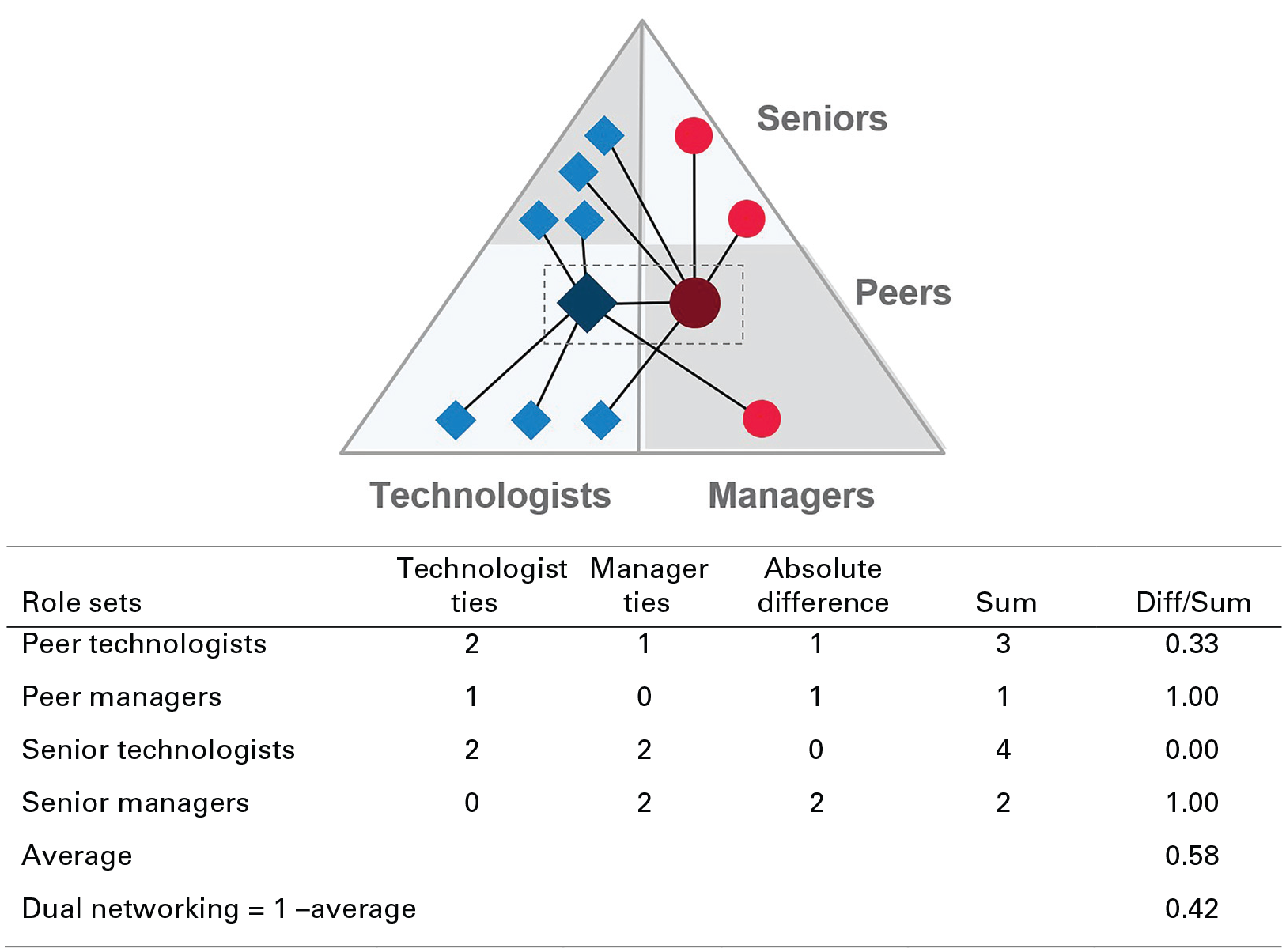
Computation of dual networking.
First, we calculated for each role set k the absolute difference in tie count d between manager i and technologist j. Any individuals who were overlapping between the manager’s and the technologist’s ego network were excluded to avoid any overlap with the measurement of structural equivalence. 6 Second, for each role set we divided the absolute difference in manager and technologist tie count by the sum of that tie count, such that a difference between 0 and 1 ties to a specific role set counts as more dissimilar than a difference of 6 and 7 ties. Finally, we averaged across the four role sets and subtracted the result from 1 to get a measure of equivalence rather than dissimilarity. As figure 2b illustrates, the dual networking measure captures the continuum from completely divided networking to complete dual networking, ranging from 0 for partners who have ties to none of the same role sets to 1 for partners who have the same number of ties to each of the four role sets.
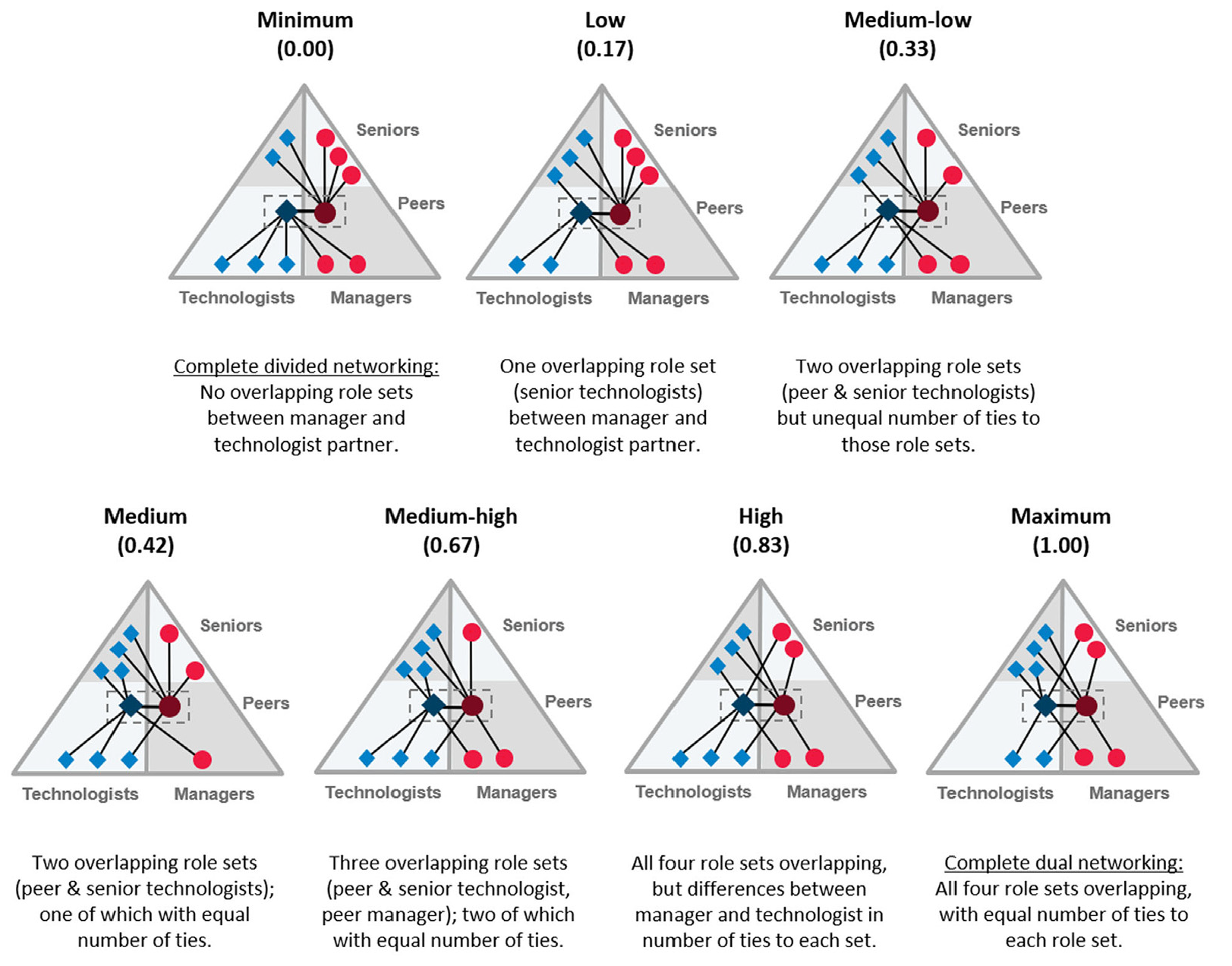
Range of values of dual networking.*
To gauge how dual networking relates to other properties of the manager–technologist partners’ networks, table 1 reports the values of other key network variables for each quintile of dual networking. This shows that higher levels of dual networking are neither the result of the number of connections the manager and technologist—separately or jointly—have to individuals nor the result of the number of connections they individually have to role sets. Rather, the measure captures the number of overlapping role sets between the manager–technologist pair and the number of non-overlapping connections to individuals in those overlapping role sets (i.e., the number of dual networking ties). Note that there are no evident differences in the dual network variable among pairs having more or fewer ties to specific role sets (not shown), with the exception that technologists with higher dual networking tend to have more ties to peer managers. Thus the dual networking variable is unlikely to capture potential advantages of network configurations focused on specific role sets.
Quintile Analysis of Dual Networking
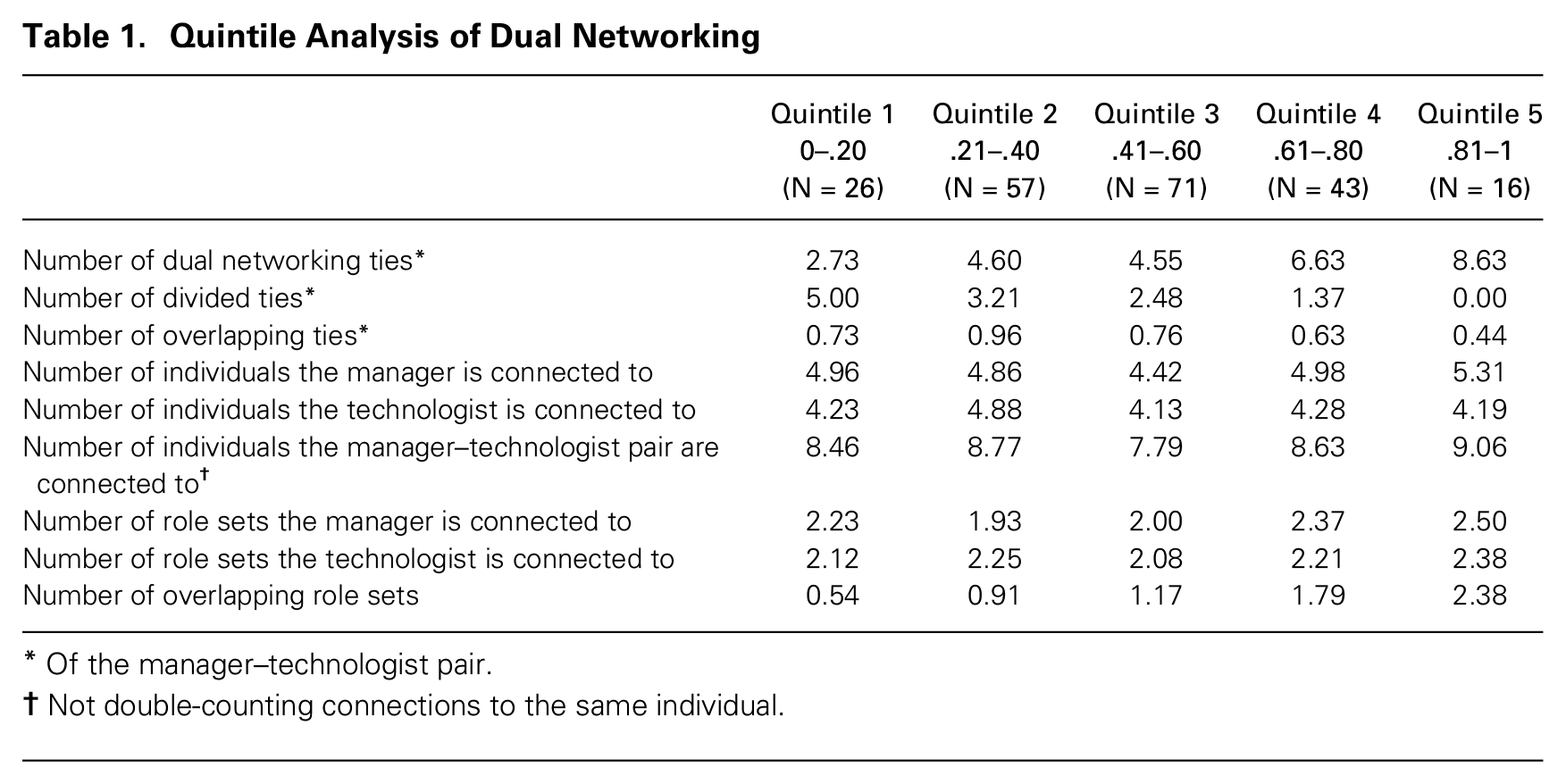
Of the manager–technologist pair.
Not double-counting connections to the same individual.
Moderator Variables
Shared technical expertise is measured using a question on the survey asking respondents to indicate all technical expertise areas in which they had relevant expertise and their level of expertise for all areas selected. This list was based on the more than 40 technological areas of strategic importance to Neptune, most of which underpin a range of products. We asked respondents to judge their depth of expertise in each area using a 5-point scale ranging from “general awareness” (1) through “fairly competent” (3) to “leading expert” (5). Shared technical expertise is the fraction of expertise areas in which the technologist is at least fairly competent in which the manager partner is also at least fairly competent. We set the areas held by the technologist as a reference point since managers tend to move more often across divisions. Managers’ accumulated areas of expertise may thus not reflect the knowledge relevant for their current division and, by extension, for the joint work they are undertaking with the technologist.
To calculate ego prominence, we used information from our name-generator questions. In line with existing studies on status and prominence (Brass and Burkhardt, 1993; Kilduff and Krackhardt, 1994), an individual’s prominence was inferred from nominations by others. We operationalized prominence as the number of times an individual is mentioned by fellow managers and technologists across the full sample of respondents as a source of advice (i.e., network name generators) or as a decision maker or opinion leader (i.e., the additional name-generator questions). To account for differences between levels of seniority and career ladder, all prominence counts were standardized by groups. Ego prominence is expressed as the number of times the focal individual is nominated by others as knowledgeable or influential in the organization, normalized by role set.
Control Variables
The control variables—identical for the manager and the technologist—can be divided into three main groups: ego attributes, partner attributes, and dyadic network variables. The ego-level variables comprise a range of attributes of the focal individual, including personal and job characteristics that may impact innovation performance. To consider unobserved characteristics that may drive innovation performance, we included ego speed to promotion as an indicator of past performance; we used HR data to create a binary measure indicating whether individuals got promoted into their current position more quickly than the average among their peers. Because this measure is based on observed average career progression data for the entire population of managers and technologists, and promotion from within is the norm at Neptune, this variable helps to account for individuals’ past performance. Further, because more-senior individuals may have greater autonomy in their work and hence potentially perform better (Amabile, 1996), we included a dummy variable for ego seniority, which takes the value 1 if the respondent belongs to the highest two of three grades of technologists included in the study or the higher of two grades of managers. We controlled for the ego number of partners—either 1 or 2—because those with multiple partners may draw greater resources from the partnership model. To control for the greater difficulty in achieving innovative outcomes at the front end of the innovation process, we controlled for the ego research portfolio time horizon, which is the percentage of respondents’ main projects that are long term. Respondents were asked to indicate the time horizon for up to five of the projects on the work plan agreed to with their line manager. We calculated the share of those projects expected to reach or impact the market in more than two years. Finally, we would expect the effects of dual versus divided networking with one’s partner to be manifested beyond the effect of the respondent’s own network. Individuals with larger networks or with more open networks may have greater opportunities to access information or gain influence that could increase their innovation performance independent from dual networking (Tortoriello, McEvily, and Krackhardt, 2015). Thus we controlled for ego network degree to assess potential effects of ego network size, and for ego network closure—a measure of ego network density—to test the effect of embeddedness in open or closed network structures (Fleming, Mingo, and Chen, 2007).
The second group of control variables relates to a range of partner characteristics. We controlled for the partner speed to promotion, measured in the same way as ego speed to promotion described above. We also controlled for the extent of partner support that the respondent perceived (Oldham and Cummings, 1996; Criscuolo, Salter, and Ter Wal, 2014) using a six-item scale adapted from a supervisory support scale developed by Greenhaus, Parasuraman, and Wormley (1990) (Cronbach’s α = .92). We used slightly differently worded versions for managers and technologists to reflect differences in what respondents would gain from their partner. Because this measure strongly correlates with partner communication frequency and partnership duration, we do not include either of these variables as controls. We controlled for the partner number of partners, measured as the number of times the partner was identified by others as a partner, because having a partner with multiple partners may bring indirect access to more resources but may also reduce the partner’s time investment in the focal partnership.
Finally, the measure of dual networking does not account for the extent to which the manager and technologist mention the exact same individuals—i.e., the extent to which their networks are structurally equivalent. To calculate overlapped networking, we obtained a Jaccard similarity measure by dividing the number of overlapping individuals by the total number of distinct individuals that ego and the partner mentioned (i.e., the union of their alter lists).
Estimation
Given the categorical nature of the dependent variable, we ran ordinal probit estimations. Because the parallel assumption was rejected, we could not run ordered logit models. We clustered the standard errors by grade to account for the fact that individuals compete for a high rating within peer groups, which may introduce non-independence of observations within groups. We used population weights to address the overrepresentation of high-performing individuals in the sample. These weights were derived using the share of innovation performance ratings in the population of technologists and managers obtained from the HR records.
Results
Descriptive Statistics and Networking Patterns
Table 2 provides summary statistics for all variables in the study, shown separately for the technologist and manager samples. The average innovation performance is substantially higher for managers than for technologists. Although top-rated technologists are somewhat overrepresented in the sample, the rating differences between technologists and managers reflect those of the full population. We found a complex ecology of prominence within the organization, with senior technologists having the highest absolute levels of prominence; all senior technologists were mentioned at least once, and about 40 percent of them were mentioned more than 10 times as sources of advice or influence in the organization. Senior managers follow as the second most prominent role set, whereas prominence for peer-level managers and technologists tends to be much lower. The tables in Online Appendix B report the correlations between all variables in the regression. We also find large variation in the patterns of divided and dual networking among manager–technologist pairs in our sample; see Online Appendix C for a detailed illustration. We make three main observations in relation to networking patterns of managers and technologists.
Descriptive Statistics
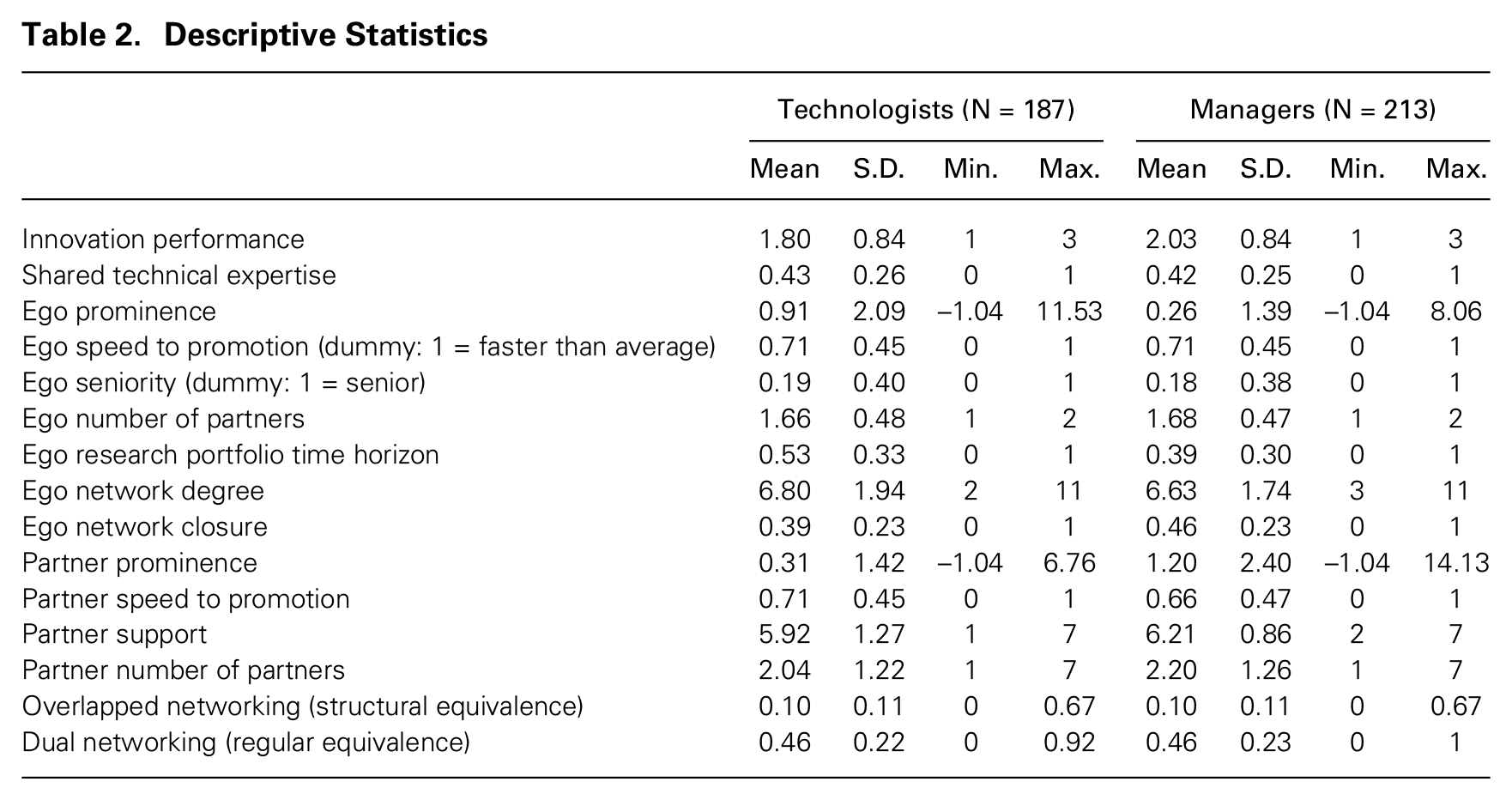
First, it is striking to note that managers’ and technologists’ networks are not starkly different. It would be an oversimplification to argue that technologists have networks focused on other technologists and managers have networks oriented toward other managers. If we compare the configuration of individual manager or technologist networks in terms of the absence or presence of ties to each of the four role sets, there are 16 different network configurations. The frequency of these configurations is remarkably similar across the manager and technologist samples. In other words, there is no “typical” technologist network or “typical” manager network. Hence divided and dual networking come in many different forms, with large variety in the role sets that manager and technologist networks reach into.
Second, whereas the majority of both managers and technologists connect to peer managers and peer and senior technologists, connections to senior managers—including top-grade managers and senior management executives—are relatively rare; 51 percent of pairs do not connect to this role set directly. This suggests that many manager–technologist pairs seek to generate new ideas and gain momentum for them without directly involving final decision makers, instead mobilizing critical stakeholders and influential voices around them.
Finally, the extent of overlapped networking is relatively low. On average, manager–technologist pairs have 10 percent overlapping alters, suggesting that, rather than drawing on the same individuals as input to their joint work, the partners in a pair tend to reach out to different groups (i.e., divided networking) or to the same groups but different individuals (i.e., dual networking). Overlapped networking by manager–technologist pairs is most commonly targeted at senior technologists, which is understandable given that this role set contains the most prominent individuals overall in the organization. 7 This does not imply, however, that manager–technologist pairs are unlikely to engage in dual networking with senior technologists. In 53 percent of all collaborating pairs in our sample who engage in dual networking with at least one role set, both the manager and technologist are tied to senior technologists (albeit to different individuals). Of the remainder, in 19 percent of dual networking manager–technologist pairs neither party connects to senior technologists, in 18 percent only the technologist does, and in 9 percent only the manager does.
Dual Networking and Individual-level Performance
Table 3 presents the ordinal probit regressions predicting individual innovation performance. Models designated (a) and (b) are identical but refer to the sample of technologists and managers, respectively. Model 1 includes only the control variables. The results show that both managers and technologists tend to register higher innovation performance if they got promoted to their current grade more quickly, if their focal partner got promoted more quickly, and if they work with multiple partners. In addition, technologists have higher innovation performance if they have higher prominence, whereas managers tend to have higher innovation performance if their work is concentrated on projects with a shorter-term time horizon and if they see their technologist partner as supportive. Working with a prominent partner has contrasting effects on technologists’ and managers’ innovation performance. Whereas technologists suffer from working with prominent managers—possibly due to prominent managers’ time constraints—managers benefit from partnering with prominent technologists. There is also a negative association between shared technical expertise and managers’ innovation rating. Although this may be surprising given that one would expect overlapping expertise to enable managers and technologists to better work together, a plausible explanation is that a manager whose technical expertise closely mirrors that of their technologist partner may find their ability to complement the technologist’s technical expertise compromised and thus find it more difficult to make an independent contribution to innovation for the organization. Looking at the effects of their own social capital, we find a negative association between network degree and innovation performance for technologists and no significant association for managers. Given that large networks require time and effort, technologists’ investments in building and mobilizing large networks may come at the expense of their focus on their core innovation tasks. This result also suggests that focusing on ego networks alone in this context might lead researchers to miss the critical impact of second-order social capital on innovation.
Ordinal Probit Regression Explaining Individual Innovation Performance*
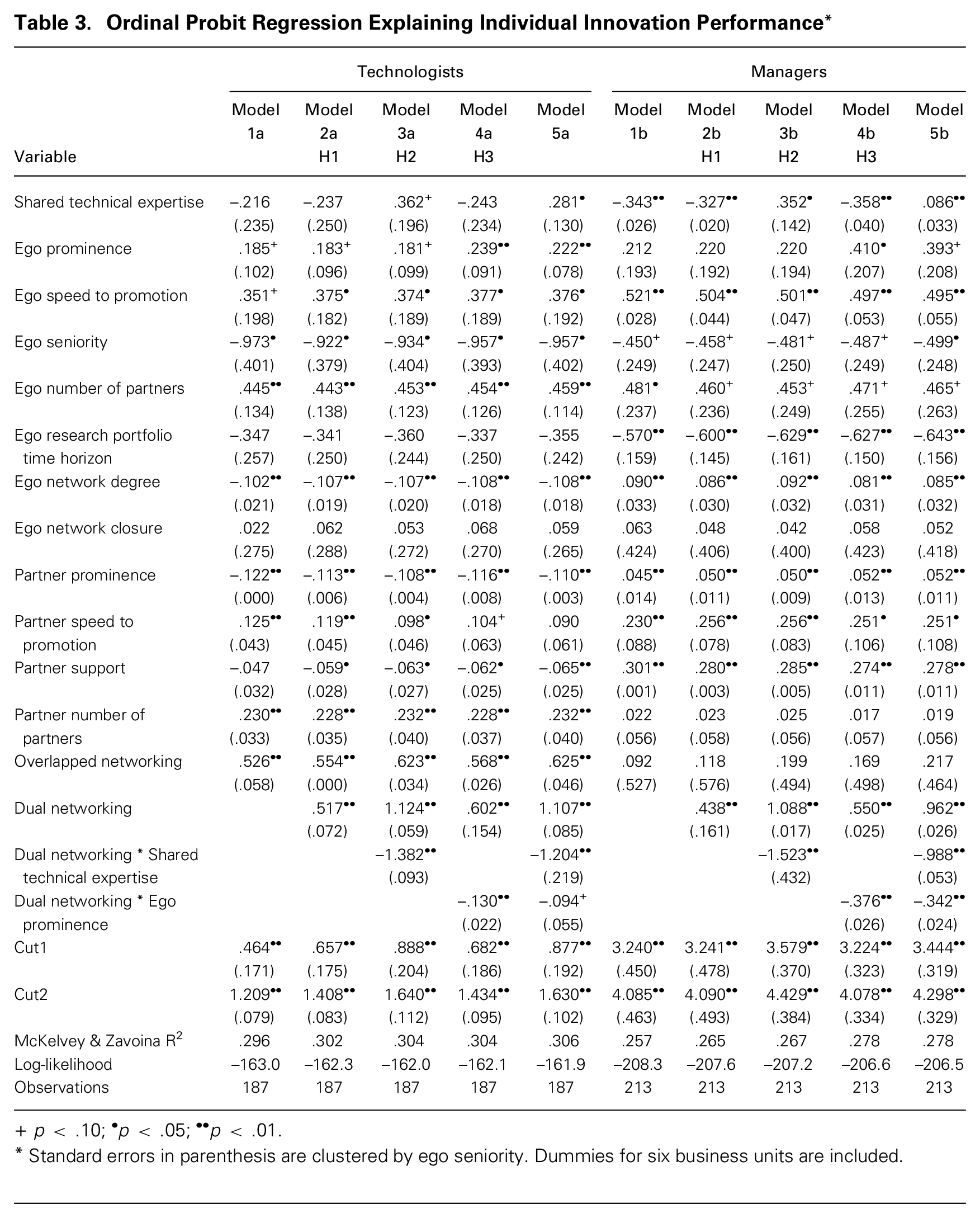
p < .10; •p < .05; ••p < .01.
Standard errors in parenthesis are clustered by ego seniority. Dummies for six business units are included.
Model 2 introduces the main effect of dual networking. The coefficient is positive and significant for both technologists and managers, providing strong support for hypothesis 1. Thus, overall, technologists and managers appear to benefit from dual networking with their partner rather than from engaging in divided networking. With a standard-deviation increase in dual networking (keeping all the continuous variables at their mean values and the significant dummy variables at 1), the probability of obtaining a top innovation rating increases by 8.8 percent for technologists (95-percent confidence interval 8.6–9.0 percent) and by 7.6 percent for managers (95-percent confidence interval 4.3–8.9 percent). For comparison, the effect of the control variable for overlapped networking on individual innovation performance is significant for technologists but not for managers. For technologists, however, a standard-deviation increase in overlapped networking increases the probability of achieving a top rating by only 4.4 percent (95-percent confidence interval 4.2–4.5 percent), which is substantially smaller than the 8.8 percent increase associated with greater dual networking.
We argued that the overall benefits of dual networking are rooted in advantages associated with dual interpretation of inputs from specific role sets by both members of the partnership, as well as dual influencing of these groups. To give credibility to our claims that dual interpretation and dual influencing underpin the merits of dual networking, hypotheses 2 and 3 stipulate conditions in which we expected these mechanisms to have lower importance. We tested the moderation hypotheses based on the partial models in models 3 and 4; model 5 reports the full model. Online Appendix D offers additional analyses that gauge to what extent overlapped networking allows for dual influencing and dual interpretation.
First, H2 predicted that individual technologists and managers who have greater shared technical expertise benefit less from dual networking. This prediction is based on the premise that dual interpretation helps in the joint sensemaking needed to integrate market and technological insights, which is easier for individuals who share more technical expertise with their partner to do independently, without the need for input from overlapping role sets. Models 3a and 3b indicate that the interaction between dual networking and shared technical expertise is negative and significant for both managers and technologists. Figures 3a and 3b demonstrate that, as predicted, the benefit of dual networking is reduced if the technologist and manager have greater shared technical expertise. In other words, the performance of individuals whose partner’s expertise overlaps a great deal with their own is less dependent on the level of dual networking than that of individuals whose partner has limited overlapping technical expertise. These results support H2 and corroborate our claim that dual interpretation is a key mechanism underpinning the advantage of dual networking for innovation performance.
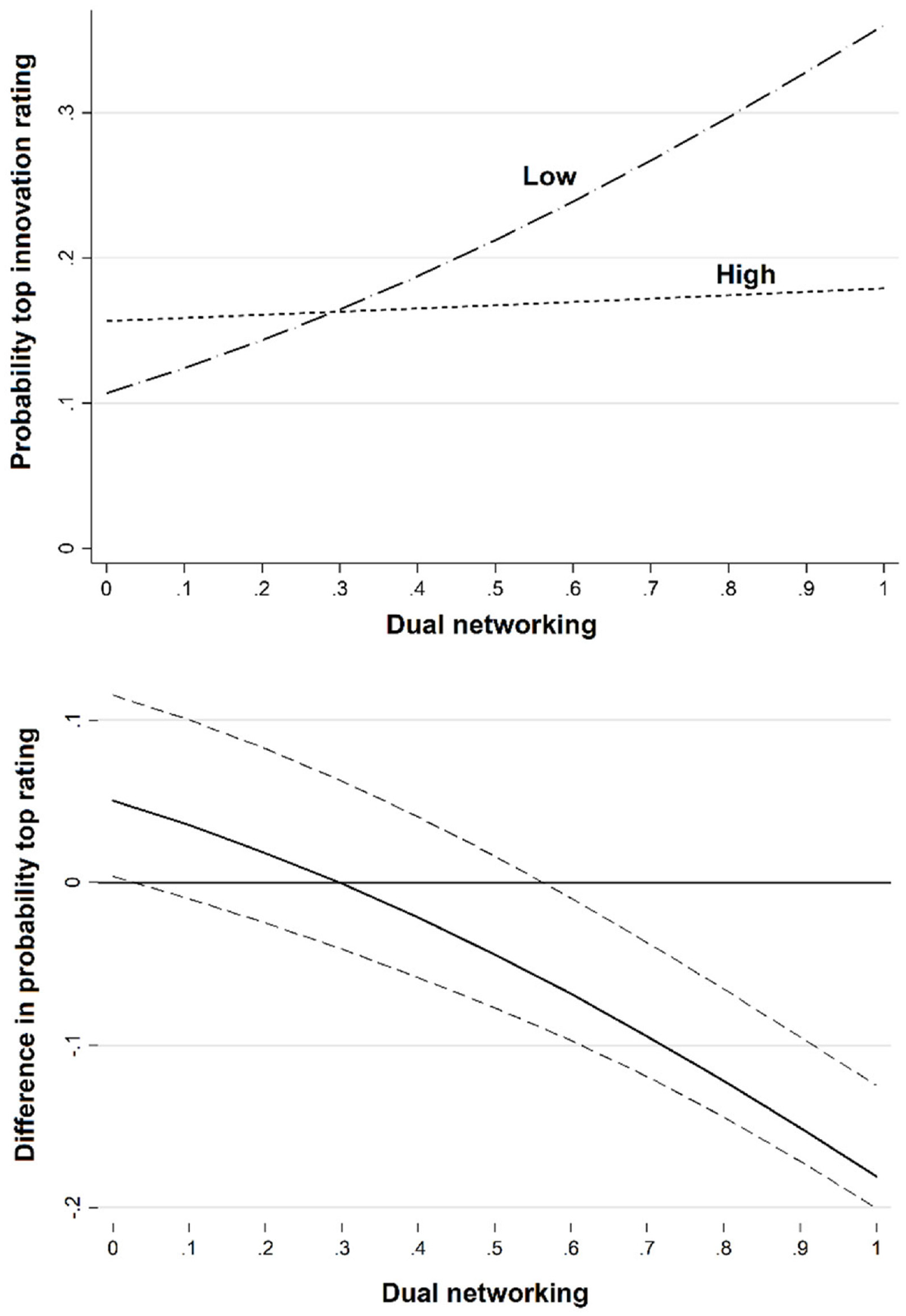
High shared technical expertise dampens the benefit of dual networking for technologists’ innovation performance.*
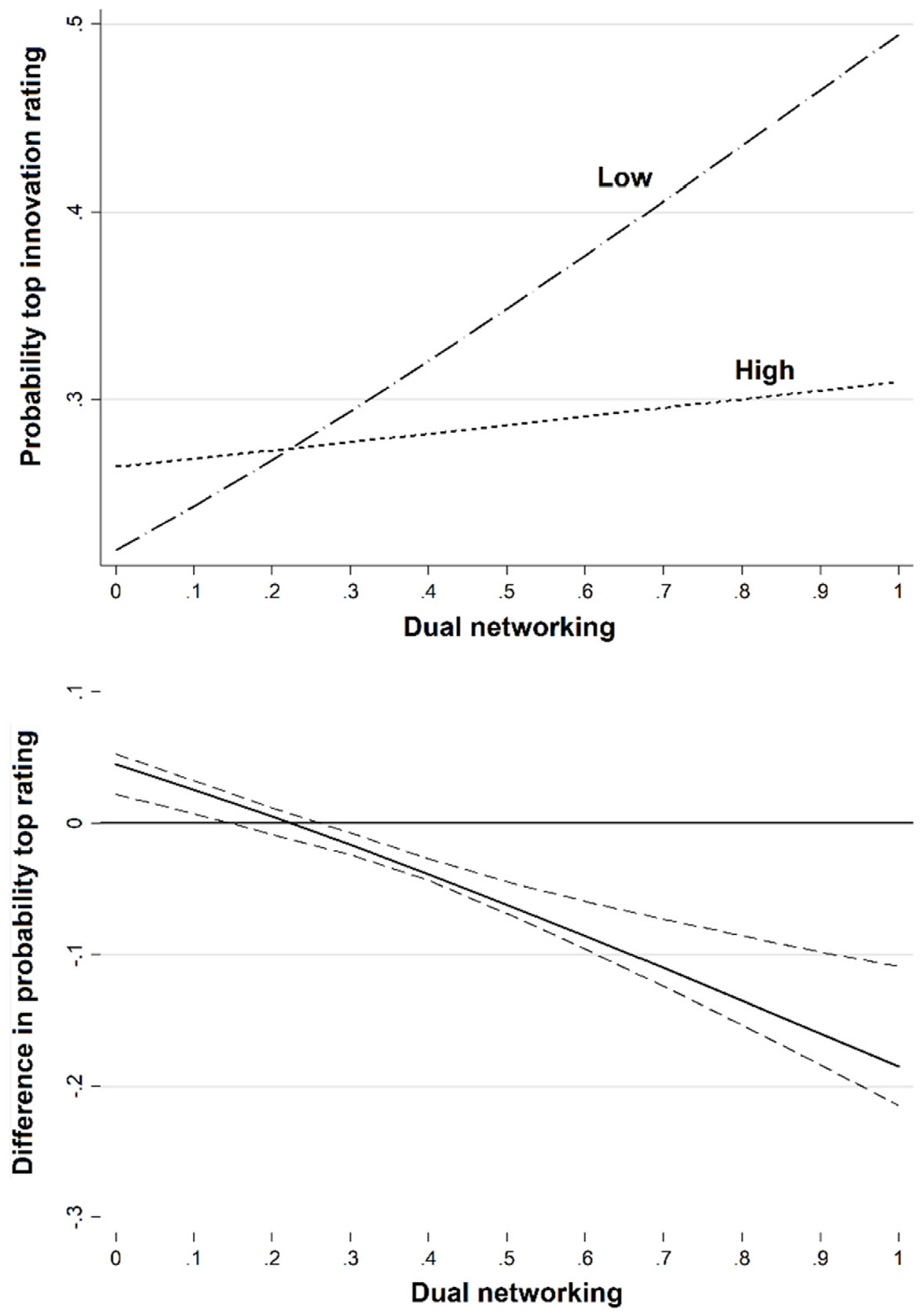
High shared technical expertise dampens the benefit of dual networking for managers’ innovation performance.*
Second, H3 stipulates that the positive effect of dual networking on innovation performance is reduced if the focal manager or technologist has high prominence. We argued that the more prominent the focal individual, the less reliant that person is on dual influencing by their partner, and thus the less the focal individual benefits from dual networking. Models 4a and 4b and figures 4a and 4b confirm this prediction for both managers and technologists. The positive relationship between dual networking and performance is dampened for both managers and technologists with higher prominence, although the effect is more pronounced for managers. These results support H3 and help validate our claim that dual influencing is a critical component of the dual networking advantage for innovation performance.
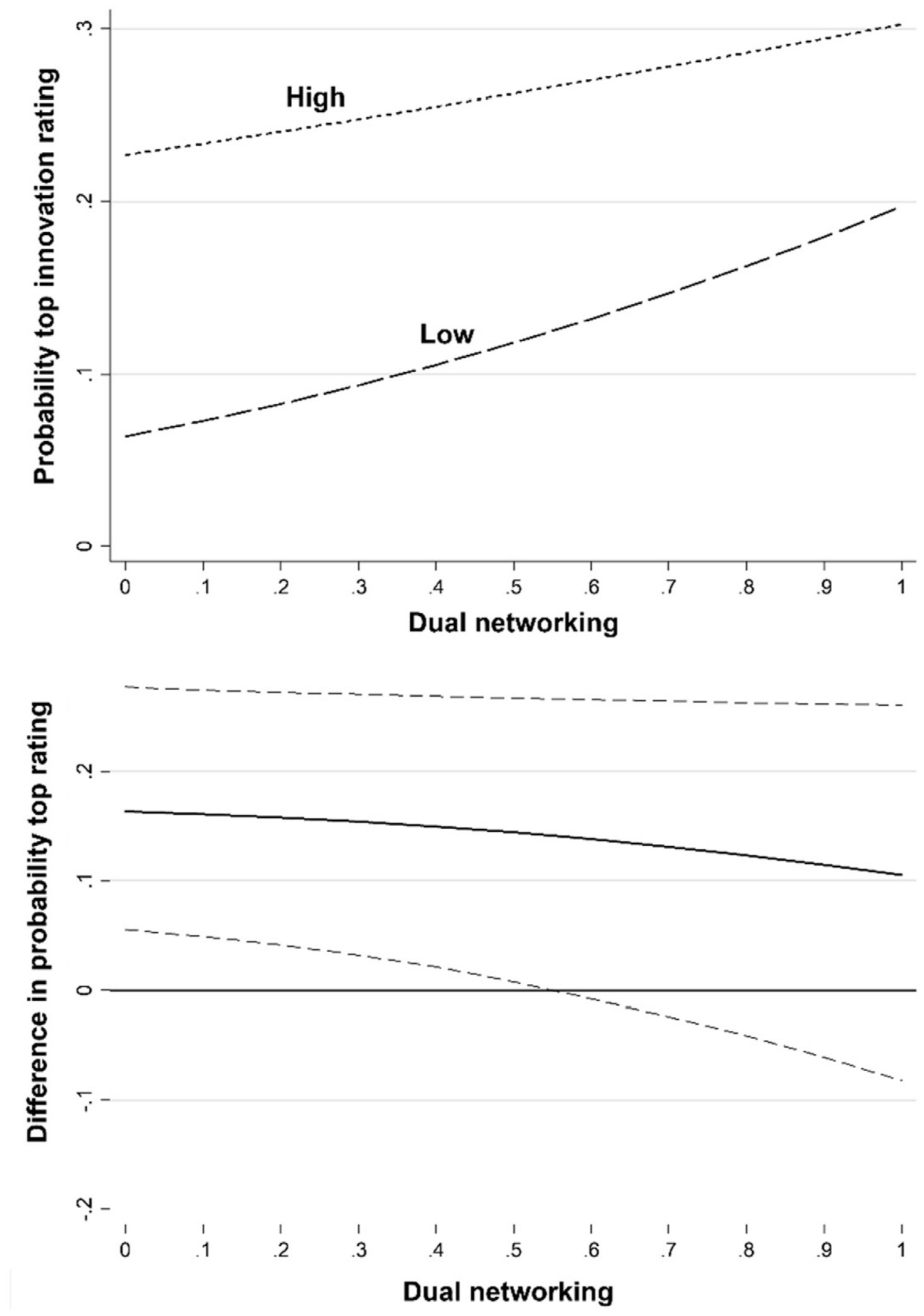
High prominence dampens the benefit of dual networking for technologists’ innovation performance.*
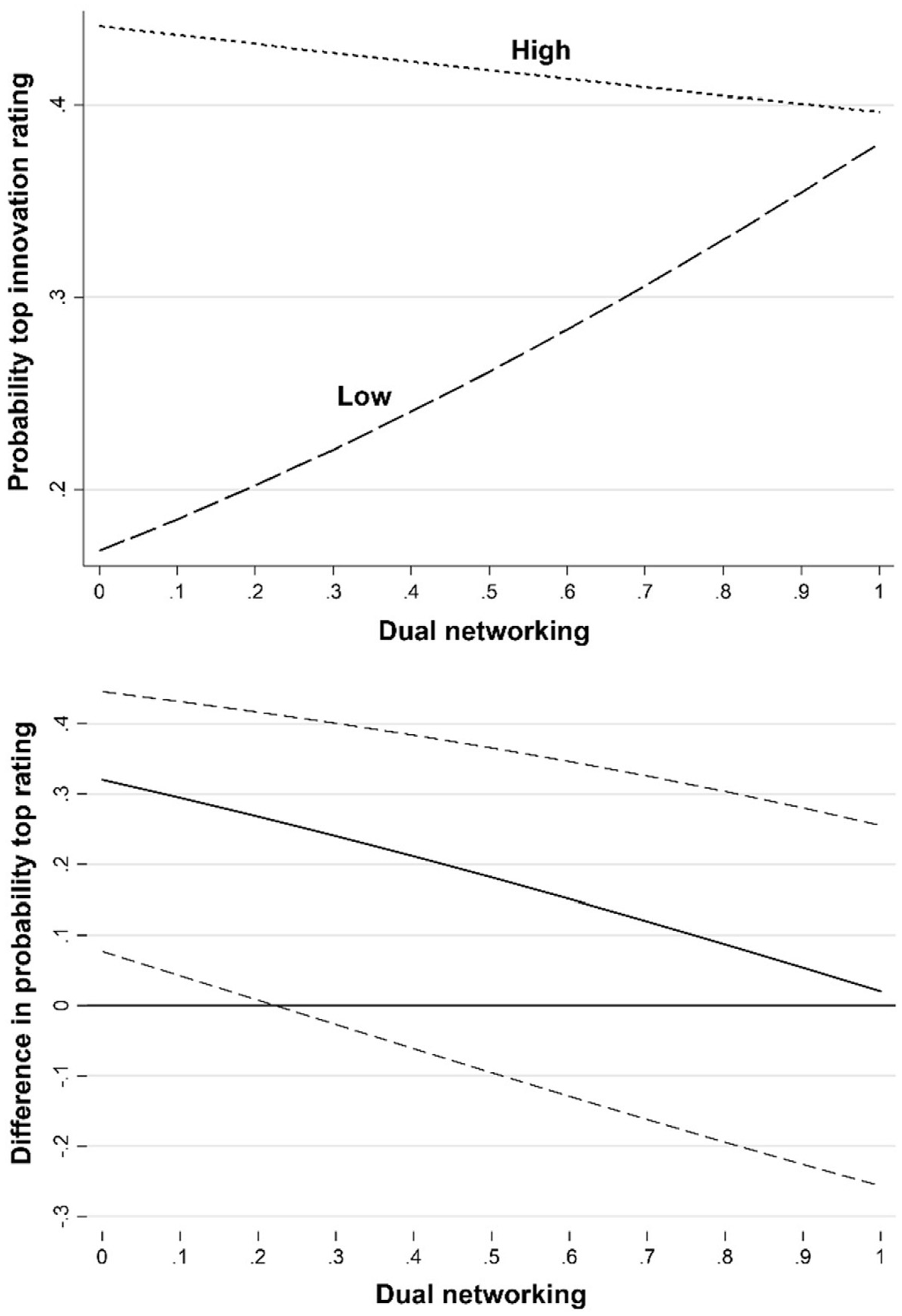
High prominence dampens the benefit of dual networking for managers’ innovation performance.*
We also tested our hypotheses in models with fewer control variables to mitigate potential concerns that our findings may be sensitive to inclusion of specific control variables (Carlson and Wu, 2012). The support for all our hypotheses remained intact in models using a restricted set of control variables (ego speed to promotion, seniority, research portfolio time horizon, network degree, and overlapped networking).
Robustness Checks
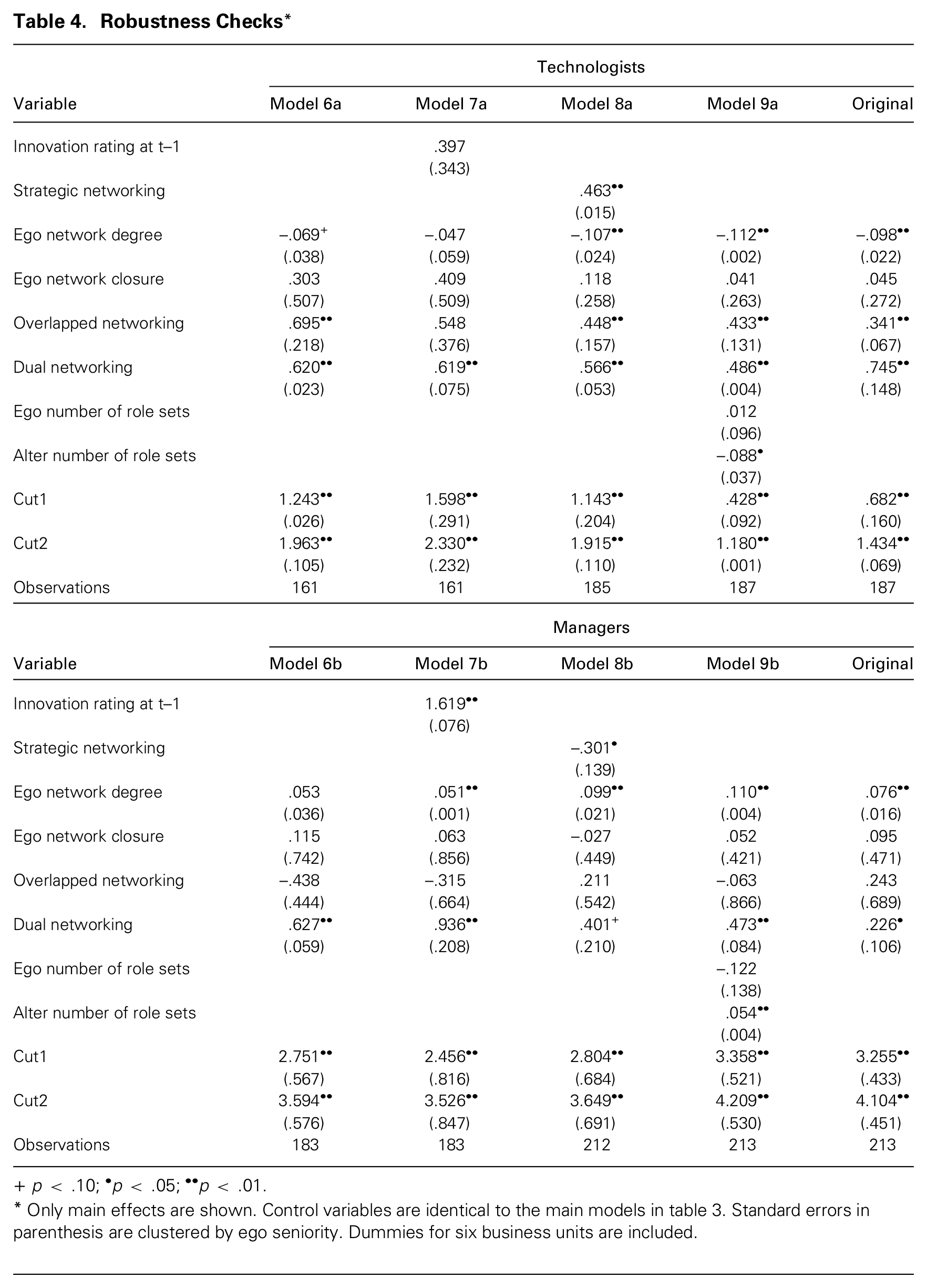
Any study examining the impact of social networks faces the challenge of identifying the causal mechanisms underpinning changes in the outcome variable, because of endogeneity due to reverse causality and unobserved heterogeneity. In the present context, the problem of reverse causality might arise if individuals with high innovation performance in the past were more likely to engage in divided networking with their partner, for example, because the credit they built up through strong past performance would enable them to influence role sets without the help of their partner. In that case, our analysis would underestimate the effect of dual networking. If, instead, highly innovative individuals were more inclined to engage in dual networking, then the association between dual networking and innovative performance would potentially be a spurious correlation. To test both these possibilities, we reran the analysis including a lagged dependent variable—i.e., the innovation performance rating received in the year prior to the survey. 8 This information was self-reported by respondents and is available for only a subset of individuals in the sample. Models 6 and 7 of table 4 report the results with and without the lagged dependent variable. Results remain substantially unchanged; for managers, the magnitude of the dual networking variable increases when the lagged dependent variable is included, suggesting that the impact of dual networking in the main analysis might be underestimated.
Robustness Checks*
p < .10; •p < .05; ••p < .01.
Only main effects are shown. Control variables are identical to the main models in table 3. Standard errors in parenthesis are clustered by ego seniority. Dummies for six business units are included.
Another source of endogeneity is the inability to control for other unobserved individual-level characteristics that could influence the main relationship between dual networking and innovation performance. For example, individuals might differ in the extent to which they are strategic about their networking. In the absence of a direct measure for strategic networking behavior, we calculated a proxy based on a survey question asking respondents to declare at what stage of an idea’s development they would elicit support from each of the network alters and from decision makers and opinion leaders. Respondents were given four options ranging from “immediately after idea conception” to “after idea validation.” The assumption is that if individuals elicit support from all contacts at the same stage, regardless of their seniority and role as decision makers or opinion leaders, then they are not very strategic in their networking behavior. Therefore, for each respondent we derived the standard deviation of their timing of all alter ties’ mobilization, such that high values indicate strategic networking behavior. In model 8, we include this variable in the main model and find that although it is positive and significant for technologists and negative and significant for managers, the dual networking variable remains positive and (marginally) significant in both the technologist (p < .01) and the manager (p < .10) regressions.
Furthermore, we argued that the advantage of dual networking is based on the benefits of dual interpretation and dual influence. These benefits arise from the symmetry in the number of relations that manager–technologist pairs have in their relations to different individuals in the same role set and not from the breadth of connections across the role sets. Although our quintile analysis in table 1 shows that higher dual networking does not tend to coincide with larger or broader networks, we performed additional analyses to control for network breadth effects. Models 9a and 9b add the number of role sets the manager and technologist individually connect to. The models show that the sign and significance of the main dual networking effect remain unchanged.
Finally, the dual networking measure is based on similarity in tie counts to each of the four role sets, and role sets to which neither the manager nor the technologist is connected count toward greater levels of dual networking. We reran our models with a dual networking measure that disregards similarity to role sets to which neither the manager nor technologist is connected. The alternative measure correlates strongly with the original one (r = .84). The regression results are consistent with those reported. Relatedly, we did a sensitivity analysis using alternative dual networking measures taking out the average of one role set at a time. We found that our measure is not driven by similarity in the number of ties to one particular role set. Specifically, the correlations between our original dual networking measure and the equivalent measures are as follows: excluding ties to peer technologists (r = .88), excluding senior technologists (r = .87), excluding peer managers (r = .89), and excluding senior managers (r = .84).
Discussion
We have sought to understand the extent to which individuals dividing work across roles can benefit from also dividing their networking. Based on our study of manager–technologist partners in the corporate R&D unit of a multinational, we make four observations. First, dual networking trumps a divide-and-conquer approach to networking for the innovation performance of both technologists and managers. Second, the dual networking advantage appears to be based on two key mechanisms: dual interpretation and dual influencing. Third, the value of dual interpretation varies based on the technical expertise of the partners, such that managers and technologists benefit less if they have greater shared technical expertise. Finally, the value of dual influencing is reduced for managers and technologists who have high organizational prominence themselves.
While we observe these findings in the context of corporate R&D, we believe they extend more broadly to other contexts of collaborative innovation, including but not limited to entrepreneurial founding teams, professional service firms, and creative industries. For organizational scholars of networks research, our findings advance understanding of how second-order social capital manifests and matters for innovation performance. For scholars of organizational innovation, our findings reveal the role of social structure in explaining how the “what’s possible” in terms of science and technology meets the “what’s needed” in terms of market and business opportunity.
Implications for Research on Organizational Networks
This study offers three contributions to research on social networks in organizations. First, we contribute to the emerging body of work on second-order social capital (Leana and Van Buren, 1999; Brass, 2009). Specifically, we complement research that has emphasized the hierarchical basis of positive externalities of social capital: whereas the locus of second-order social capital in the study by Galunic and colleagues (2012) is the supervisor–subordinate relationship, it is the horizontal relationship between collaborating partners in our study. Our findings suggest that individuals benefit not only from having line managers or supervisors with connections that offer positive externalities (Galunic, Ertug, and Gargiulo, 2012) but also from the connections of collaborating peers with whom one engages in a division of labor. We believe this distinction is important, because the mechanisms underpinning the transfer of social capital benefits vary between vertical and horizontal relationships.
Second, this study introduces two novel mechanisms through which dual networking enables the pursuit of collaborative innovation: dual interpretation and dual influencing. The benefit of dual interpretation is that collaborators who connect to different individuals from the same role set gain access to diverse perspectives on a problem or idea not yet colored or biased by one’s partner (McFadyen and Cannella, 2004; Gavetti and Warglien, 2015). This allows for the independent interpretation of inputs, creates a forum for discussion and debate between the collaborators, and enables them to bridge representational gaps in the elaboration of ideas (Postrel, 2002; Cronin and Weingart, 2007; Perry-Smith and Mannucci, 2017). Thus dual interpretation highlights the need for collaborative dyads to reach out to non-redundant connections who belong to the same groups: overlapping groups create the common ground, and non-overlapping individuals maintain diversity. The benefit of dual influencing is that groups of decision makers, opinion leaders, and other prospective advocates who can help generate momentum are more readily convinced of the merits and potential of a new idea when collaborators present multiple versions of the same arguments to different members of those groups (Shannon and Weaver, 1948; Centola and Macy, 2007). Whereas Battilana and Casciaro (2013) shed light on the benefit of the same individual sending different messages to separate, unconnected alters in order to prevent coalitions of resistance forming against them, the dual influencing mechanism suggests this risk is diminished when the different messages come from different individuals. This is likely because multiple arguments coming from the same individual may be interpreted as in conflict, whereas multiple arguments from different individuals—particularly when they occupy separate roles—are likely seen as complementary.
Third, our study shows that the value of being connected to individuals other than one’s collaborator may be based not solely on the diversity of individual connections but also on the partial overlap in group membership of those connections. The complementarity of second-order social capital is most typically defined in terms of connectedness to brokers who indirectly connect their collaborator to groups of alters otherwise beyond reach (Burt, 2007; Galunic, Ertug, and Gargiulo, 2012; Clement, Shipilov, and Galunic, 2018). Similarly, in a qualitative case study of biotech startups, Maurer and Ebers (2006) showed that firms benefited from individual organizational members each specializing in relations with different constituencies. In contrast, dual networking highlights that the value of collaborators’ networks resides not so much in such indirect connections to distinct groups but in the complementarity of distinct ties to the same groups. Independent, non-overlapping ties to the same groups create a discussion forum through which collaborating individuals can make sense of their joint endeavor, and they help generate momentum among members of the groups targeted. Operating as a good “sparring partner” in collaborative innovation tasks may thus be difficult without exposure to the same groups that one’s close collaborator relies on in their work.
In promoting a role-set perspective on network overlap between collaborators, our study shows that the benefits of networks may be defined not exclusively in terms of the structural advantages such as brokerage or closure (Burt, 2007; Kilduff and Brass, 2010) but also in terms of the overlay of networks on the organization’s formal structure (Blau and Scott, 1962). Although the advantages of dual versus divided networking may be reminiscent of the alleged tradeoffs between structural holes and network closure (Coleman, 1990; Reagans and McEvily, 2003; Burt, 2004; Ter Wal et al., 2016), there is a fundamental difference. The advantages of dual networking are defined in terms of overlap in the focus on specific role sets rather than overlap in the relations themselves. Akin to intra-organizational division of labor, where two individuals have overlaps in the type of functions they perform, dual networking occurs if two individuals overlap in the functional focus of their networks—the types of individuals they connect to and the types of information and influence they obtain as a result. Defining divided versus dual networking in terms of role sets (Merton, 1957) reminds us that informal social networks and formal organizational structure may need to be considered jointly to explain how intra-organizational social networks may yield advantages (McEvily, Soda, and Tortoriello, 2014). In showing how the benefits of intra-organizational social capital are defined in terms of the relevant groups that bring interpretation and influence advantages, we shift the network agenda away from strong emphasis on informal structure and toward more attention to the role of formal roles and hierarchies.
Implications for Innovation Research
Our study also contributes to understanding the social structure of innovation, demonstrating how individuals’ ability to excel in the generation of innovation is rooted not only in the division of labor between manager and technologist roles (Blau and Scott, 1962; Lawrence and Lorsch, 1967) but also in the collective deployment of their respective networks. We have given renewed attention to how participation and engagement in collaborative innovation across roles shapes performance. In doing so, we have extended Katz, Tushman, and Allen’s (1995) insight about the interdependence of networks on the performance of R&D innovators, demonstrating how technologists’ scientific skills and managers’ business skills come together in the generation of innovation. This also helps reaffirm that the manager–technologist relationship in innovation is not confined to technologists acting as creators and managers as evaluators (Mollick, 2012; Berg, 2016) but rather is a synergistic bond, as both partners actively contribute to the elaboration and championing of valuable ideas for their organization.
Our second contribution to innovation research is that this study exposes how the choices managers and technologists make about whether to seek input from and exert influence on the same role sets in the organization translate into variation in their innovation performance. A technologist who prefers to focus on the role of inventor, leaving much of the networking and influencing to their manager partner, may struggle to realize the potential of their ideas. If they do not reach out to role sets to which their manager partner connects, or if their manager partner does not connect to role sets they connect to, they may find it difficult to make sense of how the technological advancements of their work can be integrated with the organization’s strategic priorities and business needs (Lingo and O’Mahony, 2010; Ter Wal, Criscuolo, and Salter, 2017). Likewise, a manager who fails to reach out to the same role sets as their technologist partner or who discourages that partner from connecting to role sets within their own networks may miss the opportunity to have the technologist disseminate different arguments from their own about an idea’s potential and may thus struggle to champion novel ideas (unless they can capitalize on high levels of prominence).
Finally, by focusing on dual networking, the study has helped to increase appreciation of the complex lattice of influence and expertise in the R&D process, as well as of how individuals and their collaborators can find appropriate ways to engage, mobilize, and influence key decision makers in organizations to win support for their innovative ideas. For decades, the structural holes versus closure debate has been prominent in explaining how networks balance access to diverse information and shared understanding (Coleman, 1990; Reagans and McEvily, 2003; Burt, 2004; Ter Wal et al., 2016), yet this study shows that there may also be a balance of difference and sameness that stems from non-overlapping individuals in overlapping role sets. Further incorporating role sets into theories of organizational innovation may improve our understanding of the synergistic effects of brokerage and closure.
Limitations and Future Research
We recognize some limitations of our study and the need for future research into the value of dual networking relative to divided networking. First, the single-organization setup of the study prevents directly establishing how it would generalize to other settings. Although Neptune’s partnership model enables easy observation of the interdependence between managers and technologists, similar dynamics in terms of the value of dual versus divided networking likely occur in other organizations in which the interdependence between collaborators takes different forms. It would be useful to explore the networks of paired collaborators in non-R&D settings where similar dual-career structures are often present and where dual interpretation and dual influencing may offer similar advantages.
Second, our arguments focus mainly on the advantages of dual networking relative to divided networking (i.e., regular equivalence), as opposed to overlapped networking (i.e., structural equivalence). Although we controlled for overlapped networking in our analyses and offered supplementary analyses probing its role in dual interpretation and dual influencing, the limited extent of overlapped networking in our context did not allow us to explore this fully. Future research may shed light on how overlapped and divided networking interact. One may argue that overlapped networking may undermine the dual interpretation advantages of dual networking. Conversely, one can imagine that difficulties associated with divided networking may be mitigated by overlapped networking.
Third, we focused our assessment of the value of dual networking on ties to four of the most salient role sets, and thus we cannot comment on whether similar dynamics would apply to connections to more junior members of the R&D organization, departments outside R&D, or connections outside the firm. In other contexts with more fluid and outward-facing patterns of engagement with intra- and inter-organizational actors, some degree of divided networking could be necessary to control workloads associated with networking.
Finally, we wish to point out some shortcomings of the dependent variable. Although the organization has several safeguards in place to make the rating process as transparent and objective as possible, ratings are socially constructed and may thus be biased toward some people, certain contributions, and visible short-term outcomes. We took several steps in our empirical analyses to mitigate these effects, but some shortcomings remain. Future research could further disentangle the advantages of dual networking for innovation performance—for example, by separating short-term incremental innovation and longer-term radical innovation. Such work would be invaluable in further cementing the theoretical foundations of the merits of dual networking in collaborative innovation.
Conclusion
Innovations and their inventors are widely celebrated in the business world and beyond. Most often, these are ascribed to gifted geniuses with breakthrough insights about what the world needs, like the heroic character in an adventure movie who saves the day. In sharp contrast, our notion of dual networking is more akin to the partners in a “buddy” movie who are individually distinct yet work in tandem to solve problems. Our understanding of the social structure of innovation stands to benefit from further pursuing this line of enquiry.
Supplemental Material
Ter_Wal_Criscuolo_McEvily_Salter_online_supp – Supplemental material for Dual Networking: How Collaborators Network in Their Quest for Innovation
Supplemental material, Ter_Wal_Criscuolo_McEvily_Salter_online_supp for Dual Networking: How Collaborators Network in Their Quest for Innovation by Anne L. J. Ter Wal, Paola Criscuolo, Bill McEvily and Ammon Salter in Administrative Science Quarterly
Footnotes
Acknowledgements
The research underpinning this article has received funding from the European Research Council (ERC) under the European Union’s Horizon 2020 research and innovation program (Grant agreement No. 715280) and from the Economic and Social Research Council [ES/K001159/1]. We are grateful for comments on earlier versions of this paper from participants from the INSEAD Network Evolution workshop in 2016, the 2017 DRUID Conference in New York, the 2018 Academy of Management, and the Innovation and Entrepreneurship (I&E) paper development workshop at Imperial College Business School, as well as seminar participants at ESSEC, Tilburg University, Rotterdam School of Management, EPFL, SKEMA, Warwick University, London Business School, Oxford University, and the University of Amsterdam. We are also extremely grateful to Neptune for allowing us to collaborate with their organization and its employees on this project.
1
More formally, dual networking is a form of regular equivalence (Borgatti and Everett, 1989). We propose dual networking as a new construct that captures the extent of role set overlap of the networks of two individuals working together. In contrast, regular equivalence is the broader concept that expresses any two individuals’ similarity in connectedness to groups (even if the individuals do not know each other).
2
We discuss the relative advantages of dual vs. overlapped networking, as shown in figure 1, in the results section and in greater detail in  .
.
3
Given that managers are more numerous across the board and have more seniority levels, the above grouping gives equivalently sized peer- and senior-level role sets on both career ladders. Unlike their technologist equivalents who are marked as senior, managers in the second-highest seniority grade are seen as peer-level; as they have three layers of additional decision-making authority above them, they are typically consulted for their business expertise rather than for their formal power or informal influence.
4
The 187 technologist observations included in the analyses relate to 168 unique technologists (effective response rate 27%). The 213 manager observations relate to 155 unique managers (effective response rate 16%).
5
Note that not all alters belong to the four core role sets, as individuals could mention, for example, junior researchers or individuals outside R&D. Yet for both managers (72.2%) and technologists (62.3%) in our sample, the majority of alters belonged to one of the four core role sets. Most ties outside the four groups are to junior researchers who have not reached the point at which they join either the managerial or technical career ladder.
6
This did not strongly affect the dual networking measure, as the correlation with an alternative dual networking measure that includes overlapping individuals is .89. Our results are robust to the use of this alternative measure.
7
More generally, overlapped networking is typically targeted at prominent individuals. Across all alter pairs listed by our sample of technologist–manager partners (i.e., an alter mentioned by the manager and an alter mentioned by the technologist), we find that 50 percent of overlapping alter pairs are ties to opinion leaders, whereas this figure is 41 percent for non-overlapping pairs (χ2 = 8.35, p = .004). Likewise, on average, the prominence of overlapping alter pairs (15.6 mentions as an advice source, opinion leader, or decision maker) is substantially higher than that of non-overlapping alter pairs (8.6 mentions).
8
Note that a speed-to-promotion measure is already included in the main analyses as a proxy for prior innovative performance to help mitigate omitted variable bias.
Authors’ Biographies
References
Supplementary Material
Please find the following supplemental material available below.
For Open Access articles published under a Creative Commons License, all supplemental material carries the same license as the article it is associated with.
For non-Open Access articles published, all supplemental material carries a non-exclusive license, and permission requests for re-use of supplemental material or any part of supplemental material shall be sent directly to the copyright owner as specified in the copyright notice associated with the article.
