



Abstract
Based on an in-depth, qualitative case study about a conflict between governmental authorities from the United States and Switzerland over the regulation of Swiss banks, we introduce indirect compellence as a novel triadic and indirect mechanism through which coercion leads to institutional change. Hostage-taking being a prototypical example, indirect compellence is typified by a coercive actor who takes a third party hostage to gain influence over a targeted actor. In our case, it meant that U.S. authorities (coercers) compelled Swiss policy makers (targets) to erode the famed Swiss banking secrecy rules by threatening the targets to otherwise enforce U.S. law extraterritorially against Swiss banks and bankers (hostages). Our constructivist and target-centered perspective explains this type of coercive pressure in detail, and it also suggests that targeted policy makers judge and respond to it contingent on their political ideologies. Our study contributes to research on power and influence in institutional environments and to research on global business regulation and transnational governance. Most generally, it also expands scholarly understanding of triadic relationships. In contrast to Simmelian perspectives’ focus on triads in which the third party is in a powerful brokerage position and frequently benefits as a tertius gaudens, our study suggests that the third party can also become a rather powerless tertius miserabilis who suffers rather than benefits from others’ conflict.
Keywords
A wealth of scholarship at the intersection of resource dependence and institutional theories has focused on the question of why and under what conditions “international coercion” leads to changes in national institutions, such as governmental policies or regulations (e.g., Dobbin, Simmons, and Geoffrey, 2007; Djelic and Quack, 2008; Zelner, Henisz, and Holburn, 2009; Guillén and Capron, 2016). International coercion is understood to include coercers who are foreign actors such as representatives of transnational organizations or of other countries (Henisz, Zelner, and Guillén, 2005; Polillo and Guillén, 2005). Generally, coercion is an influence mechanism (Lawrence, 2008) based on the communication of a threat (Anderson, 2011): a targeted actor (B) is induced to comply with the demands of a coercer (A) as a result of A’s threat to otherwise sanction B by withholding or withdrawing resources on which B depends (DiMaggio and Powell, 1983; Pfeffer and Salancik, 2003). But under what conditions can A coerce B to comply with A’s demands when B is not dependent on A’s resources?
Addressing this question, a few studies have explored “indirect coercion” as an additional influencing mechanism (e.g., Keck and Sikkink, 1999; Henisz, Zelner, and Guillén, 2005). In this case, a third party (C) enables A to increase its coercive power by providing A with additional resources to strengthen its hand vis-à-vis B or by putting additional pressure on B to comply with A’s demands. Indirect coercion, however, which implies a shift from a dyadic to a triadic relationship, has remained an under-researched mechanism (Henisz, Zelner, and Guillén, 2005). This is an important gap because indirect coercion can be observed not only in the international realm but also domestically (Ozcan and Gurses, 2018), and it is employed not only by governmental actors but also by social movements and other actors in order to change national institutions, industry-level institutions, or corporate policies and practices (e.g., Frooman, 1999; King and Soule, 2007; Sine and Lee, 2009).
Georg Simmel (1950) has provided generations of scholars with foundations for conceptualizing influence in triadic relationships (Wang and Polillo, 2016). This research focuses on triadic relationships in which the third party, oftentimes referred to as a “broker” (Burt, 1995; Obstfeld, 2005; Obstfeld, Borgatti, and Davis, 2014; Halevy, Halali, and Zlatev, 2019), is able to powerfully influence and shape the interactions between the two other actors in the triad (Simmel, 1950; Henisz, Zelner, and Guillén, 2005). This type of third party derives its influence from its presumed “equally independent” position vis-à-vis the two other actors who are in turn assumed to be dependent on it (Simmel, 1950: 159). In research on indirect coercion, this premise is manifest since not only the target (who the third party can pressure by withholding or withdrawing needed resources) but also the coercer (who the third party can empower with needed resources) is considered to be reliant on the resources of the third party (e.g., Henisz, Zelner, and Guillén, 2005). 1 It is assumed that its independence provides this type of third party with the opportunity to become a tertius gaudens who benefits from the others’ dependence and who can thus “make the severest conditions for [providing its] support” (Simmel, 1950: 157; Henisz, Zelner, and Guillén, 2005). An overreliance on Simmel’s work (1950), however, has led to a narrow conceptualization of triadic relationships, neglecting constellations in which the third party is less powerful.
Based on our qualitative case study on the erosion of the Swiss banking secrecy institution, we uncover such a novel type of indirect coercion mechanism in an international institutional environment and explain under which conditions it leads to national institutional change. We studied why it was possible for U.S. governmental authorities, led by the Department of Justice (DOJ), to induce changes to the Swiss bank client secrecy rules and to extraterritorially enforce U.S. bank client transparency rules in Switzerland. Extraterritorial law is a type of institution for the regulation of multinational enterprises to which the institutional literature on transnational governance, with its focus on transnational organizations and soft law mechanisms, has as yet paid scant attention (Fligstein, 2005; Schneiberg and Bartley, 2008; Bartley, 2018; Djelic and Quack, 2018). Extraterritorial jurisdiction is understood as a principle that authorizes national courts and governmental authorities to legally enforce national institutions abroad should foreign private actors such as companies and their employees (here Swiss banks and bankers) be found to transgress these national institutions in another country (Putnam, 2009). While Swiss bank client secrecy rules constituted a barrier to the enforcement of U.S. demands for bank client transparency because they legally prohibited Swiss banks from delivering the requested bank client data to U.S. authorities, the DOJ (as a coercer) repeatedly managed to induce Swiss policy makers (as targets) to change Swiss banking secrecy in ways that accommodated the coercer’s institutional demands.
We refer to the indirect coercion mechanism that induced Swiss policy makers to change the banking secrecy institution as indirect compellence. 2 Similar mechanisms have been addressed in armed conflict research (Smetana and Ludvik, 2019; see also Schelling, 1966; Harkavy, 1998; Honneland, 1998; Carter, 2015) and in particular in research on hostage-taking, which can be considered the prototypical example of indirect compellence (see, e.g., Antokol and Nudell, 1990; Buhite, 1995; Allen, 2006). 3 Hence indirect compellence means that a coercer (A, henceforth referred to as hostage taker) instrumentally uses a third party (C, henceforth referred to as hostage) as a resource to increase its coercive power over the target (B) (Borowsky, 2011). More specifically, it implies that A threatens B to sanction C unless B complies with A’s demands. In our case, it meant that U.S. authorities (A), with the DOJ at the forefront, sought to gain compliance with their institutionalized demands from targeted Swiss policy makers (B) by threatening the policy makers with legal sanctions against Swiss banks and bankers (C) and by selectively sanctioning a number of these in order to intimidate their targets.
The type of third party found in the indirect compellence scenario is the opposite of the powerful broker that the Simmelian literature on power and influence in the triad presumes. Rather than being independent from the other two actors in the triad (Simmel, 1950; Henisz, Zelner, and Guillén, 2005), the hostage is dependent on both the hostage taker (who can sanction it) and the target (who can contribute to the hostage’s release from its “miserable” position by complying with the hostage taker’s demands). Rather than having the potential to become a tertius gaudens and benefit from the conflict of the two other actors (Simmel, 1950), the hostage is in the position of a tertius miserabilis, i.e., a third who suffers from it (Scharmann, 1959).
This paper develops theory on the conditions under which indirect compellence leads to national institutional change. We adopt a constructivist approach to coercion that rests on two assumptions (Bell, 2012; Bell and Hindmoor, 2015). First, coercion is best understood from the perspective of the target (Barnett and Duvall, 2005). It is the targets (rather than the hostage takers or the hostages) and how they interpret and respond to coercive pressure that ultimately determine whether institutional change comes about. Second, policy makers’ interpretations of environmental signals are not unmediated—as realist and rational choice perspectives presume—but are filtered by established and codified ideas such as political ideologies (Adler, 1997; Wendt, 1999; Finnemore and Sikkink, 2001). Political ideologies are policy makers’ taken-for-granted beliefs about how the social world operates (Campbell, 1998; Hay, 2006; Wang, Du, and Marquis, 2018), “including ideas about what outcomes are desirable and how they can best be achieved” (Simons and Ingram, 1997: 784). Our case suggests that in parliamentary democracies, targeted policy makers are not unitary actors but heterogeneous collectives who, depending on their political ideologies, attach differential degrees of importance to the hostages threatened by the hostage takers and to the national institution that hostage takers seek to erode. Consequently, their willingness to comply with the hostage takers’ demands in order to release the hostages from their tertius miserabilis position may vary.
Research Setting
We studied how the U.S. Qualified Intermediary Program (QIP) and its extraterritorial enforcement by the U.S. DOJ led to an erosion of Swiss banking secrecy and, respectively, to the compliance of targeted Swiss state leaders and policy makers with the DOJ’s institutional demands for bank client transparency. Both the QIP and Swiss banking secrecy are legal institutions (Scott, 2007). Their underlying cultural models are thus buttressed by “the force of law and government mandate[s]” (Oliver, 1991: 168).
Swiss Banking Secrecy and the Swiss Government (the “Targets”)
Swiss banking secrecy
In the nineteenth century, banking secrecy became a widely shared professional norm and was formalized, becoming a Swiss national law in 1934 (Guex, 2000). Emphasizing the merits of privacy, the legislation made it the duty of Swiss banks to protect any information gained in transacting with their clients and stipulated severe punishment for the disclosure of bank account information (Aubert, Kernen, and Schönle, 1982). For foreign citizens, besides protecting their privacy, this provided an opportunity to evade taxes in their home countries. Estimates suggest that in 2008, 800 billion Swiss Francs in “black money” were placed in Swiss bank accounts (Swiss newspaper Handelszeitung, 2014). 4
Switzerland had bilateral agreements in place with most countries, including the U.S. Switzerland does not regard “tax evasion” as a criminal offense; only “tax fraud” as defined in Swiss Federal Tax Law (DBG) is subject to prosecution with up to three years imprisonment or fines. This distinction is a feature of the Swiss tax law. Tax evasion is considered a minor offense subject to administrative penalties, such as when the taxpayer fails “to declare certain income or assets in his tax return” (Aubert, 1984: 280; Art. 175 I DBG). In contrast, tax fraud means deceiving tax authorities by submitting false, forged, or untrue documents such as accounting records, balance sheets, profit and loss statements or payslips and other documents of third parties for the purpose of avoiding the payment of tax (Aubert, 1984; Art.186 I DGB). Consequently, in line with the double litigation principle, the bilateral agreements foresaw that Swiss authorities would provide foreign authorities with legal assistance in the prosecution of suspects only in cases of alleged tax fraud (not tax evasion), and then only for individual suspects (not for groups of suspects) and only after foreign authorities had delivered sufficient evidence (not merely suspicion) of wrongdoing. This has made the prosecution of tax cheats extremely difficult for foreign authorities.
The Swiss authorities
Within the time frame of our study, the Swiss authorities were not a homogeneous actor but consisted of representatives from seven political parties in the case of the Nationalrat (the federal parliament and legislative body) and five political parties in the case of the Bundesrat or “Federal Council,” a seven-member collective that serves as the federal government and head of the executive body. Table 1 shows the makeup of the Swiss government in terms of political parties.
Political Parties in the Swiss Government
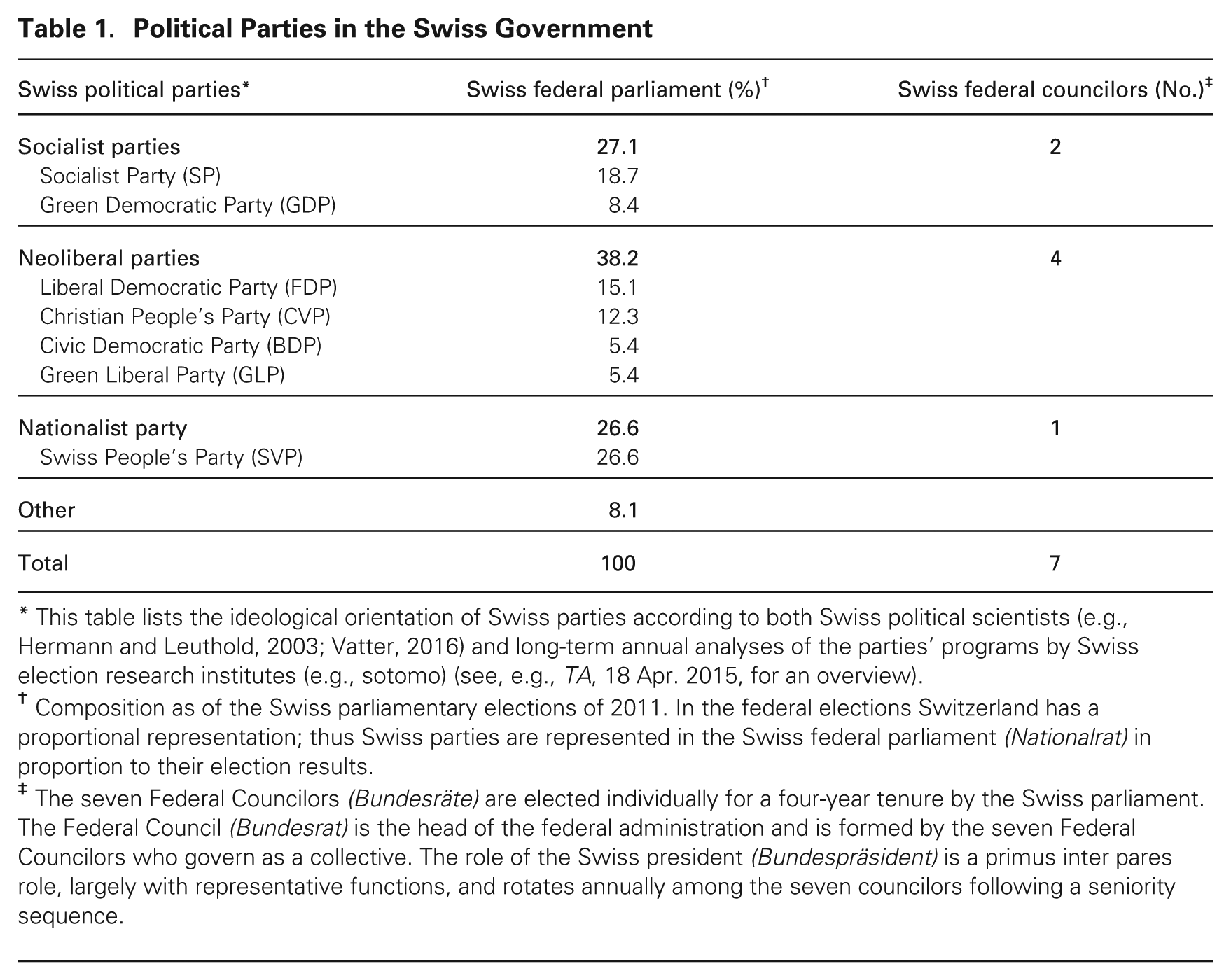
This table lists the ideological orientation of Swiss parties according to both Swiss political scientists (e.g., Hermann and Leuthold, 2003; Vatter, 2016) and long-term annual analyses of the parties’ programs by Swiss election research institutes (e.g., sotomo) (see, e.g., TA, 18 Apr. 2015, for an overview).
Composition as of the Swiss parliamentary elections of 2011. In the federal elections Switzerland has a proportional representation; thus Swiss parties are represented in the Swiss federal parliament (Nationalrat) in proportion to their election results.
The seven Federal Councilors (Bundesräte) are elected individually for a four-year tenure by the Swiss parliament. The Federal Council (Bundesrat) is the head of the federal administration and is formed by the seven Federal Councilors who govern as a collective. The role of the Swiss president (Bundespräsident) is a primus inter pares role, largely with representative functions, and rotates annually among the seven councilors following a seniority sequence.
Of the seven political parties in Switzerland, only the two Socialist parties (SP and GDP) opposed Swiss banking secrecy. Following from their socialist ideology, they strived for national and international justice (Jackson, 2014) and expressed disdain for benefiting at the expense of others. Already in 1984, the Socialist Party (SP) had launched a referendum against banking secrecy. Even though the Swiss people rejected the proposal, the SP continued to advocate that the law be repealed (Swiss National Broadcasting Agency, 18 Dec. 2017). Moreover, from the early 1990s onward, members of the SP suggested that the pressure on banking secrecy from abroad would grow, resulting in negative consequences for Switzerland (e.g., Ziegler, 1992). They thus called for more extensive forms of international collaboration in fighting tax evasion, including the automatic exchange of information between domestic and foreign tax authorities as advocated by the OECD and the large EU countries.
All the other parties strongly supported Swiss banking secrecy. The parties with a business-friendly neoliberal ideology (FDP, GLP, CVP, BDP) (see Centeno and Cohen, 2012) saw Swiss banking secrecy as important for the protection of individual citizens from too much state interference. Moreover, they regarded the institution as highly beneficial for the Swiss financial sector and the Swiss economy. Policy makers from the SVP, with its nationalist ideology (see Vincent, 2014), emphasized the concept of banking secrecy as an important symbol of Switzerland’s sovereignty. The SVP even launched repeated attempts to enshrine banking secrecy in the Swiss constitution.
Even though the banking secrecy institution faced repeated challenges from other foreign authorities (in particular from Germany, France, Italy, and the United Kingdom) or international organizations (such as the OECD) (e.g., OECD, 1998; NZZ, 21 June 2000; NZZ, 22 Sept. 2001; NZZ, 14 April 2002; NZZ, 1 March 2008), the majority of Swiss policy makers strongly rejected their demands. Backed by the Swiss banks, who strongly supported this institution, and for whom the institution implied a competitive advantage over banks from countries lacking such a rule, any demands to abandon banking secrecy were fiercely fended off.
The Swiss Banks (the “Hostages”)
In addition to chocolate and watches, Switzerland is frequently associated with banks. They have a high cultural and economic significance for the country, and many refer to the banking sector as the “state within the state” (e.g., Trepp, 1999). In 2009, the banking sector had close to 300 bank companies with 135,900 employees and contributed about 7 percent to Switzerland’s gross domestic product (GDP).
In our study, three types of Swiss banks are of interest. First, the two large, multinational banking corporations UBS and Credit Suisse offer all types of banking services. Both banks are represented in over 50 countries with branch offices and subsidiaries. Both are among the largest banks in the world: the total commitment of each exceeded 150 percent of Switzerland’s GDP (FW, 4 Sept. 2015). 5 Second, the cantonal banks are mostly active in all business areas, and most of them are publicly owned and have a state guarantee. Third, the private banks are organized as individual companies, collective and limited partnerships. Compared with the two other groups, they have a minor impact on the Swiss economy.
Swiss banks, which manage around USD 2.200 billion in cross-border private banking assets, are global leaders in cross-border private wealth management. Together, in 2009, they held a global market share of 26 percent according to the Swiss Bankers Association. All three types of banks offer this service: UBS was the leading global provider, and the private banks tend to specialize in this domain. Responding to bank clients’ concerns for privacy and protecting their assets against information disclosure, banking secrecy was particularly important for private wealth management. To ensure that banking secrecy would protect all client data from interventions by foreign authorities, all Swiss banks stored the data on servers in Switzerland.
The U.S. Qualified Intermediary Program (QIP) and the U.S. Authorities (the “Hostage Takers”)
The QIP
Devised by the U.S. Internal Revenue Service (IRS), the QIP was introduced in the U.S. in 2000 to increase tax compliance. It involved a contract that the United States entered into directly with foreign banks (GPK, 3241–3243). Foreign banks that obtained a “qualified intermediary” (QI) status became the “long arm of U.S. law enforcement authorities” (GPK, 3242). They became responsible for, first, sharing information with the IRS about U.S. citizens with beneficial interests in U.S. securities and, second, ensuring the appropriate withholding of tax on U.S. securities held by non-U.S. citizens. A majority of banks throughout the world chose to become a QI, including virtually every Swiss bank (Emmenegger, 2015). The Swiss government did not regard the QI agreement as a violation of banking secrecy. First, Swiss banks were allowed to keep the names of non-U.S. persons with U.S. securities confidential and transfer the withholding tax as an aggregate amount, and second, it “left U.S. clients of Swiss banks the choice between giving up banking secrecy and forgoing the right to invest in U.S. securities” (Emmenegger, 2015: 11).
The QIP is a specific type of transnational governance institution, namely, extraterritorial law, which has largely been neglected by institutional scholars despite its increasing importance in transnational issues such as fighting corruption, organized crime, product piracy, or terrorism (see, e.g., Colangelo, 2011; Kaczmarek and Newman, 2011; Gardner, 2015). Extraterritorial law is about the application and enforcement of national laws against individual or corporate actors located outside the nation’s territory. In such cases, judicial assertions actively project national legal norms into the transnational realm, thus making the law a transnational institution (see Putnam, 2009: 468). Extraterritorial law differs greatly from other, more thoroughly investigated types of transnational governance mechanisms.
First, as extraterritorial law, the QIP is based on “hard law” (Abbott and Snidal, 2000). Hard law, as distinguished from “soft law,” is characterized by three properties: (a) it is precise in specifying “clearly and unambiguously what is expected” of the targeted actors (Abbott et al., 2000: 413), (b) it consists of rules that are binding in nature and place an obligation on targeted actors, and (c) it is reinforced by a designated enforcement apparatus that involves courts and other administrative organizations (Abbott et al., 2000). Hence extraterritorial law enforcement emphasizes the role of legal sanctions, conceived here as a specific type of resource-based sanctioning (DiMaggio and Powell, 1983; Short and Toffel, 2010). In cases of business regulation, legal sanctions of increasing intensity involve public naming and shaming, civil penalties, criminal penalties, or the revocation of licenses, which effectively represents “corporate capital punishment” (Ayres and Braithwaite, 1992: 50; Parker and Braithwaite, 2005). Despite their increasing prevalence (Scott, Levitt, and Orr, 2011), however, legal sanctions have not been studied in depth in the context of international coercion and transnational governance (Dobbin, Simmons, and Geoffrey, 2007; Djelic and Quack, 2008).
Second, while other transnational institutions, such as those advocated by transnational organizations (e.g., United Nations, International Labor Organization) or the hard-law institutions advocated by the European Union, have “no particular or clear national origin,” extraterritorial laws are hard-law rules from a particular national space (Djelic and Quack, 2008: 308). Extraterritorial jurisdiction has gained in importance in several countries, with the United States as the most important actor (Putnam, 2009: 468; Kaczmarek and Newman, 2011).
The U.S. authorities
Before 2008, the U.S. law enforcement authorities had not acted as challengers of Swiss banking secrecy. In summer 2008, this situation changed following the onset of the financial crisis in which the United States economy incurred a dramatic decline. In previous years, the OECD and countries like Germany and France had already campaigned against tax evasion, emphasizing that it drastically undermined the countries’ national tax base. Following the financial crisis, this issue also entered the political agenda of the United States. Hence, the two primary U.S. law enforcement authorities mandated to ensure that U.S. citizens comply with U.S. tax laws—the IRS and the DOJ—were tasked by the U.S. government, including the G. W. Bush (2000–2009) and Obama (2009–2016) administrations as well as several U.S. senators, to prosecute U.S. tax cheats. U.S. authorities aimed to collect needed funds and wanted to demonstrate that they do not tolerate tax cheats with foreign accounts—who are typically very affluent—while ordinary citizens are suffering. Hence, while the U.S. had followed a principle of non-interference into foreign tax jurisdictions prior to the financial crisis, now U.S. authorities were encouraged to act unilaterally and to extraterritorially enforce U.S. law (Seabrooke and Wigan, 2016).
U.S. authorities such as the DOJ did not have direct coercive power over the Swiss government. As we will show in detail, however, the alleged transgressions of the QIP by Swiss banks—to which the DOJ was alerted by a whistleblower—enabled U.S. authorities, and the DOJ in particular, to increase their coercive power over the Swiss government because the DOJ could threaten to indict, i.e., to formally accuse and sanction Swiss banks and bankers. De facto, as we will show, an indictment of a Swiss bank jeopardizes the bank’s existence. Independently of whether the bank would later be found guilty in court or not, the mere announcement of the indictment caused clients and other banks to terminate business with the bank, thus leading to its rapid collapse. Threatening to indict Swiss banks, accordingly, enabled the DOJ to indirectly compel the Swiss government to erode Swiss banking secrecy.
Methods
Data
Our data were collected to cover the period from 2007 to 2015, starting when a whistleblower, a former employee of the Swiss bank UBS, alerted U.S. authorities to the potential transgressions of U.S. law by Swiss banks, thereby leading to the so-called “tax dispute” between U.S. authorities and Swiss authorities and banks.
We collected data from three types of sources, as shown in table 2—media data, documentary data, and interviews—thus creating a data set as rich and reliable as possible. We collected media data by creating a large database of media reports by sampling articles from major Swiss and international newspapers. These were complemented with television data sourced from the Swiss National Broadcasting Agency (SRF). We collected a wealth of documentary data from the U.S. authorities, Swiss authorities and political parties, banks and banking associations, and other important sources. This included reports, documents, transcripts, and press releases from U.S. and Swiss governmental agencies and politicians. Further, we sourced books written by experts and insiders and collected scholarly literature on the case published in various fields.
Data Sources
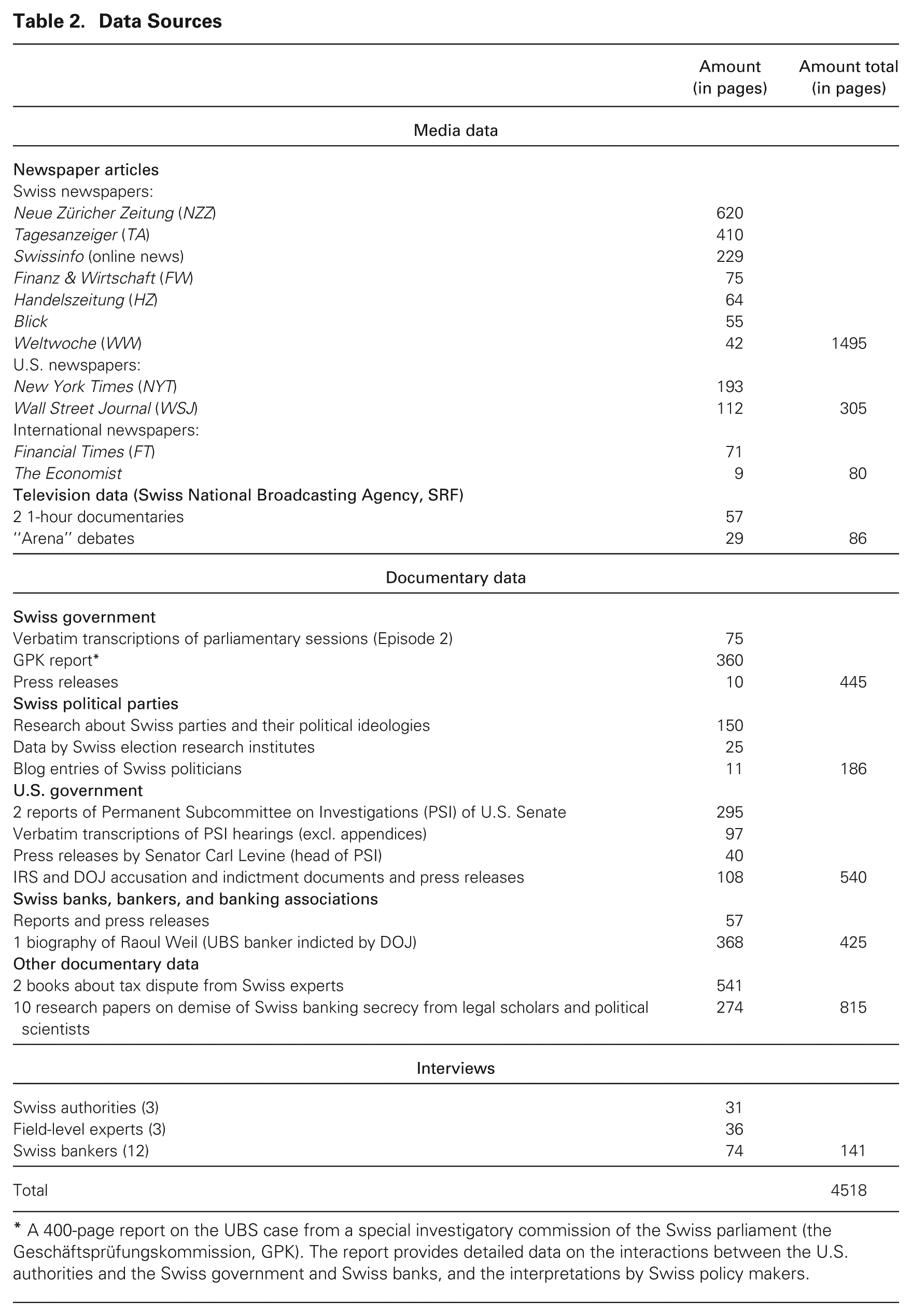
A 400-page report on the UBS case from a special investigatory commission of the Swiss parliament (the Geschäftsprüfungskommission, GPK). The report provides detailed data on the interactions between the U.S. authorities and the Swiss government and Swiss banks, and the interpretations by Swiss policy makers.
We complemented our documentary data with 18 retrospective and semi-structured interviews with informants who were purposefully sampled for their unique insights into the development of this institutional conflict. We interviewed representatives from Swiss banks, industry experts, and key participants in the interstate negotiation processes.
Data Analysis
Our purpose was to develop theory inductively (Gioia, Corley, and Hamilton, 2013). Our analysis was guided by an interpretive methodology (Strauss and Corbin, 1998) to capture the subjective meanings that are at the core of the constructivist perspective (Adler, 1997). We aimed to reconstruct the Swiss targets’ interpretations, thus focusing on their patterns of argumentation (Finnemore and Sikkink, 2001; Meyer and Hoellerer, 2010) and how and why these interpretations were triggered. Although we repeatedly went back and forth among data, emergent theoretical ideas, and prior literature, for the sake of clarity, we describe our analysis as a sequence of three separable steps.
As a first step we developed a narrative account, which enabled us to synthesize the raw data (Miles and Huberman, 1994). We effectively started the analysis with visual maps of key events (Langley, 1999). With the event timeline in hand, and drawing on our various data sources, we developed an increasingly rich and comprehensive description of the overall case. We systematically extended this narrative by extracting direct and indirect statements of the key players in the overall process from our various data sources to disclose symbolic actions and interpretations (see Meyer and Hoellerer, 2010).
Second, we bracketed our stream of longitudinal data into separate time periods (e.g., Skocpol and Somers, 1980; Haydu, 1998). In this process, we found that the U.S. authorities had actually overcome the Swiss institutional barriers to the enforcement of the QI agreement twice (in 2009 and 2012). In each case Swiss authorities had been compelled to comply with the demands of the U.S. authorities, who thus influenced the erosion of the Swiss banking secrecy institution. Hence, although we have a single case, the case consists of a sequence of two embedded sub-cases, henceforth referred to as “Episode 1” and “Episode 2” (see Ozcan and Gurses, 2018, for a similar approach). Following this, a second, more fine-grained bracketing began as we came to realize that in the first phase of the two episodes (referred to as “Episode 1—Phase a” and “Episode 2—Phase a”), Swiss authorities had resisted the demands of the U.S. authorities, while in the second phase of each episode (referred to as “Episode 1—Phase b” and “Episode 2—Phase b”) they complied.
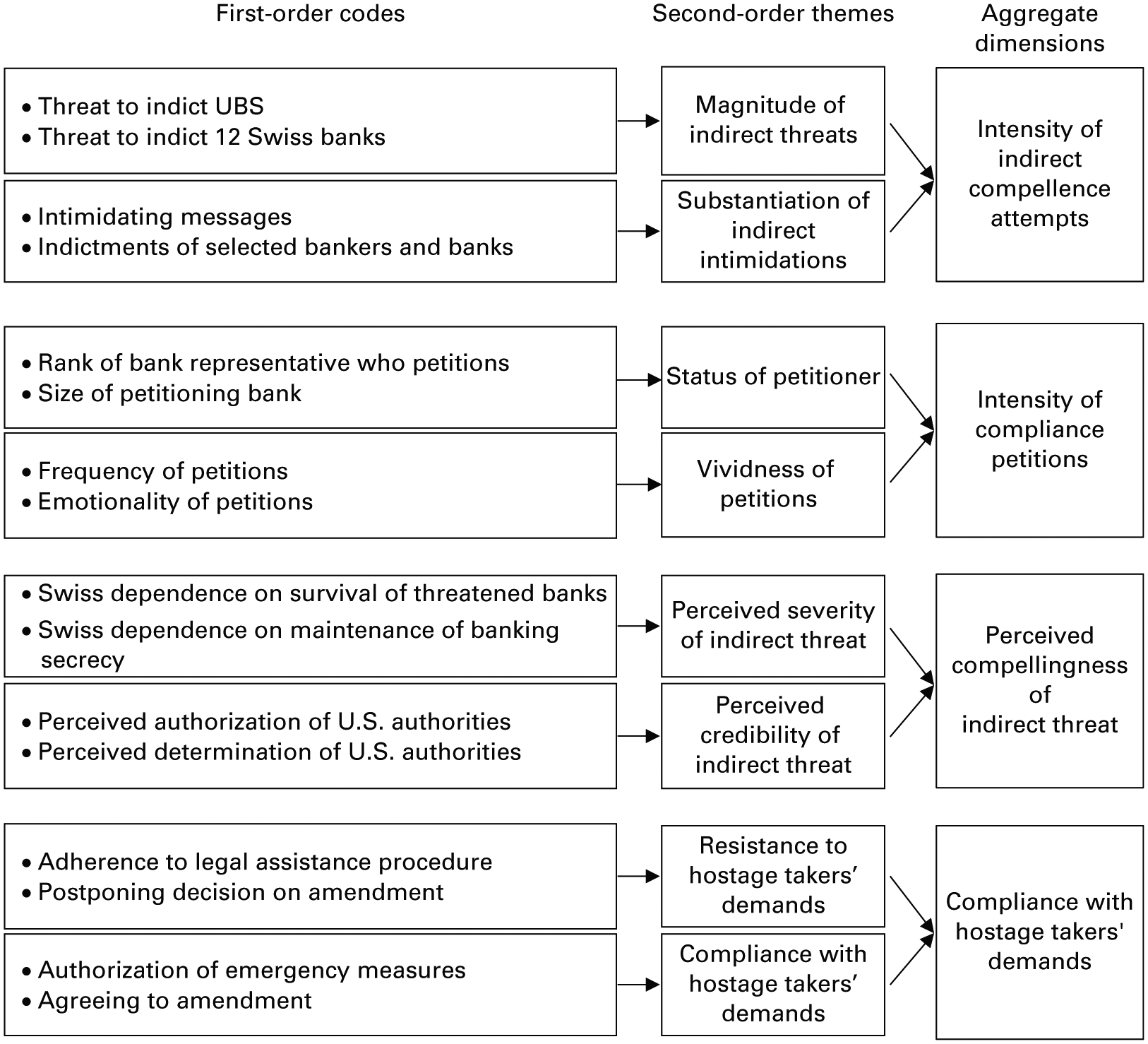
Data structure.
Subsequently we compared and contrasted the two episodes and the four phases to uncover the factors leading to resistance (in phases a) and compliance (in phases b) (Ozcan and Gurses, 2018). To this end, we systematically coded our data to develop a data structure that contained codes and themes that were increasingly aggregated, abstracted, and theoretically informed (Gioia, Corley, and Hamilton, 2013), as shown in figure 1. We started by developing first-order codes as close as possible to the empirical dynamics under investigation to make sense of events. Subsequently, we sought to produce codes that integrated these first-order codes into a smaller number of more abstract second-order themes and then to integrate them even further into a few aggregate dimensions. We developed our theoretical model on the basis of these concepts. We provide exemplary evidence for our codes in table 3 and additional evidence in the Online Appendix (http://journals.sagepub.com/doi/suppl/10.1177/0001839219855033).
Exemplary Evidence for Codes
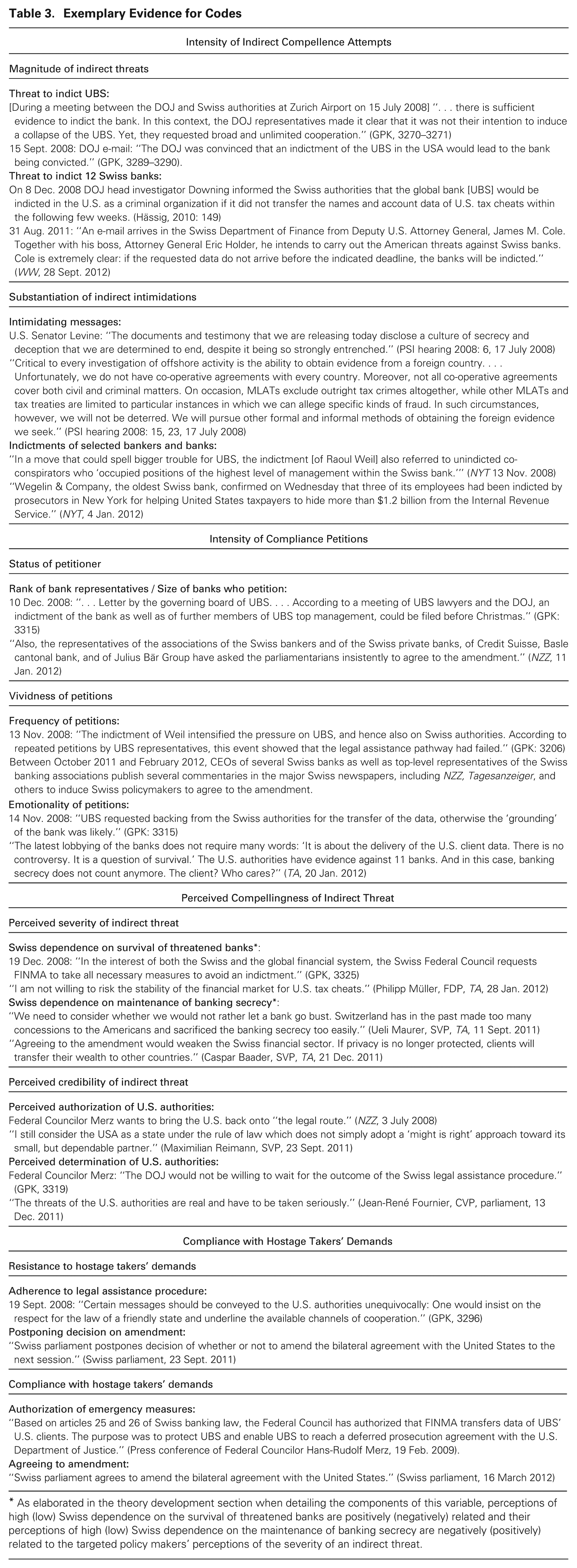
As elaborated in the theory development section when detailing the components of this variable, perceptions of high (low) Swiss dependence on the survival of threatened banks are positively (negatively) related and their perceptions of high (low) Swiss dependence on the maintenance of banking secrecy are negatively (positively) related to the targeted policy makers’ perceptions of the severity of an indirect threat.
The Case Study
Below, we present compressed narratives of the two episodes of indirect compellence and institutional change that we identified. As explained above, we have split each episode into two phases (a and b) to contrast the phases of the target’s resistance with the phases of the target’s compliance. The case narratives are structured according to our first-order codes.
Episode 1: Threatening Legal Sanctions against UBS and Effecting a Breach of Swiss Banking Secrecy (2007–2009)
Based on the revelations of Bradley Birkenfeld, a former UBS employee and whistleblower, and beginning in 2007, the DOJ, led by prosecutor Kevin M. Downing, initiated an investigation into UBS’s alleged transgressions of the QIP. The QI contained a major loophole: if U.S. clients appeared as foreign legal entities, they were not subject to information reporting, thus allowing Swiss banks to continue servicing U.S. clients with an interest in U.S. securities while respecting both the QIP and the confidentiality requirements of Swiss banking secrecy (Emmenegger, 2015: 12). UBS had allegedly supported its U.S. clients in setting up such foreign legal entities, including foreign shell companies and charitable trusts. The investigation became public in March 2008. While Swiss banks had repeatedly alerted U.S. authorities in the previous years about this loophole (e.g., NZZ, 20 Nov. 2008), in 2008, the DOJ argued that the purpose of foreign legal entities was tax evasion in the UBS case and that they were thus illegal. UBS was accused of conspiring to defraud the U.S. (DOJ, 18 Feb. 2009; PSI, 25 July 2008), and the DOJ requested that UBS immediately transfer the names of U.S. clients who had UBS accounts so that these could be prosecuted and fined.
The Swiss authorities quickly intervened. They denied the transfer of such information because the bank client data were protected by the Swiss banking secrecy act. As they emphasized, the only way forward for the U.S. authorities was to request administrative assistance. In this procedure Swiss authorities would analyze the accounts of the U.S. clients of UBS to check for evidence of tax fraud (as distinguished from tax evasion), in which case data could be transferred. In August 2008, the DOJ agreed, filing the petition, and consequently UBS handed the data over to the Swiss authorities for their inspection. The Swiss administrative assistance pathway, however, was a lengthy process. According to the double litigation principle, it involved an evaluation of every single U.S. client of UBS by the Swiss Department of Justice to assess whether the client had committed tax fraud and not only tax evasion. According to Rolf Wyss, Deputy Director of the Swiss Federal Office of Justice, Swiss authorities tried hard to accelerate the legal assistance process (SRF documentary, 2014). Still, having received some three petitions for legal assistance on tax matters in the previous years, they were completely overwhelmed, lacking the resources to process several hundred petitions at once (SRF documentary, 2014). Moreover, the respective clients were informed that their data could soon be transferred to the U.S. authorities, and several responded by filing lawsuits against this decision, causing further delays. Hence, as late as December 2008, five months after the U.S. authorities had filed their petition, not a single data file had yet been transferred by the Swiss authorities.
Episode 1 (Phase a): Targets’ resistance to hostage takers’ institutional demands
Already in August 2008 DOJ representatives had emphasized that they considered the legal assistance procedure to be inadequate, because they wanted the data as quickly as possible. They repeatedly communicated to the Swiss government the threat to indict UBS if the Swiss government would not transfer the requested data (GPK, 3270–3271). In October 2008, as no data files had been transferred, they reiterated their threat to the Swiss authorities after a meeting in which UBS had been expected to present internal findings to U.S. authorities. The DOJ then stated that indicting UBS and potentially jeopardizing its existence would not be its intention; rather, its priority would be to receive the data swiftly so that the U.S. tax evaders could be punished (GPK, 3296). DOJ representatives and other U.S. authorities also mobilized a variety of intimidating messages to back their threats. Such intimidations included hearings organized by the Permanent Subcommittee on Investigations (PSI) of the U.S. Senate that were broadcast at prime time on Swiss television. PSI officials, alongside U.S. Senators Carl Levine (Democrat) and Norm Coleman (Republican), emphasized their determination to “crack” the banking secrecy if necessary to obtain the data (PSI, 25 July 2008).
In this phase, following the pressure developed by the hostage takers, representatives of the UBS legal department approached the Swiss authorities regularly, asking them to handle the legal assistance process swiftly (e.g., GPK, 3299). The bank’s top management was not involved, and the view of UBS was that everything was still under control (e.g., Urs Zulauf, vice director, Swiss Financial Market Supervisory Authority, interview).
With regard to the Swiss government, the issue concerned Hans-Rudolf Merz, head of the Swiss Federal Department of Finance (FDF) and representative of the neoliberal Liberal Democratic Party (FDP) in the Swiss Federal Council. He did not regard the threat posed by the U.S. authorities as compelling enough to justify a deviation from the institutional status quo. On one hand, he regarded the threat as severe: experts from the FDF and from the Swiss Financial Market Supervisory Authority (FINMA) had informed him that an indictment by the DOJ would jeopardize UBS’s existence and that the bankruptcy of a bank like UBS would have disastrous consequences (SRF documentary, 2014), as it was a systematically important bank on which Switzerland was dependent (GPK, 3267; Urs Zulauf, interview). On the other hand, Merz did not regard the threat by the U.S. authorities to indict UBS as sufficiently credible. He questioned the U.S. authorities’ legal authorization since, according to him, any attempts to transfer client data had to occur within the boundaries of the legal assistance framework to which both countries had agreed and that served to protect banking secrecy (e.g., TA, 13 Sept. 2008). Hence, he thought that the DOJ would not have sufficient political backing from the U.S. government to enforce the transfer of data outside the legal assistance framework. If the DOJ tried to escalate pressure, he was confident that his strategy to intervene politically by directly addressing the U.S. Secretary of the Treasury and the Attorney General would have the effect of the DOJ being “whistled back” (GPK, 3298).
Overall, and based on his low-compellingness judgment, Merz saw absolutely no necessity to depart from the legal assistance procedure and to breach banking secrecy (Weil, 2015: 67). Therefore he merely authorized additional human resources to speed up the legal assistance process but considered a data transfer based on an emergency decree, as proposed by FINMA, to be absolutely “out of [the] question” (GPK, 3308).
Episode 1 (Phase b): Hostage takers’ intensification of indirect compellence pressure and targets’ compliance with hostage takers’ institutional demands
By the end of November 2008 no data file had been transferred, so the U.S. authorities started to intensify their coercive pressure. First, they repeated their threat to indict UBS should the data not be delivered (Hässig, 2010: 14), and in December 2008 they gave the Swiss targets an ultimatum for delivery by the end of the year (NYT, 27 Jan. 2008). Second, they substantiated their threats by indicting Raoul Weil, head of the UBS private banking division and member of the bank’s top management team, who was arrested while on a trip in Italy and extradited to the U.S. Moreover, in the publicized indictment letter, a number of “unnamed co-conspirators” were mentioned who would be the next to be indicted, and purportedly these would be CEO Marcel Rohner and Peter Kurer, chairman of the bank’s supervisory board (NYT, 13 Nov. 2008).
After the DOJ’s escalation, members of UBS—the third parties—drastically increased the intensity of their petitions directed at Federal Councilor Merz and other top-level representatives of the Swiss Federal Department of Finance to comply with the DOJ demands so that an indictment of UBS would be averted and the bank would be released from its “miserable” position. The highest-ranking representatives of UBS, including the chairman of the board, the CEO, and the general council, frequently contacted the Federal Councilor, and other top-level FDF personnel used drastic arguments to highlight the consequences if the Swiss government would not agree to transfer the data immediately and outside the protracted legal assistance procedure. An indictment of more top managers or the bank itself would jeopardize the bank’s viability (GPK, 3332). They further pointed out that, beyond the effect on the banking sector, a “grounding” of UBS would have dramatic consequences for Switzerland (e.g., GPK 3314–3315). They also emphasized that the DOJ had already taken an uncompromising stance: if the data were not transferred immediately, an indictment of the bank was imminent.
Given the U.S. escalation and heavy pressure from UBS representatives, in late November 2008 Federal Councilor Merz, together with Federal Councilor Evelin Widmer-Schlumpf (head of the Federal Department of Justice and Police), wrote a letter to their U.S. counterparts articulating their concern about the U.S. authorities’ attempts to coercively receive data outside the legal assistance process to which both countries had agreed (GPK, 3305). The letter was not answered (Hässig, 2010: 144), and in subsequent phone calls the U.S. secretaries reinforced the DOJ’s request to receive the data by the end of the year (GPK, 3318). This led Merz to reconsider the situation and change his compellingness assessment of the threat. He continued, as before the escalation, to assess the threat level as severe. He explicitly considered that an indictment by the DOJ would jeopardize the bank’s existence and that the consequences of the bank’s failure would be dramatic for the Swiss economy and financial system, leading to projected long-term costs of up to 300 billion Swiss francs (USD 300 billion) (Federal Council, 19 Feb. 2009). But the escalation now led Merz to consider the threat as credible, too. Merz recognized that the U.S. authorities would not respect the bilateral agreements and Swiss sovereignty and that they would rather draw their legal authorization from the unilateral application of U.S. law (SRF documentary, 2014). Moreover, like UBS’s top managers, Merz now came to assess the U.S. authorities as highly determined, not least because the DOJ was highly impatient and relentless (TA, 20 Feb. 2009). Merz informed his six fellow Federal Councilors about his request to transfer the data by means of an emergency decree. Ueli Maurer, the representative of the nationalist SVP, categorically objected to any attempts to undermine Swiss banking secrecy law, but the other five Federal Councilors (two socialist and three neoliberal politicians) supported the request (GPK, 3317).
Thus in early December 2008, Merz complied with the DOJ’s demands to suspend central tenets of banking secrecy and agreed to authorize the transfer of the requested client data by means of an emergency decree to avert UBS’s likely indictment and the grave consequences. From early 2009 onward, 4,400 client dossiers were delivered to U.S. authorities so they could identify and penalize U.S. tax evaders. In turn, the DOJ offered UBS a deferred prosecution agreement (DOJ, 18 Feb. 2009). In a subsequent press conference, Merz announced that the pressure of the U.S. authorities had led to this “unique case” but that banking secrecy would be maintained (Federal Council, 19 Feb. 2009). Behind the scenes, however, it was clear that this measure constituted a “grave infringement” of Swiss banking secrecy (Federal Councilor Pascal Couchepin, FDP); “it showed that the banking secrecy is not immortal, it can be cracked if there is enough pressure” (Daniel Zuberbühler, head of Swiss legal authority, SRF documentary, 2014). In the eyes of Swiss authorities and commentators, the bank had been taken “hostage” by the DOJ in order to compromise Swiss banking secrecy and receive the requested data (Landmann and Zeyer, 2013: 1; NZZ, 4 Feb. 2012; TA, 21 July 2011).
Episode 2: Threatening Legal Sanctions against 12 More Swiss Banks and Effecting the Erosion of Swiss Banking Secrecy (2009–2015)
In April 2011, based on revelations made in a voluntary disclosure program, DOJ representatives announced that they were targeting other Swiss banks for transgressions similar to those of UBS. Among the 12 targeted banks were Credit Suisse, which was almost as large as UBS, and Bank Wegelin, the oldest Swiss bank, as well as Swiss cantonal banks with a state guarantee and several other prominent banks. Via the media, DOJ representatives repeatedly announced that they expected to gain access to data on U.S. tax evaders with Swiss bank accounts, as they had done in the UBS case. Their eventual target would be to reach a “global solution” with the purpose of disclosing as many cases as possible of U.S. citizens who held untaxed Swiss accounts. Just as UBS had, the banks announced their willingness to cooperate fully with the DOJ and to transfer the requested client data if the Swiss government gave the necessary permissions.
As Federal Councilor Merz had retired in 2010, the issue was taken over by his successor as head of the Federal Department of Finance, Federal Councilor Widmer-Schlumpf. Like Merz, Widmer-Schlumpf was a representative of a neoliberal, business-friendly party (BDP), and like Merz she had witnessed firsthand the U.S. authorities’ determination to do whatever was required to access data on U.S. tax evaders. Her position was that another breach of the Swiss law through emergency measures, as in the UBS case, must not happen. Thus in August 2011 she proposed to the DOJ that Switzerland could extend the administrative assistance procedure in place between Switzerland and the U.S. at the time, but with an amendment. This would allow the DOJ to file “group enquiries” whereby Switzerland would accept U.S. requests for administrative assistance if they included a detailed and credible description of active, culpable conduct by a given bank or its employees. The existing agreement made provision for administrative assistance only in single cases, that is, if the foreign country delivered evidence of individual tax fraud. The aim was to provide the DOJ sufficient legal and administrative support for gaining the requisite data more quickly and easily. Obviously, this would weaken and erode Swiss banking secrecy. Although the DOJ noted that it would potentially accept a “global solution” based on the path of administrative assistance, a main hurdle was that this amendment had to be approved by the Swiss parliament in a legislative procedure during its autumn session in September 2011.
Episode 2 (Phase a): Targets’ resistance to hostage takers’ institutional demands
The U.S. authorities more or less immediately approached the Swiss government with an ultimatum. In a highly publicized letter to the Swiss Federal Department of Finance in August 2011, the U.S. Attorney General and the Deputy Attorney General jointly emphasized that if the requested data were not transferred by the end of the year, banks would be indicted (e.g., NYT, 5 Sept. 2011).
Following the ultimatum, petitions from the threatened banks directed at the Swiss government were still moderate. Representatives of the banks approached Swiss parliamentarians regularly to ensure that they would agree to the amendment so that indictments would be avoided (Urs Schwaller, CVP, Swiss parliament, 23 Sept. 2011). Pointing to the compellingness of the ultimatum, they highlighted the severity and credibility of the DOJ’s threat. They emphasized that delays or a rejection of the amendment would lead to an escalation of the interstate conflict and that this would carry serious risks (NZZ, 21 Sept. 2011).
Swiss parliamentarians disagreed about whether the threat from U.S. authorities was both severe and credible. Representatives of the two socialist parties, SP and GDP, regarded the threat as very compelling and judged the consequences if the DOJ were to follow through with the threat as very severe. They regarded Switzerland as more dependent on the survival of the threatened banks than on banking secrecy, which they regarded as leading to injustices and which they wished to give up in any case (Fetz, SP, Swiss parliament, 23 Sept. 2011). They also regarded the threat as highly credible: since the Swiss banks had behaved irresponsibly and transgressed U.S. law, U.S. authorities would have the legal authorization to indict the banks (Berberat, SP, Swiss parliament, 23 Sept. 2011). They saw the U.S. authorities as highly determined and believed that resisting their demands would lead to an escalation of the conflict.
In contrast, the neoliberal parties (BDP, CVP, FDP, GLP) assessed the threat as not compelling enough to warrant action. Similar to the socialists, they regarded the threat as very severe, acknowledging that the U.S. authorities “have in their assortment torture tools, from the thumbscrew to the deadly garrote” and that one would need to make sure they did not apply them (Frick, CVP, Swiss parliament, 23 Sept. 2011). One would also need to “recognize the imminent danger for the Swiss economy” if the U.S. were to follow through and indict banks that were systematically important for Switzerland (Marty, FDP, 23 Sept. 2011). Yet they interpreted the threat not as overly credible, believing that U.S. authorities would respect the bilateral agreements in place between the countries. Hence they believed that if the Swiss parliament postponed its decision, the U.S. authorities would recognize and accept that the parliament in a proper democratic rule-of-law state like Switzerland or the U.S. itself requires sufficient time for deliberation to gain a proper understanding of what this amendment was about (Brinner, FDP, 23 Sept. 2011).
The nationalists also judged the threat as not sufficiently compelling, albeit for different reasons. Unlike the socialists and neoliberals, SVP politicians did not consider the threat as sufficiently severe. As Ueli Maurer, Federal Councilor and a leading SVP politician, remarked, the party would be willing to let a bank go “bust” rather than sacrifice Swiss laws and the legal stability of the Swiss financial market. Banking secrecy was an elementary aspect of Switzerland’s national identity that the SVP would strive to defend by all means (Sonntag, 14 Sept. 2011). They also regarded the threat as not sufficiently credible; they did not think that U.S. authorities would put their power before Swiss law and sovereignty (e.g., Reimann, SVP, 23 Sept. 2011).
Thus only the socialist policy makers voted in favor of the amendment, meaning the majority of parliamentarians voted to delay the decision about the amendment until the parliamentary session of March 2012. Thus the Swiss government’s compliance with the hostage takers’ demands in this phase was low.
Episode 2 (Phase b): Hostage takers’ intensification of indirect compellence pressure and targets’ compliance with hostage takers’ institutional demands
After the Swiss parliament postponed making this decision, the DOJ drastically escalated its coercive pressure. To reinforce the ultimatum already in place, it engaged in a series of intimidating measures. In November 2011, the DOJ indicted several Swiss bankers, including seven Credit Suisse bankers—one of them a senior manager of the private banking division—one Julius Bär client advisor, and three Wegelin bankers (Blick, 13 Oct. 2011; NYT, 4 Jan. 2012). In January 2012, the DOJ threatened and subsequently indicted Bank Wegelin (FT, 6 Mar. 2012). Within less than two weeks the bank was forced to close down. Wegelin was accused of “conspiring with U.S. taxpayers and others to hide more than 1.2 billion USD in secret accounts and the income these accounts generated” (DOJ, 2 Feb. 2012). Founded in 1741, Wegelin was Switzerland’s oldest bank and one of its most traditional and prestigious private banks, and Konrad Hummler, its anti-U.S. and pro-banking-secrecy CEO, was the chair of the Swiss private banking association. The bank was relatively small, so its failure would be relatively inconsequential for the global financial system. One of the U.S. authorities, quoted anonymously early in January 2012 in the Neue Zürcher Zeitung (NZZ), Switzerland’s largest newspaper, underscored that as the Swiss parliamentarians’ deliberations concerning the amendment would soon begin again, the DOJ intended these indictments to function as a signal to Bern (the Swiss capital and seat of parliament). The DOJ would have little patience and would be suspicious of actions that could be classified as further delays. DOJ officials were convinced that only the application of massive pressure on Switzerland would lead to the desired results and thus to the swift transfer of the data on U.S. tax evaders (NZZ, 4 Jan. 2012).
The indictment of Wegelin sent a “shockwave” through the Swiss banking sector, as this was the first time ever that U.S. authorities had indicted a foreign bank (Swissinfo, 2012). In the following weeks, top managers of the affected banks published several commentaries in the major Swiss newspapers, and when they approached Swiss parliamentarians on a daily basis the bankers dramatized the consequences of indictments, emphasizing that compliance with U.S. demands was a question of life and death for the banks and the Swiss economy as well (TA, 20 Jan. 2012). The Wegelin indictment was a “warning shot” (SRF, 3 Feb. 2012).
The U.S. escalation as well as intense influencing activities by the banks led many Swiss parliamentarians to change their interpretations and responses. The majority now regarded the threat as not only severe but also highly credible and thus decided to comply with the coercers’ demands. As before, the socialist parties saw the threat to indict the banks as compelling and thus overwhelmingly voted for the amendment. Hence their compellingness judgments were reinforced and not qualitatively changed by the escalation.
The judgments of the neoliberal party members, who had previously voted against the amendment, were clearly affected by the escalation. While they had already regarded the threat as highly severe, they now emphasized the consequences of the threat for the banks and for Switzerland in a more pronounced way, highlighting that a DOJ indictment constituted a threat to a bank’s very existence (Müller, FDP, FW, 10 Feb. 2012), which, given the size of the threatened banks, held negative consequences for the entire Swiss economy (Hassler, CVP, Swiss parliament, 29 Feb. 2012). Most importantly, the escalation led them to reconsider the credibility of the threat. As the indictment of Wegelin had shown, the DOJ would be willing and able to breach the bilateral agreements and unilaterally apply U.S. law, and it would also be unscrupulous and ready to escalate further (NZZ, 4 Feb. 2012). Hence the neoliberal party members came to consider it as their duty to step in and release the banks from their “miserable” position.
Only members of the nationalist party, SVP, once again opted against the amendment because they did not regard the threat as compelling. The escalation had an effect in that some nationalists now regarded the threat as credible, emphasizing and decrying the unilateral legal approach of the DOJ (Stamm, SVP, Swiss parliament, 5 Mar. 2012), which suggests they now regarded the DOJ as able and willing to follow through with its threats. Others, however, still questioned the DOJ’s determination, doubting that U.S. authorities would dare to indict a large Swiss bank (Germann, SVP, TA, 6 Feb. 2012). And party members still regarded the threat as not sufficiently severe to warrant the amendment. Once again, they argued that sacrificing banking secrecy would be worse than sacrificing threatened banks and that it would create more instability for the Swiss financial sector than agreeing to the amendment (NZZ, 6 Feb. 2012). According to its policy document, the “SVP rejects the amendment of the bilateral agreement with the US, as it weakens Switzerland’s banking center and endangers jobs” (Reimann, SVP, 11 Mar. 2012, blog). They subsequently launched another initiative to include the institution in the Swiss constitution (Swiss parliament, 21 Nov. 2012).
Overall, and contrary to the first phase of this episode, the majority in the Swiss parliament considered the threat sufficiently compelling to warrant action and opted in March 2012 to comply with the DOJ demands to pass the amendment. According to many, this decision marked the end of Swiss banking secrecy (e.g., WSJ, 6 Mar. 2012). Subsequently, the DOJ developed a “global solution” program for the data transfer. As a DOJ official announced in September 2012, “this enforcement effort has dealt fabled Swiss bank secrecy a devastating blow and provided tools that should yield information on thousands of additional U.S. offshore account holders who have undisclosed accounts at UBS and other banks.” On the Swiss side, the drastic law enforcement actions of the U.S. authorities contributed to the announcement of a “white money strategy” as a new, radically different policy aimed at generally keeping untaxed money away from the Swiss financial sector.
Toward a Constructivist Theory of Indirect Compellence and Institutional Change
As both episodes of our case study testify, what we came to refer to as “indirect compellence” was a critical influence that prompted Swiss policy makers and state leaders to change Swiss banking secrecy rules and comply with the demands of the U.S. authorities. Indirect compellence is a novel type of indirect coercion based on the hostage taker’s (here, the U.S. authorities’) threat to sanction a hostage (the Swiss bankers and banks) unless the actual target (Swiss authorities) complies with the hostage taker’s demands. More generally, it is a distinct triadic dynamic in which the third party (the hostage) may become a tertius miserabilis—a third who suffers rather than benefits from the conflict between the two other actors in the triad (Scharmann, 1959).
Here, we develop a constructivist framework to explain under which conditions indirect compellence leads to institutional change (or not). Table 4 shows the aggregate dimensions of the data structure we derived inductively and how these are represented in the two episodes and four phases of our case. These dimensions constitute the key variables for our constructivist theory.
Representation of Derived Concepts in Episodes and Phases
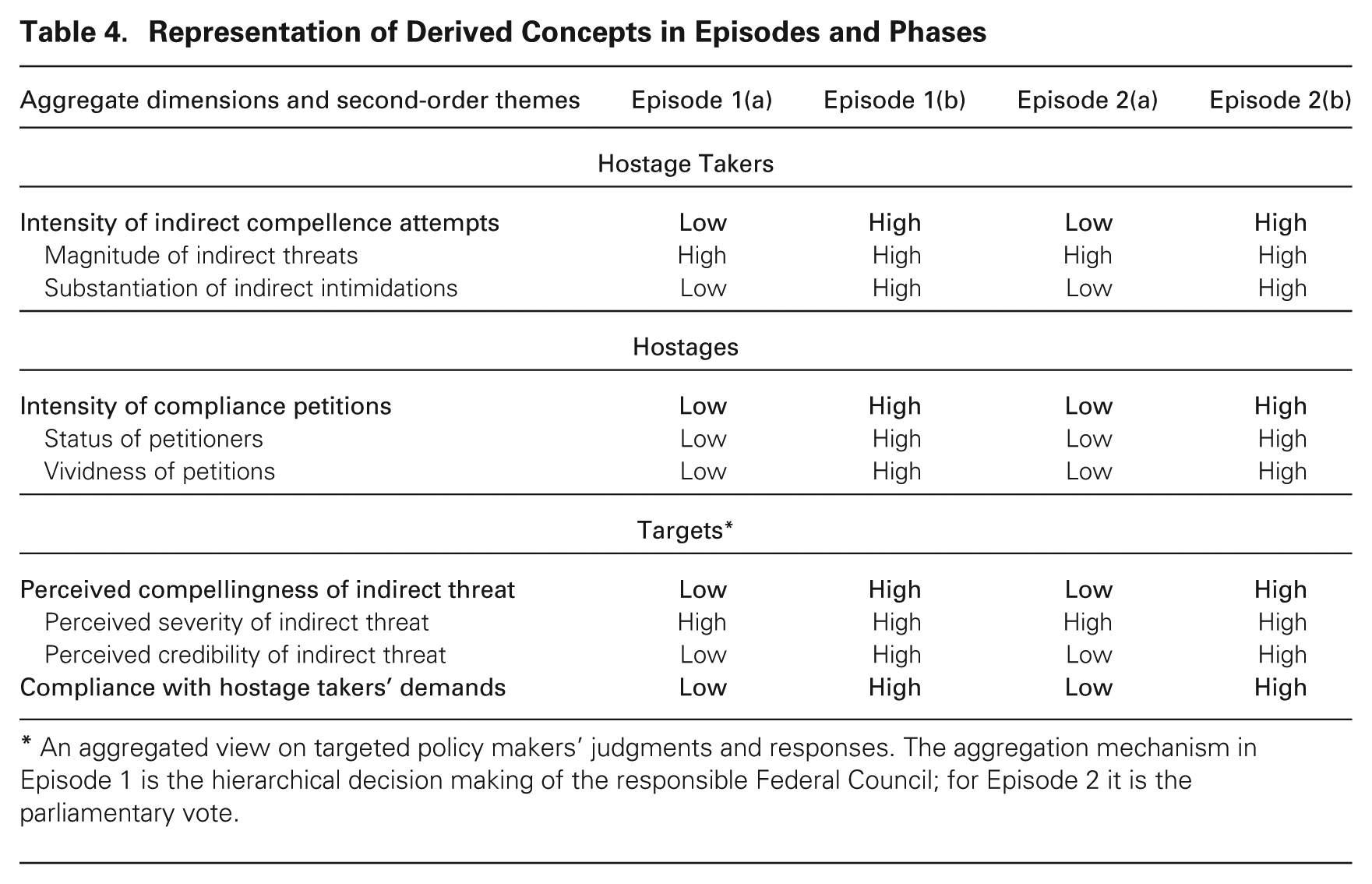
An aggregated view on targeted policy makers’ judgments and responses. The aggregation mechanism in Episode 1 is the hierarchical decision making of the responsible Federal Council; for Episode 2 it is the parliamentary vote.
Variables Explaining the Relationship of Indirect Compellence to Institutional Change
Intensity of indirect compellence attempts by hostage takers
First, our analysis focuses on the intensity of indirect compellence attempts mobilized by the hostage takers (i.e., the U.S. authorities and in particular the DOJ). We conceptualize indirect compellence attempts as involving two types of coercive activities: indirect threats and indirect intimidations. Indirect compellence attempts are of high intensity if the hostage taker mobilizes indirect threats of high magnitude as well as indirect intimidations with high substantiation.
Indirect threats
Our findings suggest that hostage takers communicate threats to sanction the hostage unless the target complies with the hostage takers’ demands—conceptualized here as indirect threats of variable magnitude (see Horai and Tedeschi, 1969). In our case, the hostage takers consistently mobilized indirect threats of high magnitude by announcing the intention to apply highly painful sanctions against the hostage. Throughout all episodes and phases, the DOJ threatened to indict and thus more or less to “kill” the Swiss banks it had captured (UBS in Episode 1; Credit Suisse and 11 other banks in Episode 2). Counterfactually, as regulators, the DOJ could have mobilized indirect threats of lower magnitude by announcing less painful sanctions such as financial penalties against the banks that do not constitute a form of “corporate capital punishment” (e.g., Ayres and Braithwaite, 1992; Gunningham, 2010).
Indirect intimidations
We suggest that it is not only through indirect threats, independently of how painful the announced sanctions are, that hostage takers develop coercive pressure but also through indirect intimidations (see also Borowsky, 2011). These are symbolic actions aimed at demonstrating to the target that not only are the means available for sanctioning the hostages, but the hostage taker is ready and willing to pay the costs that sanctioning the hostage implies (see Raven, 1992). We suggest differentiating indirect intimidations according to their degree of substantiation. Intimidating messages, such as U.S. authorities’ emotional tirades (Raven, 1992) that they were willing to do whatever it took to crack banking secrecy (Episode 1a), are categorized as indirect intimidations with lower levels of substantiation. In contrast, we refer to legal enforcement actions such as the indictments of top-level UBS bankers (in Episode 1b) and of Bank Wegelin (in Episode 2b) as indirect intimidations with high substantiation.
Intensity of compliance petitions by hostages
In line with research on hostage taking (Antokol and Nudell, 1990; Buhite, 1995), our study suggests that hostages may not just be passive resources or pawns in the political game between hostage takers and targets. Rather, they may try to implore the target to comply with the demands of the hostage taker so that the hostage taker achieves its instrumental aims and releases the hostages from their miserable position. 6 We refer to such activity as “compliance petitions.” Our data suggest that the intensity of compliance petitions varies depending on characteristics both of the sender of the petition (i.e., the status of the actor who petitions; Halperin et al., 1976) and of the petition itself, including the frequency and emotionality (Hamilton, Hunter, and Burgoon, 1990), which make it more or less “vivid.” Hence we consider compliance petitions as highly intense if high-ranking representatives (e.g., a CEO) of the threatened Swiss banks (especially from the largest ones) frequently use drastic, emotional language when imploring Swiss policy makers to comply with DOJ demands—see Episodes 1(b) and 2(b).
Perceived compellingness of an indirect threat by targeted policy makers
Our findings suggest that compellingness judgments by targeted policy makers involve two dimensions: the perceived severity of the indirect threat and its perceived credibility.
Perceived severity of indirect threat
As a first dimension, the target judges whether the indirect threat is severe and thus whether the sanctions threatened are undesirable to the extent that they warrant action (Anderson, 2011). As our case shows, such severity judgments have two components: policy makers’ perception of their country’s dependence on the survival of the threatened hostage (i.e., the banks) and on maintaining the institution that the hostage taker seeks to change (i.e., banking secrecy). The former is positively related and the latter negatively related to targets’ perceived severity of an indirect threat.
As our case suggests, targeted policy makers’ perception of their country’s dependence on the survival of the threatened hostages involves two aspects. First, it involves the target’s judgments on whether their country is (materially or immaterially) dependent on the hostages. In our case, especially the socialist policy makers (in Episode 2) and neoliberal policymakers (in Episodes 1 and 2) came to such a conclusion. Second, it also involves their judgments of whether the hostage taker has sufficient direct coercive power over the hostage to actually jeopardize the hostage’s survival. In our case, this capacity of the DOJ was undisputed across Swiss political parties, as the policy makers seemed to agree that Swiss banks might not survive an indictment by the DOJ. As for maintaining the institution, targeted policy makers’ severity judgments also involve perceptions of whether their country is (materially or immaterially) dependent on maintaining the institution that the hostage takers seek to change, a dimension that was important especially to the nationalist policy makers because they considered banking secrecy an integral part of Switzerland’s national identity.
Overall, targeted policy makers’ severity judgments involve a weighting of these two components (Buhite, 1995; Lamond, 2010). Hereby, perceived severity is high (or low) if policy makers regard their country to be more (or less) dependent on the survival of the hostage than on maintaining the institutional status quo. We argue that perceptions of high severity are a necessary condition for indirect threats leading to institutional change.
Perceived credibility of indirect threat
The compellingness judgments of targeted policy makers also involve their interpretation of whether the indirect threat is credible and thus of whether the hostage taker will follow through with the sanctions directed at the hostage if the target fails to comply with the hostage takers’ demands. We argue that perceptions of high credibility are a sufficient condition for indirect threats leading to institutional change. Based on our data, we propose that targets’ assessments of the credibility depend on targets’ impression of the hostage takers (Goffman, 1959; Schimmelfennig, 2002; Jasper, 2006) and specifically of their determination and authorization.
Judgments of the hostage takers’ determination hinge on the targets’ assessments of whether the hostage takers will be ready and willing to sanction the third parties if the targets do not comply. Toward that end, interpretations of the degree of hostage takers’ resolve—i.e., whether the hostage takers have “the temperamental inclination to make every possible effort to carry out [their] intention” (Goffman, 1971: 103)—as well as of their ruthlessness—whether hostage takers are likely to restrict their sanctioning of hostages (low ruthlessness) or whether they are actually “prepared to use the most extreme form of coercion” against hostages (high ruthlessness) (Raven, 1992: 224)—played a critical role in all four phases of our two episodes.
Targets’ judgments of the authorization of hostage takers involve their assessments of whether hostage takers are “entitled” to sanction the hostages (Wolf, 2005: 212). In this regard, targets’ assessments of whether hostage takers were “in authority,” and thus whether they were formally entitled to follow through with the threatened sanctions (Wolf, 2005: 213), were critical. Being in authority derives from a formal position (Weber, 1978; Crozier and Friedberg, 1980) and is based on the power to execute the law that, in this case, is granted by a legal mandate (see Prakash, 2003). In our case, targeted policy makers’ authorization judgments centered on their interpretations of whether the DOJ had a legal mandate to indict Swiss banks or not.
A Constructivist Theory of Indirect Compellence and Institutional Change
Having introduced the key component variables, we now introduce our constructivist theory of indirect compellence and national institutional change. As detailed in the introduction, constructivist research on coercion rests on two assumptions (e.g., Bell, 2012; Bell and Hindmoor, 2015): first, that coercion is best understood from the perspective of the target and, second, that codified ideas, like political ideologies, play a major role in how targets arrive at their interpretations and respond to coercive pressure. Our theory builds on these assumptions in separate sections.
A target-centered perspective on indirect compellence and institutional change
Figure 2 provides a rationale for explaining under which conditions indirect compellence leads to compliance and thus to changes in national institutions. First, it suggests that targeted policy makers may comply with the demands of hostage takers only if they judge the hostage takers’ indirect threats as compelling and thus as highly severe (necessary condition) and highly credible (sufficient condition) to warrant changing the institutional status quo (Buhite, 1995; Anderson, 2011). Under such conditions, the targets regard the survival of the hostage to be worth more than the concessions (i.e., the institutional changes) that the hostage taker demands (perceived high severity), and they regard the hostage taker to be sufficiently determined and authorized to follow through with the threatened sanctions against the hostage (perceived high credibility). As a result of this judgment process, the target decides to release the hostage from its tertius miserabilis (Scharmann, 1959) position by complying with the hostage takers’ demands.
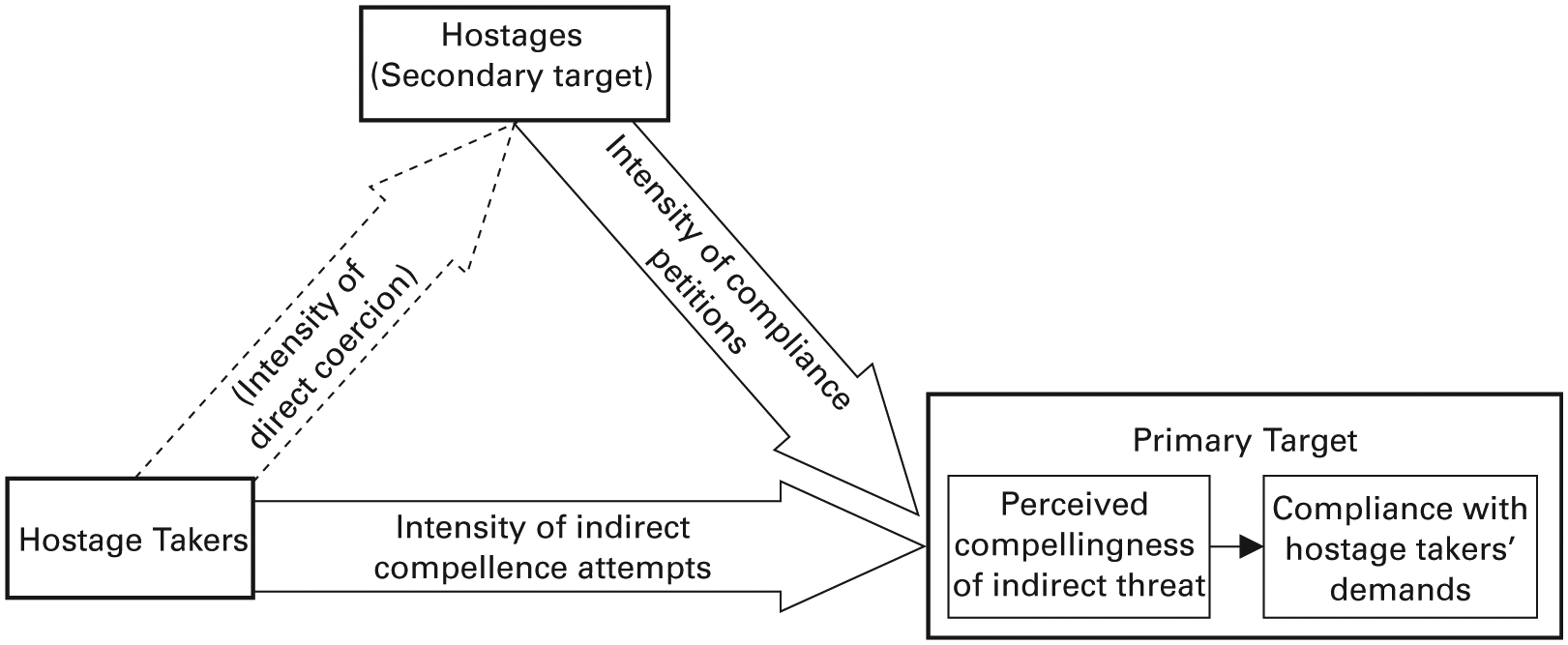
Constructivist theory of indirect compellence and institutional change.
Second, our theory proposes that the intensity of hostage takers’ indirect compellence attempts influences targeted policy makers’ judgments in two ways. The first way is that the magnitude of hostage takers’ indirect threats predominantly influences targeted policy makers’ severity judgments, but indirect threats of high magnitude are interpreted as severe only if the target regards the survival of the hostage (as jeopardized by an indirect threat of highly painful sanctions) as worth more than maintaining the institutional status quo. Otherwise the target will not regard the consequences of the indirect threat as sufficiently severe to warrant compliance with the hostage takers’ demands in order to rescue the hostage. The second way is that the degree of substantiation of hostage takers’ indirect intimidations predominantly influences the targets’ credibility judgments: targets tend to consider indirect threats with high degrees of substantiation as highly credible. By mobilizing intimidations with high substantiation, hostage takers can set an example, as the DOJ did by indicting Bank Wegelin. Setting an example involves the demonstrative or symbolic use of force against the hostage: “just enough force of an appropriate kind to demonstrate resolution and to give credibility to the threat that greater force will be used if necessary” (George, 1991: 10).
Third, as far as the relationship between the compliance petitions of the hostages and targets’ indirect compellingness judgments is concerned, the compliance petitions have a smaller impact on the effectiveness (or ineffectiveness) of indirect compellence. Rather, such petitions have an additive effect on targets’ judgments, contributing to the coercive pressure developed by the hostage takers. 7 The intensity of hostages’ compliance petitions appears to primarily influence targets’ credibility judgments. The reason seems to be that hostages provide the hostage takers with “impression management support” (Westphal et al., 2012: 217)—especially if the representative of the hostage has high status and frequently mobilizes emotional petitions—thus contributing to the impression that targeted policy makers form about the hostage taker’s readiness to sanction the hostage if the target fails to comply. As far as the influence of compliance petitions on severity judgments is concerned, they seem to reinforce rather than qualitatively change the targets’ judgments.
The mediating role of targeted policy makers’ political ideologies
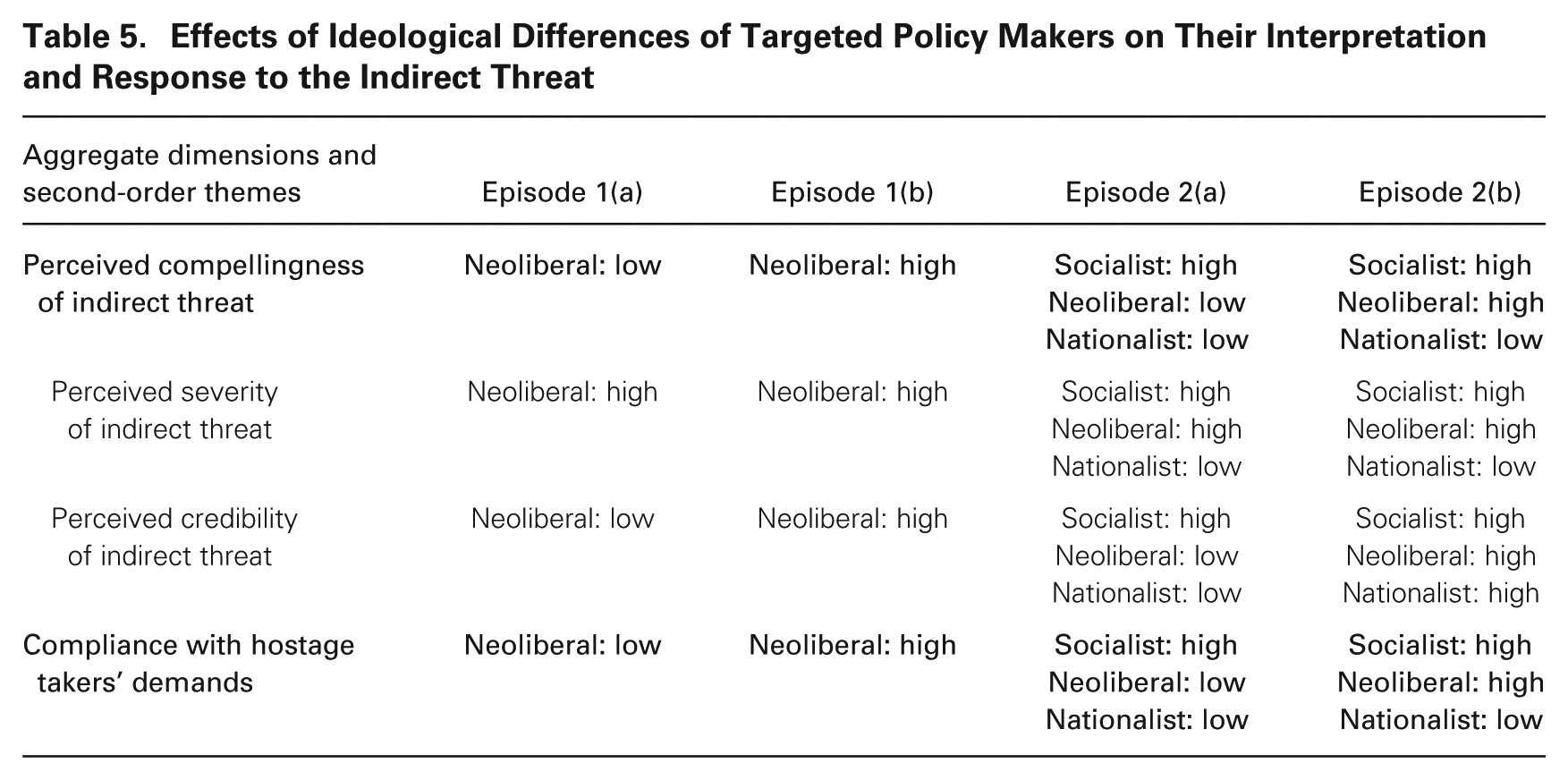
Table 5 shows how policy makers with different political ideologies responded to the indirect threats to Swiss banks. As the second episode of our case shows, Swiss policy makers interpreted and responded to indirect compellence pressure in fairly different ways. To explain why, we build on constructivist arguments that policy makers’ political ideologies mediate how they perceive and respond to coercive pressure (Bell, 2012; Bell and Hindmoor, 2015).
Effects of Ideological Differences of Targeted Policy Makers on Their Interpretation and Response to the Indirect Threat
Socialists
The socialists were early compliers. Influenced by an ideology that emphasizes the merits of an equal and just society (Rawls, 1971) and the need for international collaboration and transnational governance (Jackson, 2014), they regarded the threat as compelling already in Episode 2(a). For them, the threat was severe because they considered the survival of the hostages more important than the maintenance of the institution; they regarded it as unfair for ordinary Swiss taxpayers to have to pay the cost should the banks collapse, and they objected to banking secrecy due to its purported effect on national and global injustices. They also considered the threat as credible. They regarded the DOJ as authorized to act against the Swiss banks, whose conduct they saw as irresponsible, and also as sufficiently determined to not be deterred by the bilateral agreements and their specific wording. The intensification of the influencing attempts by hostage takers and hostages in Episode 2(b) did not change but only reinforced their judgments.
Nationalists
Policy makers with a nationalist ideology that values the protection of national identity and sovereignty (Vincent, 2014) were steadfast resisters. They regarded the threat as neither severe nor credible. For them, the targeted institution was an integral and sacrosanct part of Switzerland’s national heritage and identity. They were thus prepared to let the hostages go bust rather than comply with the hostage takers’ demands. Regarding credibility, the bilateral agreement did not have a value in and of itself for the nationalists, but they saw it as a means to secure Swiss sovereignty. Hence they did not regard the DOJ to have the authorization and determination to act unilaterally and indict Swiss banks. While the increased intensity of the hostage takers’ and the hostages’ influencing attempts changed their credibility assessments, their perceptions of severity (and thus their overall compellingness assessments) remained widely constant. 8
Neoliberals
Policy makers with a neoliberal ideology that emphasizes the primacy of the economy as a means for both individual development and national welfare (Centeno and Cohen, 2012) were late compliers. Initially, they considered the threat severe but not credible. Even though they attested to banking secrecy’s considerable importance because it would protect the freedom of individuals from excessive state intervention and because it would contribute to a competitive advantage for Switzerland, they considered it subordinate to the survival of those Swiss banks they considered too big to fail. But because neoliberalism emphasizes strict compliance with rules (Hayek, 1944: 191), they initially did not regard the U.S. authorities to have sufficient authorization and determination to transgress the bilateral treaty in place between the countries and to enforce U.S. law extraterritorially. They came to regard the threat as credible only after the intensification of hostage takers’ and hostages’ influence activities in Episode 2(b). This dynamic was similar to the judgments of the neoliberal Federal Councilor Merz in Episode 1.
Generalizability of the Theoretical Framework
As far as the generalizability of our theory is concerned, our framework suggests that international coercers’ use of indirect compellence may be particularly effective in inducing targeted policy makers to change national institutions if they judge their country as more dependent on the survival of the hostage than on maintaining the institutional status quo. This may especially be the case if the hostages are large financial services companies. Because of the financial sector’s connection with a country’s economy, some financial service companies may be interpreted by targeted policy makers as being too big to fail (Bell, 2012; Culpepper, 2015), like UBS and Credit Suisse in our case, thus making them ideal hostages. Still, other types of companies, industries, or sectors may be judged as being of utmost importance to a certain country, too. These may include the oil and gas sector in several OPEC countries (Abdelal, 2015), the automotive sector in Germany (Rhodes, 2016), mining companies in Australia (Bell and Hindmoor, 2014), or other firms and sectors that provide essential products or services to the population or government of a targeted country. Also, for indirect compellence to work, the targets must believe that the hostage taker has the sanctioning capacity necessary for jeopardizing the survival of a hostage on which the target depends. The DOJ’s sanctioning capacity was undisputed in our case. Yet other foreign actors may have significant leverage over domestic firms and sectors, including policy makers in large economies or supranational constellations such as the European Union. Threatening to block the access of foreign companies to these markets, especially if these constitute the primary destination of their exports, may give a potential hostage taker leverage to influence governmental actors in target countries when threatening to sanction companies from such countries.
As far as our theoretical extension is concerned, we are not suggesting that it is applicable only to settings in which policy makers have these three ideologies or that policy makers with these three ideologies will react similarly to indirect compellence attempts irrespective of the type of hostages involved and the types of concessions that hostage takers demand. Rather, the extension offers two key takeaways. First, attending to political ideologies matters in understanding (indirect) international coercion in general (Henisz, Zelner, and Guillén, 2005) and indirect compellence in particular, because ideologies influence targeted policy makers’ judgments of severity and credibility and mediate how they respond to influencing attempts by hostage takers and hostages. Second, understanding national-level targets of indirect compellence as unitary actors who respond to influencing attempts in a monolithic way may be suitable for exceptional cases (e.g., authoritarian states) but not for democracies in which the government is composed of policy makers with different political ideologies. Hence we expect our extension to have a wide scope.
Overall, indirect compellence is not feasible in every case of international coercion. Still, this mechanism deserves to be studied systematically as it appears to occur frequently not only in international institutional settings but also in domestic ones. For instance, and as cases of “bossnapping” in France testify (e.g., Parsons, 2013), indirect compellence also appears to be part of the tactical repertoire of some radical social movements. 9 Moreover, it may also be frequently employed by multinational companies when, for example, they threaten to lay off employees unless government changes the institutional environment to their liking (e.g., Hay, 2002: 202–204).
Discussion
In this study, we have shown how and why indirect compellence repeatedly enabled U.S. authorities, as coercers, to induce Swiss policy makers to adapt and erode the institution of Swiss banking secrecy. Based on our findings, we developed a constructivist theory on indirect compellence in international institutional environments. Our theory gives primacy to targeted policy makers’ and state leaders’ judgments of this type of coercive pressure. It emphasizes that the judgments of targeted actors vary and that, depending on their political ideologies, their judgments are influenced to a different degree by the influencing attempts that the coercers and the hostages may mobilize to induce the policy makers to comply with the coercers’ demands.
Contributions to Research on Triadic Relationships
In addition to suggesting a novel mechanism of indirect coercion that could be explored in other contexts, by other actors, and on other levels (Henisz, Zelner, and Guillén, 2005; see also Gargiulo, 1993; Keck and Sikkink, 1999; Frooman, 1999; King and Soule, 2007), our analysis of indirect compellence also contributes to the scholarly understanding of power and influence in triadic relations more generally. Following Simmel’s (1950) influential lead, extant research has focused on triadic relationships in which the third party is in an independent and thus relatively powerful position. Simmel portrayed this type of third party either as a third who has the power to connect two other, unconnected actors in the triad or to increase their connection (tertius iungens), as a third who has the power to benefit from the ongoing conflict or competition of two others (tertius gaudens), or as a third who benefits from creating such conflict in the first place (divide et impera). Simmel’s conception of these three tertius roles has been foundational for research on brokerage on various levels of analysis (e.g., Burt, 1995; Obstfeld, 2005; Hafner-Burton, Kahler, and Montgomery, 2009; Obstfeld, Borgatti, and Davis, 2014; Halevy, Halali, and Zlatev, 2019), and his conception of the tertius gaudens has also inspired research on indirect coercion in transnational institutional settings (Henisz, Zelner, and Guillén, 2005).
In contrast, our conceptualization of indirect compellence suggests that the third party can also become a hostage, thus occupying a much less independent and powerful position in the triad. In a way, this type of third party thus becomes a tertius miserabilis, a third who suffers from the conflict of two other actors (Scharmann, 1959). As part of his largely unnoticed critique of Simmel’s (1950) influential treatise, the German sociologist Theodor Scharmann (1959) offered this concept as a complementary figure to Simmel’s third party (and specifically to the tertius gaudens), as he regarded Simmel’s work as one-sided and unbalanced. Our study is among the first to give Scharmann’s (1959) critique conceptual and empirical life. Going forward, and rather than focusing only on the further elaboration and testing of the powerful tertius roles that Simmel offered and that current research on brokerage focuses on (see Halevy, Halali, and Zlatev, 2019, for a review), future research may also more fully explore other triadic influence mechanisms whereby third parties assume rather powerless tertius miserabilis roles, including the “servant of two masters,” the “bone of discord,” or the neglected or outcast third (Scharmann, 1959). This would create a more balanced and complete perspective on power and influence in triadic relations.
Contributions to Research on Power and Influence in Institutional Environments
This study also contributes to institutional research on power and influence. First, our constructivist perspective on indirect compellence adds to research at the intersection of resource dependence and institutional theory. Most generally, it emphasizes that resource dependencies are not objectively given but are socially constructed (see Pfeffer and Salancik, 2003: 71–88). More specifically, our study goes beyond extant scholarship on coercion in institutional settings (e.g., Palmer, Jennings, and Zhou, 1993; Mizruchi and Fein, 1999; Dobbin and Dowd, 2000; Guler, Guillén, and Macpherson, 2002; Henisz, Zelner, and Guillén, 2005; Guillén and Capron, 2016), which has predominantly adopted realist measures of resource dependence. This research has implicitly or explicitly assumed that the target’s de facto dependence on a coercer induces the target to more or less automatically comply with the coercer’s demands. In contrast, our study emphasizes the embedded agency of targeted actors facing coercive pressure of variable intensity. It shows that targets’ responses to a coercer’s demands are mediated by ideational factors that guide their interpretations of the coercers and the dependence relation with them (Bell, 2012; Bell and Hindmoor, 2015). Depending on these ideational factors, targets of coercion may thus respond in different ways than realist measures presume (Guzzini, 2013).
Future research may deepen the constructivist perspective on indirect compellence we have suggested. One could also develop target-centered constructivist views on other types of direct and indirect coercion in both national and transnational institutional settings. Furthermore, one may explore ideational factors when exploring coercion from the perspective of the coercer to further deepen our understanding of coercive work (Lawrence and Suddaby, 2006) or, in the case of indirect coercion, from the perspective of the third party. When doing so, and as the constructivist perspective is not limited to the political ideologies that we have focused on in our case (e.g., Campbell, 2002), future research may also explore other types of ideational factors that organizational and institutional scholars have focused on, such as professional norms (DiMaggio and Powell, 1983), interpretive schemes of expert communities (Haas, 1992; Djelic and Quack, 2010), or institutional logics (Thornton, Ocasio, and Lounsbury, 2012). This would lead to a better integration of institutional research on coercion with ideational perspectives, which have evolved largely separately.
Second, with its detailed analysis of the communication of threats and intimidations in institutional change processes, our study also contributes to research on how communication leads to power and influence in institutional environments (Lawrence, 2008; Cornelissen et al., 2015). Focusing predominantly on rather soft and unobtrusive types of communicative action such as the use of rhetoric (Suddaby and Greenwood, 2005), framing (Meyer and Höllerer, 2010), and stories (Maguire and Hardy, 2009) or rather defensive forms of impression management (Elsbach, 1994), extant research has paid insufficient attention to darker, harder, and more assertive types of communicative action and the conditions under which these may enable actors to gain others’ compliance with or commitment to institutional rules and projects. Recent political developments and the antagonisms they entail suggest that such tactics may have become more prevalent and acceptable also in other institutional domains. Hence there is a crucial need for organizational and institutional scholars to examine these developments and mechanisms in more depth.
Contributions to Institutional Research on Transnational Business Regulation
By focusing on extraterritorial law and the transnational influence of governmental authorities, we contribute to institutional research on transnational business regulation and global governance. First, while extant research has predominantly focused on transnational private authorities (e.g., Schneiberg and Bartley, 2008; Bartley, 2018; Djelic and Quack, 2018) or supranational governance authorities (e.g., Fligstein, 2005, 2008), our study has foregrounded the transnational influence of national public authorities. Specifically, we have emphasized the powerful transnational role of the United States not only in the diffusion of its culture and management models (Djelic, 1998) and in influencing transnational organizations and standards based on soft law (Djelic and Quack, 2008) but also in terms of the transnational effects of its national hard laws. Future research may also explore extraterritorial law enforcement against foreign companies or managers in other issue areas and/or by public authorities from a number of other countries that “have demonstrated some capacity and willingness to regulate extraterritorially” (Putnam, 2009: 483; see also Kacmarek and Newman, 2011). Moreover, scholars should investigate the interactions of extraterritorial law and other types of transnational institutions such as transnational standards and certification systems that have been studied more intensively.
Second, prior institutional research—akin to related streams of literature on transnational governance (e.g., Halliday and Carruthers, 2007; Vogel, 2008; Scherer and Palazzo, 2011)—has predominantly focused on transnational institutions with no clear national origin. This is based on the assumption that national governance is essentially attached to a state’s geographic territory, which leads to difficulties when regulating transnational phenomena (Ruggie, 1993). By contrast, our study suggests that this research has been too skeptical with regard to the potential of national governmental authorities to enforce rules beyond their borders, e.g., on global business firms, transnational actors, or other state actors. Our focus on (extra)territoriality goes beyond the naturalized and thus simplified notion of territory as a given geographic space (see Agnew, 1994) and draws on the distinction between territory and territoriality (Raustiala, 2009; Sassen, 2013). Territory can be defined as “a capability with embedded logics of power and claim-making” (Sassen, 2013: 23), whereas territoriality (or extraterritoriality) is defined as “claims of authority . . . that are made by particular actors with particular substantive interests to promote” (Buxbaum, 2009: 635).
This perspective implies two important insights: first, territory is not ontologically given but is the result of a social construction based on (successful) claims of authority. Second, territory is not restricted to geographic space but is rather constituted as a space of social relationships (i.e., an institutional field) with embedded rules and power logics that create order and establish a border between the inside and the outside (Fligstein and McAdam, 2012). Institutional scholars may feel inspired not only to reassess the role of national authority in transnational governance and business regulation but to engage in a subtle analysis of the relationship between jurisdictional and field expansions and the conditions under which extraterritorial enforcement of national law may shape or reshape global banking and finance, social media, internet businesses, and other seemingly “de-territorialized” fields.
Yet our proposed framework is based on a largely positive analysis, leaving open the question of whether and under what conditions it is normatively justified to extraterritorially enforce national rules on private or public actors in other countries to induce institutional change. With regard to the Swiss banking secrecy rules, the situation is ambivalent and depends on the normative stance one wants to apply. When considering the consequences, on the one hand, banking secrecy may have protected the assets of unjustly persecuted people, e.g., in the case of Jews who were persecuted by the Nazi regime. On the other hand it has also protected ill-gotten gains, be it for private tax avoiders (Zucman, 2015) or for dictators who have plundered the resources of their home countries (Guex, 2000: 265–266). A normative-ethical analysis is, however, beyond the scope of this paper.
Supplemental Material
Uberbacher_Scherer_Final_online_supp – Supplemental material for Indirect Compellence and Institutional Change: U.S. Extraterritorial Law Enforcement and the Erosion of Swiss Banking Secrecy
Supplemental material, Uberbacher_Scherer_Final_online_supp for Indirect Compellence and Institutional Change: U.S. Extraterritorial Law Enforcement and the Erosion of Swiss Banking Secrecy by Florian Überbacher and Andreas Georg Scherer in Administrative Science Quarterly
Footnotes
Acknowledgements
We are grateful to Mauro Guillén and the three anonymous reviewers for the excellent guidance and the very constructive and insightful feedback during the review process. We also express our gratitude to Shaz Ansari, Daniel Beunza, Giuseppe Delmestri, Marie-Laure Djelic, Fabrizio Ferraro, Royston Greenwood, Emilio Marti, Bill McKinley, Michael Pfarrer, Emmanuelle Reuter, Torsten Schmid, Alan Strudler, James P. Walsh, and Helmut Willke for their friendly reviews and to seminar audiences at University of Innsbruck, Università della Svizzera italiana, University of Würzburg, WU Vienna University of Business and Economics, Yale University, the EGOS Conference 2016, the Academy of Management Conference 2017, the 13th Workshop on New Institutionalism in Organization Theory, and the WK Org Workshop 2018 for helpful comments on earlier versions of this manuscript. We acknowledge the financial support of the Swiss National Science Foundation (project number 100018_169539).

Notes
Authors’ Biographies
References
Supplementary Material
Please find the following supplemental material available below.
For Open Access articles published under a Creative Commons License, all supplemental material carries the same license as the article it is associated with.
For non-Open Access articles published, all supplemental material carries a non-exclusive license, and permission requests for re-use of supplemental material or any part of supplemental material shall be sent directly to the copyright owner as specified in the copyright notice associated with the article.
