



Abstract
This 12-month ethnographic study of an early entrant into the U.S. car-sharing industry demonstrates that when an organization shifts its focus from developing radical new technology to incrementally improving this technology, the shift may spark an internal power struggle between the dominant engineering group and a challenger occupational group such as the marketing group. Analyzing 42 projects in two time periods that required collaboration between engineering and marketing during such a shift, we show how cross-occupational collaboration under these conditions can be facilitated by a radical flank threat, through which the bargaining power of moderates is strengthened by the presence of a more-radical group. In the face of a strong threat by radical members of a challenger occupational group, moderate members of the dominant engineering group may change their perceptions of their power to resist challengers’ demands and begin to distinguish between the goals of radical versus more-moderate challengers. To maintain as much power as possible and prevent the more-dramatic change in engineering occupational goals demanded by radical challengers, moderate engineers may build a coalition with moderate challengers and collaborate for incremental technology development.
Keywords
Most technology-based organizations must at some point shift their focus from developing radical new technology to incrementally improving this technology over time, but the literature has not explored the challenges associated with this common transition or elaborated the mechanisms that facilitate it. Most research on technology development during organizational transitions has focused on how firms develop—or fail to develop—radical new technologies (e.g., Christensen and Bower, 1996; Tushman and O’Reilly, 1996; Tripsas and Gavetti, 2000). It assumes that the shift from a period of radical innovation to a period of more stable, incremental innovation, which happens in both incumbent firms and new entrants, is relatively straightforward. From a capability perspective, once a new technological trajectory has been identified, a firm’s move from radical to incremental innovation should be relatively easy. Yet modifying an organization’s initial innovative technology shifts the balance of power away from the engineering group, which may have long been dominant, toward challenger groups, such as the marketing group, that are better able to contribute to new demands, like satisfying the needs of mainstream customers (e.g., Burgelman, 1994; Christensen and Bower, 1996). In the midst of the power struggle that is likely to emerge between the dominant and the challenger occupational groups in such situations, the challenger group must persuade members of the dominant group to collaborate to accomplish incremental technology development.
The literature on cross-occupational collaboration should help us identify the mechanisms that facilitate collaboration under this condition, but it does not. Though a handful of studies in this literature have focused on how members of the dominant group resist collaborating with a challenger group when an organizational transition disrupts the occupational hierarchy (Vallas, 2001; Bechky, 2003a), to our knowledge none has focused on how cross-occupational collaboration can be successfully accomplished under this condition. Understanding the barriers to collaboration, however, should be helpful, and the literature on adaptation and inertia provides a good starting point.
Adaptation and Inertia in Technology-based Organizations
The literature on adaptation and inertia in technology-based organizations highlights how technology development inside established firms can be complicated by changing environmental conditions, such as innovations in a firm’s industry (e.g., Henderson and Clark, 1990; Tripsas and Gavetti, 2000). Most studies in this literature focus on organization-level barriers to incumbent firms’ radical technology development efforts in the face of technological change (e.g., Tushman and Anderson, 1986). The studies that do explore the internal dynamics associated with technology development when a dominant group comes under threat demonstrate that incumbents frequently have challenger engineering groups inside the firm that develop new technologies, but members of the dominant engineering group often block their development (e.g., Christensen and Bower, 1996; Tripsas and Gavetti, 2000). There are three primary reasons for this: existing cognitive frames favor the dominant group (e.g., Greve and Taylor, 2000; Tripsas and Gavetti, 2000; Kaplan and Henderson, 2005); existing organizational structures allow dominant group members to block challenger groups (e.g., Leonard-Barton, 1992; Taylor, 2010); and existing resource allocation processes support the dominant group (e.g., Christensen and Bower, 1996; Rosenbloom, 2000).
Scholars have highlighted how these barriers can be overcome. Regarding cognitive frames, organizations can deliberately promote framing contests between actors with different cognitive frames and political interests (Kaplan, 2008), encourage reinterpreting past events and re-envisioning future ones in innovative ways (Kaplan and Orlikowski, 2013), provide education programs to shift dominant-group cognitions toward supporting challenger groups’ technologies (Taylor and Helfat, 2009), and bring in senior managers with new beliefs more aligned with challenger groups’ technologies (Kaplan, Murray, and Henderson, 2003). Structurally, organizations can separate groups to protect challenger groups’ efforts through ambidextrous designs (Tushman and O’Reilly, 1996; Smith and Tushman, 2005) or geographic isolation (Tripsas, 1997). And regarding resource allocation processes, organizations can allow autonomous decision making in various levels of the organization (Burgelman, 1994, 2002), de-fund poorly performing dominant group projects (Burgelman, 1994; Tripsas and Gavetti, 2000), allow for internal competition between groups (Taylor, 2010), and allow challenger groups to form independent companies that commercialize new technologies (Christensen, 1997).
Although such mechanisms facilitate technology development when the dominant engineering group comes under threat, they have been studied in settings in which organizations are developing radical new technologies rather than seeking to refine and exploit these technologies over time. Some of the political challenges in the different settings are similar; in both cases, technology development requires a shift in the balance of power away from the dominant engineering group that developed the initial technology and toward a challenger group in the organization. Yet some of the political challenges are different. For example, the literature on adaptation details mechanisms that facilitate new technology development by a challenger engineering group when the dominant engineering group is resisting it. Therefore, it delineates mechanisms that protect the efforts of a challenger group from a dominant group rather than mechanisms that facilitate collaboration between a dominant and challenger group. In addition, in our setting, members of the dominant and challenger groups were from different occupations, and this posed different challenges to collaboration for technology development.
Cross-occupational Collaboration inside Organizations
The literature on cross-occupational collaboration highlights how members from different occupations integrate contributions in their daily work across occupational differences in expertise, status, and meanings. Studies have demonstrated that it is often difficult for occupational groups to collaborate with one another across occupational boundaries and that mechanisms such as drawings that serve as boundary objects to aid interpretation across groups (e.g., Carlile, 2002; Bechky, 2003a; Seidel and O’Mahony, 2014), people acting as boundary spanners between groups (e.g., Fernandez and Gould, 1994; Levina and Vaast, 2006; Kaplan, Milde, and Cowan, 2014), and “trading zones” in which ideas, information, and coordinating structures can be accessed and exchanged by different groups (Kellogg, Orlikowski, and Yates, 2006) can facilitate cross-occupational collaboration by allowing for ongoing give-and-take between groups. But such collaboration mechanisms are useful only when the organization’s intra-occupational hierarchy is secure. When organizational transitions or environmental uncertainty disrupt the hierarchies, members of the dominant group may use these same collaboration mechanisms to resist collaborating with a challenger group (Vallas, 2001; Bechky, 2003a). They do this to protect their occupational jurisdiction, which is their means of continued livelihood (Abbott, 1988): occupational groups gain material rewards by providing services that competing practitioners cannot (Timmermans, 2008).
Occupation members draw on three aspects of jurisdictional structure to guide their day-to-day interactions inside organizations: occupational knowledge, understandings of authority relations, and values (Bechky, 2003a). First, each occupational group draws on a body of knowledge composed of formal abstract principles, and its control over this body of knowledge gives the group the autonomy to determine what work it does and in what order (e.g., Abbott, 1988). Second, occupational groups are ordered within a hierarchy, the shared understanding of which allows superordinate groups to direct the work of subordinate groups (e.g., Heimer and Stevens, 1997). Finally, occupational groups each have values that articulate and govern appropriate conduct, which allows occupation members both to sanction behavior that violates their moral order and to justify to important audiences why their occupational work practices are legitimate (e.g., Perlow, 2001; Bailyn, 2006; Turco, 2012).
Jurisdictional structures are not fixed but are enacted in practice, and dominant occupational groups must maintain and defend their jurisdictional boundaries from competing practitioners in day-to-day work in light of the shifts taking place in the broader organizational environment (e.g., Hwang and Powell, 2009; Barrett et al., 2012; Kellogg, 2014). Occupational groups protect their jurisdictional boundaries in everyday interactions by denying other groups’ claims to their occupational knowledge, understandings of authority relations, and values (e.g., Anteby, 2010; DiBenigno and Kellogg, 2014; Beane and Orlikowski, 2015). When organizations have a stable occupational hierarchy, the dominant group is often willing to make the occasional day-to-day concessions in occupational knowledge, understandings of authority relations, and values required for collaboration because its jurisdictional boundaries are not substantively threatened by them (e.g., Carlile, 2002; Bechky, 2003b; Kellogg, Orlikowski, and Yates, 2006). But organizational transitions that increase the power of a challenger group in relation to the dominant group can lead the challenger group to increase the frequency of claims that infringe on the occupational knowledge, understandings of authority relations, and values of the dominant group (Vallas, 2001). When a dominant group’s jurisdictional boundaries are under threat, its members frequently resist applying their occupational knowledge in new ways to assist the challenger group, resist abdicating authority to the challenger group, and resist doing work in line with the challenger group’s values that would legitimize its claims to the dominant group’s jurisdiction (Vallas, 2001; Bechky, 2003a; Metiu, 2006). Yet the transition from a focus on radical technological innovation to a focus on more incremental technology development often requires cross-occupational collaboration under these conditions and is fundamental in the lifecycle of most organizations. To better understand how this collaboration might take place successfully, we draw on social movement theory and its concept of the “radical flank effect.”
The Radical Flank Effect
Social movement theory focuses on how, in the face of a strong threat by radical members of a challenger group, members of the dominant group may begin to change their attitudes toward challengers’ demands, make distinctions between the goals and tactics of radical versus more-moderate challengers, and collaborate with moderate challengers in an effort to maintain as much power as possible and to prevent the more-dramatic changes demanded by radical challengers (Haines, 1984).
The Civil Rights movement offers the classic scenario of this radical flank effect (Haines, 1984; McAdam, 1999). From its incorporation in 1910 until 1954, the NAACP, with its integrationist philosophy and program of litigation, was viewed by many whites as a radical challenger group. But in the late 1950s and 1960s, the emergence of more-radical challenger groups like the Black Panthers, who promoted separatist goals and tactics of retaliatory violence, changed whites’ notions of “radicalism.” Initially, many whites resisted attempts by both moderate and radical Civil Rights challengers to make change. But the combination of the presence of radicals and highly publicized events, such as the disappearance and murder of three Civil Rights workers on the first day of Freedom Summer in 1964 and the 1965 Watts Riots in Los Angeles, challenged whites’ prevailing definitions of the situation (Cohen and Murphy, 1966; Horne, 1995). Many whites began to perceive change to the status quo as inevitable and to make distinctions between the goals and tactics of the more-radical versus more-moderate challengers. Many began to support and even engage in coalition building with leaders such as Martin Luther King, Jr. and organizations like the NAACP, believing that these moderate challengers were less threatening to their own goals than were radical challengers (Haines, 1984). Similar radical flank dynamics have been documented in other social movements, such as the women’s liberation movement (Freeman, 1973) and the environmental movement (Hoffman, 2009). The radical flank effect can also be a useful concept for understanding how collaboration for incremental technology development occurs between dominant and challenger occupational groups when an organizational transition threatens the power of the dominant group.
Methods
Research Setting
We conducted a 12-month ethnographic study of Transco, an early entrant into the U.S. car-sharing industry. Unlike traditional car-rental firms, car-sharing firms offer short-term vehicle rentals in small time increments, such as one hour. Car-sharing firms keep their vehicles in networks of vehicle locations called “pods,” which are placed throughout dense urban areas. Typically, the firms offer a membership plan in which customers pay an annual fee and an additional charge each time they use a vehicle.
Transco was an ideal setting for our study. It was a technology-based organization that had become successful initially because its engineering group developed innovative car-sharing technologies. But over time, as a dominant design for car sharing emerged, Transco shifted its strategy from developing new technology to refining its existing technology, with an emphasis on making incremental product improvements. This strategic shift moved power away from the dominant engineering group and toward the challenger marketing group, as the latter group was better able to contribute to new challenges such as satisfying the demands of mainstream customers.
Ethnographic Data Collection
Using an inductive, ethnographic approach that is well-suited for developing new theory (Glaser and Strauss, 1967; Eisenhardt, 1989), we studied a single organization to develop a rich understanding of micro-processes involved in our focal phenomenon (Van Maanen, 2011). We focused our data collection efforts on observing interactions between Transco’s engineers and marketers and interviewing engineers, marketers, and members of the leadership team to better understand how they conceived of interactions between engineers and marketers.
Data collection at Transco’s headquarters began in June 2012 and ended a year later. 1 The first author was given a desk, employee badge, company e-mail address, and permission to make contact with anyone at Transco. We observed 111 meetings: 87 daily “scrum” meetings and 24 cross-departmental meetings in which engineers and marketers discussed progress and challenges on joint projects. This enabled us to track 42 projects attempted during the study’s timeframe that were deemed strategic because they were designed to increase revenue by bringing in new customers and retaining (and increasing revenue from) existing ones. Launching these projects depended on integrating contributions of both engineers and marketers. We tracked these projects so we could understand the work practices on launched versus unlaunched projects. We also observed cross-occupational interactions that occurred at company-wide “all hands” meetings and company-sponsored social events such as Friday happy hours. In addition, we observed departmental meetings in the engineering and marketing departments.
To complement observational data, we conducted 126 formal, semi-structured interviews: 42 with 38 engineers, 51 with 29 marketers, and 33 with other Transco employees, including leadership team members. Formal interviews averaged 60 minutes each and were conducted individually with participants in private offices or meeting rooms. Initially, we asked interview questions related to everyday work tasks, how the industry and company were changing, and perceptions of and interactions with members of other departments. As the study progressed, our questions focused more on understanding why organizational members behaved the way they did during meetings in which engineers and marketers interacted, as well as their perceptions about how their work in the company was (or was not) changing. We were careful not to lead interviewees. For example, rather than asking engineers to draw contrasts between different marketers, we asked questions like, “Tell me about a positive experience working across departments,” and “Tell me about a negative experience working across departments.” In addition, we conducted 118 informal interviews with engineers and marketers, which were each under 10 minutes and probed similar areas of inquiry.
We also collected company documents, such as Transco’s annual report and internal documents. The annual report was helpful for understanding car-sharing industry dynamics, Transco’s changing position in the competitive landscape, and Transco’s change in strategy. We used internal documents such as organization charts, strategic plans, and company-wide e-mails to help us understand the company’s historical versus new strategy.
Data Analysis
Our longitudinal research design enabled us to use a Time 1 versus Time 2 analysis to investigate how a radical flank threat facilitated cross-occupational collaboration for incremental technology development between subgroups of engineers and marketers when an organizational transition threatened the power of the dominant engineering group. Data analysis occurred in several phases.
Cross-occupational collaboration and strategy changes
First we focused on understanding collaboration between engineers and marketers and changes in Transco’s strategy. To understand cross-occupational collaboration, we coded our field notes and interviews; to understand changes in the industry and Transco’s strategy, we coded both our own notes and internal documents, following the guidelines suggested by Miles and Huberman (1984). This led us to identify two important themes, about which we wrote weekly memos: (1) organization members’ sense that the balance of power was shifting away from engineering and toward marketing, and (2) different perceptions among subgroups in the engineering and marketing departments of the new strategy and the changes that would be required to accomplish it.
We identified and measured several key constructs. First, we measured the organizational change that threatened the power of the dominant engineering group using Emerson’s (1962) definition of power, in which the power of actor A over actor B is directly related to the dependence of each actor on the other. Second, we measured the strategic shift by using the leadership’s statements about the change in strategy in Transco’s 2011 Annual Report and data from our observations and interviews. Third, our initial interviews at Transco highlighted different subgroups within marketing and engineering that had different perceptions of the new strategy. We classified marketers and engineers as “radical” versus “moderate” according to several inductively derived indicators related to their views of the new strategy and of the change in engineering knowledge, understandings of authority relations, and values that would be required to accomplish it.
Strategic project launches
In the second phase of data analysis, we began to analyze the strategic projects that we were observing—42 of them over the course of the study—that required collaboration between engineers and marketers. Marketers told us that they saw each of the projects as viable from the start. We measured cross-occupational collaboration by tracking whether projects were launched or not as opposed to measuring success in the marketplace. Launch is a more-proximate measure for collaboration between engineers and marketers than marketplace success, which depends on other factors such as market competition. We coded a project as launched if the product involved was put on the market and made available to customers or if the project involved back-end work that was completed and operational. In either scenario, launching required that the project successfully made it through internal review processes, such as the quality assurance (QA) process.
We also examined how a subgroup of engineers behaved differently over time. About three months into the study, the subgroup of engineers we call “moderate engineers” began to collaborate with the subgroup of marketers we call “moderate marketers.” Early in the study these moderate engineers had resisted collaborating with all marketers. We wanted to understand why this change had occurred; we interviewed engineers asking them to describe what they perceived to be the key incidents related to engineer–marketer collaboration that had occurred in that time period (Schein, 1985). Engineers consistently described a particular incident—the announcement of Transco’s poor Q2 results, and radical marketers’ interpretation of these results—as a pivotal moment for the company. But only moderate engineers cited this incident as changing their power to resist radical marketers’ demands and as leading them to distinguish between the demands of radical versus moderate marketers.
Time 1 vs. Time 2
In the third phase of the study, we divided our data into two time periods: Time 1, which spanned the first three months of the study, and Time 2, which spanned the nine months of the study after the poor Q2 results. This allowed us to analyze the collaboration of engineers and marketers on the 42 strategic projects synchronically and diachronically (Barley, 1990). For the synchronic analysis, we examined the project launch rates for each type of engineer–marketer pairing (moderate engineer–moderate marketer, moderate engineer–radical marketer, radical engineer–moderate marketer, and radical engineer–radical marketer) in T1 versus in T2. All four pair types had similar launch rates in T1 (approximately 50 percent), but in T2, the moderate engineer–moderate marketer pairs had a 100-percent launch rate, whereas all other pairs had a 0-percent launch rate. We wanted to understand why the moderate engineer–moderate marketer pairs started to collaborate in T2, so we diachronically analyzed each type of engineer–marketer pairing to see how its members interacted differently in T1 versus T2 projects. In coding moderate engineer–moderate marketer projects over time, we came to see distinct differences in the interactions between moderate engineers and moderate marketers in T1 and T2. Table 1 describes the 42 projects, their engineer–marketer pairings, and whether a project was launched.
Descriptions of Engineer–Marketer Projects in T1 and T2
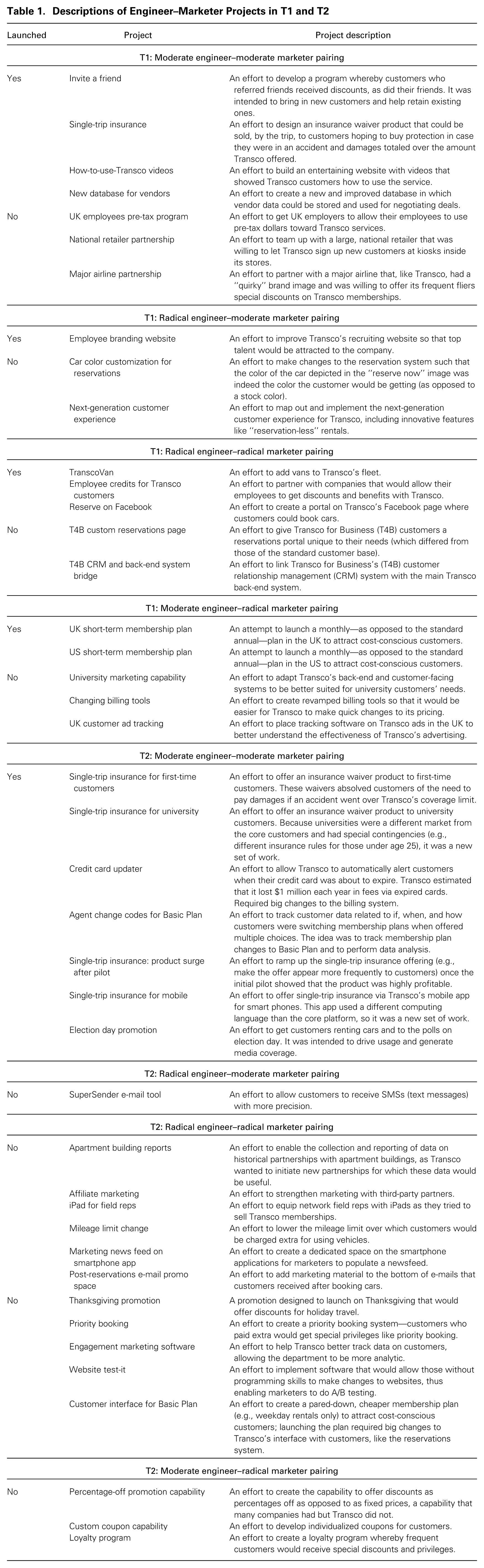
We explored the following questions: (1) What led the moderate engineers to begin to collaborate with the moderate marketers (but not the radical marketers) in T2? (2) What led the radical engineers not to collaborate with either set of marketers in T2? and (3) What practices did the moderate engineers and moderate marketers use to collaborate with one another in T2? To answer the first and second questions, we found that the concept from social movement theory of a radical flank threat helped us to make sense of our data. We observed the presence of this radical flank threat at Transco and, to measure its strength, used two indicators proposed by social movement theorists (e.g., Gupta, 2014): (1) the degree to which members of the dominant group perceive that they have the power to resist the demands being made by radical challengers and (2) the degree to which members of the dominant group perceive the moderate challengers’ goals and tactics to be meaningfully different from those of the radical challengers. We used interview data to assess the strength of the radical flank threat experienced by moderate versus radical engineers in the two time periods.
To answer the third question, we coded our field notes and found that moderate engineers and marketers used three coalition-building practices—drawing on historical Transco organizational knowledge, understandings of authority relations, and values—to guide their collaboration, so we tracked the use or non-use of these practices in engineer–marketer interactions.
When our formal data collection in this phase had finished, we checked our emerging conclusions with informants from Transco in informal, offsite meetings to ensure that these interpretations represented their experiences (Yin, 2008). These checks did not affect the actions of informants during the study. Finally, we considered alternative explanations for our findings.
Findings
Time 1: Threats to the Dominant Group and Resistance to Collaboration
Transco was an early entrant into the U.S. car-sharing industry in the early 2000s with innovative technologies, including a telematics box that alerted the company to cars’ locations and when cars had to be serviced, a keyless car-entry system, and a reservations system custom-tailored for the business. The need for innovative technology in the early years meant the engineering group was initially best able to contribute important resources to the organization. Transco’s initial strategy was to leverage its technology to target the U.S. market, focusing specifically on young urban professionals and university students. By the end of 2011, Transco was operating throughout the U.S., Canada, and Europe with approximately 500 full-time employees (Transco 2011 Annual Report).
By the time of our study, roughly one year after Transco had its IPO, car-rental firms had begun to enter the market by buying the technology that was no longer proprietary. In addition, a second set of smaller companies entered the market offering novel products such as peer-to-peer car sharing, which allowed individuals to rent out their own cars. According to Transco’s 2011 annual report, with the entrance of these new competitors, the basis of competition in the industry shifted from providing sophisticated technological solutions for car sharing to providing excellent customer service and pricing. These changes led Transco’s leadership team to shift Transco’s strategic focus away from new technology development and toward making incremental improvements to its existing technology to retain existing and attract new customers. The leadership team, which remained intact during the time of this study except for the chief marketing officer, and which was headed by a CEO who had been in place since 2003, announced a four-pronged strategy, for which improving existing technology was central and developing new technology was not: (1) increase customer awareness and adoption rates in existing markets through marketing efforts; (2) expand into new markets; (3) leverage existing networks to broaden relationships with customers by introducing new services like insurance waivers purchasable for a single trip and vans for rental; and (4) tailor offerings to new categories of customers, such as business and government customers (Transco internal strategy document).
The strategic shift increased Transco’s dependence on the marketing group and decreased its dependence on the engineering group, reducing the relative power of the engineering group vis-à-vis the marketing group. New projects were increasingly not technology-focused endeavors; for example, the Basic Plan, a pared-down membership plan designed to bring on cost-conscious customers, did not require complex technology design, nor did single-trip insurance, an attempt to develop a profitable insurance product. To help implement the new strategy, the leadership team hired a set of experienced marketers.
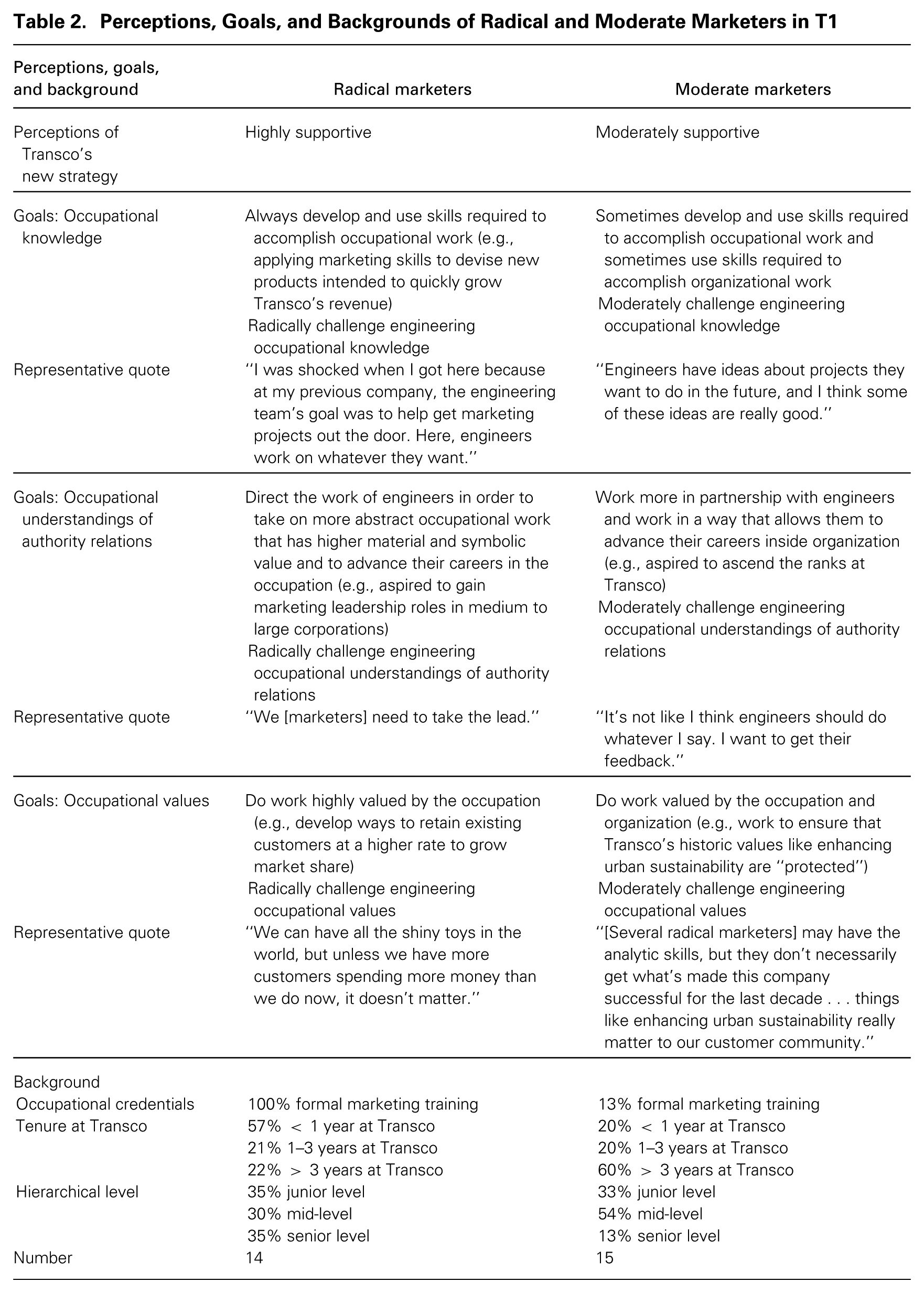
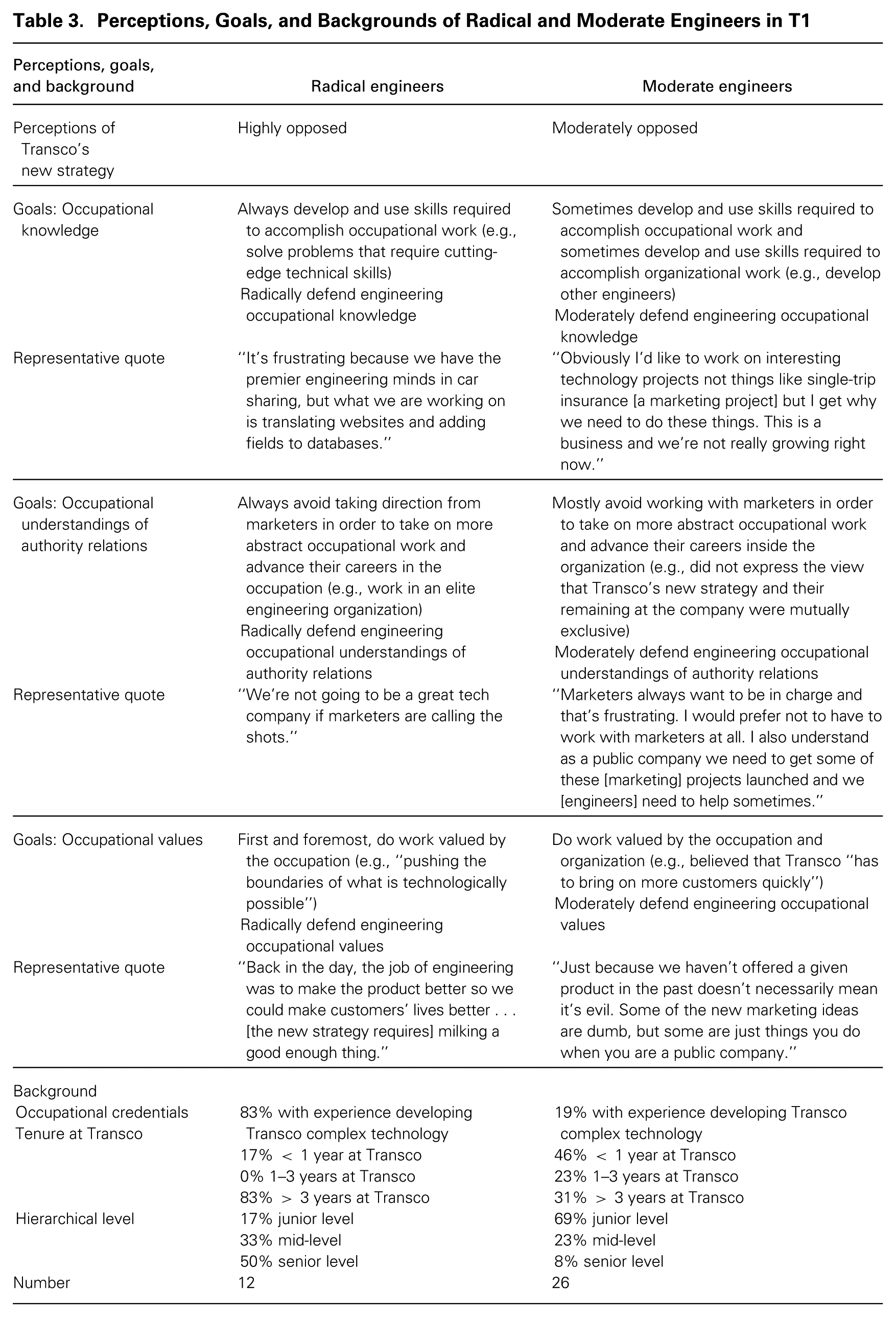
When we entered the organization, we interviewed Transco members to understand their views of the company’s change in strategy. In both the marketing and engineering groups, we observed two subgroups, which held different views of the new strategy. As Gouldner’s (1957) work on “cosmopolitans and locals” would predict, occupation members differed in their level of commitment to the occupation versus to the organization. We found that each subgroup’s view of the new strategy was shaped by how strongly its members were committed to their occupation and, therefore, how much they wanted to protect their own occupational knowledge, understandings of authority relations, and values in the face of new strategic demands. Tables 2 and 3 present the key perceptions, goals, and backgrounds of the marketers and engineers we interviewed.
Perceptions, Goals, and Backgrounds of Radical and Moderate Marketers in T1
Perceptions, Goals, and Backgrounds of Radical and Moderate Engineers in T1
Distinguishing radical from moderate marketers
The first marketing subgroup was composed predominantly of newly hired marketers but included some who had long worked at Transco but had occupational credentials similar to the new hires. All had formal training in marketing, and the primary factor that distinguished them from the other subgroup of marketers was their strong commitment to marketing occupational knowledge, understandings of authority relations, and values.
This subgroup of marketers was highly supportive of Transco’s new strategic direction, for it was highly consistent with their occupational goals. The new strategy allowed these marketers to use specialized marketing knowledge (e.g., by analyzing spreadsheets with expected revenues by product), to act according to understandings of authority relations that both privileged marketers over engineers and allowed marketers to rise within the broader marketing occupational career hierarchy (e.g., gain experience needed to secure marketing leadership roles in other firms), and to do work that was in line with marketing occupational values (e.g., bringing in new customers and retaining existing ones at a higher rate to grow market share). To accomplish Transco’s new strategy, these marketers believed that dramatic change was required in the engineering group’s knowledge, understandings of authority relations, and values. For this reason, we call this subgroup “radical marketers.” In T1, however, though radical marketers told us about their desire for change, they did not explicitly communicate these thoughts to the leadership team or the engineers.
The second marketing subgroup was primarily composed of marketers who had long worked at Transco. A few had formal marketing training like that of radical marketers, but those who did reported that they had joined Transco because of their interest in its focus on sustainability, not because of their interest in marketing. The primary factor that distinguished them from the radical marketers was their weaker commitment to marketing occupational knowledge, understandings of authority relations, and values and their stronger commitment to Transco’s historical organizational knowledge, understandings of authority relations, and values.
This subgroup was supportive of Transco’s new strategy but less supportive than the first subgroup, because of their less occupationally oriented goals. For example, unlike radical marketers, these marketers enjoyed engaging in both marketing activities and in organizational activities related to Transco’s history that did not require the use of marketing knowledge, such as doing work for Transco’s sustainability club. They wanted to draw on understandings of authority relations that allowed them to work in partnership with engineers and to advance within the organizational hierarchy at Transco rather than within the broader marketing occupational hierarchy. And they drew on Transco’s historical organizational values to guide their work in addition to drawing on the values of the marketing occupation; as one said, “We’re not just selling soap or ads . . . what we do helps limit the environmental impact of cars [and] makes customers’ lives easier.” These marketers believed that, to accomplish Transco’s new strategy, only moderate change in engineers’ occupational knowledge, understandings of authority relations, and values was required. Thus we call this subgroup “moderate marketers.”
Distinguishing radical from moderate engineers
The first engineering subgroup was composed of primarily mid- and senior-level engineers who had been with Transco for many years. Most had in-depth knowledge of Transco’s proprietary back-end technology, and several had been responsible for building key pieces of Transco’s technology systems. All reported that they had come to Transco because of the opportunity to build innovative technology. The primary factor that distinguished them from the other subgroup of engineers was their strong commitment to engineering occupational knowledge, understandings of authority relations, and values. We call this subgroup “radical engineers” because they were strongly opposed to Transco’s new strategic direction, which was highly inconsistent with their occupational goals. The new strategy required them to make concessions in their engineering knowledge (e.g., working on projects that did not allow them to use their technical and creative engineering skills), understandings of authority relations (e.g., engineers told us that a growing number of marketing initiatives were “thrown at the [engineering] department” after the IPO), and values (e.g., they objected to the new marketing projects, which were not designed to make progress on “really tough engineering issues” that they deemed to be important).
Radical engineers asserted that Transco should focus on developing novel technology “to promote social good,” such as enabling rentals for one-way trips. They wanted to upgrade Transco’s aging technology systems, which they reported were “basically about to crumble.” With 38 engineers, the department was small enough that even the most senior radical engineers were now being asked to work on the most routine projects. One radical engineer noted that although one might think that these seemingly simple tasks could be performed by junior engineers or even new hires, because Transco’s technology was proprietary, “basic changes could take us [senior people highly familiar with the technology] a very long time.”
The second engineering subgroup was composed primarily of less tenured and more-junior engineers. Most had joined Transco after the initial technology was developed and when the firm was no longer widely viewed as a destination to do cutting-edge engineering work. Some engineers who had joined while the initial technology was in early development had in-depth knowledge of Transco’s proprietary technology systems, but they reported that they had come to Transco because they were attracted to its mission to make sustainable urban living easier. The primary factor that distinguished them from the radical engineers was their weaker commitment to engineering occupational knowledge, understandings of authority relations, and values. We call this subgroup “moderate engineers”; they were less strongly opposed to Transco’s new strategic direction because of their less occupationally oriented goals. They enjoyed using historical Transco organizational knowledge in addition to occupational knowledge, such as by engaging in non-core engineering activities like “developing other engineers.” They worked in ways necessary to advance within the organizational hierarchy at Transco rather than within the broader engineering occupational hierarchy (e.g., “I’m happy staying at Transco”). And they were not as concerned as were radical engineers about doing work that violated engineering values; as one engineer noted, “I’m fine doing some work that is more routine, that’s not really cutting edge.”
Initial resistance from both radical and moderate engineers
Launching the strategic marketing projects required that engineers and marketers collaborate because the projects required both marketers’ ability to design new products and services using their knowledge of customers and engineers’ ability to make changes to Transco’s back- or front-end technology systems. 2 Although radical marketers did not openly express to engineers their goals for dramatic change at Transco in T1, they did use somewhat more assertive tactics to elicit engineers’ collaboration than did moderate marketers. Despite this difference, in T1 both radical and moderate engineers resisted collaborating with either radical or moderate marketers because marketing projects posed a threat to engineers’ knowledge, understandings of authority relations, and values.
Threat to engineers’ knowledge
Both radical and moderate engineers noted in T1 that they did not want to do “uninteresting” work that did not allow them to use their core engineering skills. For example, a moderate marketer who was excited to have secured a partnership with a major airline asked the moderate engineer on that project to perform back-end work needed to launch the project, in which the airline’s customers would be offered Transco promotions. The moderate engineer complained that the “tedious” work, which was “repetitive and boring,” was “not worth it.” The moderate engineer wanted to work on projects that required using occupational knowledge like “using new programming languages” to “make sustainable urban living easier,” not make minor changes to Transco’s “over a decade-old” back-end systems using an increasingly “archaic” programming language. The moderate marketer lost momentum with the airline, and the project never launched.
Threat to engineers’ understandings of authority relations
In T1, engineers resisted projects that challenged their ability to be in charge. For example, in the UK employees pre-tax program project, we saw a moderate engineer resist a moderate marketer’s request to help enable a program whereby employees at UK companies could exchange a portion of their pre-tax salary for blocks of Transco time, in addition to saving up to 40 percent on usage. The UK was an important market for Transco and one in which such programs were widespread. But enabling this program involved back-end integration work between Transco’s system and that of a UK car-sharing firm that Transco had acquired. The moderate engineer told this moderate marketer that the billing systems of the UK firm were still being finalized so the program would not be possible. Later, this engineer told us that it was possible, but “I don’t like being told what to do.”
Threat to engineers’ values
Engineers in T1 resisted marketers’ requests that infringed on their values, such as the importance of pushing the boundaries of what was technologically possible on projects. For example, in the national retailer partnership project, a moderate marketer asked two moderate engineers to help enable Transco to sign up new customers at kiosks inside a retailer’s stores. The retailer had national reach and a potentially overlapping customer base, so the moderate marketer was excited about the partnership. But the project never launched because the moderate engineers refused to perform the back-end work needed to get the kiosks connected with Transco’s registration system. One of the moderate engineers told the moderate marketer, “We shouldn’t be wasting time on these small-time partnerships . . . we should be doing things that are actually going to make people’s lives better. What about the next-generation system?”
Engineers’ resistance prevented the launch of many strategic marketing projects in T1. Projects were always staffed with one marketer and were primarily staffed with one engineer; in the 10 of 42 projects across T1 and T2 that were staffed with more than one engineer, there was a lead engineer responsible for the bulk of the work, and we coded the project as being led by that type of engineer. During the first three months of our study (T1), engineers and marketers worked on 20 marketing projects, and 50 percent of them were launched.
Why were engineers able to behave in this manner without formal punishment? First, marketers did not know what was and was not possible to do from a technical standpoint, and engineers often used this to their advantage when they did not want to perform a piece of work. Second, the radical engineers had crucial expertise on the firm’s proprietary technology systems, so they were not substitutable; Transco could not hire new engineers who had this expertise. Third, although the leadership team had become increasingly interested in tracking progress on internal projects, given financial pressures, they still spent the bulk of their time managing external stakeholders such as investors and board members. Thus the leadership team had limited insight into what engineers were and were not doing. Finally, marketers told us that even though, theoretically, they were able to “call out” engineers and report engineers’ resistance to the leadership team, they were reluctant to do so because they thought that it reflected poorly on them.
Time 2: Radical Flank Threat and Divergence at Transco
Although radical and moderate engineers acted similarly in T1, after the first three months of our study, their actions diverged, as did the collaboration outcomes for moderate engineer–moderate marketer pairs versus other pairs. In T1, before the introduction of the radical flank threat that we describe below, project launch rates had been similar for moderate engineers working with moderate marketers versus all other pairs: four of the seven T1 projects attempted by moderate engineer–moderate marketer pairs launched, and six of the 13 T1 projects with all other pairs launched. But in T2, after the introduction of the radical flank threat, the project launch rates for moderate engineers working with moderate marketers increased dramatically, while the project launch rates for other pairings decreased. In T2, moderate engineers working with moderate marketers launched all of their seven projects. All other pairings launched none of their 15 projects in T2. 3
This difference in launch rates cannot be explained by a difference in the kinds of projects led by moderate versus radical engineers; these projects were very similar along criteria that could have affected engineering collaboration, such as a project’s importance, complexity, alignment with the new strategy, and interest level for the engineers, as shown in the comparisons in table 4. The difference also cannot be explained by staffing differences. Staffing decisions about which marketer and engineer worked on each project were determined by the heads of the marketing and engineering departments, respectively, and were a function of an individual’s availability and area of expertise; for example, some engineers were particularly knowledgeable about the reservations system and were thus assigned to projects related to reservations changes. As a result, neither marketers nor engineers got to choose with whom they worked. To account for the difference in project launch rates for moderate engineer–moderate marketer pairs versus other pairs in T2, we need to understand the difference in the degree of the radical flank threat posed to the different subgroups of engineers in T2.
Comparison of Moderate Engineer–Moderate Marketer Projects with Those of All Other Pairings*
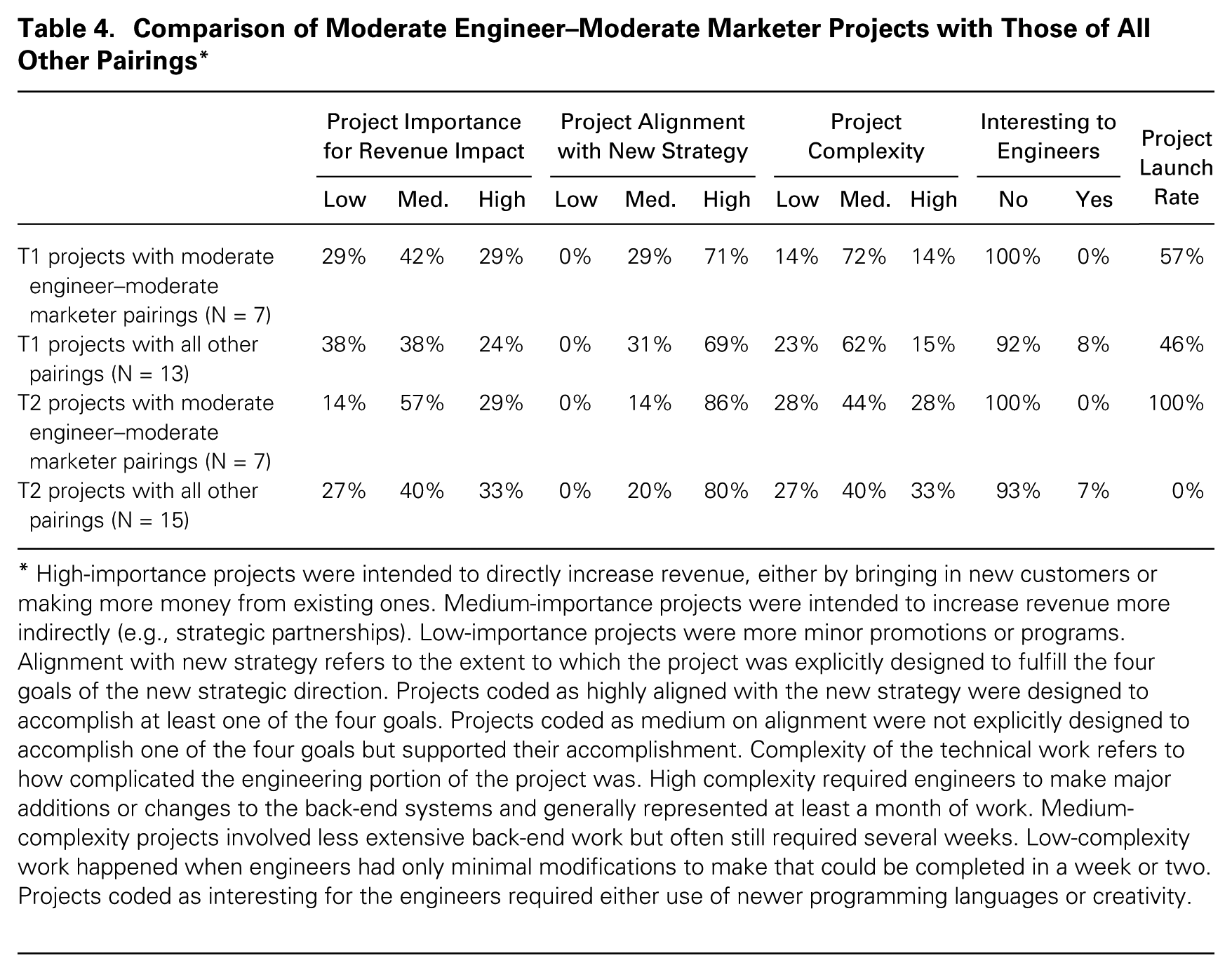
High-importance projects were intended to directly increase revenue, either by bringing in new customers or making more money from existing ones. Medium-importance projects were intended to increase revenue more indirectly (e.g., strategic partnerships). Low-importance projects were more minor promotions or programs. Alignment with new strategy refers to the extent to which the project was explicitly designed to fulfill the four goals of the new strategic direction. Projects coded as highly aligned with the new strategy were designed to accomplish at least one of the four goals. Projects coded as medium on alignment were not explicitly designed to accomplish one of the four goals but supported their accomplishment. Complexity of the technical work refers to how complicated the engineering portion of the project was. High complexity required engineers to make major additions or changes to the back-end systems and generally represented at least a month of work. Medium-complexity projects involved less extensive back-end work but often still required several weeks. Low-complexity work happened when engineers had only minimal modifications to make that could be completed in a week or two. Projects coded as interesting for the engineers required either use of newer programming languages or creativity.
Radical marketers demand dramatic change
Roughly three months into our data collection, Q2 earnings fell short of projections, and Transco cut its projections for the remainder of the year. Media coverage was negative and widespread (e.g., “Transco runs off the road”), blaming Transco’s performance on its inability to add new customers and retain existing customers. According to social movement theorists, critical events like this do not automatically expand political opportunities for challengers, like the marketers; instead, events must be actively interpreted in order to mobilize people (McAdam, 1996, 1999). At Transco, radical marketers used the opportunity to persuade the CEO to give them a public mandate for more dramatic change at Transco and to signal to the engineers that the radical marketers sought to constrain the use of engineering knowledge, understandings of authority relations, and values. These actions made radical marketers a much more visible source of radical change than they had been in T1.
Radical marketers used the opportunity to try to advance marketing occupational knowledge, understandings of authority relations, and values at Transco. For example, they persuaded the CEO that dramatic changes in engineering occupational goals were necessary by arguing that (1) Transco’s failure to launch new marketing projects was preventing them from achieving their revenue projections, (2) engineers were to blame for this failure, and (3) the CEO needed to tell the engineers and the rest of the company that launching new marketing projects was the top priority for Transco members. The radical marketers’ actions led the CEO to announce new marketing initiatives on Transco’s earnings call with analysts, investors, and the media. In response to radical marketers’ requests, the CEO fired the longtime chief marketing officer and asked three radical marketers to report directly to him, held a meeting with engineers in which he stressed the importance of supporting new marketing projects, and on a company-wide webcast stressed the importance of focusing on “marketing and strategy.” He allowed a radical marketer seated beside him during the webcast to announce several upcoming marketing projects that the radical marketers had discussed with the CEO. The radical marketers’ visible role in these events highlighted for engineers the extent to which radical marketers sought revolutionary change at Transco. One moderate engineer noted, “Someone like [one radical marketer] really wants to change this place.”
The radical marketers also began to use aggressive tactics that signaled to the engineers that they sought to constrain engineers’ knowledge, understandings of authority relations, and values. Social movement scholars note that not only the goals that challengers put forth but also the tactics they use shape the degree of perceived threat posed by a challenger group, and both goals and tactics are powerful determinants of the dominant group’s response to challenger groups (McAdam, 1996; Morrill, Zald, and Rao, 2003). In T1, though radical marketers had sometimes behaved as if engineers’ work should be directed toward helping them get marketing “things out the door,” they had not explicitly told the engineers that they thought Transco members’ use of engineering knowledge, understandings of authority relations, and values needed to be constrained. In T2, they began to use the Q2 results as a rationale for telling the engineers this.
Constraining the use of engineering knowledge
A few weeks after the release of the Q2 results, a radical marketer called a special meeting with the engineers, who were hoping to start work on new technology development projects they wanted to pursue, such as designing the next-generation back-end system. In the meeting, the marketer tried to preempt the engineers’ objections to collaborating by saying that, because of the poor Q2 results, the “leadership team fully supports” projects like the Basic Plan—designed to bring in new customers—and “has said that these projects are the top priority” for engineers in the coming months. “The fun stuff,” the marketer said, referring to advanced engineering work, “has to wait.”
Constraining engineers’ understandings of authority relations
Until T2, Transco engineers did not have to answer to marketers. But at a meeting in T2, in front of half a dozen engineers, a radical marketer said that “given where we are today,” she wanted to implement a process that had “worked out really well” at the retail company where she worked before coming to Transco. “Every quarter we [marketers] would meet with the tech group and share the list of projects we wanted done over the next few months,” she said. She suggested that Transco “needs something like this” to “ensure that critical work gets completed” and said that she would bring it up at the next marketing meeting. The comments made an obvious impression on engineers. After the meeting, engineers expressed their outrage to each other: “We’re not supposed to work for them!” one said.
Constraining engineers’ occupational values
One core engineering value was doing technologically sophisticated work to promote social good, and engineers often expressed concern about anything they saw as “exploiting the customer community.” In T2, radical marketers began to openly challenge this core value. At a meeting shortly after the announcement of the Q2 results, a radical marketer told the engineers that the customer agreement contract was going to change, and she tried to head off engineers’ resistance by saying that they needed to do this because “we’re in a different situation now.” An engineer commented that this would seem “sketchy” to customers. Ignoring the engineer’s objection, the radical marketer went on to say, “And since we’re changing it anyway, is there anything else we want to try to get in the new agreement?” Afterward, an engineer told us that the engineers saw this as “sneaky,” “greedy,” and “untrustworthy.”
Radical marketers realized that they were openly challenging the engineers in T2. One radical marketer told us, “I was hired because of my strategic skills and because of the need for serious change inside this company. I’m here to get the job done, not to make people like me.” Another said,
The reality is that not everyone in the company has insights into the economics of this business. They see no reason to change. . . . I don’t want to freak everyone out, but part of my job is to help people see that we need to change in significant ways. Does that mean we should screw over customers to make a quick buck, as some fear? No. But it does mean that some of the dot-org roots of this place, some of the values that make people averse to making money, need to change.
The radical marketers were not alone in trying to use the critical event to advance their goals: radical engineers frequently talked with one another and to us about how the poor Q2 results were evidence that the new strategy was flawed. They made comments like, “it should be an increased focus on engineering not marketing.” Several radical engineers openly commented on this to members of the senior team, including the CEO. In response, however, the CEO continued to emphasize the importance of supporting new marketing projects.
Moderate marketers use radical flank tactics
As radical marketers became more visible by making explicit demands for dramatic change, we observed moderate marketers use what we call “radical flank tactics” to visibly signal to engineers that they were less committed to dramatic change than were radical marketers and to distance themselves from radical marketing goals. For example, we observed two radical marketers and two moderate marketers talk as engineers came into the room for a meeting. The conversation shifted to A/B testing, a means of finding out which version of a website works best, and the two radical marketers discussed techniques they had learned during a marketing class while completing their MBAs. They talked about “bounce rates” and “heat maps” to summarize “click-through rates.” As the radical marketers displayed their marketing knowledge, the two moderate marketers said nothing. This was surprising to us as one of the moderate marketers had an MBA also. She later pointed out to us that her silence had been strategic: “Marketing jargon doesn’t go over well with engineers.”
Moderate marketers also signaled to engineers in T2 that they did not share radical marketers’ views of authority relations, including that marketers should always “take the lead.” One of the ways that radical marketers conveyed to engineers that marketers should take the lead was by highlighting their closeness to Transco’s leadership team. Radical marketers referred to this team as “the LT” and made frequent, uncritical references to the group. In contrast, we observed moderate marketers distance themselves from radical marketers by using the term “the leadership team,” as the engineers did, and by being critical of this team. For example, we saw a radical engineer in a meeting refer to a product in front of moderate engineers and moderate marketers as “stupid,” because engineers had given one name to the product and the CEO had changed it to a different name that engineers argued “makes no sense.” A moderate marketer responded, “Agreed. But when you’re the CEO, you can do whatever you want,” highlighting his agreement with engineers’ view of the leadership team and his distance from the CEO.
Moderate marketers distanced themselves from marketing occupational values in T2 as well. At the time of our study, it was popular for companies to market their brands on social media platforms such as Facebook. Radical marketers were very enthusiastic about “leveraging” Transco’s Facebook page to “increase revenue.” One of the T1 projects was to enable customers to make reservations for Transco cars on its Facebook page. The engineers were irritated by this project from the start, in part because they saw it as one of the marketers’ attempts to follow “whatever is trendy” even if “it makes no sense.” Engineers believed making reservations on Facebook made no sense because people would want to keep their reservations private and could do this by using the website or mobile applications. At the end of a meeting attended by several moderate marketers and moderate engineers, a moderate marketer distanced himself from the value of using technology to meet current trends rather than to deliver a useful service by sarcastically remarking, “I’m going to go make a reservation on Twitter.” Everyone laughed.
Another time, we saw a moderate marketer joke about a radical marketer’s efforts to change the terms of the customer agreement contract. Moderate engineers called this “sneaky” because “it’s not like you ever read those e-mails you get about changing service terms.” At a daily scrum meeting, when a moderate engineer remarked about the frustrations customers experienced when they received late fees, a moderate marketer joked, “Let’s just change the service contract!” Everyone in the meeting laughed.
In T2, moderate marketers also signaled to the engineers that they were less committed than radical marketers to constraining engineers’ occupational goals. For example, after the T2 meeting described above in which radical marketers told the engineers that “The fun stuff has to wait,” we observed a moderate marketer schedule a time with three engineers to discuss “options for the next-generation system,” even though the radical marketers had just told the engineers that they would not be working on this system in the near term. In taking this action, the moderate marketer signaled the belief that Transco still needed engineers’ occupational knowledge, such as the cutting-edge skills required to build the next-generation system. Another moderate marketer differentiated herself from the radical marketers in T2 by explaining to us in front of several engineers that it was important for engineers to have time to work on “. . . projects like when [an engineer] made the iPhone app in his spare time. That ended up being big for the company.”
Moderate marketers also signaled to engineers that they were less committed to constraining engineers’ understandings of authority relations than were radical marketers. Engineers frequently complained about radical marketers coming “right up to my desk” and asking for last-minute work requests. As a meeting was about to begin, a moderate engineer complained to a group of moderate marketers and other engineers about one of the “problem children” [a radical marketer] who had just committed this offense. “It’s not like I work for him,” the moderate engineer said. “Yeah, that shouldn’t be happening,” one of the moderate marketers said, signaling respect for the engineers’ understandings of authority relations.
Finally, moderate marketers also signaled to engineers that they were less committed to constraining their occupational values than were the radical marketers. Several moderate marketers did this by making frequent public statements in T2 about their respect for technology companies doing breakthrough technical work and promoting social good. One moderate marketer, in the company of engineers, talked about a recent conference he had attended. Unlike a radical marketer we observed talking to engineers about a conference she had attended that focused on ways for tech companies to increase sales, this moderate marketer reinforced engineering values. He told the engineers that there were some “really cool companies” at the conference using cutting-edge technology to solve problems, from connecting local craftspeople to customers around the world to helping make progress on global issues like climate change. In highlighting both the technological basis of these companies’ work and their focus on social good—as opposed to profits—this moderate marketer signaled to engineers that he respected their values, unlike the radical marketers.
Moderate engineers’ perceptions of a strong threat
We analyzed the perceptions of radical and moderate engineers over time by comparing engineers’ perceptions in our T1 interviews to their perceptions in our T2 interviews. This revealed that radical marketers’ actions in T2 posed a threat to all engineers, but the moderate engineers experienced a stronger radical flank threat than did the radical engineers. First, in T2, but not in T1, the moderate engineers perceived a strong threat because they began to believe that they did not have the power to resist the demands being made by the radical marketers. In T1, 12 of 26 moderate engineers had reported this perception, but in T2, 23 of 26 moderate engineers did. The mandate for more-dramatic change at Transco decreased Transco’s dependence on goals enabled by engineers, like developing new technology. And the company no longer depended heavily on most of the moderate engineers; it was able to hire engineers with skills similar to those of most of the moderate engineers somewhat easily because, unlike the radical engineers, most of the moderate engineers had not played central roles in building Transco’s proprietary technology systems. The moderate engineers who did play a role in developing or had in-depth knowledge of Transco’s proprietary technology systems also came under threat because, unlike radical engineers who wanted to work at a technology company and were prepared to seek opportunities elsewhere if Transco’s new direction prevented them from doing so, these moderate engineers wanted to remain at Transco to work on products that made sustainable urban living easier.
In addition, although moderate engineers could get jobs in other organizations, as the labor market for engineers was good at the time, they reported in T2 that these options were not as appealing to them as working at Transco. One noted, “Transco is a pretty great place to work in lots of ways . . . we have a compelling purpose that’s bigger than business . . . I’m not looking to leave anytime soon.” Thus moderate engineers began to express the belief that they could not resist the demands being made by the radical marketers. One moderate engineer said, “There are some guys here who basically just refuse to work with marketers . . . I don’t really feel like that’s an option for me. I want to keep my job [laughs].”
Second, in T2, most of the moderate engineers perceived that the moderate marketers’ commitment to dramatic change via advancing marketing occupational goals and constraining engineering goals was meaningfully different from that of the radical marketers. In T1, none of the 26 moderate engineers had reported this perception, but in T2, 21 of 26 did. Though moderate engineers did not label marketers as radical versus moderate, they began to draw contrasts between types of marketers according to the degree to which the marketers seemed to be trying to advance marketing goals and constrain engineering goals. For example, a moderate engineer noted that moderate marketers did not seek to constrain the use of engineering knowledge as much as the radical marketers did: “I far prefer [two moderate marketers], for example, over say [two radical marketers] because . . . you don’t need to do boring work unless it is really necessary.” Another moderate engineer noted that moderate marketers did not want to constrain engineers’ understandings of authority relations as much as radical marketers did: “With marketers like [two moderate marketers] . . . they don’t just want you to be a pair of hands.” Finally, a moderate engineer explained that moderate marketers did not try to constrain engineers’ values as much as radical marketers would: “I think some marketers like [one moderate marketer] get why continuing to develop technology matters . . . others are just really short-term focused.” One moderate engineer summed it up this way: “[One moderate marketer] is the lesser of two evils. She’s not even that bad.”
Radical engineers’ perceptions of a weak threat
Radical engineers perceived that the radical flank threat was weak, because all 12 of them continued to believe that they had the power to resist the demands being made by the radical marketers. Though the mandate for more-dramatic change at Transco decreased its dependence on goals enabled by engineers, Transco continued to depend on the radical engineers, most of whom had in-depth expertise related to Transco’s back-end technology systems, so their ability to provide valued resources to the organization did not change. The radical engineers continued to perceive that they were not substitutable, saying things like “It’s not like Transco can hire someone off the street who knows how to run our systems.” Two of the twelve radical engineers did not have in-depth experience with the technology, but they had come to Transco because of the opportunity to build innovative technology and were prepared to seek opportunities elsewhere “if Transco became a marketing company.”
In addition, the radical engineers continued to believe that their top-tier technical training and many years of experience at Transco developing complex technology afforded them attractive opportunities for horizontal job mobility. Several radical engineers reported in T2 that they had received invitations to interview at technical organizations such as Amazon and Google where they could further develop and use their engineering skills while also engaging in work valued by their occupational community.
The radical engineers also perceived a weak radical flank threat because they all believed that the moderate marketers’ commitment to advancing marketing occupational goals and constraining engineering occupational goals was not meaningfully different from that of the radical marketers. In both T1 and T2, the radical engineers declared that marketers were, as one said, “basically all the same . . . [their] focus is all on revenue.” One radical engineer referred in T2 to how all marketers tried to take charge of projects “like they’re the boss.” Rather than suggesting that it was a good strategy to cooperate with some marketers, radical engineers continued to say that it made most sense to resist collaboration. One radical engineer said, “It’s best to just ignore them.”
Time 2: Moderate Engineers and Moderate Marketers Collaborate
In T2, in response to experiencing a strong radical flank threat, moderate engineers began to build a coalition and collaborate with moderate but not radical marketers. Social movement theorists argue that material shifts in the environment, such as the exogenous shock of Transco’s Q2 results, do not trigger collective action until they are interpreted as threats. Then those sensing a threat must use some kind of organizing framework (such as shared knowledge, understandings of authority relations, and values) to collectively act on their interpretation (McAdam, 1999: xvii). Once moderate engineers interpreted a strong threat, they and the moderate marketers began to use their shared organizing framework of historical organizational knowledge, understandings of authority relations, and values to build a coalition and collaborate with one another.
Drawing on historical organizational knowledge
In T1, moderate engineers had resisted collaborating with moderate marketers, in part because collaboration threatened moderate engineers’ jurisdictional claim to a body of engineering knowledge; moderate engineers had reported that they did not want to do “uninteresting” work that did not allow them to use their core skills. After the introduction of the strong radical flank threat in T2, moderate engineers began to collaborate with moderate marketers by drawing on historical Transco organizational knowledge, as opposed to only engineering occupational knowledge. In T2, we observed moderate marketers begin to highlight that they were similar to the engineers in their use of two kinds of historical Transco organizational knowledge: knowledge of how to “get things done” and knowledge of how to be a “jack of all trades.” 4
“Getting things done” involved going above and beyond what was expected to get important organizational work done. One moderate marketer told us, “When I first joined Transco, mine was a kitchen sink job . . . it was not well-defined, just do whatever it takes.” Similarly, a moderate engineer reflected back on a time “before we had all these processes” and how “our job was basically to make sure this complex network of vehicles was always operational—even if it meant doing something beyond your area of expertise, like digging out cars when a blizzard hit, which actually happened.” Moderates used their shared organizational knowledge of getting things done to collaborate in T2. For example, a moderate marketer asked a moderate engineer for help launching the credit card updater project to help Transco recover an estimated $1 million per year in lost revenue when customers failed to update credit cards that were about to expire. The project did not involve applying complex engineering skills or working on new technology development. Instead, it involved more routine engineering work—making changes to the existing technology to make it easier for customers to update their credit card information by, for example, having Transco send them automated reminder e-mails.
The moderate marketer in this project emphasized that “we need to get this done.” The moderate engineer agreed to help, despite the fact that the engineer described the work as “not sexy.” Because Transco had to obtain data from a third-party vendor for the process to run smoothly, the moderate engineer had to implement an enterprise service bus (ESB) that could facilitate communication between the two systems, and this was “a big pain,” according to the engineer. Yet he collaborated with the moderate marketer and explained his reasoning this way: “This was not exciting work but I want to be someone who gets stuff done instead of always offering excuses.” Drawing on the organizational knowledge of getting things done allowed this engineer to justify performing work that required making some concessions by recasting himself as an organization member who did whatever tasks were necessary to accomplish organizational goals.
Shared organizational knowledge of how to be a “jack of all trades” also helped the moderates to collaborate in T2. In daily interactions in T2, moderate marketers and moderate engineers reinforced with one another the importance of using jack-of-all-trades organizational knowledge. For example, in T2, as several moderate engineers and two moderate marketers waited for a meeting to begin, a moderate marketer remarked that she was having trouble getting a radical engineer to make back-end changes needed for the SuperSender e-mail tool project. “I know it’s not the work he wants to be doing, but it’s frustrating for me too,” the moderate marketer said. A moderate engineer smiled wryly and said, “Yeah . . . he’s not going to do that. [The radical engineer] is not exactly a jack of all trades.” Everyone in the room laughed. The exchange helped enhance the moderates’ shared commitment to using jack-of-all-trades knowledge.
Moderate engineers working on increasing the frequency with which single-trip insurance was offered to customers after the successful pilot drew on this shared jack-of-all-trades knowledge to collaborate with a moderate marketer. The work did not involve creatively applying engineering skills or using cutting-edge programming languages—“It’s not exciting work,” one engineer said. Another noted that he had not previously worked on the insurance product but that he was a “jack of all trades” and agreed to do the work.
Drawing on historical organizational authority relations
In T1, moderate engineers had also resisted collaborating with moderate marketers because doing so threatened engineers’ jurisdictional claim to a superordinate position in Transco’s occupational hierarchy. Faced with the strong radical flank threat in T2, moderate engineers collaborated with moderate marketers by drawing on two kinds of historical Transco organizational understandings of authority relations: pre-IPO authority relations and Transco club authority relations.
According to both moderate engineers and moderate marketers, before the IPO (before T1), it had been common practice for engineers and marketers to do “favors” for one another: for an engineer to make a quick website change for a marketer, or a marketer to promote an innovative product feature that engineers had created. In T2 projects, the moderates’ shared understanding of pre-IPO organizational authority relations helped them to launch important projects, such as the agent change codes for the Basic Plan project. Historically, Transco had offered only one membership plan (annual, no limits to usage). The Basic Plan project was designed to introduce a lower-priced plan (annual, limited Monday–Friday usage) to help retain customers who might otherwise cancel their service and to recruit new customers who might find the traditional plan’s fees too high. A moderate marketer was leading the design and implementation of a portion of this project: the “reasons for changing plans” codes that customer service agents would use when entering into their systems why a given customer was upgrading or downgrading a membership plan. Tracking these data would allow the marketers to analyze the profitability of the Basic Plan. The project was proposed by the marketer, and the moderate engineer assigned to the project said, “I’m basically just expected to do what the marketer has already mapped out.” But the moderate marketer drew on pre-IPO organizational understandings of authority relations by telling the moderate engineer that she appreciated the favor. The moderate engineer told us that “there are people who I would not do this for. If [several radical marketers] asked me, I’d tell them they need to go put their request in the proper [development system] format, or I’d just say I didn’t have time. With [the moderate marketer], it was basically a favor . . . I believed I’d get it back.” Drawing on the shared pre-IPO organizational understandings of authority relations allowed the moderate engineer to justify performing work that required making some concessions in occupational authority relations by recasting her work as “doing a favor,” as had been done in the past.
In T2, the moderate engineers and marketers also drew on historical organizational understandings of Transco club authority relations to collaborate with one another. Several of the moderate engineers participated in the sustainability club and, in their interactions with other staff members there, were used to offering suggestions on projects in which they did not play the lead role. In T2, the moderate engineer and the moderate marketer staffed on a single-trip insurance project drew on the Transco club egalitarian decision-making rules. This project was designed to offer insurance for single trips to university students, a separate market for Transco, and presented new challenges because insurance policies for those under age 25 differed from those for drivers over 25, and also because laws varied by state. Though the marketer was directing the project, the engineer suggested ways to adapt how the product was offered, such as seeing if students over age 21 might be able to get lower rates than those under 21. The moderate marketer agreed to incorporate the engineer’s suggestions into the project plan, and the two had an extended exchange about how Transco could make this work. Together, they agreed that having the chance to buy single-trip insurance as a college student was “a nice feature—something I wish I’d had.”
Drawing on historical organizational values
Finally, in T1, moderate engineers had resisted collaborating with moderate marketers because doing so threatened engineers’ occupational values, such as “developing cutting-edge technology.” In T2, however, moderate engineers collaborated with moderate marketers by drawing on historical Transco organizational values, as these transcended occupational differences, particularly for employees with long tenures. The two organizational values that the moderates used to collaborate with one another in T2 were “keep Transco quirky, not corporate” and “protect the customer community.”
A moderate engineer explained to us that “keeping Transco quirky, not corporate” involved “showing that we’re basically the opposite of a slow, unhip, bureaucratic car rental company . . . even if we are a public company.” We observed several moderate marketers in T2 highlight their dedication to keeping Transco quirky by participating in longstanding Transco traditions, like the burrito club: a tradition from the startup days, led by an engineer, in which the engineer sent out funny e-mails to invite select Transco members one Friday each month to test burrito offerings from different local restaurants. Moderate engineers drew on this value to collaborate with a moderate marketer on an election day promotion project encouraging people to rent cars to drive to the polls, which did not involve building novel technology. In T1, both moderate and radical engineers had told us that they disagreed with working on promotions because “we shouldn’t just be doing small-time things; our energy should be focused on building next generation technology systems.” But a moderate marketer drew on the “keeping Transco quirky, not corporate” value by explaining to a moderate engineer that promotions could help further Transco’s reputation as a quirky, independent company that did seasonal promotions. In highlighting the benefits for maintaining Transco’s roots, as opposed to highlighting revenue potential, the moderate marketer made the project more appealing for the moderate engineer, who agreed to help. The engineer explained to us, “We [Transco] have all this potential to really transform urban mobility with our technology and new technology we can build, and so it’s kind of frustrating to be going after smaller time things like promotions. At the same time, these holiday promotions are a good thing to do because they show our quirky side and show we’re not like some crusty rental car company.”
Another organizational value that moderate engineers and marketers drew on in T2 was “protect the customer community.” A moderate engineer described how a sense of community among customers had always been important for car sharing to work: “being considerate really matters—you need people filling up the tank for the next person, throwing away garbage so the car is clean, and returning the car on time so the person with the next reservation doesn’t get delayed.” A moderate marketer pointed out to us in front of several moderate engineers that Transco’s historic association with environmentalism helped strengthen the sense of community; it generated “goodwill” between customers and the organization and created a sense that customers were like-minded people hoping to protect the environment. Moderate marketers and engineers in T2 drew on this value to collaborate on a portion of the single-trip insurance project for first-time customers. The moderate engineers and moderate marketer had worked together on a different single-trip insurance project in T1 as well. In T1, one of the moderate engineers had criticized this proposed new product because he believed efforts should be focused on developing novel technology that would help make customers’ lives better. In T1, another one of the moderate engineers “forgot” to perform important pieces of work related to the project. In T2, the same moderate marketer led the project designed to offer single-trip insurance to first-time customers and drew on the “protect the customer community” value to elicit the moderate engineers’ cooperation. At a daily scrum meeting, the moderate engineer who had “forgotten” to perform important pieces of work in T1 said, “I’m worried this will send the wrong message about us. Too sell-y.” He was particularly concerned because first-time customers were an “important group forming a first impression of us.” He suggested that Transco track usage among first-time customers, so changes could be made if customers weren’t interested. The marketer agreed, citing the importance of “protecting the community.” The engineer later explained to us that working with this marketer was “not so bad,” as the marketer “is someone who gets the community piece of Transco . . . it makes her a lot better to work with.” He even defended his collaboration later to a radical engineer who criticized single-trip insurance. The radical engineer suggested that the moderate engineer “disable” a portion of the reservations system that offered the product to prevent it from being launched. The moderate engineer responded to the radical engineer, “It’s actually not so bad . . . I think some people want it.”
By collaborating on strategic projects, moderate engineers and marketers allowed Transco to advance its new strategy by offering new types of services and attracting new types of customers. For example, single-trip insurance was crucial to accomplishing Transco’s new strategy because insurance products were highly profitable and Transco wanted to begin offering ancillary services. Similarly, the collaboration on the election day promotion advanced Transco’s strategy related to increasing customer awareness and adoption in existing markets because it significantly drove up customer usage on that day—and, as a moderate marketer explained, “when customers . . . see how easy it is, we generally see increased usage from them in the future.”
Time 2: Moderate Engineers Do Not Collaborate with Radical Marketers
In T2, moderate engineers continued to resist radical marketers, who continued to draw on marketing occupational knowledge in T2, such as when a radical marketer asked a moderate engineer for help launching the percentage-off promotion capability project, to distribute discount codes via e-mail that customers could use in Transco’s online reservations system. As with the projects that moderate marketers worked on with moderate engineers, the project did not involve applying complex engineering skills but instead involved what the engineer described as enabling “random marketing features.” The radical marketer drew on only marketing knowledge to decide how best to prioritize the work, saying “we’ve got to do this and we need to do it like [name of prominent retailer] does.” The radical marketer told the engineer, “This is important for driving up usage during lower-usage times; we’ve done the analysis.” The engineer responded, “We can’t do that; our system won’t support percentages off.” After some more back and forth with the moderate engineer, the radical marketer dropped the issue. The next day, a different engineer told us, “[That moderate engineer] knows the code front and back. He said we can’t do a percentage off for the promotions. That’s not really true because we can do it—it will just take two extra weeks of work.” Because the moderate engineer didn’t cooperate, the project was not launched.
Radical marketers also continued to draw on marketing understandings of authority relations in T2. For example, the custom coupon capability project, to develop coupons for different customer segments, demanded constraining engineering understandings of authority relations because it was proposed by a marketer. The radical marketer did not draw on Transco organizational understandings of authority relations to direct the work, instead saying, “Look, this is something we need fast. Most other companies can do it.” The moderate engineer, who later told us that he felt like he was “being treated like a pair of hands,” was annoyed and told the marketer he did not have time to complete the work. The project never launched. “Saying you’re too busy often works,” the engineer said. We saw this same engineer cooperate with a moderate marketer in T2 on a relatively similar project, and when asked why, he explained that the moderate marketer took more of a “partnering” approach and allowed him to have input into how the work should be done.
Finally, radical marketers continued to draw on marketing values in T2. For example, a radical marketer asked a moderate engineer who had helped launch the election day promotion to help launch another promotion, a new loyalty program that would give frequent customers special discounts and privileges. The project did not involve building novel technology but instead involved bringing in new customers and retaining existing ones at a higher rate so that Transco could continue to grow its market share. Instead of using Transco’s organizational values to justify the project, such as saying it would help customers, the radical marketer told the moderate engineer that the project was important because “the analysts liked this idea.” The engineer pushed back by asking, “Why would we offer something to get customers to drive more? Aren’t we trying to limit car pollution?” The project was not completed, as the engineer refused to do the work.
When we asked moderate engineers in T2 why they sometimes cooperated with marketers and other times did not, they told us that “being cooperative with marketers” and “getting projects like single-trip insurance done” were ways to demonstrate their value to the organization. Several noted that, given marketers’ increasing importance, demonstrating the willingness and ability to work with marketers was a way to advance the moderate engineers’ careers at Transco. One moderate engineer said, “I’d like to stay at Transco and these days, as an engineer, you can’t get away with only working with other engineers . . . [and] refusing to help marketers all the time.” In T2, a different moderate engineer said that as long as he was helpful to some marketers, he “didn’t need to say yes to everything.”
In addition, moderate engineers’ comments reflected that they hoped to prevent the more-dramatic change in engineering occupational goals being demanded by radical marketers. As one moderate engineer explained to us in T2, “I think some [moderate] marketers are a bit more interested in not wrecking what’s special about this place.” Another engineer explained, “Now there are some marketers like [two radical marketers] who my gut tells me to just say no to. Then there are others like [two moderate marketers] who I am okay saying yes to . . . and we are the ones who actually get projects done.”
Radical marketers did not learn from their failures and draw on Transco historical organizational knowledge, understandings of authority relations, and values in their interactions with moderate engineers. Our data provide two reasons for this. First, given their strong commitment to marketing occupational goals, they were unwilling to engage in actions that would have threatened marketing knowledge, understandings of authority relations, and values. Second, their top-tier marketing credentials afforded them attractive opportunities for horizontal job mobility, which made it unnecessary for them to compromise.
In addition, they met strong resistance from radical engineers. Unlike the moderate engineers, the radical engineers did not experience a strong radical flank threat in T2, and they did not engage in coalition building and collaboration with either moderate or radical marketers. Radical engineers continued to say that it made most sense to resist collaboration; as one put it, “I say ‘no’ to all of them.” For example, when a radical marketer asked a radical engineer for help on the priority booking project, for customers who would pay extra for the privilege, the engineer noted that it was “tedious work” and that sorting out the issues would take “weeks of headaches.” The marketer argued, “Well, we need something like this; we have customers willing to pay.” The engineer refused to do the work, and the project never launched.
The reason that moderate marketers chose to collaborate with the moderate engineers, rather than to act collectively with the radical marketers to improve project launch rates for both subgroups of marketers, seems to be that both groups of moderates were under threat. Social movement theorists suggest that coalition building is more likely to occur in response to threats than in response to opportunities (McCammon and Campbell, 2002). Both the moderate engineers and the moderate marketers were under threat from the radical marketers; moderate marketers were under threat because they saw the influx of radical marketers with formal marketing credentials as having led to moderate marketers’ being told that they were not competent in the key skills required for their roles. So both groups of moderates were motivated to engage in coalition building with one another. The radical marketers were not under threat and did not attempt to enlist the moderate marketers to act collectively with them to improve project launch rates for both subgroups of marketers.
Possible Alternative Explanations
There are several possible alternative explanations for the successful collaboration we observed between the moderate engineers and marketers in T2: structural power, differences between moderate and radical marketers in communication style, differences in cultural distance, differences in tenure-based ties, and differences in project types. We address all of these in the Online Appendix (http://asq.sagepub.com/supplemental) to conserve space.
Discussion
Our findings contribute to our understanding of adaptation and inertia in technology-based organizations, cross-occupational collaboration, and conflict in organizations. Figure 1 summarizes the theory of how a radical flank threat can lead to cross-occupational collaboration or lack of it for incremental technology development.
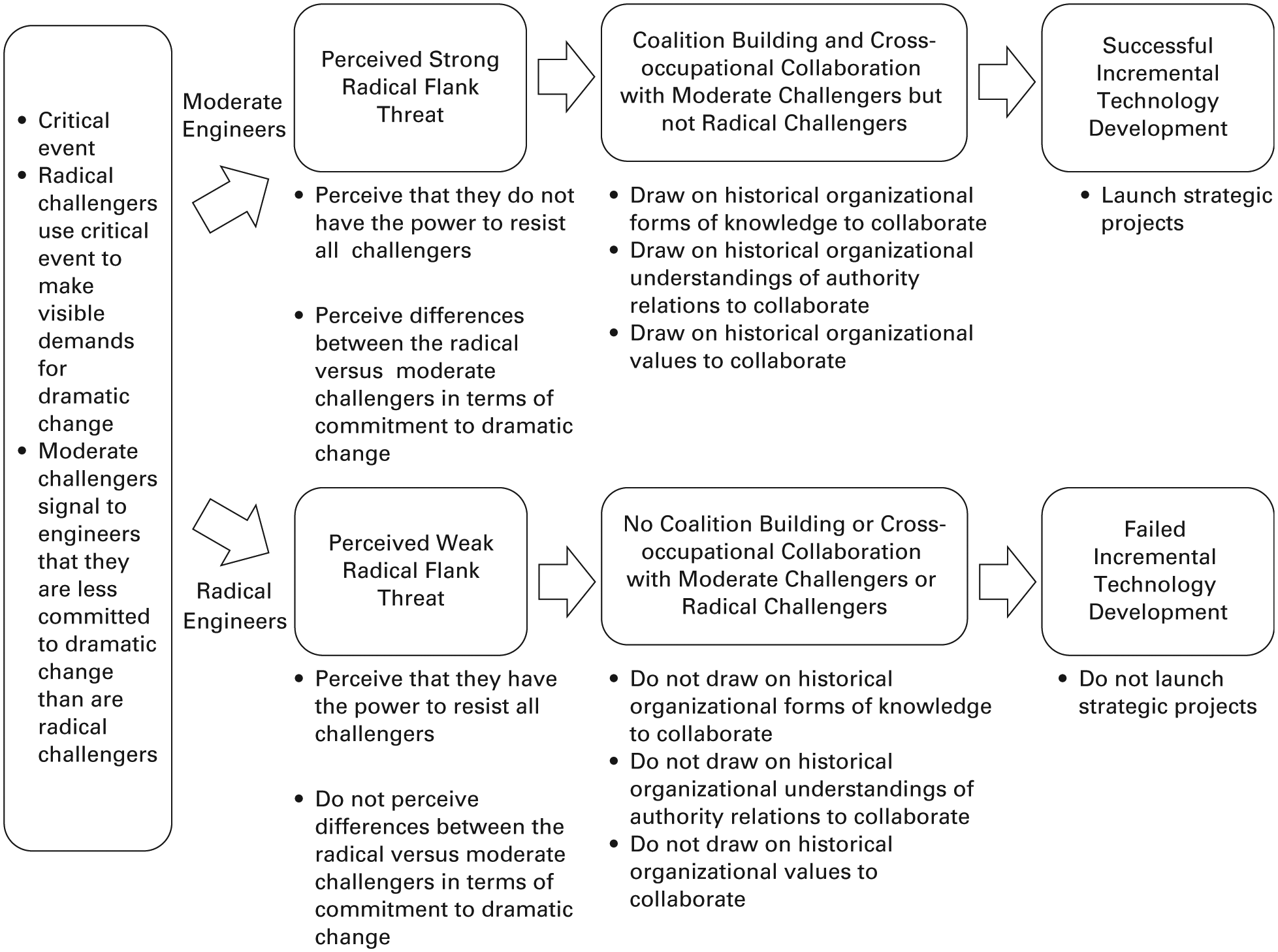
Radical flank threat and cross-occupational collaboration for incremental technology development.
Adaptation and Inertia in Technology-based Organizations
The current literature has focused on the development of radical new technologies that enable incumbent firms to remain competitive as their environments change (e.g., Tushman and O’Reilly, 1996; Tripsas and Gavetti, 2000). It does not explore the dynamics associated with the transition from developing radical new technologies to engaging in incremental innovation. Our study highlights that, far from being an easy transition, this shift can be very challenging for an organization because it requires a shift in the balance of power away from the dominant engineering group that developed the initial technology and toward a challenger group in the organization. Shifts in balance of power during times of technology change can lead to conflict inside organizations (Kaplan, 2008; Tripsas, 2009).
Because it has focused on the development of radical new technologies, the existing literature on incumbent adaptation details mechanisms that shield and protect the technology development efforts of the challenger engineering group from the dominant engineering group (e.g., Tripsas and Gavetti, 2000). Our study highlights a different mechanism useful for adaptation in cases such as the transition from developing radical new technologies to engaging in incremental innovation in which the challenge is fostering collaboration. We find that a strong radical flank threat can facilitate such collaboration. In the face of a strong threat by radical members of a challenger group, moderate members of the dominant engineering group may change their perceptions about their power to resist challengers’ demands and may make distinctions between the goals and tactics of radical challengers and those of more-moderate challengers. To maintain as much power as possible and prevent the more-dramatic change in the dominant group’s goals being demanded by radical challengers, moderate members of the dominant group may accept the coalition-building efforts of moderate challengers, and these two groups of moderates may collaborate for incremental technology development.
Finally, the current literature primarily examines cases in which the members of the dominant and challenger groups are in the same occupation: engineering (e.g., Christensen and Bower, 1996; Tripsas and Gavetti, 2000). When groups are from different occupations and an organizational transition threatens the power of the dominant group, however, the challenge is to get dominant occupational group members to make the day-to-day concessions in occupational knowledge, understandings of authority relations, and values required for collaboration. In the face of a strong radical flank threat, moderates from the dominant occupational group may make these concessions by drawing on organizational rather than occupational knowledge, understandings of authority relations, and values in their interactions with moderate challengers.
Cross-occupational Collaboration
The existing cross-occupational collaboration literature suggests that when a dominant occupational group’s jurisdiction is under threat from a challenger group, the members of the dominant group are likely to resist applying their occupational knowledge in new ways to assist the challenger group, resist abdicating authority to the challenger group, and resist using values that would legitimize the challenger group’s claims to the dominant group’s jurisdiction (Vallas, 2001; Bechky, 2003a; Metiu, 2006). We find that cross-occupational collaboration inside organizations can be facilitated under this condition by a strong radical flank threat. Such a threat can lead moderate members of the dominant group to change their perceptions about their power to resist the demands of the challenger group, to distinguish between the goals and tactics of radical versus more-moderate challengers, and to build a coalition with moderate challengers and collaborate with them to maintain as much power as possible and prevent the more-dramatic change in dominant occupational group goals being demanded by radical challengers.
The current literature on cross-occupational collaboration also describes occupation members as a unified group (Bechky, 2003b; Kellogg, Orlikowski, and Yates, 2006; Anteby, Chan, and DiBenigno, 2016). We demonstrate that within occupational groups working inside an organization, there can be heterogeneity in how committed occupation members are to using occupational knowledge, understandings of authority relations, and values in their work. Gouldner (1957) referred to these different kinds of occupation members as “cosmopolitans” versus “locals.” We show that the presence of these different kinds of members in each occupation may allow an opportunity for cross-occupational collaboration between the less occupationally oriented members of each group, who may be more amenable to making the day-to-day concessions required for collaboration.
Finally, the current literature suggests that cross-occupational collaboration practices may change over time through a process of slippage between the jurisdictional structures and the everyday interactions of occupation members (e.g., Barley, 1986), through a process of improvisation as organization members appropriate new technology into their work practices (Orlikowski, 1996, 2000) or through a process of constructed breaches that open up the practices of the dominant group to evaluation, questioning, and de-legitimation (Huising, 2014). We show that cross-occupational collaboration practices may also change over time through a process of moderate members of both occupational groups building a coalition with one another. By drawing on shared organizational knowledge, understanding of authority relations, and values, moderates can build a coalition to engage in new forms of interaction and, in turn, enact new occupational knowledge, understandings of authority relations, and values that allow them to engage in ongoing collaboration.
Conflict in Organizations
These findings also contribute to our understanding of conflict in organizations in two ways. First, the literature on organizational conflict has demonstrated that team members experience three major types of interpersonal conflicts in their everyday dyadic interaction: task conflicts, process conflicts, and relationship conflicts (e.g., Jehn, 1995). The findings presented here highlight that when an organizational team is composed of members from different occupational groups and the power of the dominant occupational group is under threat, what look like idiosyncratic, interpersonal conflicts may actually be structured manifestations of a collective jurisdictional struggle playing out in the organization. Under these conditions, interpersonal task conflicts—disagreements over ideas and opinions pertaining to the group’s task—may be shaped by broader struggles between a challenger group and a dominant group over the knowledge of the dominant occupational group. Interpersonal process conflicts—disagreements about dividing and delegating responsibilities and deciding how to get work done—may be shaped by broader struggles between a challenger group and a dominant group over the authority of the dominant occupational group. And interpersonal relationship conflicts—disagreements resulting from interpersonal incompatibilities such as different values—may be shaped by broader struggles between a challenger group and a dominant group over the values of the dominant occupational group. Our findings are consistent with Bendersky and Hays (2012), who demonstrate that team members’ conflicts can be shaped by individuals’ concerns about their individual status in addition to their concerns about task, process, or relationship conflict. We demonstrate that, in teams composed of members from different occupational groups during a time when the power of the dominant group is under threat, team members’ conflicts can be also shaped by collective concerns about protecting or increasing the valuable jurisdiction of their occupational group.
Second, the literature on organizational conflict shows that faultlines based on demographic characteristics can increase the conflict experienced in a team (Lau and Murnighan, 2005). Scholars have demonstrated that one way to deactivate faultlines is by giving groups a superordinate group identity (Jehn and Bezrukova, 2010), and they have called for additional studies of how faultlines can be deactivated and conflict decreased (Jehn and Greer, 2012). We demonstrate that one way to deactivate faultlines may be by introducing a strong radical flank threat that leads more-moderate members of each group to engage in coalition building by drawing on organizational knowledge, understandings of authority relations, and values rather than those of the occupational groups.
Future Research
Our findings highlight several boundary conditions for a radical flank threat to be useful during the transition from developing radical new technologies to incremental technology development: (1) a well-entrenched engineering group composed of some members with a strong occupational orientation (radical engineers) and some members with a less strong occupational orientation (moderate engineers), (2) a challenger occupational group composed of some members with a strong occupational orientation (radical challengers) and some members with a less strong occupational orientation (moderate challengers), (3) a critical event, (4) radical challengers’ use of the critical event to make visible demands for dramatic change, and (5) moderate challengers’ signaling to engineers that they are less committed to dramatic change than are radical challengers. Based on the wide use of Gouldner’s concept of cosmopolitans versus locals, we think that it is likely quite common for engineering groups and challenger groups to be composed of some members with a strong occupational orientation and some with a less strong occupational orientation. Future research could determine how often radical challengers use critical events to make visible demands for dramatic change and moderate challengers signal to dominant group members that they are less committed to dramatic change than are radical challengers. Future research could explore the conditions under which moderate solutions accomplished by the radical flank effect can be productive to the success of an organization going through a power shift. Finally, though our study focuses on dynamics between an engineering and marketing group, these dynamics might occur between other kinds of dominant and challenger groups in organizations undergoing transitions (e.g., in a financial services company with a dominant sales department, if the business model changed in a way that privileged the analytics department). Future research might also explore if, when, and how the radical flank effect can be valuable for organizations during other types of transitions.
Footnotes
Acknowledgements
We gratefully acknowledge Lotte Bailyn for tremendous support throughout all phases of this research and Mauro Guillén and three anonymous reviewers for improving the paper throughout the review process. The article has benefited greatly from comments on earlier drafts by Howard Aldrich, Matt Beane, Corinne Bendersky, Curtis Chan, Julia DiBenigno, Erik Duhaime, Roberto Fernandez, Linda Hill, Sarah Kaplan, Arvind Karunakaran, Dan Levinthal, Leslie Perlow, Ray Reagans, Luciana Silvestri, Cat Turco, Mike Tushman, John Van Maanen, Ezra Zuckerman, participants in the HBS Craft of Inductive Qualitative Research seminar, Boston Fieldworkers, the Emerging Scholars Workshop at Wharton, MIT Organization Studies Group seminar, MIT Economic Sociology Working Group, and WOW group.
1
We concluded data collection after one year because by this point a stable pattern of cross-occupational collaboration between moderate engineers and moderate marketers had been established, and we continued to see no cross-occupational collaboration between any other pairs.
2
It was somewhat unusual for Transco’s engineers to work directly with Transco’s marketers. In many companies, project or product managers serve as a liaison between these two occupational groups. Transco did have product managers, and part of their role was to serve as project managers for engineering scrum teams, so they were often in meetings with engineers and marketers. But they were ineffective at controlling engineers because they had no formal authority over them. Also, many product managers saw serving as project managers as an undesirable task; they preferred to “be thinking big about what’s next for Transco” rather than trying to influence engineers.
3
In T2, most projects were either moderate engineer–moderate marketer or radical engineer–radical marketer, because moderate engineers were by this time collaborating with moderate marketers. Therefore, the more experienced moderate engineers who were likely to lead projects were engaged in work and unavailable, making radical engineers often the only option to work on many radical marketers’ projects.
4
This knowledge had been commonly drawn on before Transco went public, roughly a year before our study began. Though moderate engineers had generally been at the company for less time than had radical engineers, most had been at the company before it went public and hence had been exposed to these two kinds of organizational knowledge. In the past, these two kinds of organizational knowledge had not been used to facilitate cross-occupational collaboration but rather to motivate Transco members to distinguish themselves as dedicated employees and to get important organizational work done.
Authors’ Biographies
References
Supplementary Material
Please find the following supplemental material available below.
For Open Access articles published under a Creative Commons License, all supplemental material carries the same license as the article it is associated with.
For non-Open Access articles published, all supplemental material carries a non-exclusive license, and permission requests for re-use of supplemental material or any part of supplemental material shall be sent directly to the copyright owner as specified in the copyright notice associated with the article.
