




Abstract
Due to its often-ambiguous nature, workplace discrimination can be difficult to detect. Attributing situations to discrimination is the first step toward challenging and combatting such instances. Following the PRISMA-ScR guidelines, this scoping review synthesizes experimental research on the causal predictors of discrimination attributions in organizational settings. Our systematic literature search yielded 63 experimental studies from 31 articles published between 1999 and 2023, for a total of 20,725 participants across studies. These studies, conducted almost exclusively in the United States, focused primarily on the role of ambiguous information (action-related factors), the gender or racial prototypicality of targets (actor-related factors) and the unintended effects of pro-diversity policies (context-related factors). Findings indicate that status asymmetry and the prototypicality of victims and perpetrators increase the likelihood that a situation is considered discriminatory, while the presence of organizational diversity policies and equality frames tends to reduce it. We encourage future research to broaden its scope to include other countries and grounds of discrimination, and to pay more attention to differences in attributions across actors and contexts.
Keywords
Introduction
Discrimination is pervasive in the labour market. A recent meta-analysis of 62 countries indicates that, on average, about one in five employees (17%) experiences discrimination and more than every second employee (58%) witnesses it (Dhanani et al., 2021). Both self-reports and field experiments confirm that workplace discrimination is significant and persistent across different countries and over time (Galos and Coppock, 2023; Quillian et al., 2019). Discrimination not only undermines organizational functioning, but also inflicts cognitive, psychological and physiological harm on both targets and bystanders, who experience what is known as vicarious discrimination (Jones et al., 2016; Ozier et al., 2019). As noted by Inman and Baron (1996: 727), ‘noticing and correctly categorizing prejudiced action (i.e. discrimination) is a key condition for changing such behaviour’.
In the literature, discrimination is commonly defined as unfair differential treatment based on group membership (Major et al., 2002). However, determining whether a particular treatment is unfair or based on group membership is not always straightforward. Research in social psychology suggests that most discriminatory incidents go undetected and increasingly take the form of subtle, low-intensity behaviours (Major et al., 2002; Stangor et al., 2003). The ambiguity inherent in many discriminatory events can leave people uncertain about whether discrimination has occurred in the first place (Harnois, 2023; Jones et al., 2017; Stangor et al., 2003). This uncertainty, known as ‘attributional ambiguity’ (Crocker and Major, 1989; Major et al., 2002), can discourage people from reporting workplace discrimination out of fear of not being believed (Kaiser and Miller, 2003). To resolve this ambiguity, people tend to rely on prototypes. Whether an instance is attributed to discrimination depends on how well it fits widely held beliefs about what discrimination is like, i.e. a discrimination prototype (Inman and Baron, 1996; Major and Dover, 2015). This prototype is influenced by what happens and how (action-related characteristics), who is involved (actor-related characteristics), and where the action occurs (context-related characteristics). These aspects are likely to jointly influence perceptions, although they are typically studied in isolation.
Understanding the drivers of discrimination attributions in workplace settings is important because, if discrimination goes unacknowledged, employees might develop grievances and feel disempowered. When broadly defined discrimination prototypes are widely shared, both the detection of discrimination and the likelihood of bystander intervention increase. In contrast, specific forms of discrimination may go unnoticed when prototypes are too narrow. Moreover, if prototypes vary substantially across groups or contexts, one group's experiences may be contested by another, potentially generating feelings of relative deprivation, resentment and identity threat, dynamics that can give rise to workplace conflicts (Light et al., 2011). Indeed, the misrecognition of others’ experiences has been a catalyst for recent societal tensions, such as the ‘All Lives Matter’ response to the Black Lives Matter movement; it has also fuelled resistance against workplace efforts tackling gender and racial inequalities, as shown by the recent backlash against diversity policies in the United States. While shared perceptions are a prerequisite for collective action, attributions can vary even among individuals from the same low-status groups: some may perceive legitimate actions as discriminatory (i.e. a vigilance bias), while others may ignore or dismiss unlawful ones (i.e. a minimization bias; Major et al., 2002). Understanding how these different actors form discrimination attributions is thus crucial for sociologists, as shared perceptions increase the likelihood that such experiences are seen as legitimate and acted upon (Lamont, 2023).
Research on the causes of discrimination attributions often relies on the experimental method. Survey experiments are powerful research designs, especially when they combine the internal validity of experimental methods with the external validity of representative samples from the target group. The experimental manipulation of different situational factors (e.g. explicitness of the action, target characteristics, organizational context) through randomization provides causal leverage to examine their impact on discrimination attributions, either independently or in conjunction with other factors. Randomization eliminates confounding from measured and unmeasured respondent characteristics (e.g. experiences, beliefs), thus ensuring high internal validity (Mize and Manago, 2022; Mutz, 2011).
Given the strength of experimental designs in identifying the causes of discrimination attributions, we systematically review this body of research. Previous literature reviews on this topic have either been unsystematic due to the lack of a clear search and screening protocol (e.g. Major and Dover, 2015; Shen and Dhanani, 2018) or have explicitly excluded experimental studies (Dhanani et al., 2018). Here, we take stock of research that has largely developed within social psychology and bring it to the attention of a sociological audience. Sociologists have focused more on identifying the existence of discrimination through field experiments (e.g. Erlandsson, 2024; Quillian et al., 2019) or its impact on occupational attainments, feelings of exclusion and marginalization through surveys (e.g. Diehl and Trittler, 2025; Diop et al., 2025). While field experiments examine the exposure of hypothetical applicants to discriminatory gatekeepers, regardless of attributions, survey research relies on measurement scales that ask about discrimination in general terms, without reference to specific events (see, for example, Dhanani et al., 2021; Lewis et al., 2015). When survey measures do refer to specific incidents, they usually distinguish between major life events and more subtle microaggressions (Shen and Dhanani, 2018), but still capture a wide range of negative behaviours that vary in ambiguity, severity, actors involved, context, justification, motivation, etc. All these factors likely influence attribution processes, yet correlational survey research cannot disentangle which specific features lead individuals to interpret a situation as discriminatory. Moreover, most of what we know from survey-based research reflects the target's perspective, with only more recent research focusing on discrimination that is witnessed or observed, i.e. vicarious discrimination (Dhanani et al., 2021).
We address four questions with our scoping review:
What kinds of situations have been examined and how? How explicit is the operationalization of discrimination as the dependent variable? Which factors have been experimentally varied and found to exert a causal impact on discrimination attributions? Do the factors influencing discrimination attributions vary depending on the perspective taken (e.g. victim, perpetrator, observer)?
Methods
Eligibility criteria
Following the PRISMA guidelines for scoping reviews (Tricco et al., 2018; see online supplement 3), we systematically searched and analysed experimental research on discrimination attributions. This review was pre-registered (https://osf.io/2ye6d/overview) 1 .
We included peer-reviewed, experimental studies that asked respondents to assess whether a hypothetical workplace situation was discriminatory. We only selected studies that explicitly referred to discrimination as the dependent variable. If a study relied on related concepts (e.g. microaggressions), at least one of the items used to measure the dependent variable had to include the word discrimination for the study to be eligible, or the authors had to provide a clear rationale for operationalizing discrimination with the specific measure.
We only considered English-language publications. There were no exclusion criteria concerning specific discrimination grounds, time and geographic scope.
Literature search and selection
Because workplace discrimination is studied across disciplines, we conducted the main literature search in SCOPUS (496 articles) and Web of Science (433 articles, of which 264 were uniquely in Web of Science). We used the following search string for the SCOPUS search:
(TITLE-ABS-KEY (experiment* OR vignette OR scenario OR factorial OR random)) AND (TITLE-ABS-KEY (workplace OR ‘labo*r market’ OR company OR office OR job OR occupation* OR employment OR organi*ation* OR ‘work environment’)) AND (TITLE-ABS-KEY ((attribut* OR judg* OR perceiv* OR perception* OR recogni* OR detect* OR observ* OR witness* OR experienc*) W/2 (discriminat*))).
After a broad first screening in which duplicates, non-English and non-peer-reviewed articles were removed, we proceeded with screening the titles and abstracts. Intercoder reliability was very high (97%) 2 and diverging judgements were resolved during calibration meetings. We retained the 47 articles and continued with the full-text screening, which yielded 23 articles including 49 independent studies. Additionally, we employed forward and backward snowballing: we checked the references of the included studies and used text-mining strategies to screen the abstracts of studies citing those already included in the review. This process added 14 studies to the review. See Figure 1 for the selection process of the included studies. The final dataset is available online.
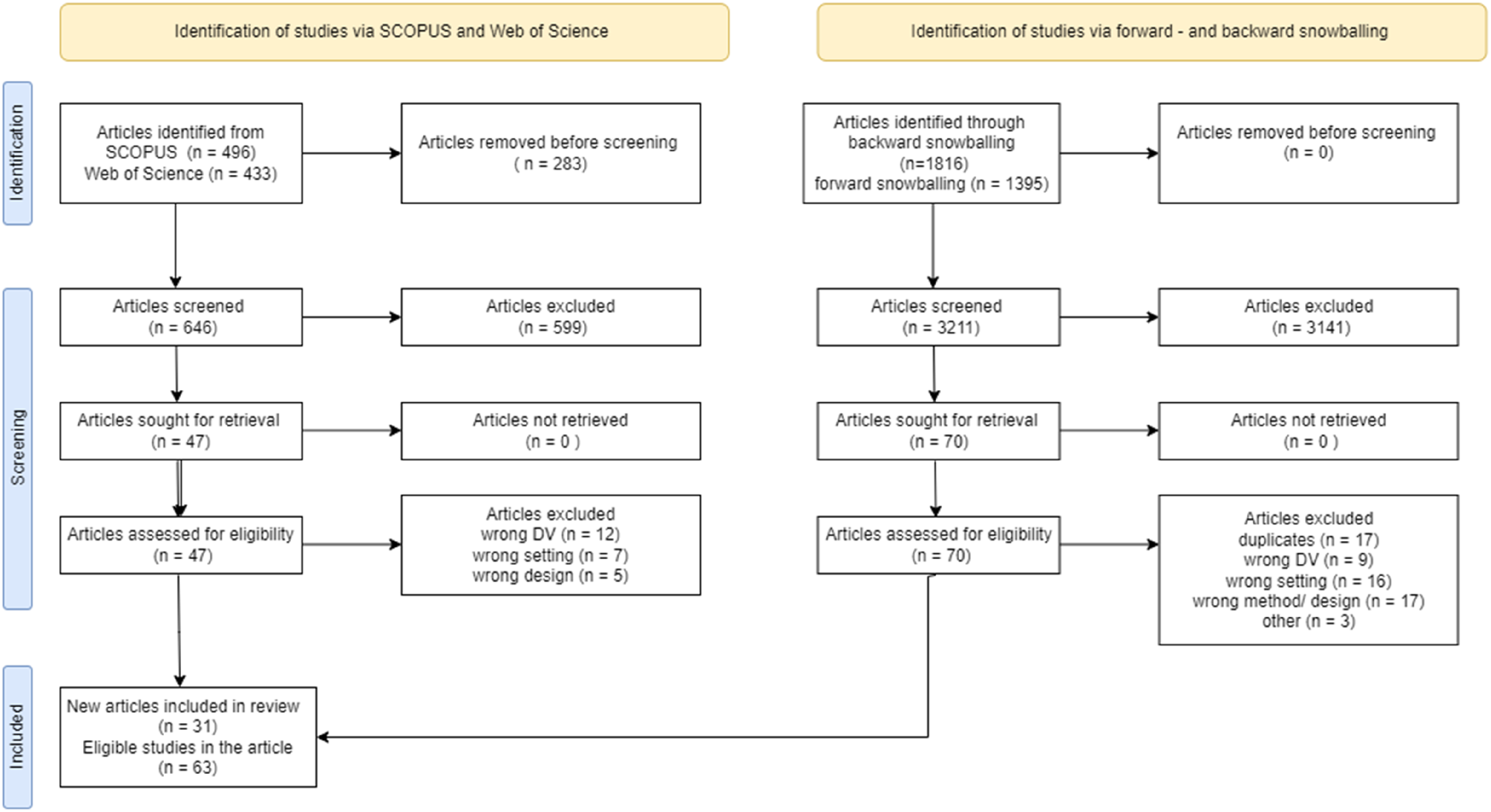
PRISMA flowchart of the systematic search.
Results
In total, 63 experimental studies from 31 articles met our eligibility criteria. While some of the articles reported more than one experiment, we present our findings narratively on the study level, as each experiment was based on an independent sample (see online supplement 1 for a list of all studies).
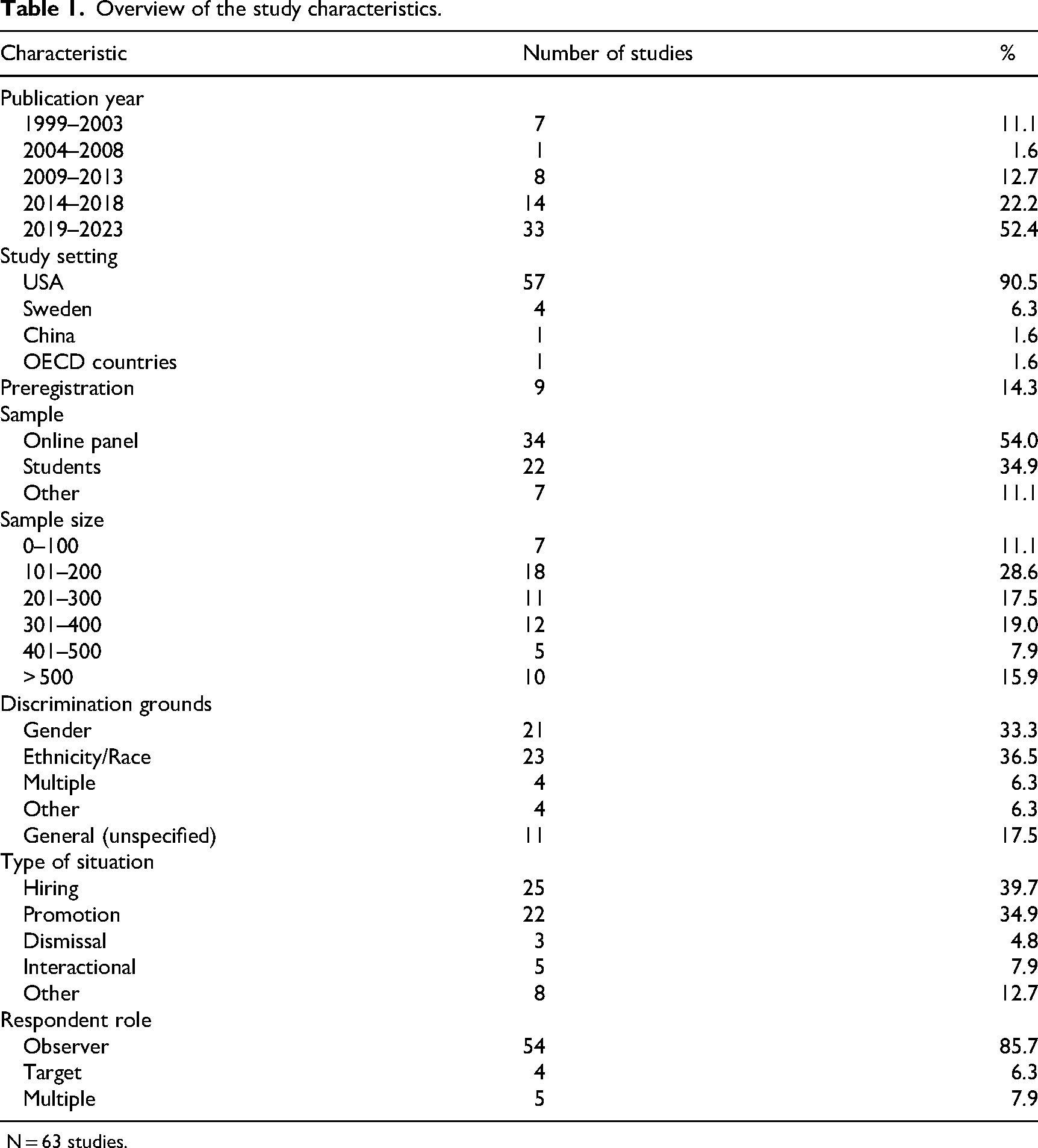
As depicted in Table 1, the studies were conducted between 1999 and 2023, with two-thirds of the articles (and three-quarters of the studies) published in the past 10 years, and half of the studies published in the past five years. Except for six studies (Carlsson and Sinclair, 2018: 1–4; Hsee and Li, 2022: 1b, 1d), 90.5% of the identified studies were fielded in the United States (N = 57). They were published predominantly in journals within the disciplines of social psychology and organizational studies. The nine studies (14%) that pre-registered their experiments were all published in the last four years, suggesting a trend towards more open science research practices.
Overview of the study characteristics.
N = 63 studies.
Sample sizes ranged from 39 to 2087 (mean=329 participants), with participants mostly drawn from online panels (N = 34, 54%) or student samples (N = 22, 34.9%), for a total of 20,725 participants. Many studies examined ethno-racial discrimination (N = 23, 36.5%) or gender discrimination (N = 21, 33.3%). Only four studies considered multiple grounds simultaneously, namely race and gender (De Leon and Rosette, 2022: 2a, 2b; Gough, 2018; Nag et al., 2022).
In the following, we first summarize the key features of the experimental designs. We then provide an overview of the scenarios examined, focusing on the type of action described, the actors involved and the context in which it took place. Next, we compare the measures used to capture perceptions of discrimination and summarize key findings on how action-, actor- and context-related factors (and their interplay) influence attribution processes. 3
Types of experimental designs
In all studies, respondents judged a hypothetical scenario in which characteristics of the action, context and actors involved, or combinations thereof, were randomly varied. With the exception of two lab experiments (Dover et al., 2021; Inman, 2001), the rest of the studies consists of survey experiments, depicting a potentially discriminatory action or environment, most often using a text-based vignette (e.g. Lindsey et al., 2015). 4
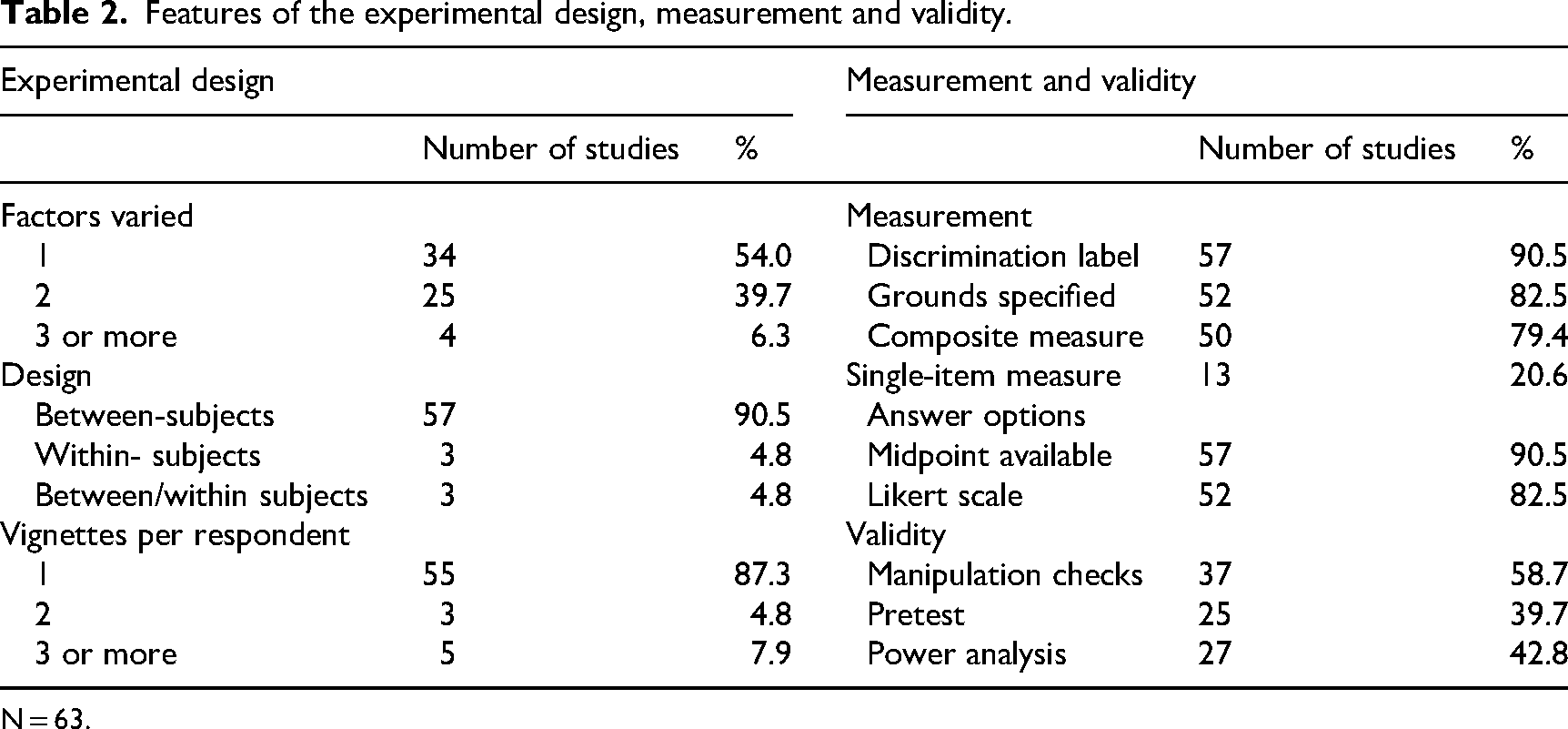
We compare experimental designs in terms of their factors (i.e. the characteristics that are randomly manipulated, such as target race) and their correspondent levels (i.e. the different values a factor can take, such as Black, White or Asian background). Most studies varied only one (N = 34, 54.0%) or two (N = 25, 39.7%) factors, with the number of levels ranging from two to 10 (Table 2). 5 The majority of studies (N = 39, 61.9%) varied factors related to only one aspect of the situation, whether action-, actor-, or context-related. Of these, nine studies manipulated only action-related characteristics (e.g. framing, explicitness), 14 studies varied attributes of the person described in the scenario (predominantly target gender and race) or of the person rating the scenario (predominantly their role) and 16 studies manipulated contextual factors (predominantly diversity initiatives). The remaining studies varied different types of situational aspects simultaneously. Nine studies varied both action- and actor-related characteristics (e.g. situational ambiguity and target gender), three varied action- and context-related characteristics (e.g. situational ambiguity and occupational stereotypes), and 12 varied actor- and context-related characteristics (e.g. target gender and occupational stereotypes). None of the studies varied action-, actor- and context-related factors within the same design.
Features of the experimental design, measurement and validity.
N = 63.
About 40% of the studies (N = 25) reported pretesting the experimental stimuli, relied on validated stimuli from previous studies, or ensured through ecological validity checks that the fictitious scenarios reflected real-life situations. These checks could take the form of cognitive interviewing, developing scenarios based on qualitative reports of workplace discrimination, or seeking expert feedback (e.g. Elkins and Phillips, 1999; Gough, 2018; Kaiser et al., 2013). Manipulation checks to verify whether the treatment of interest had the intended effect were explicitly reported in 37 studies (59%). The remaining studies either did not conduct manipulation checks or simply did not report them.
The vast majority of studies (N = 57, 90.5%) employed a between-subject design, in which experimental treatments varied between individuals and each respondent evaluated only one randomly assigned scenario. While between-subject designs are less demanding for participants, they require larger sample sizes to achieve sufficient statistical power. Within-subject designs (treatments varied within individuals) were employed in only three studies (4.8%; Basford et al., 2014; Dover et al., 2016: 1; Offermann et al., 2013) and the maximum number of scenarios per participant was eight. Within-subject designs are more economical, allowing respondents to serve as their own control and requiring smaller samples to detect effects, but they are vulnerable to demand and order effects, i.e. the risk that participants understand the goal of the experiment and align their responses with the study's hypotheses (Mize and Manago, 2022; Mutz, 2011). Indeed, in the two studies with eight scenarios per respondent, the authors added filler scenarios to blur the study's purpose (Basford et al., 2014; Offermann et al., 2013). Three studies (4.8%; Carlsson and Sinclair, 2018: 2; Lindsey et al., 2015: 1; McElhattan et al., 2017: 1) employed a between-within design, with treatments varying both within and between respondents.
What kinds of scenarios have been examined and how?
Actions
Regarding the type of action under study, a large majority of experiments focused on formal acts, i.e. job-related situations that affect the distribution of organizational resources (Hebl et al., 2002) such as hiring (N = 25, 39.7%) or promotion (N = 22, 34.9%). For example, Phillips and Jun (2022) examined how framing a hiring decision as favouring or disadvantaging a candidate influenced perceptions. Only four studies (6.3%) examined interpersonal acts, including offensive or inappropriate remarks, lack of recognition for people's input or interactions about performance assessments. For instance, respondents in Clarke's study (2022) had to judge a scenario in which a manager asked a female employee intimate questions over lunch. One study randomly varied the formality of the event, whether formal or interpersonal, as part of the experimental design (Lindsey et al., 2015).
Actors
Turning to the actors described in the scenarios, most of the emphasis was placed on the target. When an encounter between multiple people was depicted, it typically involved a perpetrator and a target. Except for one vignette used in Basford et al. (2014), none of the fictitious scenarios explicitly included a bystander. In all cases, the targets were (potential) employees, mostly in a subordinate position relative to the perpetrator. The target's gender varied in 12 studies (20.6%) and the target's race in seven studies (11.1%).
In nearly all studies, the perpetrators were managers, supervisors, HR professionals, or the company as a whole. The only exception to the focus on prototypical, high-status perpetrators are two studies that depict interpersonal discrimination enacted by a colleague (Gloor et al., 2023: 2; Lindsey et al., 2015: 1). In 39 studies (61.9%), the scenarios referred to a target who was treated better or worse than another, i.e. a comparator. Of the remaining studies, the large majority did not include any information about comparators, and a few included comparators only in some vignettes (e.g. Elkins and Phillips, 1999: 1).
Contexts
The scenarios mostly referred to professionals or managers working in high-skilled occupations in sectors such as accounting, management and consultancy, engineering, IT and pharmaceutics. In five cases, the occupation was varied experimentally (Carlsson and Sinclair, 2018: 1–3; Elkins et al., 2002; Elkins & Phillips, 1999: 1). In 19 cases (30.2%), the context was left unspecified; for example, respondents were asked to consider a hypothetical company without further detail (e.g. Johnson et al., 2013: 1). In two cases, participants were instructed to imagine the scenario as occurring within their own company (Gloor et al., 2023; Kaiser et al., 2013: 6).
How explicit is the operationalization of discrimination as the dependent variable?
Accurate measurement is crucial for the kind of conclusions that can be drawn (Shen and Dhanani, 2018), especially when the goal is to advance knowledge on a phenomenon, like discrimination, that is inherently ambiguous. Following the search criteria, in the vast majority of studies (N = 57, 90.5%; Table 2) the dependent variable explicitly referred to discrimination, either by including the term in a single-item measure (e.g. Carlsson and Sinclair, 2018: 1) or by mentioning it in at least one item of a scale (e.g. Kong & Jolly, 2019: 3). For example, one study used a perceived microaggression scale with items ‘originally developed to assess the degree to which observers perceive supervisors to be intentionally discriminatory’ (Basford et al., 2014: 343). In the other cases, although the concept being measured was discrimination, the term itself was not explicitly mentioned in the items presented to respondents (e.g. Lindsey et al., 2015: 1). For example, a study relied on a measure of favouritism to test the generalizability of findings obtained with more explicit measures and interpreted as the opposite of discrimination (Hsee & Li, 2022: 2).
The grounds of discrimination, such as gender or race, were explicitly specified in the question or at least some of the scale items in 52 studies (82.5%). This helps to ensure that respondents attribute the discriminatory incident described in the scenario to the specific ground of interest to the researchers. 6 Referring to social identities is also crucial for distinguishing the concept of discrimination from other forms of workplace mistreatment, as discrimination is identity-based and specifically motivated by the target's group membership (Dhanani and Bogart, 2025).
Apart from 13 studies that relied on single-item measures (20.6%), the remaining ones averaged multiple items into a composite measure of perceived discrimination), with the number of items ranging from one to 22 (Table 2). We also looked at whether respondents were able to express uncertainty in their attributions, but none of the studies explicitly stated that a ‘don’t know’ option was available. While 57 studies (90.5%) included a midpoint in their Likert-type response scales, it was often unclear whether and how this midpoint was labelled. This is unfortunate, given the lack of consistency in how participants interpret the meaning of midpoints in response scales, which can increase the risk of moderacy bias and socially desirable responding behaviour (Sturgis et al., 2014).
Which factors have a causal effect on discrimination attributions?
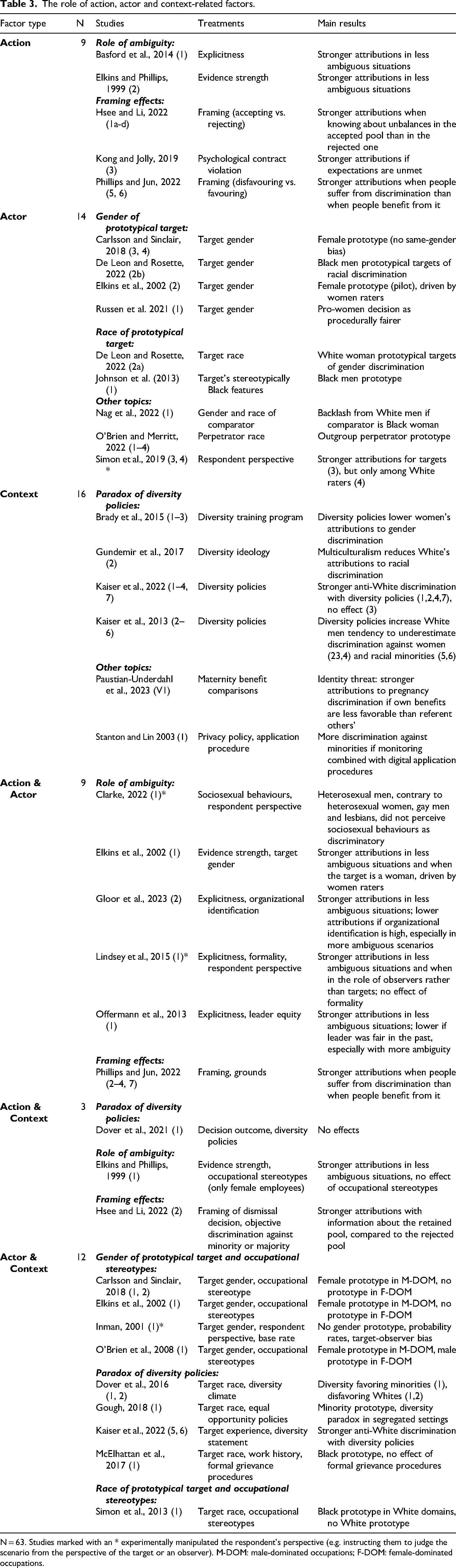
There is considerable variation in the types of factors that were manipulated and in how they were manipulated (Table 3). Due to this heterogeneity, we present overarching patterns that emerge across studies, reflecting on whether characteristics related to the action (what/how), actors (who) and context (where) that were found to causally affect attributions are consistent with the prototype model of discrimination.
Action-related factors: discrimination as overt, negative treatment
Discriminatory incidents are multidimensional (Jones et al., 2017): in other words, different aspects of what happens, and how it happens, can influence whether an action is attributed to discrimination. Two action-related factors stood out. First, seven studies, all relatively recent (11.1%; Dover et al., 2021: 1; Phillips and Jun, 2022: 2–7), examined whether the outcome of a single decision-making process (whether or not to hire/promote/dismiss a candidate) or its framing (favouring/disfavouring) influenced discrimination attributions. Their results show that negative outcomes and frames are more readily attributed to discrimination than positive ones, consistent with the prototype of discrimination as negative rather than positive differential treatment. At the same time, at the aggregate level, people perceive more discrimination when knowing the composition of the accepted pool of applicants rather than the composition of the pool of rejected ones (Hsee and Li, 2022: 2–7), regardless of the presence of objective discrimination.
The role of action, actor and context-related factors.
N = 63. Studies marked with an * experimentally manipulated the respondent's perspective (e.g. instructing them to judge the scenario from the perspective of the target or an observer). M-DOM: male-dominated occupations; F-DOM: female-dominated occupations.
Second, seven studies (11.1%; Basford et al., 2014: 1; Clarke, 2022: 1; Elkins and Phillips, 1999: 1, 2; Elkins et al., 2002: 1; Gloor et al., 2023: 2; Lindsey et al., 2015: 1; Offermann et al., 2013: 1) manipulated the explicitness of the discriminatory action or, in studies with mock jurors, the strength of evidence. All of them found that higher situational ambiguity – for example, more subtle actions – reduces the likelihood that the behaviour is perceived as discriminatory. Moreover, two studies indicate that stronger organizational identification (Gloor et al., 2023) or the presence of cues suggesting that the manager had a reputation for fairness in the past (Offermann et al., 2013) lower discrimination attributions, especially under conditions of high situational ambiguity.
Note that, with the exception of Clarke (2022), these studies often employed qualitatively distinct scenarios. For example, Basford et al. (2014) focused on ambiguous actions ranging from subtle and less prototypical to blatant and more prototypical forms of discriminatory treatment. However, explicitness was not the only factor that varied across the scenarios, which involved people in different roles and departments, sometimes with both victim and perpetrator present, and other times not. This makes it difficult to isolate the causal effect of explicitness on discrimination attributions. One solution, adopted by Offermann et al. (2013), was to counterbalance the treatment assignment across vignette types, to rule out any possible confounding effect of vignette content.
Explicitness was at times signalled indirectly. For example, in Elkins and Phillips (1999: 1, 2), information about the presence and characteristics of a comparator was added to the vignettes to signal weak, moderate, or strong evidence of discriminatory intent. This, however, blurs the distinction between action-related characteristics and actor-related ones. More generally, we note that aspects of formality, subtlety/explicitness and intentionality are often conflated in the experimental scenarios. While these dimensions may seem similar, Lindsey et al. (2015) demonstrated that female respondents could reliably distinguish between subtle and interpersonal, as well as overt and formal instances of gender discrimination. Their findings highlight the importance of simultaneously varying multiple action-related aspects, to capture events in their multidimensionality and enhance construct clarity.
Actor-related factors: prototypical victims and perpetrators
A few studies tested the status-asymmetry hypothesis, according to which prototypical discrimination involves high-status groups treating low-status groups unfairly, rather than the reverse. In line with the hypothesis, gender discrimination attributions were stronger when the target is a woman rather than a man (e.g. Elkins et al., 2002), and racial discrimination attributions were stronger when the target is Black rather than White (e.g. Johnson et al., 2013). Studies that jointly varied actor- and context-related factors tested stereotype-asymmetry effects, predicting stronger discrimination attributions in contexts where the target group is negatively stereotyped. Interactions between target group and occupational stereotypes showed that gender and racial prototypes are context-dependent (Carlsson and Sinclair, 2018: 1, 2; Elkins et al., 2002; O’Brien et al., 2008; Simon et al., 2013). For example, O’Brien et al. (2008: 1) experimentally varied the gender of a hiring manager who rejected a candidate of the opposite gender for a job that required either stereotypically feminine skills, masculine skills, or gender-neutral skills. In stereotypically feminine jobs, as predicted, attributions were stronger for the female manager rejecting a male applicant than for the male manager rejecting a female applicant. The reverse pattern was observed for stereotypically masculine jobs. However, Carlsson and Sinclair (2018: 1, 2) as well as Elkins et al. (2002: 1) only found evidence of a female target prototype in male-dominated occupations but not vice versa, while in Inman (2001) occupational stereotypes did not have any effect on discrimination attributions.
Simon et al. (2013) tested the stereotype-asymmetry hypothesis with regard to race. They presented participants with a hiring scenario in which a music band agent, representing either a stereotypical White band (Alternative Rock) or a stereotypical Black band (Rhythm and Blues), hired either a White or a Black applicant. The agent's racial background was randomly varied but always matched that of the hired applicant. Participants were more likely to attribute discrimination when the Black applicant was rejected in the stereotypically White domain than in the stereotypically Black domain. Interestingly, for White applicants discrimination attributions were unaffected by the domain. Across studies, stereotype-asymmetry effects appear to be asymmetrical, holding mainly for target groups that have generally lower status in society, namely, women in male-dominated occupations and Blacks in stereotypically White contexts.
A handful of studies have applied an intersectional lens to examine attributions of gender and racial discrimination. In a couple of experiments, De Leon and Rosette (2022: 2a, 2b) showed that Black women are non-prototypical targets of discrimination: compared to them, White women were more readily identified as targets of gender discrimination, while Black men were more readily recognized as targets of racial discrimination. This non-prototypical status – stemming from the intersection of multiple marginalized identities – makes Black women intersectionally invisible, causing their discrimination experiences to be more often overlooked or neglected (Purdie-Vaughns and Eibach, 2008). At the same time, one study found that when Black women are favoured for a promotion, their advantage tends to be perceived as discriminatory by White men (Nag et al., 2022).
Only one article experimentally varied features of the perpetrator. O’Brien and Merritt (2022) examined, across four studies, whether the race of the manager (Black, Latino, Asian, White) who rejected a Black job applicant influenced discrimination attributions. Their findings support the prototype of discrimination as an intergroup phenomenon, with the perpetrator belonging to a higher status group (the outgroup perpetrator prototype).
Context-related factors: the paradox of diversity policies
Most studies that manipulated context-related characteristics varied organizational policies and procedures signalling a pro-diversity environment (N = 19, 30.2%), such as diversity training (e.g. Brady et al., 2015: 1–3), pro-diversity statements in recruitment materials (e.g. Dover et al., 2016: 1, 2), general mission statements (e.g. Gundemir et al., 2017: 2) or diversity awards (e.g. Kaiser et al., 2022: 4). This line of research examined the effect of the presence of pro-diversity policies on discrimination attributions, considering both minority and majority group members as respondents and targets.
Studies with minority group respondents found that diversity structures either decreased discrimination perceptions (for women: Brady et al., 2015: 1–3) or had no effect (for racial minorities: Dover et al., 2016: 1, 2; 2021: 1). Studies focusing on White majority group respondents examined how diversity policies influence discrimination attributions towards minority groups such as women and Black employees (Kaiser et al., 2013) or toward their own group (Dover et al., 2016; Kaiser et al., 2022). Consistent with findings for minority respondents, Kaiser et al. (2013: 2–6) showed that diversity structures caused White men to detect discrimination towards women and racial minorities less frequently, even when contradictory evidence was present. These results were consistent across discrimination grounds (gender, race), diversity signals (e.g. training, policies, awards) and contexts (e.g. hiring, promotion). Second, and contrary to the previous findings, studies with majority group respondents found that diversity structures did not decrease discrimination attributions; instead, they led majority members to perceive more discrimination against their own group. For example, Dover et al. (2016: 1, 2) showed that White Americans expressed greater concern about being discriminated against in a company that signalled a pro-diversity stance in its recruitment materials compared to a neutral company. Similarly, Kaiser et al. (2022: 1–7) found across seven studies that the presence of organizational diversity initiatives caused White Americans to attribute the rejection of a White man for a promotion to discrimination (i.e. anti-White bias). We emphasize stimulus sampling as a best practice, that is, varying the type of diversity policy under study across experiments to test the generalizability of findings.
Altogether, these findings indicate that pro-diversity initiatives may serve as a cue for unfair treatment among majority group respondents when a pro-diversity stance is signalled (Dover et al., 2016), making them more vigilant about discrimination against their own group. Conversely, both majority and minority group members become, somewhat paradoxically, less sensitive to discrimination targeting ethnic and racial minorities. In line with this evidence, Gough (2018) shows that the unintended effects of organizational commitments to diversity extend beyond employees and direct supervisors. In segregated settings, the mere presence of equal employment opportunity policies can signal organizational compliance with anti-discrimination law, without further scrutiny, thereby influencing how plaintiff attorneys assess the merits of hypothetical employment discrimination claims.
The role of perspective-taking
We also coded the role the respondent took on when judging the scenarios. Discriminatory incidents typically involve multiple actors who perpetrate, experience or witness the discriminatory treatment (Jones et al., 2017). People's judgments of the same situation may vary depending on their role, for example, whether they are the target or an observer (Light et al., 2011). In most studies (N = 54, 85.7%), participants took on the role of observer, judging a scenario in which they were not personally involved. In four studies (Dover et al., 2021: 1; Kong and Jolly, 2019: 3; Nag et al., 2022: 1; Paustian-Underdahl et al., 2023: V1), respondents were asked to take on the target's perspective. In the remaining five studies (7.9%; Clarke, 2022; Inman, 2001; Lindsey et al., 2015; Simon et al., 2019: 3, 4), target and observer perspectives were randomly assigned, allowing researchers to examine whether discrimination attributions for the same scenario vary depending on the actor's role. We did not find any study in which participants were asked to take on the perpetrator's role.
Attributional processes may operate differently for observers and targets. Targets, who frequently encounter discriminatory acts, may be more sensitive to detecting subtle manifestations of prejudice compared to observers. Conversely, perceiving discrimination can be psychologically taxing, leading targets to downplay or overlook instances of discrimination directed at themselves while recognizing them more readily when in the role of observers. The few studies that have manipulated participants’ role while rating the scenarios suggest that perspective can influence the attribution process, but findings are inconclusive. Simon et al. (2019: 3, 4) found that White respondents were more likely to judge a situation as discriminatory when instructed to adopt the target's perspective than when taking on the observer's role. However, Lindsey et al. (2015) found the opposite effect, with participants less likely to attribute discrimination when adopting the target's perspective.
The actor's perspective may also moderate the influence of action-, actor- or context-related characteristics on attributions. For example, target-observer agreement was found to be higher in less ambiguous situations and within same-sex dyads (Inman, 2001). It should be noted, though, that studies experimentally varying the actors’ perspective are scarce, making it difficult to identify common patterns in their findings. Therefore, we refrain from drawing any tentative conclusions on the role of actor's perspective.
Discussion
In this scoping review, we summarized the state-of-the-art on the causal impact of various situational factors on discrimination attributions in organizational settings. We synthesized findings from 63 experimental studies across 31 articles and examined the operationalization, experimental design features, scenarios and manipulations within this heterogeneous research field. Building on this synthesis, we identify gaps in this body of literature and point to promising avenues for future research.
Toward stronger external validity
The survey experiments presented in this review have provided key insights on the determinants of discrimination attributions. While randomization ensures high internal validity, several aspects of the research design could be considered to strengthen external validity.
First, because the scenarios used in survey experiments are hypothetical, they involve lower stakes than real-life situations. Future studies could more directly manipulate respondents’ stakes through games and incentives (e.g. O’Brien et al., 2008: 2). Mixed-method approaches that combine scenario-based experiments with in-depth interviews could further illuminate how victims and bystanders interpret discriminatory situations in real life.
Second, roughly one-third of the studies in this review relied on student samples. While undergraduates are relatively easy to recruit, higher levels of education are associated with greater sensitivity to discrimination (Schaeffer and Kas, 2024) and awareness of discrimination directed toward others, i.e. sociotropic concerns (Müller et al., 2023), which may limit the generalizability of findings.
Third, many studies experimentally varied only one factor of a potentially discriminatory situation at a time, thereby failing to capture its multidimensionality. Discrimination is a multidimensional concept that can vary in subtlety (how obvious it is), formality (whether interpersonal or job-related) and intentionality (Jones et al., 2017). Although these constructs are correlated – for example, interpersonal acts are often also subtle – they are distinct (Lindsey et al., 2015), and yet not adequately differentiated in most studies reviewed. We encourage future research to consider the multidimensionality of discrimination, and how different factors might interact to influence discrimination attributions. Factorial survey experiments are particularly well-suited for this purpose (Auspurg and Hinz, 2015). These more complex designs allow for the simultaneous manipulation of several action-, actor- and context-related factors within the same experiment. Moreover, they can be integrated in representative and cross-national surveys, thereby enhancing external validity. If sufficiently powered, this approach enables researchers to test a broader range of moderators at different levels of analysis (Mutz, 2011). It also offers an opportunity to compare the role of these factors when considered jointly in factorial designs with studies that isolate them and vary only one factor at a time.
Fourth, it is crucial to consider not only the manipulated factors in the scenarios but also those held constant or left unspecified. Unspecified aspects are beyond experimental control and are likely to be filled in by the participants. This can introduce recall biases, as respondents may rely on easily recalled, prototypical instances when faced with ambiguous or incomplete information (Harnois, 2023). The omission of specific information in the design may even be intentional. For example, Clarke (2022: p. 3109) purposefully did not disclose the manager's gender in the vignette ‘so that participants could impute gender based on their own conceptualization or experience of sexual harassment and/or experience with managers’. In any case, we urge researchers to carefully consider how omitted variables might influence findings (Auspurg and Hinz, 2015).
More research on interpersonal and structural discrimination, new groups and contexts
Actions
The scenarios depicted in the survey experiments were predominantly job-related; this is an important focus since outcomes like being denied a job or promotion have clear economic consequences. However, the workplace also remains a fertile ground for interpersonal discrimination. Meta-analyses reveal that interpersonal discrimination, though often subtle and ambiguous, is both widespread and just as harmful to targets as formal, job-related discrimination (Dhanani et al., 2021, 2018; Jones et al., 2016). Unfortunately, the studies included in this review offer limited insight into how discrimination attributions are formed in these more interpersonal scenarios. We encourage future research to address this gap. The recent study by Doering et al. (2023), for example, illustrates how sociologists can contribute to this literature.
With regard to formal discrimination, future studies could examine the impact of AI-based screening and performance review systems on employees’ perceptions of procedural fairness and bias. Additionally, sociologists might be especially interested in examining structural and institutional discrimination, often arising from seemingly neutral policies that lead to different impacts across groups (see Simon et al., 2019: 3), as this type of discrimination is less likely to be acknowledged by the public.
Actors and contexts
Our review reveals a significant gap in knowledge regarding the causal predictors of discrimination attributions outside the US context and beyond gender and ethno-racial discrimination. Even within the US, research has largely focused on Black employees. The salience of specific discrimination grounds and the readiness to interpret inequalities through a discrimination lens may differ between the US and other parts of the world. In societies where group boundaries tend to be more strongly drawn along religious lines, as is suggested to be the case in Western Europe (Wiemers et al., 2024), a contextual factor influencing discrimination attributions could be the presence of neutrality policies in organizations, especially if selectively applied to the disadvantage of specific religious minorities. For example, workplace restrictions on wearing religious symbols may especially affect Muslim women. Additionally, our understanding of discrimination attributions in the global South or Eastern cultures remains limited. We encourage future studies to extend this research to these and other underexplored contexts and groups.
The effect of explicitly labelling discrimination
We also see much promise in research on the effect of explicitly labelling experiences as discrimination. Evidence from self-reports suggests that respondents are sensitive to question wording, but findings are inconclusive (Lewis et al., 2015). Future survey experiments could explore how different terms (e.g. bias, discrimination, unfair treatment, harassment) affect attributions by randomly varying these terms in split-ballot designs. Already in this scoping review, the study by Clarke (2022) showed that heterosexual men associated specific behaviours with harassment but not with discrimination, while heterosexual women, gay men and lesbians did not draw this distinction. This type of research would be especially valuable for sociologists who rely on self-reports of discrimination experiences, as it can shed light on the definitional boundaries people apply to the concept of discrimination compared to other forms of workplace mistreatment, and how these boundaries vary across social groups.
Beyond prototypicality
Taking stock of the experimental evidence, the prototype of discrimination can be described as a blatant intergroup process, characterized by the negative treatment of low-status groups by high-status ones, particularly in contexts where the former are negatively stereotyped. Paradoxically, the presence of diversity policies within organizations provides situational cues that reduce discrimination attributions for minority group members while simultaneously increasing feelings of relative deprivation among White observers. While the large majority of studies on discrimination attributions have drawn on the prototype model, we see great promise in research on inter-minority discrimination and perceived typicality, which can help isolate the impact of intra-categorical distinctions among both targets and perpetrators and avoid essentializing groups (Monk, 2022).
We also encourage future studies to take an intersectional approach, ideally considering both the intersecting identities of the targets described in the scenarios and those of the respondents. For example, an interesting question is whether targets belonging to multiply disadvantaged groups need to provide stronger evidence for their discrimination claims to be acknowledged, a double standard that would make them particularly vulnerable to subtler forms of discrimination, such as microaggressions.
Respondent perspective seems to matter, but remains understudied
Discrimination is a relational process involving multiple actors (Jones et al., 2017). Our review shows that experimental research on discrimination attributions has mostly focused on observer judgements. Understanding how observers attribute discrimination is indeed crucial, as bystanders can play a significant role in supporting the target by validating their experiences and advocating against discrimination. In this sense, observers’ attributions can positively influence workplace climate (Basford et al., 2014) and help counteract discrimination denial (Todd and Galinsky, 2014). Moreover, the negative impact of vicarious discrimination on observers’ mental health is known to be as severe as the impact of personal experiences of discrimination on targets (Louie and Upenieks, 2022).
Furthermore, observers might adopt different roles depending on their status in the organization and relationship with the target. Future research could rely on perspective-taking designs to examine how these roles influence discrimination attributions. Since discrimination attributions involve individuals with varying roles and power dynamics, discrepancies in attributions can lead to workplace conflict, silencing of mistreatment and internalization of blame. Therefore, we call for a research agenda that examines these role-based differences, extending the focus beyond the target-observer dyad to include a broader range of organizational actors.
Limitations
Of course, our study does not come without limitations. First, we only considered published manuscripts in peer-reviewed scientific journals. To the extent that null findings are less likely to be published, our review might overestimate the importance of prototypicality in discrimination attributions. While it is difficult to quantify the impact of the file-drawer issue on our findings, the increasing adoption of Open Science practices will help mitigate this risk in the future. Second, the fact that we only considered English-language publications may have contributed to the stronger prevalence of US-based research among the eligible studies. However, since we did not retrieve any studies conducted in other English-speaking countries such as Australia, Ireland or the UK, our review likely reflects genuine geographical differences in research focus rather than a bias stemming from language restrictions. Third, our search string may have inadvertently excluded research on more subtle forms of workplace mistreatment not explicitly labelled as discrimination, such as microaggressions, inaction or denial of help. People may perceive hurtful jokes, abusive supervision, bullying behaviour, sexist remarks and other workplace incivilities as unpleasant or unfair, but whether they associate these experiences with discrimination is a different question. To gauge whether the inclusion of terms commonly used in the literature to describe subtler forms of discrimination would have significantly broadened the scope of our review, we performed a post-hoc, supplementary search. We added the concepts microaggressions, workplace incivility and everyday discrimination (namely, the ‘subtle slights’ discussed in Smith and Griffiths, 2022) to the original search string. We retrieved 51 studies, of which only three met our eligibility criteria, suggesting that our scoping review captures most of this research field.
Conclusions
Despite legislative and organizational efforts, workplace discrimination remains a persistent and widespread problem, with estimated societal costs ranging from $692 billion to $1.97 trillion annually (Dhanani et al., 2021). Beyond its financial impact, discrimination undermines social cohesion and harms individual well-being. Against this background, detecting discrimination is a necessary step not only for victims seeking legal redress, but also for bystanders who may choose to intervene, and for managers and supervisors assessing the effectiveness of policies aimed at preventing workplace mistreatment.
Our scoping review highlighted that blatant actions, especially those targeting traditionally disadvantaged groups and perpetrated by high-status individuals such as HR managers or company directors, are more readily recognized as discriminatory. In contrast, subtle forms of mistreatment, like unpleasant interactions between colleagues or those occurring in seemingly egalitarian contexts, are likely to be attributed to other causes. More research on discrimination prototypes – specifically, whether they generalize across contexts and grounds of discrimination, and how to address prototype-based attribution processes – is needed. This knowledge is essential to prevent people from overlooking the types of discriminatory situations that are increasingly common in modern organizations.
Supplemental Material
sj-docx-1-asj-10.1177_00016993261434083 - Supplemental material for Discrimination attributions in the workplace: A scoping review of experimental studies
Supplemental material, sj-docx-1-asj-10.1177_00016993261434083 for Discrimination attributions in the workplace: A scoping review of experimental studies by Kaja Warnke, Valentina Di Stasio and Marcel Lubbers in Acta Sociologica
Supplemental Material
sj-docx-2-asj-10.1177_00016993261434083 - Supplemental material for Discrimination attributions in the workplace: A scoping review of experimental studies
Supplemental material, sj-docx-2-asj-10.1177_00016993261434083 for Discrimination attributions in the workplace: A scoping review of experimental studies by Kaja Warnke, Valentina Di Stasio and Marcel Lubbers in Acta Sociologica
Supplemental Material
sj-pdf-3-asj-10.1177_00016993261434083 - Supplemental material for Discrimination attributions in the workplace: A scoping review of experimental studies
Supplemental material, sj-pdf-3-asj-10.1177_00016993261434083 for Discrimination attributions in the workplace: A scoping review of experimental studies by Kaja Warnke, Valentina Di Stasio and Marcel Lubbers in Acta Sociologica
Footnotes
Acknowledgements
The authors are grateful for the feedback received from participants at the CEPDISC’23 Conference on Discrimination in Aarhus and at the 2023 Spring Day of the Interuniversity Center for Social Science Theory and Methodology (ICS) in Utrecht.

Ethical considerations
Ethical approval was not required because this study merely retrieved and synthesized data from already published studies.
Funding
The author(s) disclosed receipt of the following financial support for the research, authorship, and/or publication of this article: Funded by the European Union (ERC, TARGETS, project n. 101041908). Views and opinions expressed are however those of the author(s) only and do not necessarily reflect those of the European Union or the European Research Council Executive Agency. Neither the European Union nor the granting authority can be held responsible for them.
Declaration of conflicting interests
The author(s) declared no potential conflicts of interest with respect to the research, authorship, and/or publication of this article.
Data availability statement
This scoping review is pre-registered (https://osf.io/2ye6d/overview). All research materials (list of included studies, codebook, database) are available on the https://osf.io/7xmpu/overview.
Supplemental material
Supplemental material for this article is available online.
Notes
Author biographies
References
Supplementary Material
Please find the following supplemental material available below.
For Open Access articles published under a Creative Commons License, all supplemental material carries the same license as the article it is associated with.
For non-Open Access articles published, all supplemental material carries a non-exclusive license, and permission requests for re-use of supplemental material or any part of supplemental material shall be sent directly to the copyright owner as specified in the copyright notice associated with the article.
