



Abstract
How organizations connect to multiple values is well explored, while the role of valuelessness and waste therein remains understudied. The purpose of this article is therefore to conceptualize the interrelations among multiple values, organizations, and waste. By cross-fertilizing sociological perspectives on organizations with insights from valuation studies, we inquire into how waste arises when organizations engage with multiple values. Drawing on systems theory, the conceptual proposal we offer highlights that organizations prioritize values contingently in valuation processes. These processes are guided by organizational programs that provide guidance, coordination, and justification while being applied in specific situations. We argue that these valuation processes lead to the interdependent construction of worth and waste and propose to distinguish between worthless (rejected) and worth-free (ignored or overlooked) waste. We employ a specific case—the hospital—to illustrate how our conceptual arguments apply. This illustration, with its underlying conceptual account, highlights the way in which multiple values and waste are interlinked through organizations, enriching our understanding of the intersection of multiple values, organization and waste in valuation processes.
Introduction
Research from the fields of sociology and organization theory provide extensive insights into how organizations navigate and manage multiple values. This body of literature is relevant to understanding how organizations integrate and reconcile potentially conflicting values (Dahler-Larsen, 2011; Kraatz and Block, 2008; Thévenot, 2001). In seminal works, scholars have identified a range of strategies organizations employ to balance these values, including various forms of decoupling (Brunsson, 1989; Cyert and March, 1992; Meyer and Rowan, 1977), bargaining (March and Simon, 1993), or simply diverting issues to others (Alexius and Furusten, 2019). More recently, Stark (2009) suggested that organizations may even benefit from dissonance between values. As a result of this scholarly emphasis on the multiplicity of values to which organizations connect, we find ourselves in a situation where we know much about the relationship between values and organizations, but little about the role of valuelessness and waste therein.
The purpose of this paper is to conceptualize the interrelations among multiple values, organizations, and waste. We assess this an important objective, as we not only acknowledge the importance of accounting for the excluded and marginalized (Bowker and Star, 1999; Lee, 2024; Star, 1990), but also recognize that organizations are fundamentally interrelated with the construction of valuelessness and waste (Corvellec, 2019; Ilcan, 2006; Lobbedez et al., 2025). However, any such conceptualization must incorporate the insight that neither value nor waste exists as an inherent, pre-given quality; rather, both are socially constructed through ongoing processes, as highlighted by scholarship in valuation studies (e.g., Kjellberg and Mallard, 2013; Krüger et al., 2025) and waste studies (e.g., Gille, 2012; Gille and Lepawsky, 2022; Thompson, 2017). Therefore, we understand values as collective representations of principles that structure and enable valuation processes, without determining the outcomes of those processes. As a result, not only do multiple values circulate around organizations, but the same value can also be interpreted in different—and sometimes conflicting—ways. At the same time, we mobilize the term worth in contrast to waste to denote the situational valence that objects acquire through valuation processes, with varying degrees of consensus and stability. The distinction between values and worth/waste is intended to differentiate between broader symbolic forms and the concrete attribution of worth or waste to specific entities. To explore the role of organizations within these valuation dynamics and to better understand the relationship between organizations, multiple values, and waste, we ask: How does waste emerge when organizations engage with multiple values?
To address this question, we draw on systems theory and enrich it with sociological perspectives on organizations, valuation, and waste. In doing so, we develop a substantive conceptual account that explicates how multiple values and waste are relationally constructed within valuation processes occurring in organizations. We develop this account in three steps. First, building on systems theory, we argue that each societal subsystem operates through a value binary (e.g., true/false, legal/illegal, beautiful/not beautiful). These binaries do not determine valuation processes through a fixed set of criteria but rather introduce distinctions that are prioritized and operationalized through organizational programs. These organizational programs, which are the focus of the second step, refer to formally decided rules and procedures that guide observations within organizations by selecting and prioritizing among multiple values as they are applied in specific situations. This step clarifies that, while our account assumes the circulation of multiple values within society, it emphasizes the various ways in which organizations distinguish and enact these values through their specific programs, thereby generating contingent valuation processes, meaning that these valuations could have unfolded otherwise. The third step outlines how, within these valuation processes, organizations construct entities as either valuable or as worthless waste, with the latter explicitly rejected. Drawing inspiration from Bardmann (1994), who mobilized systems theory to explicate the contingency of waste in organizations, our account sensitizes us to a further form of waste: worthless waste, referring to entities observed as neither supportive of nor obstructive to the organization's prioritization of values. While our account begins by tracing the path from multiple values to the construction of waste, it could also refer to the reverse dynamic: observations of worth and waste are not merely reactive but also mobilize the very values that are selected and prioritized by organizations through their programs.
Given that purely conceptual arguments can appear speculative and demand a significant degree of abstraction, we draw on a specific case to illustrate how our concepts may be applied (Siggelkow, 2007). Using our conceptual approach, we reinterpret existing cases as empirical instances, aiming to make “the theoretical case” (Walton, 1992: 121). Our case concerns the specific organizational type of a hospital, which is known for its exposure to multiple values and valuation processes (e.g., Hauge, 2016). By illustrating our line of argument, we unravel how organizational programs in hospitals not only prioritize multiple values in contingent ways, but also that most diverse entities (e.g., medical equipment, healthy and sick people, the hospital itself) can be constructed as worth and waste in the corresponding valuation processes.
Our account foregrounds the contingency of waste in organizations in a way that has rarely been done before and offers important insights into the interdependence between multiple values and waste in valuation processes. Specifically, we demonstrate that, while multiple values and waste are indeed interrelated, this connection is shaped by specific observations guided by programs that are enacted locally within organizations. By explaining how organizations shape valuation processes and the construction of waste through these contingent observations, our account not only responds to calls from organizational sociologists to highlight the ways in which organizations matter in social processes (Grothe-Hammer and Jungmann, 2023; King et al., 2009), but also advances the field of valuation studies, which has only recently begun to explore the role of organizations (Arnold and Dombrowski, 2022; Hauge, 2016). To this debate, we contribute supporting evidence that valuation processes are shaped by social—and, as this article stresses, organizational—structures that extend beyond specific situations (Waibel et al., 2021), and that constructions of waste are likewise shaped by social—and organizational—conditions (Greeson, 2020).
In the following section, we gradually develop our conceptual proposal before shifting attention to the illustrative case of hospitals in the subsequent section. The concluding section discusses the interdependence of multiple values and waste in valuation processes and concludes by reflecting on what we may gain by distinguishing between worth-free and worthless waste.
Multiple values and waste in organizations
In this section, we gradually introduce our theoretical account, which explains how organizations engage with multiple values through valuation processes that construct not only worth but also waste. A simplified schematic representation of this account is provided in Figure 1. Each of the dark-colored blocks in the figure (multiple values, organization, worth, and waste) is discussed in a dedicated sub-section. It is important to note at the outset that, while we introduce the valuation process in a linear sequence for explanatory purposes, we conceptualize it as circular. This is because the construction of worth and waste feeds back into the maintenance and transformation of organizational programs and values. This dynamic is represented in Figure 1 by the light-colored block labeled feedback loop.
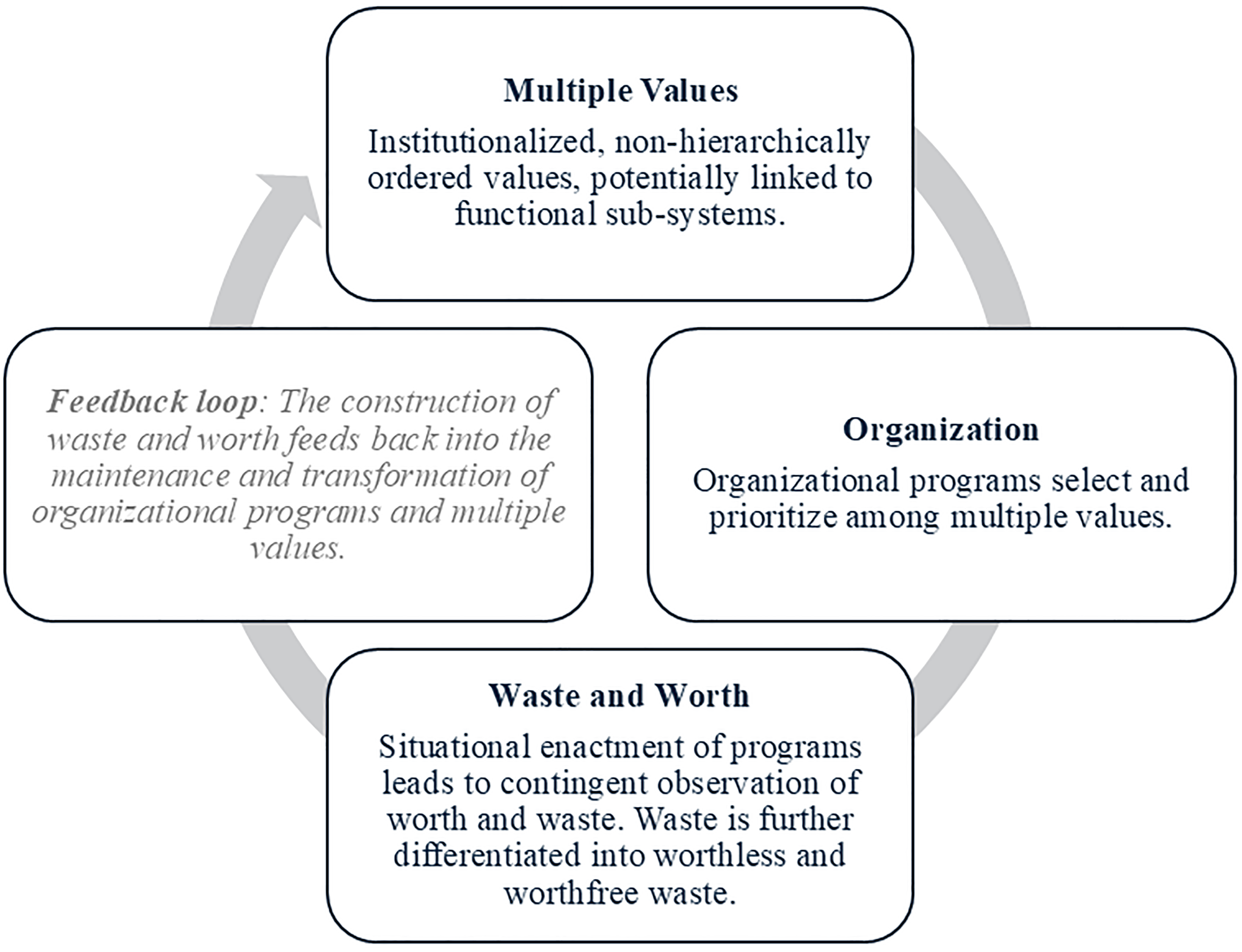
The construction of waste and worth through valuation processes that unfold in organizations engaging with multiple values. Source: Authors’ own.
Before we delve into a detailed examination of valuation processes in organizations, it is important to acknowledge that writing about values and waste presents certain linguistic challenges. The semantic field of values and valuation is inherently complex and varies significantly across languages and cultural contexts (Helgesson and Muniesa, 2013). A similar ambiguity surrounds the notion of waste. Its meaning has evolved historically and is further complicated by the coexistence of seemingly overlapping and potentially interchangeable terms such as garbage, trash, or rubbish (Bardmann, 1994). In this article, we adopt the term waste not only to indicate that we examine valuelessness in organizations beyond industrial refuse, such as packaging waste, chemical waste, or scrap materials, which is often studied in essentialist ways, but also because this choice aligns with an emerging body of scholarship concerned with waste (Gille and Lepawsky, 2022), which further elaborates its entanglement with valuation processes (Greeson et al., 2020).
Multiple values and functional sub-systems
To conceptualize the multiplicity of values—a theme frequently addressed and problematized in the literature on organizations—we draw on Niklas Luhmann's sociological systems theory, which emphasizes that values are inherently multiple and not hierarchically ordered a priori. Specifically, Luhmann (1996a: 317–319) defines values as generalized principles that allow for the expression of preferences for events or states of the world. Thus, values express an appreciation for the realization of certain desirable states as opposed to their opposites. For some values, the preference for “this” over “something else” (Luhmann, 1996a: 76) is institutionalized in a specific binary so that the countervalues are clearly specified. For example, truth is opposed to falsity, legality to illegality, and health to disease. The two sides of a value distinction can only be negated in reference to each other, for example, the absence of health implies disease and not illegality.
Luhmann's systems theory takes a decidedly non-essentialist stance on values: rather than defining what a value “truly” is, it examines how people observe certain phenomena as having the qualities associated with that value. For the purposes of this paper, we reserve the term value(s) exclusively for these generalized principles, and we introduce the term worth to refer to the situational valence that phenomena acquire in practice, with varying degrees of consensus and stability. Building on this perspective, rather than addressing ontological questions about what values are, we can treat values as collective representations of principles that structure and enable valuation processes, focusing on how observers engage with and operationalize values in practice (Heinich, 2025). For instance, while “health” may be widely accepted as a positive value in society, what exactly constitutes health or how it should be pursued remains undefined. This ambiguity is not a flaw but a feature of abstract values: they allow for broad consensus while leaving concrete valuations open-ended.
Following systems theory, value binaries function as the guiding distinctions underlying society's primary differentiation into functionally distinct subsystems, such as art, education, the economy, health care, law, mass media, religion, and science. Each subsystem operates according to its own internal logic, determined by its specific value binary—for example, true/false in science and legal/illegal in law. In contrast, some value distinctions—such as integrity or honesty—are not specific to any single subsystem; rather, they can appear across contexts and inform valuation processes more generally. Although their influence on valuation may be comparable, we set them aside here for the sake of analytical clarity. In this sense, systems theory emphasizes the plurality of values, similar to Weber's value spheres, or more recent theoretical efforts on the multiple orders of worth (Boltanski and Thévenot, 2006) or plural institutional logics (Thornton and Ocasio, 2008). However, systems theory uniquely argues that values are observed within a binary logic and specifically in distinction to non-values. At the same time, it acknowledges that multiple values can be simultaneously supported (e.g., health, freedom, truth). For instance, Schirmer and Michailakis (2011) highlight that welfare states appreciate not only solidarity but also health, as individuals’ unhealthy lifestyles and the treatment costs for resulting illnesses impose a disproportionate financial burden on the collective. Systems theory explains this possible coexistence of multiple values with the generality of values, as values do not prescribe any specific conduct and do not determine the worth of an entity. This is also, because, following systems theory, no fixed hierarchy exists among the many values that might, for example, dictate that freedom is always more important than health, or health more important than truth. The prioritization of values remains open within society precisely because modern society lacks an integrating or overarching center that orders and ranks these multiple values (Schirmer, 2024). Systems theory also acknowledges that, while values are not mutually exclusive in principle, they often stand in tension with one another in practice (Luhmann, 1996b).
This line of argument from systems theory, which holds that the ambiguous multiplicity of values is dealt with by prioritizing values situationally (Luhmann, 2008: 182), resonates with insights from valuation studies. This means, our use of worth as the situationally emergent valence of a phenomenon is consistent with the understanding developed in valuation studies, where worth is seen as arising through valuation processes in practice—that is, not as an intrinsic property but as something that emerges contextually whenever actors assess and attribute value (e.g., Antal et al., 2015; Kjellberg and Mallard, 2013; Krüger et al., 2025). In this framework, values provide the abstract principles, worth captures the valence assigned in context, and valuation refers to the processes through which this valence is produced and negotiated. Consequently, events, states, or entities do not possess inherent, immutable worth that can be deduced directly from values themselves; rather, their worth depends entirely on how values are observed, prioritized, and applied in specific situations. For example, an aspirin tablet may be valuable as a pain remedy, but if someone is suffering from hunger, the tablet holds no nutritional worth in that situation. Thus, worth is the result of situation-specific valuation. Moreover, multiple values can be invoked simultaneously, leading to valuations that may be congruent or conflicting across different dimensions. For instance, both aspirin and tryptamine-based drugs can serve as effective headache remedies, though they differ in financial cost. The presence of additional values thus constrains the unrestricted pursuit of selected values. Accordingly, the worth of something is always contingent and varies depending on which values are foregrounded in a particular situation.
As a first step, we summarize that multiple values may be considered, but they are observed and prioritized in context-specific ways and therefore do not deterministically govern valuation processes. While one could ask what roles specific individuals, professions, or even emotions play in shaping these processes, this article focuses on how organizations are implicated and how, through their involvement, they contribute to the construction of waste. In the following section, we therefore turn to the role of organizations in valuation processes and their engagement with multiple values.
Multi-referential organizations and their programs
In systems theory, the relationship between organizations and functional subsystems is both contested and highly relevant when it comes to conceptualizing how organizations engage with multiple values. A central question is whether organizations can be assigned to specific societal subsystems, for instance, schools to education or firms to the economy, and whether, accordingly, they prioritize the value binary of those specific subsystems. While Luhmann occasionally suggests that organizations belong to particular subsystems (e.g., Luhmann, 2018: 360) sociologists working within systems theory have argued more recently that this claim is neither theoretically sound nor empirically valid (Apelt et al., 2017; Besio and Meyer, 2014; Tacke, 2001; Will et al., 2018). They argue that functional differentiation, as a core structural feature of modern society, also shapes organizational operations, rendering organizations multi-referential (Tacke, 2001). This means that organizations engage with multiple, and sometimes competing, values and cannot be governed by reference to a single value binary derived from their environment (Apelt et al., 2017; Besio and Meyer, 2014; Will et al., 2018). We adopt this multi-referential perspective, which aligns with Brandtner's (2017: 202) core insight that “the multiplicity of values moderates the interplay between organizations and their environments.”
As multi-referential systems, organizations develop and build on their organizational programs to select and prioritize among multiple values and assign the object of valuation to one side of the value distinction, thereby producing its worth. Organizational programs are formal structures that reduce the ambiguous multiplicity of values to a manageable set of internal selections for valuation processes. These selections can then be assigned to specific organizational roles, thereby eliminating the need to initiate each valuation process individually and from scratch. In practice, such programs may take the form of policies, software systems, performance targets, or standardized procedures. For instance, when overtime policies prioritize legality, unpaid overtime would be assigned to the negative side of the legality/illegality distinction and thus constructed as waste, producing its situational valence. By contrast, if economic benefit were the guiding value, unpaid overtime would likely be assessed differently, falling on the positive side of this alternative value distinction. Importantly, treating the organization as an analytical unit that shapes valuation processes through programs does not negate its internal differentiation. Organizations remain multi-referential systems composed of subunits and members with potentially divergent goals and evaluative orientations (Cyert and March, 1992; Luhmann, 2018). In the section on multiple values and waste in hospitals, we substantiate this argument empirically, showing how hospital members enact, negotiate, and sometimes contest valuation processes, thereby highlighting the interplay between overarching organizational patterns and internal variation.
While organizations may align their programs with the dominant value binary of a particular functional subsystem (e.g., profit/loss in businesses, legal/illegal in courts, or true/false for research organizations) these programs are not simply extensions of subsystems. Rather, although subsystem criteria and organizational programs frequently intersect in the operationalization of values, they are analytically distinct: subsystem criteria offer a structural framework, whereas organizational programs shape their substantive enactment (Lieckweg and Wehrsig, 2001). For instance, whether research is considered true or false may depend on general methodological standards, but a specific department might stipulate that only Method A qualifies, thus narrowing the scope of what is accepted as valid knowledge. Furthermore, whereas value binaries exclude alternative considerations (something is either true or false, with no room for “beautiful,” “legal,” etc.; Luhmann, 1989: 45), organizational programs can incorporate concessions to additional values such as cost, efficiency, or feasibility. In contrast to Schirmer and Michailakis (2011), we therefore acknowledge a difference between values and organizational programs: only the latter can provide actionable guidance for valuation and decision-making processes within organizations (Luhmann, 1996a: 317–318).
Systems theory posits that when individuals accept membership in organizations, they commit to the expectations embedded in organizational programs, thereby granting the organization a generalized acceptance of these programs. Organizational members are expected to subordinate their personal discretion to the specifications outlined in such programs, a process reinforced by the fact that deviation can jeopardize career progression or even organizational membership (Luhmann, 1976). Consequently, members do not evaluate arbitrarily, but in accordance with their organizational role, which may also be defined by professional norms. Through this mechanism, organizations maintain relatively consistent patterns of valuation via programs that individuals, acting independently, would be unlikely to sustain. However, these programs do not determine valuation outcomes directly; rather, they provide premises to be considered during the valuation process. For instance, a program may specify whether applicants’ credit reports that prioritize solvency should be considered in hiring decisions (Kiviat, 2019).
Importantly, emphasizing the stabilizing function of organizational programs should not obscure the fact that valuation in organizations is not predetermined. While empirical research has demonstrated significant changes in highly organized and allegedly stable valuation processes (Arnold and Dombrowski, 2022), systems theory itself acknowledges that programs constrain but do not determine the outcomes of valuation processes in organizations, since their application remains context-specific and open to individual interpretation (Bolander and Sandberg, 2013; Zimmerman, 1970). Organizational members interpret a program's relevance in light of the situation, their understanding of the program, and the concrete conditions of implementation (Bolander and Sandberg, 2013). Consequently, members may deviate from prescribed expectations, at times prioritizing other roles—such as their professional role—over their organizational one. Although tensions between professional and organizational demands are a central theme in the sociology of organizations and professions, they are also crucial to our analysis of valuation processes, as both role conflicts and deviations from organizational programs add to their contingency.
However, it is not only the application of programs through individuals that unsettles the relatively stable grounds of valuation processes in organizations, fostering their contingency. The potential for these processes to unfold differently is likewise rooted in the multi-referentiality of organizations, as previously introduced. While organizational programs may align with a dominant single value binary, reweighting is common (Bora, 2001), as organizations adapt and reconfigure their programs in response to shifting environments. For example, purchasing departments in companies that use gold in their products can no longer operate under the assumption that “gold is gold is gold”; they must now consider whether the gold was ethically sourced (Reinecke, 2015). From the perspective of a given functional system and its core value binary, such shifts in organizational programming may appear as a corruption of the system's purity, particularly when these changes negatively affect relevant audiences, for example, by limiting access to the desired quantities of gold. However, these shifts are less about undermining core value binaries and more about the organization's own internal logic, which requires balancing multiple and often competing demands to maintain operational viability (Besio and Meyer, 2014; Bora, 2001).
In sum, this second step shows that organizations matter in valuation processes through their programs, which stabilize these processes by selecting and prioritizing specific value binaries. At the same time, these programs are subject to change and members apply them in context-dependent ways. However, this contingency does not make organizational programs irrelevant to valuations; rather, it highlights that programs cannot unilaterally determine their own relevance for these processes. Drawing on ethnomethodology, we therefore propose an interim conclusion: organizational programs and concrete valuation situations are “mutually elaborative and mutually determinative elements in a simultaneous equation that the actors are continually solving and re-solving” (Heritage, 1987: 242). But what role does valuelessness play in these valuation processes within organizations? This is what we explore in the next section.
Waste and worth
In organizations, valuation processes produce waste through the situational enactment of programs that assign worth to entities. In other terms, it is the local application of programs by organizational members that leads to variation in whether something is designated as worth or waste. Importantly, this means that waste does not arise from a value binary within a societal subsystem per se (such as truth/falsity), as introduced in the previous sections, but rather from the enactment of organizational programs that assign worth to those objects of valuation that positively support selected and prioritized values. Conversely, waste is generated by designating what obstructs or contradicts these prioritized values. Therefore, waste does not emerge simply from selecting one side of a value binary; rather, it arises when organizational programs prioritize certain abstract values over others, and these priorities are operationalized through concrete valuation processes, producing the situational valence (worth/waste) of particular entities. Only through this prioritization does the value distinction take on asymmetry, assigning one a positive and the other a negative valence. While institutionalized preferences often favor one side of a value binary, the opposing side merely indicates that things could be otherwise. For example, there may be a general preference for making profits but even this can be suspended in a concrete organizational valuation process. In certain cases, incurring losses may be viewed positively, such as when a firm's programs prioritize market entry by offering prices below cost to establish a foothold in a new market.
The impact of re-prioritizing values on worth and waste can be illustrated through Munten and Vanhamme's (2023) study on the role of repair in organizations. Their research shows that companies have increasingly begun to prioritize ecological values, such as the durability of products, over previously dominant values like reliability. Organizational programs reflect this shift, guiding corporate communication professionals to consider messages about durability as worth, whereas messages emphasizing reliability are now seen as obstructive and thus waste. This example highlights how valuation processes, mediated by organizational programs, transform abstract values into concrete assignments of worth or waste in situational contexts.
Bardmann (1994) proposes that worth and waste constitute interdependent sides of a single distinction. Drawing on Luhmann (1995, 1996a), we understand this as an operation of observation, which involves using a distinction to indicate something. These two operations are mutually dependent: nothing can be indicated without first being distinguished from something else, and a distinction only gains meaning by enabling the indication of one of its sides. Because any indication depends on a particular distinction, it is inherently contingent; another distinction would produce a different indication, and thus a different meaning. Each observation is limited by its distinction, making alternative aspects invisible. This domain of the not-seen is what Luhmann refers to as the “unmarked space” (Luhmann, 1995: 41). While a different observation may render the previously unobservable visible, it also creates a new blind spot. Observation, then, is always accompanied by unobservability; there is no access to the world that is free from distinctions, and thus no observation without contingency and limitation. Within valuation processes, an observer—such as an organization—may apply the worth/waste distinction to assess entities, assigning them either positive valence (worth) or negative valence (waste). This binary distinction not only indicates one of its sides (e.g., worth), thereby differentiating it from everything else, but also implicitly defines its opposite (e.g., waste). Being waste is thus not a property of an entity but the result of a particular mode of observation. For example, when a hospital program prioritizes medical safety, sterile instruments are constructed as worth, while used or potentially contaminated ones are simultaneously constructed as waste.
While Bardmann draws on a systems-theoretical perspective to make this argument, it resonates with Gille's (2012) work on food regimes, which suggests that value chains are inherently also waste chains, and that the very construction of what is considered valuable simultaneously generates waste. Bardmann (1994) further suggests that there are two types or modalities of waste, which constitute the other side of worth. Bardmann proposes a typology of waste that differentiates between worthless and worth-free waste, based on how values are prioritized and applied in valuation processes. His conceptualization of worthless waste is grounded in the conceptual history of the German term “Abfall,” which referred to apostasy or rebellion—a deliberate break from accepted values. This etymological lineage illustrates that waste is not merely a material category but the result of processes of rejection and negative valuation. This means, worthless waste is attributed negative meaning and actively rejected, often resulting in avoidance, exclusion, or destruction. A contemporary example is nuclear waste, which often provokes strong public aversion and a “not in my backyard” response (Lidskog, 1994). Yet worthless waste need not be materially hazardous; it is produced whenever something is actively rejected, such as meat by vegetarian lobby organizations or communication about reliability in firms prioritizing repair (Munten and Vanhamme, 2023).
Worth-free waste, by contrast, is overlooked or ignored. Entities assigned to this category do not obstruct or support prioritized values and therefore receive no evaluative significance in the focal valuation process. It occupies what (Bardmann, 1994: 182) terms a “realm of flexibility,” where no clear criteria or expectations apply. Examples include undiscovered talents or unidentified toxins. Worth-free waste results from the fact that every observation is bound to the blind spot of the distinction it employs. It represents a different form of deviation from prioritized values than worthless waste: not by opposing them, but by falling outside their scope altogether. Worth-free waste may, however, be assigned worth or designated as worthless waste in other valuation processes, where an alternative, previously unused value distinction—residing in the unmarked space of the original observation—is applied. For instance, organizational slack, described by Cyert and March (1992: 44) as “a pool of emergency resources,” may be worth-free in one situation, worth in another if it addresses emergent needs, or worthless waste if it obstructs organizational goals. In the focal valuation process, worth-free waste arises when it is left unaddressed by organizational programs, being tolerated, overlooked, or ignored.
To summarize our third step: waste is constructed in relation to worth through the situated enactment of organizational programs that translate abstract values into concrete priorities. From a systems-theoretical perspective, these processes generate worthless waste—actively rejected—and worth-free waste—overlooked or ignored—thereby revealing the contingency of valuation. This perspective also clarifies why purely instrumental definitions of waste, such as Gourlay's (1992: 21) focus on “failure to use,” are insufficient: they cannot account for the contingency of observation and the context-specific activation of values. Usefulness alone cannot explain why entities—whether materials, resources, or people—are constructed as waste; their status depends on which values are activated in a given context rather than on intrinsic utility. Our conceptualization thus aligns with recent scholarship that treats waste as integral to valuation, examining “how some materials, practices, regions, and people are valued and devalued, become disposable or dominant” (Liboiron and Lepawsky, 2022: 3).
Multiple values and waste in hospitals
To illustrate our conceptual proposal, we chose not to focus on classic waste-related organizations such as nuclear waste facilities, incinerators, or recycling firms. Instead, we examine hospitals, which, beyond their core medical practices, encompass a range of other activities, including administration and management, nursing, medical research, and education. As a result, hospitals operate at the intersection of healthcare, science, education, and business. They must therefore navigate and reconcile multiple, sometimes competing, values through ongoing negotiation to establish and maintain a coherent social order (Nugus, 2019). In the terminology of our account, hospitals are particularly useful for illustrating the contingency inherent in valuation processes due to their multi-referentiality.
Drawing on our earlier work (Dorn, 2021) and inspired by Gille's (2012) theorization of worth and waste in value chains based on secondary empirical data, we reinterpret existing studies of hospitals to empirically instantiate the conceptual distinctions introduced earlier. In line with our theoretical ambitions, we adopt a methodological approach that emphasizes conceptual transferability over statistical generalizability (Walton, 1992). Accordingly, we purposefully select cases that are conceptually generative rather than representative (Siggelkow, 2007). These cases allow us to show how values, worth, and the two types of waste interact in practice, and how organizational programs structure and guide valuation processes. The aim is not to offer a comprehensive account of hospital valuation dynamics or current conflicts (for broader discussions, see Hauge, 2016), nor to provide an exhaustive overview of ongoing practices. Rather, the examples serve as empirical illustrations of the theoretical mechanisms we aim to capture, showing how our conceptual distinctions play out in real-world organizational contexts. With this in mind, we now turn to specific cases that reveal how hospitals negotiate competing values and, in doing so, produce distinct forms of waste.
We begin by examining valuation processes in hospitals that prioritize health and medical safety—values commonly associated with the health subsystem. We then expand our focus to include economic and moral values. This allows us to trace how different value priorities give rise to varied constructions of waste, ranging from used scalpels to patients unable to pay. Finally, we also examine how hospitals themselves are subject to valuation based on their medical performance. Two clarifications are important at the outset. First, despite their diversity, all forms of waste we examine result from negative valuation: either as the negative side of worth/waste distinctions shaped by organizational programs or by being excluded from consideration altogether. Second, our analysis does not express normative judgments but reconstructs valuation processes observed in hospital settings.
Medical safety and the construction of worthless waste
Valuations that prioritize medical safety produce (worthless) waste consistent with conventional expectations, namely, solid, non-human hospital waste. Medical safety holds a central place in hospital operations and is reinforced by external regulatory frameworks, such as the European Waste List (EWL) (European Commission, 2014). The EWL offers standards for classifying, managing, and reporting various forms of waste. While we use the EWL to illustrate how such regulatory frameworks inform organizational programs that ostensibly guide valuations in hospitals, the case also demonstrates that waste is not merely constructed through the observation of values but that these constructions also feed back into how values themselves are understood.
Approaching waste in an essentialist manner, the policymakers who developed the EWL identify the following types of hospital waste. First is general waste (e.g., glass, paper, plastics) that makes up the bulk of hospital waste streams but is not safety-critical. Second and third are infectious waste types, such as wound dressings and bodily fluids, which are disposed of to protect staff and patients. Particular attention is paid to sharps (scalpels, needles) due to their ability to puncture skin and transmit pathogens. The distinction between infection risks within the hospital and those that extend outside it further shapes these waste types. A fourth category is toxic waste, expired medication, cytostatics, or radioactive materials that pose environmental and long-term health risks. Finally, human body parts form a separate category: although potentially biologically risky, their disposal is shaped as much by symbolic and ethical considerations as by safety concerns. Some hospitals may return them to patients or handle them separately due to their moral status. In our account, discarding EWL-listed items and constructing them as worthless waste serves to prioritize medical safety and ensure a safe hospital environment.
The different types of waste are only constructed as such through the actual application of the EWL and the corresponding valuation processes in hospitals. The extent to which EWL-informed valuations align with practical hospital realities remains an empirical question; however, research shows that, much like industrial organizations, hospitals generate massive volumes of solid waste of the types listed in the EWL (e.g., Chartier et al., 2014). This notion is supported, for example by Johnson's (2023) ethnographic study, which highlighted the significant volume of solid waste confronted by care workers in healthcare centers.
Importantly, none of this solid waste—from used scalpels to expired medications—is inherently waste; it becomes so through valuation processes that designate these items as threats to medical safety (Pieper and Kühling, 2014). In this way, sharps and dressings are not discarded because of any intrinsic property but because they are rendered worthless through their perceived risk of compromising the prioritized value of medical safety by potentially harboring pathogens. Their removal is therefore not incidental but follows from their valuation as waste—a process stabilized and reinforced by hospital programs such as waste management.
However, growing awareness of the ecological damage caused by solid waste is pressuring hospitals to integrate environmental concerns into their organizational programs and valuation processes. For instance, Practice Greenhealth (2023) highlights that US hospitals generate over 13 kg of waste per bed per day and calls for substantial waste reduction. According to our framework, this shift entails reweighting values within organizational programs—giving greater weight to ecology over medical safety. Such realignment can create conflicts, as seen with single-use items: when ecology takes precedence, these items are constructed as worthless waste due to their ecological harm, while reusable equipment gains worth for aligning with sustainability goals. Yet, proposals to reuse medical devices (e.g., catheters) are often rejected as hospitals continue to prioritize medical safety despite ecological benefits (Shuman and Chenoweth, 2012).
In contrast, shifting organizational programs to prioritize ecology over medical safety appears less conflictual when food waste, rather than medical equipment, is at stake. Under ecological prioritization, food waste is rejected and seen as something to avoid. However, when medical safety is prioritized, food waste is typically constructed as worth-free—considered irrelevant and thus ignored. Consequently, organizational changes that elevate ecological values—such as adjusting menu options, portion sizes, or selling leftover sandwiches in hospital canteens—can be implemented with little conflict alongside medical safety priorities (Arnold and Bouwmeester, 2025). While this example shows that shifts in value prioritization do not necessarily lead to conflict, it also underscores the inherent contingency of organizational valuation processes. Prioritization is not fixed but open to reinterpretation, meaning that what is considered waste or worth is not predetermined but constructed through context-specific distinctions.
Economic efficiency and patient dumping
In many industrialized healthcare systems, economic efficiency has come to dominate the discourse, emphasizing constraints, trade-offs, and cost containment (Schirmer and Michailakis, 2011; Scott et al., 2000). Hospitals do not exclusively prioritize health and medical safety as guiding values in their valuations; instead, they are multi-referential, also considering other values such as economic efficiency, which we examine here. One key expression of this economic logic is the use of diagnosis-related groups (DRGs) to reimburse hospitals. Rather than compensating for actual treatment costs, DRGs assign fixed payments to standardized episodes of care (e.g., an appendectomy), with limited adjustments for clinical severity and other factors (Samuel et al., 2005). Hospitals thus assume financial responsibility for deviations from these standards, creating strong incentives for management to influence medical observations in ways that prioritize economically favorable valuations of cases.
DRGs become embedded in organizational programs, translating economic efficiency into concrete valuations about which patients and procedures are worth the hospital's resources. This involves aligning clinical practices with reimbursement structures, specifically, linking clinical work to the DRG codes that determine payment. The worth of a patient is not inherent but emerges from the interaction between medical valuations and the DRG rates negotiated with public or private insurers.
This embedding has tangible effects. Because DRGs prioritize profitability, they devalue certain patients, influencing decisions around admission, treatment, and discharge. One outcome is patient dumping, where patients deemed economically burdensome are discharged prematurely or denied care. This practice observes some patients as economic waste, not because of their medical condition, but because they fall outside economically viable care parameters (Chen et al., 2009). These valuations can prompt hospitals to avoid treating such patients, for instance by redirecting them to other facilities or denying admission. While U.S. legislation, such as the EMTALA Act, adopted in the year 1986, prohibits such practices, evidence suggests they persist (Venkatesh et al., 2019). Although ethically troubling, such cases reveal how worth and waste are co-produced: removing “unprofitable” patients affirms the economic observation of worth and supports the organization's broader capacity to serve other patients.
A vivid example of patient dumping involves psychiatric hospitals in Nevada, which discharged patients and gave them one-way bus tickets to California, without arranging follow-up care (Coté, 2013). The hospitals’ medical valuations of these patients found them to require treatment. Yet they were still discharged and sent away, including some patients from a Las Vegas hospital diagnosed with “homicidal or suicidal ideations” (City and County of San Francisco v. State of Nevada et al., 2013). However, the patients’ inability to pay rendered them economically worthless within hospital programs. The medical valuation was not contested but rather subordinated to an economic logic that viewed continued treatment as a financial liability. These individuals, as Lee (2024: 13) puts it, were “sorted out as non-objects” by the organization.
This case not only underscores how economic observations produce waste but also reveals how such valuations shape what is noticed and what is neglected within organizations. Alongside active rejection, a subtler form of waste emerges, one born not of expulsion but of omission. When psychiatric patients were discharged and bused across state lines without arranging follow-up care, some discharge forms, patient records, or inter-state communication protocols may have been left incomplete, improperly filed, or ignored entirely. These administrative artifacts, lacking economic, medical, or moral worth, became worth-free waste. No one acted on them, not because they were dangerous or harmful, but because they were unseen, unprocessed, and irrelevant to any operative valuation. Waste here emerges not through rejection but through organizational omission.
In sum, the DRG system and practices like patient dumping reveal how economic valuations in hospitals do more than allocate resources; they actively produce both worth and waste. Patients acquire economic worth or worthlessness not by the nature of their illness but through their alignment or misalignment with organizational programs. Crucially, this example highlights the frequent conflict between organizational valuations—here, between medical need and financial cost—and how such tensions are resolved, in this case in favor of the economic valuation. Moreover, waste is not only produced through deliberate exclusion but also through omission, when elements fall outside the scope of any valuation. Organizations, in this light, are not only sites of productive activity but also of sorting and discarding, based on shifting observations of what, and who, has worth.
Health and informality in valuation processes
Having introduced an illustrative case in the previous section that showed how valuation processes can construct patients as waste when hospitals prioritize economic efficiency, we now turn to cases where patients are similarly rendered as waste, this time through valuations made by medical staff of patients’ health and illness. In doing so, we aim to underscore that our approach does not adopt a normative stance. Rather, it assumes that any valuation process inevitably produces waste (as a distinction from worth), and that any object of valuation can be perceived as such. However, what we seek to illustrate in particular through the following examples, which focus on valuations enacted by medical staff, is that while organizational programs structure valuation processes in hospitals, they also leave informal spaces in which individual observations and judgments by organizational members can unfold. Within organizations, valuation processes are thus characterized by being structured through formal programs, yet members may develop informal patterns of valuation.
Unlike the broader societal tendency to value health as inherently positive, medical professionals operate within a different logic: their focus lies on illness (Luhmann, 2005). From this perspective, healthy individuals can divert attention and resources (e.g., by clogging emergency rooms) that are intended for treating the ill. This dynamic becomes apparent in daily hospital routines, where medical staff must treat illness while determining who qualifies for medical care. These valuation processes are supported and structured by various organizational programs, including recording systems like medical forms and diagnostic technologies (Reiser, 2009). At the same time, medical staff perform diagnoses and anamneses, which are commonly regarded as professional tools in the delivery of treatment, to assess patients’ health and to evaluate the legitimacy of patients’ claims to assume the social role of a sick person. However, informal judgments by medical staff may also play a role in these valuation processes.
For illustration purposes, Jeffery's (1979) study of UK hospital emergency departments remains exceptionally instructive in this context, though its findings reflect an earlier period. In Jeffery's study, uncooperative patients seen as responsible for their own condition were especially likely to be observed as worthless waste. These so-called “rubbish” patients were viewed as draining scarce medical resources that could be used for the “legitimately” sick. It is important to emphasize that the label “rubbish patients” was informally applied by the medical professionals in their routine valuations, it is not ours. Staff often responded with frustration and sought to deter such patients, for instance, through long waiting times. Yet outright refusal to treat them was rare, as it would require formal justification and could jeopardize the staff's organizational membership. In practice, then, this deprecation of a patient does not suspend organizational programs but subtly alters how they are executed. Delays, minimal engagement, or passive discouragement serve as informal sanctions. While falling short of denying care, such practices nonetheless reinforced informal valuations by allowing to shift attention to more “worthwhile” cases.
The case of “rubbish patients” illustrates how informal valuations often attach themselves to formal programs, shaping the execution of those programs while preserving their structure. We now turn to the determination of a patient's death: a case where formal programs offer no clear guidance and informal valuations resolve the ambiguity of worth and waste. Declaring a person dead, particularly deciding when to cease resuscitation, is complex and ambiguous (Belkin, 2014; Casarett, 2015). Therefore, the decision to cease further treatment may not rely solely on medical valuations but also reflect informal considerations.
In Sudnow's (1967: 39) seminal study, patients deemed morally disreputable, such as drug addicts, prostitutes, or suicide victims, were declared dead more quickly. In these cases, informal observations shaped the medical valuation, leading to quicker declarations of death for those deemed worthless. Conversely, children, held in high regard, received extra attention and care (Sudnow, 1967: 42–43). Thus, the organizational programs alone are insufficient to explain how medical staff engaged in valuation of dying patients.
Trivial and terminal conditions alike reveal that worthless waste can emerge not only from conflicting valuations (e.g., economic) but also from the interaction of formal and informal medical valuations. The shifting standards for determining life and death further underscore how worth and waste are contingent upon observation. Moreover, what is considered worthless in one context, such as a dead body, may gain worth in another, as with organ transplants (Lock, 2001).
The organization as waste: Ranking hospital performance
Hospitals are not only initiators of valuation processes but also subjects of them. Hospital rankings (Dorn, 2021) apply standards of organizational values, such as medical performance and excellence to evaluate entire organizations, highlighting top performers while rendering others as waste within the healthcare system.
Rankings define which aspects of performance matter, distinguishing worth from waste among hospitals. A prominent example is the U.S. News & World Report Best Hospital Ranking, which assesses hospitals across specialties (e.g., cancer care) using a composite index of multiple performance indicators (e.g., mortality rates). Hospitals not ranked in the top 50 or labeled “high performing” are still listed, but without a ranking, distinction, or prominent display. This deprecates them, implying they are dangerous and best avoided by patients seeking high-quality care. In this way, diminishing some hospitals assigns worth to others, making waste and worth mutually constitutive.
Some hospitals are omitted entirely as worth-free waste when they fail to meet criteria such as minimum bed count or teaching status. In the 2020–2021 rankings, 2666 of 4554 eligible hospitals, about 59%, were omitted (Olmsted et al., 2020). These hospitals fall into a space of invisibility: neither endorsed nor condemned, with no clear valuation guiding public perception and decisions on whether to visit or avoid these hospitals. While they may continue operating under minimal public scrutiny, listed but unranked hospitals experience negative valuations, facing reputational depreciation that may require active efforts to restore organizational worth and legitimacy.
These dynamics show that valuation processes do not just sort individuals, but also entire organizations. Ranking practices illustrate how waste is neither an intrinsic property nor a by-product of valuation, nor something that could be eliminated by simply introducing additional value principles; rather, it is an outcome constructed by the very processes that generate worth. This approach emphasizes that the recognition of worth and the construction of waste are inherently tied to the values embedded in the ranking criteria. Regarding our conceptualization, the example of rankings further illustrates that despite the binary nature of observations, valuations are not reduced to a simple either-or choice. Instead, observations can be applied recursively, allowing rankings to distinguish not only between good and bad medical performance but also to differentiate degrees—such as very good versus marginally good hospitals, or very bad versus slightly bad ones.
Discussion and conclusion
The hospital case illustrates that our conceptual account not only captures the often-noted multiplicity of values surrounding organizations (e.g., health, medical safety, ecology, economic efficiency) but also brings into view the diverse entities constructed as waste through organizational observation (e.g., used medical materials, single-use items, financially insolvent or healthy patients, low ranked hospitals). In doing so, it bridges two strands of scholarly inquiry: research on how organizations engage with multiple and potentially conflicting values (Dahler-Larsen, 2011; Kraatz and Block, 2008; Thévenot, 2001) and the growing literature on organizations’ entanglement with waste (Corvellec, 2019; Ilcan, 2006; Lobbedez et al., 2025). Our framework contributes to this intersection by theorizing how organizations shape the relationship between values and waste—demonstrating that this relationship is not straightforward but constructed through organizational valuation processes.
Specifically, organizations establish connections between multiple values and waste in contingent ways: As multi-referential systems, organizations selectively prioritize among multiple values through their programs, thereby structuring, but not determining, how their members observe worth and waste in concrete situations. These organizational valuation processes are more stable than individual judgments yet remain open-ended. What counts as worth or waste depends on prioritized values, which can shift, be reinterpreted, or leave room for informal discretion. As we show below, this conceptualization offers important insights for organizational sociology by advancing our understanding of valuation and the organizational construction of waste.
Our account contributes to organizational sociology by foregrounding organizations as active agents and distinctive objects of analysis, rather than reducing them to mere “social containers” (Du Gay, 2020: 461). Specifically, we respond to calls to “factor in” organizations in social processes (e.g., Du Gay, 2020; King et al., 2009) by moving beyond the field's predominant focus on how organizations navigate competing logics and values in a rather passive way. Instead, we show how organizations intervene in and shape valuation processes through their programs, simultaneously constructing both waste and worth in contingent ways. Rather than treating waste as a by-product of valuation or the result of incomplete valuation—as if introducing more value principles could prevent it—we conceptualize it as an outcome constructed by the very processes that generate worth in organizations.
By systematically factoring organizations into valuation processes, our theoretical account also contributes to ongoing efforts in strengthening our understanding of the organizational dimension of valuation (Arnold and Dombrowski, 2022; Hauge, 2016). In particular, we extend the insight that waste is an immanent component of valuation (Greeson et al., 2020) by arguing that organizations constitute a specific context for both valuation processes and the construction of waste. Drawing on systems theory helps show how organizational programs connect organizations to institutionalized, non-hierarchized values, selecting from them and enacting them to produce both worth and waste. Our proposal thus acknowledges the relevance of situational moments of valuation, as highlighted by valuation scholars (e.g., Antal et al., 2015), while also supporting the analytic shift from micro-situated practices to the organizational infrastructures—or, in our terms, programs—that sustain the construction of worth and waste across time and space (Waibel et al., 2021). Importantly, however, this shift does not imply that valuation processes in organizations are fully controlled or predictable. These processes remain contingent, as programs can change, prioritize different values, and be enacted in ways that diverge from initial intentions; while informal elements in valuation always remain relevant.
Finally, our account advances the understanding of the construction of waste by illustrating the diversity of what the “multiplicity of waste” (Arnold and Schürkmann, 2022) could involve in the hospital context, while suggesting a conceptual distinction between worth-free and worthless waste. Supporting Van Bemmel and Parizeau's (2020) synchronic perspective, we have theorized and demonstrated that anything subject to organizational valuation can simultaneously be regarded as either waste or worth. For instance, disposable materials in hospitals may be classified as waste when ecological values are prioritized yet deemed valuable when medical safety takes precedence. In contrast, Thompson's (2017) diachronic account emphasizes the temporal sequencing of waste and worth. While we have not systematically examined such shifts over time, doing so may offer fruitful insights for developing the distinction between worth-free and worthless waste, and for deepening empirical engagement with the relationship between organizations and waste. For example, religious organizations may differ in how they construct non-believers: some treat them as worthless waste and actively reject them, while others simply disregard them as worth-free. This distinction can also be temporalized—non-believers might be framed as “not-yet believers,” signaling openness, or, conversely, as “not-yet non-believers,” suggesting inevitable exclusion. While our account does not take a normative stance on such constructions, it draws attention to the differences they make—both for organizations and for the entities subject to valuation (e.g., believers, disposable materials, patients)—whether something is treated as worth-free or worthless.
Footnotes
Acknowledgments
The authors are grateful to the three anonymous reviewers for their careful reading and valuable suggestions. Their insights significantly strengthened the final version of this paper. The authors would also like to thank the participants at several conferences and colloquia for their helpful comments: the session Organizing through Standards and Value Hierarchies at the XX ISA World Congress of Sociology, Melbourne; the session Waste All Inclusive at the 37th EGOS Colloquium, Amsterdam; the session Waste and Modern Societies at the Congress of the Swiss Sociological Association, Geneva; and the Sociological Research Colloquium at the University of Lucerne. We are grateful to Anja Wohlgemuth for valuable assistance with formatting and preparing the manuscript.

Ethical considerations
Not applicable.
Consent to participate
Not applicable.
Consent for publication
Not applicable.
Funding
The authors received no financial support for the research, authorship, and/or publication of this article.
Data availability
Not applicable.