



Abstract
The increasing cultural prevalence and appeal of complementary and alternative medicine (CAM) have raised concerns about its potential depoliticising effects. Due to its focus on the self, CAM is believed to cultivate individualism and orient transformative energies towards self-improvement rather than the collective struggle for social justice. However, despite these concerns, few quantitative studies have examined CAM from the perspective of the depoliticisation thesis. This article aims to address this gap by studying the association between political participation and CAM with data from the European Social Survey (ESS). These data enable us to capture a diverse range of CAM practices and to scrutinise both institutionalised forms of political participation, such as voting, and non-institutionalised participation taking place in civil society. Contrary to the depoliticisation thesis, our results show that CAM users either engage more actively in voting or do not significantly differ in their voting behaviour compared to non-users, depending on the specific CAM modalities considered. Moreover, CAM users participate more actively in non-institutionalised activities than non-users across all types of CAM modalities. This article offers valuable insights into the relationship between CAM and political engagement and challenges prevailing assumptions about the depoliticising effects of CAM.
Keywords
Introduction
Recent decades have witnessed an increasing interest in a range of self-care practices that take place outside established medical and religious institutions (Gale, 2014; Kemppainen et al., 2018; Sointu, 2012; Vuolanto et al., 2020). Self-care constitutes a heterogeneous field in which individuals seek holistic well-being and engage with diverse practices ranging from acupuncture and Tarot cards to Reiki healing and mindfulness meditation. These self-care practices have often been conceptualised with the notion of complementary and alternative medicine (CAM). 1 This notion serves as an umbrella term that encapsulates a varied array of health and well-being practices and therapeutic modalities that operate either entirely or partly outside Western orthodox medicine and organised religious settings. These practices embrace models of care that weave together physical, mental, and metaphysical elements and offer a multifaceted approach to well-being (Sointu, 2012). They reflect a broader socio-cultural pattern of the individualisation and pluralisation of practices and conceptions of health and well-being.
This increasing cultural prevalence and appeal of CAM has raised concerns, however. One of the vexing questions has been the potential depoliticising effect that CAM practices may have. This depoliticisation thesis suggests that due to their focus on the self, CAM practices cultivate individualism and orient transformative energies towards self-improvement rather than the collective struggle for social justice. These feed disinterest in the common good and promotes withdrawal from politics (Cloud, 1998; Kucinskas and Stewart, 2022; Madsen, 2014). Moreover, scholars have argued that CAM practices are often closely aligned with neoliberal rationality as they both revolve around norms of autonomy, responsibility, and individuality (Barcan, 2011; Sointu, 2012). They also tend to translate structural issues of power into individual-level psychological and emotional troubles (Cloud, 1998). Today, people are increasingly made responsible for their health and well-being, which often come to be seen as individual accomplishments marked by ‘rational’ and ‘healthy’ lifestyle choices and personal self-care efforts (Greco, 1993; Sointu, 2012). This effectively depoliticises health and well-being and obscures their structural determinants and inequalities (Salmenniemi, 2022; Sointu, 2012).
This increasing interest in CAM and the shifting conceptions of health and well-being have taken place in tandem with the transformation of political participation. The institutionalised forms of political participation have been steadily declining in many societies in the Global North during the past few decades, while non-institutionalised forms, such as petitions, boycotts and demonstrations, have become more popular (Kaim, 2021; Slavina, 2021). The decline in institutionalised forms of politics and the simultaneous increase in engagement in more individualised and direct forms of action have been attributed not only to the general disenchantment with and distrust of formal political channels for pursuing social change (Boswell et al., 2019), but also to the general shift towards the ideals of autonomy, individualism and critical thinking (Dalton, 2008). The shift from ‘duty-based citizenship,’ which stresses social order and obligation, to ‘engaged citizenship’, which focuses on autonomy and critical thinking, has resulted in the decline of traditional forms of political engagement and the rise of extra-institutional participation predicated on individualised, direct forms of action (Dalton, 2008). Consequently, people who value equality, autonomy and freedom are more inclined to participate in non-institutionalised activities compared to those who do not share these values (Slavina, 2021).
Previous research on the depoliticisation thesis has mostly relied on Zeitdiagnostic analyses and qualitative studies. Hence, there is a lack of quantitative evidence on the broader and systemic dynamics of the relationship between CAM and political participation, especially across diverse forms of CAM. As will be explained in more detail below, the few existing studies have focused on a specific CAM practice, or they are based on data from a single country. Our study seeks to fill this gap by drawing on the European Social Survey (ESS), which includes 21 countries, and addressing a range of CAM modalities. We aim to contribute to the debate on depoliticisation by examining whether individuals who turn to CAM abstain from institutionalised and non-institutionalised forms of political participation – that is, from voting and collective action in civil society. In line with this aim, our research questions are the following: (1) How does voting activity differ between users of various CAM practices and non-users? (2) How does participation in political activities differ between CAM users and non-users?
This article proceeds as follows. First, we will unpack the depoliticisation thesis and the limited empirical evidence on CAM use and political participation. This discussion lays the theoretical foundation for understanding the potential impact of CAM practices on political participation. We continue by detailing our research questions, data, and methods. We outline how we utilise the ESS to address the gaps in the existing research and contribute to the understanding of the association between various CAM modalities and political participation. After presenting our results, we will discuss them and conclude with the implications for future research and the broader picture painted by this study.
CAM and depoliticisation
Existing research on the relationship between CAM and political participation can be divided into two camps: the proponents and the critics of the depoliticisation thesis. The proponents argue that CAM practices tend to promote narcissism and individualism, which undermines civic responsibility and the common good (Furedi, 2004; Madsen, 2014). These practices erode the foundations of democracy and political citizenship by promoting withdrawal from politics and the public sphere and by replacing collective mobilisation against structural injustice with individualised projects of self-fulfilment and self-examination (Cabanas and Illouz, 2019; Cloud, 1998; Lasch, 1992). Furthermore, the depoliticising effect of CAM has also been attributed to its intimate alignment with neoliberal values, which contribute to privatising social problems and cultivating self-governing and self-centred subjects interested in their own well-being and health, rather than in collective action to pursue political reforms (Binkley, 2011; Foster, 2015). In this way, CAM practices easily end up facilitating political apathy and privileging individualist strategies of self-empowerment as remedies for structural inequalities.
Several scholars have taken issue with the depoliticisation thesis. Drawing on qualitative research, they have indicated that the relationship between CAM and political participation is more complex. They have shown that rather than only encouraging withdrawal from political engagement, CAM practices can also catalyse political contestation. They have argued that CAM does not necessarily imply narcissism, atomism, or disinterest in society (Nissen, 2011; Redden, 2011), nor does it automatically align with neoliberalism (Salmenniemi, 2022). These studies have documented how CAM practices have been instrumental in the politicisation of the private realm and the reconfiguration of the public/private division, in this way animating political action and making visible previously silenced suffering and injustices (Saks, 2003; Stein, 2011; Wright, 2008). They have also highlighted the affinity of CAM practices with counter-cultural critique against paternalist and patriarchal social relations, and with commitment to post-materialist values (Berghuijts et al., 2013; Höllinger, 2004). Moreover, they have shown that rather than merely cultivating political quiescence, CAM may also engender collective political action through a range of social movements, civic initiatives, and political parties (Haramban and Aupers 2017; Salmenniemi, 2019). Research on social movement activities has also highlighted how CAM practices can be used as tactics in various forms of protest and transformative politics (Clot-Garrel and Griera, 2019; Rowe, 2016).
CAM practices have also been discussed in relation the field of lifestyle movements, reflecting broader changes in the dynamics of collective action. Lifestyle movements are characterised by ‘individualised collective action’ and they seek to consciously and actively promote a certain lifestyle, or way of life, as a means to foster political change (Haenfler et al., 2012: 2; Simmons, 2017). Lifestyle movements emphasise the political importance of everyday lifestyle choices and practices, such as, for example, CAM use (Salmenniemi, 2019), and hold the conviction that if more people engage in lifestyle politics, this will usher in broader changes to society. Previous research has found that lifestyle movements as a non-institutionalised form of political participation appeal to CAM users due to their disillusionment and disappointment with institutional politics (Salmenniemi, 2019; Salmenniemi 2022).
An important set of studies has also discovered a mutual entanglement between spirituality and conspiracy theories of various sorts, captured by the notion of ‘conspirituality’ (Ward and Voas, 2011), as well as between spirituality, populism, and far-right activism (Kerins, 2021). The COVID-19 pandemic has particularly exacerbated this trend, uniting a heterogenous group of conspiracy theorists, anti-vaccination activists and CAM actors to form political opposition and campaign against government health policies and democratic institutions (Griera et al., 2022; Earnshaw et al., 2020). These groups are politically active in social media and in more traditional arenas of non-institutionalised politics, such as demonstrations.
As this discussion shows, CAM practices are not necessarily mutually exclusive with quests for social change, and do not automatically erode political engagement. However, it also reminds us that there is no straightforward allegiance between CAM and any single political ideology. CAM can be harnessed for diverse political projects ranging from progressive politics for social justice to neoliberal politics of individuality and celebration of the self, and to populist politics and far-right activism.
To recap, the two bodies of scholarship reviewed above have proposed divergent interpretations of the relationship between CAM and political participation. However, few quantitative studies have addressed this issue so far. These have mainly focused on interrogating the relationship between New Age spirituality and political participation, and they have looked at individual countries, predominantly the US (see Kucinskas and Stewart, 2022; Oh and Sarkisian, 2012; although see Höllinger, 2004 and Berghuis et al., 2013 on Europe). These studies have found evidence that engagement with spirituality is positively associated with political participation. Spirituality supports altruistic behaviour, participation in voluntary associations and charities, and various actions promoting social change (Höllinger, 2004; Kucinskas and Stewart, 2022; Oh and Sarkisian, 2012). This has led Kucinskas and Stewart (2022) to conclude that spirituality in the US context should not be seen as necessarily ‘selfish’, and that spiritual practice brings with it the same democratic and associational benefits traditionally fostered by religion.
However, research has indicated that there are differences in political engagement based on the various forms of CAM practices. Individuals with a high level of engagement in New Age activities have the highest level of political interest and participation, followed by individuals who practise alternative health methods and spiritual exercises; individuals involved in esoteric activities are less socially active (Höllinger, 2004). Berghuis, Pieper and Bakker's (2013) study also found that while practitioners of New Age spiritualities did not differ in terms of the level of political engagement compared to the general population, they had a heightened commitment to environmental protection, peace, and animal rights. Similarly, a recent study found evidence that green, alternative and libertarian political orientations were associated with a higher likelihood of CAM usage compared to other political orientations (Valtonen et al., 2023; see also Höllinger, 2017).
These findings indicate that it is important to acknowledge the heterogeneous nature of the CAM milieu, since not all practitioners necessarily share similar political views and forms of engagement (Höllinger, 2004; 2017; Salmenniemi 2022). Recognising that CAM users may vary in their political views and forms of engagement, we categorised CAM in our study into four modalities. This categorisation is informed by extant literature, which has distinguished between CAM approaches that differ based on their foundational theories, beliefs about health, treatment modalities, and healing practices (Ayers and Kronenfeld, 2010; Wieland et al., 2011). Moreover, previous research has shown that the socio-economic factors influencing these modalities differ significantly, indicating a complex interplay of determinants unique to each modality (Kemppainen et al., 2018). This categorisation allows us to represent the varied landscape of CAM more accurately, and to consider potential variations in how these categories may relate to political activism.
Research questions, data, and methods
As we have argued above, few studies have so far investigated the association between CAM use and institutionalised and non-institutionalised forms of political participation. The few existing studies have mostly focused on spiritual practices in a single country. Our research makes a new contribution to this body of scholarship by using data from the European Social Survey (ESS), which enables us to capture a diverse range of CAM practices beyond spirituality and examine both institutionalised and non-institutionalised participation. This nuanced approach is important, as it allows us to move beyond treating CAM as a monolith and we could conduct a more fine-grained analysis of how this phenomenon is associated with political engagement.
We used ESS data from round 7 of the survey, which encompasses a range of CAM practices (see below). We concentrated on two modes of political engagement: voting and political activism. Our study was designed to investigate the validity of the depoliticisation thesis among CAM users in Europe by asking the following research questions:
How does voting activity differ between users of the various CAM modalities and non-users? How does participation in political activities differ between CAM users and non-users?
Data
The data for this study were derived from round 7 of the ESS (edition 2.0, 2014), which is a cross-sectional pan-European survey conducted every two years via face-to-face interviews. The data included respondents from 21 countries. Following the ESS weighting guide (ESS, 2023), we used the combination of post-stratification weight (pspwght) and population weight (pweight). The combination weight considers differential selection probabilities, differences in population size across countries and addresses nonresponse, noncoverage, and possible sampling errors. The survey data were analysed using Stata version 18, and appropriate survey weights were applied using the ‘svy’ command to account for the complex survey design.
Indicators
To understand the relationship between CAM and political participation better, it is important to identify the various forms of participation. Existing research distinguishes between institutionalised and non-institutionalised forms of participation (Kaim, 2021). Our first outcome indicator is voting, which we used as an indicator of an institutionalised form of participation. We used the question concerning whether the respondent had voted in the last general election with the options ‘yes,’ ‘no,’ and ‘not eligible to vote.’ Those who were not eligible to vote (8.8%) were excluded from the analysis.
Our second outcome indicates non-institutionalised forms of political participation, which include collective action, signing petitions and participating in boycotts, among other things (Kaim, 2021). Our outcome indicator for political activism (‘yes’ or ‘no’) was determined by whether the respondent had performed at least one of the following activities during the previous 12 months: contacting a politician or government official, working in a political party or action group, wearing, or displaying a campaign badge/sticker, signing a petition, taking part in a lawful public demonstration, and boycotting certain products. 2
The independent variable – using CAM treatments – was constructed according to the question that asked the participant to select all the treatments they had received in the past year from the following list of ten: acupuncture, acupressure, Chinese medicine, chiropractic, osteopathy, homoeopathy, herbal treatment, hypnotherapy, reflexology, and spiritual healing. We did not include massage and physiotherapy, because their status as mainstream, complementary, or alternative varies from country to country.
Our CAM classification followed the widely used approaches of the National Institutes of Health and the National Center for Complementary and Alternative Medicine (Ayers and Kronenfeld, 2010; Kemppainen et al., 2018; Koithan, 2009; Tataryn, 2002; Wieland et al., 2011), with slight modifications in accordance with Fulder (1998). We categorised CAM treatments into four categories. The first was traditional Asian medical systems (TAMS), which can be described as ‘complete system[s] of theory and practice’ that have evolved independently of biomedical medicine (Tataryn, 2002). This category included traditional Chinese medicine, acupuncture, and acupressure. The second category, which draws on Fulder (1998), was alternative medicinal systems (AMS) – that is, the intake of substances thought to have healing potential. These systems included homoeopathy and herbal treatment. The third category comprised manual body-based therapies, which are focused on the structure and function of the body by using body movements. This category included chiropractic, osteopathy, and reflexology. The fourth category was mind-body therapies (hypnotherapy and spiritual healing), which focus on the role of thought and emotion in healing. For each CAM category, we created a dichotomous variable (i.e., having vs. not having received a treatment in a given category during the past 12 months). Other CAM therapies, such as nature-cure therapies (Fulder, 1998) and energy therapies (Koithan, 2009; Wieland et al., 2011) were not present in the survey data.
To illuminate the association of CAM modalities with forms of political engagement, we need to account for possible confounders, which may influence the association. We included the following variables as covariates in our analysis: gender, age, marital status, education level, main activity, level of income, self-rated health status, being part of an ethnic minority, belonging to a particular religion or denomination, and country of residence. Gender was coded as dichotomous (man/woman), men as the reference category. Age was coded into seven categories (15–24; 25–34; 35–44; 45–54; 55–64; 65–74; 75 and over), the reference category being the highest age group. Marital status was coded into four categories (married or in civil union; divorced or separated; widowed; never married) of which ‘married’ was used as the reference category. Education level was used in seven EISCED categories, and the lowest was the reference category. Main activity was coded into seven categories (paid work; unemployed or housework; permanently sick or disabled; retired; other), and paid work was used as the reference category. The ESS income deciles were coded into income quintiles and the missing category; the lowest income quintile was used as the reference category. Self-rated health was measured as very good, good, fair, bad, or very bad, using ‘very bad’ as the reference category. The question on whether the participant belonged to a minority ethnic group in their country was reported as yes or no, and we used ‘no’ as the reference category. Religiousness was measured with the question on belonging to a specific religion or denomination (yes/no), using ‘no’ as the reference category. Country of residence included the original 21 country codes, with Finland being the reference category.
Statistical analysis
The descriptive results were derived from the data by using cross-tabulation and frequencies. We used logistic regression to model voting and participation in political activities as separate outcomes. First, we estimated bivariate associations, while the second model was fully adjusted for all covariates. The results are provided as average marginal effects (AMEs), for the clarity of interpretation. AMEs provide a general overview of the expected change in the outcome variable for a one-unit increase in the independent variable, while averaging this effect across all observations in the sample (Williams, 2012). Finally, we calculated average adjusted predictions (Williams, 2012) to illustrate the participation rates of the users and non-users of different CAM modalities.
Results
Table 1 presents the unweighted frequencies and percentages of the used variables. The most common CAM modality was AMS, which was used by over 9% of the respondents. Manual therapies were used by almost 8% of the participants and TAMS by 5%. Mind-body therapies were used by approximately 2% of the respondents.
Descriptive statistics
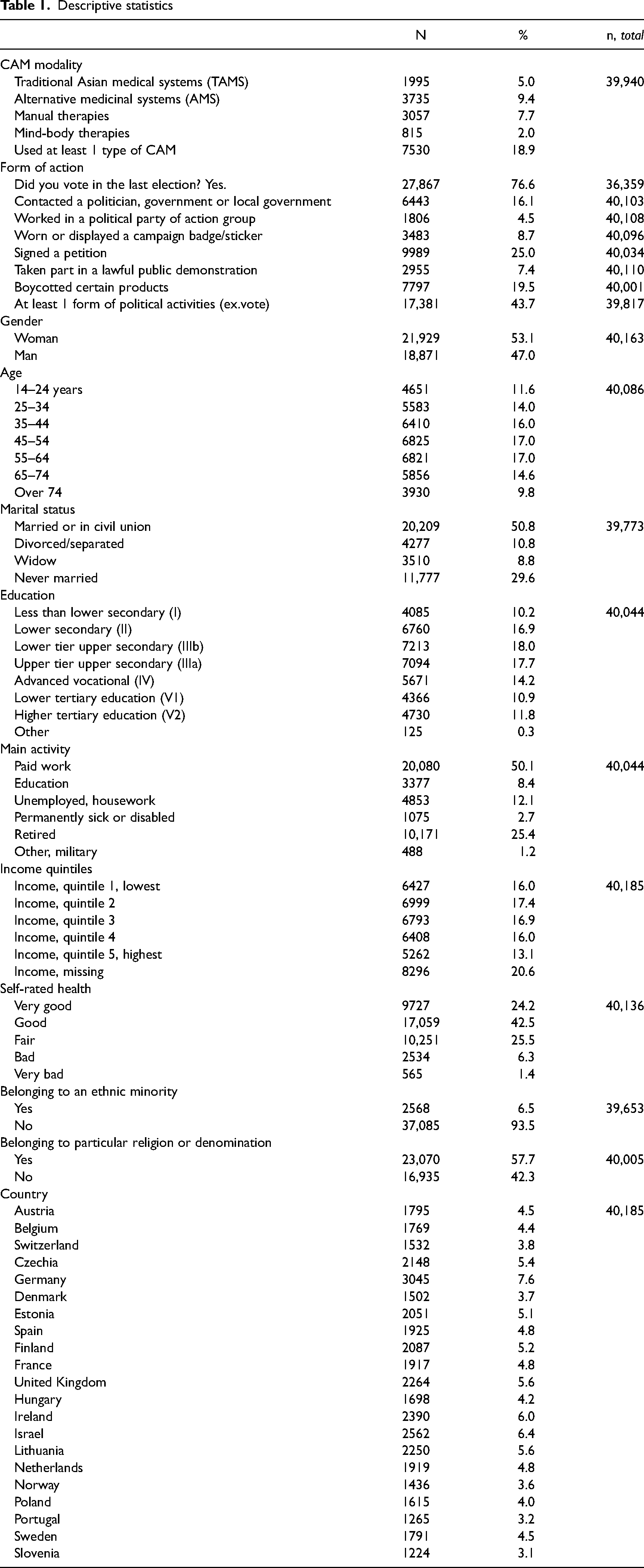
Almost 77% of the participants had voted in the most recent general election. Twenty-five percent had signed a petition; 20% had boycotted certain products, and 16% had contacted a politician, a government official, or the local government. Almost 9% had worn or displayed a campaign badge or sticker, and 7% had taken part in a lawful demonstration and 5% had worked in a political party or action group. Approximately 44% had participated in at least one type of non-institutionalised political activity.
Women made up 53% of the participants. The age groups were rather evenly distributed, with the middle age groups representing the largest percentage at 17%. Roughly half of the respondents reported being married or in a civil union. The educational categories were evenly distributed, with a slight emphasis on secondary education. Approximately 50% of the participants were employed, while 25% were retired, and 12% were unemployed. Furthermore, 6.5% of the respondents identified as belonging to an ethnic minority and 58% to a particular religion or denomination. Most of the participants reported having good (43%) or very good (24%) health.
The findings from the weighted logistic regression analysis are shown in Table 2, which illustrates the association between voting and different CAM modalities. Analysis revealed a statistically significant positive bivariate association between voting and different CAM modalities, except for mind-body therapies. In the bivariate model, using TAMS (AME = 0.04, 95% CI: 0.02–0.08) or AMS (0.04, 95% CI: 0.01–0.07) was associated with an increase in the probability of voting by four percentage points. Users of manual therapies demonstrated a stronger association, exhibiting a seven-percentage point elevation in voting likelihood (0.07, 95% CI: 0.04–0.10).
Average marginal effects (AME) from the logistic regression model for voting (n = 34,989)
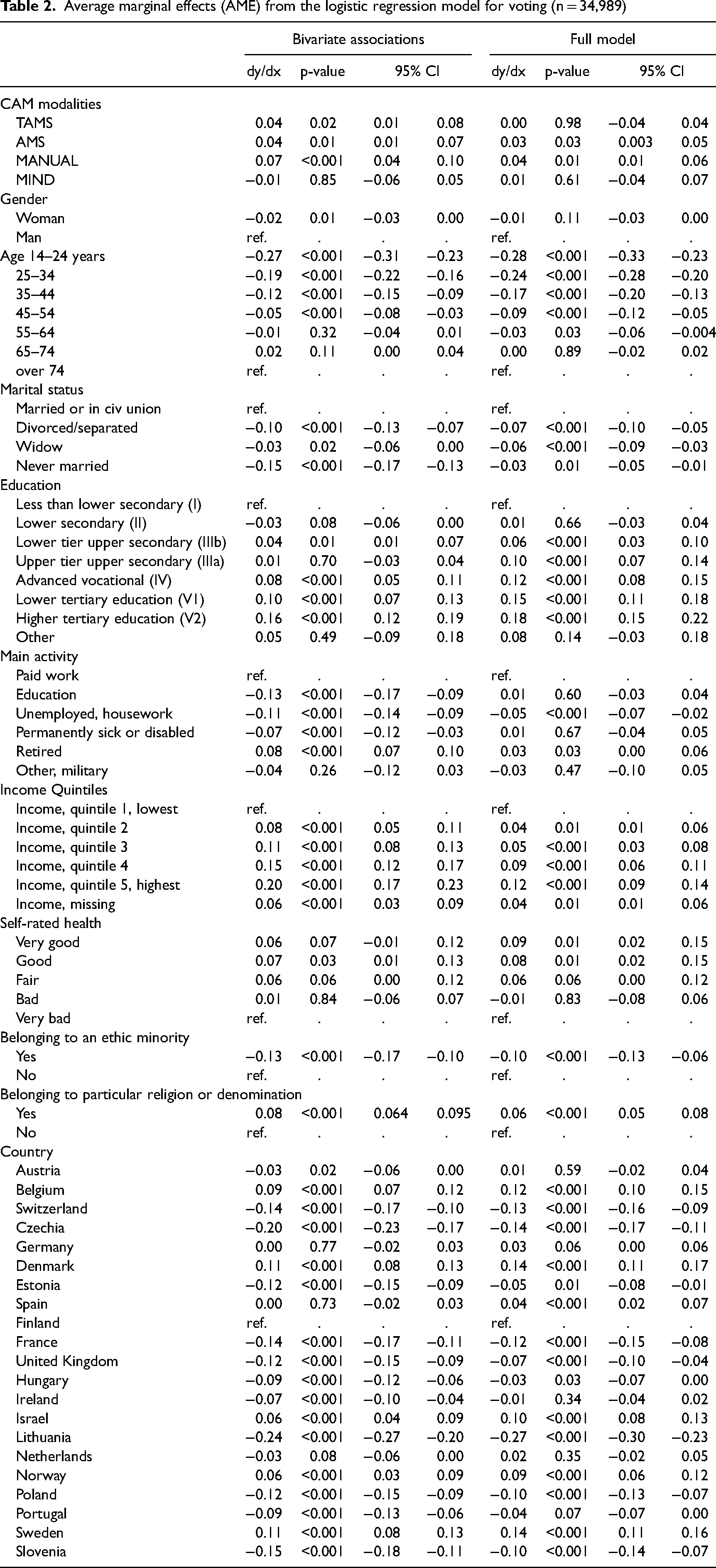
After adjusting for socio-economic and health factors in the multivariate analysis, the previously observed association between the use of (TAMS) and voting dissipated, indicating no significant difference. This result suggests that the initial positive relationship may be explained by user demographics rather than TAMS usage per se. However, AMS and manual therapies maintained a positive relationship with voting propensity in the adjusted model (AME = 0.03, 95% CI: 0.003–0.05 and AME = 0.04, 95% CI: 0.01–0.06, respectively), suggesting an association between these modalities and voting behaviour, independent of the socio-demographic and health attributes included.
We calculated average adjusted predictions that show that after accounting for the control variables, AMS and manual therapies users exhibit an approximate voting rate of 78%, in contrast to the 75% rate for non-users. The adjusted relationship between mind-body therapies and voting remained statistically insignificant, indicating that the voting patterns for users do not significantly differ from those of non-users.
Table 3 shows the results of the logistic regression of the non-institutionalised activities and CAM modalities. In the bivariate model, a strong and statistically significant association between the CAM modalities and participation in political activities was evident across all the modalities. The higher likelihood of participation ranged from 19 to 26 percentage points across the various CAM modalities, when compared to non-users. Adjusting for the covariates reduced the effect sizes, but the associations remained statistically significant. Thus, the higher likelihood of participation was not accounted for by the socio-demographic or health characteristics of the users.
Average marginal effects (AME) from the logistic regression model for non-institutionalised forms of activism (n = 38,257)
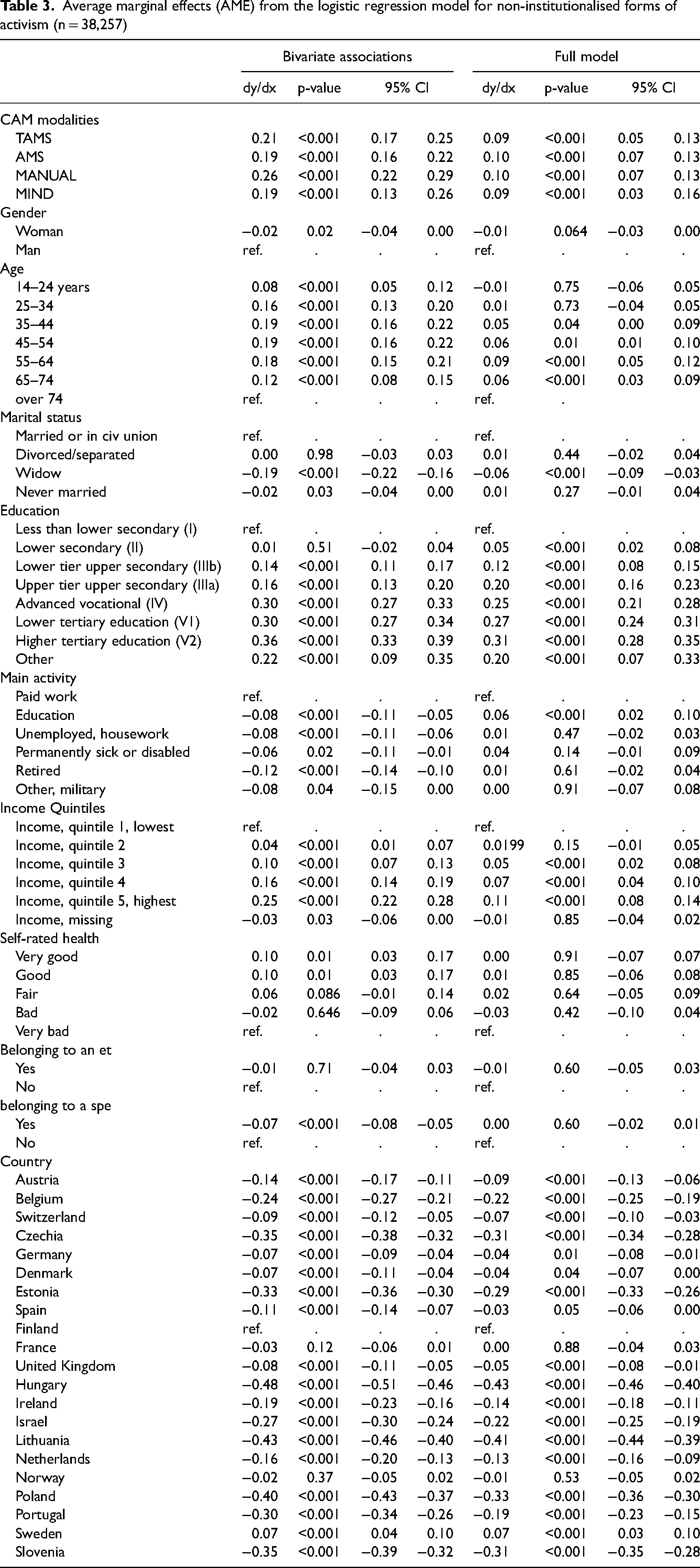
In the final adjusted model, all CAM modalities demonstrated approximately nine to ten percentage points higher likelihood of participating in non-institutionalised forms of political activism compared to non-users. Average adjusted predictions showed that upon adjusting for socio-demographic and health indicators, about 57–58% of CAM users engage in non-institutionalised political activities, compared to a 48–49% engagement rate for non-users.
Discussion and conclusion
This article has addressed the depoliticisation thesis, which proposes that CAM use implies disengagement from politics. Our study is among the rare studies examining this thesis empirically with high-quality European survey data. We investigated both institutionalised and non-institutionalised forms of political participation. Our theoretically based CAM categorisation allowed for a nuanced understanding of the relationships between different types of CAM and political participation, which avoided treating all CAM modalities as inherently similar (see Höllinger, 2004; 2017). We also included several political activities, which ranged from official voting behaviour to different kinds of collective action. Our regression analysis controlled for a variety of socio-demographic characteristics, such as health status, ethnic background, religion, and the respondent's country of residence.
Our analysis revealed differences in political engagement among users of different CAM modalities. After controlling for socio-demographic and country differences, individuals who used AMS or manual therapies had a voting rate of 78%, about three percentage points higher than the 75% for non-users. However, users of TAMS or mind-body therapies did not demonstrate any statistically significant differences in voting behaviour compared to those who had not used these therapies, after accounting for socio-demographic characteristics.
Regarding engagement in non-institutionalised forms of participation, our study found a statistically significant positive association between CAM use and involvement in collective political activities, which was evident in both the bivariate and adjusted models and across all four CAM modalities. After adjusting for socio-demographic differences, approximately 57–58% of CAM users had participated in non-institutionalised activities, compared to 48–49% of non-users.
Contrary to the depoliticisation thesis, our findings strongly suggest that the investigated forms of CAM are not linked to political withdrawal, apathy, or disinterest in collective action. In the realm of voting, disparities among users of different CAM modalities did exist; however, none of the modalities provided evidence of heightened political disengagement. Furthermore, in the domain of collective action, all the modalities we examined indicated increased political engagement among users compared to non-users. These insights challenge the assumption that CAM automatically fosters political disengagement, and emphasise the need for a more nuanced understanding of the relationship between CAM use and political participation.
Our research revealed differences in voting behaviour associated with CAM modalities, outlining differing profiles of political engagement among CAM users. Our results showed that users of alternative medicinal systems (AMS), such as homeopathy and herbal treatment, along with those engaging in manual therapies, such as chiropractic, osteopathy, and reflexology, were more likely to both vote and to participate in collective action compared to non-users. In contrast, individuals utilising mind-body therapies and traditional Asian medical systems (TAMS) did not exhibit this elevated likelihood of voting behaviour but were still more active in non-institutionalised forms of action than non-users.
The higher likelihood of AMS and manual therapy users to participate in institutionalised politics may be connected with the public debates surrounding these modalities. Legal regulation and inclusion of AMS modalities, such as homeopathy, and manual therapy, such as reflexology or osteopathy in the mainstream health care system, has sparked political debates and campaigns in several European countries (Ciocănel et al., 2021; Clarke et al., 2004; Kelner et al., 2006). It has also mobilised political parties to organise around and advocate these issues (Salmenniemi, 2019). In countries like France, Germany, Finland, and the United Kingdom AMS practices, in particular, have been politicized in electoral campaigns and in the broader political discourse (Handel, 2024; Kristallipuolue, 2024; Merrick 2022; Sénat, 2009). These practices also have their own advocacy groups, lobbying their recognition and acceptance in the health care system and in society more broadly. The public discussion surrounding AMS and manual therapy and their regulation may have contributed to an increased interest and engagement in institutionalised political participation among their users.
Debates on the use and regulation of traditional Asian medicine, including practices such as Chinese medicine, acupuncture, and acupressure, have not elicited as heightened political prominence as those surrounding homeopathy, chiropractic, or osteopathy. Among TAMS, acupuncture, in particular, is quite widely accepted and faces less controversy compared to homeopathy and chiropractic care (Zhang et al. 2021). This relative acceptance has facilitated its integration into many healthcare systems. Consequently, due to this less controversial position, TAMS may not provoke additional enthusiasm for institutionalised politics of voting among their users.
Mind-body therapies, such as spiritual healing and hypnotherapy, are, in turn, often marked by a heightened focus on personal well-being and dissatisfaction with formal politics (Salmenniemi, 2022). Their users may prefer individualised forms of collective action, such as lifestyle movements, as a more meaningful channel of political engagement. Moreover, the field of conspirituality, in which various forms of new spiritualities play a key role, exhibits a distrust in political authorities and formal decision-making bodies, which may discourage engagement with institutionalised forms of politics. However, it is noteworthy that our study does not demonstrate lower rates of voting among mind-body therapy users compared to non-users.
To conclude, our study underscores the importance of nuanced understanding in examining the relationship between CAM use and political participation. We argue that the strong association of CAM use with non-institutionalised forms of action may be interpreted as signalling its counter-cultural ethos, which persists even though some of its initial radical tendencies have gradually faded over the past decades (e.g., Höllinger, 2004; Salmenniemi, 2022). This ethos traditionally takes issue with the dominant institutions and values of society, and the authoritarian, medicalised, rationalistic, and patriarchal dimensions of the prevailing social order, especially organised religion, and orthodox medicine (Höllinger, 2004; Saks, 2003). Moreover, the preference for non-institutionalised forms of politics can also reflect the interest in lifestyle politics, in which political change is pursued through more individualised and lifestyle-centred forms of collective action. In more general terms, the general decline of institutionalised forms of participation and the increase in non-institutionalised political activities have been associated with the idea of ‘engaged citizenship,’ which stresses autonomy and critical thinking (Dalton, 2008; Slavina, 2021). This idea also resonates with the critical ethos of CAM, which provides a potential explanation for why CAM users appear more inclined toward non-institutionalised forms of engagement.
Regarding limitations of our study, even though the ESS covers a range of treatments (10) that can be ascribed to CAM, many types of CAM are still absent from the survey. Similarly, the selection between various types of political participation in the survey was limited. Therefore, the present study may have missed other associations with political engagement. Moreover, we did not investigate in detail the country-level differences in the association between CAM use and political participation. Country-level studies and more thorough examination of interaction terms could bring out a more nuanced cultural and societal differences in political participation among users of various CAM modalities across regions and countries.
As a final point, we wish to highlight avenues for future research. We suggest that political ideologies associated with CAM merit further attention. Using the 2014 ESS data, Valtonen et al. (2023) showed that people with green, libertarian, or alternative political views were more inclined to use CAM than those who held other political views. However, during and after the COVID-19 pandemic, CAM has been increasingly associated with conspiracy thinking and Far Right ideologies (Kerins 2021). Thus, future studies should disentangle in more detail these political ideologies and orientations and whether the ideological landscape of CAM users is changing. Future research is also needed in order better grasp the meanings of and motivations for political engagement among diverse CAM users, as well as the different ways of using CAM. Research could delve deeper into the specific sub-groups of CAM users, examining their unique patterns of using CAM and participating politically. Also, the differences among CAM modalities in relation to voting behaviour that we identified in this study merit future research in order to understand the underlying reasons behind these patterns better. Finally, country-level differences in the association between CAM use and political participation requires further analysis in order to better understand the historical, cultural and societal factors shaping the dynamics of CAM and political engagement.
Supplemental Material
sj-pdf-1-asj-10.1177_00016993241311741 - Supplemental material for Revisiting the depoliticisation thesis: Political participation and the use of complementary and alternative medicine in Europe
Supplemental material, sj-pdf-1-asj-10.1177_00016993241311741 for Revisiting the depoliticisation thesis: Political participation and the use of complementary and alternative medicine in Europe by Laura Kemppainen and Suvi Salmenniemi in Acta Sociologica
Footnotes
Funding
The authors disclosed receipt of the following financial support for the research, authorship, and/or publication of this article: The work was supported by the Research Council of Finland (grant numbers 312310, 336669 and 352973).

Supplemental material
Supplemental material for this article is available online.
Notes
Correction (February 2025):
Article updated to correct the values as ≤0.0005 to <0.001 in Tables 2 and 3.
Author Biographies
References
Supplementary Material
Please find the following supplemental material available below.
For Open Access articles published under a Creative Commons License, all supplemental material carries the same license as the article it is associated with.
For non-Open Access articles published, all supplemental material carries a non-exclusive license, and permission requests for re-use of supplemental material or any part of supplemental material shall be sent directly to the copyright owner as specified in the copyright notice associated with the article.
