



Abstract
Fertility rates have significantly declined in advanced, industrialized nations. The factors contributing to these swift demographic changes are diverse, but it is evident that women are opting for fewer children, delaying childbirth, and a growing number of individuals are choosing not to have children. Most studies on voluntary childlessness depict it as a growing phenomenon in Western societies and predict that the voluntary childless population will continue to increase. To explore this trend, examining individuals’ and couples’ fertility choices within the context of evolving parenting culture proves insightful. This study explores the concept of modern parenthood by interviewing 12 Icelandic voluntarily childfree individuals and five couples by examining the decision-making process associated with choosing not to have a child and exploring its connection to prevailing parenting norms. The Icelandic context provides an interesting research backdrop, given its emphasis on gender equality, diverse family structures, and policies that support both parents’ participation in work and childcare. The results indicate that women perceive the role of motherhood as mentally and emotionally draining, complex, and requiring significant personal sacrifices. This suggests that narratives of intensive mothering can directly influence and inform decisions on fertility in the Icelandic context where becoming a parent is seen as a choice, which can even stand in the way of personal fulfilment and autonomy. While the interviewees acknowledge the unequal responsibilities and duties of mothers and fathers, they do not question the individualism and intensity that characterize modern parenthood.
Introduction
Fertility has decreased drastically across most advanced, industrialized nations, including the Nordic countries. The fertility rate in Iceland has been among the highest in Europe, even among the other Nordic countries but now, there are clear signs that this is changing as the total fertility rate has decreased dramatically in recent years from a total fertility rate of 2.22 in 2010 to a rate of 1.59 children for every Icelandic woman in 2022, a figure that has not been lower since records began (Statistics Iceland, 2023). This trend is also found in the other Nordic countries where fertility rates have decreased following a small increase in the number of births in 2021, partially consisting of children conceived during the peak of the pandemic (Lappegård et al., 2023). The reasons behind these rapid demographic developments are complex and multifaceted, but certainly we can say that women are deciding to have fewer children than before, they are having them later in their lives, and increasingly people are deciding not to have children at all (Albertini and Mencarini, 2014). One way to understand this development is to focus on individuals’ and couples’ fertility choices and subsequent fertility behaviour in relation to broader changes in parenting culture. The goal of this study is to understand the decision-making process underlying the choice not to have a child in relation to dominant parenting ideologies.
When examining why some adults remain voluntarily childfree, explanations range from the impact of women's increasing labour force participation and increased reproductive choice to more micro-level motivations, such as enhanced freedom and autonomy (Gillespie, 2003). Predominantly, explanations for increasing rates of voluntary childlessness have focused on key social changes, such as the feminist movement of the 1970s, increased reproductive choice, and women's increasing labour force participation (Blackstone and Stewart, 2012). Ideas about the role of women and the nature of feminine identity have historically been strongly tied to the role of the mother (Arendell, 2000). However, in recent years, there has been a growing tendency among women to choose childlessness, and studies have thus shown that many women who choose not to become mothers are stigmatized and feel they have to justify and defend their decision in communication with others (Moore, 2014). Childlessness, chosen or circumstantial, has always been present, but its frequency has increased significantly in Western countries in recent decades (Rowland, 2007). A study by Miettinen et al. (2015) revealed an increase in childlessness for both women and men in the age groups of 30–34 years and 40–44 years, respectively, across almost all of Europe. Childlessness rates in the Nordic countries are generally around the European average, but Finland could be perceived as somewhat different from the other Nordic countries, as the rate of ultimate childlessness has historically been notably higher there (Hellstrand et al., 2021). In the Icelandic context the tendency of childlessness became much stronger from 2013 onward, and according to the estimates, approximately 11% of women and 17–18% of men were prone to become childless at age 46 prior to 2013, but 14–15% and 25% respectively during 2013–2022 (Jónsson, 2023). Most studies on voluntary childlessness depict it as a growing phenomenon in Western societies and predict that the voluntary childless population will continue to increase (Albertini and Mencarini, 2014).
For several decades scholars have suggested that women's struggle to reconcile work and family responsibilities may be one cause of declining fertility rates in many countries. McDonald (2000) proposes that low fertility is associated with a combination of high levels of gender equality in the public sphere, such as in employment and education, and low levels of gender equality within the home. Studies typically point to the Nordic countries as examples of countries that have placed strong emphasis on gender equality in the construction of their family policies, and that have historically achieved high fertility rates. Structural factors influencing fertility have been deemed positive in the Icelandic context; family policies in Iceland, including paid parental leave for both parents and affordable quality day care for children, have resulted in most Icelandic women combining paid employment with family life. Parenthood norms comprise expectations about how children should be brought up in a society and which roles mothers and fathers should fulfil in this process. The study of parenting culture is a way to explore how these norms reflect broader social trends, how caring for children is organized and conceptualized at any given time, what processes have influenced the formation of current parenting ideals as well as the implication of these for parents (Lee et al., 2023). The focus of this article is to explore voluntary childlessness as a lens through which to view modern parenthood, exploring if and how specific intensive parenting ideologies influence the choice not to have children. The Icelandic context presents an interesting backdrop for this research, as a country with a long-standing status as the most gender equal country in the world (World Economic Forum, 2023) and within a family policy context that promotes shared parenting as the ideal. The context is vitally important as it provides the opportunity to explore attitudes towards parenting within a framework that has tried to eradicate gendered inequalities through social policy, where fathers and mothers both work outside the home, the parental leave system is based on equal entitlements and the dominant narrative when it comes to parenting is that it should be shared.
The need to incorporate qualitative methods to gain a better understanding of the causes of fertility change has been highlighted (Balbo et al., 2013). Scholars have also pointed out that there is a distinct lack of micro-level analyses, especially ones where a gendered approach is used, including both men and women (Balbo et al., 2013). Hellstrand et al., (2021) have also noted that future studies should pay attention to childlessness, given that decreasing first births are the main driver of the recent decline in fertility within the Nordic countries.
Drawing on interviews with 12 voluntarily childfree individuals and five couples, this study addresses these concerns by integrating parenting culture perspectives into fertility explanations and family research by providing a valuable understanding of how intensive parenting ideologies influence decisions on childbearing. Although social policy frameworks and gender ideology differ greatly between countries, lower birth rates and increased voluntary childlessness remains an issue in most cultural settings, and this fact suggests that we require novel avenues of exploration. An important but mostly overlooked avenue of exploration is how contemporary parenting norms affect the gendered transition to parenthood and in particular how the dominant parenting discourse of intensive parenting (Arendell, 2000) influences fertility choices. This focus on parenting culture provides an important addition to the literature on reproductive decisions, child-free identities, and the interaction between policy/social culture and micro decision-making in the Nordic context.
Study context
Historically, the fertility rate in Iceland has been among the highest in Europe, even among the other Nordic countries, but now there are clear signs that this is changing. During the past decade, fertility in Iceland has decreased considerably. In 2010, the total fertility rate was 2.22, but in 2022, the total fertility rate was measured at 1.59 children for every Icelandic woman, following a slight COVID-19-related boom that has since levelled out (Símonardóttir and Arnalds, 2024). The average age of first-time mothers has also been steadily increasing in recent decades. From the early 1960s to 1980, the average age of first-time mothers was less than 22 years, but in 2022 it was 28.6 years (Statistics Iceland, 2023). The sharp decline in fertility rates in Iceland is noteworthy as structural factors influencing fertility have been deemed positive in the Icelandic context (Eydal and Gíslason, 2014). Public policy is very important when it comes to coordinating family and working life, and it has been a characteristic of the Nordic countries to use government policy to systematically strive to equalize the shares of men and women both in the labour market and in family life (Perälä-Littunen, 2007). In Iceland progressive implementations of parental leave systems have been modelled on this philosophy with measurable effects. Since 2000, the stated policy of the Icelandic parental leave law has been to equalize the sexes in the care of their children by providing a specific “fathers’ quota”, which is exclusively earmarked to the father and cannot be transferred to the mother (Eydal and Gíslason, 2014). Female labour force participation in Iceland is almost comparable to that of men, which contributes to putting Iceland on top of the Global Gender Gap Index, compiled by the World Economic Forum, a position the country has held for over a decade (World Economic Forum, 2023).
Nevertheless, recent studies have indicated that parents in Iceland, and especially mothers, are under strain when trying to achieve a balance between paid work and family life (Hjálmsdóttir and Einarsdóttir, 2019; Júlíusdóttir et al., 2018; Rúdólfsdóttir and Auðardóttir, n.d.). Icelandic mothers are much likelier than fathers to bridge the care gap from maternity leave until the child starts daycare (Arnalds et al., 2021), and repeated surveys among parents in Iceland show that over the past 20 years there has been a slow but steady decline in the percentage of mothers who find it easy to balance work and family life (Arnalds, 2020). The parental role in Iceland, as is the case in most other countries, is characterized by various gendered stereotypes based on prominent ideas about fathers as breadwinners and mothers as responsible for the care and emotional well-being of their children (Símonardóttir, 2016) and research suggests that young Icelandic women view motherhood as distressing and likely to negatively impact their social position (Símonardóttir and Guðmundsdóttir, 2022). Although Icelandic fathers are taking a more active part in the care and upbringing of their children with the introduction of the paternity leave system, prominent discourses around intensive parenting have been on the rise in the Icelandic context (Auðardóttir, 2022). This intensification of parenting is not equally directed at mothers and fathers but instead points to increased duties and responsibilities of mothers when it comes to care and upbringing (Gíslason and Símonardóttir, 2018; Símonardóttir, 2016).
The gendered division of work and care
At this point in time in Western societies, both women and men, generally possess similar levels of education and work-life experience. This suggests that the lives of young women and men have progressively become more equal over time. Similarly, gender role attitudes have also become more equal over time (Boehnke, 2011). However, despite these trends, the overwhelming majority of individuals transitioning into parenthood still tend to adopt a more traditional gender-based division of labour and childcare responsibilities (Fox, 2009; Grunow and Evertsson, 2016) as the presence of children heightens gender specialization within couples (Milkie and Peltola, 1999). Despite women's participation in the workforce, when they become mothers, they frequently end up shouldering what Hochschild and Machung (1989) describes as “the second shift”. This concept highlights that traditional gender roles still expect women to assume the majority of responsibilities related to housework and childcare. Despite the comprehensive societal changes reflected in the “Second Demographic Transition”, the gender revolution in European societies, is considered incomplete, even despite the extension of work–family policies (Grunow et al., 2018).
Contemporary depictions of fatherhood emphasise deeper emotional connections between fathers and their children and an increasing trend towards shared childcare responsibilities between mothers and fathers (Brandth and Kvande, 1998; Miller, 2011). Nevertheless, some argue that despite men's embrace of the principles of gender equality and the new notion of active fatherhood, the traditional concept of men as primary providers still exerts significant influence. Miller (2011) characterizes this situation as a “stalled” and “slow” process of transformation. Although the ideology of gender equality and shared parenting can even be accepted as the cultural norm, dominant discourses often equate motherhood with parenthood and promote an ideology of intensive mothering – which emphasizes women's innate character as primary nurturers (Gíslason and Símonardóttir, 2018; Símonardóttir, 2016).
Intensive parenting
Sharon Hayśs (1996) analysis of the ideology of intensive mothering is an important contribution to the literature on parenting and, especially, motherhood. As parenting has become an increasingly important part of adult identity in Western countries, successful child-rearing has become defined as a practice which is “child-centred”, whereby the mother is expected to immerse herself in child-rearing and take full responsibility for her child´s development, while relying on expert guidance and science to show her how (Lee et al., 2014). Several scholars have picked up on Haýs concept of intensive mothering to describe the contemporary parenting experience in Western countries (Elvin-Nowak and Thomsson, 2001; Faircloth, 2020; Lee et al., 2014), recognizing the paradox that this intensive, expert-led type of mothering coincides with womeńs increased participation in the labour force (Hays, 1996; Kanieski, 2010). Intensive parenting has thus emerged as the dominant parenting discourse (Arendell, 2000) and can be operationalised as involving four dimensions: a child-centred approach, a focus on stimulation activities, personal responsibility to do one's best for one's children, and a reliance on expert guidance (Gauthier et al., 2021).
Embedded in the cultural script of intensive mothering is a considerable expansion of mothering but this expansion has also been linked to broader ideological shifts in our perception of children as social capital to be invested in (Vandenbeld, 2014) and neoliberal ideas about mothers as managers of risk through informed decision making (Murphy, 2000). The societal norms related to intensive parenting can provide an explanation for the documented rise in both the time and financial resources that parents invest in their children, as noted in previous studies (Craig et al., 2014; Dotti Sani and Treas, 2016; Gauthier et al., 2021). Contemporary changes in our approach to raising children have resulted in a general increase in the time parents spend on caring for their children. Nevertheless, studies consistently indicate that parents possessing advanced levels of education tend to allocate more time to childcare and implement parenting methods thought to bolster their children's social, cognitive, and linguistic skills (e.g., Altintas and Sullivan, 2016; Bonke and Esping-Andersen, 2011; Dotti Sani and Treas, 2016). This phenomenon could be associated with social class, as the prevailing belief that young children require continuous and extended parental care is believed to be most dominant among middle-class families. Lareau (2003), for instance, contends that middle-class parents practice “concerted cultivation” in raising their children, aiming to maximize their potential and academic success in an ever more competitive society. Class differences should nevertheless be examined in more detail as there are suggestions that social class differences in parenting beliefs and choices have become more subtle (Lee, 2023; Rao, 2018). This may be especially true in Nordic welfare state settings which are defined by features like extensive maternal employment, universal preschool enrolment, and fair wage systems. Time-use data from Norway indicates increased class uniformity when it comes to maternal parenting practices. While there is evidence of increased involvement in intensive parenting by fathers as well, with significant contributions to childcare, their allocation of time remains less intense compared to mothers (Ellingsæter et al., 2022). The prevalence of intensive parenting norms in various cultural setting has been established in cross-national studies (Gauthier et al., 2021) but less is known about how these norms influence individuals’ fertility decisions. By exploring how contemporary parenting norms, such as intensive parenting affect decisions on childbearing this study will provide novel ways of understanding the fertility decline in Nordic countries. Exploring how parenting culture, or dominant parenting ideologies influence childbearing is an important but mostly overlooked avenue of scholarship that can provide us with an original understanding of why people chose to be childfree, not only because of lack of supportive family policy, but because of the intensification of parenting, which is relatively more focused towards and internalized by mothers.
Methods
This study represents one part of a larger study being carried out In Iceland on fertility choices and behaviours. The objectives previously outlined were achieved by conducting semi-structured interviews with 22 participants from October 2020 to March 2021. The participants were recruited using purposeful sampling, which is effective for selecting individuals who possess knowledge and experience of a certain phenomenon (Patton, 2002). The study, requesting participants, individuals, and couples who had decided to be childfree, was advertised in the media through a radio interview with the author explaining the study and requesting participants for the study. The study was further advertised on social media, mostly through Twitter and Facebook, and was circulated widely.
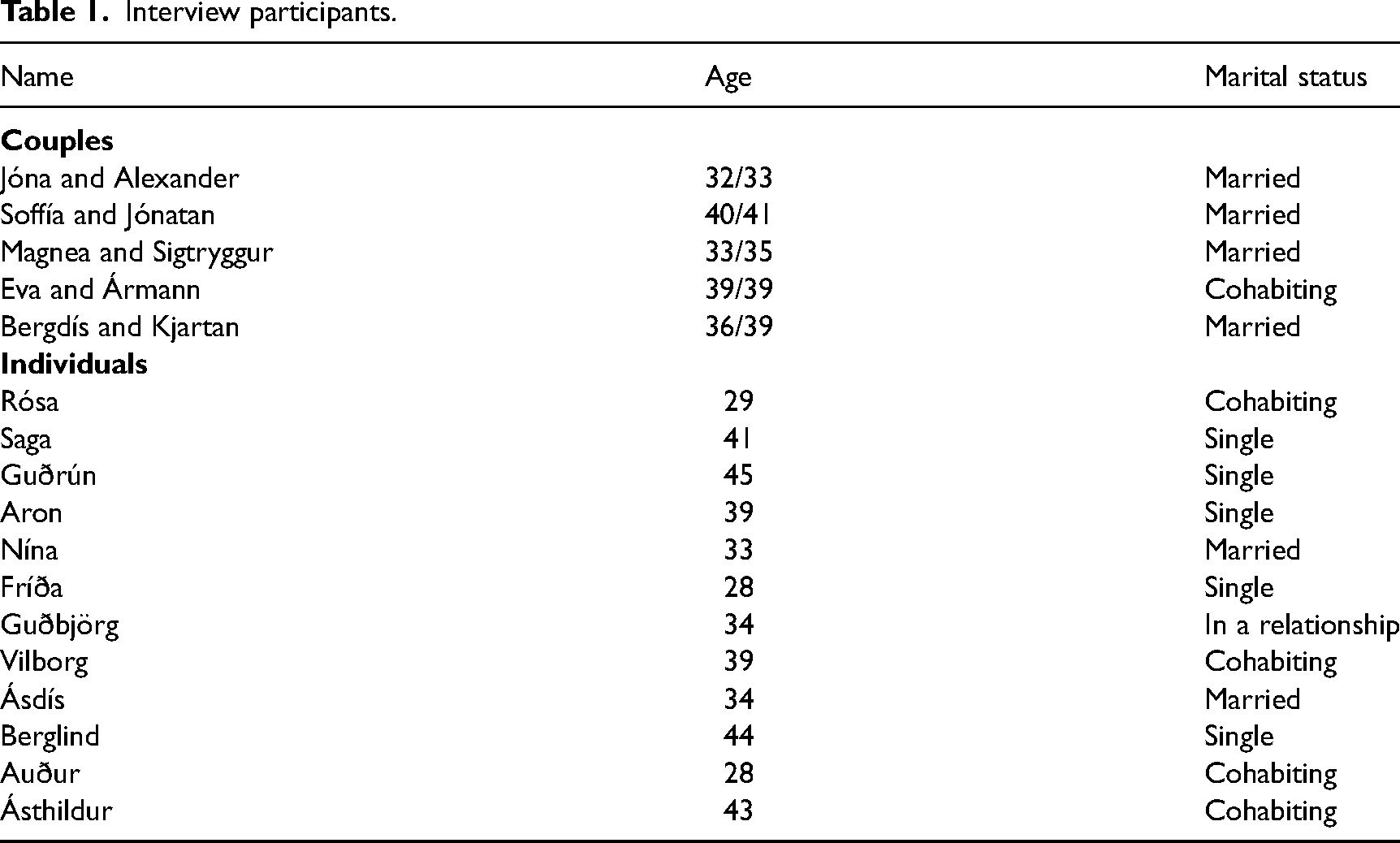
The inclusion criteria for participants were being aged between 25 and 45, living in Iceland, and having decided not to have children. The age criteria were set in order to capture the experiences of those who were of childbearing age or the age bracket that most people would associate with childbearing. A total of 12 interviews with individuals and five with couples were conducted. Among them, 16 were women and six were men, the youngest participant was 28 and the oldest 44, with the average age being 36. The benefits of joint couple interviews include the partners’ ability to co-generate data and round out each other's accounts, while drawbacks can include the risk of one participant dominating the other (Bjørnholt and Farstad, 2014). All the participants who were in relationships were in heterosexual relationships, but the interviewer did not ask directly about sexual orientation, although this information was nevertheless sometimes offered during the interview. The educational level of the participants was rather high, as most of the participants held a university degree. 15 of the participants lived in the Reykjavik metropolitan area, whilst seven of them were living in various smaller towns or municipalities. Table 1 lists the participants and their ages and marital status.
Interview participants.
The interviews were conducted by the author and ranged from 40 to 68 min. They were all conducted on Zoom due to severe COVID-19 restrictions and were all recorded on Zoom and later professionally transcribed. The positive aspects of using Zoom video conferencing as a means of conducting qualitative interviews are convenience, ease of use, and accessibility, as well as providing participants with a sense of comfort for discussing personal topics (Gray et al., 2020). As the COVID-19 pandemic had familiarized most people with video conferencing, all the study participants seemed comfortable being interviewed through Zoom. However, there are certain disadvantages that should be recognized as the researcher and interviewee do not occupy the same physical space, which makes responding to body language and emotional cues more difficult. Longer interviews also seemed more tiresome for all parties involved, which could be explained by a certain screen fatigue that has been associated with the use of video conferencing.
Two separate but similar interview guides were developed: one for couples and the other for individuals. The interview guides consisted of questions regarding three overarching topics that focused on the decision to be childfree, the reaction participants received from their surroundings towards their childfree status, and their views on parenting and the childfree lifestyle. Nevertheless, the interview guides were quite unstructured, allowing participants the freedom to discuss their own experiences in an open and unrestricted manner. All participants received an email explaining the purpose of the interview and how the data gathered would be used. At the start of the interviews, the researcher reiterated this information and explained that full anonymity would be assured by using pseudonyms and concealing all information that might jeopardize the anonymity of participants. Verbal informed consent was obtained from all interviewees, and they consented to the interview being recorded and stored. Because Iceland is a small country where participants might be identified based on their place of work, age, and/or specific circumstances, special attention has been paid to protecting the anonymity of participants by concealing sensitive and/or identifiable information. For the analysis of the interview data, a reflexive thematic analysis (Braun and Clarke, 2019) was employed. The analysis followed the general pattern of first reading all the interview data closely, making notes, and establishing preliminary patterns. Following a thorough familiarization with the data set, ATLAS.ti, a qualitative data analysis programme was used, to organize and process themes and patterns and relate them to the original research questions. The analysis has been organized into one overarching theme: What Is Being Rejected: The Problem with Parenthood, with additional sub-themes. All the quotes included in this paper were translated into English by the author, and all names of participants are pseudonyms.
What is being rejected: The problem with parenthood
The focus of this article is to explore voluntary childlessness as a lens through which to view modern parenthood, evaluating if and how intensive parenting ideologies affect the choice to be childfree. The interviewees can be divided into two distinct groups when it comes to the decision-making process, those who arrived at this decision early in life and those who took more time to consider it before eventually deciding not to pursue parenthood. It is interesting to compare the narratives of the men and women who participated in the study. Women tended to go through a very deliberate decision-making process, exploring thoughts, arguments, and counter-arguments and regularly reviewing the decision to see if they were still completely sure. Women, especially those in relationships, talk about “taking stock of their feelings regularly” (Ásdís) and making sure that they “still feel that way” (Nína) and are “still quite sure” (Magnea). The male interviewees, on the other hand, seem to construct their decision as quite simple and straightforward – something that does not need to be analysed or explained, as the following quotes demonstrate: I also do not remember having made any decision or thought to myself: No, this is not for me, or anything like that, I just did not give it any thought. (Sigtryggur - Man) Rather, if something comes up and I say that we subscribe to the childfree lifestyle or do not intend to have children, it is better for people to take it as just something like, a temporary misconception that can change and reactions like that. But I have never had to, or almost never had to explain or defend that decision. (Jónatan- Man)
It should be noted that the societal pressure and interest the men encounter is often much less pronounced than for the women, and they are therefore less likely to have to think of ways to justify or explain their childfree state. By comparison, all the women who were interviewed have had to explain and justify their decision to their surroundings, and the response to their choice to not have children is vastly different, ranging from being met with complete understanding to them recognizing their status as willingly childfree as very stigmatized and challenged. Bergdís explains what reactions she has experienced and compares them to the reactions that her male partner has encountered: I’ve been exposed to a lot of adversity and just lack of understanding, and you know, everyone thinks it's their business, you know, everyone can comment on this [being childfree]. And just more so towards me, which is a strange attitude, rather than towards him. He's just left alone. (Bergdís-Woman)
It should be noted that there was not an equal number of men and women interviewed, and men represented only 6 out of the 22 participants. Nevertheless, the gender differences remained meaningful and were further confirmed by the female interviewees who were part of a couple and described what reactions their partners faced – or more accurately didn’t face – because of their childfree state. It is important to note that for some of the participants no version of parenthood is appealing and would make them rethink their decision not to have a child. Often, they have reached their decision at an early age and construct their decision as not a conscious choice, as described by Vilborg: “this may not actually be a choice of childlessness for me in that way, it is just a default”. For others, especially those who experience more ambivalence and construct their decision as more of a “wait and see” approach, parenthood and the social construction of parenting roles can be seen to play a part. The problem with parenthood, as witnessed specifically by the female participants in this study, can be divided into two overlapping sub-themes: Intense demands and sacrificing yourself and Unequal responsibilities – becoming the dad? Viewed together, they represent a parenting framework that is perceived as very taxing on parents, especially mothers, and attest to the further intensification of parenting, even in the context of a Nordic welfare state.
Intense demands and sacrificing yourself
The female participants characterize modern parenting as intensely demanding, taking a severe toll on their mental and physical capabilities. They recognize these demands as gendered and more focused on mothers: Superman [parents have to be]. Inhuman stress is placed on people, especially mothers. Yes, I wouldn’t want to be in their shoes today. It's a crazy responsibility; they have this burden of being so many things at once, which is impossible. You have to be their [child's] best friend, you have to be their psychologist, their parent, you have to protect them from all dangers. (Ásdís – Woman)
The interviewees describe an individualistic attitude towards parenting where society does not support parents when it comes to meeting the fierce demands that are made of them. Instead, society is constructed as a somewhat hostile environment to raise children, where “the system is not made for children” (Nína – Woman). This unsuitability is reflected in various ways, for example, in lack of monetary support for parents, excessive work obligations, and lack of support from extended family. Commonly mentioned are also the perceived excessive obligations for children to take part in extracurricular activities, resulting in parents having to chauffeur them back and forth several times a week: Like my little niece, she has three hours of gymnastics practice after school you see, then she has to study and sleep and spend time with her parents. You know, this is a bit much. So, I think that, when I kind of look from the outside at the lives of other people who have children, it's chaos. And it still always needs to be planned up to the minute so that you manage to finish everything. (Nína – Woman)
The modern Icelandic mother, as described by the female study participants, is therefore expected to work full time, have a busy and enjoyable social life, take care of her body and mind, and have a clean and pleasing home: And then there's also, how the woman is supposed to look, how to behave and how she should of course also be studying and working and all of that. And then it is usually the women's responsibility to take care of the home as well…. my girlfriends are often just so defeated with all of this. (Eva – Woman)
These multifaceted demands are constructed as “seeming to instinctively always be more focused on women” (Fríða – Woman) but at the same time we see that the demands that are made of womeńs parenting skills are also scrutinized for she is “producing a child … that is a valued member of society who can take an active part in society and think for him/herself” (Rósa – Woman). This extended skillset was repeatedly stated by the participants of the study as being an integral part of modern mothering: A good mother is supportive, she's caring, she's forgiving, she favours those quiet good times. You know, they [children] can be playing roughly, but it's still somehow controlled. You know what I mean, you know the child is larking about, but the mother is just savouring the experience. (Nína – Woman)
For some of the participants, this taken-for-granted excellence is constructed as a reason to forgo motherhood, for they themselves would not want to be anything less than excellent mothers because it can be viewed as “dreadful that people are having kids without having familiarized themselves with all of this [parenting and childbirth]” (Auður -Woman).
The essence of these intense demands described by the interviewees lies in the certainty that in order to meet them the mother must be prepared to sacrifice herself and her self-interests and selfish desires. Auður explains this common theme in the following quote, where she discusses her good friend who has children: He [partner] has a lot of hobbies, while she really has no hobbies and does nothing for herself, you know, and she was just telling me the that she felt that going to work, was “me-time”. Which is just ridiculous, and then she's never alone and she also told me that the only time she gets for herself is this short period when she takes a shower at night. (Auður – Woman)
The study participants contend how mothers in particular have to sacrifice their bodies for pregnancy, birth, and breastfeeding and also their sense of autonomy to their children and families. Taking care of yourself, mentally and physically, is constructed as something belonging only to the childfree, and the parental role becomes an all-encompassing project that leaves no room for personal fulfilment.
Unequal responsibilities – Becoming the dad?
In Iceland, policymakers have strongly supported shared parenting as the ideal model for parenting, but policy and practice diverge along gendered lines regarding the parental role, as mothers are more likely than fathers to bridge the care gap between parental leave and daycare by extending their parental leave or adjusting their participation in the labour market until the child starts preschool (Arnalds et al., 2021). Most of the interviewees described gendered differences with regard to parenting in the Icelandic context, not only because of biological differences or structural factors but also when it comes to societal expectations and performances of parenting. Fríða, a woman in her late twenties, addresses this and says, “I would like to believe that this is changing for our generation, but I have yet to see it myself”. Many participants construct it as an inevitable part of motherhood that you not only shoulder most of the responsibility but also that the management of the chores and household is your responsibility: My feminist outlook is that we had to have reached the point where both parents, if it's a heterosexual couple, would be involved in parenting but then I just saw, both in my own upbringing and as I got older, that this was often – and when my friends started having children too, you know all the nagging about how husbands and boyfriends were not putting in enough effort and I just felt like their husband was somehow their child too. (Guðbjörg – Woman)
For some participants, them being childfree is constructed as beneficial to their couple relationship as they do not have to constantly nag or even resent their partners for not doing their fair share. Many participants note that household chores are not divided equally in their own households despite them not having children: I mean I notice it with the two of us, we follow traditional gender roles when it comes to the home. By accident. I cook because I enjoy it more. I clean because he hasn’t done it …. And for couples with children, there is a lower threshold for a father to be a good father, than for a mother to be a good mother. And I really notice that. (Nína – Woman)
In this quote, Nína demonstrates how the gendered division of work within the home is played out – by accident, as she says. By adding children to this mix, the idea is that the responsibilities and tasks for mothers would multiply and overburden women. Magnea labels this added work for women as “feminine duties”, and for Guðbjörg, a woman in her thirties, this is a testament to the fact that “the equality paradise that [she] was promised as a teenager – it doesn’t exist”. So, is there a solution? Are there ways to envision a parental role that could be attractive to the interview participants? For some, the cultural role of the father represents this achievable parental role: I’m really happy with the role of the aunt, and if I could, you know, get the dad role, I’d be kind of off the hook while someone else takes care of everything. It's very interesting. The role of dad is a bit exempt when I think about my friends who have had children, my brother-in-law, how things are at his house. You know they really love their children and take care of them, but it's like okay, it's not the same thing being a mum and a dad. (Fríða – Woman)
Rósa is one of the study participants who might be comfortable with a parenting role that has been culturally reserved for fathers: When I was discussing this with my boyfriend, for example, I also said quite openly that I would be open to discussions about having a child, for example, if he envisions being in the main caregiving role. So, I said I would be open to thinking about it if he could provide care and he would be the mum and I would be the dad. Not that it is relevant, but he did not find that idea very exciting. (Rósa- Woman)
It is interesting to consider how that it is often easier for participants to envision a society where mothers can take on the role of fathers than one where both parents share parenting responsibilities equally or simply a society that does not ascribe to the concept of intensive motherhood. This quote from Rósa's discussion with her partner demonstrates that the idea of change is not of much interest – at least not to her partner.
Discussion
This article examines voluntary childlessness in the context of modern Nordic parenthood, with a particular emphasis on how intensive parenting ideologies can influence the choice to remain childfree. There are limitations in this study that could be addressed in future research, as the participants of the study are mostly middle class and well educated and therefore may be seen to reflect normative discourses of parenting that have been especially tailored to their demographic (Símonardóttir et al., 2021). The Icelandic setting presents a strength due to its extensive social policy regarding shared parental leave and its position as a global leader in gender parity. The Nordic countries were forerunners in encouraging parental leave use of fathers with the introduction of non-transferable leave for fathers, the so-called fathers’ quotas. Research supports that such measures impact fertility, as fathers’ participation in care and their use of parental leave for their first child are positively associated with the propensity to have a second child (Duvander et al., 2020). Career considerations have historically often been cited as reasons women forgo having children (Park, 2005), as they have often had to choose between either work or having a family. However, in Nordic welfare societies, women and men are expected to have professional careers just as they are increasingly expected to share the care responsibilities for children (Peterson and Engwall, 2013) and therefore career considerations might not have the same impact as they do in other cultural contexts.
The Interviewees had two primary paths when deciding to be childfree, some had made this decision early on in life, while others took more time to think about it before eventually deciding not to have children. This is in line with research from other contexts that demonstrates how varied the decision-making process is, ranging from some choosing very early not to have or rear children and reporting that they have had no maternal desire, instinct, or urge to those who were more informed by circumstances or ambivalent (Dever and Saugeres, 2004; Gillespie, 2003; Peterson and Engwall, 2013). The findings also suggest an important divergence in the identity work performed by men and women as they negotiate their wishes to be childfree. Women tend to undergo a thorough assessment, re-evaluating their feelings and ensuring that they are still certain of their choice. The men in this study, however, typically view their decisions as more straightforward and uncomplicated. This is interesting in light of how “new father” norms have taken roots in the Nordic countries with increased cultural expectations towards fathers’ involvement in care (Elliott, 2016) which might suggest that both women and men would experience similar societal pressure to become parents.
The findings highlight that, for some participants, the idea of parenthood simply does not appeal and changes in parenting culture could therefore not cause them to reevaluate their decision. For others, who have more mixed feelings and tend to take a “wait and see” approach, the social roles of parenting seem to influence their choice. For those participants, the role of the mother is seen as mentally and emotionally draining, intricate, and requiring great personal sacrifice. These findings are meaningful for sociologists, demographers and family researchers who are interested in exploring and understanding the causes of declining fertility rates.
The national identity of Iceland has been directly influenced by its branding as the most gender equal country in the world (Einarsdóttir, 2020). Furthermore, egalitarianism and equality have been considered cultural traits of the Nordic countries (Bendixsen et al., 2018), and this serves as an interesting context to the interviewee's description of a reality where the bulk of the responsibility and management of the household and parenting falls on mothers. Daminger (2019) has suggested that, in post-industrialized settings, the transition to parenthood can shift the dynamics of even the most egalitarian couples and lead to a more traditional sexual division of labour. This is consistent with the findings of Hjálmsdóttir and Bjarnadóttir (2021) that suggest that the division of labour within Icelandic homes remains uneven, where mothers take on an unequal share of housework, childcare, and emotional and mental labour. For some participants, being childfree is therefore seen as advantageous for their relationship, as there is no need for them to continually criticize and become resentful of their partners for not doing their fair share.
The gendered distribution of labour within the home is not the only obstacle, but rather the idea that mothers have to sacrifice their physical and mental well-being in order to bear and nurture children as well as relinquish autonomy in favour of their children and families. This leaves little room for self-care, making it seem like a privilege exclusive to those without children. The interviewees emphasized that, in order to meet these intense demands, the mother must be willing to give up her own needs, wants, and desires – whilst fathers can retain their freedom and autonomy. The narratives of the female participants pertaining to the intense demands of motherhood may be constructed in order to justify their decisions or even constructed over time, as they are expected to justify their decision to others. Illouz (2012) has argued that increased rationalization and individualism in modern society more generally leads to a greater range of choices for women, but also a cooling of intimacy since romantic decisions are now based on bargaining and reason, and the same logic could be applied to the decision to have children. This however leaves little space for consideration of structural or ideological constraints, such as how certain parenting frameworks and ideologies prescribe parenthood in a specific way, that could be argued is both narrow and gendered. All the female interviewees are aware of the demands that society makes on mothers, and the analysis of their interviews suggests an important shift in our perspective of motherhood due to the ideology of intensive mothering, for as Faircloth (2013) has noted, intensive motherhood has been imported from the USA and UK to other cultural settings where its interpretation and representation can be very different. Interestingly, although the interviewees recognize flaws in the face of the egalitarian society regarding the unequal responsibilities and duties of mothers and fathers, they do not question the ideology of individualism and intensity that characterizes modern parenthood. There does not seem to be much scope for tailoring parenthood to one's own needs, lifestyle, or desires – or, in other words, to make it one's own. Through the analysis we see how intensive mothering narratives directly influence and inform decisions on fertility in the Icelandic context where becoming a parent is seen as a choice, which can even stand in the way of personal fulfilment and autonomy (Esping-Andersen, 2011).
Mothers still devote a greater amount of time per day to childcare than fathers (Dotti Sani and Treas, 2016; Ellingsæter et al., 2022), a trend that indicates that mothers are being called on to reconcile enhanced norms of parenting with increased labour force participation. Studies in this area have also unveiled the pressures on, particularly mothers to conform to this new standard, often to the detriment of their personal well-being (Rizzo et al., 2013). The problem of why parenthood solidifies traditional gender-based division of labour and childcare responsibilities, calls for an examination that goes beyond country specific policy frameworks and prevailing gender norms as they differ greatly between countries. An important but mostly overlooked avenue of exploration is how contemporary parenting norms affect fertility choices and the gendered transition to parenthood. The findings presented in this study suggest that the dominant parenting discourse of intensive parenting (Arendell, 2000) has become instrumental in the reproduction of gendered parenting behaviours, demonstrating how and why this division is established and maintained, and for the study participants, ultimately rejected.
Footnotes
Acknowledgements
The project from which this paper is drawn is funded by the Icelandic Research Fund, grant no. 228294.
Funding
The author disclosed receipt of the following financial support for the research, authorship, and/or publication of this article: This work was supported by the The Icelandic Research Fund (grant number 228294).
