



Abstract
The 2019 Fridays For Future global climate strikes were extraordinary protest mobilisations in many respects, both in terms of size, age composition and the absence of a specific external triggering event. To properly understand it, one must account for Greta Thunberg's leadership role in the mobilisation – the ‘Greta effect’. We contribute to such an account by linking the ‘Greta effect’ on individual mobilisation to theories of political iconicity and political role models. Empirically, we use unique data from two waves of international surveys of participants in European Fridays For Future protests – on 15 March and 20–27 September 2019 – demonstrating that the perceived individual impact of Greta differs considerably among those who were mobilised in climate strikes. Through multilevel regression analysis, we furthermore show that (a) young women were especially prone to have been inspired and mobilised by Thunberg as a role model and (b) subjectively assessed mobilising influence by ‘Greta’ – in her capacity as a political icon – is positively related to protest participants’ instrumental motivation, sense of solidarity and collective identity. We argue that our results contribute to a better understanding of informal social movement leadership in contemporary political mobilisations.
Keywords
Introduction
Compared to other areas of social movement research, movement leadership has received relatively limited attention (Morris and Staggenborg, 2004). Usually, the focus has been on the features of the leaders rather than their practice of leadership (Ganz and McKenna, 2019) and there is very little systematic knowledge about how individual activists are affected by prominent leaders in their movement. Strikingly, the micro-dynamics of individuals’ protest mobilisation have been theorised for a long time (e.g. Klandermans and Oegema, 1987) and while the role of networks, frames, efficacy, emotions and mobilising structures are well examined (van Stekelenburg et al., 2019), the analytically distinct role of leaders in these dynamics is almost entirely overlooked. A better understanding of the meaning of social movement leadership becomes particularly pertinent as online forms of mobilisation become increasingly prominent and lead to global coordination of collective action on an unprecedented scale. While this is typically connected to non-hierarchical and decentralised forms of organising, this does not necessarily imply that leaders become less important, although their forms of influence may differ from leaders of formal and hierarchical organisations. A striking example of leadership in contemporary global protest mobilisation is Greta Thunberg and Fridays For Future (FFF).
On 20 August 2018, the then 15-year-old Greta Thunberg began her initially three-week uninterrupted school strike, positioned outside the Swedish National Parliament Building in Stockholm. The school strike, intended to demonstrate the meaninglessness of going to school when the world as we know it is about to be destroyed by global warming, was eventually joined by young people from an increasing number of locations worldwide. After the initial three weeks, the school strike limited itself to Fridays, giving rise to the FFF movement that quickly managed to mobilise several waves of globally coordinated protests, beginning with the Global Climate Strike on 15 March 2019. This event was unique because it was not preceded by a specific precipitating event such as an international summit (Cassegård et al., 2017; della Porta, 2007; Hadden, 2015; Owens, 2013). There were also strikingly high proportions of ‘newcomers’ among the global climate strike activists (de Moor et al., 2020a, 2020b). News media and some scholars quickly referred to Greta Thunberg's school strike as a trademark of a new climate mobilisation, and the sudden wave of youth activism was explained by a ‘Greta effect’ (Watts, 2019).
That there is indeed some form of ‘Greta effect’ is supported by research based on a national representative survey of adults in the US, which demonstrates that those familiar with Greta Thunberg show higher intentions to participate in climate change-focused collective actions (Sabherwal et al., 2021). However, that study does not measure actual participation in FFF and other studies show fewer mentions of Greta among FFF activists than one might expect (Díaz-Pérez et al., 2021; Martiskainen et al., 2020). Some climate-strike participants even distance themselves from the feminised public image of the FFF (Sorce, 2022). There are, in other words, strong indications that the strength and character of the ‘Greta effect’ vary not only within country populations but also among climate activists. However, little is known about how it varies, and even less about what it means for protest participants to become inspired and mobilised by Greta. To address these knowledge gaps, we will theoretically develop what we argue are the key components of Thunberg's mobilising role, and empirically investigate how they play out among FFF participants.
We contend that Thunberg's impact should be theoretically understood as a combination of her eventual political iconicity, uniting people globally, and her acting as a political role model, especially for young female participants. Empirically, we explore these aspects through an analysis of a unique internationally comparable survey dataset on 3947 participants in the 15 March and 20–27 September FFF protests in 22 cities in 15 European countries. In contrast to prior one-country studies drawing samples from the entire population, our dataset on actual FFF participants makes it possible to identify, and account for, variation both within and between events and locations.
Our results show that the perceived impact of Thunberg's leadership among climate strikers is far from uniform within the mobilisation. It varies considerably both between countries and events, as well as among participants in a single protest. A regression analysis of our protest survey data further demonstrates that different degrees of perceived influence by Greta correlate with participant characteristics in ways that support our theoretical interpretations. Youths and young women appear more likely to identify with Thunberg as a role model based on their shared traits. We argue that Thunberg's role model status also explains some participants’ higher determination and the sense that their protest can have an impact. Furthermore, we demonstrate a positive correlation between, on the one hand, perceived influence by Greta and, on the other hand, a general sense of collective identity with others in the movement and a tendency to regard one's participation as an expression of solidarity. This arguably represents how the political icon ‘Greta’ functions as a unifying symbol for the movement.
Two mechanisms of social movement leadership
While young women and girls are often celebrated as community leaders (Taft, 2011), there is traditionally a scarcity of women in high leadership positions within social movements (Robnett, 1996). The FFF is an exception. Its original website was started by a woman (Janine O’Keefe) and there are many local young female leaders in different countries (e.g. Adélaïde Charlier, Kyra Gantois, and Anuna de Wever in Belgium, Luisa Neubauer in Germany, Marie-Claire Graf in Switzerland, and Hilda Nakabuye in Uganda). However, it was Greta Thunberg who led the transnational movement by example and acted as a de facto leader in several respects. She was an articulator of movement demands and a mobiliser of movement participants (Gusfield, 1966). Thunberg exercised typical leadership practices such as relationship-building and storytelling (Ganz, 2010). She arguably filled both the role as a symbol of the movement and in some sense also a decision-maker, influencing the direction of the movement (Turner and Killian, 1972). However, Thunberg did not speak as a representative of a distinct formal organisation but as herself based on the moral standing – even iconic position – that she had acquired. Leading and mobilising by example as a role model and as an iconic figure, is what we argue has been most distinct about Thunberg's leadership role in FFF, as we develop further in the following two theoretical subsections.
‘Greta’ as a political icon
The reception of Thunberg's speech on 23 September at the 2019 UN General Assembly signified that her position had become more than a spokesperson. Millions viewed her speech, and it contributed to climate protests of unprecedented scale across the world on Friday, 27 September. In less than a year, Thunberg had developed into what can be described as a political icon of crucial importance for the climate movement to mobilise globally, independent of UNFCCC climate summits as uniting events (Olesen, 2022). Alongside many other young women, such as Malala Yousafzai and Nadia Murad, Greta Thunberg had become a symbol of ‘young female heroism’ (Bergmann and Ossewaarde, 2020), which departs from the pattern identified by Prestholdt (2019) that global ‘icons of dissent’ have tended to be male.
Drawing on the works of, among others, Durkheim (1995) and Alexander (2011), Olesen (2015) developed the notion of global political icon as a subcategory of global injustice symbols. 1 Building on Durkheim's (1995) theorisation of symbols as representing something sacred to the collective, condensing collective meanings and values, Olesen (2015) argues that symbols thereby ‘connect individuals and groups with society and the social’ (p. 6). Injustice symbols highlight morally wrong actions or – more to the point in the case of Greta as a potential injustice symbol – unjust inaction. In Olesen's (2015: 41) theoretical framework, a political icon is ‘an image or person that embodies and symbolises a period, an event, or a set of values’. In practice, images and persons typically come together in specific photographs or artistic renderings of the person, reproduced on banners, clothes, pins, etc. While the physical individual herself can be conceptualised as the background person, the icon is, in a sense, a collectivised individual as a symbol for collective values. Recent media analyses demonstrate that media presented Greta Thunberg as exceptional, heroic, and iconic (Bergmann and Ossewaarde, 2020; Ryalls and Mazzarella, 2021), even though it is clear that political icons are seldom perceived unanimously and are often contested. Like Malala Yousafzai (Olesen, 2016), Thunberg has been a subject to ongoing attempts at de-iconisation, that is, attempts to deprive the background person of her iconic status (Daniel and Graf, 2020).
While studies currently proliferate on the contentious formation, negotiation, and dissemination of political icons (Alexander et al., 2012; Olesen, 2015; Prestholdt, 2019), the importance of social movement leaders’ symbolic capital (Nepstad and Bob, 2006), and the construction of public characters (Jasper et al., 2020), little empirical work analyses the ways icons have been constructed and received among protest activists. Building on the Durkheimian notion that symbols connect individuals to a collective – as well as drawing some of their power from collective rituals – we argue that an essential measurable individual correlate of perceived influence by Greta as a political icon should involve a heightened sense of shared collective identity with other protest participants. Being mobilised by a symbol representing a collective and its values should also increase the sense of belonging to that collective (Schatz and Lavine, 2007) and, conversely, a higher sense of identification with a collective should also imply a greater affinity with its icons. These arguments run counter to Ryalls and Mazzarella's (2021) concern that Greta's individual iconicity might downplay the need for collective mobilisation. Symbols contribute to a shared sense of community not by having the same meaning to all individuals but precisely by being shared while making diverse interpretations possible (Cohen, 1985). Nevertheless, with the sense of having a shared political concern comes solidarity with other members of the imagined community (Saunders, 2008), also extended to other groups evoked by the injustice aspect of the icon. In other words, Greta's iconic status can be expected to heighten FFF participants’ sense of solidarity towards each other. In symbolising the younger generation which is to a larger extent victimised by the effects of climate change, she arguably comes to represent solidarity among children and youth, as well as solidarity by older generations towards the younger. This represents two common objects of solidarity, in capturing either the support within an in-group or towards a comparatively disadvantaged out-group (Wahlström, 2016). In Waterman's (1998: 235–238) terms, solidarity would for young participants imply primarily a ‘solidarity of common interest and identity’, while for older participants mainly the ‘restitution’ aspect of solidarity, an acceptance of responsibility for historical wrongs.
In sum, we have two hypotheses about what should characterise FFF participants for which Greta performs the function of a mobilising political icon:
A stronger sense of shared collective identity with the other protesters is positively correlated with a higher perceived importance of Greta.
Participants who are more strongly motivated by solidarity also perceive a higher importance of Greta.
Greta as a role model
The position of Greta Thunberg as a spokesperson of the movement and background person for ‘Greta’, the political icon, does not exhaust what she represents to the FFF mobilisation. Crucially, Thunberg demonstrated that a young women can exercise political agency. In that capacity, she can also be a political role model (Campbell and Wolbrecht, 2006; Wolbrecht and Campbell, 2017), especially for other youths and, more specifically, young women. Being a role model is analytically distinct from Thunberg's iconic status because the background person Greta Thunberg demonstrates what is possible to others who want to follow in her footsteps. While the icon is something beyond an ordinary individual, a role model shows what is attainable for other ‘mortals’. Consequently, in media depictions, there tends to be an ambiguity between ‘Greta Thunberg as the hero and role model’ (Bergmann and Ossewaarde, 2020: 21). While positions as political icon and role model are not mutually exclusive, not all icons are role models, and not all role models have iconic status.
In an overview of role model research, Morgenroth et al. (2015) identify three distinct functions of role models: ‘(a) they show us how to perform a skill and achieve a goal – they are behavioural models; (b) they show us that a goal is attainable – they are representations of the possible, and (c) they make a goal desirable – they are inspirations’ (p. 467, italics in original). In a social movement context, these three functions could be translated to (a) demonstrating possible repertoires of contention, (b) increasing a sense of individual political efficacy, and (c) increasing alignment with the role model's framing of a political issue.
The first two functions relate to the argument that female political leaders demonstrate opportunities for women to succeed in politics and bolster women's usually low levels of political ambition (Lawless and Fox, 2015). For example, in a recent study, Campbell and Wolbrecht (2019) demonstrate how political candidates and the outcomes of their election campaigns (e.g. the one of Hilary Clinton), as well as the role models in the family, increase the protest potential among young women in the US. Also, Liu and Banaszak (2017) have shown that a higher proportion of women in high political positions (cabinet ministers) increase women's participation in peaceful demonstrations. Having a young girl as a front figure of a protest movement should have a similar effect and increase the likelihood of female protest activism. Media narratives of ‘how Greta became an activist’ could aid young women in constructing a social identity as a climate activist and indicate various trajectories to becoming one (Taft, 2011). Recent research has demonstrated that the presence of women political role models influences the protest propensity of other women and girls (Campbell and Wolbrecht, 2019; Liu and Banaszak, 2017). However, we are aware of no studies investigating participant perceptions of a woman role model within a specific protest campaign or how it correlates with the characteristics of the protest participants. We already know from descriptive reports that the Global Climate Strike activists are unusually likely to be young women (de Moor et al., 2020a, 2020b) and the fact that they are school striking indicates that Thunberg has functioned as a behavioural model – they use the same action repertoire. However, we also expect that young women mobilised in FFF are more affected by Greta, compared to other protest participants.
Political efficacy is usually analysed via its two dimensions – internal efficacy is closely related to ideas of personal competence (I am able to), and external efficacy reflects perceptions that one has a voice in politics (I have a say) (Wolak, 2018). Considering that Morgenroth et al. (2015) emphasise role models’ capacity to increase motivation and the sense of attainability among the role aspirants – those for whom role models are a source of inspiration and target for emulation – we argue that perceiving Greta as a role model should boost activists’ perceived political external efficacy. Greta might have functioned as a representation of the possible in changing role aspirants’ self-stereotyping as having the capacity to take action for the climate and, to some extent, the limited effect that external barriers (such as school regulations) had on her activity. This way, role aspirants in the FFF campaign could also be expected to have higher internal efficacy – in the sense of confidence in their capacity to act politically (see also Sabherwal et al., 2021). Therefore, the analysis focuses on the combination of motivation and political efficacy.
However, people very different from a potential role model might not be affected by the ‘inspiration’ of the model to the same degree as those very like her (Asgari et al., 2012). In other words, identifying with the role model in some respects increases the sense that the role model's achievements are attainable. In the context of FFF, one might expect young and women participants, and even more so young women, to gain a heightened sense of efficacy from Thunberg.
Lastly, whereas the central part of role model research concerns personal educational and career goals, we argue that the inspirational function of a role model such as Greta Thunberg translates into adopting the political goals and collective action frames articulated by the role model. According to Morgenroth et al. (2015), this is mediated by the degree to which the role model is regarded positively. Adopting the role model's goals also increases the motivation of the role aspirant to reach these goals.
In sum, we have two additional hypotheses about what should characterise FFF participants for which Greta has become a role model:
The higher the degree of perceived political efficacy and motivation to struggle for the campaign goals, the more strongly participants perceive themselves to be influenced by Greta.
Youth and women participants will experience a stronger perceived ‘Greta effect’ since sharing (approximate) age and gender facilitates identification with her as a role model.
Methods
The protest survey method
The data analysed in this study comes from two waves of a protest survey of FFF protests on the 15 March and on the 20 or 27 September 2019 (details about both events in Tables A1 and A2 in the Supplemental Appendix, and in two reports – de Moor et al., 2020b; Wahlström et al., 2019). Our data covers 15 countries and 22 cities (N = 3947), which provides us with a variety of geographical areas covered – southern Europe (Italy), northern Europe (Denmark, Finland, Norway, and Sweden), continental Europe (Austria, Belgium, Germany, the Netherlands, and Switzerland), and Eastern Europe (Czech Republic, Hungary, Poland, and Romania), as well as the UK. Thus, we consider that our results should be relatively well generalisable to European climate strike activists.
These surveys adhered to the sampling method initially developed by Walgrave and colleagues (Van Aelst and Walgrave, 2001) and later established in the international research programme Caught in the act of protest: Contextualising contestation (CCC) (Walgrave et al., 2016). Whereas the CCC method prescribed handing out postal surveys during demonstrations, the FFF surveys used flyers with individual IDs and web links/QR codes leading to an online survey that the protest participants could fill in at home. In other fundamental respects, the FFF survey followed previously established standardised procedures to minimise sampling bias and control for non-response bias. The survey sampling procedure was designed to give each participant in a demonstration an equal chance of receiving a survey flyer. The research teams start by estimating the size of a demonstration. Then intervals of rows, and individuals in rows, are calculated to accomplish an even distribution of max 1000 flyers. The interviewers are split into teams, each led by a ‘pointer’ who keeps track of the counting and indicates whom the interviewers should approach with flyers. The primary purpose of this is to circumvent interviewers’ tendency (deliberate or not) to avoid potential respondents who, for any reason, seem less ‘approachable’ or likely to accept a flyer. While typically over 90% of those approached will accept a survey, a much lower proportion (usually 20%–30%) responds to it. Hence, there is a risk of non-response bias. Therefore, a sub-sample is drawn by doing a short face-to-face interview with every fifth person given a flyer. Because very few refuse to respond to these questions, this sub-sample can be used as a baseline to identify non-response bias in the online survey. Comparing the face-to-face and online respondent populations, the only consistent response biases that we could identify were that online respondents, on average, tended to be somewhat older, and a lower proportion identified as ‘pupils or students’. The latter correlation disappears when controlling for age. The likely age bias should be kept in mind, especially when interpreting our descriptive data.
A problem particular to the FFF protest survey was the expected high proportion of schoolchildren in the protests. Since most participating countries have ethical regulations of minimum age for independent, informed consent to participate in research – typically 14 or 15 years – the teams had designed ways of obtaining consent from parents. For example, in Sweden, parents had to sign a consent form and post or email it to a contact person in the research team, who then emailed a separate link to a web survey that – unlike the ordinary web survey – did not block minors from participating. The study has passed ethical vetting by relevant institutions in those countries where that was required (e.g. the UK).
Surveying a sample of climate protest participants makes it possible to ask detailed questions about participation in a particular protest to a sufficiently large sample of respondents to draw statistical conclusions. In a survey directed to entire national populations, only a tiny fraction of respondents can be expected to have participated in a particular protest campaign. Further, a protest survey reaches respondents before too much time has passed to provide accurate answers. However, the limitation of our strategy of sampling protest participants is the lack of opportunities to compare participants with non-participants. However, this data allows us to study the distribution and character of the perceived ‘Greta effect’ by comparing protesters who regarded Greta as important for their participation with protesters who regarded her as less important.
Operationalisation of variables
The focal variable in our study is the
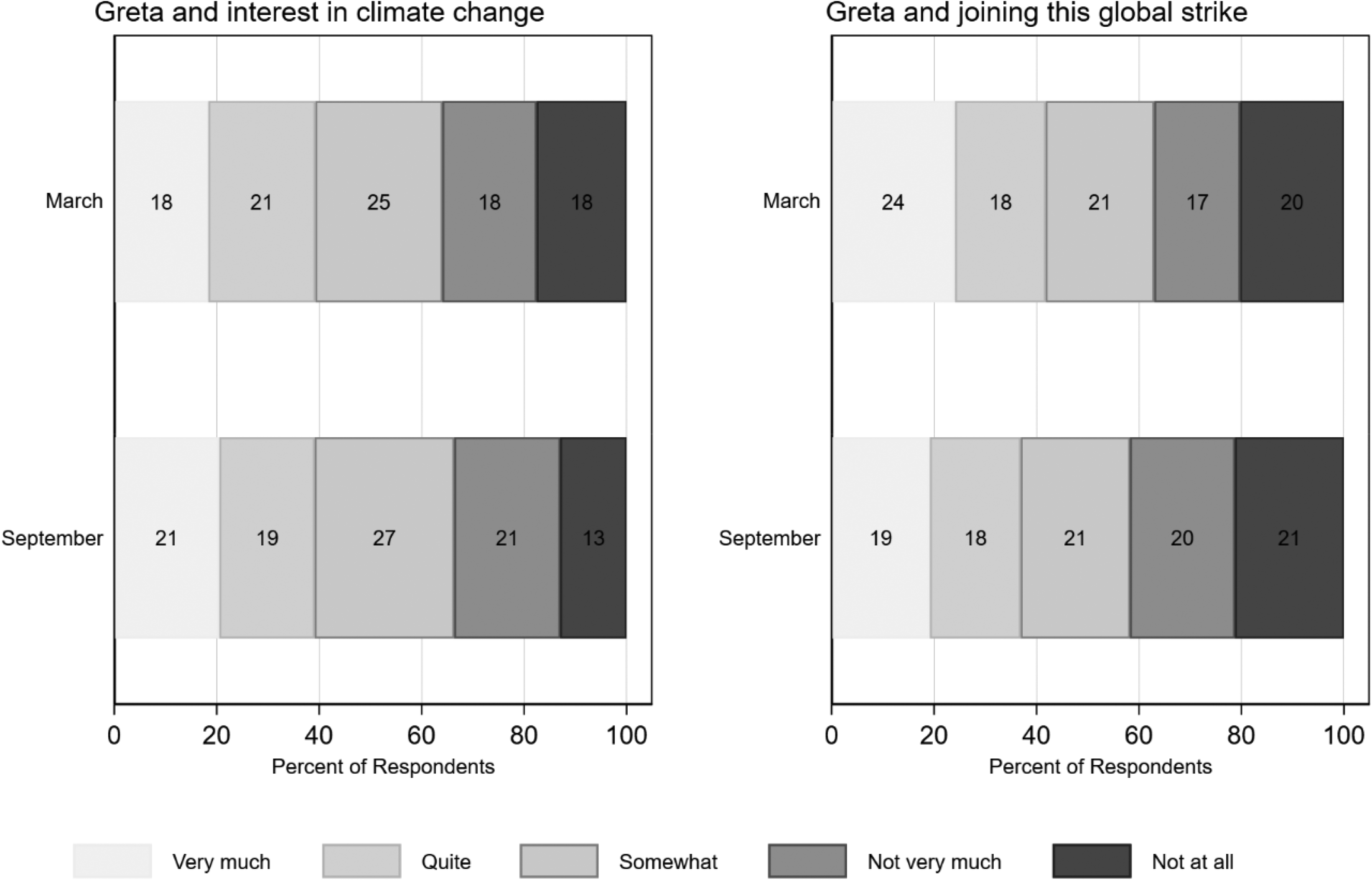
Distribution of two questions measuring the ‘Greta effect’ across two survey waves.
To simplify the analysis, we use these two questions to create an index ranging from 2 to 10 (Cronbach's alpha 0.74 in March, 0.71 in September, and 0.72 for the total). Figure 2 presents the index's (our dependent variable) distribution across the studied cities and waves, and shows clearly that the perceived importance of Greta varies significantly not only across cities – compare Bern (5.024 [±0.144]) and Stockholm (6.830 [±0.191]), but even across the waves for the same city. It was, on average, 6.667 [±0.195] for Warsaw in March and 5.55 [±0.238] in September. The country differences are also remarkable from the respondents’ open answers to a question about why they joined the strike. While, on average, 1% of all respondents mentioned Greta by name, in Sweden, the percentage was four. No respondent spontaneously mentioned Greta Thunberg when articulating their motivation to join the protest in the Czech Republic, the Netherlands, Norway, Romania, and the UK.
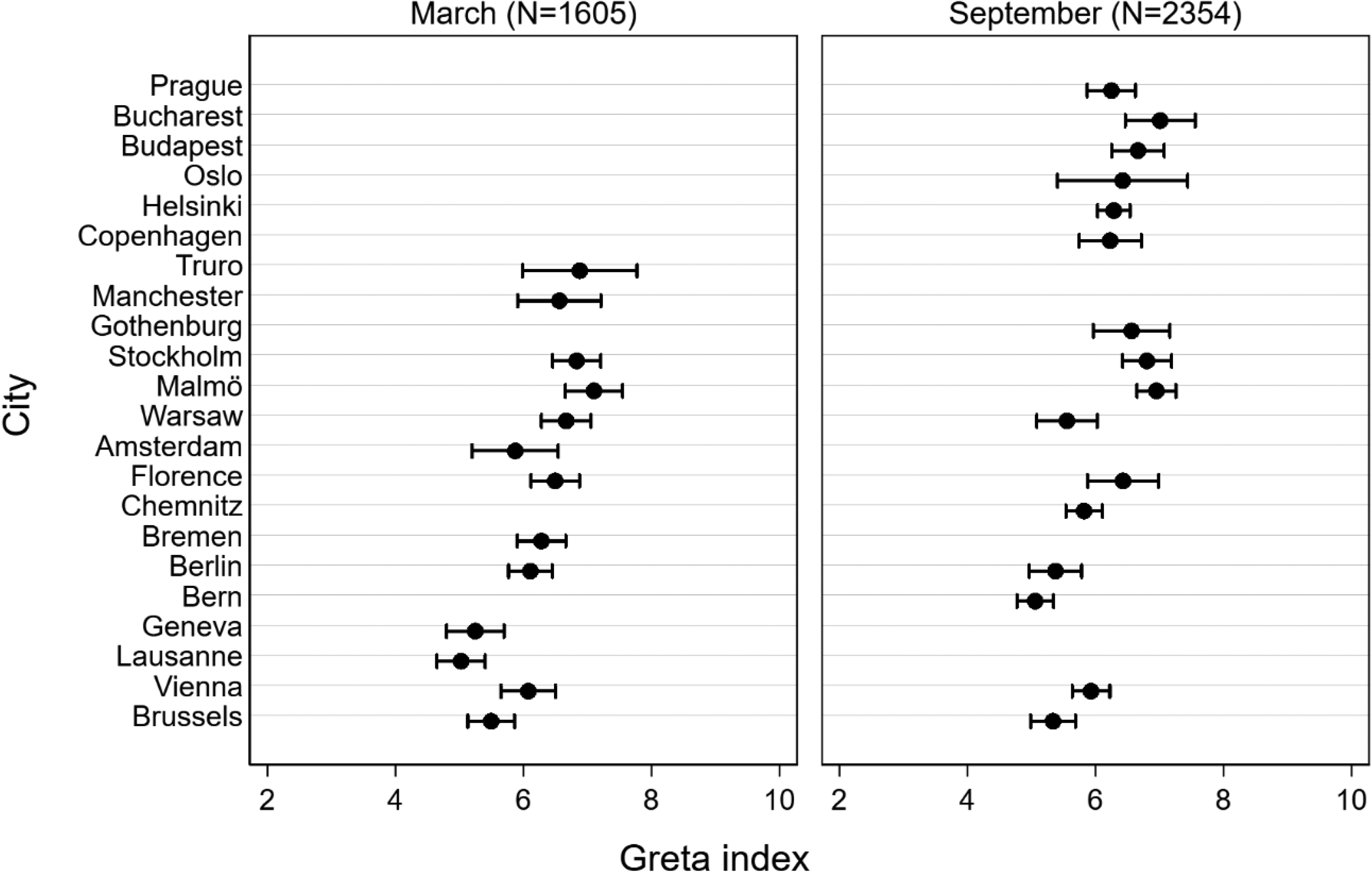
Distribution of Greta index across cities and by two survey waves.
We include several theoretically relevant independent variables. There is reason to expect that
The responses to the following question measured

As a complement to this more complex measurement of motivational strength, respondents also indicated their degree of
The sense of shared
The analysis also includes three control variables. First, because ‘experienced’ climate activists should be less likely to join the strike due to the perceived effect of Greta (since they are more likely to be already engaged in the issue and to be part of already existing mobilising networks), it is essential to account for protest participants’
Second, considering that the ‘Greta effect’ might be smaller in countries with their own young female leaders of the FFF movement, we have included a dummy variable indicating the presence of such a leader. Based on the information from the FFF website and news coverage of the strikes, we coded Belgium, Germany, the Netherlands, and the Czech Republic as having a domestic young female mobiliser that we deemed functionally similar to Thunberg.
Finally, we have included a dummy indicating the September strike to differentiate between March and September events. While it is plausible that the broader impact of Greta, like other political icons, should wax or wane over time, we found no reason to expect a specific direction that her perceived impact would change among the climate protesters. Table A3 in the Supplemental Appendix provides a descriptive overview of all included variables.
The correlates of varying perceived ‘Greta effect’
We test the four hypotheses about the perceived ‘Greta effect’ using a multilevel fixed-effects regression model, in which the levels are individuals (level 1) nested within cities (level 2). The results of our analysis (see Table 1) support all four hypotheses. Starting with the two political icon-related expectations, the perceived influence of Greta was positively related to identification with the other protesters present, hence a shared sense of
Factors explaining variation in Greta effect, multilevel models with fixed effects (N = 3947, 22 cities).
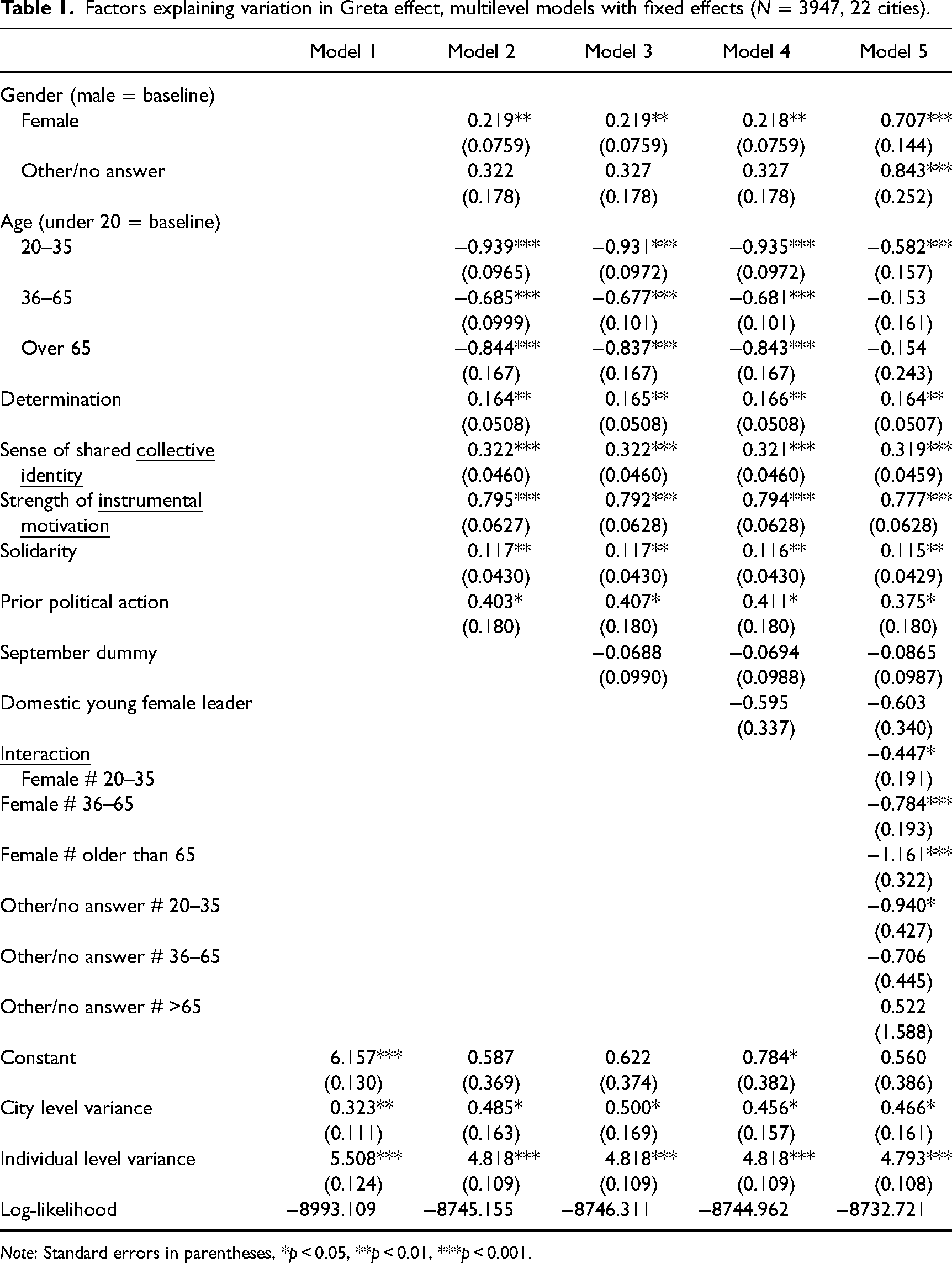
Note: Standard errors in parentheses, *p < 0.05, **p < 0.01, ***p < 0.001.
Concerning the role model effect, the results corroborate our third hypothesis as those who have higher
The control variable of prior political participation had a weak positive relationship with the perceived importance of Greta. This is unexpected, as our initial assumption was that Greta would impact mobilisation primarily for first-timers. Instead, those who had taken part in politics before had a somewhat higher perceived ‘Greta effect’. The protest wave (September vs. March) and having a domestic young female leader of the FFF had no significant relationship with the perceived Greta effect. While we cannot measure it precisely, it is likely that in those countries, the general role model effect is more significant because young women could ‘follow’ the example of Thunberg and their own specific young female activists. We also ran the analysis at the country rather than city level, and all other effects remained almost the same, while the effect of ‘domestic young female leader’ increased. It is significantly negative, suggesting that Greta had less importance in countries with their own female front figures for the FFF (or at least that the local front figures mobilised a substantial share of participants for whom Greta was not very important).
Finally, we also tested a possible interaction effect of age and gender identity on the perceived importance of Greta (Table 1, Model 5, a simplified illustration on Figure 3). Indeed, respondents younger than 20 and with a female gender identity are significantly more likely to perceive the Greta effect than older respondents with the same gender identity.
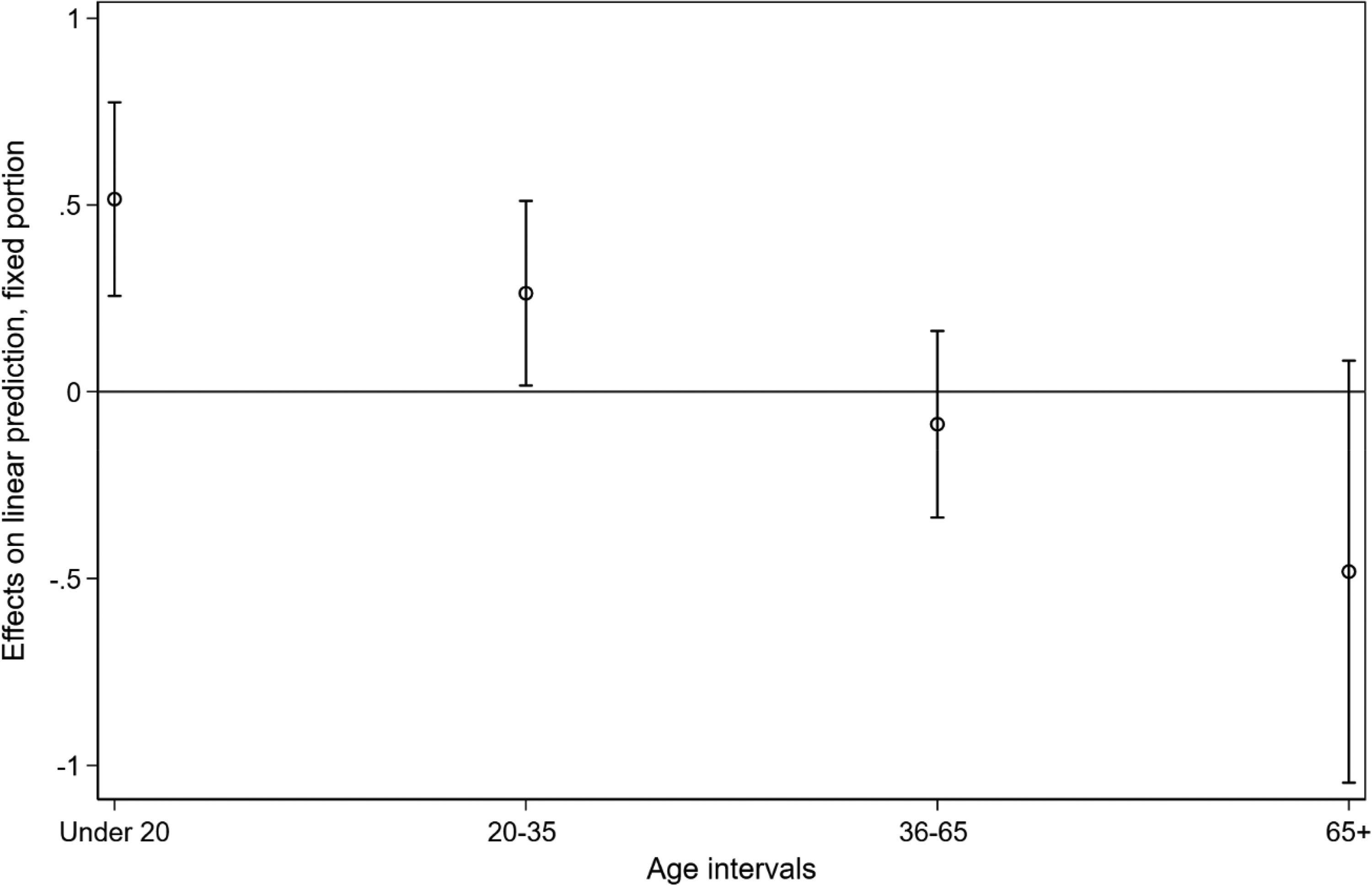
The conditional marginal effect of female gender identity over age groups (male and others as baseline)
Concluding discussion
We theorised that Greta Thunberg played two crucial roles in the climate movement in 2019: political icon and role model for those who mobilised – and those who were mobilised in – the Global Climate Strikes. Using data collected during two major global climate strikes – in March and September 2019 – we demonstrated that there is support for our assumption that Greta Thunberg not only has had the function of a spokesperson for the FFF campaign but also became a unifying political icon and a role model for many protest participants. Whereas our data does not allow us to directly assess the mobilising effect of Greta on the population at large, our results build on prior studies that relate the ‘Greta effect’ to collective efficacy (e.g. Sabherwal et al., 2021). Our analysis shows that the individually perceived level of impact by Greta among those who were mobilised is correlated with a number of participant characteristics in ways that support our theorisation of how a young female political leader can mobilise global protest both as an icon and as a role model.
The study provides empirical support to Olesen's (2015) theory of political iconicity, as possibly the first to investigate the scope and character of a political icon's importance among participants in a protest campaign. A stronger subjectively experienced ‘Greta effect’ – or likelihood to say that one has become interested in climate issues or participating in the strike because of the inspiration of Greta Thunberg – was associated with higher importance of solidarity for mobilisation, as well as identification among protest participants, by extension their sense of community. These patterns indicate that a movement leader's iconic status may indeed be a crucial element in mobilising large numbers of participants in a global protest campaign, contributing to a sense of cohesion and common purpose among people with no prior personal ties.
Activists – especially female activists under the age of 20 – may also regard Greta Thunberg as a role model, showing what is possible and politically desirable and how to struggle for political goals. Maybe not every young girl can expect to talk about climate politics to the UN, but as a role model, Thunberg has demonstrated the power of persistent collective struggle (and that you could even break some rules in the process). In our sample, age and gender were correlated with a perception of higher influence by Thunberg, and this, in turn, was associated with higher determination and instrumental motivation for participating. Time will tell if Thunberg's role model effect will be consequential beyond the contemporary climate mobilisations and politically empower the young women of today in their adult lives and (political) careers.
As we have mentioned above, the statistical correlations in our data between protesters’ perceptions of having been influenced by Greta and other characteristics do not in themselves provide information about the character of causal connections, if any. In the case of Greta's iconicity, we argue that the most plausible interpretation is that our measures of perceived influence on the one hand and solidarity and collective identity are best conceived as two sides of the same coin – different aspects of the meaning of functioning as a political icon. In causal terms, one could both imagine that the perceived importance of a common icon could boost some participants’ sense of collective identity and solidarity, while the latter factors might conversely influence the individual salience of ‘Greta’ as an icon for the collective to which one belongs. As regards Thunberg as a role model, we believe that there are reasonable theoretical grounds to expect that the higher perceived ‘Greta effect’ expressed by younger women among the protesters shows that this group is more prone to be inspired by her in this way. To the extent that perceived influence by Thunberg works as a proxy for regarding her as a role model, it is reasonable to assume that a ‘role model effect’ is a causal mechanism behind some participants’ higher determination and instrumental motivation to participate. Acknowledging her influence could mean regarding her as a role model, which heightens belief in the movement's cause and the determination to pursue it. We find no credible reason for a converse causal relationship – that participants with higher determination and instrumental motivation would be more prone to acknowledge Greta's influence.
An additional issue is if protesters’ perceived mobilising influence by Greta provides any information about the degree to which Thunberg ‘actually’ made them more interested in climate change or affected their decision to join the Climate Strike. The naïve assumption of a direct correspondence between these phenomena is undermined by other possible factors affecting participants’ responses, such as desired self-presentation, unreliable memory, and the degree to which the actual reasons for our actions are even transparent to us. However, it would be equally untenable to assume that perceived influence had no relation to actual influence. We, therefore, argue that our results regarding the perceived ‘Greta effect’ on protesters can be used for formulating hypotheses in future studies about the actual mobilising effects of young female leaders. The broader generalisability of our findings should also be assessed through further exploration of mobilisations beyond the European context because the female role model effect may vary in different regions (Liu, 2018).
In conclusion, our study reveals and elaborates on some aspects of movement leadership in micro-mobilising processes in contemporary global protest campaigns. Leaders acting as role models may have the capacity to mobilise categories of people who usually are not very active in protests – in this case, young women and girls – while iconic leaders are associated with the collective identity and cohesion of the movement. These mechanisms have not been accounted for in standard models of protest micro-mobilisation and represent a novel and important path of inquiry. Thunberg's leadership and mobilising influence in FFF can be regarded as an extreme – and potentially even paradigmatic – case (Flyvbjerg, 2006), in terms of its global scale, Thunberg's gender and youth, and salience of iconic and role model elements in her leadership. It is thus appropriate for taking initial steps in theorising neglected aspects of movement leadership but does not provide a firm basis for assessing the generalisability of our findings to leadership in other protest campaigns. Therefore, we hope that this inspires future studies exploring the effect of political icons like ‘Greta’ also on the behaviours and attitudes of the broader national populations. In that context, the uniting effect of political icons and how they might amplify existing antagonisms should be discernible.
Supplemental Material
sj-docx-1-asj-10.1177_00016993231204215 - Supplemental material for Political icon and role model: Dimensions of the perceived ‘Greta effect’ among climate activists as aspects of contemporary social movement leadership
Supplemental material, sj-docx-1-asj-10.1177_00016993231204215 for Political icon and role model: Dimensions of the perceived ‘Greta effect’ among climate activists as aspects of contemporary social movement leadership by Mattias Wahlström and Katrin Uba in Acta Sociologica
Footnotes
Acknowledgements
We would particularly like to thank Joost de Moor, Magnus Wennerhag, Kerstin Jacobsson, Abby Peterson, and Jasmine Lorenzini, as well as the editors and anonymous reviewers of this journal, for valuable comments on previous versions of the paper. We are also most grateful to all teams helping to collect the survey data, all protest participants willing to fill in the survey, and Michiel de Vydt who played an important role in the compilation of the international dataset.
Funding
The authors disclosed receipt of the following financial support for the research, authorship, and/or publication of this article: This work was supported by the Swedish Research Council for Sustainable Development, Formas, (grant numbers 2019-00261 and 2019-01961).

Supplemental material
Supplemental material for this article is available online.
Notes
Author biographies
References
Supplementary Material
Please find the following supplemental material available below.
For Open Access articles published under a Creative Commons License, all supplemental material carries the same license as the article it is associated with.
For non-Open Access articles published, all supplemental material carries a non-exclusive license, and permission requests for re-use of supplemental material or any part of supplemental material shall be sent directly to the copyright owner as specified in the copyright notice associated with the article.
