




Abstract
Ethnic minority parents who are fearful of child welfare services (CWS) is an acknowledged social problem, but the existing academic understanding is limited. Interpretations in previous research have tended to highlight people's ‘dispositions’, typically cultural backgrounds, and lack of knowledge, or ‘structures’ like welfare and penal systems. More neglected is how CWS fears can be generated from interactional processes within groups. Building on extensive ethnography with Norwegian Somalis, a marginalized migrant group, we extend the sociological understanding of ethnic minority parents’ CWS fears. Relying on an interactionist theoretical framework, we centre Erving Goffman's interaction ritual (e.g., facework) and stigma, which we combine with Robert Putnam's bonding social capital. From this vantage point, we construct a ‘bottom-up’ theoretical model highlighting transmission of child removal stories in tight-knit social networks. Among Norwegian Somalis, fears emanate from a social process with four interconnected factors: (A) adversities and ‘tribal stigma’; (B) bonding social capital, for coping and self-respect; (C) children as a ‘lifeline’. Together these generate (D) wide diffusion of child removal stories, which perpetuates pervasive CWS fears. This model should productively inform comparative research.
Introduction
“Jasmin”: I heard stories all the time: “this family had lost care of their children” and “that family had lost care.” And even though I had never had anything to do with them… just to hear about it, and the thought and the fear that sticks in your head, is painful.
Jasmin participated in an ethnographic study of Norwegian Somalis, a socioeconomically marginalized and stigmatized migrant group. We investigated how they perceive barnevernet, Child Welfare Services (CWS). After 10 years in Norway, Jasmin returned to Somalia with her husband and their four children. In this excerpt, she reflects on living in Norway, where CWS fears, and child removal stories were ubiquitous among Somalis.
A growing number of studies report of ethnic minority parents who fear the CWS (e.g., Fong, 2019; Okpokiri, 2021; Tembo et al., 2021). Two interpretations dominate. One highlights beliefs, knowledge, and prejudice, as held by parents and/or professionals. Parents’ fears reflect cultural backgrounds and lack of institutional understanding (e.g., Fylkesnes et al., 2015; Kabatanya and Vagli, 2021). Fears also arise from discrimination stemming from professionals’ low cultural sensitivity (Dettlaff et al., 2009; Križ et al., 2012). Combined, this focuses on dispositions. Another interpretation is found among U.S. researchers who take a more structural approach. Here, CWS fears are analysed against the backdrop of CWS as among punitive state institutions, and surveillance of racialized poverty (e.g., Elliott and Reid, 2019; Fong, 2019). Irrespective of whether such structural context applies elsewhere, like in Norway, both literatures noticeably neglect fears as generated from social interactions within groups. Child removal stories are especially inadequately understood. Our research questions respond to these shortcomings: How are CWS fears among Norwegian Somalis connected to child removal stories? How does the transmission of such stories relate to marginalization, stigma, search for respect, and subsequent in-group solidarity?
Through abductive analysis (Tavory and Timmermans, 2014; Vassenden, 2018), we address empirical puzzles and construct a novel theoretical model of ethnic minority parents’ CWS fears. The main puzzle is that while Somali families (like migrant families generally) in Norway are disproportionately involved with CWS, in referrals, investigations, and in-home measures like counselling/therapy, their children (like migrant children generally) are not overrepresented in child removals (Berg et al., 2017). Yet, as our data make abundantly clear, fears of losing children run deep among Norwegian Somalis. In addressing this puzzle, and understanding how fears connect to child removal stories, we deploy an interactionist framework, centred on the theories of Erving Goffman. We rely on Stigma ([1963]1990) and Interaction Ritual ([1967]1982), which we combine with Putnam's bonding social capital (2000).
CWS fears have hugely negative consequences, for families and children. CWS’ mandate is to prevent child abuse. To achieve that, it depends on trust (Skivenes et al., 2015). Fears can impede trust in fellow citizens and institutions beyond CWS: Parents who fear being reported to CWS often distrust other institutions like kindergartens, schools, and health-services, as they are acutely aware of professionals’ obligations to report suspicions of neglect or maltreatment (Fong, 2019; Handulle and Vassenden, 2021; Tembo et al., 2021). Since schools and kindergartens are essential to modern family life, distrust has detrimental effects. This necessitates sound understanding of the fears and investigating social worlds from within. This matters also because with media attention to the issue, which has been noticeable in Norway (Vassenden and Vedøy, 2019), ethnic minorities’ CWS fears may be viewed as ‘irrational’. Alternatively, CWS may be seen as a dysfunctional, oppressive institution, with flaws deriving from racism. One goal in this paper, is to demystify CWS fears, by showing how they are sensible from the points of view of parents, who are competent actors and observers in their circumstances. At the same time, we aim to avoid both exaggerating and underestimating questionable institutional arrangements and professional practices.
After presenting the background, previous research, and theoretical framework, we describe Handulle's ethnography in Oslo and Somalia. When next presenting findings, we incrementally substantiate our theoretical model, which we coin A-B-C-D: Adversities; Bonding social capital; Children as ‘lifeline’; Diffusion of stories. In conclusion, we discuss application of this model to other situations of CWS fears. This considers comparisons of Somalis and other groups (minorities and majorities), and research across national contexts.
Background and previous research
The Norwegian CWS; immigration
The child-centric Norwegian CWS considers children independent carriers of rights (Skivenes et al., 2015). This mirrors Nordic welfare more broadly: de-familialisation (Hantrais, 2004) reduces citizens’ dependency on the family, like with universally accessed state-funded schools, affordable kindergartens, and tuition-free higher education. De-familialisation also implies high legitimacy for interventions in families (ibid.): The CWS’ mandate is to support families at an early stage to prevent harm to children (Skivenes et al., 2015). Nevertheless, in Norway and internationally, this is a Janus-faced institution. While providing support for families, CWS exert discipline (Connolly and Katz, 2020; Tembo et al., 2021). Norwegian professionals who work with children are legally obligated to report to the CWS if they have ample reason to suspect mistreatment or neglect of a child. CWS authorizes these professionals to intervene in families, if necessary, without parents’ consent. These ‘dual therapeutic and coercive capacities’ can generate, as suggested by Fong in the case of U.S. families, ‘expansive surveillance’ (2020: 610). This, Fong concludes, instils fear among parents who are immigrants, poor and/or ethnic/racial minorities. Fong's description applies to Norway too.
Since public attention in Norway around CWS fears concerns migrant groups, we briefly set the context on immigration and ethnic diversity. Historically, Norway was rather homogeneous, albeit with indigenous Sami and minorities like Romani travellers. CWS and its missionary predecessors traditionally had strained relationships with these minorities, as many removals were conducted as state-directed cultural assimilation (ONR, 2015). Modern immigration diversified Norway. The ‘immigrant population’, i.e., people who are foreign-born or have two foreign-born parents, constitutes 18.2% of Norway's population of 5.4 million (2020), compared to 1.5% in 1970. Oslo is unrivalled as the most multi-ethnic city: 33% of 686,000 people are immigrants or their children. Among migrant children, the largest groups have Pakistani, Somali and Polish backgrounds. Correspondingly, Pakistanis, Somalis and Poles are typically mentioned when media or research report on CWS fears (Vassenden and Vedøy, 2019).
Somalis in Norway
Almost 43.000 Somalis live in Norway, and approximately 16.000 in Oslo. Most arrived in the 2000s as refugees from civil war. The war followed clan lines. Organized patrilineal, clans represent the main collective identifications in Somalia. They offer protection and safety-net for individuals and families, while demanding loyalty (Koshen, 2007). Clans are maintained in diaspora, structuring social networks (Engebrigtsen, 2007), but often subordinate to an overarching Somali identity stemming from joint experiences of marginalization and facilitated by common language and religion (Handulle, 2022a).
Across Europe, Somalis are socioeconomically marginalized. The employment rate among Norwegian Somalis (first-generation) is 41%, compared to 78% among population at large. 1 Working conditions for those employed often imply low income and precariousness. Most arrive with few formal qualifications, and in public discourse on Somalis’ adversities, other themes are language problems, and lack of schooling. Somalis report lack of belonging to Norwegian society, and discrimination from mainstream society, and in housing and employment (Næss, 2020). In encounters with welfare professionals, a typical Somali experience is humiliation (Fangen, 2006). These encounters are marked by mutual trust deficit (Friberg and Elgvin, 2016).
More than 80% of the Norwegian population are homeowners, while less than 20% of Somalis, which illustrates hardship (Normann, 2017). This is extra burdensome as families, often headed by single mothers, typically have many children. Less than 5% of Norway's population reside in public rentals, a strictly means-tested tenure for the neediest (Vassenden and Lie, 2013). Among Somalis, the percentage is 40. Their hardship corresponds to humiliation (Fangen, 2006), mirroring Du Bois’ ([1903]2008) ‘double consciousness’. ‘Twoness’ entails simultaneously viewing themselves as citizens and inferiors in a ‘white’ society. Second-generation Somalis, nonetheless, achieve social mobility, aligning with the broader educational and socioeconomic attainments among the second-generation (Hermansen, 2016).
Neither migrant children in general nor Somali children are overrepresented in child removals in Norway (Berg et al., 2017). Somali children are overrepresented in CWS involvement, but not in removals. In 2016, 4.3% of Somali children (first- and second-generation; 0–17 years) were subject to CWS measures (e.g., in-home measures, care orders), compared to 2.6% of nonmigrant children. Among children with Somali background 1.0% were in CWS care, compared to 0.8% among nonmigrant children. Among Norwegian-born children of Somali parents, the percentage was 0.7. 2
Previous research
As stated, main interpretations of CWS fears highlight dispositions or structures.
Regarding dispositions, researchers highlight cultural backgrounds as compelling influence on parents’ mind-sets. This includes low institutional trust, as migrants may come from countries where government is not trusted. It also reflects little knowledge about host-country institutions. Researchers also highlight the mindsets of caseworkers, who may view minority parents through racialised lens, or lack cultural sensitivity, and hence discriminate. Such dispositional interpretations come mostly from social work research and are found in several countries, including Norway (Berg et al., 2017; Fylkesnes et al., 2015; Kabatanya and Vagli, 2021), the U.K. (Okpokiri, 2021) and the U.S. (Dettlaff et al., 2009). In the U.S., this includes Križ et al.'s (2012) study of undocumented immigrants, where “fear factors” included migrants’ perceptions of CWS as reminiscent of repressive governments in the countries of origin (cf. Slayter and Kriz, 2015; Dettlaff et al., 2009). Beyond brief mentions that rumours and stories about child removals circulate among migrants and may lead to parental fears (Berg et al., 2017; Fylkesnes et al., 2015; Okpokiri, 2021), there are few if any in-depth examinations of interactional processes within groups. These studies rely on small samples, which partly explains its neglect of group dynamics. Because of convenience sampling, moreover, studies typically involve several migrant groups, which may further limit ability to identify group-specific processes. Another issue is type of data. The common method is interviewing, which often foregrounds the individual over the interactional processes beyond and behind her (cf. Tavory, 2020), processes which she may not be aware of, but which influence her deeply.
Sociological research is found mainly in the U.S., where many researchers take a more structuralist approach: Working with impressive data, typically ethnography or extensive sets of interviews, authors associate CWS engagement and fears among poor/migrant/minority parents to punitive state institutions, and policing of racialized poverty (Elliott and Reid, 2019; Fong, 2019; Roberts, 2002). Drawing analogies to mass incarceration, some see CWS as part of the ‘prison pipeline’ (Lee, 2016). These studies join a larger literature about the neo-liberal penal state, which sees welfare retrenchment as accompanied by an increasingly punitive state (Wacquant, 2009). CWS fears are analysed and theorised against this backdrop.
Valuable as structural perspectives are, in adding layers to CWS fears, neglect of interactional processes like diffusion of stories in social networks, pertains here too. Importantly, moreover, structural contexts do not easily travel between countries. Regarding welfare and penal practices, Norway and the U.S. are arguably the opposite extremes of the Global North. The Nordic welfare-state is much more supportive, and incarceration rate only one-tenth that of the U.S. Policing of racialized poverty is far less pronounced.
Theoretical framework and theory-construction
In abductive analysis (Tavory and Timmermans, 2014), sociologists engage with puzzles, i.e., observations previously unnoticed or in conflict with assumptions. By engaging broad theoretical repertoires, one works to make anomalies comprehensible. The next move is to present new theoretical accounts explaining the investigated phenomenon (Vassenden, 2018).
Combined with limitations of previous research, puzzles directed us towards interactionism, rooted in Blumer's ([1969]1986) premise that meaning arises from social interactions, and Goffman's interaction order concept (1983), which highlights social interaction as an analytically (semi-)autonomous social domain reducible to neither dispositions nor structures. Goffman proved helpful in addressing puzzles, and in understanding how worth vs shame factor into CWS fears. We rely on interaction ritual ([1967]1982), the presentational self ([1959]1987), and stigma ([1963]1990). These are coupled with Putnam's bonding social capital (2000).
The Presentation of Self in Everyday Life begins by noticing how human interaction centres on exchanging information about selves. To construct meaningful situations, we rely on previous information about each other, and we acquire new information. Provision of information about oneself, which others rely on, is however filtered through one's efforts to manage other people's impressions of oneself. Thus, we present certain images of ourselves, and we play roles ([1959]1987). More than cynical manipulation, this reflects Goffman's ritual model, centring ‘worship’ of ‘sacred selves’ ([1967]1982). Everyday symbolic performances relate to mutual affirmation of selves. Individuals constantly search for respect, which they can only find in interaction, from others in equal need of respect. Both selves and interaction are thus inherently fragile, hinging on participants presenting credible images of themselves (‘the rule of self-respect’ [1955/1967]1982:11) and respecting those that others present for themselves (‘the rule of considerateness’). Here, facework points to ritual communication to mutually protect self-presentations. Because ‘[o]ne's own face and the face of others are constructs of the same order’ (ibid.:6), we are inclined to validate other people's self-presentations (even when we suspect them to be faulty). To Norwegian Somalis, parenthood is intrinsic to face. This is typically confirmed by fellows, and seldom challenged.
Tacitly, Stigma ([1963]1990) continues ritual interaction and impression management (Vassenden and Rusnes, 2022), and the role herein of information. Stigma can be conceived of as information about self that threatens one's face, by being about discrediting traits and ‘undesired differentness’ (p. 15). Stigma matters in our case in two distinct ways, which mirror two of Goffman's main types of stigmas. First is the ‘tribal stigma of race, nation and religion’ ([1963]1990:14), which Somalis carry collectively, and which connects to “double consciousness” (Du Bois, [1903]2008). This endangers people's worth in interactions with welfare institutions, and with majority Norwegians. Second, CWS involvement is shameful (Morriss, 2018) for the parent or family, mirroring Goffman's second type of ‘blemishes of individual character’ (ibid.). 3 This works individually within the group and threatens one's face as a good parent. Further, Goffman importantly distinguished ‘the discredited’ from ‘the discreditable’. The discredited carries known-about or visible stigma and manages interactional tension. The discreditable, whose stigma is invisible or not-known-about, chooses between disclosure and passing ([1963]1990: 92–112). This distinction illuminates both Somalis’ ‘tribal stigma’ and the individual CWS stigma. With the former, a Somali parent is in a sense ‘always’ discredited: To majority individuals, stigma is readily available via phenotypes and often religious markers (hijabs). To welfare institutions, it is the same, plus stigma travels with names and portfolios. Regarding CWS involvement, the discredited-discreditable distinction clarifies the difference between child removals on the one hand, and in-home CWS measures or case dismissals on the other, and their contrasting demands for management of face-threatening information.
Our Goffmanian framework highlights, then, exchange of social information (about oneself and others) for the purpose of respect, i.e., to sustain one's face as a good parent, and for management of tribal and individual stigma. The specific interaction order is not that of mainstream society: Information exchange, facework and stigma management occur within a tight-knit ethnic community, where struggling people seek out each other for coping and recognition. Here, we introduce social capital, i.e., resources embedded in social networks (Lin, 2002). Among conceptual traditions, we engage solely with Putnam's bonding social capital (2000). Whereas bridging social capital is ‘good for getting ahead’, in providing access to diverse contacts and information, bonding social capital is ‘good for getting by’. Stronger ties within groups where people share traits like kinship can offer support and build internal solidarity. Minorities’ social capital can arise as compensation for disadvantage and lack of mainstream resources (Anthias, 2007: 801). When migrants strive to adapt, and struggle for respect, bonds to people in similar situations who share their language can be helpful. Faced with rejection, minorities may come to depend on networks with people like themselves, for positive self-image and for ‘management of spoiled identity’ (Goffman, [1963]1990). There is unnoticed affinity between such bonding social capital and a category in Goffman's Stigma, namely ‘The Own’, they who share the stigma, and ‘[…] can provide the individual with […] a circle of lament to which he can withdraw for moral support and for the comfort of feeling at home, at ease, accepted as a person who really is like any other normal person’ ([1963]1990: 32).
The fieldwork
Handulle conducted nine months of fieldwork: seven in Oslo, and two in Somalia with returnees from Norway. Fieldwork consisted of observations in cafes and shops, participation in seminars (especially in mosques), participant observation in a transnational school in Somalia, informal conversations, focus groups, and in-depth interviews.
Fieldwork in Oslo lasted from June to December 2016. It began in the inner-city Grønland area, home to approximately 10,000 people. Grønland is a well-known migrant area, with ethnic minorities visibly present. Four purpose-built mosques are located here, and smaller mosques and ethnic associations abound, as do Somali cafes and shops. Somalis are the largest local immigrant group. Many reside in public housing, of which there is more than in Oslo overall. Grønland has identified crime and poverty problems. Although this was our main location, some interviewees reside elsewhere in Oslo. They expressed CWS fears too.
Fieldwork in Somalia lasted from January to March 2017. To protect the confidentiality of participants, we leave the region unnamed. The number of returnees from Norway to Somalia is uncertain, probably amounting to a few hundreds. The reason for transnational fieldwork was that Handulle heard numerous stories about Somalis who returned because they feared removal of their children (Handulle, 2022b). While interviewees in Somalia did not report fear as personal motivation for returning, they presented detailed narratives about fearful CWS stories in their networks, which informed their lives in Norway.
Having grown up in Norway with Somali parents, Handulle speaks both languages fluently. Nevertheless, she encountered obstacles in gaining full access to informants. In her first month in Oslo, she spent several days each week in Somali shops and cafes, chatting with owners and customers. A Somali newspaper published her request for participants, and information about the study was published on social media. This resulted in a couple of interviews, but not satisfactory entry. While access is often difficult in ethnographic studies, Handulle encountered problems that underline the timeliness of our study and support our findings. Prospective informants often suspected that Handulle worked for CWS and were reluctant or unwilling to talk to her. Some tested her with traditional Somali sayings and phrases. It happens in ethnography that one person opens the door. After one month, a woman took Handulle aside for an interrogation: ‘Honestly, do you work for CWS or has the government sent you to investigate our community?’ She replied, aghast, ‘No, I am a researcher!’ After this, Handulle's status gradually changed from suspected spy to ‘one of our daughters’ (she was in her late 20 s at the time).
Handulle attended mosque activities and prayed alongside participants. She attended events organized by associations, such as counselling courses for fathers with Somali instructors trained by municipality services, a women's sewing circle, gatherings at the mosque (sometimes on the men's side, sometimes the women's), debates about elections in Somalia, and themed evenings around Somalis’ lives and troubles.
During the fieldwork in Oslo, Handulle interacted with several hundred people. Of these, approximately 60 participated in informal conversations about CWS. Furthermore, she conducted nine individual interviews and nine group interviews with 48 people. Data from Somalia are observations, e.g., in diaspora cafés, and 13 individual interviews. In both locations, participants were first- and second-generation migrants. We focus on the first-generation, data for which amount to half the individual interviews, seven group interviews (44 people) and most observations, participations and informal discussions in Oslo. The latter was because many first-generation parents are unemployed and reside in public housing at Grønland. They live in a ‘street corner society’ (Whyte, [1943]2002). Socially mobile second-generation Somalis, with full-time jobs, do not spend much of their daytime in cafes. Interview samples are gender-balanced. Parts of fieldwork are not. In shops and cafes, Handulle interacted mostly with women as some gatherings were gender-segregated. Participants had lived in Norway for a median 12 years. The Norwegian Social Science Data Services approved the study. During the fieldwork, Handulle informed extensively about the project in Somali and Norwegian, emphasizing voluntary participation.
We also read and summarized a small sample of online discussion threads among Somalis about CWS and/or child rearing in Norway (N = 30). Platforms included Facebook, YouTube channels, and chat forums.
Most conversations and interviews were in Somali, peppered with Norwegian phrases, with barnevernet (CWS) always in Norwegian. All interviews were transcribed verbatim. In the analyses, we first familiarized ourselves with data through repeated readings of field notes, memos, and transcripts. With abductive analysis, theories were part of the research throughout, and pivotal in understanding anomalies. Nevertheless, after familiarization, we performed open coding, developing categories and themes close to data. The themes were then deployed to analyse data in a next round. Themes included parenthood, childhood, recognition, networks, belonging and identification, marginalization, financial situation, otherness, hopes for social mobility.
Among validation measures, are three interviews that Vassenden did with representatives of Somali associations for another study in 2015, on migrant associations’ welfare engagement. These interviews support the findings of our paper. Moreover, two Norwegian-Somali persons (one participated in the study) read this paper. Both found our analyses highly recognizable.
Findings: The interactional processes that foster Somalis’ CWS fears
This section substantiates how CWS fears are established and perpetuated through the A-B-C-D process. In unpacking its components, we first delve into (A) adversities and (B) bonding social capital. Next, we demonstrate (C) how children become parents’ ‘lifeline’. The two subsequent sections highlight (D) diffusion of stories, and which stories that diffuse and not. Before discussion and conclusion, the findings and the model are visualized in a figure. A-B-C-D summarize as follows:
Adversities. Somalis are socioeconomically marginalized. They face stigmatization and exclusion. Bonding social capital. Faced with adversities and stigma, Somalis gravitate to each other and rely on tight-knit ethnic networks. This produces strong in-group solidarity. Children as ‘lifeline’. Parents see their children as key to moral worth, respect, and social mobility. This concerns parents’ relations to other Somalis and society at large. Diffusion of child removal stories. In tight-knit social networks, child removal stories proliferate, but few stories of ‘softer’ CWS contact.
A + B + C create disproportionate patterns of diffusion (D), in the following way. While any parent would be deeply wounded to have a child taken away, to Norwegian Somali parents, it additionally implies feelings of losing respect within the community. Through supportive interaction rituals, the community treats bereaved parents with compassion and mourn the lost children. Mourning in bonded networks expose Somalis to numerous child removal stories. In contrast, there are few CWS stories that did not entail child removals (dismissed investigations and in-home measures) although these are far more common. The outcome of A-B-C-D is pervasive fear of having children removed.
Before presenting these findings, we let interlocutors describe their fears. When asked ‘what is your first thought when we say barnevernet [CWS]?’ several participants immediately answered, ‘Iilaahay hanaga badbaadiyo!’—'may God protect us from them!’ Roda and Mahamoud expressed the prevailing view: Roda: To be honest, I’m afraid of them. I know I shouldn’t be, but to think that they have the power to take my children, this worries me a lot and sometimes I even lose sleep over it. (female; interview)
Mahamoud: I fear that my own flesh and blood can be taken away from me, and mostly I fear that I can’t do anything about it and become powerless. You know, when you feel that you don’t have the resources either financially or linguistically to defend yourself, you become powerless. (male; mosque discussion)
Adversities, tribal stigma, and compensatory bonding social capital
Participants repeatedly mentioned their hardship, and how difficult entry into Norwegian society is, especially in work and housing. They feel disrespected by white Norwegians, and connect these experiences to being Somali, Muslim and non-white.
Ahmed returned to Somalia because of social exclusion: Ahmed: Allah made me dark, and when I go out into the rain, that colour won’t be wiped away […] You’re already stigmatized… Just look at employment. No matter how well educated you are, no matter the clothes you wear, you’re chosen last. (Male; interview)
Exclusion was a dominant theme. Many mentioned discrimination in employment and housing, and negative encounters with healthcare, schools, kindergartens and social security. Everyone recalled public portrayals of Somalis as poorly integrated and lazy. Tribal stigma produces alienation. Idil: We just must stick with each other. We’ll never be accepted here. Wherever you go, social security, police, barnevernet, everyone's judged you in advance anyway. They think Somalis beat children and circumcise girls. (Discussions in mosque, women's side)
Participants repeatedly emphasized the importance of Somali networks. Exclusion, disrespect, and a sense of hopelessness contribute to strong ties. As Idil said, they stick together. In Goffman's terms ([1963]1990), other Somalis represent ‘The Own’, among whom one manages (tribal) stigma and receives self-affirmation. Sahra: We’re afraid or worried about what they’ll [Norwegians] say or how they’ll perceive us, which means we’re only searching for each other. (Women's social club)
Somalis also rely on each other for everyday problems. Despite belonging to different clans, not to mention civil war, trust is strong, witnessed in people seeking each other's advice on financial difficulties, worries about children, and marital problems. (Regarding CWS, clan divisions seemingly evaporate.) ‘We have the Norwegian family office within the community’ (mother).
Family offices are a public institution for parents and children to consult on matters like marital problems. It provides counselling and couple's therapy or mediation in family breakups. Much because of their CWS fears, very few Somalis utilize such services. Instead, they engage their community, where mosques and associations organize problem-solving initiatives. Faisa: Although there's been war and conflict between us, there's a strong bond between us when it comes to trusting each other in terms of information sharing, money lending, like the hagbad [internal money lending system]. There may be 20 women who don’t know each other personally who live in different countries or different places in Norway who become part of an internal loan system. The loan goes around every month, and everyone waits one's turn. There's a lot of trust among Somalis. (Female; interview)
The hagbad system allows people to obtain more money than they could otherwise. (Hagbad loans are also free of interest, which many deem haram; forbidden by God.) Participants described it as much safer to seek help within the Somali milieu than from public institutions, which parents typically approach with great caution, because they expect unfair treatment. They suspect, moreover, that institutional contact can lead to CWS referrals. Mohamed exemplifies how Somali parents perceive CWS’ control capacity, and the information gathered from mandated reporters, and from fellow citizens as potential reporters. Mohamed: If you go to the doctor, things are written; another office, it's written—whether you like it or not, doesn’t matter. All agencies work together—school, kindergarten. If you go one place, you enter your social security number. Everything is registered in this country. Your neighbour is barnevernet too. (Fathers’ group in mosque.)
During themed evenings at Somali organizations, on issues like youth problems, khat misuse, and CWS, Handulle often heard statements like ‘we must help each other, it's very important that we support each other’.
Marginalization and tribal stigma can produce groupness that is ‘good for getting by’ (Putnam, 2000). Among Somalis, such belonging gives individuals a sense of respect. Many depend on Somali networks for support and practical help. Here, children and parenthood hold key to moral worth and self-presentations. The ideal parenthood, regardless of background, is to consider one's children one's highest priority. The parents we met are just that; parents who love their children and put their needs before their own. Their children are also the most important, if not only, source of moral worth and respect. Raising children is their life's purpose. Children are their families’ ‘lifeline’.
Children as ‘lifeline’: Respect and moral worth through parenthood
When individuals struggle for respect through measurable statuses like employment and housing, they look for it elsewhere. For Somalis, the platform for self-worth is the ethnic community. The medium is children. Being respected by others as a good parent is imperative. ‘Good parenthood’ means raising a child to become a moral person who is a good Muslim, a responsible citizen who contributes to society, stays away from crime, speaks both Somali and Norwegian well, and takes school and education seriously. These virtues were emphasized emphatically.
In addition to the wounds that removal of children will inflict on any parent, Somalis’ CWS fears concern losing one's (sole) source of moral worth, even their entire self. Hannah simply asked, ‘What am I without my children?’ If CWS removed them, Hannah would experience the same existential crisis as other parents, but also lose her life's purpose, and affirmation from her community. Ifrah (female) said, “If a Somali mother is deprived of her children, her life is over.” Khadra: A Somali mother lives for her children.
Interlocutors: Yes, it's absolutely true, you’re absolutely right.
Khadra: […] [Norwegians] don’t believe us when we say we live for our kids. Without [children], there's no life. (Group of women in boutique)
Many Somalis seem to measure their self-worth through their success as parents. Some achievements are extra prideful, like children's admission to elite educations or entering prestigious professions. Parenting, education and social mobility interconnect as coping: Life is difficult, but if we endure and invest all our efforts in our children, we shall be rewarded.
Children as life project was evident in how especially mothers talked about mundane activities. Maryam: One of the most important things for a Somali mother […] is to have a warm dinner on the table. Her whole life revolves around the children. (Discussions in social club)
Such prosaic activities are tokens of good parenting, and Handulle often heard mothers announce that they had to go cook for their children. Others present would praise them for it. This is almost archetypal of Goffmanian interaction rituals and mutual celebration of selves. One woman presents an image of herself as a caring mother (‘the rule of self-respect’). The others confirm her ‘face’ (‘the rule of considerateness’). In the same go, they claim the same face (caring mothers) for themselves.
Children as lifeline is a two-sided project: You get affirmation from people who matter to you, namely friends, acquaintances, and others who may help you when you need it. Your child's attainments in education and work will reflect how you raised her/him, which supports yours projected self-image. Next, children's education and work are deemed crucial for social mobility. ‘To survive here [Norway], you have to go to school, educate yourself, and get a job’ (Noorah). Participants insisted on the importance of children becoming good citizens, which includes completing higher education.
When CWS come calling, this entire lifeline is at risk.
Diffusion of fearful and traumatic stories—Mourning with the Affected Families
Parents frequently hear stories of CWS taking Somali children into care. Handulle heard them repeatedly, as participants presented detailed accounts of parents who lost their children. Even at themed events about topics entirely different from CWS, child removals often became the most salient issue. At an event about the presidential election in Somalia, the discussion ended when a man mentioned his children's removal. The audience and keynote speakers promptly acknowledged his trouble, as supportive interaction ritual, and several others in the audience shared stories they had heard. This sparked statements like ‘Why are we target of every institution?’
A group of mothers in a Somali boutique in Oslo was asked how these stories are shared. Deeqa: We Somalis are VG and Aftenposten [Norwegian newspapers] for each other. Things go around fast, and when the stories reach you, it's been changed and perhaps made worse […] Somalis talk to each other, everyone talks to each other. No matter where in the country it happens, we all know about it. […] There are many misinterpretations that happen, but what we all know is that barnevernet [CWS] cannot remove children without cause.
The others agreed and shared other stories they knew. Deeqa's statement is informative in that people share stories despite knowing that CWS cannot remove a child without evidence of gross neglect or maltreatment. This paradox is noteworthy: People do not (re-)tell fear stories because they do not understand the welfare system. Unlike suggestions by some researchers, that migrants’ CWS fears reflect lack of knowledge, since their home-countries may lack corresponding institutions (Berg et al., 2017; Dettlaff et al., 2009), Handulle was struck by parents detailed, accurate knowledge about CWS and case proceedings. However, when someone shares a child removal story, his/her main point is less why CWS removed the children from a family (although there is frequent criticism of CWS for targeting Somalis) as what happens after the removal and how to support the family. Hassan: When we hear that a family's lost their child, we mourn with them […] Barnevernet takes children, but they don’t take children without reason, and it's a process before they take the child. They don’t just show up on your doorstep and take your children.
There is duality in Deeqa's and Hassan's statements. Although being well-informed about the process leading up to a child removal, Hassan mourns with the parents.
Nearly every interlocutor used the word ‘mourn’ and expressed compassion for bereaved parents. Handulle often heard the terms geeri or tacsi used about child removals. These words stem from post-funeral receptions in Somalia, where the community of the deceased, typically women, reaches out to the mourning family, e.g., with food for three days. Participants often referred to child removals as a geeri and extended deference and sympathy toward the families. The parallels with death were striking. In short, ritual acts provide worth to someone who has lost everything.
Possibly, when someone retells a child removal story, this is an act of providing respectability. It may offer recognition to someone who has been stripped of her/his only source of worth: her/his children. Stories can also be part of the collective mourning ritual. Nobody said this directly, but we believe it is a valid assumption that retelling a story also provides the bereaved with deference. Even when not knowing the people in question, participants expressed sympathy when referring to stories they knew.
Moral support also involves religious beliefs. Parents perceive that loss of custody of children equals loss of opportunity to raise them in Islamic ways. Foster children's religious, linguistic and/or cultural identity is a chronic theme with CWS and minorities (Vassenden and Vedøy, 2019). Hodan: The ultimate fear is that your child will lose everything and become gaal [infidel], lose the language, culture, religion and then lose all ties with us [Somalis]. (Female; interview)
As Norwegian Somalis are often devout Muslims, religion also matters as meeting-places. During Friday prayers, the imam may say: ‘let us say a prayer for this family who has had four children taken from them’, as retold by a male interviewee. This prayer provides moral support while also spreading the information or story about a child removal to many.
Little diffusion of the less dramatic CWS stories
Our analyses stem from puzzles. Somali children in Norway are subject to CWS referrals and investigations, and in-home measures like counselling and economic aid, twice as often as nonmigrant children. However, they are not disproportionately in care orders. Still, child removal stories abound. Moreover, while in-home CWS measures are far more common than removals among Somali children, all data show that stories of investigations and in-home measures are not widespread. They are hardly shared at all. While parents frequently hear about child removals, they rarely hear about CWS engagement that does not culminate in the children removed from the home. Such CWS contact is traumatic in its own right, involving fear, humiliation, powerlessness (Tembo and Studsrød, 2019), but precludes the existential crisis of removals. Regardless of how they are experienced, we heard few mentions of friends or acquaintances subject to in-home measures or dropped investigations. A recurrent theme on Somali social media platforms is ‘the Norwegian government took my children’. Numerous online articles and broadcasts have such headlines. These include emotional interviews and comments with prayers for the children's safe return. Yet, in the virtual world too, in-home CWS measures or dropped investigations get little attention.
Although few interviewees stated it in this detail, based on our data, we believe the following is a fruitful interpretation of why only stories of child removals are circulated. First, parents who share their experiences of losing their children, or who face imminent child removal and tell others about it, do so for several reasons. The most urgent is to obtain help, from friends, associations, and people of resources, to get their children back, stop the court order, or secure visitation rights post-removal. Moreover, preventing the shame of losing children matters (Morriss, 2018) as stigma management and facework: reconstructing identity within the community through owning one's narrative. This may be extra important in a community where child removal stories diffuse quickly. Getting support through mourning gives further incentive to tell. Issues of deference may also explain why CWS stories that do not involve child removals are neither shared nor retold. Parents would not want to infringe on the sympathy for those who lost their children, on the ritual mourning of a geeri, and on the bereaved parents’ struggles for moral worth. Thus, one will not openly question a story (even if it is ‘dubious’). One of our validation readers emphasized this point after reading our manuscript: He thinks twice before questioning any child removal story. In discussions ‘backstage’ (Goffman, [1959]1987), Handulle sometimes heard interlocutors disclose about certain child removal stories, that ‘there is something strange about that story’, or ‘it was for the better that those children were removed, just hope they’re placed with a Somali or at least Muslim family’. Frontstage vis-à-vis the bereaved parents, such concerns would not be raised. Concerning facework, that would infringe on their moral worth, and position oneself unfavourably as inconsiderate. In other cases, reasons for not questioning a certain story may be what Faisal, volunteer in a Somali association, explained: Somalis are concerned about each other. So, if something [CWS] happens to a person, they don’t ask themselves, “Why did this happen to that person?” They’re not critical of each other, as they trust each other as parents, and this leads to hasty conclusions. (Interview)
The outcome is the same: Child removal stories are not challenged.
Further, being involved with CWS is stigmatizing (Morriss, 2018), also if it is dropped investigations or in-home measures. Unlike Somalis’ ‘tribal stigma’, this stigma works within the group, more like ‘blemishes of individual character’ (Goffman, [1963]1990:14). Parents suspect that CWS involvement signals poor parenting to others. Hence, CWS contact like referrals and in-home measures is kept secret for as long as possible.
Child removals, in contrast, cannot be hidden in this tight-knit community. From first CWS contact (referral or investigation) to an actual child removal, the parent shifts, with Goffman ([1963]1990:57), from ‘discreditable’, who manages (hidden) information, to ‘discredited’, whose stigma is known ([1963]1990:115). For the discredited parent, there is incentive to tell, even loudly, to ‘own the story’. Ali, who had returned to Somalia, suggested this. His friends in Oslo run a ‘family counselling agency’ in a Somali association: Ali: They try to reach out and have told parents that “we’ll help you when you have family problems” and “we can aid you [with CWS] because we know the regulations, the language, etc.” But they [parents] don’t let anyone know. […] And they [friends] complained about Somalis keeping things hidden.
Handulle: Like what? Ali: Like others mustn’t know what's happened and not think that “he or she can’t take care of children.” But what happens eventually is that when the situation becomes very bad, then they come forward, screaming. But then, it's too late, because they’re already in the system. (Interview)
Handulle also interviewed people in this association, who gave identical accounts. As earlier excerpts indicated, parents know that child removal stories can be distorted or exaggerated. Despite not knowing the truth of a story, and despite knowing that CWS does not just ‘take children’, and even suspecting that a specific child removal was justified, one supports the family.
Support pertains to ethnic ties and feelings of common destiny (adversity). As Anthias (2007) suggested, such bonds can be damaging if people are over-reliant on them. With Somalis and CWS, strong bonds become a double-edged sword. They provide support and respect, to both those who lose their children and to the very large majority that the CWS never engages. However, strong bonds ‘overexpose’ the most dramatic stories. We return to Jasmin from our introduction. Jasmin: You hear [of] not one, not two, not three, but very many parents who’ve had their children removed. In the end, you ask yourself why. […] One person can lie, two can lie, three can lie, even four can lie, but when it's an entire milieu that talks about how they’ve been treated poorly, then you think, “Is it me? Am I crazy not to believe in this? There's got to be some truth to it?”
Jasmin's statements capture broad tendencies and show the outcome of A-B-C-D, which we can now summarize and visualize in the figure below (Figure 1).
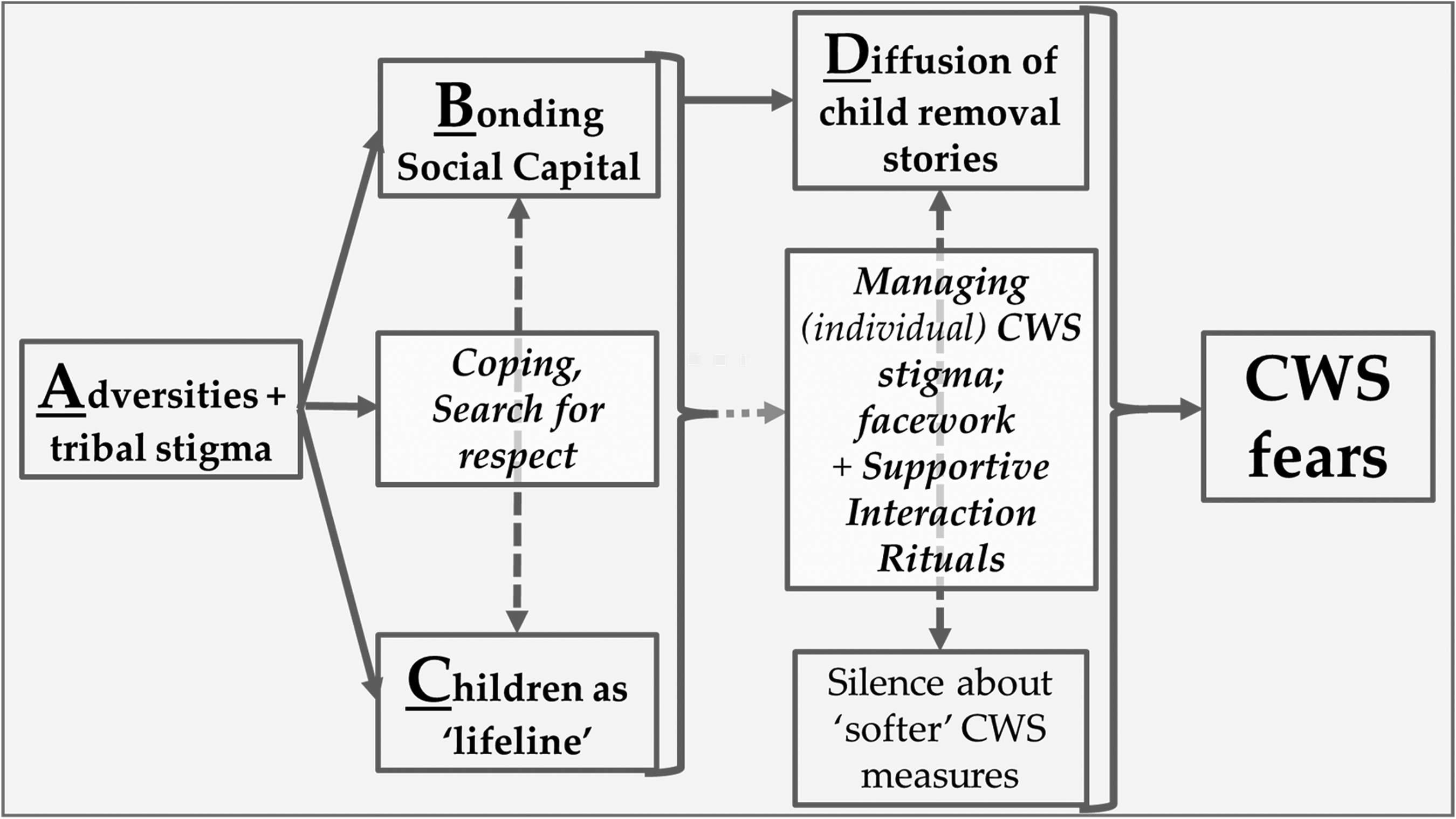
Visual presentation of the A-B-C-D model.
Discussion and conclusion
The preceding neither acquits Norwegian CWS of ethnic bias in casework nor suggests anything about its prevalence. Our aim has been to fathom interactional processes in the broader social milieus, beyond people's direct CWS encounters. Norwegian Somalis’ CWS fears relate intimately to marginalization. However, as A-B-C-D shows, disadvantage can matter in surprising ways.
We advocate for putting CWS fears on the sociological agenda, beyond national borders and across groups. Our study has important implications in this respect. Two other groups known to be distrustful of Norway's CWS are Poles and Pakistanis (Friberg and Bjørnset, 2019; Gajewska et al., 2016). Our model with Somalis may need modifications. Both groups are less marginalized. As EU citizens, Poles travel more easily back and forth, and distrust of Norway's CWS relates to political and media discourse in Poland (Gajewska et al., 2016). Pakistanis, like Somalis, have strong ethnic ties. However, this did not similarly arise from marginalization, but from ‘family chain migration’ to Norway, largely from a few villages in Pakistan. Lumping these groups together as ‘migrants’ to investigate CWS fears should not suffice. Conclusions can be flawed if we juxtapose someone who heard about Norway's CWS through Polish media before moving for work, a Syrian refugee who read about Norwegian CWS on Arabic Facebook pages before arrival, and a Somali parent whose fears were formed by residing in Norway for 15 years. We must identify the exact mechanisms of different groups, for which we may need more ethnography. Our model can be used as analytical starting point, to be modified or supplemented in each case.
Among people not in bonded groups, we expect other configurations of interaction rituals (Goffman, [1967]1982), stigma, and of the discredited—discreditable dichotomy (Goffman, [1963]1990). Thus, we should expect other dynamics regarding disclosure that one's children have been taken away. Three points are relevant: Disclosing might not spur the same sympathy and support. There is also likely less practical help to be attained (cf. associations’ legal advice). Finally, chances are higher that one can hide one's misery. This bereaved parent can choose between ‘voluntary disclosure’ and ‘passing’ (Goffman, [1963]1990:123–5; 92–112), which contrasts with the diffusion of stories among Somalis, where bereaved parents both have strong incentive to tell others, and little opportunity to ‘pass’ as parents whose children live at home.
Regarding national comparisons, the before-mentioned U.S. conditions do not readily apply elsewhere. Among U.S. racial minorities, analogies to mass incarceration appear fruitful. Understanding CWS fears in Nordic countries would be vain if this was our starting point. Policing of racialized urban poverty is not pronounced, and poverty-levels are not equally alarming. Despite grave historical racism against indigenous and national minorities, and notwithstanding current ethnic/racial disparities and stigmas, conditions cannot compare to the dysfunctional race relations in the U.S., past or present. Yet, these two countries, the U.S. and Norway, which are opposites in penal practices and welfare generosity, stand out in reports of minority parents’ CWS fears. This compels us to do comparative studies. We propose our A-B-C-D model as a theoretical starting-point.
Footnotes
Acknowledgments
We are grateful to the editors of Acta Sociologica and to three anonymous reviewers for providing valuable comments, which helped raise the quality of our paper.
Funding
The author(s) received no financial support for the research, authorship and/or publication of this article.
