




Abstract
To study discrimination in labour/housing markets, and among street-level bureaucrats in the welfare state, present both theoretical and methodological challenges. In the sociological study of discrimination, experiments have seldom been used to study how street-level bureaucrats make their decisions. The context of decision-making is different in the state and in markets, but experimental methods can provide new knowledge of how perceptions of deservingness may potentially lead to discrimination in the welfare state. Using a vignette experiment on Norwegian street-level bureaucrats (N = 645), we investigate if their perceptions of recipients’ ethnic background, and perceived ‘unfavourable’ behaviour, affect the propensity to impose a time-limited termination of unemployment benefits due to non-compliance with activity requirements. The experiment finds that the propensity to terminate the unemployment benefit was initially less for the recipient with an ethnic minority name, compared to the recipient with an ethnic majority name. However, when information about ‘unfavourable’ behaviour was added to the vignette, the propensity to sanction the ethnic minority recipient strongly increased. The results suggest that perceived deservingness-traits are crucial for understanding possible discrimination when street-level bureaucrats face ethnic minorities in the welfare state. Ethnic markers interact with markers of ‘deservingness’. Theoretical and methodological implications when studying potential discrimination among street-level bureaucrats are discussed.
Keywords
Introduction
Net migration increases cultural diversity and ethnic heterogeneity in affluent democracies. This may create challenges both for markets and the state. Migration changes the composition of the general population and the composition of welfare recipients. When the proportion of recipients with an ethnic minority background increases the principle of equal treatment in welfare states is put to the test. To avoid discrimination is a cornerstone in the normative foundation of modern states (Molander, 2016). In spite of this, knowledge about how discretionary decisions are made by the welfare state's front line is very limited (Hupe et al., 2015). This is particularly the case with regards to equal treatment and non-discrimination (Pfaff et al., 2021). Studying discrimination is theoretically and methodologically challenging, particularly to identify possible causal mechanisms (Pager, 2007; Pager and Shepherd, 2008). In this study, the aim is to explore the eventual effect street-level bureaucrats’ perceptions of the recipient's attributes and behaviour have on their discretionary decision-making.
The context is street-level bureaucrats’ decision to sanction (or not) non-compliance with activity requirements in the unemployment benefit system. To impose activity requirements has been a common trend in western welfare states since the 1990s, including sanctions for those who fail to adhere to such requirements (Watts and Fitzpatrick, 2018). The increased focus on the recipient's conduct, brought about by activity requirements, has increased the scope for discretion in front line work (van Berkel et al., 2017). Thus, it is important to investigate whether the perception of the recipient's behaviour is conditioned by attributes of the recipient when street-level bureaucrats impose sanctions.
In the sociological study of discrimination, it is well known that the attributes of an actor can influence decisions. In particular, several audit studies have demonstrated that names signalling ethnic minority background result in less favourable outcomes in employment, housing and credit markets (Quillian et al., 2019; Small and Pager, 2020). Studies of decision-making in human service organisations also point to the importance of client attributes, but here the picture is more complex. Clients who exhibit greater levels of need may receive proportionally greater benefits, while clients who are perceived as less deserving may receive poorer service and benefits (Scott, 1997). However, since ‘need’ and ‘deservingness’ can be legitimate reasons for treating welfare recipients differently, this does not necessarily represent discrimination. In this article, we examine street-level bureaucrats’ judgements of non-compliance with activity requirements and discuss whether the results can be interpreted as discrimination – as in studies of employers and landlords.
An equally important issue is what happens when ethnic background is linked to information about ‘unfavourable’ behaviour. In a well-known audit study from 2003, Pager showed how race and criminal history can be barriers to the labour market. Pager found that white applicants more often received callbacks from an employer than black applicants. Even white applicants with a criminal record got a call back more often than black applicants with a clean record (Pager, 2003). We are concerned with the importance of the recipient's welfare history and whether additional information about the recipient's welfare record, together with ethnic background, has effects on the probability of being sanctioned.
The first research question is: does the ethnic background of the recipient have an effect on the propensity to sanction a recipient? The second question is: does the interaction between ethnic background and unfavourable behaviour change the street-level bureaucrats’ tendency to sanction recipients?
To study these questions, we conducted a vignette experiment of street-level bureaucrats in the Norwegian Labour and Welfare Administration. By manipulating the ethnic and behavioural attributes of recipients, we examine the effects of such attributes on front line workers’ perception of who deserves to be sanctioned.
The study contributes to the sociology of discrimination in three ways. First, by enlarging the arena for experimental studies of potential discrimination to decisions made by street-level bureaucrats. Street-level bureaucrats’ decisions are non-transparent, but vital for millions of citizens and crucial for the legitimacy of the welfare state. Second, to investigate whether the interaction between ethnic background and the conduct of recipients influence street-level bureaucrats. Third, by discussing theoretical and methodological challenges when investigating possible discrimination in street-level bureaucracies using vignette experiments.
Theoretical assumptions and previous research
Theoretically, the study is informed by the sociology of discrimination, and corresponding theories of welfare attitudes and perceived deservingness. In different ways, all are concerned with a fair allocation of goods. Theories of discrimination have mainly been developed in studies of allocation of labour and housing on markets (Small and Pager, 2020), while theories of deservingness have been developed to explain variations in perceptions of who deserves public welfare benefits (van Oorschot et al., 2017). In markets, employers and landlords are important actors who may potentially discriminate. They are the gatekeepers for access to employment or rented housing (Fibbi et al., 2021). In the state, the actors who may potentially discriminate are street-level bureaucrats. They are gatekeepers for access to welfare benefits and services (Lipsky, 2010). In contrast to employers and landlords, they are expected to determine access based on criteria of need and deservingness. Such criteria are explicitly normative in character, which may make the decision-making process on behalf of street-level bureaucrats different from the market-based decision-making of employers and landlords.
Street-level bureaucrats
Street-level bureaucrats hold a pivotal role in the modern state (Lipsky, 2010). They are ‘mediators’ between the state and the street (Zacka, 2017). They are expected to be both ‘state agents’ and ‘citizen agents’ (Maynard-Moody and Musheno, 2003). Several related labels have been used to characterise this role, such as ‘front line worker’ (Maynard-Moody and Musheno, 2003), ‘caseworker’ and ‘welfare administrator’ (Schram et al., 2009). Although the labels vary, they all point to a role characterised by working in direct contact with individual citizens and having relative autonomy and discretionary power as ‘local policymakers’ (Hupe et al., 2015).
A basic norm in welfare states is the principle of equal treatment. This implies that similar cases should be treated similarly, but also that different cases should be treated differently (Molander, 2016). Thus, a core issue is to determine whether cases are similar or not.
To decide when criteria are met, street-level bureaucrats have a space for discretion. This means they have some freedom of choice delegated by a higher authority (the government). Within this space, there is an expectation that front line workers act in accordance with political aims, legal rules and their best professional judgement, which also includes their interpretation of the clients’ attributes and behaviour (Baviskar and Winter, 2017; Jilke and Tummers, 2018). However, the dependence on discretionary judgements when distributing services and benefits based on needs may create tensions relative to the principle of equal treatment (Molander, 2016). This is where issues of potential discrimination may arise. The challenge on behalf of street-level bureaucrats is to adhere to the principle that only relevant differences in needs should matter when they make decisions.
In this role, different from employers and landlords, perceptions of deservingness are likely to become pivotal. Empirically, street-level bureaucrats may have more or less conscious perceptions that certain clients or behaviour deserve to be rewarded or punished (Zacka, 2017). It is an empirical question to which extent such perceptions comply with the norm of equal treatment, or if they instead result in discrimination.
Discrimination
To investigate whether the discretionary decision-making of street-level bureaucrats sometimes results in discrimination, it is necessary to clarify the concept of ‘discrimination’. Following Becker's (1957) classic formulation, ‘discrimination’ can be defined as a situation where two similar applicants are treated differently because of characteristics that should not be relevant.
Two questions are the focus of discrimination studies. First, the question is if discrimination occurs at all. Second, the question why discrimination occurs. Let us discuss them in turn. As mentioned in the introduction, empirical studies in Europe and the United States have shown ethnic discrimination in hiring processes (Birkelund et al., 2017; Quillian et al., 2017; Zschirnt and Ruedin, 2016), housing markets (Auspurg et al., 2019; Flage, 2018) and credit and consumer markets (Pager and Shepherd, 2008). Empirical research on market-based discrimination both in sociology and economics has to a large degree been based on field experiments, such as audit and correspondence studies (Pager, 2003; Small and Pager, 2020). A widespread approach is to use ethnically distinctive names to signal the ethnicity of applicants for jobs, rented apartments or credit (Pager, 2007). Meta-analyses of discrimination in markets indicate significant discrimination against non-white natives in most countries (Quillian et al., 2019).
The strength of field experiments on discrimination in markets is the examination of actual recruitment processes. This secures external validity and makes it possible to directly study if discrimination occurs (Fibbi et al., 2021).
The most viable alternative for conducting experimental studies of potential discrimination in the state can be hypothetical cases, that is, vignettes. Vignette experiments are more likely to detect possible discrimination than studies based on interviews or observations (where it is not possible to ‘hold everything constant’ except the ethnicity of various claimants), but unlike field experiments, they do not investigate actual application processes. Since experimental studies of eventual discrimination on behalf of street-level bureaucrats must normally be based on hypothetical situations, they cannot directly identify the occurrence of actual discrimination, but they can nonetheless throw light on factors that may have discrimination as a consequence. Our vignette experiment belongs to this research tradition.
This leads to the second question: Why does discrimination occur? In the study of market-based discrimination, economists have drawn a distinction between discrimination based on ‘tastes’ and statistical discrimination. Taste-based discrimination, introduced by Becker (1957), postulates that employers discriminate when they are willing to pay a price of some kind to reduce their association or interaction with a given group (Small and Pager, 2020: 51). The underlying assumption is that employers are willing to suffer the cost of not hiring someone who is equally or better qualified than the one who is actually hired due to negative emotions, attitudes, or simply a behavioural tendency to avoid association with members of a group.
Statistical discrimination was introduced later by Phelps (1972). This theory regards discrimination as resulting from an information problem. It postulates that employers, facing limited information about a given potential employee, use group characteristics as a cost-efficient way to make inferences about the productivity of individuals. Skin colour, sex and ethnicity are used as proxies for relevant information not sampled, in situations where sampling more precise information is regarded (by employers) as too costly, or impossible, to obtain. Thus, the problem is not negativity as such vis-à-vis members of a group, but the high costs of gathering relevant individual-level information. Common to both taste-based and statistical discrimination is the assumption that it is an individual who decides to treat people differently, which is also the case when studying the behaviour of street-level bureaucrats. Hence, these theories are also potentially relevant when studying how street-level bureaucrats respond in vignette experiments.
The distinction between taste-based and statistical discrimination corresponds roughly to a difference between affective-based preferences and cognitive-based preferences in social–psychological theories (Zajonc and Markus, 1982). Affective-based preferences refer to theories emphasising the importance of positive or negative emotions when making decisions, in this case: decisions about who to hire or accept as a tenant. Cognitive-based preferences refer to theories of how people make inferences about the world. The core theme in cognition theory is how information is processed, including how people handle decision-making in situations where information-gathering is costly. Social cognition theory is concerned with identifying the cognitive processes by which people arrive at judgements, perceptions and decisions (Jussim, 2012; Kahneman, 2011). People take cues (signs and signals) from their environment that activate different mental schema (patterns of thought that categorise information and the relationships within it). Schemas serve as sense-making mental devices that guide decisions and actions.
Street-level bureaucrats are expected to be able to categorise and handle information fast, but at the same time to follow professional standards and legal rules for proper treatment. Since the concept of discrimination is based on the principle of equal treatment, they are expected to collect sufficient information to be able to categorise cases as similar or different, since similar cases should be treated similarly and different cases differently. They are also expected to avoid decisions based on private emotions. Some clients may be perceived to be victims of structural disadvantage, which street-level bureaucrats legitimately should compensate for. To consider special needs is a key value in the welfare state, but it requires a justification. Such justifications may also refer to degree of personal responsibility and deservingness (Mounk, 2017). When constructing justifications, street-level bureaucrats may rely on perceived client characteristics that serve as cues to degree of personal responsibility and deservingness. Street-level bureaucrats may also in practice create ‘informal taxonomies’ of clients to handle the complexity of cases (Zacka, 2017).
Deservingness
The key question in theories of welfare deservingness is ‘who should get what, and why’ (van Oorschot, 2000). As with discrimination, we can draw a distinction between two questions. First, the question if some groups, or members of groups, are regarded as more deserving than others. Second, the question why some are regarded as more deserving than others.
Regarding the first question, most empirical research on deservingness has been on the general population, using representative surveys. Previous research on deservingness perceptions in the general population indicates that if needy persons are perceived as ‘victims’, support is forthcoming; if they instead are perceived as ‘strategists’, support is lower (Fong et al., 2006; Petersen, 2012; Petersen et al., 2011, 2012).
With reference to the second question, the empirical variations in the general populations’ perceptions have been explained by postulating a set of deservingness criteria, which refer to principles and norms people are likely to deem important in ‘fair’ distributions. The most detailed categorisation of such criteria is by van Oorschot (2000) and Zacka (2017). Three of these criteria are control, whether a person is perceived to have control over their own situation; identity, whether a person is seen as one of ‘us’; and attitude, whether a person is likeable and compliant by some standard (van Oorschot, 2000; van Oorschot et al., 2017). ‘van Oorschot argues that the willingness to offer support is higher if recipients are perceived as making a personal effort, as belonging to ‘us’ and to share our standards concerning proper behaviour.
With reference to the relationship between ethnicity and perceived deservingness, a vignette experiment by Kootstra (2016) found that the general population viewed claimants with names signalling ethnic minority background to be equally deserving as claimants with names signalling ethnic majority background. However, when ‘unfavourable’ behaviour was involved, claimants with a typical ethnic minority name were punished more severely.
Although most empirical research on deservingness has been on the general population, calls have been made for studying deservingness opinions among policymakers and street-level bureaucrats (Meuleman et al., 2017). We are concerned with which effects front line workers’ perceptions of recipients’ attributes and behaviour may have on discretionary decision-making. Thus, previous studies of how street-level bureaucrats may conceptualise ‘deservingness’ are of relevance, including if findings from studies of the general populations are applicable also when studying street-level bureaucrats. We refer to these studies below.
Previous research using vignette experiments
There is a large sociological literature on discrimination, but we have identified only four previous studies that have used vignette experiments to investigate how clients with ethnic minority names are treated by street-level bureaucrats relative to clients with ethnic minority names. Two studies find that front line workers treat ethnic minority users more, rather than less, favourably. In the first of these studies, a sample of US teachers was asked to consider multiple pairs of student profiles and asked each time to pick the one they would prioritise. Jilke and Tummers (2018) found that a higher percentage of teachers claimed they would put in an extra effort if the vignette used an ethnic minority name. Similarly, a Norwegian vignette study found that front line workers treated male recipients of social assistance with a typical North African name more leniently than those with a typical ethnic majority name (Terum et al., 2018). In both the US and Norwegian studies, the perception of deservingness seemed to be important. Jilke and Tummers (2018) argued that two types of deservingness cued extra effort. First, teachers prioritised pupils who were seen as motivated and trying to make an effort, labelled ‘earned deservingness’ by Jilke and Tummers Second, pupils who appeared to be in particular need of help were prioritised, which was labelled ‘needed deservingness’. The results from this study indicated that ethnic minority status served as a cue for special needs for help and activated the ‘needed deservingness schema’. The Norwegian study showing that street-level bureaucrats treated recipients with an ethnic minority name more favourably, can be interpreted in a similar way (Terum et.al. op.cit.). In contrast, the third study – a Danish vignette – found that employment agencies were more likely to sanction an unemployment recipient with an ethnic minority name, compared to a name associated with Danish origin (Pedersen et al., 2018). This indicates similar-type discriminatory behaviour as found among employers and landlords. Findings are thus mixed.
A step further is to ask what happens when the ethnic background is linked to unfavourable behaviour. The only previous study using this more complex vignette design is a vignette experiment of US front line workers who administer Temporary Assistance to Needy Families (TANF). The study found that ethnic minority status in combination with unfavourable behaviour resulted in harsher reactions for single mothers (Schram et al. (2009). Harsher sanctioning was evident, but only if the vignette was coupled with information that the single mother had been sanctioned two months earlier for a similar offence, that is, that she was a ‘repeat offender’. Both a mother with an African-American sounding name and a mother with a Caucasian-sounding name were then treated more harshly, but a sanction was significantly more often meted out only if she had a typical African American name.
These findings can be interpreted in light of the racial classification model (RCM) developed by the authors of the study. RCM is a cognitive model of street-level policy decision-making (Schram et al., 2009; Soss et al., 2008). As in social cognition theory more generally, an underlying premise in the model is that actors rely on social categories to make complex target groups more interpretable. Thus when front line workers make decisions, they draw on social group reputations as proxies for more detailed information. The likelihood that such cognitive classifications are ethnically biased is assumed to be a function of the prevailing cultural stereotypes of ethnic groups. When front line workers observe signs regarded as stereotypical behaviour or characteristics of a minority group (but not of a majority group), these signs will lead to larger differences in the perceptions and treatment of the minority group than in those of the majority group (Soss et al., 2008). For example, if a group is stereotyped as ‘lazy’ or ‘irresponsible’ to a larger extent than another group, signs that can be interpreted as laziness or irresponsibility will be punished more severely if displayed by members of the first group.
Institutional and legal context
The context for this study is the unemployment benefit scheme in Norway, which is administered by the Norwegian Labour and Welfare Administration (NAV). NAV administers unemployment benefits, sickness benefits, disability benefits, old age benefits, a qualification program and social assistance. Every year approximately 20% of the working-age population (16–66 years) receives benefits administered by NAV. Sixteen percent are recipients of health-related benefits and 4% are recipients of unemployment benefits (Kann and Sutterud, 2017). The proportion of immigrants among the recipients varies from almost 10% for disability benefits to 56% for the qualification program. For unemployment benefits, the proportion of recipients with an immigrant background is about 30% (NOU, 2017).
According to the Social Security Act, recipients can get a time-limited termination of the unemployment benefit if they do not comply with activity requirements and compulsory attendance at meetings with NAV. Benefits can be terminated for up to 12 weeks (§4–20). This represents the sanction for non-compliance. The use of sanctions can be interpreted as a means to motivate clients, stimulate work effort and enforce responsible behaviour (Schram et al., 2009). Although increased use of conditions and sanctions are common trends in many European countries, there is a lack of knowledge of how they are implemented by the front line (van Berkel et al., 2017; Watts and Fitzpatrick, 2018).
Data and methods
Data collection
A survey was distributed online to 3228 front line workers from a representative sample of 107 local NAV offices in Norway. The offices were selected among a total of 430 NAV offices with around 13,000 front line workers. Permission was granted by the Directorate of Labour and Welfare. In the letter to respondents, we informed that one of the aims of the study was to investigate discretionary decision-making. The response rate was 51per cent (1646 front line workers). Only those who confirmed they had experience administrating the unemployment benefit scheme (645 workers) got access to the vignette, out of whom all answered the vignette. Following a suggestion by Kootstra (2016), we expected careful reading and consideration of the vignette to take some time, so we excluded 18 respondents who used less than 30 s to evaluate the vignette and answer a follow-up question about their confidence in their decision. 1 They constitute the sample (final N = 627).
A vignette is a short story based on a typical real-life situation, which respondents are asked to read and respond to (Ejrnæs and Monrad, 2012). To avoid bias due to previous questions, a vignette was placed in the first part of the questionnaire. In addition to vignettes, the survey included questions about attitudes towards benefit conditionality, educational background and demographic factors. Statistical analysis was performed using STATA software (version 15.1; STATA Corp., College Station, TX, USA).
Design of the vignettes
Research employing field experiments or vignette experiments allows researchers to ‘hold everything constant’ except for ethnic identity. All respondents had the same chance of receiving different versions of the vignette. By randomising which respondents got different versions, we can assume (and to some extent show) that the groups are similar except for the words in the vignette that was different. This means that claims of causality are on safer ground than in traditional survey research (Mutz, 2011).
Since the purpose was to examine the effect of clients’ attributes and conduct on discretionary decision-making, the vignettes were designed so that the assessment of whether to sanction does not in a straightforward manner follow from the legal framework of the unemployment benefit scheme. Street-level bureaucrats in NAV have room for professional discretion both when assessing if the appropriate requirements have been met and whether non-compliance should be sanctioned.
Vignettes contain far less information than a real-life case and probably only correspond to ‘first impressions’ compared to real-life decision-making on behalf of street-level bureaucrats. Eventual stereotypes that are activated by the limited information that is first available can be modified when additional finer-grained information is obtained (Jussim, 2012). However, first impressions are often powerful and may lead to confirmation bias when front line workers collect more information about a client. Severe workloads and time constraints on decision-making may further limit the opportunity to gather additional information, so in practice, street-level bureaucrats may seek recourse to stereotypical cues, or what Zacka (2017) labels ‘informal taxonomies’, of claimants. Thus, first impressions may be important to examine, and vignette experiments can measure the importance of initial ‘deservingness cues’.
The vignette describes a recipient of unemployment benefits who have failed to fulfil the mandatory activation requirements. Four versions of the vignette were randomly distributed to the respondents. We varied two characteristics of the client: name (signalling ethnic background) and previous welfare record (signalling previous ‘unfavourable’ behaviour).
Half of the respondents were given a client with a typical Somali name (Abdi Mohamed Jama). The other half received a vignette with a typical native Norwegian name (Stian Berg). The chosen names will most likely ensure that respondents associate ‘Stian Berg’ with a typical Norwegian name and ‘Abdi Mohamed Jama’ with an ethnic minority name. (The specific association to a Somali name is not necessarily evoked among respondents, but at least an African name.)
In half of the vignettes, the client has an extensive previous welfare record. He is characterised as well known to the welfare authorities after having received social assistance for a long time and having previously been registered for several work training courses but failing to attend, plus having been sanctioned on a previous occasion. In the other half, no information on the previous welfare record before receiving the work allowance is mentioned. The purpose was to vary information about assumed ‘unfavourable’ behaviour, in order to signal different degrees of norm-breaking behaviour, and whether the recipient's situation may be perceived to be due to factors beyond their control.
A classification of the four vignettes

Thus, the four versions are: minority name, no previous welfare record (A); majority name, no previous welfare record (B); minority name, previous welfare record including previous breaches of activation requirements (C); majority name, previous welfare record – including previous breaches of activation requirements (D).
Respondents were asked to assess whether the recipient's breach of the activity requirements should lead to a time-limited termination of the unemployment benefit. The vignette is displayed in textbox 1. The characteristics we have manipulated are marked in bold.
We did not find any systematic differences regarding the background characteristics of the front line workers who received different versions of the vignette (see online appendix). This was as expected: Since the respondents are randomly distributed across the four versions of the vignette, background characteristics of the respondents should not interact with the experimental manipulations (Mutz, 2011). We also found only weak correlations between the background variables and the tendency to sanction (tables not shown). Hence, the inclusion of control variables is not necessary.
Results
The probability of being sanctioned
Figure 1 shows that both ethnicity and previous welfare record affect the probability of being sanctioned. When no previous welfare record is mentioned, the recipient with the typical Somali name (Abdi Mohamed Jama) has a lower probability of being sanctioned than the client with a typical ethnic majority name (Stian Berg). Although 53% chose to sanction Stian Berg if no previous welfare record was mentioned, only 39% chose to sanction Abdi Mohamed Jama. Thus, clients with a name signalling a Somali background are treated less harshly than clients with a typical Norwegian name.
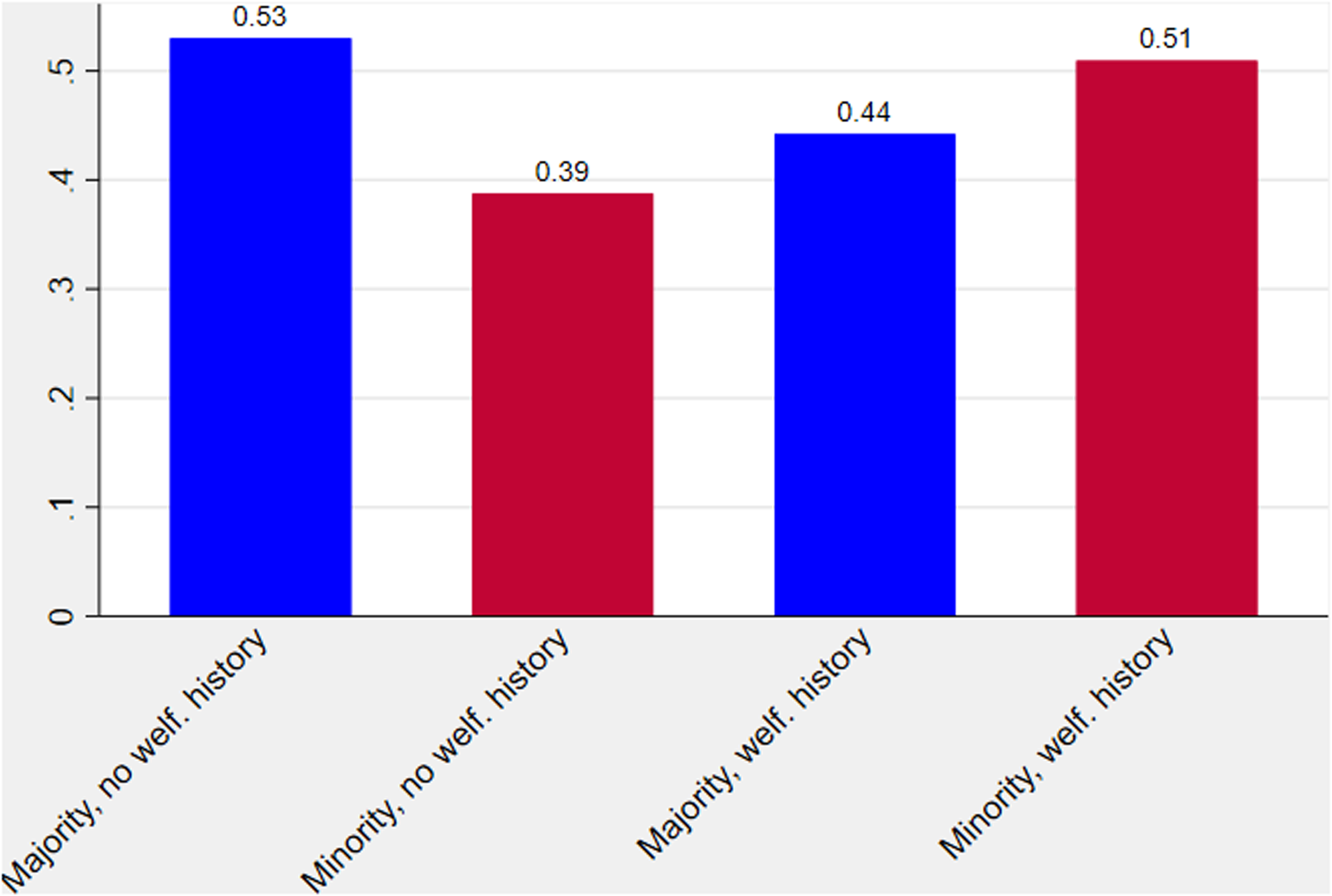
The decision to sanction according to signalled ethnicity and previous welfare record. The proportion of workers who decide to sanction. N = 627.
The pattern is different when we add information about a previous welfare record. Simply looking at the percentage differences suggests that Abdi Mohamed Jama is now more often sanctioned than Stian Berg. For the client with a typical ethnic minority name, a previous welfare record is much more negative than for the client with a typical ethnic majority name. Abdi Mohamed Jama's risk of being sanctioned increases from 39% to 51% when the previous welfare record is added to the vignette. Having a previous welfare record does not have the same effect on the recipient with a name signalling an ethnic majority background, Stian Berg. His risk of being sanctioned actually decreases from 53% to 44%.
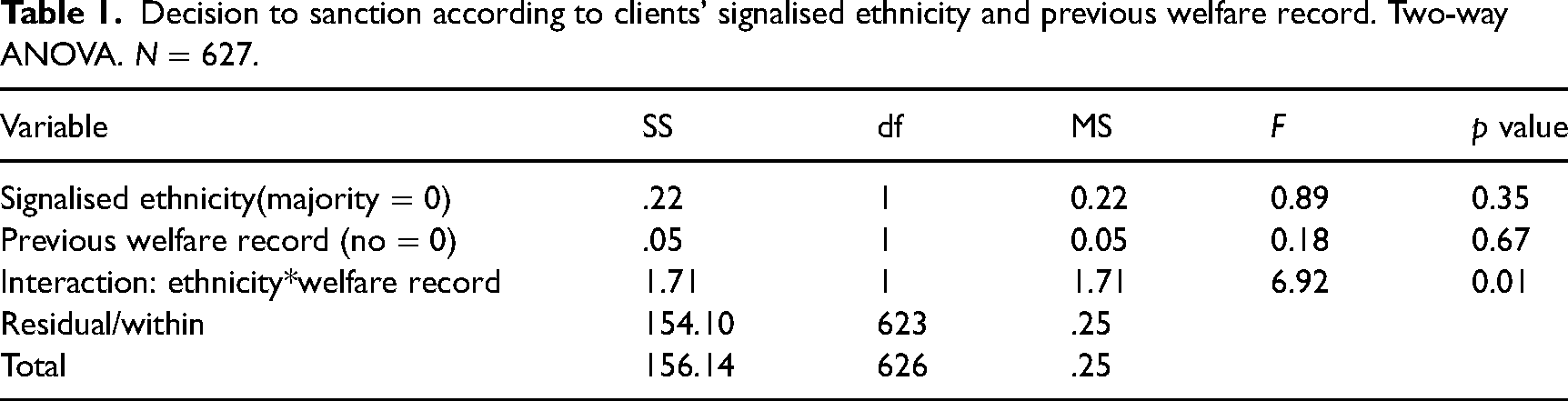
In Table 1, we perform a two-way ANOVA to analyze the effect of signalised ethnicity and previous welfare record on the decision to sanction. 2 The two-way ANOVA revealed that there is a statistically significant interaction between the effects of signalised ethnicity and previous welfare record on the decision to sanction (F(6233) = 1.71, p = 0.01). The interaction term shows us that the combination of having a name signalling ethnic minority background and having a previous welfare record significantly increases the risk of being sanctioned.
Decision to sanction according to clients’ signalised ethnicity and previous welfare record. Two-way ANOVA. N = 627.
Discussion
Our first finding indicates that street-level bureaucrats are initially less likely to sanction the recipient with a typical ethnic minority name (Abdi) than the recipient with a typical majority name (Stian). This is opposite to studies of employers and landlords, where field experiments suggest that negative discrimination based on the ethnic background is widespread. The result also seems to be the opposite of the Danish study of employment agencies, which indicated that front line workers were more likely to sanction the minority recipient than the majority recipient (Pedersen et al., 2018). However, the finding is in line with previous research on front line workers, reported by Jilke and Tummers (2018) as well as Terum et al. (2018). It also fits fairly well with Kootstra's vignette study of deservingness perceptions in the general population, which found no negative attitude towards ethnic minority claimants, as long as no information about ‘unfavourable’ behaviour was added.
Although the result is different from what sociological studies of the labour and housing market show, there could be links from such studies to our results. Street-level bureaucrats employed in local NAV offices are recruited according to strict guidelines and they undergo extensive internal training. A large proportion has higher education, and they are employed in an institutional setting where the principle of equal treatment is emphasised. Their education and training imply that they are likely to be well informed about empirical studies showing ethnic discrimination in labour and housing markets. For the same reason, they are likely to be informed about sociological theories of structural discrimination, that is, that larger societal structures, in numerous ways, limit opportunities and capabilities of ethnic minorities (Pager, 2003; Pager and Shepherd, 2008; Quillian et al., 2017). Thus, street-level bureaucrats in the Norwegian welfare administration may have a pre-understanding that ethnic minority claimants often are victims of structural factors beyond their control. This knowledge may activate the ‘needed deservingness’ cognitive schema suggested by Jilke and Tummers (2018), or the ‘lack of control’ deservingness criteria suggested by van Oorschot (2000, 2017).
Thus, perhaps somewhat ironically, research that has made street-level bureaucrats aware of structural and market-based discrimination of ethnic minorities may be part of the reason why they are less inclined to impose sanctions on Abdi – with the important caveat that this appears to be the case only when the vignettes give limited information about the recipients’ conduct.
Positive discrimination?
The critical issue of whether initially more favourable treatment of Abdi represents (positive) discrimination, will depend on whether ethnicity is a relevant difference between clients or not. Remember the initial definition that ‘discrimination’ can be defined as a situation where two similar applicants are treated differently because of characteristics that should not be relevant (emphasis added). If Norwegian street-level bureaucrats have sound reasons to believe that ethnic minority claimants are victims of circumstances beyond their control to a larger extent than ethnic majority claimants, then ethnicity is potentially a relevant difference between recipients. If so, less harsh treatment can be defended under the principle ‘different cases should be treated differently’ (Molander, 2016). Strictly speaking, treating Abdi less harshly than Stian only constitutes positive discrimination if it is totally unreasonable for street-level bureaucrats reading the vignette to assume that Abdi may face structural and/or market-based discrimination to a larger extent than Stian, that is, that there can be no reasons for believing that his ethnicity might be relevant when judging his needs and/or degree of deservingness.
Since a vignette experiment is a hypothetical case where information is deliberately standardised and limited, we cannot, based on such studies, determine if the observed differences represent legitimate favourable treatment of Abdi, or positive discrimination of Abdi. What we can say, is that a name indicating ethnic minority status serves as a signal to street-level bureaucrats, which – at least when no further context is provided – makes them treat such a claimant more leniently (whether legitimate or not).
As previously noted, there is a distinction between taste-based theories of discrimination and cognitive-based theories of discrimination (in the form of statistical discrimination). Elaborating on the above finding, it strengthens a presumption that discrimination is based on cognitive processes with regards to how street-level bureaucrats form opinions about their recipients, rather than their eventual ‘taste’ in discrimination. There are few reasons to assume that street-level bureaucrats in NAV have special, and stronger, positive emotions attached to minority groups than to the ethnic majority group, or to a larger extent regard ethnic minorities as belonging to ‘us’ that the ethnic majority. On the contrary, to the extent that emotional (rather than cognitive) factors matter, we should have expected a tendency in the opposite direction. Most street-level bureaucrats in NAV belong to the ethnic majority. Ethnographic studies indicate that front line workers find Somali men to be particularly demanding (Engebrigtsen, 2005; Fangen, 2008). Surveys of the general public, as well as analyses of mass media coverage, further suggest that North African men are among the most stigmatised ethnic groups in Norway (Bye et al., 2014; Simonsen, 2007). If emotional factors mattered, including who street-level bureaucrats regard as belonging to ‘us’, these factors should – if anything – lead to more negative rather than more positive treatment of clients with names signalling a North African/Somali ethnicity.
The recipient's conduct matter
Our second finding was that information on unfavourable behaviour has a large negative impact on how street-level bureaucrats react to Abdi. Why does additional unfavourable information dramatically increase the likelihood of being sanctioned?
One possible interpretation is that this additional information triggers negative stereotypes of Middle Eastern and North African men. The results have similarities with those from Kootstra's study of the general population, which demonstrated that when unfavourable behaviour was involved, a typical ethnic minority name displayed a lower score on perceived deservingness (Kootstra, 2016). Theoretically, this finding is rather consistent with the racial classification model (RCM), which predicts that only when minority clients possess discreditable traits consistent with minority stereotypes (that simultaneously are regarded as policy relevant), will they meet significantly stronger reactions (Soss et al., 2008). When information about a previous welfare record is introduced, the propensity to sanction Abdi strongly increased, which may indicate that a previous welfare record activates negative stereotypes of Somali males. From being perceived as a recipient who may face structural/cultural disadvantages for which he cannot be held responsible, Abdi's case might now activate the stereotype of a welfare strategist in the eyes of street-level bureaucrats, which is a stereotype of a ‘less deserving’ client. This is in line with Schram et al. (2009) referred earlier, who found that caseworkers were more likely to sanction when a discrediting marker was attached to an African American-sounding name than to a Caucasian-sounding name. The finding may also strengthen Zacka's (2017) claim, based on participant observation among street-level bureaucrats, that they often create ‘informal categories’ of clients, which influence their decisions.
A closer look at the Danish study referred earlier, which found a larger (larger than smaller) propensity for employment agencies to sanction the Middle Eastern recipient, may actually lend further credibility to this conclusion. The Danish vignette elaborated on the unemployed client's previous conduct, to signal instability as an employee (Pedersen et al., 2018). Thus, the Danish vignette is similar to the ‘unfavourable behaviour version’ of our vignette. In light of this, what initially appear to be different results seems rather to suggest a similar interpretation. The discriminatory behaviour towards the ethnic minority client in the Danish study can be tied to the explicit emphasis on previously unfavourable behaviour in the vignette. Thus, an important contribution of our study is to stress the interaction between ethnicity and signs related to ‘personal responsibility’ to understand street-level discretionary decision-making.
The possibility of social desirability bias
May the findings be due to social desirability bias? Social desirability bias occurs when respondents give a more favourable image of themselves because they want to make a good impression on others (Krosnick and Presser, 2010). Since discriminatory behaviour is a social taboo, social desirability bias might potentially be present (Janus, 2010). The public debate on alleged racism by public servants may make front line workers sensitive to accusations of racism, so they may be anxious to provide ‘correct’ answers when they see a typical ethnic minority name in a vignette (Barabas and Jerit, 2010).
Although we cannot rule out some degree of social desirability bias in our study, there are factors indicating that this is a limited problem. First, this is a study of which effect perceptions of the recipient's attributes and behaviour may have on the propensity to impose sanctions; we are not explicitly asking respondents about ‘discrimination’. Second, social desirability bias is likely to be less prevalent in experimental vignette studies compared with studies of sensitive subjects using surveys, qualitative interviews or observation, where respondents are fully aware their eventual discriminatory tendencies are part of the investigation (Janus, 2010). In experimental vignette designs, participants are not asked upfront about their perceptions or treatment of ethnic minorities. Since respondents are not informed that they are participants in an experiment, their judgements are less likely to be influenced by social desirability bias. Third (and related), recipients with an ethnic minority name are quite unremarkable for front line workers since immigrants represents a substantial proportion of recipients at the Norwegian labour and welfare administration. Hence, they should not find ethnic minority names to be ‘something special’ when reading a vignette. Fourth, when information about a previous welfare record is included, the client with the typical ethnic minority name is not any longer treated more favourably than the recipient with the ethnic majority name. If social desirability was important, we should expect favourable treatment to be independent of how clients are portrayed.
Conclusions
One of the most difficult problems in systems that depend on street-level discretion is the potential abuses based on institutionalised and culturally embedded stereotypes (Maynard-Moody and Portillo, 2010). Although the decision-making process in street-level bureaucracies is different from the labour and housing markets, experimental methods can illuminate this important and non-transparent area where ‘the state meets the street’. The sociological study of deservingness, along with theories of social cognition, is important contributions to explain decisions in street-level bureaucracies, including to identify factors that might lead to discrimination.
Supplemental Material
sj-doc-1-asj-10.1177_00016993231156486 - Supplemental material for Who deserves to be sanctioned? A vignette experiment of ethnic discrimination among street-level bureaucrats
Supplemental material, sj-doc-1-asj-10.1177_00016993231156486 for Who deserves to be sanctioned? A vignette experiment of ethnic discrimination among street-level bureaucrats by Silje Fekjær, Einar Øverbye and Lars Inge Terum in Acta Sociologica
Footnotes
Acknowledgements
This work was supported by grants from the Research Council of Norway's Welfare, Working Life and Migration (VAM) program [257603/H20]. The authors wish to thank Andreea Alecu, Simon Innvær, Willy Pedersen, Gaute Torsvik, the editor and two anonymous referees for helpful comments.
Funding
The author(s) disclosed receipt of the following financial support for the research, authorship, and/or publication of this article: This work was supported by the Research Council of Norway (grant number 257603/H20).

Supplemental material
Supplemental material for this article is available online.
Notes
Author biographies
References
Supplementary Material
Please find the following supplemental material available below.
For Open Access articles published under a Creative Commons License, all supplemental material carries the same license as the article it is associated with.
For non-Open Access articles published, all supplemental material carries a non-exclusive license, and permission requests for re-use of supplemental material or any part of supplemental material shall be sent directly to the copyright owner as specified in the copyright notice associated with the article.
