




Abstract
Scholars have unpacked the rhetorically nuanced ways political actors alter state narratives in resisting pressure to comply with international norms. But many of these rhetorical strategies apply in other contexts, where there exists sufficient norm ambiguity, too. For example, in response to Turkey's long-standing denialism, many governments have been asked to recognise the Armenian Genocide (or 1915 Genocide of Christians in the Ottoman Empire). But, because there exists no clear international norm about recognising genocides perpetuated by other states, even some of the most unlikely government officials adapt their rhetoric to resist recognition and pursue ulterior foreign policy objectives. Building on Dixon's rhetorical adaptation framework, this article argues that, between 1999 and 2021, Swedish political actors often adapted their rhetoric in ways similar to Turkish officials as a result of the normative ambiguity of states recognising the Armenian Genocide. In explaining why Sweden consistently resisted Genocide recognition efforts, this analysis focuses on its larger foreign policy commitments of spreading democracy in Turkey and managing the Syrian refugee crisis.
Introduction
Several international bodies, central governments and state parliaments have recognised the Armenian Genocide (or 1915 Genocide). 1 In addition, many scholars have categorised these events as genocide – including Raphael Lemkin, who coined the term (Lemkin, 1946; Mann, 2005; Straus, 2007). While Turkey remains staunchly opposed to recognising the 1915 Genocide of Armenians, Assyrians and Greeks, growing international expectations have caused Turkish officials to change the way they speak about these events.
Jennifer Dixon introduces the framework of rhetorical adaptation to evaluate how actors resist pressure to follow norms and reduce perceptions that their actions violate norms Dixon (2017). She relies on a longitudinal study of the Turkish state's denial of the Armenian Genocide to exemplify this phenomenon. Her framework's typology – norm disregard, norm avoidance, norm interpretation and norm signalling – provides a more nuanced model to evaluate how political actors employ rhetoric to maintain and/or alter their official positions, particularly in relation to international norms. Although Dixon's framework identifies how Turkish officials violate the norm of accountability in refusing to recognise the Armenian Genocide, what norms, if any, do other states violate when they use the same rhetorical strategies to resist or avoid Armenian Genocide recognition efforts? The existing scholarship does not answer this question.
In this article, I argue that rhetorical adaptations occur not only to resist compliance to international norms; they also act as a strategy for states in response to norm ambiguity about genocide recognition. To illustrate the broader implications of Dixon's framework, this article analyes Sweden's resistance to recognise the 1915 Genocide. In this analysis, ‘Sweden’ refers to the head of government (or executive branch) between 1999 and 2021 – this does not include the many Swedish actors, who have supported Genocide recognition, such as several political parties, activists, ethnic organisations and even its unicameral parliament (or Riksdag). Despite its human rights orientation in the global imaginary (Puyvallée and Kristian Bjørkdah, 2021), Sweden has an over two-decade history of resisting 1915 Genocide recognition. 2 First introduced in 1999, Sweden consistently took a hardline position against recognition. Even after recognitions by its own Riksdag (2010), the European Parliament (2015), European People's Party (2015), US Congress (2019) and US President Joe Biden (2021), Sweden tenaciously refused to do so. Applying an expanded version of Dixon's framework, this article demonstrates how norm ambiguity influences state behaviours in responding to 1915 Genocide recognition efforts.
In the case of Sweden, officials’ rhetorical adaptations between 1999 and 2021 reflect the state's conflict with other foreign policy priorities – namely, promoting democracy abroad and managing the refugee crisis resulting from the Syrian civil war. In the 1990s and early 2000s, Sweden distinguished itself among Northern and Western European countries in its efforts to spread democracy. Given this foreign policy commitment, Sweden remained vocally supportive of Turkey EU accession from the late 1990s until the Syrian refugee crisis. By the mid-2010s, the Syrian refugee crisis and rise of right-wing political parties had caused many European governments, including Sweden, to make concessions to Turkey. Among these concessions included sidestepping Genocide recognition. While Sweden's refusal to recognise the genocide is complex and multifaceted, these factors explain, in part, why Sweden resisted 1915 Genocide recognition efforts.
Rhetorical adaptations and norm ambiguity
Katzenstein argues that norms ‘describe collective expectations for the proper behavior of actors within a given identity’ (1996, 5). Generally, norms can either define (‘constitute’) or prescribe (‘regulate’) behaviour, but they may also do both. Norms scholarship focuses, largely, on non-state actors (Keck and Sikkink, 1998; Price, 1998; Risse et al., 1999); however, the scholarship has also unpacked the role of states in terms of their compliance or non-compliance to international norms (Risse et al., 1999, 2013). This latter approach is particularly developed in the scholarship, which emphasises domestic and regional strategies to accommodate local beliefs, practices and conditions (Acharya, 2004; Capie, 2008; Zimmermann, 2016). In addition, scholars have noted the rhetorical instrumentality of norms (Schimmelfennig, 2001; Hurd, 2005; Cardenas, 2006; Gentry, 2010; Greenhill, 2010; Erickson, 2015).
In contributing to the rhetorical instrumentality of norms, Dixon (2017) has developed the framework of rhetorical adaptation to unpack Turkish state officials’ refusal to recognise the Armenian Genocide. She defines this phenomenon as ‘a strategy in which actors shape their rhetoric in response to understandings of an international norm in order to avoid charges of norm violation or to resist pressures for compliance’ (2017, 84). Dixon argues that actors draw on the content of norms to devise new arguments that ‘minimize perceptions that certain actions are in violation of a norm’ (85). Dixon delineates four distinct types of rhetorical adaptations: norm disregard, norm avoidance, norm interpretation and norm signalling. Norm disregard occurs when the norm is weak – that is, lacks a consensus in terms of its appropriateness. It most often takes place when actors are aware of a norm but opt not to reference it. Norm avoidance occurs when actors argue that the outcomes under question do not violate any norms at all. Dixon argues that norm avoidance typically involves ‘framing action as acceptable and appropriate with regard to one norm rather than another, and implicit or explicit claims that one norm is hierarchically more important than another’ (2017, 86). Norm interpretation occurs when actors alter, reinterpret, or contest aspects of a norm's definition; this strategy attempts to limit the interpretation or application of a norm. Norm interpretation typically involves redefining the norm itself. Norm signalling occurs when actors openly express support for specific actions or practices, but fail to change their behaviours accordingly—or, as Dixon frames it, ‘when an actor “talks the talk” but fails to “walk the walk”’ (86). Dixon uses this typology to explain how, throughout the 20th century, Turkish officials have changed rhetorical strategie to maintain their denial of the Armenian Genocide. Dixon's typology complicates scholarly binaries – compliance versus non-compliance – in studying state officials’ responses to international norms. In addition, her model broadens the scope of norm takers’ agency (Table 1).
Dixon's typology of rhetorical adaptations.
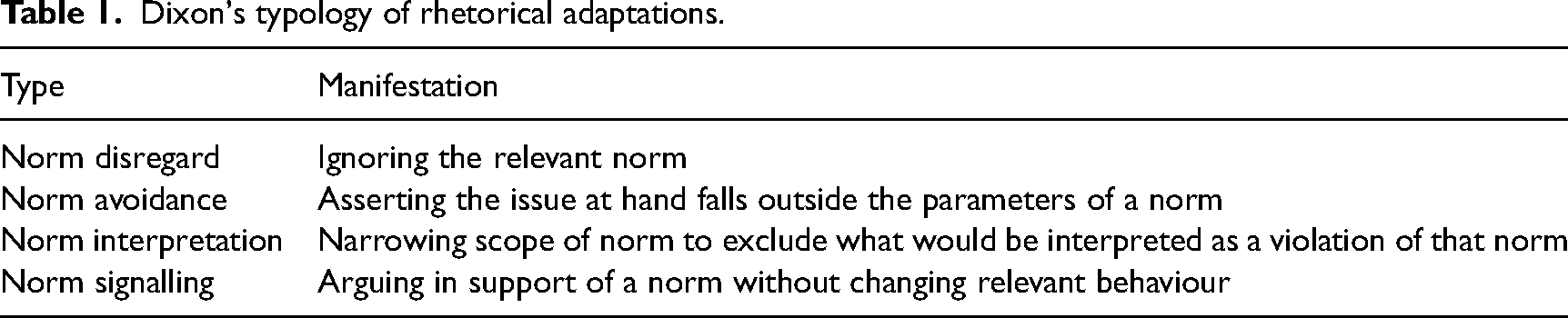
While Dixon's framework is intended to describe actors violating the norm of accountability, this article argues that the model applies equally persuasively to describe political actors’ rhetorical strategies in contexts where the violation or evasion of a norm is less clear. Given the interchangeability of these rhetorical strategies in quite distinct circumstances, actors’ adaptations highlight the ambiguity about genocide recognition and influence the behaviour of political actors.
IR scholars have noted the diverse implications of norm or policy ambiguity (Widmaier and Glanville, 2015; Hansen, 2016). Henry Kissinger referred to the strategic use of ambiguity as ‘constructive ambiguity’ – a process that involves deliberately obscuring obligations so that actors consciously avoid complying with any behavioural expectations (Berridge and James, 2003). Purposefully ambiguous rhetoric can assist actors to achieve policy objectives. While some scholars have identified the strategic benefits of ambiguity in the gradual institutionalisation of norms (Widmaier and Glanville, 2015), several others argue for greater clarity in what a norm is and the behaviour that constitutes a violation (Finnemore and Sikkink, 1998; Abbott et al., 2000; Kahler, 2000). As Ben-Josef Hirsch and Dixon argue, norm ambiguities have ‘limited scholars’ ability to test competing hypotheses about norm violation, contestation and localization, thereby hindering the accumulation of knowledge about international norms (Ben-Josef Hirsch and Dixon, 2021, 522).
Building on Dixon's typology, I argue that rhetorical adaptation explains not only a strategy of political actors, who resist compliance to international norms but also describes the behaviour of state officials, who use ambiguity as a strategy to obscure their obligations. This analysis highlights the lack of proscriptive and prescriptive behaviour for states in dealing with the 1915 Genocide. When there exists sufficient ‘constructive ambiguity’ – in this case, regarding whether states should recognise genocides perpetuated by other states – actors can strategically adapt their rhetoric, particularly when these adaptations enable them to pursue other policy objectives. As a result of norm ambiguity on the topic of recognising the 1915 Genocide, political actors adapt their rhetoric – in the same ways Dixon describes – often to promote ulterior agendas.
Methods
The article's findings are based, primarily, on documentary analyses of Sweden's parliamentary transcripts on the topic of 1915 Genocide recognition. These transcripts include Swedish MPs’ speeches and debates in the Riksdag between 1999 and 2021. I also analysed popular secondary source materials, such as newspaper articles, news media and social media posts. And I conducted 20 interviews with current and former Swedish elected officials, leaders of Armenian Swedish organisations, Swedish academics and the Armenian ambassador to Sweden. Among the elected officials, I interviewed officials across Sweden's political spectrum – Liberal, Green, Social Democratic, Center, Moderate and Sweden Democratic parties. I also interviewed people from the Armenian Swedish community, who had actively participated in recognition efforts. These interviews contextualised the parliamentary speeches between 1999 and 2021 and captured a broad range of narratives and orientations to Genocide recognition within Sweden.
Among those who supported the initiative and from those within the ethnic communities, I generally had a high level of access and very little resistance. However, among those who had opposed the resolution, access proved a greater challenge. This was particularly true among Sweden's Social Democrats. The majority of those whom I reached out to manifested very little responsiveness or willingness to speak. On some occasions, they refused to participate; however, in most cases, they merely did not respond to emails and/or telephone calls. Nonetheless, I did interview a few key Social Democrats, who supported the resolution, such as the former mayor of Södertälje and, at the time of this writing, the mayor of Boden – the latter asked that the interview take place via email. I also interviewed two key Moderate party members – the former leader of the Turkish friendship parliamentary group as well as the former OSCE's envoy, who mediated the conflict between Armenia and Azerbaijan after the first Karabagh (Artsakh) War. By gaining access to officials from diverse political parties in Sweden, I developed data to corroborate and broaden documentary analyses of the parliamentary transcripts between 1999 and 2021.
Genocide recognition efforts in Swedish parliament
The accession of Turkey to the EU and Sweden's ‘special mission’
On first thought, Sweden's long-standing resistance to 1915 Genocide recognition efforts may appear incongruous with its global ‘brand’ of human rights achievements. Sweden is the world's largest donor to humanitarian bodies, second largest to the UN Development Program and third largest to the UN High Commissioner for Human Rights (McEachrane, 2018). Sweden also receives more refugees per capita than any other European country (Jahan, 2016) and ranks among the top 10 refugee-receiving countries worldwide. Also, in 2014, Sweden became one of very few countries in Western or Northern Europe to recognise Palestine (Aggestam and Bicchi, 2019). For these and other achievements, Sweden's foreign policies were long represented as uniquely altruistic and human rights oriented (Ingebritsen, 2002; Dahl, 2006). Nonetheless, while several international organisations have recognised the Armenian Genocide, such as the UN's Genocide Report from 1985, the International Center for Transitional Justice in 2002 and the European Parliament in 2015, Sweden staunchly has refused to do so. This seemingly ‘Janus-faced’ orientation (Barker, 2013) relates, in part, to Sweden's distinct orientation to Turkey and its self-appointed mission to spread democracy.
To be sure, Sweden maintained a long tradition of openly criticising Turkey's human rights record. For example, Sweden (along with other Nordic countries) resisted Turkey's accession to the Council of Europe in the 1950s because it failed to meet European standards of democracy. In addition, Sweden played a role in initiating an interstate complaint against Turkey under the European Convention on Human Rights in 1982. Under the Moderate Prime Minister, Carl Bildt, however, Sweden abruptly changed course in the late 1990s.
Turkey's candidacy to join the European Union (EU) was first broached at the 1999 Helsinki Summit. On condition it met the European Council's criteria, discussions of Turkey becoming a full EU member began in 2005. While the governments of several Western and Northern European countries held strong reservations about Turkey's accession, Sweden was supportive of this prospect. Or, as Ann-Kristin Jonasson and Emine Bademci have argued, ‘From the Swedish perspective, the issue was never whether Turkey should join the EU but when’ (2014, 343).
Since 2010, however, the relationship between Turkey and Sweden (and the EU, more generally) has been conditioned by the Syrian refugee crisis. As Turkey's president, Recep Tayyip Erdoğan, aroused ire for repeated human rights violations, there grew a broad consensus across EU member states that Turkey's membership was no longer tenable; however, EU members maintained a cooperative or strategic relationship, in part, on account of the many challenges the Syrian refugee crisis introduced. As Saatçioğlu argues, EU member states have had to make significant compromises on many of their foundational political values to manage the crisis (2020).
Although Sweden's refusal to acknowledge the 1915 Genocide is complex and multifaceted, its commitment to spread democracy in Turkey helps clarify, in part, its over long-standing reluctance to support recognition – even after several other European states and international institutions have done so. These efforts do not necessarily reflect, however, a particularly pro-Turkish slant in Sweden's foreign policy. Rather, Sweden's efforts to democratise Turkey exist within a broader set of policies of promoting democracy (Schaffer, 2020).
By attempting to promote democracy in Turkey via EU accession, Swedish officials consciously avoided recognition, which, many felt, would undermine these efforts. Interviews with Moderate party members corroborated this rationale. For example, Göran Lennmarker, who served in the Riksdag from 1991 to 2010 (and Chair of the Committee on Foreign Affairs from 2006 to 2010), acted as the OSCE's ‘special representative’ to mediate conflict between Armenia and Azerbaijan following the first Artsakh (Karabagh) War between 2002 and 2010. While serving as the special representative, he spent time in both countries and frequently met with their respective leaders. Along with Carl Bildt, he also developed what would become Sweden's foreign policy orientation to Turkey and, indirectly, Genocide recognition efforts. In an interview, he shared the following: From the outside, we should not now go into [Genocide recognition]; it would be better to let a commission go into that and decide what happened. If there is an interest in Turkey, we should not go into process. That was more of a tactical approach…We knew that inside Turkey it was a very delicate position. We certainly knew about that among the hardliners so to say. We, Sweden, at that time, we were the most supportive country within the EU [of Turkish accession]. We should strive to get the right forces in Turkey…We saw the EU process as a way to help westernize Turkey.
On account of the perceived ‘delicacy’ of recognition, between the late 1990s and early 2010s, Sweden opposed 1915 Genocide recognition efforts; Swedish political actors feared such a resolution could undermine its ‘tactical’ position on democratising Turkey. Subsequent Social Democratic governments maintained the same position.
Early parliamentary debates on genocide recognition
As Dixon indicates, norm disregard occurs when the norm in question is weak or lacks a consensus. Turkish officials relied on this strategy through the 1980s (2017, 88). However, in the late 1990s and early 2000s, the global failure to prevent or stop mass killings in Rwanda, Srebrenica and Darfur led policymakers and scholars alike to develop policies, which could prevent future genocides. These policies generated global debate on the nomenclature of mass killings and the denial thereof. Furthermore, the 1990s introduced several key events, which raised genocide awareness: the International Criminal Tribunal for former Yugoslavia in 1993, the International Criminal Tribunal for Rwanda in 1994, the establishment of the International Criminal Court (ICC), civil suits seeking restitution for losses incurred during the Holocaust and others (Dixon 2017). By the late 1990s, the definition of genocide and its awareness had become more prominent. Sweden, however, did not want to risk compromising Turkey's potential EU accession, and therefore Swedish officials used a combination of rhetorical disregard and avoidance.
Before the late 1990s, the issue of Genocide recognition did not garner much, if any, attention within the Swedish government. While officials from the Armenian diaspora had been organising and lobbying governments and international courts long before 1999, it remained, largely, absent from the Swedish government's agenda. Swedish-Armenian and Left Party MP, Murad Artin, was the first to bring the matter to the Riksdag in 1999.
In the early parliamentary debates in Sweden on the topic of recognition, several officials used the same language, which the Turkish state also adopted in the early 2000s. As Dixon argues about the Turkish state's rhetoric in response to the international events from the 1990s, ‘Turkey's narrative has focused even more on the international legal definition of genocide’ (2017, 90). Similarly, Swedish officials’ oppositional rhetoric also focused on the legality of the term and ambiguity of states’ prescriptive behaviour. For example, the Moderate MP, Sten Tolgfors, argued the following: I do not want a politicized judiciary. I do not want it to be the Riksdag instead of international courts that assess whether one or the other case in the world, now or in the past, was genocide in the legal sense. That is what the question is about and nothing else. Let me also emphasize to those who sit in the stands and to those who may read this in the future that the reservation does not ask that Sweden should officially recognize this as a genocide. What is in the reservation is general reasoning and opinions. It is not a request for Sweden to officially recognize what happened in the early 20th century in the Ottoman Empire, during its collapse, as a genocide. Stop claiming it, because you do not ask for it! (i)
Tolgfors’ speech employs both rhetorical disregard and avoidance. By invoking international courts and shifting the remit of genocide recognition, Tolgfors follows similar rhetorical strategies then employed by the Turkish state and Turkish officials. He also uses disregard by emphasising the temporal and physical distance between contemporary Sweden and the final years of the Ottoman Empire. Even though the rhetorical strategies resemble those of Turkish officials, the motivations are quite distinct. Tolgfors’ disregard reflects the normative ambiguity of a state's role in recognising a genocide, which took place in another place and time. As Dixon argues, norm disregard is primarily used when the idea may still be novel and not yet an established norm (2017, 91). But Tolgfors’ speech, which took place in 2001, employs disregard and avoidance to obscure the state's obligation in terms of recognising the Genocide.
Tolgfors also uses rhetorical avoidance in his parliamentary speeches. By claiming that the sole focus pertains to the legality of the term (‘That is what the question is about and nothing else’), Tolgfors deflects responsibility for the Swedish state recognising the 1915 Genocide. As Dixon claims, norm avoidance is typically presented as reasonable or acceptable discourse, but the main function is to avoid the topic altogether. But, as Tolgfors’ speech reflects, it also acts as a strategic use of ambiguity to evade responsibility.
Moderates were not the only Swedish parliamentarians, who opposed a recognition bill using rhetorical avoidance. Even quite prominent Social Democrats argued against the resolution. Urban Ahlin, who would later become the Speaker of the Riksdag (and ambassador to Canada), also used rhetorical avoidance in opposing the resolution. In an excerpt from a rather lengthy speech, Ahlin argues: History is full of genocide! Had the respective countries felt that oh, if we sign this genocide convention, we will be brought to justice for genocide we committed three hundred, two hundred or one hundred years ago when we did not have a genocide convention. That's the simple truth…Murad Artin knows that it's not really in this manner, but it's just about trying to win some voters. But let us imagine that he would succeed in his intention to get the concept of genocide to apply retroactively even to things that happened before 1948. Yes, then the Criminal Court would never come into force. That is the simple answer. Our political ancestors who after the Second World War sat down and decided that this should never be repeated again made a fantastic good deed…We have a Rwanda tribunal based on the Genocide Convention. That is also why Mĭlošević is in The Hague today. It's because we have a genocide convention, and we must safeguard it. (ii)
Ahlin uses rhetorical disregard by referring to historical genocides and claiming that ‘history is full of genocides’. Ahlin implies that delving into the past would prove a futile (or inexhaustible) endeavour. As with the Turkish state's rhetorical strategy before the 1990s, Ahlin attempts to disregard the prospect of recognising the 1915 Genocide because of the hypothetical challenges recognising historical atrocities may trigger (‘we will be brought to justice for genocide we committed three hundred, two hundred or one hundred years ago’). As before, Ahlin's rhetorical adaptation does not violate the norm of accountability; rather, it is a strategic response to the norm ambiguity regarding states’ behaviour in recognising the 1915 Genocide.
As previously stated, however, events taking place on the international stage heightened the awareness and sensitivity regarding how states should treat genocides. This publicity and notoriety made using only rhetorical disregard increasingly untenable. Thus, as with the Moderate speaker before, Ahlin also uses rhetorical avoidance to shift the responsibility of genocide recognition away from parliaments to international courts. For precedent, he references the Rwanda and Yugoslavia international court cases. Furthermore, Ahlin claims, should Murad Artin succeed in getting a resolution passed in the Riksdag, it would undermine the efficacy of the contemporary courts (‘Yes, then the criminal court would never come into force’). By the time of this hearing, some central governments, such as Uruguay and France, had already recognised the Armenian Genocide. Still, there existed (and still exists) no clearly established norm for dealing with such recognitions. Despite his association with a political party steeped in human rights, this norm ambiguity provided Ahlin a justification to avoid complying with any behavioural expectations and emboldened him in speaking out against Genocide recognition.
Parliamentary debates on genocide recognition: Norm interpretation and norm signalling (2005–2010)
In March 2010, the Riksdag passed a resolution, which recognises the Genocide of ‘Christians in the Ottoman Empire in 1915’. Assyrians, Greek and Armenian community organisations and activists worked together in gaining the support of several Swedish MPs. Spearheading these efforts was then President of the Union of Armenian Associations in Sweden (UAAS), Vahagn Avedian. The UAAS is an umbrella organisation consisting of various Armenian groups in Sweden; it organises events and supports diverse activities, which include raising awareness about the Armenian Genocide. A genocide scholar himself, Avedian produced much of the content, which became the 2008 motion on which the Riksdag ultimately voted. 3 He also met with various Swedish MPs and worked closely with community leaders from the Swedish Assyrian and Armenian communities. Furthermore, many MPs relied on his research in preparing their own parliamentary speeches. 4
To be sure, certain party positions were already established. For example, Moderate party members were opposed, while Left and Green party members supported the resolution. But Avedian and others lobbied tirelessly and gained support among quite a few individual members, who would not otherwise have supported the resolution. In addition, several MPs, such as Annelie Enochson (Swedish Christian Democrat Party), Gulan Avci (Liberal Party) and Agneta Berliner (Liberal Party), decided to vote against their parties’ positions and support the resolution. As a result of these efforts, the resolution narrowly passed by a single vote (131–130). Following the parliamentary vote, the Moderate Prime Minister, Fredrik Reinfeldt, refused to adopt the resolution as a part of Sweden's foreign policy. The foreign minister at that time and former prime minister, Carl Bildt, also publicly condemned the resolution. He described the 2010 resolution as going ‘against the report of the Parliamentary Committee on Foreign Affairs’. 5
Still, the Riksdag's recognition resolution was a significant achievement, particularly on account of the novelty of its framing: While the Armenian Genocide had been recognised in several other national parliaments and central governments, Sweden's Riksdag became the first parliamentary body to include the Assyrian and Greek groups in their recognition resolution. As scholars have pointed out, the much larger sizes of other groups favour the formation of coalitions to pressure political actors to support such initiatives (Koinova, 2020; Fittante 2022a). This proved true in the case of Sweden's Parliament, as well.
To be sure, the resolution's passage proved especially compelling given that it occurred during the period in which Carl Bildt acted as Sweden's foreign minister. Bildt made Turkey's EU accession a long-standing and integral aspect of his foreign policy strategy. For many years, he argued in favour of recognising Turkey's European identity. In 2004, Bildt referred to Kemal Ataturk as ‘undoubtedly the most significant European revolutionary of the last century’. 6 Underlying this identity-based approach, Bildt had more strategic designs for Turkey. For example, in a New York Times article from 2006, Bildt is quoted as saying Turkey's membership, ‘would give the EU a decisive role for stability in the eastern part of the Mediterranean and the Black Sea, which is clearly in the strategic interest of Europe’. 7 And, in 2010, Bildt criticised EU President, Herman Van Rompuy, for omitting Turkey in EU-enlargement discussions. 8
Familiar with increasing international pressure to recognise the 1915 Genocide and aware of Sweden's reputation as a global bastion of human rights, Bildt, along with several others, relied heavily on the ambiguity of genocide recognitions to adapt their rhetoric and voice their opposition in debates leading up to and during the 2010 vote. Between 2006 and 2010, Bildt's rhetoric about the 1915 Genocide shifted the focus from legality to research and diplomacy. In several debates, he stressed the improvements Turkey had been making and the fear of destabilising that process. In 2007, he also used rhetorical interpretation to argue that genocide recognition creates a dangerous precedent: What I have to answer formally, and where I say no, is about whether we should make political decisions about history…For me, this is a core principle in a liberal society. We do not do that. There are other types of states at other stages of history that have made history a political weapon. They gather in government and parliament and decide that this was the case; these were guilty and those were innocent. This is how history is turned into a political weapon. We do not want that in Sweden. I was asked if I criticize the countries that have done so. Yes, I would say that. Our principle is a liberal open society where history is – as I said earlier – extremely important. If you do not understand history, you lose part of the ability to both manage the present and shape the future. (iii)
According to Dixon's framework, norm interpretation attempts to narrow or limit the interpretation of the conditions under which a norm applies. By limiting a norm's interpretation, political actors exclude any activity, which could be perceived as violating the norm in question (2017, 86). Because there is no clearly established norm about what governments should do in terms of recognising historical atrocities occurring outside their own borders, Bildt could claim governments ‘do not make political decisions about history’. This articulation narrows the capacity of the government and eschews any potential responsibility in recognising the 1915 Genocide. He went further to condemn other national governments, which had recognised past genocides.
Nonetheless, by 2010, growing pressure from the international community caused many political actors to adapt their rhetoric – both inside Turkey and out. In Sweden, Social Democrats, Moderates and even Christian Democrats frequently stressed their own personal views – that they believed it was and should be treated as genocide. Nonetheless, the norm ambiguity about states recognising genocides left sufficient strategic room for these actors to persist in their resistance to recognise the 1915 Genocide. For example, the Moderate MP and leader of the Turkish Friendship parliamentary group, Gustav Blix, used rhetorical signalling to oppose recognition:
I will be clear and say that we have certainly seen the suffering that exists, and we feel very strongly – both we in the Moderates and I personally – with the stories we have heard and the experiences that people have gone through. But I do not think that politicians with a narrow majority – or even with a broad majority for that matter – can contribute to the reconciliation that is required. That reconciliation must take place between the concerned people. Sweden is trying in many ways to contribute to that reconciliation. We have done it in other parts of the world. We have done it in Iraq, in Kurdistan. We are now doing the same in our relations with Turkey. But we cannot solve it by a simple vote in Sweden's Riksdag. This is a process that must take place between the people involved. I also want to be clear that we do not deny anything. Nor do we say anything about what has not happened. However, it is not the job of politicians but that of historians, debaters, journalists and writers to decide this. (iv)
Blix begins by acknowledging the existing suffering and ends by saying that he does not deny anything. In parliamentary debates, speakers often explicitly say that they acknowledge that the 1915 Genocide did, in fact, occur as a way of signalling compliance with the expectation that one should recognise genocides. However, Blix strategically uses ambiguity (‘I also want to be clear that we do not deny anything. Nor do we say anything about what has not happened’) to obscure the state's responsibility. At the same time, this was also a period in which Sweden strongly supported Turkey's accession. As such, those representing the government's prerogative signalled sympathy without changing their behaviour.
Parliamentary debates on genocide recognition: It's ‘complicated’ (2011–2021)
In terms of Sweden's orientation to Genocide recognition between 2010 and 2021, several important local and international developments took place. In Sweden, one of the most significant changes related to those who advocated it. While largely a left-wing agenda item for the first decade, the far-right Sweden Democrats (not to be confused with the Swedish Social Democrats), which entered Parliament in 2010, adopted 1915 Genocide recognition as a part of their platform. In Sweden, as elsewhere, the theme of Armenian Genocide recognition has become popular among anti-immigrant, Islamophobic parties. In Bulgaria and Australia, for example, far-right political actors appropriate Armenian Genocide recognition to signal a willingness to express anti-Muslim sentiments (Fittante, 2022b, Fittante, 2022c). With the rise of its own far-right, nationalist political party, Sweden follows this pattern, as well.
Also, even as President Erdogan's many human rights violations all but ended Turkish EU accession talks, another key development gave Turkey strategic leverage and influence in Europe. From the early 2010s, Syrians became the world's largest refugee group. Many of these refugees relocated to refugee camps in Turkey. Seeking to settle in Europe, the refugees caused Europeans to feel mounting anxiety about the prospect of millions of newcomers from Syria flooding into European cities. These anxieties have, in turn, triggered support among anti-immigrant, Eurosceptical political actors and parties throughout Europe. As such, Turkey's commitment to EU conditionality largely disappeared without any real consequences resulting therefrom (Saatçioğlu 2020). The increasing evidence of human rights violations in Turkey has made Europe's support increasingly inconsistent with its own human rights agenda.
Within Europe, the European Parliament passed a genocide recognition resolution in 2015. As a result, recognising the Armenian Genocide became, if not a strong international norm, at least a more widespread institutional practice. EU member states began to feel more pressure not to resist recognition efforts. For others, as with Sweden, they confronted the increasingly difficult challenge of justifying their resistance to 1915 Genocide recognition efforts. This was made evident in 2018 when, Social Democratic candidate and incumbent for Prime Minister, Stefan Löfven, promised he would recognise the 1915 Genocide while campaigning in a city south of Stockholm, Södertälje, where a large community of Assyrians live. But, after taking office, he refused to do so.
Thus, from 2015, Sweden's rhetoric on Genocide recognition has become quite obscure. To be sure, leading political actors have continued to use rhetorical avoidance, interpretation and signalling; however, they also began to employ rhetoric, which did not fit neatly into any of Dixon's categories. Between 2015 and 2021, Swedish political actors, who represent the government's increasingly inconsistent position, often referred to the issue as ‘difficult’ or ‘complicated’. Also, rhetoric among leading Social Democrats reverted to a form of denialism, in which officials call for a ‘lively debate’ and more evidence (Mamigonian 2015). Despite these shifts, Swedish MPs continued to fall back on the norm ambiguity about governments (outside of Turkey) recognising the 1915 Genocide. The rhetoric of the foreign ministers, Social Democrats Margot Wallström and Ann Linde, reflect both these continuities and discontinuities.
For example, in 2017, Margot Wallström responded to questions raised by a Liberal parliamentarian of Assyrian ancestry, Robert Hannah,
9
with the following: Both you, Robert Hannah, and everyone else know that the concept of genocide is difficult and sensitive, as well as who is to decide whether it is precisely this legal concept that should be used. Governments around the world rarely comment on the matter, for good reason, because we believe it is the courts that should use the term. (v)
In her response, Wallström uses rhetorical avoidance as a strategy to deflect and place the burden on courts. As before, this rhetoric stems from the ambiguity as regards prescriptive behaviour for states, which have been asked to recognise the 1915 Genocide. In addition to this avoidant discourse, she characterises the matter as ‘difficult’ and ‘sensitive’, which rhetorically signals awareness that political actors should manifest sensitivity regarding such events. Wallström also uses rhetorical signalling in calls for ‘free research’ and a ‘lively debate’ about what happened in the early 20th century: ‘We also want to emphasise how important it is that conditions are provided for conducting free research and a lively debate, open to international research findings and without censorship’ (vi). In seeming compliance with the truth commissions in the 1980s and 1990s, Wallström signals an openness to research and debate to resist recognition. Between 2015 and 2019, Wallström consistently responded to Genocide-related questions by reiterating that the issue warrants more debate and deferring to international courts. 10 As Marc Mamigonian has argued, this rhetorical approach is also a strategy consistently employed by both Turkish officials and scholars to legitimise denialism (2015).
Even after US President Joe Biden recognised the Armenian Genocide in 2021, Swedish officials continued to deflect in rather obscure language. Sweden's Social Democratic foreign minister, Ann Linde, served as the chair of the Organization for Security and Co-Operation in Europe (OSCE).
11
On questions raised by Sweden Democrat Björn Söder in 2021, Ann Linde responded with the following: What happened in 1915 is an incredible tragedy. Depictions from 1915 testify to ruthless cruelty. I have great respect and understanding for the issue and the commitment it evokes. We follow the issue continuously. There is no doubt that terrible deeds were committed against the Armenian people and other minorities in the disintegrating Ottoman Empire during the First World War. Questions about how a government should call mass atrocities, which is a collective term for very serious atrocities and violations of human rights, in the past are complicated and contain several legal and political aspects. (vii)
After first using rhetorical signalling to identify the Genocide as ‘a terrible tragedy’ in which she has ‘no doubt terrible deeds were committed’, Linde reinforces resistance to recognition by referring to the topic as ‘complicated’ with ‘several legal and political aspects’. As with Wallström, who referred to the events as ‘difficult’ and ‘sensitive’, Linde speaks ambiguously to deflect and resist compliance to the growing normative expectation that political actors should recognise the 1915 Genocide. Furthermore, Linde explicitly identifies the ambiguity about states’ normative behaviour (‘Questions about how a government should call mass atrocities…’) as both the problem and justification for her resistance. As such, Swedish officials continued to adapt their rhetoric to resist 1915 Genocide recognition-related efforts.
Discussion
In response to calls to recognise the 1915 Genocide between 1999 and 2021, officials in Sweden employed the same rhetorical adaptations as those of Turkish officials. This commonality highlights not only the growing ‘compliance gap’ that exists between states’ human rights commitments and behaviours (Dai, 2013), but also the ambiguity regarding state behaviours in recognising genocides and other historical atrocities. While Dixon developed the rhetorical adaptations framework to identify how actors resist compliance to international norms, the rhetorical strategy in Sweden also clarifies how states respond to norm ambiguity – in this case, as it relates to the norm ambiguity of recognising genocides perpetuated by other states.
Sweden's resistance to 1915 Genocide recognition efforts may ostensibly conflict with its human rights-leaning foreign policies and global brand in the popular imaginary. But these tensions begin to make more sense when situated within the context of its foreign policy, particularly regarding Turkey and promoting democracy or receiving (and retaining) Syrian refugees. As this article argues, fearing it would undermine its foreign policy objectives, several officials in Sweden adapted their rhetoric to resist 1915 Genocide recognition efforts. Human rights organisations and norms scholarship have clarified what, if any, norms Sweden was violating. This ambiguity left room for officials to resist recognition and even condemn other state recognitions.
Still, the implications of Sweden's refusal to recognise the 1915 Genocide are multifaceted. While this article has focused on Sweden's orientation to promoting democracy and managing the Syrian refugee crisis, future scholarship should investigate other potential motivations, which have prevented the state from committing to human rights issues. Sweden's resistance to genocide recognition fits well within the growing scholarship, which complicates the rather facile gloss of Sweden and other Nordic countries’ ‘do-gooder’ brand (Puyvallée and Kristian Bjørkdah, 2021), particularly as it relates to Sweden's ‘Janus-faced’ human rights commitments (Barker, 2013). In addition, as Schaffer argues, from the 1990s, Swedish domestic policies have shaped its international policies, which, in practice, has meant the government becoming increasingly reluctant to commit to several international human rights issues (2020). Future scholarship should unpack the extent to which Sweden's unwillingness to recognise the 1915 Genocide exemplifies, as Schaffer articulates, its ‘self-exempting activism’ and reluctance to commit to human rights issues (2020).
Furthermore, this analysis has only covered Sweden's central government's resistance to Genocide recognition between 1999 and 2021. In 2022, a right-wing coalition won a majority in general elections. Among them were the far-right, nationalist party, Sweden Democrats, who won approximately 20% of overall votes. For the latter half of the period this analysis covers, Sweden Democrats were among the most vocally supportive of Genocide recognition efforts. In addition, Sweden's 2022 general election took place against the backdrop of Russia's invasion of Ukraine and Sweden's decision to join NATO. NATO accession talks involved negotiations with Turkey, which demanded the extradition of dozens of Kurdish asylum seekers in Sweden. As with EU accession talks and the Syrian refugee crisis, Sweden's NATO bid reflects yet another example of compromises Sweden must consider making to accommodate Turkey. At the time of this writing, it is still quite unclear what these issues will signify in terms of Sweden's orientation to 1915 Genocide recognition and myriad other issues. Future research should build on this analysis by incorporating relevant developments reshaping Sweden's political landscape.
Beyond Sweden, this analysis also has broader scholarly implications. While I have applied Dixon's framework to Sweden, future scholarship should evaluate how to classify states’ refusal to recognise the 1915 Genocide. Researchers should consider more seriously the norm implications of states refusing to recognise historical atrocities, such as the 1915 Genocide of Greeks, Armenians and Assyrians. For example, is the refusal to recognise another state's historical atrocities a form of genocide denialism? What should be the consequences of states refusing to recognise these events? Genocide recognitions, particularly those perpetuated in other states, inhabit a rather ambiguous space in the norms scholarship. But it has rather significant implications both in terms of policy commitments as well as the behaviour of states. Future scholarship should develop this understudied area of research and policymaking.
Supplemental Material
sj-docx-1-asj-10.1177_00016993221141587 - Supplemental material for Sweden's ‘complicated’ relationship with genocide recognition
Supplemental material, sj-docx-1-asj-10.1177_00016993221141587 for Sweden's ‘complicated’ relationship with genocide recognition by Daniel Fittante in Acta Sociologica
Footnotes
Acknowledgments
The Foundation for Baltic and East European Studies provided financial support, which made this article possible.
Funding
The author disclosed receipt of the following financial support for the research, authorship, and/or publication of this article: This work was supported by the Foundation for Baltic and East European Studies (Östersjöstiftelsen).

Supplemental material
Supplemental material for this article is available online.
Notes
Author biography
References
Supplementary Material
Please find the following supplemental material available below.
For Open Access articles published under a Creative Commons License, all supplemental material carries the same license as the article it is associated with.
For non-Open Access articles published, all supplemental material carries a non-exclusive license, and permission requests for re-use of supplemental material or any part of supplemental material shall be sent directly to the copyright owner as specified in the copyright notice associated with the article.
