




Abstract
This article explores how cohesive labour movements are created. Although overlooked by previous research, strategic labour leaders that act as identity entrepreneurs can play a decisive role in class formation processes. Using the Swedish trade union movement during the crucial period from 1910 through the 1930s as a case, I examine the labour leaders’ strategic actions to create cohesiveness in the movement. Being pressured by emerging left-wing organizations in the 1910s, Swedish labour leaders realized that the Trade Union Confederation needed a strong organizational identity. The threat of the fragmentation of the trade union movement into different organizations fighting over the same members made the leaders formulate and implement a strategy for cohesion. Through an extensive education campaign to teach trade union members the aim and meaning of the reformist union movement, the leaders hoped to solve the fragmentation problem. This article indicates not only that labour leaders actively managed identity formation in the Swedish case, but also that internal education served as a means for creating cohesiveness in the movement.
Introduction
The labour movement came to play a crucial role in the development of welfare states and democracy in the twentieth century. Democratic citizenship was promoted by the reformist labour movement, which was important to the consolidation of democracy in the interwar period. There were, however, profound differences between the European labour movements in terms of their size, cohesiveness, ideology, and influence. The radicalization of the international labour movement that followed the 1917 Russian Revolution brought massive mobilization for change that not only challenged the anciens régimes but also put pressure on existing labour movement organizations. In some countries, the labour movement became fragmented as different ideological fractions ended up fighting one another instead of fighting together. Meanwhile, political developments took a completely different path. In Spain, Italy, and Germany fascist movements overthrew democracy with support from parts of the working class. In other countries, such as France, the ideological split of the labour movement became deep and profound, preventing the formation of a single national, cohesive movement. Indeed, the radicalization challenged the labour movement and simultaneously highlighted a crucial problem for social movements: How does one create cohesiveness in a large movement?
The Swedish labour movement displayed the same tendencies as did the labour movement in the rest of Europe in the 1910s: the trade union movement, Landsorganisationen (LO), split into one reformist part and one syndicalist part in 1910, and the labour party, Socialdemokraterna, split into a reformist part and a communist part seven years later. Yet contrary to its many European counterparts, the Swedish labour movement developed into a cohesive and strong movement: the Social Democrats governed Sweden 44 consecutive years and the union density was consistently high (Kjellberg, 2001). During the interwar period, the Swedish labour movement managed to do what many others had failed at: making the leap from an ideologically fragmented and radical movement to a well-organized and cohesive labour movement. Examining the Swedish case may therefore shed some light on how movements can de-radicalize and become cohesive.
The argument made here suggests that the internal developments of the Swedish union movement during the 1920s and 1930s and the strategic actions of Swedish labour leaders concerning the internal cohesion of the movement are the key factors in understanding how cohesive movements are constructed. The hypothesis guiding this study suggests that the leaders used internal education strategically to manage the identity formation process in the organization. Acting as identity entrepreneurs, the leaders actively changed the identity of the union movement in order to tie the members to LO and distance them from the new left-wing organizations. Thereby, LO prevented further fragmentation by creating a strong organizational identity.
Labour leaders and strategic identity formation
Traditionally, research on identity formation in the labour movement has taken its point of departure in the literature on class formation. Whereas much of this research has focused on finding and isolating the explanatory factors underlying class formation (see e.g. August, 2011; Balibar, 1979; Kocka, 1986; Sewell, 1986), less attention has been paid to actors. Criticizing the focus on structural factors, Thompson (1963) directed attention to the lived experiences of class for the development of class consciousness. Although shifting focus from structures to workers, labour leaders were still overlooked (Katznelson 1986; Thompson, 1966 [1963]).
Within social movement research, on the other hand, leaders have been given a prominent role in movement mobilization (Ganz, 2009; Morris and Staggenborg, 2004). As already noted by C. Wright Mills in 1948, labour leaders need to be ‘managers of discontent’, that is, they need to manage rebellions within the labour movement and not only against the employers (Mills, 1948: 8). McCarthy and Zald (1977) reached similar conclusions about movement leaders: strategic leaders must lead the movement against external as well as internal threats. Although researchers within this field have analysed labour leaders’ role in mobilization (Ganz, 2009), the strategic use of internal education and study activities to actively affect the identity formation process has attracted little attention.
What role do leaders play in identity formation and how can identity formation be managed? Research has claimed that individuals have multiple identities often connected to structures such as gender, ethnicity and class. Structural factors alone, however, are insufficient for developing consciousness. Social structures create prerequisites for social identities, but whether or not a specific social identity becomes important to individuals depends on whether it is ‘activated’ (Huddy, 2001). In organizations, leaders activate and maintain identities through their daily work: they make decisions for the organization, represent the organization in various fora, and run the everyday operations of the organization. How they talk and act in this role affects how members perceive the organization. When they strategically, ‘master’ the identity formation process, they become identity entrepreneurs (Haslam et al., 2010: 143–164). One precondition for leaders to become identity entrepreneurs is their central position in the organization: they are social brokers, connecting different parts of the movement with one another (Diani, 2003, 2013).
Even though leaders are not strategic in game theory terms (Jasper, 2004), they can take measures to manage rebellions within the movement. As recognized by Ganz, leaders have the authority to make decisions if the organizational structure allows ‘regular, open and authoritative deliberation’ (Ganz, 2000: 1005). When imposing discipline, leaders have sticks and carrots at their disposal. Sticks – the punishment of behaviour not in line with the leadership’s wishes – are associated with the risk of alienating and scaring away members. This is particularly true in democratic movements, such as the labour movement. Democratically elected leaders need to gain the trust and support of the members. This empowers them but simultaneously puts them in a position where they can easily be dismissed. Thus, ordering or prohibiting radical fractions in a democratic movement seldom works, as the Swedish case demonstrates. Creating cohesiveness in an ideologically divided democratic movement thus calls for other means.
One way of imposing discipline in the movement without punishment is to actively work on identity construction. When members identify with the organization and adopt and internalize its values, this process constrains and encourages certain actions. In other words, identity creates a logic of appropriateness, that is, some behaviour is regarded as appropriate and some is not for members who share an identity (March and Olsen, 2004). Changing the content of the identity can change the behaviour of the members. Such identity management is not easily done, as movement members do not uncritically accept identity management from above. Research has indicated that although leadership actions can affect members’ impressions and definitions of reality, the process is never completely top–down, because ‘organizational members are not reducible to passive consumers of managerially designed and designated identities’ (Alvesson and Willmott, 2002: 621). Thus, the means chosen for this task is crucial.
In this study, it is suggested that the LO leaders recognized this dilemma and came up with a solution to it, namely, using internal education for identity formation. Internal education constitutes a perfect means for identity formation for three reasons. First, it is a setting in which leaders can control the form and content of the study activities, transferring their views and definitions of the organization and its goals directly to the members. Second, workers’ education was already integral to working class culture in the 1910s, suggesting that it would be easy to induce members to attend study activities. Third, due to a decentralization process in the union movement following a failed general strike in 1909, Swedish labour leaders’ position as social brokers in the labour movement had weakened. The workers’ education institutions, in contrast, occupied the perfect brokerage position: libraries and study circles already existed all over the country, creating a space for all branches of the labour movement to meet. Using these institutions strategically for active identity formation made the Swedish labour leaders successful in their quest to create a cohesive movement.
Research design and methodological considerations
Examining whether Swedish union leaders acted as identity entrepreneurs in the 1920s can be done using process-tracing (Collier, 2011). By identifying ‘the intervening causal processes – the causal chain and causal mechanism – between an independent variable (or variables) and the outcome of the dependent variable’ (George and Bennett, 2005: 206), process-tracing focuses on the chain of events that leads to a particular outcome. In this study, the outcome is known: the Swedish labour movement became a cohesive reformist labour movement in which the left-wing organizations were marginalized and subordinated to social democracy. Tracing the process that led to this outcome requires a well-developed theory of why the particular outcome was realized; the theory needs to be specific enough to provide clear criteria for interpreting and analysing the material in order to decide what observable phenomena support the theory and what speaks against it. Defining such criteria has been done using Carol Bacchi’s (2000) analytical problem–cause–solution model.
The first step of the analysis is to examine the problem facing the LO leaders. According to the hypothesis guiding this paper, the LO leaders were faced with problems concerning lack of cohesiveness in the movement in the 1910s and 1920s. The first empirical analysis accordingly examines whether this was the case. A problem can exist without being publicly discussed; in fact, problems originating from inside the organization might well not end up in print, since the whole organization may not recognize them. There is also the possibility that leaders, because of their broker position, may see problems that other parts of the organization do not recognize as problematic. Examining problems therefore requires diverse sources. In this study, the primary sources used include meeting minutes and annual reports from different levels of several labour movement organizations (i.e. the LO, Paper Mill Workers’ Union, Sawmill Workers’ Union, syndicalist movement, SAP, and Left/Communist Party), several labour movement magazines (e.g. Fackföreningsrörelsen, Tiden, and Fram), documents such as diaries, letters, and notebooks from the personal archives of several leading labour leaders (e.g. Sigfrid Hansson, Per Bergman, August Lindberg, and Arvid Thorberg), and secondary sources on the Swedish labour movement.
The second step of the analysis focuses on the problem’s causes and solution. How the problem is defined and what the causes are thought to be determines what solutions are possible. This step aims to find out whether or not LO leaders defined the main problem as an identity problem caused by the left-wing factions and, accordingly, whether the solution to the problem was study activities. Finally, if the leaders tried to manage identity formation in LO, we would also need to know how well the solution to the problem was implemented. These steps also include an analysis of a broad set of material: minutes, reports, and magazines from the steering bodies of LO and the Workers’ Educational Association (ABF), from the local sections of the Paper Mill Workers’ Union, the Sawmill Workers’ Union, and ABF in Skutskär, as well as diaries, letters, and notebooks from personal archives and books published by the labour movement.
Problems facing LO leadership
In the late 1910s, there were clear signs of the fragmentation of the Swedish labour movement. The leaders of the trade union confederation faced several serious problems, all linked to weak organizational identity. The recession in the wake of the First World War hit Swedish industry hard: falling demand for industrial products, layoffs, and attempts to lower wages resulted in turbulence on the labour market. By international standards, Sweden experienced a very high number of work stoppages (Korpi, 1980: 116–117; Shorter and Tilly, 1974: 333). The number of strikes caused the leading body of LO, the Secretariat, much concern. Strikes were costly, and members’ constant involvement in strikes led to the depletion of strike funds, which was perceived as threatening the movement’s existence. Without strike funds, a coordinated general lockout could massively damage the unions. This was demonstrated during the failed general strike of 1909, when LO lost half its members in only a few months (Hansson, 1921; Representantskapet, 1921). The decision to go on strike, however, was not taken by LO leaders but by the local sections. The decentralization of strike decisions likely contributed to the number of work stoppages: personal conflicts and emotions could easily escalate conflicts between workers and employers into work stoppages. The LO leaders who worried about what more conflicts would do to the labour movement as a whole could only urge the local sections to refrain from ‘unnecessary’ conflicts (Hansson, 1921; Representantskapet, 1921). The number of strikes was not considered a problem at all levels in the organization, however: in many parts of LO, work stoppages were considered to be caused by the employers, who could only be fought with more strikes. To the Secretariat, the employers surely played some role in the number of work stoppages, but so did the left-wing organizations’ influence over LO sections (Landssekretariatet, 1920a). The cause of and solution to the problem were defined differently by the different levels of the organization.
The eagerness to strike among parts of LO can be traced to the advent of the syndicalist and communist organizations. With the emergence of Sveriges arbetares centralorganisation (SAC, founded in 1910), and to some degree also the Left Party (founded in 1917, from 1921 the Communist Party of Sweden), LO first had to face real competition for members. Before 1910, there was only one union movement in Sweden: LO. SAC quickly grew in size. Starting with 21 local sections and 700 members in 1910, by 1917 SAC had 202 local sections with 15,000 members, and by 1920 those figures had doubled (SAC, 1910a, 1917, 1920). Of course it was worrying for the Secretariat to witness the continuous growth of SAC. Although SAC never had anywhere near the number of members LO had – in 1922, the year SAC membership peaked, LO had approximately 300,000 members, versus SAC’s 30,000 – in the 1910s, LO leaders could not know that would be the case. SAC was particularly successful at organizing unskilled workers in the mining and forest industries, important export sectors located in northern and central Sweden. Many of these workers were unorganized, so not only did LO risk losing members to SAC, but SAC was recruiting members in areas where LO was weak. Such a development would give SAC dominance in certain geographical areas (Horgby, 2012: 42, 466; Karlbom, 1968: 216). Being well aware of how a split trade union movement had weakened labour’s strength in other countries, the Secretariat feared that the emergence of SAC would do the same to the trade union movement in Sweden (Johansson, 1924).
Competition for members was indeed a problem for LO, but SAC’s size was hardly the biggest problem facing LO leaders. SAC advocated the use of ‘direct action’, that is, using all available methods to fight bourgeois society, the general strike being one popular method (SAC, 1910b). Besides the general strike, the SAC also advocated other methods, such as obstruction, boycotts, and even sabotage (Jensen, 1920, 1912). These means of conflict, in particular the general strike, appealed to some LO members. Having experienced the failed general strike of 1909, LO leadership strongly opposed any further attempt to use that means of conflict. They were convinced that the employers would always be economically stronger than the unions, so another confrontation of that scale would be the end of the union movement. This view of the general strike was not shared within LO, some parts of which kept raising the general strike as an option for workers in their struggle against employers. Led by the Metal Workers’ Union, some affiliates seriously suggested a new general strike at the beginning of the 1920s, and even though the Secretariat managed to prevent that, the issue kept recurring on the internal LO agenda until the mid-1920s (Casparsson, 1951: 33–34; Landsorganisationen, 1922:183–187; Representantskapet, 1920). The other means advocated by the syndicalists in labour market conflicts – obstruction and sabotage – were also problematic for LO. As an important goal of LO was to conclude national collective agreements with the employers’ organization, obstruction and sabotage would undermine LO’s credibility as a trustworthy counterparty in such agreements.
The support for syndicalist methods reveals what might have been the biggest problem facing LO leaders: the internal support for left-wing organizations. Many LO members joined SAC in its conflicts as an act of solidarity with fellow workers. There was a clear pattern in the 1910s in which SAC instigated work stoppages and local LO affiliates’ sections would join them. This of course increased the number of conflicts for the LO. LO members participated in up to 65% of all conflicts SAC started (in 1919). However, the organizations rarely cooperated at the central level, once again indicating a discrepancy between the central and grassroots levels in LO (SAC, 1913: 17; Jansson, 2020).
The situation escalated during the 1910s and eventually the LO leaders took action. At the 1917 LO congress, the Secretariat suggested a prohibition against any kind of cooperation with any part of SAC; it also condemned the use of syndicalist methods (Landsorganisationen, 1917: 40–42). The strategy of the LO leaders was apparently to use ‘sticks’ in order to create cohesiveness in the movement. However, the strategy backfired and the affiliates did not approve the proposal. On the contrary, it was pointed out that cooperation with SAC was the very core of trade union solidarity: all workers should unite against capital. The primary goal should be to unite all workers in one cohesive movement, and banning cooperation with a competing trade union movement would prevent that from happening (Landsorganisationen, 1917: 42–44). It turned out at the congress that not even all members of the Secretariat (seven at the time) stood behind the proposal. The proposal was firmly rejected (Landsorganisationen, 1917: 42, 147–154), and instead of stabilizing LO, the proposal was used against the Secretariat by SAC to gain ground among LO members and unorganized workers.
All these problems facing LO at the beginning of the 1920s were all aspects of internal cohesion. Although LO leaders had a distinct ideological awareness, there was an obvious gap between the leaders and the grassroots. The members and the member organizations were only loosely tied to LO, creating an incohesive organization. The loose ties between LO, on one hand, and the affiliates and their members, on the other, favoured ‘unfaithful’ behaviour such as supporting syndicalists and communists. The problem of internal left-wing support was a matter of weak organizational identity. Lack of organizational discipline combined with eagerness to turn labour market conflicts into work stoppages threatened the foundations of LO. Before 1920, there were no signs that the Secretariat understood that it had to work actively at identity formation, which seems to have been taken for granted. However, the scope of this problem was demonstrated in 1920 when internal left-wing opposition forced the president of LO, Herman Lindqvist, to resign. This unexpected turn of events demonstrated the power of the left wing and the susceptibility associated with weak organizational identity, serving as a ‘wakeup call’ that eventually made the new leadership reconsider its strategy for coping with these new left-wing organizations (Representantskapet, 1920).
Solution to the problems: Reactions and actions of the secretariat
We now turn to the second part of this paper addressing the LO leaders’ reactions to the problems. Discussing the left-wing organizations as a problem became very difficult for the Secretariat after the failed attempt to prohibit contacts with SAC and the dismissal of Herman Lindqvist. Subsequently, few discussions are preserved in the archives. However, one revealing statement is found in the 1921 annual report. Annual reports were public documents, usually distributed to the entire organization, and in 1921 the Secretariat analysed the state of affairs of the union movement, discreetly explaining that ‘the agitation and awareness-raising’ had been ‘directed towards internal stabilization’. The reason why the Secretariat had initiated the change was that the scale attained by the trade union movement required the organization to educate and discipline its members in order to advance trade union work. Moreover, the Secretariat claimed that it by no means lacks ambition with regard to the expanding superficial perception of the membership that it is enough merely to possess a membership book and duly pay their membership fees. If the organization is to fulfil its role successfully as the means whereby the workers can defend the benefits they have already obtained and to prepare and implement further improvements of an economic and social nature, it is necessary that the number of ‘supernumerary members’ be reduced by awakening personal interest in and personal responsibility for the movement’s work. (Landsorganisationen, 1921: 38, my translation)
Hence, LO leadership deemed it necessary to improve the members’ understanding and awareness of LO’s goals and values. The means defined to raise awareness was education in the functions of the trade union movement, which would then activate personal interest. Thus, the Secretariat assumed what organizational research has since proven: members’ personal interest in an organization breeds loyalty to the organization (Ashforth and Mael, 1989; van Knippenberg and Ellemers, 2003: 30–34). Getting the individual members to understand who ‘they were as LO members’ and what part they played in the organization was part of constructing a cohesive identity. More importantly, the Secretariat identified the means of such identity construction: teaching the members what the trade union movement stood for. If the organization was understood to be a reformist organization, its members would not join syndicalists in strikes because that was incompatible with LO membership. Since the decentralization of powers within LO had weakened the ties between LO and the workers, most of the communication went through the affiliated unions, which at the time made it difficult for LO to teach the individual members about the goals and values of LO. As a solution to that problem, the Secretariat explicitly mentioned that the Workers’ Educational Association could be used to attain better educated members (Landsorganisationen, 1921: 38).
Although not explicitly expressed, the analysis of the further actions taken by the Secretariat (which is done below) strongly indicates that the source of the stability problems at that time was the left-wing organizations. If the statement from the 1921 annual report indeed articulated the LO leadership’s strategy for creating cohesiveness in the movement, we would expect the leaders to take measures to encourage members to view the organization in a certain way. Moreover, such measures should concern using study activities to teach members about the aim of the organization. To better understand this matter, we turn to the actions of the LO leadership.
Controlling the workers’ education institutions
If identity management was a prime goal and internal education was the prime means to reach that goal, then controlling the main organization providing study activities became crucial. The Workers’ Educational Association – Arbetarnas bildningsförbund (ABF) – was the main institution for workers’ education in the 1920s. ABF organized different forms of study activities, including study circles, lectures and correspondence courses. ABF provided educational infrastructure (e.g. funding for books, local library access and syllabuses) to ABF members only. By 1920, ABF constituted a web of local education committees and libraries all over Sweden, so it possessed a broker position in the labour movement and it would have made sense to control ABF if workers’ education was indeed to be used to create internal cohesion.
ABF was open to all social movements. When ABF was founded in 1912, it had only one labour party and one youth organization as members. After the Social Democratic Party and its youth organization split in 1917, the situation became more complex. In 1918, the Left Party and its youth organization were granted ABF membership (ABF-Representantskap, 1918). At the very first meeting at which these new organizations were represented, in 1919, they tried to limit the powers of the reformist organizations by introducing several proposals to change the governing body of ABF. The following year, counteractions were taken by the Social Democratic Party. Obviously shaken by the new organizations, the Social Democratic Party suggested changing the voting rules of the ABF governing body: the member organizations should be allocated votes in proportion to their size. The voting procedures prevalent in 1919 gave each member organization one vote, giving the smaller organizations as much influence as the larger ones (ABF-Representantskap, 1919b). Since the new left-wing organizations were many in number, they could form a majority against the reformist organizations if they managed to unite. The party argued in the proposal that the small organizations contributed only a small part of ABF’s finances. In fact, the three biggest organizations, that is, the Social Democrats, LO and the Cooperative Union, provided 85% of ABF membership fees, so they should, it was argued, have more influence over their use.
To gain support for the proposal and knowing that the left-wing organizations had financial problems, the Social Democratic Party added a report on the finances of ABF to the proposal, claiming that the membership fee paid to ABF was too low to cover expenses. Either ABF would have to change its activities and make cutbacks or the membership fee had to be increased (ABF-Representantskap, 1919a). The prospect of increased fees put pressure on the smaller organizations. The small left-wing organizations, the Communist Party, and its youth organization were obviously opposed to such a change, as none of them could afford an increased membership fee. After long debates (the voting was postponed several months), the proposal gained support, as did the argument that those that made the biggest financial contribution should have proportionate influence (Jansson, 2020). The timing of these changes prevented the left-wing organizations from gaining any notable influence over ABF. Had SAC joined ABF before this decision (it joined in 1922), it would have been more difficult to gain support for the proposal. Later in 1929, when the Communist Party split, the leaders of ABF (by then all of them came from the Social Democratic Party and LO) used the split as an excuse to suspend the membership of both communist parties and their youth wings, claiming it was impossible to decide which of the parties was the rightful heir of the old ABF membership (ABF-Representantskap, 1930). As a result, the left and communist organizations were denied access to the ABF’s study facilities between 1930 and 1938.
Aside from the focus on study activities through ABF, LO started its own educational institution in 1929, the LO school at Brunnsvik Peoples’ High School (Landsorganisationen, 1926). The aim of this school was, above all, to educate central activists in the labour movement who held important national or local positions. Brunnsvik became an elite school for labour movement activists, and LO managed to mobilize central figures in the Swedish reformist labour movement, including Social Democratic Party leadership, to teach there. The LO school devoted its time and resources to subjects such as Trade Union Studies, Labour Movement History, macroeconomics, and social policy (Landsorganisationen, 1928), all subjects important to the labour movement. More importantly, these were subjects that thoroughly treated the aim of LO as well as its ideological positions and values, so this educational setting constituted a suitable forum for constructing a cohesive identity for the movement (Jansson, 2020). The establishment of the school and the securing of control over ABF both indicate how highly the Secretariat valued study activities, and that the statement from 1921 indeed led to action.
Controlling written material
Another action taken by the Secretariat to teach the members about the aim of the organization and to pursue active identity formation was the foundation of the magazine Fackförningsrörelsen (The Trade Union Movement). When Arvid Thorberg became the new LO chair in 1920 after the dismissal of Lindqvist, he began his leadership by starting the magazine. Until then, the only LO-associated magazines and journals were driven by the affiliates and sympathetic political parties. LO, however, lacked a direct communication channel to the trade union members. As stated in the LO’s annual report of 1921, a magazine could help ‘stabilize’ the organization (Landssekretariatet, 1920b). Sigfrid Hansson was appointed editor of the magazine. As a member of parliament representing the Social Democrats and as the elder brother of Per Albin Hansson (the Social Democrats’ party leader 1925–1946 and prime minister of Sweden 1932–1946), Hansson had strong ties to the Social Democratic Party. With the right ideological convictions and as a skilled writer devoted to enlightening the working class, Hansson was a good choice for the post of editor. Besides his work with the magazine, Hansson also wrote the syllabuses and books for the study circles on Trade Union Studies and Association Studies, the two most important study circle courses for the LO, as well as being in charge of the LO school in Brunnsvik and a board member of ABF.
Hansson’s writings were widely disseminated in Sweden. Examining library catalogues and minutes from study circles in different locations around the country conclusively indicates that Hansson’s books and the magazine were in most local ABF libraries and local union sections throughout Sweden, meaning that they were likely widely read (Sågverksindustriarbetareförbundet avd. 2, 1926; Sågverksindustriarbetareförbundet avd. 54, 1927; Stuveriarbetarefackförbund, 1920; ABF-Skutskär, 1917; ABF-Föllinge, 1936; ABF-Uppsala, 1927). A thorough analysis of the unions in the industrial town of Skutskär indicates that all local union sections subscribed to the magazine and that there was a tradition of reading aloud from it at meetings to raise awareness of trade union issues (Sågverksindustriarbetareförbundet avd. 2, 1926). Past issues were archived in the local ABF library, so they could be used as course material for study circles. Starting the journal to improve the workers’ understanding of the reformist trade union movement seems to have been a success.
Controlling the study circles
Strategically managing identity formation is difficult for all movements, since members rarely uncritically adopt ideas ‘from above’. After seizing control of the ABF and establishing the LO school, LO had good preconditions for using internal education as a means to teach its members about the aims of the movement. The most common study activity in the labour movement during the 1920s and 1930s was the study circle, that is, a small group of people meeting regularly to discuss books in accordance with a syllabus published by ABF. However, workers’ education in Sweden was ‘free and voluntary’, and the grassroots had considerable freedom to design the study activities. LO could by no means order its members to study certain subjects, but could only make recommendations. The central organization of ABF provided the individual study circles with syllabuses, but individual study circles made the final decision. Even though the LO made sure the materials used in the circles had the ‘right’ content, there were no guarantees that the circles would use the material. Another way of controlling the circles was through the study leader courses introduced by ABF. The study leaders came from all over the country and they offered support to the local education committees and trade union sections to run study circles. The different subjects had different study leader courses. Trade Union Studies, the biggest and most important course in LO’s education strategy, was managed by Sigfrid Hansson starting in 1923 (Heffler, 1962: 44–43, 71–75, 111). Workers who wanted to become study leaders and instruct local associations on how to run study circles in trade union studies had to read the book Den svenska fackföreningsrörelsen (The Swedish Trade Union Movement) by Hansson (for analysis of the book, see Jansson 2020) and answer questions about it. The answers were to be sent to Hansson personally for examination. The questions captured some of the most important aspects of the book and helped determine whether the aspiring study leaders had actually read the course material and whether they possessed suitable ideological convictions (Hansson, 1929). After all, if successful, they would come into contact with many LO members, so it was important to ensure that the ideas they disseminated were reformist.
To what degree did the study circles follow the syllabus written by LO? Analysis of study circle activities over two decades in the industrial town of Skutskär suggests that many of the study circles followed the syllabus closely (Jansson, 2020). New study circle participants typically enrolled in Trade Union Studies and Association Studies, reading the books listed by the LO as essential content. Materials from study circles in other parts of Sweden similarly indicate that the participants followed the syllabus (ABF-Uppsala, 1927; ABF-Föllinge, 1936).
The strategy of inducing LO members to participate in the study activities that LO had designed seems to have worked well. As illustrated in Figure 1, the number of study circles grew rapidly in the 1920s.
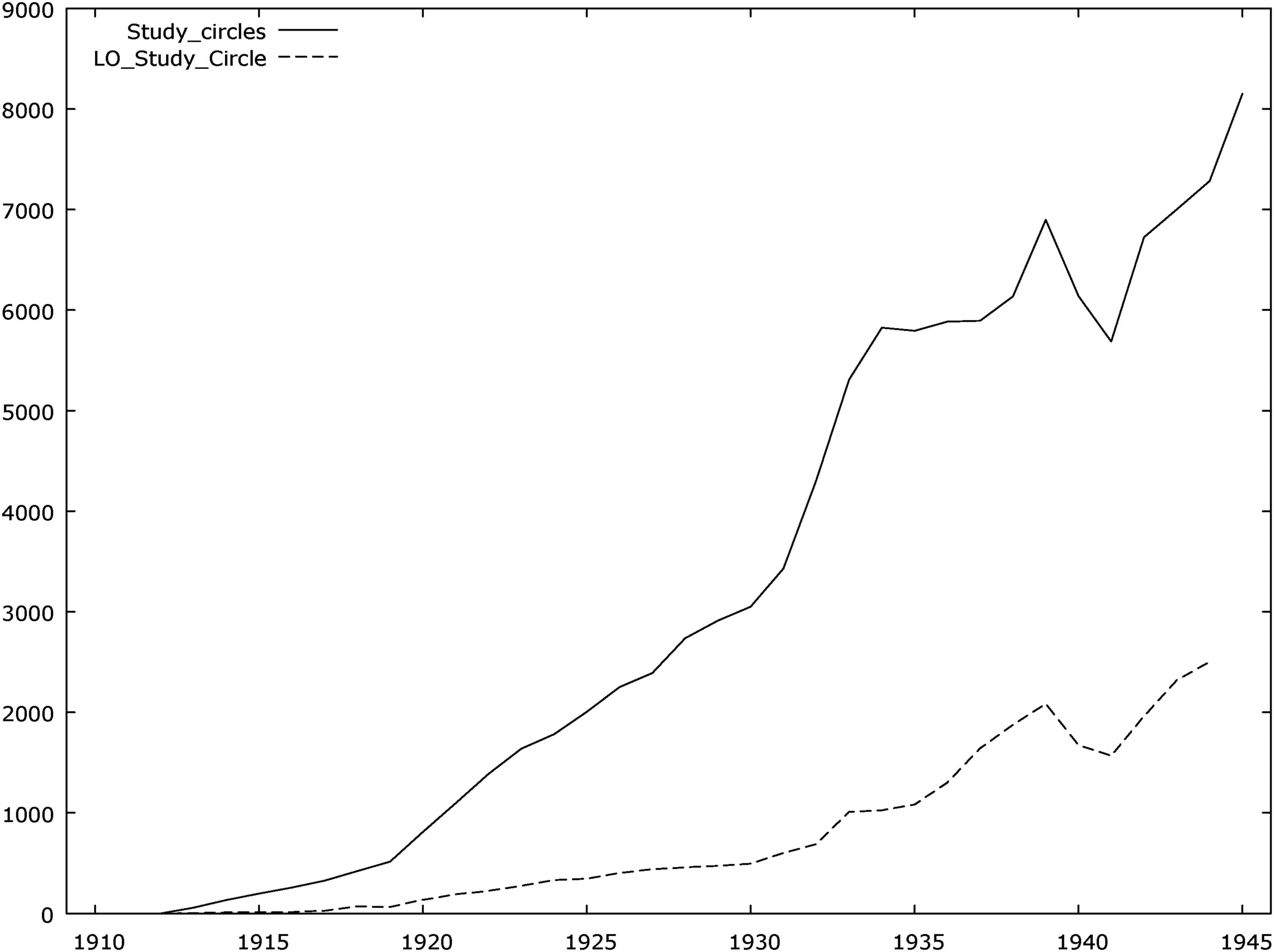
Number of ABF study circles, 1912–1945. Note: The black line indicates all ABF study circles regardless of what organization arranged them. The dashed line indicates the number of study circles organized by LO sections within the ABF. Source: ABF annual reports.
Examining who organized ABF study circles indicates whether the reformist organizations’ seizure of control over ABF led to greater study activity among LO members. Figure 2 shows the number of study circles arranged by the main ABF member organizations. The data indicate a clear pattern: the reformist organizations (i.e. the LO, Social Democratic Party, and Social Democratic Youth League) dominated the ABF study activities in the 1920s and 1930s. Not only did the reformist organizations arrange most of the ABF study activities, but they also increased their overall share over time.
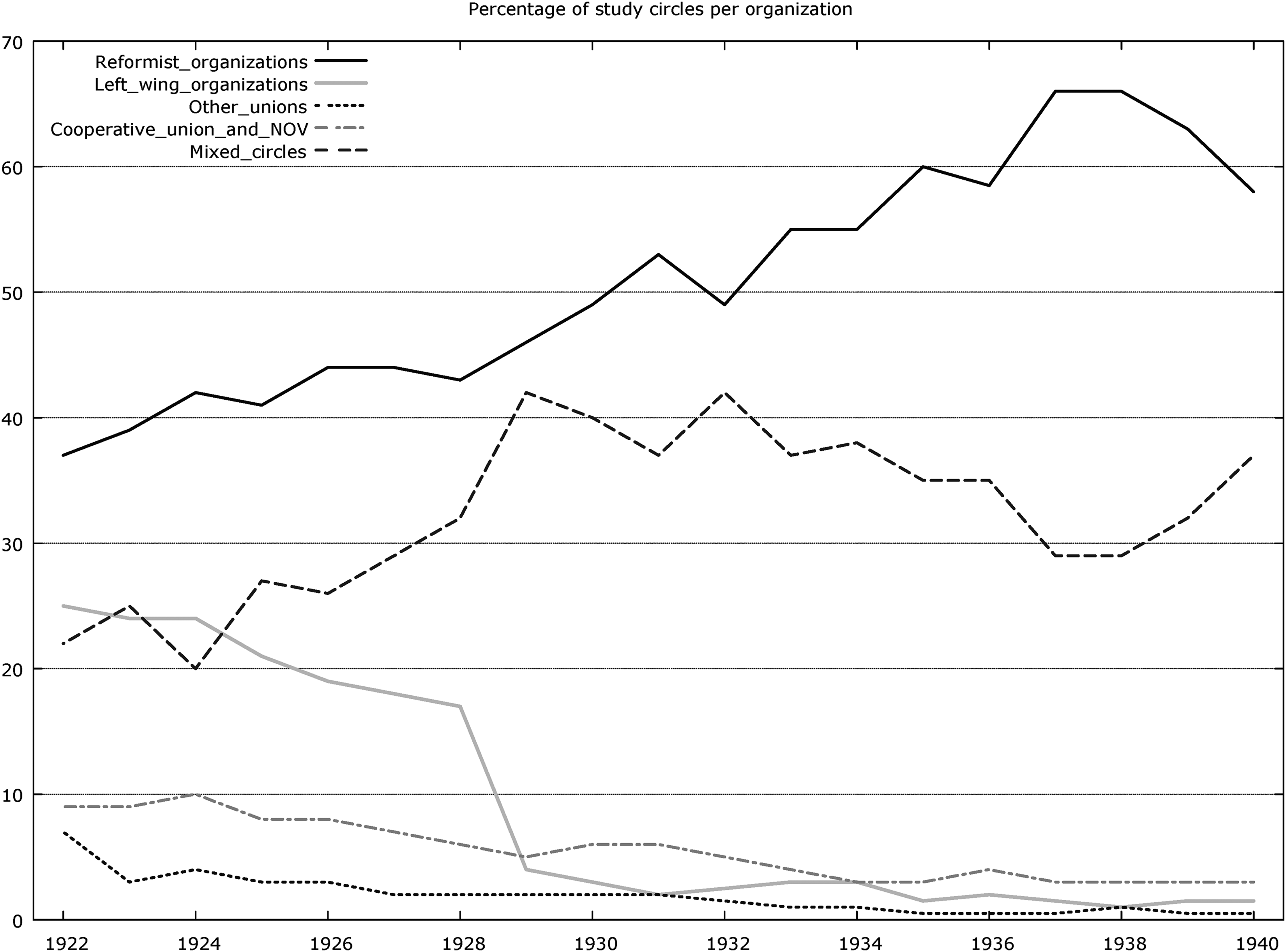
Number of study circles offered by the main member organizations of the ABF. Note: The various organizations have been sorted into categories: ‘Reformist organizations’ are the LO, Social Democratic Party, Social Democratic Youth League, and Young Eagles (a Social Democratic organization for children founded in 1930); ‘Left-wing organizations’ are the SAC, Communist Party of Sweden, Communist Youth Organization, and Swedish Young Socialist Party; ‘Other unions’ are unions not belonging to LO; Cooperative Union and NOV (Temperance Organization Verdandi) have been aggregated because these organizations were neither political parties nor labour-market organizations. Source: ABF annual reports, 1922–1940.
The increase in the number of study circles suggests that the efforts of the Secretariat to engage workers in study activities worked; indeed, the reformist organizations dominated ABF. However, simply increasing the number of study circles was not enough for the education strategy to have an impact. For the study circles to work as vehicles of identity formation, it was important that the study circle participants actually studied the ‘right’ subjects, that is, those that conveyed information about the union movement (e.g. solely studying literature would have little effect on class consciousness; see Jansson, 2016). Figure 3 presents the study circles arranged by LO in the 1920s and 1930s, sorted by the subject of study. As the graph indicates, study circle courses conveying reformist messages, such as Trade Union Studies and Labour Movement History, became the most popular study circle subjects over time.
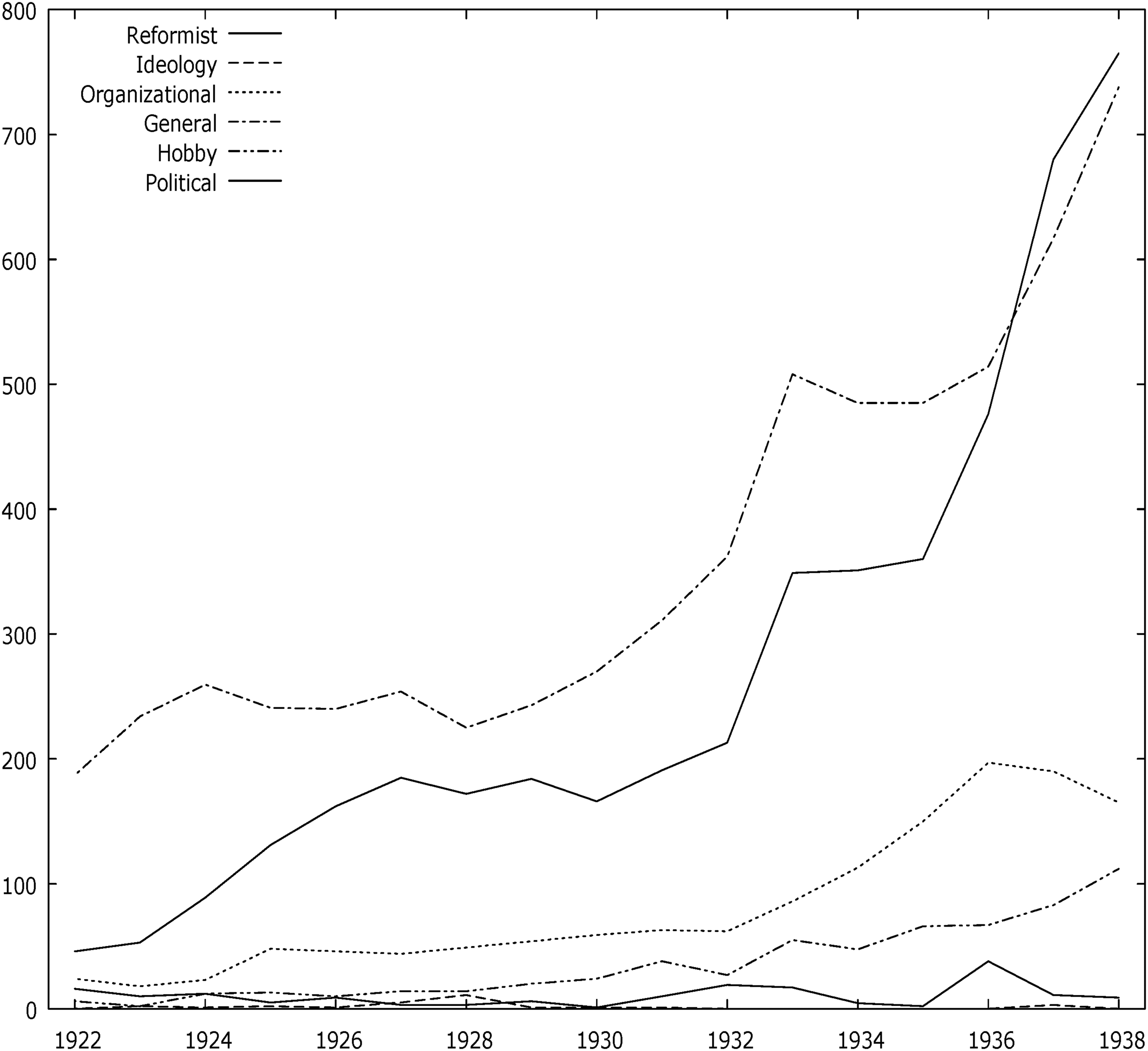
Study circles offered by LO affiliates by subject, 1922–1938. Note: The graph shows all study circles offered by LO affiliates’ sections as reported to the ABF. The circles are sorted by subject. Reformist circles consisted of courses on: association/organization/trade union studies, the history of the Swedish working class, industrial democracy, the labour movement, labour movement history, socialism and the trade union movement. Organizational circles consisted of courses on: book-keeping, cooperation, meeting culture and rhetoric. Ideological circles consisted of courses on: communism and syndicalism. General circles consisted of courses on: biology, English, Esperanto, fiction, geography, German, governmental and municipal studies, history, literary history, macroeconomics, mathematics, philosophy and religion, sociology, stenography and Swedish. Hobby circles consisted of courses on: amateur theatre, astronomy, botany, construction techniques, design, electronic techniques, food studies, gardening, gymnastics, singing and music, and women’s and men’s handicrafts. Circles on current political issues consisted of courses on: socialization, current Swedish working life, legislation on workplace safety, current legislation and current social issues. Because of the lack of data for 1934, I have used a mean for that year. The subjects for which values are missing are: labour movement history, rhetoric, macroeconomics, sociology, women’s handicrafts, amateur theatre, electronic techniques and gymnastics. Source: All figures come from ABF annual reports, 1922–1938.
From agitation to education
The quoted statement from the 1921 annual report proclaimed that agitation was to be directed inwards instead of towards unorganized groups and SAC members: recruiting new members was subordinated to caring for those LO already had. If the union leaders were actively and strategically trying to manage identity formation, the agitation efforts should mirror this change.
The main methods used to diffuse the ideas of the labour movement in the late nineteenth century had been agitation and newspapers (Gröning, 1988:72–80). In the 1920s, these two means were still important but some changes are detectable. The first was that the members of the Secretariat began travelling the country to give lectures. The LO leaders had always to some degree travelled to recruit new members, but these efforts intensified and the Secretariat was more than before involved in study activities when meeting members and potential members. Having LO leaders give talks in person at meetings had symbolic value, as it showed that the top level of the organization genuinely cared about the grassroots. Of course, this commitment also enabled the Secretariat to control what was said at such meetings. However, the most profound change was the hiring of full-time organizing commissioners who were posted in regions where the Secretariat deemed extra support necessary for the local sections. The northern Swedish provinces where the forest and mining industries were strong were prioritized because of the strong presence of SAC and the Left Party (later named the Communist Party of Sweden) (Horgby, 2012: 42, 48; Eriksson, 1991: 338–348). The commissioners provided a new channel for direct contacts between the grassroots and LO. They sent regular reports to the Secretariat about their work and the developments in the regions. Particular attention was paid to the left-wing organizations’ activities. The aim was to prevent communists from infiltrating the LO unions and to stop the sections from supporting the communists and syndicalists. The commissioners were also assigned to prevent the syndicalists from forming local sections. The reports from the agitators testify to a race between SAC and LO to organize the workers in northern Sweden (Thorberg, 1924; Sätterberg, 1928, 1932a, 1932b).
Comparison of study activities in different regions in Sweden confirms the Secretariat’s apprehension that some regions required more resources and measures for active identity formation. In the northern Swedish region of Norrbotten where communist and syndicalist organizations were strong, 27% of all study circles arranged in 1927–1928 contained studies of communism and syndicalism, while only 7% of the circles arranged in the region had reformist content (the rest treated general subjects such as literature and languages). In Malmö and Lund, two southern Swedish cities where the reformist labour movement had strong support, the corresponding figures were 31% reformist content and only a single study circle on communism. However, examining regional change over time indicates a change in line with the organizing efforts of the Secretariat: ten years later, the number of circles treating reformist content had increased tremendously in Norrbotten but decreased in Skåne, the reformist circles in Skåne having been replaced with hobby circles. Although causation is difficult to prove, one interpretation of the development is that the agitation in Norrbotten had paid off and that workers in Skåne were already well-behaved reformists in the 1920s. They had attended study circles in Trade Union Studies in the 1920s, and for the union movement to maintain interest in education among these workers, circles treating hobbies such as amateur theatre and music were offered (Jansson, 2020: 135–140).
Identity entrepreneurs and study activities: Conclusions
Did Swedish labour leaders strategically manage the identity formation process in the trade union movement during the interwar period? This analysis of the LO leaders’ attempts to address the problems that came with the increased fragmentation and radicalization of the Swedish working class indicates that the LO leaders indeed attempted to teach LO members about the goals and values of the labour movement. After failed attempts to forbid affiliates and individual members from cooperating with syndicalists and communists, LO abandoned such ‘stick’ strategies and turned to soft steering methods to impose and uphold discipline in the organization. The study activities were free and voluntary, organized from below by activists who wanted to learn about the trade union movement. Choosing internal education as a means to raise membership awareness gave LO access to the whole network of local associations affiliated with the labour movement: trade unions, party organizations, youth wings, cooperatives, and temperance organizations. Workers’ education had gained a social brokering function, and since this education was already integral to working class culture, controlling ABF gave the Secretariat a channel of direct communication with the working class.
In analysing the actions of LO, this study has presented a number of indicators that the LO leaders indeed acted as identity entrepreneurs. Any one of these indicators alone is not enough to draw conclusions about identity entrepreneurship, but adding them together – controlling ABF, study leader education, hiring agitation commissioners, etc. – provides a more comprehensive picture that allows such conclusions. Little indicates that the LO leaders were game theory strategic in the sense that they had a master plan from the start; rather, they realized that identity formation could not be left to develop on its own, but needed to be managed, and they acted accordingly. Thus, they did think about identity in strategic terms.
This result is not the only explanation as to why Swedish social democracy became so successful, but it is an important aspect that has been overlooked and the related conclusions go beyond the case of Sweden. Cohesiveness and strong identities in movements do not just appear out of thin air; rather, strong organizational identity is often the product of hard work. Connecting identity entrepreneurship to internal education, moreover, adds another important aspect to our understanding of class formation. Workers’ education existed in most countries during the first decades of the twentieth century, so labour leaders all over Europe had the same means at their disposal as did the Swedish leaders. To what degree workers’ education was controlled by labour leaders and how it was organized have yet to be empirically explored from a cross-national perspective. From a theoretical perspective, however, this study indicates that identity entrepreneurship and the strategic use of workers’ education (or lack thereof) have the potential to advance our understanding of why labour movements came to develop differently in terms of cohesiveness and strength. Identity entrepreneurship also brings a much-needed actor focus to the class formation literature.
Identity entrepreneurship through internal education is not limited to the early labour movement. On the contrary, educational settings can contribute to identity formation in any organization or movement, because internal education offers a good opportunity to define the organization, discuss ideological issues, and foster and discipline members. This requires that leaders think strategically about study activities. Study activities’ socializing effects should therefore be on the research agenda of social movement scholars. The circumstances under which study activities contribute to identity formation and whether movement leaders strategically use internal education are important research questions that, if addressed, could advance our knowledge of identity formation in movements.
Jenny Jansson obtained a PhD from Uppsala University in 2012. She is currently an associate professor in political science at the Department of Government, Uppsala University. Her research focus on trade union mobilization, digitalization, industrial action and minimum wages.
