




Abstract
Even though recruiters’ practise of searching for information online during recruitment and selection has been a contested practise, owing to the risk of discrimination and privacy intrusions as well as poor evidence for its ability to predict work performance, it is used in recruitment. In this article, our aim is to understand how ‘professional talk’ is used as a discursive resource to legitimize contested practises such as the practise of cybervetting by recruiters. The study is based on interviews with 37 recruiters in Sweden, all of whom had experience of cybervetting jobseekers. We found that professional talk was linked to objectivity and being unemotional, having knowledge about recruitment methods and the ability to distinguish between relevant and irrelevant information. In relation to the theory on professional talk, our study contributes with empirical evidence for the normative function of professional talk. Using cybervetting, as a case of legitimizing controversial practises, we provide a theoretical contribution to the theory on professional talk by illustrating how professional talk not only fills a disciplinary function by restraining a practise but also by enabling, legitimizing and providing discursive frames for how it can be performed.
Introduction
Cybervetting, also labelled ‘profiling’ (McDonald and Thompson, 2016), has been reported to be increasingly popular during recruitment and selection processes. By ‘cybervetting’, we refer to the practise of searching for information online; that is, on social media, news media and search engines (Berkelaar, 2014; Hedenus and Backman, 2017). Cybervetting is a contested practise. It is believed to provide recruiters with tools to find, evaluate and (de)select new personnel, but at the same time it is connected to privacy intrusions, increased risk of discrimination and biased selection decisions (e.g. Elzweig and Peeples, 2009; Jeske and Shultz, 2016; Zibulka-Horwath, 2019). Besides the risks of discrimination and privacy intrusion, cybervetting has low criterion-related validity (Van Iddekinge et al., 2016). In addition, cybervetting is generally not accepted by jobseekers, although some express understanding for employers’ use of it (Hurrell et al., 2017; Jacobson and Gruzd, 2020; Miller and Mundey, 2015; Stoughton et al., 2015), and it raises ethical dilemmas for some employers, human resource (HR) staff and managers (Backman and Hedenus, 2019).
Studying the use of cybervetting by employers, HR staff and managers, one of our interests concerned how they motivate this practise and how they navigate in relation to the potential risks and problems associated with it. As we discovered, the interviewees often refer to their own professionalism to justify cybervetting. But what does it mean to act in a professional way or act professionally? Why did the employers, HR staff and hiring managers that we interviewed for this study connect cybervetting to professional talk?
Sociologists have studied the characteristics of occupational groups considered to ‘be’ professions, as well as occupational groups striving for professional status (Evetts, 2003; Watson, 2002a) but less is known about what people achieve by claiming to act professionally, regardless of whether they are considered to have the status of professionals. Words such as ‘professionalism’ and ‘professional’ are in everyday use and have meanings that go beyond those intended by occupational groups striving for professional status. Watson (2002a: 94) argues that owing to the everyday use of phrases such as ‘being professional’, we ought to study ‘professional talk’ to account for actions, making sense of the social world and as a rhetorical device, rather than as a specific analytical concept that describes certain occupations. In this article, our aim is to understand how professional talk is used as a discursive resource to legitimize contested practises. We do that by exploring how professional talk was used in relation to the contested practise of cybervetting by employers, HR-staff and hiring managers—from here on referred to as ‘recruiters’ because they were interviewed in their capacity of selectors of new employees.
Cybervetting
Although cybervetting is usually considered to refer to publicly available information, it may also refer to information from social media, such as Facebook, that may not be publicly available but is nevertheless accessible to employers. For example, the employers may send a ‘friend’ request to the jobseeker (Berkelaar, 2014: 14) or ask a mutual friend in the social media network to show them the account (Backman and Hedenus, 2019). The number of employers who cybervet remains uncertain, as is the extent to which the frequency of the practise varies between sectors and countries. However, although the methods are rarely reported, several surveys conducted by private organizations indicate that a substantial number of employers cybervet (Careerbuilder, 2008; Stockholm Chamber of Commerce, 2017, 2018; YouGov, 2017). In the US, cybervetting is presented—by both employers and jobseekers—as such a self-evident part of personnel selection that Berkelaar (2014) suggests that a new ‘digital social contract’ has taken shape. According to Berkelaar (2014: 498) we should understand this digital social contract as expanding the role of employees beyond working hours due to ‘normative expectations for workers’ digital visibility in exchange for employability’. Jobseekers and employees thereby must regulate their self-presentations online to pass as employable (see also Backman and Hedenus, 2019).
Research on cybervetting has studied whether it aids employers to predict jobseekers’ personality types (Back et al., 2010; Kluemper et al., 2012; van de Ven et al., 2017) and future work performance (Van Iddekinge et al., 2016). The research results concerning cybervetting and its use to predict personality types or future job performance are not favourable. Kluemper et al. (2012) have found that it is possible to predict personality type by reading a person's Facebook profile for five to ten minutes. However, for these results to be valid in a real-world setting, one must have access to a full Facebook profile and the owner must have posted a substantial amount of information on the page. The most reliable study so far is one by Van Iddekinge et al. (2016). In contrast to other studies on the ability to predict work performance or personality, it is based on actual recruiters evaluating authentic jobseekers’ profiles. Their results show that cybervetting does not improve employers’ ability to predict job performance or turn-over.
Overall, from current research on cybervetting and future job predictions, the method does not improve predictions about jobseekers’ future job performance or whether they will remain in the organization (Roth et al., 2016). In other words, cybervetting during the selection process may not provide the organization with more skilful or loyal employees.
As mentioned in the introduction, cybervetting has been questioned and criticized from both legal and ethical perspectives. The main criticism relates to the risks of privacy intrusion, basing hiring decisions on false information and illegal discrimination (e.g. Elzweig and Peeples, 2009; Jeske and Shultz, 2016; Zibulka-Horwath, 2019; Zibulka-Horwath and Psy, 2018). For instance, findings from the above-mentioned study by Van Iddekinge et al. (2016), show that female and white candidates were evaluated more positively than male and black candidates. In an experimental study using fake profiles on social media, Acquisti and Fong (2020) found that cybervetting employers in US areas with higher proportions of Republican voters were less likely to call back Muslim candidates compared with Christian candidates. Without the applicant's knowledge, recruiters may also come across information on, for instance, applicants’ sexual orientation, although this may not necessarily involve a discriminating hiring decision (see for example Acquisti and Fong, 2020; Hedenus and Backman, 2020). Moreover, cybervetting may give recruiters access to information about the characteristics of applicants that are not protected by discrimination law but often result in oppression or disadvantages. The risk of unequal treatment is, in relation to cybervetting, especially salient for diversity strands that are not visible in applications, e.g. obesity, and in personal meetings, e.g. sexuality. Cybervetting has also been criticized for shifting the power balance between employers and employees (Berkelaar, 2014), involving forced disclosure of personal information, and for excessively intrusive surveillance of employees and jobseekers (Holland and Bardoel, 2016).
In this article, we argue that through professional talk it is possible to account for cybervetting and present it as a legitimate practise for recruiters. However, it should be noted that professional talk is only one way to account for cybervetting. Recruiters provide a vast number of reasons to justify cybervetting (as well as other methods used in the process). Recruiters in the US have been found to cybervet to learn as much as possible about jobseekers, evaluate their ‘professionalism’ and whether they appear (un)professional online, avoid making biased hiring decisions, protect organizations’ reputations, be efficient and satisfy curiosity (Berkelaar, 2014; Berkelaar et al., 2015; Berkelaar and Buzzanell, 2014). They do it because it is fun, because it is possible and it is part of the future. We have previously analysed accounts used by recruiters (Hedenus and Backman, 2018) and shown that the accounts can be divided into three categories, as displayed in Table 1.
The three categories of account for cybervetting.
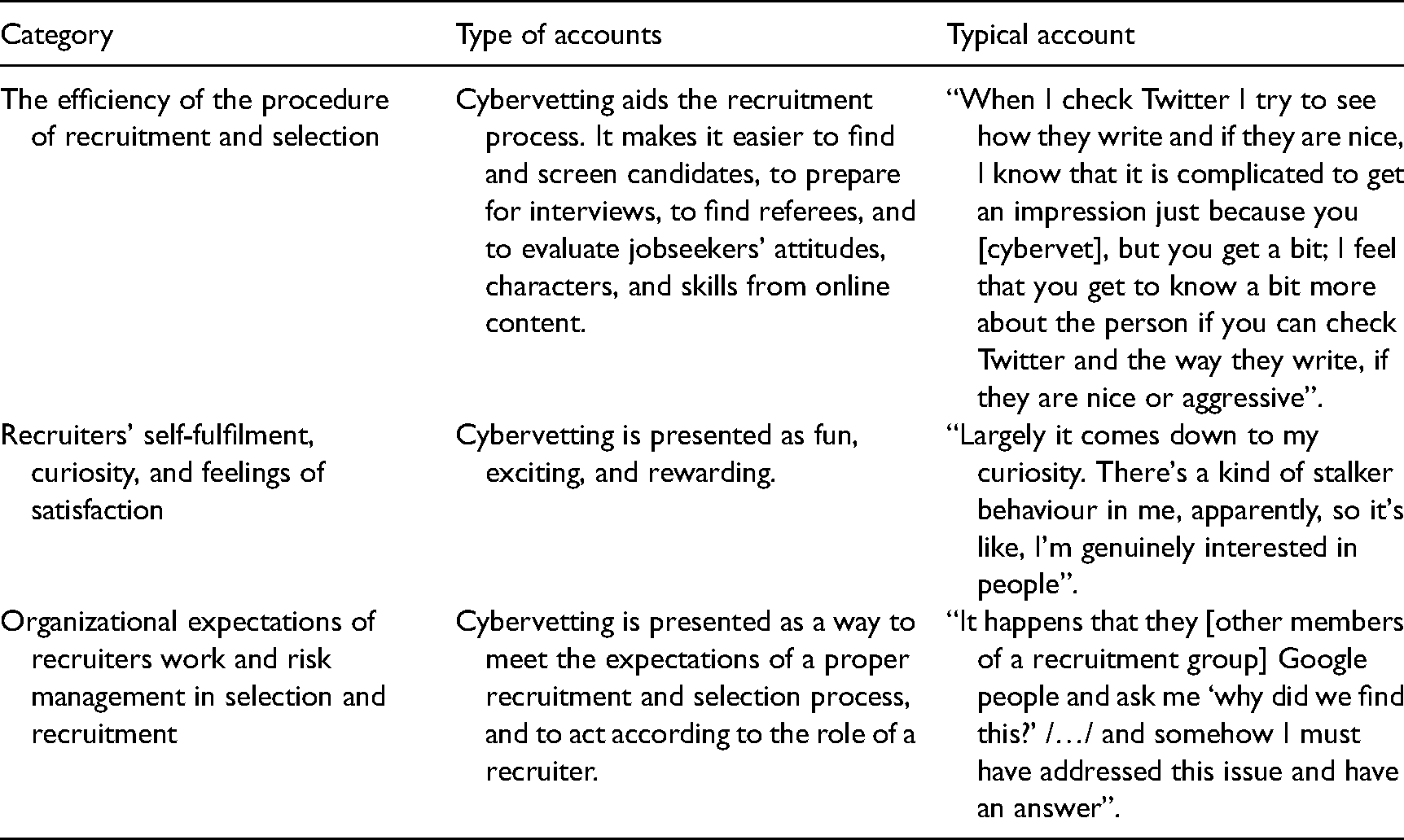
First, there are accounts that relate to the procedure of recruitment and selection; that is, cybervetting is done to make the process more efficient and improve the results. Second, cybervetting can be explained in relation to feelings of self-fulfilment; that is, it is done out of curiosity, and because it is fun, thrilling and satisfying. Third, explanations can be related to role performance and to fulfilment of others’ expectations concerning what recruiters should do and know to do a good job and avoid unnecessary risk to the organization.
Professionalism and human resources
The sociology of professions is often described as moving from a functionalistic and normative understanding of professions—whereby occupations are examined to determine whether they fulfil the requirements of professions—to a more critical approach focusing on the motives and improvements of professions along with their strategies to maintain their privileges (Barley et al., 2016; Evetts, 2003; Watson, 2002b). Over time, the sociological study of professions and professionalism has evolved from the close study of small groups of occupations that meet the criteria of professions to studies of a wide variety of occupations such as semi-professions, new professions and groups with ambitions to be recognized as professionals, as well as studies of the discourses around professions (Barley et al., 2016; Fournier, 1999; Oldenhof et al., 2016; Watson, 2002a).
Human resources is among the occupational fields that have been studied as a job performed by a group of people with ambitions to become recognized as professionals. For example, Gilmore and Williams (2007) have studied how the British occupational organization for people working in the HR sector has strived to gain professional status. Likewise, Pohler and Willness (2014) have studied Canadian HR associations and their professionalization activities. Both studies conclude that the organizations have been successful in gaining some of the attributes associated with professions, such as closure, although neither conclude that the occupation of dealing with personnel can be considered to constitute a profession, mainly owing to a lack of autonomy and status vis-à-vis other occupational groups in organizations.
In addition to studies on the professionalization of HR, others have studied the extent to which people working in HR identify themselves as professionals and how the idea of being professional impacts their work identity (Pritchard and Symon, 2011; Watson, 2002b; Wright, 2008). Pritchard and Symon (2011) have studied junior HR staff and find that they are engaged in identity work to prove their professional status in relation to other more senior HR practitioners in the organization. On the other hand, Wright (2008) has studied senior HR staff and finds that they do not identify themselves as professionals. Hence, it could be that a professional identity is more important for HR practitioners in positions with lower status in the organization than that held by those who achieve higher status. However, the difference in results may also be related to age or to more context-specific circumstances in the two cases, and no certain conclusions can be drawn except that HR staff do not seem to have a strong identity as professionals.
In this article, we take no stand on whether HR staff should be regarded as professionals by one definition or another; nor do we consider whether they identify as professionals. The questions of whether certain occupations constitute professions and where to draw the line between those occupations and non-professions are still debated in the sociology of professions. While some establish clear standards, others argue for a more pragmatic approach. For instance, Evetts (2003) argues that there is no hard definitional line to be drawn, while Freidson (1994) advocates for a phenomenological understanding whereby people ‘accomplish’ professions through their activities and claim that status in interaction with other members of society. What interests us in this article is how the recruiters, whether they are HR staff or managers, use professional talk during interviews to make the contested practise of cybervetting legitimate.
Professional talk
The words ‘professionalism’ and ‘professional’ are legion in current culture and are used in reference to far more occupations than those traditionally distinguished as ‘professions’ in the sociology of professions. Fournier (1999) points to an inflation in the use of the term and how occupational practitioners are labelled ‘professionals’ or ‘providers of professional services’. There are several explanations for occupational groups or individual practitioners seeking to position themselves as professionals. For example, people may be attracted by the autonomy in decision making and the status ascribed to professionals, which is generally also associated with higher pay (Evetts, 2013; Watson, 2002b). Watson (2002a) argues that the use of ‘profession’ as an analytical concept risks creating confusion because a very particular meaning is ascribed to a concept that has an everyday use. Rather than thinking about professions and professionalization as sociological descriptions of certain groups or the results of a process of closure and jurisdiction over knowledge by expert groups, Watson (2002a) argues that we need to study professional talk as a discursive resource. Discourse is understood to be a resource that is available to interviewees and can be used to achieve certain objectives (Barley et al., 2016; Cheney and Lee Ashcraft, 2007; Kuhn, 2009; Oldenhof et al., 2016; Watson, 2002a, 2002b). Evetts (2013: 786) describes the discourse of professionalism as a ‘powerful ideology’ that either operates ‘from within’ (occupational professionalism), i.e. is used by occupational groups to achieve status and autonomy, or ‘from above’ (organizational professionalism) where it is used to discipline employees to behave professionally regardless of the presence of supervisors. Although discourse disciplines and limits the ways in which one can talk about professionalism, it is also flexible and it contains many different repertoires that can be combined (see also Lammers and Garcia, 2009). Moreover, discourses can be used as justifications and accounts, and thereby not only limiting but, on the contrary, enabling certain actions. One can choose when and how to use different repertoires to position oneself in a preferred way and to seek desired outcomes (Jørgensen and Phillips, 2002; Potter and Wetherell, 1987).
We agree with Evetts (2013) that contextual factors influence the use of the discourse, the repertoires available and how they are used. The main issue for us in this article is, however, not the Foucauldian macro perspective on what is achieved by organizations or occupations using discourses of professionalism that merits Evetts’ analysis. Our interest is why is it appealing to position oneself as professional in a conversation, in particular in a research interview on cybervetting? What functions does professional talk fill in interactions, and what do these functions imply for the use of cybervetting? By using a discursive approach to professional talk, it is possible to analyse the positions that professional talk enables, the actions it can account for and any dilemmas that professional talk raises.
Previous studies on professional talk have shown that it is linked to talk about being good at a job, which in turn is linked to practical experience rather than to education (Barley et al., 2016; Fournier, 1999; Oldenhof et al., 2016; Watson, 1977, 2002b). To our knowledge, Watson's (1977, 2002b) studies on professional talk among people working in HR are the only ones on professional talk in human resource management (HRM). Others, such as Barley et al. (2016) studied technicians’ professional talk, and Fournier (1999) wrote a seminal article on the vocabulary of professionalism in an organization in the service industry. The normative and potentially disciplinary effect of professional talk is most obvious in interactions between managers and team members in the study by Oldenhof et al. (2016). Here, being professional is connected to the ways team members should dress, speak and behave in their interaction with co-workers and clients, as well as to expectations for them to reflect upon their behaviour and values (see also Fournier, 1999). Although they did not analyse cybervetting in terms of professional talk, Berkelaar and Buzzanell (2014), found that some of the HR workers interviewed said that they refrained from the practise because it was not in line with recruitment theories and standards. At the same time, other recruiters used recruitment theories and norms to frame cybervetting as a professional activity that provided them with tools to do a better job. In summary, we have some knowledge of how professional talk is used and what it is used to achieve. However, we still lack knowledge of how professional talk is used to account for contested practises in general, and in particular, as in Berkelaar and Buzzanell’s (2014) study, how ‘professional’ theories about recruitment can be used both to legitimize cybervetting and to avoid it.
Methods and material
The subject of how recruiters used cybervetting—how they searched for and evaluated information and the consequences of this for organizations and jobseekers had rarely been studied when we started our project. Owing to the explorative character of the study, and to learn about their sense making around cybervetting, we chose to use a qualitative approach and to interview cybervetting recruiters who hire new staff for organizations.
We approached potential HR-educated interviewees by advertising the study while giving talks on a different HR-relevant subject (criminal background checks), and by sending information to alumni from HR programmes in Sweden and to members of HR organizations. We also wanted to attract hiring managers and employers who did not necessarily identify themselves as working in HR and so were not taking part in talks organized by HR organizations. Therefore, we sent information about the study to all organizations that advertised job openings on the national employment office's webpage during the period February–May 2015, and to all hiring managers in one municipality of Sweden. We also added an invitation to participate on the webpage of the research project. In total, we interviewed 37 people, 21 women and 16 men, working as HR managers, recruiters, employees and hiring managers, all of whom had experience of cybervetting jobseekers at some point during the recruitment process.
The interviews were semi-structured and involved questions on their use of cybervetting (how often, how they proceeded, what occupations and positions it was for, etc.), how they evaluated search results, examples of search results that had a positive or a negative impact on their evaluation of the candidate, the positive and negative aspects of cybervetting, ethical considerations, whether the organizations had a policy on cybervetting and if not, whether they wanted one. We did not ask about their professional appearance, identities, status or ambitions. The interviews lasted between 45 and 90 min and were transcribed verbatim. The interviews were conducted and transcribed in Swedish. The quotes used in this paper have been translated into English by the authors.
Our analytical approach can be described as abductive in the sense that we moved back and forth between the empirical material and theory (cf. Tavory and Timmermans, 2014), and was based on discourse psychology once we became interested in the use of professional talk in our interviews (Edwards and Potter, 2001; Tuffin and Howard, 2001). In the initial inductive process of coding, we noticed the use of variations of the word ‘professional’ and were puzzled by the use of such wordings despite no further reference to a professional organization or identity. Because it was not part of our initial research aim, we wrote memos about the use of different phrases relating to the use of ‘professionalism’ but we did not, at that point, pursue coding and analysis of these instances. At a later stage of the project, we returned to the memos on profession and started to look for previous studies on the use of the concept of profession by ‘non-professionals’ without focusing on professionalization processes. As we outlined above, we found work on professional talk, in particular by Watson (2002a, 2002b), that inspired us to go back to our material to conduct a theory-driven coding process where we searched for every occasion when the word ‘profession’ or a variation of ‘profess*’ was used to gain as much material as possible from our transcripts. We extracted these occasions and coded them based on constant comparisons, i.e. each new extract was compared with previously analysed extracts (Tuffin and Howard, 2001). If the extract resembled another extract, they were placed in the same category. If the current extract was unique, a new category was created to label the extract. Based on theories on discourse psychology in general, and professional talk in particular, we paid particular attention to how the interviewees positioned themselves and others when they used professional talk, what the interviewees tried to accomplish by using professional talk during these parts of the interview and whether the use of professional talk gave rise to any dilemmas (Edely, 2001; Potter and Wetherell, 1987). In this process, we for example found the position of the gatekeeper, which inspired us to connect to Lewin’s (1947) writings on gatekeepers. We also found three ways of using professional talk to legitimize cybervetting, and one particular dilemma regarding feelings of loyalty towards both their employer and their professional standards and ethics of trained HR staff.
Analysis
Legitimizing cybervetting through professional talk
In this section, we show how the interviewees used professional talk to position themselves as professionals. We show how professional talk was related to acting objectively and to disregarding personal feelings, having specific knowledge and being able to distinguish between relevant and irrelevant—that is, private and/or information covered by the Discrimination Act—information found during cybervetting. Thereby, the interviewees’ professional talk helped legitimize their use of cybervetting.
Professional talk about not acting upon feelings
Professional talk was linked to an ability to not act upon feelings of liking or disliking a candidate, and a professional position was achieved by contrasting HR recruiters with hiring managers who according to the recruiters tend to make decisions based on how they feel about candidates. One HR manager stated that HR staff even ‘make jokes’ about managers’ tendency to make decisions based on feelings: HR can, like, sometimes make jokes about those we work for. So they [managers] say, like, ‘oh, that was a good guy!’ or ‘that was a good girl’. [deep sigh] Okay, what does that mean? Well, often it just means that it's someone who is just like you, and if you have a good relationship with the manager and [if you] are professional than you tell [the manager] ‘yes but’. Then you say ‘you know what, you were so alike, and you only talked about golf, the entire interview! That actually doesn't mean that this person was a good person, or that it is someone we should hire. It only means that you have things in common’. (HR manager no. 14)
The HR manager positions recruiters (‘we’) as a group who do things differently to other members of the organization (‘they’). Recruiters who act professionally do not hire people based on common interests. To act professionally is also connected to the ability to question a hiring manager who does not understand that he or she makes decisions based on feelings and common interests with the candidate, which further highlights the difference between skilled professionals and hiring managers.
Professional talk about knowledge of formal theories and model
The position of someone who has the ability to not act upon feelings was also achieved by referring to knowledge about recruitment theories and models that the university HR programmes provide. In the next quote, the HR manager distinguished between educated HR staff and hiring managers and talked about the risk that occurs when managers compare themselves to ‘professional’ recruiters and believe that they can use the same methods. Although he acknowledged the risks of discrimination associated with cybervetting, and the lack of scientific knowledge of its effect and accuracy as an evaluation instrument, he talked about it as the primary risk when unqualified managers make hiring decisions. I can see the risk [of cybervetting] that you are affected by the person as such and not by relevant matters. And as a [municipality] we should not recruit like that. I myself think that I’m fairly aware of the risk but I am also trained in HR and have recruitment [as my job]. If you think about most people who recruit, they are managers and they don't have that background. I meet a lot of people who make hiring decisions based on their gut feelings. And of course, if you have searched [online], it has affected your gut feeling /…/ And [hiring managers] can hear professional recruiters talk about gut feelings; it makes the ones who only do it [recruitment] on the side [think] ‘well, I agree because that's how I think too; you feel in your gut if it's right’ /…/ I like to think that I remain scep[tical], partly because I do it all the time, recruitment, so all the time I have to challenge myself to try to have an open mind and then also, because I know what is proven by science (HR manager no. 18)
The HR manager portrayed university HR courses as teaching recruiters a scientific approach to recruitment. The emphasis on education and knowledge resembles strategies identified as important to both professions and professionalization (cf. Freidson, 1988; Wilensky, 1964). It is by reference to specific knowledge and abilities that the HR manager is positioned as professional and different from other (non-professional) members of the organization involved in recruitment and selection. By making this distinction between himself and managers without training in and knowledge of recruitment methods, the HR manager thereby legitimized his use of cybervetting. Moreover, by referring to the general knowledge of recruitment models and the ability to make objective, discretionary decisions, the formal education of an HR professional makes it possible to account for cybervetting despite the lack of scientific support for the method. Although cybervetting appears unprofessional owing to this lack of scientific support, it might be the contested nature of cybervetting that causes recruiters to cite a wider sense of professionalism to justify and make sense of the practise.
Professional talk about acting professionally
Professional talk is, however, not merely associated with formal education and knowledge but also used in relation to concrete activities and decisions and referred to as acting professional. The contested status of cybervetting has caused some organizations to ban cybervetting from recruitment processes altogether, as search results may include fake news sites and anonymous forums that make it difficult to evaluate the validity of the information. In the quote below from an interview with a hiring manager, the interviewer asked what it would be like if her organization were to ban cybervetting. Although the hiring manager stated, ‘well, it would not be a catastrophe’, she described such policy as ‘unnecessary’: I think that they [the management banning cybervetting] wouldn't think very highly of their managers because it's often managers who hire, or HR divisions if it's HR divisions that recruit. They are wise, sensible people who actually can see this [cybervetting] for what it is and can act professionally. And I think that would be a pity, if one would not, as a manager, have the option to choose from case to case, if you want to [do it]. (Hiring manager no. 23)
In contrast to the HR manager quoted previously, this interviewee does not base her notion of professionalism on formal education and theoretical knowledge about recruitment. In her view, hiring managers are capable of acting professionally during the recruitment process, just like HR staff. Therefore, hiring managers—at least those who act professionally—should also be allowed to use cybervetting, despite its contested status, and should not be prevented from using it by the organization. It is not spelled out what ‘acting professionally’ really means. Yet, the claim that it involves ‘wise, sensible people’ who can assess cybervetting ‘for what it is’ implies an understanding of professional behaviour as being judicious and able to stay critical. Her shift to the pronoun ‘one’ in the last sentence may further be seen as an attempt to present this notion as a general norm, rather than her own opinion, on how hiring managers should be allowed to act according to their professionalism. The talk of acting professional corroborates previous studies on professional talk highlighting the importance of being good at a job and have practical experience (e.g. Barley et al., 2016; Oldenhof et al., 2016).
When professional talk is used as demonstrated, it implies that a person who is capable of acting professionally should also be allowed autonomy and discretionary powers. Such reasoning was connected not only to the question of whether cybervetting should be allowed but also to how it could be used and how much autonomy professional recruiters should be allowed. Based on our knowledge, it is uncommon for organizations to ban cybervetting, but they may restrict the websites that employees can access when using the organizations’ network. In a joint interview with an HR manager (no. 4) and an HR specialist (no. 5) at a municipality, the HR manager mentioned that during a recent recruitment process he had become aware of search hits that his team could not view from work. During the interview, the HR manager positioned himself as professional and used this position to legitimize cybervetting as one of many methods used ‘to get as much information as possible’ about the candidate. For him, the organization's web filter meant that the autonomy of the recruiters was restricted. However, his subordinate, an HR specialist, positioned information from certain websites as incompatible with acting professionally towards the jobseeker and thus posing a dilemma for recruiters who came across such information. How shall we handle the information on these sites? In some ways, by blocking it, the municipality indicates that that information is not useful to any civil servant anyway. And what attitude shall you, as a recruiter, take toward the information? /…/ On these sites there are people who have a clean slate but are exp[…], well, surely are exposed as something else entirely, and I can imagine that for some people it will be very hard for me as a recruiter to ask in a professional way about the information because it's from a source that is not quite acceptable to bring up. So that it—it can be problematic to bring up information from [inaudible] but that's something that you have to make up your mind about, when it becomes an issue too: ‘what is it?’ If you read it. If you should read it at all. I don't—I don't have an answer. (HR specialist no. 5)
The HR specialist argued that certain sources are not ‘acceptable’—hence the web filter—and according to the HR specialist, it would be difficult to retain a professional position towards a jobseeker basing his decision on information from such websites. On the other hand, the HR manager cited, throughout the interview, the value of having as much information as possible and being able to judge independently whether the information was useful. The quote illustrates two contradictory positions on how to use cybervetting and how it congruences with how the professional role and the degree of autonomy are described.
The quote above thus provides an example of a tension in the professional talk around cybervetting, where the understanding of professionalism as the ability to engage autonomously with all types of information contrasts with the understanding of it as the use of only reliable and possibly only work-related websites. However, both understandings were used to legitimize cybervetting. The former made it possible to use cybervetting without restriction because of the recruiters’ professional ability to manage the information, while the latter meant that because the recruiters’ professionalism limited how cybervetting was applied, it became legitimate.
The professional gatekeeper
The ability to act professionally by distinguishing between relevant and irrelevant information, and thereby being entitled to use cybervetting, positioned the HR recruiters in what we refer to as a ‘gatekeeper’ position. A gatekeeper was originally described by Lewin (1947) as someone who managed the in- and output through ‘gates’ of various kinds, such as the ‘executives’ and ‘management’ of organizations (Lewin, 1947: 147f.). In the sociology of professions, the concept of gatekeeper was later used by Freidson (1988) to label professions’ control over resources that others, often clients, want to access. In our case, we use the concept to describe how recruiters present their control of information during the recruitment process—that is, their talk on how they decide what information about a jobseeker to pass on to other members of the organization—as part of acting professionally. In the first example below, the HR manager at a business for IT consultants, explained how she only forwarded ‘professional’ information, not ‘private’ information, to hiring managers: – Do you keep any documentation when you search? Any kind of notes? (Interviewer)
– I usually make a summary before meeting the managers during selection. And then it's one of the things I bring [to the meeting]. /…/ When I present to the managers it's more the professional [information], then I usually don't say much about what's, like, private that I’ve encountered. (HR manager no. 13)
HR specialists in large organizations often support hiring managers. However, they often do not make the final hiring decisions. The quote above is an example of how professional talk was linked to the gatekeeper role and used to distinguish between information that is forwarded to others and information that the recruiter keeps to herself, thereby limiting the information on which the hiring managers can base their decisions. By doing so, recruiters engage in boundary work, that is, they construct and reconstruct boundaries around the public–private dimension (Backman and Hedenus, 2019). As gatekeepers, recruiters position themselves as a kind of guardian of the jobseekers’ right to their private life and to be treated fairly in the recruitment process. It is professional talk about their ability to distinguish between relevant and irrelevant information, and to treat search results with discretion that allows them to position themselves as gatekeepers and guardians.
The gatekeeper position was linked to acting in a professional role, and this posed a dilemma because of the possibly conflicting expectations of acting professionally and acting as an employee. The HR manager in the quote below said that the tendency for managers to base their hiring decisions on whether they like a candidate rather than his/her qualifications made her reluctant to share information that she found through cybervetting. Because it's hard enough, I think, hard enough to set up this competency profile, and hard enough to get the managers to keep to it. Not to be carried away by ‘oh what a nice person’ /…/ It's a pretty big responsibility, I think, for HR and the HR profession to reflect on. How shall I present this information? And what if I don't tell and later it is revealed in some other way? (HR manager no. 14)
The recruiter reported her belief that it was the responsibility of the HR professional to act autonomously and make discretionary decisions on what information to present to hiring managers in the organization. At the same time, she spoke of a dilemma that relates to having two positions: one as a professional and one as an employee (cf. Watson, 2002b). The recruiter drew attention to the point that her ‘professional’ choice not to disclose information may have consequences. Perhaps this would be seen as having done a poor job or maybe even disloyalty if it became known that she had kept information from others. She considered it to be her professional responsibility to manage the dilemma by choosing wisely ‘how’ to disclose information that may prevent hiring managers from making an objective hiring decision.
Concluding discussion
Cybervetting is a contested practise that, according to Jeske and Shultz (2016, p. 543), ‘is not recommended under any circumstances at this point in time’ for recruitment and selection. Despite the questionable status, cybervetting was legal in Sweden in 2013–2015 when we conducted our study, and still is if it does not result in discrimination against jobseekers. 1 Support for the method is however still low, both from an ethical point of view as well as from the perspective of improving hiring decisions. The questionable status of search results that may appear, the difficulty in evaluating findings based on their validity, and the risk of recruiters becoming biased, despite their avowal of non-discriminatory behaviour, further call into question whether cybervetting should be used (cf. Berkelaar, 2014; Zibulka-Horwath and Psy, 2018). The ideal of meritocratic recruitment and objective selection decisions further questions cybervetting due to the risk for biased decisions and unfair treatment of minority groups (cf. Konrad et al., 2005).
How come then, that it is possible for recruiters to present cybervetting as a legitimate method despite the apparent risk that it will provide a less-objective evaluation of applicants? This has been an underlying question, founding for our aim to understand how professional work is used as a discursive resource to legitimize contested practises. In this study, we have shown how recruiters use professional talk as a discursive resource (Watson, 2002a) to position themselves as professionals and thereby legitimize the use of cybervetting. This is done by both HR staff, who are trained to manage HR matters in organizations, and hiring managers. Summarizing our analysis, we must also ask: How can cybervetting, and taking part of applicants’ private lives, be perceived as a legitimate and ethical part of the recruiters’ practise? By positioning themselves as professionals and linking ‘being professional’ to the capacity to be objective and unaffected by feelings, professional talk helped legitimize searches performed by the interviewees. It was also linked to knowledge about recruitment methods and the ability to distinguish between relevant and irrelevant information without being affected by irrelevant information. By framing cybervetting as a method conducted in a professional manner, the recruiters addressed the risks and negative aspects (e.g. for discrimination and privacy intrusion) that have made cybervetting a contested practise.
Recruiters in HR divisions used professional talk to take the position of gatekeeper. A professional gatekeeper controls information and only lets information about competency—or ‘professional’ information—reach others in the organization. By using professional talk to describe how they sift out information before making it available to managers, the recruiters emphasize their skills as professionals and the difference between themselves and the managers. In this way, the gatekeeper position helps cybervetting to be a legitimate method for HR staff.
The gatekeeper position is based upon loyalty to a professional group, which may cause a dilemma because of the recruiters’ position as employees. A normative aspect of being professional seemed to be to safeguard professional ideals and methods, so as to avoid personal information about the candidate influencing the selection process. At the same time, another normative ideal seemed to be that an employee would share everything, or at least everything important, with others involved in the recruitment process. If the HR professional adhered to the professional ideal and acted as a gatekeeper and other members in the organization learned that information had been kept from them, the HR professional would risk being seen as disloyal or perhaps as not carrying out the task properly. If on the other hand the HR professional disclosed ‘juicy’ information about the candidate, he or she failed to act professionally. The competing loyalties to the organization and to the professional ideal entail a delicate balance for the professional gatekeeper.
Previous research has illustrated how cybervetting is motivated with reference to how it may aid the recruitment process, for self-fulfilment, to meet expectations of others and to avoid unnecessary risks to the organizations (see Table 1, see also Berkelaar, 2014; Berkelaar and Buzzanell, 2014; Berkelaar et al., 2015). It has also been shown that recruiters account for cybervetting by distinguishing between relevant and irrelevant information as well as accessible and inaccessible information (Backman and Hedenus, 2019). Thereby, they both acknowledge and dissociate from the associated critique on integrity and validity concerns. In this article, we further explore these attempts to justify a controversial practise by showing how professional talk is a resource used by recruiters to legitimize cybervetting.
What have we gained by analysing our material as a case of professional talk? Does it matter that it is through professional talk that the recruiters achieve legitimacy for their cybervetting? We argue that it does. Professional talk becomes a discursive resource to account for a contested, perhaps even ‘unprofessional’, practise. By legitimizing cybervetting through professional talk, it becomes more difficult to question cybervetting and the potential negative effects it can have, especially regarding discrimination and selection bias. We have shown how recruiters can acknowledge the risk of selection bias and yet legitimize cybervetting relying on their professional ability to handle such risks. Professional talk is connected to specialized knowledge, experience and is used to distance trusted professionals from inexperienced recruiters who should not use cybervetting. In this sense, the use of professional talk to legitimize recruiters’ exclusive right to use a contested method, stress the traditional notion of professions constituted through closing mechanisms. By arguing that only the professions possess the right knowledge and skill to exercise a certain practise, such practises are closed to outsiders. Professional talk is used to claim autonomy and discretion powers—even when it implies the circumvention of the organizations’ Internet filter.
In relation to the theory on professional talk, our study contributes with empirical evidence for the normative function of professional talk. In particular, we add to the small number of studies of professional talk in HRM. The application of the theory to cybervetting, as a case of legitimizing controversial practises, further involves a theoretical contribution to the theory on professional talk. Here, we want to stress how professional talk not only fills a disciplinary function by restraining a practise but also by enabling, legitimizing and providing discursive frames for how it can be performed. Thus, in the case of cybervetting, professional talk can be seen as part of establishing what Berkelaar (2014), in her study of cybervetting, described as the ‘new digital contract’ between employers and employees by tying cybervetting to normative ideas of conducting a proper recruitment process.
Professional talk has previously been conceptualized as a resource for expressing norms of how to behave, dress and talk, as well as talk about being good at the job. Likewise, the professional talk used by the recruiters in our study limits how cybervetting should be done and who can do it. A recurrent restriction linked to professional talk, in our study, is to avoid letting personal information or (dis)like of the applicant inform the selection decision. As we have shown, on the one hand, this restriction may be interpreted as limiting what information a professional recruiter can access, as has also been shown by Berkelaar and Buzzanell (2014). On the other hand, the professional ability to remain objective can also be seen as a reason for recruiters accessing any information, without restricting cybervetting per se (see also Backman and Hedenus (2019). Some HR staff used professional talk to make cybervetting acceptable for themselves as professionals but unacceptable for unqualified managers with less recruitment expertise. In contrast to previous research on professional talk related to practical rather than theoretical knowledge (Barley et al., 2016; Watson, 2002b), our study showed that professional talk did relate to being qualified and having specific knowledge about recruitment models, and thus our research broadens the understanding of professional talk.
Together with previous studies on professional talk, our findings constitute only a small sample of settings and contexts in which professional talk is used. Because of the limited settings and context in which professional talk has been studied, and the time that has passed since several of the existing studies have been conducted, including ours, further studies on the discursive resources for which professional talk is used are needed. One way to continue the exploration of professional talk is to investigate the extent to which it is used to account for other contested practises in groups both with and without a strong professional identity. Through a continued study of professional talk, we could begin to understand and explain why it seems to be so prevalent in modern culture.
Footnotes
Acknowledgements
We wish to show our appreciation to the respondents who participated in our study and provided us insight into their work with cybervetting, recruitments and selection. We would like to thank the anonymous reviewers for their constructive comments on a previous version of this paper. As usual, all errors remain ours.
Funding
The author(s) disclosed receipt of the following financial support for the research, authorship, and/or publication of this article: This work was supported by the Swedish Research Council for Health, Working Life and Welfare, (grant number 2013-01105).
