



Abstract
Historically, wedding traditions have reflected unequal power dynamics between women and men. Anglo-American studies suggest that despite growing gender equality in society and preferences for egalitarian marriages among young adults, wedding traditions perpetuate patriarchal ideas. This article explores this puzzle in the Nordic context. Semi-structured interviews were carried out with Norwegian millennials, 27 women and men, who were soon to be married or had been recently. How this new generation navigates three wedding traditions rooted in gender inequality — the male marriage proposal, the gendered division of wedding planning and women's change of surname — was investigated by identifying gender dynamics at the institutional, interactional and individual level. The study makes two main contributions to the literature. First, it brings new insights into whether and how wedding traditions are maintained or resisted in a Nordic context, extending existing Anglo-American research. Second, representing a novel empirical lens to the Nordic context, the study also advances knowledge about the progress in gender equality in a hitherto little studied domain.
Keywords
Introduction
A puzzle addressed in Anglo-American wedding research inspired the present study — namely, how gender egalitarian ideals are reconciled with wedding traditions rooted in gender inequality (e.g. Bair and Kaufman, 2020; Fairchild, 2014). Historically, wedding traditions have reflected unequal power dynamics between women and men (Bair and Kaufman, 2020). Despite improvements in women's educational and employment opportunities, which have undermined conventional beliefs about gender differences, and strong preferences for egalitarian marriages among young adults, wedding traditions continue to follow conventions that reproduce gender inequality and reinforce ideologies concerning gender performance (e.g. Bair and Kaufman, 2020; Baker and Elizabeth, 2013; Fairchild, 2014).
The tension between gendered conventions and gender equality is of particular interest for the Nordic countries, which are regularly ranked at the top of gender equality indices, for example, the UN Gender Inequality Index and the World Economic Forum Global Gender Gap, reflecting small gender gaps in educational attainment, employment rates and political representation. However, Nordic wedding traditions are underresearched; thus, the present study sets out to explore if, and how, the puzzle described above is expressed among Norwegian millennials — that is, those who have come of age in the 21st century. The study is based on semi-structured interviews with 27 women and men, who were soon to be married or had recently been. How this new generation navigates three wedding traditions rooted in gender inequality — the male marriage proposal, the gendered division of wedding planning and women's change of surname — was investigated by identifying gender dynamics at the institutional, interactional and individual level. The study makes two main contributions to the literature. First, it brings new insights into whether and how wedding traditions are maintained or resisted in a Nordic context, extending existing Anglo-American research. Second, representing a novel empirical lens to the Nordic context, the study also advances knowledge about the progress in gender equality in a hitherto little studied domain.
Wedding traditions and gender inequality
The role of tradition in both personal life and intimate partnerships in late modern societies is disputed. Individualisation theories have been criticised for overestimating detraditionalisation — how traditions become increasingly irrelevant for people who reflexively create their own biographies (see e.g. Carter and Duncan, 2018; Smart and Shipman, 2004). The present study's point of departure is that the detraditionalisation of people's beliefs and actions does take place, but traditions also do continue (e.g. Carter and Duncan, 2018; Lauer and Yodanis, 2010). In contemporary societies, where traditions are chosen and not imposed, wedding traditions are likely to be subjected to critical reflection to varying degrees; some may be taken for granted, while other elements are scrutinised, adjusted, or rejected (Carter and Duncan, 2018).
For the present study concerning gender dynamics in the adoption of wedding traditions, Risman's multidimensional ‘gender structure’ framework provides a useful analytical lens (Risman, 2004, 2018a; Scarborough and Risman, 2017). It conceptualises gender as a stratification system operating simultaneously in multiple processes at three dimensions of the gender structure — individual, interactional and institutional/macro — including both material and cultural elements. The gender structure constrains choices, but individual action includes reflexivity and actors’ interpretations of their situation, and responses may either reinforce or challenge existing structures. People's choices thus re-shape gender structures over time.
According to the gender structure framework, at the institutional or macro level, organisational structures (including formal and informal regulations) and ideologies shape gender relations. While most laws and policies have become gender neutral in Western societies, dominant cultural ideologies about what it means to be a woman, or a man, may remain. Ideologies shape the possibilities for change – they influence behaviour and choice at the individual level, expectations at the interactional level and uphold unequal structures at the institutional level. However, ideologies are complex, different aspects can change independently of each other. At the interactional level, individuals encounter expectations about gendered behaviour, from partners and others. At this level cultural stereotypes and taken for granted assumptions are important. Resistance to gendered expectations are always possible but may be accompanied by substantial costs, reactions to non-conformists depend on what is considered appropriate at any moment of history. At the individual level, cultural ideologies are internalised into gendered identities and gendered ways of interpreting the social world, shaping people's self-perceptions and their ideas about themselves as gendered.
Besides being rooted in gender inequality, the common denominator of the three wedding conventions selected for empirical investigation – the male marriage proposal, the gendered division of wedding planning and women's name change – is their puzzling continuation in institutions, social interactions and individual self-perceptions, exemplified in the following review of mainly Anglo-American studies.
The male marriage proposal
While heterosexual romantic relationship scripts in general are especially resistant to changing gender roles in society, the male marriage proposal is particularly so (Robnett and Leaper, 2013). At the institutional level, it is scripted as a ‘masculine moment’ (Schweingruber et al., 2004) – men are expected to play the active role, and women to be passive and reactive (Baker and Elizabeth, 2013; Jowett and Peel, 2019; Robnett and Leaper, 2013; Yodanis and Lauer, 2017). Scripts are underpinned by ideals of romantic love based on gender difference (Illouz, 2012; Miller and Sassler, 2019; Schweingruber et al., 2004). Only a small minority of women propose to their male partners; the custom in some countries permitting women to propose in a leap year is the exception that proves the male proposal as the cultural rule (Jowett and Peel, 2019). At the interactional level, the woman may play an active role behind the scene; sometimes the couple plan the proposal together and it is a confirmation of a mutual decision that they will marry (Sassler and Miller, 2017; Schweingruber et al., 2004). However, if women attempt to ‘undo gender’ by being the one that makes the proposal, men may not accept it (Miller and Sassler, 2019). At the individual level, both women and men prefer men to propose. Men emphasise the value of initiating the proposal, while women want men to let them know that they have been chosen and are worthy of their partner's love and commitment (Lamont, 2014; Robnett and Leaper, 2013). There is no reflection over the tradition's patriarchal roots, the tradition is not perceived as problematic from a gender equality perspective (e.g. Robnett and Leaper, 2013).
The gendered division of wedding planning
Weddings have become a more prominent institution both in popular culture as well as a social aspiration, compared with the more pragmatic wedding celebrations of the 1970s (Boden, 2003; Carter and Duncan, 2017). The aspect examined here is ‘wedding work’ (Humble et al., 2008) — the couple's relative involvement in the wedding planning. At the institutional level, the media and the wedding industry reinforce conventional expectations of gendered behaviour in wedding work (e.g. Baker and Elizabeth, 2013; Boden, 2003; Engstrom, 2012; Fairchild, 2014; Fetner and Heath, 2016; Froschauer and Durrheim, 2019). The bridal culture of the ‘white wedding’ is extremely feminine, reproducing stereotypical gender norms, and the discourse of the ‘bride's day’ justifies unequal practices (Arend, 2016; Engstrom, 2012; Fairchild, 2014; Froschauer and Durrheim, 2019; Leonard, 2006). At the interactional level, even couples who are gender equal in their relational orientation, often have an unequal division of labour in wedding work, with women taking on more responsibility and work (Arend, 2016). Wedding work extends women's traditional responsibility for unpaid work, with minimal male participation (Boden, 2003). Some couples may resist, or attempt to resist gendered expectation, but in the end a gendered work pattern often is reproduced (Humble et al., 2008). At the individual level, women may consider men incompetent in wedding planning, while men accept a sign off role in relation to what is perceived as a feminine activity (Boden, 2003).
Women's change of surname upon marriage
At the institutional level the patrilineal naming tradition in which women take their husband's surname upon marriage is a patriarchal institution indicating that women (and children) belong to men in a hierarchical order (Pilcher, 2017). In Western countries, legal enforcement of this tradition has been abandoned, but still, women's name changing continues as a taken-for-granted, almost universal practice (e.g. Carter and Duncan, 2018; Robnett et al., 2016; Thwaites, 2017). Shared surnames are one way for families to display the nuclear family ideal when family instability is increasing (Finch, 2007; Nugent, 2010). Marital and child surnaming processes are interlinked, giving fathers’ surnames to children is a common practice (e.g. Lockwood et al., 2011; Nugent, 2010; Thwaites, 2017). At the interactional level women wanting to retain their name encounter negative reactions from male partners and relatives, and their marriage commitment may be questioned (Carter and Duncan, 2018; Robnett et al., 2016; Thwaites, 2017). The creation of family identity is shouldered by women alone, men's name keeping is not judged to conflict with family identity (Nugent, 2010). At the individual level, the primary motivation for women to assume their husband's name is a desire for a cultural model in which family unity is defined by a shared surname (e.g. Carter and Duncan, 2018; Castrén, 2019; Nugent, 2010; Thwaites, 2017). For some women, wife identity also is important in connection with name change (e.g. Carter and Duncan, 2018; Nugent, 2010; Thwaites, 2017). Changing their surname is not necessarily a habitual act; for some women it requires ‘agentic work’ (Castrén, 2019).
Expectations: ‘maintainers’ or ‘resisters’?
The focal point of this study is to examine whether marrying young people go along with, or oppose, the wedding conventions examined, and to display processes of how traditions are maintained or resisted. Accordingly, the analysis distinguishes on the one hand between ‘maintainers’ and ‘resisters’ of the three traditions, and, on the other, between processes at the institutional/macro, interactional and individual level underpinning these patterns, following Risman's approach.
There are reasons to expect that Norwegian millennials navigate wedding conventions differently from Anglo-American couples. The advanced progress of gender equality ideology in society and the decline of the marriage institution are expected to influence institutions, interactions and identities, making resistance more likely. For example, high cohabitation rates may have eroded the role of the marriage proposal as a transition ritual, the 1980s and 1990s saw a decline in engagements (Noack, 2001). Declining gender differences in the division of unpaid work (Kitterød and Rønsen, 2013), supported by gender egalitarian work-family policies, may have led to a more equal division of wedding work. Name legislation in 1980, where women and men automatically keep their name upon marriage (unless they want to change it), has been succeeded by a substantial decline in women changing their name – from 80 per cent in 2003 to 47 per cent in 2018 (Grønstad, 2020; Noack and Wiik, 2008). Moreover, while 27 per cent abandoned their own surname in 2018, 20 per cent kept their own surname as a middle name (Grønstad, 2020). Men's practices were rather stable; a little over 90 per cent made no changes to their surname, while 4 per cent took their partner's surname. In comparison, women changing their name is estimated to 89 per cent in Britain and 94 per cent in the US (Duncan et al., 2020; Robnett et al., 2016).
Data and analytical strategy
The empirical foundation of this study is interviews with 16 women and 11 men, which were conducted in 2015. The interviews represent 21 wedding events; 13 individuals from a bridal couple (nine women and four men) and seven bridal couples, see appendix 1 for sample description. All informants were given pseudo-names that are referred to in quotes from the interviews. Three of the couples were interviewed together (interview 4, 7, 21), four couples separately (partner in parenthesis, appendix 1). Couple interviews were practically motivated to ensure enough informants of both genders, but different interview strategies also gave access to useful couple-level information. Four couples and six individuals had married within the year prior to the interview. The rest had set a wedding date within the next four months and were well into the wedding planning.
The sample is not representative of people who marry, which is a limitation to the analysis. Informants were recruited through snowball method (e.g. social networks and Facebook) in two cities in the eastern part of Norway. The participants are middle class; all were in or had completed college/university education, except one couple with vocational education. Those employed had middle class or upper middle-class occupations. Those who enter marriage in Norway in general have a higher socioeconomic status (concerning education and income) than cohabitants (Wiik, 2010). Moreover, the interviewees were heterosexual, marrying for the first time and ethnic Norwegian (except one man from another Nordic country and one male 2nd generation immigrant with parents from Eastern Europe). The sample is young, spanning millennials, born from the beginning of the 1980s to the early 1990s (cf. Risman, 2018b). Age at marriage ranged between 21 and 32 years (average age 25.5 and 27.2 years for women and men, compared to 31.4 and 34.2 years among first marriages in the population, see Dommermuth et al., 2015). Two of the women and two of the men had had a child with their partner before their wedding. Three of the couples had not cohabited before marriage for religious reasons. Statistics show that one in ten marry without having lived together, which is associated with religious faith and certain immigrant groups (Dommermuth et al., 2015). Moreover, there were more church weddings – twelve church weddings and nine civil ceremonies – compared to all marriages in 2015, where 38 percent per cent were done in the Norwegian church (Lutheran), 33 per cent were civil ceremonies, 8 per cent were from other faith communities and 20 per cent married abroad (likely to be civil ceremonies). A church ceremony was chosen for religious reasons by three couples and two individuals. However, several participants, two couples and five individuals, did not consider themselves religious but also wanted a church ceremony because of tradition and culture. For those who chose a civil ceremony, the main reason was their not being religious.
The interview guide started with an open question, in which the participants were asked to tell about their wedding. The rest of the interview was semi-structured and contained questions about why the informants wanted to marry, when and how the decision was made, different aspects of planning and implementing the wedding, including division of wedding work, and change of surname. The guide did not ask specifically about marriage proposals, but it came up in all interviews in connection with the decision to marry.
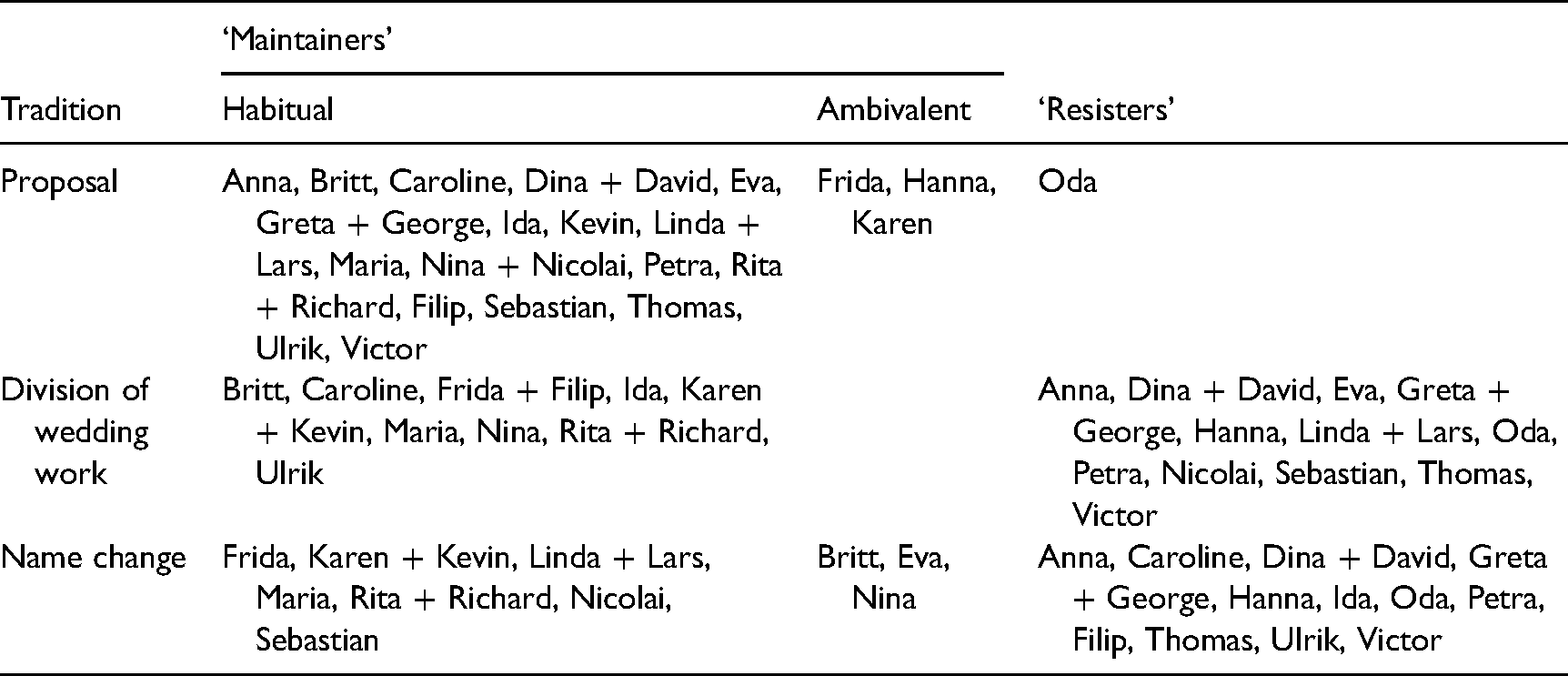
Interviews were recorded, transcribed verbatim and entered into NVivo. In the first phase of analysis, the interviews were coded for the selected themes: accounts of marriage proposals, division of wedding work and change of surname. The next step was to assemble the accounts of these themes for more detailed analysis. Then, the accounts were coded according to whether they represented maintaining or resisting the actual tradition. The distribution of ‘maintainers’ and ‘resisters’ of the three wedding traditions is presented in Table 1. ‘Maintainers’ distinguishes between those who habitually adopted the tradition and a few who did so with ambivalence.
Participants’ maintaining or resisting gender inequal wedding traditions.
The final step of the analysis was to uncover how wedding traditions are maintained or resisted. The processes that influenced the ‘maintainers’ and ‘resisters’, distinguishing between processes at the institutional, the interactional and the individual level, are summarised in Table 2.
Processes involved in participants’ maintaining or resisting gender inequal wedding traditions.
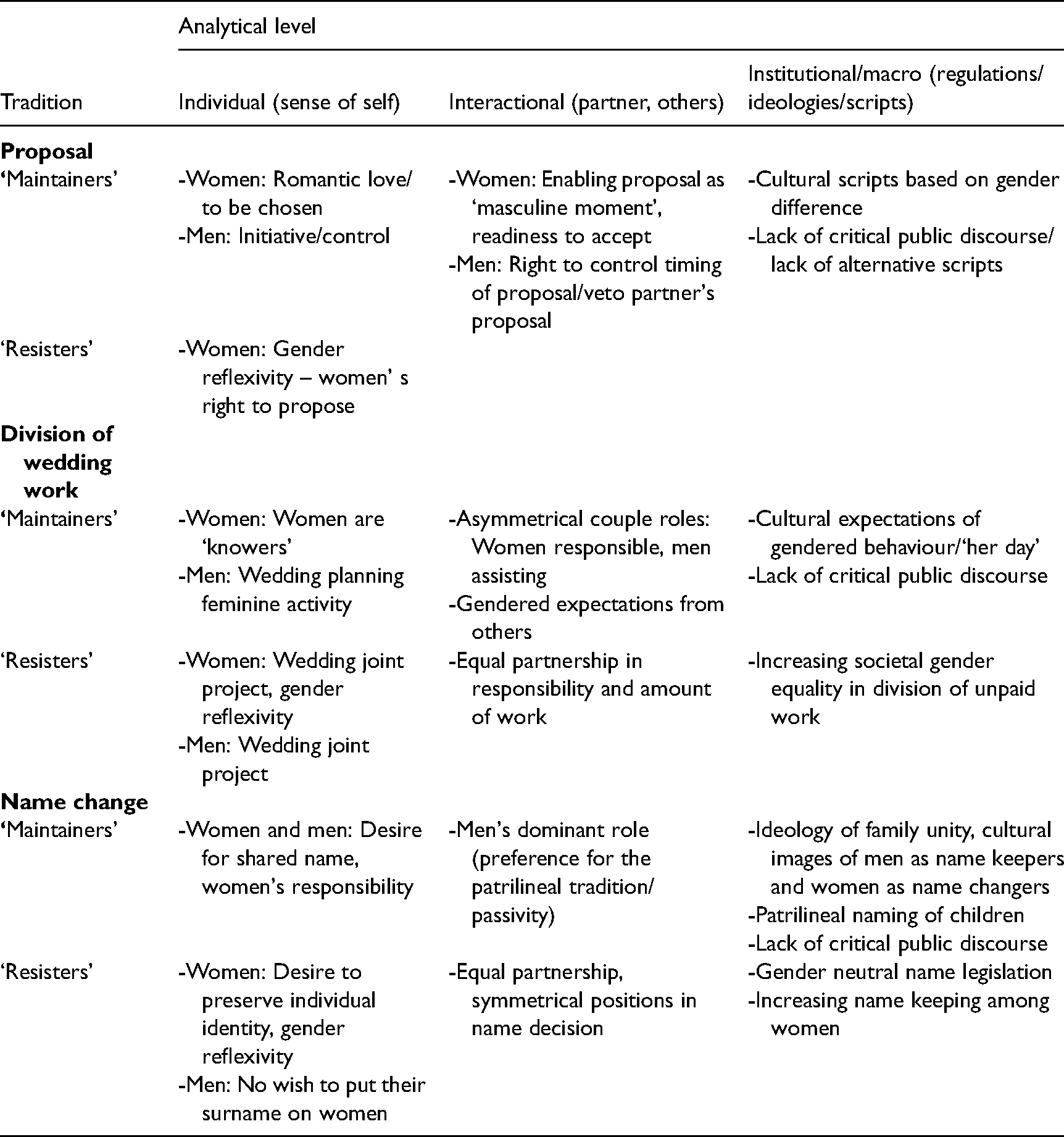
The categories of ‘maintainers’ and ‘resisters’ and the discussion of how processes at the three analytical levels influence ‘maintainers’ and ‘resisters’ structure the analysis.
The male marriage proposal: A masculine moment?
Now comes this moment that I've seen so many times before and thought so much about. Or as I have seen so many times before in movies and the like and then just … ecstasy and … I felt a fierce expectation then, on his part. And surely, [there was] an expectation for me that I should now jump up, cheer, and be happy.
In several cases, the man proposed after the couple had agreed to get married — ‘We had talked a lot about it beforehand’ (Ida). However, the timing of the agreed proposal was often a surprise, although some of the men said it was ‘not that surprising’ or ‘shocking’ (Sebastian, Ulrik). Nicolai did not doubt the answer, as it had been a topic they had discussed for some time. And now the time had come, she was getting ‘ready’, and it was fun to do it before it became ‘completely obvious’. But some men were slow in making the agreed proposal; their partners had to wait. Britt, the woman who proposed did so in a leap year, in a humorous tone said that her partner was ‘a bit slow’ in proposing, but she could not have proposed another day because it is ‘not allowed’, referring to herself as being bound by tradition, which was very ‘self-chosen’.
Not all proposals were the result of a previous agreement, for some women it was unexpected, but they were still happy to accept. Eva did not expect it to happen for another two years. Dina had not thought much about getting married, but ‘maybe started to think that…we perhaps would have children first’, but when he proposed ‘there was no doubt’. Petra thought it was nice to be asked before marrying became a ‘practical’ matter. Only Anna was unsure about her partner's proposal since their relationship had just gone through a bad period. She had previously rejected the idea of getting married as a ‘counter reaction’ to the ‘marrying trend’, of which she wanted no part. But then it was nice to be proposed to as a ‘declaration of love’.
The male proposal was more or less taken for granted. At the individual level, some women who explicitly wanted the man to propose wanted the feeling of being ‘chosen’: [He] knows that I like it to be … romantic, but I think it was after such lighter pressure from my side, for a long time, then, such hints now and then … and he did know I was going to answer yes if he asked. But he did also know that it was he who had to ask (Caroline).
I want him to do it… I don’t know if we girls always go around and are more insecure, but at least for me, it’s that way … because then he shows that he wants to be with me, for the rest of [his] life… If I had proposed to him, I would not know for sure if he wanted to marry me, maybe he said yes to be kind, somehow, or he felt he had been pushed into a corner (Ida).
‘Resisters’ to the male proposal were a few women who challenged the male convention; women should be able to propose. Oda had planned to propose later in the summer, but then her partner asked first However, the other three consented to their partner's unspoken or explicit wish to make the proposal. Karen had considered the possibility, but then she ‘knew that he was the one that was going to propose’. Hanna was asked by her partner not to propose, as he wanted to do it. She gave him an ultimatum: If he had not proposed before New Year Eve 2015, she was free to do it. Frida had suggested to her partner that she could propose, but he said if she did, he would say no: Maybe it's something to do with the fact that, uh, I would have felt not in control if I had been proposed to, I think, and then it would not have been my choice. How it was for [her], if she felt the same, I do not know; she did not say, but … I think it is weird that more girls don’t have the same feeling I had (Filip).
While he wondered why women are not more concerned about having control, exercising his cultural male prerogative meant that his partner had to wait and interpret signs of whether he was going to propose or not: ‘We had talked about it several times … blah, blah, blah … [I] just [thought] “Oh, man! Do I have to wait even more?” Because I was very ready then, for him to propose’ (Frida).
In sum, the prevailing pattern is that of ‘maintainers’ habitually complying with the convention of the male marriage proposal, only a few women expressed ambivalence or resistance. The convention is perpetuated at the institutional level by gender conventional scripts mediated by popular culture (Table 2). Scripts are activated and enforced at the interactional level, where women and men cooperated in facilitating the proposal as a ‘masculine moment’. Men had the right to decide the timing of the proposal and to veto their partners’ wish to propose. At the individual level, perceptions of femininity and masculinity worked to sustain the convention: women's desire to feel chosen and their ‘readiness’ to accept men's proposals and men's sense of initiative/control. Potentially undermining men's prerogative is women who believe they should have the right to propose like men, but men's resistance is an obstacle.
Division of wedding work: Her day?
The wedding was considered a once in a lifetime event, and a lot of thought, emotion, work and money went into its planning, often including a large party for family and friends. One woman observed that weddings had become popular – ‘a thing’ – for her generation, and they often followed the more American tradition of big, expensive weddings, with white dresses.
The tradition of gendered division of wedding work was met by both ‘maintainers’ and ‘resisters’ (Table 1). Among ‘maintainers’, women did the main planning and most of the work and knew how things should be, while men had an assisting role; invited to decide on their partners’ proposals and were assigned more practical tasks. ‘Resisters’, by contrast, were characterised by joint partnerships, responsibilities and the amount of work were quite evenly divided. Some tasks could sometimes be divided in a more traditional way; for example, the woman was responsible for decorations, and the man for more technical things.
Among the women ‘maintainers’, some half-jokingly acknowledged the asymmetry: Ida googled for hours, looking at all sorts of things, like venues, types of weddings, then she picked out ‘maybe two things’ for him so he could be involved in making decisions, ‘or believe that he decides’ she added, laughing. Britt said ‘He works, earns money, [but] I plan [laughs]. Pretty much like that … but the decisions we have somehow made together’. Caroline said: ‘I decide, and [her male partner] says “yes, that's okay!” [laughs]. No … it's not quite like that’. She described herself as ‘the difficult one’, she had clear ideas about what she wanted. The accounts of men ‘maintainers’ reflected those of the women, they merely assisted the women, acknowledging imbalance in responsibility and amount of work. They were involved in the decision making, however, one of the men said laughingly that he did not believe he would get ‘voting rights’ on everything, but it was alright because his fiancé had ‘good taste’ (Ulrik).
Individual justifications of their asymmetrical roles varied among women ‘maintainers’ – it was seen as a gender specific trait, individual interest, a result of their partner being busy with job or education, or a combination. For example: ‘We ladies are a little more like “bridezillas” … maybe we want more overview and more control than men’ (Britt). But Britt also said that she had solved practical problems so that her partner could concentrate on his job, as ‘he works terribly many more hours than ordinary people do’. Karen thought that men do not have strong opinions about ‘how things should be…I’ve had the last word on what's nice’, while Frida said: ‘I’m a very super-organised lady who likes to think and plan. And I’m so much better than [her fiancé] …And [he] is so busy…I have done most things … because I have the time and because I think it is fun’. Maria said it had to do with different interests in planning: ‘My husband is very “let's wing it”, and I don’t think that's any fun’. One male ‘maintainer’ explained the imbalance in the amount of work as a natural gender difference: ‘She thinks it is fun, and it gives her energy… men do not [feel such] energy’ (Filip).
Women ‘resisters’ depicted equal couple interaction, for example: ‘Much [of the planning] is thought activities…we divided responsibilities’ (Hanna). Line said she and her partner did most planning together, although ‘most people thought that it was probably just me who would do the planning, since I’m a girl, but also he has a great eye for detail’. Women ‘resisters’ distanced themselves from some of the conventional expectations about gendered wedding behaviour. Maria perceived ‘a lot of pressure both from media and family and friends about how things should be’ and criticised expectations of a ‘princess wedding’ – this unique day blown up to American size, in which all the focus is on the bride. Oda ironised ‘It's my day, and everything's going to be perfect. My God, it's just a party’. Petra was ambivalent about getting married at all; she referred to the feminine ‘package’ that goes with it, such as the roses and veils were not for her. At the individual level some women ‘resisters’ had a gender equality ideal for their wedding work. ‘I wanted it to be a joint process…We both had a gender equality or feminist perspective on getting married’ (Oda). Not to ‘distancing’ their partners, some women held back their control. ‘I didn’t want to become like a bridezilla, [but] I noticed I had to work a little with myself and others by saying like “it is not only me, not only my party…we have to ask him what kind of flowers he want to have on the table” …Most of those who would help, asked me’ (Petra).
The story of division of wedding work among the male ‘resisters’ was like women's – it was a joint project, characterised by close interaction and equal roles: ‘We talked a lot about it, dreamed about how it would be, agreed all the time about what [the celebration] would look like’ (Thomas). David and Dina agreed that they ‘pretty much always sat together … and planned everything…we made all decisions together…and we made all things together, like, those table cards.’ Greta and George said ‘We are very good at discussing and come to agreement… [We] sat in the evenings and planned who is to do what.’ According to one man, the couple had talked about most things, divided responsibility for various tasks, and tried to share the amount of work; another man described the division as ‘fifty-fifty’.
In sum, ideologies at the institutional level that construct the wedding as being for women rather than couples and that view brides as ‘knowing’ of how weddings should be celebrated (Humble et al., 2008) continue to generate gendered divisions of wedding work (Table 2). The asymmetrical wedding work tradition was upheld at the interactional level by women taking responsibility and doing most of the work and men assuming a more assistant/passive role. At the individual level women's role was perceived as caused by a mix of natural gender differences and individual preferences, but also by women having more available time than men. However, these cultural expectations were subject to criticism ad contestation: ‘Resisters’ distanced themselves from what they perceived as conventional expectations about the wedding as ‘her day’. At the interactional level ‘resisters’ were typified by joint partnerships – equal responsibilities and equal amount of work. At the individual level, equal involvement appeared as a habitual practice, underpinned by critical reflexivity vis-à-vis gender among some women.
The marital naming tradition: women changers?
The patrilineal name tradition also brought about both ‘maintainers’ and ‘resisters’ (Table 1). Among ‘maintainers’ a modified variant of the tradition was common – the woman takes her husband's surname but keeps her own surname as a middle name. Two of the men whose partner made this kind of change, had added their wife's surname as their new middle name. Only one couple represented the classical tradition — the woman took her husband's surname and abandoned her own. Among the ‘resisters’, women made no change of their surname.
Women and men ‘maintainers’ complied with the cultural expectation that a shared family name defines family unity and that men do not change their surname. Marital and child surnaming conventions were linked: Changing to the husband's surname was often made with (future) children in mind. As the common practice is that children receive their father's surname (Wiik, 2005), taking the husband's name means that the woman will be connected to the (future) child through a shared surname. The marriage event and the decision were sometimes decoupled; a couple of women delayed the naming decision to after the wedding. It was not urgent, until ‘you have children and have to decide their names’ (Eva).
Some ‘maintainers’ had discussed the name choice with their partner. Eva's fiancée, and her future father-in-law, would love her to change, but she had been very ‘up and down’ and had not decided yet. Nina did not quarrel about her husband's name coming last, but he got it his way ‘because he is a man’. Some men had an explicit preference for their name as the shared family name. Lars had asked his partner if it was okay for her to change name, Line confirmed that this was what she wanted to do. Two men had exercised ‘considerable pressure’ to have their surname as the shared family name. ‘I felt like having a pretty big wedding was her thing and for me it was important with the name…The most important thing was that we have the same name, but it was quite important it was my name [that came last] (Sebastian). However, some men were passive and indifferent, leaving it to their partner to decide. One man ‘could not care less’; for him, it was about identity: ‘there is no template; it's up to each individual’ (Filip). But he suspected that his partner, who had already taken his surname, did it because he had a rare name and she a very common one; she confirmed that she found his name ‘exclusive’ and ‘nice’ (Frida). Another man whose wife had taken his surname did not expect her to do this, but she wanted to, since their daughter had both names. One man thought it was ‘right’ to have a shared family name, but why his wife planned to ‘add his surname’ he could not tell; it was her decision (Ulrik).
Individual justifications of ‘maintainers’ included some who perceived women's change of name as natural. When you are wife and husband you should have the same name, according to Karen. In Lars’ family, a shared name was a ‘normal’ part of establishing a new family — ‘about seeing that we are together.’ The two men who had forced the decision of their name as the family name emphasised that they had surnames with long family traditions. For most women ‘maintainers’ keeping their own surname as a middle name was a compromise between a family ideology in which family is defined by a shared surname and the preservation of self-identity – to ‘gather the family’ and ‘keeping a part of oneself’. According to Nina ‘I – or we– think it's nice to have a family name when we have children and …[but] the name is such an important identity, so I would not give up my whole name’. None of the women emphasised the wife identity, the title of Mrs (Fru) is mostly no longer used in Norway. Neither was having the social/administrative simplicity of only one name mentioned by the women, as more and more women keep their own name, this concern seems to lose traction.
Women and men ‘resisters’ acknowledged women and men as occupying equal positions regarding surnames. David said they both had a conscious relationship with their surnames; neither felt that they had to ‘force their name on the other’, while Dina referred to her father's pride in the family name. For another couple, the man planned to take his wife's surname, and both would take his surname as their middle name. Greta had a rare family name she wanted to keep, while George had a foreign surname. Being born in Norway, he was tired of people continuously asking where he comes from — he wanted to get rid of that assumed immigrant identity. None of the women ‘resisters’ mentioned any negative reactions to their decision, neither from their partner, nor from others. ‘Name keeping has become more and more common’, stated Caroline.
To women ‘resisters’ the desire was to preserve their individual identity. A sense of ‘linear self-hood’ (Thwaites, 2017) was crucial: ‘I am who I am, so I have no need to change my name. I have an identity feeling to my own name that I want to continue having’ (Caroline). As Anna said, ‘My name is to be my name; I want to keep it. And be who I am’. Sometimes individual identity was linked to their family of origin or having a rare family name. Some women rejected ‘the patriarchal culture we have had — that women, as a rule, take the man's name’ (Anna). Ida said, ‘The feminist in me didn't want it … And if we were to be named something else … why is it that his name will come last, anyway?’ Oda thought the patrilineal tradition is ‘totally ridiculous’, for her, it is simply ‘embarrassing’ that women do not think more about it. She also found it ‘weird’ from the men's side — ‘the idea that one sort of puts one's name on others … without being willing to change names themselves … you name things’. Still, other ‘resisters’ respected women who went along with the romantic idea of belonging to a man.
In sum, the patrilineal naming institution continues as an ideology of family unity. At the interactional level the tradition is reproduced by women who assent to being accountable for accomplishing the family unity ideal, and by men who either explicitly pressure for their surname to be the shared family name or passively leave the choice to women (Table 2). Individual justifications of women's name change are that it is natural or desirable to display family unity, especially when children arrive. Women ‘maintainers’ try to solve the dilemma between women's selves and commitment to others by keeping their own surname as a middle name. ‘Resisters’ reject women's name changing at the interactional level by acknowledging women and men as equal partners – occupying symmetrical positions with an equal legitimate right to individuality and to preserve ancestry. Women name keepers do not seem to be negatively sanctioned. At the individual level, women ‘resisters’ desire to preserve their sense of individual identity, in some expressed by critical reflexivity vis-à-vis gender. Men ‘resisters’ feel no desire for their partner to take their name.
‘Tainted’ by history: gender inequality, wedding traditions and change
This study contributes new insights into whether and how wedding traditions rooted in gender inequality are maintained or resisted among young Nordic middle class couples and how gender equality is progressing in this little explored domain. Expectations about more resistance and change compared to findings from Anglo-American studies were partially met: While the convention of the male marriage proposal was more or less unchallenged, the asymmetrical division of wedding work and the patrilineal name tradition engendered both ‘maintainers’ and ‘resisters’. ‘Maintainers’ corroborate that wedding conventions in the Nordic context are still ‘tainted’ by the history of gender inequality (Baker and Elizabeth, 2013:34). But at the same time there are ‘resisters’ breaking with the traditions. Guided by Risman's gender structure approach, the analysis substantiates how continuation of tradition and detraditionalisation unfold at the institutional, interactional and individual level (Table 2).
The unexpected dominance of the male marriage proposal is maintained by a romantic gender difference ideology. Male proposal scripts mediated by popular culture appear to be very powerful. The scripts are deeply internalised and alternatives are lacking. Women and men interact in the reproduction of the convention, nurtured by gendered senses of self, of men being in control and women feeling being chosen. Resistance from a few women suggest a potential for change – not for the ritual to be abandoned, but for it to become a right for both genders. However, men's resistance indicates that the convention mediates influential masculinity norms. The feminine ‘white wedding’ culture promotes unequal wedding work, permeated by images that weddings are a woman's domain, women know how weddings are supposed to be. ‘Maintainers’ comply with this asymmetrical gender ideology in the interaction of the division of work, with women in charge and men assuming an assisting and passive role. By contrast, women ‘resisters’ reject what they perceive as a ‘princess wedding’ culture, and women and men interact in sharing responsibility and amount of work. Likely to have propelled this change is the general societal trend toward more gender equal divisions of unpaid work. As women and men increasingly are accustomed to divide unpaid work more equally, this creates ‘habitual’ equal partnerships, sometimes underpinned by individual critical gender reflexivity, especially among women. The patrilineal name tradition complying with an ideology where a shared named defines family unity is continued by ‘maintainers’. Men ‘maintainers’ expected to keep their names; some forced their traditional name preference on their partner, while other men played a ‘latent dominant role’ in the process (Castrén, 2019:260) by leaving the choice to their partner, some letting their partner know they wanted them to change. ‘Resisters’ of the patrilineal tradition are likely to be influenced by the gradual normalisation process of women's name keeping succeeding legal reform. Resistance in the longer term has opened to alternative perceptions of ‘the family’ not dependent on a shared name (Castrén, 2019). The absence of sanctions of women who keep their names suggests that name keeping increasingly is perceived as a legitimate choice and not a transgression of the gender order. Women's name keeping is supported in couple interactions that acknowledge women and men's symmetrical positions, and at the individual level by women's sense of individual identity and critical gender reflexivity, and by men who have no wish to put their name on women.
The study illuminates the complex processes behind detraditionalisation and the continuation of tradition. There is substantial variation in how individuals perceive and react to institutional pressures and expectations from others, and in their self-perceptions as gendered. The categories of ‘maintainers’ and ‘resisters’ of the various wedding traditions do not always include the same individuals, and couples may have diverging ideas. Contradictions are an inevitable part of culture, and people move in between the categories (Illouz, 2012). Even if detraditionalisation processes are apparent, although less so regarding the male proposal, one might ask why gender equality has not gained more momentum in this domain. On the one hand, macro level institutional change seems to undermine unequal wedding conventions – by changes in the gender division of labour and gender-neutral name legislation. On the other hand, a common feature of the wedding traditions studied is that their specific patriarchal roots and unequal power dynamics have escaped the critical public attention directed at many other gender equality issues. Choice is privatised, only scattered criticism can be observed. This is not specific to Norway. For example, international scholars note that the earlier feminist critique of ‘the white wedding’ has subsided, being replaced by a discourse more focused on choice (Arend, 2016; Leonard, 2006; Thwaites, 2017). Critical public debate is important in generating critical reflexivity vis-à-vis gender, in this study indicated to be an important source of change. Promoting awareness of the gender stereotypical norms underpinning wedding conventions could contribute to making women and men more equal partners also in weddings.
Finally, while this study has provided new insight into little known gender dynamics in wedding traditions in a Nordic context, it can only present a limited picture, since it is based on a small and non-representative sample. Studies indicate that wedding traditions and gender dynamics may differ in other groups, for example, among the working class, immigrants, same-sex couples and people in their second marriage (e.g. Bair and Kaufman, 2020; Jowett and Peel, 2019; Sassler and Miller, 2017; Smart and Shipman, 2004). Extending research to such groups in the Nordic context could further advance insights into processes maintaining or undermining gender inequalities.
Footnotes
Acknowledgements
I wish to thank Julia Carter and Simon Duncan for access to the interview guide of their pilot study of weddings (Carter and Duncan, 2017) and Ragnhild Ekelund for research assistance, including interviewing.
Declaration of Conflicting Interests
The author(s) declared no potential conflicts of interest with respect to the research, authorship, and/or publication of this article.
Funding
The author received financial support for the data collection from the Department of Sociology and Human Geography, University of Oslo.

Appendix 1. Study participants.
Interview no.
Pseudonyms
Age group
Job/studies
Ceremony (C = conducted,
P = planned)
1
Anna
30-32
MA student
Civil, abroad (P)
2
Britt
30-32
Preschool teacher
Church (P)
3
Caroline
30-32
Teacher
Civil, abroad (P)
4
Dina
30-32
Engineer
Civil (C)
David
30-32
Economist
5
Eva
21-24
BA student
Church (P)
6 (13)
Frida
21-24
MA student
Church (P)
7
Greta
30-32
Account manager
Church (C)
George
25-29
Consultant
8
Hanna
25-29
Economist
Church (C)
9
Ida
30-32
Medical doctor
Church (P)
10 (12)
Klara
25-29
BA student
Church (P)
12 (10)
Ken
25-29
MA, jobseeker
Church (P)
13 (6)
Filip
25-29
MA student
Church (P)
14 (17)
Line
21-24
MA student
Church (C)
15
Maria
25-29
BA student
Church (P)
16 (20)
Nina
30-32
Lawyer
Civil (C)
17 (14)
Lars
21-24
Teacher
Church (C)
18
Oda
21-24
MA student
Civil (C)
19
Petra
25-29
Journalist
Civil (C)
20 (16)
Nicolai
25-29
Lawyer
Civil (C)
21
Rita
30-32
Warehouse worker
Church (P)
Richard
25-29
Hair dresser
22
Sebastian
30-32
Lawyer
Church (C)
23
Thomas
25-29
Teacher
Civil (C)
24
Ulrik
21-24
Business networker/BA student
Civil (P)
25
Victor
30-32
Financial advisor
Church (C)