




Abstract
Cultural reproduction has attracted the attention of cultural sociologists over the last few decades. While a body of research has shown that the orientation to highbrow culture is transmitted from parents to their children, research on the transmission of other cultural orientations has been scarce. In this paper, I study the intergenerational transmission of three cultural orientations—highbrow, popular, and crafts—in Finland. The data were derived from a nationally representative sample (N = 1425) surveyed in Finland in 2018, and it was analysed with regression techniques. For the respondent, I target current cultural participation, and for the parents I rely on retrospective data targeting joint cultural participation with the respondent during their childhood. I show that there is symmetric transmission of cultural orientation, namely that the respondent's current orientation is most tightly associated with the same orientation that they practiced with their parents, suggesting symmetric cultural reproduction in Finland. Additionally, parents’ overall cultural participation is associated with their children's overall cultural participation. I reflect on the findings in the light of past and current research on cultural practices and suggest directions for future research.
Keywords
Introduction
Cultural reproduction has intrigued cultural sociologists for decades. Sociological interest in studying cultural reproduction lies in its potency to mediate and channel social reproduction: cultural practices and lifestyles are socially stratified, and certain intergenerationally transmittable cultural practices and elements of lifestyles can operate as cultural capital that is convertible to social advantages (Bourdieu, 1973, 1984). The logic of cultural reproduction, according to Bourdieu, is that children learn cultural practices ‘naturally’ from their parents at their childhood home and, after entering formal (‘scholastic’) schooling, displays of socially appreciated practices are (mis)recognised, rewarded and further consolidated by schools, which in turn converts these practices into advantages in the education system (Bourdieu, 1973, 1984, 1996; Bourdieu and Passeron, 1977, 1979). Since Bourdieu's seminal work, a branch of cultural sociology has focused on studying how cultural practices and lifestyles are intergenerationally transmitted.
In this article I study cultural reproduction in Finland, where the stability of cultural stratification amid major social changes in recent decades offers a well-suited research setting. I focus on the intergenerational transmission of lifestyles from parents to their children. I operationalise lifestyle as cultural participation in various activities, and construct three cultural orientations—that is, dimensions of lifestyle: highbrow, popular, and crafts—as combinations of participation in closely related activities. I ask: how are these cultural orientations intergenerationally transmitted? My main result is that there is symmetric association between the cultural orientations of respondents and their parents. Additionally, while parents’ overall participation is associated with their children's overall participation, parents’ crafts orientation seems especially important. I thus broaden the horizon of cultural reproduction analysis in three ways: (1) add a new dimension—crafts—to the analytical scheme, (2) introduce the idea of symmetricity, and (3) show that parents’ mundane cultural practices may be a key factor in an individual's overall cultural participation, an issue that has escaped analyses to date.
This article structures as follows: the next section contextualises the analysis by describing the history of Finnish society and cultural stratification since the 1950s, because I use cross-sectional data that could contain time-bound effects from that period. Third section describes the data, variables and methods, followed by the results section. The final section contains discussion and conclusions.
Cultural reproduction
Intergenerational transmission of cultural practices
Cultural reproduction, as outlined in the introduction, refers to the intergenerational transmission of cultural practices—that is, knowledge about, taste in and participation in various forms of culture—that can yield short-term and long-term advantages in various social fields. Simply put by Sullivan (2011, 207–208), parents pass their socially stratified cultural dispositions to their children, who benefit from acquiring certain dispositions both in school and later in labour markets that, in turn, consolidate dispositional stratification. Research on cultural transmission from parents to their children and children benefitting from culture in schooling has been extensive, with results typically supporting cultural reproduction theory (see Dumais, 2015; Nagel and Ganzeboom, 2015; Sullivan, 2011 and Jaeger and Breen, 2016 for reviews), and cultural practices can be further capitalised on when competing for prestigious jobs (Hora, 2020; Koppman, 2016; Rivera, 2012). In this paper, I focus on cultural reproduction within the family, the setting where the process begins.
Cultural practices can be transmitted from parents to their children in various ways. These ways may differ in terms of families’ socio-demographic factors, such as social class (Lareau, 2011) and race (Kalmijn and Kraaykamp, 1996), and their effects may be modified by the society's structural characteristics (Andersen and Jaeger, 2015; Xu and Hampden-Thompson, 2012). Nevertheless, a key distinction is the differentiation between parents actively guiding their children's cultural practices and children learning to appreciate culture by following the (passive) parental example (Jaeger and Breen, 2016; Mohr and DiMaggio, 1995; Van Hek and Kraaykamp, 2015). Parents’ active efforts to guide their children's cultural practices, both encouraging some practices and discouraging others, can be understood as efforts to improve children's life chances (Lareau, 2011; Mohr and DiMaggio, 1995). For example, Lareau (2011) observed that middle-class parents enrol their children in organised activities under the conscious belief that these activities not only offer valuable life experiences in youth, but also instil and refine skills and dispositions that secure advantages later in life. While it is debated whether active guidance or passive example is more important for intergenerational cultural transmission (Nagel and Ganzeboom, 2015; Notten et al., 2012; Van Hek and Kraaykamp, 2015), both ways can contribute to the transmission.
Various cultural domains have been analysed to assess whether taste and participation in them are intergenerationally transmitted from parents to their children. According to Sullivan (2011, 198), research has found no cultural domain without evidence of intergenerational transmission. The most well-documented phenomenon is the transmission of highbrow participation (Jaeger and Breen, 2016; Sullivan, 2011). However, there are other patterns of cultural taste and participation conceptualised as, for instance, ‘cultural schemes’ (Van Eijck and Lievens, 2008) or ‘taste cultures’ (Gans, 1974), yet there is limited research on their intergenerational transmission. From the few existing empirical studies, those by Ter Bogt et al. (2011), Notten et al. (2012) and Nagel and Lemel (2019) merit closer attention here.
Analysing intergenerational transmission of musical preferences, Ter Bogt et al. (2011) found that parents’ musical preferences could be categorised as pop, rock, and highbrow patterns, whereas their children's patterns could be categorised as pop, rock, highbrow, and dance. They found that parents’ preference for highbrow music was associated with their children's preference for highbrow music, and parental pop preference was associated with children's preference for pop and dance music. Finally, parental preference for rock was associated with their daughter's, but not their son's, preference for rock. Thus, in addition to the highbrow pattern, pop and rock patterns were also intergenerationally transmitted (see also Willekens and Lievens, 2014). Similar results were provided by Notten et al. (2012), who studied the transmission of reading and television watching habits. They found that parental orientation towards highbrow reading was associated with their children's orientation towards highbrow reading, but also that parents’ orientation to lowbrow reading was associated with their children's similar orientation. Similarly, in television watching, parental orientation towards highbrow/lowbrow viewing was associated with the same type of viewing habits in their children. In a slightly different vein, Nagel and Lemel (2019) analysed the inheritance of lifestyle and showed that parents’ culturally oriented lifestyle was associated with their children's culturally oriented lifestyle and that parents’ luxury-oriented lifestyle was associated with a similar lifestyle in their children. They concluded that parents transmit their lifestyle to their children as one way of transferring their social status to their children. Taken together, these studies indicate that in addition to the inheritance of highbrow orientation, other cultural orientations, such as a popular orientation, can be inherited, too.
Social and cultural change in Finland since the 1950s
Finnish society has experienced major structural changes since the 1950s. Economically, Finland transformed from an agrarian society into an industrial and service-based economy relatively quickly (Vartia and Ylä-Anttila, 2005, 77–80; Karisto et al., 1997, 63–65). Compared to other Western countries, industrialisation in Finland spread late, and after the Second World War industrialisation progressed simultaneously with service economy development (Vartia and Ylä-Anttila, 2005, 80). Additionally, the post-War settlement policies delayed the structural change of Finnish agriculture (Karisto et al., 1997, 60–61), which increased pressure for further economic change. This led to rapid economic transformations in the 1960s and 1970s. Consequently, a large proportion of the industrial and white-collar service workers of the 1980s were first-generation paid workers with farmer parents (Alestalo, 1985; Pöntinen, 1983). Simultaneously with economic change, rapid urbanisation took place in the 1960s and 1970s (Karisto et al., 1997, 67; Valkonen, 1985). The lifestyle of the newly suburbanised Finns, ‘the generation of the great transformation’ (Roos, 1985) in the 1970s and 1980s was characterised by a mixture of urban/suburban and agricultural lifestyles (e.g. Ahponen and Järvelä, 1983; Kortteinen, 1982). As a result, many contemporary late-middle-aged Finns have ‘agricultural roots’ either themselves or through the experiences and stories of their parents (Alasuutari, 2017, 63; Korkiakangas, 1996).
Despite the major socio-economic changes in Finnish society, cultural hierarchies seem to have changed only little. Research in Finnish cultural practices throughout the last 60 years has constantly shown a homology between cultural participation and socio-demographic factors. Starting from the 1960s, Toiviainen (1970) showed that Finns’ musical tastes were stratified according to education level, area of residence and age; the audience for classical music was older, more educated and urban, whereas the audience for (American) pop music was young, more educated and urban and the audience for schlagers was older, less educated and rural. Toiviainen (1970) also observed that listening to classical music was associated with visiting theatre and art galleries (listening to schlagers was not), amounting to an orientation towards highbrow culture. Similarly, Piepponen (1960) had already noted that serious reading and attending both theatre and movies were more common in people with higher levels of education. In the 1970s, Eskola (1976) re-captured the highbrow orientation including reading, going to classical music concerts and visiting theatre and art galleries. Additionally, she showed that mundane cultural activities, including handicrafts, gardening, cooking and watching television were related. Sports and outdoors formed a third orientation, whereas going to movies and listening to pop and entertainment music were popular across the population. Stratification-wise, highbrow orientation was characteristic of more educated upper-class people, while sports and outdoor activities were more typical for the young and men, and the orientation to mundane activities was typical for less educated middle-aged people. (Eskola, 1976.)
Using data from the 1980s and 1990s, Seppänen (1993) observed stratification patterns in musical tastes similar to those found by Toiviainen. With the same data as Seppänen, Pääkkönen (1993) showed that opera, theatre, art museums and galleries were visited more often by more educated people with higher occupational status. The same stratification prevailed at the beginning of the 2000s (Liikkanen et al., 2005). At the turn of the 2010s, Purhonen et al. (2014) found three profiles of cultural practices in contemporary Finland: highbrow, popular, and traditional. Of these, highbrow is associated with higher levels of education (and higher social position) and it is more typical for women, whereas the popular and traditional are differentiated mainly by age, popular being typical for younger people and traditional typical for older. Purhonen et al. (2014) concluded that Finnish cultural stratification was surprisingly similar to Bourdieu's (1984) results concerning France in the 1960s. In general, it seems that Finnish cultural practices have long been stratified in the same way, and this stratification has been quite resistant to social change. Attuned to this stability, Alasuutari (2017, 290–291) concludes that the long-term aim of Finnish cultural policy to ‘democratize’ highbrow culture has failed. While the general picture of Finnish cultural practices, their interrelatedness and their social stratification seems stable, there might have been more subtle changes in the mixing of practices into orientations, but to date no research sheds light on this issue. Overall, the stability of cultural stratification amid major social changes in recent decades makes Finland a well-suited research setting for analysing cultural reproduction.
Research questions
Research in cultural reproduction at the family level has focused largely on the intergenerational transmission of highbrow culture, but recently research in the transmission of other orientations has gained momentum. I aim to contribute to this emerging thread of cultural sociology, using Finland as an example. Research on Finnish cultural stratification suggests that for the past 60 years the stratification has remained surprisingly stable. In addition to a highbrow orientation, there seems to exist a clear orientation consisting of mundane crafts in Finland. Popular cultural practices were relatively loosely coupled in earlier decades, but later research shows that they have cohered, and in contemporary Finland a distinct orientation to popular culture is observed. Against this background, I set my research question as follows: how are cultural orientations intergenerationally transmitted in Finland?
Before entering the analysis, however, it should be noted that regardless of parents’ efforts, individuals’ cultural practices can be influenced by other factors. For example, schools and formal education may—instead of only benefitting the privileged by consolidating pre-existing cultural stratification—be more beneficial to people with less privileged backgrounds and consequently boost cultural and social mobility (e.g. Aschaffenburg and Maas, 1997; DiMaggio, 1982; DiMaggio and Mohr, 1985; Ganzeboom, 1982; Nagel and Ganzeboom, 2015). Social mobility, in turn, can influence individuals’ practices (Daenekindt and Roose, 2013, 2014). Parents and home upbringing are but one factor influencing individuals’ cultural orientation and lifestyle, and its effects might diminish over the life course (Georg, 2004; Scherger, 2009). Bearing this in mind, analyses of cultural reproduction should control for factors known to influence individuals’ cultural practices. Here, this means controlling for gender, age, education, occupational position, income and area of residence (see previous subsection). I also control for parents’ education level, as it influences Finn's cultural participation (Kallunki and Purhonen, 2017).
Data, variables and methods
Data
The data (N = 1425) was collected by Statistics Finland in 2018, drawing from a nationally representative random sample of 3500 Finnish citizens aged 18–74 (excluding the Aaland Islands). The data were supplemented by register-based information regarding respondents’ income, education and area of residence. There was an overrepresentation of women, older people and highly educated people in the data compared to the corresponding population. Statistics Finland provided an index to weigh the data to correct for these biases, and analyses were performed both with and without the index. Both ways produced essentially the same results, so I report results based on the unweighted data.
Variables
The questionnaire contained a wide array of questions enquiring about respondents’ cultural practices, including knowledge about, taste in and participation in different cultural areas, genres, products and events. For the parents’ practices, as is typical in this line of research, I must rely on the respondent's retrospective memory data (e.g. Nagel and Ganzeboom, 2015; Sullivan, 2011). I measure parents’ practices through joint activities (worded ‘hobbies’ in the questionnaire) that the parents and the respondent practiced: repetition, regularity and continuity of activity implied by the word ‘hobby’ should bring robustness to the memory accounts. The question read ‘In your childhood, were your (a) father or (b) mother interested in any of the following hobbies, and did you participate in any of those hobbies together with your (c) father or (d) mother’ (yes, I ‘hobbied’ with my father/mother = 1, no = 0). The questionnaire enquired about nine such activities: reading, movies, gardening, handicrafts, sport, pop music, classical music, cooking, and visual arts. I use the indicators (c) and (d) that measure joint activities. These indicators capture two phenomena: both parents’ own regular participation and their sustained effort to actively guide their child to participate in these activities. For the respondent, the questionnaire enquired about their current participation in the same activities.
I began the construction of variables by studying the nine activities that the respondents had participated in with their parents. Relatively strong correlations existed between reading, classical music, and visual arts for both fathers and mothers, separately and jointly. Similar correlations existed, on one hand, between movies, pop music, and sports, and, on the other hand, between handicrafts, gardening, and cooking. I studied these associations further with latent class analysis (LCA) (Collins and Lanza, 2010). I analysed the activities with fathers and mothers both separately and together and, in each case, tested solutions with varying number of latent classes. LCA showed that reading, classical music, and visual arts were linked, meaning that the item-response probabilities of these indicators varied across classes in different LCA solutions in the same way. That is, when reading had high/low probability in a class, so did classical music and visual arts. Similarly, handicrafts, gardening and cooking were linked. Slightly less consistently, but still coherently, movies, pop music and sports were also linked. Observing the historical Finnish cultural participation patterns (see previous section), it seems valid to conclude that reading, classical music and visual arts form a highbrow cultural orientation for the parents. Handicrafts, gardening and cooking amount to an orientation that can be labelled crafts, whereas movies, pop music and sports can be categorised as a popular orientation. In other words, the data about the parents’ activities produce results consistent with the existing knowledge about past Finnish cultural orientations. Notably, though, the latent classes produced by different LCA solutions were not always identical to these orientations but often combinations of them: for example, none of the solutions had a latent class that would consist solely of highbrow activities, and all solutions produced a sizeable class representing parents who had no joint activities with the respondents.
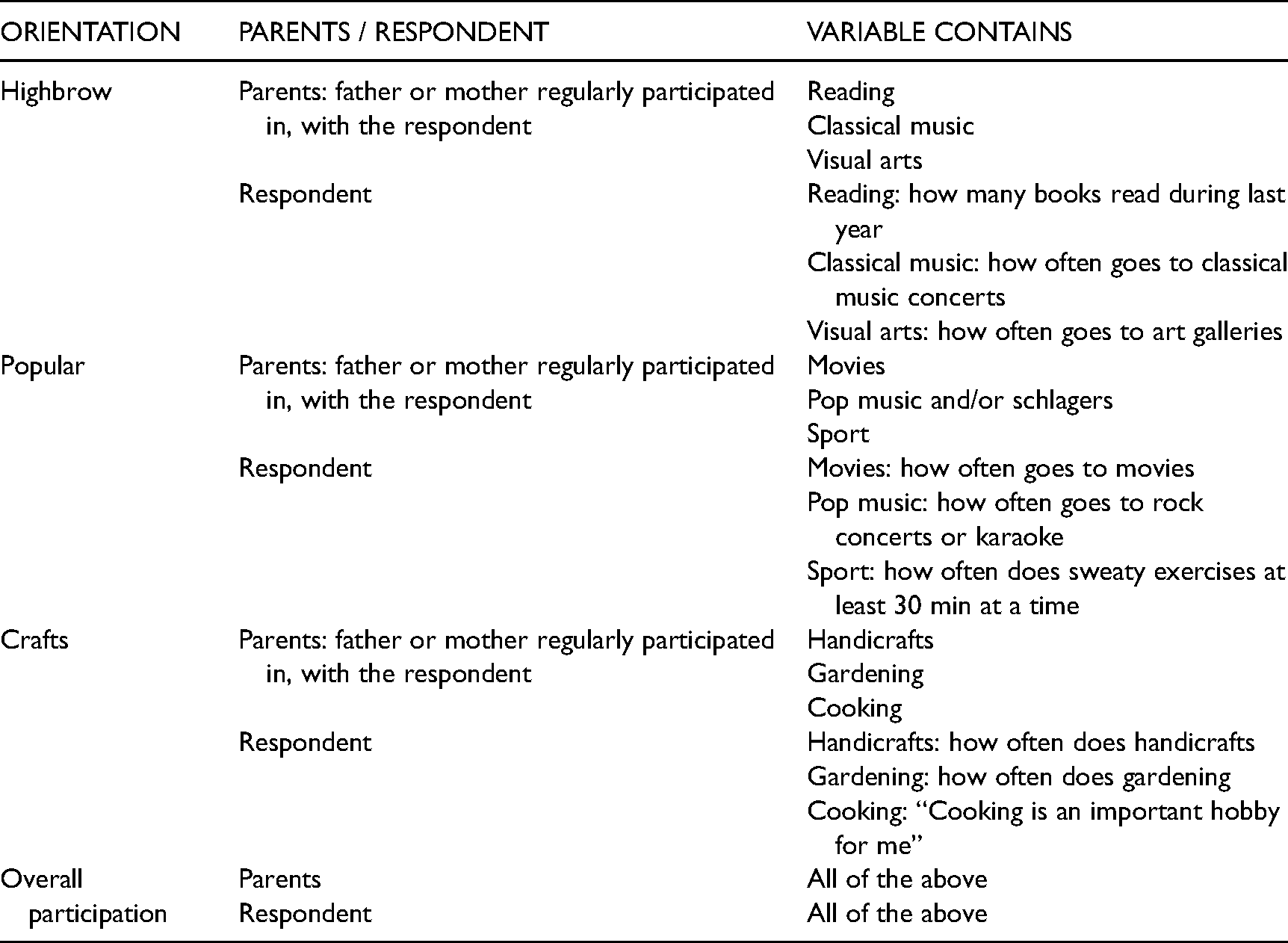
Informed by the preliminary analysis (LCA tables available on request from the author), I constructed variables measuring parents’ cultural orientations as sum variables. Thus, the variable describing parents’ highbrow orientation, for example, was formed by adding up respondent's participation in reading, classical music, and visual arts with either parent. This produced a variable with a range of 0–6 indicating how many highbrow activities the respondent's parents regularly participated in with the respondent during the respondent's childhood. Similar measures were constructed for parents’ orientations to popular culture and crafts. These variables thus measured how many joint regular activities within each orientation the respondent had with either of his/her parents during childhood. While studying the different roles that the father and mother might have in the transmission process would be interesting (Mohr and DiMaggio, 1995; Willekens and Lievens, 2014), it falls outside the scope of this paper. The variables are summarised in Table 1 and their descriptive statistics are in Table 2.
Variables measuring cultural orientations of parents and their children.
Descriptive statistics for cultural orientation variables of parents and their children.
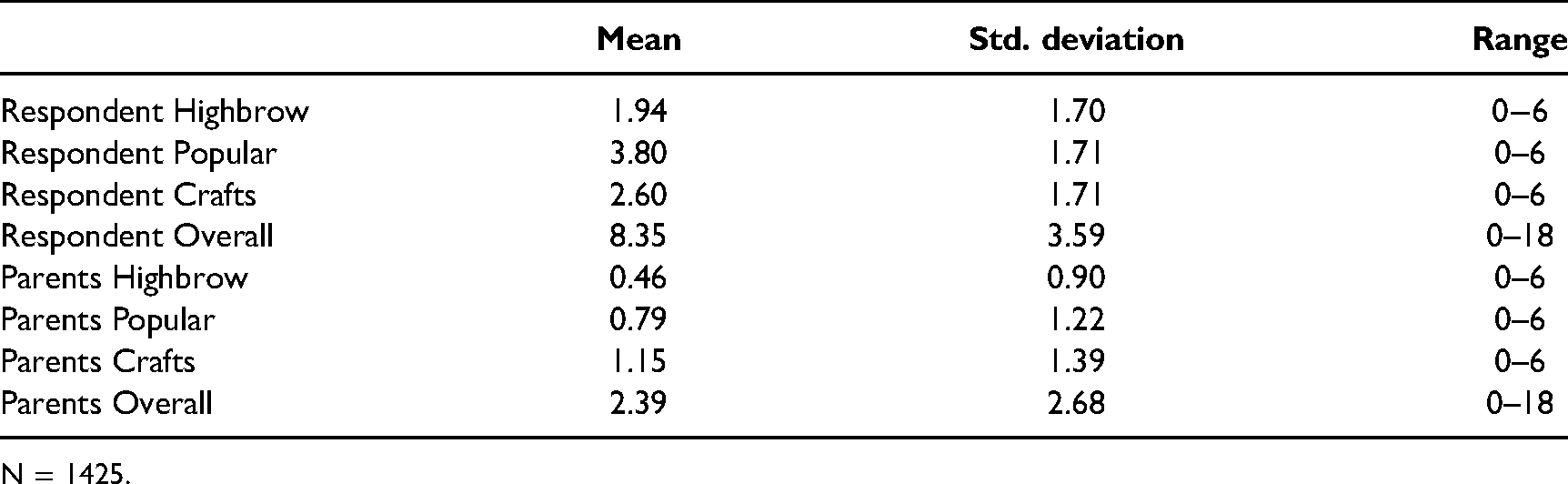
N = 1425.
To analyse the intergenerational transmission of cultural orientations, I constructed variables measuring the respondents’ current cultural orientations that were symmetrical to the variables for the parents. That is, I took items measuring respondents’ current participation in the same activities that I had for their parents: these nine items and the variables constructed from them are in Table 1 (details in Appendix Table A1) and their distributions in Table 2. An LCA procedure was conducted for this set of activities and it showed that reading, going to classical music concerts, and visiting art galleries amounted to a highbrow orientation. Symmetrically, going to movies and rock concerts and practicing sports amounted to a popular orientation, and doing handicrafts, gardening and cooking added up to a crafts orientation. This is consistent with existing knowledge about contemporary Finnish cultural orientations.
The cultural orientations are not mutually exclusive for neither parents nor the respondents. On the contrary, the correlations between the parents’ activities (and orientations) were positive, as were the corresponding correlations for the respondent. That is, for both the parents and the respondents I observed the ‘cumulative nature of leisure activities’ (Allardt et al., 1958). This allows me to compose measures for overall participation (in these activities) for both the parents and the respondents by adding up the orientations. Because recent literature has considered that the volume of cultural participation is another key contemporary dimension of social stratification of cultural practices (e.g. Heikkilä, 2021; Miles and Sullivan, 2012; see also Peterson, 1992) I include the overall participation and its intergenerational transmission in the analysis. Due to lack of space I do not discuss cultural ‘omnivores’ (Peterson, 1992) theoretically in this paper, but noteworthily the overall participation might be interpreted as a measure of omnivorousness in Finland (Purhonen et al., 2010).
There is a clear difference in the distributions between the parents’ and respondent's orientations, as the parents tend to have lower scores in all variables (Table 2). This could have been expected, as the questions regarding parents enquired about regular joint participation. First, if the respondents participated in several activities during their childhood, they probably participated in only some of them regularly with their parents. Second, it seems unlikely that parents took their children to all the activities they participated in, so these variables likely measure only part of parents’ total activity. A third factor contributing to the difference is that the younger generations have more free time and likely face wider supply of activities than their parents, so they may be culturally more active than their parents.
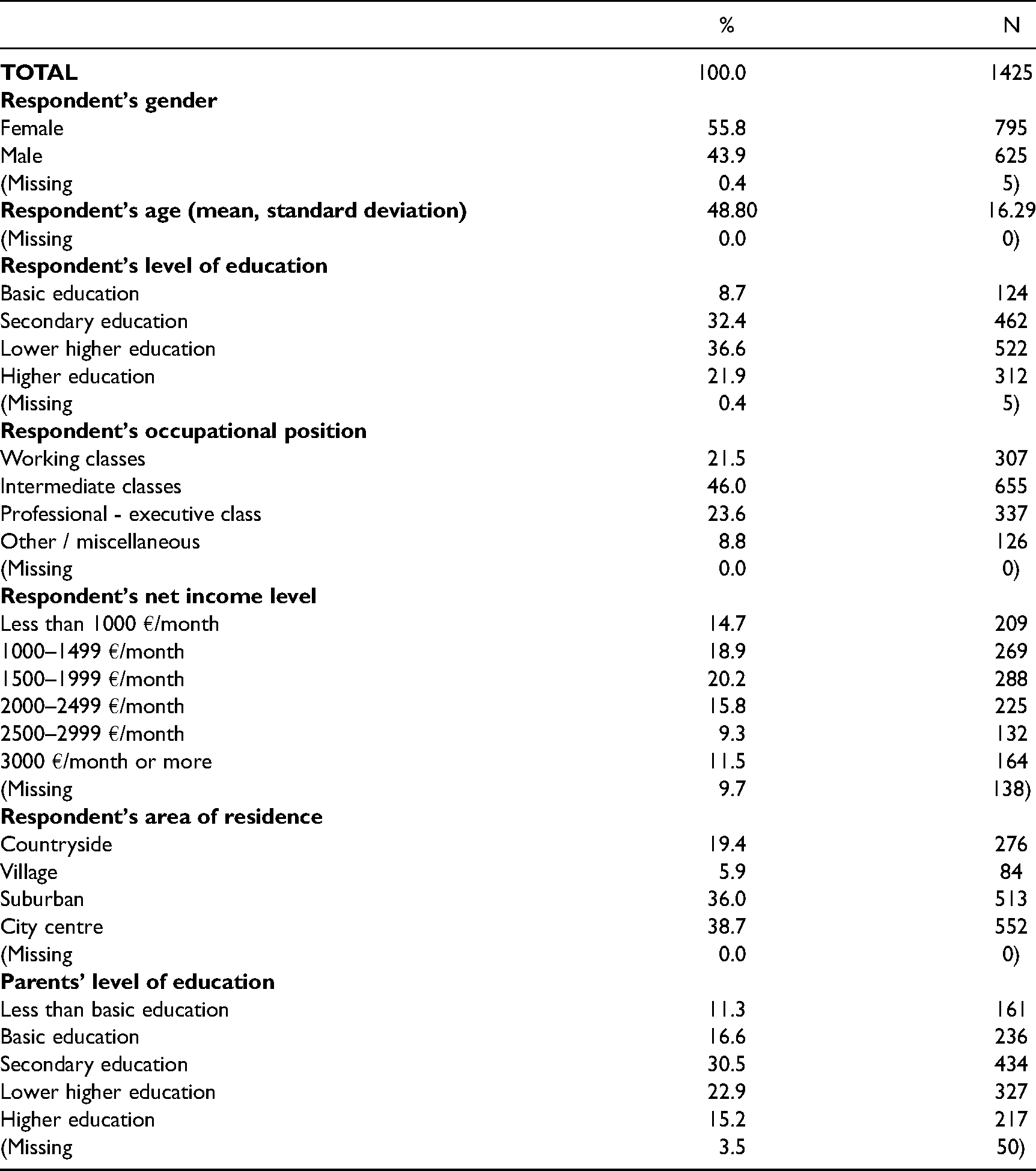
The questionnaire produced a standard set of indicators regarding the respondents’ gender, age, education level, occupational position, income level, area of residence and parents’ education level (operationalised here as the maximum of father's and mother's education levels). These factors influence Finns’ cultural practices, so I control for them in my analyses (see Appendix Table A2 for their distributions).
Methods
I have four dependent variables: the three variables measuring the respondents’ cultural orientation and the overall participation. The distributions of variables for respondents’ highbrow orientation and crafts orientation follow approximately Poisson distribution and the variables’ values are non-negative integers, so I use Poisson regression (Cameron and Trivedi, 2013; Dunteman and Ho, 2006). Respondents’ popular orientation is somewhat underdispersed for the Poisson model, but when the variable's scale is inverted, the Poisson requirements are met. Thus, for methodological simplicity, instead of participation, I model non-participation in the case of popular orientation. I report parameter estimates and Wald chi-square statistics to assess the variables’ explanatory power, and chi-square tests for the models.
The respondents’ overall participation meets the assumptions of general linear regression. Hence, it will be modelled using general linear model (GLM). Recalling direct linear combination of the cultural orientations, it is not possible to enter that variable into the regression models simultaneously with the cultural orientation variables. Thus, for each respondent's cultural orientation, I need two models: one that has all the parents’ cultural orientation variables except overall participation (Models 1) and one that has only overall participation but none of the orientation variables (Models 2).
Analysis and results
The results are presented in the following manner: first the basic correlations (with no controls) as this shows the symmetricity of transmission in the simplest way (Table 3). Then I present the results of the Poisson regressions (Table 4) which show that the symmetricity prevails under controls. These results leave me with an apparently peculiar result that parents’ crafts orientation influences positively not only the respondent's crafts orientation but highbrow and popular orientations too. This gains explanation after performing the GLM for the respondent's overall participation (Table 5) as the GLM shows that parents’ crafts orientation is the best predictor of respondent's overall participation. Thus, at the end of this section I can return to more nuanced interpretation of Table 4.
Correlations between the cultural orientations of parents and their children.
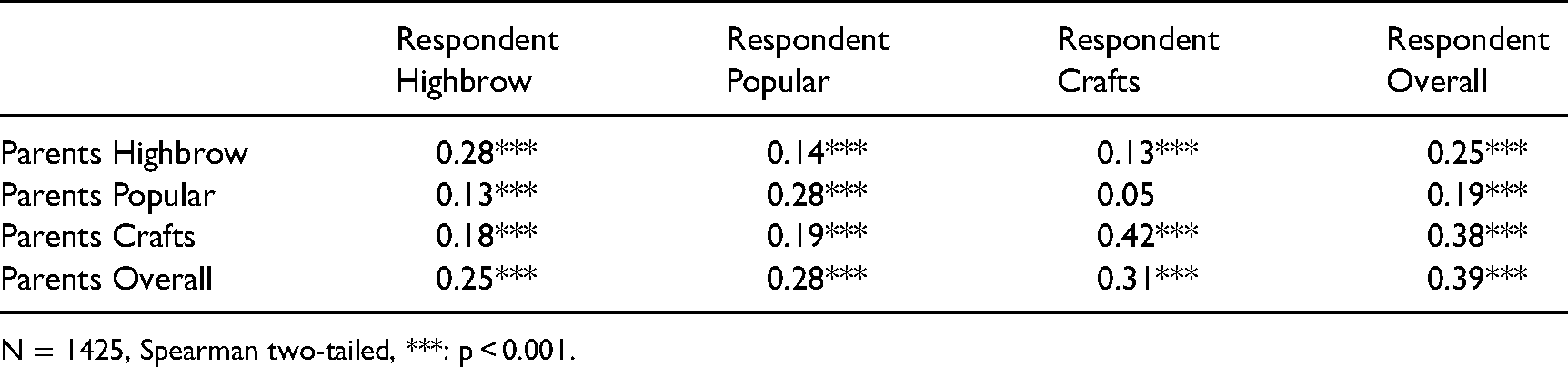
N = 1425, Spearman two-tailed, ***: p < 0.001.
Respondent's cultural orientation by parental orientations and socio-demographic controls (parameter estimates (exp(b)) and wald chi statistics from poisson regression).
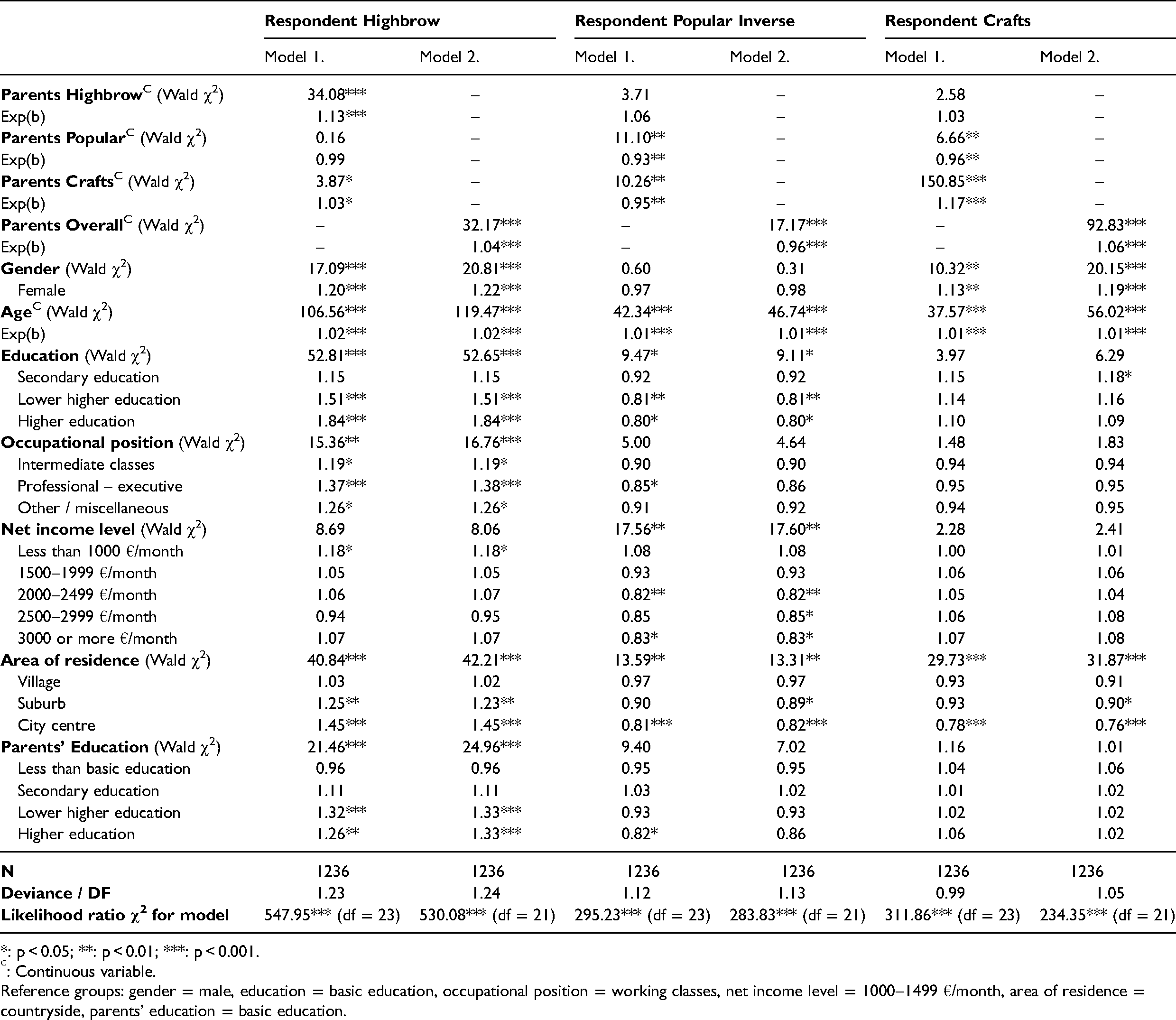
*: p < 0.05; **: p < 0.01; ***: p < 0.001.
: Continuous variable.
Reference groups: gender = male, education = basic education, occupational position = working classes, net income level = 1000–1499 €/month, area of residence = countryside, parents’ education = basic education.
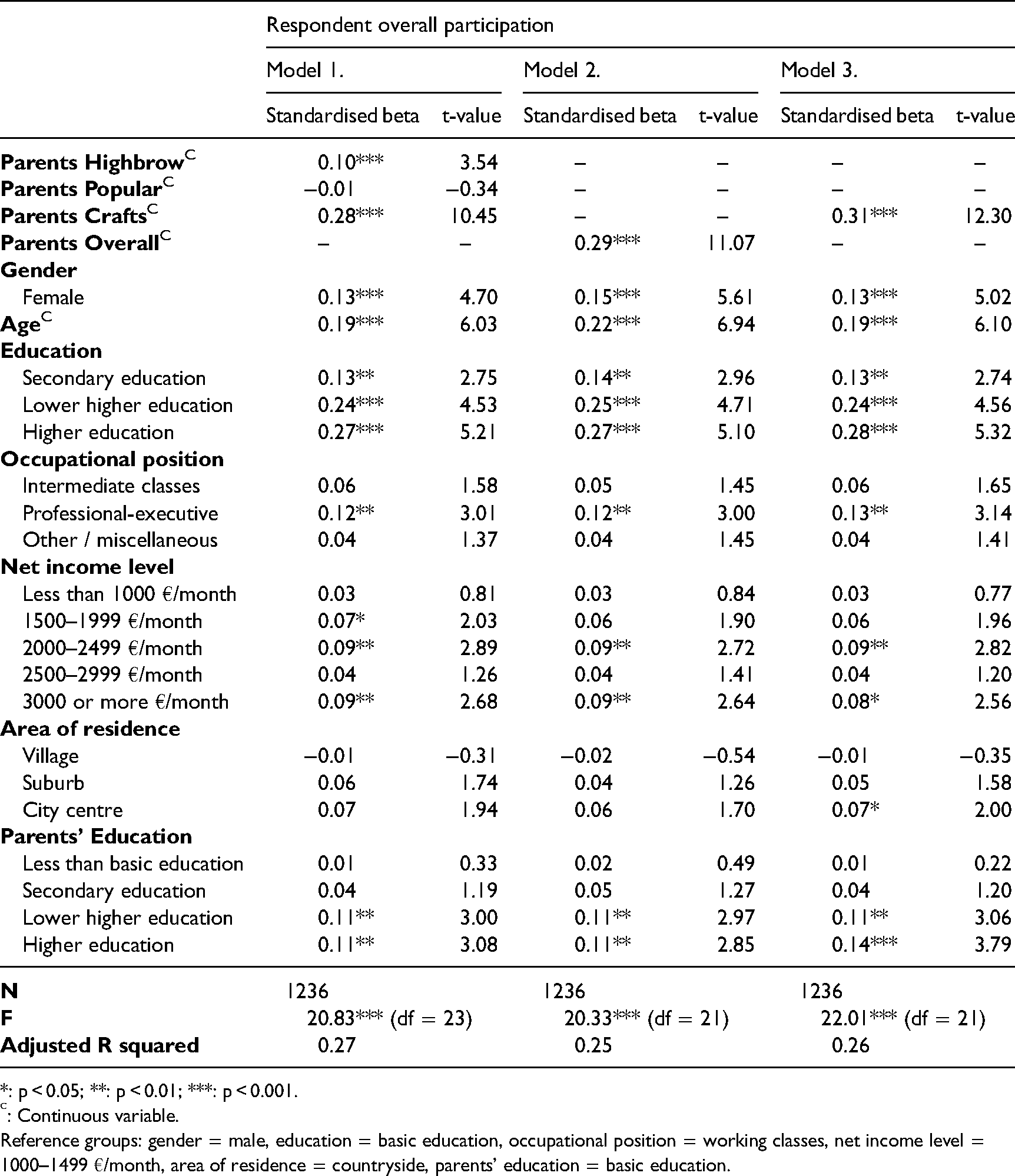
Respondent overall participation by parental orientations and socio-demographic controls (standardised parameter estimates and t-values from GLM).
*: p < 0.05; **: p < 0.01; ***: p < 0.001.
: Continuous variable.
Reference groups: gender = male, education = basic education, occupational position = working classes, net income level = 1000–1499 €/month, area of residence = countryside, parents’ education = basic education.
Correlations between the parents’ cultural orientation variables and those of the respondent are in Table 3. The strongest correlations are found at the matrix's diagonal between the same cultural orientations of parents and the respondent. Steiger's (1980) test (calculator by Lee and Preacher, 2013) confirmed that the coefficients between parent highbrow and respondent highbrow, between parent popular and respondent popular, and between parent crafts and respondent crafts are statistically different from the rest of the coefficients between different orientations (excluding overall participation, see below). Thus, the correlations suggest symmetric intergenerational transmission of cultural orientations in the sense that the strongest associations exist between the same orientations of parents and the respondent (correlations at the diagonal), while the other associations are much weaker and statistically indistinguishable from one another.
In addition to symmetric associations, all the correlations between parents’ and respondents’ cultural orientations are positive. Parents’ overall participation correlates highly with all the cultural orientations of the respondents, but this is explained to a large degree by it being a linear combination of the three orientations. Positive correlations nevertheless suggest that parents’ cultural participation in general increases their children's cultural participation, so that besides the orientations, cultural participation in general seems to be intergenerationally transmitted.
To assess whether these associations prevail after controlling for other, potentially underlying or mediating factors that influence cultural participation, and to assess the relative importance of each parental orientation, I used Poisson regression: these results for each respondent's cultural orientation are in Table 4. Recalling that respondents’ popular orientation has an inverted scale, the interpretations for that part were double-checked using cross-tabulations. Respondents’ overall participation is analysed using GLM, and these results are in Table 5.
In Table 4, Models 1 include the parents’ cultural orientation variables and Models 2 show the parents’ overall participation. Two main results emerge from Table 4 (Models 1). First, each of the respondent orientations is associated to a different pattern of parental orientations: respondent's highbrow orientation is increased by both parents’ highbrow and crafts orientations and unaffected by parental popular orientation. Respondent's popular orientation is increased by both parents’ popular and crafts orientations and unaffected by parental highbrow orientation. Finally, respondent's crafts orientation is increased by parents’ crafts orientation, decreased by parents’ popular orientation and unaffected by parents’ highbrow orientation. The second main result is that the parents’ cultural orientations retain their independent explanatory power for the respondent's symmetric cultural orientations under controls. This suggests that parents’ orientation has a lasting effect on respondent's cultural orientation in the sense that it influences their orientation regardless of education level, occupational position and other factors emerging later in life. Additionally, Models 2 show that the parents’ overall participation increases the respondent's participation in all orientations, and the parents’ overall participation also retains its explanatory power.
Like in Table 4, in Table 5 I have parents’ cultural orientations in Model 1, and parents’ overall participation in Model 2. The initial result is that parent's overall participation, under controls, retains its independent explanatory power for the respondent's overall participation. Notably, models 1 and 2 in Table 5 differ only little. Moreover, in Model 1, parents’ crafts orientation has relatively strong coefficient (0.28***), similar in magnitude to parents’ overall participation in Model 2. Thus, I re-ran the GLM, using only parents’ crafts orientation (with controls): these results are Model 3. Model 3 shows that dropping the parents’ highbrow and popular orientations changes the Model 1 only slightly (the main change being the small increase of parents’ crafts orientation's coefficient). Thus, Model 3 seems to be the best model for the respondent's overall participation. The main (final) result of Table 5 is, then, that parents’ crafts orientation is the best predictor of the respondent's overall participation. This is congruent with the results in Table 4, where parents’ crafts orientation increases the respondent's participation in every orientation.
Returning to Table 4, knowing that parents’ crafts participation increases the respondent's overall participation, what the table essentially shows is that after controlling for socio-demographic factors, the respondent's highbrow orientation is associated with parents’ highbrow orientation, popular orientation is associated with parents’ popular orientation and crafts orientation is associated with parents’ crafts orientation. Thus, the regression analyses support the idea about the symmetric transmission of cultural orientation. The negative association (coefficient 0.96**) between respondent's crafts orientation and parents’ popular orientation is a small sign that the respondent might be less likely to develop an orientation other than what their parents have, but the other parameter estimates suggesting this are not statistically significant.
Summarising the analysis, the symmetric associations between the respondent's cultural orientation and parents’ cultural orientation remain significant after controlling for other factors. Additionally, parents’ orientation to crafts is the best predictor of the respondent's overall participation. Controlled socio-demographic factors (Tables 4 and 5) have their own, previously known associations with the respondent's orientations, so I omit further discussion about them (for such discussion, see Purhonen et al., 2011 and Purhonen et al., 2014).
Discussion and conclusions
While research on cultural reproduction has focused mainly on the intergenerational transmission of highbrow culture, transmission of other types of cultural practices has recently gained ground. Drawing on nationally representative data, I show that in Finland, individuals’ cultural orientations are associated with the cultural orientations that they practiced in their childhood with their parents. This association is symmetric in that the respondent's orientation to highbrow culture has the strongest association with parents’ highbrow orientation, popular orientation with parents’ popular orientation, and crafts orientation with parents’ crafts orientation. Additionally, the respondent's overall cultural participation is associated with parents’ overall participation, with specification that parents’ crafts orientation is the best predictor of respondent's overall participation.
Symmetric associations suggest that the intergenerational transmission of cultural orientations in Finland is symmetric. Overall cultural participation is similarly intergenerationally transmitted. This conforms to the existing knowledge about cultural reproduction. While earlier research has studied the transmission of highbrow practices (Jaeger and Breen, 2016; Sullivan, 2011) and popular practices (Ter Bogt et al., 2011; Notten et al., 2012; Nagel and Lemel, 2019), this analysis adds a third dimension—mundane crafts. This broadens significantly the horizon of cultural reproduction analysis, because the importance of mundane culture has only recently gained attention in this field (Heikkilä, 2021; Leguina and Miles, 2017; Miles and Sullivan, 2012), and potential significance of parents’ mundane culture in encouraging offspring's overall cultural activity has escaped research attention to date. At general level, symmetricity of transmission underscores the need for research that analyses not only transmission of ‘high status cultural signals’ (Lamont and Lareau, 1988) but broader assemblages of practices and lifestyles.
The association of parents’ orientation to crafts with all the respondent's orientations can be understood from the perspective of cultural change. Since a large proportion of Finns have ‘agricultural roots’ and crafts are typical practices for the rural Finns (Eskola, 1976; Purhonen et al., 2014), the joint activities the agriculture-rooted respondents had with their parents likely had a strong crafts-element. Therefore, crafts with parents could have been common to both those respondents who adopted crafts and those who eventually abandoned crafts for other practices. If this interpretation is valid, then the intergenerational associations between parents’ crafts and respondent's orientations suggest Finnish cultural transformation at the level of individual cultural practices that is not captured by previous research.
There are two main limitations to this research. The first is the use of cross-sectional data, which prevents causal inferences. All causal inferences are, therefore, hypothetical. The second limitation is the reliance on retrospective data on part of the parents. Analyses in this field often rely on such data, and recommend caution against potential memory bias (e.g. Nagel and Lemel, 2019; Sullivan, 2011). My choice was to target regular joint activities (‘hobbies’) to both avoid overreporting random instances and to dismiss exact timing of practices. While I cannot ascertain the reliability of the memory data in any strict sense, memory data is usually the only way to access past experiences (Korkiakangas, 1996; Nagel and Ganzeboom, 2015). Nevertheless, potential memory effects should be recalled to avoid excessively strong interpretations.
For the research on cultural and social stratification in a society such as Finland, my results offer two perspectives for further research. First, this analysis offers a snapshot of cultural reproduction in Finland and shows that cultural orientations are transmitted from parents to their children—despite the fact that Finland is known for a relatively weak transmission of social position in general (Erola and Moisio, 2007; Sirniö et al., 2013). Thus, cultural reproduction may play a role in social reproduction in Finland, and it should be considered, for instance, in the analyses of rediscovered educational inequalities (Karhunen and Uusitalo, 2017). Second, there is a paradox in that Finland has experienced rapid societal changes since the 1950s, but research on transformation of cultural practices suggests slow change. This paradox calls for further research.
Footnotes
Acknowledgements
The author would like to thank Ossi Sirkka from Tampere University for his help with latent class analysis with R software. The author would also like to thank Semi Purhonen, Taru Lindblom, and Riie Heikkilä from Tampere University, and Koen van Eijck and his research team at Erasmus University Rotterdam for their valuable comments to the earlier drafts of this work. Finally, the author would like to thank the editors of Acta Sociologica and the anonymous reviewers for their constructive and helpful feedback.
Declaration of Conflicting Interests
The author(s) declared no potential conflicts of interest with respect to the research, authorship, and/or publication of this article.
Funding
The author(s) disclosed receipt of the following financial support for the research, authorship, and/or publication of this article: This work was supported by the Academy of Finland (grant number 309181).

Author biography
Appendix
The distributions of control variables used in the analyses.
| % | N | |
|---|---|---|
|
|
100.0 | 1425 |
|
|
||
| Female | 55.8 | 795 |
| Male | 43.9 | 625 |
| (Missing | 0.4 | 5) |
|
|
48.80 | 16.29 |
| (Missing | 0.0 | 0) |
|
|
||
| Basic education | 8.7 | 124 |
| Secondary education | 32.4 | 462 |
| Lower higher education | 36.6 | 522 |
| Higher education | 21.9 | 312 |
| (Missing | 0.4 | 5) |
|
|
||
| Working classes | 21.5 | 307 |
| Intermediate classes | 46.0 | 655 |
| Professional - executive class | 23.6 | 337 |
| Other / miscellaneous | 8.8 | 126 |
| (Missing | 0.0 | 0) |
|
|
||
| Less than 1000 €/month | 14.7 | 209 |
| 1000–1499 €/month | 18.9 | 269 |
| 1500–1999 €/month | 20.2 | 288 |
| 2000–2499 €/month | 15.8 | 225 |
| 2500–2999 €/month | 9.3 | 132 |
| 3000 €/month or more | 11.5 | 164 |
| (Missing | 9.7 | 138) |
|
|
||
| Countryside | 19.4 | 276 |
| Village | 5.9 | 84 |
| Suburban | 36.0 | 513 |
| City centre | 38.7 | 552 |
| (Missing | 0.0 | 0) |
|
|
||
| Less than basic education | 11.3 | 161 |
| Basic education | 16.6 | 236 |
| Secondary education | 30.5 | 434 |
| Lower higher education | 22.9 | 327 |
| Higher education | 15.2 | 217 |
| (Missing | 3.5 | 50) |