




Abstract
It is a matter of debate whether free school choice should lead to higher or lower levels of school segregation. We investigate how school choice opportunities affect school segregation utilizing geocoded Swedish population register data with information on 13 cohorts of ninth graders. We find that local school choice opportunities strongly affect the sorting of students across schools based on the parents’ country of birth and level of education. An increase in the number of local schools leads to higher levels of local segregation net of stable area characteristics, and time-varying controls for population structure and local residential segregation. In particular, the local presence of private voucher schools pushes school segregation upwards. The segregating impact of school choice opportunities is notably stronger in ‘native’ areas with high portions of highly educated parents, and in areas with low residential segregation. Our results point to the importance of embedding individual actors in relevant opportunity structures for understanding segregation processes.
Introduction
Sociologists have a longstanding interest in how structures constrain and enable patterns of sorting by sociodemographic dividers. In segregation processes, desires and subsequent mobility choices shape the distribution of groups across settings, which in turn shape the structural conditions of everyday life. In this article, we hypothesize that such individual desires are expressed in dialogue with local sociodemographic contexts and opportunity structures in the process generating school segregation, and test our predictions using Swedish population register data. Structural opportunities to segregate vary across time and space, and schools provide us with a clear-cut illustration of how such variation gives rise to variation in segregation across time and space.
There is a substantive body of research investigating the effects of school segregation, typically by examining how school composition affects some individual level outcome such as school achievement, delinquency, or employment (Benito et al., 2014). In this stream of research, the structural conditions that give rise to the selection process leading to an unequal distribution of population groups across schools are usually treated as a nuisance to be netted out in the estimation of the composition effects in focus. Fewer studies have examined the process behind the distribution of students across schools, and this study helps to fill this gap.
A global trend of increasing school choice opportunities for parents (Musset, 2012) has endowed them with rights to make independent choices regarding where their children will be educated. Concerns are often voiced about the potentially segregating effects produced by free school choice. If choice opportunities are disproportionately exploited by more privileged parents and their children, the positive peer effects experienced by less advantaged students may be diluted, and social integration is hampered. Defenders of school choice policies instead argue that, in addition to empowering parents, they may be seen as a means of counteracting the school segregation that results from residential segregation, because such policies provide access for disadvantaged children to better schools outside their deprived neighbourhoods (Archbald, 2004).
We analyze how such choice opportunities affect the sorting of students – by country of birth and their parents’ education – across schools. The context of our study is Sweden, which has a voucher system that gives parents a more or less free choice of schools, at no cost, subject to the availability of study places at schools. Our analytical strategy exploits the fact that choice opportunities vary greatly over time and space. We contribute to current research by (1) empirically testing the importance of opportunity structures for analysing the sorting of individuals across contexts and (2) providing a stringent test of whether and how local school choice opportunities affect local school segregation levels, and how these effects are contingent upon the local availability of alternative school forms, local area population composition, and local area segregation.
School choice policies as opportunity structures for segregation
It is a matter of debate whether free school choice should lead to higher or lower levels of segregation. Proponents of free school choice policies argue that it creates access for disadvantaged (i.e. minority or low-class) children to better schools outside their deprived neighbourhoods. Therefore, increased choice should lead to decreased school segregation (Archbald, 2004; Epple et al., 2017). This liberation model of school choice, in which school choice is seen as a means of counteracting residential segregation, together with ideological developments that favour the New Public Management paradigm of promoting market-like competition in the public sector (see Björklund et al., 2006) has guided policy makers in most Western countries for the past couple of decades (Musset, 2012).
However, there are reasons to believe that applying free school choice rather than school allocation mechanisms based on, for instance, geographical proximity, might both mitigate and exacerbate segregation, depending on the design of the system used to choose schools (cf. Archbald, 2004; Elacqua, 2012). Contrary to the assumptions of the liberation model, more affluent majority-group parents are generally more likely to exercise an active school choice and opt out of their local school, if they are given the opportunity to do so (Musset, 2012; Saporito and Sohoni, 2006). Such segregating effects of free school choice are also likely to be exacerbated if schools are allowed to employ hurdles to entrance, such as interviews, admission tests or waiting lists, or to charge tuition fees (cf. Elacqua, 2012). For this reason, diversity goals are often integrated into school choice reforms (Archbald, 2004; Saporito and Sohoni, 2006). Unfettered school choice, without any form of requirement to balance school composition with regard to the background of the children attending, tends to increase segregation (Miron et al., 2013).
What kind of schools do parents want?
In order to understand the impact that the availability of school choice has on segregation levels, it is important to understand the micro-level preferences of parents choosing schools for their children. A few stylized facts may be discerned from the research, which shows that parents typically prefer (i) schools located close to their home, (ii) schools that have an appropriate peer composition, and (iii) ‘high achievement’ schools, as reflected in average test scores or average grades (Burgess et al., 2015; Hastings et al., 2005).
With regard to the relative weight given to peer composition and school quality, research tends to show that peer composition is the more important factor for school choices, but there are important nuances in this pattern. Mean school achievement is a joint function of the value added by school effectiveness and effects associated with student selection into schools, with the latter accounting for the larger part of variance (Luyten et al., 2005). A parent interested in the learning development of their child should weigh in some kind of value-added measure of school effectiveness in addition to school composition. However, a number of studies demonstrate that this dimension does not appear to influence parents’ school choices (see for instance the review in Black and Machin, 2011), even when such information is publicly available (Mizala and Urquiola, 2013). If academic achievement enters the calculation of parents, it typically does so in the form of mean school achievement, which correlates strongly with school socioeconomic and ethnic composition. Most studies, however, show that the social composition of schools is more important for school choice than the schools’ achievement level as such (see Billingham and Hunt, 2016; Fiske and Ladd, 2000; Kallstenius, 2010; Renzulli and Evans, 2005; Saporito and Lareau, 1999; exceptions include Borghans et al., 2015; Burgess et al., 2015). Because of the strong correlation between these two dimensions, parents probably find it difficult to distinguish between them, or use one as an indicator of, or even an excuse for, the other, as when concerns about the social composition of schools are apparently masked as concerns about school quality (Malmberg et al., 2014). Parents might also engage in a two-stage decision process, where schools with a large presence of out-group(s) are first screened out, with other school factors only being taken into consideration subsequent to this initial sorting (see Saporito and Lareau, 1999).
There also appears to be a considerable degree of heterogeneity in parental school preferences and in how parents define a preferred peer composition. The preference for high-performing schools is stronger among high income/high-SES parents (Borghans et al., 2015; Burgess et al., 2015; Hastings et al., 2005). The relative weight placed on homophily versus high performance also appears to vary between socio-demographic groups. Majority middle-class parents do not face a trade-off between composition and school quality, but the situation is different for minority parents. In the U.S. context, some research suggests that minority families tend to prioritize homophily at the expense of the school's performance levels (Hastings et al., 2005), thus manifesting a desire for similarity that outweighs the performance level of the school.
Institutional context: Sweden
The context of our study is Sweden, which in line with most western countries has moved towards a system with increasing school choice opportunities for students and their parents, encouraging competition between schools. The Swedish school system is compulsory for nine years, and students usually finish the final ninth grade the year they turn 16. 50 percent of all schools that have ninth graders have the full range of compulsory school grades (1–9) whereas the other half have grades 6/7–9 or (less common) 4 to 9 (Holmlund and Böhlmark, 2017). In 1992, Sweden moved from a system with virtually no choice and no private alternatives, to a Tiebout model voucher system that allowed parents to place their children in any public school in the municipality (subject to space limitations), or a privately run, but publicly funded school (Björklund et al., 2006). Schools do not face any kind of requirement to balance the school composition with regard to the background of the children attending. The proportion of students enrolled in private voucher schools (‘independent schools’) has increased steadily since the reform. During the observation period for the present study, 2000 to 2012, this proportion increased from 4 percent to 13 percent (Swedish National Agency for Education, 2019).
The Swedish voucher system does not target vouchers at particular groups, and it is similar to the school choice systems in place in Chile, Denmark, Holland and New Zealand (Epple et al., 2017). 88 percent of all students in private voucher schools at compulsory level follow the same general curricula as the public schools, whereas the remaining percentages attended confessional- or Waldorf schools (Friskolornas riksförbund, 2019). Swedish private voucher schools should be distinguished from ordinary private schools as they are not financed in any way by fees paid by parents but must accept the school voucher as payment in full (Lindbom, 2010). For-profit companies operate the majority of private voucher schools (Swedish National Agency for Education, 2014). Although all schools must be open to anyone who applies, private schools are incentivized to attract high-ability students, and may influence the pool of applicants by locating in areas with certain socioeconomic or ethnic profiles, and targeting information at specific groups of parents (see Jennings, 2010 for a U.S. case). Swedish private schools tend to locate in more densely populated municipalities, in areas with high portions of students with highly educated parents, and in areas with higher-than-average proportions of immigrants (Edmark, 2019).
Swedish parents who actively chooses schools are more likely to be highly educated, employed, and native-born (Bunar and Kallstenius, 2006). If there is a high proportion of immigrants (natives) in an area, natives (immigrants) tend to place their children in private voucher schools (Holmlund et al., 2014). Andersson et al. (2012) found similar school choice patterns: Natives chose more distant schools as the neighbourhood fraction of immigrants, or the neighbourhood fraction of families on social assistance, was high.
The few studies that have investigated the effects of school choice on school segregation in Sweden have found it to produce modest increases in ethnic segregation, but smaller or zero effects have been observed for socioeconomic segregation. Lindbom (2010) compared the actual distribution of students to that which would have emerged had the proximity principle been used. He found increased residential segregation to be the main cause of the increase in ethnic school segregation noted during the study period. School choice also contributed to increased ethnic segregation, but only marginally. Socioeconomic school segregation was not affected by increased school choice. Yang Hansen and Gustafsson (2016) used a similar approach and compared the development of actual school segregation to proximity-based counterfactual school segregation levels, concluding that school choice dynamics had increased ethnic school segregation, but that socioeconomic school segregation had not been affected. Similarly, Böhlmark et al. (2016) found that the increase in ethnic and socioeconomic school segregation between 1988 and 2009 could for the most part be explained by a parallel increase in residential segregation, but that it was also in part a consequence of school choice dynamics.
Empirical strategy
One potential problem when analysing how the school choice system affects school segregation is that it is hard to find a counterfactual, to suggest what levels of school segregation we would have witnessed if the opportunity structure was more restricted than it is today. The basis of our analytical strategy is therefore that even in a system based on free school choice, such as Sweden's, the actual opportunity structure vary over time and space. Within a given area, it is quite common for schools to open and close down, and in doing so they contribute to changing the landscape of choice opportunities available at the area level. To examine the impact of school choice opportunities on segregation levels, we exploit this variation.
We operationalize the local opportunity structure as the number of available schools to choose from in local areas of a given size. With this approach, we may assess how groups of schools that are competing for the same stock of students are affected by an increase, or decrease, in the availability of alternative schools to choose among. Since cause and effect is likely to operate at the local level, we focus on changes within local school areas of rather small size (3.2 km in diameter, see below), but our results are robust also to larger area definitions (11.2 km in diameter).
Empirical expectations
Given that parents’ tend to prefer to have their children attend schools with ‘similar’ or ‘high-status’ children (e.g. Böhlmark et al., 2016; Saporito and Hanley, 2014; Sikkink and Emerson, 2008), we hypothesize that when given the opportunity to separate their children from ‘others’, a non-negligible portion of parents will exploit this opportunity, which leads us to the following empirical expectation: When the number of schools in an area increases, school segregation increases (Hypothesis 1)
Placing a child in a non-public school is always an active choice compared to the default option of placing your child in the closest available public school, which is where the child is placed by the municipality in the absence of any action on the part of the parent. In other words, parental desires and beliefs should come more into play in relation to the placement of children in private voucher schools compared to their placement in public schools (see Fiel, 2015). The empirical expectation is therefore: When the number of private voucher schools increases, school segregation increases more as a consequence, compared to when the number of public schools increases (Hypothesis 2).
We further hypothesize that the segregating impact of an increase in the choice set depends on the socioeconomic and ethnic composition of the (area) context in which these choices are made. In order for a change in the choice set to impact school segregation, there must be a certain portion of parents who are ready to move their children from their current school, and this group of parents must differ, ethnically or socioeconomically, from other parents who are not ready to move. We therefore expect that the segregating effect of increases in the number of schools is larger in school areas that composition-wise deviate from the general Swedish population (Hypothesis 3), i.e., school areas where sizeable portions of parents find themselves to be in a local minority, or at least to have fewer in-group peers than would be expected on the basis of population averages. Smaller, or zero effects, are expected in areas that are representative of the population.
The tendency to segregate is further likely to be stronger among ‘high-status’ groups (e.g. Böhlmark et al., 2016; Saporito and Hanley, 2014; Sikkink and Emerson, 2008). Groups that are perceived by themselves and by others as ‘high-status’ should be more inclined to uphold social boundaries, and therefore want to avoid having their status contaminated by being physically proximate to ‘low-status’ groups (cf. Bursell and Jansson, 2018). We therefore expect the segregating effect of increasing the number of schools is larger in areas where the ‘high-status’ groups are in a minority position, compared to areas where the ‘low-status’ groups are in a minority position (Hypothesis 4). Minority position may be relative; what is important is whether groups are underrepresented relative to their proportion of the Swedish general population.
In a final step, we test a corollary of the fact that we should expect stronger latent desires to segregate in areas with ‘too much’ mixing of people belonging to different groups. Because of various local parameters – e.g., housing heterogeneity, physical boundaries –areas differ with regard to their residential segregation. In areas with low residential segregation, we may tentatively expect groups to have a stronger latent desire for more segregation (cf. Olzak et al., 1994). In areas with high residential segregation, we expect such desires to be weaker, or perhaps even reversed, implying a desire for more mixing (see Granovetter and Soong, 1988). We test this hypothesis by comparing school segregation effects across areas with different levels of residential segregation. If our hypothesis holds true, i.e., if school choice has the kind of segregating effects hypothesized, the segregating effect of increasing the number of schools is larger in areas with low levels of residential segregation, compared to areas with high levels of residential segregation (Hypothesis 5).
Data and variables
We utilized Swedish population register data for the years 2000 to 2012, including all students who finished the ninth grade in any of these years. To these individuals, we linked geocoded data on where they lived, unique identifiers of their schools, the location of their schools (with 100 by 100 square metre accuracy), and data on their social and ethnic background.
School areas
To examine how our measure of the opportunity structure of school segregation – the availability of school choice in school areas – independently affects school-area segregation levels, we need first to define school areas that do not change over time. We have operationally defined school areas by specifying each school with ninth graders as a focal centroid school in a school area that consists of this school and all other schools located within the same municipality and within a distance of 1.6 km from the focal school. Our school areas are thus 3.2 km in diameter (which produces an area of about eight square kilometers). Schools within such an area are highly likely to compete for the same stock of students, because almost all children choose to go to schools within their home municipality (Statistics Sweden, 2017), and because 1.6 km is the median ninth grader home-to-school travel distance. Depending on the municipality, four to five kilometers is usually considered the maximum home-to-school walking distance for students in ninth grade (this is the cut-off used in decisions on eligibility for publicly funded transportation). As a robustness check we used school areas that were 11.2 km in diameter (5.6 km is the 75th percentile home-to-school travel distance for ninth graders), with very similar results to those reported below (see Supplemental Figure 1).
Our operational definition of school areas implies that areas can overlap such that one school may belong to more than one school area. To obtain unbiased estimates and standard errors, we weighted observations (school areas) with the inverse of the average number of school areas in which the schools in the given school area appeared. In order to obtain meaningful measures of school segregation, school areas are only included in our analytical sample in years in which they contained at least two schools. Schools that in a given year were found to be ‘isolated’ – i.e., did not have a neighbouring school within the 1.6 km cutoff, were excluded from the analytical sample. The sample includes 1137 school areas, with an average of 3.5 schools per area. In total our data covers 53 percent of all schools in Sweden, with a slight overrepresentation of urban areas. In Stockholm county, 66 percent of all schools are included. The average number of 9th graders in a school area is 285. Figure 1 plots our school areas across Sweden and exemplifies by zooming in the municipality of Norrtälje.
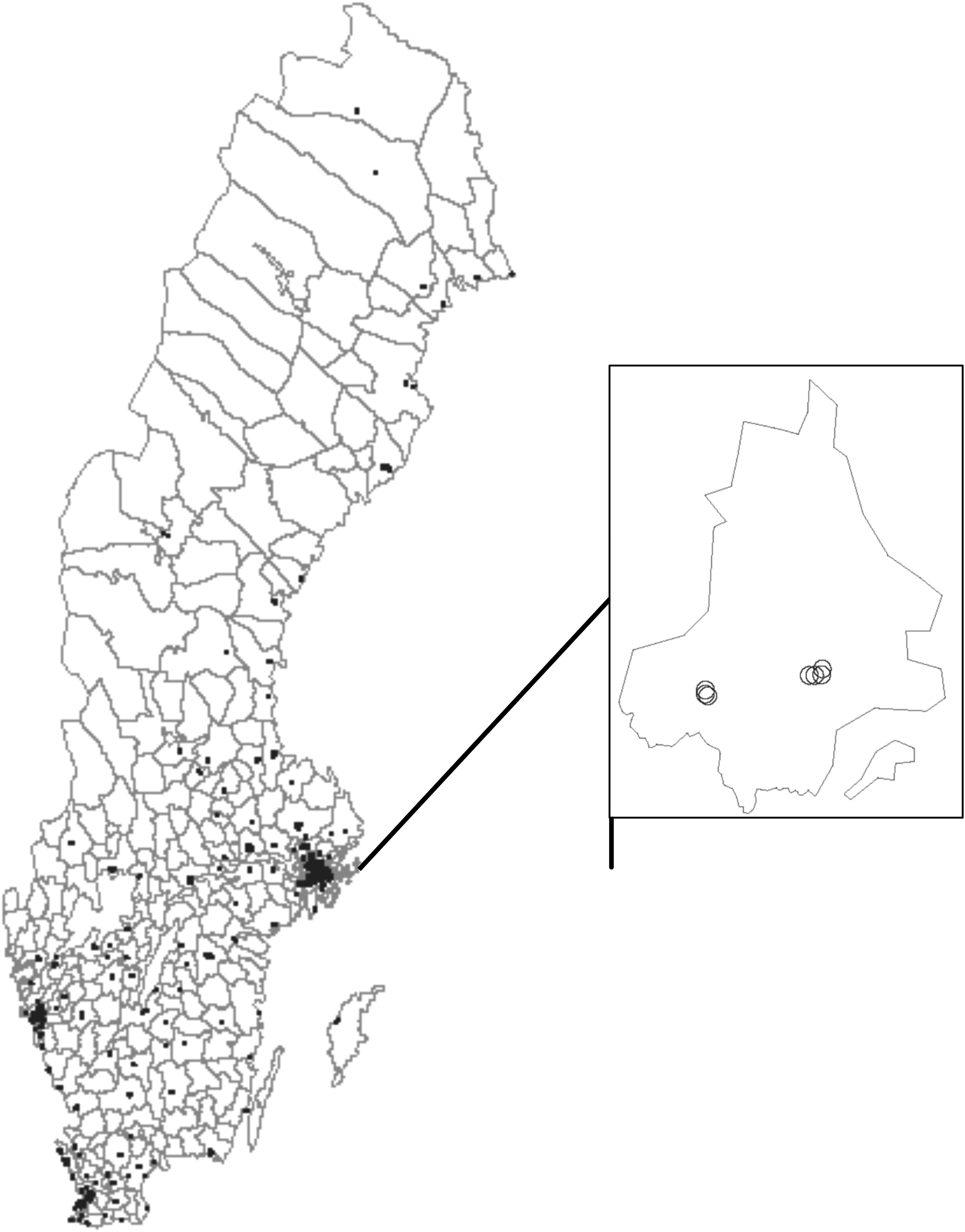
Distribution of school areas across Sweden in 2012, including close-up of school areas in Norrtälje municipality.
Individual level variables
We examined local school segregation across two dimensions: immigrant status and parents’ education. For Immigrant status, we distinguished between (1) foreign-born to two foreign-born parents and (2) others. The ‘native’ population includes all children who were born in Sweden, including Swedish-born children of immigrants, and a (small) group of foreign-born children with one or two Swedish-born parents. For Parental education level, we distinguished between (1) children whose parents had at most upper secondary education, and (2) children whose parents had at least some post-secondary education.
Segregation measurement
Using a segregation measure that is robust to the size distribution of schools as well as the size of the minority share is important because the addition of a school to a school area may simply decrease the average number of students across schools in the area – thereby increasing the upward bias in standard measures of segregation (Carrington and Troske, 1997). First, we calculated the Duncan dissimilarity index (Duncan and Duncan, 1955) for school area j at time t as
Analytical strategy
To properly understand how school segregation is maintained and changed by the interplay between parental desires and the opportunity structure, we focus our attention on those instances when the number of schools in an area changes. An important problem here is that changes in the number of schools in an area do not occur randomly. Areas with an increasing number of schools are likely to be located in areas with population growth – usually urban areas with universities – while areas with a decreasing number of schools are likely to be situated in areas with population decline – usually smaller towns and rural areas. We address this endogeneity issue by adopting an area fixed effects approach, differencing out all time-constant area-specific factors that may affect school segregation. In effect, we follow areas over time to observe whether changes in the availability of school choice are accompanied by changes in school segregation in these areas, holding all stable area-specific factors constant. Because private and public schools are substitutes and compete for the same student base within areas, their effects should not be analysed in isolation. For this reason, we have estimated the effect of increasing the number of one type of school conditional on the number of schools of the other type:

Note that our analytical strategy requires that all time-varying characteristics that can impact both the number of private and public schools and segregation levels are properly adjusted for. The model's area fixed effects absorb time invariant observed and unobserved heterogeneity, whereas the time-varying covariates absorb observed time-varying heterogeneity. What is left is then time-varying unobserved heterogeneity, and the assumption needed (if the reader wants to interpret the estimated effects as causal) is that this type of heterogeneity is ignorable. We control for five important time-varying residential characteristics: ethnic segregation, educational segregation, the number of ninth graders living in the area, the share of ninth graders living in the area who has immigrant background, and the share of ninth graders living in the area whose parents have a post-secondary education.
Residential areas are defined based on a common neighbourhood definition accessible in Swedish registers, SAMS-areas (Small Area Market Statistics), which on average include around 1000 residents. All SAMS-areas which have their geographical centroid within the boundaries of the school area are included in these measures, and residential segregation is calculated across all SAMS-areas belonging to the same school area.
It should be noted that the empirical model is generic describing in (linear) terms what we are up to in the empirical analysis, and the way the parameters in this generic model relate to the hypotheses. When we actually test the hypotheses we however do this with ordinal variables treated as categorical variables.
As a robustness test, we estimated a lagged outcome model (without the school area fixed effects). Results were very similar to the fixed effects estimates reported in the article. These results are available upon request.
We report descriptive statistics in Table 1. Table 2 includes the distribution of private and public schools across school areas over the studied period. It should be noted that only areas with at least two schools have been included in the analytical sample, giving us three structural zeros in the combination of public and private schools (see Table 2). In our multivariate analyses, areas with zero private schools and two public schools are treated as the reference category as this is the most common area type in the data.
Descriptive school area-years statistics, 2000–2012.
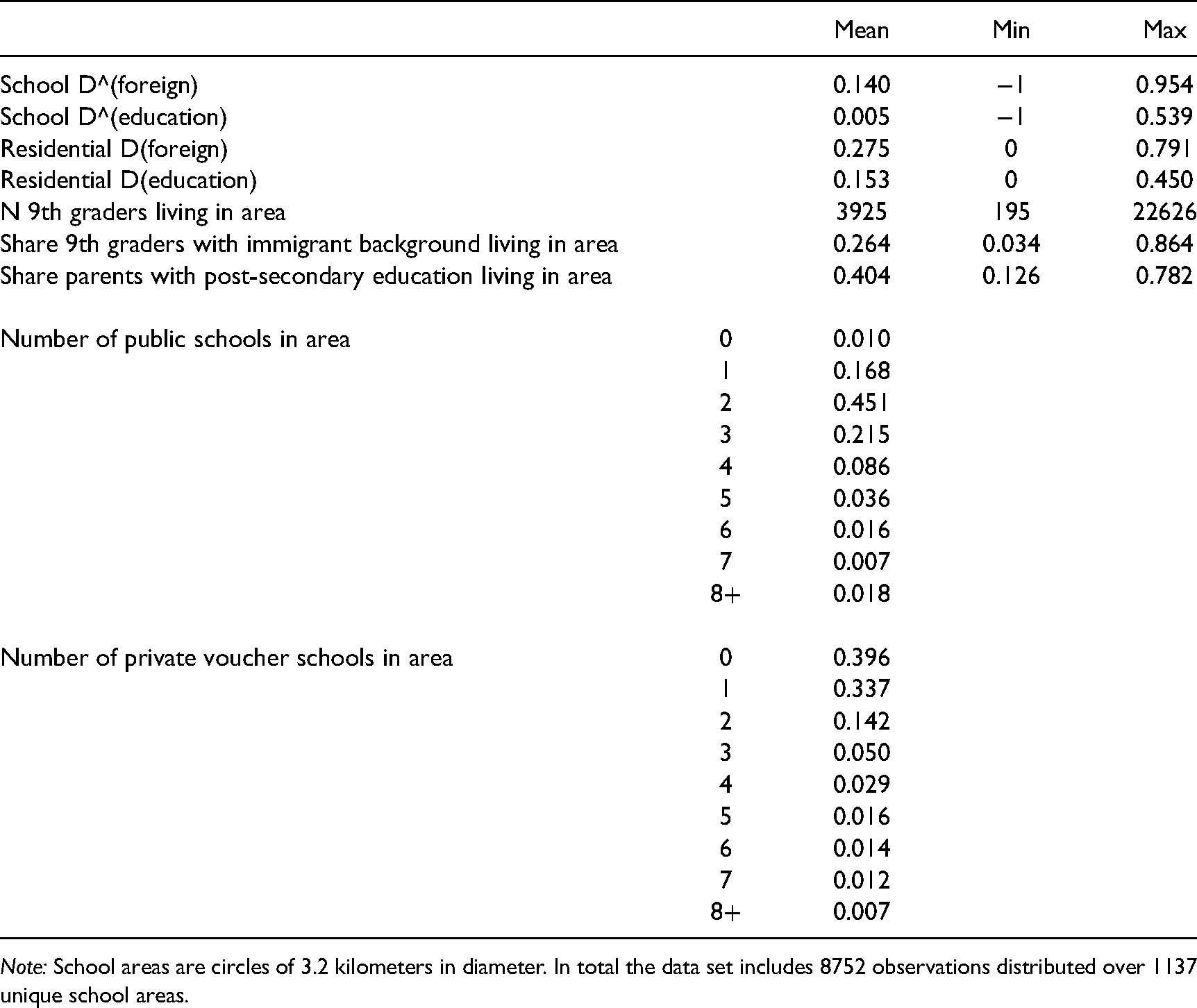
Note: School areas are circles of 3.2 kilometers in diameter. In total the data set includes 8752 observations distributed over 1137 unique school areas.
Distribution of private and public voucher schools across school area-years, 2000–2012.
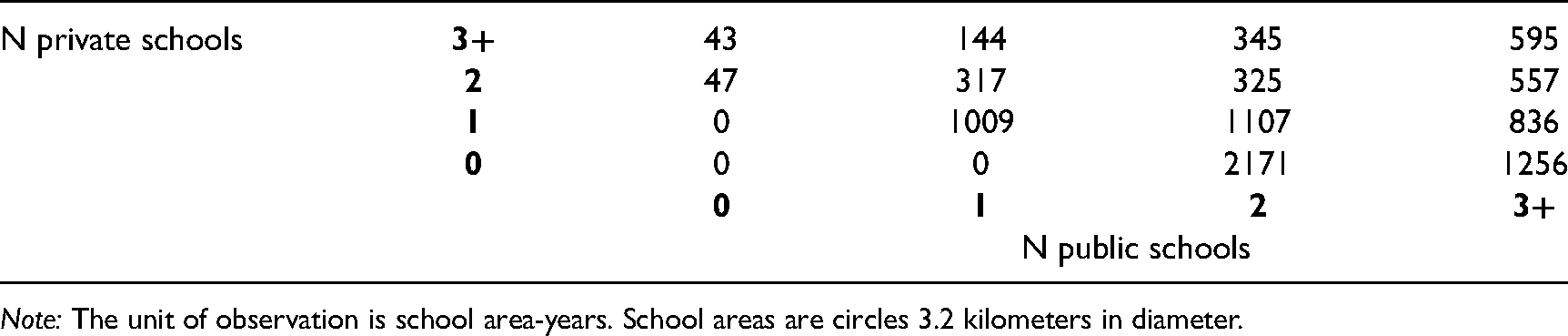
Note: The unit of observation is school area-years. School areas are circles 3.2 kilometers in diameter.
Results
First, we examine whether there is an association between our measure of the general opportunity structure for school segregation, the number of schools within a school area, and segregation levels in the same area. In Table 3, we present estimates from the number of private and public schools, and compare (1) a model containing the main effects of the number of private and public schools, and (2) an interacted model (the estimates for the full set of control variables can be found in Appendices 1 and 2, Model 2). From Model 1, we note that whereas the number of private schools is statistically significantly associated with segregation levels, no such statistically significant association can be found for the number of public schools. The joint effect of the interaction terms between the number of public and private schools (Equation 1) is significantly different from zero, for both types of segregation studied (p = 0.000), implying that the effect of adding or removing a school is strongly dependent on the presence of other schools, and the type of schools, in the area.
Number of public and private schools in school areas and their level of segregation (
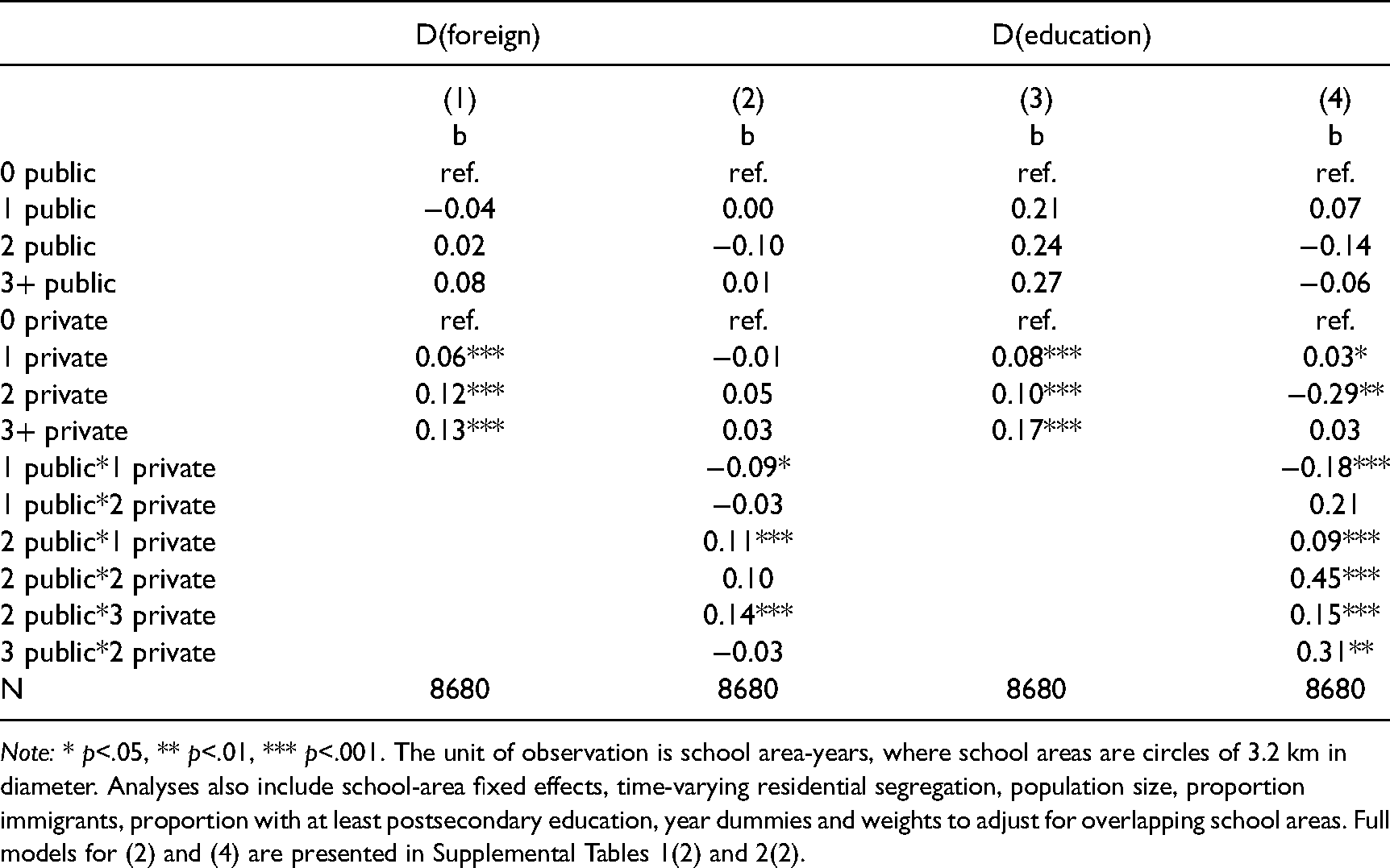
Note: * p<.05, ** p<.01, *** p<.001. The unit of observation is school area-years, where school areas are circles of 3.2 km in diameter. Analyses also include school-area fixed effects, time-varying residential segregation, population size, proportion immigrants, proportion with at least postsecondary education, year dummies and weights to adjust for overlapping school areas. Full models for (2) and (4) are presented in Supplemental Tables 1(2) and 2(2).
We present a summary of the most important results in Figure 2, which describes the combined effect of changes in the number of public and private schools in a school area on
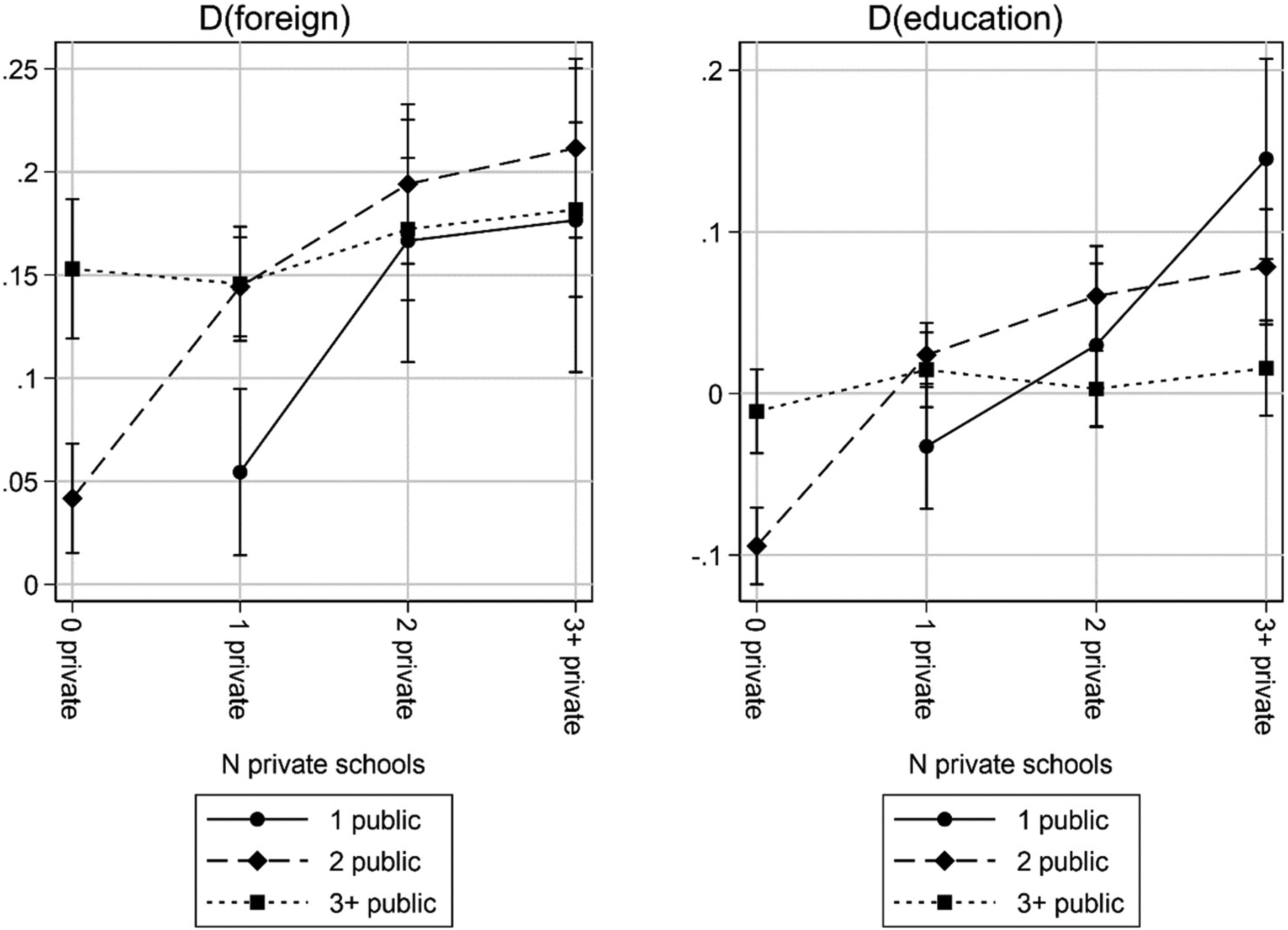
Number of public and private schools in school areas and their level of segregation (
There is a positive association between changes in the number of private schools in an area and changes in the level of ethnic school segregation in the same school area. The higher the number of schools, the higher the level of ethnic segregation becomes, but there are clear tendencies of saturation in the effect of adding yet another school to an area. If an area with two public schools (dashed line) goes from zero to one private school, this is accompanied by ethnic segregation getting about 10 percentage points closer to a state of maximum segregation. Going from two to three public schools in such an area moves ethnic segregation in a very similar way, about 11 percentage points closer to a state of maximum segregation. The impact from an increase in the number of private schools is contingent on the number of public schools in the area. In areas with many public schools (dotted line), the addition of private schools has a rather modest effect, whereas in areas with just one or two public schools, the impact is much greater (solid and dashed lines). Also, in areas with two public schools, the impact is greater when an area moves from zero to one private school than when it moves from two to three or more private schools. An increase in the number of public schools also impacts segregation levels, but mainly when there are zero or only one private schools in the area. In order to check that our results do not stem from an inflow from students from outside the school area when a new private school opens, we re-estimated our models excluding all newly established schools from the segregation measurement, with equivalent results (see Supplemental Figure 2).
These patterns are rather similar for school segregation by parental education level. Going from zero to one private schools in an area with two public schools (dashed line) is accompanied by an increase in this type of segregation by 13 percentage points, but for increases in public schools, the effect only appears if there is no or only one private alternative. The results suggest that changes in the number of both public and private schools matter for segregation levels, but the impact from a change in the number of private schools tends to be larger. It is in areas with one or two public schools that segregation by parents’ education increase more sharply with the number of private schools.
These models have been estimated using variation within school areas, netting out the effects of all school area characteristics that are constant over time, as well as any time-varying effects of residential segregation, population size or proportion immigrants or highly educated individuals, as well as any time trends that are common to all areas. Thus, they indicate that when there is an increase in the number of schools in an area, a select group of students opt out of the old school(s), and cluster in the new school(s), thereby increasing the school segregation in the area. In sensitivity checks (Figure 3), we estimated staggered fixed effects models with lags and leads of the treatment to check that our estimated effects of changes in the opportunity structure are not just spuriously generated by treatment group specific time trends in school segregation levels. If such trends are present, this would violate a causal interpretation of the results. If there a discontinuity in the school segregation level at the time of an additional school being established, this would lend support to a causal interpretation of the effect.
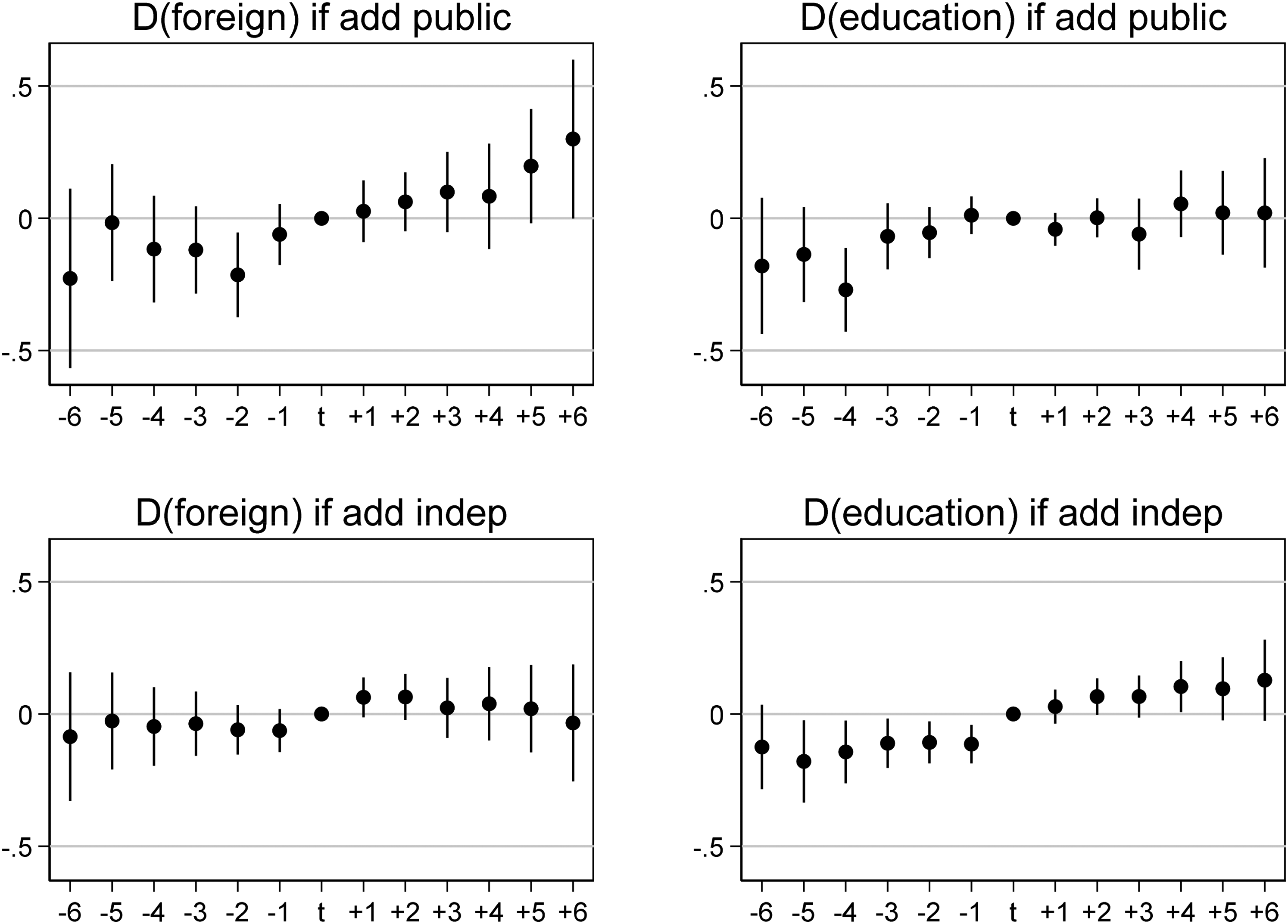
Number of years before or after the establishment of a new school in school areas and their level of segregation (
We report our sensitivity analysis in Figure 3. We can see clearly that point estimates indicate that school segregation levels are lower in the period prior to the emergence of a new school and higher in the period following. In areas with an addition of a public school, we do not see a clear discontinuity in the time trend, indicating that the increase in school segregation that we observe would have taken place also in the absence of the establishment of a new school. For new private voucher schools, we see clear discontinuities around the year(s) of school establishment, with segregation ‘jumps’ equal to 0.06 to 0.07 in immediate conjunction with a private school being established in the area, suggesting a causal interpretation. These results partially support Hypothesis 1, that the mean effect of the availability of school choice on school segregation is positive, and Hypothesis 2, that private schools appear to increase school segregation more than public schools.
Turning to Hypotheses 3 and 4, our expectation is to find heterogeneity in the effect of increasing opportunities for school choice based on the composition of the area in which such changes take place. In order to address this issue, Figure 4 reports how the effect from increased school choice differs by the social composition of residents in the school area. The analyses correspond to those presented in Figure 2, but are estimated separately for areas with different compositions. We divided areas into quartiles based on the proportion of immigrant children or children with parents who had low levels of education, and we distinguish between the lowest quartile, the two middle quartiles and the top quartile. Given the small N for different combinations, in these analyses we distinguish between 0, 1, and 2 or more schools of the private type, and 1 and 2 or more schools for public schools. Figures 4 and 5 include estimates of the impact from a change in the number of private schools in areas where there are 2 or more public schools. Full models are included in Supplemental Tables 1 and 2.
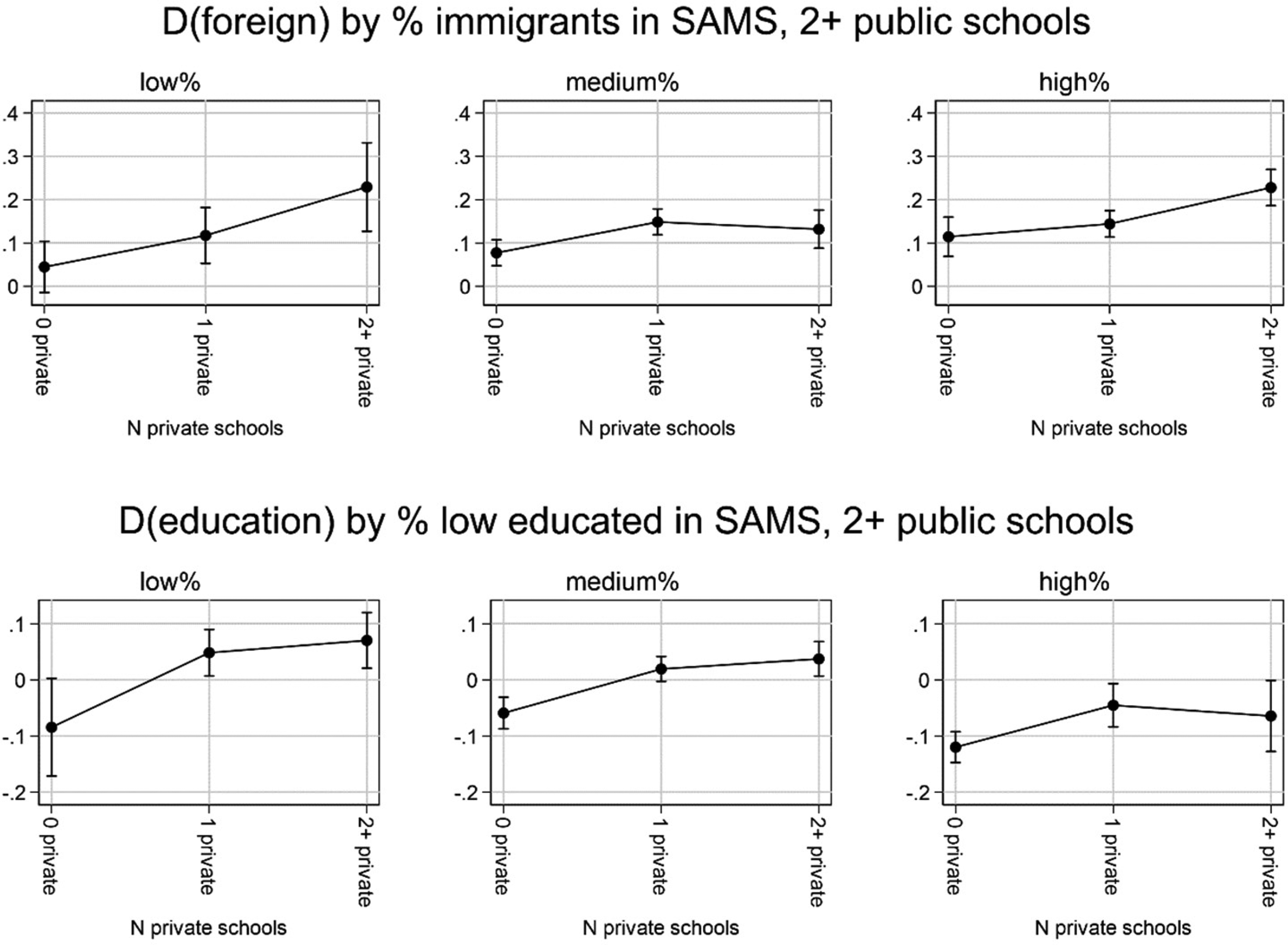
Number of private schools in school areas and their level of segregation (
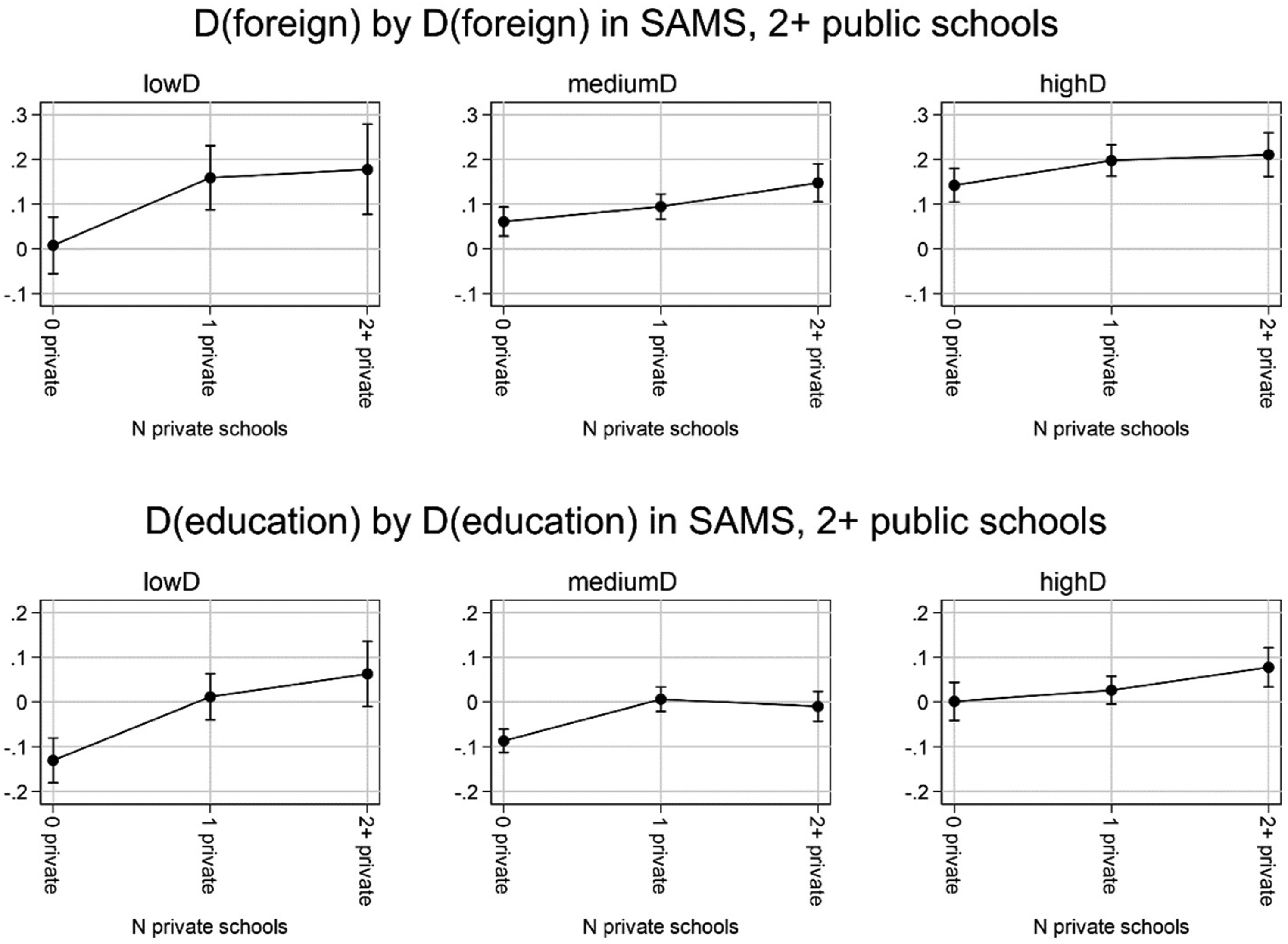
Number of private schools in school areas and their level of segregation (
We expected stronger effects in areas with a high proportion of the ‘low-status’ group (H4), but this is not what we find, at least in terms of point estimate tendencies. We see significant differences for moving from zero to two private schools for all neighbourhoods, but the effect size is larger in areas with a small proportion of the ‘low-status’ group than in areas with a large proportion of the ‘low-status’ group (0.16 compared to 0.08). For segregation by parents’ education, school choice appears to increase segregation more in areas with a high portion of the ‘low-status’ group, i.e., areas with a high share of low educated parents, but school choice opportunities appear to increase segregation everywhere. That is, the absolute magnitude of the estimated segregating effects of adding schools are larger in areas with a small portion of the ‘low status’ group, and this holds true for effects on ethnic segregation as well as segregation by parents’ education. We see similar positive segregation effects of adding schools also in the other areas, but they are smaller in size and in two cases non-significant.
Finally, in Figure 5, we repeat the analyses reported in Figure 4, but instead of dividing neighbourhoods based on their proportion of the ‘low-status’ group, we have divided them on the basis of their levels of residential segregation. We have done this in order to test Hypothesis 5, i.e. whether increasing choice can be a catalyst for an increase in segregation in areas with low residential segregation. We find support for this hypothesis. The strongest effects of increased availability of school choice can be observed in areas with low residential segregation. When private schools locate in integrated residential areas, school segregation increases a lot, and this is the case for both ethnic and segregation by parents’ education. The effect size on school segregation when private schools establish in a low-segregation area with 2 public schools is approximately 20 percent closer to maximum segregation. For more segregated areas, we see more variation in the direction of effects, but the tendency is that more schools in an area are followed by more segregation.
Discussion and concluding remarks
There is a longstanding interest in the social sciences in how structures and institutions constrain and enable patterns of social sorting across contexts. Structural opportunities to segregate vary across time and space, and schools provide us with a clear-cut illustration of how such variation gives rise to variation in segregation across time and space. We have examined how changes in local school choice opportunities within the same general voucher-based school choice system affect the local sorting of students. By exploiting variations in the local availability of school choice over time, we have arrived at estimates which we believe come close to estimates of the causal impact of the availability of school choice on school segregation levels.
We hypothesized a positive impact from increased availability of school choice on school segregation levels, and particularly so for non-public (private) schools. We document strong effects of local changes in school choice opportunities on school segregation by immigrant status and school segregation by parental education level. In contrast to earlier studies based on Swedish data (Böhlmark et al., 2016; Lindbom, 2010; Yang Hansen and Gustafsson, 2016), we document some rather strong effects of school choice on school segregation, not only in the form of ethnic sorting but also by parental education. Our results are in line with a recent Swedish study showing that sorting is stronger where large local school populations makes room for the establishment of more schools (Malmberg and Andersson, 2021). In an international perspective, our study adds to the accumulated evidence (cf. Fiel, 2015; Hsieh and Urquiola, 2006; Miron et al., 2013; Musset, 2012; Saporito and Sohoni, 2006) indicating that school choice policies contribute to more sorting across schools on the basis of family background, i.e., to more school segregation. The emergence of private voucher schools appears to push both types of school segregation upwards more than the emergence of public schools, which is interesting given that new private voucher schools are generally smaller than new public schools, and from this perspective should have a lower potential to create substantial changes in segregation levels (on average 30 ninth graders finish as the first cohort in new private schools, to be compared to 58 in new public schools).
We further hypothesized that the impact from an increase in the effective availability of school choice would be greatest in residential areas with a high proportion of immigrants or children whose parents have a low level of education, since this would be where the latent demand for school choice would be the greatest If anything, our results pointed in the opposite direction as the largest segregating effects of increasing choice could be seen in ‘high-status’ residential areas, but increased availability of school choice pushes school segregation upwards regardless of neighbourhood composition. We further tested whether an increase in the availability of school choice may have a stronger impact on segregation, when it occurs in low residential segregation areas. We found this to be the case – an increased availability of school choice leads to a surge in school segregation in areas with low residential segregation, suggesting that outgroup exposure creates a demand for separation (cf. Olzak et al., 1994). This pattern is in stark contrast to the expectations of proponents of school choice policies, whom argue that school choice may be used to counter the effects of residential segregation (Archbald, 2004; Epple et al., 2017), and to reduce school segregation.
To sum up, our results suggest that the trend of increased school choice, which has taken place on school markets throughout the western world, has contributed to increased school segregation. If parents are given the opportunity to choose between different schools, this leads to more segregated school environments, because of latent desires for separation among parents. It is worth mentioning, however, that we are measuring only the degree of segregation between schools, with no attention to segregation within schools, which might offset segregation between schools (Clotfelter et al., 2021). It is also worth stressing that the expected consequences of school choice are dependent on the design of the school choice system. If school choice policies are integrated with diversity goals and admission principles that counteract segregation, the impact on segregation is likely to be weaker (Archbald, 2004; Saporito and Sohoni, 2006). With these caveats in mind, our findings however suggest that simple numbers matter: all else equal, segregation increases when the number of local available school units increases. In particular, if these local additions are private voucher schools, increased school segregation is to be expected.
Supplemental Material
sj-docx-1-asj-10.1177_00016993211068318 - Supplemental material for The opportunity structure of segregation: School choice and school segregation in Sweden
Supplemental material, sj-docx-1-asj-10.1177_00016993211068318 for The opportunity structure of segregation: School choice and school segregation in Sweden by Maria Brandén and Magnus Bygren in Acta Sociologica
Footnotes
Declaration of conflicting interests
The author(s) declared no potential conflicts of interest with respect to the research, authorship, and/or publication of this article.
Funding
The author(s) disclosed receipt of the following financial support for the research, authorship, and/or publication of this article: This work was supported by the Vetenskapsrådet (Grant Nos. 2013-5460 and 2020-02488), and Riksbankens jubileumsfond (Grant No. M12-0301:1).

Supplemental material
Supplemental material for this article is available online.
Author biography
References
Supplementary Material
Please find the following supplemental material available below.
For Open Access articles published under a Creative Commons License, all supplemental material carries the same license as the article it is associated with.
For non-Open Access articles published, all supplemental material carries a non-exclusive license, and permission requests for re-use of supplemental material or any part of supplemental material shall be sent directly to the copyright owner as specified in the copyright notice associated with the article.
