




Abstract
Applying theories from sociology and social psychology concerned with the intersection of culture and cognition to in-depth interviews, this paper empirically explores the Norwegian majority population’s perceptions of cultural diversities using a dual-process (DP) methodological and analytic approach. Globalization has produced a mix of new anxieties, opportunities, and curiosities, leaving most people juggling conflicting objectives of self-preservation and self-realization, and making cognitive self-regulation and behavioural flexibility valorized skills of contemporary life. Instead of identifying xenophobic and cosmopolitan attitudes at opposite ends of a spectrum, the current paper argues in line with current research and theory in studies of DP cognition that they commonly co-exist, albeit in separate automatic and discursive cognitive systems, within the same individual. As a result, people’s perceptions of cultural and ethnic diversities tend to be ambivalent and contextually malleable – for example, in cases where their deep dispositions appear incompatible with their own self-concept or dominant cultural expectations. Most centrally, the current research proposes concrete strategies to elicit responses from both cognitive systems in the context of interpretive interviews. Secondly, the paper proposes clues that help to identify from which cognitive system interviewees’ conflicting cosmopolitan and xenophobic attitudes originate, thereby enabling researchers to further delineate the specific characteristics of these attitudes, including the mode of cultural learning through which they form, their flexibility or robustness to change, their role in behaviour motivation, and the extent to which they are conscious and controllable.
Introduction
Recent large-scale social surveys suggest that Western countries are becoming more accepting and tolerant towards immigrants (Pew Research Center, 2019; Statistics Norway, 2017). Yet, at the same time, the numbers of ethnic and cultural minorities who report experiencing everyday racism and discrimination increase (Hellevik and Hellevik, 2017), and there is growing support for far-right populist parties (Jungar and Jupskås, 2014). Research on everyday experiences with difference (Lamont and Aksartova, 2002; Skrbis and Woodward, 2007) and discourse about cultural and ethnic diversities (Van Dijk, 1992) also show contradictory patterns and apparently conflicting viewpoints. Indeed, as will be argued in this paper, searching for an unambiguous answer to the question of whether populations of Western countries are becoming more accepting or increasingly sceptical of cultural and ethnic Others is a misguided endeavour. This is because, and as this paper also empirically explores, both findings can be simultaneously true; apparently incongruent perceptions occur within the same individual, in the same day, and even at the same time. Drawing on 25 in-depth interviews with White majority Norwegians from a range of social backgrounds, this research focuses on the ‘messiness’ of human perception and demonstrates the dual-process (DP) framework (Haidt, 2012; Lizardo et al., 2016; Vaisey, 2009) as a powerful addition to sociological studies of intercultural relations.
The central research objectives are twofold. Firstly, and contributing towards a DP methodology for qualitative interview research, the paper proposes and empirically exemplifies concrete strategies to elicit interview communication from both cognitive systems – striving to draw out information not only about how people deliberately reason, but also concerning the heuristic thinking and affect triggered in their response to the Other. More specifically, this will be achieved by compiling relevant propositions from state-of-the-art literature on qualitative interviewing (McDonnell, 2014; Pugh, 2013, 2014), which – it is argued – can be much developed via insights drawn from cognitive neuroscience (Squire, 2004), and social psychology (Fazio, 1986; Smith and DeCoster, 1999). Indeed, interdisciplinarity with cognitive science and neuroscience in particular has been frequently noted as essential to improve sociological theories of culture (Cerulo, 2010; Vaisey and Lizardo, 2010; Vila-Henninger, 2015). Although most sociologists do not explicitly use DP models, their arguments often ‘implicitly draw on the idea of automatic cognition by proposing mental processes that are implicit, unconscious, instantaneous, habitual, uncontrollable, or emotional’ (Miles et al., 2019: 309).
One important example of this is found in the literature on qualitative interviewing, where there has been an increasing focus on the importance of accessing emotion and getting past the interviewees’ polished surface talk (Pugh, 2013, 2014). Here, emphasis is placed on skilful interpretation. And, as far less is said about how to formulate good interview questions that trigger automatic thought processes, we remain too reliant on the individual researcher’s experience, skill, and intuitive understanding of how to manoeuvre the cognitive terrain of interviewees with all its obstacles and secret compartments. In contrast, neuroscientists and social psychologists have advanced far in their development of specific techniques for measuring DP cognition, but their focus has typically been on statistical (Dovidio et al., 2017) and response latency techniques (Greenwald et al., 2009), as well as experiments (Epstein et al., 1992) and functional magnetic resonance imaging (fMRI) of brain activity (Greene et al., 2001) that are less relevant to sociologists and particularly qualitative researchers. Still, this body of work, which rarely appears in sociological forums, contains in-depth knowledge about the cognitive processes we need to understand in order to improve sociological research methods.
As a second objective, this paper proposes and demonstrates the analytical advantage of a DP theoretical framework to sociological studies of intercultural relations. Earlier papers in this field of research also picked up on themes of ambivalence, and emphasized the contradictory and rhetorical aspects of cosmopolitan practice (for example, Skey, 2012; Skrbis and Woodward, 2007). Without having the benefit of cultural advances in DP theory to help frame and locate specific processes, and instead drawing on the popular discourse of reflexivity, these researchers typically stated that people identify aspects of the global that they like to a more or lesser extent, and that they relate to and appreciate some components of cosmopolitan practice more than others in context-dependent settings. DP theory helps to systematize these earlier observations – placing them on an advantageous theoretical foundation, and giving an entirely new way of understanding attitudinal mess. For example, the current research proposes clues that can help researchers identify the cognitive origin of people’s often conflicting attitudes. And, as addressed in the paper’s empirical demonstration and conclusion, this knowledge enables researchers to more systematically explain, in reference to two characteristically different cognitive processes, why, in what ways, and under what conditions people appreciate or dislike certain aspects of cultural and ethnic diversity; the typical pattern for where ambivalent cosmopolitan and xenophobic or parochial forms are cognitively located, as well as the far-reaching implications of this identification. Perhaps most importantly, identifying an attitude as ‘automatic’ or ‘discursive’ enables researchers to more accurately theorize whether the attitude reflects the interviewee’s attractions and repulsions, or serve mainly the social needs of the situation. This is an important task, as research (Dovidio et al., 2017; Ivarsflaten et al., 2010) suggests that the mainstream populations of Western democracies increasingly self-present in cosmopolitan and egalitarian ways that are now associated with cultural capital, intellectualism, and moral refinement (see also, Peterson and Kern, 1996; Prieur and Savage, 2013), something which calls for the development of new methodological strategies that can help get past the surface of people’s discursive skills and get at their feelings. By proposing such strategies, and exploring intercultural attitudes through a DP lens, the paper highlights complexities and ambivalences frequently studied by sociologists of intercultural relations, but increases the capacity to explain what is going on.
DP theory
This research is inspired by recent work on the intersections of cultural and cognitive processes (Cerulo, 2010; DiMaggio, 1997; Lizardo et al., 2016; Vaisey, 2009), which looks closely at changing cultural norms, categorizations, and how they influence people’s thinking, talk, and behaviour. One of the key insights of this endeavour concerns a divide between two systems for thinking; an idea that was first established in 1970s psychology (for review, Evans 2003; Kahneman, 2011), but which is now widely applied across disciplines. As noted by Lizardo et al. (2016: 291), ‘often, when cultural analysts in sociology make a distinction such as “implicit and explicit,” “conscious and unconscious,” or even “fast and slow,” they are helping themselves to a key premise of the [DP framework]’. Examples includes Haidt’s (2012) metaphor of the mind as being divided like a rider (reason) on an elephant (emotion), whereas in sociology, Bourdieu (1990) distinguishes between the ‘practical and discursive consciousness’. The current research, however, will refer to the two systems as ‘automatic’ and ‘discursive’, as these terms best reflect the interviewees’ own experience of their cognitive processes.
The two cognitive systems are, for the most part, distinct, separate, and situationally used in ways that sometimes complement and at other times interfere with one another (Kahneman, 2011; Lizardo et al., 2016; Vaisey, 2009). More specifically, the automatic system consists of a series of mental shortcuts (heuristics) that are formed subconsciously through early socialization and tacit experiential learning, and that associate people and things with unreflective intuitions, attractions and repulsions which in turn guides most of human action (Haidt, 2012). More specifically, and in response to foreign bodies and cultural practices, mental heuristics tend to facilitate prejudiced stereotypes that evoke aversive ‘embodied schemata’ (Lakoff and Johnson, 1980) such as disgust, contempt, anger, and fear. What this means is that the body automatically ‘knows’, on the basis of instantaneous and irrational associations that are not learned willingly nor fully consciously, to maintain boundaries from that which is unfamiliar and foreign.
Even in the globalizing world, where transcultural competence is increasingly becoming a core skill and source of self-development and success (Peterson and Kern, 1996; Prieur and Savage, 2013), xenophobic sensitivities are still culturally reproduced and ingrained in people’s automatic consciousness (for review, Dovidio et al., 2017). Therefore, and given that the second ‘discursive’ cognitive system adapts quickly to changing external circumstances, it likely plays an important role in contemporary engagements with cultural, ethnic and religious difference as well as social debates and everyday talk on this matter. The discursive system consists of conversational resources, cultural scripts, meanings and logics individuals assemble from their external culture though short-term socialization and explicit learning. And, although people are usually only emotionally committed to a small subset of prevailing cultural scripts (Vaisey, 2014), they strategically draw on them to communicate a contextually appropriate version of self (Swidler, 1986; Vaisey, 2009).
In fact, both in the United States (Dovidio et al., 2017) and in Norway (Ivarsflaten et al., 2010), researchers interested in DP analysis have concluded that people have not necessarily become less xenophobic over time, but rather begun to manage their talk and behaviour in accordance with increasingly egalitarian cultural norms. Given that culture shapes emotions, moral intuitions, and defines acceptable forms of talk (Rozin et al., 1999), it is important to mention that the people of Norway, where the current research was conducted, have historically viewed themselves as egalitarian. For example, Bangstad writes that Norwegians cast themselves as ‘exceptional’ and ‘virtuous’, rendering the term racism ‘taboo in the public sphere’ (Bangstad, 2015: 49). Helleland (2014) suggests that Norway has ‘racism without racists’, and Gullestad (2004) refers to Norwegians as ‘blind slaves of our own prejudices’. In this national context, and using quantitative scales, political science scholars Ivarsflaten et al. concluded that Norwegian individuals’ explicit and ‘sincerely held beliefs in racial equality co-exists with deeply rooted, highly negative stereotypes of racial others, often within the same individual’ (Ivarsflaten et al., 2010: 424). The norm, they argue, in Norway as well as Western Europe more generally, is not that we are in fact anti-racist, but that we consider ourselves to be (Ivarsflaten et al., 2010; see also, Van Dijk, 1992). Clearly, then, as the wall of denial or egalitarian surface is hardening, there is a distinctive need to develop and concretize methodological means by which qualitative interview researchers may access and measure ‘automatic’ responses to cultural and ethnic diversities.
The accessibility of automatic cognitions
In this paper, most effort will go towards developing methodological strategies that trigger communication from the automatic rather than the discursive cognitive system, as there is wide consensus among DP theorists that automatic cognitions are ‘subconscious’, ‘non-verbal’ and difficult to access for qualitative interview researchers (Lizardo et al., 2016; Martin, 2010; Vaisey, 2009). Notably, and drawing on the work of Schmidt (1995), the current research considers this inaccessibility to be exaggerated: even in the absence of a highly conscious ‘metalinguistic awareness’ associated with the discursive cognitive system, people’s ‘awareness as noticing’ will be operational, and they will be able to ‘notice’ and give some verbal account of their automatic processes even if they cannot fully explain them (Schmidt, 1995; see also, Kahneman, 2011). Indeed, psychological research supports this notion, finding that people can, for example, make relatively accurate predictions of their own scores on an Implicit Association Test which measures automatic attitudes (Cameron et al., 2012; see also, Hahn et al., 2014).
Additionally, and while the discursive cognitive system is something like a ‘cultural barometer’ (Pugh, 2013: 57) of what is admirable which interviewees readily convey through talk, automatic cognitions more often contain potentially normatively stigmatizing perceptions that interviewees may feel less comfortable to divulge. From this perspective, it has frequently been argued that automatic cognitions must be measured using rapid-response techniques such as forced choice surveys or Implicit Association Tests (see Miles et al., 2019) that trigger automatic forms of thinking (Vaisey, 2009) without allowing respondents the time to discursively self-regulate their first reactions. These perceptions, namely that automatic cognitions are inaccessible to the interviewee and/or easily suppressed in the interview setting, have limited the development of methodological strategies and general use of DP frameworks in empirical and particularly qualitative sociology (Miles et al., 2019: 309; see also, McDonnell, 2014: 247).
With that said, however, the most recent decade has seen a change occur, with researchers beginning to propose qualitative methods for measuring the heuristic and visceral level of consciousness (McDonnell, 2014; Pugh, 2013, 2014). Perhaps most relevant to the current research are writings by Allison Pugh (2013, 2014) whose paper (Pugh, 2013) convincingly outlines four types of information available in interviews, namely: (a) visceral information; (b) schematic information of the cultural frames people use discursively; (c) information concerning which schemas the interviewee considers more ‘honourable’ than others; and (d) cultural ‘meta-feelings’ that give information of how people feel about their feelings (Pugh, 2013: 52). According to Pugh (2013, 2014), residuals of ‘visceral’ information surface in qualitative interviews, but given their muddled and subtle form, data analysis cannot be performed as a ‘surface-level gleaning of “answers” to “questions”’ (Pugh, 2013: 56): To get past ‘honourable talk’, interpretive interviewers must pay attention to what people convey semi-consciously, non-verbally and indirectly through facial expressions, sights, pauses, potent silences, or laughter, and also be attuned to interviewees’ bending of language, the use of metaphors and jokes, verbal missteps and logical contradictions, and the verbal misrepresentation of automatic response through discursive talk (Pugh, 2013, 2014). From her perspective (Pugh, 2014: 160), people’s individual use of language and how they say things allow skilful interpretive interviewers to read deeply into their ‘emotional and schematic messages to try to understand what is not being said as much as what is’ (Pugh, 2014: 160).
Recognizing the undeniable value of Pugh’s work, it should be noted that her account focuses primarily on the skilful listeners’ excavation of semi-conscious meanings through interpretation, which relies on ‘competence borne out of experience [and] possibly some innate traits such as empathy’ (Pugh, 2013: 53). Interpretation is indeed important, but not all interpretive interviewers have yet obtained sufficient experience or intuitive aptitude for interpretation, and many would benefit from insights from DP theory concerning how different sections of the brain are triggered by different stimuli, and how to formulate targeted and strategic interview questions that inspire people to divulge one type of information over another. Such knowledge about cognitive processes further increase the researchers’ ability to systematize and explain interview participants’ incongruent attitudes, their origin and implications. With these objectives in mind, the current research now proceeds to outline some specific DP inspired interviewing strategies that will be exemplified in relation to my empirical study of intercultural relations, and that may be helpful to guide researchers in their pursuit and heightened understanding of the heuristic and visceral universe of their interviewees.
Methodology
Data collection and sample
This research presents findings from qualitative semi-structured and face-to-face interviews with a sample of 25 White-native Norwegians 1 of approximately one-hour duration, that covered a broad range of topics relating to their perceptions of culturally and phenotypically diverse people. To ensure broad demographic representation, five sampling locations across Norway were selected that vary in geographical location, size, population density, local history and culture. Employing a site-sampling method (Arcury and Quand, 1999), potential informants were sought at multiple ‘sites’ within each location, including businesses, community organizations, and hang-outs that were deemed likely to inhabit different demographics.
The DP theme developed inductively early in the data-collection. For example, when I asked one of the interviewee participants if she felt that the interview questions were clear, she explained that she would respond differently depending on whether she was asked for her perception of what is ‘right’, or how she ‘feels’. Again, alluding to a self-awareness of this separation of thought systems, another interviewee stated that his feelings are often irrelevant, as he would regularly ignore them and instead abide by cultural norms and ideals. These early interviews pointed towards the relevance of DP theory, and prompted a further adjustment of the interview guide according to debates on how to measure two distinct levels of cognition.
It is well known that participants frequently underreport stigmatizing perceptions, such as xenophobia, due to social desirability concerns (Dovidio et al., 2017). Additionally, DP research has found that people often go beyond automatic and heuristic thinking when circumstances make them feel a great need to be accurate, defend an attitude, or create a positive impression (Chen and Chaiken, 1999). On the basis of this knowledge, it is relevant to note that I am a White, Nordic female, and interviewees would not need to withhold perceptions to avoid offending my culture or ethnicity. To maximize interview participants’ willingness to disclose a fuller range of their attitudes, interviews took place in various private locations. I, being the interviewer, dressed neutrally as I believe rapport-building processes run more smoothly if the aesthetics of the interviewer cannot be visually tied to any identifiable taxonomy of style and associated social grouping such as ‘liberals’ and ‘conservatives’ – wearing simple, semi-casual, and somewhat indeterminable clothes that were neutral in colour also allowed me to more convincingly code-switch between self-presenting as a highly serious researcher or intellectual, but also perform folksiness or even aloofness and silliness should the context require it to lighten the mood and downplay my position as an intellectual or ‘expert’. Before commencing the interview, I expressed that I came to the topic of research by chance. What I wanted to convey is that my attitudes on the subject matter are quite fluid and ‘casual’ rather than motivated by a set of clearly established anti-racist outlooks as the interviewees might expect, and that I have no heightened sensitivities for participants to appease or displease. I also stated directly that I consider myself to be an open and tolerant person, but that I am not void of prejudices and biases.
Developing interview questions and techniques
The DP theory maintains that similar questions will activate different part of the brain depending on how they are worded (Greene et al., 2001; Epstein et al., 1992; Smith and DeCoster, 2000). Firstly, asking specifically about feelings will prompt greater engagement from the automatic cognitive system, and directing people’s attention to their spontaneous affective reactions can increase people’s acknowledgement of bias (Hahn and Gawronski, 2019). Secondly, specific and general judgements call differently on the two cognitive systems (Sherman et al., 1999): whereas general and abstract stimuli tend to elicit discursive thinking, more richly detailed and specific stimuli often prompt response from the automatic cognitive system (Epstein, 1991; Kahneman and Miller, 1986). Thirdly, and by measuring brain activity through fMRI, Greene et al. (2001) found that people use more logical reasoning in response to moral dilemmas where they have little or no personal involvement, whereas more ‘automatic’ and emotive types of cognitive processing will be engaged when people are (or imagine themselves to be) personally involved in a given scenario.
Finally, and related to the importance of specificity to elicit talk from the automatic cognitive system, DP theory explains that only the cultural scripts people learn explicitly from society are ‘downloaded’ in their minds, in declarative memory, and will be continually available to the interviewer. In contrast, automatic thinking, including heuristics (e.g., stereotyping) and affective judgements (e.g., racial bias), is initiated and potentially verbalized only when external ‘contextual cues’ (Fazio, 1986) trigger them into conscious awareness (Dimaggio, 1997; Swidler, 1986). For example, research has found that people often lack awareness of their own racial prejudices (review in Dovidio et al., 2017), and they may not know of their propensity to stereotype and their aversions towards dark skin until they ‘notice’ (Schmidt, 1995) because the attitude object is standing in front of them; in reality, produced through imagination, or recalled from a past memory. If we want to elicit information from the automatic cognitive system, then, contextual cues must somehow be inscribed in the interview questions.
Combining these pieces of knowledge, the current research proposes that qualitative interview questions will strategically ‘speak to’ and trigger the interviewees’ automatic cognitive system optimally if they ask directly about spontaneous, visceral reactions in response to detailed scenarios where the participant is personally involved (in reality or imagination), and that provide contextual cues. More specifically, this paper identifies three strategies as being particularly effective. Firstly, asking interviewees to give specific ‘real-life’ examples has been found to offer valuable sources of deeper layers of meaning (Pugh, 2013), and DP theory explains why that is. In this literature, episodic memories are defined as ‘the capacity to re-experience an event in the context in which it originally occurred’, replete with ‘temporal and spatial cues’ (Squire, 2004: 174). Automatic cognitions are associative (Smith and DeCoster, 1999), and thinking back on a time when you were disgusted, you might become disgusted once again – suggesting that visceral reactions are responsive to ‘contextual cues’ (Fazio, 1986) contained within memories of events. Interestingly, people are more likely to remember ‘stereotype-relevant traits or behaviors’ (Hewstone, 1989: 211), and to also more readily remember vivid, emotionally interesting information (Nisbett and Ross, 1980). This is beneficial in that interviewees’ memories will typically emphasize events that triggered affect, and that tell us something about their ‘automatic’ heuristic and affective categorizations of attitude objects.
The use of vignettes that prompt visualizations was also found by the current research to effectively elicit automatic cognitions. In one such vignette, interviewees were asked to imagine themselves working as a massage therapist and deciding whether to give a back massage to a White Norwegian or a Somali customer – ‘who would you prefer?’. In responding to vignettes, it often appeared that interviewees drew on past responses to similar situations as a reference point. Using the words of Kirkegaard, ‘life can only be understood backwards; but it must be lived forwards’, and when interview participants are unsure what they would do in the scenario presented, they may nevertheless know what they did in a similar situation in the past. As such, both directly and as a trigger of cue-rich memories, vignettes can ‘speak to’ the automatic cognitive system.
Above all else, however, photo-elicitation proved to be a powerful tool to elicit automatic responses. As one example, when asked only verbally and abstractly what they think of the Hijab, interviewees reported generally positive or neutral judgements. They were then shown a photograph of a smiling and gentle looking middle-eastern woman with her hair out, and asked what they feel when they see her, prompting exclusively positive judgements. Immediately thereafter, interviewees were shown a photograph of the same woman, but now wearing the Hijab; a visual cue theorized here to activate latent ‘automatic’ prejudiced stereotypes of Muslims (see Miles et al., 2019) that are neurologically associated with ‘embodied schemata’ (Lakoff and Johnson, 1980) of disgust, contempt, or fear. Many interviewees now contradicted their initial tolerance, and instead reported forms of aversion. It is well known among qualitative researchers that interviews encourage interviewees to present exaggeratedly coherent selves (Lamont and Swidler, 2014). Interestingly, then, and by priming participants to ‘feel for’ automatic responses as well as heighten their self-awareness of attitudinal contradictions, the photo-elicitation method seemed to prompt some interviewees to mentally reframe the interview setting as a context in which to explore their dual and conflicting attitudes, rather than construct or rehearse narratives of the self.
But even if automatic cognitions are successfully triggered using these methods, interviewees may not feel comfortable to divulge them. In the interview process I noticed that I was sometimes more successful in getting people to talk about their potentially stigmatizing automatic responses to cultural and ethnic diversities if I approached this endeavour indirectly, by asking about their ‘meta-feelings’ (Hochschild, 1979; Pugh, 2013). According to Hochschild (1979), ‘social feeling rules’ instils in people notions of how they should feel in a given situation, and ‘meta-feelings’ can be considered the culturally produced ‘feelings about how we feel’. In short, getting people to talk not only about their visceral response, but also how they feel about this response, increased the extent to which they were willing to express stigmatized attitudes. One reason for this, I suppose, is that the interviewee can, by disclosing their automatic racial aversions coupled with meta-feelings of shame associated with this aversion, partake in the normative rejection of their own xenophobia and can thereby maintain a more respectable self-concept and self-presentation. Another reason why this strategy works may be that interviewees are less aware that they are on course to divulge normatively stigmatized perceptions if the topic is approached indirectly.
Strategies to interpret the cognitive source of statements
As emphasized by Pugh (2013), and once the DP oriented qualitative interviewer has successfully elicited a mess of discursive and automatic communications, the researcher must make well-informed attempts to disentangle them in the analysis. Again, DP theory assists with some specific suggestions on how to make this distinction between forms of communication, relying less on the intuition of the researcher. The first clue is provided by the interviewee’s response-time, as ‘fast’ or immediate ‘first reactions’ often emerge from automatic processes, whereas slow responses tend to be products of the discursive cognitive system (Kahneman, 2011). Secondly, automatic communications, being vested with the force of embodied schemata (Haidt et al., 1997; Lakoff and Johnson, 1980), are often accompanied by non-verbal information that ‘leaks out’ in the form of difficult to control micro-expressions and other body language that can be observed by the interviewer. Thirdly, people’s automatic heuristics and the ways in which they ‘lump’ people together in their mind is quite often visible in their talk (Kahneman, 2011) – for example, when interviewees blatantly generalize about Polish construction workers as being unqualified.
Finally, as previously mentioned in this paper, the current research argues that both cognitive systems can achieve discursive representation: automatic cognitions can ‘talk’ in the very rudimentary sense that people are able to express an ‘automatic’ like or dislike of something, even if they are most likely unable to discursively understand or explain it (Kahneman, 2011; Vaisey, 2014). Perhaps more commonly, efforts to elicit information from the automatic system capture a sequential combination of automatic and discursive communications (see Vila-Henninger, 2015). In the data that will be presented in the current paper, these sequential cognitive processes were often observable, for example, when interviewees responded impulsively in simple exclamations of like or dislike accompanied by emotionality and non-verbal cues, only to then pause and ‘confabulate theories’ about their ‘non-representational’ automatic cognitions (Greenwald et al., 2009). Particularly, when interviewees struggle to find the right words, or as Pugh (2013: 51) explains, ‘when an interviewee’s normally clear and concise language devolves into convoluted or halting syntax’, it can be taken as an indication that their initial reported judgement emerged from their automatic cognitive system, which has limited discursive and analytical capabilities. With that said, however, this process of determining the cognitive source of interviewee communication is by no means infallible: interviewees will at times be able to control and subdue their impulsive ‘first reactions’, leaving the researcher none the wiser.
Having presented some concrete strategies for a DP informed approach to qualitative interviewing and analysis, the following text presents an empirical demonstration. Emphasis will be placed on a limited number of interviewees to highlight the conflicts and incongruencies within narratives. The conclusion then proceeds to explain the relevance and implications of identifying the cognitive origin of attitudes, thereby further clarifying the theoretical contribution of DP theory to sociological intercultural relations research.
Findings
Only one out of 25 interview participants expressed close to consistently xenophobic automatic and discursive cognitions. This was a man in his late 70s, who openly discussed anti-immigrant sentiments with anyone around him. In comparison, five interviewees self-presented as coherently ‘cosmopolitan’ (Skrbis and Woodward, 2007), merging emotion and knowledge-based narratives of openness. The clear majority of the interview sample, however, consisted of 19 Norwegians who divulged largely negative feelings and stereotypical representations of cultural and ethnic diversities coupled with cosmopolitan talk of openness and inclusivity. This clear majority, expressing dissonant dual cognitions, is at the centre of the current analysis, which focuses on the dominant intercultural cognitive pattern among White majority Norwegians.
One typical example of an interviewee exhibiting such incongruent dual cognitions was Ragnhild; a well-educated and well-presented woman in her late 60s who I interviewed in her suburban home in Oslo. Referring to her family of four, she explained that ‘intellectually speaking, a core value for us has been that all people have the same inherent worth’. Thinking back on her visceral response when walking past a Romani beggar, she followed up in an exaggerated whisper, ‘but deep down I do think I’m worth more than the Romani woman in the corner at the mall, if I’m being totally honest with myself’. When I asked for her gut-feeling concerning whether there is a limit to how many immigrants and refugees Norway should let in, Ragnhild provided another example of what dissonance between discursive and automatic cognitions may look like in narrative practice:
: I don’t know what to answer. Ideally speaking and in terms of how I really want to be, I think that we’re one of the richest countries in the world! We should be able to help people and families! That’s one side of it. But when I saw what happened up north where [refugees] came in hordes on bicycles across the border [anxious expression], I thought “how are we going to manage this?!”, and it made me hesitant.
: So maybe you feel that on one side this is a little bit scary, but then on the other hand there’s a moral responsibility…
:…yes, yes, I do!
For Ragnhild, the cue-rich television imagery showing ‘hordes’ of cultural strangers seemingly flooding the national border triggered mental shortcuts to her more privately held anxieties about the Other. My conversation with Ragnhild proceeded this way, entangling proudly announced ‘honourable’ (Pugh, 2013) cosmopolitan principles, with automatic stereotyping, emotional xenophobic outbursts and shamefully admitted disgust, fear, and sense of detachment from Otherness in its more visceral and tangible forms. Indeed, at one point, Ragnhild stated that Muslims should be able to pray and practice how they want. But, when I showed her a photograph of Muslim children praying in school as White children walk by, her embodied socio-moral disgust schemata (Haidt et al., 1997; Miller, 1998) ‘bubble[d] forth…despite the efforts of the reasonable, honourable self to suppress it’ (Pugh, 2013: 57). Getting visibly worked-up, she exclaimed ‘I don’t like it! Not with the white children present’. Departing from her previously calm and careful wording, her response was suddenly accelerated and forceful. Standing up to place the ridge of her hand on the photograph as a barrier between the Muslims and the Whites she added, ‘they need to do that in a separate room and lock the door. I don’t like it’. Still, Ragnhild was adamant that she would never voice her aversions for other cultures publicly. And, when I asked why she generally outwardly expressed more positive perceptions of difference, she cited the external expectations of her peers, and education, rather than some profound internal value as her main motivations.
This understanding of the particular ‘social feeling rules’ (Hochschild, 1979) that ‘you’re not supposed to even be sceptical of immigrants, that’s what our culture dictates’ (Linda, in her 60s), was expressed at all five research locations, and indicates why the DP lens should be central to contemporary studies of intercultural relations in Western culture: as expressions of attitudes towards difference increasingly cannot be taken at face value, and to avoid predominantly recording idealized cultural discourses as they flow through the interviewees, the researcher must develop tools to excavate depth. To further explore this point, it is relevant to look at my interview with Mikael; an unemployed teacher in his mid-30s who I met in a far-northern village of less than 50 people. Had his initial interview narrative been taken at face value, Mikael would be presented here as someone deeply anti-racist, ironically living in an isolated town with his ultra-cosmopolitan sensibilities; his far-left politics, and distaste for anything ‘grossly nationalistic’. However, as Mikael was probed to speak from the gut, it became evident that his streamlined rationales were not extensions of, but often contradicted, the aversive automatic cognitions about cultural and ethnic diversities that he felt in the context of real-life encounters:
: There’s often a difference between people’s rational thoughts and their gut-feelings…
: [interrupts]…yes, I instinctively assume that people are dumber than me if they don’t speak the language properly, which I know is not right, but it’s still a deep seated [thought]. […] There are some prejudices there though I wish there weren’t.
: Can you think of other things that trigger your prejudices?
: I think I have traces of most prejudices. […] Brown skin generates totally different feelings deep inside me than white skin does for example. If I – who’s not very worldly – get on the subway in Oslo for example, it creates two different experiences of safety. I mean, I’m OK, but I do notice those prejudices, and probably most other traditional prejudices [laughs]. […] It’s uncomfortable to feel those things cos it completely goes against my convictions.
Similar to Mikael, a few other interview participants also demonstrated at least fleeting moments of self-awareness concerning their visceral xenophobic aversions. This was the case for Hannah; a politically liberal journalist in her late 20s who had grown up in a small village, but now lived in an immigrant neighbourhood of central Oslo. Hannah first defined herself in the interview as open and tolerant, explaining that she associates xenophobia and racism with ‘the dim-witted and ill-mannered’, and thereby confirming a finding from recent years that ‘cosmopolitan’ ways of life signify refinement, intellectualism, and increasingly function as an embodied form of cultural capital (Peterson and Kern, 1996; Prieur and Savage, 2013). Perhaps in part for this reason, she continuously narrated different situations in which she had engaged with diversity as ‘exciting’ and ‘fascinating’. But, when I eventually asked whether her typical response to diversity is to find it exciting and fascinating, she told me ‘well, I try to have that attitude towards it’. As her automatic cognitions were repeatedly activated through photo-elicitation, and as she was probed about her ‘meta-feelings’ (Pugh, 2013), Hannah began to open up about diverse contexts in which her unwanted xenophobic emotions would typically surface: [I]f I’m walking by myself at night and I see a group of [foreigners/immigrants] I’m automatically a bit sceptical. Maybe it’s a natural reflex. But then I’m aware and I try not to have that response, so I stop and think. I try to tell myself that “your prejudices gave you that reaction”. I don’t want to give in to those prejudices.
Ouff! [raised upper lip, wrinkled nose] Yes, it does. [Pause] My associations with that head-garment are religious. I can understand that it’s a personal choice, but when she has her hair out, I see her as more approachable and open to the world. With the head-garment, she’s visually tied to a community and lifestyle that I’m not familiar with, so that creates an automatic barrier for me.
: I think I would choose [to massage] the Norwegian.
: Do you know why?
: [Pauses] No, well, I think that basically it would be a matter of anatomy, or that there would be differences between races in muscle structures and such. Sometimes people have a different body shape or hair-type – there are many such differences – but in terms of touch, I don’t think there’s any big difference. There shouldn’t be. Maybe it’s easier to massage someone with smooth dark skin than a white person, stuff like that, I don’t know if…Maybe that’s a little bit…I just…[mumbles].
Finally, almost all interviewees at times used their discursive ‘toolkit’ (Swidler, 1986) not to represent and convey automatic responses, but in what has been referred to as a ‘double strategy’ (Van Dijk, 1992: 89) common for White people, to balance and soften xenophobic statements with disclaimers and denials of racism for face-saving purposes. For example, Herman (in his 60s) was a working-class man who I interviewed in his tractor barn in a southeastern rural town, and who I initially interpreted to have unsettled views on immigrants and foreigners more generally. Herman would prefer to hire Norwegians over immigrants, ‘although one shouldn’t judge a book by its cover’. And, as demonstrated in the following quote from his interview, he drew two entirely different boundaries for ‘Norwegian’ identity:
: I do have some acquaintances that are foreigners or immigrants, but that label’s only fitting when they’ve just arrived. Once they’ve been here a while, the only difference is the colour of the skin really. Inside we’re all the same.
: What does it take for them to become Norwegian, or for people to truly see them as Norwegians?
: That’s when we run into some difficulties, cos I could easily be labelled a racist for saying this, but if you’re on the Norwegian national team, you shouldn’t be from Ghana. I think that’s wrong, that’s just the way it is. But the black athletes have been in Norway long enough to become Norwegian citizens, and now […] they’re singing the Norwegian national anthem, waving the Norwegian flag, and they’re black as night, and…maybe that’s fine, but…
Herman initially discursively expressed a cosmopolitan concept of civic nationalism even when his intuitions seemingly supported a more exclusionary form of ethno-nationalism built on sameness and common ancestry. Analysing his narrative from a DP perspective, it became clear that he was not simply ‘ambivalent’: through the process of tracing the cognitive origin of his statements, I came to recognize that his cosmopolitan communications were ‘discursive’ and coherently expressed in relation to abstract questions, through ad-hoc ‘throw in’ catchphrases, and references to cultural clichés. They were easily contradicted when challenged or probed, and seemed performative. In contrast, Herman’s xenophobic expressions were divulged in response to concrete examples and photo-elicitation, and appeared to emerge from the automatic cognitive system – his heuristic categorizations and affective reactions to the Other – which is known to motivate the clear majority of human behaviour (Haidt, 2012; Vaisey, 2009).
Concluding discussions
This paper set out to contribute towards a DP approach to qualitative interviewing and sociological interpretation in the field of intercultural relations research. To reiterate, the DP framework states that people operate with one ‘automatic’ cognitive system consisting of mental shortcuts and affective reactions that is less conscious and verbal, and another ‘discursive’ system which is conscious, rational, and stores different cultural scripts and conversational resources (Vaisey, 2009). In other DP research domains, it is common for interviewees to construct their narratives from the discursive repertoires they find to be the ‘best fit’ for how they feel (Kahneman, 2011; Pugh, 2014). However, when it comes to the highly contentious topic of intercultural attitudes, the current research found, and past research supports (Dovidio et al., 2017), that people are far more inclined to verbally challenge or obscure their stigmatizing automatic xenophobia from public view. Arguably, as the growing cultural idealization of egalitarianism and tolerance causes people to increasingly suppress and hide their more aversive automatic responses to cultural and ethnic difference, the need for good strategies and theoretical frameworks to access and interpret the full range of human cognitions is growing. Qualitative researchers who lack the necessary tools and skills to elicit ‘automatic’ responses will record mainly culturally idealized cosmopolitan discursive scripts, and potentially produce findings that reinforce White majority people’s egalitarian self-concepts. This majority denial of racism and lacking self-awareness stops cultural and ethnic minorities’ reports of prejudice and discrimination from being taken seriously, and also acts as a barrier against discussing xenophobia in the public realm (see Gullestad, 2004: 187). Still, DP theories and methodological approaches which could assist in a deeper excavation and interpretation of dissonant attitudes and their implications have been identified as lacking from empirical and particularly qualitative sociology (McDonnell, 2014: 247; Miles et al., 2019: 309).
With this in mind, and drawing on knowledge about how the dual-cognitive systems are activated through different means and different logics, the current paper suggested methodological strategies to target the less accessible automatic cognitive system. Most importantly, and as automatic cognitions are triggered into consciousness by ‘contextual cues’ (Fazio, 1986), the paper proposed that researchers rely heavily on memories, photo-elicitations and detailed vignettes as these are particularly potent means to provide context and activate heuristic and visceral thinking. Additionally, this paper proposed and empirically demonstrated strategies to identify the cognitive origin of interviewee communications.
Beyond methodology, the DP framework has important implications for theory development. Whereas the notion of ‘ambivalence’ which is frequently noted by researchers in this field (for example, Skey, 2012; Skribs and Woodward, 2007) suggests that competing attitudes with equal status, using the DP framework to identify whether people’s xenophobic and cosmopolitan attitudes are mostly ‘automatic’ or ‘discursive’ adds theoretical complexity. To be specific, the current paper identified that for the majority (19 out of 25) of the White Norwegian citizens interviewed for this research, their xenophobia was largely ‘automatic’. From what DP theory teaches about ‘automatic’ cognitions, we can then deduce, to mention some examples, that the majority of mainstream xenophobia has formed through tacit learning in early socialization, and is rooted in prejudice and aversion-generating mental heuristics that are ‘habits of mind’ (Devine, 1989) and robust to change. A society and citizenry with viscerally xenophobic sensitivities cannot implicitly teach its children to be different, and cultural change thus depends largely on children’s ability to problematize rather than uncritically acquire the implicit culture of their parent and previous generations (see discussion in Strauss and Quinn, 1997). From this perspective, potential change towards less xenophobic and more cosmopolitan heuristics and emotionalities will likely be a very slow process. Knowing that automatic cognitions are only partly conscious and difficult to control but nevertheless very powerful action motivators, we can further expect this ‘automatic’ xenophobia to manifest behaviourally or ‘leak out’ through micro-aggressions and uncontrollable nonverbal behaviours that are noticed by conversation partners (Dovidio et al., 2002). And, if it is possible for immigrants, through their lived experiences, to differentiate between forms of civility that are grounded in cosmopolitan emotion and variations that are merely performative and discursive – so should researchers.
The overwhelming majority of ‘discursive’ communication from the interviewees, on the other hand, was identified as cosmopolitan. Notably, most people also have innate cosmopolitan propensities to feel excitement, curiosity, and positive emotions in response to unfamiliar cultures and phenotypes that can be mobilized in certain contexts, but such ‘automatic’ expressions of cosmopolitanism were only expressed by an attitudinal minority within the sample interviewed for the current research. According to what DP theory tells us about discursive cognitions, we can then specify that this common form of discursive cosmopolitanism is likely to be a product of short-term socialization and explicit forms of cultural learning that will be flexible to shifting audiences. It could even depend on the reproduction of social discourses, formal and informal norms and laws that have been established in support of egalitarianism and tolerance, and may transform rapidly with changes in political and cultural rhetoric. From a DP perspective, a more blatantly xenophobic environment does not necessarily materialize because the population ‘becomes’ xenophobic, but rather because cultural discourses and value systems shift (or subcultures emerge) that deteriorate people’s motivations to self-regulate and suppress their deeply ingrained automatic cognitions. Additionally, knowledge about the cognitive origins of attitudes also enable researchers to theorize and predict the contexts in which these dissonant responses are likely to be activated and manifest behaviourally. For example, and given that discursive cognitions are far less powerful action motivators (Vaisey, 2009), we can expect that this form of cosmopolitanism may rarely manifest behaviourally outside of public contexts, in the presence of disciplining audiences, and with an associated potential for social stigmatization or acclaim.
Footnotes
Acknowledgements
My greatest appreciation goes to Professor Katrine Fangen and Professor Ian Woodward who supervised this research, as well as my colleagues at the Center for Research on Extremism.
Declaration of conflicting interests
The author declared no potential conflicts of interest with respect to the research, authorship, and/or publication of this article.
Funding
The author disclosed receipt of the following financial support for the research, authorship, and/or publication of this article: This research was funded by the Research Council of Norway, Grant No.: 256205.

Notes
Appendix
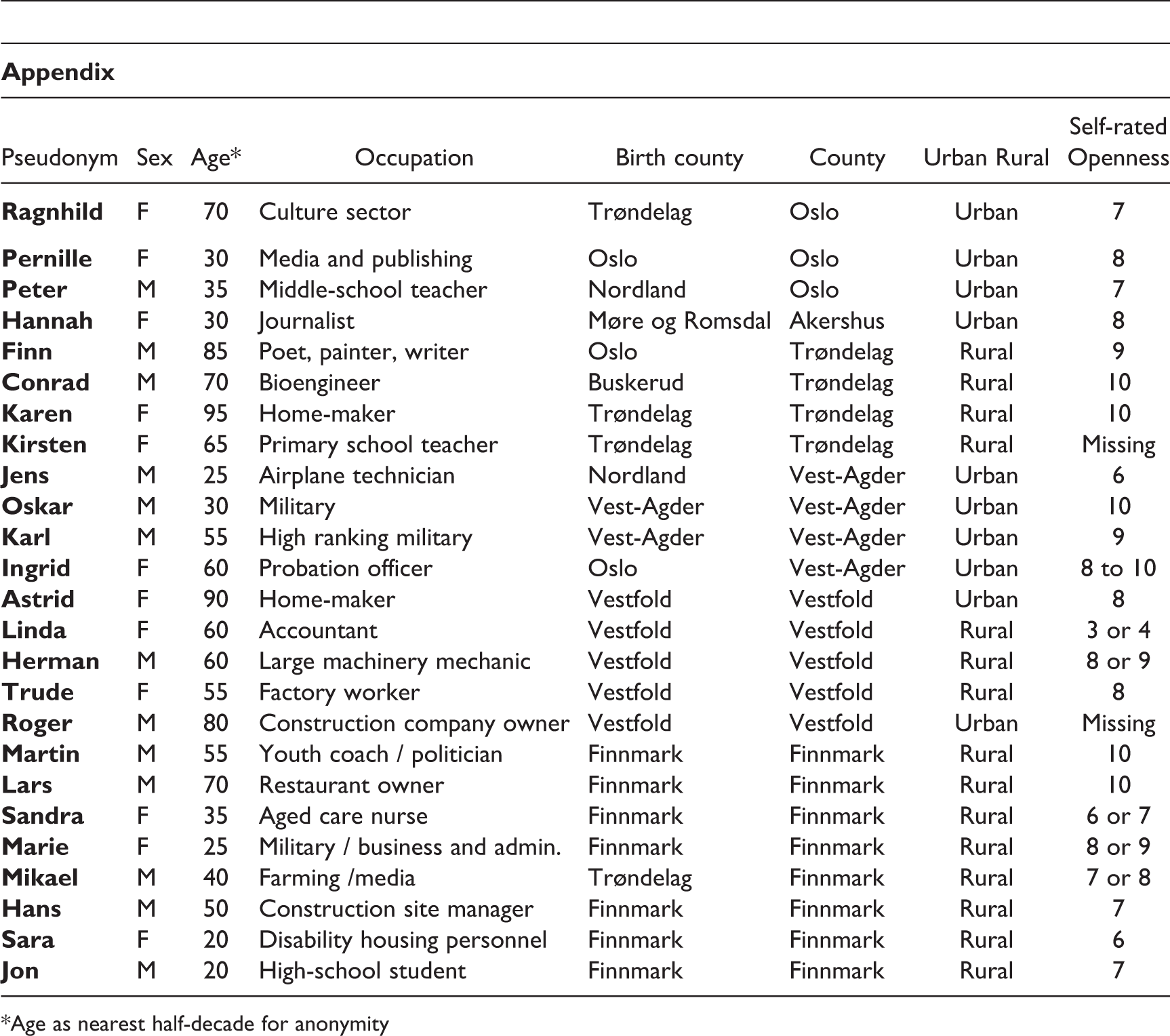
| Pseudonym | Sex | Age* | Occupation | Birth county | County | Urban Rural | Self-rated Openness |
|---|---|---|---|---|---|---|---|
|
|
F | 70 | Culture sector | Trøndelag | Oslo | Urban | 7 |
|
|
F | 30 | Media and publishing | Oslo | Oslo | Urban | 8 |
|
|
M | 35 | Middle-school teacher | Nordland | Oslo | Urban | 7 |
|
|
F | 30 | Journalist | Møre og Romsdal | Akershus | Urban | 8 |
|
|
M | 85 | Poet, painter, writer | Oslo | Trøndelag | Rural | 9 |
|
|
M | 70 | Bioengineer | Buskerud | Trøndelag | Rural | 10 |
|
|
F | 95 | Home-maker | Trøndelag | Trøndelag | Rural | 10 |
|
|
F | 65 | Primary school teacher | Trøndelag | Trøndelag | Rural | Missing |
|
|
M | 25 | Airplane technician | Nordland | Vest-Agder | Urban | 6 |
|
|
M | 30 | Military | Vest-Agder | Vest-Agder | Urban | 10 |
|
|
M | 55 | High ranking military | Vest-Agder | Vest-Agder | Urban | 9 |
|
|
F | 60 | Probation officer | Oslo | Vest-Agder | Urban | 8 to 10 |
|
|
F | 90 | Home-maker | Vestfold | Vestfold | Urban | 8 |
|
|
F | 60 | Accountant | Vestfold | Vestfold | Rural | 3 or 4 |
|
|
M | 60 | Large machinery mechanic | Vestfold | Vestfold | Rural | 8 or 9 |
|
|
F | 55 | Factory worker | Vestfold | Vestfold | Rural | 8 |
|
|
M | 80 | Construction company owner | Vestfold | Vestfold | Urban | Missing |
|
|
M | 55 | Youth coach / politician | Finnmark | Finnmark | Rural | 10 |
|
|
M | 70 | Restaurant owner | Finnmark | Finnmark | Rural | 10 |
|
|
F | 35 | Aged care nurse | Finnmark | Finnmark | Rural | 6 or 7 |
|
|
F | 25 | Military / business and admin. | Finnmark | Finnmark | Rural | 8 or 9 |
|
|
M | 40 | Farming /media | Trøndelag | Finnmark | Rural | 7 or 8 |
|
|
M | 50 | Construction site manager | Finnmark | Finnmark | Rural | 7 |
|
|
F | 20 | Disability housing personnel | Finnmark | Finnmark | Rural | 6 |
|
|
M | 20 | High-school student | Finnmark | Finnmark | Rural | 7 |
*Age as nearest half-decade for anonymity