



Abstract
This study used 2009–2015 time-diary data to examine gender differences in daily activities among children and adolescents aged 10–17 in Finland, Spain and the UK (N = 3517). In all three countries, boys were significantly more involved in screen-based activities and exercising and girls in domestic work, non-screen educational activities and personal care. Gender differences in socializing time were only significant in the UK, with girls socializing more than boys. Gender gaps within countries were largest in domestic work (UK: 60%; Finland: 58%; Spain: 48%) and exercising (UK: 57%; Finland: 36%; Spain: 27%), followed by educational time (UK: 35%; Finland: 34%; Spain: 18%) and screen-based activities (UK: 31%; Finland: 16%; Spain: 16%), and lower in personal care (UK: 27%; Finland: 21%; Spain: 14%) and socializing (UK; 21%; Finland: 13%; Spain: 6%). Two-way country-gender interactions in children’s activities were statistically significant when comparing Spain and the UK on screen-based activities, socializing, and personal care, with larger gender gaps in the UK than in Spain. By contrast, gender differences in child time use between Finland and either Spain or UK were not statistically significant. The complex role of national contexts and life-course stages in shaping gendered time-use patterns is discussed.
Introduction
Time-use patterns remain markedly gendered in contemporary societies, despite progress towards gender equality over recent decades (England, 2010; Goldscheider et al., 2015). Gender inequalities in activities like employment, domestic work or leisure increase during the transition to parenthood and remain quite stable afterward (Dotti-Sani, 2018; Grunow and Evertsson, 2016; Kühhirt, 2011). We know that gender gaps in adults’ time use differ across societies. Countries with more gender egalitarian policies and norms tend to exhibit the highest levels of gender symmetry in activities like paid work, childcare and housework (Anxo et al., 2011; Craig and Mullan, 2010; Esping-Andersen et al., 2013; Hook, 2006; Kan et al., 2011). Although cross-national differences in adult men’s and women’s time use are well documented, much less is known on gender gaps in child and adolescent time use across national contexts. Our study contributes to fill this important gap.
In this study, we examine gender differences in child and adolescent time use from a cross-national approach. Previous studies emphasized the importance of gender role socialization. Children are socialized in contexts where families, schools, communities and the media display gender-typed norms, which leads them to enact and reproduce gendered actions through daily interactions with individuals and institutions (Goffman, 1977; West and Zimmerman, 1987). Other studies considered socio-biological factors. This research highlights how gender differences in puberty interplay with sociocultural contexts that bring boys and girls to display gendered behaviours in activities like sports, consumption or leisure preferences (e.g. Becker et al., 2016).
Previous research shows that gendered patterns in time use start early in the life course (Solaz and Wolff, 2015). Studies with US data found that female teenagers are more active in domestic chores, reading and doing homework, while male teenagers are more involved in screen-based activities (Wight et al., 2009). Research using Italian data found that girls spend less time than boys on active leisure and sports, and more time on domestic chores, with gender differences increasing remarkably from childhood to youth (Dotti-Sani, 2018; Mencarini et al., 2019). In a study with Canadian data, boys and girls were also found to have gendered leisure patterns (Hilbrecht et al., 2008). However, this literature has largely omitted a cross-country comparison.
Only one study – to our knowledge – has examined gender differences in children’s time use from a cross-national perspective. Rees’s (2017) study with 2013/15 data from 16 countries of different income levels found some important cross-country similarities (i.e. girls did more domestic chores than boys everywhere), but also interesting cross-country differences (i.e. some less gender egalitarian countries were more gender symmetrical in children’s time use, compared to more gender egalitarian countries). This suggests weak associations between gender gaps in children’s activities and gender inequality indexes. While Rees’s (2017) study is relevant, it presents a relevant weakness: it uses data with stylized time-use measures, where respondents report their general frequency of time allocated to specific activities. Contrary to surveys with stylized time-use measures, time-diary data are more robust and less subject to bias. Time-diary surveys measure individuals’ daily activities by gathering detailed information through a 24-hour diary of activities, where respondents indicate their exact activities in specific slots throughout the day (Gershuny, 2000; Sevilla-Sanz, 2014).
Our study examines high-quality, nationally representative time-diary data from 2009 to 2015 to compare the daily activities of boys and girls aged 10–17 across Finland, Spain and the UK. Gender gaps in children’s time use could differ across societies with different policy and cultural contexts. Countries with distinct welfare and gender regimes shape men’s and women’s roles in the public and private spheres in ways that impact gender equality in health, lifestyles, education, politics and employment (Cooke, 2011; Esping-Andersen, 1999; Grunow et al., 2018; Hook, 2006; Lewis, 2009; World Economic Forum, 2017). Children and adolescents might integrate the gender egalitarian norms and attitudes of their country through daily social interactions within families, communities, schools or the media. From this perspective, boys and girls might have more similar ways of spending time in activities like domestic work, reading or using electronic devices in more gender egalitarian countries (i.e. Finland) than in less gender egalitarian countries (i.e. Spain).
Yet, gender relations are complex and multidimensional. Gender gaps in children’s daily activities might not reproduce the overall gender equality levels of society. The scarce cross-country evidence on gender differences in child daily activities, although based on stylized measures that are less robust than our time-diary measures, suggests that gender equality levels are not closely associated with gender gaps in child time use (Rees, 2017). Other studies show a strong persistence in adolescents’ gendered roles across countries with different policy and cultural contexts (Kagesten et al., 2016). Further, certain gender-typed attitudes and expectations (i.e. career and educational aspirations) have been found to emerge strongly also in advanced post-industrial societies, which show high levels of ‘self-expressive’ values embracing gender egalitarianism (Cech, 2013; Charles, 2011; Charles and Bradley, 2009; Stoet and Gary, 2018). In short, gender differences in child and adolescent time use across countries could be driven by factors not related to gender egalitarianism in society.
We argue that how post-industrial societies structure children’s daily routines could influence gender differences in children’s activities. Across countries, even in the most gender egalitarian, children reproduce marked gender roles and ideologies through socialization mechanisms, be this within families, schools, peer groups or the media (Kagesten et al., 2016). Yet, children could more easily engage in gendered routines in societies that give them strong discretion and space to spend time in their own activities, either alone or with peers. While children’s early socialization in families and schools shape their gendered roles, identities and preferences (DiPrete and Buchmann, 2013; Platt and Polavieja, 2016), children’s time in these institutions would be relatively uniform by gender, with school activities being educationally oriented and family activities involving routines that often include both boys and girls (i.e. family socializing, dinners, TV time). By contrast, children’s free time outside schools and families (i.e. alone or with peers) might leave them with more diversity and autonomy to choose their preferred leisure activities, leading potentially to a stronger reproduction of gendered daily routines, where boys engage more in male-typed activities (i.e. video-gaming) and girls in female-typed activities (i.e. personal care). Therefore, in countries where young people are strongly encouraged to participate in their own leisure activities with peers or alone (outside families and schools), children could have more space to ‘do gender’ in their free time, and in ways that do not necessarily reflect their country’s gender equality levels.
The three countries of our study – Finland, Spain and the UK – illustrate three Western European contexts with different policy, cultural and gender regimes. Finland exhibits a strong egalitarian public policy framework supporting gender equality in domestic work, leisure and employment (Esping-Andersen, 1999; Kansala and Oinas, 2016; Sullivan et al., 2018). Also, Finland has a culture that embraces strong ‘self-expressive’ orientations among young people, with children’s routines occurring disproportionately alone and outside parental supervision (Gracia et al., 2020; Inglehart et al., 2014; Triandis, 2018). The UK, labelled as a liberal welfare regime, tends to show more gender egalitarian arrangements and norms than Spain, but is less gender egalitarian than Finland, with a cultural context found to have the highest levels of self-expressive values among these three countries (Inglehart et al., 2014; Lewis 2009; Triandis, 2018). Finally, Spain is the country of the three where children spend more hours with parents and at school on a random day of the year, and where the family plays a more important role in structuring social relations (Gracia et al., 2020; Jurado Guerrero and Naldini, 2018; OECD, 2014).
Overall, our study is –to our knowledge– the first cross-national time-diary analysis of gender differences in child and adolescent time use. We investigate this question by focusing on three high-income Western European countries: Finland, Spain and the UK. We argue that gender gaps in child and adolescent daily routines are not necessarily a function of national contexts of gender equality, but potentially reflect how societies structure young people’s gender-typed daily activities.
Three national cases: Finland, Spain and the UK
Our study focuses on three Western European countries with distinct policy, gender and cultural contexts: Finland, Spain and the UK. We can summarize important differences across these three countries in two main axes: (a) gender egalitarianism in work, values and behaviours, and (b) variations in degrees of self-expressive values and organization of children’s daily routines.
Finland represents the Scandinavian model, based on a ‘social-democratic’ policy tradition (Esping-Andersen, 1999). The Finnish case shows internationally high rates of dual-earner couples, with high female employment participation rates (Eurostat, 2017). While previous research documents that Finland exhibits gender inequalities in (un)paid work (Mustosmaki et al., 2017), this country has among the highest levels of job autonomy and flexibility among both genders (Anttila et al., 2015), and high gender equality in the division of unpaid labour (Kansala and Oinas, 2016). Finland has high levels of individual autonomy and ‘self-expressive’ values that promote young people’s autonomous choices (Inglehart et al., 2014; Triandis, 2018), with some research indicating high levels of gender segregation in individuals’ career preferences in Finland (Charles and Bradley, 2009). In Finland, students spend internationally a quite reduced number of total hours per week in school, and a high number of hours alone and socializing without parents’ supervision (Gracia et al., 2020; OECD, 2014).
The UK captures the Anglo-Saxon model with a ‘liberal-oriented’ policy approach (Esping-Andersen, 1999). While the UK has relatively high levels of female employment, British mothers are employed disproportionately as part-time workers (Lewis, 2009). In terms of the gender division of domestic labour, the UK is less egalitarian than Scandinavian countries like Denmark or Finland, but it is also more egalitarian than Southern European countries, like Italy or Spain (Esping-Andersen et al., 2013; Kan et al., 2011). Studies found the UK to exhibit the highest levels of self-expressive values of our three countries of study, showing clear differences with Spain (Inglehart et al., 2014). On an average week of the year, British pupils aged 10–17 spend about 20 hours a week at school, just like their Finnish counterparts, while their Spanish counterparts spend about 25 weekly hours at school (Gracia et al., 2020). 1 In the UK, similar to Finland, children spend more time socializing with people outside parents’ supervision than in Spain, spending also less time with parents than Spanish children (Gracia et al., 2020).
Spain captures the Southern European model with a ‘family-oriented’ policy approach (Esping-Andersen, 1999). Spain is the country of our study with the highest rates of male-breadwinner couples, even if maternal full-time employment is more common in Spain than in the UK (Lewis, 2009). Spain is less gender egalitarian than Britain, and especially Finland, in the couple’s division of labour, with a rather family-based model of care and social relations (Bueno and Grau-Grau, 2021; Garcia-Roman et al., 2017; Jurado Guerrero and Naldini, 2018; Kan et al., 2011). The presence of self-expressive values emphasizing young people’s autonomy outside the family is tinier in Spain than in Finland and the UK (Inglehart et al., 2014). Finally, apart from spending more time in school, Spanish children share more time with parents than their British and Finnish counterparts (Gracia et al., 2020).
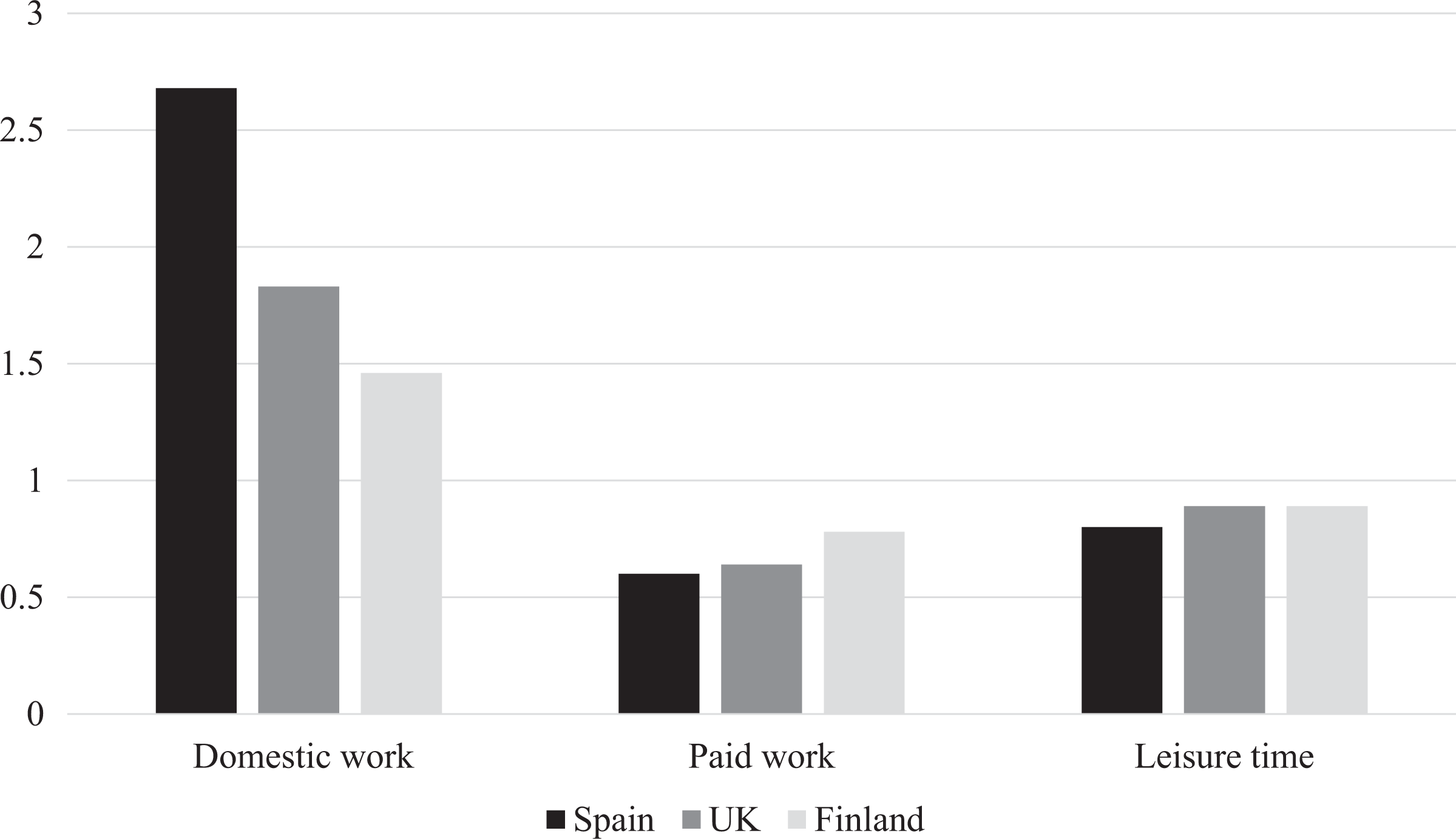
Gender ratios in time use in Finland, Spain and UK for individuals aged 25–65. Note: Authors’ calculations based on the HETUS statistics for Finland (2009/10), Spain (2009/10) and the UK (2014/15), with time-diary data retrieved by the authors from the study: https://stats.oecd.org/Index.aspx?DataSetCode=TIME_USE. Details on the way the data were collected can be found in Fisher et al. (2019). The ratio is based on the average time that men and women spend on a random day in each of the three activities. The ratio follows this formula for each activity: F / M. Where F is the female’s time and M is the male’s time in each activity. The outcome of the gender ratio shows the number of hours that females spend in each activity for each hour spent by males in the same activity, where 1 would imply that men and women spend exactly the same hours in the activity, values above 1 indicate that females spend more time in the activity, and values below 1 indicate that males spend more time in the activity.
Figure 1 contextualizes the gender differences in adults’ time use across the three countries of our study, based on the Harmonised European Time Use Study data (see Fisher et al., 2019). The figure shows the average gender gaps in paid work, domestic work and leisure time among adults in the three countries, using a ratio that indicates the time allocation of women relative to men. We observe that, for every hour that men spend on unpaid domestic work in Spain, women spend 2.7 hours, with lower gaps in the UK (1.8) and the lowest gaps in Finland (1.5). Finnish women spend 0.78 hours of paid work for every hour spent by men in paid work, with larger paid work gaps in the UK (0.64), and especially in Spain (0.60). For leisure time, the male advantage is largest in Spain (0.80) compared to Finland (0.89) and the UK (0.89). Overall, Finland is where adults’ time use allocation is more similar between genders, particularly in domestic work and paid work, followed by the UK, while Spain shows the most pronounced differences in time use allocation between men and women.
Overall, Finland, Spain and the UK capture different policies, norms and attitudes in terms of gender relations, but also regarding how societies structure children’s and adolescents’ daily routines and autonomy. These differences are considered in our analytical framework.
Hypotheses
Our study examines gender differences in child and adolescent time use in a cross-national perspective by focusing on six gendered activities: (a) ‘screen-based activities’; (b) ‘non-screen educational time’; (c) ‘socializing’; (d) ‘exercising’; (e) ‘unpaid domestic work’; and (f) ‘personal care time’ (Dotti-Sani, 2018; Hilbrecht et al., 2008; Mencarini et al., 2019; Wight et al., 2009). We develop hypotheses regarding (a) gender gaps in child time use without addressing country variations, and (b) gender gaps in child time by considering country variations. For reasons of space, we refer generally to levels of gender (di)similarity in child daily activities.
Gender differences in children’s time use
We generally expect boys and girls to differ in their time-use patterns. Children grow up embedded in gendered contexts that shape their norms and attitudes (West and Zimmerman, 1987). For example, children might (un)consciously internalize that girls should be active in domestic chores and boys in computing, due to their exposure to such gendered norms and practices through daily personal and media interactions. Accordingly, girls might disproportionally engage in ‘female-typed’ activities (i.e. domestic work, personal care, homework, reading) and boys in ‘male-typed’ activities (i.e. sports, screen-based time). Although boys and girls differ in their socializing styles and can give different meaning to social relations (Hilbrecht et al., 2008), gendered differences in how often boys and girls engage in socializing activities are likely to be small. We expect gender differences in child time use to apply to all three countries and to persist after controlling for demographic factors.
Cross-country gender variations in children’s time use: Two alternative scenarios
We propose two alternative hypotheses regarding gender differences in children’s daily activities across our three countries of study, namely Finland, Spain and the UK: (a) the gender equality hypothesis, and (b) the child autonomy hypothesis.
The gender equality hypothesis argues that gender equality at the country level brings higher gender symmetry in child time use. This hypothesis expects boys and girls in Finland to have less gendered time-use patterns than boys and girls in the UK, particularly compared to their Spanish counterparts, mirroring cross-national variations in adults’ time use and gender roles. For example, if adults exhibit more egalitarian behaviours in domestic work and gender norms in Finland than in Spain, these gender inequalities among adults might be transmitted to the younger generations via intergenerational socialization processes, which in turn might lead to smaller gender differences in child and adolescent domestic work in Finland, compared to Spain. Therefore, compared to the UK, and especially to Spain, children in Finland might feel less gender pressure to engage in activities like exercising, playing video games, brushing their hair or reading books, leading to smaller gender gaps in child time use in Finland, compared to the UK, and especially to Spain.
The child autonomy hypothesis holds that national contexts influence children’s gendered time use through the social organization of children’s daily routines and free time. Gender differences in child daily activities do not seem to be associated with gender egalitarian policies and norms at the national level (Rees, 2017), contrary to adults’ time use (Anxo et al. 2011; Hook, 2006; Kan et al., 2011). Studies found that post-industrial societies with marked ‘self-expressive’ values emphasizing individual autonomy display strong gendered educational preferences, irrespective of gender equality levels (Cech, 2013; Charles, 2011; Charles and Bradley, 2009; Stoet and Gary, 2018).
One could argue that children are more inclined to develop gendered time-use patterns in countries offering support and time to young people to develop their own leisure with peers or alone, outside the context of schools and families. While activities in schools are strongly standardized for both boys and girls (i.e. educational activities) and parents often arrange relatively homogeneous family routines with children (i.e. family dinners, screen time, homework, playing time), children’s free time outside schools and families (alone or with peers) gives more space to reproduce gendered leisure preferences through their participation in boy-typed activities (i.e. video-gaming) and girl-typed activities (i.e. personal care) (Hilbrecht et al., 2008). If across cultural contexts children integrate gender-typed ideologies and preferences through family, school, peer-group and media socialization processes (Kagesten et al., 2016), societies that strongly promote children’s own space in their free time – alone or with peers – could disproportionately reinforce children’s gendered activities.
Accordingly, the ‘child autonomy hypothesis’ expects gender differences in child time use to be largest in the UK, followed by Finland, and smallest in Spain. First, if young people in the UK, compared to young people in Spain, receive more ample support, time and autonomy to explore their leisure activities outside families and schools (Gracia et al., 2020; Inglehart et al., 2014), children’s time use might be more gendered in the UK than in Spain. Second, if Spanish children spend more time in family activities and at school, and Finnish children are encouraged to participate more in their own activities alone and with peers (Gracia et al., 2020), then Finnish children could have more space and time to reproduce gendered time-use patterns, compared to Spanish children. Third, while both Finland and the UK have high cultural values emphasizing young people’s autonomy during their free time (Inglehart et al., 2014), the more gender egalitarian context of Finland could partly contribute to lessen existing gender differences in children’s time use in Finland, compared to the UK.
Data and methods
Data
We use time-diary data from Finland (2009/10), Spain (2009/10) and the United Kingdom (2014/15) from the Harmonised European Time Use Survey (HETUS). 2 These data combine comparable individual and household level measures with the most precise and robust statistical sources available to measure individuals’ daily activities (Bianchi et al., 2006; Robinson and Godbey, 1997). Respondents reported detailed diaries of activities along the 1440 minutes (24 hours) of a random day by indicating what (with whom and where) children were doing along 10-minutes time slots. Our sample contains diaries filled by boys and girls aged 10–17 who were students, not employed, and living in a single-mother or a different-sex/two-parent family at the moment of the interview. We further excluded cases with missing data in any of our variables of study, most of them on maternal employment hours. This implied dropping observations of 8 children in Spain, 14 in Finland and 73 in the UK. While additional analyses with these missing cases in the model – controlling for maternal work status and not maternal work hours – yielded comparable results (not shown), we excluded these cases in the interest of adding all our covariates in the models. The final sample includes 3517 diaries (830 diaries in Finland; 1324 diaries in Spain; 1363 diaries in the UK).
The surveys from Finland and the UK had two diaries completed by children (one on a weekday and another on a weekend), while respondents in the Spanish survey filled one diary (either on a weekday or weekend). Analyses fully account for the clustered nature of the samples at the household level and the existence of two individual diary observations in Finland and the UK. Surveys from all countries contain household samples, which means there could be multiple children in some households of observation (i.e. siblings). 3 By conducting weighted analyses our models measure a random distribution of days, weeks and seasons in all three countries, as well as demographic weights correcting for a potential selection in responses in each country. 4
Dependent variables
Our dependent variables include six continuous measures of children’s daily minutes on a random day allocated to: (a) ‘screen-based time’ (i.e. TV, videos, electronic activities, using iPads, mobile phone use, video gaming); (b) ‘non-screen educational time’ (i.e. studying, reading, library time, cultural spectacles, arts, music); (c) ‘socializing time’ (i.e. informal social relations, playing with others, social games, volunteering activities); (d) ‘exercising time’ (i.e. exercising, active sports); (e) ‘unpaid domestic work’ (i.e. housework, child care); and (f) ‘personal care time’ (i.e. putting on make-up, dressing up, combing/brushing hair, showering). We refer only to the main activity, as secondary activities, namely those synchronized with the main activity, can produce estimation bias due to different sample criteria (Kitterød, 2001). Table A1 presents our strategy for the coding of all study activities.
Independent and control variables
Regarding our independent variables, ‘gender’ is our main covariate at the individual level: ‘girls’ (= 1) and ‘boys’ (= 0), while we employ a dummy measure of ‘country’. We use control variables as adjustments on the statistical associations between child gender and time use across countries. ‘Age’: continuous variable; boys and girls differ significantly in their time-use patterns across developmental stages (Dotti-Sani, 2018); ‘Family structure’: 0 = ‘two-parent family’ and 1 = ‘single-mother family’; family structure can influence children’s gendered time-use patterns (Mencarini et al., 2019); ‘Maternal weekly work hours’: 0 = ‘mother not employed’; 1 = ‘mother works 1–30 hours’; 2 = ‘mother works 31–37 hours’; 3 = ‘mother works over 37 hours’; maternal work hours impact child time use and are distributed differently across the three countries (Gracia and Garcia-Roman, 2018; Lewis, 2009); ‘Maternal education’: 0 = ‘not college degree’; 1 = ‘college degree’; education impacts child time use and might reflect different gender norms across countries (Bianchi et al., 2006); ‘Number of children’: number of children aged 0–17 at home (ordinal); ‘Number of adults’: number of adults at home aged 18 or older (ordinal); the number of individuals and children at home differs across countries and is considered to be a predictor of teenagers’ time use (Wight et al., 2009). ‘Day of the week’: 0 = ‘weekday’ (Monday–Friday); 1 = ‘weekend’ (Saturday–Sunday). ‘Quarter’: 0 = ‘1st Quarter (Jan – March)’; 1 = ‘2nd Quarter (April – June)’; 2 = ‘3rd Quarter (July – September’; 3 = ‘4th Quarter (October – December)’; children tend to have different behaviours depending on the day of week and season of the year, so adding this control variable is relevant (Gracia et al., 2020).
Empirical strategy
Our analyses follow four steps: (a) we conduct descriptive analyses; (b) we run linear prediction models by plotting predicted values by child gender, after controlling for all demographic and socioeconomic measures, to examine gender gaps between and within countries; (c) we apply two-way country-gender interaction effects; and (d) we run a set of robustness checks.
Results
Descriptive analyses
Table 1 presents the summary statistics with means and standard deviations of the study measures, showing different demographic distributions across countries (i.e. maternal work, family structure, educational level). In Figure 2 we show boys’ and girls’ average daily minutes for the six dependent variables across Finland, Spain and the UK. Descriptive findings of Figure 2 resemble the multivariate analyses that we present next, using predicted values, adjusting by demographics. Additionally, in Table A2, the reader can find the full OLS regression analyses for our six dependent variables, adding gender and all study variables in the model.
Summary statistics, means and standard deviations.
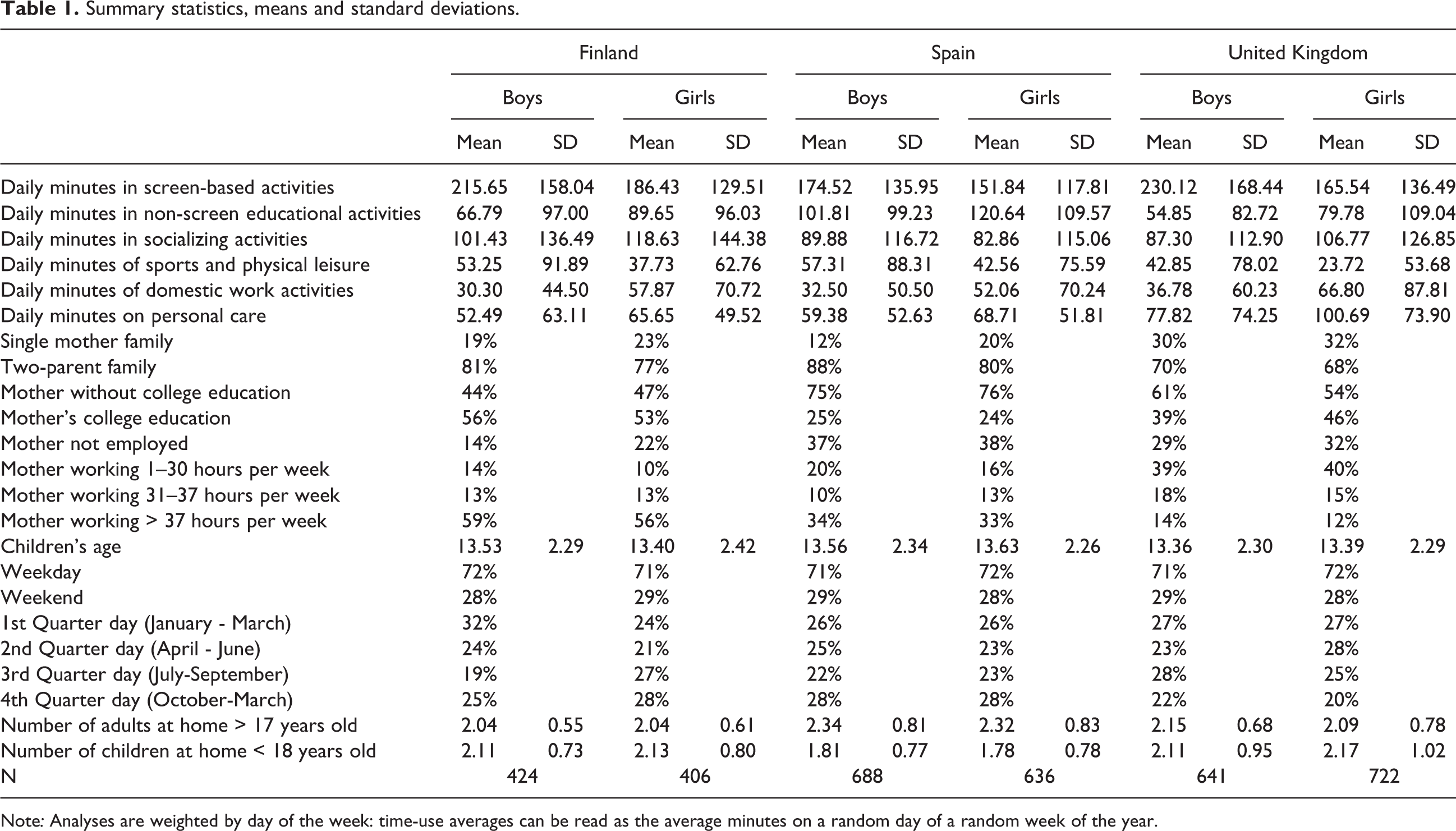
Note: Analyses are weighted by day of the week: time-use averages can be read as the average minutes on a random day of a random week of the year.
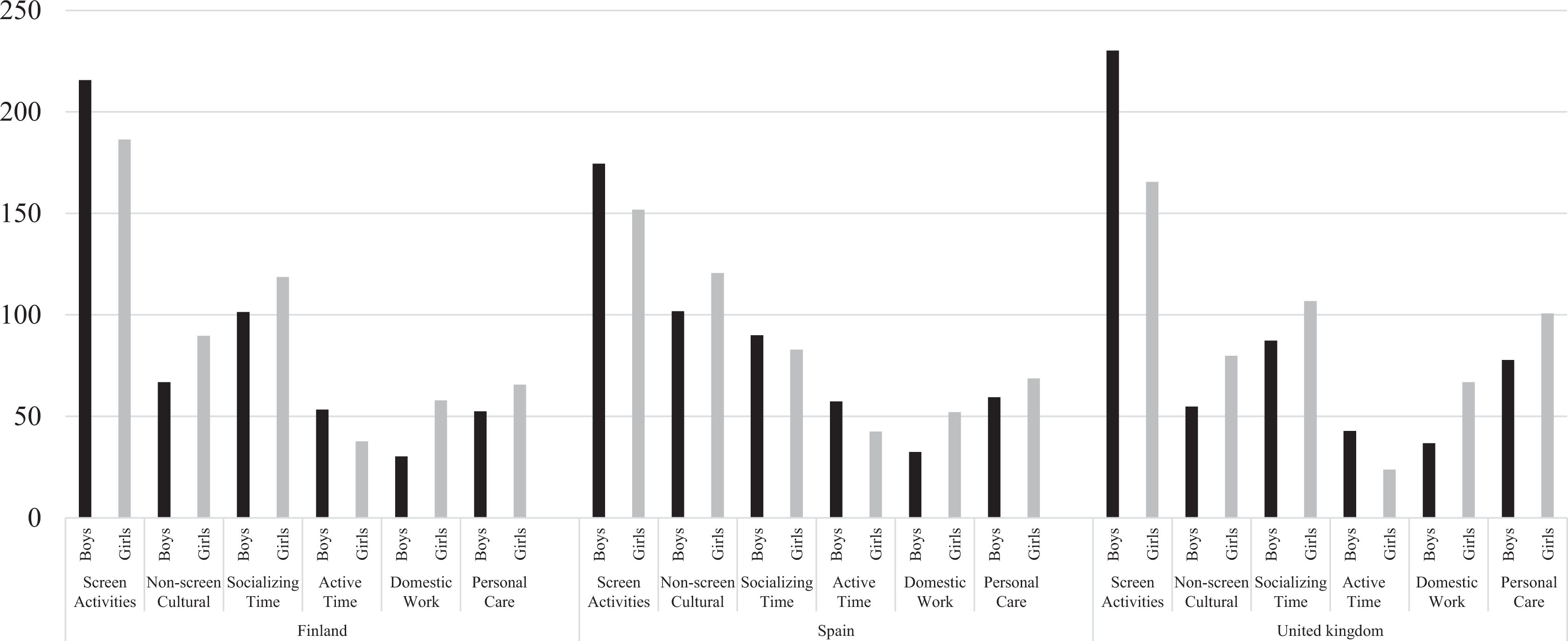
Average minutes in daily activities by child gender and across countries. Note: The average time in activities by boys and girls is computed by treating an average day of a random week over the year in all three countries (weekdays are counted as 1/5 and weekends as 1/2 for an average full week of the year) (N = 3517).
Multivariate analyses: Gender and country gaps in child time use
Figure 3 shows the full predicted linear models of children’s daily minutes in the six activities with country-gender interactions. Results are presented as predicted values with confidence intervals (CI) at the 95% level for each of the three countries.
At the top of Figure 3, we observe that boys in the UK and Finland spent more time in screen-based activities (229 and 222 minutes, respectively) than boys in Spain (171). Finnish girls were the most active in screen-based activities (190 minutes), followed by British girls (169) and then Spanish girls (146). In educational activities, girls spent about 20 minutes more than boys in all three countries. Spanish boys and girls allocated more time in educational activities (above 100 minutes) than boys and girls in Finland and the UK, with British boys being the least involved in these activities (57). Socializing activities show dissimilar patterns by country. While girls in Finland (119 minutes) and the UK (105) were more active than boys in socializing, in Spain boys (90) spent marginally more time in socializing activities than girls (85).
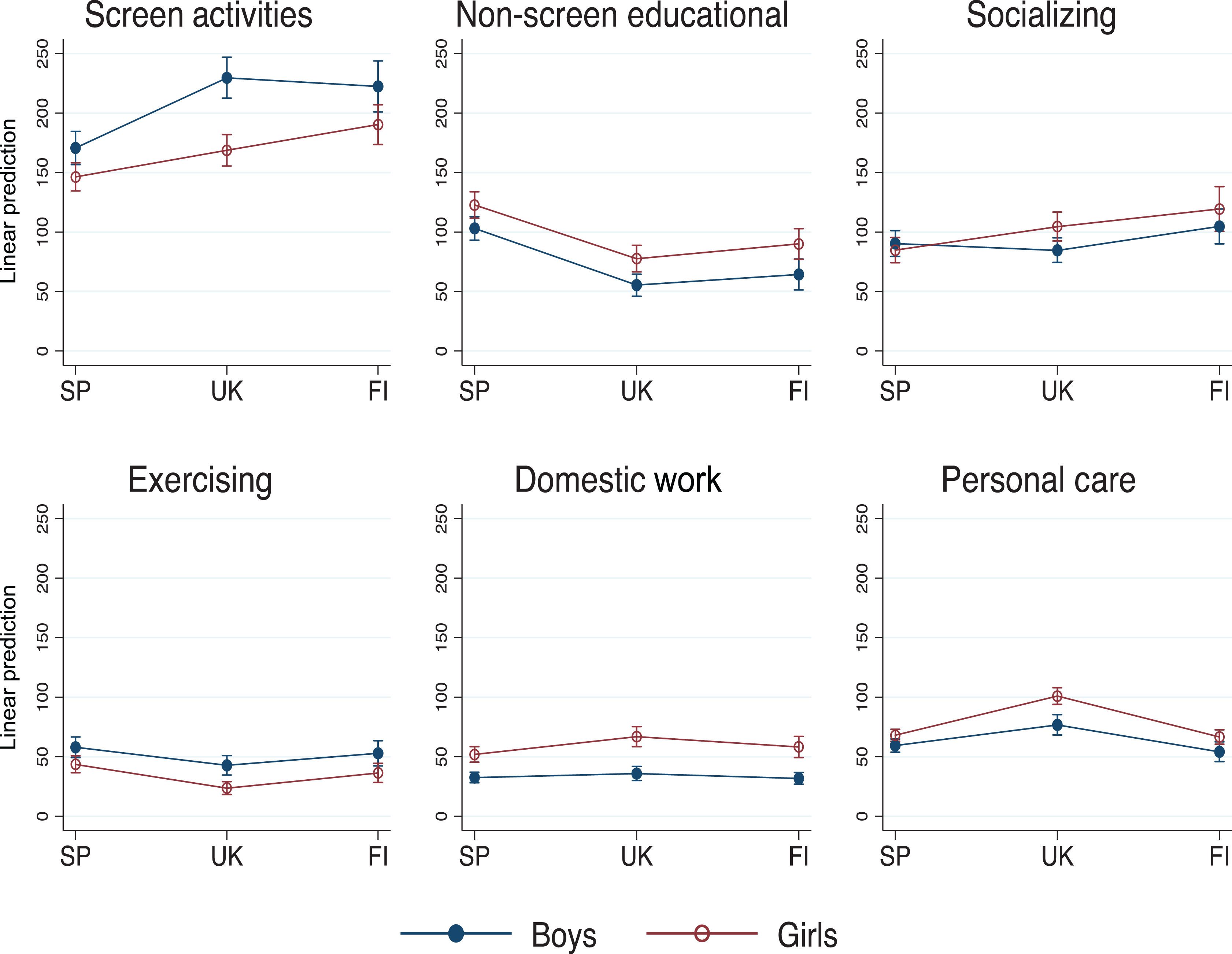
Predicted daily minutes in activities by country and gender. Note: Linear prediction models. The figure includes a total of six separated models with an interaction term between gender and country, with confidence intervals at 95% levels. All models include the following controls: Family structure; Mother’s education; Mother’s employment hours (Not employed; Mother’s working 1–30 weekly hours; Mother’s working 31–37 weekly hours; Mother’s working more than 37 weekly hours); Children’s age; Weekend diary; Season’s quarter (January – March; April – June; July – September; October – March); Number of adults at home aged 18 or older; Number of children at home aged 0–17. All analyses represent an average day where weekdays are counted as 1/5 and weekends as 1/2 for an average full week of the year, providing a representative random day, week and month of the year of observation; SP = Spain (N = 1324); UK = United Kingdom (N = 1363); FI = Finland (N = 830).
At the bottom of Figure 3, we see that Spanish boys were the most active in exercising (58 minutes) and British boys the least (43 minutes), with boys doing more exercising than girls in all three countries. For domestic work, girls in the UK spent the highest amount of time (67 minutes), adding about 10 minutes more than Finnish girls and 15 minutes more than Spanish girls. Finnish and Spanish boys were the least active in domestic work (32 minutes), slightly below British boys (36). In personal care, British girls were the most involved (101 minutes), adding about 30 minutes more in these activities than girls in Finland and Spain.
Table 2 shows within-country gender gaps in child time use, using percentage differences. The gender gap is largest as it distances more from 0: it has positive values when boys spent more time in the activity and negative values when girls were more involved in the activity. The percentage gender gaps are calculated from the net predicted values of each gender in each country. Table 2 also indicates whether gender differences were statistically significant (p), based on models run separately for each country subsample, adding all our study control variables in the regression.
Table 2 shows that boys were more involved in screen-based activities and exercising, while girls were more active in domestic work, non-screen educational activities and personal care activities. These gender differences are observed in all three countries. For socializing time, girls were more active than boys in Finland and the UK, whereas in Spain boys were more active in socializing activities. Gender differences in child time use were statistically significant (at 95% levels of higher) in all three countries and for all activities, except for socializing, where gender gaps were only statistically significant in the UK (p < 0.05), not in Finland or Spain. Table 2 shows percentage gender gaps in child domestic work of 60% in the UK, 58% in Finland and 48% in Spain. For exercising, gender gaps were 57% in the UK, 36% in Finland and 27% in Spain. As for educational activities, we found gender gaps of 35% in the UK, 34% in Finland and 18% in Spain. Gender gaps in screen-based activities were 31% in the UK and 16% in both Finland and Spain. With respect to personal care, percentage gender differences were 27% in the UK, 21% in Finland and 14% in Spain. Finally, gender gaps in socializing were 21% in the UK, 13% in Finland and 6% in Spain.
Predicted values, gender differences in child daily minutes in selected activities.
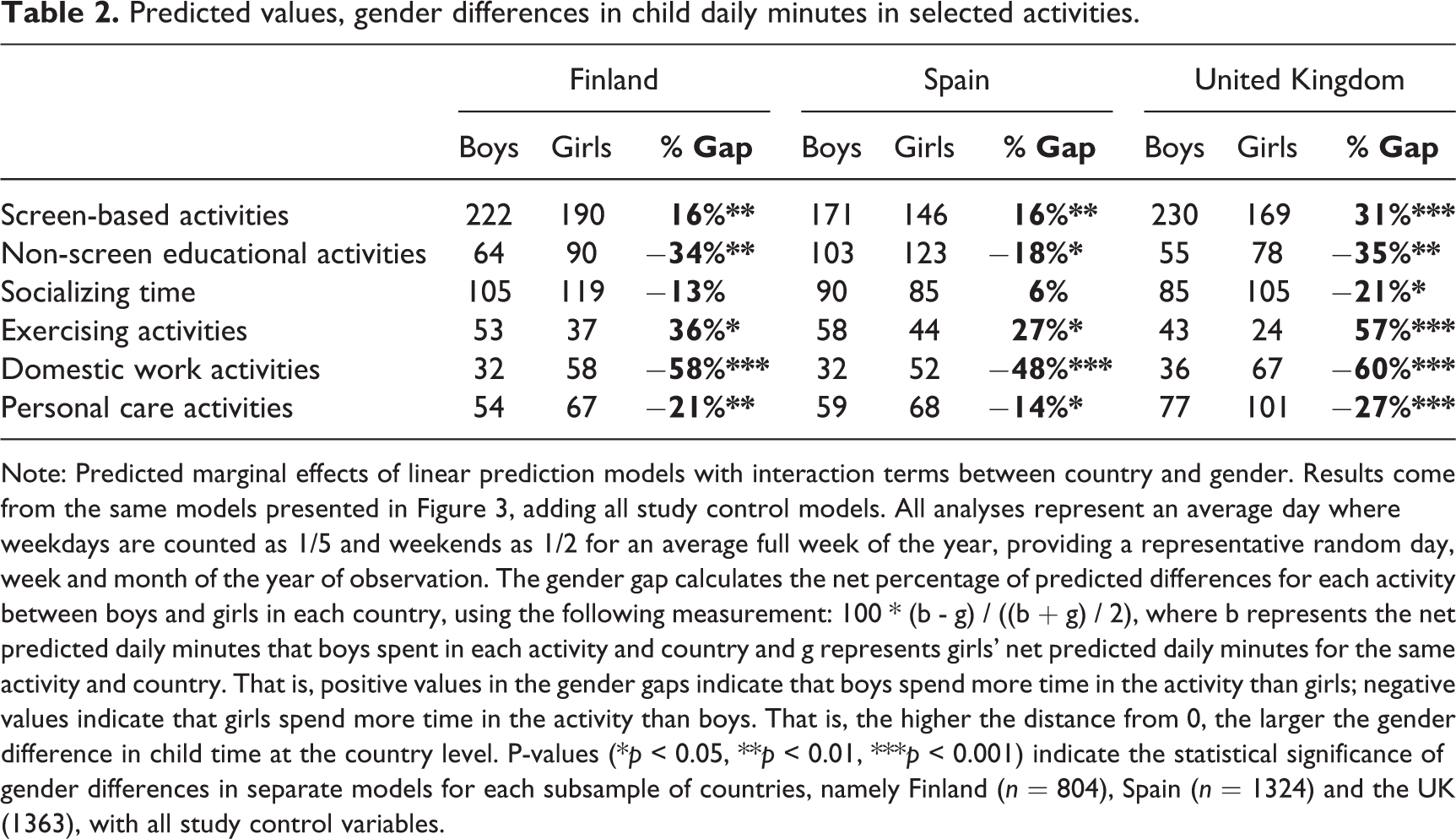
Note: Predicted marginal effects of linear prediction models with interaction terms between country and gender. Results come from the same models presented in Figure 3, adding all study control models. All analyses represent an average day where weekdays are counted as 1/5 and weekends as 1/2 for an average full week of the year, providing a representative random day, week and month of the year of observation. The gender gap calculates the net percentage of predicted differences for each activity between boys and girls in each country, using the following measurement: 100 * (b - g) / ((b + g) / 2), where b represents the net predicted daily minutes that boys spent in each activity and country and g represents girls’ net predicted daily minutes for the same activity and country. That is, positive values in the gender gaps indicate that boys spend more time in the activity than girls; negative values indicate that girls spend more time in the activity than boys. That is, the higher the distance from 0, the larger the gender difference in child time at the country level. P-values (*p < 0.05, **p < 0.01, ***p < 0.001) indicate the statistical significance of gender differences in separate models for each subsample of countries, namely Finland (n = 804), Spain (n = 1324) and the UK (1363), with all study control variables.
Table 3 presents the two-way country-gender interaction effects for all six dependent variables, adjusting for the study control variables. These country-gender interactions allow us to test whether gender differences in children’s time use across countries are statistically significant. Most cross-country gender differences in child time use were not statistically significant, except those comparing Spain and the UK, where three of the six models yielded statistically significant variations. The interaction effects of Table 3 show that differences between Spain and the UK were statistically significant for screen-based activities (Girl x United Kingdom; ß = −37.77; p < 0.01), socializing (Girl x United Kingdom; ß = 26.94; p < 0.05) and personal care (Girl x United Kingdom; ß = 15.07; p < 0.05). By contrast, the gender interactions comparing Spain and the UK were not statistically significant (at the 95% or higher) for the other three activities of study (i.e. non-screen educational time, exercising and domestic work). Finally, the country and gender interactions comparing Finland with Spain, and comparing Finland with the UK, were not statistically significant (at the 95%) for any of the six dependent variables of study.
OLS, child time use, country and gender interactions.
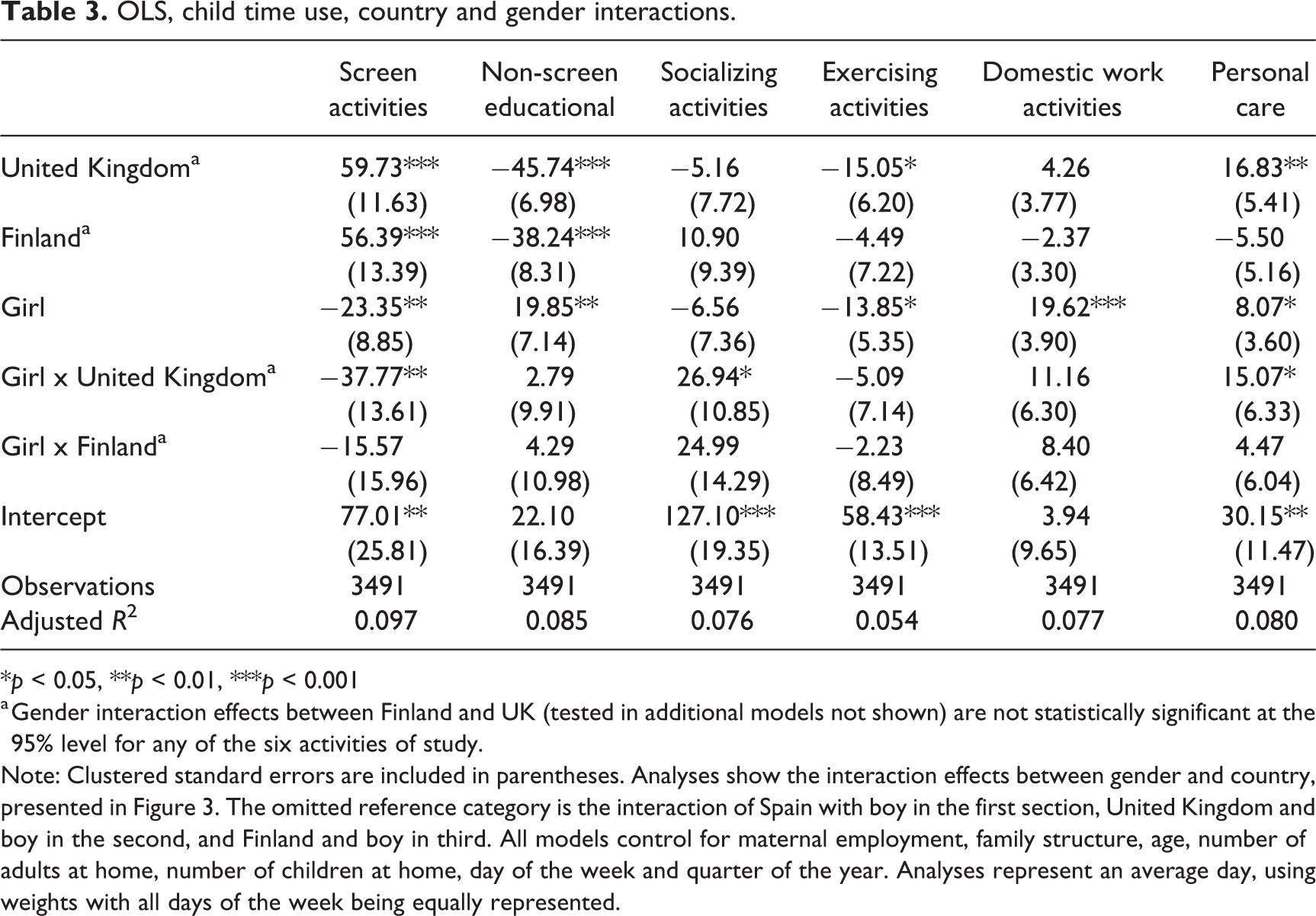
*p < 0.05, **p < 0.01, ***p < 0.001
a Gender interaction effects between Finland and UK (tested in additional models not shown) are not statistically significant at the 95% level for any of the six activities of study.
Note: Clustered standard errors are included in parentheses. Analyses show the interaction effects between gender and country, presented in Figure 3. The omitted reference category is the interaction of Spain with boy in the first section, United Kingdom and boy in the second, and Finland and boy in third. All models control for maternal employment, family structure, age, number of adults at home, number of children at home, day of the week and quarter of the year. Analyses represent an average day, using weights with all days of the week being equally represented.
Additional analyses: Child age, family structure, maternal work and activity context
We conducted multiple additional analyses. First, we addressed the moderating role of children’s age in gendered activities across countries, as research reveals gendered child age-specific developmental processes in time use (Gracia, 2014; Dotti-Sani, 2018). Figure 4 shows predicted values of three-way interactions with age (‘10–13’ against ‘14–17’), gender and country. Only in the UK were gender gaps in screen-based time substantially larger for older respondents. Gender differences in domestic work were most salient among older children in the UK, and especially in Finland, with robust differences at the 95% CI levels, while such gendered age gradient was not found in Spain. Overall, even if the UK and Finland show slightly larger gender variations by age (among older teenagers), cross-country gender differences in child time use by child age are modest.
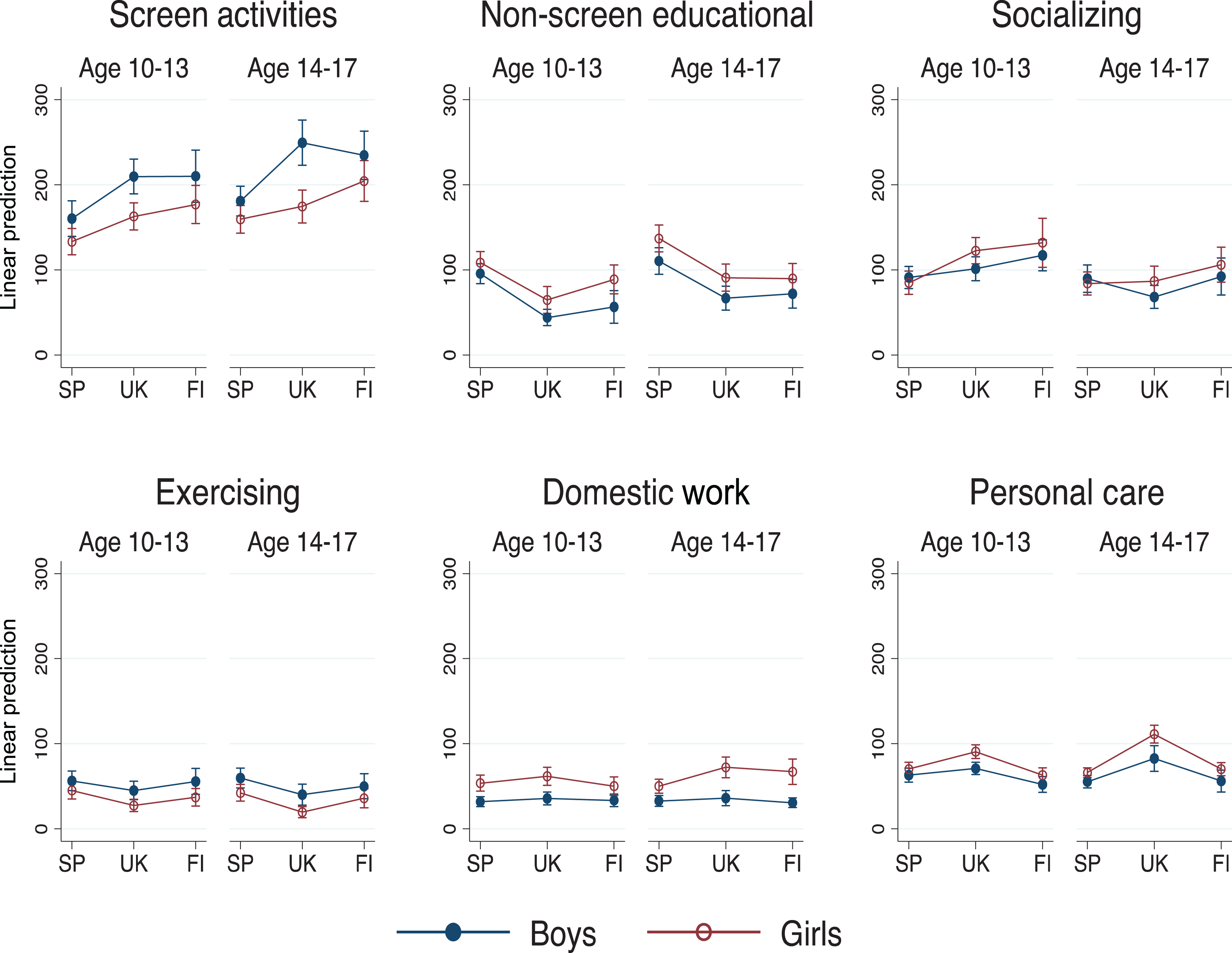
Predicted daily minutes in activities by country x gender and child age group. Note: Linear prediction models. The figure includes a total of six separated models with an interaction term between gender and country separately by children’s age groups, the youngest (Age 10–13; about 50% of boys and girls) and the eldest (Age 14–17; about 50% of boys and girls), with confidence intervals at 95% levels. All models include the following controls: Family structure; Mother’s education; Mother’s employment hours (Not employed; Mother’s working 1–30 weekly hours; Mother’s working 31–37 weekly hours; Mother’s working more than 37 weekly hours); Weekend diary; Season’s quarter (January – March; April – June; July – September; October – March); Number of adults at home aged 18 or older; Number of children at home aged 0–17. All analyses represent an average day where weekdays are counted as 1/5 and weekends as 1/2 for an average full week of the year, providing a representative random day, week and month of the year of observation; SP = Spain (N = 1324); UK = United Kingdom (N = 1363); FI = Finland (N = 830).
Second, we examined the moderating role of family structure, following research on the gendered role of family structure in affecting both parents’ and children’s time use (Cano and Gracia, 2020; Fallesen and Gähler, 2020; Mencarini et al., 2019). Figure 5 shows the predicted values of a three-way interaction with family structure, gender and country. For exercising time, only in the UK, gender gaps were slightly larger for two-parent families (at 95% CI levels). For educational time, gender differences in the UK and Finland were larger for children in two-parent families than for children in single-mother families (around 95% CI levels), with no differences in Spain. Gender gaps in child screen-based time were largest within two-parent families in Finland and the UK. Finally, the higher involvement of girls in socializing time in the UK seems driven by two-parent families, but interestingly it was driven by single-mother families in Finland. In short, gender differences in child time use between single-mother and two-parent families are generally small and, if they appear, we see them in Finland, and especially in the UK, but not in Spain.
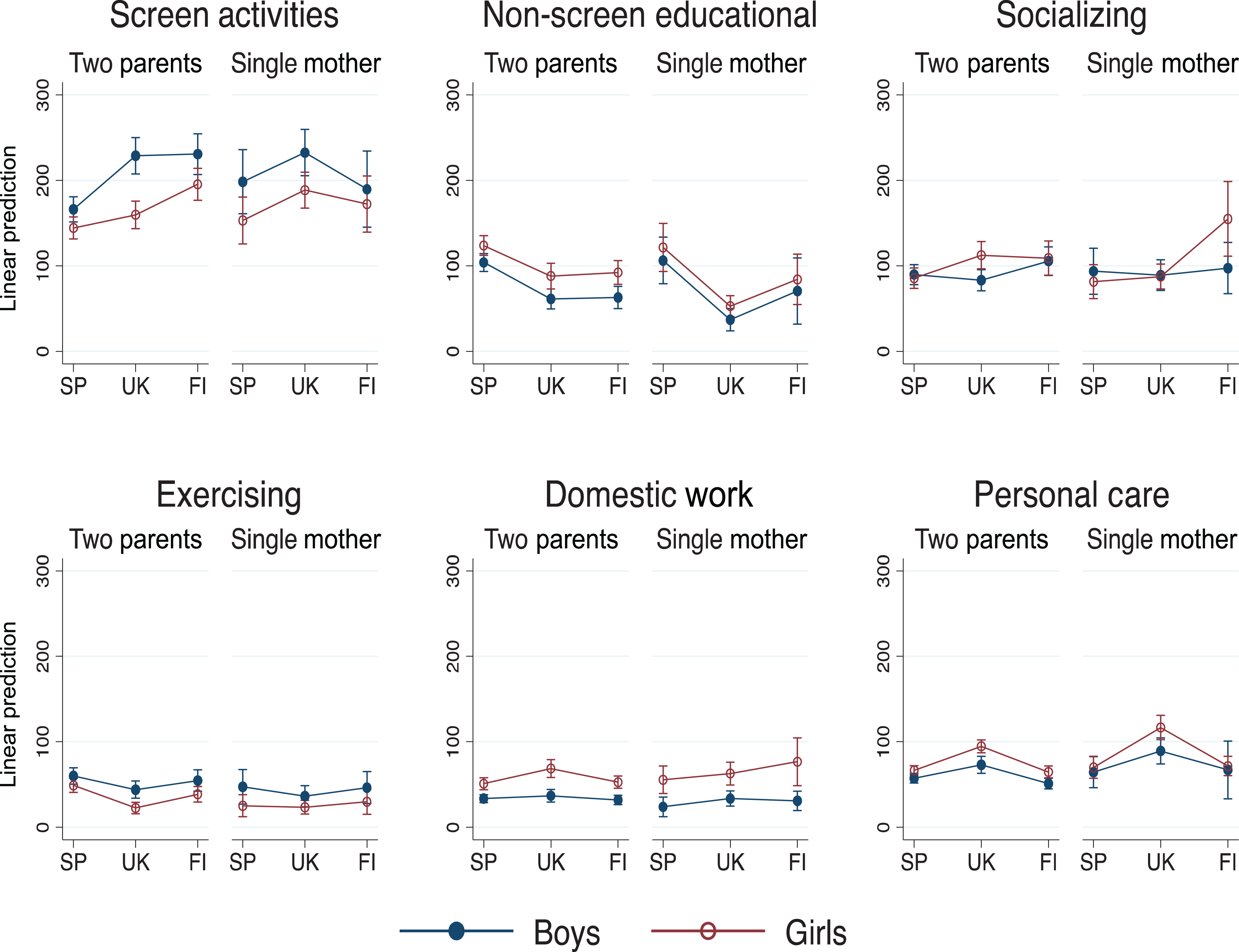
Predicted daily minutes in activities by country x gender and family structure. Note: Linear prediction models. The figure includes a total of six separated models with an interaction term between gender and country separately by family structure, including two-parent families and single-mother families, with confidence intervals at 95% levels. All models include the following controls: Family structure; Mother’s education; Mother’s employment hours (Not employed; Mother’s working 1–30 weekly hours; Mother’s working 31–37 weekly hours; Mother’s working more than 37 weekly hours); Children’s age; Weekend diary; Season’s quarter (January – March; April – June; July – September; October – March); Number of adults at home aged 18 or older; Number of children at home aged 0–17. All analyses represent an average day where weekdays are counted as 1/5 and weekends as 1/2 for an average full week of the year, providing a representative random day, week and month of the year of observation.
Third, we examined the role of maternal employment status. Our three countries of study show disparities in maternal work participation (Gracia and Esping-Andersen, 2015; Lewis, 2009), which might reflect differences in parental time availability, having potential implications for children’s gendered time-use patterns. Figure 6 shows the predicted values of three-way interactions with maternal work status, gender and country. Spain only shows some gender differences in children’s time use by maternal work in non-screen educational activities and exercising, with larger differences for the group of employed mothers (CI around 95%). In Finland, we found differences in screen-based activities only, specifically among children with employed mothers (CI around 95%). For the UK, we only found relevant differences in socializing time, with such gender gaps being driven by children with non-employed mothers only (CI around 95%) and in domestic work, for which we see somehow stronger gender gaps among children with employed mothers. Overall, gender disparities in child time use by mother’s work status are modest, without clear cross-country patterns.
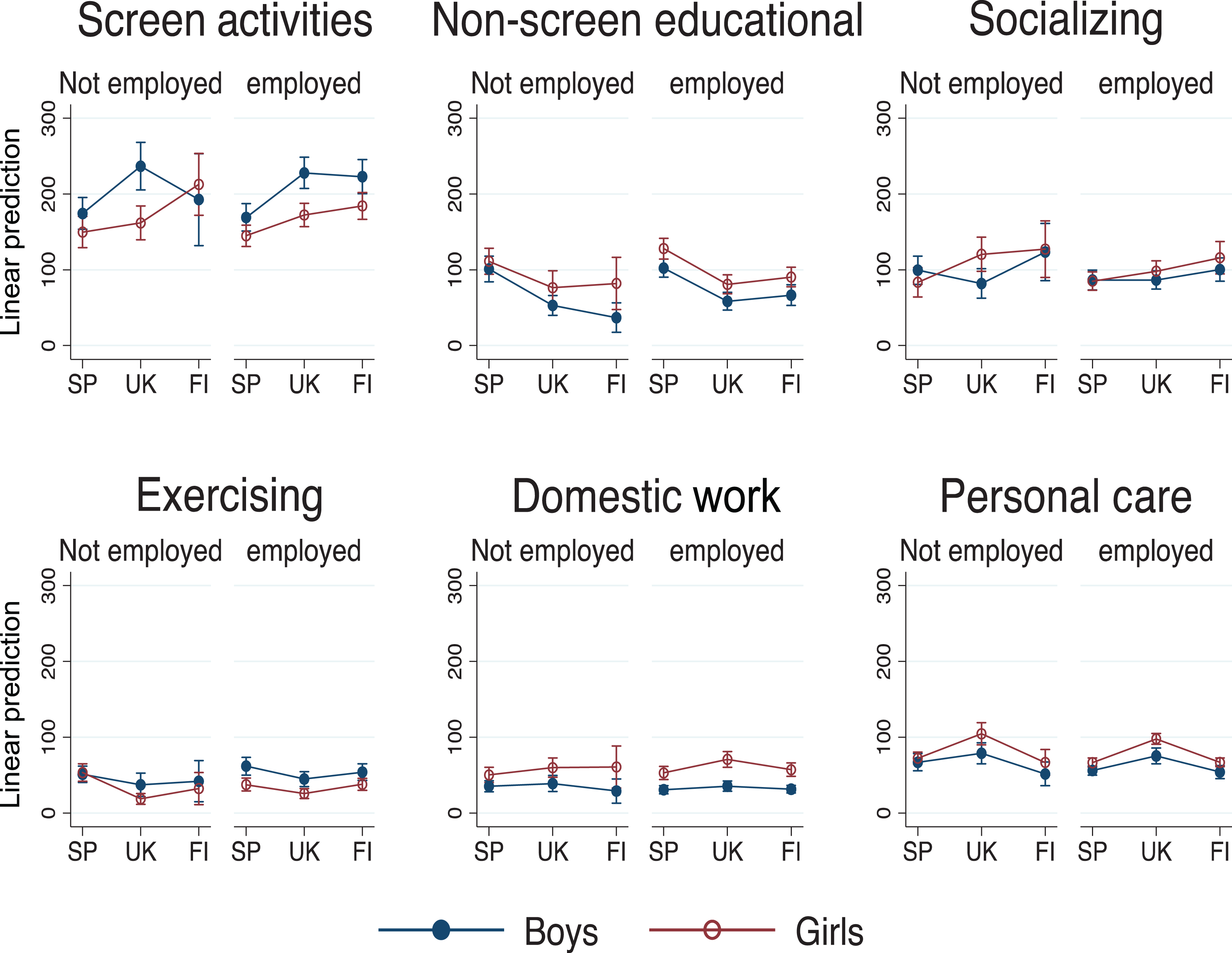
Predicted daily minutes in activities by country x gender and maternal work status. Note: Linear prediction models. The figure includes a total of six separated models with an interaction term between gender and country separately by maternal work status, including two-parent families and single-mother families, with confidence intervals at 95% levels. All models include the following controls: Family structure; Mother’s education; Children’s age; Weekend diary; Season’s quarter (January – March; April – June; July – September; October – March); Number of adults at home aged 18 or older; Number of children at home aged 0–17. All analyses represent an average day where weekdays are counted as 1/5 and weekends as 1/2 for an average full week of the year, providing a representative random day, week and month of the year of observation.
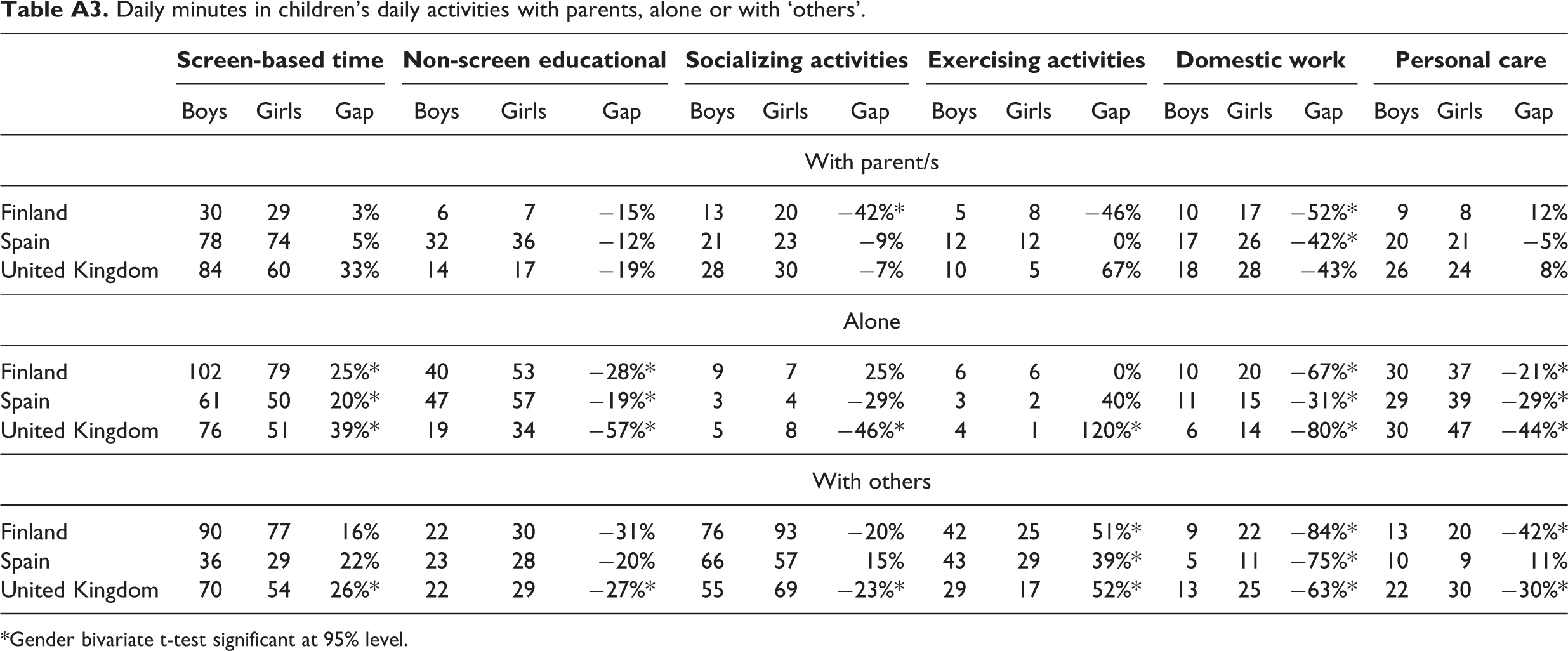
Fourth, we checked if the social context of children’s activities – whether activities were performed alone, with parents or with ‘others’– differed by gender across countries. These results are presented in Figure A1 and Table A3 of the Appendix. While there are cross-country differences regarding who children spend time with (Gracia et al., 2020), we did not observe within country differences between boys and girls in who children share time with. We found that gender gaps in children’s leisure time occur across different activity contexts, not only alone and with others, but also with parents. However, consistent with our theoretical framework, gender gaps in time use are generally, and in all three countries, more pronounced in children’s time alone and with others than in their time shared with parents.
Finally, we examined the role of parental education. Sociological research shows educational inequalities in parent-child investments and children’s time use across policy and cultural regimes, focusing on Anglo-Saxon, Southern European and Scandinavian contexts (Gracia and Garcia-Roman, 2018; Gracia and Ghysels, 2017; Thomsen, 2015). Also, research shows that gender and social background intersect in shaping adolescents’ attitudes and behaviours (Buchmann and DiPrete, 2006). While our additional analyses revealed educational differences in children’s daily activities, these educational gaps were generally constant across both gender and country.
Discussion
This study has examined gender differences in children’s daily activities from a cross-national perspective. Scholars have argued that studying children’s (gendered) activities is essential for a better understanding of their well-being, daily lives, values and attitudes (Ben-Arieh and Ofir, 2002). But how boys and girls differ in their daily activities across national contexts has to date received very little attention. Our study contributes to answer this crucial sociological question by using high-quality time-diary data from Finland, Spain and the UK.
The study findings can be summarized at three main levels. First, there were clear gender differences in child time use in all three countries. Net of demographic and socioeconomic factors, boys were more active in screen-based activities and exercising, whereas girls were more involved in domestic work, personal care and non-screen educational activities. These time-use gender differences in children’s time use were statistically significant across all three countries. These findings give general support to Hypothesis 1 and contribute to previous time-diary studies focusing on other national contexts (Dotti-Sani, 2018; Farooq et al., 2018; Hilbrecht et al., 2008; Mencarini et al., 2019; Solaz and Wolff, 2015; Wight et al., 2009).
Second, we found within-country gender gaps in child and adolescent time use that differed across activity types. These analyses reveal a similar order of within-country gender gaps in child time use across all three countries: gaps were (a) more pronounced in domestic work and exercising; (b) intermediate for educational, screen-based time and personal care activities; and (c) smaller in socializing activities. In the UK, gender gaps in time use were largest in domestic work (60% gender gap) and exercising (57%), followed by non-screen educational time (35%) and screen-based activities (31%), with smaller gender differences observed for personal care (27%) and socializing activities (21%). In Finland, gender disparities in children’s time use were also higher in domestic work (58%), followed by exercising (36%) and non-screen educational time (34%), and less pronounced in personal care (21%), screen-based activities (16%) and especially in socializing time (13%). Spain followed a very similar order of gender disparities in children’s time use, with the largest gaps in domestic work (48%), followed by exercising (27%), non-screen educational activities (18%), screen-based time (16%) and personal care (14%), and with the lowest gender differences in socializing activities (6%). Future studies should examine which gendered processes operate in children’s and adolescents’ time on activities with different meanings and life-course consequences.
Third, we examined if gender gaps in child time use differ between countries by applying two-way country and gender interactions, with analyses providing mixed results. We proposed two alternative country-gender hypotheses. The ‘gender equality’ hypothesis (Hypothesis 2a) expected gender gaps in adults’ time use and values to be reproduced among children, with weaker gender disparities in ‘egalitarian’ Finland than in ‘liberal’ UK, especially compared to ‘family-oriented’ Spain, and largest gender gaps in Spain than in UK. The ‘child autonomy’ hypothesis (Hypothesis 2b) argued that societies conceding more autonomy to children to develop their time outside family and school give children more incentives to ‘do gender’ in time use, as free-time activities outside these institutions give high levels of discretion to engage in gendered leisure activities. Here, Spain would show weaker gender differences in child time use than Finland and the UK, whereas Finland would exhibit smaller gender gaps than the UK, as the strong emphasis on child autonomy in the two latter countries would be partly cancelled out in Finland, a country showing more widespread gender egalitarian attitudes than the UK. Contrary to both the ‘gender equality’ (H2a) and ‘child autonomy’ (H2b) hypotheses, Finland did not show any statistically significant gender differences in child time use compared to Spain and the UK. We found partial support for the ‘child autonomy’ thesis when comparing Spain and the UK, but only for three out of the six activities examined. Indeed, country-gender interaction effects comparing Spain and UK were statistically significant for screen-based activities, personal care and socializing, with larger gender gaps in children's time use in the UK than in Spain, but the same country-gender interactions were not statistically significant for domestic work, exercising and educational time.
How can we explain our mixed cross-national results? We shall stress, first of all, that gendered time-use mechanisms are shaped differently throughout the life course across different countries. In other words, the ‘glasses’ that we use to study cross-national gender inequalities in adults’ time use seem less effective when examining gender gaps in time use during childhood and adolescence. Family-friendly contexts are key in supporting Finnish adults to engage in more gender egalitarian time-use arrangements regarding (un)paid work and leisure, compared to their British counterparts, and especially to their Spanish counterparts. In fact, previous research indicates that the transition to parenthood is a critical life-course event that shapes distinct gendered time-use patterns across nations (Anxo et al., 2011; Grunow and Evertsson, 2016; Kan et al., 2011). Yet, the processes affecting gender differences in time use among adults do not seem to apply to children and adolescents. To illustrate, previous research on adults found the UK shows a more gender egalitarian division of labour than Spain (Esping-Andersen et al., 2013). However, our study finds smaller gender gaps in children’s time use in ‘family-oriented’ Spain than in ‘liberal’ UK, with differences being statistically significant in half of the six activities included in our study. Future research should provide a closer inspection of when exactly, and in what types of families, gender variations in time use start to widen across countries. Future life-course studies on gender gaps in time use should focus on a broader picture of activities, besides (un)paid work and total leisure time, and should concentrate on different age groups and life transitions.
We believe that examining the exact place and context where children’s daily activities occur will help to understand gender differences in young people’s time use, even if our cross-country comparisons yielded mixed results. While children incorporate gender-typed roles and norms in both families (Platt and Polavieja, 2016) and schools (DiPrete and Buchmann, 2013), in free-time activities boys and girls can have many opportunities, space and discretion to reproduce gender roles by engaging in boy-typed activities (i.e. sports, video-gaming) or girl-typed activities (i.e. personal care, reading). The way countries influence gender gaps in child time use, however, is not yet conclusive. An important question that emerges from our study is this: why does Spain show lower gender gaps in children’s time use than the UK, specifically in screen-based activities, personal care and socializing? Recent time-use studies have stressed the role of generational changes in shaping gendered time-use patterns, with particular focus on Spain (Ajenjo and Garcia-Roman, 2014). Yet, a more specific country comparison will be needed. We hope future studies will gather high-quality data across periods and cohorts to disentangle the mechanisms by which societal contexts and life-course processes shape gender differences in young people’s time use.
We must highlight two limitations in our study. First, we have only examined objective time-diary measures. Our data lack important subjective measures on attitudes, preferences and activity enjoyment. Second, we have focused on three countries only. Future studies based on time-diary comparisons with a larger sample of countries capturing different policy regimes, gender values and income levels could complement our study. Our study, we believe, is an important first step to guide future time-diary studies having access to a large and diverse group of countries.
To conclude, this article shows important within-country gender differences in child and adolescent time use in all three countries examined: Finland, Spain and the UK. Furthermore, we show that the country labelled as ‘family-oriented’ (Spain) is clearly not more gender dissimilar than the one labelled as ‘egalitarian’ (Finland) when it comes togender differences in children’s and adolescents’ time use. Also, based on country-gender interactions, more ‘family-oriented’ Spain (and not ‘egalitarian’ Finland) shows clearly lower gender gaps in children’s time use than ‘liberal’ UK, even if onlyfor three (out of six) activities that are key for the formation of gender roles across the life course: screen-based activities, personal care and socializing. These results open relevant questions on ‘gender paradoxes’ in young people’s gendered activities. We hope our study using high-quality time-diary data will inspire new theoretical and empirical advancements on the critical question of how boys and girls differ in their daily activities across policy and cultural contexts.
Footnotes
Funding
The authors disclosed receipt of the following financial support for the research, authorship, and/or publication of this article: (1) Pablo Gracia contributed to the study with financial suport from the DIGYMATEX project (Grant agreement ID: 870578), funded by the European Commission H2020 within the call ‘DT-TRANSFORMATIONS-07-2019 - The impact of technological transformations on children and youth’; (2) Joan Garcia-Roman contributed to the study with financial support from the Ramón y Cajal programme (RYC2018-024808-I) and Global Family Trends: Gender, Social and Regional Inequalities (GLOBFAM) (RTI2018-096730-B-I00).

Notes
Appendix
Daily minutes in children’s daily activities with parents, alone or with ‘others’.
|
|
|
|
|
|
|
|||||||||||||
|---|---|---|---|---|---|---|---|---|---|---|---|---|---|---|---|---|---|---|
| Boys | Girls | Gap | Boys | Girls | Gap | Boys | Girls | Gap | Boys | Girls | Gap | Boys | Girls | Gap | Boys | Girls | Gap | |
| With parent/s | ||||||||||||||||||
| Finland | 30 | 29 | 3% | 6 | 7 | −15% | 13 | 20 | −42%* | 5 | 8 | −46% | 10 | 17 | −52%* | 9 | 8 | 12% |
| Spain | 78 | 74 | 5% | 32 | 36 | −12% | 21 | 23 | −9% | 12 | 12 | 0% | 17 | 26 | −42%* | 20 | 21 | −5% |
| United Kingdom | 84 | 60 | 33% | 14 | 17 | −19% | 28 | 30 | −7% | 10 | 5 | 67% | 18 | 28 | −43% | 26 | 24 | 8% |
| Alone | ||||||||||||||||||
| Finland | 102 | 79 | 25%* | 40 | 53 | −28%* | 9 | 7 | 25% | 6 | 6 | 0% | 10 | 20 | −67%* | 30 | 37 | −21%* |
| Spain | 61 | 50 | 20%* | 47 | 57 | −19%* | 3 | 4 | −29% | 3 | 2 | 40% | 11 | 15 | −31%* | 29 | 39 | −29%* |
| United Kingdom | 76 | 51 | 39%* | 19 | 34 | −57%* | 5 | 8 | −46%* | 4 | 1 | 120%* | 6 | 14 | −80%* | 30 | 47 | −44%* |
| With others | ||||||||||||||||||
| Finland | 90 | 77 | 16% | 22 | 30 | −31% | 76 | 93 | −20% | 42 | 25 | 51%* | 9 | 22 | −84%* | 13 | 20 | −42%* |
| Spain | 36 | 29 | 22% | 23 | 28 | −20% | 66 | 57 | 15% | 43 | 29 | 39%* | 5 | 11 | −75%* | 10 | 9 | 11% |
| United Kingdom | 70 | 54 | 26%* | 22 | 29 | −27%* | 55 | 69 | −23%* | 29 | 17 | 52%* | 13 | 25 | −63%* | 22 | 30 | −30%* |
*Gender bivariate t-test significant at 95% level.