




Abstract
This article investigates how cultural factors might affect the employment of female immigrants to Europe. Cultural factors include the characteristics of individual women, their countries of origin in Africa, Asia and Latin America and the European regions where they reside. Data are from the European Social Survey (2002 to 2019) and various international organisations. Employment is predicted by educational level and religiosity, religious composition of the country of origin, and rates of unemployment in the region of residence. Less educated immigrants from Muslim countries have particularly low employment rates. Contrary to expectations, the employment of female immigrants seems unaffected by overall female employment rates in the region of residence, and correlation with female employment in the country of origin disappears when controlling for its religious composition. The findings for cultural factors are consistent with theories about transculturation and also with theories about religion and moral orders. They are less consistent with a standard acculturation model hitherto popular in the research literature.
Introduction
Background
The employment of female immigrants has become a topic of public and academic debate, certainly in European regions with high female employment. Female immigrants typically have lower employment rates than male immigrants, and in many regions they have lower employment rates than native females (Bevelander, 2005; Blau et al., 2011; Kesler, 2006). Economic integration of female immigrants in Europe is typically less successful for migrants from poorer countries in Asia, Africa and Latin America than for migrants from wealthier countries, whose economic integration typically puts them on a par with natives (Van Tubergen et al., 2004).
Female immigrants are over-represented in temporary and precarious jobs (Morokvasic, 1984; Schierup et al., 2015), and they make up a rising proportion of women in traditional ‘housewife’ families (Kitterød and Rønsen, 2013). The comparatively low employment rate and poor employment situation of many female immigrants contribute to poverty among immigrants (Kaida, 2015), and may counteract policy goals related to gender equality, income distribution and child poverty (Blume et al., 2007).
This article adds to the literature on female immigrants by considering cultural explanations for customary or typical female behaviour in both country of origin and region of residence, religious composition in country of origin and individual religiosity. It presents different theoretical understandings of how these cultural factors may affect the economic behaviour of immigrant women. The empirical analysis investigates the employment of 3146 female migrants from 69 countries in Africa, Asia and Latin America, who were living in 136 European regions in the first nine rounds of the European Social Survey (ESS) between 2002 and 2019.
Cultural explanations
In this article, ‘culture’ refers to a set of customs, traditions and values of a society in relation to a country of origin or a region of residence in Europe. It corresponds to concepts of ‘multiculturalism’ and ‘cultural pluralism’ that have developed following long-distance migration. It presents various conceptualisations of cultural explanations of female employment and empirical approaches to identifying cultural factors in large-scale data.
Female employment has expanded strongly in most countries, and varies considerably between countries (Hausmann et al., 2010). In northern Europe, female employment is almost on a par with male employment, while in some Muslim countries it can be as low as one-third of the level of male employment (Hausmann et al., 2010). Europe-wide, female employment rates also vary considerably, from just above 30% in some parts of Italy to 80% in some Scandinavian regions (labour force data are presented later).
Historical and geographical variations in female employment may reflect diverse cultural ideas about the appropriate role of women in a society. Immigrant women are subject to multiple sets of cultural ideas about the appropriate roles of women, including those stemming from their country of origin and from their region of residence. Hence, their employment can be investigated from an acculturation perspective – a process of maintaining identities from their countries of origin in Africa, Asia or Latin America while adapting to the prevailing culture of a new host society (e.g. Berry et al., 2006).
This acculturation perspective implies that immigrant women are less likely to work if they come from cultures that emphasise domestic responsibilities, while exposure to more egalitarian cultures in the host country might lead them to engage in paid work (Inglehart and Norris, 2003; Read and Cohen, 2007). The first part of this model – relating to country-of-origin effects – finds empirical support in the fact that female employment rates and religious composition in the country of origin can predict the employment of female immigrants, including when educational level is controlled for (Antecol, 2000; Blau et al., 2011; Frank and Hou, 2016; Van Tubergen et al., 2004). The second part of the acculturation model has been investigated in research exploring what is described as ‘economic integration’ (Algan et al., 2010; Lee, 2009; Piore, 1979; Rendall et al., 2010) or ‘employment penalty’ (Ballarino and Panichella, 2018; Heath and Cheung, 2007).
Empirical findings do not always support the idea that female immigrants approach the employment rates of native women. Comparative research has shown that the employment penalty for female immigrants (i.e. lower employment rates that cannot be accounted for by observed characteristics such as age composition, education level, family composition and regional unemployment rates) is smaller in countries in the southern parts of Europe than in the northern parts (Ballarino and Panichella, 2018; Rendall et al., 2010). However, such findings might reflect a variation in the employment of native women rather than female immigrants.
One alternative understanding is that immigrants create new cultures, rather than merely changing their preferences and behaviour from their home country culture to their culture of residence. In our case, they develop new preferences – regarding the appropriate role of women in a society – that deviate from those of both their home country and their country of residence. This argument is associated with theories about ‘transculturation’ (Ortiz, 1995) and ‘transnational identity’, which, according to Beck (2002), characterise all social strata of immigrants. Somewhat similarly, Schiller and colleagues (2011) call for an ‘everyday cosmopolitan’ approach as an alternative to what they see as an ethnic/homeland bias in much migration research. We may call it a transcultural model of female employment.
Identifying cultural factors
While many analysts believe that different societies (nations, regions) hold diverse cultural ideas about the appropriate role of women, there is more controversy over how to identify these cultural factors in terms of observable characteristics. This debate is also related to various conceptualisations of culture and how fixed (or malleable) cultural factors are through the life course of immigrants and other individuals.
One line of research tries to identify cultural beliefs directly using scales of human values or attitudes to gender roles that may motivate women to enter paid employment (e.g. Inglehart and Norris, 2003; Polavieja, 2015). This approach is consistent with theories about general human values, arguing that different people and societies tend to hold different values that motivate them when evaluating and participating in various activities (Schwartz, 2012). It is also consistent with the second demographic transition theory, which argues that rising female employment is an outcome of more general changes in attitude towards family and employment (Van de Kaa, 2001).
Empirical research provides some support for these arguments. For example, Khoudja and Fleischmann (2015) found that traditional gender attitudes correlate negatively with employment and hours worked by female immigrants in the Netherlands. However, such findings may also reflect the possibility that female immigrants adopt traditional gender attitudes if they cannot find paid employment. Polavieja (2015) tried to avoid the risk of such reverse causality by imputing traditional values in countries of origin rather than among immigrant women themselves, and data from the ESS supported the expected correlations among women who had migrated between European countries.
A second, alternative approach (to studying cultural beliefs directly) is to investigate gender practices in the country of origin rather than values and attitudes towards such practices. Empirical studies show that female employment rates in countries of origin predict the employment of immigrant women (Antecol, 2000; Blau et al., 2011), as well as their earnings once employed (Frank and Hou, 2016). Such findings are consistent with various explanations, however. The authors of these studies (Antecol, 2000; Blau et al. 2011; Frank and Hou, 2016) interpreted their findings as reflecting cultural attitudes towards female work.
This interpretation is seemingly at odds with dominant understandings within the sociology of culture (Lizardo, 2017; Swidler, 1986), which is sceptical about the role of human values in explaining behaviour. For example, Swidler (1986) argued that culture is better seen as the way social groups organise their overall patterns of behaviour, rather than providing values that affect behaviour. In this line of theory, culture is considered malleable (Vaisey, 2009). Swidler (1986) argued that culture is merely a ‘tool-kit’ that people draw on to accomplish strategies of action, while Boltanski and Thévenot (1999) argued that culture provides moral justifications for behaviour rather than affecting behaviour itself.
A third approach (to direct measures and behavioural measures) is to investigate religion or religious factors as potentially cultural explanations of female behaviour. Religious factors are associated with human values. Smith (2003) argued that moral beliefs direct behaviour, and that religion is a prime example as it defines a set of moral orders. However, there are many religious factors, including dominant religion, religious affiliation, religious beliefs, religious practices and religiosity, and it is not always clear whether these are characteristics of individuals or of societies. Smith (2003) argued that the moral orders associated with various religions affect not only believers but also secular and non-believing individuals in a society. This argument indicates that religion is a characteristic of societies, and that their dominant religions may affect the employment of both believing and non-believing immigrants.
Empirical research also supports these arguments. For example, female immigrants from predominantly Christian countries are more likely to be employed than immigrants from countries dominated by other religions (Van Tubergen et al., 2004), while female immigrants from predominantly Muslim countries are less likely to be employed (Koenig et al., 2016; Kogan et al., 2019: 3–4). Individual religiosity may also help to explain low employment among various female groups (Guetto et al., 2015), while religious practices (participation) appear less consistently correlated with the employment of female immigrants (Koenig et al., 2016).
Interpretations of these findings are less straightforward, however. Religious affiliation or the dominant religion in a home country may affect what female immigrants consider to be important in life (Inglehart and Norris, 2003; Smith, 2003), or how far such values are endorsed or nonconformity sanctioned by families and communities (e.g. Kogan et al., 2019). Another possible explanation is that religious factors function as signals that activate social stereotypes, or, perhaps less consciously, as salient, symbolic boundaries among employers, colleagues or customers (e.g. Wimmer, 2009). In such situations, individuals with observable characteristics, such as their region of origin (e.g. their names or biological features) or religious symbols (e.g. jewellery, clothes), might be subject to discrimination in labour markets.
Discrimination
Low employment rates among female immigrants, or certain groups of immigrants, may reflect the preferences of both immigrants and employers. The preferences of immigrants correspond to the cultural and supply-side factors already mentioned. Preferences among employers (the demand side) may relate to relevant human capital characteristics, but also to other characteristics, such as gender, ethnic group, home country or religion – factors by which people typically discriminate (Arrow, 1973; Becker, 1971; Merton, 1972).
Discrimination against minority groups in hiring processes is well-documented in field experiments (Riach and Rich, 2002; Zschirnt and Ruedin, 2016). For example, a meta-analysis indicates that minority groups have 49% lower odds of being invited for a job interview than their majority competitors (Zschirnt and Ruedin, 2016). Policymakers are aware of the challenges relating to prejudice against various minority groups, and the European Union (EU) has made recommendations for anti-discrimination policies in labour markets, starting with gender in the 1970s. Two EU directives in 2000 specified non-discrimination polices related to racial or ethnic origin (no. 43) and religion or belief (no. 78) (Bell, 2008).
It is not easy to indicate discriminating practices in large-scale data on employment probabilities, in contrast with broader factors such as employment penalties, which include discrimination among other factors (Heath and Cheung, 2007). One possible approach is to investigate how far the employment of certain social groups is more strongly associated with the general demand for labour, as indicated by general unemployment rates in regions of residence.
Temporal processes
The economic integration of immigrant women may improve in the years following their arrival in their region of residence for various reasons. One reason is the cultural and supply-side factors related to acculturation processes (e.g. Berry et al., 2006). Human capital theory has similar empirical implications, however. It argues that immigrants may face some employment penalties during the early years following migration because they lack human capital factors such as language acquisition, formal education and knowledge of the functioning of labour markets in their new country. Because these factors may improve over time, migrants tend to integrate economically gradually until they are on a par with natives (Lee, 2009; Piore, 1979; Rendall et al., 2010).
Temporal processes may also depend on how fixed or malleable cultural factors are during the life course of immigrants. If they are primarily about how social groups organise their overall patterns of behaviour and how they relate to the requirements of new social realities (Boltanski and Thévenot, 1999; Swidler, 1986), economic integration may occur relatively fast. If internalised schemes about the appropriate role of women direct the employment of female immigrants, their economic integration will occur slowly. The latter is consistent with theories about religion and moral beliefs (Smith, 2003), as well as theories about practical consciousness (Giddens, 1984) and habits (Bourdieu, 1984; Vaisey, 2009).
Hypotheses
From the theory and research presented so far, we hypothesise that the employment rate among female immigrants to Europe will be predicted by:
Female employment in the country of origin (positive effect)
Religious composition in the country of origin (Christian higher than Muslim)
Female employment in the region of residence in Europe (positive effect)
Individual religiosity (negative effect)
Unemployment in the region of residence (negative effect)
Further:
H1 to H3 will wary with time sine migration
H1 to H5 are more important for female immigrants from Muslim than from Christian countries
The first three hypotheses (H1–H3) are consistent with a standard acculturation model (e.g. Inglehart and Norris, 2003; Read and Cohen, 2007). However, this general model does not say which cultural elements are most important for female employment: actual behaviour (H1), the religious composition of the home country (H2) or the role of typical female behaviour in the new host country (H3). Individual religiosity (H4) and local unemployment rates (H5) are individual and structural explanations, respectively, of the employment of female immigrants.
In H6 we test how far the supposedly cultural characteristics of country of origin (H1 and H2) and region of residence (H3) change over time, as indicated by time since migration. We hypothesise that home country characteristics (H1 and H2) are more important among more recent immigrants, while the characteristics of region of residence (H3) are more important for those who migrated many years ago. In H7 we hypothesise that the role of individual and regional characteristics are more important for female migrants from predominantly Muslim countries of origin than migrants from Christian countries.
Method
The empirical analysis investigates the seven hypotheses (H1–H7) using the first nine rounds of the ESS, collected from 2002 to 2019. The data set includes female migrants aged 20 to 60 from Africa, Asia and Latin America who currently live in Europe and whose parents were both born outside Europe. 1 Migrants to Cyprus, Israel, Russia and Ukraine were excluded because these countries lack relevant explanatory variables for regions of residence from Eurostat (explained later in this section). Countries of origin or residence with fewer than five female migrants were also excluded from the analysis. The final analysis includes 3146 female migrants born in 69 countries in Africa, Asia or Latin America, who are currently living in 136 regions of 20 European countries. 2
Descriptive statistics for 3146 immigrant women living in Europe.
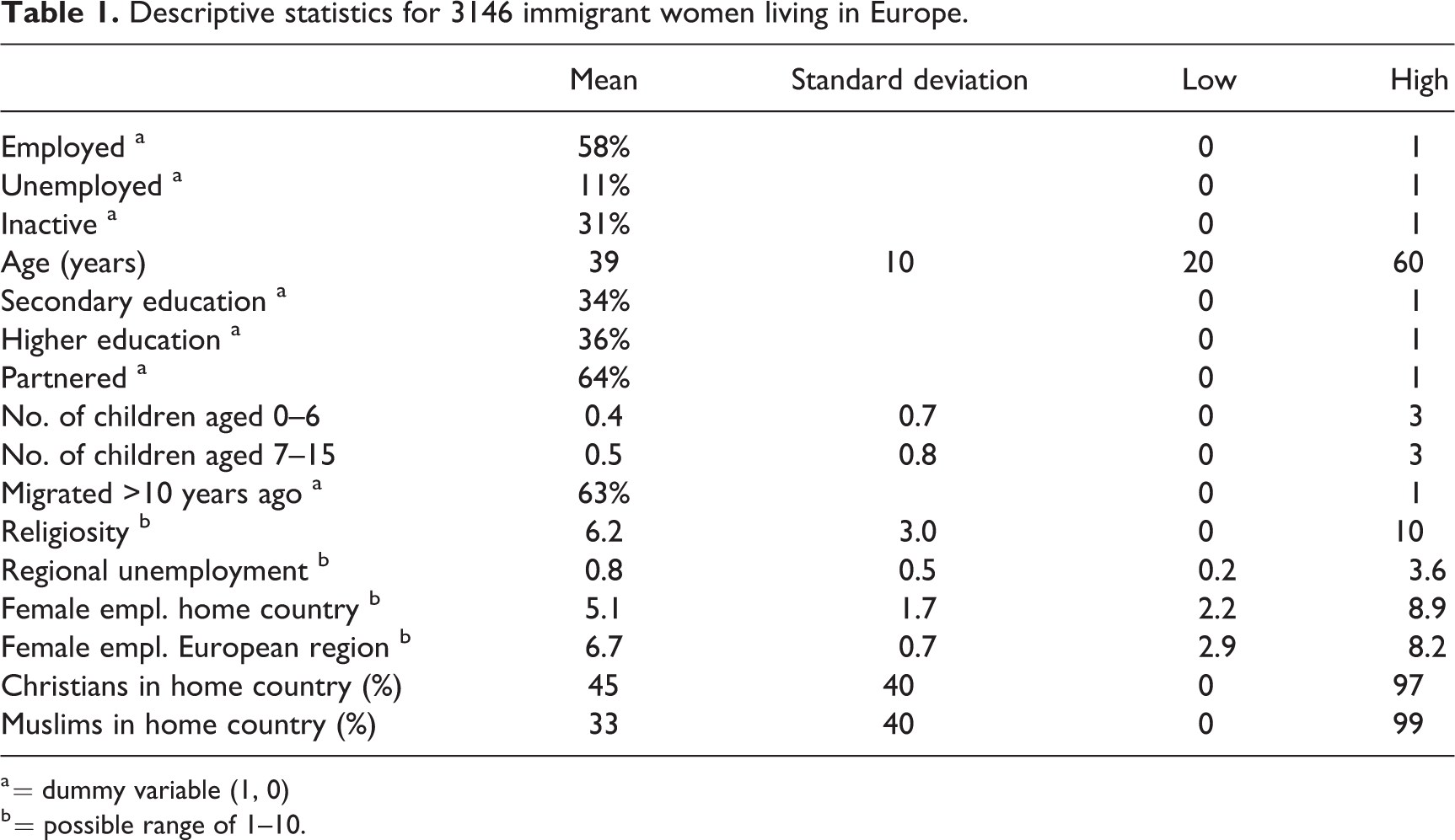
a = dummy variable (1, 0)
b = possible range of 1–10.
The principal dependent variable, employment, is any paid work of an hour or more during the last seven days, coded ‘1’ if employed and ‘0’ if not, because this is the standard definition of employment in official statistics and most related research. A sensitivity analyses also investigates employment of more than 20 hours (versus less/no employment, n = 3038, excluding 108 respondents who did not report working hours). Further analyses investigate unemployment and economic inactivity as two alternatives to employment.
Explanatory variables include the characteristics of individuals and households, and of the country of origin in Africa, Asia or Latin America (n = 69) and region of residence in Europe (n = 136). Individual characteristics include age, measured by linear and squared terms in the regression models; educational level, using dummy variables for secondary and higher education; and a dummy variable for those who migrated to their country of residence more than ten years ago (because this question was not consistent across the eight rounds of the ESS). Religiosity is investigated by a single item: ‘Regardless of whether you belong to a particular religion, how religious would you say you are?’ Response categories vary from ‘0’ (not at all religious) to ‘10’ (very religious). Household characteristics include a dummy variable for being partnered (married/cohabiting) and the number of children in two age groups: ‘0–6’ and ‘7–15’ years.
Characteristics of countries of origin include female employment rates and religious composition. Female employment rates (possible range of 0–10) were collected from the World Economic Forum’s Global Gender Gap Index for 2010 (Hausmann et al., 2010), the first year that this information was available for many countries. Religious composition was collected from the World Religion Dataset of the Association of Religion Data Archives, also for 2010. This statistical analysis investigated the proportions of national populations that were Christian or Muslim in 2010 (possible range of 0–1).
Characteristics of the regions of residence in Europe include female employment rates and general unemployment rates, both collected from national labour force surveys and downloaded from Eurostat for each year (2002 to 2017). Both variables are indicated by a 0–10 possible range, meaning that an employment rate of 51% has the value 5.1, while an unemployment rate of 8% takes the value 0.8 in the data.
European regions are defined as far as possible using the second level of the Classification of Territorial Units for Statistics (NUTS 2) and a consistent set of regions throughout the observation period (2002 to 2017). However, ESS rounds one to four and round eight have slightly different regional classifications, and Eurostat does not publish rates of unemployment and female employment for all years and regions. Hence, some countries had to be treated as single regions (i.e. Estonia, Finland, Lithuania and Luxembourg) and some regions had to be collapsed (using weights for the population aged 15 to 64) to produce a consistent set of regions (i.e. Denmark and Ireland with two regions each; Belgium and Greece with three regions each; Italy and Spain with only minor changes). National unemployment rates were used whenever regional data were unavailable (n = 47).
The data are analysed using linear probability models of being employed or not, as well as multi-nominal logit models where employment is compared with unemployment and inactivity. All results are presented as marginal effects using percentage point (p.p.) differences estimated at mean values of the explanatory variables from the logit models.
Standard statistical tests assume independent observations, and this is violated by the current data because they are grouped into two sets of clusters: individuals from the same country of origin are more similar (to each other) than individuals from different countries, and migrants residing in the same region are more similar than migrants residing in different regions, because they are exposed to the same regional characteristics. This analysis corrects the standard errors for its two-way (non-hierarchical) clusters using a method presented by Cameron and colleagues (2011). It estimates the regression models with cluster- and heteroskedastic-robust standard errors (using the cluster option in Stata), with data first clustered on countries of origin (n = 69), then clustered on regions of residence (n = 136), and next on the combination of countries of origin and regions of residence (n = 1255). Finally, we create a new variance matrix that subtracts the latter matrix (with 1255 clusters) from the sum of the first two matrices (with 69 and 136 clusters, respectively).
Results
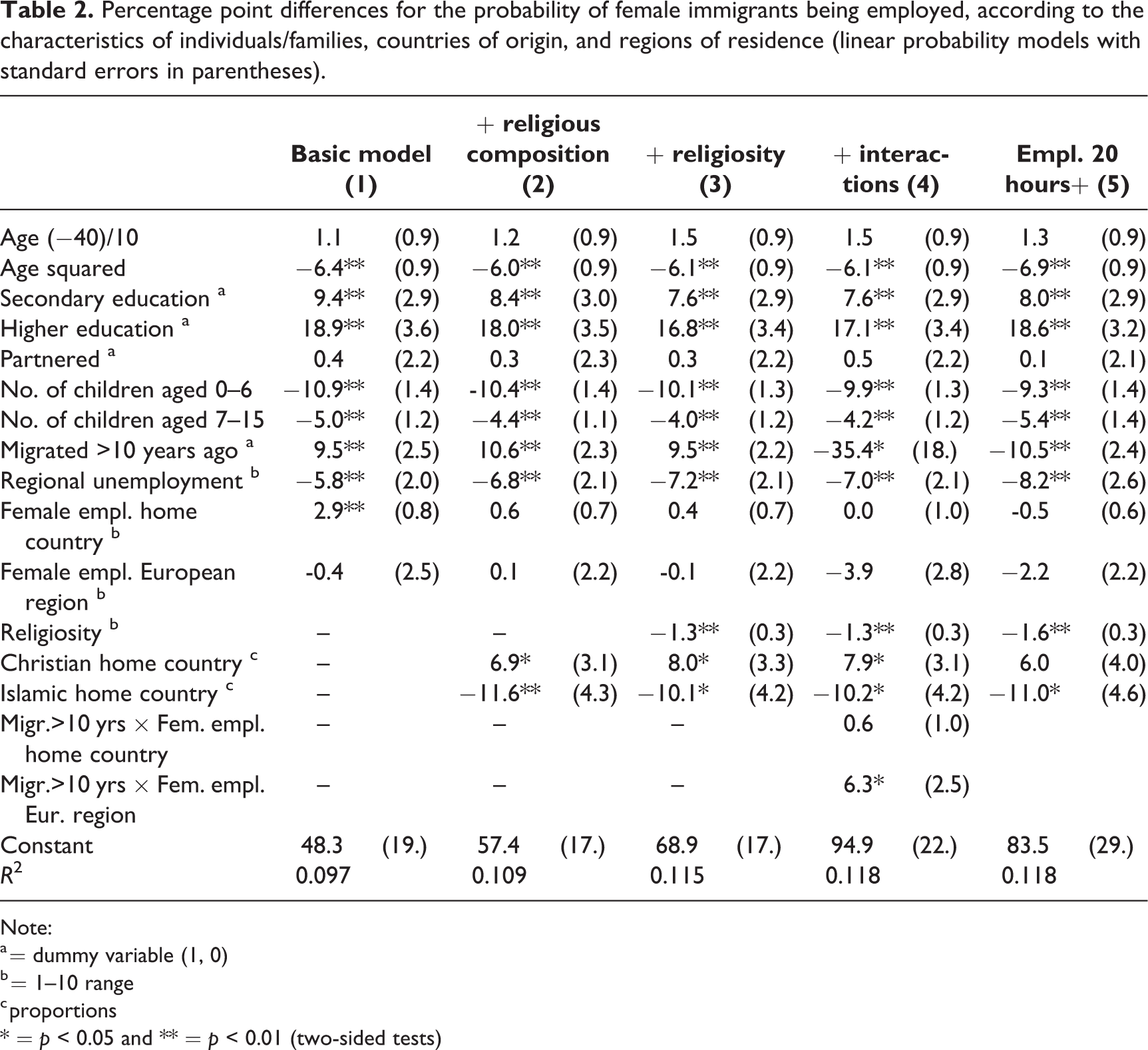
The employment of female immigrants to Europe is correlated with the employment rates in countries of origin but not with employment rates in regions of residence (first model, Table 2). If the employment rate in the home country increases by 10 p.p. (the unit used in this analysis, corresponding to 1.7 standard deviations (SD) in the data), the probability of being employed in a new country increases by 2.9 p.p. The employment of female migrants to Europe is also correlated with the religious composition of their home country, with high rates for migrants from Christian countries and low rates for migrants from Islamic countries (second model). Because there are hardly any purely Christian or Islamic countries, multiplying the coefficients for the proportions of Christians and Muslims by 0.85 can be used to indicate the mean differences for countries with a majority of either Christians or Muslims. If so, the difference between the two groups of female immigrants is 15 p.p. (6.9*0.85+11.6*0.85, significant at the 1% level). Interestingly, there is no correlation between female employment rates in the home country and the employment of female migrants when also controlling for the religious composition of the home country.
Percentage point differences for the probability of female immigrants being employed, according to the characteristics of individuals/families, countries of origin, and regions of residence (linear probability models with standard errors in parentheses).
Note:
a = dummy variable (1, 0)
b = 1–10 range
c proportions
* = p < 0.05 and ** = p < 0.01 (two-sided tests)
Individual religiosity is also correlated with the employment of female migrants (third model). If religiosity increases by five units along the 0–10 scale (corresponding to 1.7 SD in the data), the probability of being employed drops by 6.8 p.p. (−1.3 × 5). The difference in employment rates between female immigrants from Christian or Muslim countries also remains strong (15 p.p.) and significant (at the 1% level) when controlling for individual religiosity.
A fourth model (Table 2) tests hypotheses about the temporal aspects of acculturation processes as related to the role of female employment rates in the country of origin and region of residence. The female employment rate in the region of residence appears to gain more importance in the employment of female immigrants migrating more than ten years ago than for more recent migrants. However, this result is largely driven by an unexpected negative effect (of -3.9 p.p.) over the first ten years, which most likely reflects non-observed characteristics in the data. There is no indication of any change in the role of female employment in the home country with the length of time after migration.
A final model (Table 2) investigates working more than 20 hours per week as an alternative to the third model. There are no substantial differences between the result of using either working any hours (third model) and that of employment for more than 20 hours per week (fifth model).
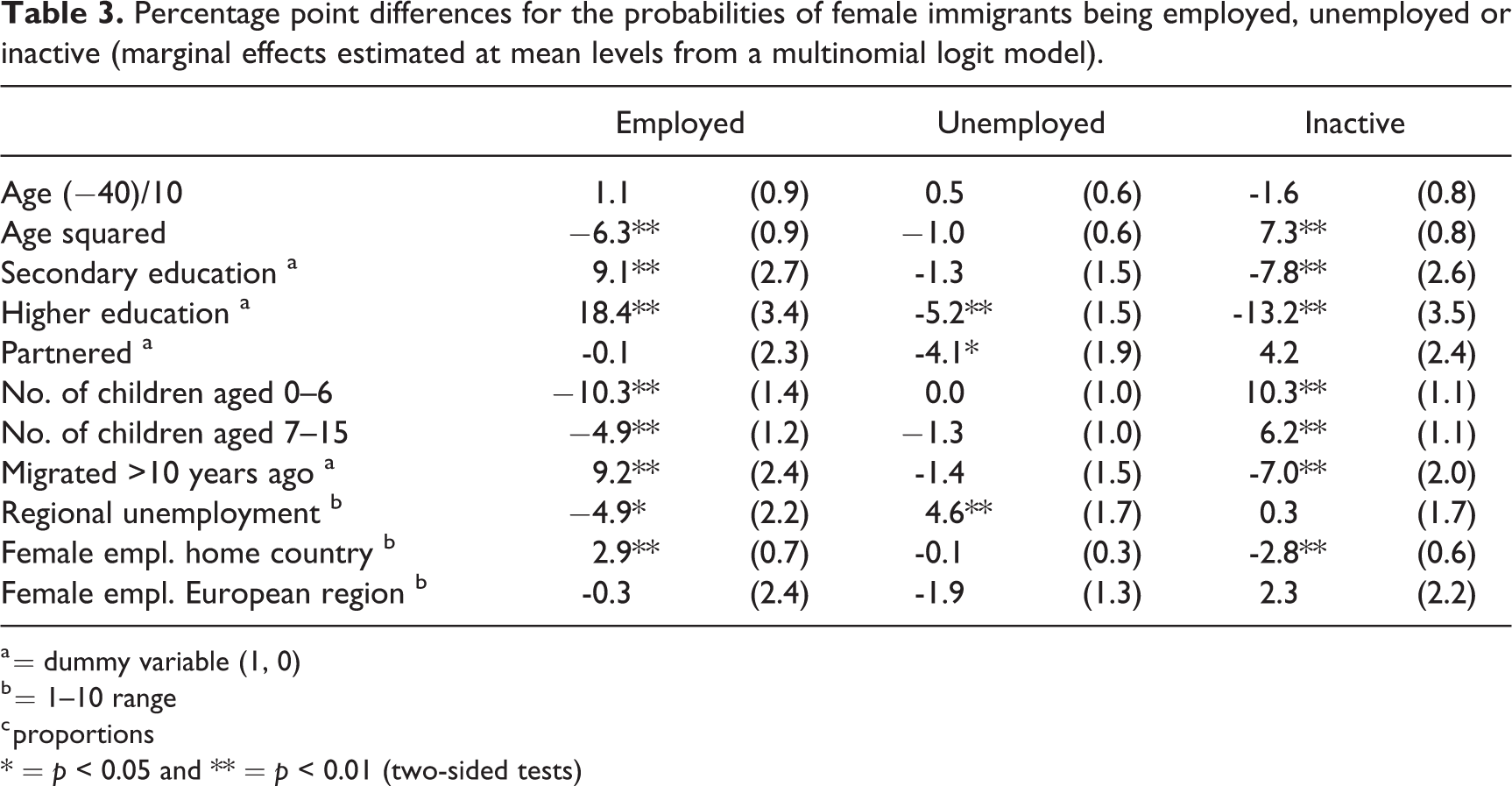
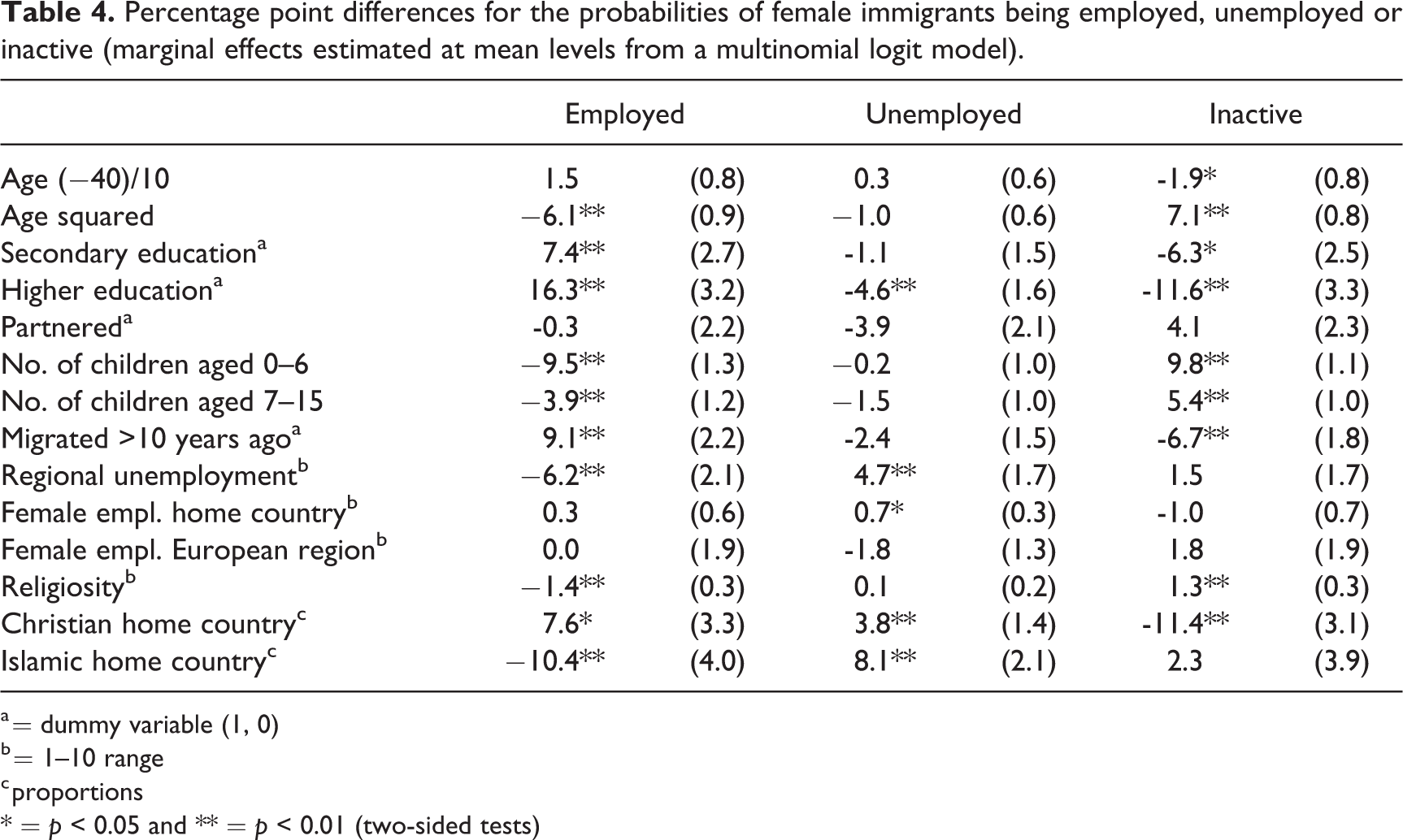
Further analyses compare employment with unemployment and economic inactivity (Tables 3 and 4, which exclude and include the religion variables respectively.). When not considering religion (Table 3, with explanatory variables corresponding to the first model in Table 2), it appears that a high female employment rate in the home country is associated with a low probability of economic inactivity in a new country. However, this effect disappears when controlling for the religious composition of the home country (Table 4, with variables as in Model 3 in Table 2).
Percentage point differences for the probabilities of female immigrants being employed, unemployed or inactive (marginal effects estimated at mean levels from a multinomial logit model).
a = dummy variable (1, 0)
b = 1–10 range
c proportions
* = p < 0.05 and ** = p < 0.01 (two-sided tests)
Percentage point differences for the probabilities of female immigrants being employed, unemployed or inactive (marginal effects estimated at mean levels from a multinomial logit model).
a = dummy variable (1, 0)
b = 1–10 range
c proportions
* = p < 0.05 and ** = p < 0.01 (two-sided tests)
When comparing female immigrants from predominantly Christian and predominantly Muslim countries (Table 4), the employment gap of about 15 p.p. (when using the 0.85 proportional adjustment) is more strongly associated with economic inactivity (about 12 p.p.) than unemployment (about 4 p.p., difference not significant).
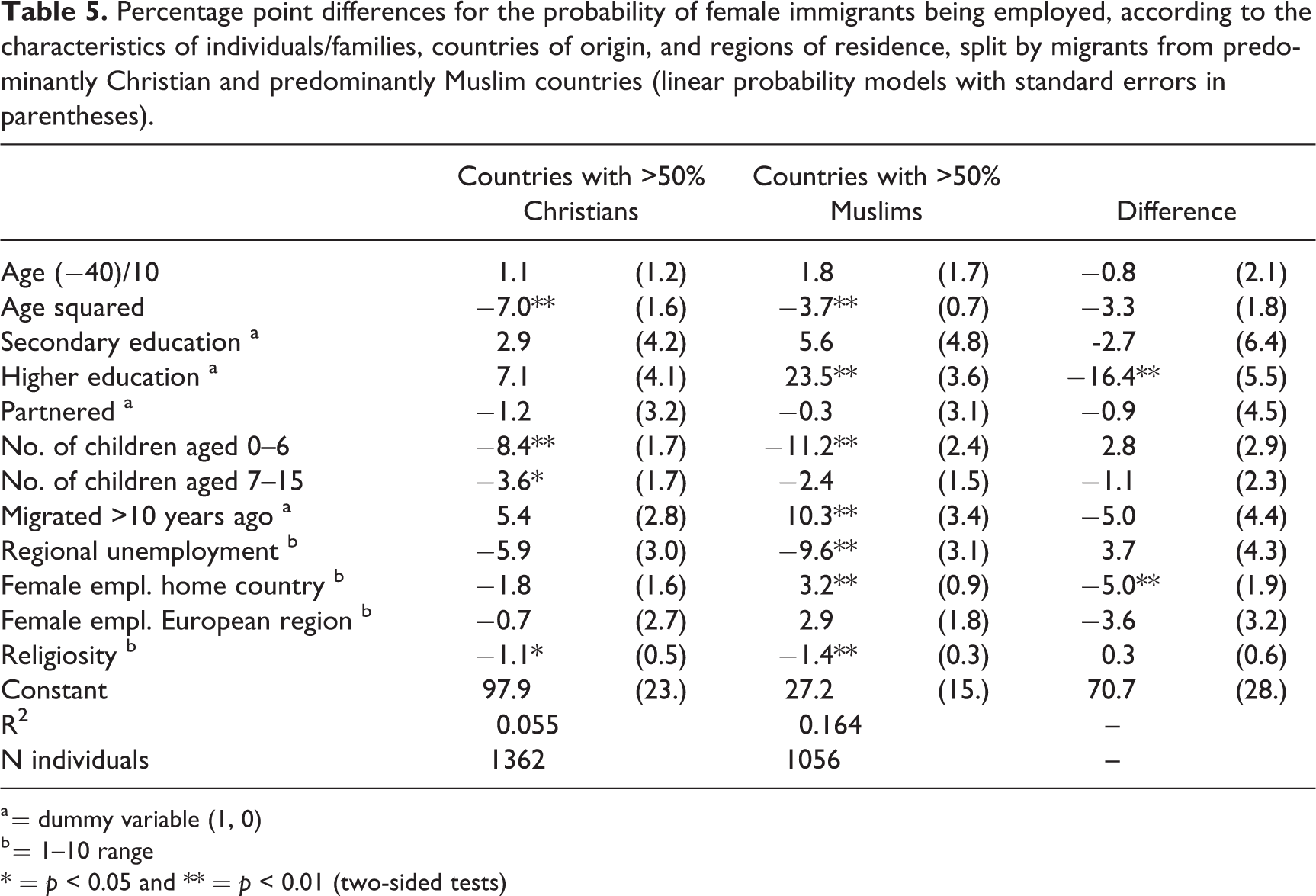
The most important finding so far relates to the role of the religious composition of home countries. Hence, we next compare the regression results between two groups of female immigrants: those from countries with a Christian majority (n = 1362) and those from countries with a Muslim majority (n = 1056). The results (Table 5) indicate that the employment of immigrants from Muslim countries varies more with the characteristics investigated (R 2 = 0.16) than the employment of immigrants from Christian countries (R 2 = 0.06). Only educational level and female employment rate in the home country vary significantly between the two samples, however. Still, it is female immigrants from predominantly Muslim countries who tend to have higher employment rates ten years or more after migration compared with more recent immigrants. And this is the only group whose employment is significantly associated with local unemployment rates.
Percentage point differences for the probability of female immigrants being employed, according to the characteristics of individuals/families, countries of origin, and regions of residence, split by migrants from predominantly Christian and predominantly Muslim countries (linear probability models with standard errors in parentheses).
a = dummy variable (1, 0)
b = 1–10 range
* = p < 0.05 and ** = p < 0.01 (two-sided tests)
This separate sample analysis (Table 5) indicates that female employment rates in the home country may affect the employment of female immigrants from predominantly Muslim countries. There is no such tendency for female immigrants from predominantly Christian countries. Individual religiosity, on the other hand, has the same negative effect on the employment of female immigrants from Christian and Muslim countries.
The educational gap in female employment is larger among immigrants from Muslim than from Christian countries. Female immigrants from either Christian or Muslim countries with higher (tertiary) education have similar employment rates; and less educated female immigrants from Muslim countries have much lower employment rates than other female immigrants.
Discussion
This analysis has investigated potential cultural explanations for the employment of female immigrants to Europe. The overall impression is that the expected cultural effects apply to a limited number of female immigrants. The effect of female employment rates in countries of origin disappears in models also controlling for the religious composition of countries of origin. A subgroup analysis indicates that female employment rates in home countries affect the employment of immigrants from predominantly Muslim countries.
An even more striking finding is that female employment rates in regions of residence have no effect on female immigrant employment rates. There is considerable variation in female employment rates across Europe. But this variation does not seem to affect the probability of female immigrants entering employment. The finding indicates that much comparative research on the economic integration (e.g. Algan et al., 2010) and employment penalties (e.g. Ballarino and Panichella, 2018) of immigrants is based on theoretical assumptions that do not correspond to the behaviour of immigrant women. A major element of acculturation theory, regarding adaptation to the prevailing culture of a new society, is not supported.
It appears that many immigrant women develop ideas about appropriate female behaviour that deviate from those of their region of residence. Further, female immigrant employment also seems little affected by typical female behaviour in their country of origin when their religious characteristics are controlled for. These observations are consistent with theories of transculturation (Ortiz, 1995) and transnational identities (Beck, 2002). In some parts of Europe with high female employment rates, immigration might thus entail a conflict between liberal principles regarding human behaviour and policy goals related to gender equality and income distribution. In other parts of Europe, immigration might lead to more gender-equal societies because the mean employment rate of immigrant women (58% in Table 1) is higher than among native women.
A further theoretical assumption is that the employment of female immigrants may increase over the years after migrating to Europe as a result of changing preferences for female employment among immigrants. This expected ‘time since migration’ effect appears to affect the probability of female immigrants entering the labour force, because it is positive for employment and negative for inactivity. It is only significant among immigrants from Muslim countries and seemingly less important among immigrants from Christian countries. It may also capture the effects of improved human capital, such as language acquisition (Rendall et al., 2010); and it may also reflect factors such as high fertility over the first few years after migrating to Europe (Blekesaune, 2020), when female migration is related to family formation processes (Kulu and Gonzalez-Ferrer, 2014), or to the postponement of employment during education. Participation in education programmes during the early years after immigration may be mandatory for some groups of immigrants in some countries (Fernandes, 2015).
Other findings might also reflect preferences for work and family obligations among female immigrants. For example, having children of preschool age in the household is more strongly associated with the employment of less educated than more educated female immigrants. However, this finding might also reflect levels of pay or working conditions, including the combination of family and work responsibilities.
The most important cultural factors identified in this research relate to religious factors. This finding is consistent with the argument that religion captures the moral beliefs and normative ends towards which people act, as argued by Smith (2003). The most consistent factor is individual religiosity, which appears to affect the employment of female immigrants from both Christian and Muslim countries. These findings are consistent with previous research on female employment in relation to religious factors among all females (Guetto et al., 2015; Guiso et al., 2003). Research that compares levels of happiness among employed and non-employed women indicates that the lower employment of religious than non-religious women reflects both individual preferences as well as patriarchal social norms among both Christian and Muslim women (Davis and Gao, 2020).
The religious composition of countries of origin also predicts sizeable differences in female employment. Further, the employment gap between religious and non-religious women is the same for those coming from Christian and Muslim countries. Similar findings have been made when comparing Turkish and native women in Germany (Diehl et al., 2009). These findings indicate that the sizeable employment gap between female immigrants from Christian and Muslim countries is not related to individual level factors such as religious affiliation or religious beliefs, but is rather related to collective phenomena. It might reflect two effects. One is related to the preferences of immigrants, assuming that Islam is currently more dominated by patriarchal social norms than Christianity (Inglehart and Norris, 2003), and that the moral orders associated with various religions affect both believing and non-believing individuals in a society (Smith, 2003). The other is related to discriminatory attitudes to various immigrant groups in the host society.
This study provides only indirect evidence of discrimination in labour markets. As expected, low demand for labour, as indicated by high unemployment rates, does affect the employment prospects of immigrant women. However, this effect is only significant for immigrants from Muslim countries. This finding might reflect tendencies for some female immigrants to enter employment only when other sources of labour have been exhausted. If so, it might reflect discriminatory hiring practices associated with labels such as ‘reserve army of labour’ (e.g. Martiniello and Rath, 2010) or ‘intersectionality’ (e.g. Grosfoguel et al., 2015): this is the idea that certain female groups are subject to discrimination depending on combinations of individual characteristics.
Limitations
This research has both strengths and limitations compared with previous comparative research on the employment of female immigrants. It investigates the characteristics of regions instead of the countries of residence used in some previous studies. While states are the most important policy actors, the small number of countries and the many differences between them make it difficult to determine the effects of different policies. It is also complicated to compare policies across countries because of the various policy instruments that apply in different states. Comparing employment and unemployment rates between regions allows us to compare a much larger number of aggregated units, as well as to utilise more comparative (labour force survey) data. However, this analytical strategy comes at the cost of using limited information about each aggregate group and the risk of non-observed correlations with country-level policies.
Many studies of immigrants are qualitative (Levitt and Jaworsky, 2007), where the choice between ethnic diversity (studying differences between migrants) and cosmopolitan practices (studying similarities between migrants) may reflect the preferences of the researcher. This analysis has the advantage of identifying the predictive power of the characteristics of both homelands and destination regions.
The ESS combines valuable information about the characteristics of individuals, households and countries of origin. However, compared with other quantitative data sources, it has fewer observations and somewhat lower response rates than the labour force surveys that some previous studies have used (e.g. Van Tubergen et al., 2004). Census and register data provide even better coverage of relevant populations (e.g. Read and Cohen, 2007) but are typically restricted to single countries and include relatively few variables. For this type of comparison, the ESS provides a decent amount of information about a limited number of individuals.
This research does not investigate language proficiency, religious affiliation or the processes leading to migration to Europe. It is possible that many older migrants entered Europe to work in manufacturing industries. In contrast, more recent migrants may have entered Europe to seek asylum rather than for a specific job (e.g. Van Mol and De Valk, 2016). Somewhat related is the issue of return migration, which is likely to become relevant for immigrants who cannot access any reliable source of income.
This research also says nothing about the quality of immigrant women’s jobs. It is possible that low-quality employment is more attractive in situations where migrants do not have alternative sources of income. More female migrants to Italy and Spain take low-quality jobs compared with migrants to the northern part of Europe (Ballarino and Panichella, 2018), where welfare policies might provide alternative support (Nelson, 2013). Future research might investigate this issue in the ESS and other data sources by combining occupational codes with data on working conditions.
