




Abstract
Using classic elite understandings as our point of departure, we specify the constituent elements and repertoires of the cultural elite as these are described in Swedish and Norwegian newspapers. Through qualitative and quantitative content analyses, we contextualize and compare the cultural elite through five occupational categories and five main themes, and we ask how these characterizations affect the role this elite plays in politics. Also, we suggest a theoretical apparatus for how to link thematic analysis to national cultural repertoires and configurations. We find that there is a higher percentage of references to artists and those with authority over culture production in Sweden than in Norway, while the cultural elite are referred to as academics and culture policy influencers more often in Norway. Another finding is a high level of similarity between the two countries’ view of the cultural elite as snobbish, politically correct, powerful, arrogant and privileged. The study shows that the cultural elite are drawn into a media logic in which they are portrayed as despised adversaries of ordinary people. However, the cultural elite is a more politically contentious label in Sweden than in Norway. The Swedish cultural elite are described as both more cherished and more despised. Moreover, access to membership in the cultural elite is more difficult, and the polarization between the cultural elite and ordinary people is stronger in Sweden.
Introduction
My father was told his whole life, ‘You are vulgar, you have bad taste, your vote should not count, you are a threat to democracy, and by the way, you have no manners’. While the cultural elite deride people for their terrible taste, at the same time they refuse to take their problems seriously. […] You put all this together and, of course, it becomes pure dynamite and parties like the Progress Party sail right in as an alternative. Åsa Linderborg, Culture Editor, Aftonbladet (Dagbladet, 2 September 2008).
The concept of culture is normally assigned a number of positive qualities (Kortti, 2014). However, the characterizations in the public debate of those at the forefront of culture, the cultural elite, are much more negative (Bennett et al., 2009; Currid-Halkett, 2017; Jarness, 2017; Lamont et al., 2017). This is reflected in the various names attributed to them, such as ‘the politically correct elite’, ‘cultural snobs’, as well as in descriptions of them as self-centered, arrogant and powerful (Haarr, 2009; Jarness and Friedman, 2017). In the introductory quote above, Åsa Linderborg, Culture Editor of Aftonbladet (Sweden), refers to the political explosivity such collectively constructed meanings can have. She, as well as researchers (Brubaker, 2017; Elgenius and Rydgren, 2019; Frank, 2006; Norris and Inglehart, 2019), also point out the importance of elites in explanations of increased support for right-wing populist parties.
In this qualitative and quantitative study, we identify and specify the constituent elements of this negatively loaded concept, the cultural elite, and ask how these characterizations affect the role this elite plays in Swedish and Norwegian culture and politics. However, our focus is not on the cultural elite in itself but on how the concept of the cultural elite is filled with meaning in public media. Firstly, we explore Swedish and Norwegian newspaper portrayals (2008–2015) to identify the occupations of those who are typically categorized as cultural elite. Secondly, we explore the themes, the combination of themes (repertoires) and the hierarchal classification of themes (what we call configurations) that emerge in these depictions of the cultural elite. Thirdly, we investigate the political implications of how the cultural elite is portrayed. What exactly is it about this elite that is so provocative and appears to make them into one of the main enemies of ordinary people? If indeed the cultural elite, perhaps unwittingly, play an important role in the advancement of populist politics, the topic is well worth studying. Also, the aim of this article is to suggest a theoretical apparatus for how to link thematic analysis to national cultural repertoires and configurations.
Scandinavia: A challenging context for elites
Sparked by various social and political developments in the last two decades, not least a widening gap between the elites and people in several countries, there has been a renewed interest in sociological research on elites (Bennett et al., 2009; Gulbrandsen, 2017). According to Gulbrandsen (2017: 160), scholars have within recent research primarily focused on two different notions of elites. In line with C. Wright Mills (1956), elites are defined as individuals who hold command positions in powerful institutions and organizations in society. Alternatively, elites are defined as individuals who have disproportionate control over and access to vital resources (Khan, 2012: 362). Both definitions will, in addition to Pareto’s ([1901] 2008) notion of elites as a social stratum that stands in striking contrast to the vast majority of citizens, be of relevance in this study.
In addition to studying the elite structure in particular countries (Bennett et al., 2009; Gulbrandsen et al., 2002; Ruostetsaari, 2015), sociologists have explored various types of elites (Bourdieu, 1984; Prieur and Savage, 2013;), and they have pointed to new themes, such as elite subjective identity (Ljunggren, 2015), symbolic boundaries (Jarness and Friedman, 2017; Lamont, 1992), cultural cleavages (Norris and Inglehart, 2019) and populist elite critiques (Mangset et al., 2019). Moreover, they have expressed an interest in ‘new politics’ organized less by class and more by differences in lifestyles, values and identities (Harrits, 2013; Jarness et al., 2019).
Scandinavian cultural elites have often been compared in research to their counterparts in France, where, according to Bourdieu (1984), elites have traditionally been highly regarded. For Bourdieu, ‘taste’ functions as a type of unconscious social and cultural compass that allows people to orient themselves and distinguish between different groups in the social space. In later years, Bourdieu’s approach has been challenged and the French cultural elite is now depicted in different, more nuanced ways (Lahire, 2004; Lamont and Thévenot, 2000). In addition, the elite position of other cultural elites, such as the British (Bennett et al., 2009; Prieur and Savage, 2013) and American (Khan, 2012), is described as being considerably eroded. While studies within elite research indicate a weakening of cultural elites (Bennett et al., 2009; Khan, 2012), there is – apart from the Norwegian studies of Haarr (2009), Haarr and Krogstad (2011) and Krogstad (2019) – a shortage of studies exploring such tendencies in the mediated public sphere. As Jarness et al. (2019) point out, there is also a shortage in studies exploring how political attitudes are interwoven in broader cultural tastes. We will try to remedy such shortcomings.
In contrast to France and many other Western countries, where the ideology of natural taste has traditionally been synonymous with the taste of the cultural elite, Sweden and Norway have been characterized by a distinct type of ordinary citizen power, a type of ‘folk elitism’ (Graubard, 1986; Henningsen and Vike, 1999; Sørensen and Stråth, 1997). Several comparative studies show that in the Scandinavian countries, which are some of the world’s wealthiest, elites feel that they have a lower degree of power than in other countries (Daloz, 2007; Daun, 1998; Jarness and Friedman, 2017). In fact, Daloz (2003: 48) maintains that the Scandinavian countries ‘are extreme cases of non-ostentation’. This orientation toward equality as a cultural value creates a challenging context for the cultural elite (Hjellbrekke et al., 2015; Ljunggren, 2015).
There are, however, differences between the two Scandinavian countries. Historically, Norway has barely had an established nobility, unlike Sweden where there was a system of nobility that both cultivated and financed cultural traditions. Norway’s anti-elitist ethos can be connected to an enlightened populace and the rural community as the dominant model. According to Henningsen and Vike (1999), this model has contributed to unfavorable conditions for rhetoric, charisma, playfulness and other expressive dimensions. In this context, equality assumes the appearance of a natural state (Bendixsen et al., 2018). Gullestad (1992) has even observed that equality tends to presuppose sameness. Interview studies confirm – and elaborate on – cultural elite’s downplaying of status and class (Jarness, 2017; Jarness and Friedman, 2017; Ljunggren, 2015; Skarpenes, 2007).
There is limited research in Sweden in this field. However, aristocratic history and culture seems to produce a somewhat greater tolerance for difference and elitism. Distinctions and hierarchy are not necessarily viewed as threatening, as disorder. Still, representatives of the elite who exhibit self-promotion, arrogance and assertiveness can easily be viewed as ‘insufficiently Swedish’ (Daloz, 2007; Daun, 1998). Relatively small differences make the collective representation of the cultural elite in Sweden and Norway especially hard – and interesting – to compare. If the cultural orientation in Sweden is more elitist than the one in Norway, will we find differences in the media portrayals of the cultural elite?
Also, political constellations and events put pressure on elites and can affect their role and how they are portrayed by the media (Strömbäck and Dimitrova, 2011). There have, for example, been several different governments in Sweden and Norway during the period under investigation (2008–2015). In Sweden, the conservative government was replaced by a coalition formed between the Social Democrats and the Green Party in 2014. Norway’s political situation in the period was nearly the opposite, whereby the coalition government assembled by the Labor Party, the agrarian Center Party and the Socialist Left Party was replaced in 2013 by a minority government formed by the Conservative Party and the Progress Party. There may also be differences in how the parties, especially the new populist right, affect opinion regarding the cultural elite. Populist parties have in recent years been in the forefront of the criticism levelled at elites, in an effort to increase their legitimacy and level of influence (Brubaker, 2017; Mangset et al., 2019). Support for populist parties in the aforementioned parliamentary elections was 12.9 and 16.3 percent for the Sweden Democrats and the Progress Party (Norway), respectively. Our expectation is that not only culture and history, but also government constellations and political climate, can produce variation in media portrayals of the cultural elite.
Tools for comparative analysis
In addition to their lengthy common border, Sweden and Norway have much in common both historically and culturally. The countries were in a personal union in different periods (most notably 1814–1905), they are both small, stable democracies with high levels of prosperity, and the media in both countries operate in a fashion congruent with the democratic corporatist model (Hallin and Mancini, 2004). Furthermore, the people of Sweden and Norway are among the world’s most avid newspaper readers. 1 These similarities make the Scandinavian countries well suited for a comparison based on what Przeworski and Teune (1970) call ‘most similar systems design’.
As previously mentioned, we approach our research questions through a study of a systematic sample of articles from national newspapers. This approach allows for the identification and hierarchical classification of themes that emerge in the portrayal of the cultural elite. In our study, we use thematic analysis to identify the main aspects of how the cultural elite in Sweden and Norway are characterized and evaluated. Thematic analysis is a ‘rarely acknowledged’ but, nonetheless, widespread method for the identification of patterns, similarities and variations within a dataset (Braun and Clarke, 2006: 79).
The concept of repertoires is adopted from Swidler, who asserts that culture primarily influences interpretation and action by equipping individuals with a tool kit containing a repertoire of ‘symbols, stories, rituals, and world-views, which people may use in varying configurations to solve different kinds of problems’ (Swidler, 1986: 273). In the quote, Swidler uses the phrase ‘varying configurations’ to highlight the diverse compositions repertoires may assume. Although Swidler herself does not elaborate on this concept, we intend to develop it in relation to thematic analysis and to the works of Lamont and Thévenot (2000).
Lamont and Thévenot (2000) elevate the concept of cultural repertoires to a national level in order to compare how different countries’ criteria of evaluation come into play around certain issues, so-called ‘hot areas’, most of which are intellectually stimulating and/or emotionally charged. Their main concept, national cultural repertoires of evaluation, refers to previously existing and relatively stable interpretation, legitimization and evaluation schemas, which are employed in varying degrees across national contexts.
Each nation makes more readily available to its members specific sets of tools through historical and institutional channels, which means that members of different national communities are not equally likely to draw on the same cultural tools to construct and assess the world that surrounds them. (Lamont and Thévenot, 2000: 8–9)
Lamont and Thévenot’s (2000: 9) theoretical approach enables the analysis of national cultural differences and similarities while avoiding one-sided emphasis on institutional conditions or simplified essentialistic clichés about national character. It also includes consideration of how political rhetoric contributes to the creation of repertoires and configurations (Lamont et al., 2017).
In order to address the comparison of the cultural repertoires in the two Scandinavian countries, we draw on Brubaker, who maintains that repertoires are activated ‘unevenly within a given time, place, and context’ (Brubaker, 2017: 361–362). He further maintains that within repertoire theory, it is not the individual theme in itself that is of importance, but rather how it is combined and interwoven with other themes. Inspired by this, our ambition is to take repertoire theory one step further and sharpen the concept of configuration, which we will refer to as hierarchical classification of main themes. We will also show how interwoven themes come into play and are incorporated into one particularly ‘hot’ area – politics. We claim that repertoires and configurations not only reflect structural conditions but, to a large degree, make salient categories and symbolic boundaries that shape the general understanding of – and the rhetoric of – the cultural elite in the period under study.
Data and methods
Two national newspapers from Sweden (S) and Norway (N) were selected – one subscription newspaper and one newsstand-only paper. Other selection criteria included circulation volume, 2 political profile and the volume of articles on culture. 3 The subscription-based newspapers Svenska Dagbladet (S) and Aftenposten (N) are considered quality newspapers, both with high circulation, a liberal conservative political profile and a strong focus on culture. The newsstand-only papers Aftonbladet (S) and Dagbladet (N) also devote considerable space to culture news. Both of these newspapers have high circulation rates and a social democratic/-left political profile. We acknowledge that there are reasons to suspect that the inclusion of more distinct right- and left-leaning newspapers would reveal more negative and positive judgement, respectively. We have, however, deliberately chosen newspapers that, although they reflect some political and cultural variation, target an audience fairly close to the political center, not political extremes. This makes our findings of polarization even stronger.
Articles have been coded using HyperResearch. We utilized the search terms ‘kulturelit*’ and ‘kulturelle/a elite*’ to collect the sample. The investigation period stretches across eight years, from 2008 to 2015, beginning where Haarr’s (2009) previous study of the Norwegian cultural elite ended. Our sample includes most types of articles. 4
Our sample consists of a total of 669 articles from Sweden (256) and Norway (413). Even though the number of articles is unevenly distributed between the two countries, a word count shows a more even distribution, with approximately 120,500 and 123,500 words stemming from Swedish and Norwegian sources, respectively.
Figure 1 shows the sample of articles referencing the cultural elite. It shows a higher number of Norwegian articles, particularly in the period from 2008 to 2012.
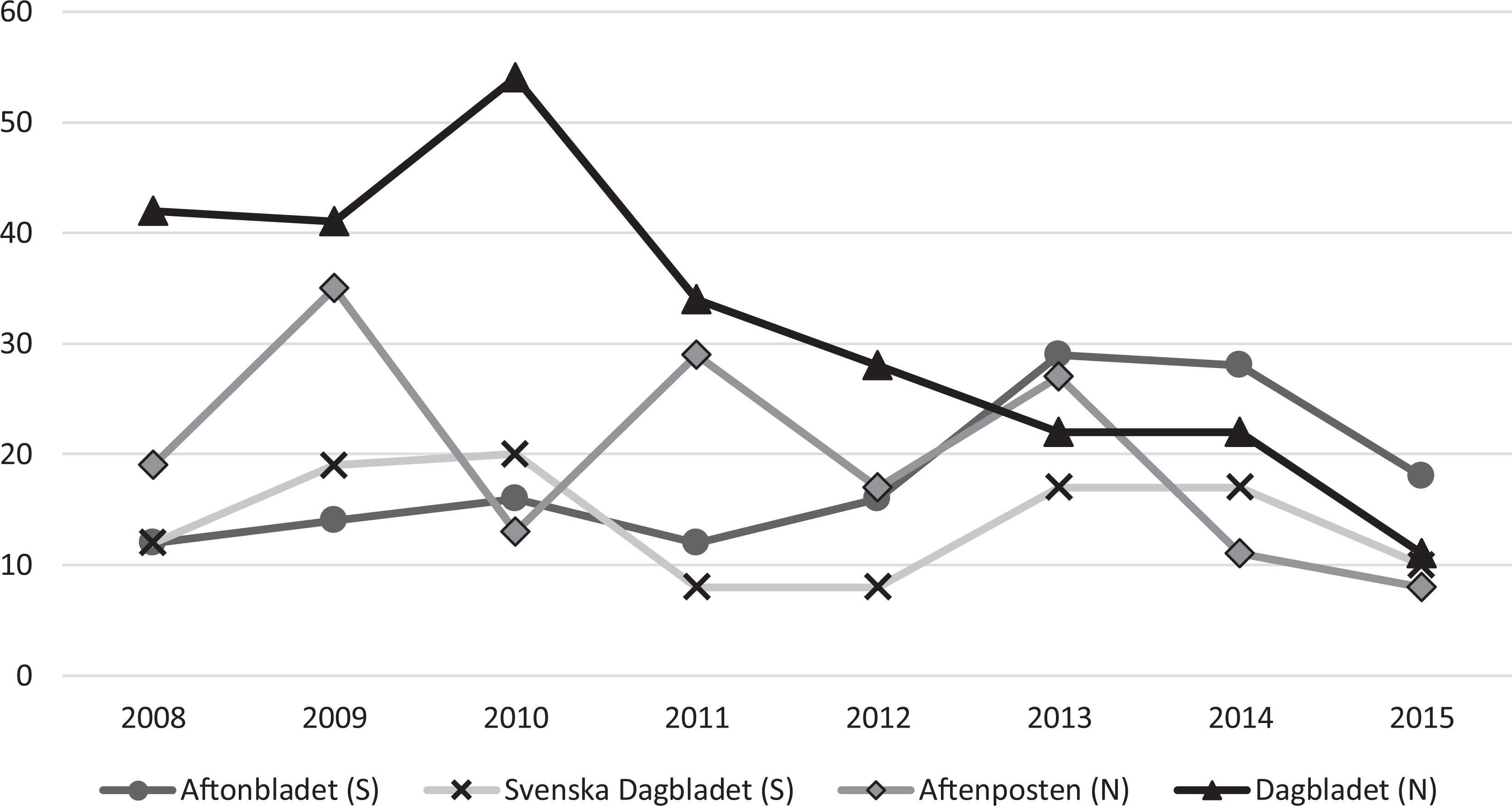
Final sample of articles referencing the cultural elite, 2008–2015 (N = 669).
Table 1 shows the occupations and themes linked to the cultural elite. Both measures were identified through careful examination of the journalist’s or the interviewee’s choice of words, expressions, metaphors or arguments (Djerf-Pierre et al., 2016). 5 Expressions were classified according to the main understandings they constructed of the cultural elite in context.
Measures of occupations and themes associated with the cultural elite.
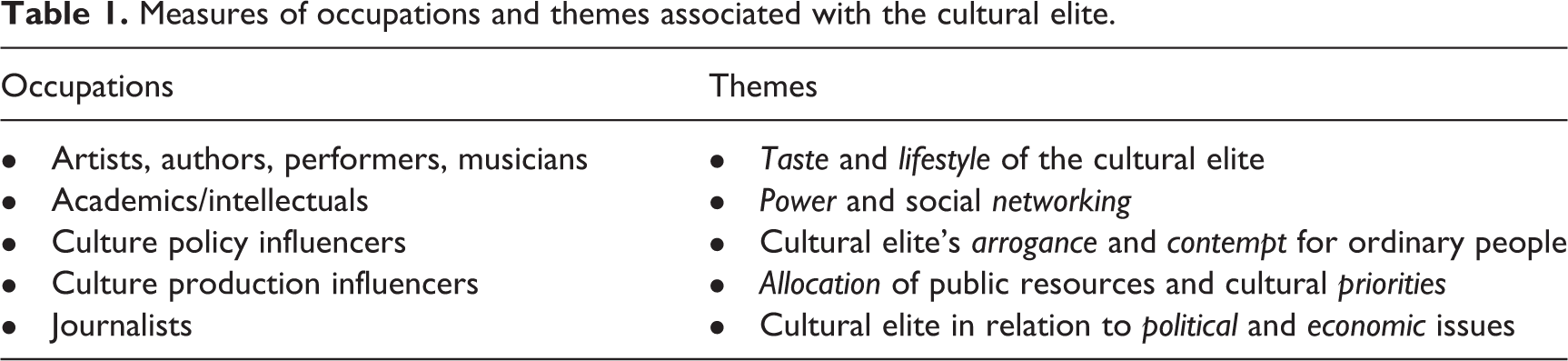
The occupations were first inductively coded and then further structured and categorized in order to transform the data into conceptual generalizations. The first four themes were chosen in accordance with former inductively coded newspapers on Norwegian cultural elites (Haarr, 2009; Haarr and Krogstad, 2011). The last theme, the cultural elite in relation to political and economic issues, was detected by opening up for other codings.
Considering that such coding is, to a certain degree, based on the researcher’s judgements, the first author of this article, Anne Krogstad, read all the texts and sample-coded the Swedish material. The coding of the overall material was completed by the second author, Audrey Stark, who also read and recoded parts of the material several times. The authors had continuous discussions regarding the meaning of the material and how codes should be applied. In line with previous research, we identified ‘difficult or marginal cases of articles and revised the coding when interpretation diverged’ (Djerf-Pierre et al., 2016: 642). However, since no reliability test was carried out, we rely heavily on the qualitative data. The quotes in this article have been carefully selected and we believe they demonstrate the general sentiments found in the data.
In the coding of the data, we have operated with the individual articles as the main unit of analysis. Each article was coded once for every and all occupations and themes that were present in the article. Because the most prominent theme in each article may influence the readers’ total impression of the cultural elite, we also utilized an additional code to indicate the article’s dominant theme. This latter code allowed for a more general understanding of the trends in the material. While we theoretically relate the presence of themes to repertoires, we relate the dominant themes to configurations.
Who is affiliated with the cultural elite?
How is the cultural elite typically defined in the newspapers? Figure 2 shows the percentages of Swedish and Norwegian articles containing references to various occupations associated with the cultural elite.
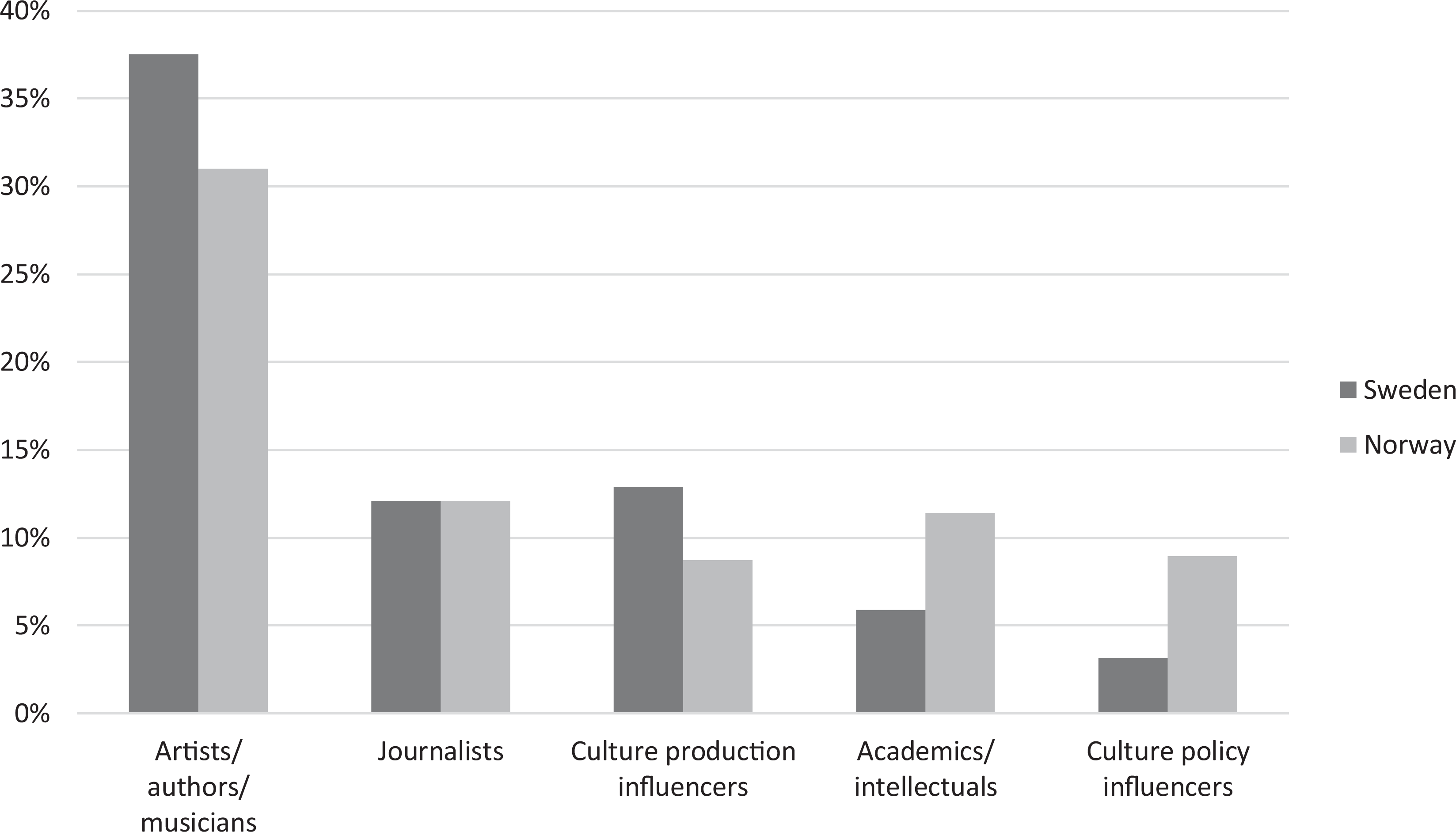
Percentages of articles associating various occupations with the cultural elite in Sweden and Norway.
In both countries, the highest percentages are found in the category ‘active artists, authors and musicians’. Thereafter, we see more variation in the percentages of references to journalists, those with influence over culture production (publishers, theatre directors, etc.), academics and those with influence over culture policy (politicians, bureaucrats, etc.). The percentage of articles that refer to journalists as members of the cultural elite is the same for Sweden and Norway. However, there is a higher percentage of references to artists and those with authority over culture production in Sweden than in Norway, while the cultural elite are referred to as academics and culture policy influencers more often in Norway.
The occupation categories are, to a large degree, tied to big institutions: art/culture, media, academia and politics. Here, the cultural elite is mainly portrayed in accordance with Mills’ (1956: 11) definition, as a category of individuals occupying dominant positions in the structure of relations. However, we find it interesting that the category of individuals most associated with the term – artists, authors and musicians (see Figure 2) – is described as consisting of individuals who may command ‘power of definition’ through their learned capital (Khan, 2012), but only rarely as consisting of individuals holding institutional command positions. In the material, this dominant category is described as including ‘celebrities' and ‘pundits seen and heard in the media’ (Aftonbladet, 29 September 2012; Aftenposten, 1 April 2011); indeed, ‘all who operate within the field of culture and get paid for it, albeit very little’ appear to be included (Dagbladet, 16 July 2009).
Even though the Swedish newspapers refer to the cultural elite as active artists, authors and musicians in a higher percentage of articles than is the case in the Norwegian data, our qualitative review indicates that access to membership in the cultural elite is more difficult in Sweden than in Norway. In Sweden, there is a greater focus on the cultural elite as an exclusive group of people who are ‘born with cultural capital’. The cultural elite is referred to as a ‘Parnassus populated by a well-educated middle class from Stockholm’s northern neighborhoods’ (Aftonbladet, 10 June 2011).
This view on Swedish cultural elites can also be seen in the Norwegian material – for example, when composer Synne Skouen reflects on the relationship Norwegians have to institutionalized elites, as compared to their Swedish counterparts:
Until now we have been spared from that kind of cultural snobbery that most often follows in the wake of elites. We don’t have to look farther than to Stockholm to see this, with their royal court singers and all that results from an active nobility (Aftenposten, 8 January 2008).
Our material also shows that, while there are very strong opinions about the cultural elite in both countries, these opinions are often projected upon a very vague category of people. For example, Ulf Erik Knudsen from the Progress Party (N) is criticized in the following way: ‘He has never seen the cultural elite and he does not know what it is. But he apparently knows where they hang out: Kunstnernes Hus’ (Dagbladet, 9 August 2008). This finding is supported by our attempts to ascertain the ratio of men to women in the cultural elite in both countries. Our results show that the newspaper articles overwhelmingly refer to the cultural elite as an anonymous, gender-neutral group: 79 and 80 percent of Swedish and Norwegian references, respectively. When gender is mentioned, descriptions of men dominate in both countries.
In his interviews of Norwegian cultural elites, Ljunggren (2015) found that when elites were asked about their own elite affiliation, responses ‘ranged from defensiveness, via acknowledgement and acceptance, to outright embracement’ (Ljunggren, 2015: 6). They had a clear understanding, however, of the necessity of downplaying their elite position in public contexts. We find a similar tendency. While there are 788 either specific or general references to other people’s cultural elite affiliation in our material, the tally of individuals who acknowledge their own affiliation without reservation is low – four Swedes and seven Norwegians. While our finding represents a small increase compared with that found by Haarr (2009), the number of individuals who freely label themselves as cultural elite is still low. This echoes Swidler (2001), who remarks that individuals – in their deployment of repertoires – are often ‘constrained by their knowledge, often implicit, of how their action will be read by others’ (Swidler, 2001: 165).
It is in the qualitative review of the material that the main understanding of who the cultural elite are clearly emerges – an understanding in line with Pareto’s ([1901] 2008) early definition of the elite as a social stratum that stands in striking contrast to the vast majority of citizens. Ordinary people are portrayed as embracing cultural and consumer products that are reportedly despised by the cultural elite. While a number of articles endeavor to mitigate such differences by emphasizing how the cultural elite and ordinary people can coalesce around specific likes and dislikes, the main trend points toward a deep divide between the cultural elite and other people. Pareto further argued that elites use their positions ‘for good as well as evil’ (Pareto, [1901] 2008: 36). It is the latter characterization, elites as lacking in morals, that comes across as a main understanding of the cultural elite in the material. This ties into descriptions of the cultural elite as an ‘exclusive circle’ of ‘politically correct’, ‘self-centered’ and ‘haughty’ individuals who view ordinary people as inferior, or, in the alleged language of the cultural elite, as ‘stupid’, ‘vulgar’ or ‘uneducated morons’ (Dagbladet, 2 September 2008).
Exploration of themes, repertoires and configurations
As previously mentioned, five themes are clearly visible in the newspaper material. Descriptions of the cultural elite’s taste and lifestyle are abundant. Often clad in black, the cultural elite can be found at the opera, the theatre and in concert halls in their respective capital cities. Descriptions circle around annual book fairs and garden parties, champagne as a ‘road to liberation’, ‘respectful nodding in front of something your child could have drawn’, ‘culture men’ and their antics (not least in Sweden) and ‘long weekends to Rome or Barcelona’ (Dagbladet, 23 January 2009; Aftenposten, 1 April 2011). In both countries, the cultural elite are associated with peculiar and obscure art forms. Swedish cultural elite are, for example, associated with ‘destructive and elitist cultural expressions’, while the Norwegian cultural elite are depicted as favoring ‘poems that don’t rhyme, music that no one can dance to and sculptures of poop’ (Dagbladet, 25 July 2009). This demarcation is also apparent in descriptions of the cultural elite’s view of culture as something that should ‘shock, upset and provoke’ and that culture is ‘something that must be mastered, but by all means not enjoyed’ (Svenska Dagbladet, 22 September 2010; Dagbladet, 27 July 2009; Dagbladet 9 April 2008). When these experiences or products become mainstream, it is time for the cultural elite to move on (Aftenposten, 23 February 2008).
In both countries, the cultural elite’s engagement in political issues is often cited. To a lesser degree, economic issues are mentioned. The irony found in the taste/lifestyle theme is dampened when politics is discussed, especially in Sweden. A central point is that a politically correct and left-leaning cultural elite brush aside, or ridicule, ‘ordinary people’s democratic culture’. Another ‘hot’ argument, often used in Swedish debate, is that the cultural elite behave naively, foolish or dishonestly by only pointing to the positive effects of immigration. Thereby, they push ‘social and economic matters under the carpet’ (Aftonbladet, 19 March 2014; Aftenposten, 1 September 2010).
The cultural elite purportedly use their power and network to ‘allocate and secure funds for themselves’ for the purposes of self-fulfillment and enrichment (Aftenposten, 13 May 2009). Within this theme, the culture elitist avant-garde is portrayed as a closed and exclusive circle. They go to each other’s parties, define what is good and bad, dominate fields of culture and have access to the media.
It is the cultural elite’s alleged arrogance and contempt which provoke the most. The ‘standard image of the cultural elite who despises ordinary people’ is ‘the self-fulfilling cultural snob, with a strange view of humanity’, ‘a difficult person’ who ‘in pure wickedness, persists in incomprehensibility’ and ‘doesn’t give a shit about the audience’ (Aftonbladet, 12 September 2008).
When it comes to the allocation/priorities theme, the cultural elite are described as a group who by way of their position can attain privileges at the expense of weaker groups. While people in hospitals ‘are freezing in the corridors’ and ‘have called for blankets’, the cultural elite are said to want ‘avant-garde art without clothes and cultural initiatives which are more correct than interesting’ (Svenska Dagbladet, 7 May 2008).
Authors in the newspaper sample weave the mentioned themes together – into what we, in line with Swidler (1986) and Lamont and Thévenot (2000), have called national cultural repertoires – in order to present their readers with narratives about who the cultural elite are and how they behave. One such repertoire is illustrated in an opinion piece written by Siv Jensen (Party Leader) and Ulf Erik Knudsen (Member of Parliament) from the Progress Party (Norway):
It is, in fact, wrong that a small group of insiders allocate public funds (allocation/priorities), on a so-called discretionary basis (power/network), to what they think is good culture and art (taste/lifestyle). This system is based on a condescending attitude (arrogance/contempt) towards the tastes and preferences most people have (taste/lifestyle). (Aftenposten, 8 July 2009)
As the reader will understand from the above quote, identifying themes requires discretion on the part of the researcher. Bearing these uncertainties in mind, we have – for comparative reasons – tried to quantify the constitutive parts of the repertoires, the themes. Table 2 shows the theme presence within the articles, hereafter referred to as within-article themes, as well as the dominant article themes, both in percentage of articles. We view the within-article themes and dominant themes as representations of what we earlier called national cultural repertoires and configurations, respectively. These concepts help identify prominent characteristics of the cultural elite in both countries and serve as an illustration of each country’s cultural compass (Bourdieu, 1984).
Dominant article themes and within-article themes, Sweden and Norway. Percentage of articles. 6
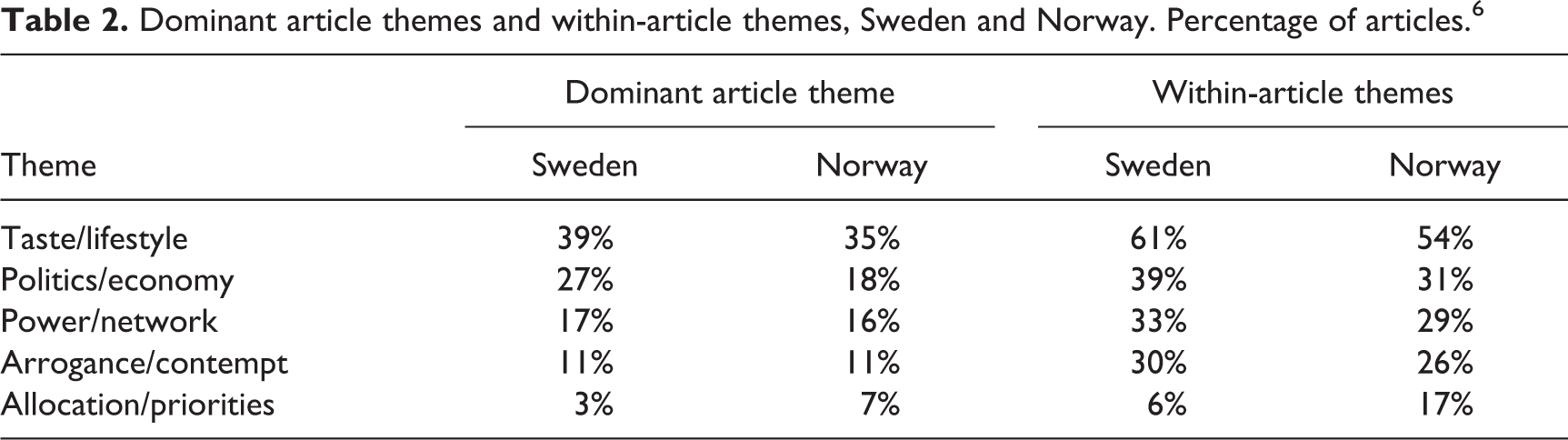
Table 2 shows that there are striking similarities in the hierarchical classification of the main themes in Sweden and Norway. The same pattern emerges in the measurement of both the within-article themes and the dominant article themes. The internal ranking of the five themes is the same in both countries. Taste/lifestyle is the theme most often associated with the cultural elite in both countries, followed by politics/economy and thereafter by power/network. The theme of the cultural elite’s arrogance and contempt for ordinary people is present in only slightly lower percentages than the power/network theme. The theme of allocation of public resources and cultural priorities is least often associated with the cultural elite in both Sweden and Norway.
Results of the chi-square test show that the only statistically significant differences (p < 0.05) between the two countries can be found in the categories of politics/economy and allocation/priorities. In the case of within-article themes, the difference between Sweden and Norway in the category of politics/economy was seven percentage points, while there was a difference of 11 percentage points in allocation/priorities category. As for the dominant themes, we found differences of eight and four percentage points in these two categories, respectively.
Our analysis of attitudes toward the cultural elite showed that there were no statistically significant differences in attitudes toward the cultural elite expressed in the respective newspapers from each country; however, there were statistically significant differences between the two countries (p < 0.05). Although the attitude toward the cultural elite was considerably more negative than positive in both countries, the attitudes expressed in the Swedish newspaper articles were more divided, as both the percentage of positive articles and the percentage of negative articles were higher in Sweden than in Norway.
In Haarr’s (2009) Norwegian study, cultural elite involvement in political issues was almost absent in the 1980s and 1990s. The political dimension became more visible in the period 2000–2008, but nevertheless accounted for only six percent of references (Haarr, 2009: 50). The present study, in which politics/economy is the second most prevalent theme, shows a clear politicization of the perceptions of the cultural elite in Norway. We also see a heightened mentioning of the cultural elite in connection with political elections in both Sweden and Norway. 7 Thus, it appears that the cultural elite are not only associated with typically ‘cultural stuff’, but also play a role in politics, an argument that Harrits (2013) and Jarness et al. (2019) have made in their studies on Scandinavian politics. In what follows, we will dwell more on how the mediated image of the cultural elite is linked to politics, or, more precisely, how the cultural elite is turned into unwilling foils of the political right.
Political implications
In this article’s introductory quote, Åsa Linderborg describes the cultural elite’s treatment of her working-class father as someone who is vulgar in taste and manners and whose vote should not count. She links such treatment to the increasing popularity of populist political parties: ‘You put all this together and, of course, it becomes pure dynamite’ (Dagbladet, 2 September 2008). Echoing researchers who analyze populism as a rhetorical and stylistic repertoire (Brubaker, 2017), Linderborg further writes, ‘The Christian Democrats and SD have made party politics by turning on the politically correct elite, in the same way as right-wing populists and conservative movements are churning all over Europe’ (Aftonbladet, 30 January 2015).
In the Norwegian material, it is mainly the Progress Party that is associated with populist politics. The excerpt in the previous section shows how Jensen and Knudsen draw on various themes and weave them into a political argument against elites. Echoing Pareto ([1901] 2008), the party’s relationship to the cultural elite is referred to as ‘the nation’s new class war: “the people” against the “cultural elite”’ (Dagbladet, 9 August 2008), with the party proclaiming an ‘imagined sameness’ with the people. This rhetoric of sameness with the people (Gullestad, 1992) serves as a foundation for exclusion of the cultural elites. Also, the people are described as being generally more down to earth and more adept at recognizing threats posed by immigration and Islamic terrorism, threats that do ‘not seem to worry the cultural elite’ (Aftenposten, 4 January 2011).
In the Swedish material, the cultural elite is portrayed as having an adversarial relationship to not one but two political parties: the Christian Democrats (CD) and the Sweden Democrats (SD). In a famous speech, party leader Göran Hägglund (CD) put the cultural elite on the agenda when he contrasted them with what he called ‘reality’s people’. 8 In doing so, he incorporated all the previously discussed themes. Hägglund focused on ‘defining a conservative, value-based approach that corresponds to the sentiment of ordinary people who do not recognize themselves in the cultural elite’s condescending perspective’ (arrogance/contempt). ‘He raged about “abstract art”‘ (taste/lifestyle) and ‘prattled on about a cultural elite who want to force these advanced things on the masses’ (power/network). He criticized what he called ‘the cultural left’ and how they ‘badmouth reality’s people (arrogance/contempt) for, amongst other things, where they live and their taste in music’ (taste/lifestyle). He pointed to a ‘deep divide’ between the norms and priorities of the ‘oblivious cultural elite’ and those of the average Swede (allocation/priorities) (Aftonbladet, 23 September 2009; Svenska Dagbladet, 5 July 2009; Aftonbladet, 30 June 2013; Svenska Dagbladet, 19 September 2009; Svenska Dagbladet, 17 April 2013; Svenska Dagbladet, 27 August 2009). Again, themes in various combinations are articulated into a political argument in which the people serve as a striking contrast to the elite. SD supported Hägglund’s narrative of difference. However, Hägglund distanced himself from this support by criticizing SD for only including ‘ethnic Swedes’ in the category of the people. Although the political argument had a similar structure, the people were given different meanings – and different legitimacy – in the two parties.
As mentioned earlier, a main argument in Bourdieu’s study on legitimate culture is the working classes’ experience of low esteem – that they have a negative experience of themselves compared to elites and elite culture (Bourdieu, 1984). In their own eyes, as in most others’, elite culture has the highest esteem. Admittedly, in our study of media depictions, we do not study such evaluations directly or from the same angle. However, we find it interesting that journalists and other newspaper authors give ‘ordinary people’ the most esteem, while the cultural elite – to which many of these authors are reported to belong (Hovden, 2008: 207; see also Figure 1) – are harshly criticized.
Does this finding support researchers’ claims that the elite position of cultural elites in many Western countries is being considerably weakened (Bennett et al., 2009; Khan, 2012; Prieur and Savage, 2013)? Not necessarily. Again, bear in mind that we do not study power directly, only through media perceptions, although perceptions seep into the lived world (Lamont et al., 2017: 161). What we do see is that the power/network theme comes in third in our hierarchical configuration, after taste/lifestyle and politics/economy. We also see that the cultural elite are drawn into a media logic in which they are given a strong adversary role vis-a-vis ordinary people. In this latter role, the cultural elite is attributed a certain amount of power – adversary power.
An explanation for this strong adversary role can, apart from a rhetoric drawing on egalitarian sentiments in which ordinary people have heroic status, be linked to the ‘moral turn’ in the wake of Bourdieu’s class analysis. Several researchers (Lamont, 1992; Lamont et al., 2017; Norris and Inglehart, 2019) have pointed to cultural and political cleavages in which elites are not just regarded as powerful but morally wrong in their core values. At the other end of this moral–political positioning, the people are commonly regarded as ‘unified, authentic, and unquestionably morally right’ (Norris and Inglehart, 2019: 6). This resonates well with our findings. However, we would also argue that a focus on moral–political positioning is too narrow. For example, Jarness et al. (2019) maintain that ‘political attitudes can be seen as a political taste, on par with broader cultural tastes’, and that these are ‘deeply engrained in people’s way of life and sense of self, for instance manifested in symbolic boundaries and judgements demarcating “us” and “them” as (real or imagined) symbolic communities’ (Jarness et al., 2019: 882). We would go one step further and argue that not only taste and politics are ingrained in the alleged morality of the cultural elites but all the themes we have identified.
These multi-layered repertoires and configurations are, in addition, further structured. As mentioned above, references to ‘class wars’ and ‘deep divides’ between the cultural elite and the people runs through our material, making Pareto’s definition of elites highly relevant. This boundary work has theoretical implications for our analysis. It enables us to analyze exclusion as it manifests itself around our various themes. We find a splitting up of each of the five themes into contrasting versions: the cultural elite are culturally snobbish, the people have simple tastes; the cultural elite are politically correct, the people are realistic; the cultural elite are being heard, the people are ignored; the cultural elite are arrogant, the people are ridiculed; the cultural elite are privileged, the people are suffering. In this binary, almost mythical structure, negative and positive characterizations are systematically glued to the cultural elite and the people, respectively (Krogstad, 2019: 21). The central mechanism is to emphasize oppositions and thereby establish cognitive distance between the two parts (Lévi-Strauss, 1955). This is also a well-known mechanism in political polarization, by which public opinion goes to ideological extremes (Norris and Inglehart, 2019: 13). In its most dramatic form, the cultural elite emerge as a cultural Voldemort, dark clad, mighty and evil, while the people are portrayed as innocent victims. Taking into consideration that this study is based on newspapers with profiles relatively close to the political center, we did not expect to find this strong polarization tendency.
Sweden and Norway are not the only countries in which the cultural elite have become ensnared in a multi-layered and intense conflict between society’s bottom and top. In recent years, a number of Western countries have experienced popular protests against elites (Mangset et al., 2019; Norris and Inglehart, 2019). Admittedly, protests have often been directed toward economic and political elites, not necessarily toward cultural elites. However, the situation is more complex. Frank (2006) has, for example, shown how politicians use rhetorical tactics to divert voter attention away from issues like the politics and economy by focusing on questions related to cultural taste, which are more ‘inexpensive’ to handle than demands for workers’ rights and economic redistribution. In this case, a taste/lifestyle focus with a strong narrative on cultural values contributes to subsume and partly hide political and economic issues (Haarr, 2009; Haarr and Krogstad, 2011; Krogstad, 2019). Also, in the present study, we see that the cultural elite is loaded with negative characteristics and serves as a convenient foil for the political right. The political advantage of this is that individual people disassociate themselves from the cultural elite, something we have documented. When few to none acknowledge their cultural elite affiliation, no effective defense is mobilized. To accuse someone of being a member of the cultural elite is, therefore, a potent political and rhetorical device.
Comparisons and conclusions
Comparative studies show that elites are targeted for various reasons in various parts of the world. West European and North American cultural elites are often attacked for being too liberal, while Eastern and Southern European political elites are criticized for being corrupt (Mangset et al., 2019: 205). In this study, we have contextualized, specified and compared public ideas about two north Scandinavian cultural elites through five main themes and five occupational categories, and we have asked how these characterizations affect the role this elite plays in politics.
Through the qualitative study, we provided descriptions of how, in both countries, the cultural elite is characterized by themes such as snobbery, political correctness, power, arrogance and privilege. Through the quantitative study, we captured both the occupational categories and the distribution and hierarchical classification of the themes in each country. There is a higher percentage of references to artists and those with authority over culture production in Sweden than in Norway, while the cultural elite are referred to as academics and culture policy influencers more often in Norway. The national cultural repertoires gave an overview of the main perceptions of the cultural elite in both countries. There is a high level of coherence in the relative importance of the repertoires in the two countries. However, there is a difference in the degree of mobilization of the different themes. This confirms Lamont and Thévenot’s (2000) assertion that certain cultural tools seem more accessible in a national context than others.
While repertoires point to the presence of a more or less standardized set of themes, we have developed the term configuration to refer to hierarchical combinations of themes that present members of different national communities with prevalent cultural narratives about societal matters. As we have shown, the ideas about the cultural elite are emotionally charged. By taking this into account, we have tried to answer Swidler’s (2001: 14) call for ‘more differentiated ways of describing not the content of culture, but the varying […] engagement with which people hold it’. Although politics often operated as an unmentioned elephant in the room, all of the themes were inextricably linked to and nourished this theme, which appeared to be especially ‘hot’ when linked to populist politics contrasting the cultural elite to the people. Here, meanings were surprisingly thick on each side and very thin in the middle, a phenomenon that we tie to binary structures and polarization.
A last important finding in this study is that the cultural elite is a more contentious label in Sweden than in Norway. The Swedish cultural elite are both more cherished and more despised. Moreover, the polarization between this elite and ordinary people is stronger. In fact, the polarization is so strong that political adversaries in some cases do not agree on the rules of the game (Hornburg, 2019). Even though the polarization is much more shallow in Norway, comparisons with earlier studies of the cultural elite (Haarr, 2009; Haarr and Krogstad, 2011) show that also in Norway there has been a growingly darker view on the cultural elite over time. We found the criticism of the cultural elite so immense that very few individuals in each country acknowledged openly, and without reservation, their affiliation with the cultural elite, with ‘them’. We interpret this as a continued strong orientation toward egalitarian values in the two countries. In this particular case, where public media is involved, egalitarianism does not serve as a dampener of tensions between groups but as a means for creating political division and exclusion.
