




Abstract
Volunteering is an activity in which individuals work for free to benefit others; however, research has also focused on the benefits volunteers themselves might experience. We add to the literature by focusing on how not only volunteering itself has an impact on wages but how the intensity, duration and timing of volunteering also have an effect on these. In addition, we distinguish between the effects on volunteers in the same job and when changing a job, and test the role of social capital. Using German data from the Socio-Economic Panel, we find that current volunteering has positive effects on wages in a fixed effects wage regression, especially if individuals volunteer with low to medium intensity. The duration of volunteering does not increase wages. However, based on the dummy impact function, we find that volunteering increases wages almost immediately and that this effect remains fairly constant over time. We find no indication that reverse causality drives this effect. Furthermore, we show that the wage benefits of volunteering are realized only through job changes, not on-the-job wage progression. With regard to job changers, we show that social capital accumulation through volunteering is one reason explaining the observed wage effects.
Introduction
Volunteering is an activity whereby individuals work for free to benefit others, often in a formalized context (Wilson, 2000). However, empirical research shows that volunteer work not only benefits others but may also have positive consequences for the volunteering individual (e.g. Borgonovi, 2008). For example, the literature discusses the positive effects of volunteering not only on the volunteer’s health and wellbeing but also on more tangible measures, such as employability and wages.
The wage effects of volunteering are the subject of controversial debate in the literature. First, some authors argue that in analyses of wage effects, whether individuals volunteer might be less important. In contrast, wage effects might depend on the intensity of volunteering and/or the time spent volunteering during the life course (e.g. Hackl et al., 2007). Second, authors debate the question of how exactly volunteering causes wage gains among those who volunteer, that is, the causal mechanisms. Here, human capital, signalling and social capital are discussed as potential and not mutually exclusive reasons explaining why volunteering increases wages (Spera et al., 2015). Third, critics of the literature concerning volunteering and wages often voice concerns with regard to whether the wage effect observed in the literature is a methodological artefact of not controlling for unobserved confounders (see e.g. Qvist and Munk, 2018).
In this article, we aim to contribute to all three discussions. First, we compare the effects of volunteering with those of volunteering intensity and volunteering duration, which are two indicators frequently found in the literature. In addition, to the best of our knowledge, we are the first to present empirical evidence with regard to the timing of volunteering and distinguish between wage effects on volunteers who remain in the same job and on those who change jobs. Timing might be important because wage effects could either be immediate or, alternatively, only develop over time. Job changes might be important to consider because such changes might be necessary for generating wage benefits through volunteering. Second, specifically in relation to job changers, we investigate the role of social capital in creating wage benefits through volunteering. Third, we address the question of causality using longitudinal data, making our study one of the few in the literature to do so. Specifically, we estimate dummy impact functions in a fixed effects regression. This flexible design not only allows us to explore the timing of volunteering and the development of effects over time but also accounts for unobserved confounders and selection into volunteering. This approach further allows us to explore the matter of reverse causality, something that is rarely performed in the context of volunteering and labour market outcomes.
Wage effects of volunteering: Literature review and hypotheses
In this article, we follow Wilson (2000: 215) in defining volunteering as ‘any activity in which time is given freely to benefit another person, group, or organization’ and that this activity ‘does not preclude volunteers from benefiting from their work’. In contrast to caring for a friend or family, volunteering is considered more formalized and public (Wilson, 2000).
Whereas a major part of the research on volunteering is aimed at identifying the antecedents or causes of volunteering (Wilson, 2012), in this article, we focus on the consequences of volunteering, a considerably smaller subfield of the research on volunteering. Specifically, we are interested in the effects of volunteering on wages.
In general, the literature expects positive effects of volunteering on wages, basing this expectation on three theoretical mechanisms (e.g. Spera et al., 2015). First, the human capital (Becker, 1964) mechanism assumes that volunteering leads to the accumulation of specific skills that are valued by employers. For example, Rego et al. (2016) find that volunteers acquire soft skills such as social and civic competences, learning to learn or a sense of initiative and entrepreneurship. In addition, they also acquire skills that extend beyond the scope of their specific voluntary organization by, for example, organizing and cataloguing documents, coordinating projects and activities, entering data, assisting with training or classes or fundraising. Second, the signalling (Stiglitz, 1975) mechanism assumes that instead of actually enhancing ability, volunteering only signals a worker’s likely ability during the application process. For example, individuals who volunteer signal their cognitive and, particularly, noncognitive skills, such as motivation, reliability and team spirit (Strauß, 2009). Third, the social capital mechanism assumes that volunteering facilitates the accumulation of social resources. Such resources can be used to find better-paying jobs, for which so-called weak ties are especially helpful. Weak ties are nonintimate ties with people, for example, acquaintances. In particular, Granovetter (1973) emphasizes the benefits of weak ties because they provide unique information that is, otherwise, inaccessible. Volunteer work is considered a prototypical source of weak ties (Flap, 2002; Uhlendorff, 2004; Wollebaek and Selle, 2002).
The expectation that volunteering has positive effects on wages has received some support in the literature; however, the empirical evidence is far from consistent. Starting with research based on cross-sectional data, Day and Devlin (1997) observe a wage premium of approximately 11% for men who volunteer. No significant effect of volunteering on wages is observed for women. In a subsequent analysis using the same database, Day and Devlin (1998) find an average of 6%–7% higher annual earnings for those who volunteer compared to nonvolunteers. Bruno and Fiorillo (2016) analyse the effect on wages of volunteering versus not volunteering in formal organizations. The authors attempt to solve the problem of unobserved confounders by relying on participation in religious organizations or other groups, and private voluntary activity (informal help) as two instrumental variables. Whereas the effect of volunteering on wages is originally close to zero and statistically insignificant, it becomes positive if instruments are used. Hackl et al. (2007) analyse the effect of volunteering per se, the number of hours volunteered (intensity) and the number of associations in which participants volunteered (diversity). Instrumenting their various indicators for volunteering activity by club membership during childhood and as to whether the individual has a volunteering partner, the authors find positive wage effects for all three indicators. Prouteau and Wolff (2006) focus on performing managerial tasks in voluntary organizations and distinguish between wage effects for employees in the private and public sectors. They find small negative wage differentials for the former and large positive wage differentials for the latter; however, both are statistically insignificant.
Ruiter and Graaf (2009) also rely on cross-sectional data; however, their survey data contain retrospective information on respondents’ employment history. The authors distinguish between the number of memberships of organizations and the number of organizations for which the respondents volunteered. They find that the positive effects on wages derive from membership alone, with no additional effect of actual volunteering for the respective organizations. Ruiter and Graaf (2009) use retrospective data to account for reverse causality issues, but they cannot control for the unobserved factors driving selection into volunteering.
Based on longitudinal data, Paine et al. (2013) examine the effect of volunteer work on wages by applying fixed effects regressions to account for unobserved confounders. The authors use a five-point measure of volunteering intensity ranging from never to at least once a week, and they find negative wage effects. For example, people who perform voluntary work at least once a week earn 4% less on average than those who never volunteer. The authors also report negative effects for people who perform volunteer work several times a year or only once a year or less. No explanation for this counterintuitive result is provided. Qvist and Munk (2018) apply fixed effects regressions and find that the overall effect of volunteering duration, as measured by the years spent volunteering, is slightly negative and statistically insignificant. However, interacting volunteering duration with labour market experience reveals that labour market entrants and people at an early stage of their working life significantly benefit from volunteering in terms of wages, but that the positive effect of volunteering on wages disappears after more than 10 years of labour market experience.
Given this mixed evidence and the scarcity of research based on longitudinal data, the first hypothesis we aim to test is as follows: H1: Volunteering increases wages.
In contrast to the clear theoretical expectation of positive wage effects, the literature is not as clear on the cause(s) of these effects. One aspect of this question involves the role of job changes. On the one hand, volunteering could lead to wage gains in the same job, for example, by promoting occupational advancement within a person’s employing organization. On the other hand, wage gains could depend on job changes such that the benefits of volunteering can only be reaped in a new job, regardless of whether someone changes jobs voluntarily or involuntarily. The following two subhypotheses reflect these – not mutually exclusive – possibilities. H1a: Volunteering increases wages on the job. H1b: Volunteering increases wages through job changes.
Only a few articles have attempted to test the mechanisms behind the returns of volunteering empirically. For example, Ruiter and Graaf (2009) follow Lin’s (1999) social capital theory, which postulates that an individual’s high-status social contacts are most useful in locating high-status or high-wage jobs. Measuring the average status of members in different types of voluntary associations, the authors find that joining high-status associations provides socioeconomic payoffs in terms of finding a job and occupational status but not in terms of wages. In contrast, wages were associated with the mean level of supervision of co-members in an association. The authors interpret these results and the fact that they find wage effects to arise from membership only with no additional effect of actual volunteering is seen as evidence for the social capital mechanism and against the human capital one. Bruno and Fiorillo (2016) interpret a subgroup analysis, for example, by age, wage level or gender, as evidence that all mechanisms are effective empirically but that different groups benefit from different mechanisms. Hackl et al. (2007) derive implications from the three mechanisms concerning the relationship between wage effects, and age, volunteering intensity and organization size. Empirical support for neither implication is found in the data, suggesting that social capital accumulation might not be an important mechanism for explaining the wage effects of volunteering.
Distinguishing between on-the-job wage gains and wage gains through job changes should provide us with some insight with regard to their relative importance, indirect and limited though it may be. The reason for the importance of drawing this distinction is that workers might use the human capital spillover between volunteer and paid work for both occupational advancement within the organization and obtaining a new and better-paying job elsewhere. In contrast, the signalling and social capital effects are more likely to play a role in the context of job changes. Because employers are well informed about a job holder’s ability, they do not have to rely on signals when deciding about promotions. Similarly, information about high-wage job opportunities will only be important for jobs outside the organization because employees should be well informed about internal job openings.
However, with regard to the social capital effects of volunteering, a more direct test can be derived from the seminal article on social capital and wages by Mouw (2003). In this, the author develops a plausibility test in relation to the wage effects of social capital. Slightly adapting
1
Mouw’s (2003) theoretical reasoning, we argue that if social capital drives the wage effects, volunteering should increase the probability that individuals will find new jobs through personal contacts because social capital would raise the probability of obtaining job offers through relatives and acquaintances but not through any other channels. If, in contrast, volunteering works mainly through human capital or as a signal, it should have no differential effect on the job-finding method. Our last hypothesis is, thus, the following: H2: Volunteering increases the probability of finding a job through personal contacts.
Limitations of the previous research
In this section, we list the limitations of the current literature and present how we plan to address these issues. First, in the studies cited above, different indicators of volunteering are often applied. Although studies in the literature often compare volunteers to nonvolunteers or investigate the effect of volunteering intensity, except for Qvist and Munk (2018), we are unaware of any analysis that estimates the effect of volunteering duration. Furthermore, to the best of our knowledge, to date, no analysis of the timing of volunteering has been conducted. We consider this omission important because the accumulation of human and social capital should depend on the length and consistency of an individual’s past volunteering. In our analysis, we also aim to contribute to a further understanding of the role of timing by identifying the time point in an individual’s life course at which he/she began volunteering and, thus, gain some insight into how potential wage effects develop over time, something that has not been performed in the current literature to date.
A second limitation of the current research is potential bias due to systematic but unobserved a priori differences between volunteers and nonvolunteers. Because volunteering often requires the individual to have specific skills, and volunteers are known to be well connected even before volunteering (Janoski and Wilson, 1995), volunteers are already highly employable and often work in jobs with higher wages (Lancee and Radl, 2014). Therefore, identifying the impact of volunteering on wages is nontrivial, and to a large degree depends on eliminating those – often unobservable – a priori systematic differences between volunteers and nonvolunteers. The problem of unobserved a priori differences can, in principle, also be solved using cross-sectional data, for example, through instrumental variable approaches. However, the instrumental variable approach only identifies the so-called local average treatment effect (LATE). In the analysis that follows, we use fixed effects regressions to account for unobserved time-constant confounders in a general population panel data study and, instead, identify the average treatment effect on the treated (ATT).
A third limitation of the current research is reciprocal causation, which is also referred to as reverse causality or simultaneity bias. In this situation, there are two potential causal directions, and whether a high socioeconomic position (employment and wages) drives individuals to volunteer, or whether volunteering leads to high socioeconomic positions 2 , or both, is unclear. The potential for bias due to reciprocal causation is most obvious in cross-sectional data and is often discussed as a threat to the validity of standard regression results (e.g. Day and Devlin, 1998; Hackl et al., 2007; Prouteau and Wolff, 2006). If solutions are attempted, such as instrumental variable approaches (e.g. Bollen, 2012), they are often not performed according to their full potential because the instrument quality is not tested, as observed in the social capital literature of Durlauf (2002). In addition, the problem of reciprocal causation is not easily solved even if longitudinal data are available. Here, methodological research (e.g. Vaisey and Miles, 2017) indicates that researchers are often too optimistic that strategies such as lagging the dependent or focal independent variable will remove reverse causality bias; moreover, even in fixed effects regressions with lagged variables, the problem remains.
Whereas we consider our analysis to address all three of the above limitations, a fourth limitation of the literature is one that, unfortunately, also holds true for our analysis. The tests applied to the mechanisms of human capital, social capital and signalling are always indirect and often ambiguous, and mechanism tests, for example, in the form of formal mediation analysis, are missing entirely. This absence is most likely due to problems of measurement. Such an issue might not pose as much of a concern for social capital, because researchers have proposed a variety of different ways to measure its different aspects, but it is a concern for human capital and signalling. The latter two are often virtually indistinguishable, as shown by the long-standing discussion on the effect of education on wages (cf. Bills et al., 2017: 294).
Data, variables and method
Data and variables
We use data from the Socio-Economic Panel, waves 1–31 (1984–2014). This representative panel survey began in West Germany in 1984 and in East Germany in 1990. Interviews are conducted annually and include all individuals 17 years of age and older within the selected households (Wagner et al., 2007).
For hypothesis 1 as well as hypotheses 1a and 1b, the dependent variable is wages, and the analytical sample contains all waves per individual in which the respective individuals were in regular employment, thus excluding periods of unemployment or other states of nonemployment. For hypothesis 1, this results in a sample consisting of 18,131 individuals. In hypothesis 1a, in which only job stayers are observed, the sample consists of 5606 individuals. To test hypothesis 1b, the sample includes individuals who change their job during the observation period, resulting in 12,529 individuals.
For hypothesis 2, the dependent variable is a dummy variable indicating whether a job was found through social networks. The sample consists of individuals who accepted new employment, resulting in 2044 individuals. The number of individuals (groups) and person years (observations) are displayed in each table and the figure notes.
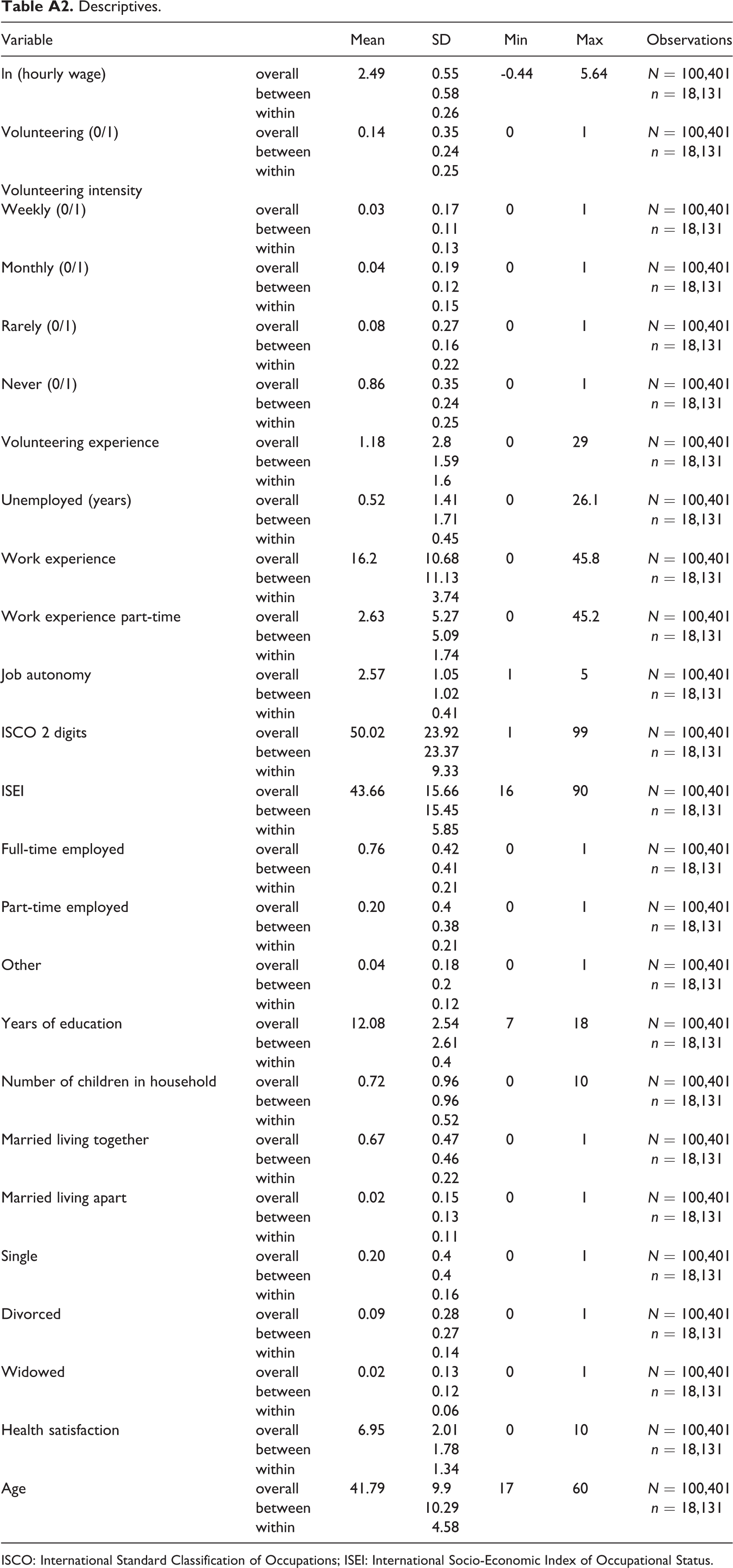
The dependent variable is the natural logarithm of the gross hourly wage, which is calculated from the gross monthly wages and the stipulated working hours. We exclude observations with monthly wages less than €100 (3,299 observations) and greater than €99,999 (7 observations) (for sample overview, see Table A2 in the appendix). For hypothesis 2, the dependent variable is finding a job through personal contacts. In line with a large part of the literature on social capital, we consider finding a job through personal contacts as opposed to any other job-finding method (employment offices, newspaper ads) as an expression of whether individuals mobilized social capital during their job search (Lin, 1999; Mouw, 2003). Therefore, in a regression with finding a job through personal contacts versus all other methods as the binary dependent variable, a significant coefficient of volunteering would support the hypothesis. Please note that to avoid endogeneity bias, we measure volunteering as well as the covariates in period t and finding a job in period t+1.
For all hypotheses, our focal independent variable is volunteering. In our data, volunteering is part of an item battery assessing the use of free time. The respective survey question is, ‘In which of the following activities do you take part during your free time?’, for which the volunteering statement is as follows: ‘Volunteer work in clubs or social services’. The respondents have the following response options: ‘once a week’, ‘once a month’, ‘less often’ and ‘never’. With the exception of the years 1994–1999, volunteering is measured only every other year (see appendix Table A1). Therefore, to avoid substantially reducing the precision of our estimator, we fill in the gaps with the information from the year before (move one forward strategy; see also Lancee and Radl (2014)). If anything, this strategy should underestimate the effect of volunteering and, thus, be biased against our hypotheses because all individuals in our sample begin as nonvolunteers (see below).
Based on the abovementioned survey question, we construct four indicators of volunteer work. First, we follow the majority of the literature in categorizing respondents into those who, at the time of the survey, do not volunteer (‘never’) and those who spent some of their free time volunteering, irrespective of how often. We call this indicator ‘current volunteering’. Second, we use the original four-point scale as a categorical indicator of ‘volunteering intensity’, in which those who currently do not volunteer are the reference category. Third, we construct an indicator for ‘volunteering duration’ by cumulatively summing all years the respondents spent volunteering, regardless of the intensity. Similar to labour market experience, the indicator does not revert to zero once the individual has quit volunteering, and the indicator begins counting again for those who reenter volunteering. Fourth, we construct a dummy impact function that measures the ‘timing of volunteering’ for the first time in the context of volunteering. Dummy impact functions (Allison, 1994; Andreß et al., 2013) or distributed lags (Dougherty, 2006), are a flexible and nonparametric way to measure the impact of volunteering as it develops over time. On the one hand, this approach allows us to measure wage development after individuals began volunteering, that is, whether a wage effect arises immediately or takes time to develop. On the other hand, the dummy impact function allows us to investigate wage development before individuals began volunteering. Because positive wage effects due to the mere anticipation of volunteer status seem theoretically unjustified, a wage increase before volunteering would indicate reverse causality, that is, the initiation of volunteering because of a prior positive wage development. Specifically, our dummy impact function is modelled as follows. We use the time up to seven years before volunteering as our reference category and introduce several dummy variables for the years before, one dummy for the year of beginning volunteering (coded zero) and several dummy variables for the years after taking up volunteering. 3 Please note that each dummy variable covers a two-year period because of the (predominantly) biannual measurement of volunteering. Overall, we model 7 years before and up to 15 years after volunteering. Finally, a dummy for when the individual ceased volunteering is also included. Because the dummy impact function is only applicable to binary variables, it cannot reflect volunteering intensity. We chose to use the same dichotomization we used for the first volunteering indicator.
To account for the time-changing confounders, we used several control variables. The specific set of variables depends on whether the analytical sample consists of regularly employed individuals (hypothesis 1) or those who took up (new) employment (hypothesis 2). For both hypotheses, we controlled for years of education, previous time in unemployment, and full-time and part-time employment experience in years; for the latter two, we also included squared terms. Furthermore, we controlled for the following sociodemographic characteristics and health factors that may cause individuals to select into volunteering: family status (we include dummies for married, living together, married but living apart, single, divorced and widowed); age in categories; number of children; and health satisfaction (0–10). Furthermore, we included year dummies. For the wage hypotheses, we also included employment status (full-time, part-time, other) and controlled for changes in occupation, work autonomy and social status because such changes might lead to wage increases and motivate individuals to begin volunteering.
From our analytical samples, we excluded those individuals who were already volunteering when they entered the panel survey. For such individuals, we cannot accurately compute the cumulated time spent volunteering or the dummy impact function of the time spent volunteering. Consequently, in the analytical sample, 14% of the observations (data rows) are from current volunteers. Among the individuals in our sample, 33% volunteered at least once during the observation period. The respective share of the unrestricted sample is 26%. Furthermore, we excluded observations with missing values for at least one covariate.
Due to our fixed effects regression, we also excluded individuals with only one observation because, for them, the intra-individual changes in wages or job-finding method cannot be measured. We excluded individuals older than 60 because they are near the legal retirement age in Germany. Individuals with two or more consecutive missing values in the volunteering variable were also excluded because we need nonmissing information in the wave before and after the missing volunteering information to impute a reasonable value.
Method
To account for time-constant unobserved confounders, we use a fixed effects estimator (Allison, 2009; Verbeek, 2012). The estimator eliminates unobserved confounders correlated with both the dependent and independent variables by subtracting individual-specific means. The elimination of bias due to unobserved confounders from the fixed effects estimator is a major advantage over a pooled ordinary least squares (POLS) or a random effects model (Brüderl and Ludwig, 2015). As shown by Lancee and Radl (2014), unobserved time-constant confounders, such as personality traits or social skills, are important factors when observing volunteering. The research shows that personality traits barely change over time (Cobb-Clark and Schurer, 2012). If these unobserved variables correlate with volunteering and the outcome, then the results obtained from POLS and the random effects model are biased.
A statistically significant coefficient in a fixed effects regression indicates that a within-person change in volunteering is associated with a within-person change in employment probability or wages, respectively. This within-estimate presents a stronger argument for causality than mere static comparisons between persons with different levels of the focal dependent and independent variables (between-variation). However, researchers often have no information about which change came first – the change in the dependent or the independent variables. Thus, bias due to reverse causality is possible. The potential for this could be of particular importance in the wage regression, in which, even after applying fixed effects regression, a change in volunteering that increases wages is virtually indistinguishable from a change in wages that leads to the start of volunteer work. If wage increases lead to volunteering, the impact dummies should be significantly different from zero even some time before individuals began volunteering. If wage differences appear only after individuals began volunteering, but not before, the problem of reverse causality is most likely negligible. Because fixed effects regressions only control for time-constant unobserved confounders, the results could still be biased by time-changing confounders. However, if such changes are not covered by our control variables and increase wages before volunteering, such an effect should be visible in the prevolunteering dummies of the impact function.
In the case of wages as the dependent variable, we can use standard linear fixed effects regression. In linear fixed effects regressions, the coefficient estimate relies only on individuals who actually experienced a change in the volunteering variable. Those who do not experience a change in volunteering will, however, contribute to the quality of the analysis by removing differences in the time trends (Brüderl and Ludwig, 2015). For the binary dependent variable of job-finding method, we used conditional logit fixed effects regression. 4
Results
We begin reporting our empirical results with hypothesis 1, which is tested by applying the above-discussed four indicators of volunteering. As shown in Table 1, for the first volunteering indicator, that is, the dummy for current volunteers (Model 1), we find that wages increased by approximately 1.4% by volunteering. In Model 2, the indicator measures the effect of different intensities of volunteering. We find that the relationship between volunteering intensity and wages is inversely U-shaped. Compared to those who never volunteer, those who volunteer rarely or monthly can raise their wages by 1.7% on average. In contrast, those who volunteer even more frequently obtain no wage gains compared to those who never volunteer. A potential explanation for this difference could be that volunteering as often as every week takes time and effort away from work, thus counterbalancing wage effects. With regard to volunteering duration (Model 3), we find a positive but statistically insignificant coefficient, suggesting that wages do not increase with the time that persons have spent volunteering during their career. 5 With regard to the final indicator, that is, timing of volunteering (Table 1, Model 4 and Figure 1), we observe that for those who eventually volunteer, no wage gains are observed in the years before they began volunteering. Wage gains start immediately in the year the individual began to work as a volunteer. As indicated by the dashed lines, the coefficient estimates are statistically significant for the dummies until years 3–4 after beginning to volunteer. These coefficients become statistically insignificant, but as indicated by the broadening of the confidence band in Figure 1, this result is most likely due to a much lower number of cases in the later years. In contrast, the point estimate is still large, with approximately 10% for the years 5–6 to 9–10 and 22%–38% for the later years. 6 Thus, our interpretation is that the wage gains realized through volunteering are immediate and fairly constant over time.
Effect of volunteering on ln (wages).
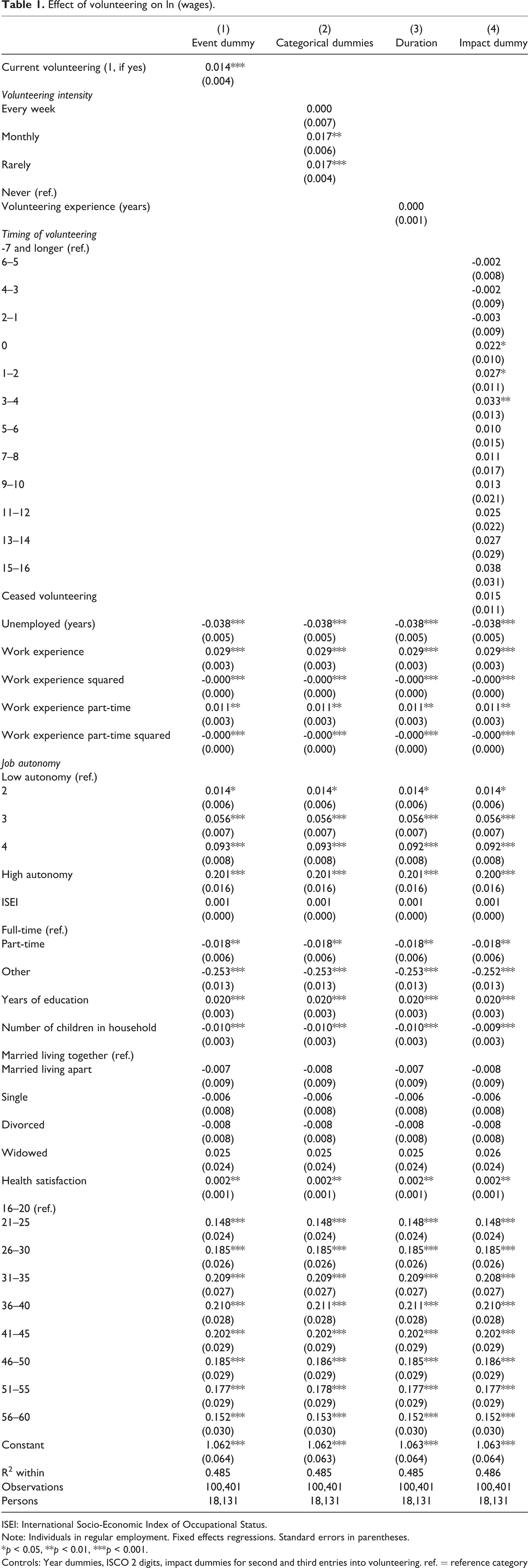
ISEI: International Socio-Economic Index of Occupational Status.
Note: Individuals in regular employment. Fixed effects regressions. Standard errors in parentheses.
*p < 0.05, **p < 0.01, ***p < 0.001.
Controls: Year dummies, ISCO 2 digits, impact dummies for second and third entries into volunteering. ref. = reference category
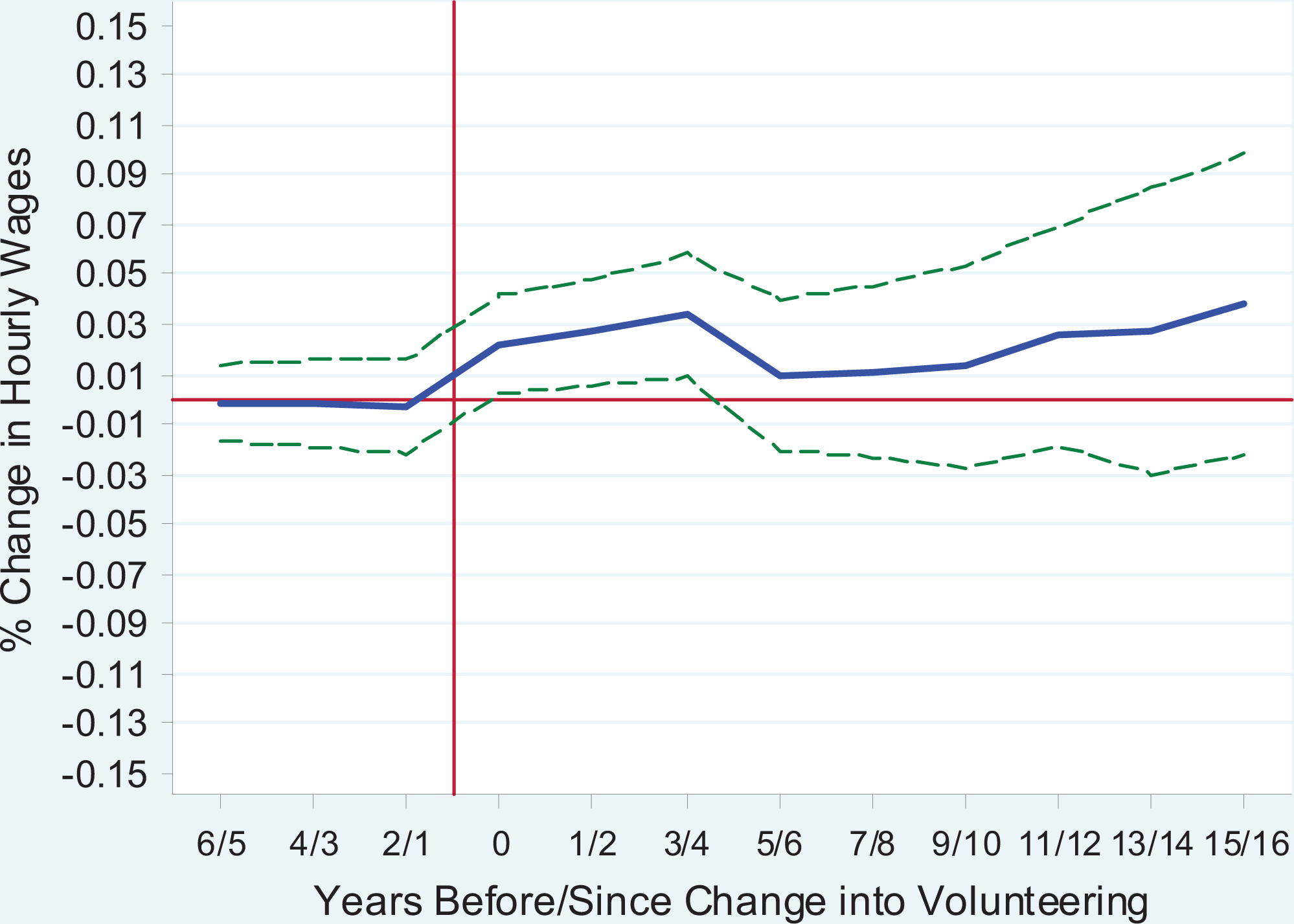
Effect of volunteering on ln (wages).
Ceasing to volunteer is not associated with significant wage gains or losses. With regard to wage gains through volunteering, we conclude that hypothesis 1 is generally supported by the data. However, although on average volunteers profit from volunteering, we find that those who volunteer very frequently do not experience wage gains. In addition, wage gains do not depend on the duration of volunteering. Based on the dummy impact function, we have no reason to believe that our results are artefacts of reverse causality, whereby increasing wages leads people to begin volunteering, because there are no wage differences between individuals before they began volunteering.
After establishing that there is a causal effect of volunteering on wages, we ask how it is caused. The first step is to test hypotheses 1a and 1b, in which we distinguish between those who held only one job (job stayers) and those who changed jobs at least once (job changers) during the observation period. We begin with hypothesis 1a, which states that volunteering increases wages through career advancement on the job. Table 2 shows that for those who stay in the same job, volunteer work has no effect on wages. The coefficient of the volunteering dummy is 0.002 and, thus, close to zero and statistically insignificant. Similarly, no effects of volunteering intensity are observed, and the coefficient of volunteering experience is slightly negative as well as statistically insignificant. Examining the timing of volunteering (not included in the table, see Figure 2), we also find that over the whole range of the dummy impact function, the effects on wages are not significantly different from zero. If anything, according to Figure 2, wages even start to decline several years after volunteering began; however, because the confidence band also becomes quite large, we do not want to overinterpret this development. In sum, we conclude that for those who remain in one job, volunteering does not lead to wage gains. Thus, the wage effect of volunteering is not due to wage progression on the job. Hypothesis 1a is, therefore, not supported.
Effect of volunteering on ln (wages) for stayers and changers.
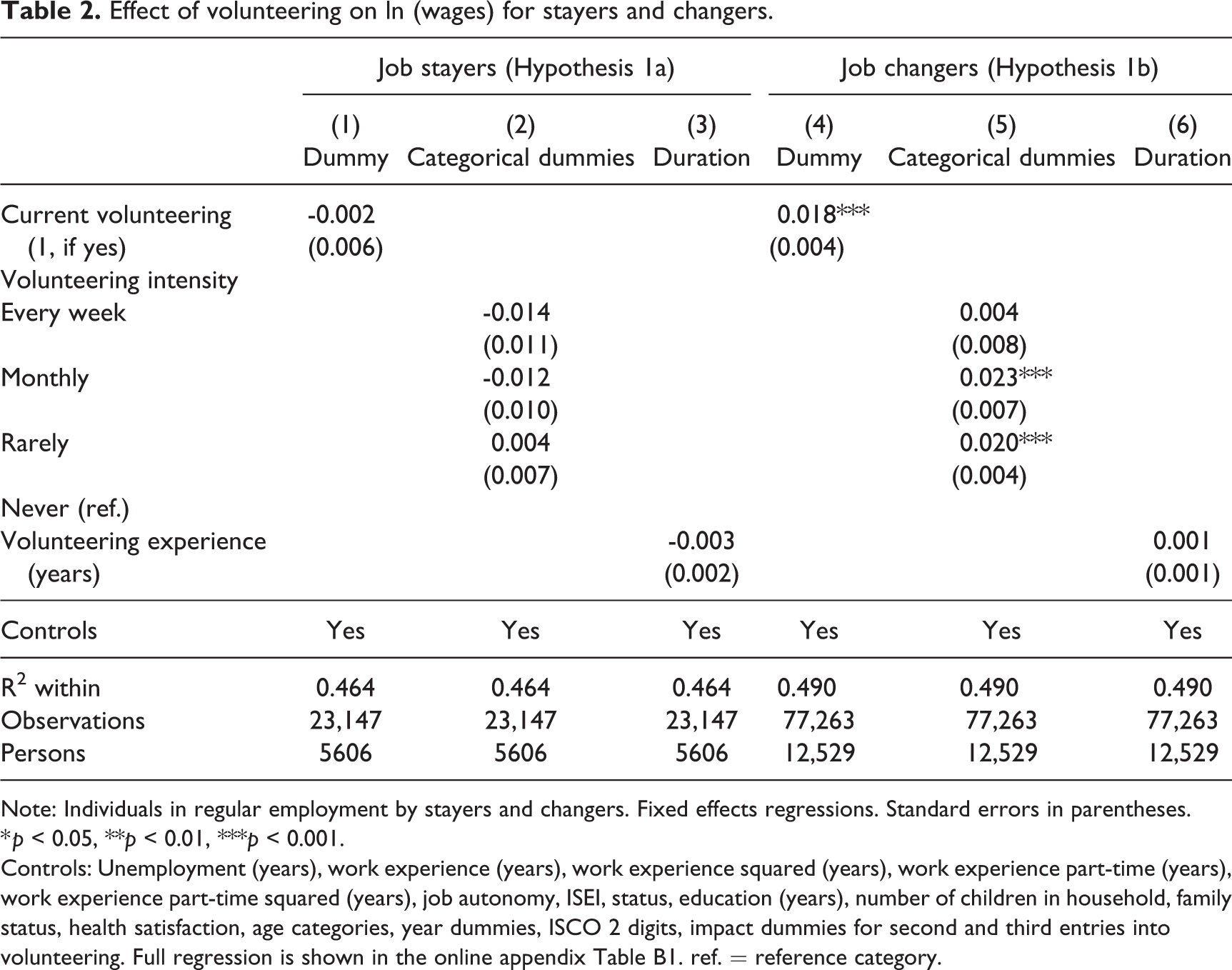
Note: Individuals in regular employment by stayers and changers. Fixed effects regressions. Standard errors in parentheses.
* p < 0.05, **p < 0.01, ***p < 0.001.
Controls: Unemployment (years), work experience (years), work experience squared (years), work experience part-time (years), work experience part-time squared (years), job autonomy, ISEI, status, education (years), number of children in household, family status, health satisfaction, age categories, year dummies, ISCO 2 digits, impact dummies for second and third entries into volunteering. Full regression is shown in the online appendix Table B1. ref. = reference category.
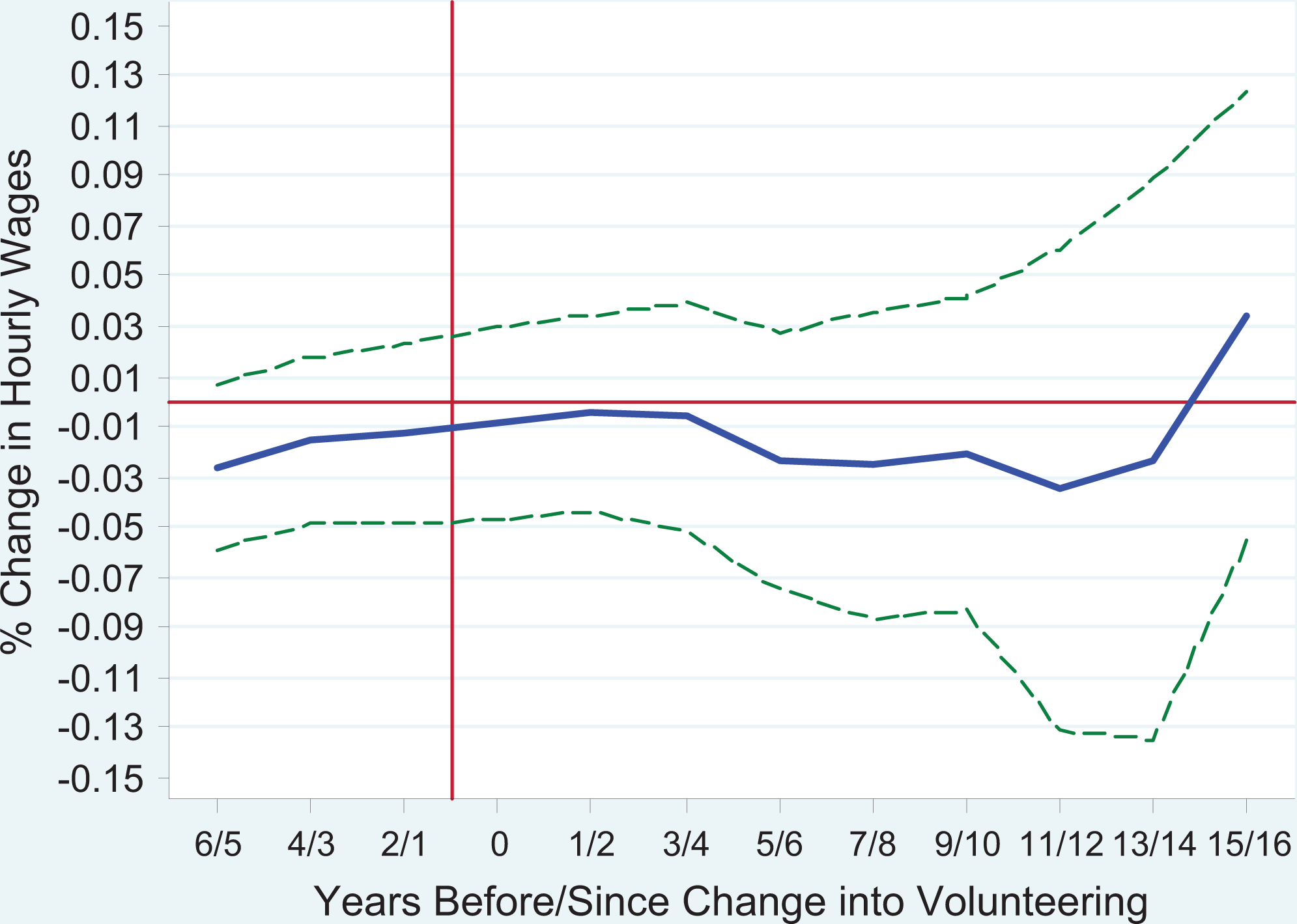
Effect of volunteering on ln (wages) for stayers.
Hypothesis 1b states that individuals realize wage gains through volunteering by changing jobs. The results documented in Table 2 suggest that such is the case. We find that, at 0.018, the coefficient of the volunteering dummy is statistically significant and slightly larger than in the whole sample, which also includes job stayers. Similarly, low and medium volunteering intensity leads to wage increases of similar sizes; however, the effect of high intensity is close to zero and is statistically insignificant. The coefficient of volunteering experience is identical in size to the overall sample and is statistically insignificant. The behaviour of the dummy impact function also strongly resembles the one observed in the overall sample, indicating no reverse causality and wage gains until the first four years of volunteering (not included in Table 2, see Figure 3). We conclude that the data support hypothesis 1b, which states that wage gains are realized through job changes. Thus, we find that volunteers must change their job to reap the monetary benefits of volunteering.
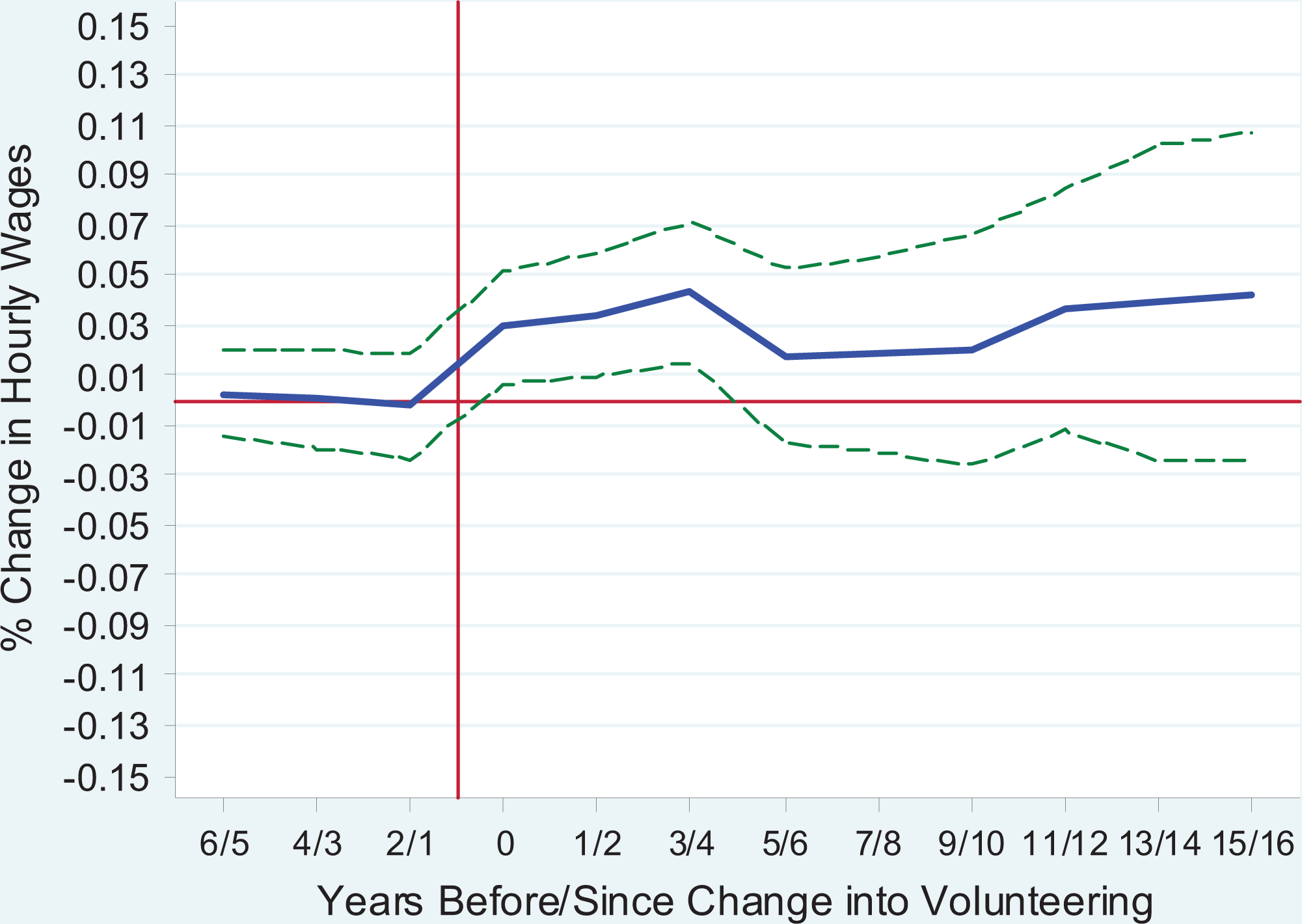
Effect of volunteering on ln (wages) for changers.
Hypothesis 2 closely examines job changes and focuses on the role of social capital in explaining the wage effect. We apply the plausibility check proposed by Mouw (2003) and analyse whether volunteering not only increases wages but also increases the probability of a person finding a job through personal contacts, that is, members of his/her social network. By definition, this analysis focuses only on those who changed their job during the observation period, similar to the sample of job changers used for hypothesis 1b. The main difference is that we only have one observation per job because, in contrast to wages, the job-finding method is constant for all the years in the same job. Table 3 presents the results from a fixed effects logistic regression for three of our four indicators of volunteering. 7 We find a statistically significant increase in the probability of finding a job through personal contacts if individuals volunteer. For volunteering intensity, we also find positive coefficients, even if only the coefficient of rarely volunteering is statistically significant. The coefficient for volunteering experience is statistically insignificant, indicating no additional advantages of the duration of volunteering for mobilizing the social capital. This result leads us to conclude that the data support the assumption that social capital accumulation through volunteering is one of the mechanisms leading to wage gains. 8 However, due to the lack of data on human capital or signal effects, we cannot draw any conclusions with regard to the other two mechanisms from this result.
Effect of volunteering on job found through social networks.
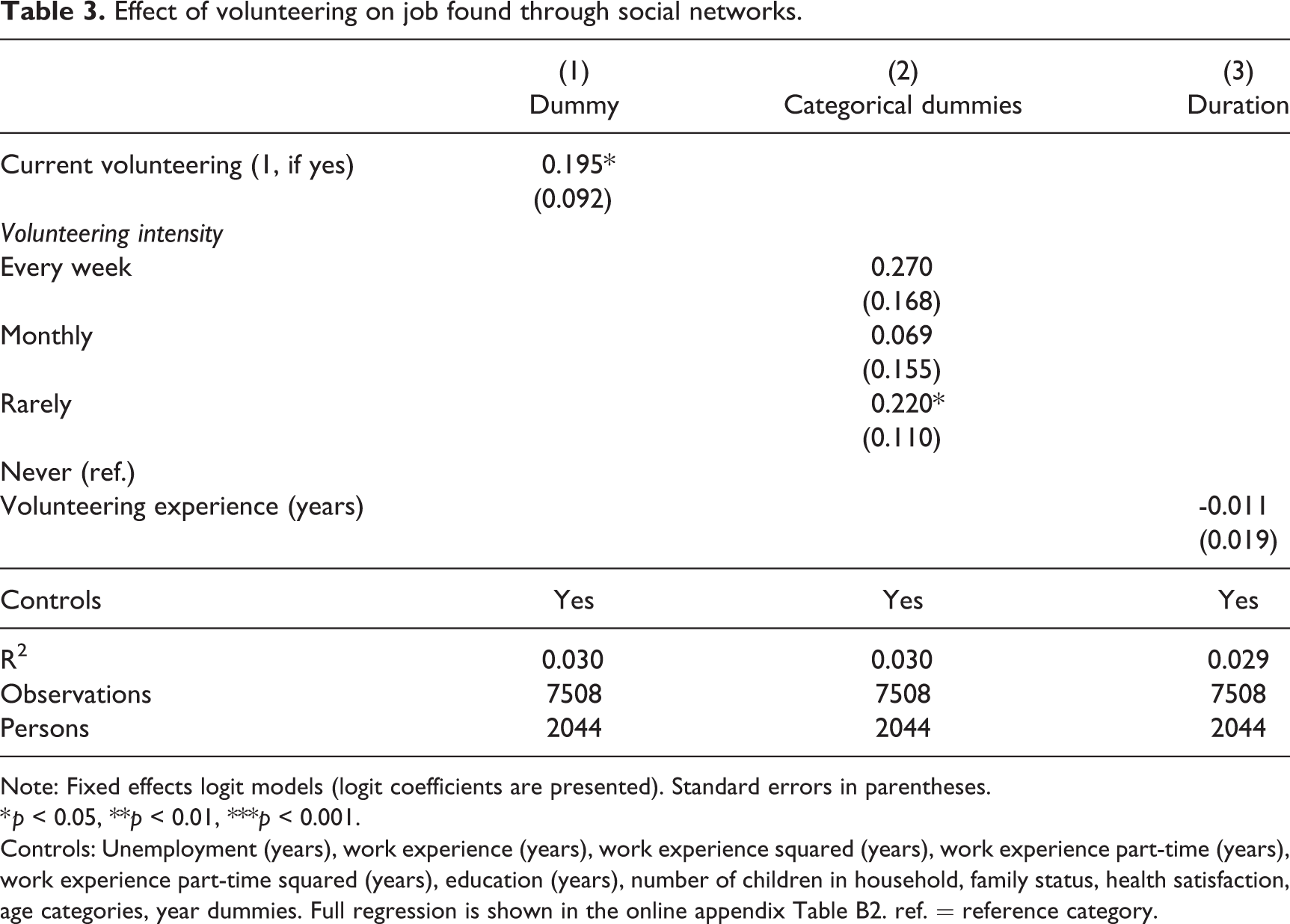
Note: Fixed effects logit models (logit coefficients are presented). Standard errors in parentheses.
* p < 0.05, **p < 0.01, ***p < 0.001.
Controls: Unemployment (years), work experience (years), work experience squared (years), work experience part-time (years), work experience part-time squared (years), education (years), number of children in household, family status, health satisfaction, age categories, year dummies. Full regression is shown in the online appendix Table B2. ref. = reference category.
Discussion and conclusions
Volunteer work is often expected not only to increase the welfare of others but also to benefit the volunteers themselves, for example, in terms of higher wages in paid employment. The scarce empirical evidence with regard to this topic is not only mixed, ranging from null or negative effects to positive wage gains, but also limited by the omission of the timing of volunteering as a potential key determinant of wage gains, a disregard for the distinction between on-the-job wage development and wage development following job changes, and the potential for unobserved heterogeneity and reverse causality bias.
In this article, we aimed to fill these gaps in empirical research and, thus, provide a broader picture with regard to if, how and when volunteering has an impact on wages. The first novel result of our analysis is that wage gains through volunteering are concentrated among those volunteers who experience a job change. This result is important because it indicates that volunteering alone is not a means of increasing wages, which occurs only in connection with entering a new job. The reason for this relationship is that in the case of job changes, those individuals who volunteer seem to be able to enter better-paying jobs than nonvolunteers. The second key result of our analysis is that not all individuals who volunteer can increase their wages during job changes. Wage benefits are obtained mainly by those who volunteer monthly or less, whereas those who volunteer weekly do not fare better in terms of wages than nonvolunteers. Unfortunately, the reason for this higher effect of a lower intensity of volunteering cannot be inferred from our data. Third, again, only in the context of job change, we found that wage benefits do not depend on the duration of time that individuals volunteer. Instead, wage effects through volunteering are typically obtained even shortly after individuals start volunteering and seem rather independent of the timing of volunteering. Again, from our data, we cannot infer why this is the case. From a methodological perspective, we are confident that our results reflect causal relationships instead of mere associations because we accounted for unobserved time-constant confounding variables, and we find no indication that reciprocal causation explains the relationship between volunteering and wages.
The fourth key result refers to the social mechanism underlying the observed wage effects, which is of importance and might be able to shed some light on both the ineffectiveness of high-intensity volunteering and the independence of wage gains from volunteering duration. After we studied those who reaped monetary benefits from volunteering, that is, the job changers, more closely, we found that those who volunteered at a time immediately before their job change were more likely to have found the new job through personal contacts from their social network. This finding suggests that social capital is an important driving force underlying the wage gains from volunteering. Even if we could not test the other two mechanisms discussed in the literature, that is, signalling and human capital, our results at least suggest that human capital plays only a minor role in increasing volunteers’ wages. To acquire skills through volunteering or otherwise could take time and, thus, we could expect long-term volunteers to be more likely to experience wage gains, which is not the case according to our data. In addition, the human capital gained from volunteering should be as likely to increase wages on the job as through job changes, but we only find wage effects for the latter. In contrast, whereas social capital from co-workers might be helpful for experiencing wage gains on the job, fellow volunteers are most likely not co-workers and, therefore, more likely to be helpful if individuals want or have to change jobs. Furthermore, job search support from other volunteers should be available soon after individuals started volunteering and bonded with others over the shared experience. Therefore, the benefits of volunteering should be independent of the timing of volunteering, which is consistent with the results of our analysis.
Although human capital most likely plays a rather minor role in creating wage benefits for volunteers, our results are less informative with regard to signalling effects. Volunteering might be a positive signal indicating positive characteristics, such as trustworthiness, to potential employers. Similar to social capital, volunteering as a signal is more likely to be useful during job changes because current employers can draw from their own experience with the employee instead of having to rely on volunteering as a signal. In addition, the signal should not depend on the duration or timing of volunteering, again similar to social capital. Thus, we interpret our results to support the social capital mechanism of volunteering, oppose the relevance of human capital in this context and provide no information with regard to the signalling mechanism of volunteering.
From a methodical perspective, this article addresses the issue of reverse causality. We find no indication that reverse causality drives our results. However, it is also possible that reverse causation is ‘hidden’ between waves. For example, because volunteering is often surveyed only every other year, it is possible that an individual’s wages increase in one panel wave, followed by the start of volunteering in the next wave. Therefore, it is still possible that our estimation strategy cannot fully control for this type of bias.
In conclusion, our analysis supports the assumption that volunteers are not only doing good by volunteering, but are also doing well in terms of wages. During the job search, we identified the mobilization of social capital as an important driving force behind the monetary benefits of volunteering. In this context, further research should focus in more depth on the social resources volunteers are mobilizing via their personal contacts. Such resources include information concerning the existence of vacancies in specific organizations or information with regard to job requirements, organizational culture, etc., which make an application more likely to succeed. They could also actively influence the decision-making process of the employee-seeking organization, for example, through recommendations. Such research should preferably be based on longitudinal data and include measures of social and human capital through volunteering; such research should also identify the means by which to distinguish human and social capital from signalling effects. We are unaware of the existence of such data.
Supplementary material
Supplemental_material - When and how does volunteering influence wages? – Evidence from panel data
Supplemental_material for When and how does volunteering influence wages? – Evidence from panel data by Andreas Eberl and Gerhard Krug in Acta Sociologica
Footnotes
Acknowledgements
We would like to thank Sebastian Bähr, Matthias Collischon, Kerstin Jahn, Johannes Ludsteck, Malte Reichelt, Stefan Schwarz and Mark Trappmann for their valuable and helpful comments.
Funding
The author(s) disclosed receipt of the following financial support for the research, authorship, and/or publication of this article: Andreas Eberl gratefully acknowledges financial support from the graduate programme of the IAB and the University of Erlangen-Nuremberg (GradAB).

Supplementary material
Supplementary material for this article is available online.
Notes
Appendix
Descriptives.
| Variable | Mean | SD | Min | Max | Observations | |
|---|---|---|---|---|---|---|
| ln (hourly wage) | overall | 2.49 | 0.55 | -0.44 | 5.64 | N = 100,401 |
| between | 0.58 | n = 18,131 | ||||
| within | 0.26 | |||||
| Volunteering (0/1) | overall | 0.14 | 0.35 | 0 | 1 | N = 100,401 |
| between | 0.24 | n = 18,131 | ||||
| within | 0.25 | |||||
| Volunteering intensity | ||||||
| Weekly (0/1) | overall | 0.03 | 0.17 | 0 | 1 | N = 100,401 |
| between | 0.11 | n = 18,131 | ||||
| within | 0.13 | |||||
| Monthly (0/1) | overall | 0.04 | 0.19 | 0 | 1 | N = 100,401 |
| between | 0.12 | n = 18,131 | ||||
| within | 0.15 | |||||
| Rarely (0/1) | overall | 0.08 | 0.27 | 0 | 1 | N = 100,401 |
| between | 0.16 | n = 18,131 | ||||
| within | 0.22 | |||||
| Never (0/1) | overall | 0.86 | 0.35 | 0 | 1 | N = 100,401 |
| between | 0.24 | n = 18,131 | ||||
| within | 0.25 | |||||
| Volunteering experience | overall | 1.18 | 2.8 | 0 | 29 | N = 100,401 |
| between | 1.59 | n = 18,131 | ||||
| within | 1.6 | |||||
| Unemployed (years) | overall | 0.52 | 1.41 | 0 | 26.1 | N = 100,401 |
| between | 1.71 | n = 18,131 | ||||
| within | 0.45 | |||||
| Work experience | overall | 16.2 | 10.68 | 0 | 45.8 | N = 100,401 |
| between | 11.13 | n = 18,131 | ||||
| within | 3.74 | |||||
| Work experience part-time | overall | 2.63 | 5.27 | 0 | 45.2 | N = 100,401 |
| between | 5.09 | n = 18,131 | ||||
| within | 1.74 | |||||
| Job autonomy | overall | 2.57 | 1.05 | 1 | 5 | N = 100,401 |
| between | 1.02 | n = 18,131 | ||||
| within | 0.41 | |||||
| ISCO 2 digits | overall | 50.02 | 23.92 | 1 | 99 | N = 100,401 |
| between | 23.37 | n = 18,131 | ||||
| within | 9.33 | |||||
| ISEI | overall | 43.66 | 15.66 | 16 | 90 | N = 100,401 |
| between | 15.45 | n = 18,131 | ||||
| within | 5.85 | |||||
| Full-time employed | overall | 0.76 | 0.42 | 0 | 1 | N = 100,401 |
| between | 0.41 | n = 18,131 | ||||
| within | 0.21 | |||||
| Part-time employed | overall | 0.20 | 0.4 | 0 | 1 | N = 100,401 |
| between | 0.38 | n = 18,131 | ||||
| within | 0.21 | |||||
| Other | overall | 0.04 | 0.18 | 0 | 1 | N = 100,401 |
| between | 0.2 | n = 18,131 | ||||
| within | 0.12 | |||||
| Years of education | overall | 12.08 | 2.54 | 7 | 18 | N = 100,401 |
| between | 2.61 | n = 18,131 | ||||
| within | 0.4 | |||||
| Number of children in household | overall | 0.72 | 0.96 | 0 | 10 | N = 100,401 |
| between | 0.96 | n = 18,131 | ||||
| within | 0.52 | |||||
| Married living together | overall | 0.67 | 0.47 | 0 | 1 | N = 100,401 |
| between | 0.46 | n = 18,131 | ||||
| within | 0.22 | |||||
| Married living apart | overall | 0.02 | 0.15 | 0 | 1 | N = 100,401 |
| between | 0.13 | n = 18,131 | ||||
| within | 0.11 | |||||
| Single | overall | 0.20 | 0.4 | 0 | 1 | N = 100,401 |
| between | 0.4 | n = 18,131 | ||||
| within | 0.16 | |||||
| Divorced | overall | 0.09 | 0.28 | 0 | 1 | N = 100,401 |
| between | 0.27 | n = 18,131 | ||||
| within | 0.14 | |||||
| Widowed | overall | 0.02 | 0.13 | 0 | 1 | N = 100,401 |
| between | 0.12 | n = 18,131 | ||||
| within | 0.06 | |||||
| Health satisfaction | overall | 6.95 | 2.01 | 0 | 10 | N = 100,401 |
| between | 1.78 | n = 18,131 | ||||
| within | 1.34 | |||||
| Age | overall | 41.79 | 9.9 | 17 | 60 | N = 100,401 |
| between | 10.29 | n = 18,131 | ||||
| within | 4.58 |
ISCO: International Standard Classification of Occupations; ISEI: International Socio-Economic Index of Occupational Status.
References
Supplementary Material
Please find the following supplemental material available below.
For Open Access articles published under a Creative Commons License, all supplemental material carries the same license as the article it is associated with.
For non-Open Access articles published, all supplemental material carries a non-exclusive license, and permission requests for re-use of supplemental material or any part of supplemental material shall be sent directly to the copyright owner as specified in the copyright notice associated with the article.
