



Abstract
Socioeconomic inequality and conflicts regarding distributional issues have resurfaced in many OECD countries over the past three decades. Whereas most research has focused on the objective determinants of perceived social conflicts, we contribute a new facet to this discussion by assessing the relevance of collective stratification beliefs as an independent driver of vertical conflict perceptions. After formulating theoretical positions that give precedence to two factors in explaining the perceptions of social conflicts – objective inequality and the collective stratification belief – we use individual-level data from the 2009 International Social Survey Programme, along with suitable country-level indicators to evaluate both hypotheses. Amid the diverse collective stratification beliefs, we focus on the role of an egalitarian (middle-) class imagery. We are particularly interested in the extent to which such a class imagery can mediate the relationship between socioeconomic inequality and individual conflict perceptions. The results of our multilevel analyses of 27 OECD countries indicate that an egalitarian (middle-) class imagery held by a certain share of a country’s population constitutes a distinct dimension of reality and clearly dominates country-level objective inequality in the explanation of individually perceived social conflicts.
Keywords
Introduction
Over the past three decades, many member countries of the Organisation for Economic Co-operation and Development (OECD) have experienced an increase in objective inequalities, particularly due to economic globalization, tax cuts, and welfare state retrenchment (Alderson et al., 2005; Brady, 2009; DiPrete, 2005; Fischer, 2003; Milanović, 2016). At the same time, conflicts have re-erupted around distributional issues (Giddens, 1973; Kerbo, 2012). Since Iceland’s “Pots and Pans Revolution” in the aftermath of the 2008 financial crisis, the number of conflicts over inequalities has risen substantially (Bernburg, 2016). Occupants of Tahrir Square, Occupy Wall Street activists, and the Spanish indignados, among others, have taken to the streets to protest alleged corruption, a lack of freedom, and rampant inequality (Castañeda, 2012; Milkman et al., 2013; Taibo, 2013). Renewed social critique (Boltanski and Chiapello, 2005) contrasting the wealthy 1% with the remaining 99% has coincided with the recent increase in economic inequalities, which peaked in the wake of the Great Recession (Jenkins et al., 2012; Piketty, 2014). With rising inequalities, the middle classes in many Western countries have become increasingly concerned about social decline (Ehrenreich, 1989; Grabka and Frick, 2008; Littrell et al., 2010; Newman, 1988; Pressman, 2007; Steijn et al., 1998). 1
In light of contemporary social protests, we aim to address vertical conflicts around resources, power, and socioeconomic position. Tensions typically arise between people at the top and bottom of society (Kerbo, 2012)—more specifically, between those who give orders and those who receive them (Collins, 1975: 63; Savage et al., 2014). These frictions lead to vertical conflicts in the labor market—for example, between capital and labor or between employers and employees—and within structures of domination and subordination independent of the ownership or control of the means of production (Dahrendorf, 1959, 2008; Goldthorpe, 2007; Korpi, 1983). Perceived social conflicts (PSC) signal the extent to which individuals experience their environments as characterized by such antagonistic relations.
Many researchers contend that conflict perceptions are mainly affected by objective inequalities, while others argue that they are primarily impacted by political attitudes and ideological convictions (Kelley and Evans, 1995; Kluegel and Smith, 1986; Verba and Orren, 1985). Similarly, recent findings from Iceland suggest that egalitarian stratification beliefs in particular can fuel social conflicts if inequality is rising (Oddsson, 2010, 2016). Hence, in terms of conflict perceptions, a country’s objective stratification order might be less influential than people’s stratification beliefs (Niehues, 2014; Oddsson, 2016). Such collective beliefs about the social space represent a shared “class imagery,” that is, a specific conception of the shape and degree of vertical differentiation in a society (Evans and Kelley, 2017; Oddsson, 2018). Against the backdrop of the “middle-class century” (Therborn, 2012), we are specifically interested in whether a prevalent (egalitarian) middle-class imagery can quell individual conflict perceptions, independently of factual socioeconomic inequalities.
The simultaneous rise in economic inequalities and social protests has motivated our study of prevalent egalitarian stratification beliefs as mediators between socioeconomic inequalities and conflict perceptions. Examining the drivers of individual conflict perceptions has gained importance in the study of societal integration, especially in light of many anti-liberal movements’ recent success (Eribon, 2013; Hochschild, 2016). Whereas previous research has focused on the prevalence of various class imageries or their interrelation with individual social positions and objective inequalities (Evans and Kelley, 2017; Oddsson, 2018; Sachweh and Olafsdottir, 2012), we investigate the role of a prevalent egalitarian class imagery in the perception of social conflicts. In doing so, we aim to determine whether collective stratification beliefs and socioeconomic conditions independently affect conflict perceptions.
To understand what impacts conflict perceptions, we consider their relationship to: (a) various country-specific objective measures of socioeconomic development and inequality; and (b) one focal subjective factor at the country-level: a collective class imagery depicting a low-inequality (i.e. middle-class) society. To assess the relative importance of objective and subjective factors, we employ multilevel regressions that simultaneously account for various individual-level and country-level characteristics with potential impact on conflict perceptions. Empirically, we draw on individual-level data from the 2009 International Social Survey Programme (ISSP-2009) for 27 OECD member countries, as well as on suitable country-level determinants.
Theoretical and analytical framework
Inequality and perceived social conflicts
In this section, we formulate hypotheses on the relationship between social stratification and individual conflict perceptions. We present two contrasting positions regarding this relationship: according to the first (objectivist) position, factual socioeconomic inequalities propel conflict perceptions. According to the second (subjectivist) position, these perceptions depend foremost on stratification beliefs.
The objectivist position is rooted in classic historical materialism, which posits a direct relationship between objective class position and conflict perceptions. Marx assumed that class antagonism between industrialists and wage laborers would fuel vertical social conflicts because of the exploitation-driven capitalist mode of production (Wright, 1997). Other class analysts have more recently proposed that class formation and (potential) collective actions are not limited to groups defined solely by the ownership of the means of production. Instead, rent-seeking generally produces social conflicts—for example, by motivating occupational associations and unions to lobby exclusively on behalf of their members (Sørensen, 2000; Weeden and Grusky, 2005). Rents produce economic inequality, which, in turn, motivates individuals to unite around a shared perceived conflict, thus triggering collective action. Because rent creation depends on available social, cultural, and economic resources, the specific labor market position informs individual conflict perceptions.
Aggregate inequality, we would further argue, also affects conflict perceptions, as it fosters awareness of the reproduction of privileges and advantages. This process of referencing inequality represents part of the legitimacy struggles around the naturalization of inequality and social recognition (Bourdieu, 1984; Devine and Savage, 1999). Individuals perceive their societies as highly conflictual only if they experience inequality as illegitimate (Thompson, 1980). In times of mass media and global interconnectivity, inequality’s legitimacy is profoundly relative: High levels of socioeconomic inequality may fuel conflict perceptions against the backdrop of equality expectations and living standards elsewhere (Fraser and Honneth, 2003). This relationship may particularly hold for middle-class societies, where inequality easily ignites protest if hopes of social mobility are increasingly dashed while top earners’ incomes continue to grow (Chetty et al., 2017).
Empirical evidence supports conflict perceptions’ link to individual social positions via rent-seeking, as well as to aggregated inequality via legitimacy struggles. Studying class position and identification in such diverse cases as those of the US and Sweden, Wright (1989) found that class consciousness and conflict perceptions were similarly connected to individual class position: lower-class members tended to be in favor of conflictual, pro-working class policies, whereas higher-class members preferred less conflictual redistributive compromises (Corneo and Grüner, 2000; Schöneck and Mau, 2015). Additionally, comparative studies have found that the relationship between objective class position and class identification is stronger when incomes are distributed less equally (Andersen and Curtis, 2012), and PSC levels between classes are higher when material inequality is high (Edlund and Lindh, 2015).
By contrast, Kelley and Evans (1995) developed a more subjectivist argument and disputed the unmediated link between objective inequalities and PSC. 2 While acknowledging the effect of objective inequalities on conflict perceptions in general, they argued in favor of a blended approach, namely one in which subjective perceptions of objective inequality mediate the latter’s effect on conflict perceptions. Based on socio-psychological studies on framing’s importance in decision-making (Kahneman et al., 1982; Tversky and Kahneman, 1989), Kelly and Evans (1995) suggested that the relationship between inequality and conflict perceptions is muted by everyday experiences within reference groups, such as one’s core family and friends. Individuals rarely experience vertical social conflicts in daily interactions, because conflictual behavior is generally considered to be inappropriate and conflictual cross-class interactions do not endure (Kelley and Evans, 1995: 160). Findings further indicated that individuals have a tendency to self-identify as middle class and to perceive stratification orders against the backdrop of their own positions, thus overstating the middle class’s quantitative importance (Evans and Kelley, 2017). Hence, socio-psychological traits limit the awareness of inequality inasmuch as social norms constrain conflictual relationships, making it less likely for socioeconomic inequality to translate into individual conflict perceptions.
To distinguish this approach from the objectivist position, we label it “subjectivist.” This qualifier emphasizes the fact that subjective perceptions of inequality are a necessary (although insufficient) condition for socioeconomic inequalities to affect social conflict perceptions. Because individuals tend to generalize based on their personal experiences regardless of overall inequalities, we hypothesize that the latter do not necessarily affect PSC levels.
There is a third approach against which the objectivist and subjectivist positions can be assessed. Assuming the end of class hierarchies, some researchers claim that individuals no longer view social conflicts as vertical because rising standards of living in the mid-20th century destroyed classes’ material and cultural foundations (Beck, 1992; Clark and Lipset, 1991; Kingston, 2000). Social conflicts, they argue, now revolve around horizontal, non-class-based cleavages (e.g. women versus men, older versus younger people, parents versus childless couples, or natives versus foreigners). From this perspective, no relationship exists among individuals’ social position, socioeconomic inequalities, collective stratification beliefs, and conflict perceptions. We term this null hypothesis the “death-of-class” (DoC) position.
Collective stratification beliefs
All current societies are more or less vertically stratified, which should be mirrored in people’s beliefs about stratification in their countries (Hout, 2008). Several distinct types of stratification are plausible. Societies range from those with highly unequal distributions of income, wealth, and life opportunities to those that are largely egalitarian. Evans et al. (1992) visualized five possible class imageries. In Figure 1, we present their typology.
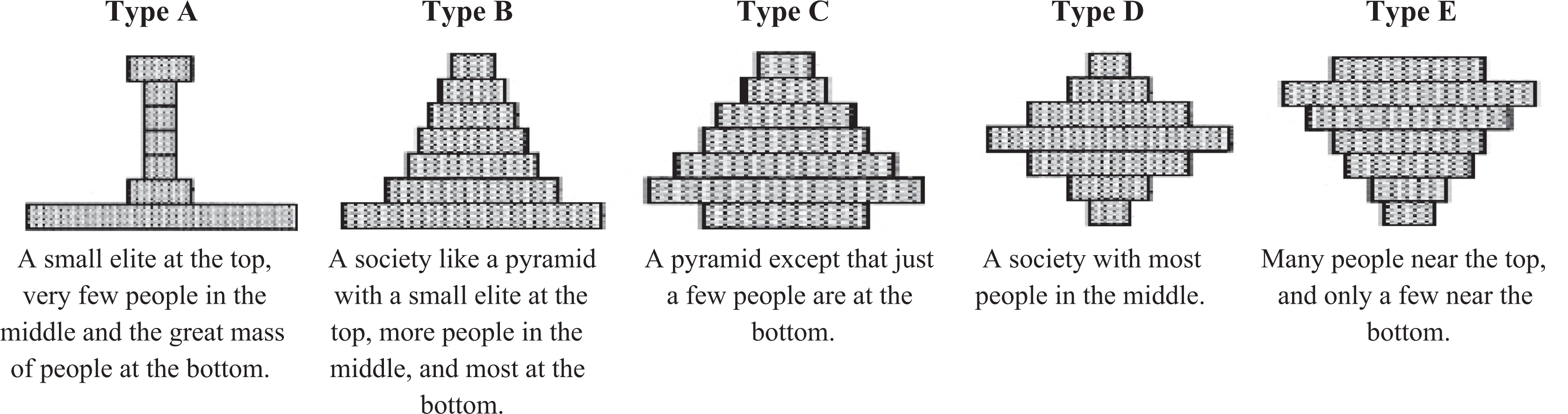
Types of stratification. Source: The authors’ own drawing based on the ISSP-2009 questionnaire.
In these five pictograms, the center of social gravity gradually moves upward from Type A (representing an elite-mass hierarchy) to Type E (placing primary emphasis on the upper class). Types A and B are obviously more unequal compared with Types C, D, and E, which have more people in the middle strata. Type D represents a middle-class imagery: a largely egalitarian, diamond-shaped stratification type, with the majority of people in the middle and relatively few people at the top and bottom (Evans and Kelley, 2017).
To study the impact of collective stratification beliefs and objective inequalities on PSC levels, we employ Type D in our empirical analyses as a gauge for egalitarian collective vertical stratification beliefs in a given society. Middle-class societies are generally considered to be desirable (for a concise overview see Littrell et al., 2010). In concrete terms, they stand for a variety of societal benefits, such as economic development and prosperity (Amoranto et al., 2010; Easterly, 2001; Ravallion, 2010), political stability (Acemoğlu and Robinson, 2006; Barro, 1999; Birdsall, 2015), and social cohesion (Larsen, 2013). They are well-balanced societies that enable the majority of their citizens to have good lives (Wilkinson and Pickett, 2009).
Subjective beliefs about social stratification, however, may be detached from objective stratification realities (Niehues, 2014; for people’s perceptions as a distinct dimension of reality, see Glatzer, 2008, 2012), and middle-class societies account for more than class imageries. Hence, we define a middle-class society in terms of three objective dimensions: a relatively high level of socioeconomic development (socioeconomic level); comparatively low economic inequality levels (socioeconomic dispersion); and a large share of middle-income households (middle-classness). In the following sub-section, we detail the relationships among individual objective social position, socioeconomic inequality, collective stratification beliefs, and PSC levels.
Hypotheses
The vast majority of cross-national studies on PSC focus on objective country-level determinants. In contrast to the idea that objective conditions may influence conflict perceptions, our study tests whether an egalitarian class imagery mediates the impact of objective determinants on PSC levels (i.e. the subjectivist perspective). Thus, we consider people’s shared class imagery to be a distinct dimension of reality.
Following the DoC position, our null hypothesis is as follows: no relationship exists among individual social position, socioeconomic inequality within a country, a collective middle-class imagery, and PSC levels (H0). In contrast, both the objectivist and subjectivist views assume that there is a relationship between individual social position and PSC levels. However, they differ regarding the extent to which the prevalence of a middle-class imagery mediates the effects of socioeconomic inequality within a country.
Concerning the objectivist perspective, we hypothesize the following: the more a country objectively resembles a middle-class society, the lower the PSC levels, independently of the prevalence of a middle-class imagery (H1). In line with the objective dimensions of middle-class societies previously outlined, we divide H1 into three empirically testable sub-hypotheses: H1a: Larger country-specific shares of middle-income households correlate with lower PSC levels, independently of the prevalence of a middle-class imagery. H1b: Higher country-specific socioeconomic levels—as measured by gross domestic product (GDP) per capita and the United Nations’ Human Development Index (HDI)—correlate with lower PSC levels, independently of the prevalence of a middle-class imagery. H1c: Lower country-specific socioeconomic dispersions—as measured by the Gini coefficients for income and wealth—correlate with lower PSC levels, independently of the prevalence of a middle-class imagery.
Finally, we hypothesize the following from the subjectivist perspective: the more prevalent a middle-class imagery within a country, the lower the PSC levels (H2). We also divide H2 into three empirically testable sub-hypotheses: H2a: The more prevalent a middle-class imagery within a country, the lower the PSC levels, independently of country-specific shares of middle-income households. H2b: The more prevalent a middle-class imagery within a country, the lower the PSC levels, independently of country-specific socioeconomic levels. H2c: The more prevalent a middle-class imagery within a country, the lower the PSC levels, independently of country-specific socioeconomic dispersions.
Empirical setup
Data
We employed individual-level data from the ISSP-2009 in our empirical analyses. 3 Because we sought to study social conflict perceptions in the realm of labor relations, we limited our analyses to respondents aged 18 to 65 who worked at least 30 hours per week. 4 We also focused on OECD countries, primarily for reasons of country-level data availability but also to ensure a sample of comparatively advanced modern societies. 5 After performing these steps, as well as a listwise exclusion of missing individual-level data, we obtained a sample of 10,643 cases from 27 countries (Table A1 in the Online Supplement). 6
Our dependent variable was the level of individual PSC, measured through a combination of four items (variables V40 to V43) from the ISSP-2009 “social inequality” module: respondents were asked to rate the extent of conflicts between (a) “poor people and rich people”, (b) “the working and the middle class”, (c) “management and workers”, and (d) “people at the top of society and people at the bottom.” Respondents characterized conflicts as (1) “very strong,” (2) “strong,” (3) “not very strong,” or reported (4) “there are no conflicts.” After recoding to a value range from 0 (“no conflicts”) to 3 (“very strong conflicts”), we added responses on each of the four items to create a continuous additive scale from 0 to 12. 7 The higher the values obtained, the higher the PSC levels.
To test our hypotheses, we introduced several independent variables. At the country-level (which was our main area of interest), we employed six macro indicators related to the three dimensions mentioned in the sub-section “Collective stratification beliefs” (Table A1 in the Online Supplement provides an overview of our contextual data). As we were particularly interested in an egalitarian class imagery’s mediating effect on the relationship between objective inequality and PSC levels, we employed a straightforward measure of collective middle-class imagery, namely (1) the country-specific share of respondents with a (type D) middle-class imagery, calculated on the basis of the ISSP-2009 (variable V54). We contrasted this aggregated subjective macro indicator (labeled “aggregated belief D”) with an objective measure of middle-classness, namely (2) the country-specific share of middle-income households, which contemplated households whose net income fell between 75% and 125% of the median income (Milanović, 2005; Pressman, 2007). This objective macro indicator was also calculated on the basis of the ISSP-2009. We equivalized household net income by dividing it by the square root of household size (Förster and d’Ercole, 2012: 7–8).
Next, we provided two objective measures of countries’ socioeconomic levels. The first was (3) GDP per capita, which measures economic prosperity. Values for this macro indicator stemmed from Penn World Table 8.1 (real GDP at constant 2005 national prices; data from 2009; see Feenstra et al., 2015). The second was (4) the United Nations’ Human Development Index (HDI), which reflects the stage of socioeconomic development by assessing health, education, and living standards (data from 2009).
Eventually, we explored the influence of two objective measures of socioeconomic dispersion. The first was (5) the Gini coefficient for income, which reflects a country’s overall income inequality. Values for this macro indicator came from the Luxembourg Income Study Database and the CIA World Factbook (Central Intelligence Agency 2016) (data from various years, as close to 2009 as possible). The second was (6) the Gini coefficient for wealth, which measures a country’s wealth inequality. Values for this macro indicator were obtained from the United Nations University World Institute for Development Economics Research, an institute of the United Nations University (data from 2000). 8
In all models, we used four individual-level predictors for PSC levels: (1) gender; (2) age (in years) 9 ; (3) socioeconomic status (SES) as a composite index of education, labor market position, and equivalized household net income (low, middle, and high) 10 ; and (4) self-placement in a social hierarchy. We used a 10-point scale, with higher values indicating higher subjective statuses (Table A2 in the Online Supplement provides a descriptive overview of these control variables).
Method
Although the existing literature offers some insight into the impact of individual positions and socioeconomic conditions on PSC levels, we know little about a collective class imagery’s mediating influence on this relationship. Our method allowed us to model the individual-level attributes associated with variations in PSC levels while simultaneously establishing the country-level effects that constitute our primary interest: differences in socioeconomic inequality; and prevalence of a middle-class imagery. 11 We employed linear multilevel regressions, as they are well-suited for the analysis of clustered data such as those gathered from respondents in various countries (Hox, 2010; Snijders and Bosker, 2012). We estimated all multilevel models using MLwiN (version 3.02) and deploying the restricted iterative generalized least-squares method.
Empirical findings
Descriptive findings
Figure 2 displays the conflict scale’s country-specific means and composition based on the four conflict items discussed above. Across all countries, the scale’s average value was 5.62 (standard deviation = 2.64). PSC levels differed noticeably across countries, with 18 countries scoring lower than average on the conflict scale, in particular, Denmark (3.57) and Iceland (4.01). Nine countries had above-average PSC values, particularly South Korea (8.52) and Hungary (8.67). Furthermore, PSC levels in the face of conflicts between (amorphous) large groups, that is, between poor and rich people (V40) or between people at the top and bottom of society (V43) were generally higher compared with PSC levels regarding specific conflicts, such as tensions between the working and middle classes (V41) or between managers and workers (V42).
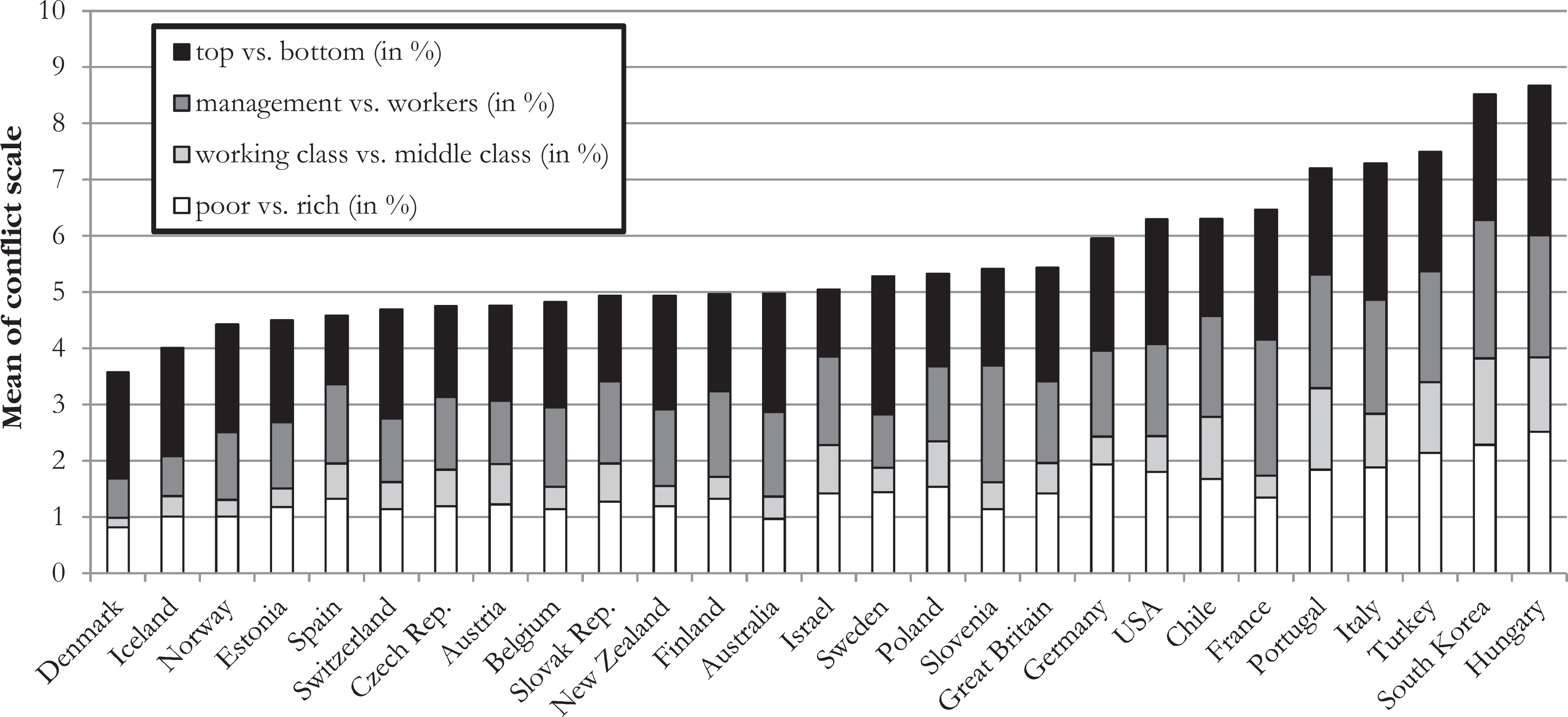
Country-specific means and composition of an additive scale for measuring perceptions of social conflicts. Note: scale range is between 0 and 12, with lower values indicating less perceived social conflict. The horizontal line indicates the overall mean of the conflict scale. The columns are compartmentalized according to the shares of respondents who answered that the conflicts were “very strong” or “strong” for each of the four conflict items. All country-specific means are calculated using weights. Source: ISSP-2009; n i = 10,643 (unweighted), nj = 27.
Figure 3 depicts, in descending order, the prevalence of a middle-class imagery across countries (mean: 24.4%). Particularly large shares of the population had a middle-class imagery in Scandinavia (including 64% in Denmark, 42% in Sweden, and 41% in Finland), Switzerland (43%), and Australia (42%). Other countries had remarkably low shares of respondents with an egalitarian class imagery, including Portugal (7%) and some post-communist countries such as Hungary (4%), Slovakia (6%), and Estonia (7%).
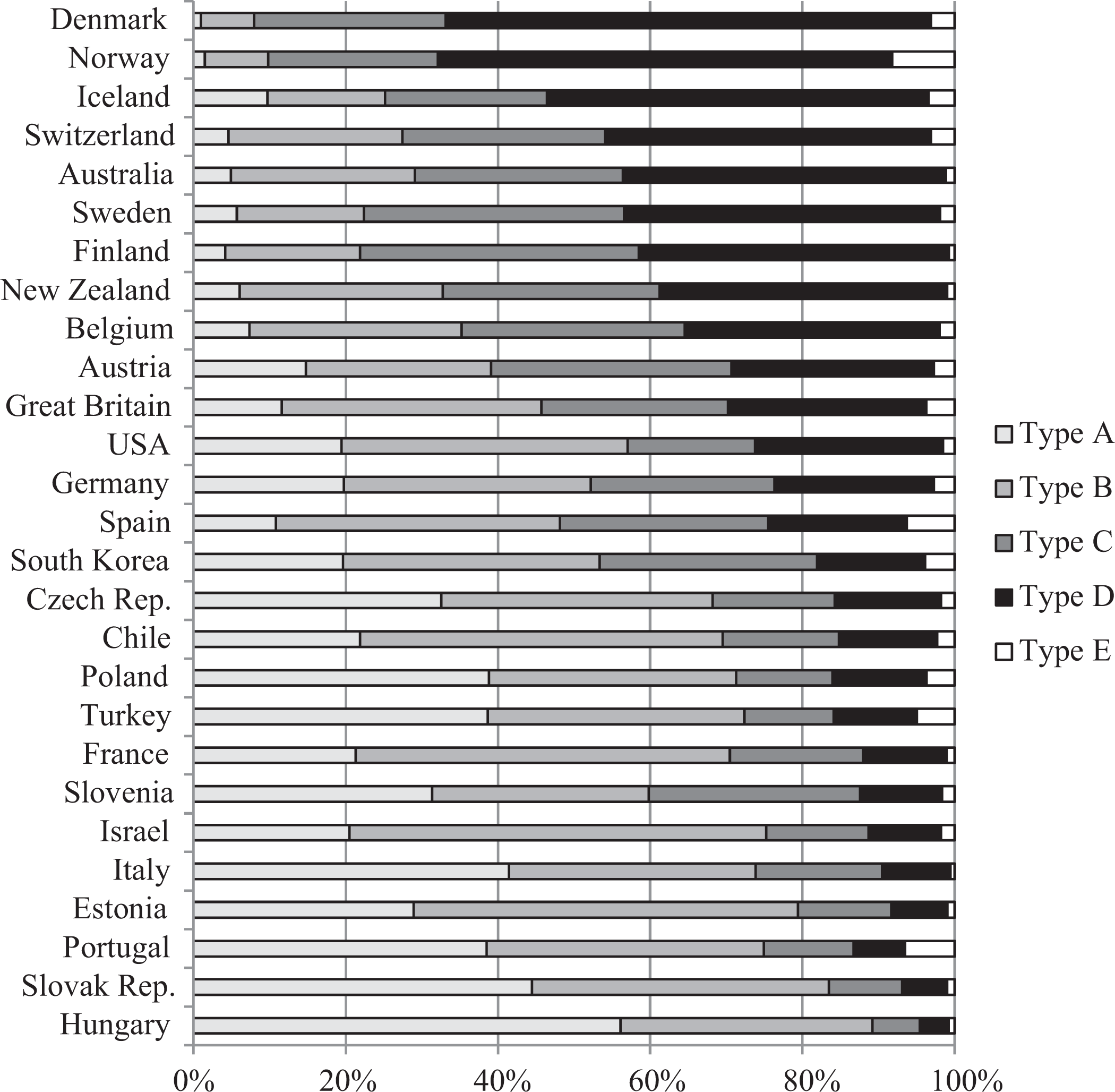
Beliefs about stratification realities. Note: bar graph is ranked in descending order by the share of respondents who believe that they live in a middle-class society (type D). Source: ISSP-2009; ni = 10,643 (unweighted), nj = 27.
Multilevel analysis
As usual in multilevel analysis, we started with an empty model (Table 1; Model 0)—that is, one which lacks explanatory variables—to establish what fraction of the variance in PSC levels could be attributed to country-level differences. We obtained an intraclass correlation coefficient of 0.239, meaning that nearly one-fourth of the variance was attributable to country-level differences (Snijders and Bosker, 2012: 17–18).
Individual-level determinants of perceived social conflict (linear multilevel models).
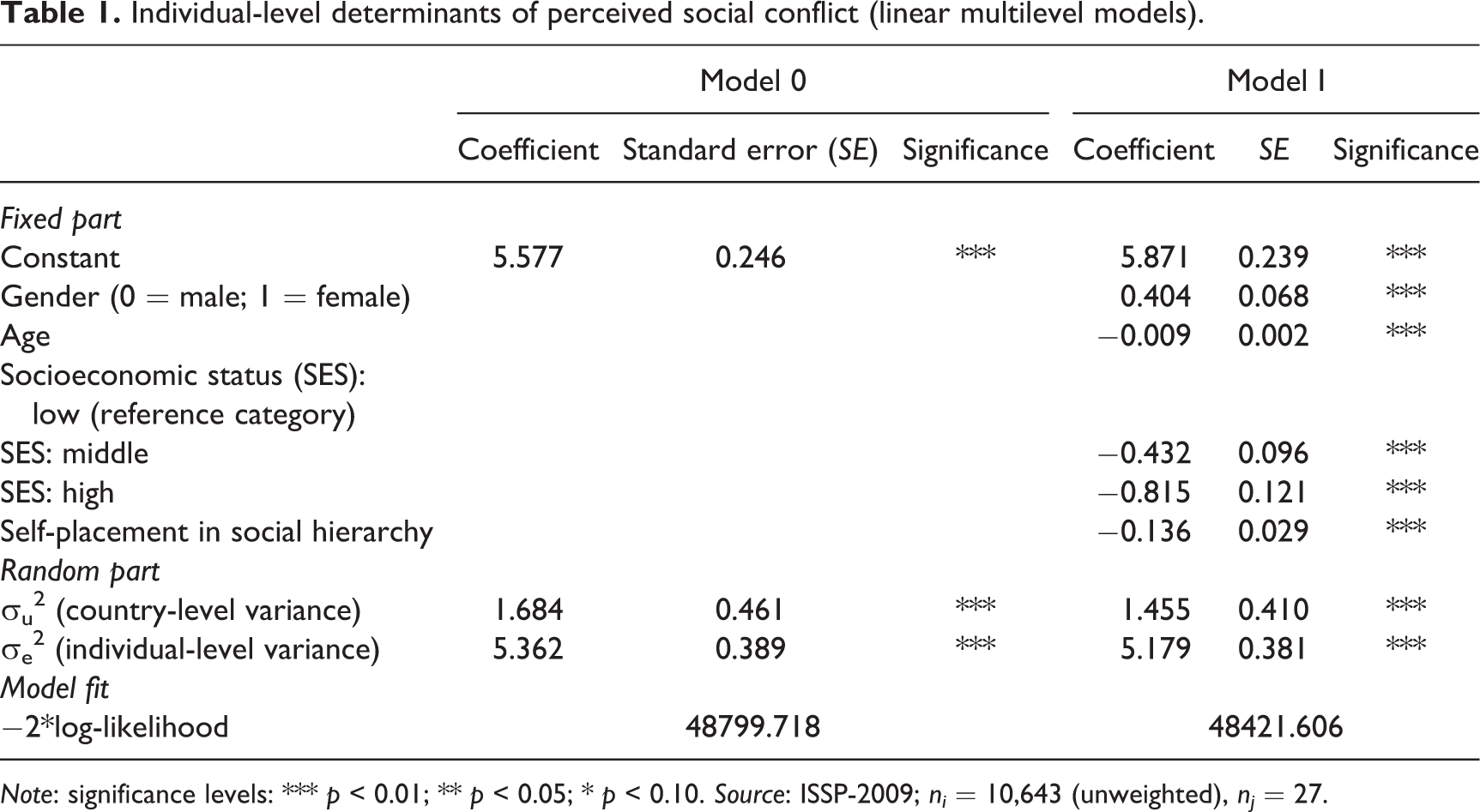
Note: significance levels: *** p < 0.01; ** p < 0.05; * p < 0.10. Source: ISSP-2009; ni = 10,643 (unweighted), nj = 27.
Model I in Table 1 is a random intercepts model in which all individual-level explanatory variables are included as fixed effects. Men, older respondents, respondents with a higher SES, and respondents who believed they ranked higher in their respective countries’ social hierarchy exhibited significantly lower PSC levels, thus corroborating previous research (Edlund and Lindh, 2015; Hadler, 2005; Kelley and Evans, 2000). This link between social positions and PSC levels contradicts the DoC hypothesis, whereby distributional conflicts are independent of SES. Therefore, we rejected the null hypothesis that individual status has no impact on PSC levels. The pseudo-R2 showed that individual characteristics account for 13.6% of cross-national variance in PSC levels (Hox, 2010: 71), leaving the greater part of intercountry variance unexplained. To judge the relative merits of the objectivist and subjectivist approaches, we studied the influence of socioeconomic inequality on PSC levels and a collective middle-class imagery’s mediating effect on this relationship.
When constructing the models presented below, we used an array of contextual information to test our hypotheses by comparing the effects of socioeconomic conditions and a collective middle-class imagery (Table 2). According to our straightforward empirical setup, the main focus was on the latter (“aggregated belief D”). Other country-specific determinants (which are thereby competing factors) were consecutively tested against “aggregated belief D.” This rather basic design was due to the fact that the number of country-specific observations was limited, making it difficult to confidently interpret macro-level effects (Bryan and Jenkins, 2016). 12
Country-level determinants of perceived social conflict (linear multilevel models).
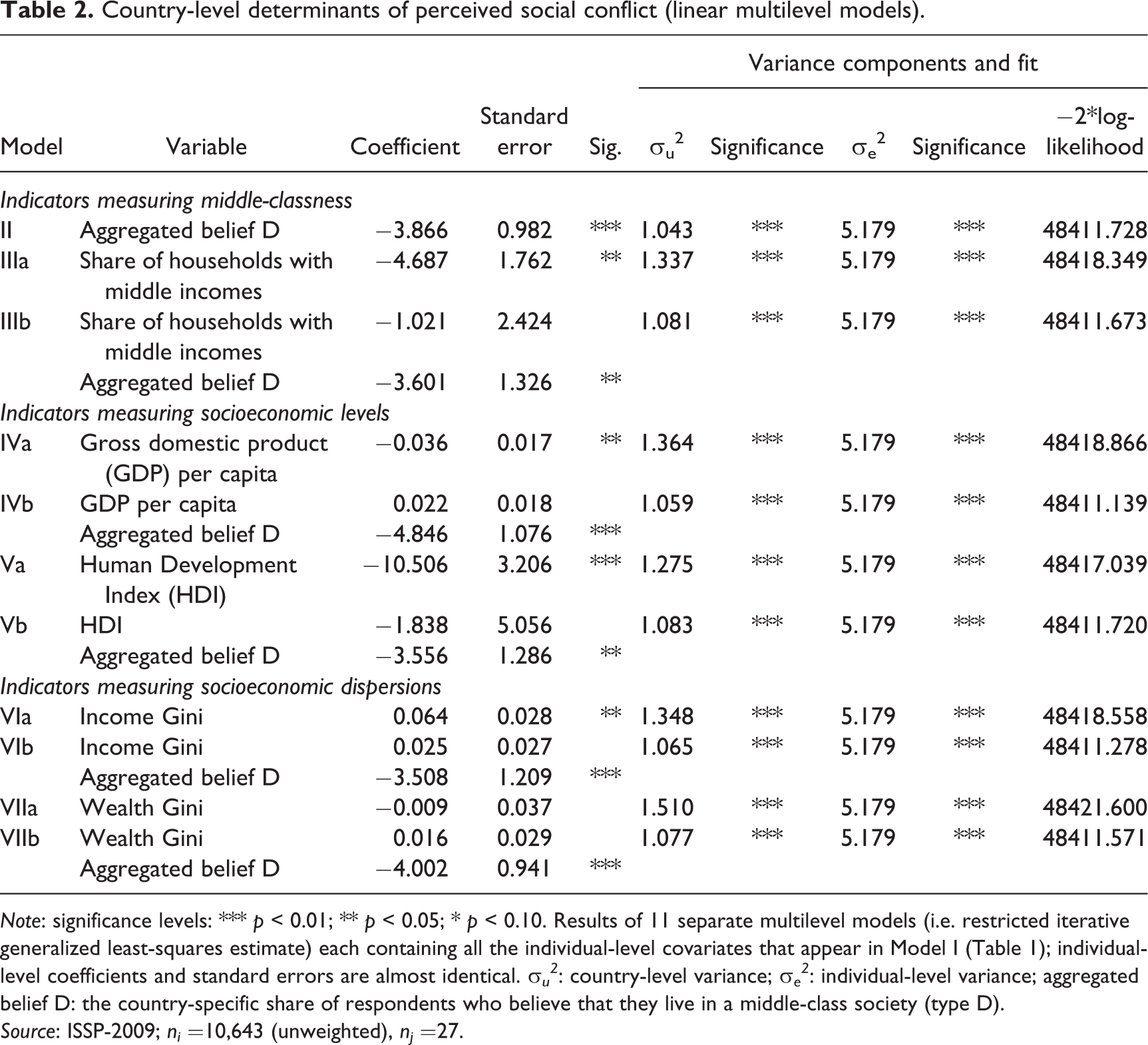
Note: significance levels: *** p < 0.01; ** p < 0.05; * p < 0.10. Results of 11 separate multilevel models (i.e. restricted iterative generalized least-squares estimate) each containing all the individual-level covariates that appear in Model I (Table 1); individual-level coefficients and standard errors are almost identical. σu2: country-level variance; σe2: individual-level variance; aggregated belief D: the country-specific share of respondents who believe that they live in a middle-class society (type D).
Source: ISSP-2009; ni =10,643 (unweighted), nj =27.
Based on the three dimensions mentioned in the sub-section “Collective stratification beliefs”, we started our analyses with country-specific middle-classness. Whereas Model II in Table 2 confirmed the significance of an egalitarian class imagery (“aggregated belief D”) to PSC levels, Model IIIa corroborated the significance of socioeconomic inequality: the share of people with a middle-class imagery and that of middle-income households were both negatively associated with PSC levels to a substantial degree. Thus, both the subjectivist and objectivist perspectives appear to have merit if considered separately. However, the conflict-reducing effect of a broader middle-income class decreased substantially when we added “aggregated belief D” as a second explanatory variable at the country-level (Model IIIb). 13 The mediating effect of an egalitarian class imagery was remarkably strong: the effect of a country’s middle-income class decreased by about 80% (from -4.7 to -1.0), whereas the effect of a middle-class imagery remained nearly unchanged (from -3.9 to -3.6). Against this backdrop, we rejected the objectivist position reflected in H1a in favor of the subjectivist stance as formulated in H2a, noting that collective stratification beliefs have a persistent effect independent of the observable (objective) stratification reality. We also discarded the null hypothesis stating that both objective conditions and a prevalent middle-class imagery are unrelated to PSC levels.
As for the two indicators of country-specific socioeconomic level, we again observed that controlling for a collective middle-class imagery led to remarkable reductions in the conflict-muting effects of GDP per capita (Models IVa versus IVb) and HDI (Model Va versus Model Vb). Consequently, we rejected the objectivist standpoint as formulated in H1b in favor of the subjectivist approach as given in H2b.
Finally, we looked at the two indicators of country-specific socioeconomic dispersion that directly address objective inequality. We found that a higher Gini coefficient for income was associated with higher PSC levels (Model VIa), but that, once again, its effect was greatly reduced when we controlled for the prevalence of a collective middle-class imagery (Model VIb). In comparison, a higher Gini coefficient for wealth did not have a significant impact on PSC levels (Model VIIa). However, when we added “aggregated belief D” to the model, we did find that a higher prevalence of an egalitarian class imagery correlated with significantly reduced PSC levels (Model VIIb). Thus, we rejected the objectivist position as given in H1c and endorsed the subjectivist standpoint as per H2c.
Our findings were further supported by the log-likelihood test statistic, which judges the significance of each added variable’s effect on PSC levels relative to the loss in model parsimony. Using Model I (with only individual-level determinants) as a baseline for all subsequent models, we found that only Model VIIa did not significantly improve the model fit. 14 Furthermore, all models that included collective stratification beliefs (“aggregated belief D”) yielded a significantly better model fit than when they lacked that covariate.
The analyses discussed above draw a clear picture: four objective country-level macro indicators (i.e., the share of middle-income households, GDP per capita, HDI, and the Gini coefficient for income inequality) have a substantial impact on PSC levels when considered individually. However, their effects vanish when “aggregated belief D” is added to the model. By contrast, the fifth objective country-level indicator (i.e., the Gini coefficient for wealth inequality) does not have a significant impact on PSC levels if examined alone. Thus, an egalitarian class imagery appears to be decisive to individual social conflict perceptions; in fact, “aggregated belief D” was the only macro indicator that consistently showed a comparatively substantial effect on PSC levels.
To test the robustness of our results, we performed various sensitivity analyses (Tables A4 to A8 in the Online Supplement). 15 The first set of analyses tested whether mediating effects could, in fact, be attributed to the egalitarian nature of the chosen class imagery. Hence, we replaced “aggregated belief D” with alternative measures of a country’s collective class imagery (Figure 1), namely “aggregated belief A” (representing an elite-mass hierarchy), “aggregated belief B” (symbolizing a pyramid), and a hybrid of both, “aggregated belief A or B.” We then repeated the aforementioned analyses. In broad terms, we found significant positive correlations between the prevalence of more unequal class imageries and PSC levels. The most noteworthy finding related to “aggregated belief A:” a highly inegalitarian class imagery was consistently associated with higher PSC levels. Thus, the most egalitarian and the most inegalitarian class imageries mediated the impact of objective country-level characteristics on PSC, albeit in opposite directions. These results affirm our central finding regarding the particular effectiveness of a middle-class imagery (as a structural macro indicator) in mediating the relationship between objective inequality and PSC.
The second set of sensitivity analyses were meant to test whether less economically developed countries had influenced our results. We therefore replicated our estimations based on a less economically heterogeneous set of countries (nj = 22). We established a lower GDP per capita threshold for inclusion in the sample by subtracting one standard deviation (10.41) from the mean (27.97) GDP per capita, and we repeated our analyses excluding the five least economically successful countries, namely Chile, Estonia, Hungary, Poland, and Turkey. Broadly speaking, results resembled those of our main analysis: prevalence of a middle-class imagery was negatively associated with PSC levels to a significant degree. However, concentrating on economically prosperous countries rendered both macro indicators of socioeconomic development (i.e. GDP per capita and HDI) less effective in predicting PSC levels.
Although our results signaled an egalitarian class imagery’s power in shaping individual PSC, we wished to examine the extent to which this imagery aligns with an objective account of a middle-class society. In order to do so, we turned to an empirical amendment.
An empirical amendment
According to Birdsall (2015: 11), a middle-class society requires “some minimum proportion – at least 20% and perhaps closer to 30% – of the population” to belong to the middle class. Following Birdsall, we adopted 30% as a minimum value in order to compare the prevalence of a middle-class imagery to the share of middle-income households (Figure 4).
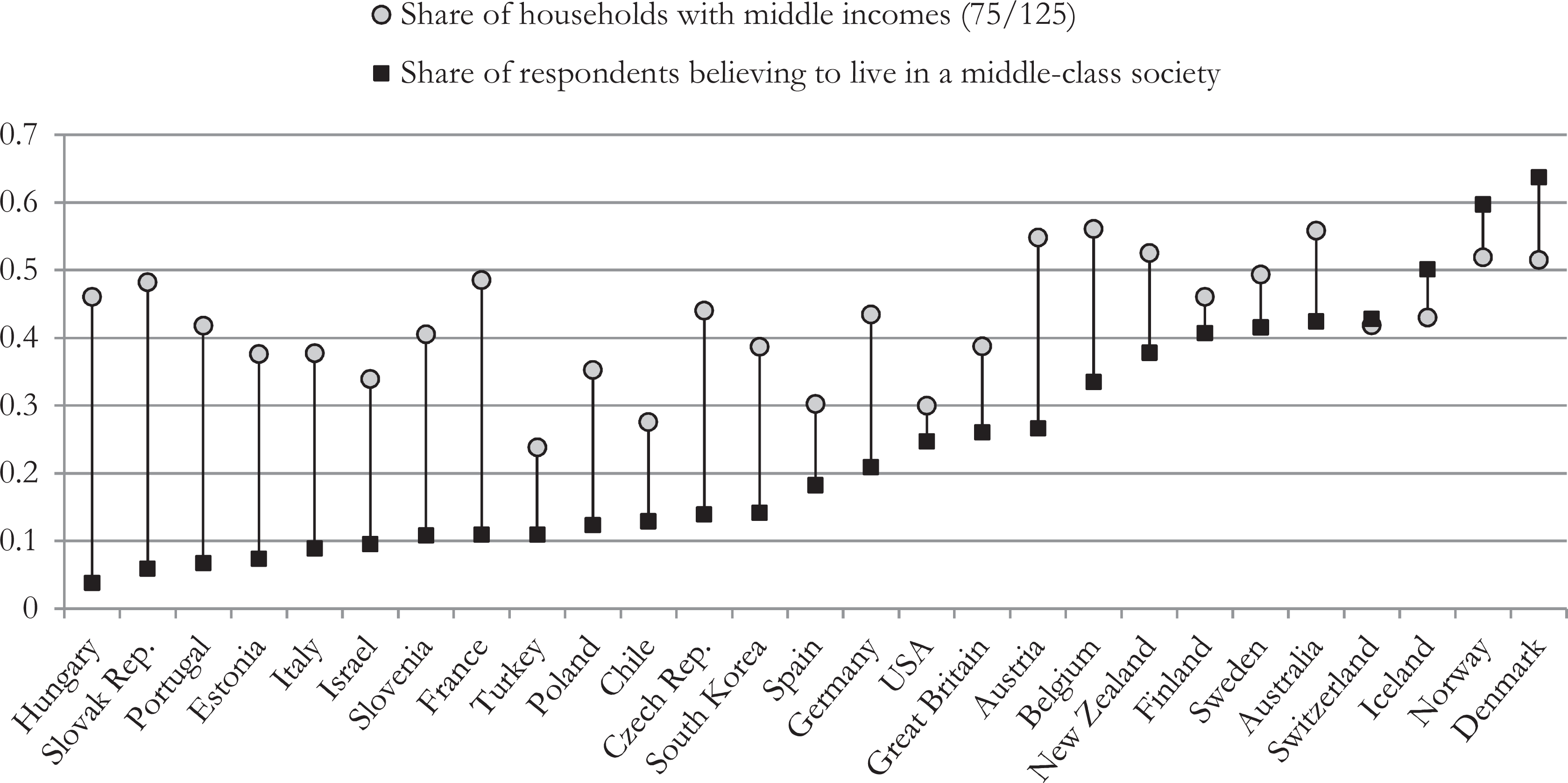
Middle-class beliefs versus share of households with middle incomes. Note: all depicted values are country-specific shares. The graph is sorted in ascending order by the share of respondents who believe that they live in a middle-class society. The horizontal line indicates the 30% threshold. Source: ISSP-2009; ni = 10,643 (unweighted), n j = 27.
There were only nine countries in which at least 30% of the population shared a middle-class imagery (black squares in Figure 4). At the same time, in most of these countries, well over 40% of households had middle incomes (gray circles). In two-thirds of the 27 countries under study, we found a clear discrepancy between “aggregated belief D” levels and the share of middle-income households. In most cases, the latter was markedly higher than the former, although both were moderately correlated (r = 0.515; p = 0.006). Only in Switzerland and three Scandinavian countries (i.e. Iceland, Norway, and Denmark) was the prevalence of a middle-class imagery greater than the share of middle-income households, with Switzerland exhibiting roughly equivalent figures for both. This finding corroborates studies on the covariation of inequality and stratification beliefs (Evans and Kelley, 2017; Niehues, 2014).
As already shown in our multilevel analysis, this empirical amendment elucidates the critical influence of collective subjective beliefs: Neither the assumption of objective conditions dominating aggregated subjective perceptions (sub-section “Inequality and PSC”) nor the expectation of considerable correspondences between a country’s socio-structural shape and its people’s stratification beliefs (sub-section “Collective stratification beliefs”) deserves support. Instead, the prevalence of a middle-class imagery is largely independent of objective socioeconomic characteristics.
Conclusions
In this study, we have conducted a cross-national comparison of the relationships among socioeconomic inequality, collective stratification beliefs, and the individual levels of perceived social conflicts (PSC). To explain the variation in PSC levels, we have derived hypotheses from alternative theoretical perspectives that give precedence either to a country’s socioeconomic inequality (the objectivist position) or to its collective class imagery (the subjectivist position). A third position, the DoC paradigm, suggests that individual social positions and objective inequalities have become largely negligible and that conflicts in the 21st century are no longer based on distributional issues.
Our empirical analyses yield four main conclusions. First, there seems to be merit to the subjectivist position, because a collective egalitarian class imagery shapes PSC levels to a considerable extent. Second, we also find support for the objectivist position: people in countries with larger shares of middle-income households, higher socioeconomic levels (as measured by GDP per capita and HDI) and lower socioeconomic dispersions (as measured by their Gini coefficients for income) show significantly lower PSC levels. Third, the effect of each of these objective factors is mediated by the prevalence of an egalitarian class imagery. The latter is true even though, in most countries, the share of people with a middle-class imagery is distinctly smaller than the share of middle-income households. Fourth, individual-level demographic and socioeconomic factors affect PSC levels, as shown in previous research (Delhey and Keck, 2008; Edlund and Lindh, 2015; Hadler, 2003; Kelley and Evans, 2000).
Some of our study’s limitations invite future research. First, we did not consider the causes of individual conflict perceptions themselves. Exploring the respective processes at the individual-level with longitudinal data may contribute to an improved understanding of how collective stratification beliefs mediate the impact of socioeconomic inequality on individual conflict perceptions. Second, although we are confident that we have chosen relevant objective measures of socioeconomic level and dispersion, alternative measures may also help in understanding an egalitarian class imagery’s mediating effect. Third, we addressed only vertical conflicts, in spite of horizontal conflicts’ increasing importance. Provided that suitable cross-national data are available, further research could study the differential effects that collective stratification beliefs have on both vertical and horizontal conflicts.
Despite these possible improvements and extensions, our study contributes to the growing number of investigations on the benefits of a vital middle-class society, and it shows that a collective egalitarian class imagery outweighs objective factors in explaining PSC levels. In the context of populist parties’ recent success in many countries, our research underscores how important it is for governments to not only reduce inequality but also actively foster a more egalitarian class imagery if they want to substantially reduce social conflicts (Inglehart and Norris, 2016).
Supplemental material
Supplemental Material, Final_Online_Supplement_-_Conflict_Perceptions - Conflict perceptions across 27 OECD countries: The roles of socioeconomic inequality and collective stratification beliefs
Supplemental Material, Final_Online_Supplement_-_Conflict_Perceptions for Conflict perceptions across 27 OECD countries: The roles of socioeconomic inequality and collective stratification beliefs by Florian R Hertel and Nadine M Schöneck in Acta Sociologica
Footnotes
Acknowledgments
The authors wish to thank Nate Breznau, Cathrin Ingensiep, Arvid Lindh, Henning Lohmann, Sascha Peter and two anonymous referees as well as the editors of Acta Sociologica for their helpful comments on earlier versions of this article. Furthermore, they are grateful to the participants at the 3rd International Sociological Association Forum of Sociology in Vienna, 10–14 July 2016, session “Economic Inequality, Distributive Preferences and Political Outcomes” (RC42 and RC18), and at the 38th Congress of the German Sociological Association in Bamberg, 26–30 September 2016, session “Current Research Projects on Social Structure Analysis and Social Inequality”, for their valuable feedbacks to our presentations. All remaining deficiencies and errors are the authors’ alone.
Funding
The authors received no financial support for the research, authorship, and/or publication of this article.
Supplemental material
Supplemental material for this article is available online.
Notes
References
Supplementary Material
Please find the following supplemental material available below.
For Open Access articles published under a Creative Commons License, all supplemental material carries the same license as the article it is associated with.
For non-Open Access articles published, all supplemental material carries a non-exclusive license, and permission requests for re-use of supplemental material or any part of supplemental material shall be sent directly to the copyright owner as specified in the copyright notice associated with the article.
