




Abstract
One of the main aims of the Erasmus programme is to promote a sense of European identity. Whereas several empirical studies have already investigated this relationship, few studies investigate what students actually mean when they refer to ‘Europe’. Therefore, in this paper I investigate the different latent dimensions of the concept Europe, as well as which of these dimensions are particularly associated with an exchange period abroad. The analyses are based on an online survey conducted with higher education students in Austria, Belgium, Italy, Poland and Sweden in 2011 (n = 4278). The presented models reveal four latent dimensions, namely a ‘cultural’, ‘political’, ‘rights’ and ‘experiential’ dimension. Furthermore, the analyses suggest that exchange students are largely a self-selected group, being a priori more likely to identify with Europe and score higher on the four dimensions.
Introduction
The number of higher education students participating in the European exchange programme Erasmus+ has skyrocketed since its foundation in 1987. Today, more than 3 million students spend a study period abroad in another European country within the framework of this exchange scheme. Therefore, it is not remarkable that the European Commission describes the programme as ‘not just the best known of all European Union programmes, but the most successful student exchange scheme in the world’ (European Commission, 2012: 3). The programme serves two main aims (Van Mol, 2013). First, it seeks to enhance the competitiveness of the European Union (EU) among global knowledge economies. Exchange students might gain ‘mobility capital’ (Murphy-Lejeune, 2002), making them more likely to move abroad for work after graduation and providing the EU with a much needed highly educated mobile workforce (Van Mol, 2014a). This is particularly important insofar as demands for highly qualified people in the EU are projected to rise by almost 16 million by 2020 (European Commission, 2011). Second, an Erasmus stay abroad aims to bring young Europeans into contact with each other, leading to an increased sense of European identity among participants. In the programme guide of the Erasmus+ programme, for example, one of the specific aims is that transnational mobility of students should ‘raise participants’ awareness and understanding of other cultures and countries, offering them the opportunity to build networks of international contacts, to actively participate in society and develop a sense of European citizenship and identity’ (European Commission, 2018: 30). This rationale will be examined empirically in this paper, focusing on a sample of higher education students in Austria, Belgium, Italy, Poland and Sweden.
Even though several studies have already investigated the link between (student) mobility and individuals’ identification with Europe (e.g. Kuhn, 2012; Mitchell, 2015; Recchi, 2015; Sigalas, 2010; Stoeckel, 2016; Van Mol, 2013, 2018; Wilson, 2011), most of these studies use standard identification questions about Europe such as those used in the Eurobarometer surveys (e.g. the question ‘Please tell me how attached you feel to Europe?’, which has been asked since 1971 in the Eurobarometer surveys). Nevertheless, measuring a sense of European identity merely through such questions can be inherently problematic (e.g. Duchesne, 2010; Favell, 2005). After all, people can mean very different things when talking about and/or referring to Europe while using the same terms (Diez Medrano, 2010; Jenkins, 2008a). However, only a limited number of studies investigated the meanings individuals attribute to Europe (Diez Medrano, 2010; Schlenker, 2013; Schroedter et al., 2015; Slavtcheva-Petkova and Mihelj, 2013). Therefore, the first aim of this paper is to investigate which meanings higher education students attribute to the word ‘Europe’. Unpacking the different conceptualisations of Europe at the micro-level is theoretically important as it allows for a more in-depth understanding of the content of what individuals eventually identify with. It allows assessment of which different meanings of Europe exist ‘from below’ and how they relate to individuals’ identification processes. Furthermore, such an exercise is also relevant from an empirical and methodological point of view, as it allows one to put into question whether standard questions used in European identity research (whereby respondents are often asked to rate their identification with Europe) can be interpreted differently, potentially leading to biased results.
The second aim of this paper is to advance our understanding of the supposed link between intra-European student exchanges and identification with Europe. In contrast to previous research, which mainly focused on the question of whether or not student mobility fosters a sense of European identity and the mechanisms that explain the presence or absence of such a relationship (e.g. Mitchell, 2015; Sigalas, 2010; Stoeckel, 2016; Van Mol, 2013, 2018; Wilson, 2011), in this paper I explore which of the identified conceptualisations are related to spending an exchange period abroad.
In sum, in this paper I aim to advance our understanding of what Europe means subjectively to individuals, as well as to explore the role student exchange might play in strengthening specific meanings attached to identification with Europe.
Theoretical background
The content of European identity
In the academic literature on European identity, a culturalist and structuralist model can be discerned (Recchi, 2015). The former investigates how institutional processes have an impact on the development of a sense of European identity among the wider population (Van Gorp and Renes, 2007). Studies starting from this angle principally investigate how specific policy actions such as the establishment of particular symbols – the European anthem, the European flag, a European currency, European licence plates and the leitmotiv ‘United in diversity’ (Bruter, 2003; Fornäs, 2012; Risse, 2003; Shore, 2000) – or specific cultural policies (Sassatelli, 2002; Shore, 2000) influence European-identity formation in society. Structuralist models of European identity, in contrast, depart from the perspective of the individual and investigate how a sense of European identity is formed and conceived ‘from below’. Such models particularly concentrate ‘on social relations and their spatial contexts’ (Recchi, 2015: 127). The present study can be placed within such an approach.
This paper follows theorists who conceptualise identity as a dynamic process, reflecting continuous processes of identification (e.g. Brubaker, 2004; Brubaker and Cooper, 2000; Jenkins, 2008b). These processes are helpful for individuals to order social reality and can be considered time- and context-specific. Throughout their social relations, individuals position themselves in their social reality and the surrounding society (Van Mol, 2013). Simultaneously, individuals are classified by others through interaction (Brubaker and Cooper, 2000; Jenkins, 2008b). These three mechanisms (self-identification, positioning and classification) reveal the dynamic and complex nature of identification processes.
Yet identities also involve a subjective aspect which is often not considered in research into European identity, namely their internal meaning for the individuals involved (Huddy, 2001). Following this line of reasoning, the specific meaning(s) attributed to Europe might be even more specific according to the respective person and/or the location in which an individual is situated. It is even highly plausible that when individuals use the same word, ‘Europe’, they might be referring to multiple and differing conceptualisations. This puts into question the notion of European identity itself. For some, Europe might point to Christianity and thus receive a predominantly religious connotation, whereas others might equate Europe with the political entity of the EU. In other words, there are various – and possibly overlapping – meanings individuals attribute to Europe, and these meanings probably influence individuals’ answers to identification and attachment questions. Surprisingly, however, there are only a few studies that empirically investigated individuals’ internal meanings or conceptualisations of Europe (e.g. Diez Medrano, 2010; Schlenker, 2013; Schroedter et al., 2015; Slavtcheva-Petkova and Mihelj, 2013). Based on Eurobarometer data, the results of Schlenker (2013), for example, suggest that people refer to a mix of civic, cultural and ethnic elements when referring to European identity. Civic elements include democratic values and rights, cultural elements include common history and language, and ethnic elements include ancestry and religious heritage. Schlenker’s (2013) results suggest that civic elements dominate the content of European identity. In turn, the study of Schroedter et al. (2015) investigates the latent structure of the meaning of Europe among national and European bi-national couples in Switzerland. Using confirmatory factor analysis, they identified six latent variables to represent the data structure, namely ‘egalitarian values’, ‘common ground’, ‘politics’, ‘Christianity’, ‘loss of national identity’ and ‘dominance of economic interests’. Unfortunately, they did not elaborate further on the significance of these latent dimensions in substantive terms, as they were primarily interested in whether any differences regarding these latent variables could be detected among Swiss national and European binational couples. Altogether, these studies show that there can be significant heterogeneity in what people cognitively refer to when using the term ‘Europe’.
Based on the available empirical and theoretical literature, I expect to detect three latent dimensions of the concept ‘Europe’. Several scholars have differentiated between, first, a ‘civic’ or political (sense of citizenship) component of European identity and, second, a cultural (sense of communal identity) component of European identity (Bruter, 2005; Mayer and Palmowski, 2004). A European civic identity refers to individuals feeling ‘they are citizens of a European political system, whose rules, laws, and rights have an influence on their daily life’ (Bruter, 2003: 1155). A European cultural identity, in turn, refers to the bond and identification of individuals with other Europeans ‘regardless of the nature of the political system’ (Bruter, 2003: 1156). Van Mol (2013) has added a third ‘experiential’ component. By ‘experiential’, Van Mol is referring to an experience-related social conceptualisation of Europe existing alongside conceptualisations of Europe as a cultural and/or political space. This idea is echoed by authors such as Recchi (2015: 1), who shows that the freedom to travel, study and work in any other member state of the EU ‘epitomizes the EU in the minds of Europeans’ much more than other characteristics of the EU. Naturally, these three components might also be reflected in the meanings students attribute to Europe.
In relation to the first aim of this paper, I therefore propose the first hypothesis (Hypothesis 1). As mentioned above, I expect to detect our three latent dimensions attributed to Europe: a cultural (Hypothesis 1a), a political (Hypothesis 1b) and an experiential one (Hypothesis 1c).
The link between student mobility and European identity
A second hypothesis (Hypothesis 2), linked to the second aim of the paper, as introduced earlier, arises from the role of mobility in shaping a person’s identification as European. The link between geographical mobility and the development of a sense of European identity emerged in the 1950s in relation to the development of a structural model of European identity in the form of the ‘transactionalist thesis’ (Deutsch et al., 1957). This thesis expected geographical mobility within the European space to strengthen social ties between citizens from different European countries, in turn leading to an increased sense of belonging to an emergent European community. Recent empirical studies arising from the transactionalist thesis have confirmed the idea (Recchi, 2015). In line with the structuralist model and the transactionalist thesis, it is hardly surprising that European exchange students are expected to figure prominently amongst the European population groups with the strongest sense of European identity (Fligstein, 2008).
Nevertheless, empirical research into the effects of an exchange period abroad on the development of a sense of European identity is not conclusive. While a number of authors suggest there is no effect (Llurda et al. 2016; Sigalas, 2010; Van Mol, 2018; Wilson, 2011), some conclude Erasmus students become more European through their exchange (e.g. Mitchell, 2012, 2015; Stoeckel, 2016), and others argue this is dependent on the specific national contexts from which students originate (Van Mol, 2013). These diverging findings might be related to the contextual and methodological differences of these studies. The quantitative studies of Sigalas (2010) and Wilson (2011), for example, were conducted in the context of the UK, which is often characterised as a Eurosceptic country (e.g. Hawkins, 2012; Recchi and Salamońska, 2014). Choosing the UK as a case study thus probably affects students’ identification with Europe. The other studies were conducted in a wider variety of countries, where levels of European identity are higher compared to the UK. Altogether, the existing empirical evidence suggests that the link between student mobility and an increased sense of European identity is context-specific. Finally, the studies of Kuhn (2012), Van Mol (2013) and Wilson (2011) suggest there is a selection effect. Students who are more likely to participate in international exchange programmes will already feel more European.
Unfortunately, the studies discussed above did not focus on the different meanings students might attribute to Europe. It is, however, likely that specific conceptualisations of Europe are fostered by participating in an exchange semester or year. To the best of my knowledge, only the qualitative study of Van Mol (2013) has investigated how exchange and non-exchange students conceptualise Europe. The study hints at the emergence of an ‘experience-based image of Europe’ during an exchange period, primarily associated with experiences abroad, travel records and an international social network. It provides, as far as I am aware, the only existing empirical evidence comparing conceptualisations of Europe among non-exchange and exchange students.
In this paper, I therefore test a second hypothesis: that a latent ‘experiential’ dimension of Europe – if it exists at all – will be more prominent among exchange students than among immobile students, (Hypothesis 2), given the former group’s direct exposure to European ‘otherness’ during their period of study abroad.
Data, design and methods
Data and sample
The analysis is based on an online survey, conducted at the end of the 2010–2011 academic year with higher education students at 27 higher education institutions in Austria, Belgium, Italy, Poland and Sweden representing different parts of Europe, as there is significant variation in levels of European identity across the EU (Recchi and Salamońska, 2014). At each institution, at least one faculty participated. The data was collected through total population sampling. This means that the invitation to participate in the questionnaire was sent out to all students of the participating faculties. Although this kind of sampling does not allow one to make statistical generalisations beyond the sample, it does allow for analytical generalisations, which is relevant for this exploratory exercise as the presented results can be verified or falsified by other studies. All students were invited through the dean’s office, as students are known to be more motivated to participate when an invitation originates from within their own institution (Durrant and Dorius, 2007). Students could complete the survey in three languages, namely Dutch, English or Spanish. This limited range of languages was the result of budget constraints.
The response rates varied between 10% and 20%. Although these response rates are low, they are not uncommon for web surveys (Fricker, 2008; Muñoz-Leiva et al., 2010; Smyth and Pearson, 2011), especially with higher education students, as they are frequently surveyed (Sax et al., 2003). Furthermore, the strength of the relationship between response rates and non-response bias has been recently questioned in a meta-analysis of six major face-to-face surveys (Sturgis et al., 2016). In their analysis of 541 questions, higher response rates were not strongly related to the distribution of survey outcomes (Sturgis et al., 2016). These recent results expand on previous research, which showed that although ‘hard-to-get’ respondents often significantly differ from other respondents, excluding them has very little effect on survey estimates (Curtin et al., 2000). To assess the possible bias associated with this low response rate, I applied ‘time of response analysis’ (Porter and Whitcomb, 2005). More specifically, I analysed differences in the distribution of survey responses between early responders and students who answered after (several) reminders by cross-tabulation. Statistical significance was estimated by chi-squared tests. No significant differences could be detected.
The database covers students from a broad variety of science disciplines, including both ‘hard’ and ‘soft’ sciences. The database was limited to students aged 30 or less, and incomplete and double answers were filtered out. In addition, foreign students (with a nationality different from the country of their home university) and second-generation migrants were filtered out as their European-identification levels might be substantially higher than those without prior exposure to an international environment (e.g. Weber, 2016). Finally, I limited the analysis to students that went on exchange to another European country, as exchange experiences in non-European countries might lead to different social relations and hence different identification patterns. The final sample consisted of 4278 responses, all being bachelor- and master-level students enrolled at the participating universities.
Instrument
The online survey the presented findings are based on was developed over the course of three years following the method of constant comparison (Glaser and Strauss, 1967). This method is often used by qualitative researchers but was applied here to a mixed-method design (for more details, see Van Mol, 2014b). This means that the survey items concerning the meanings students attribute to Europe on which the results of this paper are based were refined year after year according to the insights emerging from continuous comparisons between collected quantitative and qualitative data.
The initial questionnaire in 2009 was based on existing surveys on European identity (e.g. Bruter, 2005) and refined after analysis of 23 explorative interviews in 2009 at the University of Antwerp (Belgium) and the University of Valencia (Spain). The participating students originated from Belgium, Finland, France, Germany, Greece, Italy, Slovakia and Spain. Thereafter, an online pilot study was conducted. This pilot study was forwarded on student internet forums and in student groups on social network sites such as Facebook. Special attention was given to the design of the questionnaire, as it has been suggested this influences response, break-off and the quality of responses (e.g. Couper and Miller, 2008; Thorndike et al., 2009). Wherever possible, answer categories were randomised in order to reduce the ‘response order effect’ (Couper and Miller, 2008). Participants were free to go backwards and forwards through the questionnaire before submitting.
Thereafter, the questionnaire was implemented as a repeated cross-sectional survey in 2009, 2010 and 2011. Between the first and second wave, additional qualitative data was gathered through in-depth interviews and focus groups among (exchange and non-exchange) students in six European countries in 2009 and 2010 (n = 71). This qualitative data allowed me to grasp in detail how students conceptualise Europe, and additional items were hence added to the questionnaire. Furthermore, in each survey, respondents could indicate in an open question which items they considered to be missing when referring to their idea of Europe. If several respondents missed an item, this item was included in the next survey. The triangulation of quantitative and qualitative data in a sequential design thus allowed me to refine the items used to measure the meanings students attribute to Europe. Consequently, the presented analyses are based on the quantitative data of the 2011 survey, as this survey represents the most refined version of the questionnaire and items on the meaning of Europe.
Variables
Dependent variables
First, I analyse whether students emotionally identify with Europe by the question ‘How would you say you identify with Europe?’, which could be answered on a seven-point Likert scale, varying from 1 (not at all) to 7 (very much). This is a necessary first analytical step in order to know whether Europe is actually relevant to the surveyed students. Second, four variables measured latent dimensions of the meanings students attribute to Europe. These dimensions were identified through a principal component analysis, reducing a 20-item battery of answer categories to the question ‘Which of the following issues do you relate with your current idea of Europe?’. These items were based on the constant comparison method adopted in the earlier phases of the project. Students could rate the 20 items on a scale ranging from 1 (not at all) to 5 (very much). As the detection and definition of these different dimensions form part of the main aims of this paper, I present this set of dependent variables after the preliminary analysis in the results section, which identifies the dimensions.
Independent variables
Students were divided into different groups according to their mobility status. As this study relies on cross-sectional data, distinguishing between different mobility groups is useful for detecting in which identification schemes exchange students exist as a pre-selected group and thereby reducing self-selection bias. One group consisted of non-exchange students, who indicated that they did not have any intentions to study abroad during their studies when answering the question ‘Do you intend to spend some time abroad during the remainder of your degree?’, with an explanatory note indicating the question related to a semester or full academic year. A second group consisted of potential exchange students who did not yet know whether they wanted to study abroad, answering ‘perhaps’ to the same question. A third group consisted of future exchange students, namely those who answered ‘definitely’. The final group consisted of exchange students who were currently studying abroad or indicated they had previously studied abroad. To ensure that students who were currently studying abroad and those who previously studied abroad could indeed be grouped together, I investigated bivariate correlations between both groups and the dependent variables. These analyses were not significant, allowing me to consider both groups together in the analysis. The group of exchange students is used as the reference category.
Control variables
Several variables that have been shown to correlate with European identity are included as control variables. First, age is measured by a continuous variable indicating single years, as younger people have been shown to feel more European (Citrin and Sides, 2004; Fligstein, 2008). Second, I included a variable indicating whether the respondent had foreign friends in her/his home country. Respondents could indicate this on a four-point scale, ranging from 0 (no) to 4 (all of them). This variable was included because exposure to an international environment in the home country might make students more prone to identifying with Europe. Third, I included a variable indicating the number of independent travels a respondent made (alone or with friends) before the age of 18. I did so because European identification might be exponential – that is, the more one travels to other European countries, the higher the European identification. This variable was measured in different categories, ranging from 0 (none) to 5 (more than 20 times). Fourth, gender is included as a dichotomous variable (0 = male, 1 = female) as women appear to be less enthusiastic about Europe (Fligstein, 2008; Nelsen and Guth, 2000; Recchi, 2015). Fifth, I included a dichotomous variable indicating parental education (0 = no higher education, 1 = higher education), as well as two variables with five categories indicating social class, based on the Erikson and Goldthorpe class-scheme (Erikson and Goldthorpe, 1992). These variables are included because highly educated individuals and individuals from higher socio-economic strata would be more likely to identify as European (Citrin and Sides, 2004; Fligstein, 2008; Kuhn, 2012; Recchi, 2015). Sixth, I included three dichotomous variables indicating international experiences within the family. The first two variables indicate whether the respondent’s parents lived abroad (0 = no, 1 = yes) and the third whether the student him/herself lived abroad during youth (0 = no, 1 = yes). I included both variables because European identity is known to be intergenerationally transmitted (Quintelier et al., 2014), and this measure might indirectly capture the degree of European identification of students’ parents. Finally, I included several dummy variables to account for country-specific effects. Sweden is used as the reference category because Sweden consistently scored lowest on all dependent variables.
Analytic strategy
Following the main aims of this paper, I first explored whether the different meanings students attribute to Europe can be reduced to a meaningful number of latent dimensions through a principal component analysis (PCA). In contrast to confirmatory factor analysis, which is used to test whether theoretically informed a priori dimensions are consistent with the data, PCA is a statistical procedure used to uncover the underlying structure of a set of variables without any a priori assumptions about the structure and patterns of the latent dimensions. PCA is often used in exploratory research, which is the case of this paper. In a subsequent step, I investigate whether the likelihood of identifying with Europe or scoring high on the identified dimensions through PCA significantly varies among exchange and non-exchange students with ordinary linear regression, controlling for possible confounding factors.
Results
The meaning of Europe
I conducted a PCA with a free number of components on the 20-item battery investigating the meaning of Europe. Before proceeding to this analysis, an initial check of the data revealed that the items ‘Europe is a continent’, ‘Christianity’ and ‘Europe is the Western world’ did not correlate enough with other items. Preliminary analyses showed that ‘Europe is the future’ and ‘free movement of people’ loaded on multiple factors. Following standard methodological procedures (see Field, 2009), these five items were excluded from the analysis. I first ran a PCA on the 15 remaining items with oblique rotation (promax with Kaiser normalisation). The Kaiser–Meyer–Olkin (KMO) measure verified the sampling adequacy for the analysis, KMO = .87 (great, according to Hutcheson and Sofroniou, 1999). Furthermore, all KMO values for individual items were greater than .56, which is well above the acceptable limit of .5 (Field, 2009). Bartlett’s test of sphericity (X 2 (105) = 14910.50, p < .001) indicated that the correlations between the items were sufficiently large for PCA. Four components had eigenvalues over Kaiser’s criterion of 1 and in combination explained 56.67% of the variance (see Table 1). This is the number of components retained for subsequent analyses in this paper. The items that cluster on the same component suggest that component one represents a cultural conceptualisation of Europe, component two a conceptualisation of a ‘Europe of rights’, component three a political conceptualisation and component four an experiential conceptualisation. Given the ordinal nature of the data, as a robustness check I investigated whether the same solution is obtained with nonlinear categorical PCA with a fixed number of four dimensions (promax with Kaiser normalisation). The same four components emerged from this analysis, increasing the robustness of the reported results (results not shown, available on request to the author).
Exploratory factor analysis on the meaning students ascribe to Europe (n = 4083).
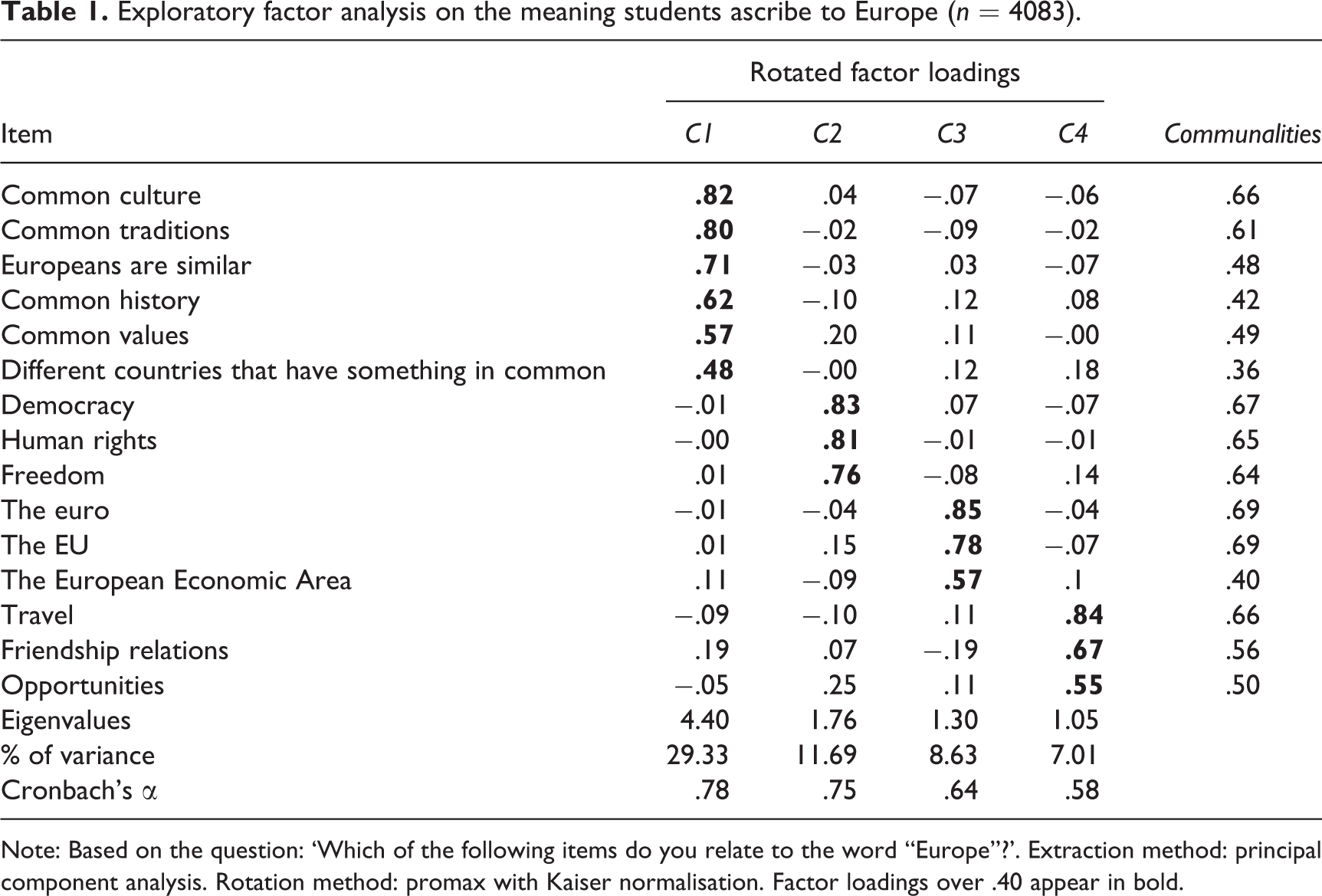
Note: Based on the question: ‘Which of the following items do you relate to the word “Europe”?’. Extraction method: principal component analysis. Rotation method: promax with Kaiser normalisation. Factor loadings over .40 appear in bold.
Components one, three and four are thus in line with Hypotheses 1(a), 1(b) and 1(c). Interestingly, however, the analysis indicates that existing theoretical frameworks can be expanded by including a fourth component, namely a perception of Europe as an area where democracy, human rights and freedom are fundamental values. This fourth component makes sense, as democracy and human rights are among the official membership criteria agreed upon at the 1993 Copenhagen summit and are regularly communicated to European citizens through different channels, including the media (e.g. Inthorn, 2006). Furthermore, recent work by Schlenker (2013) based on the Eurobarometer survey showed that democratic values are often mentioned by Europeans as one of the most important elements making up European identity.
In subsequent analyses, we use restricted sum scales of the four components as dependent variables.
The link between student mobility and European identity
Descriptive analysis
As can be observed from Table 2, most of the respondents were female, and above one-third of the interviewed students reported to have at least one parent with a higher education degree. Furthermore, more than half of the students originated from a white-collar background. Regarding their exposure to foreignness, the vast majority of students and their parents did not live abroad during their childhood and/or youth, and the vast majority had some independent travel experience. In addition, the surveyed students generally reported rather low levels of foreign friendships in their home country.
Descriptive statistics of the sample.
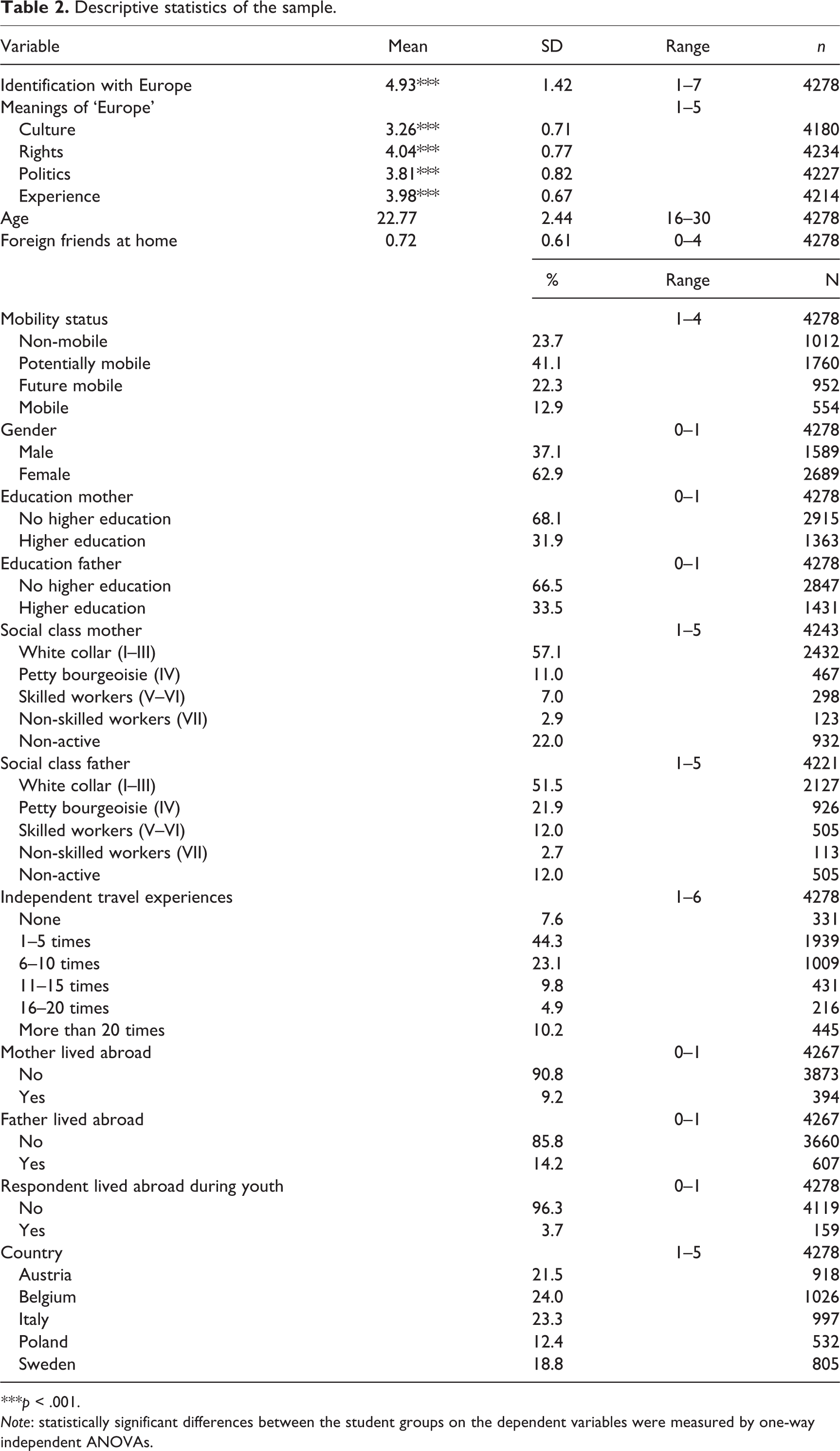
***p < .001.
Note: statistically significant differences between the student groups on the dependent variables were measured by one-way independent ANOVAs.
In a next step, I explored whether any differences could be detected on the main dependent variables between the four student groups I discerned based on their mobility status by a one-way independent ANOVA (significance results also reported in Table 2). The analysis revealed significant differences between the student groups regarding their identification with Europe as well as regarding the four latent dimensions of Europe.
Finally, I ran a partial correlation to determine the relationship between the four latent dimensions of Europe and students’ identification with Europe, controlling for the effect of the other dimensions. As can be observed in Table 3, similar patterns are found for the four latent dimensions. The reported correlation coefficients – all statistically significant and ranging from weak to moderate relationships (Evans, 1996) – are largely in line with those reported in other studies on European identity among exchange students (e.g. Mitchell, 2015). This analysis clearly shows that identification with Europe might partially depend on the specific meanings individuals attribute to it (Schroedter et al., 2015).
(Partial) correlations of identification with Europe and conceptualisations of Europe.
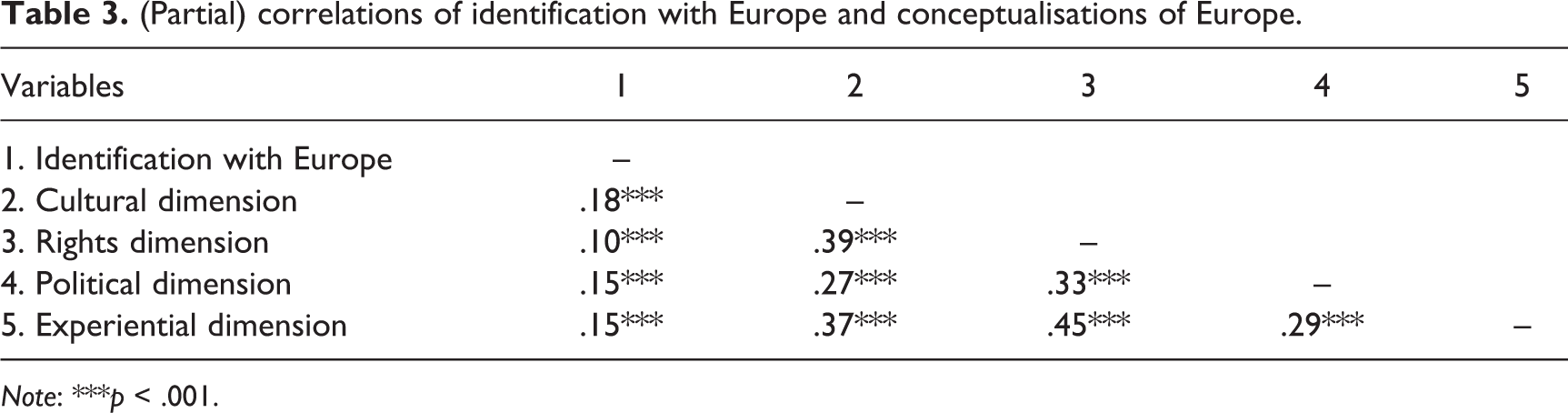
Note: ***p < .001.
Multivariate analyses
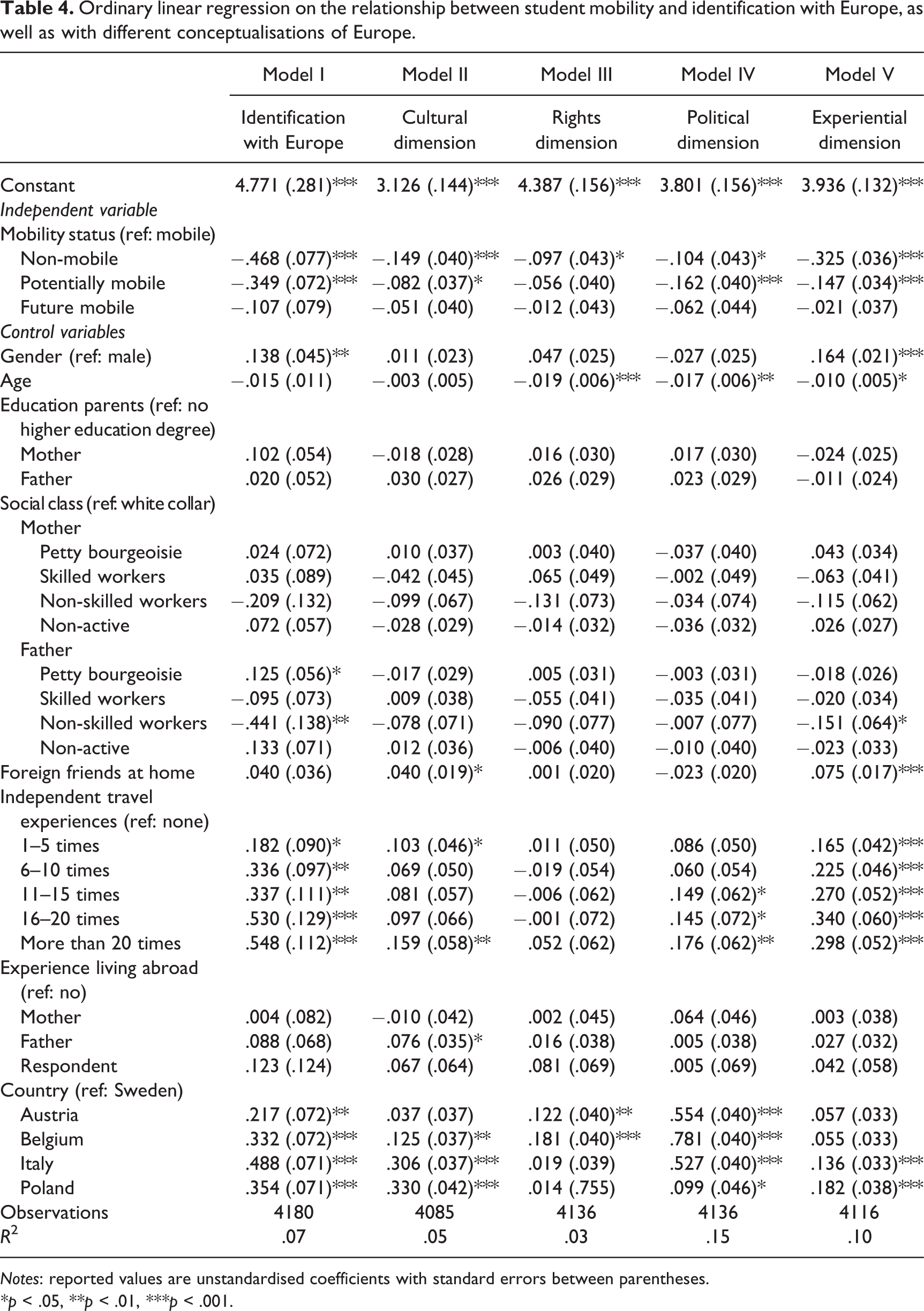
In order to investigate the relationship between student mobility and identification with Europe, as well as between student mobility and the four latent dimensions of Europe, I constructed five different models, controlling for confounding variables (see Table 4).
Ordinary linear regression on the relationship between student mobility and identification with Europe, as well as with different conceptualisations of Europe.
Notes: reported values are unstandardised coefficients with standard errors between parentheses.
*p < .05, **p < .01, ***p < .001.
Model I reveals that exchange students report higher levels of identification as a European compared to non-exchange and potential exchange students. Nevertheless, they do not differ from future mobile students in this respect. This suggests that those who participate in exchange programmes identify more with Europe before their exchange experience. Similar findings are reported for the latent dimensions of the meanings students attribute to Europe. Models II, IV and V show that mobile students differ from non-mobile and potentially mobile students regarding their rating of the cultural, political and experiential dimension of Europe, but not from future mobile students. For the rights dimension, only differences between the groups of mobile and non-mobile students could be observed. In sum, the analysis does not support the hypothesis that exchanges would mainly enhance the experiential dimension of the meanings students attribute to Europe. This idea clearly exists before going on exchange. Interestingly, this experiential component is – in contrast to the other dimensions – highly correlative with students’ travel record and international social networks in their home country, which suggests transnational social interaction and movement are important for fostering this dimension.
In a final analytic step, I investigated interaction effects between students’ countries of origin and mobility status for the four latent dimensions of Europe. In these models, I control for the variables listed in Table 4. The interaction effects between mobile vs. non-mobile and Polish vs. Swedish students proves to be statistically significant for the cultural (B = −0.23, SE B = 0.11, p < .01) and political dimensions (B = −0.21, SE B = 0.11, p < .05). This result indicates that Polish non-mobile students are less likely to score highly on these two dimensions. All other interactions terms in the analyses did not prove statistically significant (results can be obtained from the author on request). Together, these results suggest that the relationship between study exchanges and the latent dimensions of Europe are quite consistent across the five countries under study.
Discussion and conclusion
This paper addresses two main objectives. First, I have aimed to investigate which different meanings students attribute to Europe in order to advance our understanding of the ‘content’ of students’ identification with Europe. Second, I have aimed to advance our current understanding of the influence a study period abroad might have on the different latent dimensions of Europe. Based on the analysis, two main conclusions can be drawn.
First, the findings reveal the polysemous nature of Europe. The findings show that the meanings students attribute to Europe can be reduced to four meaningful dimensions: cultural, Europe of rights, political and experiential. As such, the presented findings provide quantitative evidence for a recent qualitative study that argued for the inclusion of an experiential component in theoretical models of European identity (Van Mol, 2013). Furthermore, a fourth meaningful dimension, namely a ‘Europe of rights’, also emerges. This is in line with research based on the Eurobarometer which shows that European citizens rate democratic values as one of the main elements composing European identity (Schlenker, 2013). It makes sense to consider these four conceptualisations of Europe as analytically distinct dimensions. A cultural conceptualisation of Europe mainly indicates a ‘sense of community’ whereby other Europeans and European countries are considered to share many similarities, making them less distant compared to, for example, non-European countries. A political conceptualisation of Europe, in turn, is related to the political institution of the EU and its symbols such as the Euro. Expanding this binary conceptualisation with the two other latent dimensions allows one to gain a more fine-grained understanding of the variety of meanings individuals attribute to Europe. A Europe of rights probably points to the context of Europe as the origin of ‘universal’ values such as democracy, human rights and freedom. Finally, with the increasing unification of Europe, citizens are aware of the possibilities they are offered for studying, travelling and working in other (European) countries. While this is the result of the political unification of Europe, students often perceive these first-hand experiences of Europe as quite distinct from the European political institutions (e.g. Van Mol, 2013). Together, these findings thus reveal the importance of going beyond simple identification questions commonly used in research into European identity and develop more fine-grained measures of what individuals actually mean when they state that they identify with Europe or as European. The results strongly confirm that students might refer to quite different things when they talk about Europe.
Second, considering the link between student mobility, identification with Europe and the different meanings students attribute to Europe, the presented analysis strongly suggests that student mobility does not have an enormous impact on the development of a sense of European identity, if such a construct can be measured with identification questions at all. While differences are detected between mobile students, non-mobile and potential mobile students in their identification with Europe, this was not the case for the comparison with future mobile students. The findings thus support the idea that many of those who depart on an Erasmus exchange are already more prone to liking the idea of Europe (see Van Mol, 2013; Kuhn, 2012). When considering the link between student mobility and the four latent dimensions, a similar pattern emerges. For the ‘cultural’, ‘political’ and ‘experiential’ component, differences are detected between the group of mobile with non-mobile and potentially mobile students, but not with future mobile students. Regarding the ‘rights’ dimension, only a difference between non-mobile and mobile students is detected. In a similar vein, the control variable indicating independent respondents’ travel experiences also indicates that the more students travel, the more likely they are to score higher on the identification question and the four latent dimensions. Together, these results indicate that those who are most likely to participate in intra-European exchanges are already more likely to incorporate the identified four different meanings of Europe in their conceptualisation of Europe.
Lastly, several limitations of the study as well as directions for future research should be mentioned. First, it would be interesting to deepen the presented analysis by, for example, investigating how different meanings and identification work out in practical (behavioural) terms (Favell, 2005). How are the meanings individuals attribute to Europe related to everyday ways of being European? After all, individuals might have behavioural intentions as a function of their identification frames. Investigating, for example, whether a study period abroad leads to stronger feelings/intentions of solidarity towards other Europeans would be a promising line of future research, as it might help to shed light on the practical consequences of European identity (e.g. Van Mol et al., 2015 on transnational solidarity among European bi-national couples). Second, the analysis was conducted on a sample of a very specific group, namely students in higher education. As educational levels are related to levels of European identity (e.g. Citrin and Sides, 2004; Fligstein, 2008; Recchi, 2015), the generalisability of the results towards the broader European population remains an open question. Future research could investigate whether the four identified latent dimensions can also be detected among the general population. Third, this paper only focused on five countries and used a strict quantitative approach which was, however, informed by previous qualitative and quantitative data collections (see Van Mol, 2014b). Future research could benefit from focusing on a larger number of European countries to validate or falsify the presented results. In particular, qualitative research might be helpful to further unravel and specify the polysemous nature of the meaning individuals attribute to Europe. Finally, an in-depth between-country analysis fell beyond the scope of this paper. Nevertheless, the control variable included in the various models – whereby Swedish students were the reference category – revealed significant differences between Swedish students and students in the other case countries regarding the five dependent variables. Consequently, future research focusing on between-country differences might be a promising way to improve our understanding of the local/national ‘rootedness’ of identities and different conceptualisations of Europe.
In conclusion, the analyses presented in this paper show, first, that higher education students mean very different things when referring to Europe. Grasping this diversity of interpretations is important, as they significantly influence the way individuals answer the kind of standard identification questions commonly used in surveys measuring European identity. Second, the findings clearly indicate that European exchange programmes in higher education are unlikely to attain one of their key aims: to generate an increased sense of European citizenship and identity among participants. Participants in such programmes are inevitably a largely pre-selected group, who already have a positive disposition and affinity with the distinctive meanings attached to Europe. If these programmes are ‘preaching to the converted’ (Kuhn, 2012), they might have limited potential for reducing the divide between Europhiles and Eurosceptics, which has become increasingly visible in European societies over the past years.
Footnotes
Acknowledgements
I am very grateful to Allan Findlay for proofreading the final version of this paper.
Funding
The author(s) disclosed receipt of the following financial support for the research, authorship and/or publication of this article: This work was supported by the Research Foundation - Flanders.