




Abstract
Drawing upon ideas stemming from social disorganisation theory, this study explores how structural and social aspects of the school context affect youth substance-use behaviours in terms of smoking, alcohol and/or drug use. A key focus is to investigate the joint effect of school collective efficacy and schools’ substance-use norms on students’ substance use. Analyses are based on combined information from two independent data collections conducted in 2014 among ninth grade students (n = 5122) and teachers (n = 1105) in 81 senior-level schools in Stockholm. Results from multilevel analyses confirm previous research by suggesting that the proneness to engage in substance use varies depending on the socioeconomic profile of the school. Youth in socioeconomically advantaged schools were more prone to engage in substance use than youth in disadvantaged school settings. Furthermore, collective incentives for exerting social control against substance use seem to be weaker in schools where conventional values towards substance use (anti-substance-use norms) are suppressed.
Keywords
Introduction
Research into contextual effects on problem behaviours tends largely to focus on low socioeconomic environments, on the assumption that problem behaviours are more common in these types of settings (Botticello, 2009). Among adolescents, however, substance use has repeatedly been found to be more prevalent in socioeconomically advantaged settings, both in terms of neighbourhoods (Karriker-Jaffe, 2011) and schools (Botticello, 2009; Ennett et al., 1997). There has been less research into the active mechanisms that link the characteristics of these types of setting to youth substance-use. In fact, a common criticism of contextual studies in general is that they often lack a theoretical underpinning and that they tend to treat contextual effects as the remaining miasma rather than something worth exploring per se (Macintyre et al., 2002). Furthermore, social epidemiological studies of the role of place or context tend to follow classic epidemiological traditions (only at the aggregate level) in the sense that they concentrate more on risk factors than on trying to understand the processes behind the effects found (Frohlich et al., 2001). These general patterns also apply to studies of youth development concerned with the influence of contexts (Sellström and Bremberg, 2006). Questions about how environmental characteristics influence youth development often tend to be overlooked. This is especially true for environments commonly perceived as advantaged. Moreover, even though there has been considerable research interest in social stratification, this has largely focused on characteristics of the individual rather than on the places to which individuals are exposed (Macintyre et al., 2002). However, socioeconomic status is a multilevel construct that needs to be considered not only as an aggregate of individual-level conditions, but also as a characteristic of the environment itself that can act directly and in combination with individual-level characteristics (Kawachi et al., 2002; Moore and Littlecott, 2015). Accordingly, the present study departs from the theoretically derived concept of collective efficacy and aims to more explicitly explore the process linking school advantage with youth substance-use.
Background
Much of the sociological and criminological research exploring how social conditions are linked to deviant behaviours has been guided by Merton’s theory of anomie (1938) or Shaw and McKay’s (1942) theory of social disorganisation. Both theories highlight the ways in which macrosocial forces influence deviant behaviours, albeit in different ways. According to anomie theory, deviant behaviours are symptoms of a structural imbalance between the relative emphasis placed on culturally valid goals and the prescribed means of realising these goals (Merton, 1938). Focusing entirely on the goals at the expense of the means of achieving them leads to a state of normlessness (anomie) that has been linked to the distribution of deviant behaviours across society (Featherstone and Deflem, 2003) as well as later deviance in individuals (Agnew, 1992). Social disorganisation theory (SDT), on the other hand, is recognised as a fruitful framework for studying the contextual effects of social stratification (Bruinsma et al., 2013). Where anomie theory departs from the idea of social values and norms as sources of pressure that can lead to deviance, SDT focuses more on the way in which features of social structures may or may not impair the regulation of deviant behaviours. Deviant behaviours are according to SDT, more likely to occur when structural conditions impair the collective capacity for informal control. This situation is most likely to occur in less advantaged settings (Shaw and McKay, 1942).
The current study is based on a more recent version of SDT that explicitly focuses on the mechanism believed to be active in the association between the socioeconomic conditions of environments and deviant behaviours. Given our ambition to explore the mechanisms linking school advantage to adolescent substance-use, this seems like an ideal point of departure.
Collective efficacy theory
The collective efficacy concept was originally developed by Sampson et al. (1997) to empirically explore the neighbourhood processes theoretically assumed to link neighbourhood disadvantage to individual-level outcomes (Shaw and McKay, 1942). Building on the notion of self-efficacy (Bandura, 2000) and theories of social capital, collective efficacy is conceptualised as a feature of the neighbourhood that defines its conjoint capability for action to achieve common goals, such as public order or control of crime (Bruinsma et al., 2013). The willingness of local residents to intervene for the common good is thought to depend on conditions of mutual trust. Thus, socially cohesive neighbourhoods are seen as the most fertile contexts for the realisation of informal social control. In line with these theoretical ideas, Sampson et al. (1997) found neighbourhood collective efficacy to be negatively associated with several measures of violence, even after controlling for individual-level characteristics, and to mediate the effects of neighbourhood disadvantage on criminal outcomes.
The literature on collective efficacy has grown beyond neighbourhood research to also investigate the influence of other central contexts (such as schools) (Kirk, 2009). Some critics have maintained that important aspects of the theory have been downplayed in the process (Kubrin and Weitzer, 2003). One such aspect is the role of culture, value systems or norms. Another, related to the first, is the failure to recognise that social ties may take many forms and vary in their capacity to exert informal control, depending on the actors involved and their interests (Kubrin and Weitzer, 2003). Settings with high collective efficacy may efficiently enforce local norms on their inhabitants, but whether this will be for the social good or not depends on the character of these norms. Criminological studies, for instance, have found that in disadvantaged settings where conventional values against crime are attenuated, residents have weaker cultural support for exerting social control over their fellow citizens (Kubrin and Weitzer, 2003). In other words, if the behaviour is not considered norm breaking in the setting, the incentive for intervening is weakened. Similar processes may also occur in settings other than neighbourhoods and in relation to other types of deviant behaviour (Botticello, 2009; Su and Supple, 2016). Neighbourhood smoking norms have for instance been found to modify the relation between neighbourhood collective efficacy and smoking among adults in a US setting (Ahern et al., 2009). More specifically, higher collective efficacy was shown to be associated with more smoking in neighbourhoods where smoking norms were permissive, whereas the opposite was true in neighbourhoods where norms were strongly anti-smoking.
Similarly, the trust dimension of the collective efficacy concept cannot always be assumed to be beneficial. In fact, the close contacts between residents of, for instance, cohesive neighbourhoods, may sometimes even enforce unhealthy behavioural norms (Ahern et al., 2009; Poortinga, 2006; Portes, 1998). Likewise, in the case of schools, higher perceived safety has been linked to an increased risk of moderate drinking (Botticello, 2009). The down sides of social trust have also been recognised in studies of social capital (Kawachi, 1999; Portes, 1998; Rostila, 2011). Rostila (2011), for example, has demonstrated that more closed individual- or organisational networks are more likely to facilitate submission to negative norms and behaviours. Further, strong trust and ties have been found to reinforce unhealthy attitudes and thereby lead to negative behaviours (Chuang and Chuang 2008; Poortinga, 2006).
In conclusion, collective efficacy and its components (trust and social control) are likely to be task-specific; the efficiency of the actions and the willingness to intervene depend not only on levels of social trust, but also on the perceived good. To get a fuller picture of how the structural and social characteristics of settings influence outcomes, we must take additional characteristics of these settings into consideration. The current study seeks to address this by incorporating information about substance-use norms.
Health risk behaviours and norms
It is a well-recognised theme in sociological literature that behaviours are based on choices influenced by one’s social circumstances (Bourdieu, 1990). This has also been demonstrated in epidemiological models (Cockerham, 2005; Frohlich et al., 2001). In these types of models, behaviours are viewed as social practices that largely reflect the surrounding environment and its norms. Applied to the school setting, this suggests that social interaction with substance-using peers may influence young people’s behaviours directly (contagion models) by, for instance, providing more opportunities for substance use. School peers may also shape behaviours indirectly by influencing the character and the content of schools’ normative climate. Normative climates should here be understood as the aggregate attitudes shared by members of a social group, acting over and above individually held attitudes (Ennett et al., 1997; Thrash and Warner, 2016).
People continuously internalise the prevailing norms and attitudes of the surrounding environment through processes of socialisation. The family is the main socialisation agent during early life, whereas more distal agents such as peer groups, neighbourhoods and schools become more important during adolescence (Singh-Manoux and Marmot, 2005). Adolescence is also a period in life when many health risk behaviours are adopted (Hanson and Chen, 2007). Thus, social influences stemming from outside the family may be particularly important for behaviours established during adolescence (West, 1997). The social and symbolic significance ascribed to behaviours in different settings may even be more central to young people’s decisions to engage (or not) in behaviours than any concerns about later health effects. In settings where unhealthy behaviours are associated with desirable values, engagement in such behaviours may seem perfectly rational in order to gain status or avoid peer rejection or other social risks (Jessor, 1991). Nevertheless, the overall empirical evidence suggests that early experimentation with substances is linked to a higher risk of continuing such behaviours and impaired health than if no such experimentation had taken place – especially among the already vulnerable (Due et al., 2011).
Collective efficacy in the school setting
The structural components of schools, just like those of neighbourhoods, are largely determined by segregation processes along ethnic and socioeconomic lines, with some schools facing more difficult structural challenges than others. Typically, school characteristics such as high concentrations of students with poorly educated parents and students with non-native backgrounds have been linked to greater school disorder (Gottfredson, 2001). As with neighbourhoods, structural factors are seen as challenging the overall functioning and character of the school (Bradshaw et al., 2009). Disadvantaged schools may, for instance, be characterised by conflicting values and weaker social networks due to a more ethnically and socioeconomically heterogeneous student body. Under such circumstances, commonly agreed-upon behaviour may be harder to establish, and collective control functions may be less effective. Hence, as with neighbourhoods, it is not the indicators of disadvantage per se that are likely to increase a school’s concentration of problem behaviour, but the mechanisms that they activate and the social processes they influence (Bradshaw et al., 2009; Kemppainen et al., 2018). Moreover, as pointed out by Kirk (2009), the mechanisms recognised by collective efficacy theory as important for linking aspects of neighbourhood structure to various outcomes have much in common with those identified by school effectiveness researchers as central components of a well-functioning school (Bryk and Driscoll, 1988; Payne et al., 2003). In brief, school effectiveness research focuses on how organisational characteristics of schools influence student outcomes. This research has for instance demonstrated that the quality of the school itself matters for student performance, regardless of the students’ own background (Mortimore, 1993; Rutter et al., 1979). One important aspect of an ‘effective school’ is its ethos, i.e. the beliefs, values and norms that prevail and that manifest themselves in the way that teachers and students relate, interact and behave towards each other (Koth et al., 2008; Rutter et al., 1979). The fact that school ethos and related concepts such as school climate and school culture have been found to be associated with student behaviours (Granvik et al., 2018; Grosin, 2004; Mortimore et al., 1989) suggests that it may be just as important to examine the influence of social ties and collective social control on behaviour in the school as in the neighbourhood setting.
Substance use in the school setting
Much research has demonstrated an association between school conditions and adolescent outcomes, in particular school achievement (Rutter et al., 1979), but also more specifically adolescent problem behaviours (Aveyard et al., 2004; Sellström and Bremberg, 2006). For instance, as with the research into neighbourhood effects on crime (Sampson et al., 1997), school-level factors such as low mean parental socioeconomic status and ethnic heterogeneity among students have repeatedly been linked to increased delinquency in schools (Eklund and Fritzell, 2013; Kirk, 2009; Pauwels, 2011). A similar pattern has also been found for other types of problem behaviour in schools. Bradshaw et al. (2009), for instance, found school indicators of disadvantage to be significantly associated with bullying-related experiences and attitudes over and above the influence of individual-level risk factors.
In contrast to the general picture and theoretical predictions (Shaw and McKay, 1942), much of the literature indicates a reverse association between school disadvantage and adolescent substance-use behaviours. Adolescents who attend more socioeconomically advantaged schools have repeatedly been shown to have a higher risk of substance use than students in less privileged schools in both the USA (Botticello, 2009; Ennett et al., 1997) and Sweden (Carlson and Almquist, 2016; Olsson and Fritzell, 2015). For instance, Botticello (2009) found that adolescents who attended schools in areas characterised as suburban, socioeconomically advantaged and with a lower concentration of ethnic minority residents had a generally higher risk of heavy drinking. In Sweden, youth attending more advantaged schools have been found to binge drink and try drugs more than youth attending less advantaged schools (Olsson and Fritzell, 2015).
The theoretically unexpected associations found between structural socioeconomic advantage and adolescent substance-use are not unique to school settings; they have also repeatedly been found in studies of neighbourhood effects (Karriker-Jaffe, 2011; Pedersen and Bakken, 2016). This supports the idea that the operating mechanism may be the same whether the setting is a neighbourhood or a school.
Aim of the study
The purpose of the present study is to explore how certain aspects of the school context affect youth substance-use. A key focus is to investigate the joint effect of school collective efficacy and schools’ substance-use norms. We will examine the impact of the structural and social characteristics of schools on youth substance-use behaviours, controlling for individual-level predictors. Drawing upon previous findings and ideas stemming from collective efficacy theory, we will examine the following research questions: Is the positive association between advantaged school settings and youth substance-use (smoking, alcohol and/or drugs) attributable in part to more liberal collective norms about substance use? Is the effect of collective efficacy on youth substance-use moderated by the prevailing norms about substance use represented at the school?
More specifically, we hypothesise that the positive association between school advantage and youth substance-use is in part attributable to more liberal collective norms about substance use in the school. We also hypothesise that the effect of collective efficacy will be reversed in schools characterised by liberal substance-use norms, so that a strong collective efficacy will promote youth substance-use.
Data
The study material consists of combined information from two separate data collections performed in 2014, involving 81 senior schools in Stockholm, one among teachers (STS, n = 1104) and the other among ninth grade students (SSS, n = 5122). This corresponds to a response rate of 83% for students and 57% for teachers. School-level socio-demographic information from the Swedish National Agency for Education was also linked to the data. One school that lacked information (n = 18), and respondents with internal attrition for specific survey questions were excluded (n = 255). Hence, the final sample consists of 4849 students distributed over 80 schools. This corresponds to 92% of all public schools and 32% of all independent schools in the municipality of Stockholm. Investigations of the non-response among independent schools suggest that the non-participating schools are small and that the response rates of the participating ones are high, which to some extent strengthens the validity and the generalisability of the data (Begler and Sandahl, 2014). The STS (dnr: 2013/2188-31/5) and SSS (dnr: 2010/241-31/5) have been approved by the Regional Ethical Review Board in Stockholm, Sweden.
Dependent variable
Substance-use behaviours
Alcohol, tobacco and/or drugs were measured by three items that were collapsed into a mean score index. In cases where respondents had missing information for any of the included items (missing for one item n = 461, two items n = 81, three items n = 15), only the information available was used to construct a mean score. Alcohol consumption was measured by the question ‘How often do you drink alcohol corresponding to at least 18 cl liquor/a whole bottle of wine/four large bottles of cider or four bottles of beer on the same occasion?’. The response alternatives were ‘Do not drink alcohol’, ‘Never’, ‘Extremely rarely’, ‘Once a year’, ‘Once a month’, ‘A couple of times a month’, and ‘Once a week’. Drug use was based on the question ‘Have you ever tried drugs?’ with response alternatives ‘Yes’ and ‘No’. Smoking was captured by the question ‘Do you smoke?’, with response alternatives: ‘No, I have never smoked’, ‘No, I have only tried it’, ‘No, I have quit’, ‘Yes, I smoke sometimes but not daily’, and ‘Yes, daily’. Each of the three items were standardised (mean 0, variance 1) before they were added together and divided by the number of items by which the sum was calculated. Higher values indicate more substance use. The index rendered an alpha value of 0.78. 1
Level 2: School characteristics
The purpose of the present study is to explore the impact of school-contextual characteristics on youth substance-use while controlling for individual-level predictors. In the following, school-contextual variables will therefore be described before the individual-level variables.
School (dis)advantage
This measure was based on information about mean marks, the percentage of students with highly educated parents (i.e. at least one parent with tertiary education) and the percentage of students with a non-native background (i.e. born outside Sweden or with both parents born outside Sweden) from the Swedish National Agency for Education. A mean score for each school was constructed by using standardised values of the individual items (mean 0, variance 1), adding these together and dividing the score by the number of items by which the sum was calculated. Values greater than zero indicate an above average advantage. Cronbach’s alpha corresponded to 0.93.
Liberal norms about substance use
School norms were measured using three items from the SSS. The first captures, on a five-point scale, whether respondents (1) have been given alcohol by their parents/guardians. The two remaining items capture, on a three-point scale, the extent to which the respondents’ parents (2) let them drink alcohol and/or (3) smoke. The items were aggregated to school means before being standardised, added together and divided by the number of items by which the sum was calculated. Values greater than zero indicate that school substance-use norms are more liberal than in the average school. Cronbach’s alpha corresponded to 0.77.
Collective efficacy
Information from the STS was used to create this measure. A standardised mean score was constructed using four items that aimed to capture the degree of social cohesion and informal social control at the school. Teachers were asked to rate, on a five-point scale, how strongly they agreed with the following four statements (1) ‘At this school adults would intervene, even outside the classroom, if the school rules were being broken’, (2) ‘At this school graffiti and vandalism are unusual’, (3) ‘This is a close-knit school’, and (4) ‘People at this school can be trusted’. Responses were aggregated to the school level, before being standardised and, as with the other scales, added together and divided by the number of items by which the sum was calculated. Cronbach’s alpha corresponded to 0.92.
Level 1: Control variables (family background)
Family composition
This measure was created by asking the question ‘Who do you live with?’ Those not living with two original parents (including those living in reconstituted families and those in joint custody) were classified as living in non-nuclear families.
Parental education
Parental education was measured by the question ‘What is the highest level of education your parents have?’ with separate response alternatives for mothers and fathers. Respondents with at least one university-educated parent were distinguished from those with no university-educated parents. Such a large number of respondents answered ‘Don’t know’ to this question that they were assigned to a separate group.
Parental employment
The measure was created using the question ‘What do your parents do?’ Respondents with one or both parents unemployed were classified as having unemployed parents.
Migrant
Migrant background was measured by the question ‘How long have you lived in Sweden?’ The variable was dichotomised and those who had been living in Sweden all their life were distinguished from those who had not.
Family substance-use norms
This is a dichotomous variable distinguishing respondents living in families with more permissive substance-use norms from those who do not. The variable is based on the same three items that were used to assess school normative climate. The items were combined into a mean score by standardising the individual items before adding them together and dividing them by the number of items by which the scale was constructed. Respondents with values above the mean were defined as exposed to more permissive substance-use norms.
Analytic strategy
Initially, descriptive analyses were conducted to assess correlations between various school characteristics, and between school characteristics and the three types of substance-use behaviour under study. Multilevel linear models were used to assess the impact of the schools’ structural, social and normative environment on youth substance-use. The empirical analyses were performed by means of a four-step process. For all models, school-contextual variation was assessed by means of intra-class correlation coefficient (ICC) estimates, taking school and class-level variation into consideration. In Step 1, an empty model was estimated. The empty model contains no explanatory variables and gives information about how much of the variance in the outcome variable can be accounted for by the higher-level unit. In the next model, the individual-level covariates were introduced. Adjusting for individual characteristics makes it possible to establish whether any school differences in youth substance-use remain once their individual-level analogues have been controlled for. The main unit of interest in this study is the school. In order to explore school-contextual effects, school-level covariates were introduced to the model in a stepwise manner, controlling for the socio-demographic composition of the students. In the fourth stage, interaction terms were introduced to the model to estimate the joint effect of the school characteristics on the outcome. A significant interaction term is regarded as evidence of a moderation effect. All models were run in MLWin version 2.28.
Results
Mean levels of socio-demographic characteristics and youth substance-use across the studied schools are presented in Table 1. The large variation between schools is worth noting. For instance, the share of highly educated parents varies from 21 to 92%, and the share of students with a non-native background ranges between 6 and 89%. A similar pattern also exists for school collective efficacy and substance-use norms as well as youth substance-use behaviours. In some schools, none of the students report high alcohol consumption, having tried drugs or smoking, while in other schools as much as 30% of the students fall into these categories.
Description of school-level variables (N = 80).
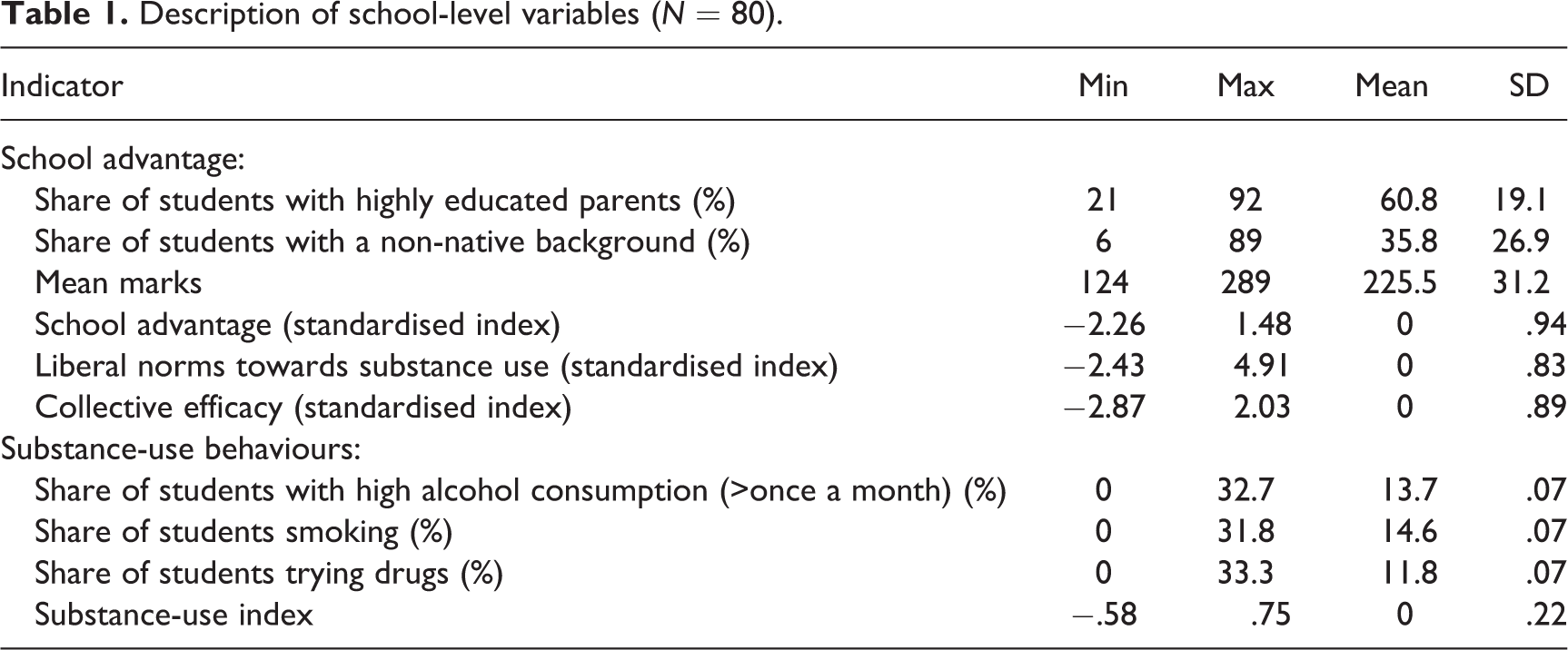
Table 2 presents the associations between the schools’ structural characteristics and their normative and social ones. An overall positive association exists between school advantage and school liberal norms about substance use. However, the association does not reach statistical significance. The proportion of students with non-native backgrounds is negatively associated with liberal substance-use norms, indicating that school substance-use norms tend to become less liberal with increasing shares of students with a non-native background. The remaining structural characteristics display a positive, although non-significant, association with liberal norms about substance use. This suggests that school norms about substance use tend to become more liberal the higher the mean marks and the share of students in a school with highly educated parents. When one looks at the separate effects of the indicators that make up the index of liberal norms (data not shown), the strongest indicator is the item measuring the extent to which adolescents were given alcohol at home. This indicator displays a strong positive association with all school structural characteristics (r = 0.59–0.66) except for the share of students with a non-native background, where a strong negative association is found (r = −0.68).
Pearson’s correlations between school characteristics (N = 80).
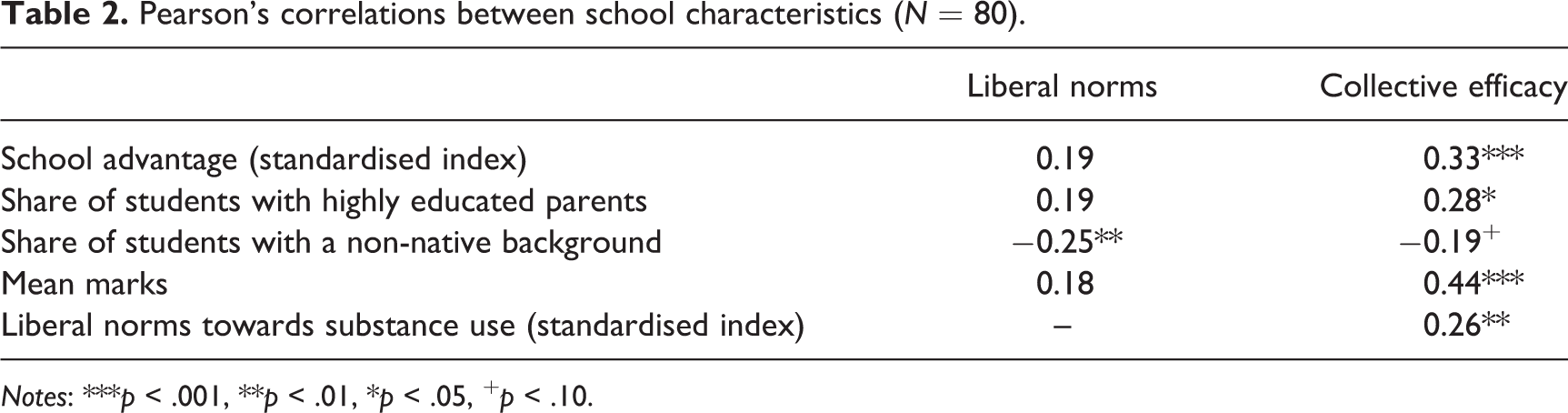
Notes: ***p < .001, **p < .01, *p < .05, + p < .10.
Table 2 further shows that there is a positive association between collective efficacy and school advantage, as well as between schools’ collective efficacy and their share of students with highly educated parents, mean marks and liberal norms. The share of students with a non-native background, in contrast, is negatively associated with collective efficacy.
Associations between school characteristics and the outcomes are presented in Table 3. School advantage shows an overall positive association with substance use, suggesting that these types of risk behaviour are more common in advantaged school settings. The strongest associations are between indicators of school advantage and prevalence of alcohol use. The estimates for smoking and drug use run in the same direction, although they are generally weaker than the ones found for the measure of alcohol use. School liberal norms show a positive association with overall school substance use as well as with the specific substance-use indicators. Overall, results suggest that substance use tends to be more prevalent in schools where substance-use norms are more liberal.
Pearson’s correlations between school characteristics and outcomes (N = 80).
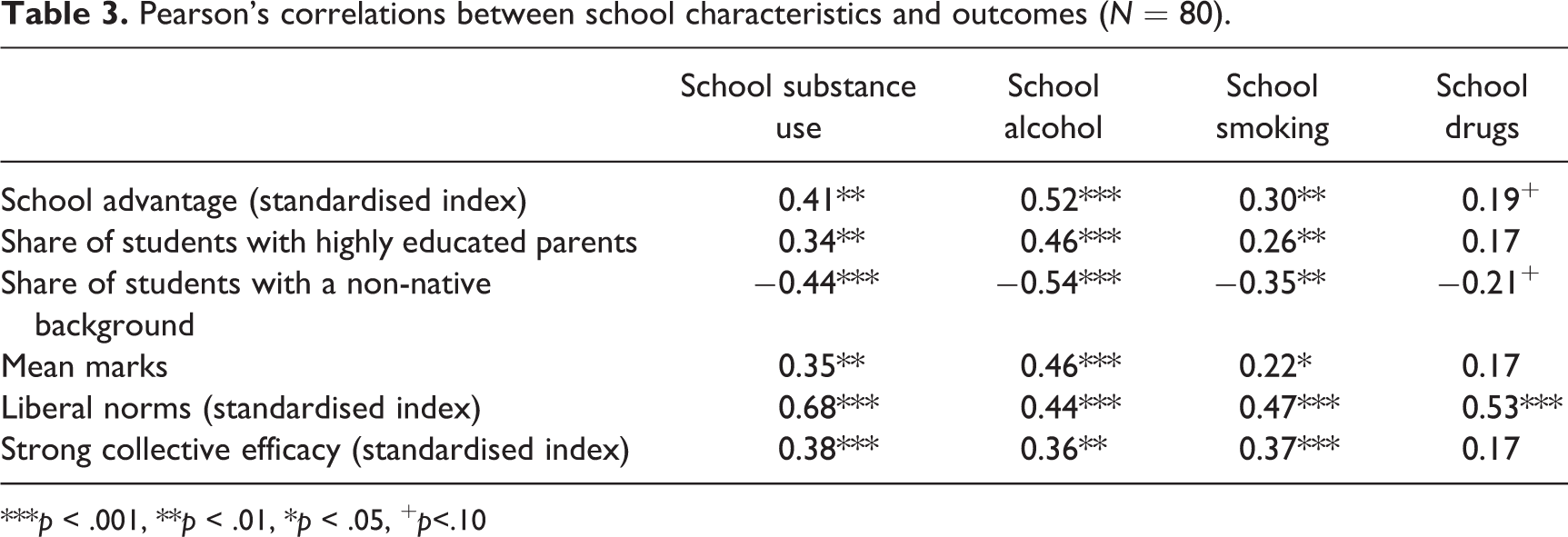
***p < .001, **p < .01, *p < .05, + p<.10
Finally, collective efficacy is positively associated with all three types of substance use, suggesting that these risk behaviours are more common in schools where teachers rate the level of collective efficacy as strong.
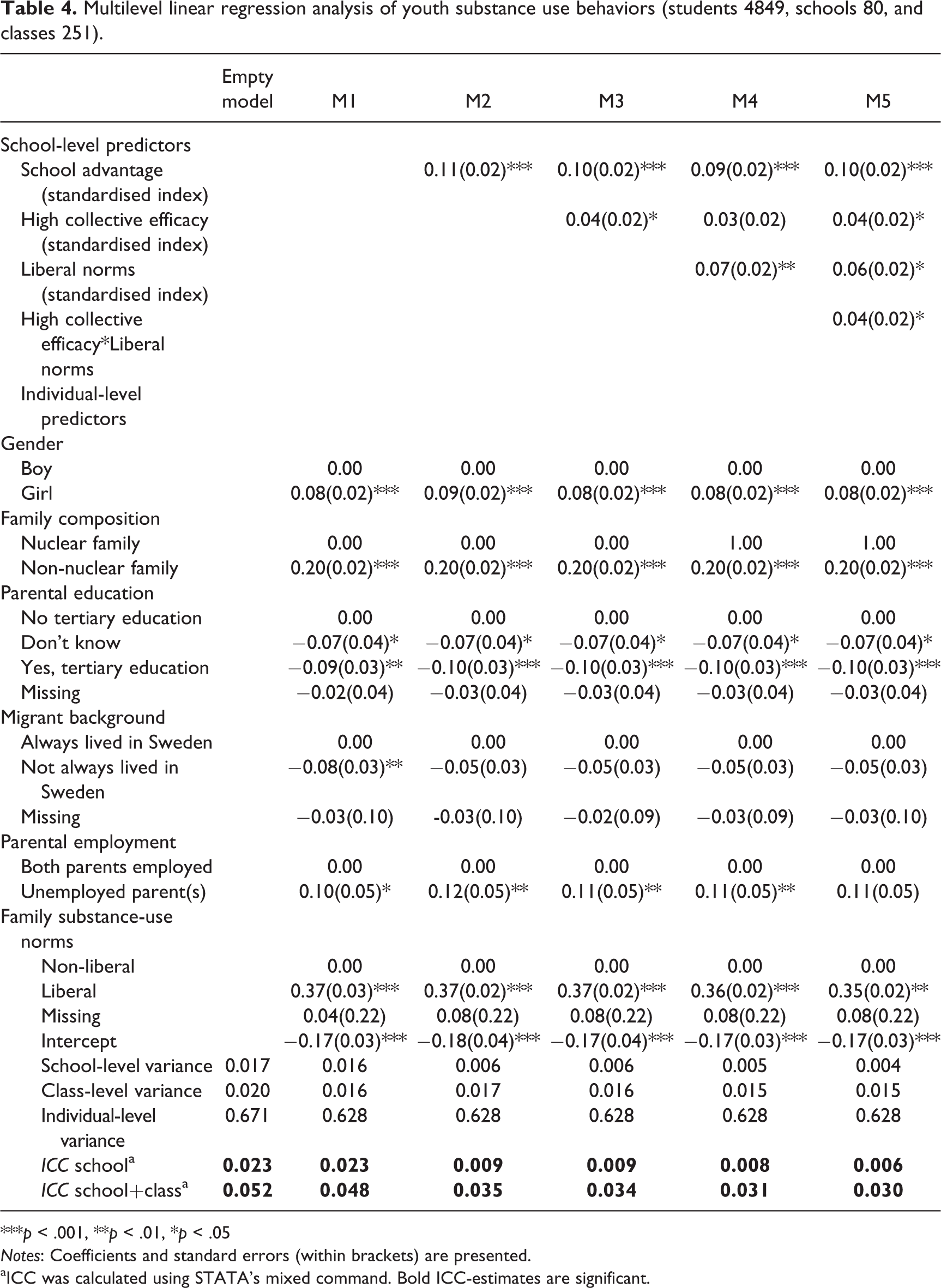
Results from the multilevel analyses, which separate the effects of individual-level and school-level characteristics, are presented in Table 4. First, an empty model is fitted. As indicated by the ICC, 5.2% of the total variation in substance use can be attributed to differences between schools, taking school- and class-level variation into consideration. Next, student-level variables are introduced to the model in order to establish whether any school differences in substance use remain when individual background characteristics are taken into consideration. This results in a somewhat reduced ICC, but 4.8% of the variation in substance use can still be attributed to schools. Overall, the results suggest that being a girl, not living in a nuclear family, having at least one unemployed parent and coming from a family with more liberal norms towards substance use are associated with increased substance use. In contrast, students with a foreign background and those with tertiary-educated parents tend to be less involved in substance-use behaviours than their peers.
Multilevel linear regression analysis of youth substance use behaviors (students 4849, schools 80, and classes 251).
***p < .001, **p < .01, *p < .05
Notes: Coefficients and standard errors (within brackets) are presented.
aICC was calculated using STATA's mixed command. Bold ICC-estimates are significant.
The school-level covariates are included in a stepwise manner in models 2–5 (controlling for the socio-demographic composition of the students). As Model 2 demonstrates, substance use is more prevalent in more advantaged school settings (β = 0.11, p < .001). In terms of explained variance, the inclusion of the indicator of school advantage lowers the ICC substantially. Model 3 suggests that schools’ level of collective efficacy is positively associated with substance use among students (β = 0.04, p < .05). However, the effect of school advantage on substance use largely remains when collective efficacy is introduced in Model 3. In Model 4, the measure of schools’ substance-use norms is introduced. The result suggests that schools characterised by more liberal norms towards substance use, i.e. schools where many students come from families with more permissive norms towards drinking and smoking, also have a higher prevalence of substance use among their students (β = 0.07, p < .01). Jointly adjusting for the school’s collective efficacy and normative climate attenuates the effect of school advantage by about 18%, but a direct and significant effect remains.
The final model tests for the joint effect of school collective efficacy and liberal norms by including an interaction term to the model. The result suggests that the positive effect of school collective efficacy on substance use is accentuated in schools where permissive norms towards substance use are more strongly represented (β = 0.04, p < .05). Figure 1 illustrates this association. It shows the slope for substance use on collective efficacy when the moderator variable (school norms) is held constant at different values. As suggested by the figure, in schools where less permissive norms are more strongly represented, a high collective efficacy has an attenuating effect on youth substance use, whereas the opposite is true in school environments characterised by more permissive norms. Schools characterised by a high collective efficacy and liberal norms are the most detrimental settings in relation to substance use.
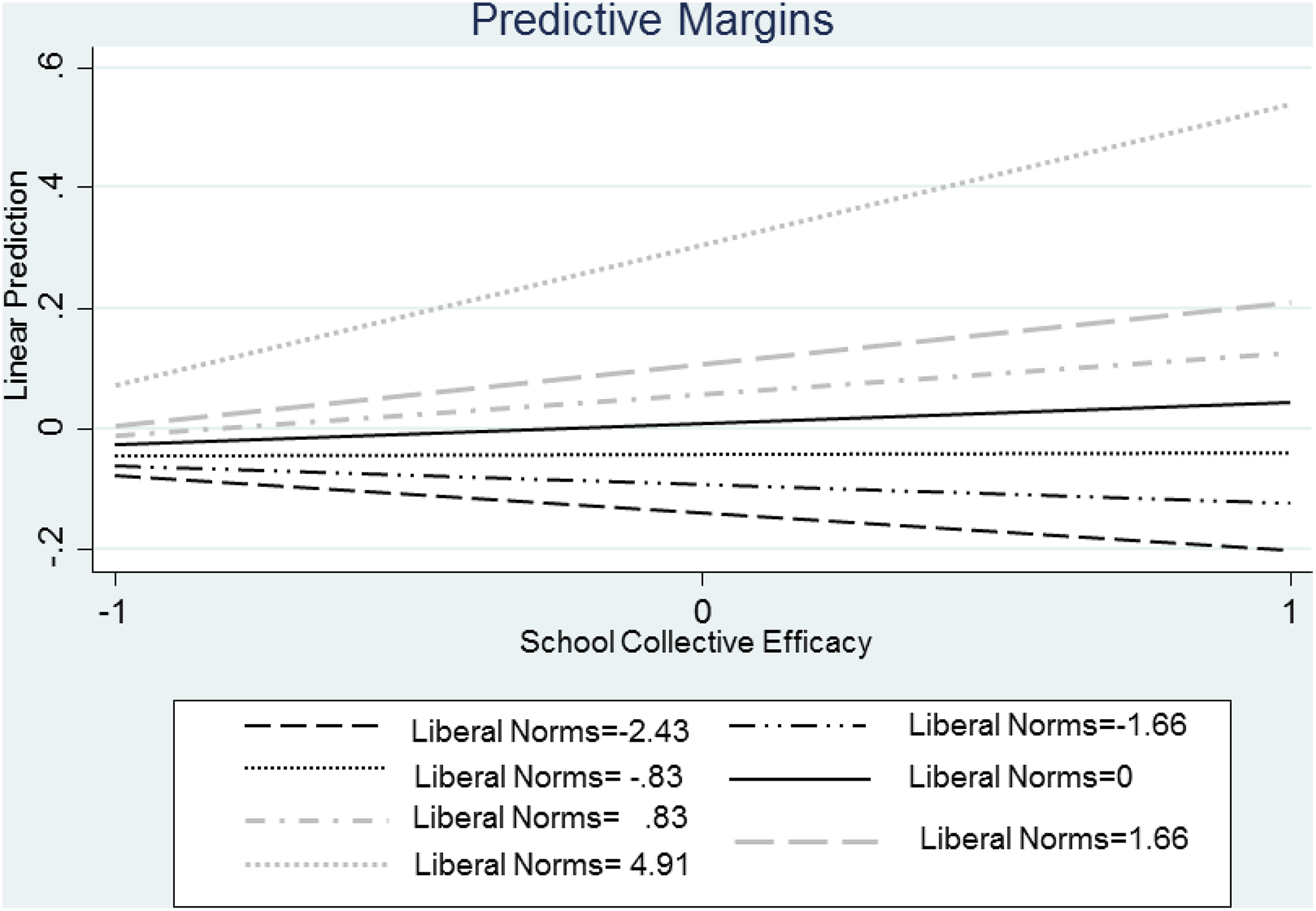
Marginal plot on the interaction between school collective efficacy and school collective norms about substance use on adolescents’ health risk behaviours (n = 4849). Moderator variable held constant at min, max, mean and +/- one and two standard deviations (sd = .83).
Discussion
The purpose of this study was to explore some possible mechanisms behind the theoretically counter-intuitive empirical findings that adolescent substance-use is more prevalent in socio-demographically advantaged than in disadvantaged school settings. The ambition was to expand previous findings about how aspects of the school context are linked to youth substance-use by investigating the separate and joint effects of school collective efficacy and schools’ substance-use norms.
Our findings indicate that school has a direct effect on young peoples’ substance-use behaviours, net of individual social background. About 5% of the total variation in substance use occurred at the school level. Although the contextual variance is limited, it is in line with what could be expected. In a systematic review of school effects on health outcomes which includes studies from Australia, USA and Europe, Sellström and Bremberg (2006) found that between 9 and 12% of the total variation in smoking and alcohol use occurred at the school level. A more recent UK study of school variations in health outcomes (Hale et al., 2014) found school variation in substance use to vary between 3 and 12%. Considering that Sweden, from an international perspective, has relatively low levels of school segregation (Swedish National Agency for Education, 2006), a school variation on the lower part of the scale is in line with what could be expected. Consistent with previous research (Botticello, 2009; Carlson and Almquist, 2016), rather than theory (Shaw and McKay, 1942), our results also indicate that substance use is more common in advantaged schools than in more disadvantaged ones. Thus, the results support the idea that certain school environments are associated with greater risks of substance use than others and that the same individual’s proneness to engage in these types of behaviour will vary depending on the socioeconomic profile of the school that he or she attends.
A closer look at the two hypothesised mechanisms (school norms and collective efficacy) revealed that both were associated with school advantage. Substance-use norms were more permissive and collective efficacy stronger in more advantaged school settings. In addition, a couple of interesting findings emerged regarding these associations. Firstly, the positive association between school advantage and liberal substance-use norms largely depended on the schools’ share of students with a non-native background: the smaller the share, the more liberal the norms. This finding adds support to the growing body of research linking the ethnic composition of schools and neighbourhoods to youth substance-use (Botticello, 2009; Carlson and Almquist, 2016; Van Tubergen and Poortman, 2010). Secondly, the extent to which students were allowed to try alcohol at home proved to be the single most important item of the ‘liberal norm index’ for its association with school advantage. Thus, a central component in the association between school advantage and collective substance-use norms is the fact that students in more advantaged schools are more commonly allowed alcohol at home.
The contribution of school-level norms and collective efficacy to the association between school advantage and substance use was then further explored by combining information about school advantage, school norms and collective efficacy in a series of multilevel models. The results showed that collective efficacy had more of a direct than a mediating effect. Further, in contrast to the original theoretical assumption, schools with high levels of collective efficacy tended to have a higher substance-use risk. This finding is in accordance with studies of social capital showing that strong ties have the potential to encourage unhealthy attitudes under certain circumstances (Kubrin and Weitzer, 2003). Although most studies show that social capital has a protective effect (Kawachi, 1999), it has previously been suggested that the social character of substance-use behaviours makes them more vulnerable to social influences (Poortinga, 2006). Aspects of social capital have, for instance, been found to encourage substance use among adults (Chuang and Chuang, 2008; Poortinga, 2006). A reasonable assumption is that similar processes also operate in the younger part of the population (Pedersen et al., 2014).
The results further suggest that schools’ normative characteristics do indeed influence youth substance-use. We found that schools’ normative climate had a clear direct effect, but only found limited support for a mediating effect. This indicates that youths attending schools where the student body tends to come from families with more permissive substance-use norms are more prone to engage in such behaviours, irrespective of the norms they are exposed to at home. Other studies that have considered the influence of schools’ normative climate on substance use have reached similar results (Su and Supple, 2016; Thrash and Warner, 2016). These have suggested that schools’ disapproval of substance use may act as a barrier against this kind of behaviour because students are more likely to encounter negative reactions to their (intended) behaviour in schools where the prevailing norms are more conservative. The opposite is likely to be true in schools characterised by more permissive norms about substance use. In a similar vein, criminological studies as well as studies of social capital have recognised that the extent to which the involved actors disapprove of the behaviour is central for their capacity to exert informal control (Kubrin and Weitzer, 2003). This suggests not only that substance use is likely to be higher in schools where such behaviours are regarded as at least somewhat more acceptable, but also that the effect of schools’ informal controls is likely to be attenuated (Botticello, 2009).
An even more important finding is the moderating effect of school norms on collective efficacy that we found, which suggests that the effect of collective efficacy on students’ substance use varies as a function of school-specific norms. This is in line with the idea that collective efficacy is task-specific (Kubrin and Weitzer, 2003). Thus, in schools where permissive norms about substance use are more strongly represented, the positive association between collective efficacy and student substance use appears to be a stronger. Similar results have also been found for adults in a study of neighbourhood collective efficacy and its effects on smoking behaviour (Ahern et al., 2009). Our study adds to these findings by showing that in schools, just as in neighbourhoods, efforts aimed at building collective efficacy as a way to reduce youth substance-use need to consider and target other characteristics of the environment as well. As suggested by Ahern et al. (2009), building collective efficacy without addressing norms about substance use could otherwise lead to the opposite of the intended effect. However, our results also suggest that a net direct effect of school advantage on youth substance-use remains when school collective efficacy and substance-use norms have been taken into consideration. Thus, additional mechanisms may also be at work. Adolescents in advantaged school settings may for instance engage in these types of behaviour in order to combat the stress, anxiety or depression they experience from achievement pressures (Luthar and Becker, 2002). Moreover, adolescents in more advantaged schools may also have greater access to economic resources, which enables them to spend money on alcohol, tobacco and/or drugs (Pedersen et al., 2014). Exploring other aspects of individual and contextual socioeconomic advantage than those under study here may thus help our understanding further.
Limitations
Certain features of the data, design and choice of methods may have affected our findings. The data is cross-sectional, which therefore makes any kind of causal inference difficult. It is also possible that access to other potentially important variables would have enriched the study further. In addition, we know that the socio-demographic characteristics of schools in Sweden largely mirror those of the surrounding neighbourhood. It is thus possible that the school effects function partly as a proxy for neighbourhood effects. However, studies aimed at disentangling the effects of neighbourhoods and schools suggest that, although these processes are intertwined, schools matter more for youth behaviours (Carlson and Almquist, 2016; Ennett et al., 1997; Kirk, 2009). Moreover, the educational system in Sweden allows children to choose their school, which means that school and neighbourhood contexts will not be geographically the same for all students. It should be borne in mind, however, that we may have overestimated the effects of schools by not considering neighbourhood effects in our analyses. Another possible limitation is that information about school-level norms regarding substance use was aggregated from students’ self-reports. This can introduce source bias, whereby any association found may merely reflect unmeasured characteristics of those providing the data. However, the aggregation of micro-level data to the macro-level is a common procedure (Snijders and Bosker, 1999). By adjusting for the same questions at the individual level, any such bias should be largely controlled for. Moreover, we derived information about school disadvantage and school collective efficacy from other sources than the individual-level information, which is a clear strength. A further possibility is that our decision to combine items into substance-use scores rather than keeping them as single items has masked more specific associations. However, the overall idea of this study was not to scrutinise detailed associations between particular indicators of substance use, but rather to give a broader account of how the theoretically derived and empirically supported concepts relate to each other. More research into the shared determinants of correlated outcomes has been called for, and this study is one such attempt (Jackson et al., 2012; Wiefferink et al., 2006).
Conclusions
In conclusion, we have found limited support for the first research question. The results showed that school norms (and collective efficacy) had more of a direct than a mediating effect on the association between school advantage and youth substance-use. In addition, in contrast to our original assumption, schools with high levels of collective efficacy exhibited a higher risk of substance use among their students. In relation to the second research question, the effect of collective efficacy on youth substance-use was found to vary as a function of school-specific norms. In schools where more permissive norms about substance use prevailed, the positive association between collective efficacy and student substance was stronger. The current study contributes to research into school effects by suggesting that school environments perceived as safe and characterised by strong trust may increase youth substance-use behaviours, unless school norms about these behaviours are addressed simultaneously.
Footnotes
Acknowledgement
We would like to thank the Stockholm City Social Development Unit at the Social Affairs Administration for giving us access to the Stockholm School Survey.
Funding
The author(s) disclosed receipt of the following financial support for the research, authorship, and/or publication of this article: The study was financed by The Swedish Research Council Grant No. 2014-10107 and Swedish Research Council for Health, Working Life and Welfare project Grant No. 2013-0159.