In the last two decades, questions have been raised against the relevance of business education all around the globe including the famous MBA program. Despite few shortcomings of western MBA programs, they are considered to be the global benchmark owing to their reputation, quality, research focus etc., whereas most of their Chinese counterparts are criticized heavily for their different weaknesses ranging from obsolescence and incorporating unique Chinese characteristics to blindly following the US model, without devising the right mix. This study compares the Chinese MBA with the Western MBA programs, highlighting the crucial weaknesses prevailing in Chinese MBA programs and then identifying the necessary improvements to bring them at par with their western counterparts. The study also contributes by bringing-forth ‘must have’ and ‘can have’ courses as a part of the MBA curriculum by going through both Western and Chinese MBA curriculums in depth.
Business education today faces a paradoxical issue: the most renowned business schools in the world are no longer in the flourishing economic zones. As a follow-up to this change, Business schools—and more specifically MBA s—have seen their relevance been called back into question over the last few years, especially in China (Borgonjon & Vanhonacker, 2006). To date, many researches have been conducted, either focusing on the market approach of business schools MBA s, and how they are attractive to employers, or by polling students enrolled in Business schools. Most of them have outlined a lack of practical learning, making business schools an “off-track” path to the business environment.
Although business schools are responsible for providing leaders/managers with knowledge, values and cross-cultural intelligence to seek progress for their businesses, their communities and society at large; business schools currently face great challenges and opportunities in educating future leaders who can work across the countries and cultures (Maria, 2013). This challenge indicates the importance of defining a quality business education program to deliver business graduates with the knowledge, attitude, and skills that employers and extended society’s need; therefore, raise the awareness of a standard business education program that is matching with premier business schools. Recent studies have worked on how business schools in different areas of the world make an appropriate approach to MBA programs based on the original MBA prototype in the USA (Lamb, P. & Currie, 2012). In this paper, we chose Chinese business schools in comparison to US and European business schools’ standard in consideration to the unique “Chinese characteristics” that has been contributed to modify the MBA program in this country (Goodall et al., 2004). Under Western MBA standards, the MBA in China is not immune from criticism and as courses proliferate this will grow (Goodall et al., 2004).
On the other hand, Western Business schools and MBA s, despite some of their shortcomings owing to curriculum, have always had the reputation of educating some of the most valuable and well-performing managers in the business world. We thus come to the point that despite ample literature on weaknesses of Chinese MBA, there is no concrete work on providing pragmatic solutions to address those. Considering the chasm, our research question is (RQ) how to develop an innovative and evolving Chinese MBA program that is on par with global standards. The paper aims to make a comparison between Western and Chinese Business Schools to find out the inherent loopholes in Chinese Business Schools, and then provide the solutions accordingly.
Literature Review
MBA at a Glance of Global Standard and Its Tendency History
The first school that made a pure focus on graduate business education and first produced the MBA program is Harvard Business School in 1908 (Copeland, 1958). MBA curriculum at the beginning focused heavily on learning about existing business practices rather than about the theoretical frameworks that construct the business (Pierson, 1959). The 1940s and 1950s witnessed an enormous growth of business schools in general and for graduate programs in particular, along with an increased focus on analytical methods related to planning and decision making (AACSB, 1966). The 1970s to late 1980s can be considered as the golden age of MBA program development whereby the programs were improved with innovation courses, along with the debate about making a balance between practical versus theoretical learning which led to competency-based models of MBA program (Gilbert, 2009).
According to Gilbert et al. (2009) that compiled, developed, and adapted from Hambrick (1975), the goals of MBA schools that ranked by executives and educators including mainly: problem solving, communication, implementation (ability to implement managerial decisions), specific business environment, analysis (business analytical skills), interpersonal competencies, learning and leadership and other knowledge of remote business environment (political, social and economic) and soft skills (attitude and enthusiasm for management). AACSB (2019) presented all the capacities that need to be trained through the MBA program should include: (1) strategic management (2) learner success, and (3) thought leadership. Furthermore, an emphasis on technology integration was expected to integrate in the study method which requires both from the learners and faculty’s technology competency (AACSB, 2019).
Lorange (2008) defined the challenge of business schools as : “ … The need to be staffed by the best possible executive talent from around the world has placed a burden on business schools to offer relevant learning, based on current and practical research, for leading executives-cum-learning partners”. In order to do that, Cremer (2010) suggested that it is necessary to make a transformation to business education which is based on both business schools’ leaders and faculty while cooperating with practical executives on location in the emerging markets, not only by the business schools’ curriculum established in the US or Western European. Recent researches have studied on how business schools adapt the original MBA prototype in a specific emerging market. Several studies like Currie (2011) suggested that there should be a modification, owing to revamping of the curriculum, bringing in technical and modern flexibilities etc. in order to raise the global standards as a whole.
The Prevalent Scenario of Business Education in China
In China, MBA has been extensively considered as the most identified and prestigious management degree (Micklethwait, 1996). However, MBA Education has not seen such a long history in China (Hui et al., 2019). The demand for MBA has increased immensely since the early 1990s; the number of MBA programs in China has increased from nine with 86 students enrolled to over 231 with over 40,000 students enrolled in 2016 (Chen & Yang, 2010; Zhao, 2016). Despite the increasing programs and students enrolled in the MBA program in China which mostly focused on joint cooperation with foreign universities as partners, the MBA programs in China faced themselves tangled in the lack of knowledge and skills that should be delivered in business schools and the challenges of ethical standards should be imparted to their students (Navarro, 2008). The first MBA program, the China-Europe Manager Program (CEMP) started in 1984 by the European Community and the State Economic Commission, a ministry of a Chinese government; later it was developed into China Europe International Business School (CEIBS) located in Shanghai (Fischer, 1999). During 1988–1989, Chinese Government decided to officially launch MBA programs and conducted intensive assistance of several Chinese universities. The Ministry of Education (MOE) authorized the first cohort of nine business schools in China to pilot an MBA program since 1991 (Wu & Tong, 2001).
Chen and Yang (2010) pointed out that Chinese business schools constantly hire professors with minimal or no real world experience, which is tantamount to rubbing salt on the wounds. The commonality found in most of all the studies address the escalating criticism on the relevance of business education curricula (MBA), which undermines the most crucial managerial competencies (Tan & Ko, 2019). The review done by Rynes and Bartunek (2013) of five studies (Navarro, 2008; MBA Roundtable, 2012; Rubin and Dierdorff, 2009; Datar, Garvin & Cullen, 2010; Segev, Raveh & Farjoun, 1999) between 1993 and 2012 found that the MBA curricula is generally misaligned with competencies.
Lorange et al., (2008) pointed out that most of the core knowledge has been taught in business schools is rooted in business practices in the US and Europe, most researching and teaching materials focus on “Western” business practices. Taking a similar approach to other industries, Chinese business schools are basically based on successful programs and cases in the US such as Wharton’s program (Warner & Goodall, 2009). Tong (2000) and Berrell (2001) recognized that Chinese MBA program was transplanted from the West and has become an important component for developing Chinese managers (Wang, 1999; Wu & Tong, 2001; Berrell, 2001; Guo, 2009). According to Cremer et al., (2010), one of the reasons behind this “copying” situation is Chinese business schools, like any business schools in emerging markets, have no choice but to aim at a standard model that has been considered widely. Secondly, these are the strategies of business schools in China which are striving to raise their reputation and international standing. Furthermore, under the pressure of producing more managers, most MBA programs in China simply copied the US model (Zhao, 2003) with management concepts and models originated from the west while applying singular instructional methods. The problem is that the “US model” has been criticized for years (Mintzberg, 2004; Navarro, 2008).
Difficulties in Developing MBA Program in Chinese Business Schools
Among cross-cultural studies which explain the effect of national culture to any specific aspect of business development, China has not surprisingly received considerable attention as it is one of the strongest and most influential economies in the world (Li & Persons, 2011). However, Lau and Roffey (2002) affirmed that there are extensive difficulties correlated with cultural and traditional background in China towards managers educated from Chinese business schools to work in the country. Business education in China was indicated with problems due to the discrepancy in “imported” programs from the US and European business schools (Bu & Mitchell, 1992). Nonetheless, considering the difference of historical, cultural, demographic, social, political and institutional realities in China, this is not an appropriate approach. Jaeger (1990) stated that the imprudent use of Western management theories and techniques in developing countries could end up causing organizational inefficiency and ineffectiveness while bringing in resentment and other negative effects associated with the perception of being subject to “cultural imperialism”, for example, while Chinese business schools are imitating servilely “US model” to their MBA program, they are forced to adopt and accept practices that run counter to values and assumptions of their culture. The researchers (Rubin & Dierdorff, 2009; McNamara, 2006) accepted that MBA curriculum is the major issue which has to be addressed but there are other aspects which have to be looked at, just like Chen and Yang (2010) pointed out shortage of qualified business faculty, lack of integration between internationalization and localization, and non-adaptability to changes in the market, as major challenges of MBAs in China. Not being able to connect foreign theories with China’s management environment is one of the biggest weaknesses of Chinese MBAs (Lau & Roffey, 2002).
Among the reasons that lead to the discrepancy, the nature of management theme, classroom culture, decision making in the curriculum, learning design, teaching materials, teaching staff quality, participation and direction in the learning process play critical parts (Lau & Roffey, 2002). The challenges for Chinese business schools currently can be seen as how to keep up with the changing market, curriculum design, faculty, the balance of internationalization and localization (Chen & Yang, 2010). Therefore, cross-cultural training in specific contexts of business programs which reflect a country’s economic development, industrial policies and legal system should be added as supporting courses in the curriculum. This will be illustrated in our suggested framework in the next part and in detailed analysis.
Kolachi Framework
Kolachi framework is a comparative framework of business education which was developed by Kolachi and Waijidi, 2008. The framework reflects on the system, methodology, exposure, environment and business ambassadorship between business programs in developed and developing countries (Kolachi & Waijidi, 2008). By using this framework, a coherent understanding which covers the whole view of business education will be provided concerning both the concept of business education and required exposure in different universities. In detail, the main components of the framework includes Faculty, Students, Higher Education Commission or Authority (of the country), Faculty’s remuneration and Research activities. All the components are used to analyze considering both internal and external environments. It provides an insight on ascertaining the position of any business school with reference to internal and external activities based on Faculty and Students’ exposure.
The model can be applied on less or more than fifteen. The only thing that will remain constantly is the criteria of elements (4 Internal and 4 External Elements) which covers lots of things especially the techniques of achieving academic excellence. (Random Selection of Business schools). The criteria of scaling are based on a 1 to 5 where 1 is Bad, 2 is Fair, 3 is Good, 4 is Very Good and 5 is Excellent. In total 1 to 10 is Bad, 11 to 20 is Fair, 21 to 30 is Good, 31 to 35 is Very Good and 36 to 40 is Excellent.
The questionnaires were developed and given separately to American, European and Chinese Business Schools. The respondents were related to industry, government, policy makers, teachers, alumni, trainers and senior students. Following is the explanation for terms used in the model and terms used in the analysis. The framework is presented in Appendix 1.
Internal: Faculty Development Program (FDP), Students’ Development Program (SDP), Rem (Faculty remuneration & rewards), Edu (Faculty education & exposure)
External: International Faculty Development Program (IFDP), International Students’ Development Program (ISDP), IL (Industry Linkages), Res (Research environment)
Methodology
This is a mixed methods research which inquires the involvement of both quantitative and qualitative data, integrating these two forms of data with narrative analysis. As the research was carried out to make a comparative study under time-constrained condition, it is a cross-sectional study (Saunders et al., 2015). In order to increase the validity and trustworthiness of the results, both primary and secondary data were used in the analysis. Since the authors are currently master students in a business school in Sweden and have access to business students with international background, as well as a network of business schools in Europe, the study was preceded by an ethnography approach in which the researchers conduct the study on-site and in a naturalistic setting where real people work. Furthermore, it can be personalized as the authors are both the observers and participants in the environment (Sanasubana, 2011).
For the primary data collection, a combination of interviews and questionnaires was used. Therefore, semi-structured questionnaires, skype and telephone interviews were proceeded among respondents who are professors, Chinese and Western business students. Since the research consists of four different segment groups, four questionnaires were designed for four different categories of participants (Western students, Chinese students, professors and employers). The questionnaires were designed to define the difference between Chinese business school’s curriculum and those from Western business schools, as well as the thoughts and experiences of Chinese business students about the program. Additionally, secondary data will be collected from different peer reviewed articles, newspapers, magazines, third party contacts, vlogs and emails.
The sample of Business schools in the US, Europe and China will be selected on the basis of convenience and personal contacts of the authors, including both graduates and current students. Furthermore, some authors have observed the major differences between Chinese and Western B. Schools when they visited them in the past. The main framework that was used is Kolachi’s IE Model (Kolachi, 2008) in which chosen business schools will be utilized in order to make a comparative analysis between Western and Chinese Business Schools. This model covers faculty, students, research activities, faculty remuneration etc.; that will help to analyze through the lens of internal and external environment. Total 10 business schools will be considered, 3 from the United States, 3 from Europe and 4 from China. The list of universities are presented as below.
Data Collection
Considering the time constraint, the quantitative data was collected from November to 2019 using four questionnaires as above mentioned. The two surveys for business students collected 206 responses from Western students which were derived from Copenhagen Business School, Neoma Business School, Bryant and Stratton College and 129 Chinese students which were from Nanjing University, Ningbo University, Peking University and Shanghai University. In order to understand the structure of curriculum in business schools of both sections, the questionnaires focus on the components of curriculum and the additional courses that were provided to strengthen the academic base of the students such as career orientation programs, professional experiences, internships, etc.
List of Western and Chinese Business Schools
A total of 25 professors have done the survey which consists of 17 professors from Europe and 8 professors from China. Among them, 44% have a PhD and 72% are researchers. There are 32% of the professors working as a researcher and lecturer simultaneously. Throughout the semi-structured interviews with seven professors which concentrated on their ideas about MBA curriculum, most of them emphasized the importance of practical perspective while building curriculum. In response to the question in which the professor was asked to describe an experience in which they identified educational needs of the students and successfully developed a way to teach/train them, five out of seven professors mentioned strong networks with local businesses and practical learnings which involved the students in connecting theories and business practices.
There were 50 employers whose sectors are from financial services, consulting, construction, engineering and education responded to the survey. Among them, there are 19 employers from Europe and 31 employers from China. Due to the results, 52% of employers considered MBA as a strength while considering a candidate, 28% of employers have heard about Chinese MBA program and 26% considered hiring someone who graduated with Chinese MBA. In order to make a better comparison, two curricula from representatives of Chinese and Western universities were chosen to discuss which are from Peking University and Copenhagen Business School. This is due to the consideration that Peking University ranks in the world’s top 50 in total of 32 business education subjects and the highest among universities in Mainland China, while Copenhagen Business School offers three triple-accredited MBA programs and is well-known because of quality business education.
Findings
With all gathered databases shown above, the authors applied available information on the basis of the Kolachi framework which considers main components of Faculty, Students, Higher Education Commission or Authority (of the country), Faculty’s remuneration and Research activities. The framework takes into consideration both internal and external factors activities of business education, which shows the relevance of our database which regards the reality of those in business schools. The result is presented in Table 2.
– Internal: Faculty Development Program (FDP), Students’ Development Program (SDP), Rem (Faculty remuneration & rewards), Edu (Faculty education & exposure)
Management of MBA Program
It can be seen that most of Western business schools got a high total rate in general and in each factor of their program in particular. While most of Western universities focus on the quality of students regarding the academic and research career, most of Chinese universities basically concentrate on creating the faculty and attracting more students. This can be explained under the pressure of the national business school association supervising MBA education in China who actively promoted the expansion of business schools in China; accordingly, the schools were forced to open more majors to develop into “comprehensive universities” (Choi & Lu, 2013). For instance, Peking University is working with seven universities in five countries (United States, Canada, South Korea, France and Singapore) and offers dual degrees in which the students just need to attend a one-year program in Peking and another year in the other cooperating university. Garrett et al. (2006) reported that China hosted 32 international branch campuses in which the majority offer an MBA. Among the universities in China, there is an outstanding trend to focus on developing the network with companies and keep the students updated with market information and trends (Industrial linkages) as China has been experiencing a burgeoning economy and in needs of qualified workers to meet a more capitalistic society guided by free market principles (Alon & Lu, 2014).
For the chosen Chinese business schools in this paper, the majority hired fresh MBAs as lecturers or very limited number of both Western and Chinese lecturers to conduct the work, as well as engaging in the program development. When being asked what the main reasons for changes in MBA programs are, more than a half of professors in China answered that it is the suggestions of the program director. The second most answered reason was the competition meaning that academic opinions and pressure of other competing schools are seen relevant when changing and adjusting curriculum of MBA programmes. Whereas, the lowest ranked answers were employers’ feedback and students’ feedback, respectively, which may be indicating the issues in the relationship of business environment and academia. Chen and Yang (2010) pointed out this weakness of Chinese business school for constantly hiring professors with minimal or no real world experience.
Program Structure
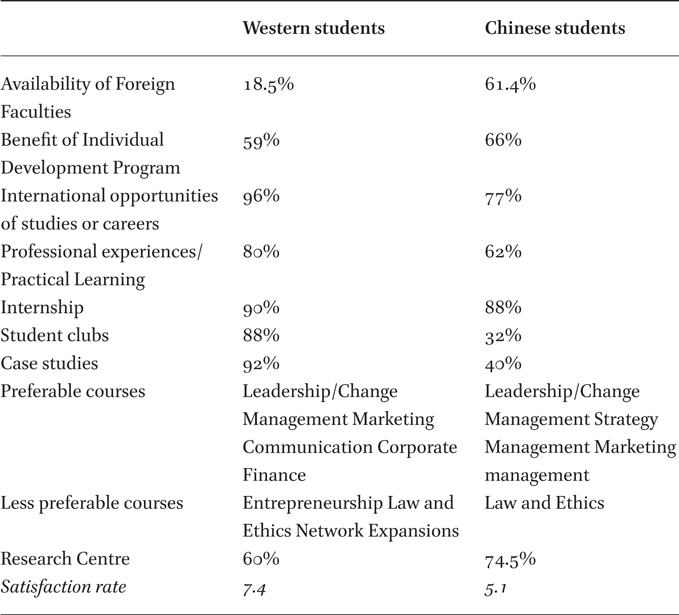
The survey on the students’ ranking of 12 different classes according to their personal development’s preferences shows that the most liked course was “Leadership/change management”, occurring 32 times on every step of the podium, and mentioned only 39 times under sixth position. “Management” as well as “Marketing and communication” were also highly rated as the first choice of students (respectively 33 and 32 times in first position), but do not create such unanimity (more than 50% of students placed them in second half of the ranking). “Entrepreneurship”, “law and ethics”, “corporate finance”, and “network expansion” were the most lowly rated classes, all of them occurring more than 75% of time in the second half of the ranking.
Many authors mentioned Chinese MBA program is based on successful programs and cases in the Western program (Creme, 2010; Warner & Goodall, 2009; Zhao, 2013). Taking a look at the curriculum of Peking business school, it can be recognized that there is a mixture between traditional courses of MBA and Chinese “characteristics” such as “Business Chinese”, “China in Global Political Economy” as main courses, and “Entrepreneurship in China” as Elective courses. That shows a proof of improvement of Chinese MBA programs to answer the need of leading Chinese firms who favor MBA programs that have both global perspective and a Chinese focus (Ma & Trigo, 2011), and to deviate from the material focus on “Western” business practices. That also proves that Chinese MBA program has connected foreign theories with China’s management environment and adapted to the changes of the market, which has always been a challenge of MBA s in China (Chen & Yang, 2010). Additionally, both Chinese and Western professors concentrated on their ideas about MBA curriculum, most of them emphasized the importance of practical perspective while building curriculum. In response to the question in which the professor was asked to describe an experience in which they identified educational needs of the students and successfully developed a way to teach/train them, five out of seven professors mentioned strong networks with local businesses and practical learnings which involved the students in connecting theories and business practices. Aithal (2015) also emphasized the importance of industry collaborations which adds industry experience in the form of project work enhancing better results of MBA students. This can be seen as a course of CBS such as “Master Project: Integrated Strategy Project” where Peking University’s program is still lacking.
Peking University’s MBA curriculum. Extracted from Peking University’s official website
CBS’s MBA curriculum. Provided by CBS (2020)
Summary on Western and Chinese students’ response on MBA course structure
During the interview, one Chinese professor mentioned that one of the approaches of Chinese MBA program is to translate popular Western MBA textbooks into Chinese and then make materials for MBA courses to Chinese students in native language. This approach created a barrier for Chinese MBA programs to meet the demand of Chinese market and Chinese students’ expectations, at the same time ignoring the prevailing view of curriculum from both sides is different. For example, the Western education program is centred on the individual while Chinese notions are collective (Berrell et al., 2001). Furthermore, the nature of Chinese managerial behavior values collective action, maintaining relationships in the long term (Mead, 1994); therefore, an appropriate curriculum which incorporated unique lectures in communication, conflict resolution and management practices are more appreciated.
Conclusion
MBA has been a popular topic and it has recorded an emphasis on the irrelevance of Chinese MBA programs. By this study, it can be seen that the curriculum has been innovated in Chinese business schools which considered a combination of core courses of MBA that were imported from Western business schools and Chinese traditional backgrounds. Chinese Business Schools are now more competent on the quality of education. However, more courses concentrated in making a clear difference in the cultural and business background of China would be more useful to both Chinese and international managers educated from Chinese business school to work in the country (Lau & Roffey, 2002). To solve curriculum issues of Chinese B. Schools the foremost point is to adopt AACSB, AMBA or EQUIS like curriculum and blend it with unique Chinese characteristics (integration of local and international, Chinese expertise with international exposure). Additionally, curriculum should support a lifelong learning path which is deep learning in contrast to rote learning. Regular interactions between academia and industry experts at large is very important in designing curriculum and for this purpose Bloomberg, GMAC annual surveys regarding desired skill set should also be considered. In addition, as a suggestion, this study provides a framework which divides the taught courses in the program between the ‘must’ and ‘can know’ categories according to global standards (Appendix 2). The ‘must’ courses that an MBA program should have are the core courses in business and management like accounting and finance, digital marketing etc. whereas the ‘can know’ courses are like real estate. This should be enriched by multi-parties including international faculty, practical business (by the industry collaboration network), professors and business students. Emphasis on research culture, faculty and students’ development programmes, international faculty and international student development programs, industry linkages both national and international, faculty remuneration etc. will play an instrumental role in taking Chinese Business schools to global standards. Faculty members should have a proper balance of theory and practice. Moreover, Chinese professors should have typical corporate leadership personalities like in western business schools.
Limitations
Considering this is a cross-sectional study made under time constraint, the study included just a few business schools from sources within the personal network of the authors. It therefore does not reflect the whole view of business schools in China and in Western countries. Therefore, it is recommended to broaden the range of universities by investing more time, and including more details would be beneficial to the research field.
Footnotes
Appendix
References
1.
AbramiR. M., KirbyW. C, & McFarlanF. W. (2014). Why China can’t innovate. Accessed from: https://hbr.org/2014/03/why-china-cant-innovate.
2.
AithalP. S. (2015). Comparative study on MBA programmes in private & public universities: A case study of MBA programme plan of Srinivas University. International Journal of Management Sciences and Business Research, 4(12), 106–122.
3.
AlonI., & LuL. (2014). The state of marketing and business education in China. Marketing Education Review, 14(1), 1–10.
4.
AsdemirK., & AhrensT. (2019). A pragmatist solution to the relevance gap of business school education. Journal of Economic and Administrative Sciences, 35(4), 285–295.
5.
Association to Advance Collegiate Schools of Business, AACSB (2020). Eligibility procedures and accreditation standards for business accreditation. Accessed on 12 January 2020, from: https://bit.ly/2FJKbsu.
6.
BerrellM., WrathallJ., & WrightP. (2001). A model for Chinese management education: adapting the case study method to transfer management knowledge. Cross Cultural Management: An International Journal, 8(1), 28–44.
7.
BorgonjonJ., & VanhonackerW. R. (2006). Management Training and education in the People’s Republic of China. International Journal of Human Resource Management, (2), 327–356.
8.
BuN., & MitchellV. F. (1992). Developing the PRC’s managers: How can western experts become more helpful?Journal of Management Development, 11(2), 42–53.
9.
CamuffoA., & GerliF. (2004). An integrated competency‐based approach to management education: an Italian MBA case study. International Journal of Training and Development, 8(4), 240–257.
10.
ChenX., & YangB. (2010). Copying from others or developing locally? Successes and challenges of MBA education in China (1990–2010). Journal of Chinese Human Resources Management, 1(2), 128–145.
11.
CheungC. K. (1998). Business education in Hong Kong after 1997. Journal of Education for Business, 73(6), 333–335.
12.
ChoiS. J., & LuJ. (2013). Returnee faculty members, network position and diversification strategy: an analysis of business schools in China. Asia Pacific Business Review, 19(4), 559–577.
13.
CopelandM. T. (1958). And mark an era: The story of the Harvard Business School. Little, Brown.
14.
CremerR. D. (2010). Chinese business schools and the future of management in the post-crisis era: Responsibility and opportunity. Chinese Management Studies, 4(1), 11–17.
15.
CurrieG. (2007). Beyond Our Imagination: The Voice of International Students on the MBA. Management Learning, 38(5), 539–556.
16.
CurrieL.2011. Higher education and the IB Diploma: A UK perspective. In Taking the IB Diploma Programme forward, eds. HaydenM.C. and ThompsonJ.J., 206–216. Woodbridge, UK: John Catt Educational.
17.
DatarS. M., GarvinD. A., & CullenP. G. (2010). Rethinking the MBA: Business education at a crossroads. Boston, MA: Harvard Business Press.
18.
Economist. (2018). Top 10 business school GMAT scores. Accessed from: https://gmat.economist.com/gmat-advice/business-school-admissions/rankings/top-10-business-school-gmat-scores.
19.
FischerW. A. (1999). To change China redux: a tale of two cities. Education+ Training, 41(6/7), 277–286.
20.
FlesherD. L. (2007). The History of AACSB International, Volume 2: 1966–2006. Tampa, Florida: AACSB International.
21.
FugateD. L., & JeffersonR. W. (2001). International perspective: Preparing for globalization—Do we need structural change for our academic programs+. Journal of Education for Business, 76(3), 160–166.
22.
GarrettR., KinserK., LaneJ. E., & MerolaR. (2016). International branch campuses: Trends and developments, 2016. London: The Observatory on Borderless Higher Education.
23.
Gilbert, D. (2009). MBA effectiveness in non-OECD countries: Perceptions of leadership and managerial skills. Unpublished DBA dissertation, University of Phoenix, Arizona.
24.
GoodallK., WarnerM., & LangV. (2004). HRD in the People’s Republic: The MBA ‘with Chinese characteristics’?Journal of World Business, 39(4), 311–323.
25.
GoslingJ., MintzbergH. (2004). The education of practicing managers. MIT Sloan Management Review, 45(4), 19–23.
26.
HuiP. P. Z., ChiuW. C., PangE., & CoombesJ. (2019). Escaping unintended collusion in MBA programmes in China. Industry and Higher Education, 33(3), 151–156.
27.
JaegerA. M. (1990). The applicability of western management techniques in developing countries: a cultural perspective, in JaegerA. M. and KanungoR. N. (eds.), Management in Developing Countries. London: Routledge.
28.
KolachiN. A., & WajidiA. Z. (2008). Business education in Pakistan: Identifying weaknesses and suggesting improvements. East-West Journal of Economics and Business, 11, 154–178.
29.
LambP., & CurrieG. (2012). Eclipsing adaptation: The translation of the US MBA model in China. Management Learning, 43(2), 217–230.
30.
LauA., & RoffeyB. (2002). Management education and development in China: a research note. Journal of Labour and Management in Development, 2(10), 3–18.
31.
LiS. F., & PersonsO. S. (2011). Cultural effects on business students’ ethical decisions: A Chinese versus American comparison. Journal of Education for Business, 86(1), 10–16.
32.
LorangeP. (2008). Thought leadership meets business: How business schools can become more successful. Cambridge: Cambridge University Press.
33.
MaS., & TrigoV. (2011). Internationalization of China’s MBA education: Failing to walk the talk?Journal of Teaching in International Business, 22(3), 149–167.
34.
MBA Roundtable. (2012). Curricular innovation study. Accessed from: http://www.mbaroundtable.org/curricular_innovation_study.
35.
McKenzieJ., & SwordsD. (2000). Maintaining Relevance in Business Education. A Framework for exploring alternative teaching paradigms. International Journal of Value-Based Management, 13(3), 273–295.
36.
McNamaraD. E. (2006). The relevance of business school education, what do you think?Journal of College Teaching & Learning (TLC), 3(11).
37.
MicklethwaitJ. (1996). The search for the Asian manager. Economist, Survey insert, 3–5.
38.
NavarroP. (2008). The MBA core curricula of top-ranked U.S. business schools: A study in failure?Academy of Management Learning & Education, 7(1), 108–123.
39.
PiersonF. C. (1959). The education of American businessmen. New York: McGraw Hill.
40.
PrinceM., BurnsD., LuX., & WinsorR. (2015). Knowledge and skills transfer between MBA and workplace. Journal of workplace learning, 27(3), 207–225.
41.
RubinR. S., & DierdorffE. C. (2007). How relevant is the MBA? Assessing the alignment of MBA curricula and managerial competencies. In Academy of Management Proceedings (Vol. 2007, No. 1, pp. 1–6). Briarcliff Manor, NY 10510: Academy of Management.
42.
RynesS. L., & BartunekJ. M. (2013). Curriculum matters: Toward a more holistic graduate management education, chapter 5. Graduate Management Admissions Council (GMAC), Disrupt or be disrupted: A blueprint for change in management education, 179–207.
43.
SangasubanaN. (2011). How to conduct ethnographic research. Qualitative Report, 16(2), 567–573.
44.
SegevE., RavehA., & FarjounM. (1999). Conceptual maps of the leading MBA programs in the United States: Core courses, concentration areas, and the rankings of the school. Strategic Management Journal, 20(6), 549–565.
45.
SyedJ., MingersJ., & MurrayP. A. (2010). Beyond rigour and relevance: A critical realist approach to business education. Management Learning, 41(1), 71–85.
46.
TanB. S., & KoS. (2019). How relevant is the MBA: A revisit. Journal of Education for Business, 94(1), 64–69.
47.
ThornhillA., SaundersM., & LewisP. (2009). Research methods for business students. London:Prentice Hall.
48.
TongY. H. (2000). The development and challenges of MBA education in China. China Higher Education (Biweekly), 21, 13–14.
49.
WarnerM. (2016). How Chinese managers learn: Management and industrial training in China. Singapore: Springer.
50.
WarnerM., & GoodallK. (2009). Management training and development in China: Educating managers in a globalized economy (Vol. 45). London: Routledge.
51.
WuS. N., & TongY. H. (2001). MBA Education in China: Practices and Prospects.
52.
ZhaoX. Y. (2016) Entrance exams to change for MBA programs. China Daily. Accessed on 19 December 2019, at: http://www.chinadaily.com.cn/china/2016-04/07/content_24355280.htm.