



Abstract
In the first half of the 20th century, the Christian universities in China founded by North American missionaries made a great contribution to China’s higher education development and set models for other universities. These universities adapted the American liberal arts education into Chinese contexts with a completely different social and cultural tradition. The paper explores the concept and essence of liberal arts education as reflected in the curriculum of the Christian universities through a qualitative methodology employing archival document analysis. The study brings insights for today’s trend towards reviving liberal arts education in China’s elite universities as a way of countering the influence of utilitarianism and neo-liberalism in an era of economic globalization.
Introduction
Since the end of the 20th century, scholars and policymakers in China have been advocating cultural quality education or general education, because specialized education cannot meet the social needs for versatile talent (Shi & Lu, 2016). There have also been growing concerns about the decline in moral standards and a lack of social responsibility in the new generation of graduates in Chinese society in recent years (Godwin & Pickus, 2017). To cope with these problems, a new reform towards general education or liberal arts education has taken place in elite universities such as Peking University, Tsinghua University, and Fudan University and been further expanded to over 100 institutions (Jiang, 2014). Liberal arts education or general education is not something new to China. It had been the characteristic of modern Chinese higher institutions in the first half of the 20th century (Kirby, 2017). Many universities at that time were shaped by a liberal arts model before turning to a Soviet model with a focus on specialization during the higher institution reorganization in the early 1950s (Hayhoe & Lu, 2010).
At the beginning of the 20th century, among the modern higher education institutions in China, there were 16 Christian universities 1 (13 protestant and three Roman Catholic) which played an important role in China’s higher education development (Hayhoe & Lu, 2010). This study focuses on the 13 Protestant institutions established by North American missionaries (Lutz, 1971) which followed the American liberal arts education model (Hayhoe & Lu, 2010). Hence, at this time of renewed higher education reform in China, it should be helpful to look back at the practical experience of how liberal arts education was developed and met social needs in China’s earlier history. An important dimension of liberal arts education was its curriculum design. This paper analyzes the liberal arts curriculum in selected historical institutions, to bring insights or suggestions to educators and policymakers today, as they make plans or implement educational policies for cultivating talent to meet the social needs in a changing society in an era of globalization.
This study explores the liberal arts education perspective in China’s Christian universities by examining their educational goals and curriculum modules from historical documents preserved in the Yale Divinity School Library. The main research question is: How did the curriculum in China’s Christian universities reflect a liberal arts education perspective? Under the umbrella of the main research question, there are several sub-questions:
1) How did that curriculum adapt to the Chinese context with Chinese classics being added in?
2) How did these universities make a balance between professional training and the liberal arts curriculum?
3) How were religious courses included in the curriculum?
4) How far would the historical experience of Christian universities be relevant to current reform issues in China’s higher education curriculum?
With these questions, the study aims at finding out how liberal arts education was defined in terms of educational goals and what courses were offered at different periods in the curriculum.
These questions help to guide further exploration of the liberal arts education elements in the curriculum of these Christian universities. Their specific features and adaptation to the Chinese context will be examined. The answers to these questions will present a deeper understanding of the transfer of the liberal arts education curriculum into a different culture and tradition, which could bring insights for the current reform towards a liberal arts education that suits the Chinese context. Scholars, researchers, and policymakers might find suggestions through the experience of Christian universities in China that may be relevant to curriculum design and goal formation today.
China’s Former Christian Universities and Liberal Arts Education
The late 19th and early 20th centuries witnessed the burgeoning of modern higher education in China. Foreign missionaries started building church schools while doing missionary work in the late 19th century in China. With decades of development, most schools evolved into colleges and universities with their names, titles, and locales being changed (Lutz, 1971). Between 1911 and 1937, over one hundred public and private institutions were founded on the local, provincial, or national level, with a large variety of models and types (Hayhoe, 2001). Among these new higher education institutions, a unique group, the Christian universities, established by missionaries from North America, was quite noticeable. The faculty members in the Christian universities were college graduates from across the United States and Canada who joined foreign mission work, mostly through the Student Volunteer Movement for Foreign Missions and went overseas to serve in China for Protestant missions (Lautz, 2009). The experiences of these missionaries shaped a Western-style education in the Chinese context and brought Christian universities into existence.
The development of Christian universities was shaped by three historical turning points: the government registration in 1928, the Postwar plan in 1943, and the nationwide reorganization in 1951, which divided the half-century period from their inception to their demise into three periods: the inception amid political chaos, the secularization in the late 1920s, and the after-war planning in the later 1940s (Liu, 2009). Despite the political chaos, the time before the 1920s was a period of free development for the Christian universities, without much intervention and restriction from the government and society. In the 1920s, the anti-Christian movement, anti-imperialism movement and government registration prompted the secularization process of the Christian universities with religious courses being eliminated from required subjects and administrative control turned over to Chinese nationals (Rigdon, 2009; Thurston & Chester, 1956; Wang, 2000). In 1943, the Postwar Plan for the Christian universities in China reiterated the educational goal of Christian education: to serve Christian purposes, promote liberal arts education, and make contributions to Chinese society (Liu, 2009). However, in the 1950s, as mainland China adopted a Soviet model of professional specialization in the higher education system, the Christian universities were closed down and their programs were divided and merged into public universities (Hayhoe, 1999).
The Christian universities played an important role in the development of modern higher education in China, with their special contribution in the areas of higher education for women and training in modern medicine and nursing (Lutz, 1971). Adapting the American liberal arts education into the Chinese context, they also developed specialized science curricula in zoology, botany, astronomy, physiology, and biology. For example, Lingnan University even developed applied science programs directly relevant to the local situation of China—the study of agriculture (Dunch, 2009). The Christian universities had twice as many disciplines in the natural sciences as those in other public and private universities (Zhang & Waldron, 1991). After the amalgamation into new higher institutions, the influence of the Christian universities still existed, but less visibly, providing campus, faculty, and academic support within the newly reorganized institutions (Hayhoe, 1988; Hayhoe & Lu, 2010).
As mentioned above, Christian universities in China followed American liberal arts education and adapted this to the Chinese context in the first half of the 20th century. The origin of liberal arts education can be traced back to the educational philosophy in Greco-Roman society with its goal of cultivating free citizens (Nussbaum, 1998). Liberal arts education in the classical Greek model is focused on the trivium (grammar, logic, rhetoric) and quadrivium (arithmetic, geometry, music, astronomy). In the 17th century American society, the central purpose of college and university education was to train Christian citizens. In the 1828 Yale report it is argued that besides the liberal arts and sciences, the knowledge of ancient Greek and Latin was the foundation for a liberal education to cultivate the proper character of an educated person (Yale Report, 1828). Coming to the 19th century, the German research model posed a challenge for the tradition of liberal arts education with the founding of John Hopkins University and the University of Chicago. The emphasis was placed on basic and applied science. However, some traditional universities, such as Harvard, Yale, and Princeton, still kept the tradition of liberal arts education with courses focusing on classical languages, philosophy, ethics, and other humanitarian studies. A strong Christian spirit was at the core of the educational purpose in the early American universities (Jiang, 2014). In the 20th century, there were reforms and changes in liberal arts education in the United States. The University of Chicago issued a new curriculum consisting of 14 year-long comprehensive courses, each integrating a basic field: the physical, biological, and social sciences and the humanities to encourage a wide breadth of knowledge (Jiang, 2014). In today’s society, the central tenet of liberal arts education is to cultivate the abilities of thinking effectively, communicating thoughts, making relevant judgments, and discriminating among values with the recommended core curriculum consisting of the humanities, social sciences, and natural sciences (Harvard Committee, 1946).
In terms of educational goals and values in different societies and traditions, scholars argue that there is a common understanding between core values of liberal arts education and Confucian tradition in the aspect of the relationship between person and nation (Chai, 2016; Yang, 2016). The aim of liberal arts education in cultivating an actively engaged citizen with ethical judgment and self-reflection agrees with the Confucian educational ideal of cultivating a Junzi (君子), similar to the gentleman, who will be devoted to self-development and social responsibility. For example, De Bary (2013) examined the Confucian value of an educated person and found that there was a strong sense of self-fulfillment in Neo-Confucianism. Also, the concept of personalism in Neo-Confucianism involves the autonomy of mind, self-consciousness, critical awareness, creative thought, and independent judgment through broad inquiry (De Bary, 2013). Besides, the aim of education in Neo-Confucianism is learning for the sake of one’s self, not for pleasing others, which corresponds with the goal of liberal arts education promoted by Newman, learning for the sake of knowledge (Newman, 1998). With the understanding of the common ground of educational goals, this paper explores the liberal arts education in China’s former Christian universities through curriculum design and examines how they adapted the American liberal arts education into the Chinese context with its Confucian tradition.
Some previous research examined the curriculum of China’s Christian Universities from different perspectives. Lutz (1971) summarized the curriculum development and expansion in the Christian universities in a broad historical context. Dunch (2009) examined the subjects of science, religion, and the classics in the curriculum in the era of 1920s when social movements imposed pressures. Xu (2009) studied liberal arts education in one of the Christian universities—St. John’s University in Shanghai—by analyzing its English language teaching and campus culture. Despite these specific case studies, very little research was done in terms of comprehensive and comparative studies on the education of China’s Christian universities with their liberal arts curriculum as a focus. Hence, this study fills the gap by examining the liberal arts curriculum in China’s former Christian universities in three periods with case studies.
Research Methodology
This study employs qualitative document analysis. It focuses on analyzing the archival documents of the former Christian universities, which are preserved in the Yale Divinity School Library. The collected documents are focusing on academic programs, which include information on the educational goals, history, curriculum design, and course content.
In terms of document analysis, this research focused on analyzing the archival documents of the former Christian universities, which are preserved in the Yale Divinity School Library. I collected the documents focusing on academics, which include information on educational goals, history, curriculum design, and course content. I gained access to these documents online due to the digitalized form. The study and analysis of these documents could bring us a picture about the historical facts of education in these Christian universities in China, as is stated in the website of the United Board for Christian Higher Education in Asia:
The early leaders of Christian colleges and universities in Asia demonstrated their commitment to education that was both intellectually rich and of service to society. A visit to the United Board archives, either virtually or in person, is a reminder that their vision found expression in the day-to-day business of managing an institution in changing times, a lesson as relevant today as it was 90 years ago.
However, due to the limited resources preserved and the scope of this study, I have chosen four sample universities as representatives with selected years to analyze in-depth. To analyze the curriculum information and have a complete overview of the liberal arts education offered nearly a century ago, I used first-hand data and secondary literature. Secondary literature is used to provide information about the background and history. The method of sample selection is purposive sampling. I chose four representatives from the 13 Protestant universities, based on their location and features. Three years for each university are purposively selected based on the review of literature that showed there were three important periods in their development.
Below is a map of the geography of China in 1945 on which the location of the four sample universities is marked. The location of Ginling Women’s College is marked as 1, and Yenching University 2, Lingnan University 3, West China Union University 4, respectively.
The geographic location of the four sample universities.

The four sample universities selected are one women’s college—Ginling Women’s College, two comprehensive universities—Yenching University in the north and Lingnan University in the south, and a comprehensive university with a strong medical college—West China Union University in the hinterland. The four universities had their distinctive features both in terms of geographical location and the special focus of their academic programs and disciplines. Three years from each sample were selected to analyze. As discussed in the literature review, the development of the Christian universities can be classified into three stages: the primary period before secularization, the secularization process with the influence of the student movements and government registration, and the development after the Sino-Japanese war with the impact of after-war planning. The selected years include one year around 1920, one year in the 1930s, and one year after 1945 for all the four universities. The details of the selected years are as follows: Ginling Women’s College, 1919, 1933, and 1947; Yenching University, 1920, 1938, and 1947; Lingnan University, 1919, 1937, and 1946; West China Union University, 1919, 1935, and 1945.
The strength of the approach is that the data are from real documents and present genuine information about the universities near a century ago. Thus, both faithfulness and validity are guaranteed. The weakness is that this was only the mission and curriculum design as written in the historical documents. Without feedback or evaluation from the society, the alumni, and educational administrators, it is hard to measure exactly how the mission and goals were implemented in practical teaching. Another weakness of this research lies in the scope and the selection of the samples. A specific year in their history could not fully demonstrate the holistic situation of their development and change. However, despite this limitation, it is still useful and meaningful to do this research, because this research provides us a glimpse of the education offered in specific periods of history, which will help us to understand its contribution and learn some lessons from this historical experience.
Findings and Analysis
This part presents the findings related to the mission and goal, curriculum and course contents in three different periods from the four chosen sample universities. The detailed curriculum design and course information are collected and examined. The four universities were founded by different denominational societies, but with the same goal and mission of promoting Christianity and cultivating graduates with a spirit of service for China’s social development.
Mission and Goals
Table 1 shows the history, development stages, and mission of the four universities. The four universities were all started in the late 19th or early 20th century. Ginling and West China Union were founded as new institutions from the beginning, while Lingnan and Yenching evolved from a few Christian schools and merged under the collaboration of several previous schools or colleges. The departments and programs in these universities were developed over time. During the anti-Japanese war, 1937 to 1945, the teaching and normal activities on campus were greatly influenced. Three of the four universities, Ginling, Yenching, and Lingnan, were relocated to the hinterland and remote provinces which the war had not affected. Students joined other universities to take classes and study. Because of its location in the city of Chengdu in Sichuan province in the hinterland, West China Union University was lucky to escape the destruction of the anti-Japanese war. Moreover, it had offered accommodation to other universities that moved to Chengdu to escape the war and continued to develop and made its efforts in pursuing academic excellence. Normal teaching resumed on their former campus when the war ended and faculty and students moved back. In the early 1950s, the four universities were divided and reorganized according to the national plan of higher education reform.
History, development stages, and missions of the four universities
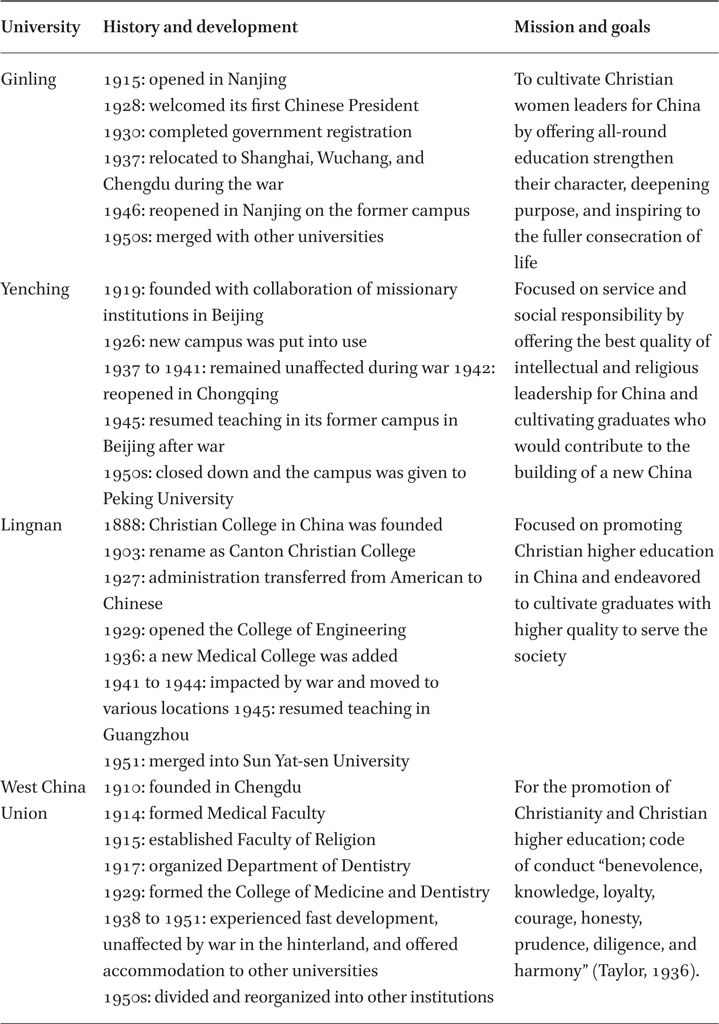
As for their missions and goals, the four universities were all promoting Christianity and Christian higher education based on their background in Protestant denominational societies. Also, they explicitly stated that the goals were to offer all-round education to develop students with a high quality of intellectual and religious leadership to serve the country and society. Hence, an emphasis on social responsibility was among their missions. As a women’s college, Ginling was devoted to women’s education and cultivating women leaders. Specifically, the model of liberal arts education for women was claimed in its mission statement. With the goals and purposes stated, the four universities cultivated students both professionally and morally.
Curriculum
The curriculum in these universities mostly followed the Western curriculum. English, Chinese, and Religion were among the core courses of all the four universities. The other common courses offered were Philosophy, History, Physics, and Chemistry. Before 1910, the curriculum of these universities was essentially “a combination of literary Chinese, English, mathematics and the sciences, religion, and a little history and philosophy” (Lutz, 1971:174). With the development in scale, after 1915, most schools offered curriculum with a system of majors, minors, and electives. The most commonly provided majors were sciences, social sciences, Western languages and literature, and religion. The degrees conferred were Bachelor of Science degree and Bachelor of Arts degree. Some of the colleges were offering professional and vocational education (Lutz, 1971). With the government registration and anti-Christian movement in the 1920s, the curriculum expanded with practical and professional courses added. Vocational education was developed after the 1930s with the process of sinification and secularization. However, there was a problem with the curriculum: overcrowded credits. At that time the standard number of semeste hours in most American higher institutions was 120 hours. In Christian colleges in China, this number ranged from 128 to 163 in 1926. Over half of them required more than 150 hours for graduation. This is because a large number of class hours were spent on a foreign language, English (Lutz, 1971).
Table 2 presents the curriculum of some programs in a specific academic year from the four universities in three periods. Around the 1920s, much importance is attached to the study of Chinese, English, and religious courses, the common core courses. In the course objectives, it is stated that moral training, the learning of social ethics, and the formation of character are the key elements in the common core courses. The objective of the Chinese courses, was not only focused on language training, i.e. teaching how to write in Chinese. It also added the contents of Chinese classics, including the Four Books and the Five Classics, Chinese Philosophy, Poetry and Ancient Literature. These courses aimed at training students to have a broad and profound knowledge about the Chinese tradition and culture, which prepared them well for the society where they lived. Also, religious courses were required for all students, which was mainly on Christian education. The required courses were comprehensive and in a broad range of subjects and disciplines. Besides Chinese, English, and Religion, there are also history, natural sciences, social science and philosophy or ethics in the required courses.
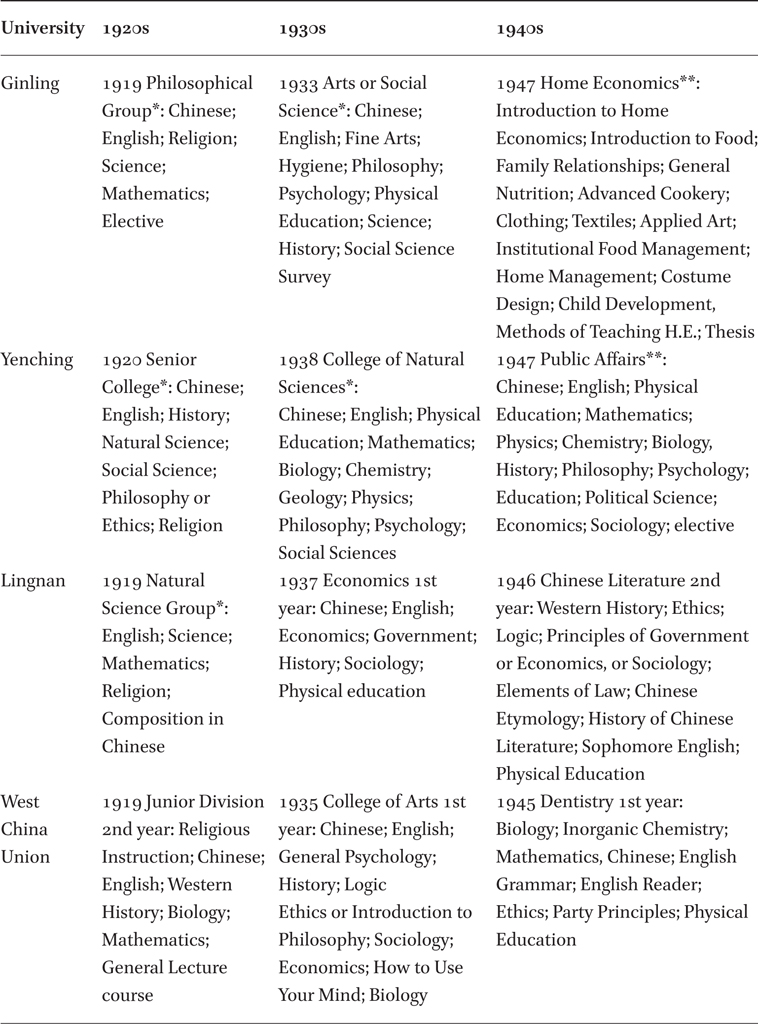
Note: Due to the scope of the paper, the table only presents some selected years from the data in this study. *Year of study not available **Courses across the four years
In the 1930s, the offered courses were broader in terms of disciplines with the development of faculties and departments, and it was also because of the secularization process. Besides Chinese and English, more common core courses were offered for different programs, such as Fine Arts, Hygiene, Psychology, and Physical Education. Chinese and English were still on the list of the common core courses, but there were some changes and modifications in their credits. It is noticeable that religious courses were removed from the required common core courses after the secularization process. Instead, the Ethics courses were added to take the place of religious courses to train students with knowledge in general ethics, Christian ethics, ethical systems, and philosophy of life. This was for cultivating moral standards and the formation of character.
In the 1940s, after the war, the universities kept on developing and reconstituting themselves with departments and programs expanded. Similarly, courses were offered in a broad range of subjects. Although the religious courses were removed from the curriculum, ethics was a required course for all students and was used to cultivate moral reasoning and character formation.
Discussion
The curriculum of the four Christian universities had similarities both in their course offerings and in course contents. Courses in a broad range of disciplines were offered for students of all majors in the first two years. The last two years of the undergraduate study, namely, junior year and senior year, were focused on professional courses. The culmination of a thesis stood for the completion of undergraduate study and met the requirements for a Bachelor’s degree. The four universities had their distinctive features. For example, Yenching University was a comprehensive university with a relatively large number of students and faculty, and its Chinese courses were focused on Classics and Confucian thought; Ginling Women’s College was specifically oriented to women’s education; West China Union University had a strong medical college offering education in medicine and dentistry; and Lingnan University was famous for its agriculture and engineering programs. In the aspect of inculcating moral standards and character formation, the courses in religion, Chinese classics, and ethics were helpful for the cultivation of a whole person for the Chinese society at that time. The liberal arts curriculum in these universities did not contradict the social values and traditions in China in any way. Rather, the Confucian tradition and historical ethics were valued through the inclusion of the courses of Chinese and ethics, especially in Ginling Women’s College and Yenching University. The courses offered in these universities covered a broad range of disciplines to train a person with a creative mind and problem-solving competence.
Adaptation of Liberal Arts Education to the Chinese Context
By examining the courses offered in the four sample universities, it is noticeable that Chinese literature and history were given great importance in the curriculum. It remained in the list of core courses through the three periods in all the four universities. It was placed in the first place in some of them and occupied a large proportion of the total semester hours. For example, in 1919, the Chinese course took up as much as 20 credit points in Ginling Women’s College. It was reduced to 12 credit points later in 1933 (out of around 150 points). The same importance was attached in Yenching University, Lingnan University, and West China Union University. According to the historical documents, Chinese was the only course delivered in the Chinese language (The Board of Control of Ginling College, 1919). The Chinese courses included Chinese literature, Chinese history, and Confucian classics. For example, in Ginling and Yenching, the Chinese courses were mostly focused on Chinese literature and Confucian classics. In the Chinese studies, classics such as the Four Books, the Five Classics, and Chinese ethics and philosophy were included. For example, the courses in Ginling were Chinese Classics, Chinese History, History and Chinese Literature, and Chinese Philosophy. The Chinese courses in Yenching were also very famous at that time. They touched upon the Classics and Confucian studies. The classics were offered to pass down traditional Chinese values.
These universities did not consider the incorporation of Chinese classics as something controversial in terms of Western liberal arts education, but rather as something important to cultivate an all-round person, who could adapt to the local society. They held the point of view that for students’ future career development, the education offered in the homeland was more appropriate and constructive than that from a foreign land because students could stay in their homeland and keep close contact with the community and social development. While studying abroad, Chinese students lost touch with their homeland, and in particular the social norms. Upon returning to China, they experienced difficulties reintegrating into their social environment. This was a key factor that they considered, i.e., the localization process. Ethics courses and philosophy courses also touched upon the traditional ethics and social conduct codes, which helped students to know and conform to the cultural and social norms of the country. In West China Union University, the university code of conduct reflected Confucian virtues from the Classics with the following eight key words: benevolence, knowledge, loyalty, courage, honesty, prudence, diligence, and harmony (Taylor, 1936).
The above-mentioned points constituted a way of adaptation into the Chinese context in the curriculum design of these Christian universities. Although nearly all subjects could be taught in English and followed the American curriculum design, the faculty who graduated from American universities chose to make changes that ensured a liberal arts education suited to the Chinese context. They selected the classics and Chinese for local students, which made Christian education in China something localized. From this perspective, they valued and respected the local and traditional culture and social ethics, not aiming at cultivating students who would be foreigners to Chinese society. This could bring insights for the localization process of liberal arts education or general education reform in contemporary China in a situation where China is aiming at building world-class universities by copying and following Western models. The traditional culture and Confucianism which focused on person-making and cultivating an all-round person conforming to the social norms should be an inseparable part of liberal arts education in China. The traditional values and Confucianism have also been recognized worldwide. Scholars, such as De Bary (2013), advocate for the whole person education elements in Neo-Confucianism such as the autonomy of mind, self-consciousness, critical awareness, creative thought, and independent judgment. It is undeniable that this tradition can complement or substitute for some classics in a Western liberal arts curriculum and could be adopted for the liberal arts education curriculum in China, with the same function of cultivating a whole person to contribute to society.
Religious Studies in the Curriculum and Education Goal
An examination of the curriculum in the four universities in three different periods shows that religion courses or Christian studies were among their core courses initially but were removed after the anti-Christian movement and government registration. Based on their foundation and background with missionary societies, Christian universities had Christian studies in their common courses and Christian education was also declared in their mission statement. Ginling aimed at educating Christian women leaders for China, and Yenching strived for Christian higher education. The mission statement of Lingnan was less explicit. It aimed at offering the same high standard education as that in the United States. Since at that time much American higher education was oriented to cultivating Christian citizens, Lingnan’s mission of Christian education was the same. West China Union University aimed at the promotion of the kingdom of God. These goals were deeply instilled into their curriculum and the organization of teaching and study. In the beginning, students were mostly Christian. The religious courses were established based on Christianity, including The Life of Jesus, the Growth of Christianity, and the Social and Ethical Teaching of Jesus (The Board of Control of Ginling College, 1919). To enhance the religious education, Christian worship and Sunday school were organized after class. The Christian education and religious courses were not solely aiming at training Christian ministers in China, but also at cultivating Christian citizens with a broad range of knowledge and dedication to serving the development of China. It is emphasized in the mission statement of Yenching that education is for cultivating talent for the development of a new China (Peking University, 1920). This echoes the liberal arts education in the United States at that time, as is stated in the 1946 Harvard Report. which indicates that American higher education mostly focused on cultivating Christian citizens for American society in the 19th century. This comparison suggests that liberal arts education was passed down from American history and carried on to China in the 20th century with the same goal and mission.
The religious courses were to cultivate Christians with high moral standards and behavior. These courses were not for the sake of knowledge but for person-making, the formation of character, and the spiritual development of each person. It means that educating a person is not only a matter of imparting skills, but also of cultivating and nurturing the spirit, body, and mind (Peking University, 1920). According to Newman (1992), religion is the science of sciences and is recommended as a core area of study in the education of an ideal university. The purpose of religious education is not only for human redemption but for the cultivation of moral standards. In this sense, religion is an inalienable part of moral education and essential to a liberal arts education that serves the function of whole person cultivation.
The government registration and anti-Christian movement greatly influenced the development of Christian universities and their curriculum design. The Nationalist government stipulated that religious courses should not be among the required courses and religious activities on campus were not encouraged. The 1930s was a period of sinification and secularization for these Christian universities. The religious courses were removed, with ethics added. The ethics courses were intended to contribute to the formation of moral standards and whole person cultivation. The contents of the ethics course included philosophy and the ideas of Dewey among others (Peking University, 1920). In the period of the 1940s, although the religious courses were removed from the curriculum, ethics took the place of religion in the formation of moral standards and the character of students. This shows that in liberal arts education, the cultivation of moral standards is very important. The Christian universities paid much attention to this while moral reasoning is given less emphasis in current university education. Nowadays, there is criticism about the moral decline among graduates from universities in China. According to Jiang (2014), both moral reasoning and spirituality in the three universities he studied in Shanghai were neglected and needed to be given attention. The lesson for today’s reform is that, to cultivate an all-round person, specialized knowledge is far from enough. Moral training, the inner spiritual life, and social ethics should be cultivated so that the person can grow fully into a talent with the spirit of service and social responsibility, making a contribution to the global society as a global citizen.
Professional Courses in the Curriculum
Apart from the common core courses, the four universities in this study had professional courses for students and required a major and a minor concentration. Professional education was also given much importance. The professional courses mainly started in the third year. The orientation of vocational education in Yenching was emphasized. West China Union University had a strong medical college to cultivate doctors and nurses. Lingnan University offered an excellent professional program in Agriculture and Horticulture.
With their different focuses, the four universities had their own features, but with the same purpose of cultivating talent for the social development of China. Ginling emphasized the promotion of women’s education and cultivating women leaders, as well as education for teachers. Home economics was a famous major designed for women. Yenching pointed out in its mission statement that professional and vocational training was an integral part of their education. Vocational education in Yenching was of practical value in cultivating people for making a new China. The cooperation with plants and factories provided students with internship opportunities. Besides, the University also provided openings for students in two specific areas: applied psychology and industrial service. Lingnan, with its mission of providing high-quality education for the development of China, was influenced by Guangdong’s geographic features. The local focus on engineering and agriculture was famous and enhanced the teaching and study in these majors. The agriculture and horticulture majors were well developed thanks to Guangdong’s geographic advantages. West China Union University was a comprehensive university with a strong medical college, focusing on cultivating medical professionals. The first two years offered courses mainly from the college of arts and science. From the third or the fourth year, there were systematic medical courses offered for medical students, among others. The professional courses lasted until the seventh year. The completion of the medical program also included clinical practice and experimentation. The education at West China Union University made a great contribution to China’s medical and dentistry development.
Relevance for Today
The formation of character and breadth of knowledge are the elements missing in today’s higher education in China. Jiang (2014) investigated the moral reasoning and spirituality in liberal arts education reform in three universities in Shanghai and found that these aspects were not given enough attention either in the curriculum or in the mission of education. As Newman (1992) argued, religious education is not for human redemption but for the cultivation of a whole person. In this sense, Confucianism or traditional values, or the study of ethics and philosophy should be the integral elements for liberal arts education or general education, because it has the function of cultivating the whole person, which echoes with the essence of liberal arts education in the West. Currently, scholars such as De Bary and Tu Wei-ming (1998) advocate for Confucianism in current education reform as it focuses on person-making and self-exploration with the final goal of cultivating a Junzi (君子) whose aim is to contribute to society and country. Neville (2000) argued that Confucianism should be a universal philosophy. Based on the analysis of historical curriculum and the findings of contemporary scholars, university administrators and policymakers might need to consider Confucianism and traditional values as an integral part in the current curriculum reform for culture quality education or general education in China.
While there are good examples in terms of the curriculum design in these Christian universities, we can also learn from certain shortcomings. Due to a heavy focus on the English language, the semester hours in the Christian universities were exceeding the standard semester hours in American colleges at that time, which added a heavy burden to students (Lutz, 1971). There are similar problems in today’s general education curriculum. To broaden students’ knowledge and promote general education, there is now a mixture of elective lessons from different departments in many universities, which adds an extra burden to students (Shi & Lu, 2016). The suggestion for the curriculum design for today might be that the curriculum should be adequately designed with a focus on classics and character formation, based on humanities, arts, science, and social sciences.
Conclusion
The study took four examples from the 13 Christian universities founded by North American missionaries at the beginning of the 20th century in China. The four chosen universities had their special characteristics and could serve as typical for the whole group in some way. The curriculum information for three one-year periods was chosen to analyze the change and development based on the historical background. The curriculum was similar to the American liberal arts education curriculum, but changes and alterations were made in accordance with the Chinese context. In their mission statements, they all claimed they were promoting a liberal arts education. They introduced Christian higher education to cultivate graduates to serve the social and economic development of China. They followed the liberal arts education curriculum from North America, focusing on a broad range of knowledge, offering common core courses, and aiming at cultivating whole persons for the society. Based on their religious background, they focused on cultivating Christian leaders for China. Religion courses and ethics were important in their curriculum. They also developed professional courses according to their mission and local contexts, such as home economics, agriculture, and dentistry. Their main difference from liberal arts education in America at that time was that the Christian universities in China included Chinese classics. Chinese was an important part of the teaching in these four universities. In Chinese studies, classics, Confucianism, and traditional values were emphasized. They acknowledged the importance of localization and indigenous culture and made adaptations to the local context. This flexibility in liberal arts education could be suggestive for today.
Today, China is aiming at building world-class universities. While matching the benchmarks of research universities, Chinese universities might also need to focus on the cultivation of whole persons, which is the ultimate purpose and goal of a university. The early American universities and colleges held fast to the essence of liberal arts education—training the mind. Developing world-class universities requires a good understanding of the essence of education and the intrinsic value of liberal arts education, that is, to cultivate a person with curiosity, problem-solving skills, lifelong learning competence, high moral standards and dedication to serve their society. To reach this goal, we cannot neglect the core values of liberal arts education while introducing curriculum from other countries. From the experience of China’s Christian universities, we can find that the Chinese classics are an important part of education for a citizen in Chinese society. Scholars such as Neville (2000) argued the importance of Confucianism as a world culture and emphasized the values of Confucianism and its relevance for today’s whole person education. Another important element of liberal arts education is the focus on the formation of character and moral education. Although religion is not a required course in most of the universities around the globe, its importance for moral reasoning and the development of spirituality could not be neglected. Courses in religion or ethics, with the objective of moral formation, could be suggested for today’s liberal arts education curriculum. Besides, the elective courses for broadening knowledge need to be carefully chosen and specifically designed, without adding an extra burden to students. The reform toward liberal arts education or whole person education in the time of globalization could be innovative and flexible, avoiding conformism and welcoming inclusivity and diversity.
Due to the scope of the study and availability of documents and materials, the study only focuses on four sample universities, with three one-year periods from each examined. The scope of curriculum analysis is limited. In the four representative cases, data are not available for all the departments and majors. Even for the same major, the data could not be obtained for every school year since its foundation. Therefore, it is impossible to make a chronological comparison. Rather, the analysis is based on the availability of documents. Further study might focus on this topic by searching for liberal arts education traditions in several specific universities which took over the campuses and inherited the heritage of the former Christian universities both in their curriculum design and campus environment. It would be meaningful to examine how today’s universities carry on the tradition of liberal arts education from the former Christian universities to their current general education reform.
Footnotes
1
Among the 16 universities, there were 13 Protestant Institutions: St. John’s University in Shanghai, the University of Shanghai (Hu-chiang University), Soochow University, Hangchow Christian University, the University of Nanking, Ginling Women’s College, Shantung Christian University (Cheeloo University), Fukien Christian University, Lingnan University, Yenching University, Hwa Nan College, West China Union University, and Huachung Christian University (Central China University); and 3 Roman Catholic Institutions: Chen-tan University, Fu-jen University, and Tsinku University.