



Abstract
In recent decades a prolific amount of research has been conducted into the topic of students’ relationships with supervising professors as key to doctoral experiences and success. Across different education systems, positive relationships between doctoral students and their advisors have been strongly associated with socialization into their departments and disciplines, as well as overall satisfaction with doctoral programs. While faculty-student relationship has been widely studied as one of the most important factors affecting student satisfaction and attrition, little is known about how the choice of advisor and how advisor-student relationships are related to stress. Data was collected by administrating a survey of students enrolled in doctoral programs from a public, research-intensive university in the Midwest of the United States and a public, research-oriented institution in South Korea. The findings indicate that US students were generally more positive about the advisor-advisee relationship than Korean students and both Korean and US doctoral students’ concerns were largely related to post-graduation options.
Introduction
During doctoral education, students are given the opportunity to develop over an extended period of time transferrable skills and competencies, to grow as independent scholars, to establish professional networks, and to learn the academic norms of research and socialization within their professional fields. For many doctoral students, navigating the PhD process is a highly demanding, strenuous, and stressful period of time, often leading them to withdraw before graduating (Hermann, Wichmann-Hansen, & Jensen, 2014). Previous research has shown that it is common that doctoral students often feel stressed about their graduate programs and suggested that the nature and quality of advisor-advisee relationship is key to successful degree completion (Barnes & Randall, 2012; Gardner, 2008, 2009; Wao & Onwuegbuzie, 2011; Zhao, Golde, & McCormick, 2007). In addition, academic and social support from doctoral supervisors have been found to reduce physical and psychological health problems, and alleviate stress (Cornér, Löfström, & Pyhältö, 2017; Hermann et al., 2014; Jairam & Kahl, 2012; Zhao, et al., 2007).
Despite different structures and systems of graduate education across countries, positive interpersonal and professional relationships between doctoral students and their advisors have been strongly linked to student socialization into their departments and disciplinary communities, as well as the success of students in their doctoral programs. While faculty-student relationships have been extensively studied as one of the most significant factors in student success (e.g., doctoral degree attainment, increased employment opportunities, and professional development) (Bova, 2000; Golde, 2005; Lovitts, 2001), the literature on faculty-student relationships has primarily focused on doctoral students in the US and European educational contexts, investigating the impact of types of faculty-student relationships and their interactions on student success, roles and characteristics of advisors, and advising and mentoring issues in various academic programs (e.g., Barnes, Williams, & Archer, 2010; Barnes & Austin, 2009; Golde & Dore, 2001).
In recent years, scholars have sought to understand the quality and the nature of doctoral education beyond Western society. As a result, there is a growing body of research on the nature, function, and quality of doctoral education in non-Western societies, especially in East Asia (e.g., China, South Korea) as this region has experienced a rapid growth of graduate education fueled by government supported world-class university initiatives (Shin, Kehm, & Jones, 2018). However, there is sparse research on doctoral students’ perceptions of the relationship with their advisor from cross-cultural, cross-national perspectives.
Thus, in this study, we seek to understand how doctoral students’ perceptions of the relationship with their advisors, along with experienced doctoral stress, are similar or different among Korean and American doctoral students, while recognizing the different educational environments. It should be also noted that as researchers have investigated a wide range of topics to increase our understanding of doctoral experiences in different countries/regions, certain forms of data collection have been widely used in the field, most notably qualitative studies based on interviews and quantitative studies based on survey research from a single institution or a limited number of institutions within a country. Given such methodological limitations, our exploratory study analyzed the survey data collected from both Korean and US doctoral students in an effort to illuminate how the choice of advisor, relationships with advisor, and stress of doctoral experiences, differ by student demographic characteristics between these educational contexts.
We begin by briefly introducing the comparative policy contexts of US and Korean graduate education. We then provide a review of related literature on the topics of criteria for advisor selection, advisor-advisee relationship, and stress experienced by students during a doctoral journey. Next, we describe our research sites and methodological approaches to data collection and analysis. We then present our research findings and discuss implications for practice and future research.
National Contexts
US Graduate Education
The US graduate education system is widely considered to be world-class and has been adopted by many national higher education systems. Since the creation of US graduate education in the late 19th century, doctoral programs in the US have continuously expanded and produced annually the largest number of doctoral recipients in the world (Cummings & Bain, 2018). According to the US Department of Education (2018), total graduate enrollment grew by 39 percent between 2000 and 2017 and more than 3 million students were enrolled in graduate programs in 2017. Though the quality of US graduate education has attracted talents nationally and internationally over the past decades, this system is not without criticism. During the last 10 years, US graduate education programs have experienced challenges with an increasing lack of academic and research positions, decline in the value of a PhD for training the next generation of academics and/or the professional workforce, declining financial support, and increased societal demands to move toward a knowledge society (Nerad & Heggelund, 2008).
The US doctoral education model is generally characterized as coursework-based curriculum, pre-determined course requirements, doctoral candidacy in conjunction with supervised thesis writing (Shin et al., 2018). Unlike the German model that focuses on one-on-one research supervision, individual research projects, and seminars, US graduate education has put in place standardized procedures such as research seminars, doctoral qualifying exams, and defense of a doctoral thesis (Shin et al., 2018). These more structured components of US graduate education have been adopted by many higher education systems in Europe and East Asia amid growing pressure for increased global competitiveness and university rankings in a knowledge-based society (Cummings & Bain, 2018; Shin et al., 2018). For example, in South Korea, which is one of the countries that have shown a fast-growing enrollment rate of graduate education, the number of students enrolled in doctoral programs almost doubled in 15 years from 31,787 in 2000 to 72,558 in 2015 (
Korean Graduate Education
As government supported initiatives that aimed for promoting world-class universities in East Asia in the mid-1990s were fueled by societal demands for competent and skilled workers in a knowledge society, growing attention in recent years has been focused on transforming doctoral education systems in the region (Shin, Postiglione, & Ho, 2018). In particular, the Korean doctoral education system integrates components from the US and German model; the coursework-based US model with standardized procedures from course-taking to thesis defense, and the apprenticeship-based model of Germany in which doctoral students participate in their professors’ research projects and seminars, and they are supervised closely by their individual professors (Shin, 2011).
Graduate schools in South Korea offer academic degrees aimed at basic theories of learning and research as well as practice-oriented degrees in professional fields. Since the late 1990s, the enrollment of graduate students has increased dramatically. A total of 97,835 graduate degrees including Master’s, PhDs, and professional degrees has been awarded by 2017; of those, 14,316 were doctoral degree recipients (Korea Education Statistics Service). Compared to US graduate education, which is highly decentralized and unregulated (Zhao et al., 2007), doctoral education in South Korea has been expanded by government support and initiatives for research and development (R&D), along with extensive financial investment in the late 1990s and the 2000s (Shin, 2011). Government-led projects such as the Brain Korea 21 (BK21), and support for science and engineering research centers such as the Engineering Research Center (
Since the mid-1990s, the Korean higher education system has sought actively to train the next generation within their own doctoral programs. Nevertheless, US doctoral degrees are still more favorable than those from Korean or other foreign higher education institutions (Kim, 2011). For example, about 40% of faculty in Korean higher education institutions earned their doctorates overseas with the majority trained in US doctoral programs (Shin, 2012). In the context of the recent movement toward standardized doctoral education, which follows the US doctoral model and the effort to train academics in their own South Korean educational system, this study explores American and Korean doctoral students’ perception of doctoral training with respect to advisor selection, advisor-advisee relationships, and stress about their doctoral experience.
Related Literature Review
Advisor Selection
The extant literature suggests that advisor selection might be the most important to the beginning of a successful doctoral journey and conducive to developing a good advisor-advisee relationship. The processes of matching students and advisors vary across disciplines: students can either personally identify and select their advisors based on a common research interest at some point in the doctoral program or they are assigned their advisors upon entry into the program (Zhao et al., 2007). However, there are various factors in advisor selection which often seem ambiguous. Many students enter doctoral programs with inaccurate information and unrealistic expectations about the research field and their potential academic advisors. Doctoral students often need to make efforts to adapt to the department and to their advisor in order to narrow the gap of expectations between themselves and their advisors. Zhao et al. (2007) found that there are several criteria that prospective students consider when selecting a doctoral advisor such as general support, intellectual compatibility, financial support, and supportive environment. They also found that these factors differ depending on the field of study and the motivating factors in choosing an advisor impacted the quality of relationship with their advisors regardless of their major and student demographic characteristics (Zhao et al., 2007). For example, physical and biological science students relied more on financial support than graduate students in the social sciences and the humanities. Often, personal reasons such as a sense of familiarity and first impressions were more important to their choice of graduate advisor than other academic reasons such as common research interests, time to degree, and research productivity of faculty (Hineman & Semich, 2017). Holley and Caldwell (2012) suggested that graduate programs systematically need to coordinate to match an advisee with an advisor in order to foster the success of doctoral students. Although choosing an advisor is one of the most significant decisions a doctoral candidate has to make, most of the empirical research has focused on the US context, examining the impact of advisor selection on the success of advisor-advise relationship and the relative importance of selection criteria by gender and academic departments (e.g., Barnes & Randall, 2012; Golde, 2005; Ray, 2007). To the best of our knowledge, no research has been conducted to explore the differences in advisor selection across academic disciplines and gender from the cross-national perspective.
Advisor-Advisee Relationship
The quality and the nature of advisor-advisee relationship is key to the success of doctoral educational outcomes (Austin, 2002; Earl-Novell, 2006; Lovitts, 2001; Weidman & Stein, 2003). Doctoral supervisors play multiple roles as advisor, guide, critic, arbiter supporter, and examiner (Brown & Atkins, 1988). For example, a doctoral advisor serves as the committee chair who provides extensive feedback on the topic and method of research; they also provide academic and financial resources; they help their students cope with personal and professional problems (Brown & Atkins, 1988).
Doctoral students are expected to become independent scholars through engaged scholarship facilitated by interactions with their advisors. Moreover, interaction with an advisor encourages students to participate in academic and professional communities, to integrate themselves into their program and discipline, and to motivate them to continue their doctoral program (Earl-Novell, 2006; Golde, 2005). Empirical research documents that ineffective advising such as neglecting the role of an advisor, indifference to a student, being overly involved and intrusive, and using students as cheap labor, can bring stress to doctoral students (Grant, 2005; Löfström & Pyhältö, 2014). Therefore, selecting an advisor and building and maintaining a positive working relationship with their advisor is crucial to fostering students’ academic success as well as their overall well-being (Maher, Ford, & Thompson, 2004).
The characteristics and norms of the academic disciplines influence the criteria of professionalism, the educational program, and the relationship between faculty and students (Becher et al., 2001; Weidman et al., 2001). In addition, academic disciplines have their own culture, code of conduct, and values, which contribute to students’ professional socialization into their graduate school (Becher & Troller, 2001). For example, doctoral students in the hard science fields are expected to participate in team-based research projects with emphasis on social connectedness within disciplines whereas in the soft sciences, students pursue an individual research project, work in a more isolated setting and make a higher commitment to teaching (Becher & Trowler, 2001). Therefore, the culture and social structures of academic disciplines are important in influencing students’ level of cooperation and relationship with an advisor and the advisor’s advising attributes and behaviors.
Unlike aforementioned studies that mainly focused on graduate education in Western societies, Korean society is traditionally influenced by the authoritarian, patriarchal culture of Confucian ideals. Also, the hierarchical culture of teacher-student relations has been deeply ingrained in the Korean academic community in which students follow teachers’ orders and show reverence to their teachers (Oh, 2001). As an authoritarian figure, an advisor often holds an exclusive power and social position, determining their doctoral students’ graduation and even future employment (Kim, 2019; Lim, 2018). Research found that doctoral students perceived themselves as disadvantaged in their relationship with their professor and they often were unable to focus on their graduate studies due to excessive work demands and unfair treatment (Lee, 2016; Lim, 2018). Also, the quality of the relationship between students and professors differs by academic disciplines. For example, Kim (2019) found that in the humanities and social studies, students reported a strong sense of research autonomy and the degree of academic interaction with their advisor as helpful for the development of cognitive competency. In the science and engineering fields, which are project-based disciplines, developing a personal bond and closeness with their advisor is essential to student success (Kim, 2019). In addition, despite limited evidence, research has shown that Korean female students experience identity conflicts in the patriarchal culture of collectivism and male centric social networks (Han, Park, & Kang, 2010; Min & Lee, 2005).
Stress of Doctoral Experiences
Pursuing a doctoral degree requires a substantial investment of emotional and financial commitment to academic endeavors. Doctoral students are commonly concerned with meeting academic demands, failing coursework or examination, and feeling time constraints to complete their degree (Bowman & Bowman, 1990; Esping, 2010) while managing socialization into new professional roles, developing a professional identity, and creating new relationships with peers and faculty (Golde, 1998; Weidman, Twale, & Stein, 2001). Such academic demands placed on students in graduate programs are attributed to their stress as they progress through their programs (Cahir & Morris, 1991). Furthermore, the stress doctoral students experience is closely linked to student attrition. Empirical research shows that feelings of social support and connection can serve as a buffer to mitigate their stress levels and meaningful connection with fellow students and faculty (Kaufman, 2006; Lovitts, 2001; Oswalt & Riddock, 2007).
According to the cognitive-relational model of stress (Lazarus,1991), also known as the transactional model, stress refers to an ongoing transaction between personal and environmental stress in which an individual assesses the situation and identifies coping actions. In other words, stress is an internal state of tension as a result of one’s perception of environmental conditions (Kaufman, 2006). As such, heightened stress may affect doctoral students’ academic performance and interfere with their ability to progress through their doctoral program. Several empirical studies have documented that stress is negatively associated with graduate students’ physical and psychological well-being (Cahir & Morris, 1991; Kaufman, 2006; Nelson, Dell’Oliver, Koch, & Buckler, 2001). However, most of the research on perceived stress among graduate students has focused on graduate students in particular disciplines such as psychology or medical/health-related fields with small samples of the graduate student population (e.g., Givens & Tjia, 2002; Kaufman, 2005; Neson et al., 2001) within US graduate programs.
Stress is one of the key factors that impacts the quality of doctoral students’ educational experiences (Lovitts, 2001). According to previous studies, major stresses experienced by graduate students are various, including financial difficulty, personal relationships, demanding academic work and research, fear of the future, and work-life balance (Appel & Dahlgren, 2003; Esping, 2010). Doctoral students experience a high level of stress due to their poor social status and low rewards relative to their high-intensity intellectual work (Cahir & Morris, 1991). In addition, doctoral students are concerned with the difficulties and responsibilities of the research process and the pressure of research productivity (El-Ghoroury et al., 2011). Such academic and research-related stresses may affect physical and mental health and might lead to depression or anxiety, and thereby giving up their studies and changing career. In particular, the level of stress on students increases significantly in the second half of the doctoral program due to the pressure of time-to-degree, sustainability of financial support, and difficulties in producing and publishing research results (Levecque et al., 2017).
As research has shown that doctoral students attribute their stress to their doctoral programs, an academic advisor plays a critical role in helping doctoral students deal with a stressful academic environment and integrate their academic and personal lives (Golde, 2005). Advisors provide students with academic and emotional support and help them develop a sense of belonging in their doctoral programs (Austin, 2002). The more negative experiences the students have about their doctoral programs, the more likely they are to leave graduate school without a degree (Nerad & Miller, 1996). Therefore, the relationship between students and their advisors is an important factor that reduces doctoral stress.
Methods
Design and Procedures
Data was collected by administrating a survey of students enrolled in doctoral programs at a large, public university in the Midwest of the US, and a large, public, research-intensive institution in South Korea. The US institution was classified by the Carnegie Foundation as having very high research activity. This institution offers more than 130 research-based graduate programs in the fields of science, engineering, agriculture, medicine, humanities, and the arts, as well as interdisciplinary programs. The Korean institution was considered one of the most selective universities in South Korea. As one of the nation’s top research-oriented universities, this institution has received the largest amount of research funding and has the largest number of faculty. Both of the institutions were ranked in the top 100 world-class institutions in 2019.
Doctoral programs at the Korean institution are influenced by the complex historical path of Japan’s early transplantation of a German university model followed by a transition to the US model after the liberation from the Japanese occupation in the 1940s (Ma, 2001; Umakoshi, 1995). Therefore, although these programs are similar to the US model in terms of coursework and comprehensive exams, reliance on an individual advisor is emphasized according to the German model. In addition, there was a partnership between these two institutions several decades ago; the Korean university trained their academics by sending them to the US institution in the fields of natural science, medicine, health science, agriculture, and engineering in order to rebuild their academic programs (Kim, 2009). Therefore, the comparison between these two institutions provides implications for graduate education systems that have undergone changes from the German model to the more standardized doctoral training model.
At the US institution, a total of 16,415 students (both Master’s and doctoral level; 52% female and 48% male) were enrolled in 2017. Of those doctoral students, approximately 2,500 students were enrolled in PhD programs. US doctoral students were solicited to participate in a web-based survey about doctoral student academic experience and socialization. Email requests with the web link were sent to potential participants. A total of 349 students participated in the web-based survey with a response rate of 14%. Of those 349 responses, responses with missing data and respondents with part-time status were excluded from data analysis. This resulted in a final sample of 316 complete responses.
At the Korean research institution, 3,670 total students were enrolled in doctoral programs. Because the research team did not have direct access to the students via email at the Korean institution, paper-based survey questionnaires were administered to students at places on campus such as libraries, research laboratories, the student union, and cafeterias, with the goal of reaching as many doctoral students as possible. The Korean final sample included 418 doctoral students enrolled in five major disciplinary areas such as engineering, natural sciences, social sciences, humanities, and education, with a response rate of 11.4%. Students enrolled in professional degree programs such as medicine, health sciences, veterinary medicine, and public administration may have different doctoral experiences and motivations to pursue a doctoral degree; as such, these fields were not included in the Korean sample.
Participants
Table 1 shows the frequency and percentage of gender, discipline, and year in program of doctoral students who responded to the survey. The US sample included almost equal numbers of male (50.6%) and female students (49.4%). The year in the program of the respondents was as follows: 58.6% in the first two years, 26.1% in 3rd or 4th year, and only 15.3% in their fifth year or beyond. Three-fifths of the respondents were in
Demographic characteristics of Korean and US students
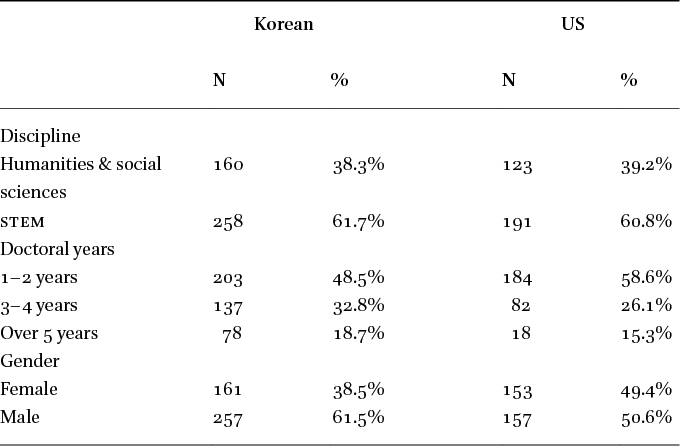
Demographic characteristics of Korean and US students
The Doctoral Student Survey in East Asian Flagship Universities (Shin et al., 2015) was developed collaboratively by an international research team from three leading research universities in South Korea, Hong Kong
Three student demographic variables were used. Gender was a dichotomous variable indicating whether students identified themselves as female or male. Due in part to labeling differences in academic majors, we recoded students’ disciplines by reducing categories to a dichotomous variable indicating whether students were enrolled in soft disciplines or hard disciplines. Students’ year in program was represented by three categories: 1st–2nd year, 3rd–4th year, and fifth year or beyond.
Motivating factors for choosing a graduate advisor were represented by eight items: match in research interests, usefulness of advisor for career prospects, advisor’s ability to help secure an academic position, advisor’s reputation in the field, advisor’s networks outside the university, financial support, the same advisor from the previous degree program, and no other choice due to scarcity of faculty in the field. Relationship with a graduate advisor was represented by 14 items such as a good professional relationship, availability of advisor for advice, ability to offer feedback on learning, and research scales. Doctoral stress was represented by seven items, including negative influence on work-life balance, concern with financial situation, concern with graduating on time, and post-doctoral career.
Data Analysis
The analysis in this study is divided into two main parts. The first part examines the factors that influence doctoral students’ decisions to choose their graduate advisor, students’ perceptions of the relationship with their academic advisors, and stress experienced by doctoral students between Korean and US students. The second part explores how advisor selection, advisor-advisee relationship, and perceived stress differ by demographic variables (gender, year in program, discipline) within each group using t test and analysis of variance.
Results
Choosing a Doctoral Advisor
Of the listed reasons for choosing their advisor, research matches between students and faculty was considered the most important reason for both American (5.92) and Korean students (5.52), followed by the advisor’s reputation in the field for US (5.42) and Korean respondents (4.67). However, while Korean students reported having the same advisor from the previous degree program (4.41) as an important reason for selecting their advisor in a doctoral program, this was not an important factor for American students (2.83). An advisor’s expertise as useful for career prospects was cited as an important reason for both groups. US students (5.37) reported a higher mean than Korean students (4.17). American students considered an advisor’s network outside the university as one of the five key factors in selecting their advisor (4.49). This was not rated as an important reason for Korean students (3.46). Although an advisor’s ability to help secure an academic position was one of the top-five ranked reasons among Korean students (3.54), they reported a lower mean than US students (4.05). Although financial support was as important as other choice factors for US students (4.59), this was not as important for Korean students (3.49). (see Table 2)

Note: The response scale range is 1–7 (1 = not at all, 7 = extremely true)
Table 3 presents both American and Korean students’ perceptions of relationship with their doctoral advisor. Of the listed items, US students believed that their advisor had good disciplinary knowledge in their research area (5.97). American respondents also reported that their advisor showed enthusiasm for research (5.87) and gave them the autonomy to develop their own research (5.84). In addition, they reported having a good professional relationship with their advisor (5.76) and that their advisor was helpful for clarifying research topics (5.62). For Korean students, having research autonomy was the most positive aspect of the advisor-advisee relationship (5.46). They also reported that their advisor had good disciplinary knowledge (5.25), their advisor was available to provide advice on their research (5.16), and helped to clarify their research topic (5.02). When looking at the results comparatively, interesting differences in the perceptions of American and Korean students emerged.
In sum, US students were more positive about the advisor-advisee relationship—their average scores are generally higher than those of Korean students. Both Korean and American participants rated the following four items very highly: advisor’s disciplinary knowledge, autonomy of research, helpfulness in clarifying research, and good professional relationships. It is worth noting that US students reported a significantly higher mean (5.87) regarding their advisor’s enthusiasm for research than Korean students (4.91). Advisor’s availability for research advice was not as highly rated as other listed items for US students though they reported a higher mean (5.42) than Korean students (5.16). In terms of students’ perceptions of their advisor as an authoritarian figure, there was little difference between Korean (3.40) and American students (3.38).

Note: The response scale range is 1–7 (1 = not at all, 7 = extremely true)
Per Table 4, both Korean and American students reported having various stress-related concerns. Overall, Korean students reported more stress in their doctoral program than American students did. Korean students consistently reported higher means in all the listed areas of concern (ranging from 3.49 to 4.56), while US students responses ranged from 2.57 to 4.05. Korean students especially were concerned about postgraduate career (4.56) and graduating on time (4.28), as well as reporting that lagging behind in work and having too much administrative work or a large teaching load were stressful. On the other hand, American students felt most concerned that the doctoral program negatively influenced their work-life balance (mean = 4.05), followed by concerns about post-graduation career (3.95). US students were significantly less concerned about lack of focus on research related to their research topics (2.57) than Korean students (4.12). American students showed some concerns for graduating on time (2.89); however, they reported a significantly lower mean than Korean students.

Note: The response scale range is 1–7 (1 = not at all, 7 = extremely true)
Mean differences in the criteria for selecting an advisor across gender and discipline among Korean respondents revealed that there is a statistical difference in advisors’ networks outside the university between male and female students, t(402) = 2.239, p < .05. In addition, the analysis indicated that advisor’s financial support was more important for choosing their advisor for Korean male students than Korean female peers. While these two factors were not found as statistically significant differences among US male and female students, US female students considered their advisor’s expertise in the field to be much more important than US male students did, t(271) = -2.120, p < .05.
Korean students in hard disciplines reported higher ratings of advisor’s network outside the university and financial support as important reasons for advisor choice than did those in soft disciplines. Interestingly, students in soft disciplines reported higher ratings of the same advisor from the previous degree program as an important criterion than did students in hard disciplines. In the US, students in soft disciplines reported higher ratings of advisor’s reputation in the field as an important factor in selecting their advisor than did students in hard disciplines. There is a statistical mean difference in advisor’s financial support between soft and hard disciplines. Students in hard disciplines reported considerably higher rating of advisor’s financial support than did students in soft disciplines. This difference across the two groups is also practically significant (effect size = 0.537).
Differences in the ratings of factors for choosing an advisor by gender & discipline

Differences in the ratings of factors for choosing an advisor by gender & discipline
Korean male and female students’ perceptions mostly did not differ in the responses related to the relationship with their advisor. However, male students (M = 5.05, SD = 1.384) differed from female students (M = 5.34, SD = 1.30) in their perception of their advisor’s availability for research advice, t(412) = -2.080, p < .05. The effect size for advisor’s availability for research advice (d = 0.210) suggests a moderate difference between male and female students. Female students (M = 4.29, SD =1.814) differed from male students (M = 4.80, SD = 1.538) in the introduction to scholarly community, t(412) = 2.923, p < .01. The effect size for introduction to scholarly community (d = 0.304) suggests a moderate difference between male and female students, pointing to a potentially problematic academic socialization for female students in Korean graduate education. The analysis revealed that students in soft disciplines differed from students in hard disciplines in the number of items regarding their rating of advisor-advisee relationship. The students in soft disciplines reported to be more positive about the relationship with their advisor in the following items: good personal relationship, considers my needs and circumstances, availability for research advice, disciplinary knowledge, helps to clarify one’s own research topic, offers autonomy to develop one’s own research, offers feedback on research and learning. The effect sizes for these variables range from d = 0.272 to d = 0.483, indicating a moderate to medium difference by discipline.
American male and female students did not differ in the number of items pertinent to their relationship with their advisor. However, female students (M = 3.62, SD = 2.068) differed from male students (M = 3.14, SD = 1.944) in their perception of their advisor as an authoritarian figure, t(297) = -2.044, p < .05. The effect size for their advisor as authoritarian figure (d = 0.234) suggests a moderate difference between male and female students. Male students (M = 5.24, SD = 1.719) differed from female students (M = 4.77 SD = 2.000) in plenty of opportunity for research collaboration variable t(297) = 2.198, p < .05. Also, the effect size for plenty of opportunity for research collaboration variable (d = 0.254) suggests a moderate difference between male and female students. The analysis revealed that students in soft disciplines differed from students in hard disciplines in the following items regarding the advisor-advisee relationship. The students in hard disciplines reported perceiving their advisor as more authoritarian than students in soft disciplines. The effect size for their advisor as authoritarian figure (d = 0.364) suggests a moderate difference between soft and hard disciplines. However, students in hard sciences reported feeling more positive about their advisor in terms of providing plenty of opportunity for research collaboration and introduction to scholarly community. The effect size for the opportunity for research collaboration figure (d = 0.584) suggests a moderate difference between soft and hard disciplines students. This finding indicates a lack of opportunity for research collaboration provided for students in soft disciplines (liberal arts, education, and social sciences). Analysis of variance revealed no statistical differences by year in the program with the exception of two items: students in the first two years of the program reported more positively about their advisor with regard to providing opportunity for research collaboration and providing career advice than those students in later years of the doctoral program.
Differences in the ratings of advisor-advisee relationship by gender & discipline
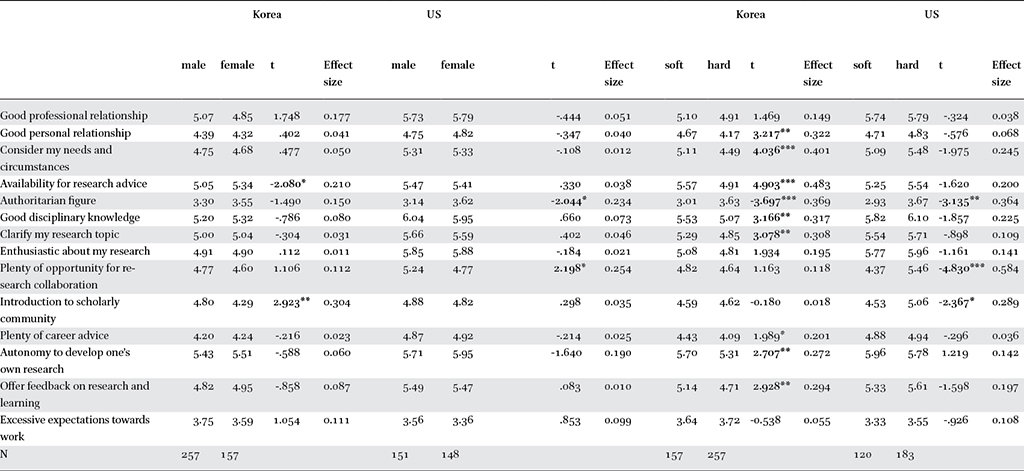
Differences in the ratings of advisor-advisee relationship by gender & discipline

Note: 1: 1~2 years, 2: 3~4 years, 3: over 5 years
T-test and analysis of variance were used to test for significant differences in students’ perceptions of stress in the doctoral program. Levels of stress related to work-life balance, financial concern, and postgraduate career differed significantly between Korean men and women, with female students reporting higher levels of stress on average than male students. The effect sizes for work-life balance (d = 0.400) and post-graduate career (d = 0.365) suggest a moderate difference between male and female students, indicating female students were more stressed about work-life balance and securing a job after graduation. Korean students in soft disciplines showed higher levels of concern for finance and postgraduate career on average than those in hard disciplines (d = 0.367). However, students in hard disciplines reported higher levels of stress about graduating on time than those in soft discipline (d = 0.329). The result shows that students who had been in the program five years or more reported higher levels of stress about graduating on time and their postgraduate career than those in early years of the program.
American female students reported higher levels of stress on average related to postgraduate career compared with their male counterparts. The effect size for postgraduate career (d = 0.308) suggests a moderate difference between male and female students, indicating female students were more stressed about securing a job after graduation. Levels of stress differed significantly between the students in soft and hard disciplines, with those in soft sciences reporting higher levels of stress about work-life balance (d = 0.240), financial concern (d = 0.490), and too much other work (d = 0.316), compared with the students in hard disciplines. In addition, levels of stress differed significantly by the three subgroups in terms of years in the program, indicating the students in their fifth year or beyond reported higher levels of concern with work-life balance and graduating on time.
Differences in perceptions of stress by gender & discipline

Differences in perceptions of stress by gender & discipline

1: 1~2 years, 2: 3~4 years, 3: over 5 years
The results of our study indicate that for both US and Korean students, the top-ranked reasons for choosing their advisor were: (a) the degree to which students’ research topics matched their advisor’s research interests, (b) an advisor’s reputation in the field, and (c) an advisor’s expertise pertaining to career advancement. With regard to understanding what factors influence students’ selection of their doctoral advisor, Barnes (2005) found that how closely a student’s research interest matched a faculty member’s expertise was important to establishing a productive advisor-advisee relationship. In addition, our study supports Zhoa et al.’s (2007) finding that the alignment of the advisor’s research interest with the student’s interest was important for advisor selection. Interestingly, Korean students, especially those in the soft disciplines, tended to choose the same advisor from their previous degree program and also considered their advisor’s ability to help students with their academic career as key factors for choosing an academic supervisor. One potential explanation for this could be academic inbreeding in Korea, which is understood to be an admissions practice in which graduate programs select doctoral candidates who graduated from their own institutions (Shin, Jung, & Lee, 2016). In the US, an advisor’s ability to provide financial and career support were important criteria for selecting a graduate advisor. This finding confirms previous research by Zhao et al. (2007) that financial support is a critical factor in choosing an advisor. Our study also illuminates that, while doctoral students expected their advisor to provide sufficient advising for career preparation upon entry to a doctoral program, there seems to be a lack of faculty attention to such advising (Austin, 2002; Barnes & Austin, 2009; Golde & Dore, 2001; Lovitts, 2001).
We found that both Korean and American students maintained a good professional relationship with their advisor. US students were generally more positive about the advisor-advisee relationship than Korean students. Across both groups, respondents described their advisors as an expert in the field with good disciplinary knowledge. Additionally, students believed that their advisors provided autonomy when it came to choosing a research topic and helped them to clarify research topics. The literature on doctoral education has consistently documented the importance of the relationship doctoral students establish with their advisor in their academic programs. Doctoral advisors play a vital role in students’ socialization, preparing students for becoming a member of their research and disciplinary communities, and cultivating students’ intellectual competency (Austin & McDaniels, 2006; Barnes & Austin, 2009; Lovitts, 2001, 2004). Our results indicate that Korean students tended to describe their advisors as more authoritarian and demanding of workload than their US counterparts, suggesting that interpersonal relationships between professors and graduate students in the Korean academy might be based on a more rigid hierarchy, influenced by the Confucian tradition that emphasizes seniority (Lim & Shin, 2018). Future research needs to be conducted to explore why such perceptions exist among Korean students.
When students experience stress, they often feel unable to cope with a perceived threat to their mental, emotional, and physical well-being (Seaward, 2002). Our study found that both Korean and US doctoral students’ concerns were largely related to post-graduation options. This finding gives rise to concerns about increasingly limited employment opportunities in the recent academic job market in both countries. In particular, Korean doctoral students fear failure when it comes to obtaining jobs that match their qualifications after earning a doctoral degree (Park, Jang, & Shahiri, 2018).
Similar to previous research (Oswalt & Riddock, 2007), the results of our study indicate differences between males and females regarding perceived stress. For example, the stresses Korean female students reported were often related to work-life balance, financial concerns, and postgraduate career. Likewise, US female students had a higher level of financial concern than their male counterparts. Our study also supports previous research that students enrolled in soft disciplines such as education and the humanities were more concerned about financial resources than students enrolled in engineering in the US (Barnes & Randall, 2012). This difference may be explained partly by funding sources. Students in the soft disciplines are more likely to finance their doctoral education through teaching assistantships or self-funded while students in the hard disciplines tend to receive grants and external funding (Kim & Otts, 2010). Because of the higher levels of stress perceived by students in the soft disciplines and female students, faculty and student service professionals should be aware of these differences and consider offering advice and additional financial support to meet the needs of these students which differs from those provided to male students and/or those in the hard disciplines (Oswalt & Riddock, 2007). Our finding indicates that faculty advisors should discuss career options with their doctoral students on a regular basis in order to help them to fulfill their academic and career goals. We recognize that while faculty advisors need to be proactive in ensuring students’ intellectual and professional growth, students also should actively seek feedback and advice on career-related concerns and progress toward completion of a doctoral degree (Barnes & Austin, 2009).
Our study is not without limitations, two of which are low response rates and convenience sampling strategy utilized to recruit Korean participants, giving rise to concern about the representativeness of the samples used for data analysis and the generalizability of the results. In addition, due to differences in designation of academic disciplines between these two countries, it is difficult to determine how the advisor-advisee relationship and doctoral programs differ across various academic disciplines/fields of study. Due to limitations in the data, we were unable to ascertain whether students’ stress is related to educational outcomes such as time-to-degree and graduation rates; however, relying upon prior research (Lovitts, 2001; Offstein, Larson, McNeill, & Mwale, 2004), we presume that doctoral student departure is linked to levels of stress and students’ overall well-being. Future studies should seek to gather direct information on these important outcomes and to examine the extent to which stress affects educational outcomes. While the intention of our study was not to examine the impact of the advisor-advisee relationship on stress and how students cope with their stress, the exploratory nature of this study sheds light on the ways in which faculty and administrators involved in graduate education address the stress experienced by graduate students and the importance of advisor-advisee relationship in buffering the stress.
In conclusion, as noted previously, the nature of the relationship between doctoral students and their advisors is one of the key determinants in graduate students’ successful doctoral experiences. As levels of stress reported among Korean and American students are high (for Korean students especially), faculty and doctoral supervisors should pay attention to providing social and academic support, mentoring, and guidance to students. As Hadjioannou, Shelton, Fu, and Dhanarattigannon (2007) cogently said, “doctoral work is challenging on a variety of levels, stretching often excessively, the minds as well as the emotions, the stamina and the finances of doctoral students” (p. 160). Therefore, doctoral advisors should be more aware of the impact of the advisor-advisee relationship on student doctoral experience and reassess their own advising approaches.