



Abstract
This study aims to develop a theoretical perspective on postdoctoral experiences as professional socialization, and to empirically analyze whether postdoctoral experiences are associated with professional socialization such as deepened knowledge and skills, sense of belonging and academic identity. For this study, we used the data of the Academic Profession in the Knowledge Society (
Keywords
Introduction
Postdoctoral experiences are becoming mandatory for most disciplines including social sciences and humanities (e.g., Hill et al., 2004; Zumeta, 1985). However, there are few studies that explain the postdoctoral experiences from a theoretical perspective although doctoral education has been widely explained in terms of socialization (Austin 2002; Gardner 2007; Weidman et al., 2001). Scholars assume that researchers learn most of their knowledge and skills during their doctoral studies. However, with the growing complexity of job markets, doctoral degree holders are expected to undertake advanced training and socialization after their doctoral degree (Melin & Janson, 2006; Paul, 2001; Scaffidi & Berman, 2011). This study expands the academic socialization for doctoral degree holders to a professional socialization during their postdoctoral training. This is because postdoctoral training helps doctoral degree holders to understand the nature of academic jobs and to develop their identity as an academic through internalizing academic values, norms, and attitudes, as well as knowledge and skills.
Many doctoral degree holders, especially in the fields of sciences and engineering, develop their survival toolkits in academia through their postdoctoral training (Davis 2009; Nerad & Cerny, 1999; Stephan & Ma, 2005). The formal position for postdoctoral studies may be a “postdoc” position but it may also be named as research professor, contract professor, teaching professor, etc. This study interchangeably uses postdoctoral “study” and postdoctoral “training” because postdoc experience is a learning process (postdoc study) through doing (postdoc training). Doctoral degree holders began to teach students during their postdoctoral training. (Readers are reminded that teaching during doctoral studies is not encouraged in most Korean universities). They also internalize their disciplinary knowledge and skills, and develop their understanding about the academic community. Further, they have a chance to develop their academic identity through their work experience. Because of these competencies, postdoctoral study is a critical path to be an academic.
Higher education researches have explained doctoral education in terms of the socialization processes of both academic socialization and professional socialization (Austin, 2002; Austin & McDaniels, 2006; Weidman et al., 2001); however, they did not pay much attention to the different stages of socialization between doctoral and postdoctoral studies. This study shows that postdoctoral researchers are experiencing mainly professional socialization during their postdoctoral stage, while doctoral students are experiencing academic socialization during their doctoral studies. This conceptual distinction between academic socialization and professional socialization contributes to our understanding of the socialization process of postdoctoral training. In addition, this conceptual differentiation explains the reality of doctoral studies where most doctoral students spent most of their time and energy learning their disciplinary knowledge and skills, which is academic socialization in this study.
The professional socialization perspective highlights that doctorates develop their required competency such as job skills, understanding the work environment, and their academic identity, during their postdoctoral training. Postdoctoral researchers develop these competencies through their socialization process as academics (but less so through their doctoral education), as proposed by Shin (2019). Academics with postdoctoral experience are more highly research productive than their colleagues without that experience, have a stronger identity as a researcher, and have a higher sense of belonging to their own community (academic disciplines and institutions). This study poses three major research questions to investigate whether postdoctoral experiences are associated with academic performance, a sense of belonging, and identity.
Research question 1: Do academics with postdoctoral experience demonstrate a higher level of research performance in comparison to their colleagues without those experiences?
Research question 2: Do academics with postdoctoral experience report stronger researcher identity in comparison to their colleagues without those experiences?
Research question 3: Do academics with postdoctoral experience report a higher sense of belonging to their disciplines and institutions in comparison to their colleagues without those experiences?
Theoretical Background
Academic and Professional Socialization
Socialization refers to the process whereby new members learn values, norms, and cultures, as well as knowledge and skills of their affiliated community as discussed by sociological theories, following Merton’s conception of socialization (1957). The Socialization theory, especially from Weidman et al. (2001), contributed to our understanding of doctoral students’ experiences. Doctoral students who are well socialized in their own academic disciplines are considered to be well prepared as the next generation scholars. However, with the rapidly changing academic job markets, simply being socialized in their own disciplines is not enough to survive in the changing academic and professional job market in the knowledge society (Austin & McDaniel, 2006). With these changing environments, higher education researchers began to emphasize the importance of the competency development of doctoral students. There are some comprehensive discourses on doctoral student competencies, such as by Austin and McDaniel (2006) and
Competency development during postdoctoral training is qualitatively different from during doctoral training because the former focuses more on practice in job fields. For example, postdoctoral researchers learn through doing research (rather than studying knowledge), teaching and mentoring students (rather than taking courses), working in an institution (rather than enrolling in a university), etc. The changing nature of postdoctoral training differs from the socialization that occurs during doctoral studies and can be conceptualized differently. Socialization during doctoral studies emphasizes the need to learn disciplinary knowledge and skills. Although we emphasize that doctoral students are expected to learn communication skills, teamwork, networking and career planning, the core of doctoral training is disciplinary knowledge and skills (Austin, 2002; Hancock & Walsh, 2016; Usher, 2002). Considering the differences between the socialization during doctoral studies and postdoctoral studies, this study defines socialization during doctoral study as “academic socialization”, and for those in post-doctoral study as “professional socialization”.
As the figure demonstrates, doctoral students develop their academic competencies mainly during their doctoral studies and professional competencies during their career stages, including their postdoctoral studies. Professional socialization is not completed at the stage of postdoctoral studies and it is a continuing learning process throughout their academic career as a professional. As socialization theory explains (e.g., Weidman et al., 2001), doctoral students experience three phases during their doctoral studies. After their doctoral degree, academics develop their careers from a junior stage (postdoc.) to a senior stage (tenured position) (Figure 1). During their doctoral studies, they develop their academic competency such as disciplinary knowledge and skills, and then develop professional competency during their professional careers. However, Figure 1 does not imply that academic competence develops only during doctoral studies, and professional competence only through a professional career. Rather, it is about the relative weight between the two types of competencies during the doctoral studies stage and the academic career stage.
Academic and professional socialization by stages

Academic and professional socialization by stages
Postdoctoral research has developed in parallel with the changing academic job market since the 1960s when the market began to deteriorate after the rapid growth of higher education enrollment in the US (Geiger, 1986). With the changing academic environments and job market, postdoctoral training has become popular in the social sciences and humanities (Miller & Feldman, 2015; Shin et al., 2018a). For example, postdoctoral researchers in the US increased from 15% of doctoral graduates to 30% during the period 2000–2015 (National Science Foundation, 2018). The changing patterns of postdoctoral studies are not limited to the US (Kehm et al., 2018; Shin et al., 2018a). According to the Changing Academic Profession (
In addition, the quality of academic positions that doctoral degree holders attain is deteriorating because of neoliberal reforms (Kolsaker, 2008). For example, almost 50–60% of academic jobs are fixed terms according to the
Shin (2019) proposed training doctoral degree holders in combination with postdoctoral training to meet societal demands. He proposed focusing on training in core skills (e.g., disciplinary knowledge, communication and networking skills, and career planning skills) during their doctoral studies and training other competencies during their postdoctoral work. This model is based on the belief that these advanced competencies should be developed through professional socialization. The competency of understanding work environments is related to understanding the purpose and history of higher education, institutional mission, and participation in governance (Austin & McDaniel, 2006). These competencies are not obtainable during doctoral studies. In addition, academic identity cannot be obtained during doctoral study. Identity development is related to developing identity as a scholar and researcher. Developing these advanced competencies requires field experiences through their major activities—teaching, research, service and governance participation and administration—because these skills are developed through professional work life experiences rather than through academic training.
Professional Socialization and Postdoctoral Training
Postdoctoral experiences enable doctoral degree holders to internalize core knowledge and skills through field experiences. Doctoral degree holders have a chance to apply, and further develop their knowledge and skills in a practical context during their postdoctoral training (Chen et al., 2015; Davis, 2009; Su, 2013). In addition, they may have a chance to teach undergraduate or graduate students, and mentor doctoral students (Müller, 2014). They also have a chance to work closely with professors and develop their own research networks through their academic activities (Horta, 2009; Scaffidi & Berman, 2011). Further, they may have a chance to apply for funding to further develop their research. Considering these, there may be significant differences in competencies between doctoral degree holders, and universities prefer to hire applicants with postdoctoral experience. The benefits of postdoctoral experiences have been identified in many previous studies (e.g., Cantwell, 2011; Horta, 2009).
Although socialization includes values, norms, and attitudes, as well as knowledge and skills in a professional community, most researches on postdoctoral training have focused on the knowledge and skills in their analytical models. This study set out to highlight those non-cognitive dimensions such as academic identity and sense of belonging that are closely related to academics’ values, norms and attitudes. Some studies (Billot, 2010; Harris, 2005) understand academic identity from a broad sense and identity includes sense of belonging. However, this study defines academic identity from a narrow concept, so that academic identity differs from sense of belonging. In this study, academic identity is how academics identify themselves in their own professional setting; sense of belonging is how much academics feel they belong to the community. Academic identity is closely related to the academics’ major functions such as teaching, research, service, and administration within their professional job (Dugas et al., 2018). A sense of belonging can be met from two major communities—academic discipline and their affiliated university (e.g., Harris, 2005; Gouldner, 1957). Although these dimensions are discussed in some academic discourses, these dimensions of socialization are rarely addressed with empirical data in academic research.
Postdoctoral experience might lead to academic identity development. Some academics identify as a researcher, while others identify as an educator or administrator (e.g., Baldwin, 1990; McAlpine et al., 2014). Academic identity is critical for their career because their motivation and activities, even their performance, depends on their identity as an academic (Antony, 2002; Austin, 2002; Weidman et al., 2001). We often observe some faculty members concentrate only on research and do not pay much attention to their teaching although they are in a teaching focused university. These faculty members have learned their understanding of academic work as a researcher through their socialization during doctoral studies and postdoctoral studies (e.g., Austin & McDaniel, 2006; Cantwell & Taylor, 2015). Although academics are required to find a balance between the different dimensions of scholarship—discovery, application, teaching, and synthesis—as Boyer (1990) conceptualized in his famous book, Scholarship Reconsidered, in practice academics tend to prefer one of the three (researcher, teacher, or administrator), especially teaching or research. Considering that most postdoctoral researchers are hired based on a research project, it is likely that most academics with postdoctoral experiences develop their identity as researchers (e.g., Cantwell & Taylor, 2015; Fitzenberger & Schulze, 2014).
In addition, postdoctoral experience helps early career academics to adapt to their disciplinary culture as well as deepen their knowledge and skills. Consequently, academics who embark on a postdoctoral career may have a higher sense of belonging to their academic disciplines. However, a strong sense of affiliation with their academic field might result in a weak sense of belonging to their own university, as discussed by Gouldner (1965), and Jencks and Riesman (1968). A university as a social institution has a unique culture which is distinct from other social organizations, and faculty members need to understand the culture of their own institutions. However, postdoctoral researchers do not develop their own understanding of their own university because they are not a regular member of their current university. In this context, postdoctoral experience might contribute to a sense of belonging to their academic disciplines but less so to their university (e.g., Harris, 2005). This is because postdoctoral researchers tend to be trained in a discipline as next generation researchers, but not as regular members of their current university.
Data and Analytical Model
The data for this study is based on the data collected by the Korean research team as a part of the Academic Profession in the Knowledge Society (
Variables and measures
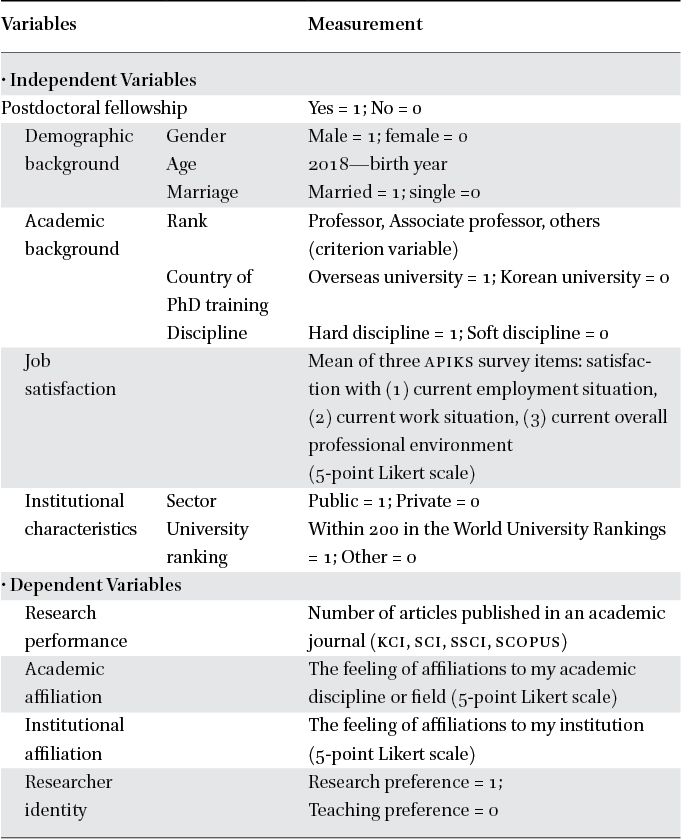
Variables and measures
This study has three dependent variables. First, this study analyzes how much the postdoctoral research experiences contribute to their research performance. The research performance is measured by the number of articles published in academic journals (
The independent variable is postdoctoral experience, and it is coded as a dummy variable (postdoctoral fellowship experience = 1, no experience = 0). The control variables for this analytical model consist of four categories: demographic background, academic background, job satisfaction, and institutional characteristics. First, demographic background items such as gender, age, and marital status, are used in the model as control variables. Second, academic background includes academic ranks, country of PhD training (PhD obtained at an overseas university or at a Korean university), and academic discipline. Academic rank is divided into professor, associate professor and others. Assistant professors, lecturers and research professor are classified as others, and they are used as a criterion variable in this study. In terms of discipline, engineering and natural sciences are classified as a hard discipline while humanities and social sciences are classified as soft disciplines. Third, job satisfaction is measured using the means of three
Three methods of statistical analysis are used. Negative-binomial regression,
Descriptive Analysis
About 35% of Korean academics who are hired into tenured positions, lecturer or researcher positions have post-doctoral experience, as shown in Table 2. The share of Korean academics who have postdoctoral experience has increased 27.3% since 2008 when we collected the data for the Changing Academic Profession study. In addition, there are discipline differences between hard sciences and soft sciences: in 2018, about 50% of academics in hard disciplines have postdoctoral experiences, while the proportion is only 15% in social sciences and humanities. This figure shows that postdoctoral training is becoming popular, even in social sciences and humanities as well as in sciences and engineering (Ates & Brechelmacher, 2013; Miller & Feldman, 2015).
In Table 3, the descriptive statistics show that academics with postdoc. experience publish about 4.26 more articles than their colleagues without that experience. They have a stronger sense of belonging to their affiliated universities and academic disciplines than their colleagues without that experience, and they have developed stronger academic identity as a researcher, as shown in Table 3. These differences between academics with and without postdoctoral experience are tested through multivariate analysis in the following section.
Multivariate Analysis
This study developed multivariate models for research productivity, sense of belonging, and academic identity as a researcher. The analytical models are applied separately to the soft disciplines and hard disciplines, as well as the total sample.
According to the negative binominal regression analysis, research productivity of the academics with postdoctoral experience is significantly higher than for their colleagues without that experience, both in sciences/engineering and social sciences/humanities, after controlling for other variables such as gender, age, marital status, academic rank, origins of doctoral training, job satisfaction, and institutional characteristics such as sector and rankings. This finding is in line with other research on the association between postdoctoral experience and research productivity (e.g., Cantwell, 2011; Horta, 2009). In addition, male and senior academics (full professor, associate professor) in high ranked universities show higher research productivity than their female and junior academics in low ranked universities. These findings do not differ much between hard and soft disciplines.
In our
Finally, this study found that postdoctoral experience is significantly associated with academic identity as a researcher in the field of sciences and engineering. This finding implies that academics develop their academic identity as a researcher during their postdoctoral studies in sciences and engineering but not in humanities and social sciences. This is because postdoctoral experience is mainly focused on research training in sciences and engineering, while it is not much in the fields of social sciences and humanities. Readers are reminded that one of the primary tasks for postdoctoral researchers in humanities and social sciences is the teaching of undergraduate courses in Korean higher education. This is different from US higher education where doctoral students tend to be the ones who teach undergraduate students. Among the control variables, male academics in high ranked universities have a higher identity as a researcher than their female counterparts in low ranked universities. Academics in highly ranked universities have a stronger researcher identity compared with their colleagues in lower ranked universities. Female academics are struggling with the balance between family care and academic work, as has been extensively discussed elsewhere (Sax et al., 2002; Xu, 2008).
Descriptive statistics

Descriptive statistics
Descriptive analysis of research productivity, affiliation, and identity


* p < .05 ** p < .01 *** p < .001

+p < .10 * p < .05 ** p < .01 *** p <.001

+p < .10 * p < .05 ** p < .01 *** p <. 001
This study found that postdoctoral training contributes to the development of research skills, identity as a researcher, and sense of belonging to an academic discipline. On the other hand, we found that postdoctoral training does not contribute to a sense of belonging to the institution. These findings imply that during their postdoctoral training academics internalize their research skills, and this contributes to their identity as a researcher, and thus their sense of belonging to their own academic disciplines (not to their institutions). These findings support our hypotheses that professional socialization during postdoctoral training is closely related to academic identity and a sense of belonging to the disciplines, as well as scholarly performance.
The literature on postdoctoral training (e.g., Cantwell, 2011; Horta, 2009; Shin et al., 2014) has addressed the association between postdoctoral research and academic performance measured by research productivity. This study also found that academics with postdoctoral experience have higher research productivity when surveying academics in Korean universities. Doctoral degree holders have the chance to closely work with their experienced researchers (e.g., senior researchers, professors, etc.) during their postdoctoral training. Most doctoral students tend to just finish their doctoral degree and are not certain about their competency as an independent researcher. This is because they have limited contact with their supervisor during their doctoral studies, as explained by socialization theories (e.g., Gardner, 2008; Weidman et al., 2001). However, postdoctoral researchers have frequent contact with their senior researchers to develop funding proposals, to design and implement research, and to write papers. Through their research participation and close contacts with senior researchers, they internalize their research skills. This fact is well represented in the high research productivity of academics with postdoctoral experiences.
We highlight the importance of the postdoctoral stage as a transformational period from being a student to being an independent researcher through the development of academic values, norms, identity, and attitudes, as well as developing research skills (e.g., Laudel & Gläser, 2008). Much of the literature on postdoctoral education has focused on the association between postdoctoral training and research productivity. However, postdoctoral training is not simply about developing research skills. It is about developing academic values, norms, identity, and attitudes (e.g., McAlpine et al., 2014; Müller, 2014). This dimension of socialization was barely addressed in the research on postdoctoral studies. However, developing academic values, norms, and identity, is critical for postdoctoral studies. In addition, institutional environments for doctoral education are much more complicated because universities are pressured to shorten the time it takes to gain a doctoral degree (Shin et al., 2018a). In this context, a reasonable approach is to focus on the disciplinary knowledge and skills during one’s doctoral studies (academic socialization), and to focus on the socialization as a professional (professional socialization) during postdoctoral studies.
Among the various dimensions of socialization, this study focused on academic identity and sense of belonging. Although this study picked very limited dimensions of socialization, the findings have implications for professional socialization during the postdoctoral stage. First, academics with postdoctoral experience have a higher identity as a researcher than their colleagues without that experience in the fields of sciences and engineering. This finding is in line with the fact that research capability is considered to be the key factor for hiring and promoting academics in most Korean universities (Shin et al., 2014). In this context, academics focus on research publications during their postdoctoral studies in order to be successful later in the job market. In this regard, it is natural for most postdoctoral researchers to develop their professional identity as a researcher.
As discussed and proposed by Boyer (1990) and follow up studies (e.g., O’Meara, 2005), different dimensions of scholarship such as teaching and application as well as research (discovery in Boyer’s typology), are critical to an academic career. However, in practice the balance between different types of scholarship is not particularly emphasized during the postdoctoral training. This is true for the sciences and engineering as well as for the humanities and social sciences (e.g., Müller, 2014). In postdoctoral training practice, postdoctoral researchers in humanities and social sciences have some teaching experience while it is less so for their colleagues in sciences and engineering. One noticeable policy approach is to balance both teaching and research. The National Research Foundation of Korea developed a program to develop teaching competency of early career academics through providing funding for teaching positions (National Research Foundation of Korea, 2019). However, this type of funding opportunity is very limited and research productivity continues to have priority for faculty hiring and promotion decisions. This study does suggest that there is a need for more balanced scholarship between teaching and research.
Second, a sense of belong is one of the key concepts when discussing professional socialization because socialization involves seeing oneself as a member of a professional community. In sociological discussions, individual academics’ sense of belonging is a key to explaining their perception and activities. For example, academics with strong institutional affiliation tend to show strong loyalty to their own institution, and they tend to be actively involved in institutional governance and administration. On the other hand, academics who demonstrate a strong sense of belonging to their academic discipline also report strong loyalty to their academic disciplines and actively participate in scholarly activities in their disciplines. Those different attitudes are explained as cosmopolitan (for academics with strong disciplinary affiliation) and local (for academics with institutional affiliation) by Gouldner (1957) and in follow up discussions (Hackett, 1990; Olsen, 2007; Trowler, 1998).
These findings and discussions imply that doctoral degree holders are experiencing transformative changes during their postdoctoral studies. Academic identity and their sense of belonging to their own academic disciplines differ between the academics with postdoctoral experience and those without that experience. These differences are mainly found in the fields of sciences and engineering but less so in humanities and social sciences. Although there is no clear explanation for those disciplinary differences, they might be explained by the disciplinary differences between hard and soft disciplines (Braxton & Hargens, 1996; Smart et al., 2000). Academics in the fields of humanities and social sciences have multiple value systems because these disciplines are based on multi-paradigms; however, those in sciences and engineering have a single value system because these disciplines are based on a single paradigm (Biglan, 1973; Becher & Trowler, 2001). The differences in value systems between the two groups of academic disciplines may result in differences in their academic identity and their sense of belonging.
This finding and discussion proposes to develop and redesign doctoral education and postdoctoral education in the continuous process of competency development. The shortened time to doctoral degree is not enough to train required competencies because there are growing societal demands for doctoral degree holders in the knowledge society. As this study found, policy makers are encouraged to realign doctoral degree programs to focus on disciplinary knowledge and skills, and postdoctoral programs on professional socialization (e.g., academic values, norms, and attitudes). This proposal suggests that the postdoctoral training should be much more systematic to prepare early career academics to be more prepared for their professional jobs. Often, universities are confronted with the market criticism that recent doctoral degree holders are not very well prepared for the changing job market. One reasonable option is for the university to shorten the time for granting a doctoral degree and provide professional socialization opportunities through postdoctoral studies.
Conclusion
This study contributes to academic discussions on how postdoctoral training is associated along sociological dimensions such as academic values, norms, and the attitudes of Korean academics. This study found that postdoctoral experiences are significantly associated with an individual’s sense of belonging to their academic disciplines and their academic identity, as well as their research performance. Based on the findings, this study highlights professional socialization during postdoctoral training. Most academic researches on a postdoc have focused on scholarly performance of postdocs while their learning experiences were not much addressed. This study aimed to uncover those areas through our survey data. Although this study is based on perceptional survey data, we believe that this study expands the theoretical discussions to socialization of postdocs. In addition, the sociological understanding of doctoral studies—academic socialization in this study—might be better understood in the continuum of academic socialization during doctoral studies and professional socialization during postdoctoral studies.
The socialization stage that postdoctoral researchers experience is a transitional period to become an independent academic. Postdoctoral researchers learn from their own experiences, their observation of senior scholars, and their interactions with their colleagues. However, these learning processes might differ from those of doctoral students or junior academics because they are between those two stages (e.g., Åkerlind, 2005). They might experience transformative changes in their understanding of academic work, academic community, and university as a social organization. Those experiences might differ depending on where they do postdocs—the reputation of university, program, and supervisor (Cantwell & Taylor, 2015). In addition, those experiences might differ by their career plan—the career plan for an academic track might differ from a professional track. Those different postdoctoral experiences might be related to their perception, activities, performance, etc. Therefore, exploring the internal process of professional socialization during postdoctoral studies has considerable value for the quality of postdoctoral training.
The concept of professional socialization has implications for universities and supervisors of postdocs. Often, doctorates are considered independent researchers while they are not. The learning processes of postdocs are dependent on individual supervisors and individual postdocs. However, we recommend higher education institutions and supervisors pay more attention to the development of a well-designed system to train postdoctoral researchers. Postdoctoral researchers are not yet independent researchers, and they need care and protection until they emerge as junior academics. The professional socialization might focus on narrowing the competency gaps between doctoral students and junior academics because they are between the two (e.g., Åkerlind, 2009). This arrangement will lessen the heavy burden of doctoral education and enable the systematic development of postdoctoral training. Although senior academics often complain about junior academics’ research competency, their social attitudes, and their commitment to the academic community, senior academics tend to pay little attention to their professional socialization process. We hope that this study stimulates academic and policy discussions on developing postdoctoral training from a perspective of professional socialization.
This study is based on academics who already held a university job, and does not include those who are in postdoctoral studies or those who have completed postdoctoral studies but found a job outside of academia. However, the study findings and discussions might have implications for those who have a job outside of academia. Such professionals are also expected to develop their professional competency through their field experiences, such as internship or postdoctoral experience in a private company, public research lab, or their own company. This line of professional competency, whether for the academic profession or for the knowledge professional, has similarities, but it is also different. The challenge is how to arrange different types of postdoctoral experiences to systematically develop the professional socialization process.