



Abstract
The quest to become research universities of international repute has led flagship universities in East and Southeast Asia to develop a new focus on attracting international doctoral students. This paper aims to understand Chinese doctoral students’ mobility in the immediate region and their education to work perceptions. The study draws from a sample of 301 doctoral students from China who were studying at five universities in Japan, South Korea, and Singapore. Analysis on students’ decision making and after-study pathways highlights the regional exchange in related areas. We argue that this regional mobility of doctoral students, characterized as the second education circuit, is facilitated by a higher education migration infrastructure with three interactively weaved dimensions: commercial, social, and regulatory. The research findings suggest the growing importance of Asia as a regional second circuit of doctoral training for students from China.
Keywords
Introduction
China is characterized by a large market of youths open to the possibility of study abroad. While the primary intention is education and training, studies have also shown that for young people important factors in moving abroad include broader objectives of gaining life experience and self-cultivation (Yang, Volet, & Mansfield, 2018). This combination of instrumental and non-material objectives creates a compelling desire to study abroad. As one of the world’s most important manufacturers and a technology leader, China faces a huge demand for high caliber workers. The demand is streamlined with the movement of doctoral students. Doctoral students are more mature in that they are “autonomous learners, highly motivated and able to control their own study”, and more likely to exercise great care in their university choices (Ye, 2018). At the same time, host countries and their universities are discerning in the selection of potential research labor to staff laboratories, research institutes, and other middle to high level appointments (Ge & Ho, 2018).
Students from China and indeed the rest of the world continue to choose the major primary markets of North America, Europe, and Oceania (Zhang, 2014; Heng, 2018; Reynolds, 2018). According to Zhou (2014), 28% of the doctoral degrees awarded to international students came from Mainland China, of which 92% came from
Asia as Second Education Circuit for Chinese Doctoral Students
China sees high caliber labor, in particular skilled talents in the science and technology areas, as a most important driving force of national development. This understanding is planned and reflected in its national policy regarding education and talent cultivation. Since 1995, the national strategy of “kejiao xingguo” (in English, “invigorating the country through science, technology and education”) has been initiated by the central government, emphasizing profoundly that science and technology is the driving force of its economic development and plays a critical role in shaping the developmental structure of the country. Accordingly, the Chinese government invests remarkably in research and development (R&D). For instance, the R&D expenditure of China in 2017 accounted for 20% of total world R&D expenditure (Veugelers, 2017). The development of an innovation-driven economy relies on the improvement of overall quality of human capital and investment in research-related work. In 2010, the Chinese leadership launched a major national talent development plan with the purpose of further cultivating, attracting, and retaining, highly skilled talents worldwide (Wang, 2011).
Specific attention at the policy level has been given to overseas returnees. Over the years, millions of Chinese students have studied abroad. The number of outbound students reached 608,400 in 2017, with an increase rate of 11.74%. A range of policies and incentives at the national and regional levels have been announced to attract citizens who have studied and worked overseas to return, such as the launch of the “1000 Talents’ Program” in 2008. As reported by China Daily in April 2018, over 350 entrepreneurship parks have been built nationwide, aiming to attract 86,000 overseas returnees. It is believed that returnees are attached with “transnational capital” and able to contribute significantly to the country’s overall R&D and innovation capacity by not only bringing back high skilled human resource but also additional values, like international networks, advanced technologies, and so on (Xu, 2009; Mok & Han, 2016).
Our focus on examining overseas doctoral students represents a critical element in China’s talent development program. As researchers, the post-study paths of doctoral students are in the research fields where they act as bridges between academia, culture and industry. A report released by the Studying Abroad Service Center of China’s Ministry of Education shows that East and Southeast Asia were the second large educational region for doctoral students from China: with traditional host countries in North America, Europe, and Oceania, attracting 57.67% doctoral students from China, while East and Southeast Asia universities host 31.30% of students (see Table 1). To better understand this high skilled regional mobility, we introduce the idea of second education circuit to connect the China market of talented young people and universities in East and Southeast Asia.
Qualifications need to be made in the use of the term “second education circuit”. First, in using the term “second circuit”, it does not imply that it represents a second choice or second chance for students whose primary goal is to study in North America or Europe. Within the choices made by Mainland Chinese students to move to very diverse countries, the point to be conveyed is that the second circuit is emergent in its function to shape the movement of students. Second, what elements go into the making of this circuit? This circuit is clearly defined by the type of migration. The dimension of the migration infrastructure supporting the second circuit will be moderated by the focus on young education migrants, in particular at the high skilled level. Third, the characterization of the second circuit highlights the role of the proximate region. The analysis on the second education circuit needs to be positioned in the broad picture of regional economic and sociocultural integration.
Top 10 educational destinations for doctoral students from China (2016)

Source: Information published in The 2016 Blue Book of Chinese Returnees and Employment (In Chinese, zhongguo liuxue huiguo jiuye lanpishu 2016) by the Studying Abroad Service Center of China’s Ministry of Education, accessed from: http://en.moe.gov.cn/ .
Top 10 educational destinations for doctoral students from China (2016)
Chinese regional strategy in Asia, in particular East and Southeast Asia, represents an interplay between economic interests and political strategy (Liu & Zhou, 2019). China has, over many decades, developed strong intergovernmental ties with its neighbors. As a member of the Association of Southeast Asian Nations plus 3 (
China’s foreign direct investments (
The regional investment made by China opens up opportunities for doctoral graduates studying in East and Southeast Asia in four ways. First, graduates from
For the analytical framework, we rely on the concept of migration infrastructure to conceptualize the second education circuit. Biao and Linquist (2014) focused on unskilled and semi-skilled workers and proposed five dimensions of migration infrastructure. 1 In relation to higher education migration, the current study emphasizes three dimensions of infrastructure for high education migration with the proximity to China of East and Southeast Asia. We argue that these three dimensions interact and weave together to form an infrastructure which facilitates the movement of Chinese doctoral studies in flagship universities in Southeast and East Asia:
(a)
Typical questions in terms of international student mobility will be: how are students recruited by universities, and what are the intermediary agencies in the process (Ortiga, 2018)? The significance of education migration is the understanding about both the process of going for study and what happens after study. Thus, an equally important question for student migration is the economic opportunities after study. Are there opportunities for employment in the home and host country after graduation (Zhuang & Wang, 2010)? In section 2, we detail the importance of China’s demand for high skilled labor, suggesting that mainland students who study overseas have opportunities for home employment.
(b)
Do intergovernmental relations play an important role in facilitating student flows through scholarships, and other training opportunities? East and Southeast Asia forms an important part of China’s immediate region and it has developed important ties with its neighbors that have resulted in strong educational linkages. Most importantly, we see this in the form of government-to-government ties, scholarships and also information received by students. A second form of regulatory structure is formed by the universities themselves. Such interuniversity ties are stronger regionally because of the density of interaction. These dense networks further channel the flow of information and support for prospective students. Shen, Wang and Jin (2016) also highlight regulatory measures such as student and employment visas.
(c)
This captures the type of social networks that students build and/or depend on. In the case of the second education circuit, relatives, friends, seniors, and graduates, become important sources of information about the country and the university (Sidhu, Collins, Lewis, & Yeoh, 2014). In comparison to transitional host countries in the West, the social ties among people of these Asian societies are much stronger. In what ways, are the agents implicated in the social infrastructure important in shaping doctoral students mobilities and their after-study pathways?
Existing studies of international student mobility tend to focus on student choice (e.g., Fang & Wang, 2014; To, Lai, Lung, & Lai, 2014; Ahmad & Hussain, 2017). However, an important question raised in this paper is how choice is mediated and consequently enabled. If mobility is enabled by an assemblage of elements which make up what Biao and Linquist (2014) term the migration infrastructure, then what are the elements that shape this second circuit? The idea of migration infrastructures highlights the importance of understanding how mobilities are being organized (Biao & Linquist, 2014) and directed (Lin, Linquist, Xiang, & Yeoh, 2017). In advancing the concept of migration infrastructures, Lin, Linquist, Xaing and Yeoh (2017: 169) argue for a shift in attention away from the focus on the migrant to “human and nonhuman actors that move migrants within specific infrastructural frames”. This opens the way to think about pathways, channels and opportunities and how these are enabled and regulated by actors
Some infrastructure mobility pathways are managed through the actions of formal organizations. The management is part of the formal responsibility of the organization and it is this responsibility that is tasked to specific officials and has a budget allocated to its maintenance. It is this resourcing with its implied regulatory power that keeps the pathway and opportunities stable and permanent until policy changes. Within organizational theory, it is about the unfolding of a resource environment that is open to migrants. This is particularly important for higher education mobilities where these movements are enabled by intergovernmental arrangements, university scholarships, research collaborations, links between research laboratories, research internships, foundations, and various forms of shorter term higher education training aid. At another level, such forms of mobility are also informed by informal networks of returnee graduates, and interpersonal interactions within alumni associations. Equally important is an ongoing dominant ideology which supports the resourcing of particular forms of mobility. Within the context of higher education, we understand how in the face of government budget cutbacks, universities have relied on the fees paid by foreign students for their operational budgets. But what ideology justifies the creation of foreign student scholarships? Why is the education of foreign students a necessary expenditure? Is this tied to a notion of how such students may contribute to the university and economy? Or are scholarships and training aid tied to soft power projections?
The concept of migration industries proposed by Cranston, Schpendonk and Spaan (2018) implicates similar agents as the concept of migration infrastructure. However, Cranston, Schpendonk and Spaan (2018: 543) invoke a wider context and broader forces when they point out that an “understanding the migration industries helps us understand contemporary articulations of the interactions between the economy, nation states, non-governmental organisations and the movement of people”. Moving beyond migrant networks and organizations, these broader connections between the nature of the economy and politics enable another level of analysis.
An exclusive focus on migration infrastructures and industries is limited as these concepts say very little about the way a potential migrant approaches migration. The work of Synder (2002) and Collins (2018) provide ways forward in this conceptualization. Synder (2002) suggested an influential pair of concepts—pathway thinking (the ability to develop a clear pathway to achieve a personal goal) and agency thinking (the “perceived capacity to use one’s pathway to reach the desired goals”)—to discuss hope theory. Collins and his colleagues have argued for the introduction of desire to the study of migration, pointing to the anticipation of the transformation aspect of mobility (Collins, Sidhu, Lewis, & Yeoh, 2014; Carling & Collins, 2018; Collins, 2018). By focussing on the process rather than an end point, Collins (2018) is able to link migration back to migration industries and infrastructure, by arguing that “desire is encouraged, enlisted, channelled or impeded in relation to migration regimes”. While hope and desire are emotional attributes that are quite relevant to understanding higher education migration, Synder (2002) and Collins (2018) differ in important ways. Synder’s (2002) concern is focused more specifically on the individual and is oriented around how high hope individuals are able to have the ability and the capacity to find pathways to achieve a particular goal. By building on Deleuze and Guttari’s (1983) approach, Collins (2018) commits to a position which links desire as an emotive state to a wider social, political and economic context where desire is created, and responds to and brings together new arrangements. The adoption of a processual framework sharpens the focus on the transformative outcomes of movement, along with how desire is shaped along the pathway(s) by contextual factors mediated by agencies (Collins, 2018).
Neighboring Asia as the Destination of Chinese Doctoral Students
Dataset
The empirical support of the current paper comes from the data collected from international students. To characterize the second education circuit and understand the infrastructure that facilitates it, it is important to address how international students make decisions to study in Asia. What are the perceived opportunities? How is the decision of being in Asia linked with their career pathways?
The data presented in this paper is derived from a research project entitled “Globalizing Universities and International Student Mobilities in Asia” (
Research Findings
Reasons for Studying in Neighboring Asia
As mentioned earlier, conceptualizing East and Southeast Asia as the second circuit of Chinese doctoral students does not mean the group of Chinese students exhibits lower performance, nor that Asia is a second choice for them. The survey result shows that Chinese doctoral students who chose to study in Asian flagship universities have high quality academic performance: 80.1% of respondents reported they were within the top 10 in their previous class at their home university in China. The high performance of these students in their home universities suggests these are students who have had a history of repeated academic success. Encouragement from teachers and parents go into making what Synder (2002) terms high hope individuals who are able to map out clear pathways into their achievement of goals. This is evident with the finding that 71.2% of doctoral students in the survey indicated they did not choose to study in the host university because “with my results, it is difficult to gain entry to a better university at home or overseas”. Related research examines the interaction between agency and pathway thinking as well as the context in which such thinking occurs. For example, Crane (2014) suggests the relative importance of agency thinking over pathway thinking in determining goal performance. Tong, Fredrickson, Chang and Lim (2010) raise the more general context in which hope arises. In the context of higher education, our data shows that doctoral students have both the agency ability as well as the pathway thinking to discern clear pathways within this second circuit.
As more mature students with stronger concerns to enter the academic and research market, doctoral students exercise great care in their university choices (See Table 2). 4 The reputation and quality of training is clearly the major consideration. 5 They carefully selected the program, made sure the curriculum makes use of the latest knowledge, had an international standard, and was taught by experts (see items 2, 3, 5, and 8). Clearly, flagship universities in Asia have accumulated a good reputation for research training among Chinese students, and likely for employers in China as well (see items 1, 6, and 7).
Reasons for studying in East Asia universities

Reasons for studying in East Asia universities
The majors selected by Chinese doctoral students demonstrate a significant attraction of
Major chosen by Chinese doctoral students in Asian universities

The three dimensions of migration infrastructure can be seen from how these students get information about the host universities and their program. As for social infrastructure, regional ties are strong at the interpersonal level. Intraregional migration patterns are strong. The Chinese have a long history of movement into East and Southeast Asia. In the contemporary period, a study conducted by Zhuang and Wang (2010) on new Chinese migrations into Southeast Asia suggests that new Chinese migrants into Southeast Asia can follow two routes. The first is that they migrate on the path set by China’s trade and overseas investments, which create opportunities for Chinese businesses and therefore settlement. The second route is suggested from the study abroad and settlement pattern created from the 1980s with scholars sent by the government to study in North America, Europe, Japan, and Australia. Although it was less clear about the implications of study abroad for Southeast Asia, this is certainly a possibility, particularly for Singapore, South Korea, and certainly Japan where the work opportunities for graduates are promising. With geographical and cultural approximation, people’s social networks in Asian countries has laid foundations to reduce concerns of studying abroad. Introduction and recommendation from friends and relatives are reliable resources that support the decision making process. It is listed as the third channel for information gathering for Chinese doctoral students (see item 6 in Table 4).
Host university and program channels of information of
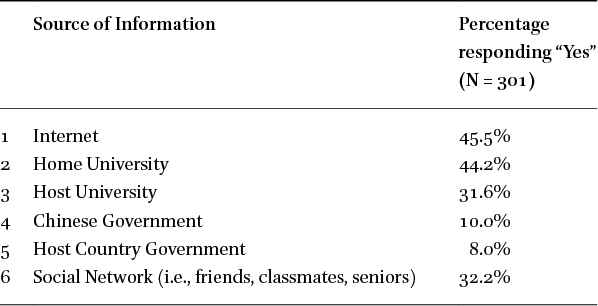
Host university and program channels of information of
Students were able to obtain information regarding other Asian universities when they were studying at home universities in China (see item 2 in Table 4). The biographical interviews with doctoral students from China show that universities in Asia have well established ties such as collaboration in research, exchange of researchers/academic staff, and recruitment channels (see the quotes from two interviews with Chinese doctoral students in Korea). For instance, a student was recommended by a visiting professor from Pai Chai University in Korea and got accepted by
The strategy of student recruitment is based on students’ understanding of future job prospects after training. For instance, the successful strategy of mentioning big high-tech companies like LG and Samsung reflects well established regional economic ties: doctoral training in KU could open opportunities to work in the R&D sectors of the multinational companies in both home and host countries, or even beyond. This shows the importance of proximity to the neighboring region of China.
At that time, there happened to be a professor from Pai Chai University in Korea who came to our university as an exchange professor. I asked this professor if he could write me a recommendation letter. And he agreed.
Harbin Institute of Technology (
Regarding the regulatory infrastructure, a clear agenda exists at the national level. The intraregional university network exists alongside, and is often reinforced by, a network of intergovernmental bilateral and multilateral educational support. Doctoral students from China received study information both from the home and host country governments (see items 4 and 5 of Table 4). The support from government is manifested in financial support. For instance, students studying in South Korea and Japan indicated Chinese students often receive scholarships from home and/or host country governments (see the two interview quotes below).
Korea and Chinese governments have agreement. Korean government provides scholarships for Chinese students to study in Korea, while Chinese government provides scholarships for Korean to study in China.
I obtained scholarship from Chinese government, many other students get scholarship from Japan … I need to go back and work in China for two years. But even there is no such requirement, I will go back.
From the perspective of Chinese students, the opportunities of doctoral training in Asia are accompanied with tangible financial support. Financial concern is often seen as a significant factor affecting the selection of overseas educational destination (see Table 4, item 4, and the interview quote below from a KU doctoral student majoring in International Studies). The financial support, especially from the host country, makes the opportunities feasible for Chinese students (see Table 5, items 1 and 2). It shows that both at the country level and institutional level, China is regarded as an important partner in research and high skilled labor training. Host countries and their universities are discerning in selecting potential research labor for staff laboratories, research institutes, and other middle to high level appointments.
Korea is the cheapest one. America and Canada are good but expensive. From a practical experience, Japan is relatively cheap … Korea’s culture and language are similar to us. But financial reason is the most influential to my decision.
Financial support for Chinese doctoral students in Asia

Whether and how can this high caliber, well-educated labor, trained in Asia, contribute to regional development? This can be analyzed via their after-study pathways including their work location, major, and type of work industry. After-study pathways raise the important questions of where graduates move to, and what benefits they bring to hosting sites. Shen, Wang and Jin (2016: 341) noted that doctoral students add to the scientific research capabilities of hosting universities as graduate students and contribute to the host country’s scientific, technological, and economic development in the countries they choose to go in their after study phase.
Where do these doctoral students plan to work after graduation? From previous literature, an increasing number of international doctoral students benefit the host country by bringing innovation and research manpower. It could be a huge loss for the home country if the loop of “brain circulation” cannot be formed (Johnson & Regets, 1998). In research carried out by Kim, Bankart and Isdell (2011), it was reported that only 8.3% of foreign doctoral students in the US decided to return to their home countries after graduation in 1990s, and the rate was 7.4% during the 2000s. In contrast, the intention to return for Chinese students in Asian universities seems much higher. The survey result in this study shows China is definitely the first choice of working place after graduation for this group of doctoral students in Asian universities: 74.4% of them have the intention to work in China after graduation. And there is no disciplinary difference: students in both
Intended work location of Chinese doctoral students

Intended work location of Chinese doctoral students
Further empirical research needs to be done to understand reasons behind the high intention to return for Chinese doctoral students hosted by Asian universities. The findings from this study regarding decision making factors may have provided some clues. As the reputation of training in Asian flagship universities is well recognized by employers, the decision to return could be part of the planned trajectory. This suggests commercial infrastructure is playing a role in the future plans of Chinese doctoral students. With the well-established economic ties between China and their host countries, the group of Chinese doctoral students could have made long-term career path plans when they chose to get training in universities in Asia (see interview quote from KU doctoral student majoring in International Studies). The training and work experience, as well as the regional networks, are more transferable than for their fellow doctoral students who studied in the first circuit (see interview quote from
I want to set up a company for information management (in China). I am now studying international studies, especially international trade … If I work for Korean companies, I think I can get more information and skills.
As I mentioned earlier, I researched on information to do with the World Bank. When I applied, it was with the World Bank as my aim. I hope to be able to use the knowledge that I’ve learned to develop regional economics.
About 42.3% and 33.1% of students respectively showed interest in staying in the host country or working in a third country. The intention of working in a third country could be associated with students’ English language proficiency. With English as the host country language, Chinese doctoral students in Singapore had significant higher intention to work in a third country than their fellow doctoral students in Korea and Japan (see Table 7). Table 8 demonstrated that there is a significant different between
Comparison of host country language proficiency for intention to work in a third country

Comparison of host country proficiency between STEM and non- STEM students

What types of work do these research-trained talents aim to get? With the acknowledgement of academia as the traditional career path for doctoral training, this group of Chinese doctoral students also foresees the possibility of working in the industry sector (see items 1 and 2 in Table 9). Research universities become essential partners with industry, with the state providing seed and start-up funding to encourage partnerships between industry and academia. As suggested in the last section, China’s role in regional integration also creates opportunities for employment in Chinese
Future plans for Chinese doctoral students in Asian universities

Three contributions to the literature on international education and student mobilities can be highlighted from this paper. First, we contribute to the emerging field focusing on doctoral students for their potential contributions as highly skilled knowledge workers in the making. This realization of their potential propels the state to work through its regulating and enabling agencies to ensure the availability of new creative labor in the interests of economic competitiveness for their national economies. Second, we show how wider structures and opportunities, conceptualized in terms of the migration infrastructure shaping the second education circuit resource, enable and regulate the flow of doctoral students. Third, we also take a closer look at doctoral students to understand their motivations, desires, and after-study pathways. We therefore expect stronger focus, mindfulness, and resilience, when they move through their doctoral journeys and in their transition to work. It is necessary to understand how these doctoral inclinations are linked to the wider structures that create the opportunities these students seek. We thus have followed Carling and Collins’ (2018) call to “conceive of the wide-scale economic, social and political drivers of migration as well as how they get articulated in individual bodies’ will and capacity to migrate”.
China and its East and Southeast Asian neighbors are experiencing an important moment of mutual opportunity. Within Pacific Asia, Japan, Korea, and Singapore, with China as a later comer, are moving to strengthen their innovative capacity as a way to move forward economically. High skilled labor, in particular research labor, is at the core of development. China is experiencing an important moment in terms of the transformation of its economy. The need to move beyond labor intensive industries represents strong opportunities for its universities, as well those abroad, to train high skilled graduates. There is an important role for regional research universities to contribute to training of research labor in China. As in other developed East and Southeast Asian countries, China needs such highly educated labor to contribute to its own economic growth.
On the other hand, it is also an important moment in terms of China’s involvement in East and Southeast Asia. This involvement requires the deployment of highly skilled, professional researchers, particularly in the fields of International Relations and Public Policy, to support the policy needs of China’s think tanks. Graduates from Economics and Business will be critical in supplying the economic intelligence to support market and trade information needed as China’s trade with its immediate neighbors increases and its corporations move production and service operations overseas. Graduates from area studies, Sociology, and Anthropology, are needed to teach new generations of Chinese graduates seeking employment in East and Southeast Asia to help create a better understanding and appreciation of the cultures of host societies.
This paper highlights the twin processes of structure and agency in the mobilities of doctoral students from China to East and Southeast Asian flagship universities. We propose the term second education circuit to emphasize the characteristics and mechanisms of this regional mobility, which is seen as very different from the traditional first circuit. At the structural level, the movement of Chinese doctoral students into flagship universities in East and Southeast Asia rides on opportunities within China’s stage of development, as well as with China’s growing participation in this region. The process is facilitated by commercial (i.e., regional economic ties, R&D collaborations, and job opportunities), regulatory (i.e., national agenda,
Students can capture the opportunities provided by an evolving migration infrastructure and exercise their agency in terms of choice of study destination and major, and the making of future plans. With the recognition of the role of
Footnotes
1
Biao and Linquist (2014) looked at unskilled and semi-skilled workers. The other two dimensions—technological (the communication and transportation) and humanitarian (
2
3
4
Doctoral students are goal oriented, yet knowing what they want does not mean there are no withdrawals. Recent research by Gao (2019) shows unanticipated reasons for withdrawal.
5
To, Lai, Lung, and Lai (2014) noted similar factors (recognition of qualification, reputation of the program) in a survey of graduate study plans of final year undergraduate students studying in universities in Macau, Hong Kong and China.