



Abstract
The aim of this study is to explore whether local and non-local doctoral students in Hong Kong perceive their competency, supervisory style and institutional environment differently, and how these perceptions influence their stress levels. Two research questions are identified: Are there differences in the perceived competency and learning experiences of local and non-local doctoral students in Hong Kong? What are the factors resulting in doctoral students’ stress, and how do these differ with students’ origins? This study used survey data from the Comparative Study of Doctoral Education in Asian Flagship Universities. An analysis of 482 responses was conducted and analysis of variance (
Keywords
Introduction
Higher education in Hong Kong is a hybrid of Western and Chinese elements, resulting from the coexistence of British colonial history and traditional local Chinese culture (Siu, 1996). Its diverse demographic, socio-cultural and linguistic environment (Vyas & Yu, 2018) successfully attracts non-local students to its global higher education opportunities. The University of Hong Kong, for example, has been ranked the third most international university in the world (Times Higher Education, 2018). The government has strategically recruited students from outside of Hong Kong since 2007, with the policy target of becoming an “Asian education hub” (Cheng et al., 2011). For example, the policies regarding the admission ceiling and scholarships for non-local students were changed, and visa and employment restrictions were relaxed to attract more non-local students (Cheung et al., 2008; Mok & Bodycott, 2014).
The majority of non-local students in Hong Kong are from mainland China. Although they share the ethnicity and cultural heritage of the locals, they have experienced a different social and political environment in recent years. Hong Kong and China have maintained one country and two systems since the handover in 1997 (Postiglione & Jung, 2017), and mainland students are considered very similar to other international students in terms of tuition, fellowship and working hours during their studies. Due to the international environment and their relatively high reputations among Asian universities, Hong Kong universities have become major study destinations for mainland students.
Many international students also come to study in in Hong Kong. The proportion of international students in Hong Kong postgraduate education is slightly lower than that of local students, approximately 10%. The issue of whether we can define international students as a homogenous group when considering the diversity of their nationality, language and cultural backgrounds remains, but in this study, they are regarded as one group, as they are generally socialised together. All international students enter degree-level education with the same required programs and conditions and have the same formal and informal campus experiences.
Thus, in demographic terms, Hong Kong students can be divided into three groups: Hong Kong local, mainland, and international, with the latter two defined as non-local. Studies such as that of Yu and Wright (2017) have applied this grouping to understand the dynamics of Hong Kong students and to compare their motivations and learning experiences. The term non-local students used in this study is defined as “a politically correct term that refers to both foreign students originating outside of the administrative region and Mainland students from China” (Yu & Zhang, 2016; p. 2) in the Hong Kong context. The number of non-local students in Hong Kong, both undergraduate and postgraduate, has been increasing. The percentage of non-local students up to 1997 was only 1%, but it reached 13% in 2017 at the undergraduate level. At the postgraduate level 81% of students were non-local, and most were from mainland China (
Learning experience of students should be discussed in the understanding of sociocultural contexts as learner’s identity building and learning approaches are differently shaped by their cultural backgrounds. As Datu et al. (2016) pointed out, learners’ learning approaches and self-esteem in a collective society, such as Asian Confucius cultures, is different from those in Western culture. Watkins and Biggs (1996) explained that Chinese learners generally show strong goals for academic success although this sometimes causes a higher level of academic stress and pressure (Fwu et al., 2016). Students in Chinese culture also employ unique learning approaches such as memorization and rote learning, and strategically switch their learning approaches when they study abroad (Wang, 2015).
Several studies have explored how Chinese students study overseas in Western countries (i.e., Smith & Khawaja, 2011), but little is known about the acculturation experiences of Chinese students in Asian contexts, including Hong Kong. Some recent studies have explored their motivations for choosing Hong Kong for their studies, but most focused on the undergraduate level (Bodycott, 2009; Li & Bray, 2007). Few comparisons of the three groups (local, mainland, and international) have been conducted in terms of who they are, what and how they learn differently, what makes their learning experiences satisfactory, and what factors influence their stress.
Doctoral students experience stress due to factors such as graduation requirements, intellectual or social isolation, time pressure, lack of confidence in their abilities, the quality of their programs, their relationships with supervisors, and uncertainty about their future careers (Berry, 2002). Not surprisingly, the stress factors differ with students’ backgrounds. For example, sociocultural adaptation to the host culture induces stress in most non-local students (Smith & Khawaja, 2011). They also express how various study factors put pressure on them, such as language proficiency and approaches in the teacher-student relationships that are different from their previous educational experiences (Yu & Wright, 2017). International students have typically been described as a minority group that needs extra support and has adjustment issues in the local community. However, non-local students in Hong Kong, and mainland students at the doctoral level in particular, are no longer a minority on campuses. They now far outnumber local students and have established their own learning community, but they still experience academic and cultural challenges as newcomers.
Thus, the focus of this study is on the dynamics of doctoral students’ composition in Hong Kong. We compare how the experiences of the three groups of doctoral students differ in their learning throughout the doctoral journey. The study focuses on how their learning experiences affect their levels of stress. The research questions are as follows: Are there differences in the perceived competency and learning experiences of local and non-local doctoral students in Hong Kong? What are the factors resulting in doctoral students’ stress, and how do these differ with students’ origins?
Literature Review
Doctoral Students in Hong Kong: Local vs. Non-local and Chinese vs. International
Hong Kong successfully attracts non-local students from mainland China and other countries. In 2017, 81% of students were non-local at the postgraduate level, as shown in Figure 1 (
Proportion of non-local students in Hong Kong

Source: University Grant Committee Statistics, 1996–2017
Proportion of non-local students in Hong Kong
The number of mainland students increased from 4,041 in 2010 to 5,117 in 2017. Those from other locations in Asia increased from 216 to 575, and students from the rest of world increased from 149 to 433. Although the overall number of non-local students increased, those from mainland China made up the largest group in Hong Kong postgraduate education (see Table 1).
Numbers of non-local research postgraduate students in Hong Kong, 2010–2017

Why has the number of non-local students been increasing in Hong Kong? Studies have suggested that the main reasons why they come to Hong Kong are academic, economic, social, cultural and political (i.e., Li & Bray, 2007). For example, mainland students mainly choose Hong Kong because of its geographical proximity, use of English as a medium of instruction, and relatively high reputation in Asia (Gardner & Lau, 2018; Yuen et al., 2017). Employment prospects are also a strong motivation, with an expectation of work in Hong Kong after graduation and better working conditions (Yuen et al., 2017). Some students regard Hong Kong as a stepping stone to further international development (Li & Bray, 2007). Parents who may hesitate to send their children overseas choose Hong Kong as an alternative, as it still provides international educational experiences outside of the mainland (Vyas & Yu, 2018). International students believe that Hong Kong is a place where Asia meets the West, and along with the bilingual environment, it is a region of China that can be a bridge to future employment opportunities (Ng, 2012).
The different backgrounds of the three groups of students lead to clear distinctions in their campus lives. Ladegaard (2017) pointed out that the three distinct groups coexist in all Hong Kong universities, but each is separate on campus and tend not to interact substantially. Laufer and Gorup (2019) explained that non-local students experience othering from local students, both academically and socially, and as Tien (2019) pointed out, most non-local students live in the dormitories and share daily routines, but their space is not shared with local students.
The distinction between mainland Chinese and Hong Kong local students is particularly marked. Although students from both Hong Kong and the mainland share a similar East Asian Confucian culture and Chinese ethnicity, they still experience different spoken languages (Mandarin for mainland Chinese and Cantonese for Hong Kong locals), and mainland students are perceived to be different by the locals (Yu et al., 2019). They express their stress in terms of the language barrier, prejudice and discrimination in the social environment, different learning approaches, and political tension (Pan et al., 2019). Xu (2019) referred to this distinction as an example of a transborder context, as it is politically the same country but can be ideologically and socially divergent.
One group of international students in Hong Kong universities may commonly interact with another group without actively interacting with the host society (Collins, 2008; Waters & Brooks, 2011). Gardner and Lau (2018) point out that the international students in Hong Kong have diverse cultural and linguistic influences. Some are East Asian and share a Confucian heritage, some are from Southeast Asia and share the experiences of British colonialism, and some are Westerners who came to Hong Kong to find career opportunities.
Non-local students are more likely to have various adjustment issues than local students in terms of being integrated into the academic community, and in their relationships with supervisors and peers. In addition, they must adjust to a new linguistic environment as the medium of instruction is English in most Hong Kong universities (Yu & Wright, 2016). Doctoral students are stressed in general, but international students are confronted with the additional challenge of finding their way in a new academic tradition and society. Their main issues are academic isolation, and problems with supervisors and socialising in the community (Laufer & Gorup, 2019). For example, non-local students interpret teacher-student relationships in Hong Kong universities differently. Mainland students feel that these relationships are too informal, while international students feel that their relationships with supervisors are too formal and hierarchical. Mainland students expect a closer relationship and continuous monitoring from supervisors, but doctoral education in Hong Kong encourages their self-directed learning, and students often feel that they lack support (Ding & Devine, 2018).
Stress occurs as a psychological response when individuals’ life events exceed their capability to handle them (Lazarus & Folkman, 1984). To some extent, stress increases motivation and personal growth, but it generally causes negative consequences in terms of working performance and physical and mental health. Recent studies report high levels of stress among doctoral students, with one-third found to be at risk of developing a psychiatric disorder in the European context (Levecque et al., 2017), and in the US it was reported that 47% were considered depressed (The Graduate Assembly, 2014). These high levels of stress have negative impacts on the learning outcomes, degree completion rates, and research productivity of doctoral students (Barry et al., 2018; Hunter & Devine, 2016). Studies have explored the factors leading to stress among doctoral students, which include the intensive workload and the lack of ability to handle it, their relationships in the scholarly community with both supervisors and peers, the uncertainly of their career paths, and a lack of support from institutions (Cornwall et al., 2019; Pyhältö et al., 2012). In general, doctoral students are stressed due to either individual factors, such as their perceived competency, or the institutional environment.
First, doctoral students may become stressed when they are not confident enough in their abilities to successfully complete their doctoral studies. They are required to complete their dissertations or other tasks in a limited time (Litalien et al., 2015) and to develop various skills including problem solving, thinking and writing, and interactive skills such as communication and networking (Leung et al., 2017). Studies show that doctoral students experience high levels of stress when developing and managing their generic skills (Barry et al., 2018). A lack of confidence in their own abilities and concerns about their academic progress are the major sources of stress for doctoral students (Hockey, 1994; Tsai & Muindi, 2016).
Second, a high level of stress can be caused by a broad range of learning experiences, such as their relationship with supervisors and the institutional environment and culture (Mackie & Bates, 2018; Shin et al., 2018). The role of a supervisor is critical in determining the quality of the learning experience of doctoral students. Supervisors can help in their professional development, career path and degree completion (German et al., 2018), and a supportive supervisor can predict the innovation and creativity of doctoral students (Wisker et al., 2003). Sharing research interests and having compatible work relationships with supervisors are essential to ensuring good levels of satisfaction in doctoral students (Ding & Devine, 2018; Zhao et al., 2007). Mackie and Bates (2018) found that inspirational supervision reduces the stress level of doctoral students, while a laissez-faire style can lead to poor mental health outcomes.
The institutional environment is important in determining doctoral students’ stress. As Leung et al. (2017) pointed out, the research culture steers the discourse and the practice of doctoral students’ learning communities. For example, a productive research culture including active collaboration and regular meetings and seminars helps to increase the satisfaction of doctoral students (Ding & Devine, 2018) although it can also increase their workload and stress (Peluso et al., 2011). However, ambiguity in department culture and poor communication can increase their stress levels (Mackie & Bates, 2018). When doctoral students have the autonomy to choose their activities and to have constructive discussions and arguments with academics, they experience higher levels of satisfaction (Shin et al., 2018). A supportive environment that includes funding and facilities, and opportunities for activities, also contributes to the satisfaction of doctoral students (García-Aracil, 2009; Sojkin et al., 2012).
The origins of students can influence these stress-inducing factors. Although a welcoming and inclusive campus environment for international students is generally important (Jung & Kim, 2018), the interpretation of collegial supervision differs with students’ backgrounds. For example, Chinese culture emphasises networks in the scholarly community, so the support of supervisors is important when being introduced to the areas of study, but international students are often confused by the importance of these informal networks and the socialisation process (Wang & Byram, 2018).
Methodology
Data
Survey data from the Comparative Study of Doctoral Education in Asian Flagship Universities were used in this study (Shin et al., 2015). Three research-intensive universities in Hong Kong, Singapore and South Korea participated in the project to explore doctoral students’ motivation, competency, formal and informal learning experiences, career planning, and satisfaction with programs in different contexts. The Hong Kong team has participated in the comparative project since 2015, and the survey was conducted between January and February 2016 in one of the universities in Hong Kong. Two levels of stratified sampling that considered the majors and gender of doctoral students were used. After ethical approval from the Human Research Ethics Committee (
The background of the survey respondents is presented in Table 2. As the main purpose of this study is to examine differences in perceived competency, learning experiences and stress between local and non-local students, the survey respondents are presented in terms of their origins. Most doctoral students in the case university are from mainland China, almost 72%, and the percentages of Hong Kong local students and international students are similar, at 12.9% and 15.4% respectively. Interestingly, the gender composition was different in each group. Among local doctoral students, the percentage of male students (62.9%) was much higher than of female (37.1%), but more female students from the mainland study in Hong Kong compared to male students (43.4%). The percentages of male and female international students were similar, at 52.7% and 47.3% respectively. The starting ages for doctoral degree programs were all similar, at around 26 or 27 years old for all students.
Survey respondents (N, %)

Survey respondents (N, %)
The levels of education of the students’ parents were higher for those from the mainland and for international students than for those from local backgrounds. For example, 53.2% of doctoral students’ fathers and 42.3% of their mothers had tertiary degrees among mainland students, which was similar for international students’ parents at 48.6% and 44.6% respectively. However, among local doctoral students, 38.7% of fathers and 27.4% of mothers had tertiary degrees. The respondents were asked whether either or both parents were academics and 13.6% of mainland students and 18.9% of international students replied yes. Most students were receiving full or partial scholarships either from the government or from the university.
The study used factor analysis to construct variables in terms of doctoral students’ perceived competency, supervisory style, institutional environment, and stress. Based on the constructed variables, two statistical analysis methods were used. For descriptive purposes, the analysis of variance (
Variables and Measurement
In the first part of the
For example, doctoral students’ perceived competency consisted of 14 items on a 7-point Likert scale ranging from “not at all” (1) to “extremely well” (7). The survey question was “How do you assess your current knowledge and attributes acquired so far during your PhD?” Based on the principal component analysis, the key competences of doctoral students were categorised into the two dimensions of self-possession and interactive competencies. Self-possession competencies include knowledge of methodology, innovation, critical analysis thinking, career management, scholarly context, presentation, problem evolving, creativity, and flexibility. Interactive competencies include responsibility, networks, project management, pedagogy, and teamwork.
Similarly, to measure the learning experiences of doctoral students, supervisory style and institutional environments were included in the analysis. Supervisory styles were constructed via principal component analysis into three types of supervision—professional, collegial or authoritarian. For example, a professional style is defined as task-oriented supervision that focuses on research advice, disciplinary knowledge, helping to clarify the research subject, and collaborating in a research project. A collegial style of supervision is more relationship-oriented and focuses on considering personal circumstances, providing career advice, and introducing students to the scholarly community. The third type is authoritarian, in which excessive expectations in terms of student performance are demonstrated.
The institutional environment was examined by asking the question “How would you assess the culture and climate of your programme’s learning-research community?” and the items were categorised as research-oriented, resource-oriented, and autonomous or supportive. The research-oriented culture referred to an environment with active collaborative research, engagement with research projects, and an emphasis on research performance. A resource-oriented environment was measured by competition for departmental resources and resource distribution. An autonomous environment was measured by the freedom to choose courses and to express opinions to professors. Additionally, a supportive environment was included in the analysis, which was measured by the four items of scholarship, salary for a research project, facilities for research and learning, and administrative support for learning and research.
Last, the stress levels of doctoral students were measured by the eight items of a negative influence in work-life balance, concern for their financial situations, concern for their English proficiency, the difficulties of doing research, concern about the time of their graduation, work progress compared to other students, concern for their future careers, and whether they had too much work in addition to their learning and research.
The variables for the multiple regression analysis and the descriptive analysis are presented in Table 3.
Variables

Variables
Do Local and Non-local Students Perceive Their Competency Differently?
This study examined how doctoral students perceive their competency and how these perceptions differ with the students’ origins. The perceived competency in some dimensions was significantly different for local and non-local students, although doctoral students in general tended to believe their competencies were high.
There were no significant differences or levels of perceived competency between different groups in terms of problem-solving, project management and communication skills. However, international students indicated that they had higher levels of knowledge in research methodology compared to the other two groups. The mean score was 4.92 for international students and 4.39 for local students, and the difference was statistically significant. Regarding networking and team working, international students also scored their competency highly compared to those of local or mainland students. The mean score of networking competency was 4.58 for international students and 3.98 for local students. Local students’ perceptions were lower than those of mainland students. In terms of pedagogy, international students’ perceptions were higher than those of mainland students.
The differences were particularly significant in idea-related competency or attitudes. For critical analysis thinking, innovation and creativity, international students generally evaluated their competency higher than local students and mainland students, and this tendency was consistent. For example, international students assessed their innovative thinking and creativity as 4.86 and 4.76 respectively, while local students assessed these as 4.23 and 4.02. Similar results were found for flexibility and responsibility. The self-perceptions of international students were the highest of the three groups. For example, they assessed their flexibility and responsibility as 5.03 and 5.46, while mainland students assessed these skills as 4.67 and 5.06. Mainland students generally had higher perceptions of their competency levels than local students.

* < 0.05, ** < 0.01, *** < 0.001 (Post-hoc:
Students showed different perceptions in terms of how they identified their relationship with their supervisors. Table 5 shows that there were few differences in the perceptions of local and non-local students in terms of professional relationships. The three groups showed a similar level of satisfaction concerning their supervisors’ advice and comments about their doctoral studies, and concerning supervisors’ knowledge and collaboration opportunities. International students felt that their supervisors were more enthusiastic about their PhD research than local or mainland students. For collegial supervisory style, international students tend to assess their relationships with supervisors more positively than local or mainland students. For example, supervisors’ consideration of their personal circumstances and needs, career advice, and engagement in the scholarly community, were perceived more positively by international students than by local or mainland students. However, local and mainland students felt that their supervisors were authoritarian figures and had excessive expectations regarding their work. Thus, Chinese students (local and mainland) have clearly different perceptions from international students about how they regard their relationships with supervisors.

* < 0.05, ** < 0.01, *** < 0.001 (Post-hoc:
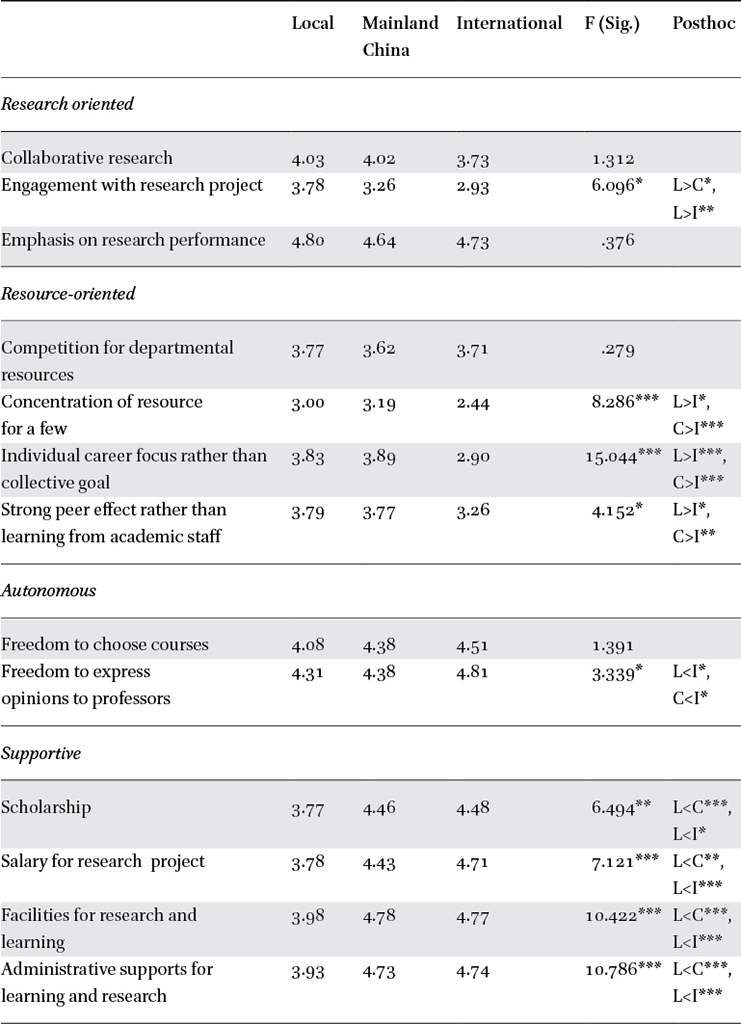
Second, the students had different perceptions about the institutional environment. Chinese students felt that they were more engaged in research projects compared to international students. They also perceived that their institution has a resource-oriented culture, for example through the concentration of resources on a few students and by emphasising individual careers rather than collective goals. International students generally felt that their institutions had autonomous cultures and respected students’ choices and opinions. In terms of supportive environment, international students were more satisfied with their scholarship, their salaries from research project participation and facilities, and administrative support for research and learning, compared to local students. In addition, mainland students’ satisfaction with the supportive environment was higher than that of local students. The support provided by institutions is expected to be equal, and the reasons why students from different origins perceived the quality differently requires further explanation.
The levels of stress of doctoral students and how the stress levels differed with students’ origins were examined. In general, the stress levels of local students were higher than those of mainland and international students. For example, for the negative influence of the work-life balance survey item, the mean score of local students was 3.66 and was 3.13 for mainland students, which was a significantly different result. Concerns about careers were also high among local students, such as the concern about graduating on time and about their careers after graduation. Local students were also stressed by having too high a workload in addition to their learning and research. English proficiency stress in particular was the highest among mainland students.
* < 0.05, ** < 0.01, *** < 0.001 (Post-hoc:

* < 0.05, ** < 0.01, *** < 0.001 (Post-hoc:
Multiple regression was conducted to examine the influencing factors of doctoral students’ stress, and the analysis was conducted separately in the three groups of local, mainland and international students to identify the different factors. Table 8 shows the results of the multiple regression analysis. In general, the higher the academic year, the more stress is perceived. Cornwall et al. (2018) explained that doctoral students in senior years feel more pressure to finish their degrees on time and in terms of data collection and writing progress, and they are also pressured to find sources for scholarships if they stay longer than expected.

Standardised coefficients (Beta): * < 0.05, ** < 0.01, *** < 0.001
Doctoral students also experienced less stress if they assessed their competency highly. A negative relationship was found between professional supervisory style and stress, and a positive relationship between research or resource-oriented culture and stress. The influencing factors were different depending on students’ origins. For example, dissertations were the stress factors for non-local students, but were negatively significant for mainland students and positively significant for international students.
Both local and mainland Chinese students’ stress levels were highly influenced by individually possessed competency, but this was not significant for international students. Thus, the Chinese students appeared to be stressed when they felt that they were not competent enough in their studies, but this was not the case for international students. Interactive competency, such as teamwork or networking, was not associated with the level of stress in any of the three groups.
Different supervisory styles had different effects on doctoral students’ levels of stress. Local students were stressed when they felt that their supervisors were authoritarian, while mainland students were less stressed when their supervisors appeared more professional. The case of international students was interesting because they were more stressed when their supervisors had a more collegial style when they cared about students’ personal issues, helped them with networking, and provided more career advice.
Institutional environments also affected students’ stress levels differently. Students from the mainland were stressed by research- and resource-oriented cultures. International students were less stressed when the institution provided an autonomous culture for their learning and research. Local students were influenced by supportive environments in which scholarships or opportunities to work as research assistants were provided.
This study addressed the different perceptions of local and non-local doctoral students in Hong Kong in terms of their competency, supervisory style, institutional environment and stress. The focus was on whether local and non-local students’ levels of stress are influenced by different factors. The results showed that doctoral students have different perceptions of their competency depending on their origins. They also assess their supervisory styles and learning environments differently and are stressed by different factors. Hong Kong local students were stressed about their perceived competency and by an authoritarian supervisory style, while they felt less stress when the institutional environment was supportive. Doctoral students from the mainland were stressed about their perceived competency and by research- and resource-oriented cultures, but their stress was reduced when they felt their relationship with their supervisor was more professional. International students were stressed by their dissertation requirements and by a collegial supervisory style, but they felt less stress in an autonomous culture. Based on these results, the following points are put forward for discussion.
First, the study showed that non-local students assessed their competency higher than Hong Kong local students. Although studies such as that of Kim et al. (2011) suggest that students who choose to study abroad tend to be more academically prepared than those in their home countries, it is still questionable whether Hong Kong local students are less competent than non-local students, or if they generally have more pessimistic views about their competency. The results of this study consistently showed that local students have negative perceptions in their learning experiences and are more stressed than non-local students. According to Shen (2012), Hong Kong local students generally have negative views about their political and educational system and their career prospects. Oleksiyenko (2017) described the condition in Hong Kong higher education that several internationalisation strategies have been defined but there are not enough resources for locals. The Hong Kong government has also expressed the concern that highly qualified local students are not attracted to doctoral programs in local universities. These students observe that the postgraduate programs in public universities are filled with non-local students (
Second, in terms of requirements, writing a dissertation was a stress factor for international students, but was negatively associated with mainland students’ stress, and therefore mainland students feel less stress when the requirement is a dissertation. Students in doctoral education in Hong Kong are now expected to publish more papers in journals and this pressure is particularly serious among mainland students. Most doctoral students from the mainland aspire to pursue academic careers and so they aim to publish research during their doctoral journey (Kwan, 2003). They may feel that completing a dissertation is a relatively clear goal and may be more stressed when other tasks in addition to dissertations, such as publications, are required.
Third, Chinese students, whether local or from the mainland, are stressed when they feel that they do not have enough competency, while international students are not stressed by their own abilities. Some studies interpret the lack of confidence in Chinese students as due to their language proficiency in an English-dominated environment (Yu et al., 2019), and this can be partly explained by different learning cultures. Chinese students often blame themselves for their unsatisfactory learning outcomes, thinking that they did not work hard enough (Wang, 2015). They must also transform their learning attitude in their doctoral studies, which brings more stress through doubting their own competency. Chinese students prefer exact goals for their tasks (Brown, 2008) and also emphasise harmony and group goals (Fan & Ashdown, 2014), but doctoral study in Hong Kong requires them to be more critical and argumentative and emphasises self-directed learning. Many Chinese students experience reduced confidence when mastering the new learning environment if these stressors are not overcome (Vyas & Yu, 2018).
Fourth, similar results were found in their supervisory style preferences. As Hyun et al. (2007) suggested, domestic and international students can provide very different judgments about the best type of supervision. For example, students from the mainland felt less stress when their supervisors were more professional and provide structured guidance, continuous monitoring and regular meetings to check their progress and collaborate with them (Ding & Devine, 2018). This is consistent with other studies, which found that doctoral students felt stressed when they had limited access to supervisors and inconsistent communication (Cornwall et al., 2019). However, this type of supervisory style did not influence the stress levels of the other groups of students. Interestingly, international students were more stressed when their supervisors had a collegial style and thus cared about their students’ wellbeing, which includes their personal issues. They were less stressed in an autonomous culture.
Fifth, the institutional environment had different effects on stress levels. For example, students from the mainland were stressed by research- and resource-oriented cultures. Pan et al. (2017) and Vyas and Yu (2018) found that Chinese students often feel stressed when they enter a new learning environment that demands that they speak up about their own research topics and methodologies and discuss them, because their previous educational experiences emphasised self-restraint and not voicing strong opinions. This may also be related to their inner circle attitude. Chinese students have strong internal bonds and form a community that they stay within throughout their doctoral journey when abroad. This socialisation within their community is important for their study. The network provides tacit learning opportunities for newcomers and gives considerable support to them in their study, but the culture is also a source of stress because they must compete for resources and prove their performance to be part of the group (Wand & Byram, 2018).
The study demonstrates the importance of understanding the characteristics of different groups of doctoral students and of providing appropriate support to reduce their academic stress. Although students’ cultural backgrounds affect their perceived level of stress, their perception can be transformed through the positive learning experience in a multicultural learning environment. Arranging mutual learning experiences for all students, no matter where they originate from, is important, along with providing the synergy to encourage them to understand each other’s strengths in terms of their learning styles. Previous studies have consistently emphasised the importance of cross-cultural experiences (i.e., Sit et al., 2017). However, in doctoral programmes, this should not only be in terms of cultural exchange but should also be linked with their research experiences, thus helping them to be independent researchers.
This study provides interesting findings and implications, but it requires a follow-up investigation to deepen the understanding of the dynamics between local and non-local doctoral students in Hong Kong. First, the different nationalities of international students were not considered, and they were regarded as a homogenous group. Follow-up studies should reflect the diversity of international students in terms of their language proficiency and proximity with Chinese culture. Second, the previous educational experiences of individual students should be broadly included in further analyses, such as their overseas experiences in earlier stages of study and academic disciplines. Last, future studies should take a qualitative approach to obtain more in-depth findings and to include the voices of different groups of students.
Footnotes
Acknowledgements
This research is supported by the National Research Foundation of Korea (