



Abstract
Social Practice (SP) is a type of educational activity with “Chinese characteristic,” and it is widespread and accessible in China’s higher education institutions. This paper explores the features of Social Practice participants and the impacts of these practices on college student learning outcomes with quantitative data collected through the “China College Student Survey” (
Introduction
Higher education is costly for the governments, higher education institutions, and education participants. Governments and individuals invest tremendous resources in higher education, but how do we know that this money is spent effectively? 1 The investors and consumers of higher education need to know the returns of their expenditures in higher education, and student learning outcomes is one of the most important returns. Based on the widespread educational ideas of “student-centered” and “outcome-based,” learning outcome is usually considered as a core concept in higher education research and practice around the world.
However, “learning outcomes” is a broad concept, especially in higher education. College students are expected to gain a series of achievements when they graduate, including knowledge, skills, values, attitude, etc. Tremendous researches have talked about what kind of knowledge, skills, qualities and values are essential for college graduates in modern society. For instance, the Association of American Colleges & Universities (
Among the numerous studies on the factors influencing college student learning outcomes, one concept that is valuable noticing is “High-Impact Education Practices” (
The “high impact” of
When it comes to the higher education setting in China, the meanings and scope of
However, what is “social practice”? Social practice is a series of goal-oriented, designed, organized educational activities that push students to step into society, serve the society, connect knowledge with the real world, in order to improve their knowledge application skill, creativity, etc. 11 Social practice is a widespread and accessible educational activity in China’s colleges and universities (also in primary, middle, and high schools). Nevertheless, “social practice” is not a single activity, but includes a series of activities, such as field work, community service, volunteerism, social investigation, internship, and so forth.
Observers find that social practice is a meaningful educational activity for college student learning and development. For instance, it inspires college students’ motivation for learning, enhances the sense of social responsibility, and improves knowledge application skills, creativity, and employability. 12 It also helps to develop college students’ values, improve creativity and entrepreneurship, 13 develop self-awareness, renew knowledge structure, and improve adaptability. 14
However, observers may elucidate the educational value of social practice based on their own or others’ observation or experiences. And finally there is still lack of sufficient quantitative evidence to explore the impact of social practice on college student learning outcomes.
Therefore, this paper examines the impact of social practice on college student learning outcomes with student survey data collected in China’s colleges and universities. The research questions are: a) what is the participation rate of social practice among college students in China; b) what are the impacts of social practice on college student learning outcomes?
In the era of “quality-oriented” higher education, it is meaningful, useful and valuable to explore the factors and methods to improve college student learning outcomes. This study will bring some enlightenment both for the construction of theories on social practice and the practices for higher education reform and development in China.
Conceptual Structure
Social Practice
Given the fact that there is not a clear definition of social practice, this paper tries to define it as: a series of activities that encourage students go out of school campus and step into the society, to engage in practical activities in real world situation that help them construct a close connection between theory and practice, and it may help to improve students’ skills of knowledge application, communication, collaboration, problem solving, critical thinking, creativity, and so forth.
There are two typical features of social practice: first, social practice is implemented outside of school campus, and the participants of social practice should go out of campus and step into society; second, social practice includes a practice activity instead of a course or some other pure knowledge learning. These features are two important criteria to judge whether an educational activity is social practice or not. Under these criteria, internship can be seen as a social practice, but extra tutoring outside of campus is not a social practice, because it is a process of knowledge learning instead of a practice activity.
Many activities, such as community service, social investigation, field work, internship, and volunteerism, are typical social practice. However, there are differences between them. Internship is not the same as volunteerism, because it is more professional-oriented and involves more professional knowledge and skills. Activity such as social investigation is different from community service, because it includes more academic features such as research design, data collection, and report writing. It is clear that different types of activities in social practices may include different assignments, practices, challenges, and may bring different impacts on student learning outcomes. Therefore, it is necessary to classify social practice into different types. This paper classifies social practice into three types:
The questionnaire of “China College Student Survey” (
Since the data in this paper was collected in
Learning Outcomes
Learning outcomes include a tremendous amount of educational achievements. This paper focuses on three types of learning outcomes:
In the questionnaire of
Engagement Levels
The questionnaire of
Model of Social Practice
Constructing a model may help to demonstrate social practice and its impact on learning outcomes simply and clearly (Figure 1). College campus and other organizations belong to the whole society. However, school campus is only a small part of the whole society, while social practice is in any places beyond campus, and it is a huge and wide platform for students to learn and practice. Students go out of college campus and step into the society to engage in social practice. There are lots of activities, assignments, practices, collaborations, communications, interactions, questions, problems, and challenges in social practice, and they may bring lots of educational stimulus to help enhance student growth.
The model of social practice.

The model of social practice.
As mentioned above, social practice has two typical features: feature 1, it is usually implemented outside of college campuses (“outdoor-oriented”); feature 2, it includes a practical activity instead of a pure knowledge learning course (“practice-oriented”). These two features suggest that social practice is different from the other
Engaging in social practice pushes the students go out of campus and step into the wide “fields” (such as the communities, villages, cities, companies, and any fields beyond campus) to involve in practical activities. In these “fields,” students encounter the real-world assignments, problems, and practical challenges.
In the process of engaging in social practice (in the fields), students may learn to construct a close connection between knowledge and practical problems in the real-world, construct a close connection between themselves and their partners and local people, and construct a close connection between their majors and their future careers. These experiences (engaging in social practice), as an extension of the learning inside school and classroom, are meaningful, valuable and important for students’ personal, academic, and career development.
The quantitative data used in this paper was collected through “China College Student Survey” (
The author uses the data collected in 2014 to 2016. Fifty-four colleges and universities in China had participated in
Matched samples were selected by
Beside the quantitative data from
Results
The Participants of Social Practice: Who are they?
Although social practice is not a compulsory activity or course that every student must participate in, however, most of college students in China show their interest and enthusiasm on social practice.
The Participants of Social Practice
As a whole, 43.68% (observations: 122,260) college students have engaged in one or two types of social practice, and 26.74% have engaged in all three types of social practice defined in this paper. That means 70.42% (26.74% + 43.68%) undergraduate students have engaged in at least one social practice; in other words, only 29.58% did not have participated in any social practice (when they accepted this investigation).
The percentage of social practice engagement (the rate of students who had engaged in at least one social practice) in the year 2014 to 2016 are 69.20%, 72.36%, and 69.75%, respectively. The social practice engagement rate is stable from 2014 to 2016, only with a small fluctuation. It indicates that China’s college students have a stable enthusiasm and interest on social practice.
Among the students who haven’t engaged in any social practice (totally 29.58%), most of them (88.72%) show their intention to engage in social practice during their college time. That means in all college students, 70.42% have engaged in social practice and 26.24% (88.72% * 29.58%) intend to engage in one social practice before graduation, and only about 3.34% don’t intend to engage in any social practice or haven’t decided by the time when they accepted this investigation.
According to the statistical data from the Ministry of Education of China, there are 16.13 million undergraduate students in China’s higher education institutions. 16 Based on the above findings, it might be estimated that more than 11.35 million China’s undergraduate students have engaged in social practice, and about 4.23 million undergraduate students intend to engage in social practice before graduation. This shows that social practice is a “popular” educational activity among China’s college students. It suggests that social practice may impact a huge amount of college students in China’s higher education. To this extent, social practice is definitely an “influential” educational activity in China.
The Participants of Different Types of Social Practice
Among the three types of social practices defined in this paper,
Attentions should be paid to a fact that some freshmen or sophomores are not “at the right time” to engage in social practice (especially internship), therefore, only half of these students or even less have engaged in
The Impact of Social Practice: What are the Effects?
Self-selection bias may exist in quantitative study. For instance, student in high reputation university, with positive learning attitude and a higher
Therefore, the author selects the matched samples through
P: propensity score
SP: social practice
Fi: students’ personal features, including GPA, learning attitude, learning habit, social desirability
Xi: other control variables, including gender, family background, discipline, grade, institute type.
Matching the treated and untreated based on p-score
The General Impact of Social Practice on Student’s Learning Outcomes
This paper explores the impact of social practice on college student learning outcomes mainly through regression analysis (based on the matched samples in
Outcomes: college student learning outcomes
SP: social practice (two groups, Group A: haven’t engaged in social practice; Group B: have engaged in social practice, at least one type)
X: control variables, including: gender, grade, discipline, institute type, first generation, social desirability
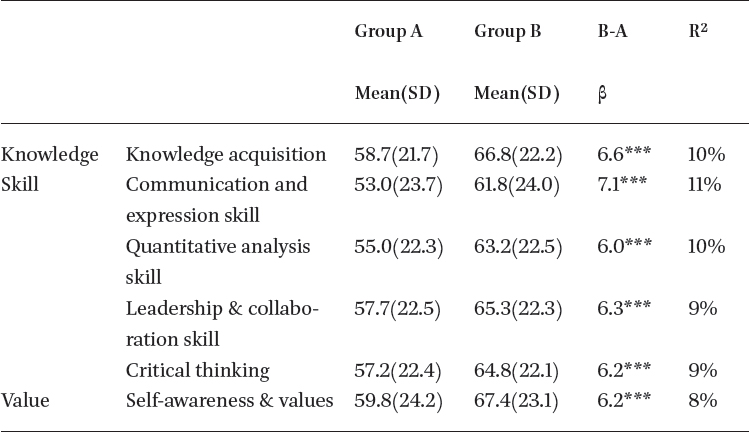
The results of the regression are shown in Table 1. Group B (have engaged in social practice) has a statistically significant higher score than Group A (haven’t engaged in social practice) in all kinds of learning outcomes (Knowledge, Skill, and Value). This means engaging in social practice may improve student learning outcomes. Specifically, among the four types of skills, engaging in social practice enhances leadership and collaboration skill more than other skills.
The general impact of social practice on student learning outcomes (N=79,120)

The general impact of social practice on student learning outcomes (N=79,120)
As illustrated above, the author classified the engagement in social practice into three levels:
In this section, it intends to compare the impacts of different engagement levels of social practice on learning outcomes. The regression equation is shown as (3), and the results are shown in Table 2.
Outcomes: college student learning outcomes
SP: social practice (three groups, Group A: have engaged in one type of social practice, Group B: have engaged in two types of social practice, Group C: have engaged in all three types of social practice)
X: control variables, including: gender, grade, discipline, institute type, first generation, social desirability
The impacts of different social practice engagement levels on student learning outcomes (N=31,575)

The impacts of different social practice engagement levels on student learning outcomes (N=31,575)
Group A, B, and C represent engagement Level 1, Level 2 and Level 3, respectively (Table 2). It is clear that higher level of engagement in social practice is correlated to higher gains of learning outcomes (the scores of learning outcomes of group B, C are statistically significant higher than group A, and the coefficients of C-A is higher than B-A).
It shows that: on the one hand, engaging in social practice enhances student learning outcomes; on the other hand, higher level of engagement brings about a higher gain in learning outcomes. Therefore, it is better for the improvement of learning outcomes for students to engage in all three types of social practice.
As illustrated above, different types of social practice may include different assignments, challenges, problems, and therefore may have different impacts on student learning outcomes. In this section, the paper intends to explore the different impacts of
The Impact of ASP on student Learning Outcomes
Outcomes: college student learning outcomes
X: control variables, including: gender, grade, discipline, institute type, first generation, social desirability
The regression equation is shown as (4) and the results are shown in Table 3. The results show that engaging in
The impact of ASP on student learning outcomes (N=43,140)

The impact of ASP on student learning outcomes (N=43,140)
Outcomes: college student learning outcomes
X: control variables, including: gender, grade, discipline, institute type, first generation, social desirability
The regression equation is shown as (5) and the results are shown in Table 4. The results show that engaging in
The impact of PSP on student learning outcomes (N=43,140)
The impact of PSP on student learning outcomes (N=43,140)
Outcomes: college student learning outcomes
X: control variables, including: gender, grade, discipline, institute type, first generation, social desirability
The regression equation is shown as (6) and the results are shown in Table 5. The results show that engaging in
The impact of SSP on student learning outcomes (N=43,140)

The impact of SSP on student learning outcomes (N=43,140)
Features of the Participants of Social Practice
As illustrated in this paper, social practice is a “popular” educational activity among college students in China: most of college students (70.42%) have engaged in social practice, a part of them (26.74%) have engaged all three types of social practice defined in this paper; among the students who haven’t engaged in any social practice by the time when they participated in this investigation, most of them (88.72%) expressed their intention to engage in social practice during their college time; therefore, in total, 70.42% have engaged and 26.24% intend to engage before graduating; that means 96.66% college student have engaged or intend to engage in social practice. These numbers show students’ interest and enthusiasm in social practice. It is important to mention that although students are encouraged to participate in social practice, but social practice is not a compulsory course or activity in every college or university in China (social practice engagement may be required in some colleges or universities and some majors).
Among three types of social practice,
Summaries of the Impacts of Social Practice
Data show that engaging in social practice enhances college student learning outcomes (including knowledge acquisition, self-awareness and values, and the skills of communication and expression, quantitative analysis, leadership and collaboration, and critical thinking.)
Generally, engaging in social practice enhances the leadership and collaboration skill the most. Specifically, among the three types of social practice,
Among three levels of engagement of social practice, higher engagement level means more gains of learning outcomes. Therefore, it is more beneficial for college students to engage in more types of social practice.
Some Implications from Qualitative Materials
Besides the quantitative data analysis, the author conducted some semi-structured interviews of seven graduate students in a university in China. The interviewees all had engaged in social practice during their undergraduate period, when reflecting on their experiences of social practice, they all have a holistic and clear idea about their experiences of social practice. The qualitative materials collected in the interviews provide us with some deeper understanding of social practice and its’ impact on learning outcomes.
All of the interviewees said that engaging in social practice brought an improvement of their learning outcomes: they have gained a lot from social practice, include skills, friendships, self-awareness, planning for their further learning and career, and so forth; and the experience of social practice has even changed their lives. Student C said that engaging in social practice helped her make some new friends who majored in different fields, and social practice pushed her to do presentations in front of a crowd of people. That experience improved her public speaking skill and self-confidence. Student E said that she had engaged in a social investigation (
The reasons why social practice helps to enhance student learning outcomes are complex. However, some facts are worth considering. In the interview, almost all of the interviewees said that engaging in social practice may confront numerous assignments, problems, challenges that you may or may not be conscious of before engaging. The numerous practical activities, assignments, collaborations, communications, interactions, questions, problems, and challenges in social practice, bring about numerous educational stimuli to the participants. These educational stimuli drive the students engaging in social practice to apply their knowledge, skills, etc., to dealing with the problems and challenges. And their skills might be trained, their horizons might be expanded, their values might be renewed in this process. Furthermore, they may learn some new knowledge and gain some unforgettable experiences when engaging in social practice. As student G said in the interview:
we may forget about the knowledge that we learned in classroom after graduation, but we may still remember the social practice experience that we had during our college time; and this memory may last as long as our lifetime.
The Implications of This Paper to the Practice
In the last fifteen years, China had experienced a rapid growth in higher education, particularly the scale growth. In 2015, the total enrollments of China’s higher education are more than 37 million; China has the biggest higher education (the scale of enrollments) in the world. 17 However, the quality of higher education is still comparatively low when compared with the developed countries. Therefore, “quality improvement” has become one of the key words in China’s next strategy of higher education development. Given this background, the improvement of college student learning outcomes is definitely one of the focuses. The research findings in this paper, generally, show the educational meaning and value of social practice as an important educational activity to enhance college student learning outcomes, and therefore, enhance the quality of higher education. Therefore, social practice, as a series of meaningful, valuable, influential and popular educational activities, is worth to be recommended strongly and taken into practice in all the colleges and universities.
When it comes to the practice of social practice in higher education institutions, the author suggests that: a) the administrators, teachers and students in colleges and universities should be aware of the value of social practice in improving student learning and development (and in improving the quality of higher education); there are many more values of social practice that are difficult to measure, and many more values of social practice that cannot be presented immediately, in that it may only take effect when students graduate from college or in later years in their careers; b) colleges and universities should construct a close connection between social practice and classroom learning, course taking, and knowledge acquiring; at present, social practice is comparatively isolated from classroom learning, teachers should guide students to reflect on their social practice experiences and connect that experiences with their course learning, which may enlarge the values of social practice further; c) every student should engage in at least one social practice during their college time, and it is better to engage in all three types of social practice, because higher engagement level means more gains in learning outcomes, and personal, professional and academic development; d) the institutionalization of social practice in college and universities should be taken into account; it may be beneficial to construct a stable system for social practice: provide funds, trainings, and guidance, and design courses, assessments, awards for the participants of social practice, so that the students might be encouraged and supported to engage in social practice; making social practice to be a compulsory activity for applying for baccalaureate might be also an effective policy; however, institutionalization should be careful, since when it becomes a compulsory activity, the quality of social practice may decline.
Social practice is valuable in improving student learning outcomes. However, it relies on students’ and colleges’ high level of engagement. It means that the investments of colleges’ resources, students’ time and energy, at some extent, are the core factors that make social practice valuable, meaningful and influential in improving college student learning outcomes, and help to enhance student learning and development; and therefore, improve the quality of higher education.
Summaries of This Research and Suggestions for the Future Researches
This paper explored the features of the participants of social practice, and the impacts of engaging in social practice on college student learning outcomes. Due to the “special” features of social practice (“outdoor-oriented” and “practice-oriented”), it may bring about a forgettable experience for the students.
Different types of social practice may provide different educational stimulus to students and may have different impacts on student learning outcomes, therefore this paper classified social practice into three types:
In the future researches in this field, more types of social practice, more kinds of learning outcomes, and more qualitative materials should be taken into account, in order to explore the impact of social practice deeply.
Footnotes
6
The author of this paper thanks Professors Hamish Coates, Jinghuan Shi, and Fei Guo, and Research Assistant Ruobing Zhang at the Institute of Education at Tsinghua University for their help in this research and constructive suggestions and comments on the paper. The author would like to show his deepest gratitude to them.
1
2
Association of American Colleges & Universities, “Essential Learning Outcomes,” retrieved from:
3
George Kuh, High-Impact Educational Practices: What They Are, Who Has Access to Them, and Why They Matter (Washington, DC: Association of American Colleges and Universities, 2008).
4
Ibid.
5
6
7
Wen Wen, Jing Chu, and Jinghuan Shi, “One High-Impact Educational Practices in Chinese ‘985’ Universities,” Journal of Higher Education 35, no. 8 (2014): 92-98.
8
Ibid.
9
Na Wang, Yiwu Huang, and Zhe Zhou, “New Paths in the Cultivation of Topnotch Undergraduate Level: Based on the Students’ Participation in the High Impact Educational Practices,” Meitan Higher Education 33, no. 5 (2015): 95-100.
10
Huafeng Zhang, Fei Guo, and Jinghuan Shi, “On Improving First-generation College Students’ Participation in High-impact Educational Practices,” Educational Research, no. 6 (2017): 32-43.
11
Huijuan Gao, “The Effectiveness and the Development Path of College Student Practice,” Journal of Xuzhou Normal University (Philosophy and Social Sciences Edition) 30, no. 6 (2010): 124-127.
12
Ibid.
13
Jia Zhang, “Constructing the Effectiveness of College Students Social Practice,” Education and Vocation, no. 26 (2015): 35-36.
14
Cong Xie and Yongfeng Chen, “Study on Effectiveness of College Students Social Practice,” Education and Vocation, no. 5 (2011): 177-178.
15
Dongbo Tu, Jinghuan Shi, and Fangfang Guo, “A Metric Study on NSSE-China,” Fudan Education Forum 11, no. 1 (2013): 55-62.
16
Ministry of Education of the People’s Republic of China, “Number of Students in Higher Education Institutions,” retrieved from:
17
Ministry of Education of the People’s Republic of China, “The Issuing of Series Higher Education Quality Reports for The First Time,” retrieved from: