



Abstract
Student success is an elusive aspiration in South Africa, especially for its majority African population as the country continues to endure the imprints of a racially divided higher education system. This article will critically examine various reform initiatives designed to enhance student success since 2004. The authors will demonstrate that despite successive efforts and increasing resources directed at enhancing student success, the outcomes have been minimal, largely because student failure has been pathologized as a function of student deficits rather than a consequence of systemic dysfunction, especially as it relates to the curriculum. We concede that while the impediments to student success are multifarious, using the affordances of technology to institute a less alienating curriculum structure, alongside a review of content, can catalyse the process of reform to reverse current student outcomes.
Introduction
Higher education is afflicted by a curious contradiction: Entrusted with the intellectual project of finding solutions to world problems, it has a poor record of finding solutions to its own persistent problem of low progression and success rates. The South African Council on Higher Education (
The consequence is that higher education is failing to catalyse the conditions necessary for intergenerational mobility for the majority African population.
2
Narratives of chronic attrition and failure continue to dominate the South African experience as the country is denied the requisite skills to arrest the shrinking capitalist economy, evident in the annualized 0.2 percent economic growth in 2017.
3
Higher education in South Africa was, and continues to be a ‘low-participation, high-attrition system’
4
which largely fails to interrupt the cycle of poverty, as unemployment and income inequality increases and South Africa boasts one of the highest
Historically, this failure was attributed to the articulation gap between secondary schooling and further education. 6 More recently, institutional under-preparedness 7 is being acknowledged as contributory, particularly institutions’ incapacity to monitor and track student progression effectively. Despite its best intentions to rid itself of its colonial legacy, supported by huge resource investments, the apartheid inspired system, which was historically differentiated along unequal racial demographics, failed to meet the needs of the recently enfranchised masses.
Using a transformative framework, 8 this article explores how student success is currently being characterised in the South African higher education system. The overarching question framing this article is whether the core elements of social justice are being addressed in higher education in post-apartheid South Africa. In particular, we are interested in how resource allocations and specialised programmes to address equity, contribute to student pathways that lead to success.
The Higher Education Transformation Journey
In 1996, the South African National Commission on Higher Education (
Between 2002 and 2005, the higher education sector underwent major reorganisation. The mergers involved shutting down large numbers of teacher education colleges and incorporating some within universities, while expanding the further education and training (
In the years that followed the restructuring, despite substantial resource investments especially in the formerly black (historically disadvantaged) institutions, the mergers failed to deliver on the ambitious promise of equitable access and in particular, equitable outcomes. The reconfigured higher education landscape remained expensive and wasteful as 70% of undergraduates continued to enrol at universities while the expanded and potentially more productive Further Education and Training (
Ironically, by around 2010, following the introduction of new school curricula and the resultant rapid increase in the numbers of students gaining access to higher education, the rationalised higher education system, which now comprised of 23 public universities, wasn’t big enough to provide access to those seeking post-secondary education. Fast-forward to 2014, 2 new comprehensive universities were created and one university demerged in 2015, expanding the total to 26 universities. Table 1 provides a descriptive profile of the higher education sector by institutional type, merger status, undergraduate student enrollments and permanent staff headcounts.
Public universities in South Africa in 2015

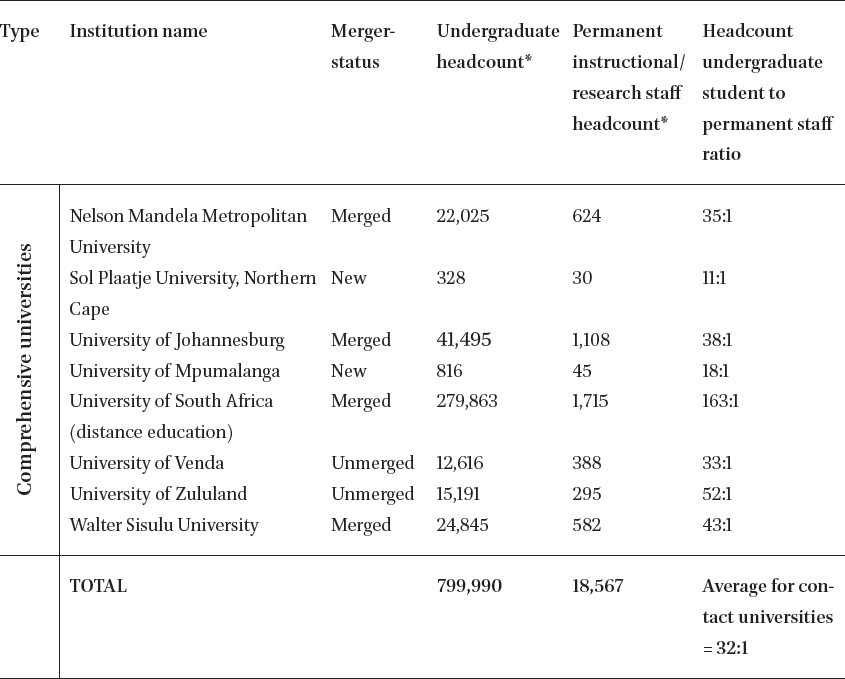
Public universities in South Africa in 2015
* Data source: DHET website (
Participation rates for tertiary education in South Africa appears to be better than the rates of counterparts in the Southern African Development Community (
Undergraduate progression profile

Thus, institutions were under pressure to address student performance, transformation and social cohesion. During this period, student bodies diversified rapidly, while universities where mildly responsive in transforming their curricula offerings and structuring of academic programmes, as evident in the modest increase of 2% in graduations over the 2005 to 2015 period. This reluctance to transform is regarded as a symptom of universities perpetuating their deeply entrenched institutional cultures, rituals and traditions which inhibit success in higher education.
The White Paper on post-secondary education and training (2013) noted that, “despite the advances made since the advent of democracy, the education system continues to replicate the divisions of the past. The institutional landscape is still reminiscent of apartheid … in terms of infrastructure, teaching facilities and staffing. 16 Amidst several competing demands in higher education transformation, South African universities are under pressure to ensure that they are financially viable and accommodate the demands of increasing numbers of students while providing high quality education; all within the circumscriptions of reduced government spending in the sector. 17 These pressures on the higher education sector may be broadly characterised by three types of government-initiated structural reforms: equity, expansion, competitiveness.
The first reform underpinning transformation is equity-driven and is aimed at providing increased access to the previously disadvantaged majority. By 2015, the student body in universities comprised 84% Blacks (African, Indian and Coloured) and 16% Whites. In addition, women constituted 58% of enrolments. 18 While substantial gains in this regard have been made, black students are still unevenly represented at historically advantaged (White) universities. 19 Similarly, although the number of black academics and women academics teaching in the public higher education sector have also increased, these staff are aggregated in the lower ranks of the academy. 20 Moreover, these quantitative gains in providing access (for both Blacks and women: staff and students) to the academy have not been matched by progress in creating institutional cultures where all students and staff can thrive and succeed in equal measure. 21 For example: The medium of instruction in most South African universities is English. Yet, the majority of students speak English as a second or third language. Currently, the language issue in South Africa is the subject of much controversy and “has added to the instability of the social justice project in teaching and learning in higher education.” 22 But more importantly, while universities have long acknowledged the centrality of language as a determinant of student success, most universities have only succeeded in providing symbolic access to student’s mother tongues.

*includes all permanent and contract instructional/research staff and all students enrolled in undergraduate qualifications such as certificates, diplomas and degrees.
The second reformation is the drive for the expansion of the higher education sector. Universities have responded by reducing institutional spending, increasing student enrolments and fees and seeking other streams of income. Student headcount enrolments in higher education have doubled since 1994 and in the last decade, income from student fees have increased from 24% to 31%. 23 These increases in student numbers exceed the increases in staff numbers (see Figure 2) resulting in escalating student to staff ratios. The increased student enrolments have resulted in larger class-sizes which means that academics are now spending more time on teaching with little time for academic support, amidst increasing demands for higher research productivity.
Although administrative access to higher education has been achieved by the removal of exclusionary barriers, financial access continues to be the de-facto gatekeeper for the majority African population. The ongoing campaign for free higher education, accompanied by violent protests which catapulted the fees crisis into the national spotlight, gives a new complexion on higher education transformation, yet again, shifting attention away from the unresolved problem of unsustainably low graduation rates. When taking into account the increases in headcount enrolments, governmental funding support for universities has declined in real terms by 1.1% from 2000 to 2010. Instead, tuition fees have increased by 2.5% over the same ten-year period. 24 Whether intentional or accidental, the funding of South African higher education seems to be shifting toward a cost sharing model, where the burden of higher education costs and the reliance on government for support was being recalibrated to the student/parent in terms of tuition fees. The consequence of increases in tuition fees has resulted in frequent and volatile student protests largely motivated by socio-economic motivations, exemplified by hashtag movements such as RhodesMustFall and FeesMustFall in 2014 and 2015. 25
Initially the government responded with a band-aid attempt at restructuring the national student financial aid scheme (
Without student fees and/or fee increases as an income stream, universities are currently hard-pressed to hire more staff, run operations and maintain existing infrastructure. Overall, it is unlikely that staff-student ratios will decrease in the near future and, the quality of higher education teaching is under threat (Jansen 2017) as are the prospects of student success.
The third expression of reformation relates to competitiveness which emphasises the increase of efficiencies and reduction of redundancies. This has been partially realised through mergers and de-mergers; fiscal control by government (where public funding is earmarked and government prescribes the type of activities the funding can be spent on), and demands for accountability of public spending (in particular, future government funding is based on satisfactory progress against government approved institutional plans and performance indicators). Universities have been somewhat more successful in responding to this type of reform compared to the other reforms. For instance universities have capitalised on the earmarked funding for the development of teaching and research by creating centres of excellence, encouraging staff capacity development, and supporting the progression of emerging academics undertaking masters and doctoral studies. 27
Government funding for higher education

These structural reforms in higher education have placed explicit demands on teaching in public universities with the implicit expectation that enhanced higher education teaching and learning quality has the potential to enhance student success, which would in turn resolve the country’s need for skilled graduates which is essential for economic growth in the 21st century. Are the core elements of social justice indeed being addressed within this triumvirate of expansion, equity and efficiency; or do some elements dominate and eclipse others?
In response to the demands for improved teaching, an array of funded national interventions was introduced. This included the Foundation Provisioning Grant; the Teaching Development Grant; the Research Development and other infrastructure and efficiency grants. 28 By 2015, (Figure 1) South Africa experienced a 3-percentage point increase in undergraduate participation rates since 2005 and a 2-percentage point increase in graduation rates. In contrast to this unspectacular performance, there was a significant decline in the dropout rate from 25% to 18%. This decline follows a concerted attempt by government to ameliorate the problem of student under preparedness, conceding that the schooling sector was failing to expedite access to higher education especially for students from low socioeconomic contexts.
The decline in the dropout rate may be attributed, in part at least, to the Foundation Provisioning Grant and associated programme, which was institutionalized in 2004. Foundation provisioning sought to improve the academic performance of first-time entering undergraduate students, who are at risk of dropping out because of their poor educational backgrounds. Such students are placed on ministerially-approved extended curriculum programs, which are in most case one year longer than the regular qualifications. This is complemented by earmarked Teaching Development funds, which are directed at enhancing teaching capacity. Both teaching development funds and earmarked foundation provision funds aim to increase the average success rate and the graduation rate. 29
The State budget for the Foundation Provisioning grant has almost quadrupled since inception of the grant, from just under
Are the increases in funding for these specialised programmes paying dividends and to what extent does this investment improve student success? In short, the answer is affirmative; the success rates of students enrolled in foundation provisioning programmes have generally been stable while demonstrating a small (2%) upward trend over time. This is consistent with the growth in the number of programme offerings which in turn may be linked to the increases in the budgetary allocations for these programmes. Comparative analysis shows that the foundation students’ success rates are comparable with those of the whole student body despite their different risk profiles. This comparability suggests that addressing the articulation gap for students who are underprepared for existing mainstream higher education curricula improves their performance to the extent that they are able to perform on par with their better-prepared peers. 30
What can be considered noteworthy in the current foundation programmes, is their curriculum structure and content which bear the semblance of characteristics and attributes necessary to disrupt the general cycle of underperformance in higher education. Scott (2012) reminds us that the flexible curriculum framework of foundation programmes allows curriculum space for foundational learning and for fresh teaching approaches. More recently, increased academic support systems (Table 2) for under-performing students appears to be mitigating high attrition but has also resulted in unintended consequences: rather than graduate in minimum time, students are now being retained in the system for longer, which accounts for the low gains in graduation rates (see Figure 1). 31 This unintended outcome is a consequence of the generous provision of academic support early in the undergraduate programme and the absence of distributed support in subsequent years, which means that students are often left to their own devices, and success is a function of survival rather than persistence in an often hostile institutional climate. 32 Moreover, student profiling and early-warning systems are often premised on student deficits (such as at-risk of underperformance, failure or drop-out). Despite the ubiquity of these systems across universities in South Africa, very little is known about how students actually navigate existing curriculum structures. What are the student pathways that lead to success?
Academic support interventions deemed successful

Data source: CHE (2015) - p.113-130
Academic support interventions deemed successful
An emergent discourse in South African higher education revolves around demands for the decolonisation of the academy. 33 Shay (2016, cited in Heleta 2016, 1) articulates the essence of the campaign: “students have called for the end of domination by white, male, Western, capitalist, heterosexual, European worldviews in higher education and incorporation of other South African, African and global ‘perspectives, experiences [and] epistemologies’ as the central tenets of the curriculum, teaching, learning and research in the country.” The substance of this discourse is often reductionist and is typically linked to curriculum as content, which is believed to be rooted in colonial epistemologies. Mgqwashu, (2016) cautions against simplistic definitions: “decolonising the curriculum is far more nuanced than replacing (European) theorists and authors” (with African ones). Regrettably, the populist discourses on curriculum transformation, which is largely ideological in orientation, pays little attention to curriculum structure, which indeed also has its roots in colonial prescripts, which are often inappropriate for the African context. By curriculum structure we are referring to the dominant model adopted more than a century ago, based on assumptions about students’ prior knowledge, pedagogies, time and duration of learning programmes, sequencing of modules, the pace and flexibility of progression pathways, credit allocation, combinations of modules, pre and co requisites, amongst others.
One noteworthy response and arguably, one of the more ambitious attempts to initiate substantive curriculum reform at the structural level to address student success in South Africa has been the Proposal for Undergraduate Curriculum Reform in South Africa. Led by the Council on Higher Education (
The essence of the proposal is that all undergraduate programmes should be extended by one year, to “ensure realistic starting points and progression paths, and to introduce valuable forms of curriculum enhancement.” 35 This model would emphasise flexibility allowing students to exit earlier if they demonstrated the capacity to do so. Using complex modelling techniques, the report deemed the proposal to be more cost effective than the status quo. Using scenario-modelling techniques, this claim was later found to be flawed. 36
On the face of it, the proposal offers an opportunity to re-envision the existing curriculum structure beyond its colonial prescriptions. Regrettably, the proposal undermines itself by cautioning that there is an “irreducible core” in the curriculum that needs to be preserved. The irreducible core was interpreted to be an attempt at preserving the vestiges of colonial content. Concerns were then raised that “the existing curriculum will in fact, with all of its structural pathologies, be ‘stretched’ to accommodate an additional year, wherein student un/under-preparedness will be remedied,” 37 without necessarily enhancing student success. The proposal, with its conservative (biblical) undertones, was an attempt to “advance an econometric model to solve a pedagogic problem.” 38
In 2015, the Department of Higher Education (
Our first assumption in advocating
Noting the above, we contend that modern analytic methods such as those afforded by Artificial Intelligence (AI) now “enable data-mining of progression information from successful students to determine how existing curricula and timetables may be optimised.” 42 Such data mining has the potential to provide insights into the less visible elements of curriculum structure, which are rarely interrogated. These include, how courses are sequenced and scheduled, and what motivates the logic of such sequencing; the conditions of pre and co-requisites required for the acquisition of foundational knowledge and skills and what informs student choice in selecting modules, combinations of modules and how these are sequenced. Analytics makes possible the assessment of whether the pre- and co-requisites actually promote concept scaffolding or whether content-drift has made them irrelevant. For instance, machine learning can reveal whether pre-and co-requisites actually feature in the data analysis when cross-correlating requisites and the courses they are intended to support. The application of AI algorithms enables the analyses of large data sets to generate natural-language advice to staff and students in monitoring persistence and progress, including real-time alerts to students. 43
A concrete illustration of one such approach is the AutoScholar Advisor systems being implemented in three South African universities. This advisory system is a home-grown progression mapping tool, which provides a host of curriculum data by mining student information to: obtain real-time views into student records, school data, and programme information; apply progression mapping to reveal student progression routes; identify major obstructions to student progression; deduce the curriculum structure of the core content of any programme to about 92% accuracy. Such a system may also facilitate richer analyses, e.g. determining how on-track students are performing with respect to minimum time progression. The tool is accessible to both students and staff to provide signals to alternative curriculum pathways which have a history of success. This data, when aggregated has the added potential to harvest evidence for “more substantive curriculum reform to address what has become a stubborn pathology in higher education reform.” 44
Perhaps the most valuable application of artificial intelligence and its contribution to the AutoScholar, is its potential to satisfy the obsession of academics and policy makers to change the content of higher education curricula as a tangible illustration of curriculum transformation. The current plea for change is ideologically grounded as demands for the stripping out of colonial content reverberates. Our view is that there is little merit in replacing one brand of ideological content with another—which has populist appeal. Ultimately, what content achieves hegemonic status must be determined by analysing its ability to cultivate productive graduate attributes. Such an analysis must be empirically derived through data mining of existing content to reveal the official curriculum, the enacted curriculum, the received curriculum, the hidden curriculum and the null curriculum. Such an analysis must privilege the interests and experiences of the student rather than advance the epistemological commitments of professors.
Concluding Comments
Globally, higher education is considered both a private and public good, and access to this good is often a proxy for a nation’s commitment to equity and social justice. Education systems are routinely reconfigured to meet the changing aspirations of its citizenry. 45 The kind of changes envisioned and enacted are in turn reflective of what a society values as catalysts for successful navigation of public and private domains. It is not uncommon for change to be driven by ideological and political imperatives rather than pedagogic motivations, as has been the case of South African public higher education. We have witnessed more than two decades of tinkering around the periphery of substantive change in the form of programme reviews, organisational changes in the form of mergers and de-mergers, a litany of policies and plans none of which has advanced the project of improving student success.
Higher education has the remarkable capacity to insulate itself from substantive change while society demands graduate attributes which are socially, culturally and economically valuable for future generations. Despite the installation of democratic institutions to drive systemic change and the academic freedoms enshrined in the constitution, South Africa has not re-imagined curriculum. We should concede that part of the reason for the complexity we are experiencing today is precisely because our attempts at granting access to higher education has been successful, while our attempts at supporting them have been less successful. If structure delineates the boundaries and limits of curriculum, then we need to disrupt the hierocracy of the extant curriculum by appropriating the affordances of available technological tools to deconstruct “the totalising colonial project.” 46 The curriculum transformation agenda can and should be realigned to address the current disembodied and disembedded structure while avoiding “perceptions of students as the ‘hassle factor’, and instead re-centre the students as individuals with their own identities and potential to thrive.” 47
Footnotes
7
Marco Bozza and Abdulbaqi Badru (Research Interns in the
1
Council on Higher Education, “A Proposal for Undergraduate Curriculum Reform in South Africa: The Case for a Flexible Curriculum Structure.” (Pretoria:
2
M. Louw, S. Van der berg and D. Yu, “Educational Attainment and Intergenerational Social Mobility in South Africa”, Stellenbosch Economic Working Papers: 09/06 (2006).
3
Statistics South Africa 2017.
4
G. Fisher, and I. Scott, “Background Paper 3: The Role of Higher Education in Closing the Skills Gap in South Africa. Closing the Skills and Technology Gap in South Africa.” The World Bank, Human Development Group, Africa Region. (2006): 1.
5
The Gini Coefficient is a measure of inequality of income distribution or inequality of wealth distribution. It measures the extent to which the distribution of income (or, in some cases, consumption expenditure) among individuals or households within an economy deviates from a perfectly equal distribution.
6
M. Wilson-Strydom, “Traversing the Chasm from School to University in South Africa: A Student Perspective.” Tertiary Education and Management 16, 4 (2010): 313-325.
7
Dhunpath, R., and R. Vithal eds., Alternative Access to Higher Education: Underprepared Students or Underprepared Institutions? (Cape Town: Pearson Publishers, 2012).
8
D. M. Mertens, “Mixed Methods and the Politics of Human Research: The Transformative-emancipatory Perspective.” In Handbook of Mixed Methods in Social and Behavioural Research. eds. A. Tashakkori and C. Teddlie, 135-164. (Thousand Oaks, CA: Sage, 2003).
9
Department of Higher Education and Training, “National Plan for Higher Education.” (Pretoria: DoE, 2001).
10
G. Subotzky, “Public Higher Education.” In Human Sciences Research Council (Ed.), Human Resources Development Review (2003).
11
Council on Higher Education, South African Higher Education Reviewed: Two Decades of Democracy (Pretoria:
12
Ibid.
13
Teferra, D. “Flagship Universities in Africa.” ed. 2017. (Cham, Switzerland: Palgrave, Macmillan, 2017).
14
R. Dhunpath and R. Vithal, Alternative Access to Higher Education: Underprepared Students or Underprepared Institutions? (Cape Town: Pearson Publishers, 2012).
15
Higher Education South Africa, “Sector Position Paper on the Report of the Ministerial Committee on Transformation and Social Cohesion and the Elimination of Discrimination in South Africa’s Public Higher Education Institutions.” (Grahamstown:
16
Department of Higher Education and Training, “White Paper for Post-school Education and Training: Building an Expanded, Effective, and Integrated Post-school System.” (Pretoria:
17
J. Jansen, As by Fire: The End of the South African University (Cape Town: Tafelberg, 2017).
18
Council on Higher Education, VitalStats: Public Higher Education (Pretoria:
19
Council on Higher Education, “A Case for Improving Teaching and Learning in South African Higher Education Higher Education Monitor,” 2007: 6.
20
R. Subbaye, “The Shrinking Professoriate: Academic Promotion and University Teaching.” South African Journal of Higher Education 31, no. 3 (2017).
21
Higher Education South Africa, “Sector Position Paper on the Report of the Ministerial Committee on Transformation and Social Cohesion and the Elimination of Discrimination in South Africa’s Public Higher Education Institutions.” (Grahamstown:
22
Council on Higher Education, South African Higher Education Reviewed: Two Decades of Democracy (Pretoria:
23
N. Cloete, “For Sustainable Funding and Fees, the Undergraduate System in South Africa Must be Restructured.” South African Journal of Science 112, no. 3, 4 (2016): 1-5.
24
Ibid.
25
These student protests began in 2015, and reflected an uprising against hostile institutional cultures, lack of access to, and financial exclusion from, higher education in South Africa. See
26
South African Presidency. “The President’s Response to the Commission of Inquiry into Higher Education and Training.” (The presidency: Republic of South Africa, 2017).
27
N. Cloete, J. Mouton and C. Sheppard, “Doctoral Education in South Africa.” (Cape Town: African Minds, 2015).
28
Department of Higher Education and Training, “Ministerial Statement on the Implementation of the University Capacity Development Programme through Effective Management and Utilisation of the University Capacity Development Grant, 2018-2020, South Africa.” (Pretoria:
29
Department of Higher Education and Training, “South Africa, Ministerial Statement on University Funding, 2017/17 and 2017/18.” (
30
Council on Higher Education, “A Proposal for Undergraduate Curriculum Reform in South Africa: The Case for a Flexible Curriculum Structure.” (Pretoria:
31
Department of Higher Education and Training, “First Time Entering Undergraduate Cohort Studies for Public Higher Education Institutions: 2000-2014.” (Pretoria:
32
C. Soudien, “Report of the Ministerial Committee on Transformation and Social Cohesion and the Elimination of Discrimination in Public Higher Education Institutions.” (Pretoria:
33
(see Mgqwashu). “Universities Can’t Decolonise the Curriculum without Defining It First,”
“Dismantling Epistemic violence and Eurocentrism in South Africa,”
34
Council on Higher Education, “A Proposal for Undergraduate Curriculum Reform in South Africa: The case for a Flexible Curriculum Structure.” (Pretoria:
35
Ibid.
36
Rawatlal, R., and R. Dhunpath. “Stretching the Undergraduate Curriculum: A Compensatory Response to Curriculum Modelling.” Alternation 12 (2014): 171-179.
37
Ibid., 171.
38
Ibid., 177.
39
R. Rawatlal and R. Dhunpath, “Transcending the Econometric Discourse in Curriculum Design: Multi-trajectory Progression Planning.” Alternation Special Edition no. 16, 2015: 94-114.
40
Ibid., 101.
41
Ibid., 102.
42
R. Rawatlal & R. Dhunpath, “Transcending the Economic Discourse in Curriculum Design: Multi-trajectory Progression Planning.” Alternation 16 (2015): 94.
43
R. Rawatlal, “Application of Graph Theory to Analysing Student Success through Development of Progression Maps, Engineering Education for a Smart Society.” In World Engineering Education Forum & Global Engineering Dean’s Council 2016 (2018): 295-307.
44
R. Rawatlal & R. Dhunpath, “Transcending the econometric discourse in curriculum design: Multi-trajectory progression planning.” Alternation 16 (2015): 94-114, 112.
45
46
C. Soudien, “‘What to Teach the Natives’: A Historiography of the Curriculum Dilemma in South Africa.” In Curriculum Studies in South Africa: Intellectual Histories, Present Circumstances, ed. W.F. Pinar. (New York: Palgrave Macmillan, 2010): 19-49, 29.
47