



Abstract
It is the aim of the paper to reflect on the lessons learned after ten years of existence of the Sino-French School for Engineering at Shanghai University (
Keywords
Introduction and Context
Transnational education is a broadening concept in Higher Education comprising not only the “mobility” of course contents and programs, but also that of providing institutions. 1 Several types of transnational education have been identified such as distance education, franchised programs, collaborative ventures, and international branch campuses, but in most of these cases learners and the awarding institution are located in different countries. 2 Concerning the case of international branch campuses, there is a tentative definition emerging from currently ongoing operations, mainly located in Asia and the Arabian Gulf. Namely, they are being described as entities pertaining to a university whose primary location is in one country and where students, upon successful completion of the course program fully undertaken abroad, are awarded the degree in that foreign country, although study abroad mobility windows at the providing institution for the branch campus also start to appear. 3 In the latter case, it thus appears that transnational and international approaches can be combined.
The internationalization of the Chinese Higher Education system was initiated with a first cycle of foreign universities operating in China from as early as the 19th century until the 1950s.
4
Beginning in the 1950s, there was a strong reception of Soviet university models emphasizing centralization and standardization, followed from 1978 to 1992 by a government program dispatching Chinese scholars and students abroad.
5
Starting from 1992, the Chinese Higher Education policy gradually turned toward a reciprocal international mobility and transnational education internationalization policy.
6
,
7
Specifically in China, transnational education approaches including so called “Chinese Foreign Cooperation in Running Schools” (
This Chinese internationalization policy also needs to be put in a broader global context, in particular as far as it concerns transnational education. As a matter of fact, transnational education as a recent trend in higher education is a new research subject, therefore related literature is still scarce. 12 , 13 , 14 A large part of existing literature on transnational education so far mainly concerns categorization and motivation for the projects, yet little information is available on modalities of implementation and concrete examples. 15 It has been argued that this is due to its newness but also to possible reluctance to disseminate data. 16
In terms of rationale underlying the decision for a providing or “exporting” institution to engage in a transnational approach, several motives are raised, such as income generation, internationalization, increase of reputation, strategic alliances 17 and complementarity of academic strengths. 18 However, in the case of public universities where the income generation argument is secondary or nonexistent, as in France for example, the objective of an enhancement of cultural “softpower” for the exporting country (university system, language, industrial strategy) should be added. This type of approach has been compared to a “triple helix” between university—industry—government, in which systematic interaction of universities with governments and industry in the field of international relationships has been identified as being crucial for the national innovation competiveness at an international level. 19
Statistical data on subjects and origins of foreign education providers in China show that business and management related operations are most frequent (42,7%), followed by
Although recent transnational approaches in China have been studied and described in the literature,
21
,
22
,
23
,
24
,
25
it is however striking that French operations in this field have largely remained unnoticed compared to operations led by British or
France is very committed to the development of international cooperation in Higher Education with China. At the first session of the “France China High level People to People Dialogue on Human Exchanges” held in Paris in September 2014, the French Minister of Foreign Affairs and International Development, Laurent Fabius, fixed an ambitious student mobility target of 50 000 Chinese students coming to France and 10 000 French students going to China, knowing that currently 50 000 French youth study Mandarin, and 100 000 Chinese youth study the French language.
33
Concerning international student mobility with China, France holds the 11th position concerning foreign students studying in China with more than 8 300 students.
34
According to
On a European level, and in the framework of the “
After an introduction of the specificities of the French Engineering model, it is the aim of the present article to showcase a collaborative venture in engineering education with
Specificities of the French Engineering Education Model
Describing the French engineer, one can read that “l’ingénieur à la française” 37 (French engineer) is a “generalist of high level”, thus prepared to face the variety and complexity of the modern economy. 38 Also the high prestige of the engineers in French society and their large diversity in terms of studies and professional tracks is considered to be a unique feature of France. 39
Pursuant to Art B4 of the Accreditation criteria issued by the French Engineering Degree Commission, this French approach to engineering can be defined as:
The posing and answering of complex questions in an effective and innovative way, in the fields of creation, design, production and implementation, within a competitive environment and with a focus on products, systems or services, and possibly their financing and sale. As such, engineers should have a good understanding of technical, economic, social and human issues, based upon a solid scientific background. 40
Taking into account several positive experiences with dual degrees between France and China, as well as the orientation on innovation of French engineering education, France had been invited to China in 2004 in order to implement this “French approach to engineering education” with Chinese partners in the framework of
Historically, the term “ingénieur” derives from the Latin word “ingenium” defined as a “natural disposition of the spirit or an invention”, becoming in the 12th century the French medieval term “engegnor” meaning “someone building all sorts of engines; machinist; architect”, before being referred to as the French “ingénieur” of the 16th-18th centuries describing a “military professional and mathematician.” After the French Revolution of 1789, a split emerged between civil and military or naval engineers, each trained in specialized state schools (Grandes écoles).
42
As opposed to the “Old Regime” in France with only very few specialized schools, particularly in artillery, mining, bridges and roads, the period following the French Revolution saw the introduction in 1794 of laic (secular) schools such as Ecole Polytechnique (then named Ecole Centrale des travaux publics).
43
As a new concept after the French Revolution, its objective was to train engineers “of all kinds” for the French society and with a curriculum of three years based on mathematics and fundamental sciences, combined with follow-up application schools installing engineering as a “learned profession”.
44
These schools also embraced the ideal of being open to the best students, whatever their social background. Yet considering the high level of mathematics needed to enter and succeed in these schools, from 1804 on saw introduction of special courses organized based on the framework of secondary or high schools (lycées) and designed to prepare students for the entrance examination required to enter the Ecole Polytechnique and similar institutions.
45
The ongoing industrialization also led to a proliferation of both public and private engineering schools developing in parallel to the university system but with a largely diverging quality concerning their curricula, thus generating an issue of quality assurance and standardization.
46
This development eventually led to the creation of the French Engineering Degree Commission (Commission des titres d’ingénieur or
As a consequence of this historical heritage, a two-tier-system between Universities and “Ecoles” is still present in France today, even if composite and integrated models have also been introduced (see Figure 1 below).

As a matter of fact, engineering education in France lasts 3 years (equivalent to 180
Currently French Engineering education is performed in both “Grandes écoles” and universities with about 220 Schools of Engineering in France training about 150 000 students (including preparatory cycle) and awarding more than 30 000 degrees per year representing 60% of all master degrees in science and technology. 50
In the present case of French Universities of Technology, an “integrated” model has been found. The French Education Codex states in its Article L 711-3 that Universities of Technology are public institutions with scientific, cultural and professional character that have as a main mission the training of engineers and the development of research and technology.
51
Université de Technologie de Compiègne (
The curricula at the universities of technology in France are divided into a common trunk of two years, followed by a three-year specialization into a field of engineering. The whole period is designed as an integrated 5-year university program. In order to ensure a close link to industry, two internships of one semester each are included in the curriculum at the end of the third and fifth year of study. This model allows for confronting students with learning autonomy and elective course choices, as well as with a large choice of mandatory courses in the field of humanities and social sciences from the beginning of their training. Another advantage of this model resides in the early exposure to research and researchers, which are typically not present in the preparatory classes traditionally integrated in French secondary schools.
This approach has proven pertinent as by combining the assets of engineering education in the French model, including close interaction with the industry and society by offering access to research environments and autonomous learning, graduates from the French Universities of Technology have a very diverse and high employability.
54
It is this “integrated model” of French engineering education, slightly adapted to the specificities of the Sino-French context, which has guided development of the Sino-European School of Technology of Shanghai University (
The utseus Experience
On February 14th 2005, the three French Universities of Technology and Shanghai University set up a cooperation agreement aiming at the creation of a Sino-European School of Technology of Shanghai University (
On November 5th, 2006, the Chairman of the Chinese Academy of Engineering, Mr. XU Kuangdi, and a member of the French Academy of Technologies, Mr. François Guinot, participated in the founding ceremony of
In 2015, after 10 years of existence,
The utseus Study Model
For the study model implemented at
Statistical data on education levels of transnational education in China show a strong focus on Bachelor education, accounting for more than 71,6% of the global transnational education offer currently available in China, whereas Master and PhD education represent 27,6% and 0,8% respectively. 59 Differences can however be observed concerning the granting institution: whereas Xi’an Jiaotong Liverpool University awards both a British and a Chinese degree, University of Nottingham Ningbo awards just the foreign degree from University of Nottingham. 60
In the case of French institutions two major approaches can be distinguished: either only a French degree approved by the French
Specificities of the Curriculum for Chinese Students
Concerning the presence of study periods abroad and with the objective of validating the French engineering title, two options exist: (1) either the engineering curriculum takes place entirely abroad, and it is then evaluated and (co)accredited as such by
In the framework of dual degrees and in order to fulfill French engineering title graduation requirements, it is necessary that two out of three years of the engineering specialization are spent in France, and at least one internship of six months is completed under (co)supervision of French faculty. 63 A comparative overview of the different study tracks open to Chinese students is given by Figure 2 below.
Concerning the entrance to Shanghai University, all students entering the

The question could be asked whether this type of study path is attractive to Chinese students. Considering the fast rising international mobility of Chinese students and the emerging market of transnational education in China, first studies concerning the reasons for choosing this type of track have been conducted mainly focusing on English-speaking providers and study destinations. 64 , 65 Findings suggest that “push-and-pull-concepts” as used for tourism also apply to the choice of an abroad study destination, showing that for students and their parents safety of the destination, a high overall country education level (and not necessarily ranking-driven), and cost expenditure are the main pull factors rather than just language. The associated push factors are mainly related to higher education quality and opportunities in the home country. 66 Concerning the phenomenon of transnational education, it has been found that the same push factors concern transnational programs, however, the pull factors differ. Students identify the low cost of an international flavor accessible in a domestic environment as a main advantage, but in general either tend to rank it lower than domestic higher education or international education, or use it as a tool to regain access to high-quality domestic higher education or oversea education. 67
Consequently, in the case of
A second major issue concerns language, as it has been shown that Chinese students are less attracted to a foreign education destinations when the number of years needed to learn the language of the destination country increases.
68
French operations in China approach the language issue differently. For example, Centrale Pékin at Beihang University and ParisTech Shanghai Jiaotong opted for a preparatory year dedicated exclusively to intensive French language learning, and that before starting any engineering curriculum,
In practical terms, this means that a crucial effort is put on the learning of the French language starting from the first year of studies. As a matter of fact, almost all Chinese students start French as a new foreign language when entering
During their studies, Chinese students accede to French language proficiency in several steps, starting from learning French as a foreign language moving toward learning of scientific content in French being a foreign language. As this is a dynamic process intended to converge, a blend is operated concerning the language of tuition and according to progress with French during the first three years. During the first year, courses are taught in Chinese by Chinese faculty and English by French faculty. Starting from the second year, courses in French taught by French academic staff are gradually introduced amounting to 30% at the end of the three years in China. For those students pursuing their studies in France, they are completely integrated into the engineering or Master’s curriculum taught in French.
Concerning the engineering curriculum, the first two years are dedicated to general training, then starting from the third year an engineering specialty must be chosen by the candidates. In the framework of
Quality assurance and guarantee of equality of academic standards is often raised as being one of the major challenges in transnational operations. 70 Furthermore, adaptation to local environment and intercultural context is also important for all resident foreign faculty, faculty from the providing institution, and local faculty engaged in the transfer process. This subject is referred to in the literature as “flying faculty” and has raised a certain number of challenges in terms of quality insurance, intercultural adaptation, professional development of teaching staff, in addition to health and cost related issues. 71
In terms of faculty,
Twinning activity at utseus Shanghai in April 2014.

Concerning the types of courses, a “French touch” has been implemented through three approaches: The first concerns the format of the class work consisting in lectures, exercises, and practical courses in small groups, limited to 40 students per group. Secondly, during the semester, two innovation projects are conducted in parallel to the coursework. Small groups of 3-5 students are asked to manage and analyze these projects related to the research activities conducted at
The implementation of the French curriculum at
As shown in Figure 2 above, after the first three years spent at Shanghai University, three options exist for Chinese students at
Pursuant to the dual degree setup, in both cases involving mobility to France the Chinese Bachelor’s degree is being validated by the means of credit equivalencies during the stay abroad. Otherwise, the difference between the French engineering title and the French Master’s degree resides in the main career paths ambitioned by the students. As a general rule, those who are oriented towards the French engineering title have a focus on careers in industry, whereas those who are enrolled for a French Master’s in Engineering focus instead on academic research. Either way, the selection of Chinese students for mobility to France is operated taking into account both the Grade Point Average (
As noted, students going to France have mandatory 6-month internships. However, for the more research-oriented French Master in Engineering degree, only a single 6-month internship is required either in a laboratory or in industry at the end of the 5th year. Students seeking the French title of engineer of the French Universities of Technology need to complete two 6-month internships in industry. Typically, a first internship in industry takes place at the end of the first year of specialization, generally the end of the 3rd year, and a second one at the end of the 5th year. The first of these internships not included in the curriculum during the first three years in China, which has been a specific challenge to the Sino-French context. The solution found is the shift of the timing of the first industry internship by one year. In this case it takes place only after a first study semester in France at the end of the 4th year.
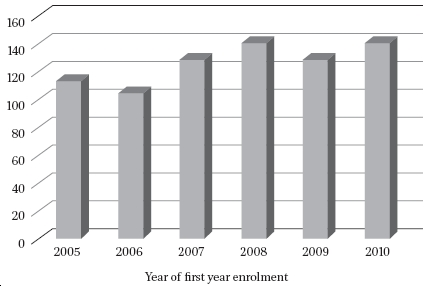
There are two major benefits to this scheme. First, it allows Chinese students to find an internship position while already in France. Second, it is a first intercultural acclimation to the French environment as a whole as well as to the French university. This requires however an additional semester of courses when preparing for an engineering title. From a logistical point of view, when arriving in France, Chinese students are taken in charge by Chinese speaking staff at the International Offices of the Universities of Technology that assist them with their integration (housing, opening a bank account, administrative procedures, psychological follow-up, etc.).
This model as implemented at
Specificities of the Curriculum for French and International Students
The Chinese government has been proactive in attracting overseas students, and the number of international students has increased, including a rising number of French students. 72 , 73 Considering the difficulty related to studying in Chinese, international branch campuses and joint ventures have become additional hubs for attracting foreign students to China with, however, mainly an intercultural ambition to familiarize students with the “Chinese culture”. 74
From the beginning,
Another major ambition considering the specificities of Shanghai as a global hub is the design of adapted course modules emphasizing innovative and interdisciplinary approaches. This is especially important given latest developments in the Higher Education and Research landscape in France saw the introduction of university clusters.
75
These clusters aim to enhance the critical mass of French institutions on the global stage, both in terms of disciplinary spectrum and international visibility and attractiveness, and in particular those supported by the French Investments into the Future Program (
Taking into account these challenges and recent developments, and with the objective of creating conditions adapted to attract students from France, Europe and beyond, different specialized and increasingly interdisciplinary international programs in French and English have been developed at
Currently, three international exchange programs are offered at
At the Bachelor’s level, the exchange program “Engineering and Social Sciences in China”
78
allows foreign engineering students from French speaking countries to attend lectures with Chinese 3rd-year
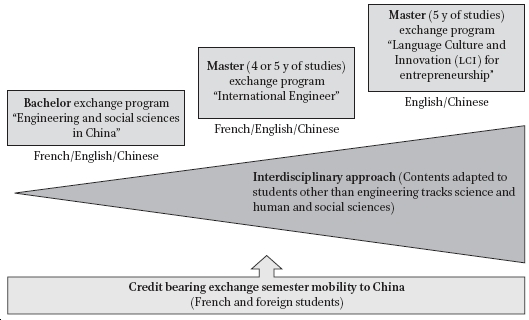
At the Master’s level, two newly developed one-semester exchange programs are offered to international students coming to
Both programs have been designed in order to allow foreign students to build a first significant international experience in Asia. Both programs also prepare participating students for international careers in engineering and beyond.
With this perspective, the course language is English and two thirds of the lectures are taught by experts from industry, including French as well as international consultants operating in China, while one third of the lectures are taught by academic faculty members. This approach aims to ensure that the students have both a solid engineering knowledge and practical views on socio-economic needs. As future stakeholders understanding the needs of the society and the environment they are enabled to suggest holistic solutions.
Concerning the latest program “Language, Culture and Innovation for Entrepreneurship”, which is of a more interdisciplinary nature, it has been the objective to design a program training a new generation of students with diverse disciplinary backgrounds. This program implies the enlargement of
For the upcoming cohorts, an expansion to students with disciplinary backgrounds in sciences and humanities and social sciences is planned. In order to accompany this movement, incentive for this innovative type of interdisciplinary study semester abroad has been implemented at the level of Sorbonne Universités. Therefore students from Université de Technologie de Compiègne, University Pierre et Marie Curie (
Concluding Remarks and Outlook
Looking at the initial design of transferring the French model of engineering to a Chinese environment, the results achieved show a very positive picture. As a matter of fact, more than a transfer, both the French and Chinese sides have co-constructed a curriculum that has produced bicultural engineers enjoying high employability both in France and in China. These achievements are due to a progressive improvement of the course contents in terms of equivalences of learning outcomes and skills acquired. In terms of current challenges, the critical role of French language learning remains an area for progression, and needs further customization to the specificities of a native Mandarin student cohort.
Considering mobility towards
Finally, and as a perspective for the next ten years, interdisciplinary and intercultural approaches in research are also being developed, allowing for new opportunities concerning academic staff mobility, and innovative research based projects for students as well as for increased links with industry.
Footnotes
Acknowledgements
Certain study tracks presented in the manuscript have been partially supported with funding from the French Government “Investments into the Future” program, managed by the French National Research Agency (
6 Huang, “Policy and Practice of the Internationalization of Higher Education in China,” 225-240.
7 Ennew and Fujia, “Foreign Universities in China,” 21-36.
8 State Council of China, “Regulations of the People’s Republic of China on Chinese-Foreign Cooperation in Running Schools,” adopted at the 68th Executive Meeting of the State Council on February 19, 2003, promulgated by Decree No. 372 of the State Council of the People’s Republic of China on March 1, 2003, effective as of September 1, 2003, accessed on Sept. 9th 2015,  ; Defines
10 Fang, “The Development of Transnational Education in China,” 5-23.
11 Ennew and Fujia, “Foreign Universities in China,” 21-36.
12 Fang, “The Development of Transnational Education in China,” 5-23.
15 Fang, “The Development of Transnational Education in China,” 5-23.
16 Onsman, “International Students at Chinese Joint Venture Universities.”
17 Fang, “The Development of Transnational Education in China,” 5-23.
19 Manuel Heitor, “How University Global Partnerships may Facilitate a New Era of International Affairs and Foster Political and Economic Relations,” Technological Forecasting & Social Change 95 () 276-293,
20 Fang, “The Development of Transnational Education in China,” 5-23.
21 Firoz Alam, et al., 5th ): 870-874,
22 Fang, “The Development of Transnational Education in China,” 5-23.
23 Feng, “Globalization of Higher Education in China,” 471-485.
24 Wilkins and Huisman, “International Branch Campus as Transnational Strategy,” 627-645.
25 Ennew and Fujia, “Foreign Universities in China,” 21-36.
26 Altbach, “Is there a Future for Branch Campuses?” 101-106.
27 Feng, “Globalization of Higher Education in China,” 471-485.
28 Wilkins and Huisman, “International Branch Campus as Transnational Strategy,” 627-645.
29 Girdzijauskaite and Radzeviciene, “Contemporary Issues in Business, Management and Education,” 301-308.
32 Fang, “The Development of Transnational Education in China,” 5-23.
33 Laurent Fabius, “Dialogue Franco-Chinois de Haut Niveau sur les Échanges Humains,” Paris, 18 September 2014, accessed on Sept. 9th 2015, .
34 Campus France, Fiche pays “Chine”.
35 Ibid.
37 This can be translated as “French style” engineer.
38 Armand Hatchuel, “La Naissance de l’Ingénieur Généraliste—L’exemple de l’Ecole des Mines de Paris,” November 1997, , accessed on Sept. 9th 2015.
40
41 Clarisse Jay, “Quand la France Forme les Futurs Ingénieurs Chinois,” La Tribune, Jan. 10th 2012, accessed on Sept. 9th, 2015, .
42 Hélène Vérin, “L’identité de l’“Ingénieur”—Quelques Repères Historiques,” Recherche et Formation 29 (1998): 11-20, accessed on Sept. 30th, 2015, .
43 Konstantinos Chatzis, “Les Ingénieurs Français du .
44 Ibid.
46 Ibid.
48 .
49 Pursuant to Art 2 lit 3 of the Decree n° 2002-604 of April 25 2002 concerning the creation of the Master degree, accessed on Sept. 9th, 2015: http://www.legifrance.gouv.fr/affichTexte.do?cidTexte=JORFTEXT000000407229&categorieLien=id.
51 Text of article L 711-3 French Education Codex in French, accessed on Sept. 9th, 2015: http://www.legifrance.gouv.fr/affichCodeArticle.do?cidTexte=LEGITEXT000006071191&idArticle=LEGIARTI000006525324.
52 Text of the decree in French, accessed on Sept. 9th, 2015: http://www.legifrance.gouv.fr/jopdf/common/jo_pdf.jsp?numJO=0&dateJO=19721003&numTexte=&pageDebut=10443&pageFin=.
55 Fang, “The Development of Transnational Education in China,” 5-23.
57 Fang, “The Development of Transnational Education in China,” 5-23.
59 Fang, “The Development of Transnational Education in China,” 5-23.
60 Feng, “Globalization of Higher Education in China,” 471-485.
66 Ibid.
67 Fang and Wang, “Chinese Students’ Choice of Transnational Higher Education,” 475-494.
68 Gong and Huybers, “Chinese Students and Higher Education Destinations,” 196-218.
69 These are “Information engineering” (45% of the cohort in 2014), “Material engineering and sciences” (23% of the cohort in 2014), “Mechanical engineering and Automation” (22% of the cohort in 2014) and “Bioengineering” (10% of the cohort in 2014).
70 Altbach, “Is there a Future for Branch Campuses?” 101-106.
72 Campus France. Fiche pays “Chine”.
73 Onsman, “International Students at Chinese Joint Venture Universities.”
74 Ibid.
75 “Pôle de Recherche et d’Enseignement Supérieur (
76 European Commission, Günther Schmid, “New Skills and Jobs in Europe: Pathways towards Full Employment,” Report for the European Commission (Directorate General for Research and Innovation), Luxembourg: Publications Office of the European Union, 2012, .
79 Namely “Introduction to Numerical Analysis”, “Mechanical Vibrations”, “Operational Research”, “Coupling Systems”, “Quality Management”, “Microprocessors and Embedded Microcontrollers”, “Advanced Project Management”, “Intercultural Management”, “Principles of Marketing, Management and Organizations”, “Financial Management Simulation” and “Science Technology and Society”.
82 In particular from Ecole de Design de Nantes having an antenna at Shanghai University, the “China Studio”.