



Abstract
Effective and efficient strategy is central to university internationalization. This study focused on 50 top research universities worldwide to compare their international endeavors through in-depth analysis of their publicly stated international strategies. The study conducted a typological analysis of those world-class research universities at macro, meso and micro levels. The findings point to a set of generic strategies across the universities, as well as various specific strategies at individual universities. We provide a conceptual framework to describe, explain and evaluate university international strategies.
Keywords
* HAN Shuangmiao is a PhD candidate at the Department of Education in the University of Oxford in United Kingdom. Postal address: St. Hugh’s College, St Margaret’s Road, Oxford,
** ZHONG Zhou is an Associate Professor at the Institute of Education in Tsinghua University in China. Postal address: Institute of Education, Wennan Building, Tsinghua University, Beijing, 100084, China. Email address:
1 Introduction
The rapid development of globalization and internationalization is one of the main forces influencing and shaping higher education in the 21st century (Knight, 2008). With major stakeholders like governments, international organizations and national universities as well as an increasingly sophisticated and education hungry population in many countries, higher education internationalization is becoming more complicated and diversified in approach and operation. Research universities’ internationalization not only aligns with the needs of knowledge creation and transfer, but also is consistent with contemporary expectations for their relevance and responsiveness to society.
For any university’s sustainable international development, it is important to systematically analyze and understand the international strategies being employed by other world-class universities. Despite this, current research of university international strategy is neither consistent nor systematic to form a meaningful dialogue in this field (e.g., Chen, 2004; Maringe, 2009; Poole, 2001; Bartell, 2003; Ayoubi and Massoud, 2007; Zhong, Ulicna and Han, 2014).
Accordingly, our study aimed for a comprehensive and integrated analysis of how research universities use strategies to deliberately transform themselves into globalized entities. Building on a comparative and typological analysis, the study proposes a conceptual framework to understand, describe, explain and evaluate university international strategies. We believe that this study can lead to a better understanding of international strategies in higher education, in terms of significance, content and application.
2 Literature Review
2.1 University Internationalization
University internationalization is not a new phenomenon, but what is new is the breadth and depth of impact of internationalization on a university’s overall development (Nhandari and Belyavina, 2012). From 2000 to 2010, the number of students undertaking overseas study almost doubled (
In addition, most governments around the world actively promote the internationalization of higher education. For example, Singapore plans to attract 150, 000 foreign students to study before 2015. Japan has a similar plan with the aim of 300,000 students before 2025 (Nhandari and Belyavina, 2012). China is also keen to promote higher education internationalization and world-class research university building. The Chinese National Outline for Medium and Long Term Educational Reform and Development (2010-2020) highlights increasing the level of educational internationalization and attracting more global talents with international outlook and competitiveness. China has also set the goal of building a group of world-class universities by 2020 (Zhong, 2010). Given all that, it is timely to conduct a systematic review of how research universities transform themselves into internationally focused entities.
The key features of higher education internationalization tend to change in accord with the development of modern society, although the broad concept is based primarily on western models of education (Maringe and Foskett, 2010). In the 1980s, the popular terms were international education and international cooperation (Knight, 2013). During that period, international education mainly referred to some specific activities, projects and service of international study, exchange and cooperation (Arum and Van de Water, 1992). In the 1990s, internationalization was viewed more as a process rather than an end product. It was seen as the process to incorporate international and cross-cultural elements into teaching, research and service of an institution (Knight, 1997). The fundamental goal of internationalization in that decade was to promote the overall development and competitiveness of the university.
In the 21st Century, higher education internationalization is a more inclusive and multi-dimension concept that relates to a university’s strategic goals. The Association of International Educators proposes a definition of ‘Comprehensive Internationalization’, in which internationalization refers to the commitment and attendant action to ‘infuse international and comparative perspectives throughout the teaching, research, and service missions of higher education’ (Hudzik, 2011). In this study, we adopt this definition to inform and structure our analysis of university internationalization across the dimensions of education, research and service.
2.2 Research University and Strategic Plans
We focus here on the research university, which is a type of university based on the Humboldt Model of the early 20th Century. It emphasises the importance of research as well as teaching. The research university is one particular form of higher education institution, which is characterized by engagement in knowledge advancement and research production and application at all levels (Geiger, 1993). Generally, the research university enjoys the ‘highest status among colleges and universities’ (Kuh and Hu, 2001). It is important to note that research universities and world-class universities are not completely identical. However, in this study, the top 50 universities selected from a world-recognized and well-received ranking table can all be regarded as world-class, research universities.
Strategic planning is a ‘disciplined effort to produce fundamental decisions and actions that shape and guide what an organization (or other entity) is, what it does, and why it does it’ (Bryson, 1988). A strategic plan is a document stating the goals, resource allocation and stakeholders’ development based on open and structured planning. Effective and efficient strategic planning can help universities better manage global challenges, enhance their competency and competitiveness, and achieve university missions (Han and Zhong, 2013).
2.3 Research on University International Strategy
Based on a literature review of work on university international strategy (e.g., Chen, 2004; Maringe, 2009; Poole, 2001; Bartell, 2003; Ayoubi and Massoud, 2007), we identified three themes that are central to our approach. The first theme focuses on the rationale, motivation and design of university internationalization. The second theme concerns the implementation of international strategies as well as problems and solutions encountered in the process. The third theme is the evaluation and assessment of international strategy and its outcomes.
Under the first theme, Chen divided university international strategies into two categories: activity and organization. Strategies for activity mainly relate to education, research, technical support and international cooperation. Strategies for organization refer to organizational commitment and support for activity strategies (Chen, 2004). A comprehensive international strategy is positively related to university international level (Elkin, Farnsworth and Templer, 2008). It is noteworthy that universities around the globe engage in international endeavors based on different rationalization, have different priorities and employ different strategies. A study based on about 200 universities worldwide identified three ‘value driven models’ that define the institutions’ understanding and practice of internationalization from different cultures. Maringe, Foskett, and Woodfield point out that while western universities are driven largely by commercial imperatives, some Confucian and Middle East countries place greater value on culture and on curriculum in the process of internationalization (Maringe, Foskett, and Woodfield, 2013).
Also, the ability to design and implement international strategy differs across universities Maringe (2009) argued that certain elements inhibit the integration of internationalization into university’s strategic mission and culture through multiply case studies. Such elements include the institution’s organizational deficiencies, as well as an overemphasis on individual overseas experience rather than a focus on cultural integration and local needs.
Under the second theme, Poole (2001) regarded higher education internationalization as international entrepreneurial activities in Australian universities, and proposed a Strategic Advantage Model of Internationalization of four strategic advantage elements: strategically decentralized leadership, leverage of organizational and strategic competencies, pursuit of executional advantages, and development of international business competencies. Some barriers that inhibit international strategy were identified through a case study by Dewey and Duff (2009). These barriers included a lack of coordination and information to engage stakeholders, limited funding, heavy administrative demands, and a lack of support personnel. Bartell (2003) applied an organization culture typology to the process of university internationalization. Bartell emphasised the importance of organizational characteristics and university culture in institutional internationalization, and highlighted how universities range from ‘weak culture with internal orientation’ to ‘strong culture and external orientation’ (Bartell, 2003). This influenced our own approach of a typological analysis of university international strategies.
Warwick and Moogan (2013) conducted an exploratory and evaluative study of the process of internationalization strategies’ implementation based on two groups of
Under the third theme, Ayoubi and Massoud (2007) conducted an evaluative study of university international achievements and the extent to which they match their strategic goals. Their study categorized 117 universities’ mission statements as international winners, actors, speakers and losers. This work underscores our classification of university mission statements and international strategy. It also points to the fact that an increase in international-related activities (or students) does not necessarily equate to effective internationalization.
Our study conducted an international and comparative analysis of 50 world-class, research universities to identify the strategies and processes of university internationalization. We used typological analysis to assist in developing a conceptual framework to better understand the approaches and types of university internationalization and outcome.
3 Research Design and Methods
Our study was an international and comparative study of university international strategies through a mixed-methods design. We used the publicly available mission statements and strategic plans of the top 50 universities ranked by Times Higher Education World University Ranking 2013-2014 1 to explore their internationalization.
These 50 universities largely represent the most advanced and sophisticated endeavors in educational institutional levels on a global scale. Therefore, to analyse, generalize and convey those strategies should be able to provide a blueprint for how research universities worldwide can make strategic decisions and develop relevant strategies to enhance internationalization and competiveness.
The sampling strategy was full sampling of all 50 universities whose mission statements and/or strategic plans were accessible to ensure the comprehensiveness of the study. The study collected 47 universities’ mission statements and 38 universities’ international strategic plans or strategic plans involving internationalization strategies. The data was collected exclusively online from the official websites of the selected universities over the period from October 2013 to February 2014.
The study was a mixed-methods design using statistical analysis and document analysis. The collected data was analysed by two researchers independently to ensure reliability. In the first part, it used statistical methods to analyse the main themes of research university’s mission statements to see how international aspects are integrated into university’s everyday practice. In the second part, the study conducted a document analysis of the international strategies of the universities. Through inductive reasoning, the study elicited the main strategies and typologies at macro, meso and micro levels for research universities’ internationalization.
4 Results
4.1 Mission Statement and University Internationalization
A mission statement typically states a university’s fundamental principles and strategic goals, serving as ‘a foundation of all activities’ (Hamidi and Delbahari, 2011). An accurate and effective mission statement is an integral part of university’s sustainable development. Forty-seven of the 50 universities published their mission statements on their official websites. We conducted a key word selection and frequency analysis of those mission statements to explore how international dimensions are expressed. There are two major findings based on this analysis.
A frequency analysis of Universities’ mission statements

First, the most frequently mentioned missions were education, research and social service. Key words related to ‘education’ were mentioned 41 times, and 23 times for ‘research’. The main goal of education and research was said to be to create, preserve and disseminate ‘knowledge’. This formed a cluster of key words in those mission statements, appearing 29 times altogether. University’s mission of social service was mentioned 26 times. All these align with the definition of a research university and the common understanding of the functions of a modern university.
Second, internationalization played a significant role in many, but not all, or those mission statements. Twenty-five universities mentioned explicitly about international dimensions for 38 times. This aligned with work by Ayoubi and Massound (2007) who found that 74% of
In the first way, some universities position themselves as a ‘global university’. There were 11 universities that indicated they wanted to pursue international standards in teaching and research. For example, University College London expresses itself specifically as ‘London’s global university’.
In the second way, some universities made strategic goals with international dimensions. There were 11 universities that indicated targets to benefit the world through education, research and global citizens. For example, the University of Cambridge’s mission statement stated that it pursued ‘education, learning, and research at the highest international levels of excellence’ for social good.
In the third way, some universities highlighted how they were strategy-oriented, and how they would achieve their strategic goals through some specific strategies. An example can be seen from Columbia University, whose mission statement is ‘to attract a diverse and international faculty and student body, to support research and teaching on global issues, and to create academic relationships with many countries and regions’.
It is shown in the mission statements that internationalization is taking a considerably important place in university’s overall direction. It does not develop for its own sake, but is usually closely related with the three major functions of education, research and service. Therefore, to better understand university internationalization strategy and development, we must understand it through analyzing its education, research and service.
4.2 University International Strategies
It is important to view internationalization in the whole picture so as to generate coherent conclusions. The study accessed 32 strategic plans by searching the official websites of the top 50 universities. Each of these strategic plans contained international dimensions. The study also identified 13 universities with independent international strategies. After considering the overlap, we used 38 samples to analyse the strategies to promote internationalization through two dimensions: teaching and research. Under each category, the study analysed the relevance of stakeholders, activities, and organizational support.
Chart 2 2 presents how internationalization is promoted through the dimensions of teaching and research. The stakeholders are the subject of internationalization. They are engaged into activities and supported by the institutions to enhance the internationalization of themselves and the university. However, the study could only focus on teaching and research without further consideration of social service. There are two reasons for this design. First, the universities’ most important functions are teaching and research, which are placed at the centre of university development. Second, social service mostly happens outside campus making it more difficult to analyse.
Generic strategies for university’s internationalization


4.3 A Typological Analysis
We also conducted a typological analysis of the universities’ international strategy at macro, meso and micro levels. There were two main goals of this analysis. First, a systematical description and classification of current strategies would enhance the understanding of international strategy. Second, it was a way to build relationships among relevant elements to enable other universities to choose the most suitable strategies to develop themselves.
University International Strategy: A Macro Analysis
At the macro level, university international strategy emphasises two dimensions (Figure 1). One dimension is to examine whether the international elements are flowing in or out. Inputting international elements includes the introduction and application of international students, faculty, teaching methods, materials, etc. Outputting international elements refers to the spread of the university’s own international elements, such as promoting students and faculty mobility and publicizing research product and educational notion to the world. Another dimension is to examine whether the international endeavors are focusing on internal building or external extension. Internal building focuses on developing internationalization within the boundary of the campus, such as the internationalization of curriculum, teaching, infrastructure and university culture. External extension, on the other hand, focuses on linking the university with the rest of the world to extend university international influence and reputation, such as setting joint degree programs, building overseas campus or implementing massive open online courses. Based on these two dimensions, we categorized international strategy into the four types of Introversion, Extraversion, Expansion and Proactivity.
Types of university international.

Introversion: a university focuses on the input of international elements and internal internationalization development. Yale University is an example in this category. The university emphasises curriculum internationalization by introducing more majors and classes on global issues and recruiting more scholars with international background. Yale also focuses on the building and development of international research centers to attract more global talents. Through these, Yale integrates international elements into its own teaching and research to foster an internationalization culture within the campus.
Expansion: a university focuses on the input of international elements and external extension of internationalization development. For example,
Extraversion: a university focuses on the output of international elements and internal building of internationalization development. The University of Tokyo, whose mission is to be preeminent and to service the world’s public good, actively promotes student mobility, such as overseas exchanges and summer internship. Within the campus, besides infrastructure development and program building, it lays great emphasis on developing themes related to global issues in its teaching and research, such as in world peace, environmental security and technology development.
Proactivity: a university focuses on the output of international elements and external expansion. Cornell University emphasises student and faculty mobility by promoting their outbound international experiences through substantial administrative support, program building and funding. It also encourages external cooperation and outbound extension through joint-degree program, double-degree program and overseas campus. For example, Cornell partnered with Qatar Foundation to open a branch campus in Doha’s Education City, with a medical college built upon Cornell’s own discipline of medicine.
Through a brief sketch of different types of university’ internationalization, the study points out the different routes being chosen by universities based on their strategic positioning and goals from time-to-time. It is important to note that the above four categories are not incompatible. They all aim at the development of ‘stakeholders’ internationalization, achieved through ‘activities’ in teaching, research and service, and supported by institutional ‘organization’.
University International Strategy: A Meso Analysis
At the meso level, the implementation types of international strategy focus on whether they are institutional/policy oriented, or individual/activity oriented (Figure 2). Based on the two dimensions, we divided the way in which international strategies are implemented into four categories as comprehensive, top-down, bottom-up and intermittent.
Comprehensive: When both the institution and individuals are actively engaged in not only participating, but also developing internationalization, the university would reach comprehensive internationalization. Both the institution and individuals take ownership of their own international development, and this is all supported by sustainable policy and continuous activities. It is, perhaps, the ideal type of implementation of university international strategy. Based on our research, none of the universities has clearly conveyed that they had reached this point.
Types of university internationalization implementation.
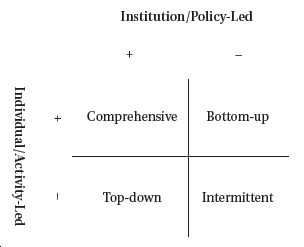
Top-Down: when the internationalization is mainly driven and implemented by institutional policies and support, the university could be regarded as a top-down type. Sample methods include building university-level agreement and strategic partnership to enable international cooperation. An example is the University of British Columbia which places emphasis on building institutional agreement and partnership with other research universities and educational institutions on a global scale to seek long-term sustainable cooperation. The advantage of the top-down approach is to ensure internationalization has sustainable policy, funding and organization support with relatively large scale and long-term impact. However, it may not effectively motivate students and faculty or enable their initiatives, which can result in the strategy simply becoming a collection of formal agreements without any real activity.
Bottom-Up: when the internationalization is mainly driven and implemented by individuals or through certain activities, the university could be regarded as a bottom-up type. ‘Individual’ here mainly refers to faculty scholars. Sample strategies include scholar-initiated international research projects or co-authored publication. For example, in the report of Princeton University’s international strategy, it mentions that ‘research and exchanges work best at Princeton when the stakeholders are also the initiators and custodians of their efforts.’ Therefore, Princeton actively encourages and support international activities initiated and centered by faculty. The bottom-up approach is able to concentrate resources to develop a particular program or activity, and can effectively engage students and faculty. However, it may lack sustainable organizational support and continuous resources since it mainly relies on individuals’ resources and network.
Intermittent: when neither institution nor individual are the initiator of a university’s internationalization, the university could be regarded as an intermittent type. It normally occurs in the beginning phase of university internationalization development, when it lacks continuous policy and activity and is opportunistic and scattered. None of the universities surveyed in the study fall into this category, which is consistent with their being in the top 50 research universities in the world.
University International Strategy: A Micro Analysis
At the micro level, we considered different types of specific international strategies based on the scale of their impact and the difficulty of their implementation (Figure 3). Based on the two dimensions, the specific strategies employed by a university can be viewed and evaluated as limited use, ideal use or shelved use.
Ideal Use: the international strategies with relatively more impact and less difficulty to implement are the ideal strategies in university internationalization, and should be used with priority. For example, internationalize curriculum is potential beneficial for all students and can be achieved with relatively few additional resources, especially compared with mobility programs. It can also contribute to university’s internal internationalization.
Limited Use: the international strategies with relatively less impact and less difficulty, or more impact but more difficulty are the strategies that should be used within limits to achieve effective and efficient university internationalization in an overall scale. For example, encouraging faculty to participate in international academic conferences mostly requires less input from the institution, but its impact lies mainly in the relevant individuals and somewhat in their discipline areas. On the other hand, promoting students to participate in mobility programs can be systematically developed and implemented to form the mechanism for the benefit of all students, but it requires significant financial and human resources and can be difficult to implement. So it is mainly used within limits to allow a portion of students to participate in such mobility programs.
Types of specific international strategies.

Shelved Use: the international strategies with relatively smaller impact but larger difficulty are the strategies that should be shelved due to its ineffectiveness and inefficiency. For instance, the creation of a major research centre to link universities across the world can be highly resource hungry and can be complicated because of different research and legal jurisdictions, and can lead to substantial duplication of effort without necessarily concomitant increases in productivity or international impact.
In summary, university international strategy can be categorized respectively at the macro, meso and micro level. No matter what route or routes a university chooses to use, its internationalization should be related to teaching, research and service to achieve both meaning and sustainability. To determine whether a university is an international and/or an internationalized one, we should examine whether it can undertake teaching and research of international standards, and whether it can positively influence the world by the output, its graduates and service. The positive influence would in turn improve the university’s international reputation and perhaps attract more and better international students and faculty, thus promoting knowledge transfer and exchange in a global scale. It would form a virtuous cycle for university international and overall development, as shown in Figure 4.
5 Conclusion and Discussion
5.1 A Conceptual Framework
Through a study of universities’ mission statements and international strategies, we can point to the strategies employed by those world-class research universities through two dimensions: teaching and research. We now present a framework that can be used to describe, analyse and evaluate university international strategy and development, as shown in Figure 5.
In this framework, international strategy is structured in three parts: for stakeholders, for activities (teaching and research), and for organization. For stakeholders, the core is to attract, retain and develop students and faculty. It includes recruiting international students and faculty and internationalizing domestic students and faculty. The university facilitates this through comprehensive strategic planning, rigorous project building and resource allocation in the fields of education and research. Such activities mainly cover four aspects: curriculum building, international educational exchange, internationalization of content, and international research cooperation. Through coordination and cooperation, the university should be able to achieve sustainable development in their international endeavor. The framework can also be served as a model for university to design and implement their international strategy.
University internationalization cycle.

5.2 Practical Suggestions for International Strategy and Development
We now provide some practical suggestions for international strategy and development. First, it is imperative to have a comprehensive international strategy to set clear strategic goals and coordinate resources. It should be based on the strategic positioning, mission and culture of the university rather than simply imitating another university.
Second, university internationalization is not an end-product, but a means to achieve the overall development of the university. Therefore, it should be a whole package that includes students, faculty, and staff, and integrated into teaching, research and service. Each stakeholder should realize the importance of internationalization and take their ownership to actively participate in the process.
A framework for university internationalization’s description, explanation and evaluation.

Third, learning from other world-class universities, such as through this study, can be effective and efficient if a university wishes to know how best to integrate their strategies based on their resources and aims. Providing this information is one of the main goals of this study.
Fourth, the university should build an evaluation system to monitor and assess the internationalizing process and the effectiveness of international strategies. The setting of success criteria could be a productive way to contribute to the development of internationalization.
In summary, for strategic international development, the university should be clear about where it currently is, where it wants to go, how it can get there and how it will know when it is there. We believe that the analysis and findings of the present study will help universities undertake this work.
Through our comparative and typological study of the top 50 universities’ mission statements and international strategies, we have proposed a conceptual framework for international strategy development, implementation and evaluation. This work contributes to the theoretical understanding and real-world practice of universities’ international and national development.
Footnotes
Acknowledgements
The article is based on Han’s master’s thesis, under the supervision Dr. Zhong, submitted to Tsinghua University in June 2014.
