



Abstract
Abstract
The paper uses macro-causal analysis combined with empirical data analysis to illustrate how Chinese scholars in higher education (
Keywords
As we become an increasingly knowledge-based society, the competition of mental capability and “soft power” of which higher education is highly representative becomes a crucial issue, especially in China. In recent years, China is approaching a key stage of social reform: its
1 Research Background: Four Trends and the Changing Context of he in China
Currently higher education in China is undergoing reforms in which the driving forces are mainly due to a rapidly changing society, with four trends particularly relevant to
Globalization in a knowledge-based society is a global phenomenon with wide-ranging effects on many different parts of the world
1
—
Marketization represents the movement of the ideology and rules of free market from the economy to
Massification of
With a large number of new recruits, especially first-generation college students entering the campuses with diverse needs, from different backgrounds, being used to contrasting social norms and armed with divergent views on education, there arose increasing tensions, or “institutionalized distraction” in Trow’s words. 9 An obvious tension is that as traditional universities no longer have a monopoly in the tertiary education sector, the concept of excellence is challenged, so that the quality value rooted in the system of meritocracy has to be redefined. 10 Therefore, a few questions needs to be further studied, such as what massification means in China and how it affects the campus atmosphere. The changes of interpersonal relationships and student learning behaviors are also issues to be researched in detail.
The reform in basic education in China, in addition to
Figure 1 depicts the framework for macro background analysis. In the framework, globalization plays a role in stimulating the internal efforts of internationalization; it presents a new perspective and creates new academic resources/networks to work with. It greatly revitalizes Chinese academia. Massification brings diversity and changes to the ecological structures of
Framework for macro background analysis

Generally speaking the four trends representing external forces, along with numerous ancillary factors, lie at the center of any consideration of
2 Major Works in Constructing the ccss
The
27
Sharing the same theoretical foundations with the
Student engagement is concerned with the interaction between the time, effort and other relevant resources invested by both students and their institutions intended to optimize the student experience and enhance the learning outcomes and development of students and the performance, and reputation of the institution. 14
This term has its historic roots in a body of work concerned with student involvement, mainly in North America and Australia, where it has been firmly entrenched through annual, large-scale national surveys (
Although
2.1 Adding Psychological Variables to Deeper the Understanding of Behaviors
Engagement is more than involvement or participation.
21
Acting without feeling engaged is simply involvement or even compliance, while feeling engaged without acting is dissociation. Fredricks et al.
22
and Bloom
23
describe three dimensions of engagement: behavioral engagement, emotional engagement and cognitive engagement. Results from our data analysis and interviews show that Chinese learners’ engagement and the learning outcomes are largely influenced by their motivation, their feeling about the learning process, and their conceptions of learning. Therefore, the
Emotional engagement: Students who engage emotionally would experience affective reactions such as interest, enjoyment, or a sense of belonging. 25 Emotional engagement is reflected in four ways: one’s interest (or lack thereof) in one’s major, appreciate its usefulness, enjoy the learning process and feel happy while studying.
Motivational engagement: Student motivation is a key component of student learning, stimulating students to become engaged in certain learning activities. Students who have intrinsic motivation are more engaged behavior-wise and produce better results, while those who have extrinsic motivation are less engaged with poorer results. 26 This dimension of engagement is characterized as intrinsic motivation (interest in knowledge itself, self-development and challenging oneself) versus extrinsic motivation (satisfying teachers and parents, gaining high scores).
Cognitive engagement: Students’ conceptions of learning and of their educational situation have a large influence on their behavioral engagement. Students who see learning as a process of self-improvement are generally more invested in their learning, seek to go beyond the minimum requirements, and relish challenges more than those who see learning as a mere tool to increase knowledge. 27 Five levels of conception of learning have been identified: 1) learning to increase knowledge through memorization; 2) learning to help understand the world; 3) learning as a process of discovery and exploration; 4) learning as a process of vocational training; 5) learning as a process of growth into a fully developed person.
2.2 Developing the Diagnostic Function in the Chinese Context
To enhance the diagnostic function of the instrument in the Chinese educational context and to help Chinese universities improve education quality, four constructs have been developed as follows:
Course cognitive goals (memorize, apply, analyze, evaluate, synthesize)
Level of rigor of teachers’ academic requirements (number of writing and reading tasks, difficulty of exams, etc.)
Engagement in class (active learning behaviors in class)
Engagement outside of class (active learning behaviors outside of class)
The constructs agree well with the Chinese higher education pedagogy and emphasizes the operational factors of the teaching process. 28 It is reported by many project universities that the four constructs are better used in diagnosing the problems and improving the teaching and supervision of students. 29 , 30
2.3 Adapting the Instrument for Vocational hei s
To meet the needs of the rapid development of vocational education, a field rarely researched in China by academia, we have developed an instrument aimed at evaluating the education quality of vocational colleges.
31
The core framework of the vocational instrument is identical to that of the
The vocational instrument is still in its early stages. A dozen vocational colleges over the country piloted the instrument in 2013. The validity and reliability of the instrument will be described in a later report.
2.4 Student Background Matters
Along with the massification and marketization of the Chinese higher education system, students enrolled in
3 Validity, Reliability, and Credibility of the ccss Data 2009-2012
The quality of
Table 2 shows that the five benchmarks achieved a high degree of consistency during the four wave data collection. The lowest Cronbach’s alpha coefficient is
Criteria validity of five benchmarks on self-reported attainments

*p < 0.05 **p < 0.01 ***p < 0.001
Summary of five benchmarks’ Cronbach’s alpha coefficients from 2009-2012

In order to test the quality of the items of the
4 Basic Description of ccss 2012 Data
The paper uses three types of data collected by the
Reliability of five benchmarks in 2010
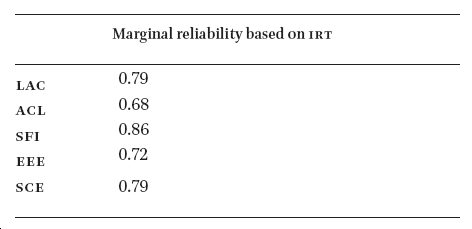
The whole sampling process consists of two stages: 1) institutes were chosen by stratum sampling in which the data collected could be inferred nation-wide by proper weighting; 2) students were randomly chosen on the basis of school years with an average of 400 students per grade in one institution.
We distributed 100,644 questionnaires in 2012; of these, 72131 were completed and returned, resulting in a response rate of 71.61%. Student background variables were coded as gender, ethnicity, grade, discipline, first generation college student, rural, only child, region, local student and enrollment type. We categorized
The sample included more male students (54.6%) than female students, with a greater percentage majoring in Engineering (46.4%) than the Humanities and Social Sciences (25.1%) or the pure Sciences (7.8%). It revealed that 70.6% of the students are not from the local area, which means that most of the students migrated from another area to the place where their university was located.
5 Further Investigation of the ccss 2012 Data
To better understand the behaviors of Chinese students in college, we need to first realize that the college students are living in a rapidly changing society influenced by the global trends with their learning behaviors being the products of their prior learning experience, current learning goals, college education norms and overall perceptions towards learning. Based on the data collected in 2012, three cases will be taken to discuss the issues and to depict college student learning in a macro contexts.
Description of demographic variables and institutional characteristics

5.1 Comparison of Student Learning Behaviors in 5 Benchmarks: China’s 985 Project Universities with American Students in Top Research Universities
With the aim of forming world-class universities, the 985 Project University in China has undertaken considerable effort in improving campus facilities, reforming teaching/learning and increasing quality of education.
42
What is the situation of student learning engagement compared with the American top research universities? Table 5 shows the student’s scores in the five benchmarks from China’s top research universities (985 project universities) and those of his counterpart in the
We find that the mean scores of Chinese students are significantly lower than American students in
T-test and effect size analyses of five benchmarks

* p < 0.05 **p < 0.01 ***p < 0.001
5.2 High Impact Educational Practices (hip s) in Chinese College
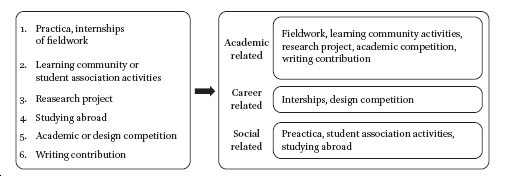
Experienced educators and researchers conducting empirical studies often find that certain activities in college tend to be more purposeful and influential upon students. Kuh recommends these activities as high impact practices (
The questions for us to focus on are whether the benchmarks of
As shown in Figure 2, the
In the 985 project universities, the junior students are more active in the third type of
academic performance and learning outcomes
= β0 + β1
We find that
To better understand which kind of
Corresponding relationship between HIPs and learning outcomes

* p < 0.05 ** p < 0.01 *** p < 0.001
In conclusion, universities in China, just as in the
5.3 Learning Features of First-Generation College Students
The first-generation college students here refer to the students whose parents have not received any degrees in
We tested the distribution of first generation and non-first generation students using Chi-square test and found that a statistically significant differences exist between the two groups in terms of school type, gender, grades, ethnicity, number of siblings and hometown.
From the distribution table, the first-generation college students are mainly enrolled into local universities (χ2=1059.39, p < .001). Most of the first-generation college students (77.8%) are male (χ2=202.71, p < .001). The Han ethnic group has a much higher representation (76.5%) than minority ethnic groups in terms of first-generation students (χ2=338.04, p < .001). Among the first-generation students, 90.6% comes from families with more than one child (χ2=9818.63, p < .001). The data also revealed that, compared to non-first-generation students, more first-generation students come from the countryside (χ2=9571.36, p < .001).
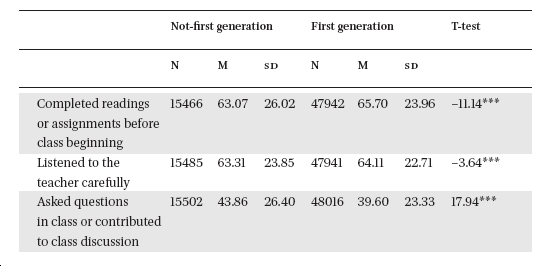
Table 8 gives the T-test results, by category, of the learning behaviors observed in independent samples of college students. As the table shows, the first-generation college students tend to be “good” students from the traditional Chinese perspective. They complete assignments in time and listen to their teachers’ instruction carefully. However, they do not communicate with their faculties by asking questions or actively responding to them, let alone by making a presentation or questioning the teachers’ viewpoint. Learning in this fashion meets the outside requirements, but does not activate their personal, learning desires.
Chi-square analysis

* p < 0.05 ** p < 0.01 *** p < 0.001
T-test of study behaviors

* p < 0.05 ** p < 0.01 *** p < 0.001
In terms of time allocation, the first-generation college students spent a lot of time on the Internet; for example, playing games, chatting online, or watching online videos. They participated less in extra-curricular courses, sports activities. Based on our observation, first-generation students are more likely to be within a small social circle due to financial constraints or lack of self-confidence. Therefore, they do not usually spend much time exploring their potential abilities or new territory in the region.
As for personal relationships on the campus, first-generation students reported a better relationship with their classmates compared to non-first-generation students. Non-first-generation students received more support from other important people like their faculty, administrators and class assistants who have authority on resource distribution and student benefits.
From the above data, a portrait of the first-generation college students seems to present themselves: they try hard to be good students in terms of classroom learning, but do not invest much energy in higher order learning activities. They participate in fewer extracurricular activities with others and protect themselves by staying in their comfort zone, playing online games or watching television. They hardly communicate with important people on campus and prefer to ask for help from their peers. First-generation students are a group who are easily overlooked. Compared with the non-first-generation college students, they make less efficient use of resources provided by the college.
T-test of time allocation

* p < 0.05 ** p < 0.01 *** p < 0.001
T-test of personal relationships

* p < 0.05 ** p < 0.01 *** p < 0.001
5.4 The Impact of Ascribed and Achieved Status Factors to College Student Learning
Living in a rapidly changing society with tremendous geographic mobility, students enter colleges with abundant personal background knowledge (
In the reduced model, the gross effects of high school attainment and high school types on student learning and development are estimated. With the full model we are able to estimate the size of the effect of precise pre-college on student development by controlling the
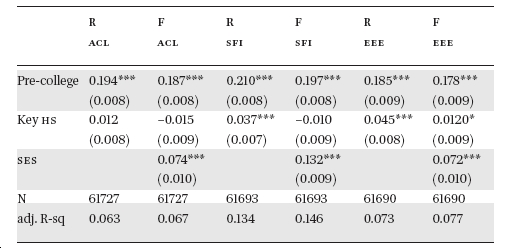
Our overall findings are as following: a student’s pre-college experience is the most important factor influencing one’s college learning and is the strongest predictor on the college learning outcome of that student, whether in the reduced model or in the full model (p< 0.001).With the entry of the
Table 11 shows that after controlling student backgrounds and institutional characteristics, pre-college experience is closely associated with Active and Collaborative Learning (
Control variables are gender, ethnic, grade, major, university type, location, local students.
Furthermore, we calculated the difference between the standardized coefficient of pre-college experience and the
Coefficients of demographic variables, institute characteristics, pre-college experience and SES on student learning behaviors
* p < 0.05 ** p < 0.01 *** p < 0.001
Coefficients of demographic variables, institute characteristics, pre-college experience and SES on student learning status

* p < 0.05 ** p < 0.01 *** p < 0.001
Coefficients of demographic variables, institute characteristics, pre-college experience and SES on student learning outcomes

* p < 0.05 ** p < 0.01 *** p < 0.001
Furthermore, the higher school factor is stronger than the family background. Its direct effect on higher education is not much stronger than proximal factors like high school impacts. When we compare the pre-college experience coefficient in the reduced model and the full model, there is a slight change. It demonstrates that the relationship between the pre-college period and the
To sum up, both pre-college experience and
6 Conclusions and the Future of the Project
During the past 5 years, the
In addition, along with the expansion of participating
We have broached a number of topics in this paper, namely the comparison of Chinese top university students and their American counterparts in
As indicated in this article, we have made a great effort in indigenizing the survey instrument. We believe that with the increasing global role China is expected to play, a tool that allows international comparisons is indispensable. We have retained the five benchmarks of the
Attempting to break open the black box of Chinese college student learning is an endless yet meaningful journey. We shall continue the journey with the confidence that a better understanding of the learning process of Chinese students will not just benefit China, but the whole world.
Footnotes
1 D.L. Cogburn, “Globalisation, Knowledge, Education and Training in the Information Age,” International Forum on Information and Documentation, 23(4) (1998): 23-29.
2 P.G. Altbach, et al., “The Task Force on Higher Education and Society,” Comparative Education Review, 48(1) (2004): 70-88.

4 T.W. Bigalke, & D.E. Neubauer, (Eds.) Higher Education in Asia/Pacific: Quality and the Public Good (New York: Palgrave MacMillan, 2009).
5 Y. Wu, & H. Zhang, “Higher Education Reform: Capture the Last Fort of Planed Economy,” Journal of Educational Development, 1(1999): 7-8.
6 Q. Shi, Wu, X., & Wang, A., Research on Quality Assurance and Evaluation System in the Phrase of Higher Education Massification (Guangdong: Guangdong Higher Education Press, 2012), Chapter 1.
7 P.G. Altbach, “Academic Freedom: International Realities and Challenges,” in Tradition and Transition: The International Imperative in Higher Education (Rotterdam: Sense Publishers, 2007).
8 Wu, D., & Zhao, T., Studies on the Issues of Massification of Higher Education (Beijing: Higher Education Press, 2002) Chapter 1.
9 M. Trow, Problems in the Transition from Elite to Mass Higher Education (California: Carnegie Commission on Higher Education, 1973).
10 P. Scott, “Access in Higher Education in Europe and North America: Trends and Developments. In UNESCO Forum on Higher Education in the Europe Region: Access, Values, Quality and Competitiveness,” Paris and Bucharest:
11 X. Yang, et al., “The Progress of Research on the Chinese Basic Education Reform during the Eleventh Five-year,” Journal of Schooling Studies, 8(3) (2011): 5-20.
13 P.G. Altbach, & P.M. Peterson, Higher Education in the New Century: Global Challenges and Innovative Ideas (Rotterdam: Sense Publishers, Introduction, 2007).
14 V. Trowler, Student Engagement Literature Review (New York: Higher Education Academy, 2010).
15 G.D. Kuh, “What We’re Learning about Student Engagement from
16 A.C. McCormick, J. Kinzie, & R.M. Gonyea, “Student Engagement: Bridging Research and Practice to Improve the Quality of Undergraduate Education,” in Higher Education: Handbook of Theory and Research (Heidelberg: Springer Netherlands, 2003), 47-92.
17 H. Coates, “Development of the Australasian Survey of Student Engagement (
18 P. Hagel, R. Carr, & M. Devlin, “Conceptualising and measuring student engagement through the Australasian Survey of Student Engagement (
19 Y. Hill, L. Lomas, & J. MacGregor, “Students’ Perceptions of Quality in Higher Education,” Quality Assurance in Education, 11(1) (2003): 15-20.
20 J.T. Richardson, “The National Student Survey and its Impact on
21 S.R. Harper, & S.J. Quaye, (Eds.) Student engagement in higher education: Theoretical perspectives and practical approaches for diverse populations (New York: Routledge, 2009).
22 J.A. Fredricks, P.C. Blumenfeld, & A.H. Paris, “School Engagement: Potential of the Concept, State of the Evidence,” Review of Educational Research, 74(1) (2004): 59-109.
23 B.S. Bloom, (Ed.) Taxonomy of educational objectives. Handbook I: Cognitive domain (New York: David McKay, 1956).
24 G.D. Kuh, The National Survey of Student Engagement: Conceptual framework and overview of psychometric properties (Bloomington: Indiana University Center for Postsecondary Research, 2001), 1-26.
25 P.A. Schutz, & R.E. Pekrun, Emotion in education (Utah: Elsevier Academic Press, 2007).
26 Z. Wang, Cognitive theories and Applications of Learning Motivation (Beijing: China Social Sciences Press, 2009).
27 M. Prosser, & K. Trigwell, Understanding Learning and Teaching: The Experience in Higher Education ( New York: McGraw-Hill International, 1999).
28 Jiang, H., et al., “Survey of Student Engagement: A New Perspective for Undergraduate Education Quality Assurance,” Higher Education Development and Evaluation, 26(4) (2010): 45-53.
29 Wu, H., & Jin, F., “Assessment and Diagnosing of Learning Quality from the perspective of Student Engagement—Application of NSSE-China in Institutional Research,” Modern Education Management, 9 (2011): 49-53.
30 Fu, C., et al., “Application of Student Learning Investigation on Chinese College Management and Decision Support—Based on the Practice of Sun Yat-sen University,” Higher Education of Sciences, 5 (2013): 19-25.
31 Xiao, Y. “Assessment and Diagnosing Research on Teaching Quality in Higher Vocational Colleges,” Vocational Education, 5 (2013): 3-10.
32 Jin, Z., & Sun, J., “Urban-rural Dual Structure: The Hidden Worry about Chinese Higher Education Development,” Higher Agricultural Education, 5 (2012):12-15.
33 Level of academic challenge.
34 Active and collaborative learning.
35 Student-faculty interaction.
36 Enriching educational experience.
37 Supportive campus environment.
38 Tu, D., Shi, J., & Guo, F., “A Measurement Study on Chinese College Student Survey Instrument,” Fudan Education Forum, 11(1) (2013): 55-62.
39 Luo, Y., Ross, H., & Cen, Y., “Higher Education Measurement in the Context of Globalization—The Development of NSSE-China: Cultural adaptation, Reliability and Validity,” Fudan Education Forum, 7(5) (2009): 12-18.
40 Wang, S., “The Impact on Student Learning of Student Engagement in Research Universities—Based on NSSE-China 2009 Data Analysis,” Tsinghua Journal of Education, 32(4) (2011): 24-32.
41 Guo, F., Shi, J., & Tu, D., “A Study on the Cultivation of the Undergraduates’ Creativity at Research University in China—An Empirical Analysis Based on the Undergraduates’ Differences of Winning Awards and Creativity Enhancement,” Tsinghua Journal of Education, 33(5) (2012): 13-26.
43 D.A. Watkins, & J.B. Biggs, The Chinese Learner: Cultural Psychological and Contextual Influences (Victoria: Australian Council for Educational Research, 1996).
44
45 G.D. Kuh, High-impact educational practices: What they are, who has access to them, and why they matter (Washington: Association of American Colleges and Universities, 2008).