



Abstract
Abstract
The learning discourse of the 21st century is characterized by the emergence of the knowledge economy, and the need for lifelong learning for learners to be able to adapt to the fast and ever changing economies of the society. This has created changing demands for the skill sets of the 21st century learners, such as the ability for critical and creative thinking, the ability for self-directed and collaborative learning, the ability to learn formally and informally, and the ability for both competition and cooperation, etc. The skill sets diverge from the almost single-faceted traditional emphasis on academic abilities, and the knowledge functions of the university is gradually changing. Knowledge creation is being regarded as possible not only by basic and discovery research, but also possible in the process of teaching, clinical practice and multi-disciplinary integration. Knowledge ownership is changing from the ivory tower research professors to combined expectations and ownership of the learners and stakeholders. The significance of knowledge is shifting from its simple significance in terms of discovery to being measured by its utilization and mobilization, and user’s satisfaction. All these have implications for learning, and university teaching is also changing from traditional research based learning modes towards practice and internship, the opportunity for experiential learning, and the opportunity of exchange among an increasingly diversified student body, developed through the agenda of internationalization. The purpose of this paper is to examine these changes and how the changes require our adjustment in our teaching and learning approaches, measurement, and expectations for learning outcomes in university education.
Introduction
In the 21st century, learning is shaped by the rise of the knowledge economy, and our need to continuously learn and adapt to the rapidly changing economies. The 21st century learners of today are required to be both collaborative and self-directed, and also critical and creative thinkers. They also need to know how to learn in both formal and informal settings, and to both compete and cooperate with others. These competencies are a departure from the once-prevalent, singular focus on academic abilities. The knowledge functions of the university are also gradually evolving and adapting to the new reality.
Knowledge creation is now thought possible not just through basic research and discovery research, but also teaching, clinical practice and multi-disciplinary integration. Ownership of knowledge is no longer seen to be the exclusive privilege of the research professors. The focus of concern is now about the expectations and ownership of the learners and stakeholders. Knowledge discovery is no longer significant by itself. Instead, its significance is being measured by its utilisation and mobilisation, and satisfaction of the users.
All these have impact on learning, and teaching in universities is also shifting from the traditional research-based learning modes to practice-oriented modes, such as internships, experiential learning opportunities, and international exchanges among increasingly diversified student bodies across all universities. This paper aims to examine these changes and how university education needs to adjust to these changes by relooking at teaching and learning approaches, measurement, and expectations for learning outcomes.
Ernest Boyer’s framework signals the evolving role of universities in the 21st century by proposing four categories of scholarship. In the past, traditional universities prided themselves on the academe’s role of basic research and knowledge discovery, but Boyer’s framework suggests to us that universities need to expand their functions, especially those functions that are aligned to societal and national development; application of knowledge to practice; the development of research capabilities and capacity that would enable researchers to apply knowledge to practice, and at the same time identify and develop research agendas during practice. This framework recognises the value of practice and also work experience to research. The scholarship of integration also emphasises the ability to synergise research and develop inter-disciplinary scholarship. The importance of linking knowledge to practice and field experience has led to an increasing focus on experiential learning, and because of that, internship is fast becoming an essential in many university programmes. 1 University students themselves are creating internships and other experiential opportunities for themselves by taking a gap year, which is now regarded as a form of training not only by employers, but also by the universities.
The growing influence of globalisation is reflected in the changing practices of universities around the world today. Many universities, especially those in Asia, are setting admission targets for international and exchange students, reflecting the growth of internationalisation agenda in their countries. The world of the universities is now a world in constant flow, and the scale of exchange is unprecedented in history with exchange happening not only among student populations but also faculties. The aims of diversity and inclusivity have become incorporated in many of the universities’ vision and mission statements.
Generally, universities of today are no longer the isolated ivory towers of yesteryears. Instead, they are higher education institutions who have aligned their vision and mission to societal and national goals, having embraced internationalisation as a way to educate 21st century graduates to possess global perspectives and can interact and communicate and thrive in the outside world, beyond the university and even beyond their shores. This paper will describe these trends, and examine what implications they may have for universities and how they position and reposition themselves. In particular, this paper analyses the knowledge functions of the universities, from the conventional function of knowledge discovery to the increasing roles of knowledge sharing and engagement, and how new knowledge is being created and discovered in this process. In addition, knowledge ownership as we traditionally know it is also being challenged by the establishment of the lifelong learning arms of universities.
Changing Concepts towards Scholarship
The concept of scholarship of today is closely associated with “research”. The association originated from English reformers who wanted Cambridge and Oxford to be places of both teaching and learning. However, in his review of concepts of scholarship, Boyer
2
put forward that the concept of scholarship is not static, but varies across time and countries. Scholarship has been viewed as “a means and measure of self-development” in the
The understanding of scholarship also changes across the centuries. In early 19th century scholarship in the
Boyer noted in the conclusion of his review:
We proceed with the conviction that if the nation’s higher learning institutions are to meet today’s urgent academic and social mandates, their missions must be carefully redefined and the meaning of scholarship creatively reconsidered . . . We believe the time has come to move beyond the tired old “teaching versus scholarship” debate and give the honourable term “scholarship” a broader, more capacious meaning, one that brings legitimacy to the full scope of academic work. 3
For Boyer, 4 scholarship has expanded to cover discovery, integration, application and teaching. Discovery is closest to the definition of basic research because of how they are both concerned with investigation. However, there are other important facets to scholarship as a concept. Integration refers to the multidisciplinary and interdisciplinary nature of scholarship, and how deliberate scholarly efforts are needed to redraw the boundaries of knowledge as urgent real-world problems and new academic questions arise. To quote him: 5
. . . philosophical inquiries looking like literary criticism; scientific discussions looking like letters morceaux; histories that consist of equations and tables or law court testimony; documentaries that read like true confessions; parables posing as ethnographies; ideological arguments cast as hisotoriographical inquiries; epistemological studies constructed like political tracts; methodological polemics got up as personal memoirs. . . .
Reflecting the notion of service as scholarship, application addresses how real-world problems can be solved by the responsible application of knowledge. This leads us to think of how it is very possible that new intellectual understandings may be derived from the very act of application—be it pedagogical interventions in schools, trialing new medications in hospitals, or influencing and informing national policies through participation in related committees. In such instances, practice and theory are seen to interact, renew and feed into each other.
To quote Aristotle: “Teaching is the highest form of understanding.” Teaching educates and entices, but it is so only if the professors are as highly engaging and well-informed as teachers. The great ones create communities of learning and elicit intellectual commitment from their learners. They exhort their students to be active and critical as thinkers and learners. They not only transmit knowledge, but also transform and extend it. For the university faculty to be good teachers, they must see themselves as scholars and also learners.
To summarise, Boyer suggests a definition of scholarship that is more wide-ranging and inclusive. His concept of scholarship recognizes that knowledge is not gained only through research (discovery), but also teaching, practice (application) and synthesis (integration).
The Significance of Lifelong Learning in the Knowledge Economy
In Asia, education systems have seen some major reform initiatives being implemented in the last decade. These include management reforms that sharpen accountability, such as making data and information about the performances of schools available to the public, recalibrating the goals of educational to focus on quality and how quality is being assessed; looking not just teaching performance, but also learning outcomes of students; redefining the objectives of examination and assessment from assessment of learning to “assessment for learning and development; and lifelong learning”. These reforms are not implemented piecemeal, but are connected and meant to complement one another.
These measures mirror the demands for performance, measurability and efficiency that all education institutions have to grapple with today. Accompanying the volatility of the global economies and the higher levels of education attainment in many nations are the mounting demands by the public to be involved in educational provisions, be it policymaking, such as public participation in curriculum development, or more involvement by the private sector in servicing schools in terms of programmes and activities.
Lifelong learning embodies most of the fundamentals found in these major educational reforms. It fulfills the educational needs of workforces in volatile economies who face unpredictable job futures because of fast turnovers in the jobs available and industries. It calls for independent and self-directed individuals with a strong sense of responsibility towards themselves, ironically at a time where in wealthy societies, independence are delayed for youth who tend to live for the moment because their future is uncertain. In Japan, there are debates that reforms are needed in order to align the demand and supply of the labour market, and to create a society in which every individual has the means and opportunity to maximise one’s potential and abilities.
Lifelong education started out as an informal form of learning. It quickly became very popular as an alternative to formal learning and many educational institutions and private education providers now offer programmes where users can eventually obtain recognized qualifications issued by higher education institutions such as universities. This can be demonstrated by the Credit Bank System in South Korea, 6 the Credit Transfer and Accumulation System in European Union 7 and the National Qualifications Framework in Australia. Lifelong learning is now in the process of being institutionalised, morphing from a wholly informal way of learning (attitudes, skills, insights, knowledge can be gained through experience and exposure), to non-formal (activities occur outside of the formal systems of education, but are educational, systematic and organized in nature) and finally, formal education (activities are decidedly structured in an hierarchy and are highly institutionalised). 8
Whenever there is sufficient demand, there will be supply. As Aspin et al.
9
have described, educational institutions and agencies, both traditional and non-traditional, have been offering lifelong learning opportunities. Duke
10
noted that in the 21st century, lifelong learning “has become popular and ‘commercially viable’, not just in the
In Asia, lifelong learning tends to resemble the traditional understandings of adult, continuing and lifelong education. 12 It could perhaps be attributed to the more centralised and systematic efforts in the planning and organising of educational activities or programmes. Such efforts are reflected in the comment that “[t]he Japanese government believes that, in order to promote lifelong learning in Japan, institutions of formal education should play an important role in offering a basis of lifelong learning.” 13
That lifelong learning is becoming more institutionalised has also led to it evolving in a multi-faceted, if somewhat contradictory manner. Formerly characterised by individual initiative and informal learning, institutionalisation has now introduced a formal structure to lifelong learning. Some academics argue that it is next to impossible to draw a line between formal and non-formal education, as they begun to share more and more similar features. Indeed, the idea of seamless learning is becoming popular, suggesting that even in schools where formal learning takes place, extra-curricular activities are now seen to be so much a part of learning that the term “co-curricular activities” is increasingly being used to describe them. Increasingly, informal learning is being regarded as part of formal learning. And learning within the schools and learning outside of schools are seamlessly important and integrated. As Duke notes, lifelong learning “can be a matrix with formal and non-formal education.”
14
According to Aspin et al., the traditional divisions of education (such as primary, secondary and tertiary/higher) will gradually become less meaningful, as lifelong learning “presupposes an integrated, holistic and seamless approach to the whole of education.”
15
A recent Report of the
The relationship between formal and non-formal education

Rogers’ discussion on formal and non-formal education and their relationship is relevant here. To represent the relationship of these two types of education, he uses a continuum instead of a dichotomy 17 (see Table 1).
As a concept, lifelong learning differs from the earlier term “lifelong education” through its emphasis on individual responsibility and effort to prepare oneself for the challenges of a rapidly changing job environment. 18 In the early 1970s, lifelong education is regarded as a broad and integrated strategy of preparing communities and individuals for social change, 19 and it was a provider-led model of learning. 20 The Delors’ Report 21 in the 1990s put it to us that lifelong education tried to “reconcile three forces: competition, which provides incentives; co-operation which gives strength; and solidarity, which unites.”
Overall, lifelong education is defined by the structures and institutions of education, and the strategic provision of educational services. It is similar to what we know as adult education and continuing education. Adult education refers to activities organised and carried out by a wide range of institutions to meet certain educational objectives, 22 to advance professional or technical qualifications, 23 and there is an emphasis on an external educational agent acting to channel behaviour into planned and systematic experiences. 24 Continuing education usually refers to any post-compulsory education that is short-term, and may be qualification- and programme-related. 25
During the 1990s, the prevalent understanding of lifelong learning was the retraining of workers and the learning of new skill sets that would ready them for the rapidly changing workplace. As it is currently being promoted, lifelong learning is more individual-based whereas lifelong education is more community-oriented. The endorsement of lifelong learning can also be understood as shifting of responsibility and agency to individuals, as opposed to the focus on institutions and structures in lifelong education. 26
This gradual shift in terminology that we are witnessing, from lifelong education to lifelong learning, reflects a conceptual departure from organised educational provision to the individualised pursuit of learning. The former focuses on centralised strategies of provision and organisations and, and what is to be taught and learnt is decided by the organisations. The latter is concerned with agency and motivation of individuals to learn in order to adapt and survive in a world that is in constant transition. This shift encouraged the proliferation of education service providers that serves to respond to the needs of the learners. 27 Generally, the former is about structures, while the latter is about culture. The former is about state-led provision, and the latter, private and personal initiatives.
Knowledge Economy and the Entrepreneurial University
The rise of the knowledge economy is acknowledged across the globe. Countries are undertaking educational reform which revolves around this new economic reality, regardless of where they are at in terms of economic development. 28
The higher educator sector is not immune to the impact of the knowledge economy. There is talk that the conventional universities as we know them need to reinvent themselves to keep up with developments of the knowledge economy. The idea of the entrepreneurial university was proposed. There is a spiral of growing prospects which, in one way or another, is overwhelmingly the entire public sector. The restructuring of its theoretical postulates has directly affected the university sphere.
The higher education institutions of today have to address several problems, such as the following:
The demands for education from their societies and communities have increased to such a level that institutions do not have the means or the capacity to cope with them;
Cuts in public spending by the governments mean less funds are available for the universities. Existing funding is increasingly being subject to whether the universities can deliver results expected of them; Increasingly, universities need to justify themselves and be accountable to the public.
All this is happening at a time when knowledge exceeds resources and thus there is a huge overload in demand that universities have difficulties in satisfying the needs and demands of the society. 29
Many universities are undergoing organisational transformation to reduce institutional inefficiency. In his study of the development of these universities, Clark 30 identifies that each university transforms itself depending on their unique situations, which are shaped by various factors, such as local and regional needs, geographical location, academic profile, and specialisation strengths. Instead of being reactive or passive in the face various constraints imposed upon them, Clark 31 notes that these “entrepreneurial universities” have taken proactive approaches:
These institutions are change-oriented. Change is a habit that has become institutionalised for them.
There is an “assertive bureaucracy” of change: Professional staff such as continuing education officers, grants and contracts officers, and development officers, are more forward- and change-oriented than the traditional “administrative” staff who served on behalf of the funding public authority and higher regulatory boards and councils.
Within the institution, there exist entrepreneurial groups, ranging from disciplinary departments to interdisciplinary and transdisciplinary research centres at the base, to schools and faculties at the intermediate levels, and to the whole university. The faculty and professional staff work together at all levels, and share an understanding that academic values are the foundation upon which managerial values are built on.
Perhaps the enabling of all is the fact that the entrepreneurial university diversifies its income sources such that financially, it is no longer solely dependent on the whims of politicians and bureaucrats who occupy the seats of state policy, nor upon business firms and their “commercial” influence, not even upon student tuition as main supports. Funds flow not only from such well-identified sources but also, from a host of public agencies (other than the core-support ministry or department) and alumni and other private donors who provide moral and political support. Effective stewardship comes to depend not on the state or on “the market”, but on university self-guidance and self-determination.
Röpke 32 argues that the entrepreneurial university is the kind of model that today’s universities should work towards. More than just managerial or administrative transformation, it is a new vision for universities that would combine innovation, knowledge creation, regional development and the globalised economy. He challenges the traditional division of labour and functions between academic science and academic teaching and industry. He challenges the significance of the new knowledge and ideas produced by a university, unless there is a societal demand for it, and it is the university’s responsibility to respond to these demands, or to create a demand for this knowledge. Thus, the entrepreneurial university is one that recognises and whose goal is to wed the economy and knowledge. He further posits that the global economy and regional development depend much upon each other, rather than being mutually exclusive. As such, the entrepreneurial university should create global demands for local innovations, and vice versa.
The discussion of the entrepreneurial university also touches on the servicing role of the universities to the society. The proliferation of private higher education and the cuts in funding for public universities are not just a matter of improving efficiency, but also a swing in ideology, signaling a focus on public accountability, and the mandate on universities to garner support from the community (in terms of financial funding) by fulfilling demands of the society through service. The challenge to today’s university education is to turn these service responsibilities into opportunities for knowledge creation.
Knowledge Transfer, Exchange and Mobilisation
The role of the universities is changing as it enters a new era of knowledge, alongside the growing discussions on the different definitions of scholarship as put forward by Boyer, and the role of the university in the knowledge economy. 21st century universities are regarded as knowledge organisations, with new demands on the university to perform a host of knowledge functions, such as knowledge transfer, knowledge exchange, knowledge utilisation, knowledge mobilisation, knowledge mediation, and knowledge management and creation, etc. The definitions of these terms vary 33 and requires some explanation.
A 2006 report for the Australian government defines knowledge translation as a process that integrates the three academic dimensions of research, scholarship and learning and teaching, involves engagement with a diversity of non-academic users of knowledge, and this process can occur at local, regional, state, national and international levels. 34 This process is illustrated in the Knowledge Transfer Conceptual Framework in Figure 1.
source: phillipskpa , 2006.

The report further suggests that the process of knowledge transfer will cover knowledge access (to make knowledge accessible to users), knowledge production (to sell “knowledge products”), knowledge relationships (to sell “knowledge services”) and knowledge engagement (to engage to achieve mutually beneficial outcomes) (see Figure 1). 35
Redrawing the Boundaries: Knowledge Production by Lifelong Learning Institutions
Although lifelong learning has shaped major policies by both higher education institutions and governments alike in the 21st century, its influence has long been felt by the higher education sector. Since the late 1800s, universities have been offering their educational services in a non-formal mode as part of extramural education. The British focused on the liberal arts and offered a “proper” education to individuals who had no access to formal education previously. “A useful education” was the aim of the American agricultural extension tradition, 36 and it was vocational in nature and learners were expected to be self-directed and self-reliant right from the start. 37 Both of these traditions had held such services to be distinct and different from formal programmes traditionally offered only by universities, where learners had no means to progress from extramural education activities to recognised and awarded programmes. As such, there were debates about whether university resources ought to be used on those who are not within the formal programmes.
The mandate issued by governments for universities to quickly and radically increase their student enrollments during the 1980s are well documented in the literature. 38 Continuing and professional education units gradually replaced extension units, and were expected to finance themselves or even generate profits. These units depended on enrolments for their survival and thus focused on catering to the educational needs of the learners. In doing so, they ceded away some control of what is to be taught and learnt to the learners. Their range of programmes expanded as they became more and more popular, to the point where units in some countries offered those that led to recognised qualifications offered by their parent universities. As a result of such attempts to institutionalise their courses, these units’ enrollments sometimes outnumbered those of the parent universities’ recognised courses.
The growing presence of lifelong learning units within universities challenges the definition of what constitutes legitimate knowledge within the context of higher education. Once these units become institutionalised, they have a formal claim towards knowledge building. Cervero 39 argues against the practice of attributing legitimacy to only “formal, abstract and general” knowledge, while that which is “local, specific and based in practice” is devalued. This belief had resulted in the transferring of learning from the place of practice to the universities. He notes that continuing education, should be more practice-orientated, and emphasise on the importance of developing professional action. Murphy and Fleming argue that prior experience is a key tenet of lifelong learning. This inevitably pits lifelong learning against traditional higher education in a major conflict, as the latter undervalues experiential knowledge and at the same time, elevates the status of abstract and general knowledge. 40 Tennant and Morris 41 however, posit that changes in policy and rhetoric have led to a focus on application of knowledge to real-world problems experiential knowledge.
Along with the changing understanding of knowledge within higher education is the agreement among scholars that universities no longer enjoy a monopoly on legitimate knowledge. They can no longer segregate themselves or stand apart from the community at large. In this sense, their lifelong learning units will gradually take on the important role of engaging the community. 42 The last two decades have seen the rise of multiple stakeholders, many of them becoming the lifeblood of lifelong learning. The notion of a “knowledge economy” has gained traction among governments that want to make universities accountable to the public and to the state, 43 highlighting its crucial role in “the economy’s supply capacity.” 44 The evolving and at times, reluctant, relationship between universities and the communities “raises sharp epistemological questions” which has led to a re-evaluation of how legitimacy or validity should be assessed within the context of universities. 45 Coinciding with these developments is the entrance of new providers into the sector of higher education. As a result, universities today no longer enjoy the privilege of being the sole providers and owners of high-status knowledge.
From Hard Knowledge to Soft Skills: The Emergence of 21st Century Competences
Kogan 46 conceptualised knowledge as a spectrum that range from hard to soft science. Hard science refers to specialist knowledge that is not accessible to those outside of its epistemic community. Soft science refers to application of knowledge, and it focuses on inclusiveness and accessibility. The appeal of soft science may well increase as “consumers demand more power” in knowledge-production processes. 47
The twin forces of globalisation and the knowledge economy have facilitated the flow of information and knowledge across the globe. They have also shaped agendas and policies for national development in countries all over the world. The knowledge capital of citizens is the most important force driving the knowledge economy. In other words, the political, social and economic advancement in any country depends heavily on how well they develop and tap into the intellectual potential of their young. This urgent need to build the capacity of students as future workers is heeded by many governments, who have been tweaking their educational systems through major reforms to prepare their students for the workplace in the 21st century. Kennedy notes that almost all Asian countries have embarked on curricular reforms to cultivate in students “21st century competences”, which cover a spectrum of skills and dispoisitons related to information, civic literacy, global awareness and cross-cultural interaction and communication; and critical, inventive and creative thinking.
It has been said that 21st century competences bear similarity to Putnam’s (1995) social capital, 48 otherwise known as “soft skills,” that broadly includes social networks, teamwork, social cohesion and trust. These “soft skills,” scholars have argued, are critical for economic advancement in the new global environment. 49 “Soft skills,” as implied, refers to the “softer” side of competences, which focus on experience and inter-personal skills. And because these are soft skills, they are the kind of skills needed for adaptability, and for change. They are acquired through learning from and through experience, and learning through action and interaction with others. The body of knowledge related to such “soft” competences are thus more fluid and not as hard as knowledge which is based on fact and evidence, as well empirical findings.
Notably, 21st century competences are also closely related to active citizenship in the global and interdependent society. For example, Merryfield with Duty 50 describe four skills necessary for active global citisenship. They include: (1) being able to understand and appreciate points of views of people who are different from themselves; (2) intercultural competence to function well in today’s multicultural societies; (3) being able to think critically, particularly when assessing information sources that are conflicting; and (4) habits of mind that are compatible with civic responsibilities in a global age, such as to approach judgments and decisions with open-mindedness, anticipation of complexity, resistance to stereotyping, and develop the habit of asking: “Is this the common good?” Similarly, Cogan and Derricott’s (1998) multidimensional citizenship model 51 requires citizens to address a series of interconnected dimensions of belief, thought and action that are expressed in terms of personal, social, spatial and temporal dimensions, as briefly summarised in Table 2.
Multidimensional citizenship

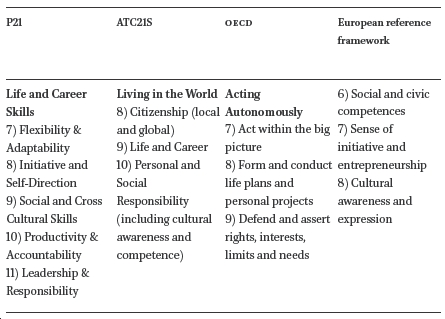
International organisations have developed implementation frameworks (e.g. P21 [Partnership for 21st Century Skills],
52
ATC21S [Assessment and Teaching of 21st Century Skills]) to help integrate 21st century competencies into the national curricula.
53
These frameworks identify and provide descriptions of key competencies which are key in the knowledge economy, including
Overview of key competencies identified by various 21CC implementation frameworks

Conclusion
In analysing the changing role of the universities in relation to the knowledge economy in the 21st century, this paper argues that it is necessary to take note of the epistemology evolution which is a part of the development of human civilisation. It always begins with the inherent process of defining and redefining knowledge. The focus on 21st century competences reflects impact that the twin forces of globalisation and knowledge economy have on our world today. The 21st century competences will be needed for nations to function in the knowledge economy, and for individual learners to survive the rapidly changing job environment. Along with that, they also need to acquire lifelong learning abilities, i.e. learning to learn formally, informally and seamlessly.
21st century competences began merely as a thought at the time when it was first mentioned in the Delors’ Report, but the continuous discourse, and the development of various assessment frameworks in the all over the world seem to indicate that is increasing buy-in of the concept, although the details and the measurement are still in a state of flux and will take time to consolidate. However, the nature of 21st century competences is quite soft, as distinguishable from the traditional hard knowledge. They are meant for times of change and adaptivity. The epistemological revolution brought about by the emergence of 21st century competences may prove to be quite fundamental.
Footnotes
2 Ernest, Scholarship Reconsidered.
3 Ernest, Scholarship Reconsidered, 13.
4 Ernest, Scholarship Reconsidered.
5 Ernest, Scholarship Reconsidered, 21.
6
7 European Commission, European Credit Transfer and Accumulation System (Luxembourgh: Office for Official Publications of the European Communities, 2004).
11 Duke, “Lifelong Learning”.
14 Duke, International Handbook, 510.
15 Aspin, International Handbook, xliii.
16 National Association of Head Teachers, Report of the NAHT Commission on Assessment (Sussex: National Association of Head Teachers, 2014), 7, 13.
18 C. Duke, Lifelong learning in the 21st century university (Melbourne:  . Accessed 4 March 2014. Duke.
23
26 Medel-Añonuevo et al., Revisiting Lifelong Learning.
31 Clark, Creating Entrepreneurial Universities.
34 PhillipsKPA, Knowledge Transfer and Australian Universities and Publicly Funded Research Agencies: A Report to the Department of Education, Science and Training Vol. 1 (Byron Bay, Australia: PhillipsKPA Pty).
35 PhillipsKPA, Knowledge Transfer and Australian Universities.
43 See D. Bradley, P. Noonan, H. Nugent and P. Scales, Review of Australian Higher Education, 2008, accessed March 4, 2014, .
47 Kogan, “Modes of Knowledge,” 18.
48 Kerry J. Kennedy, “Globalised Economies and Liberalised Curriculum: New Challenges for National Citizenship Education,” in Citizenship Curriculum in Asia and the Pacific, ed. David Grossman, Wing On Lee, and Kerry J. Kennedy (Hong Kong: Springer/Comparative Education Research Centre, University of Hong Kong, 2008), 13-26.
49 John M. Heffron, “Defining Values,” in Values in Education: Social Capital Formation in Asia and the Pacific, ed. John D. Montgomery (Hollis: Hollis Publishing Company, 1997), 3-27. See also .