



Abstract
Abstract
Canada is often cited as an exception to academic capitalism, and features the egalitarianism in conducting and managing higher education. Over the years, Canadian universities served to provide comparable university education to a population that was sparsely distributed over an immense geographical area. The increasing scarceness of resources for higher education, fuelled by a largely neoliberal process of globalization, has been causing changes in Canadian higher education towards forming a differentiated university sector. Nevertheless, the traditions die hard. With a predominant social value deeply rooted in equity and social justice, Canadian higher education and universities continue to profile many aspects of the egalitarian legacy. Drawing on the notions of liberalism (pure liberalism, compensatory liberalism and neoliberalism) and academic capitalism, this paper analyzes the data displayed in Maclean’s University Rankings and CAUT’s (Canadian Association of University Teachers) Almanac of Post-Secondary Education in Canada, and illustrates the above points.
Many have the impression that the Canadian higher education is almost identical with the American system. 2 Canadian higher education is often viewed as a largely derivative enterprise. It is noted that “[W]hen Robin Harris wrote his encyclopedic A History of Higher Education in Canada 1663-1960, he struggled with the question of whether there were unique facets or characteristics of Canadian higher education.” 3 Consequently, the Canadian higher education experience did not receive much attention in the comparative and international literature on higher education. Notwithstanding, some scholars have insightfully detected a number of unique characteristics that may define the Canadian approach to higher education, and therefore the differences between Canadian and American higher education. They include the differences in the structural and institutional arrangement, e.g., binary structures, secular universities, public monopoly over the universities, limited competition, high level of institutional autonomy, managerialism at the margins, 4 and with respect to academic values and professional norms. 5 Nonetheless, a tendency is also observed that Canada started “wandering toward the path” of the USA, 6 and in particular turning towards academic capitalism which has been salient in the USA. 7
Amid those discussions is the egalitarian debate about Canadian universities, one important and unique aspect that characterizes the Canadian approach to higher education. While the egalitarian regime in higher education often tags with the policy and mechanism ensuring affordable and equal access, 8 this paper follows the original meaning of egalitarianism. Fundamentally, egalitarianism is a doctrine or the ways in which people should be treated the same, or relate as equals. In modern democratic societies, the term “egalitarian” is often used to refer to a position that favors, for any of a wide array of reasons, a greater degree of equality of income and wealth across persons than currently exists. In this sense, egalitarianism in higher education refers to equalization of factors associated with running conditions, e.g., financial and student inputs, etc. As such, this paper is meant to revisit the egalitarianism in Canadian higher education, and attempts to identify its future trend in the Canadian context.
Methodology and Analytical Framework
By all means comparison is not the focus of this paper, though, it might be natural (or even inevitable) to benchmark Canadian universities against their American counterparts when it comes to elaborating the uniqueness of the former. Besides, Chinese universities enter the scene as well, simply because this author’s (a Canadian Chinese) research interest and expertise, and their connection to a major emerging economy (which in turn enables them to garner increasing attention in world higher education community). 9 Wherever comparison needs to be dealt with, an ideal types approach is adopted in order to discern the distinctive (egalitarian) features of Canadian universities. As a research method, ideal types is initially proposed by Max Weber, and now widely used in social sciences. It is “an attempt to analyze historically unique configurations or their individual components by means of genetic concepts,” 10 Weber asserts. When employed properly, this approach should enable one to see the values and patterns of another civilization through one’s own screen. Notwithstanding that bias is unavoidable in this exercise, it is however a bias that is explicit and open to critical discussion. 11
Relating to this approach, two theories are drawn upon for the purpose of constructing the analytical framework: liberalism and academic capitalism. They are considered primarily because they are instrumental in terms of analyzing marketization in the realm of higher education, a concept that helps distinguish some practices and features pertaining to Canadian universities from those of their American and Chinese counterparts, especially with respect to resource allocations and distributions. Lipset once described Canada and the USA as “two trains, starting from distinct points, moving along parallel tracks.” 12 How do we understand this insightful observation, while there is no question that the political economies in the both countries both fall within the liberal regime? The explanation might lie with the fact that Canada and the USA have traditionally followed two variant paths within liberalism. The American used to be obsessed with pure liberalism. 13 The pure liberal model emphasizes the importance of individual initiative and motivation (as the main source of creativity and dynamism), underlines division of labor, comparative advantage and centrality of efficiency (with belief in market as the most efficient allocator), and accepts inequality (only based on individual merit and on a temporary basis). 14 There is certainly a connection between social ideology and higher education norms. Based on those values, the American higher education system features an “incredibly heterogeneous mix of institutional types, variety of standards, and outright hucksterism”. 15 Naturally, the American system puts emphasis on meritocratic competition, diversity, and accountability.
By contrast, the Canadian have favored the compensatory liberal model, with a strong emphasis put on equality—not only of opportunity but also of participation and benefit, and on structural arrangements to overcome in-built inequalities. 16 The compensatory liberal stress group rights, and see it as an obligation to provide at least basic provision for all its members. As McKinley and Little rightfully assert, “compensatory liberalism represents something of a partial fusion of liberalism and socialism,” 17 in the sense that “[C]ompensatory liberals are willing to cede some partial loss for what they perceive to be a greater gain and that gain lies in the area of equality.” 18 Accordingly, Canada features an exclusively public university system, which is “a lot more orderly than the American system,” and “more equal in that the quality of education and the value of a degree vary little from one institution to another compared to the situation in the United States.” 19 Canada tends to have comprehensive universities offering a full range of undergraduate programs and modest-scale graduate programs, and Canadian universities are “less overtly competitive with one another than are American universities.” 20 Arguably, the Canadian emphasis on public and comprehensive universities is a response to the challenge of “bringing comparable opportunities to a population that was sparsely distributed over an immense geographical area,” yet behind this structural reason should be the Canadian value that is “less willing to compromise the principle of equal treatment for the sake of freedom than are Americans.” 21 Indeed, “[A]s the land of a single standard of state-funded health care for all, Canadians are generally apt to trade off a little excellence for a lot more equity.” 22
The divergence of cultural and social values between Canada and the USA may dictate their different responses to neoliberalism, and in particular academic capitalism, which might be viewed as manifestation of neoliberalism in the realm of higher education. When Slaughter and Leslie study academic capitalism, they note neoliberalism has ushered in the influence that leads governments worldwide to increasingly shift expenditures away from undergraduate education and towards potential revenue-generating areas. Notwithstanding, they conclude that Canada has shown signs of resisting the forces of academic capitalism, among the countries examined, namely, Australia, the UK, the USA, and Canada. Slaughter and Leslie believe that the kind of structural effects might explain why “Canadian academics have perhaps been able to resist pressures by business and the federal government.” 23 Owing to the recent economic recessions and the sweeping forces of neoliberalism, Canada has been reducing its proportional share of public funding on higher education, and has been increasing reliance upon private sources of income, particularly in the form of university tuition revenues, to fund university operations. Federal spending has become more strategically targeted at positioning Canadian institutions (particularly research-intensive universities) on the path towards increased research outcomes, efficiency and accountability. 24 Nevertheless, Canada continues to show a much higher level of public support to universities than the USA, 58.3% vs. 34.7%. In the college sector, this rate of Canada is even higher, close to 80%. 25 More importantly, Canada remains to commit a bulk of public (provincial) funding on educational function (those aligned primarily with teaching) of the universities, in particular undergraduate education.
This analytical framework is relevant to China as well, where a neoliberal approach to resource allocations and distributions seems to be taking hold in the realm of higher education. Amid massification of Chinese higher education since the late 1990s, public resources are increasingly targeted at a selected group of universities, i.e., those selected on Projects 985 and 211, in order to improve their research performance and bring forth research outcomes more efficiently, while many other institutions are left to survive on market forces. 26 As a consequence, the Chinese system is hierarchized and taking the shape of a steep pyramid, with the top echelon universities disproportionally favored in resource supply, and with research performance outweighing educational function. Figure 1 below provides a comparison of changes of per student operating budgets between the national and local universities in China. Notably, almost all the national universities (referring to those under the jurisdiction of the central ministries and mostly research intensive) are included in Projects 985 and 211, and the difference between national and local groups was in general enlarging along with the expansion of Chinese system, which indicates a preferential financial policy towards the national universities in this process. Indeed, research shows the widening revenue gap between the national and local universities is largely attributed to differentiated policy in government appropriations. In the meantime, a negative correlation between status of institution status and level of reliance on student tuition is discernible. The low echelon institutions have to survive on student contributions, while top universities enjoy much stronger financial support from the state. 27 As such, the neoliberal approach to higher education funding is evident in China. Arguably, neoliberalism inherits the core values of liberalism in both its humanistic and economic facets, and could help define the individual as an autonomous and rational being in a still politicized Chinese society. In this sense, some cherish the heightening presence of neoliberalism in China. Yet, it seems neoliberalism has largely served to advance marketized individualism and weaken public values among those who are university educated. 28

Source: compiled with data from Bao and Liu, 2009.
Analysis and Discussion
In this section, the author attempts to analyze the data displayed in Maclean’s University Rankings and CAUT’s (Canadian Association of University Teachers) Almanac of Post-Secondary Education in Canada, as well as some other sources. University rankings often produce hierarchical league tables, which tend to underscore research over other university functions and direct us away from many of the core values that are central to university work, in particular quality teaching. Yet the Canadian data reveal a certain degree of commitment to undergraduate education, and many egalitarian characteristics with respect to operating conditions in Canadian universities, in spite of resulting in ranking tables as well.
The Maclean’s University Rankings and Its Emphasis
Maclean’s is a Canadian weekly news magazine, reporting on Canadian issues such as politics, pop culture, and current events. Starting from the early 1990s, Maclean’s publishes annually Maclean’s University Rankings. The rankings focus on taking a measure of the “undergraduate experience,” comparing universities in three peer groupings: Primarily Undergraduate, Comprehensive, and Medical Doctoral. Institutions in the Primarily Undergraduate category are largely focused on undergraduate education, with relatively few graduate programs. Comprehensives have a significant amount of research activity and a wide range of graduate and undergraduate programs, including professional degrees. Medical Doctoral universities have a broad range of PhD programs and research, as well as medical schools. Table 1 describes the variables and their relative percentage weights used in Maclean’s University Rankings.
Factors and weights in Maclean’s University Rankings

Source: Maclean’s University Rankings, 2006.
The factors used by Maclean’s University Rankings, as well as the weights assigned to them, denote an emphasis on educational function of the university, mostly pertaining to students’ learning environment. This is in contrast to the U.S. News & World Report Best Colleges Rankings, which emphasizes inputs and outputs of the university, and in particular to China’s most popular university rankings administered by Guangdong Institute for Studies in Management Science, which assigns a majority of weights on research performance of the university. 29 This contrast appears to be in consistence with the previous claims that efficiency and accountability are stressed in the USA and China, where neoliberalism and academic capitalism are more prevalent compared with Canada.
The Egalitarian Characteristics of Canadian Universities
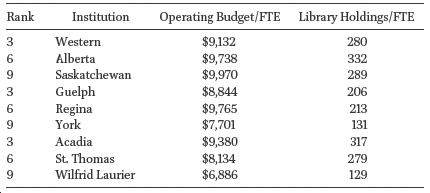
In order to get a longitudinal sense, the author randomly selects nine institutions, those ranked 3rd, 6th and 9th across three categories in 2006 Maclean’s University Rankings: Acadia, St. Thomas and Wilfrid Laurier from the group of Primarily Undergraduate, Guelph, Regina and York from Comprehensive group, and Western, Alberta and Saskatchewan from Medical Doctoral bracket, and compare those factors that describe their teaching and learning conditions. The tables below detect the egalitarian characteristics of Canadian universities. Table 2 gives breakdown of student resources in the nine universities, measured by the first-year students’ entering grades. Despite some variations, these nine institutions—no matter what group they belong to—encompass a more or less comparable body of student intake. Table 3 denotes even indistinguishable aspects among these institutions: operating budget and library holdings (corrected by the number of full-time students). The educational conditions measured by those two important factors show the almost identical circumstances. Table 4 showcases the comparability along the line of faculty caliber, as well as their possession of research funding (adjusted by the number of full-time faculty).
Limited variation reflected in student body, 2006

Source: Maclean’s University Rankings, 2006.
Limited variation reflected in finances and library holdings, 2006
Source: Maclean’s University Rankings, 2006.
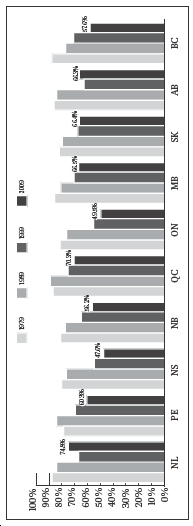
With time past, such egalitarian characteristics appear largely to stay with Canadian universities. Tables 5 and 6 show, despite changes with respect to their ranking positions in the league tables, the nine universities maintain a relatively high degree of comparability in regard to the key resources (students and finance) for their educational operations. As a result, most Canadian students choose to attend universities in their home provinces, as shown in Table 7, in spite of the fact that Canadian universities do not charge out-of-province students a higher tuition fee—as American public universities always do—with Quebec being the only exception. Apparently, the percentage of first-year Canadian students who attend local universities is very high (except for Nova Scotia, which has Canada’s second largest university sector but a modest population of less than one million), which in turn meets a major goal of governmental strategic planning, that is to provide “comparable opportunities to a population that was sparsely distributed over an immense geographical area.” 30
Limited variation reflected in faculty calibre, 2006.

Source: Maclean’s University Rankings, 2006.
Limited variation reflected in average entering grade (AEG), 2009 and 2012
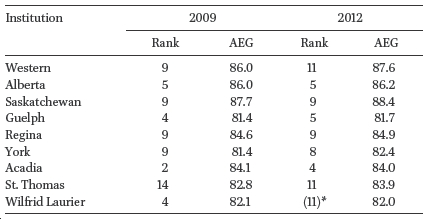
Note: In Maclean’s University Rankings, 2012, Wilfrid Laurier University is ranked 11th position in the group of Comprehensive University.
Sources: Maclean’s University Rankings, 2006, 2012.
Limited variation reflected in operating budget/FTE, 2009 and 2012
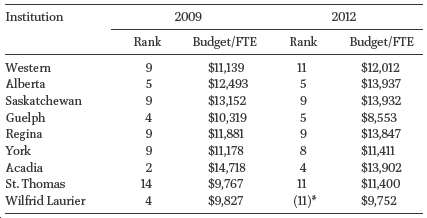
Note: In Maclean’s University Rankings, 2012, Wilfrid Laurier University is ranked 11th position in the group of Comprehensive University.
Sources: Maclean’s University Rankings, 2006, 2012
Percentage of first-year Canadian students who attend universities in their province of permanent residence, 2010

Note: NL = Newfoundland and Labrador, PE = Prince Edward Island, NS = Nova Scotia, NB = New Brunswick, QC = Quebec, ON = Ontario, MB = Manitoba, SK = Saskatchewan, AB = Alberta, BC = British Columbia.
Source: CAUT, 2012.
At a deeper level, such egalitarian characteristics of Canadian universities are the manifestation of Canadian social and cultural values, which have also found the expression in the faculty compensation structure. While Canadian university professors are among the best salaried academics across the world, their salaries show “just a 54% increase over the course of a career”. 31 When this figure is compared to an average increase of 94%—from entry to top levels—across the world, it certainly casts an image of egalitarianism on Canadian academia, which is depicted in Figure 2 below. The characteristics of Canadian faculty salary structure appear to favor lower rank faculty over their senior colleagues.

Changing Equations of Canadian Egalitarianism in Higher Education
Since the 1990s, higher education systems worldwide have been suffering from financial constraints, which were intensified by their cry for more research money, now a key investment on knowledge-based economy. As such, many systems become increasingly reliant on income from private sources (in particular student tuition and fees) for university operations, target their higher education spending more and more on high technology programs and industrial research collaborations, and stress accountability. Canada is not immune to such pressures and changes. Consequently, it is argued that academic capitalism has already been happening since the mid-1990s, 33 in the sense that governments reduce the amount of allocations to Canadian universities in the form of block grants to general operations, and increasingly put the universities in a competitive resource environment, which in turn causes institutional and professorial market or market-like actions or reactions to secure external funding. Figures 3 below tells, between 1979 and 2009, the proportion of university operating revenue provided by government sources declined from 84.2% to 58.3% while the proportion funded by student tuition and fees has increased from 11.7% to 35.3%.
In this circumstance, it is certainly not easy to uphold the kind of “exceptionalism” to academic capitalism and maintain equalization of higher education resources in Canada. The federal-level policy for supporting university research might bear stronger implications for academic capitalism. Since the late 1990s, the federal government has focused on providing direct funding for university research. Essentially, federal spending has become strategically targeted, through the Canada Foundation for Innovation (CFI) and the Canada Research Chair Program (CRCP), for which competition becomes a key to secure a greater share of funding. The CFI was created by the Government of Canada in 1997, with a mandate to fund a broad range of research infrastructure projects. When supporting those projects, the CFI only provides 40% of project funding, requiring the recipient institutions to find funding partners at the provincial level and in the private sector to raise the 60% of matching funds for each project. In many senses, the CFI promotes the institutionalization of entrepreneurial behavior in Canadian higher education by demanding the matching funds and increasing the ties between institutions and the private sector. It also leads Canadian universities to be more strategically oriented towards expanding their research capacity, stressing research function and growing graduate programs, and consequently stratification of Canadian universities. “As such, the CFI can be understood as expanding capacities for market-like behaviour at the institutional level, contributing to academic capitalism in Canada”. 35

Source: CAUT, 2013, p. 4. 34
The Canada Research Chair Program (CRCP) contributes to stratification of Canadian universities as well, through allocation of appointments of Chair holders. Launched in 2000 by the Government of Canada, the CRCP represents a major Canadian initiative to attract and retain “some of the world’s most accomplished and promising minds” in the global brain race. The program invests $300 million per year towards establishing 2,000 research professorships in Canadian universities, and therefore strengthening their research excellence. As it turns out, among the 1,738 chair holders appointed by October 2012, Canada’s Big Five Universities, a self-proclaimed Canadian “Ivy League” that includes the University of British Columbia, the University of Alberta, the University of Toronto, McGill University and Université de Montréa, obtained a share of 41.7% of the total, though they represent only 6.9% of all 72 participating universities in the program. Furthermore, the U15 Group 36 has a lion’s share of 73.1% of all appointed chair holders. Thus a concentration of research resource in a small number of large and research-intensive universities is evident. The Big Five presidents openly called for the means and mandates that would set their institutions further apart from the rest of Canada’s universities—to pursue world-class scientific research and train the most capable graduate students, while others concentrate on undergraduate education. 37 Their vision and wish pose a challenge to the traditional assumption that Canadian universities are roughly equal in quality and homogeneous in institutional form. As Jones foresees at the beginning of the CRCP, “one possible impact of CRC program may be the emergence of a more diverse university sector with an institutional hierarchy based on research intensity.” 38
The hierarchy of research intensity in Canadian universities, 2000-2011 (per full-time faculty $’000)

Sources: computed with data from RE$EARCH Infosource (n.d.).

Source: compiled with data from RE$EARCH Infosource (n.d.). 39
Using data in Canada’s Top 50 Research Universities List constructed by RE$EARCH Infosource (a leading consulting firm providing research intelligence for business and higher education sectors), Table 8 and Figure 4 measure research intensity, in terms of per full-time faculty research funds, 40 across three groups of Canadian universities: the Big Five universities, the U15 (not including the big five universities), and Canada’s top 50 research universities (leaving out the U15 members). They indicate Big Five as the premier beneficiary, showing a widening gap between this group and the rest two. These changes have been confronted with complaints and resistance from some Canadian faculty who are concerned with academic autonomy and equity, but also embraced by some others who see the stratified spending patterns among different types of universities (and consequently a segmentation of the faculty crops) as a strategy of direct investments towards creating “world class” research-intensive universities and raising Canada’s global competitiveness. 41 In this author’s research on the attributes of Canadian academic environment and their attraction to Chinese CRC holders, such a discrepancy of views is also detected. The sample studied by the research manifests a paradox: the Chinese CRC holders are clearly drawn to Canada’s egalitarian, less competitive environment on the one hand; but on the other hand, they want to be recognized as distinctively meritorious and be rewarded accordingly. 42 In this sense, if a subtle equilibrium can be obtained between the long-held egalitarian notion that has governed Canada’s higher education system and the neoliberal forces that have been pushing for new developments in higher education worldwide, Canada might be able to enjoy a unique advantage in terms of improving and profiling its universities. Needless to say, to reach such equilibrium is very challenging in the Canadian context.
The Future of Egalitarian Debates in Canadian Higher Education
Despite the signs of a shift towards a more targeted postsecondary funding policy, in particular at the federal level, it might be too early to draw a conclusion that the “equalization” era of Canadian higher education is drawing to a close. One fact worth noting is that Canada features a high degree of decentralization in higher education governance and management. By constitutional arrangement, higher education is strictly a provincial affair. Over the years, Canadian universities obtain provision of operating and capital support from the provincial governments. For this reason, it is necessary to scrutinize changes with respect to the university operating revenue by province, whereby the data for Canada as a whole may not necessarily paint an accurate picture. Figure 5 shows, in half of Canada’s ten provinces (namely, Newfoundland and Labrador, Quebec, Manitoba, Saskatchewan, and Alberta), the governments maintain a high rate public support (around 70%) to the university operating revenues, while this rate for the whole of Canada is much lower (as displayed in Figure 3). Furthermore, the public sector demonstrates an even greater commitment to supporting colleges, as Figure 6 shows. In all Canadian provinces and territories, the government funding makes nearly 80% of operating income for Canadian colleges. In addition, the government funding takes an increasing share in most of the jurisdictions (9 out of 13) between 2001 and 2010. It is also worth noting that, while the public sector’s shift away from funding trade-vocational education towards university-level education is seen a form of more targeted postsecondary funding policy and therefore a trend towards academic capitalism, 43 a majority of Canadian provinces present still an exceptional case exemplifying the continuing public commitment to the college sector.
Canadian universities and colleges are publicly funded, and the provincial transfers make a bulk of public funding for higher education. Tables 9 and 10 show the provincial support formed the foundation of higher education funding in Canada and maintained a stable standard in the first decade of the 21st century. In actual amount, Canadian provinces doubled their higher education transfers between 2001 and 2010. The provincial funding is mostly used to support operations of the universities and colleges, and is apportioned predominately on an egalitarian basis among the universities or colleges within the same jurisdiction. Notably, the federal transfers are taking a steadily rising share of higher education revenues. For the most part, they are targeted at supporting university-level research, through such competitive channels as the funding councils (the Social Sciences and Humanities Research Council, the Canadian Institutes of Health Research, and the Natural Sciences and Engineering Research Council) as well as CFI and CRCP. Presumably, they serve to widen the resource gap between research-intensive universities and others focusing on undergraduate education.
Note: NL = Newfoundland and Labrador, PE = Prince Edward Island, NS = Nova Scotia, NB = New Brunswick, QC = Quebec, ON = Ontario, MB = Manitoba, SK = Saskatchewan, AB = Alberta, BC = British Columbia.

Note: NL = Newfoundland and Labrador, PE = Prince Edward Island, NS = Nova Scotia, NB = New Brunswick, QC = Quebec, ON = Ontario, MB = Manitoba, SK = Saskatchewan, AB = Alberta, BC = British Columbia, YT = Yukon, NT = Northwest Territories, NU = Nunavut.
Yet still, Table 11 below paints us a rather “harmonious” picture. Across Canada, the provincial shares of students and faculty indicate a highly positive correlation. This pattern of equalizing teaching resources across the country enables fulfillment of the policy goal of “bringing comparable opportunities to a population that was sparsely distributed over an immense geographical area”. 46 In addition, the distribution of key research resources (CFI awards and CRC allocations) mirrors more or less a principle of equalization as well (relative to shares of enrolment and faculty), despite an emerging hierarchy in terms of apportioning such resources among the individual universities.
Concluding Remark
Canada used to be viewed as an exception to academic capitalism, featuring an egalitarian approach to conducting and managing higher education. Specifically, Canadian universities characterize the homogeneity of their major functions and dedifferentiation in resource appropriations, which in turn resulted in a much less competitive environment for the operations of Canadian universities. Over the years, those features of Canadian universities (as well as the higher education sector as a whole) served well the government goal of providing comparable university education to a population that was sparsely distributed over an immense geographical area.
Government transfers in university and college revenues: Federal versus provincial (actual amount, $’000)

Sources: CAUT, 2002, 2003, 2004, 2005, 2006, 2007, 2008, 2009, 2010, 2011, 2012, 2013.
Government transfers in university and college revenues: Federal vs. provincial (percentage of total, %)

Sources: CAUT, 2002, 2003, 2004, 2005, 2006, 2007, 2008, 2009, 2010, 2011, 2012, 2013.
Canada foundation for innovation awards (2011) and Canada research chairs allocations (2000-2011) by province

Note: NL = Newfoundland and Labrador, PE = Prince Edward Island, NS = Nova Scotia, NB = New Brunswick, QC = Quebec, ON = Ontario, MB = Manitoba, SK = Saskatchewan, AB = Alberta, BC = British Columbia.
Source: CAUT, 2013, p. 57. 47
However, the heightening scarceness of resources, resulting from the current economic depressions since the 1990s and fuelled by a largely neoliberal process of globalization, has been causing changes to higher education systems worldwide. Canada is not immune to the process, and appears to be moving towards forming a differentiated university sector, which could in turn promise more research outcomes, better accountability, and most importantly Canada’s global competitiveness. Nevertheless, the traditions die hard. With a predominant social value deeply rooted in equity and social justice, Canadian higher education and universities continue to profile many aspects of the egalitarian legacy. One evidence is that the Canadian “Ivy League” chose to name themselves as the “Big Five,” rather than the “Best Five” or “Top Five,” which indicates that they justify their claim for a differentiated mandate and more resources largely by their enrolment size. Indeed, unlike their counterparts in many other systems, Canada’s top-notch universities are often among those with the largest enrolments in the country. They seem to have managed, to a great extent, to balance their roles in terms of performing good research and serving a large body of students. A salient example is perhaps University of Toronto, which topped Maclean’s league table for many years as both the largest and the best university in Canada.
Footnotes
2 R. J. Brym, “The Great Canadian Identity Trap: Implications for the Comparative Study of Class and Power,” Canadian Journal of Sociology 14 ( ).
).
4 Michael Skolnik, “Canada,” in International Higher Education: An Encyclopedia (Vol. 2), ed. Philip G. Altbach (New York: Garland Publishers, ).
Michael Skolnik, “Putting It All Together: Viewing Canadian Higher Education from a Collection of Jurisdiction-Based Perspectives,” in Higher Education in Canada: Different Systems, Different Perspectives, ed. Glen Jones (New York and London: Garland Publishing, Inc., ).
5 Michael Skolnik, “Lipset’s Continental Divide and the Ideological Basis for Differences in Higher Education between Canada and United States,” The Canadian Journal of Higher Education XX-2 ().
S. Slaugher and L. Leslie, Academic capitalism: Politics, policies, and the entrepreneurial university (Baltimore, Maryland: Johns Hopkins University Press, ).
S. Slaughter. and G. Rhoades, Academic capitalism and the new economy (Baltimore: Johns Hopkins University Press, ).
Amy Scott Metcalfe, “Revisiting Academic Capitalism in Canada: No Longer the Exception,” The Journal of Higher Education 81, no. 4 ().
Amy Scott et al., “How Influential are Faculty Today? Responses from the Canadian Professoriate,” Academic Matters Oct-Nov 2010 (2010).
6 Skolnik, “Lipset’s Continental Divide,” 84.
9 For instance, the Chinese policy initiatives on concentrating public resources in order to heighten academic performance of a selected group of universities have essentially triggered a worldwide competition for creating world-class universities. Another example is that Shanghai Jiao Tong University has developed a ranking system for evaluating universities worldwide in terms of their relevance to their postgraduate and research needs. In spite of the narrowness and selectivity of the ranking scheme, in particular its neglect of student learning experiences and its blatant bias against the arts and humanities and most of the social sciences, it has been widely cited as providing a legitimate evaluation of universities.
11 Ibid., 271.
12 Skolnik, “Lipset’s Continental Divide,” 82.
13 This is true until most recently, when there are some indications of a newer paradigm of liberalism emerging in the USA, one that has a strong emphasis on the collective element than the individual. That seems central to the conflict between the right and the left that is going on now in the country.
15 Skolnik, “Lipset’s Continental Divide,” 88.
17 Ibid., 28.
18 Ibid., 26.
19 Michael Skolnik, “Lipset’s Continental Divide,” 86-88.
20 Ibid., 90.
25 Canadian Association of University Teachers (CAUT), CAUT Almanac of Post-Secondary Education 2012-2013 (Ottawa, Ontario: CAUT, 2013).
27 Bao Wei and Yanhui Liu 鲍威, 刘艳辉, “Gongping shi jiao xia de zhongguo gaodeng jiaoyu ziyuan peizhi quyu jian chayi de shi zheng yanjiu [An empirical study on regional variations of higher education resource distribution through equity lens],” Beida jiaoyu jingji yanjiu [Economics of Education Research (Beida)] 7, no. 1 ().
29 In the U.S. News & World Report Best Colleges Rankings, weights placed on input factors such as faculty compensation, financial resources, and alumni giving sum up to 22% (please find details at http://www.usnews.com/education/best-colleges/articles/2012/09/11/methodology-undergraduate-ranking-criteria-and-weights-2), which is much larger than the comparable weights of 12% in Maclean’s University Rankings. In China’s most popular university rankings administered by Guangdong Institute for Studies in Management Science, 42.9% weights are put on factors directly about research performance and another 19.1% on graduate programs (please see details at ).
30 Skolnik, “Lipset’s Continental Divide,” 88.
34 Canadian Association of University Teachers (CAUT), CAUT Almanac of Post-Secondary Education 2012-2013 (Ottawa, Ontario: CAUT, 2013), 4.
36 The U15 is a group of 15 research-intensive universities in Canada. This consortium started in 1991 as an informal biannual meeting of university executive heads. It develops shared strategies and provides a coordinated voice on behalf of its members on issues such as funding, research, accountability, public policy and partnerships. Now two indices of research stand out to distinguish the U15 from other universities in Canada: sponsored research funding and graduation of students with PhD’s. The U15 members include the University of Alberta, University of British Columbia, Laval University, McGill University, McMaster University, Université de Montréal, Queen’s University, University of Toronto, University of Waterloo, University of Western Ontario, Dalhousie University, University of Calgary, University of Ottawa, University of Manitoba, and University of Saskatchewan.
38 Glen Jones, “The Canada Research Chairs Program,” International Higher Education, (Fall 2000): 23.
40 Canadian universities vary tremendously in enrolment size, relating to the size of the population they serve. Accordingly, their full-time faculty stacks deviate enormously, for instance, from 63 in Nova Scotia Agricultural College to 2,667 in University of Toronto in 2011. Therefore it might be misleading to use aggregate research income to measure their research intensity. Rather, to measure it with per full-time faculty research funds might make a far better sense.
41 B. Godin, C. Doré, and V. Larivière, “The production of knowledge in Canada: Consolidation and diversification,” Journal of Canadian Studies 37, no. 3 ().
Amy Scott Metcalfe, “Revisiting Academic Capitalism in Canada: No Longer the Exception,” The Journal of Higher Education 81, no. 4 ().
44 Canadian Association of University Teachers (CAUT), CAUT Almanac of Post-Secondary Education 2012-2013 (Ottawa, Ontario: CAUT, 2013), 3.
45 Canadian Association of University Teachers (CAUT), CAUT Almanac of Post-Secondary Education 2012-2013 (Ottawa, Ontario: CAUT, 2013), 2.
46 Skolnik, “Lipset’s Continental Divide,” 90.
47 Canadian Association of University Teachers (CAUT), CAUT Almanac of Post-Secondary Education 2012-2013 (Ottawa, Ontario: CAUT, 2013), 57.