



Abstract
Abstract
This is an empirical study in the field of general education evaluation. Using data collected from three elite Chinese universities where general education is emphasized and promoted at institutional level, this study investigates the impacts of student background and extracurricular activities on student performance measured from the perspective of general education objectives, i.e., critical thinking, creativity, value judgment, decision-making, and communication skill. Female students perform significantly better in value judgment and decision-making, and students with higher socioeconomic status perform significantly better in decision-making and communication skill. Students with art talent perform significantly better in all the five skills. And high quality extracurricular activities are found to have positive effect on these skills, too.
1. Introduction
The idea and practice of general education reform have been expanding rapidly in elite Chinese universities over the past decades. However, the evaluation of the general education effect is very difficult due to several reasons including the confusing definition of general education goals, the difficulty of quality measurement, and the difficulty in data collection.
In the past many sustained efforts have been made to develop a widely accepted definition of general education. In the 1930s, several scholarly groups which had a wide influence and were led by university presidents or higher education researchers made efforts to put forward a new definition of general education which could be widely recognized. Three different attempts, each specially organized, failed to achieve common ground. 1 For example, among them Arthur Levine suggests that “general education is the breadth component of the undergraduate curriculum, defined on an institution-wide or college-wide basis. It usually involves study in several subject areas and frequently seeks to provide a common undergraduate experience for all students at a particular institution.” 2 He also says, “Liberal education is perhaps the most commonly used synonym for general education.” 3 The “Harvard Redbook” of 1945 gave the following definition: “General education . . . . is used to indicate that part of a student’s whole education which looks first of all to his life as a responsible human being and citizen”. 4 In this paper, we do not intend to offer a critique of these definitions. Rather, for the sake of stimulating discussion, we will use simple terms, and begin from the nature of the concept, which refers to one aspect of higher education, the non-specialist or non-professional aspect of education to which every university student needs to be exposed. The purpose of general education is to nurture in students’ willingness to take active part in the life of society, to have a sense of social responsibility, and to become fully developed members of society and citizens of the country.
A few pioneer studies have emerged to evaluate the practice of general education in Chinese universities focusing on the curriculum and pedagogy, 5 but few on student background and activities outside the classroom. Since general education not only includes curriculum and teaching, but also includes various activities such as extracurricular activities, the evaluation of the effect of extracurricular activities on general education output is very important for university administrators and for cultural construction in the campus. In addition, it is also important to investigate the variation of general education output according to demographic characteristics in order to examine education equity in general education practice.
Therefore, this research tries to answer two questions: using the five-scale skill measurement 6 as the output of general education, (1) does student background (such as gender, permanent residence, socioeconomic status, academic track, and university assignment) affect the general education output? And (2) what kind of extracurricular activities/social activity/self-education activity can improve the general education output? In this study, we investigate five kinds of non-cognitive skills as the output of general education: critical thinking skill, creativity, value judgment, decision-making, and communication skill. The detailed explanation of these outputs will be discussed later.
2. Literature Review
One of the influential models that explore the relationship between student background/social activity and higher education outcome is the Input-Environment-Output model (IEO) developed by Austin. 7 This model assumes that student performance is affected by student background, education background, and their effort in school. The input refers to student characteristics before entering college, and the environment refers to academic and social environments. Outputs refer to student performance when graduating. Many studies used the IEO model (such as Boughan, 2000; 8 Whitaker, 1987; 9 Kelly, 1996; 10 Campbell & Blakey, 1996). 11 Pike, Kuh, and Gonyea combined Astin and other researchers’ results and used sample data from the College Student Experience Questionnaire creating a new model. The new model suggested that student characteristics, perceptions of college environment, academic involvement, and social involvement all influence student academic outcomes. 12
Scott 13 used the IEO model as the framework to evaluate general education. The measurement of general education output is Academic Profile measured by Educational Testing Service (ETS), which is a standard test designed specifically to test the result of general education from the perspective of academic performance. He uses data collected from a state university in Tennessee, and students sampled were those who had completed general education courses. The conclusion shows that student background including race, age, entrance exam score and GPA of general education courses are significantly correlated with the Academic Profile performance.
Researchers have examined a number of ways in which extracurricular activities benefit students. Kaufman and Gabler 14 found that activities such as music and dance, public service, interscholastic team sports, and student government all improved students’ retention rates, and increase one’s self-esteem as well. And “participation in extracurricular activities would promote interpersonal competence and personal initiative, which lay the groundwork for achieving educational success beyond high school.” 15 National Survey of Student Engagement (NSSE) Annual Results 2011 shows that students who engagement with extracurricular activities reported significantly higher gains in several areas of learning and development, such as solving complex real-world problems, working effectively with others, practical competence and so on. 16 All these researches proved that extracurricular activities have positive effects on students, but few study make clear connection between extracurricular activities and general education outputs.
Most studies in higher education use academic achievement as the measurement of higher education outcome, such as GPA, graduation rate, retention rate, etc. The reason to choose these instruments lies in two aspects. First, it is easy to measure and obtain for investigators. And second, these variables are assumed to be closely correlated to labor market performance, and thus have important policy implication. However, academic performance alone cannot represent all the objects of general education. In fact, the purpose of general education is far beyond academic performance. Thus, studies on evaluating general education output should use instruments that better fit the goal of general education.
3. Research Design
The general education output includes both cognitive and non-cognitive skills. Previous studies mainly focus on cognitive skills, while few of them investigate the non-cognitive skills. This study employs the “five-scale non-cognitive skills” as the measurement of general education output. The five scales include critical thinking skill, creativity, value judgment (in truth finding and aesthetics), decision-making, and communication skill. The reason for our interest on the non-cognitive skills lies in three aspects. First, in the age of information, knowledge is easily accessible through internet, and there is no need to remember all the knowledge any more. Second, the non-cognitive skills are more important to the development of college students in China. Third, according to the goals of general education across the top universities in China, they all emphasize on non-cognitive skills such as critical thinking and creativity.
Students were invited to answer a questionnaire in which they were asked to evaluate whether the statements fit their own situation. These statements covers detailed behaviors and opinions on the five dimensions without clear hint of the preference. Factor analysis and reliability check were conducted to evaluate this measurement tool, and the result is published in Li, et al. 17
The sample is drawn from three high quality 985-project universities in China which have initiated the general education reform among undergraduates several years ago. Universities A, B, and C are located in Beijing, Shanghai, and Guangdong respectively. Using the average National College Entrance Exam score as a measurement of ranking among these three universities, University A ranks the highest and University C ranks the lowest. Students from Electronic Engineering, Computer Science, Industrial Engineering, Environment Engineering, Economics and Management, Humanities and Chinese Literature, Mathematics, Physics, and Medical Science are sampled from each university. Detailed information is reported in the next section. General speaking, the sample can well represent the elite universities conducting general education reform.
The empirical model used in this analysis is ordinary least square (OLS) regression. The regression function is as below.
Yi = α + βXi + γAi + εi
Where Yi refers to the five skills respectively, Xi refers to student background information, and Ai refers to students’ activities outside the classroom. Specifically, the background information in Xi includes gender, permanent residency, academic track, socioeconomic status (SES), which university they are enrolled, and self-reported art talent. SES is constructed using the information of parents’ education level and parents’ professions. The variable “art talent” documents self-reported information of whether the student has talent in at least one kind of art. The extracurricular activities Ai include art association, speech contest, innovation competition, and art performance. In the questionnaire, the students are asked to report whether or not have participated in each kind of activities in the last year respectively.
Since student background may have different influence in different universities, and the quality of extracurricular activities may vary across these universities, the effect of student background and extracurricular activities may be different. To examine this hypothesis, regression is also run on subsamples of each university.
4. Empirical Results
In this section, descriptive statistics are first reported, followed by the presentation and discussion of the regression results.
4.1 Descriptive Statistics
Columns (1) to (3) in Table reports the number of observation, mean, and standard deviation of the whole sample. The five scales are standardized variables with mean of zero and standard deviation of one. The sample size is 1776, among which 26.5% are from University A, 28.9% are from University B, and 44.6% are from University C. 41.7% of the students sampled are female students, and 21.3% are from rural area. 24.4% of the sampled students are from humanity track. 36.8% of the students report that they have talent in at least one kind of art. 23.3% of the students have participated in some kind of art association. The percentages of students who attend speech contest, innovation competition, and watch art performance are 12.4%, 14.2%, and 23.4% respectively.
The rest nine columns report the descriptive statistics of subsamples from Universities A, B, and C respectively. Generally speaking, students from University A have average skill scores about 20% standard deviation higher than sample mean, students from University B have average skill scores around the mean, and students from University C have average skill scores about 11% standard deviation lower than sample mean. Students from Universities A and B have an average SES about 36.5% and 21.9% standard deviations higher than sample mean, while their counterparts in University C have an average SES about 35% standard deviation lower than sample mean. Students from these three universities are not so different from each other in regards to other aspects.
4.2 Empirical Results
Table 2 presents the estimations of the effects of student background and extracurricular activities on the five scales of general education output. Among background information, students from University A consistently and significantly perform better than their counterparts from University C for all the five scales. Students from University B perform better than those from University C in critical thinking skill and communication skill. Female students perform better than their male counterparts in value judgment and decision-making. Rural students’ performance in these five scales is not significantly different from their urban counterparts. Students from humanity track perform significantly better than others in communication skill. Students with higher SES perform better in decision-making and communication skill. In regards to the extracurricular activities, only art talent has a consistent and significantly positive effect on the five skills. The other variables do not have significant effect in general. This may due to the vague evaluation of quality and nature of these activities using dummy variables.
Descriptive statistics.

Regression on the whole sample.

Standard errors in parentheses
*** p<0.01, ** p<0.05, * p<0.1.
Table 3 reports the estimations on the subsample of University A. some of the results are similar with those on the whole sample, but some are inconsistent. Different from the results on the whole sample, humanity students perform consistently better in creativity, value judgment, decision-making, and communication skill. SES is no longer a significant predictor for any skill. Attending innovation competition becomes a significantly positive predictor for critical thinking skill, creativity, decision-making, and communication skill. Watching art performance is a significant predictor of value judgment. These may be caused by the relevantly higher quality of innovation competition (since students in University A have the highest academic achievement in NCEE) and strong feature of value judgment in art performance in University A.
Regression on students from University A.

Standard errors in parentheses.
*** p<0.01, ** p<0.05, * p<0.1.
Table 4 shows the regression results on subsample of University B. Female students perform significantly better than their counterparts in value judgment and communication skill. Humanity track students do not perform differently from their counterparts in science. Students with art talents only perform better in value judgment, decision-making, and communication skill. Attending speech contest will significantly improve students’ performance in communication skill. This may show that the speech contest in University B is effective. But it is important to notice that regressions with the dependent variables as critical thinking skill, creativity, and decision-making do not pass the F test.
Regression on students from University B.

Standard errors in parentheses.
*** p<0.01, ** p<0.05, * p<0.1.
Table 5 reports the results for University C. Different from the results on the whole sample, female students only perform significantly better in value judgment. Students with higher SES perform better in decision-making and communication skill. Attending innovation competition is a negative predictor of creativity and communication skill. This may reflect that the innovation competitions held in University C is not effective. But it is important to notice that regressions with the dependent variables as critical thinking skill and decision-making do not pass the F test.
Regression on students from University C.
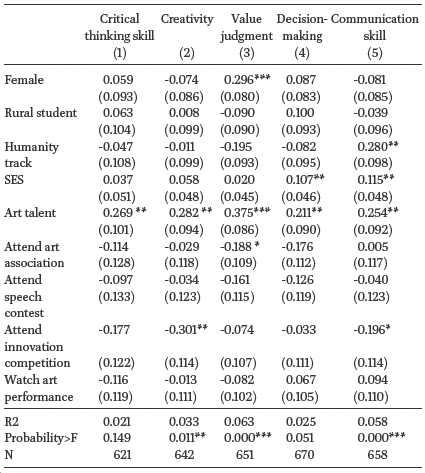
Standard errors in parentheses.
*** p<0.01, ** p<0.05, * p<0.1.
In summary, students from University A perform significantly better than those in other universities in all the five scales. Students from University B perform significantly better than those from University C in creativity skill and communication skill. Urban-rural status and SES are not significant predictors in general. Female students perform significantly better than male students in value judgment. Art talent significantly improves all the five-scale skills.
The results are heterogeneous across the universities. For example, in University A, female students also perform significantly better in decision making, which indicates that female students in University A have strong ability in synthesizing information and decision making, compared to their male counterparts. Humanity track students in University A perform significantly better in four scales. Innovation competition and art performance play significantly positive roles in improving general education output. These results may reflect higher quality of female students and higher quality of innovation competition and art performance in University A, compared with those in the other two universities. SES becomes a significantly positive predictor in University C, which may reflect education inequity because students with lower SES cannot perform the same as those with higher SES. Some extracurricular activities such as innovation competition in University C have a negative effect on creativity. This may show lower quality of these kinds of activities in University C.
Therefore, it is concluded that although extracurricular activities, which are important to general education, may have a positive effect on the general education output, the quality of these activities should be ensured in order to make them effective. Art talent is really important in improving general education output, and students’ socioeconomic background does not affect the output significantly in general.
5. Conclusion and Discussion
This article tries to evaluate the effect of student background and extracurricular activities on general education outputs in three elite universities in China. Employing the five-scale instrument as the measurement of general education output, this study finds that some student background and extracurricular activities may have an effect on some skills, which are what general education aims to improve. Students with various socioeconomic backgrounds such as rural-urban status and SES measured by parents’ education level and professions do not perform differently in general. Female students perform better in value judgment than their male counterparts. Art talent can improve all the five skills significantly. Effective extracurricular activities may have a positive effect on general education output. Ineffective activities may even hurt students’ output.
The limitations of this study include that the sample is limited. If the sample size is larger, the significant level of the model can be improved. In addition, this is the preliminary study on the evaluation of general education practice. The measurement of general education output and the empirical model can be improved in the future.
The significance of this study lies in three aspects. First, it is among the pioneer studies which make efforts in general education reform evaluation based on sound theories and solid data analysis. Second, the scope of this study is beyond one institution, and includes the elite universities representing those institutions which initiate the general education reform in China. Third, the preliminary results are consistent with the common rational and also precisely identify some problems using data analysis. This confirms that the evaluation instruments and empirical models used during the evaluation are appropriate. Therefore, this study provides a successful example of general education evaluation in China using quantitative methods. Although the results are preliminary and the methodologies need improvement, this attempt is a good start and will be able to provide informative suggestion to educators and policy makers in the near future.
Footnotes
1L. T. Benezet, General Education in the Progressive College (New York: Arno Press and The New York Times, 1970), 22-24.
2Levine Arthur. Handbook on Undergraduate Curriculum (San Francisco: Jossey-Bass, 1978), 525.
3Ibid., 528.
4Ibid., 603.
5Y. Zhang, M. Li and J. Ouyang, “The evaluation of general education reform in an elite Chinese university” (Working Paper, 2013).

7A. W. Astin, “The methodology of research on college impact,” Sociological Education 43, (1970).
——, “Open admission and programs for the disadvantaged,” Journal of Higher Education 42, (1971).
——, Assessment for excellence (New York: Macmillan, 1991).
8K. Boughan, The role of academic process in student achievement: an application of structural equations modeling and cluster analysis to community college longitudinal data. The Association for Institutional Research, Policy Analysis, and Planning Professional File, 74 (Albuquerque, NM: The Association for Institutional Research, 2000).
9D. Whitaker, “Persistence and the two-year college student” (Paper presented at the Annual Meeting of the Association for the Study of Higher Education, Baltimore, MD, November 21-24, 1987).
10L. Kelly, “Implementing Astin’s IEO model in the study of student retention: a multivariate time dependent approach” (Paper presented at the annual forum of the Association for Institutional Research, Albuquerque, NM, May 5-8, 1996).
11J. W. Campbell, and L. S. Blakey, “Assessing the impact of early remediation in the persistence and performance of underprepared community college students” (Paper presented at the 36th Annual Forum of the Association for Institutional Research, Albuquerque, NM, May 5-8, 1996).
12G. R. Pike, G. D. Kuh, and R. M. Gonyea, “The relationship between institutional mission and students’ involvement and educational outcomes,” Research in Higher Education 44, (2003): 241-261.
13D. A. L. Scott, “A Study of General Education Assessment” (PhD diss., East Tennessee State University, 2004).
14J. Kaufman and J. Gabler, “Cultural capital and the extracurricular activities of girls and boys in the college attainment process,” Poetics 32, no. 2 (2004): 145–68.
15J. L. Mahoney, B. D. Cairns and T. W. Farmer, “Promoting interpersonal competence and educational success through extracurricular activity participation,” Journal of educational psychology 95, no. 2 (2003): 409-418.