




Abstract
Abstract
Inspired by the understanding of curriculum as aesthetic text, study on the aesthetics of curriculum has attracted more and more interests in Taiwan. Based on the cultural lens of Taoism, this article aims to explore the theory and implementation of aesthetics of curriculum in a case study. The study found the aesthetics of Taoism in the curriculum can be understood from the aesthetics of relation, and the aesthetics of simplicity and plainness, which lead to the reconstruction of the way of “Being” in education.
The aesthetics of curriculum from a Taoist perspective sheds important light on educational reform. In the era of globalization, we should reconsider the implications of curriculum by looking back on and reviving our culture.
Introduction
In Chinese literature, the term “curriculum” appeared in the Tang dynasty in about A.D. 600. It means the ceremony of the construction of a temple. Under the influence of Confucianism, only the decent gentlemen could host the ceremony; thus, curriculum in Chinese education bares a connotation of cultural construction. Nowadays, under the influence of globalization, curriculum faces many challenges. The purpose of the study is to explore the aesthetics of curriculum through the lens of Taoism.
Aesthetics of curriculum has been an important field of interest nowadays. Current curriculum has been criticized to be based on technical-oriented values, with an emphasis on productivity and accountability featured in statistical numbers but neglecting the imagination and transcendence of aesthetic experiences in curriculum, hence various forms of curriculum discovery and implementation have been proposed. Scholars like Huebner, Greene, and MacDonald propose the discovery and implementation of curriculum aesthetics that guides teachers to respect aesthetic activities in curriculum experiences and reflect and form their own educational philosophy. 3 These notions in aesthetic implementation have been inspiring and enthusiastic. 4 There are two major perspectives in discovery and implementation of aesthetics of curriculum in Taiwan since 2000s; one adopts aesthetic inquiry to interpret curriculum experiences, and the other uses aesthetic theory such as Dewey’s aesthetic experiences and aesthetics of Taoism for curriculum theorizing. Even though the aesthetics of curriculum has been received more and more attention, additional research, implementation and discussion are necessary.
Based on the cultural lens of Taoism, this study examines the theory and implementation of aesthetics of curriculum in a case study, The Natural Way of Elementary School, founded in 2003 in Taichung with ideas of Chinese culture which includes people, land, and people’s life experience and wisdom. The School weaves together and is embedded in Chinese philosophy, aesthetic education and innovative education. Confucianism and Taoism are strongly emphasized in the curriculum of the School in which “Knowing is doing” and “the aesthetics of the 24 solar terms” are implemented in the curriculum. The paper aims to explore theorizing and praxis of aesthetics of curriculum from the perspectives of Taoism.
Mode of Inquiry
In order to understand the aesthetics of curriculum in the complexity of cultural contexts from the perspectives of Taoism, aesthetics-based inquiry is necessary. Researchers need to perceive what is subtle, complex, and important hidden in detailed visible and invisible contexts when they use aesthetic inquiry to elaborate the aesthetics of curriculum in practice. Aesthetic inquiry is a systematic mode of inquiry into the aesthetic qualities which are tacit and hidden underneath a curricular situation. 5 There are various methods of qualitative inquiry which has been applied to perceive the aesthetic quality of curriculum. Here the four aspects, description, interpretation, evaluation, and theme of educational criticism are applied. 6
From August 2011 to July 2012, one of the researchers was immersed in the school, in Taichung, to search for visible and invisible experiences there. At the beginning, the researcher was an outsider with a researcher’s lens doing observation and interviews. After three months, as the researcher became familiar with the students, teachers, and parents, she changed her role into a participative observer. Interviews, participant observation, and documents were the main methods to collect data. In data analysis, the researchers started from description of the practices of the school based on data from field notes, lesson plans, teachers’ diaries, course syllabi, supplementary exercise records, and students’ written work. The other type of data consisted of the transcripts of interviews. The authors attempt to conduct inductive and concept-building analysis which can provide an in-depth description to promote the understanding of the aesthetic implications in curriculum and disclose the aesthetic implication in curriculum experiences.
Theoretical Framework
Inspired by the understanding of curriculum as aesthetic text, 7 the exploration on the aesthetics of curriculum has been attracting more and more attention in Taiwan. Aesthetics is the philosophy of beauty, art, and aesthetic experience. 8 In Taiwan, some curriculum researchers devoted themselves to the theory and praxis of aesthetics of curriculum. 9 There are two approaches of inquiry and praxis on curriculum aesthetics. The first one is to apply aesthetic inquiry to interpret and understand aesthetic experiences in curriculum The second is to analyze aesthetic theory such as Dewey’s aesthetic experience and then to put into practice in curriculum, which can encourage educators and instructors to experience and realize what are essential in curriculum aesthetics.
Riley-Taylor 10 states the meanings of curriculum have been moved from a “how to” model to one for understandings, especially knowing of body, mind, and even spirit found within cultural encounters. The aesthetic understanding to curriculum means to open all sensuous capacities of humans to know: the visual, auditory, and olfactory senses, the touching, the tasting, and toward deep understanding. Based on one’s cultural heritage, the understanding to curriculum is a way back to “I” as a knower and creator in the world; moreover, it resonates with three layers of curriculum in Taiwan Curriculum Guideline of Grade 1-9: I and others, I and Nature. The “I” becomes “relational self ” and dwells in a given context, for example the culture.
Gong 11 suggests that the aesthetics of curriculum in Taiwan be different from that of the Western countries in that oriental aesthetics is originated from life, culture, and living and connecting with nature and art. Therefore, to understand the meanings of curriculum in oriental aesthetics perspective, cultural values and heritage cannot be neglected in curriculum aesthetics. In other words, oriental aesthetics is human-oriented and cares about the balance between humans and ecology. Aesthetics of curriculum is based on the discourse, the framework of the research is as following.
Oriental aesthetics is grounded in aesthetics of Taoism. Therefore, the investigation of aesthetics of Taoism helps to understand not only aesthetic theory but also implementation of aesthetics of curriculum.
The Way of Taoism
The Way that can be told of is not an unvarying way;
The names that can be named are not unvarying names.
It was from the Nameless that Heaven and Earth sprang;
The named is but the mother that rears the ten thousand creatures, each after its kind.
Research framework
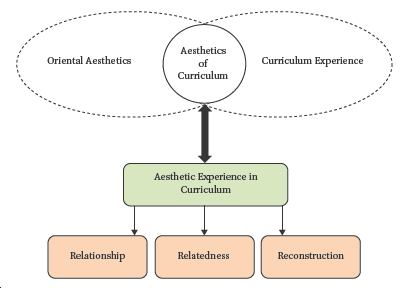
Laozi values the infinity and vacuity. He argues that cosmology and ontology are inseparable, in which null and existence are co-existence to mutually complement each other. The cosmos origins from form-less and emptiness and then all things can be emerged. Laozi says: “The Way,” 道, exists in infinity and vacuity where all creatures are initiated in its cosmic arrangement.” 12
“The Way” means the dynamic state of the golden mean where the felicitous middle between the extremes of excess and deficiency meets. There is a quote from the 77th Chapter of Tao Te Ching that states that The Way of Heaven is just like shooting an arrow: lower the arrow if you aim too high and higher it if you aim too low. The Way of Heaven always inhibits the excess and compensates for the deficient. Likewise, the 9th Chapter of Tao Te Ching elaborates The Way of Heaven, that as one stretches a bow to the very full, he/she would better stop in time for it not to fragment; as one sharpens a blade-edge, he/she would better recognize it before it turns dull; as gold and jade fill one’s house, he/she would better recognize that he/she need to guard them hence lose the freedom to travel afar. Laozi suggests that human beings can achieve perfection only when the balance between excess and deficiency is met. The Way of Heaven in action always engages in introspection and tunes in with the innate essence. Following similar line with Laozi but with illustrative examples, Zhuangzi believes that although everything in the world is growing and dying endlessly, human beings need to be nurtured and taught “The Way” to interdependence and peace so that they can experience and make contribution to the society.
The Beauty of Emptiness and Naturalness
The notion of “wandering at ease” depends on the emptiness within one’s mind. Sitting in oblivion of the heart-mind is meditations. The 16th Chapter of Tao Te Ching declares that the one who devotes himself/herself to truthful emptiness and absolute stillness of the mind as a meditator, will understand the essence of creatures and see all the living things around the world return to their original root in an illuminated and open-hearted view. The emptiness of one’s mind is like the fasting of the heart-mind, in which one forgets himself/herself sitting in oblivion with the state of calmness and stillness. The mind of human beings has to be blank and emptied first before accepting other elements. Moreover, Laozi states that if one avoids and stays away from fullness and completeness, one can then be rejuvenated and restored. Aesthetics of Taoism emphasizes emptiness, and though empty, this state can actually develop endless space for innovation and inspiration. It is no wonder that classic Chinese paintings always leave some blank space to the viewers for imagination and creation.
The great beauty of nature can’t be described. The circulation of planets can’t be commented. The principles of all of the things in the world can’t be discussed. Zh-Bei-You in the Chapter 22nd of Zhuangzi. 13
Lee & Liu 14 regard the beauty of Heaven and Earth as the beauty of Nature. Human beings discover and pursue beauty through the observations of Nature so that they feel they are part of Nature. They also seek the consonance between themselves and Nature and then promote themselves to the infinity. Da-Shen in the Chapter 19th of Zhuangzi, 15 it illustrates Yuan asking a ferryman how he handles the boat proficiently. The ferryman replied: “Good swimmers could acquire the skill rapidly because they forget the dangers of the water, and become part of water to deal with a boat.” The ferryman’s words give the concrete example in a nutshell to us. Submitting to Nature, people can prosper; opposing Nature, people can perish. Men should have peaceful coexistence with Nature; furthermore, men and Nature have to commune to each other as one unit.
Another similar story, Yang-Sheng-Zhu, Chapter 3 of Zhuangzi 16 is about cutting an ox. The cook devoted himself in a spirit-like manner to cut an ox through the space of cracks and cavities of an ox. Although the cook’s knife had been used for 19 years, it was still like a brand-new one. The beauty of naturalness highlights that human beings submit Nature and yield the space for commune with Nature. The Taoist aesthetics contains a temporary space of rest that is reserved for further creation. When this space is created, many conflicts among extremes can be resolved.
Heaven and Earth Are One: “The Third Space”
Two thousand years ago, Zhuangzi, an ancient Chinese philosopher, quoted Hui Shi’s ideas to argue in his article “Za Chapter”〈雜篇〉as follows:
Infinity Is One while Infinitesimal Is also
On the view of transcending the absolute time and space, both Infinity and Infinitesimal are “The Infinity” eventually as a kind of “The One” (太一). Consequently, with an infinite viewpoint, things we see as different are the same indeed. For example, the North and the South are the opposite direction; however, with the assumption that the North and the South are “the Infinity”, the North could be spread out, and finally the North would be close to the South even together becoming the One. The aesthetics of Taoism of “Infinity” is elaborated in The Floods in the Autumn, the 17th chapter of Zhuangzi. Zhuangzi explains that looking into things at a view of greatness, all things are grand, and looking into things at a view of smallness, all things are tiny. Also, if people can recognize “the Heaven and Earth” like “a grain of rice” or see “a piece of hair” like “a mountain,” they would understand there is no difference between greatness and smallness.
This belief inspirits us to consider that the difference-in-common and similarity-in-exclusivity do not vanish out of the air but are presented in universes containing all different natural species.
In other words, dualism cannot describe the Way of Taoism, and things cannot be the division into two opposing extremes only. There is the third space which is a nomadic space, a ghost space, a nothing space, and it is also an aesthetic space. For them, the third space is “the beauty of border crossing”, “the beauty of encounter,” and “the beauty of stranger.” Such as Zhuangzi referred to the concept of “Sky and Ground is The One,” people travel the world in-between and go into the third space where people encounter each other naturally and make adventure forward in play. Zhang-zi has a metaphor about the third space. In the 1st chapter, Wondering at Ease, it mentions that there is a giant bird (Peng) which can fly above the height of 90,000 miles. Yet, it has to depend on sufficient wind for ascending into the sky. Without the enormous space for accumulating wind, the wind cannot support the huge wings of the giant bird flying in the sky. Therefore, the enormous space is important for the giant bird. This is to say the enormous space, an aesthetic space, which is not for escape but one for recognizing oneself. The third space is between two opposing extremes. It inspires a mood of “without/at home,” a nomadic space that shuttles on a flying line that brings us infinity and possibility. In one sentence, the third space is poetic, imaginary, playing, and transcended indeed 17 because it is infinite, empty, and limitless.
An important concept of Taoism, “nothingness” for the meanings of life, is different from the Western ontology. In the 11th Chapter of Tao Te Ching, Lao-zi uses daily appliances to portray the use of “nothingness.” For instances, wheels can run because axles are made of 30 spokes which leave empty space on naves. Vessels can be filled because containers are made of clay and left hollowness in the middle of the clay. People can live in rooms because there is space divided by doors and windows. The use of “nothingness” represents infinity, creativity, and possibility, which is not limited by certain routines, patterns, or molds, but it contains unlimited possibilities such as imagination, innovation, and inventiveness. Sun 18 elaborately notes that in the nothingness of Taoism aesthetics is rooted the fulfillment of life and it leaves possibilities for implementing of the Way of Tao. To sum up, nothingness is a kind of praxis ontology which contains the space for intellectual nothingness embodied in the values of Taoism and can be inferred as a kind of La Existence des Aesthetic.
Embodied Curriculum of Taoism
The features of body in Taoist perspective are experiencing, introspection, practice, and transcendence to pursuit the whole-bodied and harmonious relations of individual, society, and nature. Aesthetical Taoism values the whole-bodied curriculum which is to integrate existential condition and spiritual consciousness for educating and nurturing. For Taoism, the aim of education is to cultivate a person with the prospect of growing for Moral “德” in the Field (場域) of “the Natural Way” (道).
In order to discuss the embodied curriculum, we borrow the term of somaesthetics coined by pragmatic philosopher, Richard Shusterman, to illustrate the bodied curriculum in schoolings. Somaesthetics is a study of ameliorative actions and sensibility of the human body. It is applied to investigate the experience of one’s body as a locus of sensory-aesthetic appreciation and creative self-fashioning for self-knowledge, right action, happiness, and justice. 19 The term “soma” indicates a living, feeling, and sentient body. The “aesthetic” in somaesthetics emphasizes the soma’s perceptual role and the embodied consciousness in the living world; therefore, somaesthetics is also body consciousness.
When we discuss the embodied curriculum, it also means the consciousness of body in the world we live. Nowadays, body is often controlled by various stimuli in the living world and becomes a medium of purpose and fulfillment to response to stimuli but not for itself. This situation also happens in education. In Taiwan, central and also local educational bureaus have increased learning time and raised performance benchmarks which cause the problems of anxiety about ranks and competition. Teachers’ and students’ bodies in classrooms are manipulated by time-schedule and the learning syllabus for accountability. As Jackson 20 concludes, the hidden curriculum in classroom life is the three Rs: rule, regulation, and routine. A similar circumstance also happens in many primary schools and junior high schools in Taiwan. Teachers-centered lectures and sit-listen learning models deprive the connection of I-self-body with other-selves-bodies and the world we encounter. Many students fall into sleep in classrooms because they are always tired and feel bored or even frustrated in learning. How could we recover from no-bodied schoolings and attain the Way of the whole-bodied person? The Tao Te Ching (道德經) of Laozi provides the possible therapy.
First of all, the concept of body in Taoism is the relation of body-mind-spirit. The body of Taoism underlines the fulfillment of the whole-bodied person including body-mind-spirit of the Human body. Physical body is like a reactor of the mind and spirit, in which mind and spirit has significant effects on reactions of the body such as somatesthesia, physical execution, and somatic sensation. However, although all reactions are directly demonstrated by the actions of body, the reactions are connected with the mind and the spirit. In other words, the relation of body-mind-spirit cannot be discussed in isolation. Mind and spirit can influence the body; similarly, the body also impacts the mind and spirit. For example, as a person is miserable all the time, his/her immune system will go down. Equally, as a person always has a headache, his/her mind and spirit will be miserable, too. In the positive way, as a person has a healthy body, he/she will have a good mood. Likewise, as a person has a good mood, his/her body will be healthy, too. Body and mind-spirit mutually nurture and influence each other. 21
Secondly, the remedial way is to withdraw the body and to grow in the natural Way “道.” For Taoism, the Way is the field constructed for inner growing unlimitedly. When a person stays in the Field of the Way, Morality emerges naturally. For an example, when we enter the station of MRT (Mass Rapid Transit), we line up in free will. This is the Field of the Way.
The Taoist curriculum is to build up the Field of the Way and practice in the living world to develop the relation of body-mind-spirit and whole-bodied person with freedom and nature, which is the aim of education in Taoist perspective.
The Embodiment of Curriculum in the Aesthetic Perspectives of Taoism
The case study is the Natural Way School (道禾小學) founded in 2003 and located in central Taiwan. Based on the cultural aesthetics of Taoism, the school was constructed to be a cultural institution which belongs to the children, parents, and teachers and by which education becomes a transformation or heritage of life experiences. The school serves as an organic eco-village. Children are cultivated by their own wholesome characters through designed and creative learning experiences.
The school’s name in Chinese is Tao-He「道禾」, in which Tao「道」 means the essential of all natural things or the way of Nature; He「禾」 means seedlings of Nature. In one word, Tao-He「道禾」means that the place where people can cultivate children like Nature nurtures all creatures based on their initiation in the natural way. Taoism is the guiding educational philosophy of the school. Principals and teachers consciously integrate this philosophy into the curriculum and design instructions which underline the natural circulation of the four seasons, the variations of the cycle of solar terms through cultivating in students ability for observation, understanding, and affection. In a word, they aim to help students explore the natural way of life and learn the doctrines of Nature.
In The Natural Way Elementary School, there are two essential cores in the curriculum. One is the integration of culture and literary tradition into the learning subjects. The other is the practice of knowing-doing. Firstly, the Chinese culture-based curriculum emphasizes integrating humanity and natural science into daily lives by conforming the contents to natural seasons and the chronological 24 solar terms. And then, in light of the knowing-doing principle, the curriculum also requires the body experiences, such as mountain climbing, tea ceremony, and Kendo, which emphasize the body aesthetics. Also, on the cultural curriculum, it reveals three facets for children to learn the balanced development of relation of I-to-self, individual-to-group, and I-to-nature: Children learn from Nature and culture, judge with an upright mind, and comprehend the principle of the unity of knowing-doing. The ultimate aims are to cultivate students to become conscious, autonomous, complete, and natural persons with decency and affluence, and be in harmony in the relationship between self, others, and Nature.
Aesthetics of Relation
Aesthetic Awareness in Cultural Rituals: Integrated Learning of the Cycle of the 24 Solar Terms
The 24 solar terms present different natural phenomena at appropriate times for agriculture during the year. The school believes that by living in and being with Nature the students can learn. The school employs real life experiences from the Chinese seasonal 24 solar terms and integrates them into the curriculum which provides children with nature and humanity learning. Also, many rituals and customs are generated to reunify family, gain social conscience, or create daily entertainment, and meanwhile, maintain the national spirit. 22
Curriculum is the aesthetics of relation which is rendered by experiences of natural and cultural life. According to the cycle of 24 solar terms, students learn how the four seasons change, how life experiences are in harmony with Nature, how people get along with one another, and how people conduct the rituals with reverence for Heaven and Earth. Thus, students become aware of the subtle atmosphere in the environment and also experience the natural beauty and cultural significance of the environment. For example, in the ritual of thank-God, students experience the worship for the land, people, and Nature, which holds symbolic substance of an ethical relation. Ritual—the hidden aesthetical curriculum—integrates with the seasonal properties, such as colors, savor, fragrance, and musical rhythm, and aesthetical lifestyle with body, mind, and spirit to lead to a unity of form and content as a whole.
Related Poetic Space: “Remaining-Blank” in the Curriculum
“Remaining-Blank” is one of the features of Chinese aesthetics. It can be applied in the curriculum of schools. Unlike regular schools, the learning time is divided into 7-8 periods, and students must follow the schedules to take courses without any exception. Yet, the Natural Way School allots the time for “remaining-blank” in the curriculum, which is understood by the semantic concept of Taoist aesthetics that “leaving-blank empowers the power of life.” From the perceptive of Taoism, the curriculum cannot be divided into small pieces; on the other hand, they should be integrated as a big piece and leave “Remaining-Blank” for nothingness. Students are allowed to use “Remaining-Blank” to extend their own interesting, nomadic, or tentative learning, e.g., students can decide what they want or what they don’t want.
For teachers and students, the “Remaining-Blank” in syllabus is not off the class but for an autonomic and creative learning moment. This creates a space for shifts from theory to practice, and also from practice to experience.
In a highly structured “curriculum,” “Remaining-Blank” provides aesthetic space for the experiences of playing, imagination and creation. 23
The Aesthetics of Plain
Concepts of difficulty, humbleness, slowness, and less-ness from the aesthetics of plain in Taoism are also applied in the curriculum. In the school, students stay at a natural and original environment without too many artificial decorations, such as they have original wood for study desks, ground colors for uniforms, and low color tones for class settings. Once the founder cited Zhuangzi and said, “The highest beauty is plain.” He also echoed Laozi’s words: “the various colors, sounds, flavors, etc. could cause people to be blind, deaf, and numb.” Only by going back to simplicity and childlike sensations can we acquire the abilities of appreciation for Nature and life.
Although slowness, difficulty, and less-ness are negative attitudes for handling daily errands usually, they have positive and significant notions in the essence of life and Nature. The school appreciates students to take slowness, difficulty, and less-ness to explore only one river and only one mountain in a school year. It is found that to explore a river and a mountain once a week in a school year is never boring because of the seasonal changes. Repetitions and routines with Nature can help students to have profound insights and thoughts in each encounter with Nature.
The aesthetics of simple and plain is also stressed in the buildings of the eco-campus which are integrated with dynamic and static as well as visible and invisible features. Campus, the nomadic and original space, invites students to fly with their imaginations and explore all possibilities. For instance, the plain wall of the school, like a canvas, strengthens the beauty of the sunlight, in which the dynamic shadow of the sunlight can inspire students’ imagination and creativity.
Slowness, difficulty, and less-ness are also applied in the daily activities which are created in the environmental atmosphere of aesthetics from Taoist’s perspectives. This is to say that students living in “the Field of the Way.” Students in “the Field of the Way” can naturally construct inner growing within an abundant, profound, and assimilated learning practice.
“Immersing silently and deeply” is the hidden curriculum of The Natural Way School, with the goal to refine the students’ visual, auditory, olfactory, savory, and tactile appreciation everywhere and every moment. For instances, peaceful music welcomed everyone in the early morning, and classroom furniture such as tables, chairs, and cabinets were made by carpenters who spent nine years to hand-made them and completed the products by the attitude of making a family heirloom. The school’s founder emphasizes that all furniture in the school is made of original wood. Also, the polishing process is consistent with Chinese classic methods by several rounds of painting and rubbing up. The same cycle takes for eleven times until the paint is penetrated to the essence of the wood. Hand-made furniture is to appreciate the work of art such as the texture of the wood, the jade-like moist texture, the distribution of a rustic flavor, which is not seen just as regular work, but which also underlines how important the concepts of difficulty, slowness, and simple are from the Taoism perspective. The school provides the opportunity for students to experience difficulty, slowness, and simple and to cultivate them to appreciate the concepts of Taoism through their environment and the equipment they live with every day.
Reconstruction in the Way of “Being”
Curriculum is the experience of living. Asanuma 24 believes students’ subjectivity is the core of the curriculum study in which the method is returned to students and facilitates students to construct the conscious and unconscious experience through dialogue in the contexts of intersubjectivity.
Life itself has a positive growth of vitality; thus, education is not only to teach children knowledge, but more importantly it is to inspire the innate original vitality which children have in their human nature. Education is “growing” which means to develop the vitality of being such as the flowing, dynamic, and creative possibilities of being, like Chi “氣” in Taoism. It doesn’t need to be provided by outer substance, but by arousing students’ inner vitality they become self-actualized, self-initiated, and self-fulfilling.
Teachers of the school reconstruct their philosophy of being of teachers based on Confucianism and Taoism. The Way of teachers, “師道”, is also the Way of curriculum, which is the origin of being. It is simple and natural like to take a breath. The Way is to follow the rhythm of life cycle and also the 24 solar terms of Seasonal Divisions; it is simply to elicit what the teachers already know rather than to encourage the teachers in outer pursuance. The recognition that less is more, difficult is easy, and plain is abundant not as classroom work but as lifework has implication for how teachers and students reconstruct the Way of “Being.”
Overall, curriculum does not occur in conjunction with any one piece of classes, but it is the practice of cultural experiences and collective memories. It is a matter of faith and it demonstrates that faith when teachers and students can be inspired to reveal their innate original vitality.
Conclusion
Curriculum does not only integrate all learning areas in a unity of knowledge and practice, it is also the carrier of culture and heritage. This paper aims to explore the aesthetics of curriculum from the perspectives of Taoism. The Natural Way Children’s School is the case which brings the aesthetics of Taoism into the curriculum through a deep interaction of learning with culture and nature, and life experiences.
As the concepts of aesthetics of Taoism are integrated into the curriculum, the 24 solar terms, the rituals of thank-God, the practice of remaining-blank, activities such as mountain climbing and tea ceremony, and the equipment and the environmental atmosphere befit the practices of aesthetics of curriculum. Although it embodies a set of abstract ideas and concepts, the practices of aesthetic of curriculum are all tangible and doable approaches to overcome the emphasis of cognitive-oriented learning which neglects the importance of “the oneness” of body, mind, and spirit.
The expressions of slowness, difficulty, humbleness, and less-ness of the curriculum are very difficult to be understood by current educational values which are in pursuit of competitiveness and efficiency of learning. However, on the way to constructing the aesthetics of curriculum in the Taoist perspective, innovative curriculum theorizing is being explored in Taiwan. Based on the current educational problems such as accountability on number, imperceptive learning, and bullying in schools etc., the aesthetics of Taoism inspires educators to reflect on the implications of curriculum and to cultivate a literary tradition which is back to the origin of being in the cultural experiences.
Footnotes

15 P. R. Fu, Zhuang zi.
16 Ibid.
19 R. Shusterman, Body consciousness: a philosophy of mindfulness and somaesthetics (Cambridge University Press, 2008), 19.