



Abstract
Abstract
Based on the author’s personal reflection from teaching a first year seminar on ecology, development and education in a US liberal arts college, this article explores the desirability as well as possibility to incorporate Eastern philosophies into Western liberal arts education. The article highlights two lessons that the author has generated from her teaching experience. Both lessons focus on the acquisition of skillsets that are at the core to both liberal arts education and education for sustainable development, and how the introduction of Eastern philosophies and their perspectives helps students accomplish or further strengthen these skills. Specifically, students develop more critical thinking skills by shifting the paradigm, and practice liberal arts education in real life by bringing knowledge and action together, connecting individual to community, and linking the global to the local.
Keywords
In many liberal arts colleges in the United States, first year seminars are often where freshmen have their first encountering of liberal arts education. First year seminars lead students to discuss the components and meaning of a liberal arts education, prepare them with developing essential skills such as critical thinking, writing, and intercultural literacy, and help them in their transition to their college life, both socially and intellectually. Depending on colleges’ curricula, first year seminars take various forms, operate within different structures, and reflect colleges’ specific missions. The instructors of the seminars also have the liberty to design the courses in a way that represents their own (inter)disciplinary background as well as their unique understanding of what liberal arts education should entail. This article explores the author’s personal experience in teaching a first year seminar taking place in a US liberal arts college. In specific, focusing on ecology, development and education as the theme, this first year seminar showcases the possibility as well as desirability of incorporating Eastern philosophies and religions in the Western liberal arts curriculum.
Background: First Year Seminar at Beloit College
Beloit College, founded in 1846, is a tier-1 national liberal arts college locating in Midwestern United States. In 2012, according to the annual U.S. News & World Report’s rankings of best colleges, Beloit College was ranked No. 6 on a list of 18 national liberal arts colleges recognized for “Best Undergraduate Teaching Methodology.” The first year seminar in this college, oftentimes referred to as First Year Initiatives seminar, or FYI seminar, is taught as a regular seminar with a theme, although many unique assignments and activities are specifically designed for freshmen to help them with their academic and social transition to college. Beloit College has a total enrollment of 1250 students and a bit over 100 full-time faculty members. Most of its students are from middle or upper-middle class families, with some students from working class families. The demographic profile of its student body is predominantly white, with increasing enrollment of minority and international students in the recent a few years. Currently, nine percent of its students are international students.
The incoming freshmen are a group of about 300 students. Each First Year Initiatives seminar (hereafter FYI seminar) has a theme based on the design of its instructor, or the FYI seminar leader. Students rank their choice of seminars based on their interest before the beginning of the semester. Each seminar recruits about 15 students. The seminar leader is not only the instructor of the course, but also these freshmen’s initial academic advisor. After the FYI seminar concludes, each faculty will continue advising the 15 or so students regarding their general education requirement until they declare major.
The faculty at Beloit College has great flexibility in deciding the themes of their FYI seminars. Oftentimes they are encouraged to use this opportunity to develop new courses based on their research or other interests, and to incorporate their understanding of liberal arts education. The author has been on the faculty of Beloit College since 2008 and taught an FYI seminar for the first time in 2011. The author’s choice of the seminar theme, ecology, development and education, is originated from her own research related to education for sustainable development in the changing ecology of rural society in China. 1 Meanwhile, being a native Chinese and having always been interested in Eastern philosophies and religions, such as Confucius, Taoism, and Buddhism, especially their perspectives on ecology, the author incorporates these philosophies, along with other traditional and modern theories from the East and the West, into her first year seminar titled “From Beijing to Beloit: Ecology, Development and Education.”
This article is based on the author’s personal reflection from teaching her FYI seminar at Beloit College. This seminar explores the interconnections between ecology, development, and education. Drawing on theories and practices from the West and the East, and the ancient and the contemporary, the seminar examines key concepts such as ecology, harmony, sustainability, modernity, and development. Ecology is defined in both physical and metaphorical terms, including both natural and social ecosystems. The seminar discusses three agendas on ecology: 1) on modern conservation policies and practices; 2) on the changing ecology of local and global community associated with modern industrial life; and 3) on efforts to restore harmony and achieve sustainable development.
In particular, the seminar takes China as a case study and examines how its recent rapid development has brought tremendous damage to its environment, altered people’s lifestyles, and disturbed traditional cultural values. The seminar also discusses the possibility to foster a new philosophy of sustainable development, one that marries scientific understanding of ecology and development with a renewed appreciation for traditional cultural values such as harmony and unity. Enlightened by the Eastern philosophies and religions with a global perspective, students then explore the ecological agendas in the local community where Beloit College locates, especially in various schools and educational sites, as their term project.
To note, the author does not claim herself to be a specialist on Eastern philosophies and religions. This neither reflects her training, nor her intention in designing this seminar. Readings on Eastern philosophies and religions, especially on the topic of ecology, are used as a springboard for discussions. The author uses these readings to offer alternative understanding about ecology, to compare and interpret other ecological theories from various disciplines ranging from political science to economics, to challenge students’ existing assumptions about the relationship between humans and nature, and to urge them to critically exam and reinterpret the Western paradigm regarding ecology in specific and knowledge in general.
Meanwhile, the author covers a variety of Eastern philosophies in the seminar, including Confucianism, Daoism, Buddhism, Hinduism, Shintoism, and a few other philosophies and religions. For the purpose of this article, more emphasis is placed on Confucianism, Daoism and Buddhism, which are grounded in Chinese culture. Confucianism is especially elaborated in the second part of the article. The seminar attends to the differences between them, but primarily focuses on the convergence of these philosophies, especially their common stand regarding the unity of human and nature, as opposed to Western science and tradition of bifurcation of human and nature. By providing Eastern views on ecology, the seminar seeks to foster a comprehensive, syncretist, universalistic and humanistic view of nature in dealing with today’s ecological crisis.
The article is written as the author’s personal reflection from her teaching in a US college. Findings from the article have limits and might not always apply to other colleges and other countries. Yet the author hopes this article can provide some useful insights for educators in the East and the West. By reflecting on the teaching of this first year seminar, especially the course design, teaching activities as well as students’ reaction, the author aims to demonstrate the possibility as well as desirability of incorporating Eastern philosophies in the teaching of ecology in specific and in liberal arts education in general. The following parts of this article will elaborate more on both. Specifically, the article highlights two lessons (and two skillsets) that the author believes to be at the core to both liberal arts education and education for sustainable development. The article explores how incorporating Eastern perspectives helps students accomplish critical thinking by shifting the paradigm, and practice liberal arts education in real life by bringing knowledge and action together, connecting individual to community, and linking the global to the local.
Liberal Arts Education for Sustainable Development Lesson 1: Developing Critical Thinking Skills—Thinking Outside of the Box, the Eastern Perspectives
The ecological crisis we face in today’s world is really a cultural crisis. Scholars have increasingly become aware that the assumptions rooted in our beliefs and the consequential patterns of behaviors have led to destructive relationships and practices harming natural environment as well as human communities. 2 Lynn White, in his exploration of historical roots of our ecological crisis, critiques Western religion: “What people do about their ecology depends on what they think about themselves in relation to things around them. Human ecology is deeply conditioned by beliefs about nature and destiny—that is, by religion”. 3 White does an anatomy of the anthropocentric nature of Judeo-Christian teleology, and concludes that Christian dogma and how its placing of men in a position superior to all other beings is the root of our ecological crisis. He quotes the Bible, “It’s God’s will that man exploit nature for his proper ends”; 4 he argues its consequence is a dualistic view of the relationship between humans and nature, with the latter being exploited to serve the needs of the former and with humans being the master of the nature. The development of Western science and technology was founded upon such premise and has further aggravated such exploitative relationship. Other scholars such as Tu Weiming 5 conclude with similar findings.
The author starts her first year seminar on ecology, development and education (hereafter FYS) 6 with a discussion of the historical roots of our ecological crisis. All 15 students enrolled, including two international students, are shocked to find about White’s conclusion—this is some perspective that has never occurred to them. To note, students enrolled in this particular FYS all have more or less understanding about and experience with ecology. Many of them are avid environmental activists since a young age. Some of them have taken related AP courses on such a theme. Nevertheless, they often equate ecology to biodiversity and biological conservation. They dedicate their efforts to fighting pollution, raising awareness about global warming, restoring wetlands, or modifying personal life style such as being a hardcore vegetarian or vegan. Before we discuss White’s article, all students are asked to turn in an essay explaining their understanding of the root of ecological crisis. Most students attribute the problem to consumerism and over-consumerism. Some tie consumerism to human weakness of greed. One student is able to dig a bit further to blame capitalism. What students conclude resembles what popular media has to say about our environmental crisis; an example is Thomas Friedman’s latest book in 2009, Hot, Flat, and Crowded 2.0: Why We Need a Green Revolution—And How it Can Renew America, which is also used as a class reading for students to critique. Friedman’s book extensively criticizes overconsumerism, and deems greed and American middle-class lifestyle being the reason of both our environmental crisis and the financial meltdown in 2008. Friedman then concludes that the American middle-class lifestyle is not sustainable. So developing countries like India and China should never model that for the sake of preserving the earth.
Putting Friedman’s “kick off the ladder” tendency aside, his interpretation and analysis of the environmental crisis, just like the students in the FYS class, while a meaningful attempt, is rather superficial. It fails to move away from the existing anthropocentric paradigm in interpreting our current crisis, cautioning people of their behavior patterns (e.g. American middle-class lifestyle, or overconsumerism) yet missing a deeper understanding of where such behavior patterns come from. Putting “greed” on trial merely simplifies the matter and reduces the problem to humans’ moral weakness.
Students in the FYS share the same problem as Friedman at the beginning of the semester. They are concerned about the crisis. They critique it. They seek a solution. Nevertheless, their critiques are confined by the very anthropocentric paradigm that produces this crisis. Without a proper understanding of the relationship between humans and nature and why it is the way it is today and what it should be instead, the solutions one offers is anything but radical. Green energy, biological conservation, veganism, more environmentally-friendly technological development—these are all good, indeed very good. But they are merely patches and bandages. What we need instead is a blood transfusion or even a heart surgery in fixing the ecological crisis today. White’s article points to the possible root of the problem: religion and the associated cultural belief about human-nature relationship. It brings students to a different level of understanding by shattering the existing paradigm. This is the beginning of true critical thinking.
By assigning White’s article, the purpose of the FYS is not to convince students that religion is the root of the ecological crisis, or the only one. Rather, it is to force students to re-examine some fundamental sets of cultural beliefs and how that confines the way they think of the world around them. Students enrolled in Beloit College are proud of themselves being critical thinkers, for, after all, it is one of the fundamental missions of liberal arts colleges. With White’s article, they soon realize that their critiques are limited by the scope and scale of what they can see, and by the paradigms that have been imbedded in their thinking. To think outside of the box, they need to go beyond the existing paradigm. They need to see alternative paradigms and how people’s behaviors (those related to ecological crisis and other social crisis) might be different under different sets of cultural beliefs.
Recognizing the anthropocentric nature of Western religion, White looks to other religions, such as Asian religion, for better alternatives. It is thus natural that the FYS then explores a series of Eastern religions and philosophies and their views of human-nature relationship. Readings on Confucianism and ecology, 7 Daoism and ecology, 8 Buddhism and ecology, 9 Chinese medicine and ecology, 10 and Japanese and Indian religions 11 are assigned to students to offer alternative perspectives on ecology. The FYS does not intend to study the above religions and philosophies in-depth, as it is not a philosophy or religious studies course. Nor is it necessary. It is more important to show students about these possibilities and alternatives, thus students are able to use these new perspectives to critically examine and challenge their existing assumptions. Moreover, because it is a first year seminar, it is expected that students will have opportunities to take more discipline-based courses, e.g. a class on Chinese philosophy or Buddhism studies, in their future years of college life, should they wish to further explore any of the topics introduced in this interdisciplinary FYS.
Students in FYI quickly identify some interesting and consistent themes across all these Eastern religions and philosophies regarding their perspective on ecology, for example, reverence to nature, interdependence and interconnectedness, holistic understanding of the nature as a unity and one. Some of the new perspectives further provoke students to rethink other social justice issues, and eventually their epistemological and ontological approaches to knowledge acquisition. Below is one of such examples.
Dualist vs. Unity: Perspectives on Ecology
Perhaps the most fundamental difference students find between the Western and Eastern religions and philosophies is their understanding of the relationship between human and nature. Western religion argues for a dualist approach which separates and distinguishes between humans and nature. It places humans in the center and nature as the affiliate. As a result, humans are to conquer and master nature; nature is to serve humans. Such anthropocentric stand is the root of today’s ecological crisis. The Eastern perspectives challenge that. One consensus among many Eastern philosophies and religions is that humans and nature is one unity. One should seek to harmonize with, rather than master nature.
The unity of humans and nature (tian ren he yi) is one of the fundamental premises of Confucianism. In Confucian understanding, there is no such “creator-created” or “subject-object” binary and dichotomous relationship between humans and nature. Cosmos is a context that both constitutes and is constituted by various elements, which comprises it. These elements are interdependent on each other and interconnected with each other. Humans are not the external creators of the nature. Humans are merely one of such elements, not to take over and conquer the nature, but to resonate and harmonize with it. Humans, as inhabits, are at home between the earth and the heaven. 12
Likewise, the Daoist universe, dominated by dao (the flow or the principles), is one unity which is comprised of all dimensions of existence, from budding of a flower to the orbit of the stars, its scale from millennia of earth history to the decades and centuries of the more present, and its magnitude from microscopic or astronomical to middle-range and ecological. Daoism argues that nature is not something outside of us to deal with, such as to conquer or to repair, but is “both a mental attitude to be carefully cultivated and the true condition of one’s body, which contains the infinite dimensions of cosmic reality within its self”. 13 In particular, Dao with its oscillating yin and yang demands a balance within this one and unity, a constant returning to the original equilibrium, or a recovery of the original wholeness. “In Tao [Dao] the only motion is returning.” 14 For some scholars, the ecological crisis is a lack of balance, a result of too much yang, or muscle and machismo, and needs a recovery of the feminine or yin by attuning ourselves to the rhythms of the nature. 15
Buddhism also opposes the homocentric or anthropocentric dualism of humans and nature. Buddhism affirms rebirth. All sentient existence is thought to be interconnected and related by virtue of karmic ties from past lives. Rebirth in non-human realms is highly possible. Thus, even though Buddhism views human as being more desirable form than other form of life because of their spiritual potential to be enlightened, it believes that all beings, be it human, animals or plants, should be held equal. The purpose of the non-human nature is certainly not to serve human needs. 16 This is the very foundation of modern day deep ecology movement—viewing all parts of the ecosystems as of equal value. One student in this FYS, who identifies herself as a future animal rights lawyer, draws her theories from Buddhism and deep ecology movement.
Students in the FYS discuss and compare these Eastern religions and philosophies. With an understanding of their common stance on humans and nature being one and whole and equal, they are able to see how such beliefs affect the way people view and act upon nature. For example, a common attitude across all these Eastern thoughts is their shared reverence for nature, and their values of and respect for life and beings in all forms. Such feelings of reverence or respect, as much as it is desired by environmental biologists, is hard to derive from pure biology, especially considering Darwinism the survival of the fittest, which is rather irreverent to lives. 17
Learning about representative Eastern convictions, with a constant back and force reference to the Western ones, provokes students to reassess their own existing mindsets on ecology and the corresponding practices, and eventually moves them away from an anthropocentric framework. A great example is how students start questioning the very definition of sustainable development. According to the 1987 UN World Commission on Environment and Development, “sustainable development” refers to “development that meets the needs of the present without compromising the ability of future generation to meet their own needs.” The 1992 UN Conference on the Environment and Development held in Rio de Janeiro further advocates the “socially responsible economic development while protecting the resources base and the environment for future generations.” These definitions have been the guiding principles for many countries and individuals in their efforts to conserve the environment. Students in this FYS, when starting the class, likewise take the definitions for granted and accept them with no questions and doubts. After discussing alternative ecological perspectives from the East, students are able to exercise their critical thinking skills. Looking at these definitions again, they now realize how such definitions fail to move away from the very anthropocentric framework that leads to the ecological crisis in the first place, and still center on humans’ needs, be it present or future. If we were to solve the crisis, some more radical framework is in need.
Beyond the Dualism Thinking and beyond Ecology: Eastern Perspectives on Equity and Justice
The examples of Eastern perspectives and their rebuke of the Western dualism have implications that go beyond the studies of ecology. As LeFay 18 points out, with the separation and distinction of nature from humans, and nature to be manipulated, controlled and exploited by humans, the result is a mechanistic worldview that dictates our analytical thinking and linear logic dominating our mode of inquiry. In correspondence to a hierarchized dualism between human beings and nature, we also separate objects from subjects, matter from mind, self from other, reason from intuition, quantity from quality, facts from values, and science from superstitions. This becomes the epistemological ground of Western science, reasoning and knowledge acquisition.
Such dualism thinking mode further shapes the way we structure power relationship in the society: civilized vs. primitive, Western vs. Oriental, developed vs. underdeveloped, global vs. local, oppressor vs. oppressed, male vs. female, and beyond. Operated under such hierarchized dualism, human is the master while nature is to be exploited; man is the better half while woman is to be subordinate to the former; European Caucasians is the superior while people of color are inferior; developed countries represent norm and standard while the underdeveloped are to be dominated and to follow or obey; and so on. 19
These taken-for-granted dualism presuppositions are the so called root metaphors, fundamental assumptions under which the society structures and operates. 20 Major discourses created via these root metaphors of modernity include individualism, mechanism, progress, rationalism/scientism, commodification, consumerism, anthropocentrism, androcentric, and ethnocentrism. 21 Oftentimes, these discourses are identified as the source of problems; for example, consumerism and/or anthropocentrism being the root of ecological crisis. Yet, without a critical understanding of their root metaphors, and their hierarchized dualism nature, any attempts to correct these discourses and to solve any crisis would remain in vein. This is exactly the difference between an ecojustice pedagogy, which targets at the cultural roots, and conventional environmental education, which fails to go beyond the surface discourse. The former, certainly, provokes more critical thinking and is what one hopes to accomplish in liberal arts education.
Mapping out these unequal and hierarchized dualism relationships is merely the first step of critical thinking and the development of the ecojustice pedagogy. The ultimate goal is to overcome them, to reform Western modern root metaphors filled with dichotomies, inequity and injustice into more sustainable root metaphors that are more holistic, fair, and organic. This is where the Eastern philosophies and religions can fit in. With presuppositions that all being one unity, all being equal, and all interconnected and inter-dependent, Eastern convictions are inherently pro justice and equity, and natu-rally in opposition to the problematic discourses raised above that dominate Western modern culture. Thus, the Eastern perspectives offers some direction for us to substitute a dichotomous, confrontational, exploitative and hierarchical relationship between different entities with a unified, harmonized, supportive and equal one.
Liberal Arts Education for Sustainable Development Lesson 2: Liberal Arts in Practice, the Confucius Way
A vital component of liberal arts education is to put it into practice. Practicing in the real world provides students an opportunity to synthesize knowledge and experience. Students test theories they have learned in the classroom and their sociological implications in the real world. They adopt and adapt knowledge they have learned in the classroom to guide their actions in the real world. They draw upon their experience to inform, test and enrich their learning in the classroom. Putting a liberal arts education in practice helps students examine, reflect on, and articulate the values associated with a liberal arts education, both for themselves and for the community they live in or beyond. They take ownership of their education, ponder on the role of individual in nature and society, in the local and the global, and explore the complex conjuncture of individual, institutions, and the wider socio-economic landscape, and the possibilities to bridge them with both knowledge and action.
For an FYS on ecology, development and education, putting liberal arts education in practice is inherently at the core of the course’s mission. Drawing upon perspectives from Eastern philosophies and religions, especially Confucianism, and coupling classroom learning with community-based projects, the FYS explores the organic relationship between theories and practices, between individual and community, between the local and the global, in the theme of ecology.
Knowledge and Action as One: the Moral Cultivation of Self
As discussed in the previous section, Chinese philosophies such as Confucianism and Daoism, unlike their Western counterpart, relinquish the bifurcation between object and subject in reality. The first proposition of Chinese experience and Chinese ontology is that humans (subject) and Heaven and Earth (object) are one, and there is no distinction between the two. Likewise, such proposition of human beings and nature as one and a whole allows Chinese experience and Chinese metaphysics to hold that theory and practice or knowledge and action are inseparable and a unity. Action does not need exact logic, hard science or external theories to guide its course. Rather, subjective experience and reflection itself constitutes valid knowledge guiding action in life. A good example of such is morality, which is central to Confucianism’s cos-mological ontological theory of the unity of humans and nature, and key to the unifying of knowledge and action. 22
Taking the studies of ecology as a case, in viewing humans and nature, Confucianism holds that the two of them are one unity, and each has its virtues. Nature and humans, although both imperfect, their virtues or ren render themselves to constantly change, innovate, succeed, rise, and strive for transformation. A person of ren or virtues is one that cultivates oneself to develop fully these potentials for virtues and make them flourish the same way as nature’s virtues develop and flourish in this universe. 23 This is how humans and nature achieve unity and harmony, in the resonance to and nourishment of each other. Confucius developed li (principles, rituals, or propriety) to coordinate and regulate the development of ren. The Confucius moral cultivation of self is action as well as knowledge guiding the former.
Tao points out that human beings are distinct from other beings by possessing the moral mind. 24 The way of nature is constantly changing and transforming, yet lacks thinking and deliberating. The natural course of the development of nature does not differentiate between good and bad, right and wrong. It is not always morally preferable or acceptable for moral mind. Natural disaster is such an example. This is how the way of humans, with moral deliberation which comes with both ability and responsibility, can help coordinate the way of nature and avoid or correct morally undesirable consequence. According to Confucius, “What Heaven has conferred it called the Nature. To follow Nature is called the Way. To rectify the Way is called Culture.” 25 A responsible person should not refrain from acting, but aim to strike a balance between respecting nature and making use of human intervention.
Confucianism’s advocacy for human intervention should not be mistaken for the Western anthropocentricism. Confucianism world view is anthropocosmic 26 rather than anthropocentric. Human moral deliberation is not to govern, nor to compete with or to replace nature, but to remedy or rectify in order to achieve a sustainable as well as harmonious relationship between humans and nature. Human moral deliberation is based on the Confucianism cosmological foundation that humans and nature being one, interdependent on each other and interpenetrating each other; their virtues in resonance to each other. It is also based on the awareness of humans’ inadequacy, thus the necessity of lifelong moral cultivation of self in such a way that is in harmony with the way of nature. Confucius’ anthropocosmic worldview regarding human-nature relationship sheds light on his conception of li (propriety), and how moral decision is essential in difficult cases. 27
With the understanding of the importance of moral cultivation and its role in unifying humans and nature, knowledge and action, students at the FYS are able to critically reflect on their daily routine and personal experience as a first year students at college and the possibility as well as their moral responsibility to change it. After 7 weeks of discussion of Eastern philosophies and religions, and other interdisciplinary theories’ perspectives on ecology, when students return from the midterm break, they start reading a book by James J. Farrell, a faculty at St. Olaf College, titled The Nature of College: How a New Understanding of Campus Life Can Change the World. 28 After students start at Beloit, they have gradually established some routines by observing what fellow students do. Before they become fully integrated into the existing academic as well as social culture of the college, reading and discussing this book gives them an opportunity to critically examine and question what is being accepted as routine or norm around them.
Chapter by chapter, students read and discuss the natural, social and moral ecology of campus life which covers many aspects of what they do every day and what they take for granted as the norm for life in the ivory tower: morning shower, stuff, clothes, food, car, Facebook, parties, sex and life, politics, and so on. Students quickly realize that fixing the ecological crisis does not start with protesting against global warming by picketing outside of G-8 meetings; nor even restoring the ecology of a local wetland. Instead, it starts with an examination of one’s personal life style and routine in the college, the development of scientific and sociological understanding of the impact of their daily choice, and the cultivation of one’s moral responsibilities in guiding and modifying one’s daily action.
Individual and Community as an Organic Unity
Students’ moral cultivation of self, starting with their self-reflection on their campus life, is the first step towards liberal arts in practice. It is also from where they extend and expand to community and beyond. According to Confucianism, individual’s moral self-cultivation is embedded in a series of concentric circles: self, family, community, society, nation, world, and cosmos. As the opening statement of the Confucian classic, the Great Learning, states:
The ancients who wished to illuminate “brilliant virtue” all under Heaven first governed their states. Wishing to govern their states, they first regulated their families. Wishing to regulate their families, they first cultivated their personal lives. Wishing to cultivate their personal lives, they first rectified their hearts and minds. Wishing to rectify their hearts and minds, they first authenticated their intentions. Wishing to authenticate their intentions, they first refined their knowledge. The refinement of knowledge lay in the study of things. For only when things are studied is knowledge refined; only when knowledge is refined are intentions authentic; only when intentions are authentic are hearts and minds rectified; only when hearts and minds are rectified are personal lives cultivated; only when personal lives are cultivated are families regulated; only when families are regulated are states governed; only when states are governed is there peace all under Heaven. Therefore from the Son of Heaven to the common people, all, without exception, must take self-cultivation as the root. 29
Source: (Tu, 1995, 144). 30
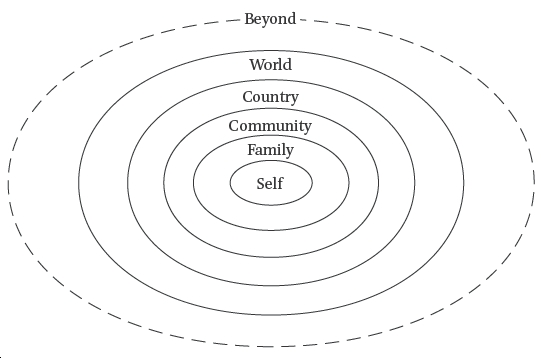
Thus, self is not an isolated individuality. Rather, its cultivation and transformation depends on its encountering and interactions with others at different settings, and the interconnectedness and interplaying of one’s identities and action at different levels. The more one broadens self to involve others, the more one is able to deepen one’s self-awareness and self-cultivation. As Neo-Confucianism argues, community is a necessary vehicle for human flourishing. 31 It is based on this organic unity of individual and community that the FYS requires all students to participate in a community-based project, which also constitutes as the summative evaluation of the course.
Every student in the FYS class is required to volunteer in a local NGO throughout the semester. Students have a chance to visit a few local NGOs as in-class field trips, including a local environmental center with most activities dedicated to environmental education for local children and youth, a community center for low-income children in a predominantly African-American neighborhood of the city, and a non-for-profit community garden locating in the same neighborhood with an aim to fight poverty and also help develop a healthier diet pattern of its residents. Students may volunteer in one of the above sites or choose their own site. Through their volunteer work, students have chance to work closely with local community and local people (such as children from low-income families). Students reflect on what they have learned from the community by incorporating knowledge they learned in the FYS regarding ecology, education, and development. Moreover, students are asked to examine their own role and responsibility as individual in the improvement of local community, where they will spend the following four years. They conclude the project by providing suggestions regarding more sustainable development of the community to the NGO they have worked with. They also reflect on their own personal development during the course, be it intellectual, social and moral.
Students take ownership in developing various projects in the local community. Some assist the development of environmental education projects for school children—they hike with 5th graders in the local parks, teaching and mentoring them about what constitutes a harmonious relationship between humans and nature. Some tutor and mentor low-income children in the community center—they learn from the children about their family, school, neighborhood and community, and study how these different levels of sites interplay to shape the way the children develop. Others start a cooking club for the low-income children and their families—they aim to examine the intersection of nature (what is grown in the community garden) and culture (the diet pattern of the residents in the neighborhood and its connection to their socio-economic status and ethnic culture) and what they can do to help facilitate a more sustainable relationship between the two.
These projects have become tremendously successful. Students skillfully translate learning about ecology from the classroom to their services to the development of the local community. They experience and study the local community in different ways to enhance their understanding of various types of ecologies (from biological conservation to human ecology). Students cultivate and transform themselves during this discourse of liberal arts in practice. They start their college career sitting at the top of the hill (figuratively as well as physically due to the college’s location). Now they see themselves more as an organic part of the local community and understand how the flourishing of individuals and community depends on each other. The result is the development of a strong sense of moral responsibility among many FYS. Many of them continue participating in the same or different community organizations after the FYS.
Think Globally? Act Locally!
The Confucius concentric circles from self to community to world also have implications for students when they examine the local global relationship. “Think globally, act locally.” This is a popular statement after globalization becomes a norm of our society today. But how exactly do the local and the global relate and respond to each other? Teaching and learning in elite liberal arts colleges, however, often risk forgoing the local when placing too much an emphasis on the global. Many students vow to help “poor people” in Africa, go to India and South America to experience urban slums, or to battle environmental pollutions elsewhere such as in China. At the same time, alas, these global minds often neglect ecological crisis at home and social issues such as poverty in the very local community. Thus, on what ground is one entitled to critique or “help” others without a close-examination of the positionality and moral assumptions of self? Likewise, how is it possible that one can understand and fix problems at the global scale without knowledge and practice at the local level?
For example, in the FYS, students are asked to work on a group project to map out the lifecycle of iPhone. Life-cycle analysis, sometimes known as Life-cycle assessment, is a popular technique used by many environmental educators to assess environmental impacts associated with all the stages of a product’s life cradle to grave, specifically, from raw material extraction, material processing, manufacture and assembly, product distribution, use, repair and maintenance, and final disposal or recycling. By looking at the different stages of an iPhone’s life, students uncover various degrees of material, social, environmental and moral cost and impact in different countries ranging from conflict minerals which finance domestic wars in the Democratic Republic of the Congo (DRC) to hazardous materials poisoning workers in the assembly line in China. The full lifecycle of an iPhone starts with mineral extraction in developing countries and finishes with waste being dumped in the developing countries again. This group project is a perfect case to help students understand the complex relationships between the local and the global, and the unfair trade between the developing world and the developed. With the Life-cycle analysis, students now have a more holistic understanding of our ecological crisis when looking at their iPhones, iPads, and other stuff and goods. They are able to comprehend the dialectic, dynamic and intricate connections between the global and the local, and how assumptions and assessment about ecology operate differently in different context and at different levels.
This is how the FYS pushes students to critique the assumptions related to “global thinking.” Students learn to use local knowledge and local action to examine global standards. Another example is the case study design of the FYS. China is used as a case study at the beginning of the class to demonstrate the scale and magnitude of the ecological crisis we face today. With its sheer size and volume and thanks to the rapid economic development in the past decades, often at the expense of the environment, the environmental crisis China faces is no doubt alarming and overwhelming. 32 The Life-cycle analysis of an iPhone reveals to students that China and other developing countries alike are victimizer as well as victims of this global ecological crisis, with more and more pollution-intensive industries moving from developed countries to the developing due to globalized capitalism.
The discussion of Eastern philosophies and religions demonstrate another dimension of victimization. Ancient philosophies and religions, which are inherently environment-friendly, are lost to the expansion of industrialization, modernization, and colonialism in the previous centuries and globalization in the recent century. With the prevailing of Western culture and tradition, as the previous section of this article has discussed, it is no wonder that our ecological crisis aggregates and there is no cure to this crisis if we to continue the Western anthropocentric assumption about humans and nature.
Prakash 33 challenges the validity of global thinking by critiquing the Eurocentric perspective on ecology in “Whose ecological perspective? Bring ecology down to earth.” Prakash, along with Wendell Berry, 34 are skeptical about the term “Think globally, act locally.” Berry warns us that global thinking risks being abstract, statistical and reductionist and argues for “to think little”—on the scale of local communities, because “. . . A good act has to be scaled and designed so that it fits harmoniously into the natural conditions and given of a particular place”. 35 Prakash further discloses how global discourse on ecology has been dominated by the developed countries, the West, and other power groups. Grassroots activists such as Eco-feminists, deep ecologists, and some indigenous groups urge the inclusion of more authentic though often marginalized local voice, and try to bring up a local discourse embracing the marginalized and less developed others to challenge the global discourse. Yet, as long as Western ideology and elite professionals prevail in the defining of what is green, what constitutes as sustainable development, and whose ecological interest it is for, our problems will continue.
Prakash and Berry’s emphasis on local communities and marginalized voices in developing a discourse on ecology echoes the core of the Confucius way. The Confucius way is about the pursuit of virtues (ren) in the ongoing efforts of moral self-cultivation, self-transformation and self-realization. Such self-cultivation is a communal act that is imbedded in various levels and layers of human relationships (self, family, community, society, nation, world, and cosmos) interdependent on and interpenetrating each other. It is also in dialogues with heaven, echoing the virtues and the way of nature. 36 Therefore, for Confucianism, local and global are two ends of one unity, serving the flourishing and transformation of both self and the community. Community plays a key role in developing the Confucius way, and it has great implications for the development of a global village while attending to the needs and reality of local communities. 37 Confucianism’s grand vision of an ideal society and world is one with great harmony (da tong), in the form of harmonizing without homogenization different groups and communities (he er bu tong). This vision is particularly valuable in today’s the world when globalization is intrinsically Westernization and homogenization takes place without harmonization. Thus the Confucianism vision of a society of great harmony calls for more voices from the local communities and marginalized groups, just as Prakash and Berry have advocated. Think globally?—maybe, as long as the global vision is based on a more inclusive approach and more holistic understanding of local communities instead of the norm and standards established by dominant groups. Act locally?—certainly! It is the only way for constant self-cultivation and transformation, and the flourishing of human, community and nature.
Conclusion
The most important message of this article is that it is not only possible but also desirable to build a bridge between Eastern and Western culture and experience. Some scholars have already attempted to make such connections in education. 38 This article gives one more example with the author’s personal reflection from teaching a first year seminar on ecology in a liberal arts college in US. As this article demonstrates, by connecting Eastern and Western philosophies and practices on ecology, Eastern views infuse Western liberal arts education with new paradigms and perspectives, especially in the development of critical thinking skills and in the strengthening of organic relationship between theories and praxis through liberal arts in practice. Moreover, the reflection on the first year seminar at Beloit College has rich implications that go beyond the scope of this article. When Aristotle meets Confucius, the dialogues between the core values of the Western liberal arts education and the tradition of Eastern philosophies and religions have the potential to spark even more new ideas in the design and development of ecological education in specific as well as liberal arts education in general. A few possible examples include but are not limited to peace education, international education, intercultural competency, interdisciplinary education, and so on. Such dialogues will benefit education in both the West and the East.
Footnotes
1 Jingjing Lou. “Transcending an urban-rural divide: Rural youth’s resistance to townization and schooling.” International Journal of Qualitative Studies in Education 24, no. 5 (2011): 573-580.
——, “The school wall crumbles: Pollution, townization, and the changing ecology of rural schooling in Northwest China.” Ph.D. Diss., Indiana University, 2010.
4 Ibid.
6 First year seminars at Beloit College are usually referred to as FYI seminar, standing for First Year Initiatives seminar. To differentiate this particular FYI seminar from others, the author uses a different abbreviation “FYS” instead.
7 Julia Tao, “Relational Resonance with Nature: The Confucian Vision,” in Environmental Values in a Globalizing World, eds. Paavola, J. and Lowe (New York: Routledge, 2005).
M. Tucker, “The Philosophy of Ch’i,” in Confucianism and Ecology: The interrelation of heaven, earth, and humans, eds. Tucker and Berthrong (Cambridge: Center for the Study of World Religions, Harvard University, 1998).
——, “Confucianism and Ecology: How do Confucian cosmology and its emphasis on intergenerational continuity contribute to environmental wellbeing,” Avalon Consulting, LLC, accessed July 19, 2008, 
Weiming Tu, “What is the Confucian Way?” in Our Religions, ed. Arvin Sharma (San Francisco: Harper Collins Publishers, 1995).
——, “Beyond the Enlightenment Mentality,” in Confucianism and Ecology: The Interrelation of Heaven, Earth, and Humans, eds. Mary Evelyn Tucker and John Berthrong (Cambridge: Harvard University Center for the Study of World Religions, 1998).
8 N. J. Girardot, James Miller, and Liu Xiaogan, eds., “Introduction,” in Daoism and Ecology: Ways within a Cosmic Landscape (Cambridge, MA: Harvard University Press, ).
11 Elisabet Sahtouris, Gaia: The Human Journey from Chaos to Cosmos (New York: Pocket Books, 1989), 19-28, 63-75. Christopher Key Chapple, Nonviolence to Animals, Earth, and Self in Asian Traditions (New York: State University of New York Press, ).
12 Julia Tao, “Relational Resonance with Nature: The Confucian Vision,” in Environmental Values in a Globalizing World, eds. Paavola, J. and Lowe (New York: Routledge, 2005).
14 Tao Te Ching, stanza 40, from Arthur Waley, trans., The Way and its Power (London: George Allen and Unwin, 1934, 1965.
17 Homes Roslston, III, “Can the East help the west to value nature?,” Philosophy East and West 37, no. 2 (1987).
18 Raven LeFay, “An Ecological Critique of Education,” International Journal of Children’s Spirituality 11, no. 1 (2006).
20 C. A. Bowers, “Toward an Eco-Justice Pedagog,” Educational Studies 32, no. 4 (2004).
22 Chung-Ying Cheng, “Nature and function of skepticism in Chinese philosophy,” Philosophy East and West 27, no. 2 (1977).
23 Julia Tao, “Relational Resonance with Nature: The Confucian Vision,” in Environmental Values in a Globalizing World, eds. Paavola, J. and Lowe (New York: Routledge, 2005).
24 Julia Tao, “Relational Resonance with Nature: The Confucian Vision,” in Environmental Values in a Globalizing World, eds. Paavola, J. and Lowe (New York: Routledge, 2005).
27 Joel J. Kupperman, “Confucius and the Problem of Naturalness.” Philosophy East and West 18, no. 3 (1968): 90.
28 James J. Farrell, The nature of college: How a new understanding of campus life can change the world (Washington: Milkweed Editions, 2010).
29 The Great Learning, chapter 1, Cf. Daniel K. Gardner, Chu Hsi and the Ta-Hsueh: Neo-Confucian Reflection on the Confucian Canon (Cambridge, MA: Council on East Asian Studies, Harvard University, 1986), 88-94.
30 Weiming Tu, “What is the Confucian Way?” in Our Religions, ed. Arvin Sharma (San Francisco: Harper Collins Publishers, 1995), 144.
34 Wendell Berry, A Continuous Harmony—Essays Cultural and Agricultural (London: Harvest, 1972).
36 Weiming Tu, “Beyond the Enlightenment Mentality,” in Confucianism and Ecology: The Interrelation of Heaven, Earth, and Humans, eds. Mary Evelyn Tucker and John Berthrong (Cambridge: Harvard University Center for the Study of World Religions, ).
Julia Tao, “Relational Resonance with Nature: The Confucian Vision,” in Environmental Values in a Globalizing World, eds. J. Paavola and Lowe (New York: Routledge, 2005).
37 Weiming Tu, “Beyond the Enlightenment Mentality.”
38 Jing Lin and Jingjing Lou, “Building Bridges of Cultural Understanding and Enabling Mutual Learning of East and West,” Frontiers of Education in China 8, no. 1 (2013).