




Abstract
This study is aimed at extending the soybean hulls’ lifetime by their utilization as an adsorbent for metal ions (Cd2+ and Cu2+) and dyes (Reactive Yellow 39 (RY 39) and Acid Blue 225 (AB 225)). ATR-FTIR spectroscopy, FE-SEM microscopy, and zeta potential measurements were used for adsorbent characterization. The effect of the solution’s pH, peroxidase extraction, adsorbent particle size, contact time, the pollutant’s initial concentration, and temperature on the soybean hulls’ adsorption potential was studied. Before peroxidase extraction, soybean hulls were capable of removing 72% Cd2+, 71% Cu2+ (at a pH of 5.00) or 81% RY 39, and 73% AB 225 (at a pH of 3.00). For further experiments, soybean hulls without peroxidase were used for several reasons: (1) due to their observed higher metal ion removal, (2) in order to reduce the waste disposal cost after the peroxidase (usually used for wastewater decolorization) extraction, and (3) since the soybean hulls without peroxidase possessed significantly lower secondary pollution than those with peroxidase. Cd2+ and Cu2+ removal was slightly increased when the smaller adsorbent fraction (710-1000 μm) was used, while the adsorbent particle size did not have an impact on dye removal. After 30 min of contact time, 92% and 88% of RY 39 and AB 225 were removed, respectively, while after the same contact time, 80% and 69% of Cd2+ and Cu2+ were removed, respectively. Adsorption of all tested pollutants follows a pseudo-second-order reaction through the fast adsorption, intraparticle diffusion, and final equilibrium stage. The maximal adsorption capacities determined by the Langmuir model were 21.10, 20.54, 16.54, and 17.23 mg/g for Cd2+, Cu2+, RY 39, and AB 225, respectively. Calculated thermodynamic parameters suggested that the adsorption of all pollutants is spontaneous and of endothermic character. Moreover, different binary mixtures were prepared, and the competitive adsorptions revealed that the soybean hulls are the most efficient adsorbent for the mixture of AB 225 and Cu2+. The findings of this study contribute to the soybean hulls’ recovery after the peroxidase extraction and bring them into the circular economy concept.
1. Introduction
Water quality represents one of the major concerns of the twenty-first century, and therefore, surface and deep-water pollution is a topic of high social and scientific interest in both developing and already developed countries. It is well known that water pollution is closely related to various anthropogenic activities (such as mining, dyeing, municipal and industrial solid waste disposal, incineration and/or openly burning waste, and agricultural soil fertilization [1]), unplanned urbanization, and rapid industrialization. Among many inorganic and organic pollutants, heavy metals and dyes receive widespread attention; their presence in wastewater is a major problem since most of them are potentially hazardous to the environment and human health. Namely, heavy metals are toxic, nondegradable, carcinogenic, and persistent; they enter our body system through the ingestion of food and water and air [2]. The relationship between environmental exposure to heavy metals and various human diseases was recently investigated by Đukić-Ćosić et al. [3], Baralić et al. [4], Buha et al. [5], and many other researchers all over the world. On the other hand, dyes are complex organic pollutants mainly present in textile, cosmetic, paper, leather, rubber, and printing industries’ wastewaters. Their presence in wastewater even at small concentrations aggravates photosynthesis; dyes disable the sun rays’ adsorption in surface waters and negatively affect the surrounding flora and fauna [6]. Not only is the suppression of aquatic biota growth and reproduction caused by these pollutants [6] but also excessive exposure to dye degradation products causes skin irritation as well as respiratory problems [7]. In response to the rising demands for clean and safe water, many different technologies are utilized for the purification of metal and/or dye contaminated wastewater [8]. Some of them include membrane separation, chemical and electrochemical technologies, reverse osmosis, ion exchange, electrodialysis, electrolysis, and adsorption procedures. Excluding adsorption, all of them require substantial financial input, high energy consumption, altogether restricting their utilization for wastewater treatment. On the other hand, adsorption using conventional and nonconventional adsorbents is an easy-handled and environmentally acceptable method for various pollutants’ removal. It enables adsorbents’ regeneration and operation under a broad range of process settings and has better selectivity [2]. Since magnetic nanocomposites have a large specific surface area, they were recently used as adsorbents for metals and dyes [9–12]. Compared to conventional adsorbents (i.e., activated carbons, ion-exchange resins, and inorganic materials such as alumina, silica gel, and zeolites), green waste-derived adsorbents are economically viable (their cost-potential makes them competitive) and have proven satisfactory adsorption capacities toward heavy metals and dyes. The most studied green waste-derived adsorbents are sugar beet shreds [13], fibers [14–17], rice husk [18], wood-based adsorbents [2, 19–21], potato peels [22, 23], and other cellulose-based adsorbents [7]. Although green waste-derived materials are intensively studied as adsorbents for heavy metal ions and dyes, the exploration of new eco-friendly, biodegradable, low-cost, and abundant adsorbents that have low/no negative impact on the environment remains primary focus of investigation among researchers.
The rapid world soybean (Glycine max L.) production (about 385 million metric tons in 2021-2022, SOPA) and utilization worldwide result in the intensive generation of soybean processing waste—hulls that are rich in soybean peroxidase. We decided to extend the soybean hulls’ lifetime and utilize them as adsorbents for metal ions and dyes since this processing waste is easily available and can be used without additional treatments (or after the peroxidase extraction in water). Moreover, soybean hulls have a myriad of functional groups (COOH, OH, etc.) which are capable of binding metals and dyes, while their porous structure contributes to a high ability to swell and store a high amount of solution. First, the used adsorbent was characterized in terms of its surface morphology (assessed by FE-SEM), chemistry (using ATR-FTIR), and electrokinetic properties (i.e., zeta potential). The influence of various parameters such as peroxidase extraction, solution pH, adsorbent particle size, contact time, the pollutant’s initial concentration, and temperature on the soybean hulls’ adsorption potential for cadmium or copper ions as well as textile dyes Reactive Yellow 39 (RY 39) or Acid Blue 225 (AB 225) (their structures are given in the Supplementary material, see Figures S1a and S2a) was investigated. Many reasons are behind the selection of these four pollutants. Namely, the World Health Organization (WHO) has identified cadmium as one of ten chemicals of major public health concern [24]. The connection between long-term exposure to this toxic metal and various renal syndromes, osteoporosis and osteomalacia, endocrine-disrupting properties, and different types of cancer has already been established [25–27]. Copper is an essential nutrient for humans, animals, and plants; however, its toxicity is a much overlooked contributor to many health problems including anorexia, migraine headaches, allergies, childhood hyperactivity, and learning disorders [28]. Furthermore, RY 39 and AB 225 were not selected randomly; contrary to many other dyes, their structures are not significantly influenced by the pH change (see Figures S1c and S2c). This enables us to eliminate the influence of the dyes’ structural changes caused by the solution’s pH, and therefore, their adsorption can be ascribed solely to the soybean hulls’ surface chemistry and morphology. Among different classes of synthetic dyes, azo dyes, like AB 225, are one of the most important synthetic dyes produced worldwide [29]. Their degradation byproducts have a toxic and mutagenic impact on aquatic organisms [16]. Furthermore, the second major synthetic dye class is anthraquinone dyes such as RY 39 which are used for dyeing wool, cotton, silk, and polyamide. Nonetheless, their toxicological profiles state that most anthraquinone dyes are mutagenic, carcinogenic, and allergenic [6].
After the adsorption from the single pollutant solution was investigated, different binary mixtures were prepared and competitive metal ion and dye adsorptions were examined. In order to make a more detailed study, one part of the manuscript is focused on water secondary pollution (i.e., leaching of organic and inorganic matter in the water) during adsorption onto soybean hulls (with and without peroxidase). The results of this investigation offer a novel valorization route, i.e., soybean hulls’ recovery after the peroxidase extraction that brings them into the circular economy concept through their utilization as adsorbents for inorganic and organic pollutants. It has to be underlined that the utilization of this kind of adsorbent avoids secondary pollution, i.e., the leaching of organic and inorganic matter from the adsorbent.
2. Materials and Methods
2.1. Materials
Soybean hulls were obtained from Sojaprotein d.o.o., Bečej, Serbia. The used chemicals were of the highest commercial grades and used as received.
To study the effect of peroxidase extraction on the soybean hulls’ adsorption potential towards metal ions and dyes, two types of soybean adsorbents were used separately. Namely, one set of experiments was performed using soybean hulls as received, i.e., with peroxidase, while the other set of experiments was carried out after peroxidase extraction. The extraction of the enzyme from soybean hulls was achieved according to the procedure described by Svetozarević et al. [30]. The procedure was repeated until the peroxidase has not been detected. Before the adsorption experiments, dry soybean hulls were ground in a mill, whereby their particle sizes were in the range of 710-1000 and 1000-1500 μm, see Figure 1.

Adsorbents’ abbreviations.
2.2. Methods
2.2.1. Soybean Hulls’ Characterization
To prove the existence of peroxidase in the sample SH+PO as well as its successful extraction from the SH-PO sample (see Figure 1), the enzyme activity was assessed according to the previously published method [30].
ATR-FTIR spectroscopy (Nicolet™ iS™ 10 FT-IR (Thermo Fisher 2 SCIENTIFIC) spectrometer with Smart iTR™ attenuated total reflectance (ATR) sampling accessory) was used for the evaluation of the SH+PO and SH-PO surface chemistry. The spectra were recorded in the range of 4000-600 cm-1 with 32 scans per spectrum. Based on the ATR-FTIR absorbance spectra, the so-called hydrogen bond intensity (HBI), lateral order index (LOI), and cross-linked lignin ratio (CLL) were calculated as ratios of the intensities of the bands at 3338 and 1334 cm-1, 1429 and 897 cm-1, and 1600 and 1508 cm-1, respectively [31].
The adsorbents’ zeta potential as a function of pH was determined by a streaming potential method using a SurPASS electrokinetic analyzer (Anton Paar GmbH, Austria) following the procedure given by Ivanovska and Kostić [32].
SH+PO and SH-PO surface morphology was assessed by FESEM (Tescan MIRA 3 XMU). Before the analysis, the samples were sputter-coated with Au/Pd alloy.
2.2.2. Adsorption Experiments from Single-Pollutant Solution
The adsorption of Cd2+ or Cu2+ has been carried out from a monometallic solution of CdCl2·2.5H2O or CuSO4·5H2O, while the adsorption of RY 39 or AB 225 was performed from their appropriate single-pollutant aqueous solutions. A 0.25 g of adsorbent was immersed in 100 ml of single-pollutant aqueous solution and constantly shaken. The adsorption optimization took place in two steps:
The optimization of the initial solution pH: The optimization of the adsorbent particle size:
The kinetic, isotherm, and thermodynamic experiments were performed on a sample SH-PO1 under the optimized conditions shown in Table 1. The kinetic and equilibrium adsorption data were interpreted according to a set of widely used kinetic and isotherm models, respectively.
The kinetic, isotherm, and thermodynamic experiments’ conditions.
Pollutant removal by soybean hulls was calculated based on its residual concentration in the aqueous solution by using Equation (1), while the mass of adsorbed pollutant per gram adsorbent (
The thermodynamic parameters: standard Gibbs free energy (
The expression of the equilibrium constant quantifies the distribution of the pollutant between the solution and the adsorbed phase. By combining Equation (3) and (4), Equation (6) was obtained:
The
All adsorption experiments were performed in triplicate with standard deviations below 2.2%.
Inductively coupled plasma optical emission spectrometry (ICP-OES, iCAP 6500 Duo ICP, Thermo Fisher Scientific, Cambridge, United Kingdom) was used for the determination of metal concentrations at Cd II 226.502 nm and Cu I 324.754 nm emission lines. The dye concentration in the aqueous solution was determined based on the UV-Vis (Shimadzu 1700 spectrophotometer) absorbance spectra at
2.2.3. Competitive Adsorption Experiments
To study the competitive dye and metal ion adsorption, four binary mixtures (RY 39+Cd2+, RY 39+Cu2+, AB 225+Cd2+, and AB 225+Cu2+) were prepared at pH of 3.00 and 5.00, while the mixtures containing solely dyes and solely metals were prepared at pH of 3.00 and 5.00, respectively. The other experimental conditions were as follows: 25 mg/l initial concentration of each pollutant, contact time of 120 min, and equal portions of both adsorbent particle sizes (sample SH-PO, see Figure 1). The presented results are the average of three measurements in parallel; the standard deviations were below 1.9%.
2.2.4. Study of the Secondary Pollution
The secondary pollution, i.e., leaching of soybean hulls’ organic and inorganic matter in the water, was studied by adding 0.25 g of the adsorbents SH+PO and SH-PO in 100 ml of demineralized water at pH of 3.00 (since the metal ion adsorption was carried out at this pH) and constantly shaken for 24 h. Thereafter, the contents of different elements (Al, B, Ba, Ca, Cd, Co, Cu, Cr, Fe, K, Li, Mg, Mn, Na, Ni, Sr, Pb, and Zn) in demineralized water were compared with those determined in the water after the adsorbent’s removal. The content of organic matter in the above-mentioned samples was estimated by the dichromate index (chemical oxygen demand (COD)) according to the appropriate standard [33].
3. Results and Discussion
3.1. Characterization of SH Adsorbents
Bearing in mind that the peroxidase removal changes the soybean hull’s overall structure, before the evaluation of the SH+PO and SH-PO adsorption potential for metal ions and organic dyes, their characterization was performed. In light of that, the enzyme activity assay was used as a key indicator of peroxidase extraction efficiency. The first extract showed peroxidase activity of 200 U/ml, while after the third cycle of extraction, the peroxidase activity within sample SH-PO was below the level of detection. Furthermore, from the examined samples FE-SEM microphotographs (see Figure 2), it is evident that the soybean hull’s surface partially collapses after the enzyme’s extraction (SH-PO) being more compressed than before the extraction (SH+PO), which is in accordance with the literature [34]. It is worth mentioning that peroxidase’s removal also contributes to a smoother soybean hull surface morphology compared to the rough SH+PO surface with pronounced pores (see Figure 2, sample SH+PO).

FE-SEM microphotographs of SH+PO and SH-PO (different magnifications).
Considering the ATR-FTIR spectra of SH+PO and SH-PO (see Figure 3(a)), it could be observed that the peroxidase extraction induces noticeable modifications of the adsorbents’ surface chemistry. A spectrum of the SH+PO displays characteristic bands inherent to lignocellulosic materials. Namely, the broad band between 3600 and 3000 cm–1 corresponds to mutual O–H and N–H stretching vibrations (related to a peptide-based enzyme), while the band at 2917 cm–1 originates from C–H stretching vibrations. A low-intensity band at 1726 cm–1 appears from stretching vibrations of characteristic C=O groups. Due to the complexity of the soybean hulls’ surface chemistry, a relatively wide band centered at 1602 cm–1 could be ascribed to different vibrations ranging from C=O peptide, C=C, and COO–stretching vibrations [35] and absorbed water [34]. After peroxidase extraction, the band at 3300 cm–1 becomes intensified, while the band at 2907 cm–1 is sharper (see Figure 3(a)). Furthermore, the band at 1602 cm–1 observed in the SH+PO spectrum shifts to a higher wavenumber (1611 cm–1) after peroxidase removal. This behavior is followed by a change in its shape and intensity indicating significant changes in the soybean hulls’ surface functionality. Moreover, the bands at 1540 and 1367 cm–1 related to the lignin backbone become stronger suggesting the enrichment of the lignin content after the extraction of the peptide-based enzyme. Empirical ratios (LOI, HBI, and CLL [31]) calculated from ATR-FTIR spectra could be used to explain the changes that cellulose and lignin moieties (within soybean hulls) underwent enzyme extraction. LOI is closely related to the amount of cellulose crystalline moieties, i.e., represents the ordered regions perpendicular to the chain direction, which is greatly influenced by the chemical processing of cellulose [36], while HBI refers to the degree of the intramolecular hydrogen bond regularity. Upon enzyme extraction, both LOI and HBI values are lowered, indicating a less ordered cellulose structure with lower hydrogen bonding intensity between neighboring cellulose chains and hence lower crystallinity of SH-PO. On the other hand, CLL is related to the amount of lignin with condensed and cross-linked properties. A higher CLL value calculated for SH-PO (0.538) in comparison with that of SH+PO (0.497) could be ascribed to the higher cross-linking and condensation of lignin chains caused by the earlier mentioned soybean hulls’ collapse after the enzyme extraction treatment.

(a) ATR-FTIR spectra and (b) zeta potential (

The changes in the soybean hulls’ surface chemistry after the peroxidase extraction were further proven by the measurement of SH+PO and SH-PO zeta potential. The results presented in Figure 3(b) pointed out that both adsorbents’ surfaces are negatively charged at pH values above 2.36 (SH+PO) and 2.55 (SH-PO), respectively, with the surface of SH-PO being less negative.
3.2. The Influence of Solution pH on the Removal of Metal Ions and Dyes
Among the different adsorption variables, the effect of the solution’s initial pH value on pollutant removal was first considered (see Figure 4) since it affects both the solubility and ionization state of the investigated cadmium and copper salts and dyes, as well as the soybean hulls’ surface charge [37].
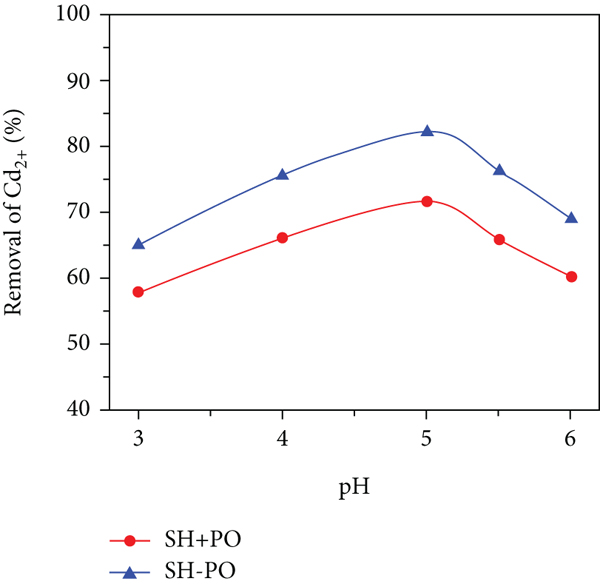
Effect of solution pH on (a) Cd2+ and (b) Cu2+ removal by soybean hulls.
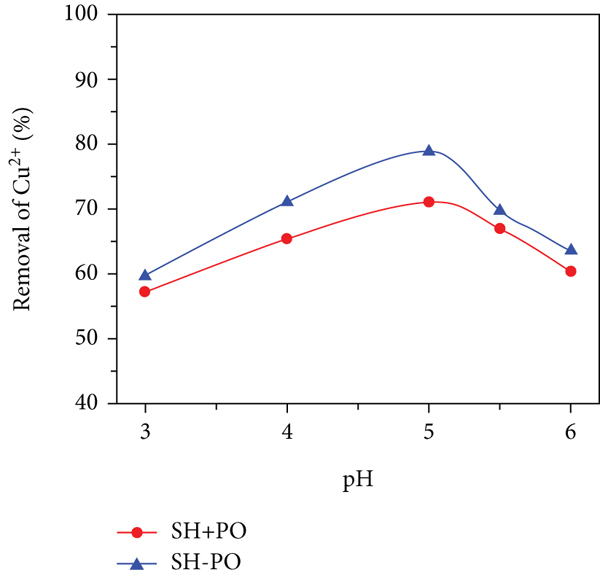
In highly acidic conditions, i.e., at a pH of 3.00, the SH+PO and SH-PO affinity for binding Cd2+ and Cu2+ is low (removal is ranged between 57 and 65%) due to the excessive H+ competing with metal ions for the soybean hull surface active sites. As is evident from Figure 4, for both studied adsorbents (SH+PO and SH-PO), maximal heavy metal removals (between 71 and 82%) were achieved at pH 5.00. With a further increase of the solution’s pH, a higher concentration of OH– in the solution leads to the precipitation of Cd2+ and Cu2+ in the form of hydroxides [38] which hinder the adsorption and thus lower Cd2+ and Cu2+ removal. Based on the presented results, and in order to achieve maximum Cd2+ and Cu2+ removal by soybean hulls without incurring precipitation, pH 5.00 was chosen as optimal and used for further experiments. Sanni et al. [39] also found pH 5.00 as optimal for Cu2+ removal by citric acid-modified soybean hulls, reaching 40% Cu2+ removal, which is much lower than the results obtained in the current study.
Besides the fact that both studied adsorbents behaved similarly regarding the solution’s pH, it has to be emphasized that the removal of Cd2+ and Cu2+ increased after the peroxidase’s extraction by 14.6 and 10.9%, respectively. Although zeta potential measurements showed that the SH-PO negative charge is lower than that of SH+PO, its adsorption capacity for the metal ions is surprisingly reinforced. Such differences could be explained by the changes in the soybean hulls’ surface physico-chemical properties that occurred after the peroxidase removal. Tummino et al. [34] ascribed the higher adsorption potential of SH-PO to the effect of the intrinsic metal ions present in the enzyme competing with metal ions for adsorbent active sites. Furthermore, the surface chemistry of the soybean hulls is modified after peroxidase extraction in terms of the availability of the groups that are capable and preferential for metal binding. As discussed previously, constituents within the lignocellulosic soybean hulls (primarily cellulose and lignin) are less ordered after peroxidase extraction. For this reason, the functional groups that were responsible for the interactions between these components are no longer constrained and are accessible for the interactions with metal ions.
Taking into account that the adsorption of Cu2+ and Cd2+ does not correlate with the negative value of the zeta potential, it could be concluded that it is not solely governed by electrostatic interactions with the negatively charged surface. Considering the involvement of different soybean hulls’ groups (proven by the ATR-FTIR spectra, Supplementary Material, see Figure S3), it could be suggested that metals are adsorbed onto soybean hulls via different binding mechanisms such as surface complexation (involving hydroxyl and carboxyl groups), ion exchange (between adsorbent H+ and metal ions, also established via hydroxyl and carboxyl groups) [40], and cation-π interactions (between the electron-rich phenyl groups of lignin and metal ions) [41] (see Figure 5, displayed for Cu2+, the same refers for Cd2+). Furthermore, the physical adsorption of the metal ions onto soybean hulls’ surface should also be taken into account. Similar observations were made in our previously published paper concerning the adsorption of Cd2+ onto lignocellulosic wood waste [2].

Graphical interpretation of the possible interaction between Cu2+ and soybean hulls’ surface.
In the case of the adsorption of RY 39 and AB 225 dyes on the SH+PO and SH-PO, the optimal dye removal was obtained in an acidic medium (pH =3), (see Figure 6). At
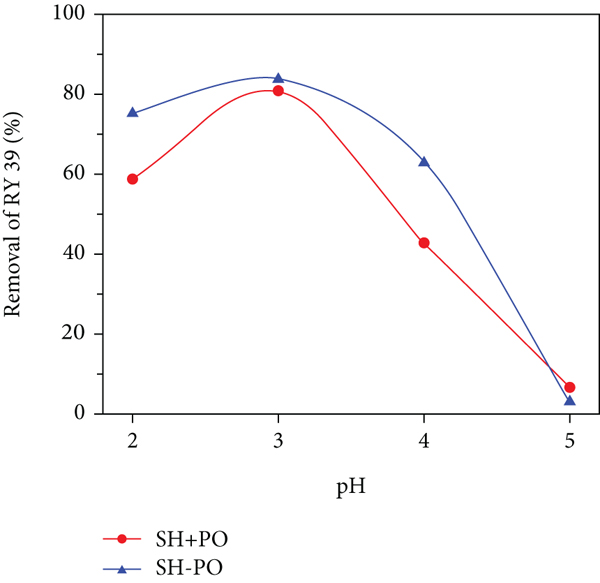
Effect of solution pH on (a) RY 39 and (b) AB 225 removal by soybean hulls.

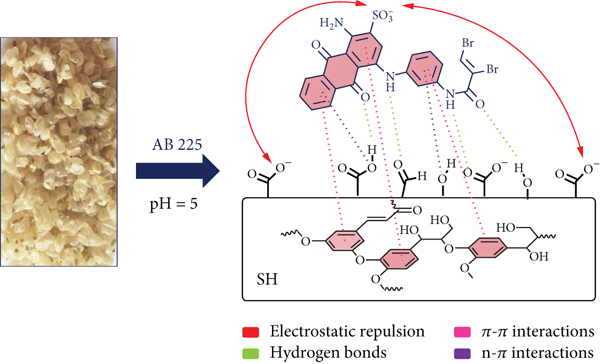
Graphical interpretation of the possible interaction of AB 225 and soybean hulls’ surface.
By comparing the adsorption capacities of SH+PO and SH-PO at
The detailed observations regarding the soybean hulls’ ATR-FTIR spectra recorded before and after dye adsorption (Supplementary Material, see Figure S4) led us to conclude that dye adsorption is governed by the repulsion between its negative charges and the adsorbent surface and is attained by the cooperation of the different interactions such as hydrogen bonds, π-π stacking, and n-π interactions [15] (see Figure 7, displayed for AB 225, the same refers for RY 39). Multiple strong hydrogen bonds could be established between dye carbonyl groups with O–H groups (hydroxyl and carboxyl), as well as between dye N–H groups and adsorbent surface carbonyl groups (aldehyde, carbonyl, and carboxylate) (see Figure 7). As both dyes bear aromatic rings, it is justified to presume that π-π stacking interactions are formed with the aromatic monomer units (guaiacyl, syringyl, and p-hydroxyphenyl) of the lignin moieties [15, 42]. Considering the fact that adsorbent surface groups bear electron-rich oxygen atoms (such as O–H), the possible interaction mechanism may as well include n-π interactions with aromatic rings of the dyes [43].
For all further experiments, we have decided to use only soybean hulls without peroxidase (SH-PO) due to the following reasons:
The observed higher metal ion removal by SH-PO than by SH+PO (see Figure 4). To “close the loop” and to reduce the disposal cost after peroxidase extraction. Namely, soybean peroxidase is widely used for the decolorization of textile industry wastewater [6, 44, 45] as well as for the degradation of phenolic compounds [46] in wastewater. However, in the available literature data, the authors did not discuss the soybean hulls’ disposal after the peroxidase extraction, i.e. the soybean hulls remain as waste. In the current study, soybean hulls were recovered after the peroxidase extraction After the peroxidase extraction, the secondary pollution, i.e., leaching of organic and inorganic matter in demineralized water from adsorbent is significantly lower in comparison with the adsorbent that did not undergo aqueous peroxidase extraction. More precisely, six times lower dichromate index (265.2 vs. 43.7 mg O2/l) and five times lower total metal content (15.3 vs. 3.1 μg/l, Supplementary Material, see Table S1) were obtained in the sample which underwent peroxidase extraction than in the sample from which peroxidase was not extracted
3.3. Effect of Adsorbent Particle Size on the Removal of Metal Ions and Dyes
As given in the experimental part of this manuscript, the second step of adsorption optimization is to assess the effect of SH-PO particle size (710-1000 and 1000-1500 μm, i.e., samples SH-PO1 and SH-PO2) on the removal of studied pollutants. From the results listed in Table 2, it is clear that Cd2+ and Cu2+ removal is slightly higher (for 4.2 and 11.0%, respectively) when the smaller adsorbent fraction was used (i.e., SH-PO1). Such results are logical since for a given mass of adsorbent, the smaller adsorbent particle sizes have higher effective surface areas and therefore a higher number of available sites capable of binding metal ions [47, 48].
The influence of soybean hulls’ particle sizes on the removal of pollutants.
Interestingly, the soybean hulls’ particle size did not have an impact on the percentage of removed dyes. Although the smaller fraction bears more active sites, no improvement in adsorption capacity is observed. Large dye molecules (Supplementary material, Figures S1a, and S2a) occupy a certain number of active sites, while at the same time they block unoccupied active sites due to their size, thus hindering the adsorption of other dye molecules. The obtained results are in line with the results presented by Rizzuti and Lancaster [49], for the removal of Remazol Brilliant Blue R by the same adsorbent. Taking into account the results presented in Table 2, further kinetic, isotherm, thermodynamic and competitive experiments were conducted only for the sample SH-PO1.
3.4. Kinetic Studies
To gain detailed information about the pollutants’ adsorption dynamic, their kinetics were studied, see Figure 8(a). At the beginning of the adsorption process, the pollutant removal sharply increased as time proceeded. This is due to a higher number of free sites having the ability for binding metal ions or dyes. The occurring phenomenon is more prominent in the case of dye removal than in the case of metal ion removal. Namely, after 30 min of contact time, about 92% and 88% of RY 39 and AB 225 were removed, while for the same time, about 80% and 69% of Cd2+ and Cu2+ were removed. By extending the contact time, the pollutant removal increased whereas the number of available sites decreased, reaching a plateau. Additionally, the effect of repulsive forces between pollutants in the solution and those adsorbed should not be neglected, since, by extending the contact time, they could hinder the pollutant’s diffusion into the adsorbent structure [14]. Furthermore, the data presented in Figure 8(a) indicate that the adsorption process can be considered rapid since the equilibrium of dye removal was attained after 90 min of contact time, while in the case of metal ion removal, 120 min were sufficient for reaching equilibrium.
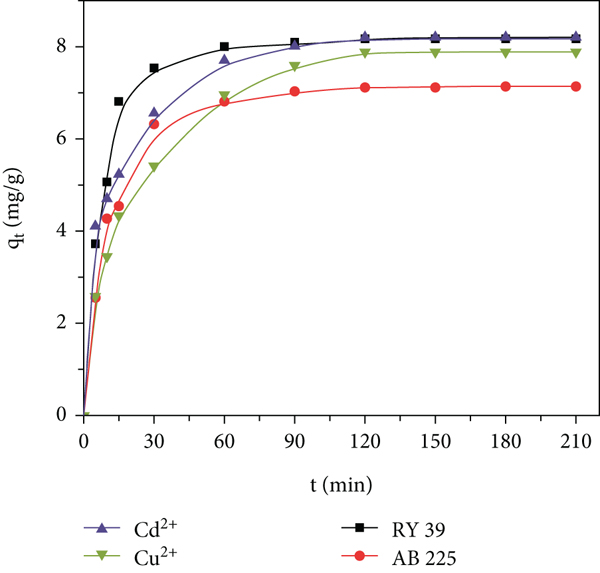
(a) Adsorption kinetic data and linear fit with (b) pseudo-first and (c) pseudo-second-order kinetic.


With the aim to obtain more information regarding the adsorption processes studied in this work, pseudo-first and pseudo-second-order kinetic models were tested. The linear fitting of
Kinetic models’ equations and kinetic parameters obtained by the pseudo-first- and pseudo-second-order kinetic models for metal ions and dye adsorption onto SH-PO1.
The results presented in this section are comparable with those given in the literature. Namely, the pseudo-second-order is the most suitable for describing the Pb2+ adsorption onto 3-aminopropyltrietoxysilane-modified soybean and peanut hulls [51], Cd2+ and Pb2+ adsorption from a single and binary mixture onto soybean hulls [52], and azo dye safranin adsorption onto soybean hulls [53]. It has to be underlined that in the adsorption experiments carried out in the current study, special attention has been paid to secondary pollution during adsorption, i.e., the peroxidase was first extracted and then the soybean hulls were used as an adsorbent, which is not the case in the previously mentioned papers.
Since the pseudo-first and pseudo-second-order kinetic models cannot identify the diffusion mechanism during the adsorption process, the kinetic data were further examined by the intraparticle diffusion model (see Table 4). Concerning the fact that several factors participate in pollutants’ adsorption, the SH-PO1 intraparticle diffusion plots are not linear over the whole
Intraparticle diffusion model’s equation and kinetic parameters for metal ions and dye adsorption onto SH-PO1.

Intraparticle diffusion plots of the metal ions and dyes onto SH-PO1.

The first linear zone observed at a low
3.5. Isotherm Studies
In order to better understand profoundly the interactions among the studied pollutants and the SH-PO1, the equilibrium adsorption experiments were performed at different initial pollutant concentrations. As given in Figure 10(a), SH-PO1 uptake capacity increases with increasing the initial pollutant concentration which could be ascribed to the high driving force for mass transfer at a high initial pollutant concentration. Bulut and Aydın [57] and Ivanovska et al. [2, 58] observed the same behavior during isotherm experiments for methylene blue adsorption onto wheat shells; cadmium ion adsorption onto wood waste, nickel, and copper; and zinc ion adsorption onto jute fabrics, respectively. It has to be noted that at the initial pollutant concentrations above 25 mg/l, the SH-PO1 possessed around 25% higher uptake capacity for metal ions than for the dyes (see Figure 10(a)).
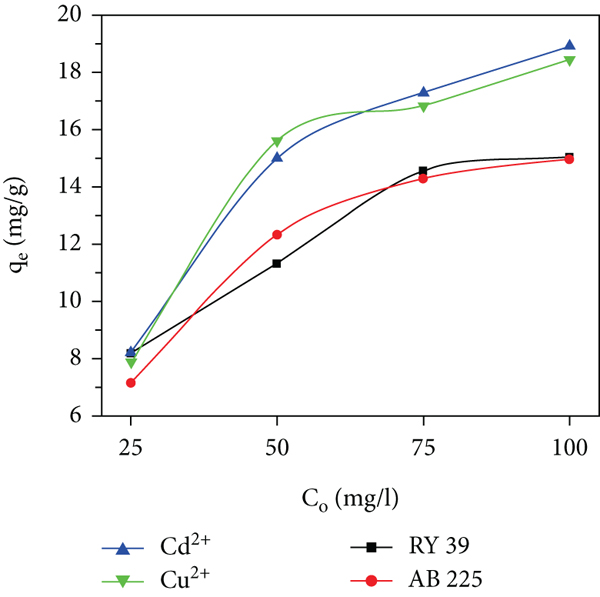
(a) Equilibrium pollutant adsorption onto SH-PO1 and (b) Langmuir and (c) Freundlich adsorption isotherms and the linear fit of experimental adsorption data for different pollutants.

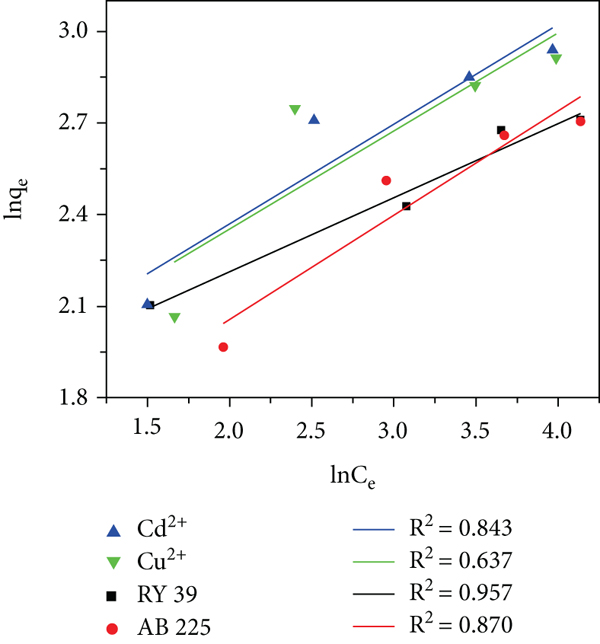
The obtained equilibrium data were further analyzed by using linearized forms of the Langmuir and Freundlich isotherm models (see Figures 10(b) and 10(c) and Table 5). The data fitting based on Langmuir isotherm showed higher
Isotherm models’ equations and obtained isotherm parameters for metal ions and dyes adsorption onto SH-PO1.
The theoretical maximal adsorption capacities (
3.6. Thermodynamic Studies
Thermodynamic experiments were carried out at three different temperatures, 25, 35, and 45°C, i.e., 298.15, 308.15, and 318.15 K, while the other optimized adsorption parameters are listed in Table 1. The results presented in Figure 11 revealed that by increasing the temperature from 25 to 45°C, the adsorption of all studied pollutants increases which could be explained by the increased availability of SH-PO1 surface sites and the pollutant mobility at higher temperatures [60]. This behavior is the most prominent for AB 225; its adsorption capacity increased by about 20%.

The effect of temperature on the pollutants’ adsorption onto SH-PO1.
From the temperature-dependent study of Cd2+, Cu2+, RY 39, and AB 225 adsorption onto SH-PO1, the thermodynamic parameters standard enthalpy
Thermodynamic parameters for adsorption of different pollutants onto SH-PO1.
3.7. Competitive Adsorption of Metal Ions and Dyes
In real conditions, most of the wastewater contains a mixture of different pollutants such as metal ions and dyes, and therefore, the assessment of adsorbent overall performance is of great importance. To examine the simultaneous competitive adsorption of metals and dyes and the two tested metals and dyes onto SH-PO1, ten binary mixtures were prepared (see Table 7).
Competitive adsorption from binary mixtures onto SH-PO1.
The Cd2+ removal from the binary mixtures containing RY 39 or AB 225 at a pH of 5.00 is almost the same as in the case of single pollutant adsorption (see Figure 4(a)). This is also observed for Cu2+ (see Figure 4(b)), where somewhat higher metal removal was observed during the competitive adsorption experiments. However, in the metal binary mixture, Cu2+ is more competitive than Cd2+ (removal of 71.01 vs. 20.96%). This is expected due to Cu2+ significantly lower molecular mass as well as higher effective ionic radii and electronegativity [62].
When the dye’s removal from the single aqueous solution (see Figure 6) and binary mixtures (see Table 7) were compared, it is clear that the RY 39 and AB 225 removal from binary mixtures (at pH of 3.00) is not affected by the metal cosolute. The dye binary mixture results in lower adsorption of RY 39 with respect to the adsorption of single-dye solutions. This could be ascribed to the fact that the molecules of RY 39 are more rigid and bear double negative charge than the AB 225 molecule, which is smaller and thus can more easily diffuse through the solution. Surprisingly, the removal of RY 39 is significantly reinforced (more than 8 times) at
To summarize, SH-PO1 is the most efficient adsorbent for the mixture of AB 225 and Cu2+, independent of the solution pH. Additionally, the lowest adsorbent affinity was registered for the mixture containing both metal ions. These very interesting results promote the novel valorization of soybean hulls after peroxidase extraction as adsorbents for inorganic and organic pollutants and bring them into the circular economy.
3.8. Advantages and Future Perspective of Soybean Hulls
It seems this is the right place to discuss the advantages of the studied SH-PO over the well-known conventional adsorbents such as activated carbons, ion exchange resins, and zeolites. SH-PO and other nonconventional adsorbents are competitive with the mentioned conventional adsorbents since they are low cost and abundant and have high affinity, capacity, rate of adsorption, and selectivity for different pollutant concentrations [63, 64]. Having a wide variety of functional groups, nonconventional adsorbents such as SH-PO provide intrinsic chelating and complexing properties for different pollutants including heavy metals, dyes, and aromatic compounds and can reduce their concentrations to ppb levels. The regeneration of nonconventional adsorbents in washing solvents is very easy since; as it was mentioned, the interaction between the pollutant and adsorbent is driven mainly by electrostatic attraction, stacking interactions, and ion exchange. On the other hand, the utilization of activated carbons as adsorbents is restricted due to the high cost of the precursor (such as petroleum residues and some commercial polymers) and the rapid saturation that imposes the necessity for their regeneration (which is expensive, complicated, results in loss of the adsorbent, and is energy-consuming) and incineration [65]. The activated carbons are nonselective and ineffective for disperse and vat dyes requiring the utilization of complexing agents to improve their removal performance [66]. Furthermore, most commercial ion exchange resins are derived from petroleum-based raw materials using processing chemistry that is not always safe and environmentally friendly. One of the highest drawbacks of this adsorbent is poor contact with the aqueous solution which requires its further modification and/or pretreatment by activation solvents. Generally speaking, activated carbons and synthetic resins suffer from a lack of selectivity, and their applications are often limited to low contaminant concentrations. Zeolites represent another group of conventional adsorbents that are used for various pollutants; however, they are characterized by low selectivity, while their microporous structure makes them unsuitable for bulky molecules [67].
The investigation of adsorbent stability, reusability, or regeneration was not within the focus of the current study, since the mentioned procedures decrease the adsorbent capacity and generate new wastewater, making them inappropriate for industrial wastewater [68]. Besides the SH-PO1 large adsorption capacities for different pollutants, the adsorption process produces solid waste that can cause secondary pollution. In light of that, the lifecycle of SH-PO1 with adsorbed pollutants could be extended by their further utilization for the production of bio-based composites which will be used as building materials or carbonized and used as a great alternative to porous carbon and a cathode matrix for lithium-sulfur batteries [69].
4. Conclusions
The experiments conducted in this study confirmed that the soybean hulls could be successfully recovered after peroxidase extraction and used as adsorbents for metal ions and dyes. The soybean hulls’ adsorption potential for Cd2+, Cu2+, RY 39, and AB 225 from a single-pollutant solution changes depending on the pH, peroxidase extraction, adsorbent particle size, contact time, pollutant initial concentration, and temperature. Before peroxidase extraction, soybean hulls are capable of removing 72% Cd2+, 71% Cu2+ (at a pH of 5.00) and 81% RY 39, 73% AB 225 (at a pH of 3.00), respectively. After peroxidase extraction, the removal of Cd2+ and Cu2+ increased by 14.6 and 10.9%, respectively. Soybean hulls without peroxidase possessed significantly lower secondary pollution (i.e., six times lower dichromate index (265.2 vs. 43.7 mg O2/l), and five times lower total metal content (15.3 vs. 3.1 μg/l) than those with peroxidase.
The adsorbent particle size did not affect the dye removal; however, Cd2+ and Cu2+ removal slightly increased when the smaller adsorbent fraction (710-1000 μm) was used. The adsorption of metal ions and dyes can be considered rapid since the equilibrium was attained after 120 min and 90 min of contact time, respectively. Furthermore, after 30 min of contact time, 92% and 88% of RY 39 and AB 225 were removed, while after the same time, 80% and 69% of Cd2+ and Cu2+ were removed. The adsorption of all tested pollutants follows a pseudo-second-order reaction (through the fast adsorption, intraparticle diffusion, and final equilibrium stage) indicating that chemical adsorption is the velocity limiting factor. On the other hand, better fitting with the Langmuir model implies a uniform distribution of adsorption sites and the presence of a single layer of pollutant on the soybean hulls’ surfaces. The maximal adsorption capacities determined by the Langmuir model are 21.10, 20.54, 16.54, and 17.23 mg/g for Cd2+, Cu2+, RY 39, and AB 225, respectively. Calculated thermodynamic parameters suggested that the adsorption of all pollutants is spontaneous and of endothermic character.
Taking into account that real wastewater contains a mixture of different pollutants, the simultaneous competitive adsorption of metals and dyes from binary mixtures was studied. The obtained results revealed that soybean hulls are the most efficient adsorbent for the mixture of AB 225 and Cu2+. The findings of this study contributed to a novel valorization of soybean hulls and bring them into the circular economy concept.
Footnotes
Data Availability
Aleksandra Ivanovska (e-mail:
Conflicts of Interest
The authors declare that there is no conflict of interest regarding the publication of this article.
Acknowledgments
The authors thank Nemanja Barać (Innovation Center of the Faculty of Technology and Metallurgy, University of Belgrade) for FE-SEM images, Matea Korica (Innovation Center of the Faculty of Technology and Metallurgy, University of Belgrade) for determination of fabric zeta potential, and Ilija Cvijetić (Faculty of Chemistry, University of Belgrade) for the determination of dye